EP0293680B1 - A method for the crystallization of fructose - Google Patents
A method for the crystallization of fructose Download PDFInfo
- Publication number
- EP0293680B1 EP0293680B1 EP88108028A EP88108028A EP0293680B1 EP 0293680 B1 EP0293680 B1 EP 0293680B1 EP 88108028 A EP88108028 A EP 88108028A EP 88108028 A EP88108028 A EP 88108028A EP 0293680 B1 EP0293680 B1 EP 0293680B1
- Authority
- EP
- European Patent Office
- Prior art keywords
- fructose
- ethanol
- solution
- water
- supersaturation
- Prior art date
- Legal status (The legal status is an assumption and is not a legal conclusion. Google has not performed a legal analysis and makes no representation as to the accuracy of the status listed.)
- Expired - Lifetime
Links
- 229930091371 Fructose Natural products 0.000 title claims abstract description 78
- RFSUNEUAIZKAJO-ARQDHWQXSA-N Fructose Chemical compound OC[C@H]1O[C@](O)(CO)[C@@H](O)[C@@H]1O RFSUNEUAIZKAJO-ARQDHWQXSA-N 0.000 title claims abstract description 78
- 239000005715 Fructose Substances 0.000 title claims abstract description 77
- 238000000034 method Methods 0.000 title claims abstract description 37
- 238000002425 crystallisation Methods 0.000 title claims description 34
- 230000008025 crystallization Effects 0.000 title claims description 33
- 239000013078 crystal Substances 0.000 claims abstract description 51
- LFQSCWFLJHTTHZ-UHFFFAOYSA-N Ethanol Chemical compound CCO LFQSCWFLJHTTHZ-UHFFFAOYSA-N 0.000 claims abstract description 42
- IDGUHHHQCWSQLU-UHFFFAOYSA-N ethanol;hydrate Chemical compound O.CCO IDGUHHHQCWSQLU-UHFFFAOYSA-N 0.000 claims abstract description 29
- 238000001704 evaporation Methods 0.000 claims abstract description 14
- 239000000203 mixture Substances 0.000 claims abstract description 14
- 239000012452 mother liquor Substances 0.000 claims description 23
- XLYOFNOQVPJJNP-UHFFFAOYSA-N water Substances O XLYOFNOQVPJJNP-UHFFFAOYSA-N 0.000 claims description 14
- 230000008020 evaporation Effects 0.000 claims description 12
- 239000007787 solid Substances 0.000 claims description 9
- 235000021433 fructose syrup Nutrition 0.000 claims description 8
- 239000002245 particle Substances 0.000 claims description 8
- 238000009835 boiling Methods 0.000 claims description 5
- 239000006188 syrup Substances 0.000 claims description 5
- 235000020357 syrup Nutrition 0.000 claims description 5
- 230000018044 dehydration Effects 0.000 claims description 3
- 238000006297 dehydration reaction Methods 0.000 claims description 3
- 238000005119 centrifugation Methods 0.000 abstract description 7
- 238000004519 manufacturing process Methods 0.000 abstract description 2
- 229960002737 fructose Drugs 0.000 description 51
- 239000000243 solution Substances 0.000 description 26
- 239000012527 feed solution Substances 0.000 description 16
- 238000000926 separation method Methods 0.000 description 5
- 239000000126 substance Substances 0.000 description 5
- 239000002904 solvent Substances 0.000 description 4
- UHOVQNZJYSORNB-UHFFFAOYSA-N Benzene Chemical compound C1=CC=CC=C1 UHOVQNZJYSORNB-UHFFFAOYSA-N 0.000 description 3
- WQZGKKKJIJFFOK-GASJEMHNSA-N Glucose Natural products OC[C@H]1OC(O)[C@H](O)[C@@H](O)[C@@H]1O WQZGKKKJIJFFOK-GASJEMHNSA-N 0.000 description 3
- 229930006000 Sucrose Natural products 0.000 description 3
- CZMRCDWAGMRECN-UGDNZRGBSA-N Sucrose Chemical compound O[C@H]1[C@H](O)[C@@H](CO)O[C@@]1(CO)O[C@@H]1[C@H](O)[C@@H](O)[C@H](O)[C@@H](CO)O1 CZMRCDWAGMRECN-UGDNZRGBSA-N 0.000 description 3
- 230000008021 deposition Effects 0.000 description 3
- 238000001914 filtration Methods 0.000 description 3
- 239000008103 glucose Substances 0.000 description 3
- 239000012535 impurity Substances 0.000 description 3
- 239000007791 liquid phase Substances 0.000 description 3
- 238000010899 nucleation Methods 0.000 description 3
- 239000005720 sucrose Substances 0.000 description 3
- OFBQJSOFQDEBGM-UHFFFAOYSA-N Pentane Chemical compound CCCCC OFBQJSOFQDEBGM-UHFFFAOYSA-N 0.000 description 2
- 230000015572 biosynthetic process Effects 0.000 description 2
- 230000001419 dependent effect Effects 0.000 description 2
- 238000004821 distillation Methods 0.000 description 2
- 239000007788 liquid Substances 0.000 description 2
- 238000011084 recovery Methods 0.000 description 2
- 229920006395 saturated elastomer Polymers 0.000 description 2
- 235000000346 sugar Nutrition 0.000 description 2
- XDTMQSROBMDMFD-UHFFFAOYSA-N Cyclohexane Chemical compound C1CCCCC1 XDTMQSROBMDMFD-UHFFFAOYSA-N 0.000 description 1
- OPFTUNCRGUEPRZ-QLFBSQMISA-N Cyclohexane Natural products CC(=C)[C@@H]1CC[C@@](C)(C=C)[C@H](C(C)=C)C1 OPFTUNCRGUEPRZ-QLFBSQMISA-N 0.000 description 1
- 230000001476 alcoholic effect Effects 0.000 description 1
- 238000010533 azeotropic distillation Methods 0.000 description 1
- 238000010923 batch production Methods 0.000 description 1
- 239000008280 blood Substances 0.000 description 1
- 210000004369 blood Anatomy 0.000 description 1
- 238000010924 continuous production Methods 0.000 description 1
- 238000001816 cooling Methods 0.000 description 1
- 235000011850 desserts Nutrition 0.000 description 1
- 235000005911 diet Nutrition 0.000 description 1
- 230000000378 dietary effect Effects 0.000 description 1
- 230000000694 effects Effects 0.000 description 1
- 230000002708 enhancing effect Effects 0.000 description 1
- 235000013305 food Nutrition 0.000 description 1
- 235000003599 food sweetener Nutrition 0.000 description 1
- 238000009472 formulation Methods 0.000 description 1
- 150000002231 fructose derivatives Chemical class 0.000 description 1
- 150000002772 monosaccharides Chemical class 0.000 description 1
- 230000006911 nucleation Effects 0.000 description 1
- 230000000737 periodic effect Effects 0.000 description 1
- 239000012071 phase Substances 0.000 description 1
- 238000001556 precipitation Methods 0.000 description 1
- 239000012047 saturated solution Substances 0.000 description 1
- 239000007858 starting material Substances 0.000 description 1
- 150000008163 sugars Chemical class 0.000 description 1
- 239000003765 sweetening agent Substances 0.000 description 1
Images

Classifications
-
- C—CHEMISTRY; METALLURGY
- C13—SUGAR INDUSTRY
- C13K—SACCHARIDES OBTAINED FROM NATURAL SOURCES OR BY HYDROLYSIS OF NATURALLY OCCURRING DISACCHARIDES, OLIGOSACCHARIDES OR POLYSACCHARIDES
- C13K11/00—Fructose
Definitions
- This invention relates to a method for the crystallization of fructose from an ethanol-water solution.
- Fructose also known as fruit sugar, is a monosaccharide constituting one-half of the sucrose molecule. Inasmuch as the sweetness of fructose is about 1.3 to about 1.8 times that of crystalline sucrose, fructose is a commercially attractive sweetener as an alternative for sucrose and has been produced commercially for that purpose for a considerable time period. In food formulations fructose is also frequently used for special dietary purposes, e.g. to reduce the calorie content of desserts, jams and other such industrially prepared products and to control blood sugar levels.
- U.S. Patent No. 3,704,168 to Hara et al. is directed to a crystallization process where fructose crystals are derived from a mixed liquid polyhydric and monohydric alcohol medium which is supersaturated with fructose at a temperature of -20°C to 70°C.
- U.S. Patent No. 3,883,365 to Forsberg et al. describes a fructose crystallization method where a saturated aqueous fructose solution is adjusted to a pH value of 4.5 to 5.5 and cooled, optionally by a concurrent evaporation of the water present, to bring about crystallization of fructose.
- the invention relates to a method for the crystallization of fructose from a fructose-containing ethanol-water solution.
- the process according to the invention is characterized by the steps of providing a supersaturated solution of fructose in an ethanol-water mixture, said solution having a degree of supersaturation with respect to fructose at crystallization temperature of at least about 1.02 and containing anhydrous fructose seed crystals; removing a minimum-boiling homogeneous ethanol-water azeotrope from said solution at a reduced pressure and while maintaining the solution at a substantially constant temperature in the range of about 50°C to about 75°C to crystallize dissolved fructose; and recovering the crystallized fructose.
- the process according to the invention provides an efficient crystallization of fructose. Azeotropic removal of the solvent results in reduced crystal growth time. Crystal yield is increased as well.
- a supersaturated solution of fructose is prepared by using an ethanol-water mixture as the solvent.
- This solution has a degree of supersaturation with respect to fructose at crystallization temperature of at least about 1.02, preferably about 1.02 to about 1.1, and more preferably about 1.05.
- Crystallization is initiated by adding to the foregoing supersaturated solution anhydrous fructose seed crystals having a mean particle size of preferably about 40 to 50 micrometers.
- Crystallization of dissolved fructose is carried out by removing from the supersaturated solution a minimum-boiling homogenous ethanol-water azeotrope at a reduced pressure and while maintaining the solution at a substantially constant temperature in the range of about 50°C to about 75°C, preferably at about 65°C.
- the produced crystals are recovered by centrifugation, filtration, or any other convenient solids-liquid separation expedient.
- the removed azeotrope can be condensed.
- the produced condensate can be used to wash recovered fructose crystals.
- the condensate can be dehydrated to obtain substantially anhydrous ethanol which, in turn, can be recycled to the production stage of the supersaturated fructose solution.
- the crystallization of fructose according to the present invention can be carried out as a batch or a continuous process with periodic or continuous removal of crystallized fructose, as desired.
- crystallization commonly refers to the separation of a solid, crystalline phase from a liquid phase by cooling, evaporation, or both
- the ensuing discussion primarily pertains to crystallization by evaporation at a substantially constant temperature.
- the rate of crystallization usually involves two actions: (a) the rate of formation of new crystals, or nucleation, either in a clear solution or one containing solids, and (b) the rate of precipitation of solute on crystals already present, usually called crystal growth.
- the present invention relates to a method for enhancing the latter.
- the deposition of a solid from a solution onto a crystal can take place only if there is a state of imbalance with a driving force, e.g., decrease in chemical concentration, between the solution and the crystal interface. This means that the solution must be supersaturated with respect to crystals of the size on which deposition is to occur before the crystals can grow by deposition from the solution.
- a driving force e.g., decrease in chemical concentration
- the degree of supersaturation at a given temperature is defined by the following equation:
- fructose syrup is concentrated by evaporation of excess water to a dry solids content of at least about 90 percent by weight, preferably 95 percent by weight.
- ethanol is added to the fructose syrup to form a feed solution of fructose in the produced ethanol-water mixture. Upon further concentration, this feed solution serves as the mother liquor for the crystallization as will be described in greater detail hereinbelow.
- the amount of ethanol to be added can vary, depending upon the amount of water present in the concentrated fructose syrup.
- the objective is, however, to provide an ethanol-water mixture that approximates a minimum-boiling homogeneous ethanol-water azeotrope at the contemplated crystallization temperature and pressure.
- the ethanol-water mixture in the feed solution contains about 94 to about 98 percent by weight, preferably about 96 percent by weight of ethanol.
- the feed solution prior to introduction into a crystallizer, the feed solution is less than saturated with respect to fructose at the contemplated crystallization temperature. That is, the feed solution has a degree of supersaturation of less than 1.
- the feed solution has a degree of supersaturation of about 0.9 to about 0.95 with respect to fructose at crystallization temperature.
- the feed solution is supersaturated to a desired degree by azeotropic evaporation, either upon introduction into the crystallizer, or by means of a pre-boiler.
- the desired degree of supersaturation is in the range of about 1.02 to about 1.1.
- the preferred degree of supersaturation is about 1.05.
- the supersaturated feed solution serves as the mother liquor when combined with anhydrous fructose crystals which are dispersed within the mother liquor to provide original crystal surfaces on which additional crystal lattice units can form.
- the anhydrous fructose seed crystals have a mean particle size of preferably about 40 to 50 micrometers. Preferably, full seeding of the mother liquor is effected for crystallization.
- the mother liquor containing the dispersed seed crystals is next subjected to a reduced pressure to effect azeotropic evaporation of the solvent while the mother liquor is maintained at a substantially constant temperature within the range of about 50°C to about 75°C, preferably at about 65°C.
- a reduced or subatmospheric pressure in the range of about 10 kPa to about 70 kPa (about 100 millibars to about 700 millibars) is used.
- Particularly preferred as process conditions for a mother liquor having a degree of supersaturation of about 1.05 are a temperature of about 65°C and a pressure of about 48 kPa (480 millibars).
- Crystal growth takes place in the crystallizer as the ethanol-water azeotrope is removed by evaporation and subsequently condensed.
- the degree of supersaturation of the mother liquor is kept substantially constant by continuous, or continual, addition of fresh feed solution.
- the rate of addition for the feed solution is determined by the rate of crystal formation which can be monitored by rate of change in the refractive index of the mother liquor.
- the fructose crystals In a batch process operation, the fructose crystals usually are separated from the mother liquor when a crystal yield of about 60 to 70 percent has been achieved.
- the separation can be effected by centrifugation and filtering.
- Recovered fructose crystals usually have a size in the range of about 200 to about 500 micrometers. After recovery, the crystals can be washed, if desired, to further enhance purity. It is convenient to do so utilizing an ethanol-water mixture that has about the same ethanol/water mol ratio as the azeotrope removed from the crystallizer. An aliquot of the condensate from the crystallizer can be used for this purpose.
- the condensed azeotrope contains a substantial amount of ethanol which can be recycled in the fructose crystallization process upon dehydration.
- Ethanol dehydration can be achieved by several means.
- the desired separation of water from ethanol can be effected by reduced pressure distillation at about 8500 to 9000 Pa (85-90 millibars) or by the use of an entrainer such as n-pentane, benzene, or cyclo-hexane as described by Black, Chem. Eng. Prog. 76 (9):78 (1980).
- the spent mother liquor is recovered concurrently with fructose crystal recovery by centrifugation, filtration, or otherwise. Thereafter the recovered mother liquor is distilled.
- a solution of fructose in water, separated from isomerized glucose syrup was concentrated by evaporation to a dry solids content of about 95 percent by weight to produce a fructose syrup.
- About 4.6 kilograms of fructose syrup were produced containing about 0.2 kilograms of water.
- the produced fructose syrup (about 4.6 kg) was then combined with anhydrous ethanol (about 7.5 kg) at a temperature of about 67°C to form a solution of fructose in an ethanol-water mixture to be used as a feed solution.
- the degree of supersaturation of the feed solution was observed to be about 0.95.
- Crystallizer instrumentation included a refractometer, vacuum gauge, and a thermometer.
- the crystallizer charge was then evaporated to elevate the degree of supersaturation to a value of about 1.05 and then seeded with anhydrous fructose seed crystals (about 3.8 g; mean particle size about 40 micrometers).
- the crystallizer charge contained about 1.45 kg of fructose plus incidental impurities, about 2.25 kg of ethanol, and about 0.7 kg of water.
- the pH value of the crystallizer charge was observed to be about 5.0 (4.0 - 6.0).
- Crystallization was maintained by evaporating therefrom an ethanol-water azeotrope containing about 97 percent by weight ethanol.
- Solution temperature in the crystallizer was about 65°C and a reduced pressure of about 48kPa (480 millibars) was maintained. Crystallization was continued for a time period of about 5 hours during which time period the remainder of the feed solution was gradually fed to the crystallizer so as to maintain a substantially constant dry solids content of about 34 percent by weight in the mother liquor as indicated by the refractive index of the mother liquor converted to dry solids content.
- Crystallization was terminated after the foregoing five-hour crystallization period, and the produced fructose crystals were recovered by centrifugation.
- the crystallizer contained about 1.1 kg of ethanol, about 0.33 kg of water, about 4.1 kg of fructose and about 0.22 kg of impurities.
- the fructose present about 3.3 kg was in crystalline form and about 0.8 was dissolved in the liquid phase present in the crystallizer.
- the liquid phase also was observed to contain about 0.20 kg of the aforementioned impurities.
- the recovered crystals were washed with ethanol-water mixture obtained by condensing the azeotrope evaporated from the crystallizer.
- the ultimate crystalline product was crystalline fructose having a mean particle size of about 400 micrometers, high purity, and low hygroscopicity.
- Ethanol in the condensate obtained by condensing the evaporated azeotrope was enriched to an ethanol content of about 99.5 percent by weight by distillation.
- the crystals were recovered by centrifugation. Fructose crystals having a mean size of about 400 micrometers were obtained in about 67 percent yield. The purity of the product was substantially 100 percent.
Landscapes
- Chemical & Material Sciences (AREA)
- Life Sciences & Earth Sciences (AREA)
- Biochemistry (AREA)
- Organic Chemistry (AREA)
- Saccharide Compounds (AREA)
- Organic Low-Molecular-Weight Compounds And Preparation Thereof (AREA)
- Pharmaceuticals Containing Other Organic And Inorganic Compounds (AREA)
- Detergent Compositions (AREA)
Abstract
Description
- This invention relates to a method for the crystallization of fructose from an ethanol-water solution.
- Fructose, also known as fruit sugar, is a monosaccharide constituting one-half of the sucrose molecule. Inasmuch as the sweetness of fructose is about 1.3 to about 1.8 times that of crystalline sucrose, fructose is a commercially attractive sweetener as an alternative for sucrose and has been produced commercially for that purpose for a considerable time period. In food formulations fructose is also frequently used for special dietary purposes, e.g. to reduce the calorie content of desserts, jams and other such industrially prepared products and to control blood sugar levels.
- Methods for crystallization of fructose from aqueous or alcoholic solutions are known. Some such methods are described in U.S. Patent No. 3,704,168 to Hara et al. and in U.S. Patent No. 3,883,365 to Forsberg et al.
- More specifically, U.S. Patent No. 3,704,168 to Hara et al. is directed to a crystallization process where fructose crystals are derived from a mixed liquid polyhydric and monohydric alcohol medium which is supersaturated with fructose at a temperature of -20°C to 70°C. U.S. Patent No. 3,883,365 to Forsberg et al., on the other hand, describes a fructose crystallization method where a saturated aqueous fructose solution is adjusted to a pH value of 4.5 to 5.5 and cooled, optionally by a concurrent evaporation of the water present, to bring about crystallization of fructose.
- It has now been discovered, however, that the crystallization of fructose can be expedited by crystallizing fructose from a solution at a substantially constant temperature while the solvent is removed from the solution by azeotropic evaporation.
- The invention relates to a method for the crystallization of fructose from a fructose-containing ethanol-water solution. The process according to the invention is characterized by the steps of providing a supersaturated solution of fructose in an ethanol-water mixture, said solution having a degree of supersaturation with respect to fructose at crystallization temperature of at least about 1.02 and containing anhydrous fructose seed crystals; removing a minimum-boiling homogeneous ethanol-water azeotrope from said solution at a reduced pressure and while maintaining the solution at a substantially constant temperature in the range of about 50°C to about 75°C to crystallize dissolved fructose; and recovering the crystallized fructose.
- The process according to the invention provides an efficient crystallization of fructose. Azeotropic removal of the solvent results in reduced crystal growth time. Crystal yield is increased as well.
- In practicing the present invention, a supersaturated solution of fructose is prepared by using an ethanol-water mixture as the solvent. This solution has a degree of supersaturation with respect to fructose at crystallization temperature of at least about 1.02, preferably about 1.02 to about 1.1, and more preferably about 1.05. Crystallization is initiated by adding to the foregoing supersaturated solution anhydrous fructose seed crystals having a mean particle size of preferably about 40 to 50 micrometers.
- Crystallization of dissolved fructose is carried out by removing from the supersaturated solution a minimum-boiling homogenous ethanol-water azeotrope at a reduced pressure and while maintaining the solution at a substantially constant temperature in the range of about 50°C to about 75°C, preferably at about 65°C.
- The produced crystals are recovered by centrifugation, filtration, or any other convenient solids-liquid separation expedient.
- The removed azeotrope can be condensed. The produced condensate can be used to wash recovered fructose crystals. In addition, the condensate can be dehydrated to obtain substantially anhydrous ethanol which, in turn, can be recycled to the production stage of the supersaturated fructose solution.
- The crystallization of fructose according to the present invention can be carried out as a batch or a continuous process with periodic or continuous removal of crystallized fructose, as desired.
- While crystallization commonly refers to the separation of a solid, crystalline phase from a liquid phase by cooling, evaporation, or both, the ensuing discussion primarily pertains to crystallization by evaporation at a substantially constant temperature. Also, the rate of crystallization usually involves two actions: (a) the rate of formation of new crystals, or nucleation, either in a clear solution or one containing solids, and (b) the rate of precipitation of solute on crystals already present, usually called crystal growth. The present invention relates to a method for enhancing the latter.
- The deposition of a solid from a solution onto a crystal can take place only if there is a state of imbalance with a driving force, e.g., decrease in chemical concentration, between the solution and the crystal interface. This means that the solution must be supersaturated with respect to crystals of the size on which deposition is to occur before the crystals can grow by deposition from the solution.
- The degree of supersaturation at a given temperature is defined by the following equation:

where - S -
- degree of supersaturation
- Cml -
- amount of substance in the mother liquor (weight %)
- Cs -
- amount of substance in saturated solution (weight %)
- Y -
- yield expressed as percentage
- Cm -
- amount of crystalline substance recovered (weight %)
- Cml -
- amount of substance in the mother liquor (weight %)
- In particular, fructose syrup is concentrated by evaporation of excess water to a dry solids content of at least about 90 percent by weight, preferably 95 percent by weight. Next, ethanol is added to the fructose syrup to form a feed solution of fructose in the produced ethanol-water mixture. Upon further concentration, this feed solution serves as the mother liquor for the crystallization as will be described in greater detail hereinbelow.
- The amount of ethanol to be added can vary, depending upon the amount of water present in the concentrated fructose syrup. The objective is, however, to provide an ethanol-water mixture that approximates a minimum-boiling homogeneous ethanol-water azeotrope at the contemplated crystallization temperature and pressure. To that end, the ethanol-water mixture in the feed solution contains about 94 to about 98 percent by weight, preferably about 96 percent by weight of ethanol. Also, prior to introduction into a crystallizer, the feed solution is less than saturated with respect to fructose at the contemplated crystallization temperature. That is, the feed solution has a degree of supersaturation of less than 1. Preferably, the feed solution has a degree of supersaturation of about 0.9 to about 0.95 with respect to fructose at crystallization temperature.
- Next, the feed solution is supersaturated to a desired degree by azeotropic evaporation, either upon introduction into the crystallizer, or by means of a pre-boiler. The desired degree of supersaturation is in the range of about 1.02 to about 1.1. The preferred degree of supersaturation is about 1.05.
- The supersaturated feed solution serves as the mother liquor when combined with anhydrous fructose crystals which are dispersed within the mother liquor to provide original crystal surfaces on which additional crystal lattice units can form.
- The anhydrous fructose seed crystals have a mean particle size of preferably about 40 to 50 micrometers. Preferably, full seeding of the mother liquor is effected for crystallization.
- In any given instance the seed crystal quantity will depend on the particular size of the seed crystals, on the desired quantity of the finished crystals, and on the desired crystal size in accordance with the following equation:

where - Ms -
- amount of seed crystals (kg)
- ds -
- effective diameter of seed crystals
- M -
- amount of finished crystals (kg)
- D -
- desired effective diameter of finished crystals.
- The mother liquor containing the dispersed seed crystals is next subjected to a reduced pressure to effect azeotropic evaporation of the solvent while the mother liquor is maintained at a substantially constant temperature within the range of about 50°C to about 75°C, preferably at about 65°C.
- Inasmuch as a particular ethanol-water azeotrope is temperature-dependent as well as pressure-dependent, both the temperature of the mother liquor and the crystallizer pressure are monitored. In the method according to the invention, a reduced or subatmospheric pressure in the range of about 10 kPa to about 70 kPa (about 100 millibars to about 700 millibars) is used.
- Particularly preferred as process conditions for a mother liquor having a degree of supersaturation of about 1.05 are a temperature of about 65°C and a pressure of about 48 kPa (480 millibars).
- Crystal growth takes place in the crystallizer as the ethanol-water azeotrope is removed by evaporation and subsequently condensed. The degree of supersaturation of the mother liquor is kept substantially constant by continuous, or continual, addition of fresh feed solution. The rate of addition for the feed solution is determined by the rate of crystal formation which can be monitored by rate of change in the refractive index of the mother liquor.
- In a batch process operation, the fructose crystals usually are separated from the mother liquor when a crystal yield of about 60 to 70 percent has been achieved. The separation can be effected by centrifugation and filtering.
- Recovered fructose crystals usually have a size in the range of about 200 to about 500 micrometers. After recovery, the crystals can be washed, if desired, to further enhance purity. It is convenient to do so utilizing an ethanol-water mixture that has about the same ethanol/water mol ratio as the azeotrope removed from the crystallizer. An aliquot of the condensate from the crystallizer can be used for this purpose.
- The condensed azeotrope contains a substantial amount of ethanol which can be recycled in the fructose crystallization process upon dehydration. Ethanol dehydration can be achieved by several means. For example, the desired separation of water from ethanol can be effected by reduced pressure distillation at about 8500 to 9000 Pa (85-90 millibars) or by the use of an entrainer such as n-pentane, benzene, or cyclo-hexane as described by Black, Chem. Eng. Prog. 76(9):78 (1980).
- After crystallization, the spent mother liquor is recovered concurrently with fructose crystal recovery by centrifugation, filtration, or otherwise. Thereafter the recovered mother liquor is distilled.
- This invention is illustrated further by the following examples.
- A solution of fructose in water, separated from isomerized glucose syrup was concentrated by evaporation to a dry solids content of about 95 percent by weight to produce a fructose syrup. About 4.6 kilograms of fructose syrup were produced containing about 0.2 kilograms of water.
- The produced fructose syrup (about 4.6 kg) was then combined with anhydrous ethanol (about 7.5 kg) at a temperature of about 67°C to form a solution of fructose in an ethanol-water mixture to be used as a feed solution. The degree of supersaturation of the feed solution was observed to be about 0.95.
- About one-third of this feed solution was introduced via a feed line into a vertical evaporation crystallizer equipped with a stirrer, heat exchanger, vacuum line, vapor condenser, and steam line. Crystallizer instrumentation included a refractometer, vacuum gauge, and a thermometer. The crystallizer charge was then evaporated to elevate the degree of supersaturation to a value of about 1.05 and then seeded with anhydrous fructose seed crystals (about 3.8 g; mean particle size about 40 micrometers). At seeding, the crystallizer charge contained about 1.45 kg of fructose plus incidental impurities, about 2.25 kg of ethanol, and about 0.7 kg of water. The pH value of the crystallizer charge was observed to be about 5.0 (4.0 - 6.0).
- Growth of crystals in the crystallizer was maintained by evaporating therefrom an ethanol-water azeotrope containing about 97 percent by weight ethanol. Solution temperature in the crystallizer was about 65°C and a reduced pressure of about 48kPa (480 millibars) was maintained. Crystallization was continued for a time period of about 5 hours during which time period the remainder of the feed solution was gradually fed to the crystallizer so as to maintain a substantially constant dry solids content of about 34 percent by weight in the mother liquor as indicated by the refractive index of the mother liquor converted to dry solids content.
- Crystallization was terminated after the foregoing five-hour crystallization period, and the produced fructose crystals were recovered by centrifugation. Upon termination of crystallization, the crystallizer contained about 1.1 kg of ethanol, about 0.33 kg of water, about 4.1 kg of fructose and about 0.22 kg of impurities. Of the fructose present, about 3.3 kg was in crystalline form and about 0.8 was dissolved in the liquid phase present in the crystallizer. The liquid phase also was observed to contain about 0.20 kg of the aforementioned impurities.
- After centrifugation, the recovered crystals were washed with ethanol-water mixture obtained by condensing the azeotrope evaporated from the crystallizer. The ultimate crystalline product was crystalline fructose having a mean particle size of about 400 micrometers, high purity, and low hygroscopicity.
- Ethanol in the condensate obtained by condensing the evaporated azeotrope was enriched to an ethanol content of about 99.5 percent by weight by distillation.
- An aliquot of a fructose solution in water, separated from isomerized glucose syrup and containing relatively small amounts of other sugars, was concentrated to a dry solids content of about 95 percent by weight and was combined with anhydrous ethanol to form the following feed solution:
ethanol 1259.9 grams fructose 579.1 grams water 45.3 grams others 43.5 grams Total 1927.8 grams - The foregoing feed solution was subjected to evaporation crystallization in a batch crystallizer under the following conditions:
temperature 65°C pressure 48kPa(480 millibars) time period 5 hours seed crystal amount 0.3 grams mean seed crystal size 0.05 millimeter - During crystallization, an ethanol-water mixture was evaporated and then condensed. About 1077 grams of condensate was obtained. The condensate contained about 1052.1 grams of ethanol and about 24.9 grams of water.
- The crystals were recovered by centrifugation. Fructose crystals having a mean size of about 400 micrometers were obtained in about 67 percent yield. The purity of the product was substantially 100 percent.
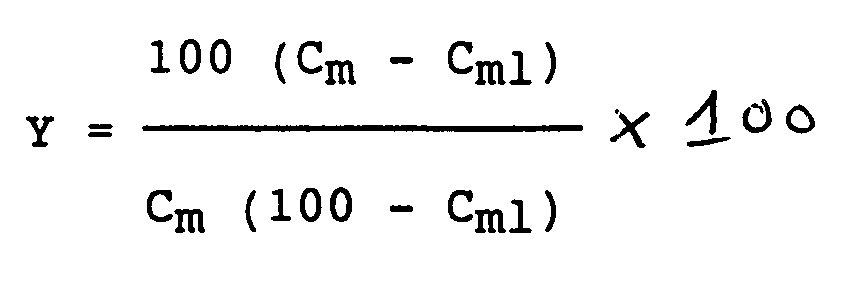
where
Claims (19)
- A method for the crystallization of fructose from a fructose-containing ethanol-water solution, characterized by the steps of
providing a supersaturated solution of fructose in an ethanol-water mixture, said solution having a degree of supersaturation with respect to fructose at crystallization temperature of at least about 1.02 and containing anhydrous fructose seed crystals;
removing a minimum-boiling homogeneous ethanol-water azeotrope from said solution at a reduced pressure and while maintaining the solution at a substantially constant temperature in the range of about 50°C to about 75°C to crystallize dissolved fructose; and
recovering the crystallized fructose. - The method according to claim 1, characterized in that said fructose seed crystals have a mean particle size of at least about 40 micrometers.
- The method according to claim 1, characterized in that said fructose seed crystals have a mean particle size of about 50 micrometers.
- The method according to claim 1, characterized in that the degree of supersaturation is in the range of about 1.02 to about 1.1.
- The method according to claim 1, characterized in that the reduced pressure is in the range of about 10 kPa to about 70 kPa (about 100 to about 700 millibars).
- The method according to claim 1, characterized in that the degree of supersaturation is about 1.05, the reduced pressure is about 48kPa (480 millibars), and the solution temperature is about 65°C.
- The method according to claim 1, characterized in that crystallized fructose is recovered periodically.
- The method according to claim 1, characterized in that crystallized fructose is recovered continuously.
- The method according to claim 1, characterized in that the removed azeotrope is condensed and the resulting condensate is subjected to dehydration to produce substantially pure ethanol.
- The method according to claim 1, characterized in that the recovered crystallized fructose is washed with an ethanol-water mixture having substantially the same ethanol-water mol ratio as said ethanol-water azeotrope.
- A method according to claim 1, characterized by the steps of
concentrating fructose syrup (water solution) to a dry solids content of at least about 90 percent by weight, preferably 95 percent by weight;
adding ethanol to the concentrated syrup to form a solution of fructose in an ethanol-water mixture having an ethanol-water weight ratio sufficient to form an ethanol-water azeotrope;
supersaturating the resulting solution by azeotropic evaporation to a degree of supersaturation with respect to fructose at crystallization temperature of at least about 1.02;
combining the supersaturated solution with anhydrous fructose seed crystals to provide a mother liquor with fructose seed crystals dispersed therein;
subjecting the mother liquor to a reduced pressure while at a substantially constant temperature in the range of about 50°C to about 75°C and removing a minimum-boiling homogeneous ethanol-water azeotrope therefrom in an amount sufficient to crystallize fructose dissolved in the mother liquor; and
recovering the crystallized fructose from the mother liquor. - The method according to claim 11, characterized in that said fructose seed crystals have a mean particle size of at least about 40 micrometers.
- The method according to claim 11, characterized in that said fructose seed crystals have a mean particle size of about 50 micrometers.
- The method according to claim 11, characterized in that said solution is supersaturated to a degree of supersaturation in the range of about 1.02 to about 1.1.
- The method according to claim 11, characterized in that said solution is supersaturated to a degree of supersaturation of about 1.05.
- The method according to claim 11 characterized in that the mother liquor is subjected to a reduced pressure in the range of about 10 kPa to about 70 kPa (about 100 millibars to about 700 millibars).
- The method according to claim 11, characterized in that the mother liquor is maintained at a degree of supersaturation of about 1.05, a reduced pressure of about 48kPa (480 millibars), and a temperature of about 65°C during crystallization.
- The method according to claim 11, characterized in that the removed ethanol-water azeotrope is condensed, the resulting condensate is dehydrated to produce substantially pure ethanol, and at least a portion of the produced ethanol is recycled for addition to the concentrated syrup.
- The method according to claim 18, characterized in that an aliquot of the condensate is used to wash the recovered crystallized fructose.
Priority Applications (1)
| Application Number | Priority Date | Filing Date | Title |
|---|---|---|---|
| AT88108028T ATE102657T1 (en) | 1987-06-03 | 1988-05-19 | METHOD OF CRYSTALLIZATION OF FRUCTOSE. |
Applications Claiming Priority (2)
| Application Number | Priority Date | Filing Date | Title |
|---|---|---|---|
| FI872487 | 1987-06-03 | ||
| FI872487A FI77693C (en) | 1987-06-03 | 1987-06-03 | Procedure for crystallization of fructose. |
Publications (3)
| Publication Number | Publication Date |
|---|---|
| EP0293680A2 EP0293680A2 (en) | 1988-12-07 |
| EP0293680A3 EP0293680A3 (en) | 1991-01-09 |
| EP0293680B1 true EP0293680B1 (en) | 1994-03-09 |
Family
ID=8524612
Family Applications (1)
| Application Number | Title | Priority Date | Filing Date |
|---|---|---|---|
| EP88108028A Expired - Lifetime EP0293680B1 (en) | 1987-06-03 | 1988-05-19 | A method for the crystallization of fructose |
Country Status (8)
| Country | Link |
|---|---|
| US (1) | US4938804A (en) |
| EP (1) | EP0293680B1 (en) |
| JP (1) | JP2644532B2 (en) |
| AT (1) | ATE102657T1 (en) |
| DE (1) | DE3888236T2 (en) |
| ES (1) | ES2050677T3 (en) |
| FI (1) | FI77693C (en) |
| RU (1) | RU1804484C (en) |
Cited By (1)
| Publication number | Priority date | Publication date | Assignee | Title |
|---|---|---|---|---|
| WO2017202686A1 (en) | 2016-05-23 | 2017-11-30 | Annikki Gmbh | Method for enzymatic conversion of d-glucose into d-fructose via d-sorbitol |
Families Citing this family (13)
| Publication number | Priority date | Publication date | Assignee | Title |
|---|---|---|---|---|
| US6663780B2 (en) | 1993-01-26 | 2003-12-16 | Danisco Finland Oy | Method for the fractionation of molasses |
| FI96225C (en) | 1993-01-26 | 1996-05-27 | Cultor Oy | Process for fractionation of molasses |
| FI97625C (en) * | 1995-03-01 | 1997-01-27 | Xyrofin Oy | Method for crystallization of xylose from aqueous solutions |
| US5795398A (en) | 1994-09-30 | 1998-08-18 | Cultor Ltd. | Fractionation method of sucrose-containing solutions |
| FI952065A0 (en) * | 1995-03-01 | 1995-04-28 | Xyrofin Oy | Foilfarande Foer tillvaratagande av en kristalliserbar organisk foerening |
| US6224776B1 (en) | 1996-05-24 | 2001-05-01 | Cultor Corporation | Method for fractionating a solution |
| FI20010977L (en) * | 2001-05-09 | 2002-11-10 | Danisco Sweeteners Oy | Chromatographic separation method |
| BR0103406A (en) * | 2001-08-15 | 2004-05-04 | Getec Guanabara Quimica Ind S | Process of producing high purity crystalline fructose using low fructose syrup originating from sucrose and product obtained |
| JP5020769B2 (en) * | 2007-10-17 | 2012-09-05 | 日本甜菜製糖株式会社 | Method for producing raffinose crystal |
| EP2292803B1 (en) | 2009-07-07 | 2013-02-13 | DuPont Nutrition Biosciences ApS | Separation process |
| CN102732648B (en) * | 2012-07-09 | 2013-07-24 | 江苏正大丰海制药有限公司 | Method for refining fructose as main raw material of carbohydrate and electrolyte injection |
| US11814691B2 (en) | 2018-07-30 | 2023-11-14 | Cargill, Incorporated | Semi-crystalline fructose in solid form and process for manufacturing the same |
| US12071451B2 (en) | 2020-05-05 | 2024-08-27 | Amalgamated Research Llc | Systems including simulated moving bed separators for high purity fructose production and related methods |
Family Cites Families (10)
| Publication number | Priority date | Publication date | Assignee | Title |
|---|---|---|---|---|
| DE2031252A1 (en) * | 1969-06-27 | 1971-02-18 | Teikoku Hormone Mfg. Co., Ltd., Tokio; Japan Chemurgy Co., Ltd., Yokohama, Kanagawa; (Japan) | Process for the crystallization of glucose, fructose or mixtures of glucose and fructose |
| US3883365A (en) * | 1972-01-04 | 1975-05-13 | Suomen Sokeri Oy | PH adjustment in fructose crystallization for increased yield |
| JPS5239901B2 (en) * | 1973-02-12 | 1977-10-07 | ||
| DK226976A (en) * | 1976-05-21 | 1977-11-22 | Danske Sukkerfab | METHOD AND APPARATUS FOR SICKING UP SUPPLIED SUGAR SOLUTIONS FOR CRYSTALLIZATION |
| US4199374A (en) * | 1978-12-22 | 1980-04-22 | Chimicasa Gmbh | Process of preparing crystalline fructose from high fructose corn syrup |
| JPS5731440B2 (en) * | 1980-08-11 | 1982-07-05 | ||
| DE3270132D1 (en) * | 1982-09-23 | 1986-04-30 | Csm Suiker | Preparation of seeding crystals for massecuite |
| JPS60118200A (en) * | 1983-11-29 | 1985-06-25 | 加藤化学株式会社 | Continuous crystallizing method and apparatus of anhydrous crystalline fructose |
| US4724006A (en) * | 1984-03-09 | 1988-02-09 | A. E. Staley Manufacturing Company | Production of crystalline fructose |
| DE3564132D1 (en) * | 1984-03-09 | 1988-09-08 | Staley Mfg Co A E | Crystalline fructose preparation |
-
1987
- 1987-06-03 FI FI872487A patent/FI77693C/en not_active IP Right Cessation
-
1988
- 1988-05-19 DE DE3888236T patent/DE3888236T2/en not_active Expired - Fee Related
- 1988-05-19 EP EP88108028A patent/EP0293680B1/en not_active Expired - Lifetime
- 1988-05-19 AT AT88108028T patent/ATE102657T1/en not_active IP Right Cessation
- 1988-05-19 ES ES88108028T patent/ES2050677T3/en not_active Expired - Lifetime
- 1988-05-27 US US07/199,487 patent/US4938804A/en not_active Expired - Lifetime
- 1988-06-02 RU SU884355846A patent/RU1804484C/en active
- 1988-06-02 JP JP63136636A patent/JP2644532B2/en not_active Expired - Lifetime
Cited By (1)
| Publication number | Priority date | Publication date | Assignee | Title |
|---|---|---|---|---|
| WO2017202686A1 (en) | 2016-05-23 | 2017-11-30 | Annikki Gmbh | Method for enzymatic conversion of d-glucose into d-fructose via d-sorbitol |
Also Published As
| Publication number | Publication date |
|---|---|
| EP0293680A2 (en) | 1988-12-07 |
| RU1804484C (en) | 1993-03-23 |
| US4938804A (en) | 1990-07-03 |
| ES2050677T3 (en) | 1994-06-01 |
| DE3888236T2 (en) | 1994-06-16 |
| FI872487A0 (en) | 1987-06-03 |
| JPS6416600A (en) | 1989-01-20 |
| JP2644532B2 (en) | 1997-08-25 |
| EP0293680A3 (en) | 1991-01-09 |
| FI77693C (en) | 1989-04-10 |
| DE3888236D1 (en) | 1994-04-14 |
| ATE102657T1 (en) | 1994-03-15 |
| FI77693B (en) | 1988-12-30 |
Similar Documents
| Publication | Publication Date | Title |
|---|---|---|
| US4938804A (en) | Method for the crystallization of fructose | |
| TWI626245B (en) | D-psicose crystals and producing method thereof | |
| US5726303A (en) | Method of preparing lacitol monohydrate and dihydrate | |
| KR19980702642A (en) | Method for recovery of xylose from solution | |
| JP4423383B2 (en) | Crystallization method | |
| KR970000526B1 (en) | High purity crystalline lactulose and preparation method thereof | |
| US4634472A (en) | Enrichment of fructose syrups | |
| US3391187A (en) | Purification of malic acid | |
| KR100762289B1 (en) | Crystallization Method of Maltitol | |
| US2102380A (en) | Process of crystallizing pure d-glucono-delta-lactone | |
| US1985255A (en) | Process for the preparation of crystalline gluconic acid | |
| FR2791703B1 (en) | PROCESS FOR THE PREPARATION OF A HIGH PURITY ANHYDROUS ALPHA CRYSTALLINE DEXTROSE | |
| US5480491A (en) | Process for the preparation of crystalline lactulose from commercial syrups | |
| US4888060A (en) | Enrichment of fructose syrups | |
| EP0155803B1 (en) | Crystalline fructose preparation | |
| JP7828482B2 (en) | Method for producing D-allulose crystals | |
| JP3094297B2 (en) | Method for producing high-purity maltose | |
| JPS5838160B2 (en) | Method for improving fructose crystal yield by pH adjustment | |
| FI78454C (en) | FOERFARANDE FOER FRAMSTAELLNING AV ZINKGLUKONATTRIHYDRAT. | |
| US3253026A (en) | Resolution of amino acid salts | |
| US2091433A (en) | Production of dextrose | |
| US3401059A (en) | Manufacture of sugar | |
| JPH0250917B2 (en) | ||
| SU332637A1 (en) | METHOD OF OBTAINING GLUCOSE AND FRUCTOSIS FROM SACCHAROSE | |
| JPH069455A (en) | Production of erythritol crystal |
Legal Events
| Date | Code | Title | Description |
|---|---|---|---|
| PUAI | Public reference made under article 153(3) epc to a published international application that has entered the european phase |
Free format text: ORIGINAL CODE: 0009012 |
|
| AK | Designated contracting states |
Kind code of ref document: A2 Designated state(s): AT BE CH DE ES FR GB GR IT LI LU NL SE |
|
| 17P | Request for examination filed |
Effective date: 19890218 |
|
| RAP3 | Party data changed (applicant data changed or rights of an application transferred) |
Owner name: CULTOR LTD. |
|
| PUAL | Search report despatched |
Free format text: ORIGINAL CODE: 0009013 |
|
| AK | Designated contracting states |
Kind code of ref document: A3 Designated state(s): AT BE CH DE ES FR GB GR IT LI LU NL SE |
|
| RAP1 | Party data changed (applicant data changed or rights of an application transferred) |
Owner name: SUOMEN XYROFIN OY |
|
| 17Q | First examination report despatched |
Effective date: 19930216 |
|
| RAP1 | Party data changed (applicant data changed or rights of an application transferred) |
Owner name: XYROFIN OY |
|
| GRAA | (expected) grant |
Free format text: ORIGINAL CODE: 0009210 |
|
| AK | Designated contracting states |
Kind code of ref document: B1 Designated state(s): AT BE CH DE ES FR GB GR IT LI LU NL SE |
|
| PG25 | Lapsed in a contracting state [announced via postgrant information from national office to epo] |
Ref country code: SE Free format text: THE PATENT HAS BEEN ANNULLED BY A DECISION OF A NATIONAL AUTHORITY Effective date: 19940309 Ref country code: LI Effective date: 19940309 Ref country code: GR Free format text: LAPSE BECAUSE OF FAILURE TO SUBMIT A TRANSLATION OF THE DESCRIPTION OR TO PAY THE FEE WITHIN THE PRESCRIBED TIME-LIMIT Effective date: 19940309 Ref country code: CH Effective date: 19940309 Ref country code: BE Effective date: 19940309 Ref country code: AT Effective date: 19940309 |
|
| REF | Corresponds to: |
Ref document number: 102657 Country of ref document: AT Date of ref document: 19940315 Kind code of ref document: T |
|
| REF | Corresponds to: |
Ref document number: 3888236 Country of ref document: DE Date of ref document: 19940414 |
|
| ITF | It: translation for a ep patent filed | ||
| PG25 | Lapsed in a contracting state [announced via postgrant information from national office to epo] |
Ref country code: LU Free format text: LAPSE BECAUSE OF NON-PAYMENT OF DUE FEES Effective date: 19940531 |
|
| REG | Reference to a national code |
Ref country code: ES Ref legal event code: FG2A Ref document number: 2050677 Country of ref document: ES Kind code of ref document: T3 |
|
| ET | Fr: translation filed | ||
| REG | Reference to a national code |
Ref country code: CH Ref legal event code: PL |
|
| PLBE | No opposition filed within time limit |
Free format text: ORIGINAL CODE: 0009261 |
|
| STAA | Information on the status of an ep patent application or granted ep patent |
Free format text: STATUS: NO OPPOSITION FILED WITHIN TIME LIMIT |
|
| 26N | No opposition filed | ||
| PGFP | Annual fee paid to national office [announced via postgrant information from national office to epo] |
Ref country code: FR Payment date: 20000411 Year of fee payment: 13 |
|
| PGFP | Annual fee paid to national office [announced via postgrant information from national office to epo] |
Ref country code: GB Payment date: 20000419 Year of fee payment: 13 |
|
| PGFP | Annual fee paid to national office [announced via postgrant information from national office to epo] |
Ref country code: NL Payment date: 20000425 Year of fee payment: 13 Ref country code: DE Payment date: 20000425 Year of fee payment: 13 |
|
| PGFP | Annual fee paid to national office [announced via postgrant information from national office to epo] |
Ref country code: ES Payment date: 20000508 Year of fee payment: 13 |
|
| PG25 | Lapsed in a contracting state [announced via postgrant information from national office to epo] |
Ref country code: GB Free format text: LAPSE BECAUSE OF NON-PAYMENT OF DUE FEES Effective date: 20010519 |
|
| PG25 | Lapsed in a contracting state [announced via postgrant information from national office to epo] |
Ref country code: ES Free format text: LAPSE BECAUSE OF NON-PAYMENT OF DUE FEES Effective date: 20010521 |
|
| PG25 | Lapsed in a contracting state [announced via postgrant information from national office to epo] |
Ref country code: NL Free format text: LAPSE BECAUSE OF NON-PAYMENT OF DUE FEES Effective date: 20011201 |
|
| GBPC | Gb: european patent ceased through non-payment of renewal fee |
Effective date: 20010519 |
|
| PG25 | Lapsed in a contracting state [announced via postgrant information from national office to epo] |
Ref country code: FR Free format text: LAPSE BECAUSE OF NON-PAYMENT OF DUE FEES Effective date: 20020131 |
|
| NLV4 | Nl: lapsed or anulled due to non-payment of the annual fee |
Effective date: 20011201 |
|
| PG25 | Lapsed in a contracting state [announced via postgrant information from national office to epo] |
Ref country code: DE Free format text: LAPSE BECAUSE OF NON-PAYMENT OF DUE FEES Effective date: 20020301 |
|
| REG | Reference to a national code |
Ref country code: ES Ref legal event code: FD2A Effective date: 20030203 |
|
| PG25 | Lapsed in a contracting state [announced via postgrant information from national office to epo] |
Ref country code: IT Free format text: LAPSE BECAUSE OF NON-PAYMENT OF DUE FEES;WARNING: LAPSES OF ITALIAN PATENTS WITH EFFECTIVE DATE BEFORE 2007 MAY HAVE OCCURRED AT ANY TIME BEFORE 2007. THE CORRECT EFFECTIVE DATE MAY BE DIFFERENT FROM THE ONE RECORDED. Effective date: 20050519 |