EP0292396B1 - Extracorporeal blood circulating apparatus - Google Patents
Extracorporeal blood circulating apparatus Download PDFInfo
- Publication number
- EP0292396B1 EP0292396B1 EP88401222A EP88401222A EP0292396B1 EP 0292396 B1 EP0292396 B1 EP 0292396B1 EP 88401222 A EP88401222 A EP 88401222A EP 88401222 A EP88401222 A EP 88401222A EP 0292396 B1 EP0292396 B1 EP 0292396B1
- Authority
- EP
- European Patent Office
- Prior art keywords
- blood
- reservoir
- circulating apparatus
- artificial lung
- extracorporeal
- Prior art date
- Legal status (The legal status is an assumption and is not a legal conclusion. Google has not performed a legal analysis and makes no representation as to the accuracy of the status listed.)
- Expired - Lifetime
Links
Images


Classifications
-
- A—HUMAN NECESSITIES
- A61—MEDICAL OR VETERINARY SCIENCE; HYGIENE
- A61M—DEVICES FOR INTRODUCING MEDIA INTO, OR ONTO, THE BODY; DEVICES FOR TRANSDUCING BODY MEDIA OR FOR TAKING MEDIA FROM THE BODY; DEVICES FOR PRODUCING OR ENDING SLEEP OR STUPOR
- A61M1/00—Suction or pumping devices for medical purposes; Devices for carrying-off, for treatment of, or for carrying-over, body-liquids; Drainage systems
- A61M1/36—Other treatment of blood in a by-pass of the natural circulatory system, e.g. temperature adaptation, irradiation ; Extra-corporeal blood circuits
- A61M1/3621—Extra-corporeal blood circuits
- A61M1/3627—Degassing devices; Buffer reservoirs; Drip chambers; Blood filters
-
- A—HUMAN NECESSITIES
- A61—MEDICAL OR VETERINARY SCIENCE; HYGIENE
- A61M—DEVICES FOR INTRODUCING MEDIA INTO, OR ONTO, THE BODY; DEVICES FOR TRANSDUCING BODY MEDIA OR FOR TAKING MEDIA FROM THE BODY; DEVICES FOR PRODUCING OR ENDING SLEEP OR STUPOR
- A61M1/00—Suction or pumping devices for medical purposes; Devices for carrying-off, for treatment of, or for carrying-over, body-liquids; Drainage systems
- A61M1/14—Dialysis systems; Artificial kidneys; Blood oxygenators ; Reciprocating systems for treatment of body fluids, e.g. single needle systems for hemofiltration or pheresis
- A61M1/16—Dialysis systems; Artificial kidneys; Blood oxygenators ; Reciprocating systems for treatment of body fluids, e.g. single needle systems for hemofiltration or pheresis with membranes
- A61M1/1621—Constructional aspects thereof
- A61M1/1623—Disposition or location of membranes relative to fluids
- A61M1/1625—Dialyser of the outside perfusion type, i.e. blood flow outside hollow membrane fibres or tubes
-
- A—HUMAN NECESSITIES
- A61—MEDICAL OR VETERINARY SCIENCE; HYGIENE
- A61M—DEVICES FOR INTRODUCING MEDIA INTO, OR ONTO, THE BODY; DEVICES FOR TRANSDUCING BODY MEDIA OR FOR TAKING MEDIA FROM THE BODY; DEVICES FOR PRODUCING OR ENDING SLEEP OR STUPOR
- A61M1/00—Suction or pumping devices for medical purposes; Devices for carrying-off, for treatment of, or for carrying-over, body-liquids; Drainage systems
- A61M1/14—Dialysis systems; Artificial kidneys; Blood oxygenators ; Reciprocating systems for treatment of body fluids, e.g. single needle systems for hemofiltration or pheresis
- A61M1/16—Dialysis systems; Artificial kidneys; Blood oxygenators ; Reciprocating systems for treatment of body fluids, e.g. single needle systems for hemofiltration or pheresis with membranes
- A61M1/1698—Blood oxygenators with or without heat-exchangers
-
- A—HUMAN NECESSITIES
- A61—MEDICAL OR VETERINARY SCIENCE; HYGIENE
- A61M—DEVICES FOR INTRODUCING MEDIA INTO, OR ONTO, THE BODY; DEVICES FOR TRANSDUCING BODY MEDIA OR FOR TAKING MEDIA FROM THE BODY; DEVICES FOR PRODUCING OR ENDING SLEEP OR STUPOR
- A61M1/00—Suction or pumping devices for medical purposes; Devices for carrying-off, for treatment of, or for carrying-over, body-liquids; Drainage systems
- A61M1/36—Other treatment of blood in a by-pass of the natural circulatory system, e.g. temperature adaptation, irradiation ; Extra-corporeal blood circuits
- A61M1/3621—Extra-corporeal blood circuits
- A61M1/3623—Means for actively controlling temperature of blood
-
- A—HUMAN NECESSITIES
- A61—MEDICAL OR VETERINARY SCIENCE; HYGIENE
- A61M—DEVICES FOR INTRODUCING MEDIA INTO, OR ONTO, THE BODY; DEVICES FOR TRANSDUCING BODY MEDIA OR FOR TAKING MEDIA FROM THE BODY; DEVICES FOR PRODUCING OR ENDING SLEEP OR STUPOR
- A61M2205/00—General characteristics of the apparatus
- A61M2205/36—General characteristics of the apparatus related to heating or cooling
- A61M2205/366—General characteristics of the apparatus related to heating or cooling by liquid heat exchangers
Definitions
- the present invention relates to an extracorporeal blood circulating apparatus.
- an extracorporeal blood circulating circuit is established using an artificial lung in which the blood is circulated for an exchange of carbon dioxide and oxygen.
- the blood is controlled at a prescribed temperature by a heat exchanger, and therafter the gases are exchanged in the articifial lung.
- the blood is temporarily stored in a blood reservoir for a steady supply of the blood.
- the blood is pumped into the patient under the operation at a constant pulse rate.
- Blood reservoirs for use in extracorporeal blood circulation include a closed-type blood reservoir in the form of a soft bag for storing blood in an airtight condition and an open-type blood reservoir in the form of a hard housing for storing blood.
- the reservoir comprises a rigid concave shell on which the flexible membrane forms a liquid-tight variable volume.
- the inlet ports to the reservoir enter into the rear shell wall adjacent to, but spaced apart from the lower end of the reservoir.
- the open-type blood reservoir is advantageous in that priming and confirmation of the stored amount of blood can easily be performed, and it would be easy to construct the blood reservoir as a unitary component of an artificial lung. Therefore, various extracorporeal blood circulating apparatus employing open-type blood reservoirs have been proposed.
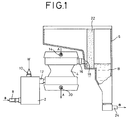
- FIG. 1 of the accompanying drawings schematically illustrates a extracorporeal blood circulating apparatus proposed by the applicant.
- the extracorporeal blood circulating appartus comprises a heat exchanger 2, an artificial lung 4, and a blood reservoir 6 as an interconnected unitary system.
- the extracorporeal blood circulating apparatus is connected to the body of a patient through a pump (not shown) which supplies blood at a certain pulse rate.
- the extracorporeal blood circulating apparatus is positioned in a location lower than the patient's body.
- Blood B discharged from the human body is introduced under the pressure developed by the blood head from a blood inlet port 8 into the heat exchanger 2 and controlled at a prescribed temperature by warm or cold water supplied from a water inlet port 10.
- the blood B is fed through a joint tube 12 into the artificial lung 4.
- the artificial lung 4 contains a multiplicity of hollow filamentary membranes through which a gas A containing oxygen supplied from a gas inlet port 14 flows.
- the blood B while passing around the hollow filamentary membranes, receives oxygen from the gas A and discharges carbon dioxide, and then flows via a joint tube 16 through a blood inlet port 18 into the blood reservoir 6.
- the gas A is discharged from the artificial lung 4 through a gas outlet port 20.
- the blood B that has entered the blood reservoir 6 from the blood inlet port 18 goes through an anti-foaming member 22 and is temporarily stored in the blood reservoir 6. Then, the stored blood B is supplied from a blood outlet port 24 into the human body by the pump.
- the blood B is circulated between the apparatus and the human body by the pressure developed by the blood head and the pump. If the artificial lung 4 and the blood reservoir 6 are connected as shown in FIG. 1, since the joint tube 16 lies substantially horizontally, the blood B may gush into the blood reservoir 6 under the pressure developed by the blood head.
- the blood B stored in the blood reservoir 6 is supplied from the blood outlet port 24 into the human body under the pulse rate determined by the pump. The blood B may therefore tend to apply unwanted vibration to the apparatus.
- the extracorporeal blood circulating apparatus comprises an antificial lung and a blood reservoir which are interconnected by a joint tube a first end of which is connected to the artificial lung, and a second end of which is connected to the blood reservoir.
- the second end of the joint tube is connected to a bottom surface of the blood reservoir for delivering blood from said antificial lung upwardly into the blood reservoir. In this way, the generation of any unwanted vibration which would otherwise be applied to the apparatus can be controlled.
- the joint tube may be substantially of an L shape including a horizontal portion extending from the artificial lung and a vertical portion extending upwardly from the horizontal portion over a predetermined length.
- a blood dispersing member is preferably mounted in the end of the joint tube opening into the blood reservoir for smoothing the flow of the blood.
- the blood dispersing member may comprise a mesh screen.
- an extracorporeal blood circulating apparatus has a unitary apparatus assembly 30 comprising a heat exchanger 32, an artificial lung 34, and an open-type blood reservoir 36.
- the heat exchanger 32 includes a tubular housing 38 accommodating therein a number of heat exchanger pipes 40. Warm or cold water W is supplied from a water port 42 to the pipes 40, and then discharged from the pipes 40 via a water port 44. Blood B flowing from a blood supply port 46 into the heat exchanger 32 is heated or cooled to a prescribed temperature while it is passing around the pipes 40. Thereafter, the blood B is supplied via two joint tubes 48a, 48b (see FIG. 3) to the artificial lung 34.
- the artificial lung 34 serves to remove carbon dioxide from the blood B and add oxygen to the blood B.
- the artificial lung 34 includes a multiplicity of hollow filamentary membranes 52 bundled and stored in a substantially cylindrical housing 50 with a constricted central portion.
- On the upper and lower ends of the housing 50 there are mounted partitions 54a, 54b holding the opposite ends of the hollow filamentary membranes 52.
- the housing 50 and the partitions 54a, 54b jointly define a space surrounded thereby and housing the hollow filamentary membranes 52 therein, the space having a lower end communicating with the heat exchanger 32 through the joint tubes 48a, 48b. This space serves as a gas exchanging chamber 56 through which the blood B flows.
- Covers 58a, 58b are also mounted on the upper and lower ends of the housing 50.
- the partition 54a and the cover 58a define a gas supply chamber 60 therebetween, and the partition 54b and the cover 58b define a gas discharge chamber 62 therebetween.
- the hollow filamentary membranes 52 are supplied with a gas A containing oxygen from a gas inlet port 64 via the gas supply chamber 60.
- the gas A delivered from the hollow filamentary membranes 52 is discharged through the gas discharge chamber 62 from a gas outlet port 66.
- the gas exchanging chamber 56 in the artificial lung 34 has an upper end communicating with the blood reservoir 36 through two L-shaped joint tubes 68a, 68b each having a horizontal portion extending from the gas exchanging chamber 56 and a vertical portion extending upwardly from the end of the horizontal portion over a certain length.
- the blood reservoir 36 has a bottom plate composed of first through third steps 70a, 70b, 70c.
- the joint tubes 68a, 68b have blood inlet ports 72a, 72b, respectively, opening at the first uppermost step 70a on its lateral sides through blood dispersing mesh screens 74a, 74b, respectively, for smoothing the blood flow flowing therethrough.
- the blood reservoir 36 is made of a transparent plastic material.
- the blood reservoir 36 has a pair of drug inlet ports 76a, 76b above the blood inlet ports 72a, 72b, respectively, for adding various drugs such as vasodilatator drug, an anticoagulant, and the like to the blood B.
- a urethane anti-foaming member 78 is disposed on the first step 70a of the blood reservoir 36 near the blood inlet ports 72a, 72b.
- a partition 82 is mounted substantially centrally on the second step 70b and divides the blood storage space on the second step 70b into a first blood storage region 80a and a second blood storage region 80b for preventing the blood surface from being subjected to resonant vibration.
- the third lowermost step 70c is coupled to a blood outlet port 84 for supplying the blood B stored in the blood reservoir 36 into the human body.
- the blood outlet port 84 is coupled to the human body through a pump (not shown) which delivers the blood at a prescribed pulse rate.
- the pump may be a rotary type or peristaltic finger type.
- the extracorporeal blood circulating apparatus of the present invention is basically of the above structure. Now, operation and advantages of the extracorporeal blood circulating apparatus will be described below.
- the blood B coming from the blood supply port 46 is supplied through the gaps between the tubes 40 stored in the heat exchanger 32 to the artificial lung 34. At this time, water W maintained at a prescribed temperature is flowing through the heat exchanger tubes 40 through the water ports 42, 44.
- the blood B is heater or cooled to a predetermined temperature by the water W flowing through the tubes 40.
- the blood B to which oxygen has been added in the artificial lung 34 then flows through the joint tubes 68a, 68b and the blood inlet ports 72a, 72b into the blood reservoir 36.
- the joint tubes 68a, 68b are of the L shape including a horizontal portion extending from the upper end of the gas exchanging chamber 56 ans a vertical portion extending upwardly from the horizontal portion over a certain length.
- the blood B flowing out of the gas exchanging chamber 56 under the pressure developed by the pump (not shown) or the blood head produced by the higher human body position flows upwardly through the L-shaped joint tubes 68a, 68b, during which time the kinetic energy of the blood B is reduced by an increase in the potential energy thereof, thereby resulting in a reduction in the speed of flow of the blood B.
- the blood B is allowed to flow smoothly into the blood reservoir 36, without the danger of unwanted vibration which would otherwise be applied to the apparatus by the pressure under which the blood B would flow into the blood reservoir 36.
- the blood B is dispersed by the mesh screens 74a, 74b mounted respectively in the blood inlet ports 72a, 72b, and then stored into the blood reservoir 36 through the urethane anti-foaming member 78.
- the blood B stored in the blood reservoir 36 is then intermittently or pulsatively delivered out to the human body by the pump (not shown) coupled to the blood outlet port 84.
- the surface level 86 of the blood B stored in the blood reservoir 36 would be subjected to resonant vibration due to intermittent delivery of the blood B by the pump.
- resonant vibration is highly effectively suppressed by the partition 82 on the second step 70b in the blood reservoir 36.
- resonant vibration which would otherwise be caused on the surface level 86 of the blood B stored in the blood reservoir 36 would be produced when the natural frequency of the blood storage system based on the characteristics of the blood B, the configuration of the blood reservoir 36, and other parameters coincides with the pulse rate of the pump.
- the pulse rate of the pump is selected to be in a certain range for practical reasons with respect to the artificial lung 34.
- the partition 82 located in the blood reservoir 36 is effective in making the system's natural frequency widely different from the pulse rate of the pump, thus suppressing the undesirable resonant vibration. Therefore, the surface level 86 of the blood B is kept calm without violent turbulent motion.
- the amount of the blood B stored in the blood reservoir 36 can easily and accurately be checked by a visual inspection. Moreover, inasmuch as any turbulent motion of the blood B in the blood reservoir 36 is effectively suppressed, vibration of the blood B is held to a minimum, and no unwanted vibration is applied to the apparatus.
- the extracorporeal blood circulating apparatus includes the artificial lung and the blood reservoir which are joined to each other, and the blood flowing out of the artificial lung is caused to flow upwardly through the joint tubes including upwardly extending portions onto the bottom of the blood reservoir. Since the speed of flow of the blood from the artificial lung is effectively reduced while flowing upwardly through the joint tubes, the blood is allowed to flow smoothly into the blood reservoir. As a result, the pressure under which the blood flows into the blood reservoir is lowered, thereby preventing unwanted pressure from being imposed on the apparatus.
- the present invention is not limited to the illustrated embodiment, but the principles of the invention are also applicable to a extracorporeal blood circulating apparatus which is separate from a heat exchanger, for example.
Landscapes
- Health & Medical Sciences (AREA)
- Heart & Thoracic Surgery (AREA)
- Vascular Medicine (AREA)
- Hematology (AREA)
- Urology & Nephrology (AREA)
- Engineering & Computer Science (AREA)
- Anesthesiology (AREA)
- Biomedical Technology (AREA)
- Life Sciences & Earth Sciences (AREA)
- Animal Behavior & Ethology (AREA)
- General Health & Medical Sciences (AREA)
- Public Health (AREA)
- Veterinary Medicine (AREA)
- Emergency Medicine (AREA)
- Cardiology (AREA)
- External Artificial Organs (AREA)
Description
- The present invention relates to an extracorporeal blood circulating apparatus.
- When a thoracic operation, for example, is to be carried out on a patient, an extracorporeal blood circulating circuit is established using an artificial lung in which the blood is circulated for an exchange of carbon dioxide and oxygen. The blood is controlled at a prescribed temperature by a heat exchanger, and therafter the gases are exchanged in the articifial lung. Then, the blood is temporarily stored in a blood reservoir for a steady supply of the blood. The blood is pumped into the patient under the operation at a constant pulse rate.
- Blood reservoirs for use in extracorporeal blood circulation include a closed-type blood reservoir in the form of a soft bag for storing blood in an airtight condition and an open-type blood reservoir in the form of a hard housing for storing blood.
- An example of a blood oxygenating apparatus that uses an airtight, flexible membrane type of reservoir is disclosed in EP-A-0 089 748. Here, the reservoir comprises a rigid concave shell on which the flexible membrane forms a liquid-tight variable volume. The inlet ports to the reservoir enter into the rear shell wall adjacent to, but spaced apart from the lower end of the reservoir. The open-type blood reservoir is advantageous in that priming and confirmation of the stored amount of blood can easily be performed, and it would be easy to construct the blood reservoir as a unitary component of an artificial lung. Therefore, various extracorporeal blood circulating apparatus employing open-type blood reservoirs have been proposed.
- FIG. 1 of the accompanying drawings schematically illustrates a extracorporeal blood circulating apparatus proposed by the applicant. The extracorporeal blood circulating appartus comprises a
heat exchanger 2, anartificial lung 4, and ablood reservoir 6 as an interconnected unitary system. The extracorporeal blood circulating apparatus is connected to the body of a patient through a pump (not shown) which supplies blood at a certain pulse rate. The extracorporeal blood circulating apparatus is positioned in a location lower than the patient's body. Blood B discharged from the human body is introduced under the pressure developed by the blood head from ablood inlet port 8 into theheat exchanger 2 and controlled at a prescribed temperature by warm or cold water supplied from awater inlet port 10. Thereafter, the blood B is fed through ajoint tube 12 into theartificial lung 4. Theartificial lung 4 contains a multiplicity of hollow filamentary membranes through which a gas A containing oxygen supplied from agas inlet port 14 flows. The blood B, while passing around the hollow filamentary membranes, receives oxygen from the gas A and discharges carbon dioxide, and then flows via ajoint tube 16 through ablood inlet port 18 into theblood reservoir 6. After the exchange of oxygen and carbon dioxide, the gas A is discharged from theartificial lung 4 through agas outlet port 20. The blood B that has entered theblood reservoir 6 from theblood inlet port 18 goes through ananti-foaming member 22 and is temporarily stored in theblood reservoir 6. Then, the stored blood B is supplied from ablood outlet port 24 into the human body by the pump. - With the above extracorporeal blood circulating apparatus, the blood B is circulated between the apparatus and the human body by the pressure developed by the blood head and the pump. If the
artificial lung 4 and theblood reservoir 6 are connected as shown in FIG. 1, since thejoint tube 16 lies substantially horizontally, the blood B may gush into theblood reservoir 6 under the pressure developed by the blood head. The blood B stored in theblood reservoir 6 is supplied from theblood outlet port 24 into the human body under the pulse rate determined by the pump. The blood B may therefore tend to apply unwanted vibration to the apparatus. - It is an objet of the present invention to provide an extracorporeal blood circulating apparatus capable of effecting a smooth influx of blood into a blood reservoir. According to the invention, the extracorporeal blood circulating apparatus comprises an antificial lung and a blood reservoir which are interconnected by a joint tube a first end of which is connected to the artificial lung, and a second end of which is connected to the blood reservoir. According to the present invention, the second end of the joint tube is connected to a bottom surface of the blood reservoir for delivering blood from said antificial lung upwardly into the blood reservoir. In this way, the generation of any unwanted vibration which would otherwise be applied to the apparatus can be controlled.
- The joint tube may be substantially of an L shape including a horizontal portion extending from the artificial lung and a vertical portion extending upwardly from the horizontal portion over a predetermined length.
- A blood dispersing member is preferably mounted in the end of the joint tube opening into the blood reservoir for smoothing the flow of the blood. The blood dispersing member may comprise a mesh screen.
- The above and other features and advantages of the present invention will become more apparent from the following description when taken in conjunction with the accompanying drawings in which a preferred embodiment of the present invention is shown by way of illustrative example.
-
- FIG. 1 is a schematic elevational view, partly in cross section, of an extracorporeal blood circulating apparatus shown as a comparative example ;
- FIG. 2 is a schematic elevational view, partly in cross section, of a extracorporeal blood circulating apparatus according to the present invention ; and
- FIG 3 is a schematic perspective view of the extracorporeal blood circulating apparatus illustrated in FIG. 2.
- As shown in FIGS. 2 and 3, an extracorporeal blood circulating apparatus according to the present invention has a
unitary apparatus assembly 30 comprising aheat exchanger 32, anartificial lung 34, and an open-type blood reservoir 36. - The
heat exchanger 32 includes atubular housing 38 accommodating therein a number ofheat exchanger pipes 40. Warm or cold water W is supplied from awater port 42 to thepipes 40, and then discharged from thepipes 40 via awater port 44. Blood B flowing from ablood supply port 46 into theheat exchanger 32 is heated or cooled to a prescribed temperature while it is passing around thepipes 40. Thereafter, the blood B is supplied via twojoint tubes 48a, 48b (see FIG. 3) to theartificial lung 34. - The
artificial lung 34 serves to remove carbon dioxide from the blood B and add oxygen to the blood B. Theartificial lung 34 includes a multiplicity of hollowfilamentary membranes 52 bundled and stored in a substantiallycylindrical housing 50 with a constricted central portion. On the upper and lower ends of thehousing 50, there are mountedpartitions filamentary membranes 52. Thehousing 50 and thepartitions filamentary membranes 52 therein, the space having a lower end communicating with theheat exchanger 32 through thejoint tubes 48a, 48b. This space serves as agas exchanging chamber 56 through which the blood B flows.Covers housing 50. Thepartition 54a and thecover 58a define agas supply chamber 60 therebetween, and thepartition 54b and thecover 58b define agas discharge chamber 62 therebetween. The hollowfilamentary membranes 52 are supplied with a gas A containing oxygen from agas inlet port 64 via thegas supply chamber 60. The gas A delivered from the hollowfilamentary membranes 52 is discharged through thegas discharge chamber 62 from agas outlet port 66. - The
gas exchanging chamber 56 in theartificial lung 34 has an upper end communicating with theblood reservoir 36 through two L-shapedjoint tubes gas exchanging chamber 56 and a vertical portion extending upwardly from the end of the horizontal portion over a certain length. Theblood reservoir 36 has a bottom plate composed of first throughthird steps joint tubes blood inlet ports uppermost step 70a on its lateral sides through blood dispersingmesh screens 74a, 74b, respectively, for smoothing the blood flow flowing therethrough. Theblood reservoir 36 is made of a transparent plastic material. Theblood reservoir 36 has a pair ofdrug inlet ports blood inlet ports - A urethane
anti-foaming member 78 is disposed on thefirst step 70a of theblood reservoir 36 near theblood inlet ports partition 82 is mounted substantially centrally on thesecond step 70b and divides the blood storage space on thesecond step 70b into a firstblood storage region 80a and a secondblood storage region 80b for preventing the blood surface from being subjected to resonant vibration. The thirdlowermost step 70c is coupled to ablood outlet port 84 for supplying the blood B stored in theblood reservoir 36 into the human body. In operation, theblood outlet port 84 is coupled to the human body through a pump (not shown) which delivers the blood at a prescribed pulse rate. In the case, the pump may be a rotary type or peristaltic finger type. - The extracorporeal blood circulating apparatus of the present invention is basically of the above structure. Now, operation and advantages of the extracorporeal blood circulating apparatus will be described below.
- The blood B coming from the
blood supply port 46 is supplied through the gaps between thetubes 40 stored in theheat exchanger 32 to theartificial lung 34. At this time, water W maintained at a prescribed temperature is flowing through theheat exchanger tubes 40 through thewater ports tubes 40. - The blood B fed from the
heat exchanger 32 via thejoint tubes 48a, 48b into theartificial lung 34 enters thegas exchanging chamber 56 surrounded by thehousing 50 in which oxygen is added to the blood B and carbon dioxide is removed from the blood B. More specifically, the gas A containing oxygen is supplied into the bundled hollowfilamentary membranes 52 in thehousing 50 from thegas inlet port 64 through thegas supply chamber 60. Oxygen and carbon dioxide are exchanged in the blood B through thehollow filamentary membranes 52. The gas A containing carbon dioxide is discharged via thegas discharge chamber 62 from thegas outlet port 66. - The blood B to which oxygen has been added in the
artificial lung 34 then flows through thejoint tubes blood inlet ports blood reservoir 36. As described above, thejoint tubes gas exchanging chamber 56 ans a vertical portion extending upwardly from the horizontal portion over a certain length. Therefore, the blood B flowing out of thegas exchanging chamber 56 under the pressure developed by the pump (not shown) or the blood head produced by the higher human body position flows upwardly through the L-shapedjoint tubes blood reservoir 36, without the danger of unwanted vibration which would otherwise be applied to the apparatus by the pressure under which the blood B would flow into theblood reservoir 36. The blood B is dispersed by themesh screens 74a, 74b mounted respectively in theblood inlet ports blood reservoir 36 through theurethane anti-foaming member 78. - The blood B stored in the
blood reservoir 36 is then intermittently or pulsatively delivered out to the human body by the pump (not shown) coupled to theblood outlet port 84. Thesurface level 86 of the blood B stored in theblood reservoir 36 would be subjected to resonant vibration due to intermittent delivery of the blood B by the pump. However, such resonant vibration is highly effectively suppressed by thepartition 82 on thesecond step 70b in theblood reservoir 36. - More specifically, it is considered that resonant vibration which would otherwise be caused on the
surface level 86 of the blood B stored in theblood reservoir 36 would be produced when the natural frequency of the blood storage system based on the characteristics of the blood B, the configuration of theblood reservoir 36, and other parameters coincides with the pulse rate of the pump. The pulse rate of the pump is selected to be in a certain range for practical reasons with respect to theartificial lung 34. Thepartition 82 located in theblood reservoir 36 is effective in making the system's natural frequency widely different from the pulse rate of the pump, thus suppressing the undesirable resonant vibration. Therefore, thesurface level 86 of the blood B is kept calm without violent turbulent motion. Since the fluctuation of thesurface level 86 arising from the pulse rate of the pump is small, the amount of the blood B stored in theblood reservoir 36 can easily and accurately be checked by a visual inspection. Moreover, inasmuch as any turbulent motion of the blood B in theblood reservoir 36 is effectively suppressed, vibration of the blood B is held to a minimum, and no unwanted vibration is applied to the apparatus. - With the present invention, as described above, the extracorporeal blood circulating apparatus includes the artificial lung and the blood reservoir which are joined to each other, and the blood flowing out of the artificial lung is caused to flow upwardly through the joint tubes including upwardly extending portions onto the bottom of the blood reservoir. Since the speed of flow of the blood from the artificial lung is effectively reduced while flowing upwardly through the joint tubes, the blood is allowed to flow smoothly into the blood reservoir. As a result, the pressure under which the blood flows into the blood reservoir is lowered, thereby preventing unwanted pressure from being imposed on the apparatus.
- The present invention is not limited to the illustrated embodiment, but the principles of the invention are also applicable to a extracorporeal blood circulating apparatus which is separate from a heat exchanger, for example.
Claims (4)
- An extracorporeal blood circulating apparatus comprising an artificial lung (34) and an open type blood reservoir (36) which are interconnected by at least one joint tube (68a, 68b), a first end of said at least one joint tube (68a, 68b) being connected to said artificial lung (34), and a second end of said at least one joint tube being connected to said blood reservoir (36),
characterized in that said second end of said at least one joint tube (68a, 68b) is connected to a bottom surface of said blood reservoir (36) for delivering blood from said artificial lung upwardly into said blood reservoir. - An extracorporeal blood circulating apparatus according to claim 1, wherein said at least one joint tube (68a, 68b) is substantially of an L shape including a horizontal portion extending from said artificial lung and a vertical portion extending upwardly from said horizontal portion over a predetermined length.
- An extracorporeal blood circulating apparatus according to claim 1, further including blood flow impeding member (74a, 74b) mounted in an end of said at least one joint tube opening into said blood reservoir (36) for smoothing the flow of the blood.
- An extracorporeal blood circulating apparatus according to claim 3, wherein said blood flow impeding member comprises a mesh screen.
Applications Claiming Priority (4)
| Application Number | Priority Date | Filing Date | Title |
|---|---|---|---|
| JP122243/87 | 1987-05-19 | ||
| JP62122243A JPS63286160A (en) | 1987-05-19 | 1987-05-19 | Blood storage tank |
| JP62320760A JPS63286163A (en) | 1987-12-18 | 1987-12-18 | Extracorporeal blood circulatory apparatus |
| JP320760/87 | 1987-12-18 |
Publications (3)
| Publication Number | Publication Date |
|---|---|
| EP0292396A2 EP0292396A2 (en) | 1988-11-23 |
| EP0292396A3 EP0292396A3 (en) | 1990-03-21 |
| EP0292396B1 true EP0292396B1 (en) | 1994-03-09 |
Family
ID=26459405
Family Applications (1)
| Application Number | Title | Priority Date | Filing Date |
|---|---|---|---|
| EP88401222A Expired - Lifetime EP0292396B1 (en) | 1987-05-19 | 1988-05-19 | Extracorporeal blood circulating apparatus |
Country Status (4)
| Country | Link |
|---|---|
| EP (1) | EP0292396B1 (en) |
| KR (1) | KR880013581A (en) |
| AU (1) | AU613914B2 (en) |
| DE (1) | DE3888234T2 (en) |
Families Citing this family (1)
| Publication number | Priority date | Publication date | Assignee | Title |
|---|---|---|---|---|
| CA2335116C (en) | 1999-04-20 | 2004-06-22 | Mitsubishi Denki Kabushiki Kaisha | Character display device and character display method |
Family Cites Families (1)
| Publication number | Priority date | Publication date | Assignee | Title |
|---|---|---|---|---|
| US4424190A (en) * | 1982-02-22 | 1984-01-03 | Cordis Dow Corp. | Rigid shell expansible blood reservoir, heater and hollow fiber membrane oxygenator assembly |
-
1988
- 1988-05-17 AU AU16457/88A patent/AU613914B2/en not_active Ceased
- 1988-05-19 EP EP88401222A patent/EP0292396B1/en not_active Expired - Lifetime
- 1988-05-19 KR KR1019880005903A patent/KR880013581A/en active Pending
- 1988-05-19 DE DE3888234T patent/DE3888234T2/en not_active Expired - Lifetime
Also Published As
| Publication number | Publication date |
|---|---|
| EP0292396A2 (en) | 1988-11-23 |
| KR880013581A (en) | 1988-12-21 |
| AU613914B2 (en) | 1991-08-15 |
| EP0292396A3 (en) | 1990-03-21 |
| DE3888234D1 (en) | 1994-04-14 |
| AU1645788A (en) | 1988-11-24 |
| DE3888234T2 (en) | 1994-07-07 |
Similar Documents
| Publication | Publication Date | Title |
|---|---|---|
| EP0378681B1 (en) | Blood storage tank | |
| EP0089748A2 (en) | Rigid shell expansible blood reservoir, heater and hollow fibre membrane oxygenator assembly | |
| US5160332A (en) | Blood reservoir | |
| US6001306A (en) | Integrated oxygenator and heat exchanger | |
| US3493347A (en) | Blood oxygenator | |
| US5026525A (en) | Extracorporeal blood circulating apparatus | |
| US5000764A (en) | Blood storage container | |
| EP0292399B1 (en) | Blood reservoir for an extracorporeal blood treatment circuit | |
| EP0292396A2 (en) | Extracorporeal blood circulating apparatus | |
| EP0292398B1 (en) | Extracorporeal blood circulating apparatus | |
| EP0292395B1 (en) | Blood reservoir for an extracorporeal blood treatment circuit | |
| US5196166A (en) | Blood storage tank | |
| JP3092856B2 (en) | Blood reservoir | |
| JP3092855B2 (en) | Blood reservoir | |
| JPS63286164A (en) | Extracorporeal blood circulatory apparatus | |
| JPS63302859A (en) | Blood storage tank | |
| JPS63302861A (en) | Extracorporeal blood circulation apparatus | |
| JPH0613738Y2 (en) | Blood reservoir | |
| JPH0433227B2 (en) | ||
| JPH042063B2 (en) | ||
| JPH04336075A (en) | Blood storage tank | |
| JPH05146508A (en) | Heat exchanger and blood reservoir | |
| JPH04114351U (en) | Heat exchanger and blood reservoir | |
| JPH0211154A (en) | Blood storage chamber | |
| JPH04114350U (en) | Heat exchanger and blood reservoir |
Legal Events
| Date | Code | Title | Description |
|---|---|---|---|
| PUAI | Public reference made under article 153(3) epc to a published international application that has entered the european phase |
Free format text: ORIGINAL CODE: 0009012 |
|
| 17P | Request for examination filed |
Effective date: 19880524 |
|
| AK | Designated contracting states |
Kind code of ref document: A2 Designated state(s): BE DE FR GB IT SE |
|
| PUAL | Search report despatched |
Free format text: ORIGINAL CODE: 0009013 |
|
| AK | Designated contracting states |
Kind code of ref document: A3 Designated state(s): BE DE FR GB IT SE |
|
| 17Q | First examination report despatched |
Effective date: 19920617 |
|
| GRAA | (expected) grant |
Free format text: ORIGINAL CODE: 0009210 |
|
| AK | Designated contracting states |
Kind code of ref document: B1 Designated state(s): BE DE FR GB IT SE |
|
| PG25 | Lapsed in a contracting state [announced via postgrant information from national office to epo] |
Ref country code: SE Free format text: LAPSE BECAUSE OF FAILURE TO SUBMIT A TRANSLATION OF THE DESCRIPTION OR TO PAY THE FEE WITHIN THE PRESCRIBED TIME-LIMIT Effective date: 19940309 Ref country code: BE Effective date: 19940309 |
|
| REF | Corresponds to: |
Ref document number: 3888234 Country of ref document: DE Date of ref document: 19940414 |
|
| ITF | It: translation for a ep patent filed | ||
| ET | Fr: translation filed | ||
| PGFP | Annual fee paid to national office [announced via postgrant information from national office to epo] |
Ref country code: SE Payment date: 19940517 Year of fee payment: 7 |
|
| PLBE | No opposition filed within time limit |
Free format text: ORIGINAL CODE: 0009261 |
|
| STAA | Information on the status of an ep patent application or granted ep patent |
Free format text: STATUS: NO OPPOSITION FILED WITHIN TIME LIMIT |
|
| 26N | No opposition filed | ||
| PGFP | Annual fee paid to national office [announced via postgrant information from national office to epo] |
Ref country code: GB Payment date: 19950510 Year of fee payment: 8 |
|
| PG25 | Lapsed in a contracting state [announced via postgrant information from national office to epo] |
Ref country code: GB Effective date: 19960519 |
|
| GBPC | Gb: european patent ceased through non-payment of renewal fee |
Effective date: 19960519 |
|
| PGFP | Annual fee paid to national office [announced via postgrant information from national office to epo] |
Ref country code: DE Payment date: 20070517 Year of fee payment: 20 |
|
| PGFP | Annual fee paid to national office [announced via postgrant information from national office to epo] |
Ref country code: IT Payment date: 20070525 Year of fee payment: 20 |
|
| PGFP | Annual fee paid to national office [announced via postgrant information from national office to epo] |
Ref country code: FR Payment date: 20070510 Year of fee payment: 20 |