EP0287709B1 - Sandwich glass - Google Patents
Sandwich glass Download PDFInfo
- Publication number
- EP0287709B1 EP0287709B1 EP87116186A EP87116186A EP0287709B1 EP 0287709 B1 EP0287709 B1 EP 0287709B1 EP 87116186 A EP87116186 A EP 87116186A EP 87116186 A EP87116186 A EP 87116186A EP 0287709 B1 EP0287709 B1 EP 0287709B1
- Authority
- EP
- European Patent Office
- Prior art keywords
- glass
- sandwich
- resin
- sandwich glass
- copolymer
- Prior art date
- Legal status (The legal status is an assumption and is not a legal conclusion. Google has not performed a legal analysis and makes no representation as to the accuracy of the status listed.)
- Expired - Lifetime
Links
- 239000011521 glass Substances 0.000 title claims description 106
- 229920005989 resin Polymers 0.000 claims description 38
- 239000011347 resin Substances 0.000 claims description 38
- 229920001400 block copolymer Polymers 0.000 claims description 35
- 239000011229 interlayer Substances 0.000 claims description 35
- 239000010410 layer Substances 0.000 claims description 23
- 239000002985 plastic film Substances 0.000 claims description 21
- 229920001577 copolymer Polymers 0.000 claims description 19
- 239000005357 flat glass Substances 0.000 claims description 17
- 239000004840 adhesive resin Substances 0.000 claims description 13
- 229920006223 adhesive resin Polymers 0.000 claims description 13
- 239000005977 Ethylene Substances 0.000 claims description 10
- -1 aromatic vinyl compound Chemical class 0.000 claims description 10
- VGGSQFUCUMXWEO-UHFFFAOYSA-N Ethene Chemical compound C=C VGGSQFUCUMXWEO-UHFFFAOYSA-N 0.000 claims description 9
- 229920000642 polymer Polymers 0.000 claims description 9
- 238000005984 hydrogenation reaction Methods 0.000 claims description 8
- QHZOMAXECYYXGP-UHFFFAOYSA-N ethene;prop-2-enoic acid Chemical class C=C.OC(=O)C=C QHZOMAXECYYXGP-UHFFFAOYSA-N 0.000 claims description 7
- 229920003145 methacrylic acid copolymer Chemical class 0.000 claims description 7
- 239000004793 Polystyrene Substances 0.000 claims description 6
- XTXRWKRVRITETP-UHFFFAOYSA-N Vinyl acetate Chemical compound CC(=O)OC=C XTXRWKRVRITETP-UHFFFAOYSA-N 0.000 claims description 6
- 229920002223 polystyrene Polymers 0.000 claims description 6
- 150000003839 salts Chemical class 0.000 claims description 6
- SMZOUWXMTYCWNB-UHFFFAOYSA-N 2-(2-methoxy-5-methylphenyl)ethanamine Chemical compound COC1=CC=C(C)C=C1CCN SMZOUWXMTYCWNB-UHFFFAOYSA-N 0.000 claims description 5
- 229910052751 metal Chemical class 0.000 claims description 5
- 239000002184 metal Chemical class 0.000 claims description 5
- RPQRDASANLAFCM-UHFFFAOYSA-N oxiran-2-ylmethyl prop-2-enoate Chemical compound C=CC(=O)OCC1CO1 RPQRDASANLAFCM-UHFFFAOYSA-N 0.000 claims description 5
- 239000005062 Polybutadiene Substances 0.000 claims description 4
- 150000001993 dienes Chemical class 0.000 claims description 4
- 125000005395 methacrylic acid group Chemical group 0.000 claims description 4
- 229920002857 polybutadiene Polymers 0.000 claims description 4
- 229920001195 polyisoprene Polymers 0.000 claims description 4
- 229920001897 terpolymer Polymers 0.000 claims description 4
- 229920002554 vinyl polymer Polymers 0.000 claims description 4
- 229940117841 methacrylic acid copolymer Drugs 0.000 claims description 3
- 229920005668 polycarbonate resin Polymers 0.000 claims description 3
- 239000004431 polycarbonate resin Substances 0.000 claims description 3
- XYLMUPLGERFSHI-UHFFFAOYSA-N alpha-Methylstyrene Chemical compound CC(=C)C1=CC=CC=C1 XYLMUPLGERFSHI-UHFFFAOYSA-N 0.000 claims description 2
- 239000005338 frosted glass Substances 0.000 claims description 2
- VOZRXNHHFUQHIL-UHFFFAOYSA-N glycidyl methacrylate Chemical compound CC(=C)C(=O)OCC1CO1 VOZRXNHHFUQHIL-UHFFFAOYSA-N 0.000 claims description 2
- 229920001596 poly (chlorostyrenes) Polymers 0.000 claims description 2
- 229920000314 poly p-methyl styrene Polymers 0.000 claims description 2
- 229920001084 poly(chloroprene) Polymers 0.000 claims description 2
- 229920003229 poly(methyl methacrylate) Polymers 0.000 claims description 2
- 239000005020 polyethylene terephthalate Substances 0.000 claims description 2
- 229920000139 polyethylene terephthalate Polymers 0.000 claims description 2
- 239000004926 polymethyl methacrylate Substances 0.000 claims description 2
- 229920002633 Kraton (polymer) Polymers 0.000 description 24
- 238000005336 cracking Methods 0.000 description 19
- 230000015556 catabolic process Effects 0.000 description 17
- 239000000047 product Substances 0.000 description 16
- 239000000203 mixture Substances 0.000 description 15
- 230000005540 biological transmission Effects 0.000 description 12
- 238000001125 extrusion Methods 0.000 description 10
- YXFVVABEGXRONW-UHFFFAOYSA-N Toluene Chemical compound CC1=CC=CC=C1 YXFVVABEGXRONW-UHFFFAOYSA-N 0.000 description 9
- 239000000470 constituent Substances 0.000 description 9
- MCPKSFINULVDNX-UHFFFAOYSA-N drometrizole Chemical compound CC1=CC=C(O)C(N2N=C3C=CC=CC3=N2)=C1 MCPKSFINULVDNX-UHFFFAOYSA-N 0.000 description 9
- 229920002037 poly(vinyl butyral) polymer Polymers 0.000 description 9
- 239000008188 pellet Substances 0.000 description 8
- 239000006096 absorbing agent Substances 0.000 description 6
- 238000010438 heat treatment Methods 0.000 description 6
- 238000000034 method Methods 0.000 description 6
- 239000000126 substance Substances 0.000 description 6
- 239000011342 resin composition Substances 0.000 description 5
- 229920002126 Acrylic acid copolymer Polymers 0.000 description 4
- 230000002159 abnormal effect Effects 0.000 description 4
- 239000003086 colorant Substances 0.000 description 4
- 230000000052 comparative effect Effects 0.000 description 4
- 230000005484 gravity Effects 0.000 description 4
- 238000003475 lamination Methods 0.000 description 4
- 239000000463 material Substances 0.000 description 4
- 239000002904 solvent Substances 0.000 description 4
- XLYOFNOQVPJJNP-UHFFFAOYSA-N water Substances O XLYOFNOQVPJJNP-UHFFFAOYSA-N 0.000 description 4
- UHOVQNZJYSORNB-UHFFFAOYSA-N Benzene Chemical compound C1=CC=CC=C1 UHOVQNZJYSORNB-UHFFFAOYSA-N 0.000 description 3
- XEKOWRVHYACXOJ-UHFFFAOYSA-N Ethyl acetate Chemical compound CCOC(C)=O XEKOWRVHYACXOJ-UHFFFAOYSA-N 0.000 description 3
- KFZMGEQAYNKOFK-UHFFFAOYSA-N Isopropanol Chemical compound CC(C)O KFZMGEQAYNKOFK-UHFFFAOYSA-N 0.000 description 3
- 238000005299 abrasion Methods 0.000 description 3
- 239000012790 adhesive layer Substances 0.000 description 3
- 238000004519 manufacturing process Methods 0.000 description 3
- 238000000465 moulding Methods 0.000 description 3
- 239000005336 safety glass Substances 0.000 description 3
- SWZOQAGVRGQLDV-UHFFFAOYSA-N 4-[2-(4-hydroxy-2,2,6,6-tetramethylpiperidin-1-yl)ethoxy]-4-oxobutanoic acid Chemical compound CC1(C)CC(O)CC(C)(C)N1CCOC(=O)CCC(O)=O SWZOQAGVRGQLDV-UHFFFAOYSA-N 0.000 description 2
- NIXOWILDQLNWCW-UHFFFAOYSA-M Acrylate Chemical compound [O-]C(=O)C=C NIXOWILDQLNWCW-UHFFFAOYSA-M 0.000 description 2
- KAKZBPTYRLMSJV-UHFFFAOYSA-N Butadiene Chemical compound C=CC=C KAKZBPTYRLMSJV-UHFFFAOYSA-N 0.000 description 2
- 239000004716 Ethylene/acrylic acid copolymer Substances 0.000 description 2
- CERQOIWHTDAKMF-UHFFFAOYSA-M Methacrylate Chemical compound CC(=C)C([O-])=O CERQOIWHTDAKMF-UHFFFAOYSA-M 0.000 description 2
- 229920003298 Nucrel® Polymers 0.000 description 2
- 239000004743 Polypropylene Substances 0.000 description 2
- PPBRXRYQALVLMV-UHFFFAOYSA-N Styrene Chemical compound C=CC1=CC=CC=C1 PPBRXRYQALVLMV-UHFFFAOYSA-N 0.000 description 2
- WYURNTSHIVDZCO-UHFFFAOYSA-N Tetrahydrofuran Chemical compound C1CCOC1 WYURNTSHIVDZCO-UHFFFAOYSA-N 0.000 description 2
- 238000010521 absorption reaction Methods 0.000 description 2
- 239000000654 additive Substances 0.000 description 2
- 239000000853 adhesive Substances 0.000 description 2
- 239000003963 antioxidant agent Substances 0.000 description 2
- 239000002216 antistatic agent Substances 0.000 description 2
- XITRBUPOXXBIJN-UHFFFAOYSA-N bis(2,2,6,6-tetramethylpiperidin-4-yl) decanedioate Chemical compound C1C(C)(C)NC(C)(C)CC1OC(=O)CCCCCCCCC(=O)OC1CC(C)(C)NC(C)(C)C1 XITRBUPOXXBIJN-UHFFFAOYSA-N 0.000 description 2
- OCWYEMOEOGEQAN-UHFFFAOYSA-N bumetrizole Chemical compound CC(C)(C)C1=CC(C)=CC(N2N=C3C=C(Cl)C=CC3=N2)=C1O OCWYEMOEOGEQAN-UHFFFAOYSA-N 0.000 description 2
- 239000012792 core layer Substances 0.000 description 2
- JHIVVAPYMSGYDF-UHFFFAOYSA-N cyclohexanone Chemical compound O=C1CCCCC1 JHIVVAPYMSGYDF-UHFFFAOYSA-N 0.000 description 2
- 239000000314 lubricant Substances 0.000 description 2
- 239000003973 paint Substances 0.000 description 2
- 229920003023 plastic Polymers 0.000 description 2
- 239000004033 plastic Substances 0.000 description 2
- 239000002861 polymer material Substances 0.000 description 2
- 229920001155 polypropylene Polymers 0.000 description 2
- 239000007787 solid Substances 0.000 description 2
- 150000003751 zinc Chemical class 0.000 description 2
- NIXOWILDQLNWCW-UHFFFAOYSA-N 2-Propenoic acid Natural products OC(=O)C=C NIXOWILDQLNWCW-UHFFFAOYSA-N 0.000 description 1
- OMIGHNLMNHATMP-UHFFFAOYSA-N 2-hydroxyethyl prop-2-enoate Chemical compound OCCOC(=O)C=C OMIGHNLMNHATMP-UHFFFAOYSA-N 0.000 description 1
- WSSSPWUEQFSQQG-UHFFFAOYSA-N 4-methyl-1-pentene Chemical compound CC(C)CC=C WSSSPWUEQFSQQG-UHFFFAOYSA-N 0.000 description 1
- FIHBHSQYSYVZQE-UHFFFAOYSA-N 6-prop-2-enoyloxyhexyl prop-2-enoate Chemical compound C=CC(=O)OCCCCCCOC(=O)C=C FIHBHSQYSYVZQE-UHFFFAOYSA-N 0.000 description 1
- JIGUQPWFLRLWPJ-UHFFFAOYSA-N Ethyl acrylate Chemical compound CCOC(=O)C=C JIGUQPWFLRLWPJ-UHFFFAOYSA-N 0.000 description 1
- CERQOIWHTDAKMF-UHFFFAOYSA-N Methacrylic acid Chemical compound CC(=C)C(O)=O CERQOIWHTDAKMF-UHFFFAOYSA-N 0.000 description 1
- 239000006057 Non-nutritive feed additive Substances 0.000 description 1
- 239000005662 Paraffin oil Substances 0.000 description 1
- ZJCCRDAZUWHFQH-UHFFFAOYSA-N Trimethylolpropane Chemical compound CCC(CO)(CO)CO ZJCCRDAZUWHFQH-UHFFFAOYSA-N 0.000 description 1
- FJWGYAHXMCUOOM-QHOUIDNNSA-N [(2s,3r,4s,5r,6r)-2-[(2r,3r,4s,5r,6s)-4,5-dinitrooxy-2-(nitrooxymethyl)-6-[(2r,3r,4s,5r,6s)-4,5,6-trinitrooxy-2-(nitrooxymethyl)oxan-3-yl]oxyoxan-3-yl]oxy-3,5-dinitrooxy-6-(nitrooxymethyl)oxan-4-yl] nitrate Chemical class O([C@@H]1O[C@@H]([C@H]([C@H](O[N+]([O-])=O)[C@H]1O[N+]([O-])=O)O[C@H]1[C@@H]([C@@H](O[N+]([O-])=O)[C@H](O[N+]([O-])=O)[C@@H](CO[N+]([O-])=O)O1)O[N+]([O-])=O)CO[N+](=O)[O-])[C@@H]1[C@@H](CO[N+]([O-])=O)O[C@@H](O[N+]([O-])=O)[C@H](O[N+]([O-])=O)[C@H]1O[N+]([O-])=O FJWGYAHXMCUOOM-QHOUIDNNSA-N 0.000 description 1
- 150000001242 acetic acid derivatives Chemical class 0.000 description 1
- 239000002253 acid Substances 0.000 description 1
- 150000001412 amines Chemical class 0.000 description 1
- 125000003118 aryl group Chemical group 0.000 description 1
- 239000012298 atmosphere Substances 0.000 description 1
- 238000009835 boiling Methods 0.000 description 1
- 238000005266 casting Methods 0.000 description 1
- 229920002301 cellulose acetate Polymers 0.000 description 1
- 239000007795 chemical reaction product Substances 0.000 description 1
- 238000013329 compounding Methods 0.000 description 1
- 238000009826 distribution Methods 0.000 description 1
- 230000000694 effects Effects 0.000 description 1
- 125000001495 ethyl group Chemical group [H]C([H])([H])C([H])([H])* 0.000 description 1
- 230000001747 exhibiting effect Effects 0.000 description 1
- 239000012467 final product Substances 0.000 description 1
- 239000012760 heat stabilizer Substances 0.000 description 1
- 229920001903 high density polyethylene Polymers 0.000 description 1
- 239000004700 high-density polyethylene Substances 0.000 description 1
- 239000004611 light stabiliser Substances 0.000 description 1
- 229920001684 low density polyethylene Polymers 0.000 description 1
- 239000004702 low-density polyethylene Substances 0.000 description 1
- 238000002844 melting Methods 0.000 description 1
- 239000002480 mineral oil Substances 0.000 description 1
- 239000000178 monomer Substances 0.000 description 1
- PNJWIWWMYCMZRO-UHFFFAOYSA-N pent‐4‐en‐2‐one Natural products CC(=O)CC=C PNJWIWWMYCMZRO-UHFFFAOYSA-N 0.000 description 1
- 230000000704 physical effect Effects 0.000 description 1
- 239000004014 plasticizer Substances 0.000 description 1
- 230000010287 polarization Effects 0.000 description 1
- 229920000058 polyacrylate Polymers 0.000 description 1
- 229920001748 polybutylene Polymers 0.000 description 1
- 239000004417 polycarbonate Substances 0.000 description 1
- 229920000515 polycarbonate Polymers 0.000 description 1
- 229920006289 polycarbonate film Polymers 0.000 description 1
- 229920005630 polypropylene random copolymer Polymers 0.000 description 1
- 229920002635 polyurethane Polymers 0.000 description 1
- 239000004814 polyurethane Substances 0.000 description 1
- 230000002035 prolonged effect Effects 0.000 description 1
- 159000000000 sodium salts Chemical class 0.000 description 1
- 229920003002 synthetic resin Polymers 0.000 description 1
- 239000000057 synthetic resin Substances 0.000 description 1
- MUTNCGKQJGXKEM-UHFFFAOYSA-N tamibarotene Chemical compound C=1C=C2C(C)(C)CCC(C)(C)C2=CC=1NC(=O)C1=CC=C(C(O)=O)C=C1 MUTNCGKQJGXKEM-UHFFFAOYSA-N 0.000 description 1
- YLQBMQCUIZJEEH-UHFFFAOYSA-N tetrahydrofuran Natural products C=1C=COC=1 YLQBMQCUIZJEEH-UHFFFAOYSA-N 0.000 description 1
- DVKJHBMWWAPEIU-UHFFFAOYSA-N toluene 2,4-diisocyanate Chemical compound CC1=CC=C(N=C=O)C=C1N=C=O DVKJHBMWWAPEIU-UHFFFAOYSA-N 0.000 description 1
- 239000005341 toughened glass Substances 0.000 description 1
- 229920001567 vinyl ester resin Polymers 0.000 description 1
- 230000004580 weight loss Effects 0.000 description 1
- 238000009736 wetting Methods 0.000 description 1
Classifications
-
- B—PERFORMING OPERATIONS; TRANSPORTING
- B32—LAYERED PRODUCTS
- B32B—LAYERED PRODUCTS, i.e. PRODUCTS BUILT-UP OF STRATA OF FLAT OR NON-FLAT, e.g. CELLULAR OR HONEYCOMB, FORM
- B32B25/00—Layered products comprising a layer of natural or synthetic rubber
- B32B25/14—Layered products comprising a layer of natural or synthetic rubber comprising synthetic rubber copolymers
-
- B—PERFORMING OPERATIONS; TRANSPORTING
- B32—LAYERED PRODUCTS
- B32B—LAYERED PRODUCTS, i.e. PRODUCTS BUILT-UP OF STRATA OF FLAT OR NON-FLAT, e.g. CELLULAR OR HONEYCOMB, FORM
- B32B17/00—Layered products essentially comprising sheet glass, or glass, slag, or like fibres
- B32B17/06—Layered products essentially comprising sheet glass, or glass, slag, or like fibres comprising glass as the main or only constituent of a layer, next to another layer of a specific material
- B32B17/10—Layered products essentially comprising sheet glass, or glass, slag, or like fibres comprising glass as the main or only constituent of a layer, next to another layer of a specific material of synthetic resin
- B32B17/10005—Layered products essentially comprising sheet glass, or glass, slag, or like fibres comprising glass as the main or only constituent of a layer, next to another layer of a specific material of synthetic resin laminated safety glass or glazing
- B32B17/10009—Layered products essentially comprising sheet glass, or glass, slag, or like fibres comprising glass as the main or only constituent of a layer, next to another layer of a specific material of synthetic resin laminated safety glass or glazing characterized by the number, the constitution or treatment of glass sheets
- B32B17/10018—Layered products essentially comprising sheet glass, or glass, slag, or like fibres comprising glass as the main or only constituent of a layer, next to another layer of a specific material of synthetic resin laminated safety glass or glazing characterized by the number, the constitution or treatment of glass sheets comprising only one glass sheet
-
- B—PERFORMING OPERATIONS; TRANSPORTING
- B32—LAYERED PRODUCTS
- B32B—LAYERED PRODUCTS, i.e. PRODUCTS BUILT-UP OF STRATA OF FLAT OR NON-FLAT, e.g. CELLULAR OR HONEYCOMB, FORM
- B32B17/00—Layered products essentially comprising sheet glass, or glass, slag, or like fibres
- B32B17/06—Layered products essentially comprising sheet glass, or glass, slag, or like fibres comprising glass as the main or only constituent of a layer, next to another layer of a specific material
- B32B17/10—Layered products essentially comprising sheet glass, or glass, slag, or like fibres comprising glass as the main or only constituent of a layer, next to another layer of a specific material of synthetic resin
- B32B17/10005—Layered products essentially comprising sheet glass, or glass, slag, or like fibres comprising glass as the main or only constituent of a layer, next to another layer of a specific material of synthetic resin laminated safety glass or glazing
- B32B17/10009—Layered products essentially comprising sheet glass, or glass, slag, or like fibres comprising glass as the main or only constituent of a layer, next to another layer of a specific material of synthetic resin laminated safety glass or glazing characterized by the number, the constitution or treatment of glass sheets
- B32B17/10036—Layered products essentially comprising sheet glass, or glass, slag, or like fibres comprising glass as the main or only constituent of a layer, next to another layer of a specific material of synthetic resin laminated safety glass or glazing characterized by the number, the constitution or treatment of glass sheets comprising two outer glass sheets
-
- B—PERFORMING OPERATIONS; TRANSPORTING
- B32—LAYERED PRODUCTS
- B32B—LAYERED PRODUCTS, i.e. PRODUCTS BUILT-UP OF STRATA OF FLAT OR NON-FLAT, e.g. CELLULAR OR HONEYCOMB, FORM
- B32B17/00—Layered products essentially comprising sheet glass, or glass, slag, or like fibres
- B32B17/06—Layered products essentially comprising sheet glass, or glass, slag, or like fibres comprising glass as the main or only constituent of a layer, next to another layer of a specific material
- B32B17/10—Layered products essentially comprising sheet glass, or glass, slag, or like fibres comprising glass as the main or only constituent of a layer, next to another layer of a specific material of synthetic resin
- B32B17/10005—Layered products essentially comprising sheet glass, or glass, slag, or like fibres comprising glass as the main or only constituent of a layer, next to another layer of a specific material of synthetic resin laminated safety glass or glazing
- B32B17/1055—Layered products essentially comprising sheet glass, or glass, slag, or like fibres comprising glass as the main or only constituent of a layer, next to another layer of a specific material of synthetic resin laminated safety glass or glazing characterized by the resin layer, i.e. interlayer
-
- Y—GENERAL TAGGING OF NEW TECHNOLOGICAL DEVELOPMENTS; GENERAL TAGGING OF CROSS-SECTIONAL TECHNOLOGIES SPANNING OVER SEVERAL SECTIONS OF THE IPC; TECHNICAL SUBJECTS COVERED BY FORMER USPC CROSS-REFERENCE ART COLLECTIONS [XRACs] AND DIGESTS
- Y10—TECHNICAL SUBJECTS COVERED BY FORMER USPC
- Y10T—TECHNICAL SUBJECTS COVERED BY FORMER US CLASSIFICATION
- Y10T428/00—Stock material or miscellaneous articles
- Y10T428/31504—Composite [nonstructural laminate]
- Y10T428/31551—Of polyamidoester [polyurethane, polyisocyanate, polycarbamate, etc.]
- Y10T428/31645—Next to addition polymer from unsaturated monomers
Definitions
- the present invention relates to sandwich glass. More particularly, it relates to a sandwich glass comprising a glass plate with one or more glass plates or hard plastic sheets which are united through a soft interlayer, which is useful as window glasses, lightening materials, sheltering materials, etc. in various fields, especially, as front glass of cars, window glass of vehicles such as aeroplanes, electric cars, etc. or window glass of skyscrapers.
- sandwich glass is called as safety glass, which consists of usually two or more glass plates laminated and united through soft resin as interlayers. Accordingly, in the case of such sandwich glass, even if the glass plate is damaged by affection of external force, the impact is absorbed by the interlayer and hence the majority of broken glass pieces do not scatter.
- plasticized butyral resins are mainly used at present, although synthetic resins of cellulose nitrate series or cellulose acetate series have been used hithertofore.
- the sandwich glass is usually produced by heating the resin interlayer held between glass plates under increased pressure or by heating it at high temperature under reduced pressure while removing air-bubbles.
- plasticized butyral resins mentioned above exhibit excellent properties as interlayer, but show the drawbacks of a high specific gravity and a fairly lowered impact-absorbing ability, because they become remarkably hard and brittle at low temperatures, especially, below -20°C. Therefore, sandwich glass using such plasticized butyral resins as interlayer includes problems in its weight and its effectiveness as used in cold district.
- US-A-3 762 988 describes a safety glass interlayer in the form of a laminate which comprises the combination of a core layer of a normally solid synthetic, polymer material such as an ionic copolymer and a load distribution layer of a normally solid, synthetic, polymer material such as a copolymer of styrene and butadiene on either side of and bonded to the core layer.
- a sandwich glass comprising a glass plate with one or more glass plate or hard plastic sheets which are laminated and united through a resin interlayer
- the sandwich glass being characterized in that the resin comprises a block copolymer (a) comprising both terminal blocks comprising a polymer of an aromatic vinyl compound and an intermediate block comprising a polymer of conjugated diene series, said both terminal blocks constitute 10 - 40 % by weight of the copolymer and are hydrogenated in a ratio of 10 % or less and said intermediate block is hydrogenated in a ratio of 90 % or more
- the surface of the glass plate or hard plastic sheet to be faced on the resin interlayer has a transparent adhesive resin layer of (i) an ethylene/acrylic acid or methacrylic acid copolymer or a metal salt thereof, (ii) an ethylene/vinyl acetate/glycidyl acrylate (or glycidyl methacrylate) terpolymer or (iii) a block copo
- the sandwich glass of the present invention is improved on the impact-absorbing ability as used at low temperatures, and on the weight, compared with known ones. Further, it shows the same light transmission factor as the known one and moreover its production, using the interlayer which hardly suffers changes in quality due to heating, temperatures, water, etc., is advantageous. In addition, since the transparent adhesive resin layer is used, the sandwich glass shows a more prolonged durability. Therefore, the sandwich glass of the present invention can be employed not only for the same use as the previous one, but also is expected to apply to new use different from that of the previous one.
- the sandwich glass of the present invention has at least one glass plate to be usually exposed to the outer atmosphere (i.e., to constitute one surface), to which one or more other glass plates or hard plastic sheets are combined by intermediation of the resin interlayer.
- the combinations are glass plate - glass plate, glass plate - plastic sheet, glass plate - plastic sheet - glass plate, and glass plate - glass plate - glass plate.
- the glass plate used as the material for the sandwich glass may be one molded into the form desired for the purpose of use, and is not necessarily of flat plate form. Usually, various glass materials such as ordinary flat glass, float flat glass, frosted glass, heat-absorbing glass, etc. may apply.
- the glass plate may be one consisting of two or more layers, so far as they are united through an interlayer. Further, it is also possible to use as the glass plate a colored one, one having coarse surface, or one tempered as a whole or partially.
- the hard plastic sheet may be used to constitute one surface or sandwiched layer of the sandwich glass.
- Such hard plastic sheet is required to be the same transparency as the resin interlayer (usually, a light transmission percentage of 70% or more) and moreover, to have a surface hardness superior than that of the interlayer (a pencil hardness of about 3H - 5H) and a good abrasion resistance.
- the hard resin polymethyl methacrylate, polyethylene terephthalate resin, polycarbonate resin or the like is preferred.
- the hard plastic sheet fulfilling these requirements can be formed by a process of adhering a film of a hard resin to the resin interlayer and also the hard plastic layer can be formed by a process of forming an adhesive layer on the surface of the resin interlayer, applying a ultraviolet ray curing resin paint having a good abrasion resistance to the adhesive layer, and curing the paint by ultraviolet ray.
- the hard plastic sheet may consist of two or more layers of different kinds. It is possible to improve the weather resistance and the abrasion resistance of the hard plastic sheet by applying a ultraviolet ray curing resin layer further on the hard resin film adhered to the interlayer to form a hard plastic sheet having a two-layer constitution. This is an embodiment especially useful, for example, for the case using a film whose weather resistance is insufficient, such as a film of polycarbonate resin or the like.
- the thickness of the hard plastic sheet is suitably 5 - 500 ⁇ m, preferably 10 - 200 ⁇ m.
- the block copolymer (a) used in the present invention is obtained by hydrogenation of a straight chain polymer having a polymer chain (terminal block) of an aromatic vinyl compound such as polystyrene, poly- ⁇ -methylstyrene, poly-p-methylstyrene, polychlorostyrene or the like, on both terminals of a straight polymer chain (intermediate block) of conjugated diene series such as polybutadiene, polyisoprene, polychloroprene or the like. It is preferred from the points of thermal resistance and weather resistance to use a sufficiently hydrogenated one whose intermediate block is hydrogenated in a ratio of 95% or more.
- the intermediate block has an average molecular weight of 5000 - 125000 and both terminal blocks have an average molecular weight of 10000 - 300000.
- the most suitable copolymer (a) is one whose both terminal blocks are polystyrene and whose intermediate block has a constitution of ethylene/butylene copolymer (a hydrogenation product of polybutadiene) or one whose both terminal blocks are polystyrene and whose intermediate block has a constitution of ethylene/propylene copolymer (a hydrogenation product of polyisoprene).
- Such block copolymers (a) are easily available under the names and type numbers KRATON G-1650 ®, KRATON G-1652®, KRATON G-1657®, KRATON G-1658® (all Shell Chemical's products), TOUGHTECH HR-1041® (Asahi Chemical Industry's product), etc.
- the block copolymers before the hydrogenation turn yellow remarkably in the weather resistance test and accordingly are not suitable for the purpose of the present invention, although they are transparent and soft.
- copolymers (a) may be used individually or, as the case may be, in combination. Since the interlayer is molded into a sheet beforehand, it is usually preferred to select a copolymer (a), or a combination of copolymers (a), having a good sheet-molding property.
- block copolymer (a) a mixture of a block coplymer 1 in which both terminal blocks constitute about 10 - 20% by weight of the same and a block coplymer 2 in which both terminal blocks constitute about 25 - 35% by weight of the same, and it is particularly advantageous for production to mix 20 - 90 parts by weight of such block copolymer 1 with 80 - 10 parts by weight of such block copolymer 2 , whereby the sheet-molding property can be improved significantly.
- the resin interlayer of the present invention is preferably composed substantially of the above block copolymer (a) only. However, other resins may be admixed with it, unless they damage its transparency, softness and weather resistance. Various transparent resin compositions mainly comprising the block copolymer (a) may apply as the interlayer.
- resins there can be mentioned various resin components such as polypropylene, polypropylene series copolymer, low density polyethylene, high density polyethylene, ethylene/vinyl ester (such as vinyl acetate) copolymer, ethylene/acrylate (such as ethyl acrylate) copolymer, ethylene/acrylic acid (or methacrylic acid) copolymer or its salt, polybutene-1, poly-4-methylpentene-1, and the like. These resin components may be used also in combination.
- the above block copolymer (a) or the resin composition mainly comprising the block copolymer (a) may contain a minor amount (usually, 10 wt% or less of the whole) of low molecular processing aids such as mineral oils, plasticizers, etc. further added thereto.
- various additives such as heat-stabilizers, antioxidants, ultraviolet absorbing agents, lubricants, antistatic agents, coloring agents, etc. may also be added in a minor amount, if necessary.
- ultraviolet absorbing agents and coloring agents are preferred especially when the final product is used for the front glass of cars.
- the resin interlayer of the present invention is preferred to use as a sheet, which can be prepared by subjecting the above block copolymer (a) or the resin composition to extrusion molding to mold into sheet (i.e., the so-called sheet-molding) or by flowing its solution into sheet (i.e., casting). Usually, it is suitable to process into sheet by the former method, from the economical point of view.
- the sandwich glass of the present invention may be usually obtained by holding such sheet between glass plates having desired form and then pressure adhering them by heating under increased pressure or under reduced pressure, in the same manner as employed hithertofore for the production of sandwich glass.
- the thickness of the resin interlayer may be properly decided, but is preferable to set it, for example, according to the stipulation (0.38 -0.76 mm) of JIS R3211 (safety glass for cars), in the case of sandwich glass to be used for front glass of cars.
- JIS R3211 safety glass for cars
- the adherence of the resin interlayer with the glass plates or hard plastic sheets is improved by interposing a soft, transparent adhesive resin at the interface between the intermediate layer and glass plates.
- the adhesive resin it is preferred from the view-point of practical use to apply the adhesive resin to both surfaces of the interlayer.
- the resin does not retard the character of sandwich glass and has a good adhesiveness to glass plates or hard plastic sheets and the block copolymer (a).
- an adhesive resin selected from the group consisting of (i) an ethylene/acrylic acid or methacrylic acid copolymer or a metal salt thereof, (ii) an ethylene/vinyl acetate/glycidyl acrylate (or methacrylate) terpolymer and (iii) a block copolymer (b) comprising said block copolymer (a) to which 0.3 - 5% by weight of acrylic or methacrylic acid residue is introduced, is suitable.
- the content of acrylic acid or methacrylic acid in the ethylene/acrylic acid (or methacrylic acid) copolymer is usually 5 - 20 wt%.
- Such ethylene/acrylic acid (or methacrylic acid) copolymer is commercially available under the name NUCREL®(Mitsui Du Pont Polychemical's product, JAPAN) or others.
- a metal salt of such ethylene/acrylic acid (or methacrylic acid) copolymer is also available commercially under the name HAIMIRAN®(Mitsui Du Pont Polychemical's product, JAPAN) or others, usually with an acid content of 5 - 20 wt%.
- the metal salt usually employed is sodium salt or zinc salt.
- the ethylene/vinyl acetate/glycidyl acrylate (or methacrylate) terpolymer is commercially available under the name BONDFAST®(Sumitomo Chemical's product, JAPAN).
- These adhesive agents (i) and (ii) are each an adhesive agent of hot-melting type. On using them it is desirable to laminate their films and the block copolymer (a) by an extrusion lamination method or to prepare a laminated sheet directly by co-extrusion.
- Suitable thickness of the adhesive layer is 10 - 60 ⁇ m, preferably 15 - 30 ⁇ m.
- the block copolymer (b) comprising the block copolymer (a) to which 0.3 - 5% by weight of acrylic or methacrylic acid residue is introduced is commercially available under the name TOUGHTECH HR-3201®(Asahi Chemical Industry's product, JAPAN).
- the block copolymer (b) can be laminated with the block copolymer (a) by extrusion lamination or co-lamination, like as the above (i) and (ii), it is also possible to laminate the block copolymer (b), which is solvent soluble, by dissolving it in a suitable solvent and applying the solution to the surface of the block copolymer (a).
- Thickness of application in the latter case is 3 - 30 ⁇ m, preferably 5 -15 ⁇ m.
- solvent benzene, toluene, tetrahydrofuran, cyclohexanone, etc. or a mixture thereof is used suitably.
- various additives such as thermostabilizers, antioxidants, ultraviolet absorbing agents, lubricants, antistatic agents, coloring agents, etc. may be added in minor amount, if necessary. Especially, when weather resistance is required, addition of ultraviolet absorbing agents is preferred.
- the sandwich glass of the present invention using the adhesive resin is produced as described above, by holding the resin interlayer laminated with the adhesive resin layer between e.g., glass plates and heating them under increased pressure or under reduced pressure.
- the block copolymer (a), or the resin composition mainly comprising the block copolymer (a), of the present invention fulfills the necessary conditions such as transparency, softness, weather resistance, etc., which are required for the interlayer of sandwich glass, and at the same time has a superior impact absorbing property, especially under low temperatures, than that of plasticized butyral resins hitherto used. Therefore, problems arising on use under low temperature circumstances are solved. Moreover, the block copolymer (a) has a low specific gravity, and accordingly the sandwich glass obtained is lighter than previously known one.
- Tinuvin P® is a ultraviolet absorbing agent comprising 2-(2 ⁇ -hydroxy-5 ⁇ -methylphenyl)benzotriazole.)
- a sheet having a thickness of 0.8 mm was prepared by extrusion with T-die.
- the sheet was held between ordinary flat glasses each having a thickness of 2.75 mm, a width of 50 mm and a length of 50 mm and pressed under reduced pressure at 230°C to prepare the sandwich glass.
- a sandwich glass for comparison was prepared in the same manner as described above, except that a hitherto known plasticized butyral resin (thickness : 0.8 mm) was used as the interlayer and the pressure adhering was effected at 200°C.
- a sandwich glass of the present invention was prepared in the same manner as Example 1.
- Example 2 Light transmission percentage (450 nm,%) 85 Breakdown test -20°C A Partial cracking B Slight scattering 20°C A Cracking B Few scattering 60°C A Cracking B Scattering
- a sandwich glass of the present invention was prepared in the same manner as Example 1.
- KRATON G-1657® 90 parts by weight KRATON G-1650® 10 parts by weight Tinuvin P® 0.4 part by weight
- KRATON G-1650® has the same constitution as KRATON G-1652®, but of a higher molecular weight.
- a sandwich glass was prepared and tested in the same manner as Example 1.
- the sandwich glasses are superior to the hitherto known ones in respect of breakdown resistance at a low temperature of -20°C, although any difference can scarcely be recognized between the two in respect of breakdown resistance at room temperature or a higher temperature.
- a sheet having a thickness of 0.7 mm was prepared in the same manner as Example 1. Both surfaces of the sheet were corona discharge, to improve the adhesiveness with glass. By this treatment, the wetting index 31 of the untreated sheet was raised up to 52, exhibiting surface polarization effect.
- Example 5 Light transmission percentage (450 nm,%) 89 Heat-resistance No abnormal signs Breakdown test -20°C A Partial cracking B Few scattering 20°C A Partial cracking B Few scattering 60°C A Partial cracking B Slight scattering
- the heat-resistance given in the Table 5 is the results obtained by checking on a change in the state of the sandwich glass as dipped and heated in boiling water by a test according to JIS R3212-1979.
- a sheet (intermediate layer) having a thickness of 0.8 mm was prepared in the same manner as Example 1.
- the interlayer of the present invention has a low specific gravity and has many merits in various properties such as weight loss on heating, water absorption, water extractant, dynamic modulus at low temperatures, etc., compared with hitherto known intermediate film (plasticized butyral resin). Moreover, it is by no means inferior to the hitherto known one in light transmission percentage, and is superior to the known one also in weather resistance.
- the low specific gravity is a big merit for reducing the weight of sandwich glass, and the low dynamic modulus at low temperatures is convenient for impact absorption at low temperatures.
- a sheet having a thickness of 0.8 mm was prepared by extrusion with T-die.
- a 10% solution of TOUGHTECH HR-3201®(Asahi Chemical Industry's product), the block copolymer (b) in toluene was applied to the sheet and dried to form an adhesive resin layer having a thickness of about 5 ⁇ m on the surfaces of said sheet.
- the sheet was then held between ordinary flat glasses each having a thickness of 2.75 mm, a width of 50 mm and a length of 50 mm, and pressed under reduced pressure at 220°C to prepare a sandwich glass of the present invention.
- the sandwich glass using the sheet coated with HR-3201 (a block copolymer (b)) as the interlayer shows satisfactory properties in all respects. Above all, it has a superior breakdown resistance at low temperatures, together with nearly equal adhesiveness to the hitherto known sandwich glass.
- composition-A KRATON G-1657® 50 parts by weight KRATON G-1652® 50 parts by weight Tinuvin P® 0.4 part by weight
- a co-extrusion sheet composed of an intermediate composition-A layer having a thickness of 700 ⁇ m and an adhesive resin layer having a thickness of 25 ⁇ m on both sides of the intermediate layer, was prepared by using a stack plate die.
- Example 8 Using the composition-A of Example 8, a sheet having a thickness of 650 ⁇ m was prepared by extrusion through T-die. Then, a three-layer sheet was prepared from the sheet according to lamination method by extruding it together with two films of Bondfast A each having a thickness of 20 ⁇ m. With the three-layer sheet, sandwich glass was prepared in the same manner as Example 7 and properties were determined. The following results were obtained: Light transmission percentage 86% 180°-peeling strength (Kg/50 mm) 6.1 Heat-resistance No abnormal signs Breakdown test -20°C A Partial cracking B Few scattering 20°C A Partial cracking B Few scattering
- Example 8 Using the composition-A of Example 8, a sheet having a thickness of 700 ⁇ m was prepared by means of T-die. On both surface of the sheet, a thin layer of TOUGHTECH HR-3201 was formed in the manner described in Example 7. The resulting sheet was held between a flat glass of Example 7 and a polycarbonate film (hard plastic sheet) having a thickness of 30 ⁇ m, and then pressed at 210°C to prepare sandwich glass of the present invention. The results obtained by determining the properties of the sandwich glass were as follows:
- Thin sandwich glass was superior to one comprising flat glass on both sides, in respect of safety, because there were no abnormal signs on its polycarbonate side, even when the glass side was cracked.
- a composition of the following constituents was blended by a blender, and then extruded by an extruder to prepare pellets.
- a sheet having a thickness of 700 ⁇ m was prepared by extrusion method using T-die.
- TOUGHTECH HR-3201® layer was formed on both surfaces of the sheet and flat glass was laminated on one side.
- a ultraviolet ray curing resin composition having the constitution given in the following table was applied to the sheet up to a thickness of about 20 ⁇ m and dried at 80°C for 10 minutes.
- ultraviolet ray was irradiated four times at a ultraviolet ray strength of 350 mW/cm2 and an irradiation speed of 20 m/minute to complete curing of the surface composition.
- the pencil strength of the resulting hard plastic layer (sheet) was 4H, and the thickness of the cured film was about 10 ⁇ m.
- Example 8 Using the composition-A of Example 8, a sheet having a thickness of 650 ⁇ m was prepared by extrusion. On both surfaces of the sheet, a film having a thickness of 5 ⁇ m of TOUGHTECH HR-3201® was formed in the same manner as Example 7. The results obtained by determining various properties of the resulting sheet are shown in the following table, along with the results obtained with a commercially available plasticized butyral resin sheet (thickness : 750 m) for sandwich glass.
Landscapes
- Joining Of Glass To Other Materials (AREA)
- Laminated Bodies (AREA)
Description
- The present invention relates to sandwich glass. More particularly, it relates to a sandwich glass comprising a glass plate with one or more glass plates or hard plastic sheets which are united through a soft interlayer, which is useful as window glasses, lightening materials, sheltering materials, etc. in various fields, especially, as front glass of cars, window glass of vehicles such as aeroplanes, electric cars, etc. or window glass of skyscrapers.
- Recently, it is recommended to use sandwich glass as front glass of cars, in view of safety, instead of partially tempered glass hithertofore used, and sandwich glass is nowadays employed for not only quality cars but also public cars. Such sandwich glass is called as safety glass, which consists of usually two or more glass plates laminated and united through soft resin as interlayers. Accordingly, in the case of such sandwich glass, even if the glass plate is damaged by affection of external force, the impact is absorbed by the interlayer and hence the majority of broken glass pieces do not scatter.
- As the resin interlayer for the sandwich glass, plasticized butyral resins are mainly used at present, although synthetic resins of cellulose nitrate series or cellulose acetate series have been used hithertofore. The sandwich glass is usually produced by heating the resin interlayer held between glass plates under increased pressure or by heating it at high temperature under reduced pressure while removing air-bubbles.
- The plasticized butyral resins mentioned above exhibit excellent properties as interlayer, but show the drawbacks of a high specific gravity and a fairly lowered impact-absorbing ability, because they become remarkably hard and brittle at low temperatures, especially, below -20°C. Therefore, sandwich glass using such plasticized butyral resins as interlayer includes problems in its weight and its effectiveness as used in cold district.
- US-A-3 762 988 describes a safety glass interlayer in the form of a laminate which comprises the combination of a core layer of a normally solid synthetic, polymer material such as an ionic copolymer and a load distribution layer of a normally solid, synthetic, polymer material such as a copolymer of styrene and butadiene on either side of and bonded to the core layer.
- Thus, according to the present invention there is provided a sandwich glass comprising a glass plate with one or more glass plate or hard plastic sheets which are laminated and united through a resin interlayer, the sandwich glass being characterized in that the resin comprises a block copolymer (a) comprising both terminal blocks comprising a polymer of an aromatic vinyl compound and an intermediate block comprising a polymer of conjugated diene series,
said both terminal blocks constitute 10 - 40 % by weight of the copolymer and are hydrogenated in a ratio of 10 % or less and said intermediate block is hydrogenated in a ratio of 90 % or more, and
the surface of the glass plate or hard plastic sheet to be faced on the resin interlayer has a transparent adhesive resin layer of (i) an ethylene/acrylic acid or methacrylic acid copolymer or a metal salt thereof, (ii) an ethylene/vinyl acetate/glycidyl acrylate (or glycidyl methacrylate) terpolymer or (iii) a block copolymer (b) comprising said block copolymer (a) to which 0.3 - 5 % by weight of acrylic or methacrylic acid residue is introduced. - The sandwich glass of the present invention is improved on the impact-absorbing ability as used at low temperatures, and on the weight, compared with known ones. Further, it shows the same light transmission factor as the known one and moreover its production, using the interlayer which hardly suffers changes in quality due to heating, temperatures, water, etc., is advantageous. In addition, since the transparent adhesive resin layer is used, the sandwich glass shows a more prolonged durability. Therefore, the sandwich glass of the present invention can be employed not only for the same use as the previous one, but also is expected to apply to new use different from that of the previous one.
- The sandwich glass of the present invention has at least one glass plate to be usually exposed to the outer atmosphere (i.e., to constitute one surface), to which one or more other glass plates or hard plastic sheets are combined by intermediation of the resin interlayer. Examples of the combinations are glass plate - glass plate, glass plate - plastic sheet, glass plate - plastic sheet - glass plate, and glass plate - glass plate - glass plate.
- The glass plate used as the material for the sandwich glass may be one molded into the form desired for the purpose of use, and is not necessarily of flat plate form. Usually, various glass materials such as ordinary flat glass, float flat glass, frosted glass, heat-absorbing glass, etc. may apply. The glass plate may be one consisting of two or more layers, so far as they are united through an interlayer. Further, it is also possible to use as the glass plate a colored one, one having coarse surface, or one tempered as a whole or partially.
- On the other hand, the hard plastic sheet may be used to constitute one surface or sandwiched layer of the sandwich glass. Such hard plastic sheet is required to be the same transparency as the resin interlayer (usually, a light transmission percentage of 70% or more) and moreover, to have a surface hardness superior than that of the interlayer (a pencil hardness of about 3H - 5H) and a good abrasion resistance. As the hard resin, polymethyl methacrylate, polyethylene terephthalate resin, polycarbonate resin or the like is preferred.
- The hard plastic sheet fulfilling these requirements can be formed by a process of adhering a film of a hard resin to the resin interlayer and also the hard plastic layer can be formed by a process of forming an adhesive layer on the surface of the resin interlayer, applying a ultraviolet ray curing resin paint having a good abrasion resistance to the adhesive layer, and curing the paint by ultraviolet ray.
- Representative physical values of films having a thickness of 100 µm of these resins are shown in the following Examples or elsewhere.
- The hard plastic sheet may consist of two or more layers of different kinds. It is possible to improve the weather resistance and the abrasion resistance of the hard plastic sheet by applying a ultraviolet ray curing resin layer further on the hard resin film adhered to the interlayer to form a hard plastic sheet having a two-layer constitution. This is an embodiment especially useful, for example, for the case using a film whose weather resistance is insufficient, such as a film of polycarbonate resin or the like. The thickness of the hard plastic sheet is suitably 5 - 500 µm, preferably 10 - 200 µm.
- The block copolymer (a) used in the present invention is obtained by hydrogenation of a straight chain polymer having a polymer chain (terminal block) of an aromatic vinyl compound such as polystyrene, poly-α-methylstyrene, poly-p-methylstyrene, polychlorostyrene or the like, on both terminals of a straight polymer chain (intermediate block) of conjugated diene series such as polybutadiene, polyisoprene, polychloroprene or the like. It is preferred from the points of thermal resistance and weather resistance to use a sufficiently hydrogenated one whose intermediate block is hydrogenated in a ratio of 95% or more. Even by such sufficient hydrogenation, the hydrogenation ratio of aryl groups in both terminal blocks is usually suppressed within 10%. Usually, the intermediate block has an average molecular weight of 5000 - 125000 and both terminal blocks have an average molecular weight of 10000 - 300000. The most suitable copolymer (a) is one whose both terminal blocks are polystyrene and whose intermediate block has a constitution of ethylene/butylene copolymer (a hydrogenation product of polybutadiene) or one whose both terminal blocks are polystyrene and whose intermediate block has a constitution of ethylene/propylene copolymer (a hydrogenation product of polyisoprene). Such block copolymers (a) are easily available under the names and type numbers KRATON G-1650 ®, KRATON G-1652®, KRATON G-1657®, KRATON G-1658® (all Shell Chemical's products), TOUGHTECH HR-1041® (Asahi Chemical Industry's product), etc.
- By the way, the block copolymers before the hydrogenation turn yellow remarkably in the weather resistance test and accordingly are not suitable for the purpose of the present invention, although they are transparent and soft.
- The above-mentioned copolymers (a) may be used individually or, as the case may be, in combination. Since the interlayer is molded into a sheet beforehand, it is usually preferred to select a copolymer (a), or a combination of copolymers (a), having a good sheet-molding property. It is especially preferable to use as the block copolymer (a) a mixture of a block coplymer ① in which both terminal blocks constitute about 10 - 20% by weight of the same and a block coplymer ② in which both terminal blocks constitute about 25 - 35% by weight of the same, and it is particularly advantageous for production to mix 20 - 90 parts by weight of such block copolymer ① with 80 - 10 parts by weight of such block copolymer ② , whereby the sheet-molding property can be improved significantly.
- The resin interlayer of the present invention is preferably composed substantially of the above block copolymer (a) only. However, other resins may be admixed with it, unless they damage its transparency, softness and weather resistance. Various transparent resin compositions mainly comprising the block copolymer (a) may apply as the interlayer. As such resins, there can be mentioned various resin components such as polypropylene, polypropylene series copolymer, low density polyethylene, high density polyethylene, ethylene/vinyl ester (such as vinyl acetate) copolymer, ethylene/acrylate (such as ethyl acrylate) copolymer, ethylene/acrylic acid (or methacrylic acid) copolymer or its salt, polybutene-1, poly-4-methylpentene-1, and the like. These resin components may be used also in combination. Although there is no special limitation in the ratio of admixing such resin component(s) with the block copolymer (a), it is usually suitable to admix in an amount of 10 parts by weight or less per 100 parts by weight of the block copolymer (a), from the viewpoint of transparency.
- The above block copolymer (a) or the resin composition mainly comprising the block copolymer (a) may contain a minor amount (usually, 10 wt% or less of the whole) of low molecular processing aids such as mineral oils, plasticizers, etc. further added thereto. In addition, various additives such as heat-stabilizers, antioxidants, ultraviolet absorbing agents, lubricants, antistatic agents, coloring agents, etc. may also be added in a minor amount, if necessary. When weather resistance is required, it is preferable to incorporate ultraviolet absorbing agents and to incorporate coloring agents over the whole or partially. Addition of ultraviolet absorbing agents and coloring agents is preferred especially when the final product is used for the front glass of cars.
- The resin interlayer of the present invention is preferred to use as a sheet, which can be prepared by subjecting the above block copolymer (a) or the resin composition to extrusion molding to mold into sheet (i.e., the so-called sheet-molding) or by flowing its solution into sheet (i.e., casting). Usually, it is suitable to process into sheet by the former method, from the economical point of view.
- The sandwich glass of the present invention may be usually obtained by holding such sheet between glass plates having desired form and then pressure adhering them by heating under increased pressure or under reduced pressure, in the same manner as employed hithertofore for the production of sandwich glass. The thickness of the resin interlayer may be properly decided, but is preferable to set it, for example, according to the stipulation (0.38 -0.76 mm) of JIS R3211 (safety glass for cars), in the case of sandwich glass to be used for front glass of cars. Further, the adherence of the resin interlayer with the glass plates or hard plastic sheets is improved by interposing a soft, transparent adhesive resin at the interface between the intermediate layer and glass plates.
- It is preferred from the view-point of practical use to apply the adhesive resin to both surfaces of the interlayer. For such adhesive resin, it is required that the resin does not retard the character of sandwich glass and has a good adhesiveness to glass plates or hard plastic sheets and the block copolymer (a). It has been found from such point of view that an adhesive resin selected from the group consisting of (i) an ethylene/acrylic acid or methacrylic acid copolymer or a metal salt thereof, (ii) an ethylene/vinyl acetate/glycidyl acrylate (or methacrylate) terpolymer and (iii) a block copolymer (b) comprising said block copolymer (a) to which 0.3 - 5% by weight of acrylic or methacrylic acid residue is introduced, is suitable.
- The content of acrylic acid or methacrylic acid in the ethylene/acrylic acid (or methacrylic acid) copolymer is usually 5 - 20 wt%. Such ethylene/acrylic acid (or methacrylic acid) copolymer is commercially available under the name NUCREL®(Mitsui Du Pont Polychemical's product, JAPAN) or others. A metal salt of such ethylene/acrylic acid (or methacrylic acid) copolymer is also available commercially under the name HAIMIRAN®(Mitsui Du Pont Polychemical's product, JAPAN) or others, usually with an acid content of 5 - 20 wt%. The metal salt usually employed is sodium salt or zinc salt. The ethylene/vinyl acetate/glycidyl acrylate (or methacrylate) terpolymer is commercially available under the name BONDFAST®(Sumitomo Chemical's product, JAPAN). These adhesive agents (i) and (ii) are each an adhesive agent of hot-melting type. On using them it is desirable to laminate their films and the block copolymer (a) by an extrusion lamination method or to prepare a laminated sheet directly by co-extrusion. Suitable thickness of the adhesive layer is 10 - 60 µm, preferably 15 - 30 µm.
- On the other hand, the block copolymer (b) comprising the block copolymer (a) to which 0.3 - 5% by weight of acrylic or methacrylic acid residue is introduced is commercially available under the name TOUGHTECH HR-3201®(Asahi Chemical Industry's product, JAPAN). Although the block copolymer (b) can be laminated with the block copolymer (a) by extrusion lamination or co-lamination, like as the above (i) and (ii), it is also possible to laminate the block copolymer (b), which is solvent soluble, by dissolving it in a suitable solvent and applying the solution to the surface of the block copolymer (a). Thickness of application in the latter case is 3 - 30 µm, preferably 5 -15 µm. As the solvent, benzene, toluene, tetrahydrofuran, cyclohexanone, etc. or a mixture thereof is used suitably. In these adhesive resins, various additives such as thermostabilizers, antioxidants, ultraviolet absorbing agents, lubricants, antistatic agents, coloring agents, etc. may be added in minor amount, if necessary. Especially, when weather resistance is required, addition of ultraviolet absorbing agents is preferred.
- The sandwich glass of the present invention using the adhesive resin is produced as described above, by holding the resin interlayer laminated with the adhesive resin layer between e.g., glass plates and heating them under increased pressure or under reduced pressure.
- The block copolymer (a), or the resin composition mainly comprising the block copolymer (a), of the present invention fulfills the necessary conditions such as transparency, softness, weather resistance, etc., which are required for the interlayer of sandwich glass, and at the same time has a superior impact absorbing property, especially under low temperatures, than that of plasticized butyral resins hitherto used. Therefore, problems arising on use under low temperature circumstances are solved. Moreover, the block copolymer (a) has a low specific gravity, and accordingly the sandwich glass obtained is lighter than previously known one.
- In the following, the present invention is further explained by giving Examples 7 to 14. The invention, however, shall not be limited to those Examples.
- A composition of the following constituents was blended by a blender and then extruded by an extruder to prepare pellets.
KRATON G-1657® 80 part by weight KRATON G-1652® 20 parts by weight Tinuvin P®(Ciba-Geigy's product) 0.4 part by weight (By the way, KRATON G-1657® is a copolymer whose both terminal blocks are polystyrene and whose intermediate hydrogenated block is an ethylene/butylene copolymer, the ratio by weight of the former to the latter being 14/86, and KRATON G-1652® is the same copolymer in which the ratio by weight of the former to the latter is 28/72. Tinuvin P® is a ultraviolet absorbing agent comprising 2-(2ʹ-hydroxy-5ʹ-methylphenyl)benzotriazole.) - From the pellets, a sheet having a thickness of 0.8 mm was prepared by extrusion with T-die. The sheet was held between ordinary flat glasses each having a thickness of 2.75 mm, a width of 50 mm and a length of 50 mm and pressed under reduced pressure at 230°C to prepare the sandwich glass.
- On the other hand, a sandwich glass for comparison was prepared in the same manner as described above, except that a hitherto known plasticized butyral resin (thickness : 0.8 mm) was used as the interlayer and the pressure adhering was effected at 200°C.
- With each sandwich glass thus obtained, determination of light transmission percentage and breakdown test under various temperatures by Du Pont's impact tester were effected. The breakdown test was carried out in the following manner.
- Setting temperatures at -20°C, 20°C and 60°C, drop tests were effected by means of Du Pont's impact tester (load : 300g, dropping from a height of 20cm) and the state of breakdown was observed.
- The results are shown in Table 1.
Table 1 Example 1 Comparative Example Light transmission percentage (450 nm,%) 87 88 Breakdown test -20°C A Partial cracking Big cracking B Slight scattering Many scatteirng 20°C A Big cracking Big cracking B Slight scatteirng Slight scattering 60°C A Big cracking Big cracking B Scattering Slight scattering Note : In the table, A denotes the state of breakdown of glass and B denotes the state of scattering of broken glass pieces (in common with the following tables). - With a composition of the following constituents, a sandwich glass of the present invention was prepared in the same manner as Example 1.
KRATON G-1657® 90 parts by weight KRATON G-1652® 10 parts by weight A polypropylene random copolymer 5 parts by weight Tinuvin P® 0.4 part by weight - With the sandwich glass obtained, determination of light transmission percentage and breakdown test were effected in the same manner as Example 1. The results are shown in Table 2.
Table 2 Example 2 Light transmission percentage (450 nm,%) 85 Breakdown test -20°C A Partial cracking B Slight scattering 20°C A Cracking B Few scattering 60°C A Cracking B Scattering - With a composition of the following constituents, a sandwich glass of the present invention was prepared in the same manner as Example 1.
KRATON G-1657® 90 parts by weight KRATON G-1650® 10 parts by weight Tinuvin P® 0.4 part by weight (KRATON G-1650® has the same constitution as KRATON G-1652®, but of a higher molecular weight.) - The results of tests effected with the sandwich glass obtained are shown in Table 3.
Table 3 Example 3 Light transmission percentage (450 nm,%) 88 Breakdown test -20°C A Partial cracking B Slight scattering 20°C A Partial cracking B Few scattering 60°C A Big cracking B Scattering - With a composition of the following constituents, a sandwich glass was prepared and tested in the same manner as Example 1.
KRATON G-1657® 70 parts by weight KRATON G-1652® 30 parts by weight Paraffin oil 7 parts by weight Tinuvin P® 0.2 part by weight Sanol LS-622 LD® 0.2 part by weight Sanol LS-622 LD® is a light stabilizer of hindered amine series (Ciba-gengy's product). - The results are shown in Table 4.

- As exhibited by the above Examples 1 - 4, the sandwich glasses are superior to the hitherto known ones in respect of breakdown resistance at a low temperature of -20°C, although any difference can scarcely be recognized between the two in respect of breakdown resistance at room temperature or a higher temperature.
- With a composition of the following constituents, a sheet having a thickness of 0.7 mm was prepared in the same manner as Example 1. Both surfaces of the sheet were corona discharge, to improve the adhesiveness with glass. By this treatment, the wetting index 31 of the untreated sheet was raised up to 52, exhibiting surface polarization effect.
KRATON G-1657® 70 parts by weight TOUGHTECH HR-1041® 30 parts by weight Tinuvin 326® 0.2 part by weight Tinuvin 622 LD® 0.2 part by weight - With this sheet, a sandwich glass was prepared in the same manner as Example 1 and its properties were determined. The results are shown in Table 5.
Table 5 Example 5 Light transmission percentage (450 nm,%) 89 Heat-resistance No abnormal signs Breakdown test -20°C A Partial cracking B Few scattering 20°C A Partial cracking B Few scattering 60°C A Partial cracking B Slight scattering - The heat-resistance given in the Table 5 is the results obtained by checking on a change in the state of the sandwich glass as dipped and heated in boiling water by a test according to JIS R3212-1979.
- With a composition of the following constituents, a sheet (intermediate layer) having a thickness of 0.8 mm was prepared in the same manner as Example 1.
KRATON G-1657® 90 parts by weight KRATON G-1652® 10 parts by weight Tinuvin P® 0.4 part by weight - The results obtained by determination of various physical properties of the sheet are shown in Table 6, along with a comparative example (a commercially available plasticized butyral resin sheet for sandwich glass : 0.8 mm).

- As it is evident from this table, the interlayer of the present invention has a low specific gravity and has many merits in various properties such as weight loss on heating, water absorption, water extractant, dynamic modulus at low temperatures, etc., compared with hitherto known intermediate film (plasticized butyral resin). Moreover, it is by no means inferior to the hitherto known one in light transmission percentage, and is superior to the known one also in weather resistance. The low specific gravity is a big merit for reducing the weight of sandwich glass, and the low dynamic modulus at low temperatures is convenient for impact absorption at low temperatures.
- A composition of the following constituents was blended by a blender and then extruded by an extruder to prepare pellets.
KRATON G-1657® 70 parts by weight KRATON G-1652® 30 parts by weight Tinuvin P®(Ciba-Geigy's product) 0.4 part by weight - With the pellets, a sheet having a thickness of 0.8 mm was prepared by extrusion with T-die. A 10% solution of TOUGHTECH HR-3201®(Asahi Chemical Industry's product), the block copolymer (b) in toluene was applied to the sheet and dried to form an adhesive resin layer having a thickness of about 5 µm on the surfaces of said sheet. The sheet was then held between ordinary flat glasses each having a thickness of 2.75 mm, a width of 50 mm and a length of 50 mm, and pressed under reduced pressure at 220°C to prepare a sandwich glass of the present invention.
- On the other hand, for the comparison's sake, another sandwich glass was prepared using hitherto known plasticized butyral resin (having a thickness of 0.8 mm) in the same manner as described above, except that the pressure adhering was effected at 200°C. Further a sandwich glass was prepared by using non-coated sheet obtained by the above pellets.
- With the sandwich glasses obtained, light transmission percentage (450 nm,%) and peeling strength at 180° were determined, and heat resistance test according to JIS R3212-1979 and breakdown test at various temperatures by means of Du Pont's impact tester were effected. In the breakdown test, the state of breakdown as a dropping plumb having a load of 300 g was dropped from the height of 20 cm was observed. The peeling test at 180° was carried out with samples of two-layer laminates each prepared from flat glass and the corresponding resin sheet. The results are shown in the following table:
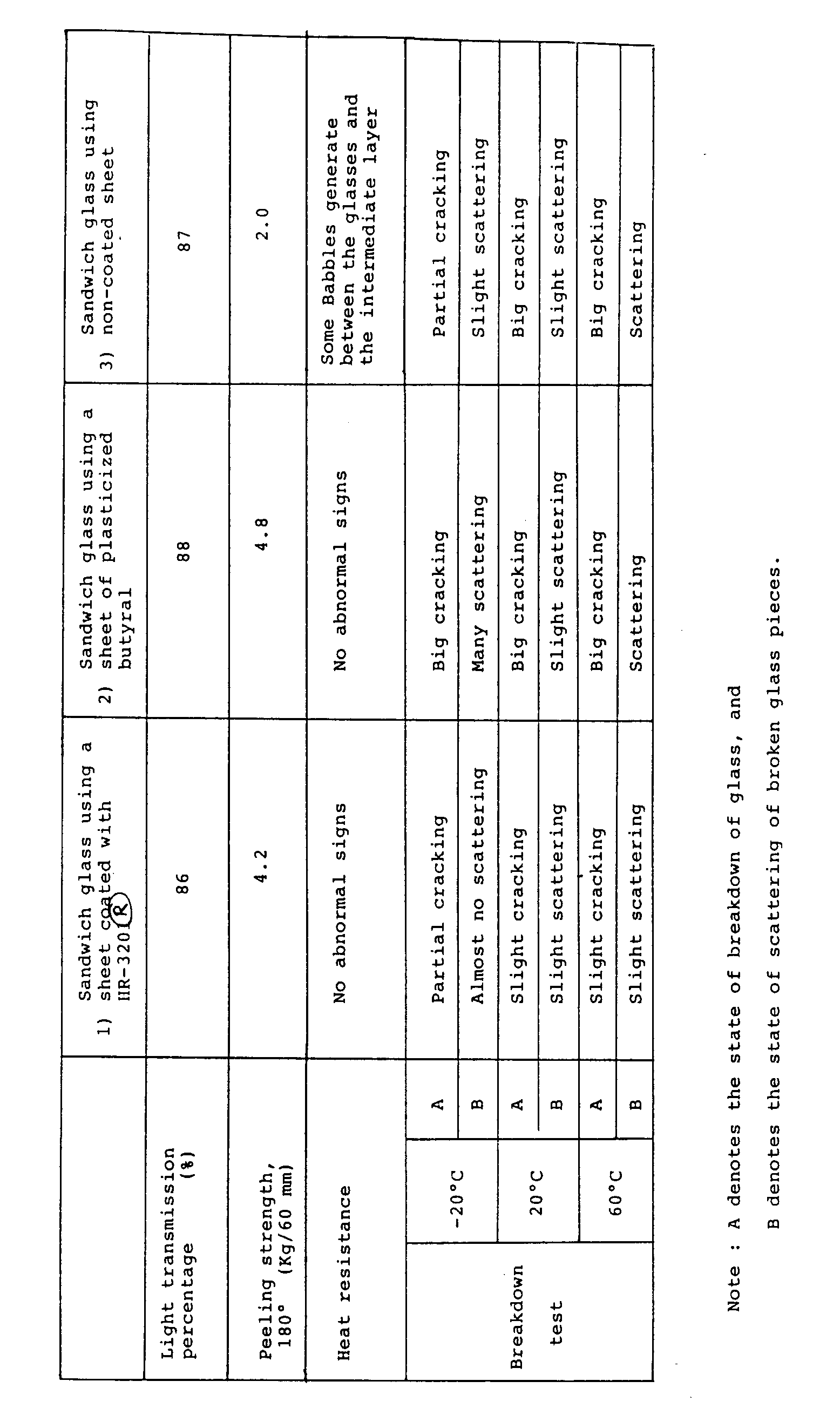
- As evident from the above table, the sandwich glass using the sheet coated with HR-3201 (a block copolymer (b)) as the interlayer shows satisfactory properties in all respects. Above all, it has a superior breakdown resistance at low temperatures, together with nearly equal adhesiveness to the hitherto known sandwich glass.
- A composition of the following constituents was blended by a blender and then extruded by an extruder to prepare pellets. This composition was named composition-A.
KRATON G-1657® 50 parts by weight KRATON G-1652® 50 parts by weight Tinuvin P® 0.4 part by weight - Using the pellets and each of the resins described below, a co-extrusion sheet composed of an intermediate composition-A layer having a thickness of 700 µm and an adhesive resin layer having a thickness of 25 µm on both sides of the intermediate layer, was prepared by using a stack plate die.
- Adhesive resins used:
- Example 8 :
- NUCREL N 1207 C®
(an ethylene/acrylic acid copolymer; Mitsui Din Pont Polychemical's product) - Example 9 :
- HAIMIRAN 1652®
(zinc salt of an ethylene/acrylic acid copolymer; Mitsui Du Pont Polychemical's product) - Example 10 :
- BONDFAST A®
(an ethylene/vinyl acetate/glycidyl acrylate terpolymer; Sumitomo Chemical's product) - Comparative Example 1 :
- EEA DPDJ-6182
(an ethylene/ethyl acrylate copolymer; Nihon Unicar's product; JAPAN) - With these sheets, sandwich glasses were prepared in the same manner as Example 7 and their properties were determined. The results are shown in the following table:

- Examples 8 - 10 gave satisfactory results.
- Using the composition-A of Example 8, a sheet having a thickness of 650 µm was prepared by extrusion through T-die. Then, a three-layer sheet was prepared from the sheet according to lamination method by extruding it together with two films of Bondfast A each having a thickness of 20 µm. With the three-layer sheet, sandwich glass was prepared in the same manner as Example 7 and properties were determined. The following results were obtained:
Light transmission percentage 86% 180°-peeling strength (Kg/50 mm) 6.1 Heat-resistance No abnormal signs Breakdown test -20°C A Partial cracking B Few scattering 20°C A Partial cracking B Few scattering - Using the composition-A of Example 8, a sheet having a thickness of 700 µm was prepared by means of T-die. On both surface of the sheet, a thin layer of TOUGHTECH HR-3201 was formed in the manner described in Example 7. The resulting sheet was held between a flat glass of Example 7 and a polycarbonate film (hard plastic sheet) having a thickness of 30 µm, and then pressed at 210°C to prepare sandwich glass of the present invention. The results obtained by determining the properties of the sandwich glass were as follows:

- Thin sandwich glass was superior to one comprising flat glass on both sides, in respect of safety, because there were no abnormal signs on its polycarbonate side, even when the glass side was cracked.
- A composition of the following constituents was blended by a blender, and then extruded by an extruder to prepare pellets.
KRATON G-1657® 60 parts by weight TOUGHTECH HR-1041® 40 parts by weight Tinuvin 326® 0.20 part by weight Tinuvin 622 LD® 0.20 part by weight - With this composition, a sheet having a thickness of 700 µm was prepared by extrusion method using T-die. In the same manner as Example 7, TOUGHTECH HR-3201® layer was formed on both surfaces of the sheet and flat glass was laminated on one side.
- Next, a ultraviolet ray curing resin composition having the constitution given in the following table was applied to the sheet up to a thickness of about 20 µm and dried at 80°C for 10 minutes.
Composition Compounding ratio (% by weight) (Polyurethane acrylate) Oligomer A reaction product of 2,4-tolylene diisocyanate, 2-hydroxyethyl acrylate and trimethylolpropane 40 Reactive monomer 1,6-Hexanediol diacrylate 10 Tetrahydrofurfuryl acrylate 10 Others (solvent) Ethyl cellosovle 10 Isopropyl alcohol 10 Toluene 10 Ethyl acetate 10 - Then, ultraviolet ray was irradiated four times at a ultraviolet ray strength of 350 mW/cm² and an irradiation speed of 20 m/minute to complete curing of the surface composition. The pencil strength of the resulting hard plastic layer (sheet) was 4H, and the thickness of the cured film was about 10 µm.
- Properties of this sandwich glass were as follows:
Light transmission percentage 86% 180°-peeling strength (Kg/50 mm) 4.2 Heat-resistance No abnormal signs Breakdown test -20°C A Cracking B Almost no scattering 20°C A Slight cracking B Few scattering - Using the composition-A of Example 8, a sheet having a thickness of 650 µm was prepared by extrusion. On both surfaces of the sheet, a film having a thickness of 5 µm of TOUGHTECH HR-3201® was formed in the same manner as Example 7. The results obtained by determining various properties of the resulting sheet are shown in the following table, along with the results obtained with a commercially available plasticized butyral resin sheet (thickness : 750 m) for sandwich glass.

Claims (13)
- A sandwich glass comprising a glass plate with one or more glass plate or hard plastic sheets which are laminated and united through a resin interlayer, the sandwich glass being characterized in that the resin comprises a block copolymer (a) comprising both terminal blocks comprising a polymer of an aromatic vinyl compound and an intermediate block comprising a polymer of conjugated diene series,
said both terminal blocks constitute 10 - 40 % by weight of the copolymer and are hydrogenated in a ratio of 10 % or less and said intermediate block is hydrogenated in a ratio of 90 % or more, and
the surface of the glass plate or hard plastic sheet to be faced on the resin interlayer has a transparent adhesive resin layer of (i) an ethylene/acrylic acid or methacrylic acid copolymer or a metal salt thereof, (ii) an ethylene/vinyl acetate/glycidyl acrylate (or glycidyl methacrylate) terpolymer or (iii) a block copolymer (b) comprising said block copolymer (a) to which 0.3 - 5 % by weight of acrylic or methacrylic acid residue is introduced. - The sandwich glass of claim 1 in which the resin interlayer is a transparent resin conposition containing the block copolymer (a) as the main component and other resins.
- The sandwich glass of claim 1 in which the polymer of aromatic vinyl compound is polystyrene, poly-α-methylstyrene, poly-p-methylstyrene or polychlorostyrene.
- The sandwich glass of claim 1 in which the polymer of conjugated diene series is polybutadiene, polyisoprene or polychloroprene.
- The sandwich glass of claim 1 in which both of the terminal blocks are composed of polystyrene.
- The sandwich glass of claim 1 in which the intermediate block has a constitution of ethylene/butylene copolymer (hydrogenation product of polybutadiene) or ethylene/propylene copolymer (hydrogenation product of polyisoprene).
- The sandwich glass of claim 1 in which both of the terminal blocks have an average molecular weight of 10000 - 300000.
- The sandwich glass of claim 1 in which the intermediate block has an average molecular weight of 5000 - 125000.
- The sandwich glass of claim 1 in which the glass plate is ordinary flat glass, float flat glass, frosted glass or heat-absorbing glass.
- The sandwich glass of claim 1 in which the hard plastic sheet comprises polymethylmethacrylate, polyethylene terephthalate resin or polycarbonate resin.
- The sandwich glass of claim 1 in which the hard plastic sheet comprises an ultraviolet ray curing resin.
- The sandwich glass of claim 1 in which two glass plates are laminated and united through the interlayer.
- The sandwich glass of claim 1 in which a glass plate and a hard plastic sheet are laminated and united through the interlayer.
Applications Claiming Priority (2)
| Application Number | Priority Date | Filing Date | Title |
|---|---|---|---|
| JP80756/87 | 1987-03-31 | ||
| JP62080756A JPS63248749A (en) | 1987-03-31 | 1987-03-31 | Laminated glass |
Publications (3)
| Publication Number | Publication Date |
|---|---|
| EP0287709A2 EP0287709A2 (en) | 1988-10-26 |
| EP0287709A3 EP0287709A3 (en) | 1989-06-14 |
| EP0287709B1 true EP0287709B1 (en) | 1992-06-24 |
Family
ID=13727254
Family Applications (1)
| Application Number | Title | Priority Date | Filing Date |
|---|---|---|---|
| EP87116186A Expired - Lifetime EP0287709B1 (en) | 1987-03-31 | 1987-11-03 | Sandwich glass |
Country Status (4)
| Country | Link |
|---|---|
| US (1) | US4822684A (en) |
| EP (1) | EP0287709B1 (en) |
| JP (1) | JPS63248749A (en) |
| DE (1) | DE3780034T2 (en) |
Families Citing this family (14)
| Publication number | Priority date | Publication date | Assignee | Title |
|---|---|---|---|---|
| US6413618B1 (en) | 1999-05-11 | 2002-07-02 | Congoleum Corporation | Laminated glass floor tile and flooring made therefrom and method for making same |
| JP2005306326A (en) * | 2004-04-26 | 2005-11-04 | Honda Motor Co Ltd | Laminated glass and interlayer film for laminated glass |
| DE102004000053A1 (en) * | 2004-11-23 | 2006-05-24 | Kuraray Specialities Europe Gmbh | Compound glazing with high energy absorption and suitable intermediate layer films |
| TWI257274B (en) * | 2005-04-27 | 2006-06-21 | Garmin Corp | Frosting-resistant panel structure |
| EP1930150A4 (en) * | 2005-09-01 | 2011-03-23 | Sekisui Chemical Co Ltd | PROCESS FOR PRODUCING LAMINATED GLASS CONSISTING PARTIALLY OF A PLASTIC PLATE, AND LAMINATED GLASS |
| US20080318063A1 (en) * | 2007-06-22 | 2008-12-25 | Anderson Jerrel C | Glass laminates with improved weatherability |
| US20090155576A1 (en) * | 2007-12-18 | 2009-06-18 | E. I. Du Pont De Nemours And Company | Glass-less glazing laminates |
| EP2394813A1 (en) * | 2009-02-03 | 2011-12-14 | Sekisui Chemical Co., Ltd. | Intermediate film for laminated glass, method for producing intermediate film for laminated glass, and laminated glass |
| WO2012016127A1 (en) * | 2010-07-30 | 2012-02-02 | E. I. Du Pont De Nemours And Company | Crosslinkable materials for safety laminates |
| CN107108352B (en) * | 2014-11-10 | 2021-01-05 | 株式会社可乐丽 | Interlayer film for laminated glass and laminated glass |
| US11084753B2 (en) * | 2014-12-03 | 2021-08-10 | Nippon Sheet Glass Company, Limited | Glass composition, glass sheet, and vehicle window including glass sheet |
| JP6907234B2 (en) | 2016-05-09 | 2021-07-21 | クラレ・アメリカ・インコーポレイテッド | Multilayer interlayer film and laminated glass |
| CN109982841A (en) * | 2016-11-23 | 2019-07-05 | Ppg工业俄亥俄公司 | The ultraviolet protection transparent body |
| WO2021108196A1 (en) * | 2019-11-26 | 2021-06-03 | Corning Incorporated | Thin glass laminates |
Family Cites Families (8)
| Publication number | Priority date | Publication date | Assignee | Title |
|---|---|---|---|---|
| GB389151A (en) * | 1931-09-09 | 1933-03-09 | Triplex Safety Glass Co | Improvements in or relating to strengthened or safety glass |
| US3415759A (en) * | 1964-03-11 | 1968-12-10 | Shell Oil Co | Preparation of hydrogenation catalysts |
| US3762988A (en) * | 1971-08-09 | 1973-10-02 | Dow Chemical Co | Interlayer and laminated product |
| US3824148A (en) * | 1972-05-11 | 1974-07-16 | Shell Oil Co | Adhesion process and article obtained thereby |
| US4264658A (en) * | 1978-07-10 | 1981-04-28 | Owens-Illinois, Inc. | Three-component polymeric coating for glass substrate |
| SU785327A1 (en) * | 1979-01-19 | 1980-12-07 | Предприятие П/Я А-7924 | Method of producing multilayer material |
| JPS56149356A (en) * | 1980-04-22 | 1981-11-19 | Sumitomo Chem Co Ltd | Laminated safety glass |
| NL8500810A (en) * | 1985-03-20 | 1986-10-16 | Dow Chemical Nederland | REINFORCED PLASTIC POLYMER COMPOSITES AND METHOD FOR PREPARING THE SAME |
-
1987
- 1987-03-31 JP JP62080756A patent/JPS63248749A/en active Granted
- 1987-10-30 US US07/114,995 patent/US4822684A/en not_active Expired - Fee Related
- 1987-11-03 EP EP87116186A patent/EP0287709B1/en not_active Expired - Lifetime
- 1987-11-03 DE DE8787116186T patent/DE3780034T2/en not_active Expired - Lifetime
Also Published As
| Publication number | Publication date |
|---|---|
| EP0287709A3 (en) | 1989-06-14 |
| US4822684A (en) | 1989-04-18 |
| DE3780034T2 (en) | 1992-12-24 |
| JPH0419178B2 (en) | 1992-03-30 |
| DE3780034D1 (en) | 1992-07-30 |
| JPS63248749A (en) | 1988-10-17 |
| EP0287709A2 (en) | 1988-10-26 |
Similar Documents
| Publication | Publication Date | Title |
|---|---|---|
| US4822684A (en) | Sandwich glass | |
| KR100411681B1 (en) | Thermoplastic interlayer film | |
| EP1979159B1 (en) | Multilayer polymeric laminates and high strength laminates produced therefrom | |
| EP2286993B1 (en) | Use of a laminated glass comprising an interlayer film | |
| EP1007352B1 (en) | Interlayer film for protective glazing laminates | |
| KR101014966B1 (en) | Cosmetic sheet for building materials and manufacturing method thereof | |
| KR20030007920A (en) | Glazing Element and Laminate for Use in the Same | |
| EP2817379B1 (en) | Adhesive for producing compound bodies, primarily a plastic-glass compound or compound glass, for architecture and construction | |
| US3532590A (en) | Laminated glass structures | |
| JPH11508842A (en) | Thermoplastic interlayer film | |
| JPS6097852A (en) | Coextruded multilayer article | |
| CN111655648B (en) | Interlayer film for laminated glass and laminated glass | |
| DE69428261T2 (en) | Surface protection film | |
| CN112646216B (en) | Polyacrylic acid-quaternary ammonium salt modified ionic polymer film and preparation method and application thereof | |
| DE112019002012T5 (en) | Door glass for vehicles | |
| US4911984A (en) | Laminated glazing unit | |
| JPS61247646A (en) | Sandwich glass | |
| EP3560901A1 (en) | Laminated glass | |
| EP0517114A1 (en) | A laminated glass and preparation thereof | |
| KR20170139561A (en) | Laminated glass | |
| US20010008695A1 (en) | Polymer films and laminates thereof | |
| JPH0371260B2 (en) | ||
| JPH06115981A (en) | Intermediate film for laminated glass | |
| US5212014A (en) | Polycarbonate sheet laminated to plasticized polyvinyl butyral sheet | |
| EP3901114A1 (en) | Interlayer for laminated glass and laminated glass |
Legal Events
| Date | Code | Title | Description |
|---|---|---|---|
| PUAI | Public reference made under article 153(3) epc to a published international application that has entered the european phase |
Free format text: ORIGINAL CODE: 0009012 |
|
| AK | Designated contracting states |
Kind code of ref document: A2 Designated state(s): BE DE FR GB IT NL |
|
| PUAL | Search report despatched |
Free format text: ORIGINAL CODE: 0009013 |
|
| AK | Designated contracting states |
Kind code of ref document: A3 Designated state(s): BE DE FR GB IT NL |
|
| 17P | Request for examination filed |
Effective date: 19890804 |
|
| 17Q | First examination report despatched |
Effective date: 19910131 |
|
| GRAA | (expected) grant |
Free format text: ORIGINAL CODE: 0009210 |
|
| AK | Designated contracting states |
Kind code of ref document: B1 Designated state(s): BE DE FR GB IT NL |
|
| REF | Corresponds to: |
Ref document number: 3780034 Country of ref document: DE Date of ref document: 19920730 |
|
| ET | Fr: translation filed | ||
| ITF | It: translation for a ep patent filed | ||
| PLBE | No opposition filed within time limit |
Free format text: ORIGINAL CODE: 0009261 |
|
| STAA | Information on the status of an ep patent application or granted ep patent |
Free format text: STATUS: NO OPPOSITION FILED WITHIN TIME LIMIT |
|
| 26N | No opposition filed | ||
| PGFP | Annual fee paid to national office [announced via postgrant information from national office to epo] |
Ref country code: BE Payment date: 19931020 Year of fee payment: 7 |
|
| PGFP | Annual fee paid to national office [announced via postgrant information from national office to epo] |
Ref country code: GB Payment date: 19931021 Year of fee payment: 7 |
|
| PGFP | Annual fee paid to national office [announced via postgrant information from national office to epo] |
Ref country code: FR Payment date: 19931026 Year of fee payment: 7 |
|
| PGFP | Annual fee paid to national office [announced via postgrant information from national office to epo] |
Ref country code: DE Payment date: 19931103 Year of fee payment: 7 |
|
| PGFP | Annual fee paid to national office [announced via postgrant information from national office to epo] |
Ref country code: NL Payment date: 19931130 Year of fee payment: 7 |
|
| PG25 | Lapsed in a contracting state [announced via postgrant information from national office to epo] |
Ref country code: GB Effective date: 19941103 |
|
| PG25 | Lapsed in a contracting state [announced via postgrant information from national office to epo] |
Ref country code: BE Effective date: 19941130 |
|
| BERE | Be: lapsed |
Owner name: DAINIPPON PLASTICS CO. LTD Effective date: 19941130 |
|
| PG25 | Lapsed in a contracting state [announced via postgrant information from national office to epo] |
Ref country code: NL Effective date: 19950601 |
|
| GBPC | Gb: european patent ceased through non-payment of renewal fee |
Effective date: 19941103 |
|
| NLV4 | Nl: lapsed or anulled due to non-payment of the annual fee | ||
| PG25 | Lapsed in a contracting state [announced via postgrant information from national office to epo] |
Ref country code: FR Effective date: 19950731 |
|
| PG25 | Lapsed in a contracting state [announced via postgrant information from national office to epo] |
Ref country code: DE Effective date: 19950801 |
|
| REG | Reference to a national code |
Ref country code: FR Ref legal event code: ST |
|
| PG25 | Lapsed in a contracting state [announced via postgrant information from national office to epo] |
Ref country code: IT Free format text: LAPSE BECAUSE OF NON-PAYMENT OF DUE FEES Effective date: 20051103 |