EP0287036B1 - New pharmaceutical compositions comprising esters or amides as active ingredients - Google Patents
New pharmaceutical compositions comprising esters or amides as active ingredients Download PDFInfo
- Publication number
- EP0287036B1 EP0287036B1 EP88105821A EP88105821A EP0287036B1 EP 0287036 B1 EP0287036 B1 EP 0287036B1 EP 88105821 A EP88105821 A EP 88105821A EP 88105821 A EP88105821 A EP 88105821A EP 0287036 B1 EP0287036 B1 EP 0287036B1
- Authority
- EP
- European Patent Office
- Prior art keywords
- pharmaceutical composition
- composition according
- ester
- acid
- amide
- Prior art date
- Legal status (The legal status is an assumption and is not a legal conclusion. Google has not performed a legal analysis and makes no representation as to the accuracy of the status listed.)
- Expired - Lifetime
Links
- 0 Cc1ccccc1* Chemical compound Cc1ccccc1* 0.000 description 1
Images


Classifications
-
- A—HUMAN NECESSITIES
- A61—MEDICAL OR VETERINARY SCIENCE; HYGIENE
- A61K—PREPARATIONS FOR MEDICAL, DENTAL OR TOILETRY PURPOSES
- A61K31/00—Medicinal preparations containing organic active ingredients
- A61K31/21—Esters, e.g. nitroglycerine, selenocyanates
- A61K31/215—Esters, e.g. nitroglycerine, selenocyanates of carboxylic acids
-
- A—HUMAN NECESSITIES
- A61—MEDICAL OR VETERINARY SCIENCE; HYGIENE
- A61K—PREPARATIONS FOR MEDICAL, DENTAL OR TOILETRY PURPOSES
- A61K31/00—Medicinal preparations containing organic active ingredients
- A61K31/557—Eicosanoids, e.g. leukotrienes or prostaglandins
-
- A—HUMAN NECESSITIES
- A61—MEDICAL OR VETERINARY SCIENCE; HYGIENE
- A61K—PREPARATIONS FOR MEDICAL, DENTAL OR TOILETRY PURPOSES
- A61K31/00—Medicinal preparations containing organic active ingredients
- A61K31/185—Acids; Anhydrides, halides or salts thereof, e.g. sulfur acids, imidic, hydrazonic or hydroximic acids
- A61K31/19—Carboxylic acids, e.g. valproic acid
- A61K31/195—Carboxylic acids, e.g. valproic acid having an amino group
-
- A—HUMAN NECESSITIES
- A61—MEDICAL OR VETERINARY SCIENCE; HYGIENE
- A61K—PREPARATIONS FOR MEDICAL, DENTAL OR TOILETRY PURPOSES
- A61K31/00—Medicinal preparations containing organic active ingredients
- A61K31/21—Esters, e.g. nitroglycerine, selenocyanates
-
- A—HUMAN NECESSITIES
- A61—MEDICAL OR VETERINARY SCIENCE; HYGIENE
- A61K—PREPARATIONS FOR MEDICAL, DENTAL OR TOILETRY PURPOSES
- A61K31/00—Medicinal preparations containing organic active ingredients
- A61K31/21—Esters, e.g. nitroglycerine, selenocyanates
- A61K31/215—Esters, e.g. nitroglycerine, selenocyanates of carboxylic acids
- A61K31/22—Esters, e.g. nitroglycerine, selenocyanates of carboxylic acids of acyclic acids, e.g. pravastatin
-
- A—HUMAN NECESSITIES
- A61—MEDICAL OR VETERINARY SCIENCE; HYGIENE
- A61K—PREPARATIONS FOR MEDICAL, DENTAL OR TOILETRY PURPOSES
- A61K31/00—Medicinal preparations containing organic active ingredients
- A61K31/21—Esters, e.g. nitroglycerine, selenocyanates
- A61K31/215—Esters, e.g. nitroglycerine, selenocyanates of carboxylic acids
- A61K31/235—Esters, e.g. nitroglycerine, selenocyanates of carboxylic acids having an aromatic ring attached to a carboxyl group
-
- A—HUMAN NECESSITIES
- A61—MEDICAL OR VETERINARY SCIENCE; HYGIENE
- A61K—PREPARATIONS FOR MEDICAL, DENTAL OR TOILETRY PURPOSES
- A61K31/00—Medicinal preparations containing organic active ingredients
- A61K31/33—Heterocyclic compounds
- A61K31/395—Heterocyclic compounds having nitrogen as a ring hetero atom, e.g. guanethidine or rifamycins
- A61K31/40—Heterocyclic compounds having nitrogen as a ring hetero atom, e.g. guanethidine or rifamycins having five-membered rings with one nitrogen as the only ring hetero atom, e.g. sulpiride, succinimide, tolmetin, buflomedil
-
- A—HUMAN NECESSITIES
- A61—MEDICAL OR VETERINARY SCIENCE; HYGIENE
- A61K—PREPARATIONS FOR MEDICAL, DENTAL OR TOILETRY PURPOSES
- A61K31/00—Medicinal preparations containing organic active ingredients
- A61K31/60—Salicylic acid; Derivatives thereof
-
- A—HUMAN NECESSITIES
- A61—MEDICAL OR VETERINARY SCIENCE; HYGIENE
- A61K—PREPARATIONS FOR MEDICAL, DENTAL OR TOILETRY PURPOSES
- A61K47/00—Medicinal preparations characterised by the non-active ingredients used, e.g. carriers or inert additives; Targeting or modifying agents chemically bound to the active ingredient
- A61K47/06—Organic compounds, e.g. natural or synthetic hydrocarbons, polyolefins, mineral oil, petrolatum or ozokerite
- A61K47/08—Organic compounds, e.g. natural or synthetic hydrocarbons, polyolefins, mineral oil, petrolatum or ozokerite containing oxygen, e.g. ethers, acetals, ketones, quinones, aldehydes, peroxides
- A61K47/14—Esters of carboxylic acids, e.g. fatty acid monoglycerides, medium-chain triglycerides, parabens or PEG fatty acid esters
-
- A—HUMAN NECESSITIES
- A61—MEDICAL OR VETERINARY SCIENCE; HYGIENE
- A61K—PREPARATIONS FOR MEDICAL, DENTAL OR TOILETRY PURPOSES
- A61K9/00—Medicinal preparations characterised by special physical form
- A61K9/48—Preparations in capsules, e.g. of gelatin, of chocolate
- A61K9/4891—Coated capsules; Multilayered drug free capsule shells
Definitions
- the present invention is concerned with new pharmaceutical compositions comprising esters or amides as active ingredients. More particularly, it relates to pharmaceutical compositions characterized in that esters or amides are suspended or dissolved in middle chain glycerides (referred to as "MCG” hereafter) or mixtures thereof.
- MCG middle chain glycerides
- the degradation of the esters or amides by digestive enzymes e.g. esterases and peptidases is inhibited by suspending or dissolving the said esters or amides in MCGs.
- esters of guanidinobenzoic acid are known to be useful as medicines, for example, useful in the treatment of acute pancreatitis owing to their anti-plasmin activity and anti-trypsin acitivity and in the treatment of pulmonary emphysema owing to their inhibitory activity on elastase.
- esters are degraded by the action of various esterases in the digestive system, especially in the intestine comparatively rapidly.
- Esters of guanidinobenzoic acid are degraded to guanidino benzoic acid and an alcohol corresponding to the ester moiety (when a medicine has plural ester-bonds, it is presumed that the bonds are severed in order of facility in breaking and finally the medicine is degraded to guanidinobenzoic acid and another part. Any degradation products have no desired pharmacological effect or have the structure not to be absorbed, and therefore, the bioavailability of the esters of guanidinobenzoic acid descends.
- esters and amides which are considered to be degraded by the action of various esterases and peptidases in digestive system, are degraded comparatively rapidly, similarly to esters of guanidinobenzoic acid.
- W/OIW-formed emulsion comprising insulin as active agent and middle chain triglycerides (referred to as "MCT" hereafter) as oily substance, and inhibiting the degradation by the action of digestive enzymes, is disclosed.
- MCT middle chain triglycerides
- MCT is used as oily substance which the oily phase in W/0/W-formed emulsion is composed of.
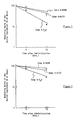
- Figure 1 to 8 are the time-course of the remaining ratio of the active ingredient in the parnnaceuticaI composition of the present invention, in small intestine, and Fig. 1, 2, 3,4, 5, 6, 7 and 8 relate to Compound A, Compound B, Compound C, Compound D, Compound E, Compound F, Compound G and Compound H, respectively.
- the present invention is concerned with parmaceutical compositions which essentially consists of an ester of benzoic acid orthromboxane analogues, an amide of benzoic acid, thromboxanes analogues or prostaglandin analogues, or prolinal orthiazolidine derivatives having amido bond(s) suspended or dissolved in middle chain glycerides (referred to as "MCG” hereafter) or a mixture of two or more of them.
- MCG middle chain glycerides
- compositions comprising glycosides, antibiotics having ester bonds and nifedipine, with MCGs are disclosed in the specifications of the British Patent Publication No. 1544576, the European Patent Publication No. 108295 and the Japanese Patent Kokai Nos 58-170788 and 59-106418.
- the CH-A-634 749 discloses a composition comprising valethamat-bromide and MCGs.
- esters of benzoic acid compounds being an ester of p-guanidinobenzoic acid as fundamental chemical structure are preferred.
- the esters are compounds of the general formula : (wherein R is an organic group) and non-toxic acid-addition salts thereof. They are described in detail, for example, in the specification of the Japanese Patent Kokai Nos. 50-4038, 51-16631, 51-54530, 51-75042, 52-89640, 53-147044, 54-70241, 55-55154, 55-100356, 55-115863, 55-115865, 56-34662 and 57-53454, and of the British Patent Nos. 1472700, 2007653, 2044760 and 2057435, and of the European Patent Publication No.
- R is a substitued aromatic group in the general formula (I)
- Such compounds are p-(p-guanidinobenzoy16xy)phenylacetic acid N,N-dimethylcarbamoylmethyl ester, p-guanidinobenzoic acid p-sulfamoylphenyl ester, p-guanidinobenzoic acid 6-amidinonaphth-2-yl ester and non-toxic acid-addition salts thereof.
- p-Guanidinobenzoic acid methyl ester and non-toxic acid-addition salts thereof are also preferred.
- esters of benzoic acid are esters of salicylic acid, eg salicylic acid ethyl ester.
- esters of thromboxane analogues used in the present invention are the compounds described in the specification of the British Patent Publication No. 2184118 and of the European Patent Publication Nos. 44771 and 171146.
- Such compounds are, for example, alkyl esters of 7-(3-tosylaminobicydo [2.2.1]heptan-2-jrl)-5Z-heptenoic acid.
- compositions comprising cyclosporins and antibiotics having amido bonds, with MCGs are disclosed in the specification of the British Patent Publication No. 2015339 and of the European Patent Publication No. 108295 and of the Japanese Patent Kokai No. 58-170788.
- GB-A- 1544576 discloses a composition comprising the amide chloramphenical and medium chain fatty acid triglycerides.
- amides of prostaglandin analogues used in the invention are disclosed in the specifications of the European Patent Publication Nos. 156611, 182231 and 232126, and of the French Patent Publication No. 2376134 and further in the Chemical Abstracts, abstract Nos. 77743g (1976), 43438a (1976) and 131213h (1975).
- Such compounds are, for example, amides of 6-keto-16S, 18S-ethano-20-ethyl-PGE, with an amino acid.
- amides of thromboxane analogues used in the invention are disclosed in the specification of EP-A-0312906.
- Such compounds are, for example, amides of 7-(3-tosylaminobi- cyclo[2.2.1]heptan-2-yl)-5Z-heptenoic acid with an amino acid.
- prolinal or thiazolidine derivatives having amido bonds used in the invention the preferred compounds are disclosed in the specification of EP-A- 0268190 and of the Japanese Patent Kokai No. 64-6263.
- Such compounds are, for example, N-[3-[N-4-chlorobenzyl)carbamoyl]propanoyl]-L-prolinal.
- esters or amides used in the compositions of the present invention are not limited.
- the esters of p-guanidinobenzoic acid of the general formula (I) have inhibitory effects on proteinases such as anti-plasmin activity, antitrypsin activity, and therefore may be useful in the treatment of acute pancreatitis, or they have an inhibitory effect on elastase, and therefore may be useful in the treatment of pulmonary emphysema.
- MCGs in the present invention mean a monoglyceride of a fatty acid of 4 to 10 carbon atoms (referred to as “MCM” hereafter), a corresponding diglyceride (referred to as “MCD” hereafter) and a corresponding triglyceride (referred to as “MCT” hereafter), and a mixture of two or more of them.
- MCM monoglyceride of a fatty acid of 4 to 10 carbon atoms
- MCD corresponding diglyceride
- MCT corresponding triglyceride
- MCGs used in the present invention are on the market with trade marks, e.g. Migryol and Imwitor (both prepared by Dynamite Novel Co.) and Panacete (prepared by Nippon Yushi Co.).
- DE-A- 3 042 975 discloses a composition comprising aspirin and an amphiphilic substance like lecithine.
- the suspension composition or solution composition of the present invention may, if desired, comprise other inert additional substances, for example, viscosity-lowing agents such as phospholipids and non-ionic surface-active agents, and specific gravity-controlling agents such as calcium carbonate, calcium citrate and calcium gluconate.
- viscosity-lowing agents such as phospholipids and non-ionic surface-active agents
- specific gravity-controlling agents such as calcium carbonate, calcium citrate and calcium gluconate.
- compositions of the present invention may be prepared by adding esters or amides, and, if desired, other additional substances into MCGs, and suspending or dissolving the mixture by known methods.
- the obtained suspensions or solutions may be administered as they are (directly), and preferably administered in the form of capsules formulations filled into gelatin-made soft capsules or gelatin-made hard capsules.
- the said capsule formulation may be coated with an enteric coating. Any enteric coatings being unreactive with active ingredients may be used. Preferable examples of enteric coatings used are carboxymethylethyl cellulose, hydroxypropylmethyl cellulose acetate succinate and phospholipids.
- the preparation of capsules and the coating with enteric coating may be carried out by known methods.
- compositions of the present invention may inhibit the degradation of esters or amides by the action of digestive enzymes in digestive system, and therefore the bioavailability of the active ingredient remarkably ascends.
- glyceryl tricaprylate Panacete® 800, prepared by Nippon Yushi Co.
- bean lecithin prepared by Hohnen Seiyu Co.
- the suspension of the present invention was obtained by using 250 g of p-guanidinobenzoic acid 6-amidinonaphth-2-yl ester dimethanesulfonate, 740 g of glyceryl tricaprylate and 10 g of bean lecithin.
- the suspension of the present invention was obtained by using 50 g of p-guanidinobenzoic acid p-sulfamoylphenyl ester methanesulfonate, 940 g of glyceryl mono- caprate (Panacete® 1000, prepared by Nippon Yushi Co.) and 10 g of bean lecithin.
- the suspension of the present invention was obtained by using 50 g of p-guanidinobenzoic acid methyl ester methanesulfonate, 940 g of glyceryl monocaprylate (Imwitor® 742, prepared by Dynamite Novel Co.) and 10 g of bean lecithin.
- the suspension of the present invention was obtained by using 250 g of p-(p-guanidinobenzoyloxy)phenylacetic acid N,N-dimethylcarbamoylmethyl ester methanesulfonate, 740 g of a mixture of glyceryl monocaprylate and glyceryl dicaprylate (6 : 4) (Imwitor® 908, prepared by Dynamite Novel Co.) and 10 g of bean lecithin.
- the suspensionn of the present invention was obtained by using 250 g of N-[3-[N-(4-chlorobenzyl)carbamoyl]propanoyl]-L-prolinal, 740 g of glyceryl tricaprylate and 10 g of bean lecithin.
- Example 1 1000 g of the suspension prepared in Example 1 were filled into water-soluble soft capsules with a rotary-capsule machine by methods known per se to obtain about 2500 capsules.
- the soft capsules prepared in Reference Example 1 were coated with an aqueous solution containing 12% (w/v) carboxymethylethyl cellulose (CMEC. AQ@, prepared by Freund Sangyo Co.), 3% (w/v) glyceryl caprylate and 1% (w/v) sodium citrate by pan-coating method to obtain enteric-coated soft capsules.
- CMEC. AQ@ carboxymethylethyl cellulose
- 3% (w/v) glyceryl caprylate 1% (w/v) sodium citrate
- the soft capsules prepared in Reference Example 1 were coated with an aqueous solution containing 10% (w/v) hydroxypropylmethyl cellulose acetate succinate (HPMCAS®, prepared by Shin-etsu Kagaku Co.), 2% (w/v) triethyl citrate, 5% (w/v) talc and 0.05% (w/v) hydroxypropylcellulose (HPC-MF@, prepared by Shin-etsu Kagaku Co.) by pan-coating method to obtain enteric-coated soft capsules.
- HPMCAS® hydroxypropylmethyl cellulose acetate succinate
- HPC-MF@ prepared by Shin-etsu Kagaku Co.
- each suspension or solution prepared in Example 2 to 10 were filled into water-soluble soft capsules with a rotary-capsule machine by methods known per se to obtain 2500 each capsules (100 mg of the active ingredient were contained in each capsules obtained from the composition of Example 2, 5, 7 and 10, and 20 mg of the active ingredient were contained in each capsules obtained from the composition of Example 3, 4 and 9, and further 8 mg of the active ingredient were contained in each capsules obtained from the composition of Example 6 and 8).
- enteric-coated soft capsules were obtained by using soft capsules prepared in Reference Example 4.
- enteric-coated soft capsules were obtained by using soft capsules prepared in Reference Example 4.
- Example 1 to 10 1000 g of the suspension or solution prepared in Example 1 to 10 were filled into water-soluble hard capsules with an oil and paste filling machine by methods known per se to obtain about 2500 each capsules.
- enteric-coated hard capsules were obtained by using hard capsules prepared in Reference Example 7.
- the experiment was carried out according to the Yasuhara's method using intestinal loop in rats [see Journal of Pharmacobio-Dynamics, 2, 251 (1979)]. That is, male Sprague-Dawley rats weighing 220-260 g were fasted an overnight priorto surgery ; however drinking water was readily accessible. The rats were anesthetized by sodium pentobarbital using an intraperitoneal injection of 50 mg/kg. The small intestine was exposed by a midline abdominal incision. The intestinal loop studied was used approximately 15 cm of the duodenal- jejunal site that was approximately 2 cm off the outlet of bile duct.
- the suspension or solution containing active ingredients was directly administered into the loop and the both ends of the loop were closed.
- the experiment with Compound F and H was carried out further by adding pancreatic juice and bile of other rats into the loop by cannula. After a given period of time, the loop was cut out. The contents were washed out with physiological salt solution and/or ethanol, and thereto was added a mixture of 0.1 N aqueous methanesulfonic acid, 1 ,2-dichloroethane and isopropanol. The obtained mixture was centrifuged and the resulting supernatant was used as a sample. In the case of Compound D to G, the washings were directly used as a sample. The active ingredient and the degradation products in sample were determined with high pressure liquid chromatography.
- H 2 0 dissolving in the ratio of 5 mg of active ingredient/0.5 ml of water/animal.
- Each one soft capsule prepared in Reference Example 1, 2, 3, 4, 5 and 6 (used only a suspension of Example 2 (compound B) in Reference Example 4, 5 and 6) was administered orally with 50 ml of water to six male Beagle dogs fasted an overnight (aged one to two and weighing 10 ⁇ 1 kg).
- the concentration of the active ingredient in blood, AUC, and then BA were calculated. The resulte was shown in Table 3.
- BA of the composition in which the active ingredient is suspended in MCG is about 1.5 to 3 times as superior as BA of the composition in which it is not suspended in MCG, even in oral administration.
Landscapes
- Health & Medical Sciences (AREA)
- Chemical & Material Sciences (AREA)
- Veterinary Medicine (AREA)
- Medicinal Chemistry (AREA)
- Pharmacology & Pharmacy (AREA)
- Epidemiology (AREA)
- Life Sciences & Earth Sciences (AREA)
- Animal Behavior & Ethology (AREA)
- General Health & Medical Sciences (AREA)
- Public Health (AREA)
- Emergency Medicine (AREA)
- Engineering & Computer Science (AREA)
- Bioinformatics & Cheminformatics (AREA)
- Chemical Kinetics & Catalysis (AREA)
- General Chemical & Material Sciences (AREA)
- Oil, Petroleum & Natural Gas (AREA)
- Acyclic And Carbocyclic Compounds In Medicinal Compositions (AREA)
- Medicinal Preparation (AREA)
- Organic Low-Molecular-Weight Compounds And Preparation Thereof (AREA)
- Medicines That Contain Protein Lipid Enzymes And Other Medicines (AREA)
- Pharmaceuticals Containing Other Organic And Inorganic Compounds (AREA)
Abstract
Description
- The present invention is concerned with new pharmaceutical compositions comprising esters or amides as active ingredients. More particularly, it relates to pharmaceutical compositions characterized in that esters or amides are suspended or dissolved in middle chain glycerides (referred to as "MCG" hereafter) or mixtures thereof. The degradation of the esters or amides by digestive enzymes (e.g. esterases and peptidases) is inhibited by suspending or dissolving the said esters or amides in MCGs.
- Out of many esters, various esters of guanidinobenzoic acid are known to be useful as medicines, for example, useful in the treatment of acute pancreatitis owing to their anti-plasmin activity and anti-trypsin acitivity and in the treatment of pulmonary emphysema owing to their inhibitory activity on elastase.
- Recently, as a result of their detailed research on pharmacokinetics in oral administration of the above esters, the present inventors have found unexpected facts. That is, it has been confirmed that these esters are degraded by the action of various esterases in the digestive system, especially in the intestine comparatively rapidly.
- Esters of guanidinobenzoic acid are degraded to guanidino benzoic acid and an alcohol corresponding to the ester moiety (when a medicine has plural ester-bonds, it is presumed that the bonds are severed in order of facility in breaking and finally the medicine is degraded to guanidinobenzoic acid and another part. Any degradation products have no desired pharmacological effect or have the structure not to be absorbed, and therefore, the bioavailability of the esters of guanidinobenzoic acid descends.
- Furthermore, it has turned out that other esters and amides which are considered to be degraded by the action of various esterases and peptidases in digestive system, are degraded comparatively rapidly, similarly to esters of guanidinobenzoic acid.
- As a result of their energetic investigation in order to find means to inhibit the degradation of the esters or amides by the action of digestive enzymes (e.g. various esterases and peptidases) in digestive system, the present inventors have found that the purpose is accomplished by suspending or dissolving the said esters or amides in MCGs, and have completed the present invention.
- In the specification of the Japanese Patent Kokai No. 55-17328, W/OIW-formed emulsion comprising insulin as active agent and middle chain triglycerides (referred to as "MCT" hereafter) as oily substance, and inhibiting the degradation by the action of digestive enzymes, is disclosed. In the composition, MCT is used as oily substance which the oily phase in W/0/W-formed emulsion is composed of. There is a fundamental difference in structure from the MCG suspensions or solutions of the present invention, and further, such W/O/W-formed emulsion does not suggest the present invention at all.
- Furthermore, no other prior art relating to MCGs suspensions or solutions for inhibiting the degradation of active ingredients by the action of digestive enzymes, is known. Further, no compositions comprising suspensions or solutions of guanidinobenzoic acid derivatives in MCGs have so far been known.
- Figure 1 to 8 are the time-course of the remaining ratio of the active ingredient in the parnnaceuticaI composition of the present invention, in small intestine, and Fig. 1, 2, 3,4, 5, 6, 7 and 8 relate to Compound A, Compound B, Compound C, Compound D, Compound E, Compound F, Compound G and Compound H, respectively.
- Accordingly, the present invention is concerned with parmaceutical compositions which essentially consists of an ester of benzoic acid orthromboxane analogues, an amide of benzoic acid, thromboxanes analogues or prostaglandin analogues, or prolinal orthiazolidine derivatives having amido bond(s) suspended or dissolved in middle chain glycerides (referred to as "MCG" hereafter) or a mixture of two or more of them.
- Compositions comprising glycosides, antibiotics having ester bonds and nifedipine, with MCGs are disclosed in the specifications of the British Patent Publication No. 1544576, the European Patent Publication No. 108295 and the Japanese Patent Kokai Nos 58-170788 and 59-106418.
- The CH-A-634 749 discloses a composition comprising valethamat-bromide and MCGs.
- Of the esters of benzoic acid, compounds being an ester of p-guanidinobenzoic acid as fundamental chemical structure are preferred. Especially preferably, the esters are compounds of the general formula :

- Other preferable esters of benzoic acid are esters of salicylic acid, eg salicylic acid ethyl ester.
- The esters of thromboxane analogues used in the present invention are the compounds described in the specification of the British Patent Publication No. 2184118 and of the European Patent Publication Nos. 44771 and 171146. Such compounds are, for example, alkyl esters of 7-(3-tosylaminobicydo [2.2.1]heptan-2-jrl)-5Z-heptenoic acid.
- Compositions comprising cyclosporins and antibiotics having amido bonds, with MCGs are disclosed in the specification of the British Patent Publication No. 2015339 and of the European Patent Publication No. 108295 and of the Japanese Patent Kokai No. 58-170788. GB-A- 1544576 discloses a composition comprising the amide chloramphenical and medium chain fatty acid triglycerides.
- Of the amides of prostaglandin analogues used in the invention the preferred compounds are disclosed in the specifications of the European Patent Publication Nos. 156611, 182231 and 232126, and of the French Patent Publication No. 2376134 and further in the Chemical Abstracts, abstract Nos. 77743g (1976), 43438a (1976) and 131213h (1975). Such compounds are, for example, amides of 6-keto-16S, 18S-ethano-20-ethyl-PGE, with an amino acid.
- Of the amides of benzoic acid used in the invention the preferred compounds are disclosed in the specification of the European Patent Publication No. 173516.
- Of the amides of thromboxane analogues used in the invention the preferred compounds are disclosed in the specification of EP-A-0312906. Such compounds are, for example, amides of 7-(3-tosylaminobi- cyclo[2.2.1]heptan-2-yl)-5Z-heptenoic acid with an amino acid.
- Of the prolinal or thiazolidine derivatives having amido bonds used in the invention the preferred compounds are disclosed in the specification of EP-A- 0268190 and of the Japanese Patent Kokai No. 64-6263. Such compounds are, for example, N-[3-[N-4-chlorobenzyl)carbamoyl]propanoyl]-L-prolinal.
- Pharmacological effects of esters or amides used in the compositions of the present invention are not limited. For example, the esters of p-guanidinobenzoic acid of the general formula (I) have inhibitory effects on proteinases such as anti-plasmin activity, antitrypsin activity, and therefore may be useful in the treatment of acute pancreatitis, or they have an inhibitory effect on elastase, and therefore may be useful in the treatment of pulmonary emphysema.
- MCGs in the present invention mean a monoglyceride of a fatty acid of 4 to 10 carbon atoms (referred to as "MCM" hereafter), a corresponding diglyceride (referred to as "MCD" hereafter) and a corresponding triglyceride (referred to as "MCT" hereafter), and a mixture of two or more of them. The fatty acids having any carbon atoms are preferred. Glycerides of caprylic acid and of capric acid are more preferred. Glyceryl monocaprylate, glyceryl dicaprylate and glyceryl tricaprylate, and a mixture thereof are especially preferred. MCGs used in the present invention are on the market with trade marks, e.g. Migryol and Imwitor (both prepared by Dynamite Novel Co.) and Panacete (prepared by Nippon Yushi Co.).
- The use of MCGs to improve the bioabsorbability of antibiotics (GB-A- 2 015 339) and the amide chloramphenical (GB-A- 1 544 576) or to improve the stability of unstable drugs (DE-A- 2 819 447) is known in the art. DE-A- 3 042 975 discloses a composition comprising aspirin and an amphiphilic substance like lecithine.
- The suspension composition or solution composition of the present invention may, if desired, comprise other inert additional substances, for example, viscosity-lowing agents such as phospholipids and non-ionic surface-active agents, and specific gravity-controlling agents such as calcium carbonate, calcium citrate and calcium gluconate.
- The pharmaceutical compositions of the present invention may be prepared by adding esters or amides, and, if desired, other additional substances into MCGs, and suspending or dissolving the mixture by known methods.
- The obtained suspensions or solutions may be administered as they are (directly), and preferably administered in the form of capsules formulations filled into gelatin-made soft capsules or gelatin-made hard capsules. If necessary, the said capsule formulation may be coated with an enteric coating. Any enteric coatings being unreactive with active ingredients may be used. Preferable examples of enteric coatings used are carboxymethylethyl cellulose, hydroxypropylmethyl cellulose acetate succinate and phospholipids. The preparation of capsules and the coating with enteric coating may be carried out by known methods.
- The pharmaceutical compositions of the present invention may inhibit the degradation of esters or amides by the action of digestive enzymes in digestive system, and therefore the bioavailability of the active ingredient remarkably ascends.
- The following examples, reference examples and experiments illustrate, the present invention in detail.
- A mixture of 250 g of p-(p-guanidinobenzoyloxy)phenylacetic acid N,N-dimethylcarbamoylmethyl ester methanesulfonate, 740 g of glyceryl tricaprylate (Panacete® 800, prepared by Nippon Yushi Co.) and 10 g of bean lecithin (prepared by Hohnen Seiyu Co.) was stirred enough and then sieved through a 100-mesh sieve to obtain the desired suspension of the present invention.
- By the same procedure as described in Example 1, the suspension of the present invention was obtained by using 250 g of p-guanidinobenzoic acid 6-amidinonaphth-2-yl ester dimethanesulfonate, 740 g of glyceryl tricaprylate and 10 g of bean lecithin.
- By the same procedure as described in Example 1, the suspension of the present invention was obtained by using 50 g of p-guanidinobenzoic acid p-sulfamoylphenyl ester methanesulfonate, 940 g of glyceryl mono- caprate (Panacete® 1000, prepared by Nippon Yushi Co.) and 10 g of bean lecithin.
- By the same procedure as described in Example 1, the suspension of the present invention was obtained by using 50 g of p-guanidinobenzoic acid methyl ester methanesulfonate, 940 g of glyceryl monocaprylate (Imwitor® 742, prepared by Dynamite Novel Co.) and 10 g of bean lecithin.
- By the same procedure as described in Example 1, the suspension of the present invention was obtained by using 250 g of p-(p-guanidinobenzoyloxy)phenylacetic acid N,N-dimethylcarbamoylmethyl ester methanesulfonate, 740 g of a mixture of glyceryl monocaprylate and glyceryl dicaprylate (6 : 4) (Imwitor® 908, prepared by Dynamite Novel Co.) and 10 g of bean lecithin.
- 980 g of glyceryl tricaprylate were added little by little to 20 g of 7-[(1R, 2S, 3S, 4S)-3-tosylaminobi- cydo[2.2.1]heptan-2-yi]-5Z-heptenoic acid ethyl ester and the mixture was stirred enough to obtain the desired solution of the present invention.
- 50 ml of ethanol was added to 250 g of salicylic acid ethyl ester with stirring to give semi-solid solution. To the mixture was added 750 g of glyceryl tricaprylate and the obtained mixture was stirred enough. Ethanol was removed completely from the mixture under vacuum more than an overnight to obtain the suspension of the present invention.
- 10 ml of ethanol was added to 20 g of an amide of 6-keto-16S, 18S-ethano-20-ethyl-PGE1 with L-leucine. To the obtained solution was added 980 g of glyceryl tricaprylate and the mixture was stirred enough. Ethanol was removed completely from the mixture under vacuum more than an overnight to obtain the solution of the present invention.
- A mixture of 50 g of an amide of 7-[(1R, 2S, 3S, 4S)-3-tosylaminobicyclo[2.2.1]heptan-2-yl]-5Z-heptenoic acid with glycine, 940 g of glyceryl monocaprylate and 10 g of polyoxyethylenehydrogenated caster oil (HCO-600, prepared by Nikko chemicals Co.) was stirred enough to obtain the suspension of the present invention.
- By the same procedure as described in Example 1, the suspensionn of the present invention was obtained by using 250 g of N-[3-[N-(4-chlorobenzyl)carbamoyl]propanoyl]-L-prolinal, 740 g of glyceryl tricaprylate and 10 g of bean lecithin.
- 1000 g of the suspension prepared in Example 1 were filled into water-soluble soft capsules with a rotary-capsule machine by methods known per se to obtain about 2500 capsules.
- The soft capsules prepared in Reference Example 1 were coated with an aqueous solution containing 12% (w/v) carboxymethylethyl cellulose (CMEC. AQ@, prepared by Freund Sangyo Co.), 3% (w/v) glyceryl caprylate and 1% (w/v) sodium citrate by pan-coating method to obtain enteric-coated soft capsules.
- The soft capsules prepared in Reference Example 1 were coated with an aqueous solution containing 10% (w/v) hydroxypropylmethyl cellulose acetate succinate (HPMCAS®, prepared by Shin-etsu Kagaku Co.), 2% (w/v) triethyl citrate, 5% (w/v) talc and 0.05% (w/v) hydroxypropylcellulose (HPC-MF@, prepared by Shin-etsu Kagaku Co.) by pan-coating method to obtain enteric-coated soft capsules.
- 1000 g of each suspension or solution prepared in Example 2 to 10 were filled into water-soluble soft capsules with a rotary-capsule machine by methods known per se to obtain 2500 each capsules (100 mg of the active ingredient were contained in each capsules obtained from the composition of Example 2, 5, 7 and 10, and 20 mg of the active ingredient were contained in each capsules obtained from the composition of Example 3, 4 and 9, and further 8 mg of the active ingredient were contained in each capsules obtained from the composition of Example 6 and 8).
- By the same procedure as described in Reference Example 2, enteric-coated soft capsules were obtained by using soft capsules prepared in Reference Example 4.
- By the same procedures as described in Reference Example 3, enteric-coated soft capsules were obtained by using soft capsules prepared in Reference Example 4.
- 1000 g of the suspension or solution prepared in Example 1 to 10 were filled into water-soluble hard capsules with an oil and paste filling machine by methods known per se to obtain about 2500 each capsules.
- By the same procedures as described in Reference Example 2 or 3, enteric-coated hard capsules were obtained by using hard capsules prepared in Reference Example 7.
- The experiment was carried out according to the Yasuhara's method using intestinal loop in rats [see Journal of Pharmacobio-Dynamics, 2, 251 (1979)]. That is, male Sprague-Dawley rats weighing 220-260 g were fasted an overnight priorto surgery ; however drinking water was readily accessible. The rats were anesthetized by sodium pentobarbital using an intraperitoneal injection of 50 mg/kg. The small intestine was exposed by a midline abdominal incision. The intestinal loop studied was used approximately 15 cm of the duodenal- jejunal site that was approximately 2 cm off the outlet of bile duct.
- The suspension or solution containing active ingredients was directly administered into the loop and the both ends of the loop were closed. The experiment with Compound F and H was carried out further by adding pancreatic juice and bile of other rats into the loop by cannula. After a given period of time, the loop was cut out. The contents were washed out with physiological salt solution and/or ethanol, and thereto was added a mixture of 0.1 N aqueous methanesulfonic acid, 1 ,2-dichloroethane and isopropanol. The obtained mixture was centrifuged and the resulting supernatant was used as a sample. In the case of Compound D to G, the washings were directly used as a sample. The active ingredient and the degradation products in sample were determined with high pressure liquid chromatography.
- Compound A: p-(p-guanidinobenzoyloxy)phenylacetic acid N,N-dimethylcarbamoylmethyl ester methanesulfonate

- Compound B: p-guanidinobenzoic acid 6-amidinonaphth-2-yl ester dimethanesulfonate

- Compound C: p-guanidinobenzoic acid methyl ester methanesulfonate

- Compound: D : 7-(3-tosylaminobicyclo[2.2.1]heptan-2-yl)-5Z-heptenoic acid ethyl ester

- Compound E : salicylic acid ethyl ester

- Compound F: 6-keto-16S, 18S-ethano-20-ethyl-PGE1 leucine amide

- Compound G: N-[3-[N-(4-chlorobenzyl)carbamoyl]propanoyl]-L-prolinal

- Compound H : 7-(3-tosylaminobicyclo[2.2.1]heptan-2-yl)-5Z-heptenoic acid glycine amide

- H20: dissolving in the ratio of 5 mg of active ingredient/0.5 ml of water/animal.
- MCM8(glyceryl monocaprylate) :
- suspending in the ratio of 5 mg of active ingredient/0.5 ml of MCM8/animal.
- MCTB(glyceryl tricaprylate) :
- suspending in the ratio of 5 mg of active ingredient/0.5 ml of MCTB/animal.
- The result was shown in Table 1, and Fig. 1 to 8.
- Notes
- 1. 0.5 mg of Compound C were used instead of 5 mg of it and the suspension of Compound C even in water was administered because of its poor solubility.
- 2. 0.5 ml of physiological salt solution (referred to "SALT") for Compound D instead of water, because of its water-insoluble character.
- 3. 0.1 mg of Compound F were used because of its strong pharmacological effect, and isotonic phosphate buffer solution (referred to "PHOS") (pH 6.5) instead of water was used because of its water-insoluble character.
- 4. Compound D, E, F, G and H were previously dissolved in 25 µl of ethanol, and then each compositions of H20, MCM8 and MCT8, for administration were prepared.
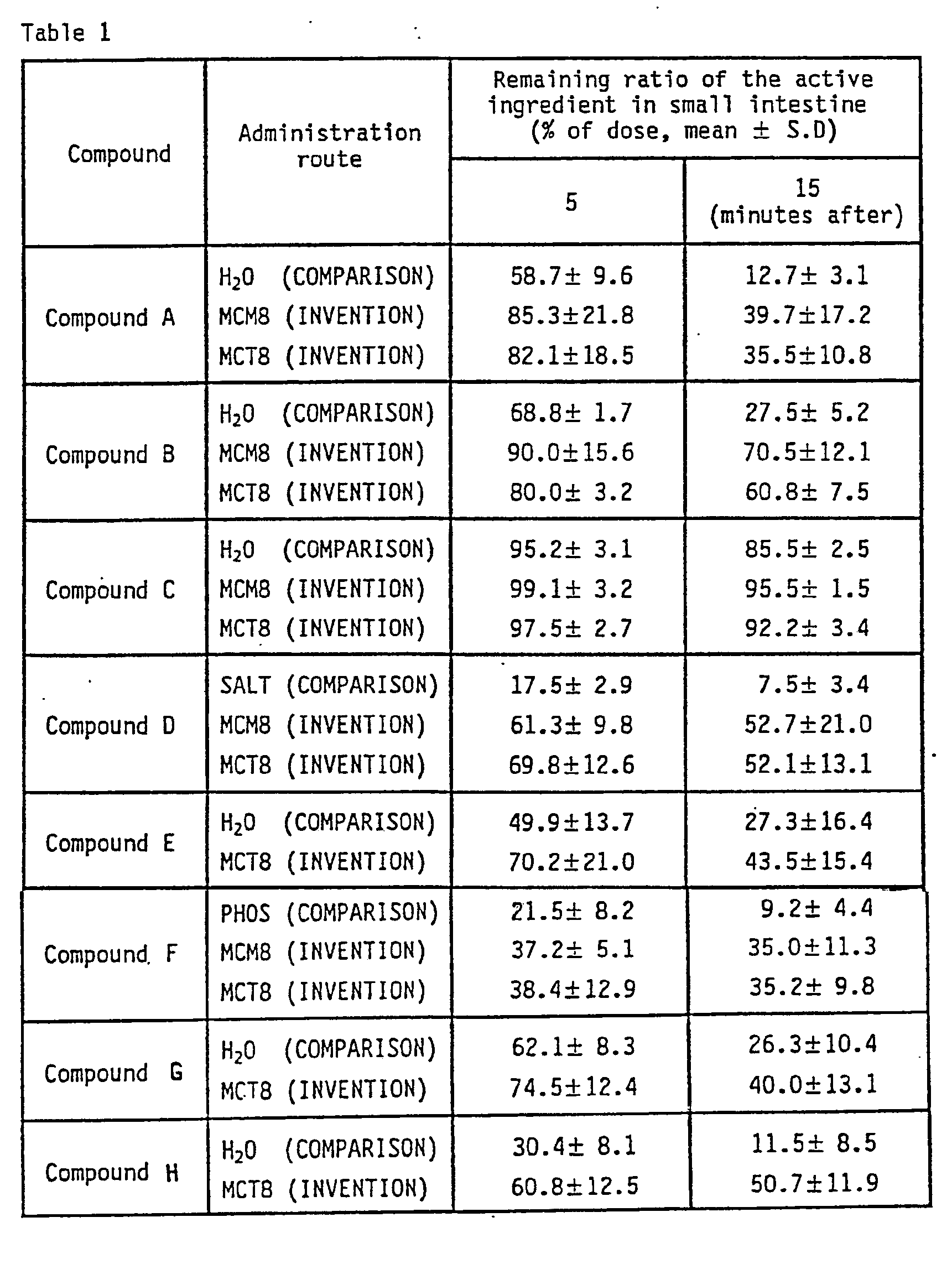
- From the result of
Experiment 1, it is understood that the degradation of active ingredients is inhibited by administering the suspension or solution of esters or amides in MCG, compared with by administering the aqueous solution thereof. - When
Experiment 1 was carried out by using Compound A and D, blood was collected after a given period of time (0, 15, 30, 60 and 120 minutes after). The concentration of the active ingredient in blood was determined with high pressure liquid chromatography, and Area Under the plasma concentration-time Curve (AUC) was calculated and then bioavailability (BA) was calculated according to the following formula by comparing with AUC in intravenous administration.
- [AUCid] : AUC in intraduodenal administration
- [AUCiv]: AUC in intravenous administration
- [Did] : Dose in intraduodenal administration
- [Div] : Dose in intravenous administration

- From the result, it is understood that BA in administration of the suspension or solution of esters in MCG is about 1.6 to 9.8 times as superior as BA in administration of aqueous solution of them. The improvement is of great significance.
- Each one soft capsule prepared in Reference Example 1, 2, 3, 4, 5 and 6 (used only a suspension of Example 2 (compound B) in Reference Example 4, 5 and 6) was administered orally with 50 ml of water to six male Beagle dogs fasted an overnight (aged one to two and weighing 10 ± 1 kg). By the same procedures as described in Experiment 2, the concentration of the active ingredient in blood, AUC, and then BA were calculated. The resulte was shown in Table 3.
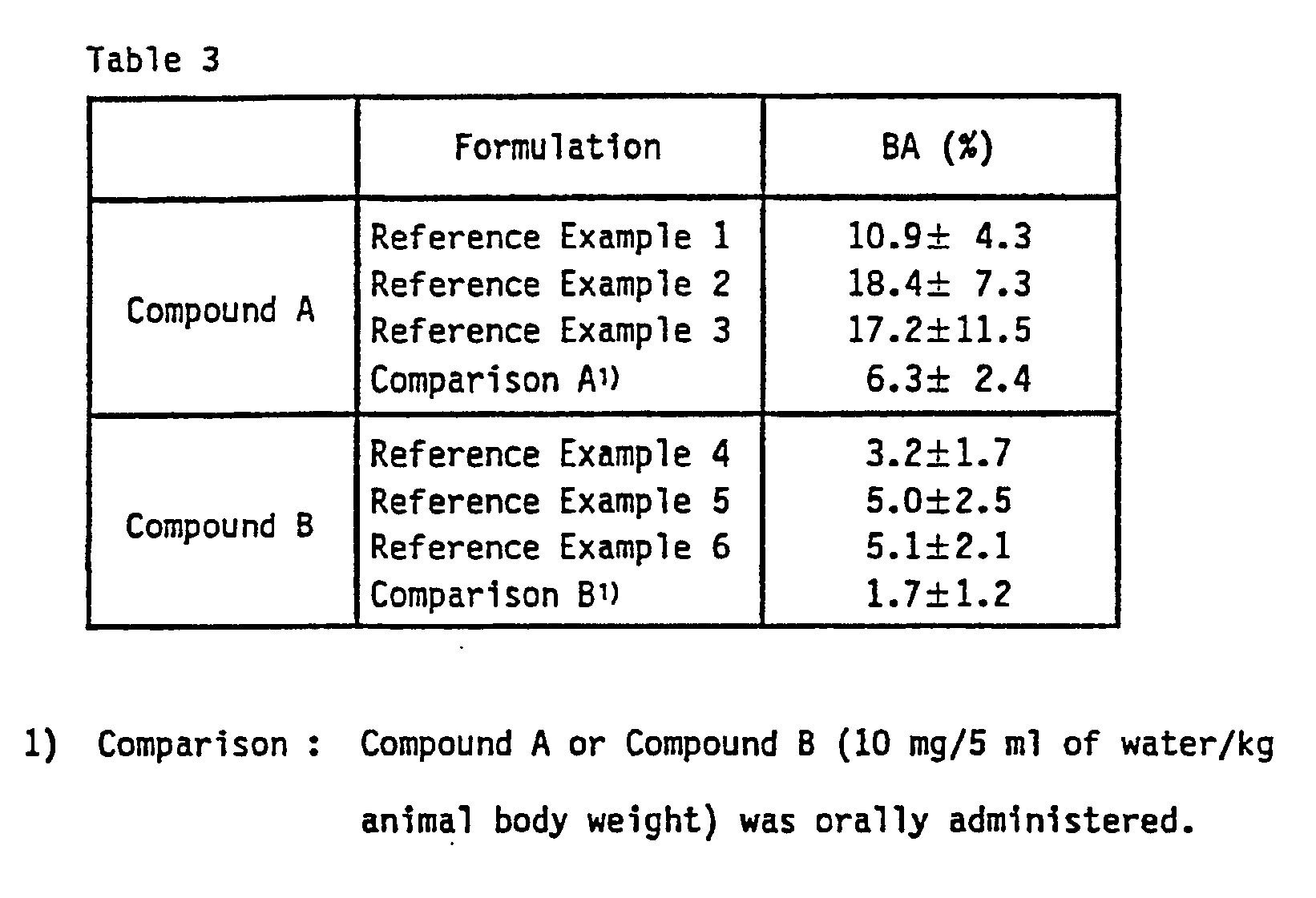
- From the Table 3, it is understood that BA of the composition in which the active ingredient is suspended in MCG is about 1.5 to 3 times as superior as BA of the composition in which it is not suspended in MCG, even in oral administration.
Claims (22)

Priority Applications (1)
| Application Number | Priority Date | Filing Date | Title |
|---|---|---|---|
| AT88105821T ATE62419T1 (en) | 1987-04-13 | 1988-04-12 | PHARMACEUTICAL PREPARATIONS CONTAINING ESTER OR AMIDE AS ACTIVE SUBSTANCES. |
Applications Claiming Priority (2)
| Application Number | Priority Date | Filing Date | Title |
|---|---|---|---|
| JP8878587 | 1987-04-13 | ||
| JP88785/87 | 1987-04-13 |
Publications (3)
| Publication Number | Publication Date |
|---|---|
| EP0287036A2 EP0287036A2 (en) | 1988-10-19 |
| EP0287036A3 EP0287036A3 (en) | 1988-11-30 |
| EP0287036B1 true EP0287036B1 (en) | 1991-04-10 |
Family
ID=13952501
Family Applications (1)
| Application Number | Title | Priority Date | Filing Date |
|---|---|---|---|
| EP88105821A Expired - Lifetime EP0287036B1 (en) | 1987-04-13 | 1988-04-12 | New pharmaceutical compositions comprising esters or amides as active ingredients |
Country Status (7)
| Country | Link |
|---|---|
| US (3) | US4889723A (en) |
| EP (1) | EP0287036B1 (en) |
| KR (1) | KR880012221A (en) |
| AT (1) | ATE62419T1 (en) |
| DE (1) | DE3862337D1 (en) |
| ES (1) | ES2033985T3 (en) |
| GR (1) | GR3001762T3 (en) |
Cited By (2)
| Publication number | Priority date | Publication date | Assignee | Title |
|---|---|---|---|---|
| US7026290B1 (en) | 1998-12-30 | 2006-04-11 | Dexcel Ltd. | Dispersible concentrate for the delivery of cyclosprin |
| US7732404B2 (en) | 1999-12-30 | 2010-06-08 | Dexcel Ltd | Pro-nanodispersion for the delivery of cyclosporin |
Families Citing this family (23)
| Publication number | Priority date | Publication date | Assignee | Title |
|---|---|---|---|---|
| FR2682253A1 (en) | 1991-10-07 | 1993-04-09 | Commissariat Energie Atomique | HEATING SOLE FOR PROVIDING THE HEATING OF AN OBJECT PROVIDED ON ITS SURFACE AND CHEMICAL PROCESSING REACTOR PROVIDED WITH SAID SOLE. |
| IT1263840B (en) * | 1993-03-30 | 1996-09-04 | Giuseppe Furiosi | ORAL FORMULATIONS OF UBIDECARENONE IN THE FORM OF CAPSULES |
| US6726930B1 (en) | 1993-09-09 | 2004-04-27 | Penwest Pharmaceuticals Co. | Sustained release heterodisperse hydrogel systems for insoluble drugs |
| US5773025A (en) | 1993-09-09 | 1998-06-30 | Edward Mendell Co., Inc. | Sustained release heterodisperse hydrogel systems--amorphous drugs |
| US5455046A (en) * | 1993-09-09 | 1995-10-03 | Edward Mendell Co., Inc. | Sustained release heterodisperse hydrogel systems for insoluble drugs |
| US5827822A (en) * | 1996-03-25 | 1998-10-27 | Sangstat Medical Corporation | Cyclosporin a formulations as nanoparticles |
| US5766629A (en) * | 1995-08-25 | 1998-06-16 | Sangstat Medical Corporation | Oral cyclosporin formulations |
| US5834017A (en) * | 1995-08-25 | 1998-11-10 | Sangstat Medical Corporation | Oral cyclopsporin formulations |
| US5962019A (en) * | 1995-08-25 | 1999-10-05 | Sangstat Medical Corporation | Oral cyclosporin formulations |
| WO1997037969A1 (en) | 1996-04-10 | 1997-10-16 | Ono Pharmaceutical Co., Ltd. | Tryptase inhibitor and novel guanidino derivatives |
| EP0859603B1 (en) | 1996-07-08 | 2008-12-17 | Penwest Pharmaceuticals Co. | Sustained release matrix for high-dose insoluble drugs |
| CA2275475A1 (en) * | 1996-12-19 | 1998-06-25 | Hiroshi Kikuchi | Pharmaceutical composition for oral administration |
| US6056977A (en) | 1997-10-15 | 2000-05-02 | Edward Mendell Co., Inc. | Once-a-day controlled release sulfonylurea formulation |
| JP4198318B2 (en) | 1998-08-19 | 2008-12-17 | ヤーゴテック アクチェンゲゼルシャフト | Injectable aqueous dispersion of propofol |
| US6849605B1 (en) * | 1999-03-05 | 2005-02-01 | The Trustees Of University Technology Corporation | Inhibitors of serine protease activity, methods and compositions for treatment of viral infections |
| US6489308B1 (en) | 1999-03-05 | 2002-12-03 | Trustees Of University Of Technology Corporation | Inhibitors of serine protease activity, methods and compositions for treatment of nitric-oxide-induced clinical conditions |
| AU3864000A (en) * | 1999-03-05 | 2000-09-21 | Trustees Of University Technology Corporation, The | Inhibitors of serine protease activity, methods and compositions for treatment of herpes viruses |
| KR100463496B1 (en) * | 1999-09-30 | 2005-01-06 | 펜웨스트 파머슈티칼즈 컴파니 | Sustained release matrix systems for highly soluble drugs |
| US20040220242A1 (en) * | 2003-05-02 | 2004-11-04 | Leland Shapiro | Inhibitors of serine protease activity, methods and compositions for treatment of nitric oxide induced clinical conditions |
| PL2520654T3 (en) | 2003-08-26 | 2017-08-31 | The Regents Of The University Of Colorado, A Body Corporate | Inhibitors of serine protease activity and their use in methods and compositions for treatment of bacterial infections |
| JP2008518013A (en) * | 2004-10-26 | 2008-05-29 | アラーガン、インコーポレイテッド | Treatment method and delivery method with prostaglandin EP4 agonist |
| EP2760433B1 (en) | 2011-09-29 | 2023-05-31 | PLx Opco Inc. | pH DEPENDENT CARRIERS FOR TARGETED RELEASE OF PHARMACEUTICALS ALONG THE GASTROINTESTINAL TRACT, COMPOSITIONS THEREFROM, AND MAKING AND USING SAME |
| JP2023518822A (en) | 2020-03-26 | 2023-05-08 | ピーエルエックス オプコ インコーポレイテッド | Pharmaceutical carrier capable of pH-dependent reconstitution, method of production and method of use thereof |
Family Cites Families (12)
| Publication number | Priority date | Publication date | Assignee | Title |
|---|---|---|---|---|
| IE45448B1 (en) * | 1976-07-12 | 1982-08-25 | Kali Chemie Pharma Gmbh | Enterally highly-absorbable preparations of cardiac glycosides which by themselves are absorbable with difficulty and process for the production of such preparations |
| JPS53136513A (en) * | 1977-05-06 | 1978-11-29 | Ono Pharmaceut Co Ltd | Stabilization of prostaglandin-x-related compounds |
| SE445174B (en) * | 1978-03-07 | 1986-06-09 | Sandoz Ag | PHARMACEUTICAL COMPOSITION CONTAINING A CYCLOSPORIN AND A HEALING SUBSTANCE |
| US4722941A (en) * | 1978-06-07 | 1988-02-02 | Kali-Chemie Pharma Gmbh | Readily absorbable pharmaceutical compositions of per se poorly absorbable pharmacologically active agents and preparation thereof |
| DE3000377A1 (en) * | 1980-01-07 | 1981-07-09 | Boehringer Mannheim Gmbh, 6800 Mannheim | NEW SULPHONAMIDES, METHOD FOR THE PRODUCTION THEREOF AND MEDICINAL PRODUCTS CONTAINING THESE COMPOUNDS |
| US4305936A (en) * | 1980-10-09 | 1981-12-15 | Dermik Laboratories | Topical corticosteroid formulations |
| DE3042975A1 (en) * | 1980-11-14 | 1982-09-09 | Lucas Meyer GmbH & Co, 2000 Hamburg | Micro:dispersion of pharmaceutical or reagent salt - contg. amphiphilic cpd., esp. lecithin, as dispersion agent, used for treatment of mastitis |
| JPS57197214A (en) * | 1981-05-29 | 1982-12-03 | Tanabe Seiyaku Co Ltd | Rapid-releasing microcapsule and its preparation |
| US4525339A (en) * | 1982-10-15 | 1985-06-25 | Hoffmann-La Roche Inc. | Enteric coated oral dosage form |
| DE3411910A1 (en) * | 1984-03-30 | 1985-10-10 | Warner-Lambert Co., Morris Plains, N.J. | Pharmaceutical formulation |
| DE3421468A1 (en) * | 1984-06-08 | 1985-12-19 | Dr. Rentschler Arzneimittel Gmbh & Co, 7958 Laupheim | LIPID NANOPELLETS AS A CARRIER SYSTEM FOR MEDICINAL PRODUCTS FOR PERORAL USE |
| US4716178A (en) * | 1985-07-22 | 1987-12-29 | Riker Laboratories, Inc. | Substituted di-t-butylphenols |
-
1988
- 1988-04-11 KR KR1019880004073A patent/KR880012221A/en not_active Withdrawn
- 1988-04-12 DE DE8888105821T patent/DE3862337D1/en not_active Expired - Lifetime
- 1988-04-12 EP EP88105821A patent/EP0287036B1/en not_active Expired - Lifetime
- 1988-04-12 AT AT88105821T patent/ATE62419T1/en not_active IP Right Cessation
- 1988-04-12 ES ES198888105821T patent/ES2033985T3/en not_active Expired - Lifetime
- 1988-04-13 US US07/180,933 patent/US4889723A/en not_active Expired - Fee Related
-
1989
- 1989-10-05 US US07/417,537 patent/US5004612A/en not_active Expired - Fee Related
-
1991
- 1991-01-15 US US07/641,404 patent/US5110602A/en not_active Expired - Fee Related
- 1991-04-11 GR GR91400346T patent/GR3001762T3/en unknown
Cited By (2)
| Publication number | Priority date | Publication date | Assignee | Title |
|---|---|---|---|---|
| US7026290B1 (en) | 1998-12-30 | 2006-04-11 | Dexcel Ltd. | Dispersible concentrate for the delivery of cyclosprin |
| US7732404B2 (en) | 1999-12-30 | 2010-06-08 | Dexcel Ltd | Pro-nanodispersion for the delivery of cyclosporin |
Also Published As
| Publication number | Publication date |
|---|---|
| ATE62419T1 (en) | 1991-04-15 |
| DE3862337D1 (en) | 1991-05-16 |
| KR880012221A (en) | 1988-11-26 |
| ES2033985T3 (en) | 1993-04-01 |
| GR3001762T3 (en) | 1992-11-23 |
| US5110602A (en) | 1992-05-05 |
| US4889723A (en) | 1989-12-26 |
| US5004612A (en) | 1991-04-02 |
| EP0287036A3 (en) | 1988-11-30 |
| EP0287036A2 (en) | 1988-10-19 |
Similar Documents
| Publication | Publication Date | Title |
|---|---|---|
| US4889723A (en) | Pharmaceutical compositions comprising esters or amides as active ingredients | |
| EP0143949B1 (en) | Pharmaceutical composition containing urokinase | |
| RU2198677C2 (en) | Pharmaceutical composition for oral delivery of physiologically active peptide agent and method of enhancement of its availability | |
| US5707648A (en) | Transparent liquid for encapsulated drug delivery | |
| ES2253871T3 (en) | EMPLOYMENT OF NANODISPERSIONS IN FINAL PHARMACEUTICAL FORMULATIONS. | |
| EP0790822B1 (en) | Controlled release composition forming a reversed micellar (l2) structure or a normal micellar (l1) structure | |
| CA1319886C (en) | Mixed micelle solutions | |
| US5318781A (en) | Absorption enhancement of antibiotics | |
| US8889180B2 (en) | Coated drug delivery formulations | |
| PL179717B1 (en) | Pharmaceutical composition containing sparingly soluble active substances in a carrier composition PL PL PL PL PL PL PL PL | |
| SK279845B6 (en) | Pharmaceutical formulation, method of its preparation and use thereof | |
| NZ280419A (en) | Pharmaceutical formulation base; comprises a combination of phospholipids, triglycerides and partial fatty acid esters of polyoxyethylene sorbitan | |
| DE69717067T2 (en) | A pharmaceutical preparation comprising coated capsules or tablets containing liposome powder containing an active ingredient | |
| KR920019359A (en) | Oral gastrointestinal pharmaceutical formulations containing bile acids | |
| US20050031687A1 (en) | Enteric-coated proliposomal formulations for poorly water soluble drugs | |
| PL188986B1 (en) | Preparations in the form of soft capsules containing cyclosporin and method for their production | |
| CA1232267A (en) | Orally administered biologically active peptides and proteins | |
| CA2138607A1 (en) | Formulations for orally administered pharmaceutical agents | |
| SK37298A3 (en) | Cyclosporin-containing soft capsule preparations | |
| CA2290973C (en) | Encapsulated solution dosage forms of sertraline | |
| JP2537658B2 (en) | Novel formulation containing ester or amide as active ingredient | |
| JP2537658C (en) | ||
| JPH07196483A (en) | Pharmaceutical composition with improved oral absorbability | |
| EP0387655B1 (en) | Stabilization of polyprenyl compound | |
| CA2066698A1 (en) | Liposomal compositions |
Legal Events
| Date | Code | Title | Description |
|---|---|---|---|
| PUAI | Public reference made under article 153(3) epc to a published international application that has entered the european phase |
Free format text: ORIGINAL CODE: 0009012 |
|
| PUAL | Search report despatched |
Free format text: ORIGINAL CODE: 0009013 |
|
| AK | Designated contracting states |
Kind code of ref document: A2 Designated state(s): AT BE CH DE ES FR GB GR IT LI LU NL SE |
|
| AK | Designated contracting states |
Kind code of ref document: A3 Designated state(s): AT BE CH DE ES FR GB GR IT LI LU NL SE |
|
| 17P | Request for examination filed |
Effective date: 19890519 |
|
| 17Q | First examination report despatched |
Effective date: 19891018 |
|
| GRAA | (expected) grant |
Free format text: ORIGINAL CODE: 0009210 |
|
| AK | Designated contracting states |
Kind code of ref document: B1 Designated state(s): AT BE CH DE ES FR GB GR IT LI LU NL SE |
|
| REF | Corresponds to: |
Ref document number: 62419 Country of ref document: AT Date of ref document: 19910415 Kind code of ref document: T |
|
| ET | Fr: translation filed | ||
| REF | Corresponds to: |
Ref document number: 3862337 Country of ref document: DE Date of ref document: 19910516 |
|
| ITF | It: translation for a ep patent filed | ||
| PLBE | No opposition filed within time limit |
Free format text: ORIGINAL CODE: 0009261 |
|
| STAA | Information on the status of an ep patent application or granted ep patent |
Free format text: STATUS: NO OPPOSITION FILED WITHIN TIME LIMIT |
|
| PGFP | Annual fee paid to national office [announced via postgrant information from national office to epo] |
Ref country code: GB Payment date: 19920320 Year of fee payment: 5 |
|
| PGFP | Annual fee paid to national office [announced via postgrant information from national office to epo] |
Ref country code: ES Payment date: 19920403 Year of fee payment: 5 |
|
| 26N | No opposition filed | ||
| PGFP | Annual fee paid to national office [announced via postgrant information from national office to epo] |
Ref country code: FR Payment date: 19920408 Year of fee payment: 5 |
|
| PGFP | Annual fee paid to national office [announced via postgrant information from national office to epo] |
Ref country code: AT Payment date: 19920409 Year of fee payment: 5 |
|
| PGFP | Annual fee paid to national office [announced via postgrant information from national office to epo] |
Ref country code: SE Payment date: 19920416 Year of fee payment: 5 Ref country code: CH Payment date: 19920416 Year of fee payment: 5 |
|
| PGFP | Annual fee paid to national office [announced via postgrant information from national office to epo] |
Ref country code: GR Payment date: 19920423 Year of fee payment: 5 |
|
| PGFP | Annual fee paid to national office [announced via postgrant information from national office to epo] |
Ref country code: NL Payment date: 19920430 Year of fee payment: 5 |
|
| PGFP | Annual fee paid to national office [announced via postgrant information from national office to epo] |
Ref country code: LU Payment date: 19920507 Year of fee payment: 5 |
|
| PGFP | Annual fee paid to national office [announced via postgrant information from national office to epo] |
Ref country code: DE Payment date: 19920514 Year of fee payment: 5 |
|
| PGFP | Annual fee paid to national office [announced via postgrant information from national office to epo] |
Ref country code: BE Payment date: 19920604 Year of fee payment: 5 |
|
| REG | Reference to a national code |
Ref country code: GR Ref legal event code: FG4A Free format text: 3001762 |
|
| EPTA | Lu: last paid annual fee | ||
| REG | Reference to a national code |
Ref country code: ES Ref legal event code: FG2A Ref document number: 2033985 Country of ref document: ES Kind code of ref document: T3 |
|
| PG25 | Lapsed in a contracting state [announced via postgrant information from national office to epo] |
Ref country code: LU Free format text: LAPSE BECAUSE OF NON-PAYMENT OF DUE FEES Effective date: 19930412 Ref country code: GB Effective date: 19930412 Ref country code: AT Effective date: 19930412 |
|
| PG25 | Lapsed in a contracting state [announced via postgrant information from national office to epo] |
Ref country code: SE Effective date: 19930413 Ref country code: ES Free format text: LAPSE BECAUSE OF NON-PAYMENT OF DUE FEES Effective date: 19930413 |
|
| PG25 | Lapsed in a contracting state [announced via postgrant information from national office to epo] |
Ref country code: LI Effective date: 19930430 Ref country code: CH Effective date: 19930430 Ref country code: BE Effective date: 19930430 |
|
| BERE | Be: lapsed |
Owner name: ONO PHARMACEUTICAL CO. LTD Effective date: 19930430 |
|
| PG25 | Lapsed in a contracting state [announced via postgrant information from national office to epo] |
Ref country code: GR Free format text: THE PATENT HAS BEEN ANNULLED BY A DECISION OF A NATIONAL AUTHORITY Effective date: 19931031 |
|
| PG25 | Lapsed in a contracting state [announced via postgrant information from national office to epo] |
Ref country code: NL Effective date: 19931101 |
|
| GBPC | Gb: european patent ceased through non-payment of renewal fee |
Effective date: 19930412 |
|
| NLV4 | Nl: lapsed or anulled due to non-payment of the annual fee | ||
| PG25 | Lapsed in a contracting state [announced via postgrant information from national office to epo] |
Ref country code: FR Effective date: 19931229 |
|
| REG | Reference to a national code |
Ref country code: CH Ref legal event code: PL |
|
| PG25 | Lapsed in a contracting state [announced via postgrant information from national office to epo] |
Ref country code: DE Effective date: 19940101 |
|
| REG | Reference to a national code |
Ref country code: FR Ref legal event code: ST |
|
| REG | Reference to a national code |
Ref country code: GR Ref legal event code: MM2A Free format text: 3001762 |
|
| EUG | Se: european patent has lapsed |
Ref document number: 88105821.8 Effective date: 19931110 |
|
| REG | Reference to a national code |
Ref country code: ES Ref legal event code: FD2A Effective date: 19990301 |
|
| PG25 | Lapsed in a contracting state [announced via postgrant information from national office to epo] |
Ref country code: IT Free format text: LAPSE BECAUSE OF NON-PAYMENT OF DUE FEES;WARNING: LAPSES OF ITALIAN PATENTS WITH EFFECTIVE DATE BEFORE 2007 MAY HAVE OCCURRED AT ANY TIME BEFORE 2007. THE CORRECT EFFECTIVE DATE MAY BE DIFFERENT FROM THE ONE RECORDED. Effective date: 20050412 |