EP0285422B1 - Hard butter composition - Google Patents
Hard butter composition Download PDFInfo
- Publication number
- EP0285422B1 EP0285422B1 EP88302895A EP88302895A EP0285422B1 EP 0285422 B1 EP0285422 B1 EP 0285422B1 EP 88302895 A EP88302895 A EP 88302895A EP 88302895 A EP88302895 A EP 88302895A EP 0285422 B1 EP0285422 B1 EP 0285422B1
- Authority
- EP
- European Patent Office
- Prior art keywords
- weight
- composition
- triglycerides
- chocolate
- hard
- Prior art date
- Legal status (The legal status is an assumption and is not a legal conclusion. Google has not performed a legal analysis and makes no representation as to the accuracy of the status listed.)
- Expired
Links
Classifications
-
- A—HUMAN NECESSITIES
- A23—FOODS OR FOODSTUFFS; TREATMENT THEREOF, NOT COVERED BY OTHER CLASSES
- A23G—COCOA; COCOA PRODUCTS, e.g. CHOCOLATE; SUBSTITUTES FOR COCOA OR COCOA PRODUCTS; CONFECTIONERY; CHEWING GUM; ICE-CREAM; PREPARATION THEREOF
- A23G1/00—Cocoa; Cocoa products, e.g. chocolate; Substitutes therefor
- A23G1/30—Cocoa products, e.g. chocolate; Substitutes therefor
- A23G1/32—Cocoa products, e.g. chocolate; Substitutes therefor characterised by the composition containing organic or inorganic compounds
- A23G1/36—Cocoa products, e.g. chocolate; Substitutes therefor characterised by the composition containing organic or inorganic compounds characterised by the fats used
-
- A—HUMAN NECESSITIES
- A23—FOODS OR FOODSTUFFS; TREATMENT THEREOF, NOT COVERED BY OTHER CLASSES
- A23D—EDIBLE OILS OR FATS, e.g. MARGARINES, SHORTENINGS OR COOKING OILS
- A23D9/00—Other edible oils or fats, e.g. shortenings or cooking oils
-
- A—HUMAN NECESSITIES
- A23—FOODS OR FOODSTUFFS; TREATMENT THEREOF, NOT COVERED BY OTHER CLASSES
- A23G—COCOA; COCOA PRODUCTS, e.g. CHOCOLATE; SUBSTITUTES FOR COCOA OR COCOA PRODUCTS; CONFECTIONERY; CHEWING GUM; ICE-CREAM; PREPARATION THEREOF
- A23G1/00—Cocoa; Cocoa products, e.g. chocolate; Substitutes therefor
- A23G1/30—Cocoa products, e.g. chocolate; Substitutes therefor
- A23G1/32—Cocoa products, e.g. chocolate; Substitutes therefor characterised by the composition containing organic or inorganic compounds
- A23G1/36—Cocoa products, e.g. chocolate; Substitutes therefor characterised by the composition containing organic or inorganic compounds characterised by the fats used
- A23G1/38—Cocoa butter substitutes
Definitions
- the present invention relates to a hard butter composition useful in the manufacture of chocolate.
- tempering type hard butters mainly composed of triglycerides having one unsaturated bond per molecule (hereinafter referred to as U1) such as 2-oleo-1,3-dipalmitin (hereinafter referred to as POP), 2-oleo-1-palmito-3-stearin (hereinafter referred to as POSt) and 2-oleo-1,3-distearin (hereinafter referred to as StOSt).
- POP 2-oleo-1,3-dipalmitin
- POSt 2-oleo-1-palmito-3-stearin
- StOSt 2-oleo-1,3-distearin
- Tempering type hard butters are very useful for the production of chocolate having mellow cocoa flavor wherein a large amount of cocoa butter is used, because such hard butters have good miscibility with cocoa butter and can be mixed with cocoa butter in any mixing ratio.
- tempering type hard butters can be prepared from natural fats containing a large amount of the above U1 component, or by appropriately compounding fractionated fats obtained from natural fats, or from ester-interchanged fats containing a large amount of U1 component obtained by an enzymatic ester interchange reaction and their fractionated fats. Efforts have also been made to imitate the triglyceride composition and properties of cocoa butter as closely as possible. Accordingly, properties of tempering type hard butters are very similar to those of cocoa butter and the hard butters are hard at a low temperature and have good melting properties such that the butters are molten at about body temperature. Thus, cocoa butter and tempering type hard butters have very good properties.
- cocoa butter or a good quality hard butter has a high solid fat index (SFI), for example of not lower than 70% at 5 to 25°C and, therefore, it is very hard at a low temperature.
- SFI solid fat index
- a liquid fat is admixed with cocoa butter or the hard butter
- SFI at a low temperature is decreased and thereby it is possible to soften a product at a low temperature.
- SFI at a high temperature is also decreased and thereby heat resistance of the product is impaired. Accordingly, in the present applicant's above proposal, a small amount of a fat having a high melting point is added to improve heat resistance and this is effective to a certain degree.
- a hard butter composition which comprises at least 85% by weight of a triglyceride component and at most 15% by weight of a non-triglyceride component based on the total weight of said composition; said triglyceride component containing
- the hard butter composition of the present invention has good miscibility with cocoa butter and can be mixed with cocoa butter at any mixing ratio. Further, the hard butter composition of the present invention has softness at a low temperature, while it has good heat resistance. Thereby, even if the hard butter composition of the present invention is coated on soft centers such as sponge cakes, mouth feel at a low temperature is improved. Further, when the hard butter composition of the present invention is used in the production of, particularly, solid chocolate, it can provide soft mouth feel at the beginning of mastication and sharp melting in the mouth, and hardness of the product is little changed with time. Therefore, solid chocolate using the composition of the present invention is suitable for an aged person or a person having bad teeth.
- the hard butter composition of the present invention is substantially composed of two kinds of triglycerides, i.e., triglycerides having one unsaturated bond per molecule (U1) and triglycerides having at least three unsaturated bonds per molecule (U3).
- U1 unsaturated bond per molecule
- U3 triglycerides having at least three unsaturated bonds per molecule
- the U1 component should contain 50 to 95% by weight of 2-oleo-1,3-distearin (StOSt) and the content of 2-oleo-1-palmito-3-stearin (POSt) should be 20% by weight or less and that of 2-oleo-1, 3-dipalmitin (POP) should be 30% by weight or less, otherwise it is difficult to improve heat resistance.
- StOSt 2-oleo-1,3-distearin
- POSt 2-oleo-1-palmito-3-stearin
- POP 2-oleo-1, 3-dipalmitin
- the hard butter composition of the present invention mainly composed of such U1 and U3 components can be prepared by appropriately compounding fractionated fats and oils which are obtained from natural fats and oils, or fats and oils subjected to an enzymatic selective ester interchange reaction; glycerides obtained by a suitable isolation technique; or liquid fats.
- the composition can be readily prepared by utilizing fats and oils subjected to an enzymatic selective ester interchange reaction.
- Such fats and oils can be obtained by subjecting to an ester interchange reaction, in the presence of an enzyme having selectivity to 1,3-positions of triglycerides, fats and oils in which oleic acid is bonded to the 2-position of the triglyceride and free stearic acid, its ester, or fats and oils containing a large amount of stearic acid.
- the enzyme may be, for example, lipase obtained from Rhizopus (e.g., R. niveus , R. japonicus ), lipase obtained from Mucor (e.g., M. javanicus ) or lipase obtained from Asperigillus (e.g., A. niger ).
- Rhizopus e.g., R. niveus , R. japonicus
- Mucor e.g., M. javanicus
- lipase obtained from Asperigillus e.g., A. niger
- the content of triglycerides having two unsaturated bonds per molecule should be 30% by weight lower based on the total amount of triglycerides.
- the content of 1-stearo-2,3-diolein (StOO) should be 40% by weight or lower based on the total amount of the U2 component.
- StOO contained in a triglyceride composition of cocoa butter or a hard butter does not adversely affect qualities of a hard butter such as tempering properties (Japanese Patent Kokai No. 61- 242543).
- the content of StOO should be as low as possible.
- mouth feel at the beginning of mastication at a low temperature is hard.
- the content of tri-saturated-glycerides (U0) is preferably 5% by weight or lower based on the total amount of triglycerides. When it exceeds 5% by weight, melting properties in the mouth are adversely affected. Further, the content of triglycerides having at least three unsaturated bonds per molecule (U3) should be 10 to 70% by weight based on the total amount of triglycerides. When the content of U3 component is less than 10% by weight, it is difficult to provide soft mouth feel at the beginning of mastication and desired softness. On the other hand, when the content is more than 70% by weight, it is difficult to provide desired heat resistance.
- the hard butter composition of the present invention contains at least 85% by weight of the triglyceride component composed of the specific amounts of U0, U1, U2 and U3 components.
- a non-triglyceride component such as monoglycerides, diglycerides, unsaponifiable materials and the like may be present at up to 15% by weight based on the total amount of the composition.
- it is desirable that the content of such a non-triglyceride component is as low as possible.
- the hard butter composition of the present invention has SFI (determined after allowing a sample to stand at 20°C for 1 week, at 25°C for 1 week and at 0°C for 1 day to stabilize the sample) of at most 65% at 5°C, 20 to 55% at 30°C, 2 to 35% at 35°C and at most 3% at 40°C, and the difference between SFI at 5°C and that at 25°C is at most 15%.
- SFI of cocoa butter and a hard butter having good melting properties is 70% or higher at 5 to 25°C and the difference between SFI at 5°C and that at 25°C is small.
- SFI is rapidly reduced and a curve obtained by plotting SFI against temperature shows a shoulder at about 25°C.
- SFI is lowered but the difference between SFI at 5°C and that at 25°C is large.
- the shoulder disappears and a gentle curve is formed.
- SFI becomes low, which results in loss of heat resistance.
- the difference between SFI at 5°C and 25°C is small and a shoulder appears in the curve obtained by plotting SFI against temperature. This curve is similar to that of the above cocoa butter or a conventional hard butter but is shifted toward a lower SFI value.
- sample oil-1 enzymeally ester-interchanged oil
- a mixture (1,000 parts) of equal amounts of high oleic sunflower oil and commercially available stearic acid was admixed with hexane (4000 parts) and powder diatomaceous earth (50 parts) which had absorbed lipase of Rhizopus niveus (17 parts) was dispersed in the mixture.
- the resulting mixture was reacted with stirring at a rate of 200 r.p.m. at 40°C for 72 hours.
- the enzyme was filtered off from the reaction system and the solvent was removed from the filtrate. Steam was blown through the resulting ester interchanged reaction mixture to heat to 170°C and free fatty acids were removed by steam distillation under reduced pressure to obtain the reaction product (475 parts).
- n-hexane 400 parts was added to the reaction product (100 parts) and the mixture was dissolved with warming. Then, according to a conventional method, the mixture was cooled with stirring to -5°C and the deposited crystalline part was filtered off to obtain a mid-fraction (yield: 30.2%).
- deacidified shea fat 1,000 parts having an iodine value of 61.8 was mixed with modified ethanol, (4,000 parts) and the mixture was stirred at 120°C for 10 minutes. After standing for 20 minutes, the insoluble part in ethanol was removed and the mixture was cooled to 40°C. The lower oil layer was separated and the solvent was removed to obtain an ethanol-treated oil having an iodine value of 55.2.
- n-Hexane 400 parts was added to the ethanol-treated oil (100 parts) having an iodine value of 55.2 and the mixture was dissolved with warming. Then, according to a conventional method, the mixture was cooled with stirring to -20°C and the deposited crystalline part was filtered to obtain a mid-fraction (yield: 52.6%).
- Example 1 Sample oil-1 (40 parts) and high oleic sunflower oil (60 parts) were mixed and the mixture was refined according to a conventional method to obtain the desired hard butter composition.
- Example 2 Sample oil-3 (50 parts) and palm fractionated soft oil (50 parts) having an iodine value of 56.8 were mixed and the mixture was refined to obtain the desired hard butter composition.
- Example 3 Sample oil-3 (25 parts) and rapeseed hardened oil (75 parts) having an iodine value of 90.2 were mixed and the mixture was refined to obtain the desired hard butter composition.
- Comparative Example 1 Sample oil-3 (15 parts) and high oleic sunflower oil (85 parts) were mixed and the mixture was refined to obtain a hard butter composition.
- Comparative Example 2 Sample oil-1 (35 parts) and palm fractionated soft oil (65 parts) having an iodine value of 56.8 were mixed and the mixture was refined to obtain a hard butter composition.
- Comparative Example 3 Sample oil-3 (50 parts) and palm mid-fraction (50 parts) having an iodine value of 33.9 were mixed and the mixture was refined to obtain a hard butter composition.
- Comparative Example 4 Brazilian cocoa butter (80 parts) and high oleic sunflower oil (20 parts) were mixed and the mixture was refined to obtain a hard butter composition.
- Comparative Example 5 Refined fat of sample-oil 2.
- milk chocolate was prepared according to the following formulation.
- Milk chocolate formulation Ingredients Parts Cacao mass 13 Hard butter composition 33 Powdered sugar 41 Whole milk powder 13 Lecithin 0.3 Flavor q.p.
- the chocolate using the composition of Comparative Example 2 (having low StOSt content, i.e., 40.8% and high POP content, i.e., 38.3% in U2 component as well as high U2 content, i.e., 31%) was soft at a low temperature and had soft mouth feel at the beginning of mastication, it was still soft at a high temperature and had no heat resistance.
- the chocolate using the composition of Comparative Example 4 (having somewhat high U1 content, low StOSt content, high POSt content and high SFI at 5°C) had hard mouth feel at the beginning of mastication.
- sweet chocolate was prepared according to the following formulation.
- Sweet chocolate formulation Ingredients Parts Cacao mass 35 Hard butter composition 20 Powdered sugar 45 Lecithin 0.5 Flavor q.p.
- hard butter compositions useful as a cocoa butter substitute having improved mouth feel at a low temperature and at the beginning of mastication as well as improved heat resistance.
Landscapes
- Chemical & Material Sciences (AREA)
- Life Sciences & Earth Sciences (AREA)
- Engineering & Computer Science (AREA)
- Food Science & Technology (AREA)
- Polymers & Plastics (AREA)
- Inorganic Chemistry (AREA)
- Oil, Petroleum & Natural Gas (AREA)
- Confectionery (AREA)
- Edible Oils And Fats (AREA)
Description
- The present invention relates to a hard butter composition useful in the manufacture of chocolate.
- As hard butters useful for cocoa butter substitutes, there have been known tempering type hard butters mainly composed of triglycerides having one unsaturated bond per molecule (hereinafter referred to as U1) such as 2-oleo-1,3-dipalmitin (hereinafter referred to as POP), 2-oleo-1-palmito-3-stearin (hereinafter referred to as POSt) and 2-oleo-1,3-distearin (hereinafter referred to as StOSt). Tempering type hard butters are very useful for the production of chocolate having mellow cocoa flavor wherein a large amount of cocoa butter is used, because such hard butters have good miscibility with cocoa butter and can be mixed with cocoa butter in any mixing ratio. Such tempering type hard butters can be prepared from natural fats containing a large amount of the above U1 component, or by appropriately compounding fractionated fats obtained from natural fats, or from ester-interchanged fats containing a large amount of U1 component obtained by an enzymatic ester interchange reaction and their fractionated fats. Efforts have also been made to imitate the triglyceride composition and properties of cocoa butter as closely as possible. Accordingly, properties of tempering type hard butters are very similar to those of cocoa butter and the hard butters are hard at a low temperature and have good melting properties such that the butters are molten at about body temperature. Thus, cocoa butter and tempering type hard butters have very good properties.
- Nevertheless, from the practical viewpoint, they still have problems such as blooming resistance, tempering properties, migration of fats and oils when they are used as a coating, and separation of oil and cracking phenomena. Various attempts have been made to solve these problems.
- In addition, when chocolate made from a large amount of cocoa butter or a tempering type hard butter is coated on soft centers such as sponge cakes, mouth feel at a low temperature is adversely affected. Further, when it is used in the production of solid chocolate, mouth feel at the beginning of mastication is very hard. This hardness increases with time and it is not suitable for an aged person or a person having bad teeth.
- Recently, it has been desirable to mitigate or solve the above problems of cocoa butter and tempering type hard butters by taking into consideration improvement of mouth feel at a low temperature as well as at the beginning of mastication. In view of this need, the present applicant has already proposed methods for preventing cracking, or improving tempering properties by admixing a liquid fat having a melting point of not higher than 25°C with cocoa butter, a mixture of cocoa butter and a cocoa butter substitute, or a hard butter rich in a 2-unsaturated-1,3-disaturated triglyceride component (Japanese Patent Kokai Nos. 59-135841, 60-27341 and 61-254143).
- Usually, cocoa butter or a good quality hard butter has a high solid fat index (SFI), for example of not lower than 70% at 5 to 25°C and, therefore, it is very hard at a low temperature. When a liquid fat is admixed with cocoa butter or the hard butter, SFI at a low temperature is decreased and thereby it is possible to soften a product at a low temperature. However, SFI at a high temperature is also decreased and thereby heat resistance of the product is impaired. Accordingly, in the present applicant's above proposal, a small amount of a fat having a high melting point is added to improve heat resistance and this is effective to a certain degree.
- According to the present invention, there is provided a hard butter composition which comprises at least 85% by weight of a triglyceride component and at most 15% by weight of a non-triglyceride component based on the total weight of said composition;
said triglyceride component containing - (a) at most 5% by weight of tri-saturated glycerides,
- (b) 20 to 65% by weight of triglycerides having one unsaturated bond per molecule,
- (c) at most 30% by weight of triglycerides having two unsaturated bonds per molecule, and
- (d) 10 to 70% by weight of triglycerides having at least three unsaturated bonds per molecule, based on the total amount of said triglyceride component;
said triglycerides having one unsaturated bond per molecule (b) containing- (i) 50 to 95% by weight of 2-oleo-1,3-distearin,
- (ii) at most 20% by weight of 2-oleo-1-palmito -3-stearin,
- (iii) at most 30% by weight of 2-oleo-1,3-dipalmitin, and
- (iv) at most 20% by weight of 1,2-saturated-3-unsaturated glycerides, based on the total amount of said triglycerides (b);
said triglycerides having two unsaturated bonds per molecule (c) containing at most 40% by weight of 1-stearo-2,3-diolein based on the total amount of said triglycerides (c); and
SFI of said composition being
at most 65% at 5°C,
20 to 55% at 30°C,
2 to 35% at 35°C,
at most 3% at 40°C, and the
difference between SFI at 5°C and that at 25°C being at most 15%.
- The hard butter composition of the present invention has good miscibility with cocoa butter and can be mixed with cocoa butter at any mixing ratio. Further, the hard butter composition of the present invention has softness at a low temperature, while it has good heat resistance. Thereby, even if the hard butter composition of the present invention is coated on soft centers such as sponge cakes, mouth feel at a low temperature is improved. Further, when the hard butter composition of the present invention is used in the production of, particularly, solid chocolate, it can provide soft mouth feel at the beginning of mastication and sharp melting in the mouth, and hardness of the product is little changed with time. Therefore, solid chocolate using the composition of the present invention is suitable for an aged person or a person having bad teeth.
- The hard butter composition of the present invention is substantially composed of two kinds of triglycerides, i.e., triglycerides having one unsaturated bond per molecule (U1) and triglycerides having at least three unsaturated bonds per molecule (U3). When the composition contains 20 to 65% by weight of the U1 component and 10 to 70% by weight of the U3 component, it can be mixed with cocoa butter in any mixing ratio and can be subjected to a tempering treatment. However, the U1 component should contain 50 to 95% by weight of 2-oleo-1,3-distearin (StOSt) and the content of 2-oleo-1-palmito-3-stearin (POSt) should be 20% by weight or less and that of 2-oleo-1, 3-dipalmitin (POP) should be 30% by weight or less, otherwise it is difficult to improve heat resistance.
- The hard butter composition of the present invention mainly composed of such U1 and U3 components can be prepared by appropriately compounding fractionated fats and oils which are obtained from natural fats and oils, or fats and oils subjected to an enzymatic selective ester interchange reaction; glycerides obtained by a suitable isolation technique; or liquid fats. Particularly, the composition can be readily prepared by utilizing fats and oils subjected to an enzymatic selective ester interchange reaction. That is, such fats and oils can be obtained by subjecting to an ester interchange reaction, in the presence of an enzyme having selectivity to 1,3-positions of triglycerides, fats and oils in which oleic acid is bonded to the 2-position of the triglyceride and free stearic acid, its ester, or fats and oils containing a large amount of stearic acid. The enzyme may be, for example, lipase obtained from Rhizopus (e.g., R. niveus, R. japonicus), lipase obtained from Mucor (e.g., M. javanicus) or lipase obtained from Asperigillus (e.g., A. niger). Such enzymatic selective ester interchange reactions can be carried out according to known methods, for example, those disclosed in Japanese Patent Kokai No. 55-71797 and U.S. Patent No. 4,416,991.
- In practice, in addition to the above U1 and U3 components, other glyceride components are contained as impurities in the hard butter composition of the present invention. In this respect, the content of triglycerides having two unsaturated bonds per molecule (U2) should be 30% by weight lower based on the total amount of triglycerides. Particularly, the content of 1-stearo-2,3-diolein (StOO) should be 40% by weight or lower based on the total amount of the U2 component. Usually, it is said that, in comparison with glyceride components other than U1, StOO contained in a triglyceride composition of cocoa butter or a hard butter does not adversely affect qualities of a hard butter such as tempering properties (Japanese Patent Kokai No. 61- 242543). However, in the present invention, it is desired that the content of StOO should be as low as possible. When the content of StOO exceeds the above upper limit, mouth feel at the beginning of mastication at a low temperature is hard. Although the reason for this cannot be clearly explained, it is presumed that, since crystallization of the StOO component takes place on standing it at about 20°C, the component which has not been crystallized in a tempering step is crystallized with time to harden the chocolate product at a low temperature.
- In addition the content of tri-saturated-glycerides (U0) is preferably 5% by weight or lower based on the total amount of triglycerides. When it exceeds 5% by weight, melting properties in the mouth are adversely affected. Further, the content of triglycerides having at least three unsaturated bonds per molecule (U3) should be 10 to 70% by weight based on the total amount of triglycerides. When the content of U3 component is less than 10% by weight, it is difficult to provide soft mouth feel at the beginning of mastication and desired softness. On the other hand, when the content is more than 70% by weight, it is difficult to provide desired heat resistance.
- As described above, the hard butter composition of the present invention contains at least 85% by weight of the triglyceride component composed of the specific amounts of U0, U1, U2 and U3 components. A non-triglyceride component such as monoglycerides, diglycerides, unsaponifiable materials and the like may be present at up to 15% by weight based on the total amount of the composition. However, apparently, it is desirable that the content of such a non-triglyceride component is as low as possible.
- The hard butter composition of the present invention has SFI (determined after allowing a sample to stand at 20°C for 1 week, at 25°C for 1 week and at 0°C for 1 day to stabilize the sample) of at most 65% at 5°C, 20 to 55% at 30°C, 2 to 35% at 35°C and at most 3% at 40°C, and the difference between SFI at 5°C and that at 25°C is at most 15%.
- Usually, as described above, SFI of cocoa butter and a hard butter having good melting properties is 70% or higher at 5 to 25°C and the difference between SFI at 5°C and that at 25°C is small. When the temperature rises above 25°C, SFI is rapidly reduced and a curve obtained by plotting SFI against temperature shows a shoulder at about 25°C. When a liquid oil is added to this, SFI is lowered but the difference between SFI at 5°C and that at 25°C is large. Thus, the shoulder disappears and a gentle curve is formed. Particularly, in a high temperature range at more than 30°C, SFI becomes low, which results in loss of heat resistance.
- However, in the hard butter composition of the present invention, the difference between SFI at 5°C and 25°C is small and a shoulder appears in the curve obtained by plotting SFI against temperature. This curve is similar to that of the above cocoa butter or a conventional hard butter but is shifted toward a lower SFI value.
- The following Examples, Comparative Examples and Reference Examples further illustrate the present invention in detail.
- In these Examples, Comparative Examples and Reference Examples, all "%'s" and "parts" are by weight unless otherwise stated.
- A mixture (1,000 parts) of equal amounts of high oleic sunflower oil and commercially available stearic acid was admixed with hexane (4000 parts) and powder diatomaceous earth (50 parts) which had absorbed lipase of Rhizopus niveus (17 parts) was dispersed in the mixture. The resulting mixture was reacted with stirring at a rate of 200 r.p.m. at 40°C for 72 hours. After completion of the reaction, the enzyme was filtered off from the reaction system and the solvent was removed from the filtrate. Steam was blown through the resulting ester interchanged reaction mixture to heat to 170°C and free fatty acids were removed by steam distillation under reduced pressure to obtain the reaction product (475 parts). Then, n-hexane (400 parts) was added to the reaction product (100 parts) and the mixture was dissolved with warming. Then, according to a conventional method, the mixture was cooled with stirring to -5°C and the deposited crystalline part was filtered off to obtain a mid-fraction (yield: 30.2%).
- According to the method disclosed in Japanese Patent Kokoku No. 54-288454 (GB 1511193), deacidified shea fat (1,000 parts) having an iodine value of 61.8 was mixed with modified ethanol, (4,000 parts) and the mixture was stirred at 120°C for 10 minutes. After standing for 20 minutes, the insoluble part in ethanol was removed and the mixture was cooled to 40°C. The lower oil layer was separated and the solvent was removed to obtain an ethanol-treated oil having an iodine value of 55.2.
- n-Hexane (400 parts) was added to the ethanol-treated oil (100 parts) having an iodine value of 55.2 and the mixture was dissolved with warming. Then, according to a conventional method, the mixture was cooled with stirring to -20°C and the deposited crystalline part was filtered to obtain a mid-fraction (yield: 52.6%).
- Example 1: Sample oil-1 (40 parts) and high oleic sunflower oil (60 parts) were mixed and the mixture was refined according to a conventional method to obtain the desired hard butter composition.
- Example 2: Sample oil-3 (50 parts) and palm fractionated soft oil (50 parts) having an iodine value of 56.8 were mixed and the mixture was refined to obtain the desired hard butter composition.
- Example 3: Sample oil-3 (25 parts) and rapeseed hardened oil (75 parts) having an iodine value of 90.2 were mixed and the mixture was refined to obtain the desired hard butter composition.
- Comparative Example 1: Sample oil-3 (15 parts) and high oleic sunflower oil (85 parts) were mixed and the mixture was refined to obtain a hard butter composition.
- Comparative Example 2: Sample oil-1 (35 parts) and palm fractionated soft oil (65 parts) having an iodine value of 56.8 were mixed and the mixture was refined to obtain a hard butter composition.
- Comparative Example 3: Sample oil-3 (50 parts) and palm mid-fraction (50 parts) having an iodine value of 33.9 were mixed and the mixture was refined to obtain a hard butter composition.
- Comparative Example 4: Brazilian cocoa butter (80 parts) and high oleic sunflower oil (20 parts) were mixed and the mixture was refined to obtain a hard butter composition.
- Comparative Example 5: Refined fat of sample-oil 2.
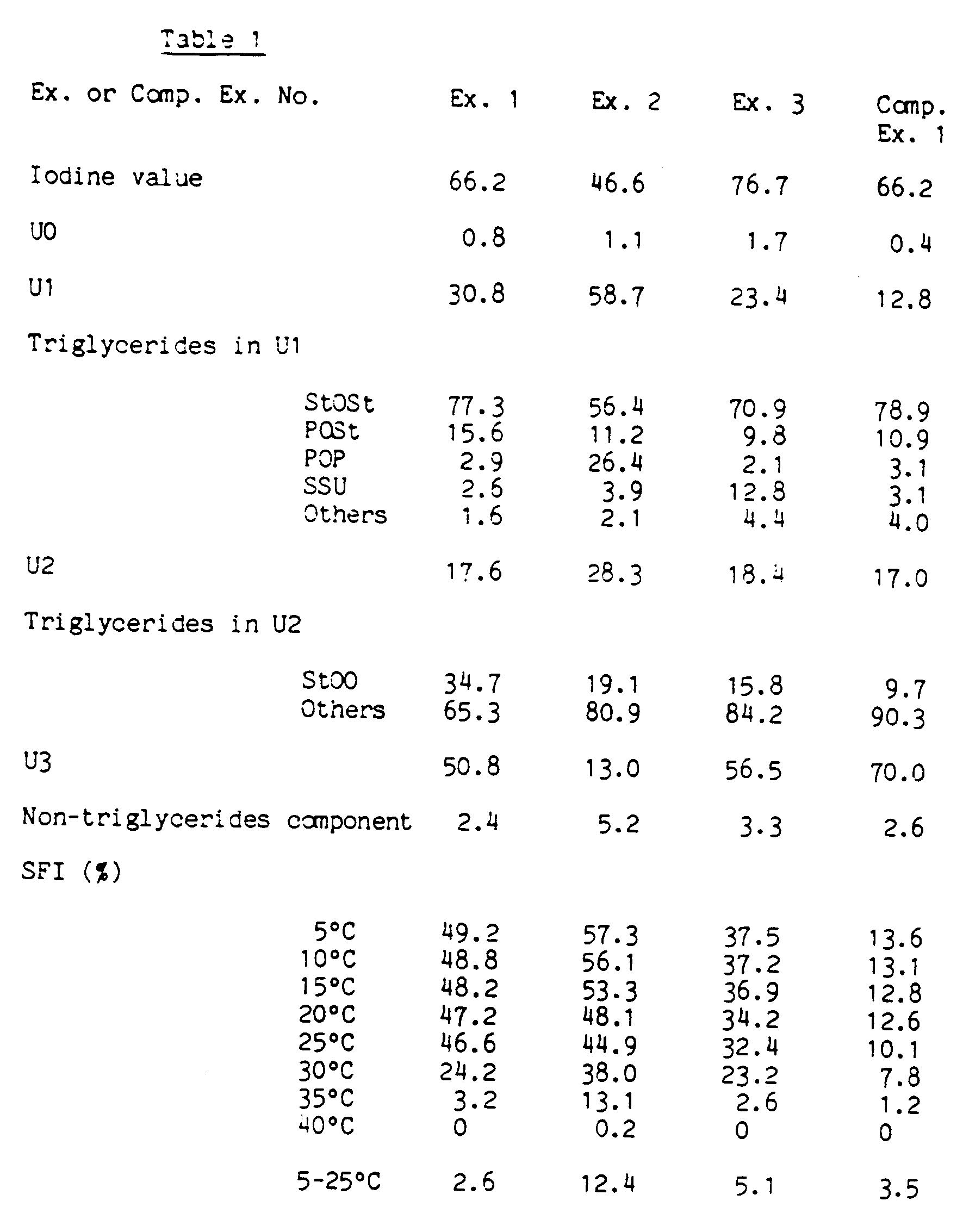
- The glyceride compositions of the hard butter compositions obtained in Examples and Comparative Examples are shown in Table 1.

- By using the hard butter composition of the above Example or Comparative Example, milk chocolate was prepared according to the following formulation.
Milk chocolate formulation Ingredients Parts Cacao mass 13 Hard butter composition 33 Powdered sugar 41 Whole milk powder 13 Lecithin 0.3 Flavor q.p. - According to a conventional method, these ingredients were mixed and the mixture was subjected to refining, conching and tempering to obtain solid chocolate. Hardness of the resulting chocolate was determined at 10°C with a cone penetrometer (a larger value represents a softer product), and at 30°C with a rheometer (a larger value represents a harder product). The results are shown in Table 2.
Table 2 Ref. Ex No. Compositions Hardness 10°C* 30 C** 1 Example 1 4.2 120 2 Example 2 2.7 110 3 Comparative Example 2 3.8 60 4 Comparative Example 3 1.6 122 5 Comparative Example 4 1.8 105 6 Comparative Example 5 1.9 55 *: cone penetrometer value: The depth of penetration (mm) when the cone was dropped from 36 mm in height. **: rheometer value: g/0.785 cm² - The determination was carried out after standing the chocolate at 20°C for 1 week and then at the respective temperature for 2 hours.
- As can be seen from Table 2, when the chocolate using the composition of Example 1 or 2 (the composition of the present invention) was compared with that using the composition of Comparative Example 3 (having high U1 content and melting properties closely resembling those of cocoa butter), the former had heat resistance and soft mouth feel at the beginning of mastication, whereas the latter had heat resistance with very hard mouth feel at the beginning of mastication. Although the chocolate using the composition of Comparative Example 2 (having low StOSt content, i.e., 40.8% and high POP content, i.e., 38.3% in U2 component as well as high U2 content, i.e., 31%) was soft at a low temperature and had soft mouth feel at the beginning of mastication, it was still soft at a high temperature and had no heat resistance. The chocolate using the composition of Comparative Example 4 (having somewhat high U1 content, low StOSt content, high POSt content and high SFI at 5°C) had hard mouth feel at the beginning of mastication.
- When sponge cakes were coated with each chocolate, mouth feel at 10°C of the products using the compositions of Comparative Examples 3 to 5 were hard and were not harmonized with cakes. On the other hand, the products using the composition of Examples 1 and 2 and Comparative Example 2 had good mouth feel. However, the product using Comparative Example 2 stuck to the fingers and had no heat resistance.
- By using the composition of the above Example or Comparative Example, sweet chocolate was prepared according to the following formulation.
Sweet chocolate formulation Ingredients Parts Cacao mass 35 Hard butter composition 20 Powdered sugar 45 Lecithin 0.5 Flavor q.p. - According to the conventional method, the ingredients were mixed and the mixture was subjected to refining, conching and tempering to obtain solid chocolate. Hardness of chocolate was determined according to the same manner as described above. The results are shown in Table 3.
Table 3 Ref. Ex No. Compositions Hardness 10°C 30 C 7 Example 3 3.0 150 8 Comparative Example 1 2.1 75 - As can be seen from Table 3, in comparison with the chocolate using the composition of Example 3 (the composition of the present invention having U1 content of 23.1%), although the chocolate using the composition of Comparative Example 1 (having low U1 content such as about 13%) had soft mouth feel at a low temperature and soft mouth feel at the beginning of mastication, it was still soft at a high temperature and had no heat resistance.
- It can be seen from the foregoing that we have provided hard butter compositions useful as a cocoa butter substitute having improved mouth feel at a low temperature and at the beginning of mastication as well as improved heat resistance.
Claims (4)
- A hard butter composition comprising at least 85% by weight of a triglyceride component and at most 15% by weight of a non-triglyceride component, based on the total weight of the composition;
the triglyceride component containing(a) at most 5% by weight of tri-saturated glycerides,(b) 20 to 65% by weight of triglycerides having one unsaturated bond per molecule,(c) at most 30% by weight of triglycerides having two unsaturated bonds per molecule, and(d) 10 to 70% by weight of triglycerides having at least three unsaturated bonds per molecule, based on the total amount of the triglyceride component;
the triglycerides having one unsaturated bond per molecule (b) containing(i) 50 to 95% by weight of 2-oleo-1,3-distearin,(ii) at most 20% by weight of 2-oleo-1-palmito-3-stearin,(iii) at most 30% by weight of 2-oleo-1,3-dipalmitin, and(iv) at most 20% by weight of 1,2-saturated-3-unsaturated glycerides, based on the total mount of the trigylcerides (b);
the triglycerides having two unsaturated bonds per molecule (c) containing at most 40% by weight of 1-stearo-2,3,-diolein based on the total amount of the triglycerides (c); and
SFI of the composition being
at most 65% at 5°C
20 to 55% at 30°C
2 to 35% at 35°C
at most 3% at 40°C, and
the difference between SFI at 5°C and that at 25°C being at most 15% - The use of a hard butter composition as claimed in Claim 1 in the manufacture of chocolate.
- Chocolate comprising a hard butter composition as claimed in Claim 1.
- The use of a chocolate as claimed in Claim 3 as a coating for a chocolate product.
Applications Claiming Priority (2)
| Application Number | Priority Date | Filing Date | Title |
|---|---|---|---|
| JP83501/87 | 1987-04-03 | ||
| JP62083501A JP2504987B2 (en) | 1987-04-03 | 1987-04-03 | Hard butter composition |
Publications (3)
| Publication Number | Publication Date |
|---|---|
| EP0285422A2 EP0285422A2 (en) | 1988-10-05 |
| EP0285422A3 EP0285422A3 (en) | 1989-11-15 |
| EP0285422B1 true EP0285422B1 (en) | 1992-04-15 |
Family
ID=13804225
Family Applications (1)
| Application Number | Title | Priority Date | Filing Date |
|---|---|---|---|
| EP88302895A Expired EP0285422B1 (en) | 1987-04-03 | 1988-03-31 | Hard butter composition |
Country Status (4)
| Country | Link |
|---|---|
| US (1) | US4882192A (en) |
| EP (1) | EP0285422B1 (en) |
| JP (1) | JP2504987B2 (en) |
| DE (1) | DE3870011D1 (en) |
Families Citing this family (34)
| Publication number | Priority date | Publication date | Assignee | Title |
|---|---|---|---|---|
| JPH0728663B2 (en) * | 1989-07-11 | 1995-04-05 | 不二製油株式会社 | Fats and soft chocolates for soft chocolate |
| JPH03292856A (en) * | 1990-04-11 | 1991-12-24 | Asahi Denka Kogyo Kk | Fats and oils composition |
| KR100218231B1 (en) * | 1991-03-04 | 1999-09-01 | 야스이 기치지 | Chocolate and Chocolate Food |
| DE69202126T2 (en) * | 1991-07-03 | 1995-08-24 | Unilever Nv | Improved chocolate composition. |
| DE69204231T2 (en) * | 1991-07-03 | 1996-01-25 | Unilever Nv | Chocolate filling containing an anti-greasy additive. |
| ATE130169T1 (en) * | 1991-10-03 | 1995-12-15 | Unilever Nv | NON-TEMPERATED FAT FOR CONFECTIONAL PRODUCTS. |
| ES2072699T3 (en) * | 1991-11-26 | 1995-07-16 | Unilever Nv | FAT OF CONFECTIONERY WITHOUT TEMPERING. |
| DE69300287T2 (en) * | 1992-03-11 | 1995-12-21 | Loders Croklaan Bv | Improved chocolate compositions based on triglyceride additives. |
| ATE146040T1 (en) * | 1993-02-26 | 1996-12-15 | Unilever Nv | FAT COMPOSITIONS FOR CONFECTIONS |
| JP3582863B2 (en) * | 1994-09-22 | 2004-10-27 | 不二製油株式会社 | Chocolate |
| DE69519363T2 (en) * | 1994-09-23 | 2001-03-08 | Fuji Oil Co., Ltd. | Low softening point chocolate and manufacturing process |
| US6512580B1 (en) | 1999-10-27 | 2003-01-28 | Verification Technologies, Inc. | Method and apparatus for portable product authentication |
| EP1797766B1 (en) * | 2004-08-27 | 2012-05-09 | Fuji Oil Company, Ltd. | Oily food and process for producing the same |
| EP1736059A1 (en) * | 2005-06-21 | 2006-12-27 | Fuji Oil Europe | Structuring granular composition |
| AU2006337928B2 (en) * | 2006-02-08 | 2012-12-20 | Fuji Oil Company, Limited | Edible products with low content of saturated and trans unsaturated fats |
| EP1992231A1 (en) | 2007-05-15 | 2008-11-19 | Fuji Oil Europe | Food products with low content of saturated and trans unsaturated fats |
| CN102548425B (en) | 2009-06-12 | 2017-09-29 | 马斯公司 | Chocolate composition containing ethyl cellulose |
| KR101821399B1 (en) * | 2010-03-19 | 2018-01-23 | 닛신 오일리오그룹 가부시키가이샤 | Fat and oil composition and chocolate products using same |
| MY161610A (en) * | 2010-09-27 | 2017-04-28 | Nisshin Oillio Group Ltd | Oil and fat composition and method of producing thereof |
| GB2485421B (en) | 2010-11-15 | 2016-05-25 | Mars Inc | Dough products exhibiting reduced oil migration |
| US9107431B2 (en) * | 2011-02-22 | 2015-08-18 | The Nisshin Oillio Group, Ltd. | Chocolate or chocolate-like food and method of producing the same |
| US9113644B2 (en) * | 2011-04-14 | 2015-08-25 | Aak Denmark A/S | Bloom retarding fat |
| BR112014010386B1 (en) | 2011-11-02 | 2019-11-12 | Fuji Oil Co Ltd | combined oil or fat composition, alternative cocoa butter, chocolate and confectionery |
| EP2692238A1 (en) | 2012-08-03 | 2014-02-05 | Bunge Növényolajipari Zártköruen Muködo Részvénytársasag | New fat blend composition |
| KR101984347B1 (en) * | 2012-08-29 | 2019-05-30 | 닛신 오일리오그룹 가부시키가이샤 | Combined confectionery |
| MX367984B (en) | 2012-09-28 | 2019-09-13 | Mars Inc | Heat resistant chocolate. |
| JP5756074B2 (en) * | 2012-11-02 | 2015-07-29 | 日清オイリオグループ株式会社 | Heat-resistant chocolate and method for producing heat-resistant chocolate |
| JP6086477B2 (en) * | 2012-12-19 | 2017-03-01 | 株式会社Adeka | Hard butter |
| JP6337477B2 (en) * | 2014-01-23 | 2018-06-06 | 不二製油株式会社 | Molded chocolates for baking and composite confectionery using the same |
| JP5940612B2 (en) * | 2014-08-27 | 2016-06-29 | ニッシン グローバル リサーチ センター エスディエヌ ビーエイチディー | Oil composition and chocolate |
| CN107708428A (en) * | 2015-06-16 | 2018-02-16 | 日清奥利友集团株式会社 | oily food |
| JP6947516B2 (en) * | 2017-03-15 | 2021-10-13 | 株式会社Adeka | Oil and fat composition for confectionery |
| MX2020003350A (en) * | 2017-10-13 | 2020-08-13 | Aak Ab Publ | Heat stable chocolate. |
| JPWO2022050339A1 (en) * | 2020-09-02 | 2022-03-10 |
Family Cites Families (15)
| Publication number | Priority date | Publication date | Assignee | Title |
|---|---|---|---|---|
| US3012891A (en) * | 1958-06-11 | 1961-12-12 | Lever Brothers Ltd | Cocoa-butter substitute |
| US3070445A (en) * | 1959-05-13 | 1962-12-25 | Twincon Nv | Process for the preparation of a cocoa butter substitute as well as for the preparation of chocolate and the shaped products thus obtained |
| DE1692522A1 (en) * | 1967-07-28 | 1971-08-05 | Henkel & Cie Gmbh | A glyceride mixture suitable for conversion into plastic edible fats with a wide plasticity range or an edible fat made therefrom and a process for the production of such a glyceride mixture or such an edible fat |
| GB1511193A (en) * | 1976-08-13 | 1978-05-17 | Fuji Oil Co Ltd | Method for producing shea fat |
| JPS6050423B2 (en) * | 1976-10-15 | 1985-11-08 | 旭電化工業株式会社 | hard butter |
| GB1562011A (en) * | 1977-01-20 | 1980-03-05 | Asahi Denka Kogyo Kk | Hard vegetable oil based butter |
| JPS5394066A (en) * | 1977-01-28 | 1978-08-17 | Asahi Denka Kogyo Kk | Production of hard butter |
| JPS53115863A (en) * | 1977-03-18 | 1978-10-09 | Asahi Denka Kogyo Kk | Cacao substitute oil |
| JPS5918969B2 (en) * | 1977-09-08 | 1984-05-01 | 不二製油株式会社 | hard butter composition |
| JPS5571797A (en) * | 1978-11-21 | 1980-05-30 | Fuji Oil Co Ltd | Manufacture of cacao butter substitute fat |
| US4348423A (en) * | 1980-10-15 | 1982-09-07 | Blohorn, S.A. | Method of preparing a cocoa butter substitute |
| US4390561A (en) * | 1981-11-04 | 1983-06-28 | The Procter & Gamble Company | Margarine oil product |
| GB8432058D0 (en) * | 1984-12-19 | 1985-01-30 | Unilever Plc | Edible fat |
| JPS61242543A (en) * | 1985-04-19 | 1986-10-28 | Fuji Oil Co Ltd | Method of improving quality of hard butter |
| GB2190394A (en) * | 1986-05-06 | 1987-11-18 | Unilever Plc | Edible fats by rearrangement of sunflower oil |
-
1987
- 1987-04-03 JP JP62083501A patent/JP2504987B2/en not_active Expired - Fee Related
-
1988
- 1988-03-31 EP EP88302895A patent/EP0285422B1/en not_active Expired
- 1988-03-31 DE DE8888302895T patent/DE3870011D1/en not_active Expired - Lifetime
- 1988-03-31 US US07/176,181 patent/US4882192A/en not_active Expired - Fee Related
Also Published As
| Publication number | Publication date |
|---|---|
| EP0285422A3 (en) | 1989-11-15 |
| JPS63248343A (en) | 1988-10-14 |
| DE3870011D1 (en) | 1992-05-21 |
| JP2504987B2 (en) | 1996-06-05 |
| US4882192A (en) | 1989-11-21 |
| EP0285422A2 (en) | 1988-10-05 |
Similar Documents
| Publication | Publication Date | Title |
|---|---|---|
| US4882192A (en) | Hard butter composition | |
| US5424090A (en) | Process of making a hard butter composition containing an anti-blooming agent | |
| US4839192A (en) | Hard butter composition containing triglycerides, and process for production thereof | |
| EP0237307B1 (en) | Substitute composition for cocoa butter | |
| EP1635649B1 (en) | Low-trans for confectionery fat compositions | |
| EP0803196B1 (en) | A hard butter additive composition and a process of making a hard butter composition containing the same | |
| EP2164336B1 (en) | Structured food products with low content of saturated and trans unsaturated fats | |
| CA2853526C (en) | Oil or fat composition, chocolate and combined confectionery | |
| EP0293194B1 (en) | Fat for chocolate | |
| JP3498623B2 (en) | Hard butter and method for producing the same | |
| JP3327122B2 (en) | Non-tempering hard butter | |
| CN102370028A (en) | Replacement fats for cocoa butter having good thermal resistance and mouth-feel and chocolate composition including the same | |
| JP2008228641A (en) | Oil composition for soft chocolate | |
| JP3031487B2 (en) | Bloom resistant triglyceride composition for food | |
| JP7203555B2 (en) | fat composition | |
| JP3016688B2 (en) | Hard butter composition and chocolate-like food | |
| JP7128045B2 (en) | chocolate improver | |
| JP4493130B2 (en) | Method for producing oil and fat composition | |
| EP0424997A2 (en) | Cacao butter fractions | |
| JP6961304B2 (en) | Oil composition for coated chocolate | |
| JP6676923B2 (en) | Oil composition for chocolate and chocolate containing the same | |
| JPH0834989A (en) | Method for fractionating cocoa butter and chocolate containing fractionated fat obtained by the method | |
| JPH0728662B2 (en) | Hard butter composition | |
| EP0547651A1 (en) | Improved non-lauric triglyceride compositions | |
| US4844940A (en) | Hard butter |
Legal Events
| Date | Code | Title | Description |
|---|---|---|---|
| PUAI | Public reference made under article 153(3) epc to a published international application that has entered the european phase |
Free format text: ORIGINAL CODE: 0009012 |
|
| AK | Designated contracting states |
Kind code of ref document: A2 Designated state(s): CH DE FR GB LI NL |
|
| PUAL | Search report despatched |
Free format text: ORIGINAL CODE: 0009013 |
|
| AK | Designated contracting states |
Kind code of ref document: A3 Designated state(s): CH DE FR GB LI NL |
|
| 17P | Request for examination filed |
Effective date: 19900117 |
|
| 17Q | First examination report despatched |
Effective date: 19910228 |
|
| GRAA | (expected) grant |
Free format text: ORIGINAL CODE: 0009210 |
|
| AK | Designated contracting states |
Kind code of ref document: B1 Designated state(s): CH DE FR GB LI NL |
|
| REF | Corresponds to: |
Ref document number: 3870011 Country of ref document: DE Date of ref document: 19920521 |
|
| ET | Fr: translation filed | ||
| PLBE | No opposition filed within time limit |
Free format text: ORIGINAL CODE: 0009261 |
|
| STAA | Information on the status of an ep patent application or granted ep patent |
Free format text: STATUS: NO OPPOSITION FILED WITHIN TIME LIMIT |
|
| 26N | No opposition filed | ||
| REG | Reference to a national code |
Ref country code: GB Ref legal event code: IF02 |
|
| PGFP | Annual fee paid to national office [announced via postgrant information from national office to epo] |
Ref country code: NL Payment date: 20070313 Year of fee payment: 20 |
|
| PGFP | Annual fee paid to national office [announced via postgrant information from national office to epo] |
Ref country code: CH Payment date: 20070314 Year of fee payment: 20 |
|
| PGFP | Annual fee paid to national office [announced via postgrant information from national office to epo] |
Ref country code: DE Payment date: 20070316 Year of fee payment: 20 |
|
| PGFP | Annual fee paid to national office [announced via postgrant information from national office to epo] |
Ref country code: GB Payment date: 20070322 Year of fee payment: 20 |
|
| REG | Reference to a national code |
Ref country code: GB Ref legal event code: PE20 Expiry date: 20080330 |
|
| PG25 | Lapsed in a contracting state [announced via postgrant information from national office to epo] |
Ref country code: NL Free format text: LAPSE BECAUSE OF EXPIRATION OF PROTECTION Effective date: 20080331 |
|
| PGFP | Annual fee paid to national office [announced via postgrant information from national office to epo] |
Ref country code: FR Payment date: 20070319 Year of fee payment: 20 |
|
| REG | Reference to a national code |
Ref country code: CH Ref legal event code: PL |
|
| PG25 | Lapsed in a contracting state [announced via postgrant information from national office to epo] |
Ref country code: GB Free format text: LAPSE BECAUSE OF EXPIRATION OF PROTECTION Effective date: 20080330 |
|
| NLV7 | Nl: ceased due to reaching the maximum lifetime of a patent |
Effective date: 20080331 |