EP0284959B1 - Stable boron resins of high selective absorbent power - Google Patents
Stable boron resins of high selective absorbent power Download PDFInfo
- Publication number
- EP0284959B1 EP0284959B1 EP88104553A EP88104553A EP0284959B1 EP 0284959 B1 EP0284959 B1 EP 0284959B1 EP 88104553 A EP88104553 A EP 88104553A EP 88104553 A EP88104553 A EP 88104553A EP 0284959 B1 EP0284959 B1 EP 0284959B1
- Authority
- EP
- European Patent Office
- Prior art keywords
- formula
- resin
- resins
- product
- reaction
- Prior art date
- Legal status (The legal status is an assumption and is not a legal conclusion. Google has not performed a legal analysis and makes no representation as to the accuracy of the status listed.)
- Expired - Lifetime
Links
- 239000011347 resin Substances 0.000 title claims abstract description 45
- 229920005989 resin Polymers 0.000 title claims abstract description 45
- ZOXJGFHDIHLPTG-UHFFFAOYSA-N Boron Chemical compound [B] ZOXJGFHDIHLPTG-UHFFFAOYSA-N 0.000 title claims abstract description 15
- 229910052796 boron Inorganic materials 0.000 title claims abstract description 15
- 239000002250 absorbent Substances 0.000 title abstract description 4
- 230000002745 absorbent Effects 0.000 title abstract description 4
- BRTALTYTFFNPAC-UHFFFAOYSA-N boroxin Chemical compound B1OBOBO1 BRTALTYTFFNPAC-UHFFFAOYSA-N 0.000 claims abstract description 9
- 239000011159 matrix material Substances 0.000 claims abstract description 9
- JCQLYHFGKNRPGE-FCVZTGTOSA-N lactulose Chemical compound OC[C@H]1O[C@](O)(CO)[C@@H](O)[C@@H]1O[C@H]1[C@H](O)[C@@H](O)[C@@H](O)[C@@H](CO)O1 JCQLYHFGKNRPGE-FCVZTGTOSA-N 0.000 claims abstract description 6
- 229960000511 lactulose Drugs 0.000 claims abstract description 6
- PFCRQPBOOFTZGQ-UHFFFAOYSA-N lactulose keto form Natural products OCC(=O)C(O)C(C(O)CO)OC1OC(CO)C(O)C(O)C1O PFCRQPBOOFTZGQ-UHFFFAOYSA-N 0.000 claims abstract description 6
- 238000006243 chemical reaction Methods 0.000 claims description 24
- 239000000047 product Substances 0.000 claims description 22
- 239000000203 mixture Substances 0.000 claims description 20
- 238000000034 method Methods 0.000 claims description 12
- 239000004925 Acrylic resin Substances 0.000 claims description 10
- 125000006527 (C1-C5) alkyl group Chemical group 0.000 claims description 8
- 150000001450 anions Chemical group 0.000 claims description 4
- 229910052736 halogen Inorganic materials 0.000 claims description 4
- 150000002367 halogens Chemical class 0.000 claims description 4
- 125000002887 hydroxy group Chemical group [H]O* 0.000 claims description 4
- 150000001720 carbohydrates Chemical class 0.000 claims description 3
- 235000014633 carbohydrates Nutrition 0.000 claims description 3
- 238000010521 absorption reaction Methods 0.000 claims 1
- 239000007859 condensation product Substances 0.000 claims 1
- 235000000346 sugar Nutrition 0.000 abstract description 4
- 150000008163 sugars Chemical class 0.000 abstract description 4
- 125000001453 quaternary ammonium group Chemical group 0.000 abstract description 3
- 150000001412 amines Chemical class 0.000 abstract description 2
- 125000003700 epoxy group Chemical group 0.000 abstract description 2
- 238000004519 manufacturing process Methods 0.000 abstract description 2
- 239000007795 chemical reaction product Substances 0.000 abstract 1
- LFQSCWFLJHTTHZ-UHFFFAOYSA-N Ethanol Chemical compound CCO LFQSCWFLJHTTHZ-UHFFFAOYSA-N 0.000 description 21
- RYHBNJHYFVUHQT-UHFFFAOYSA-N 1,4-Dioxane Chemical compound C1COCCO1 RYHBNJHYFVUHQT-UHFFFAOYSA-N 0.000 description 9
- VEXZGXHMUGYJMC-UHFFFAOYSA-N Hydrochloric acid Chemical compound Cl VEXZGXHMUGYJMC-UHFFFAOYSA-N 0.000 description 9
- 238000005360 mashing Methods 0.000 description 9
- 239000000243 solution Substances 0.000 description 9
- NLKNQRATVPKPDG-UHFFFAOYSA-M potassium iodide Chemical compound [K+].[I-] NLKNQRATVPKPDG-UHFFFAOYSA-M 0.000 description 8
- OKKJLVBELUTLKV-UHFFFAOYSA-N Methanol Chemical compound OC OKKJLVBELUTLKV-UHFFFAOYSA-N 0.000 description 6
- 238000013019 agitation Methods 0.000 description 6
- 238000001914 filtration Methods 0.000 description 6
- 239000002904 solvent Substances 0.000 description 6
- 238000010992 reflux Methods 0.000 description 5
- 239000000725 suspension Substances 0.000 description 5
- CSCPPACGZOOCGX-UHFFFAOYSA-N Acetone Chemical compound CC(C)=O CSCPPACGZOOCGX-UHFFFAOYSA-N 0.000 description 4
- 229920000178 Acrylic resin Polymers 0.000 description 4
- BRLQWZUYTZBJKN-UHFFFAOYSA-N Epichlorohydrin Chemical compound ClCC1CO1 BRLQWZUYTZBJKN-UHFFFAOYSA-N 0.000 description 4
- GUBGYTABKSRVRQ-QKKXKWKRSA-N Lactose Natural products OC[C@H]1O[C@@H](O[C@H]2[C@H](O)[C@@H](O)C(O)O[C@@H]2CO)[C@H](O)[C@@H](O)[C@H]1O GUBGYTABKSRVRQ-QKKXKWKRSA-N 0.000 description 4
- FAPWRFPIFSIZLT-UHFFFAOYSA-M Sodium chloride Chemical compound [Na+].[Cl-] FAPWRFPIFSIZLT-UHFFFAOYSA-M 0.000 description 4
- NIXOWILDQLNWCW-UHFFFAOYSA-N acrylic acid group Chemical group C(C=C)(=O)O NIXOWILDQLNWCW-UHFFFAOYSA-N 0.000 description 4
- UHOVQNZJYSORNB-UHFFFAOYSA-N c1ccccc1 Chemical compound c1ccccc1 UHOVQNZJYSORNB-UHFFFAOYSA-N 0.000 description 4
- 239000012043 crude product Substances 0.000 description 4
- 229930182830 galactose Natural products 0.000 description 4
- 239000008101 lactose Substances 0.000 description 4
- 230000007935 neutral effect Effects 0.000 description 4
- XLYOFNOQVPJJNP-UHFFFAOYSA-N water Substances O XLYOFNOQVPJJNP-UHFFFAOYSA-N 0.000 description 4
- RGHHSNMVTDWUBI-UHFFFAOYSA-N 4-hydroxybenzaldehyde Chemical compound OC1=CC=C(C=O)C=C1 RGHHSNMVTDWUBI-UHFFFAOYSA-N 0.000 description 3
- YMWUJEATGCHHMB-UHFFFAOYSA-N Dichloromethane Chemical compound ClCCl YMWUJEATGCHHMB-UHFFFAOYSA-N 0.000 description 3
- 230000008929 regeneration Effects 0.000 description 3
- 238000011069 regeneration method Methods 0.000 description 3
- 238000005406 washing Methods 0.000 description 3
- MYRTYDVEIRVNKP-UHFFFAOYSA-N 1,2-Divinylbenzene Chemical compound C=CC1=CC=CC=C1C=C MYRTYDVEIRVNKP-UHFFFAOYSA-N 0.000 description 2
- UXVMQQNJUSDDNG-UHFFFAOYSA-L Calcium chloride Chemical compound [Cl-].[Cl-].[Ca+2] UXVMQQNJUSDDNG-UHFFFAOYSA-L 0.000 description 2
- QGZKDVFQNNGYKY-UHFFFAOYSA-N ammonia Natural products N QGZKDVFQNNGYKY-UHFFFAOYSA-N 0.000 description 2
- 239000001110 calcium chloride Substances 0.000 description 2
- 229910001628 calcium chloride Inorganic materials 0.000 description 2
- 235000011148 calcium chloride Nutrition 0.000 description 2
- 239000008367 deionised water Substances 0.000 description 2
- 150000004985 diamines Chemical class 0.000 description 2
- 239000003822 epoxy resin Substances 0.000 description 2
- 239000011521 glass Substances 0.000 description 2
- 238000010438 heat treatment Methods 0.000 description 2
- 239000002245 particle Substances 0.000 description 2
- HXITXNWTGFUOAU-UHFFFAOYSA-N phenylboronic acid Chemical class OB(O)C1=CC=CC=C1 HXITXNWTGFUOAU-UHFFFAOYSA-N 0.000 description 2
- 239000003880 polar aprotic solvent Substances 0.000 description 2
- 229920000647 polyepoxide Polymers 0.000 description 2
- 239000011148 porous material Substances 0.000 description 2
- 238000002360 preparation method Methods 0.000 description 2
- 239000012279 sodium borohydride Substances 0.000 description 2
- 229910000033 sodium borohydride Inorganic materials 0.000 description 2
- 239000011780 sodium chloride Substances 0.000 description 2
- 238000005891 transamination reaction Methods 0.000 description 2
- DIRRKLFMHQUJCM-UHFFFAOYSA-N (2-aminophenyl)boronic acid Chemical compound NC1=CC=CC=C1B(O)O DIRRKLFMHQUJCM-UHFFFAOYSA-N 0.000 description 1
- GUBGYTABKSRVRQ-XLOQQCSPSA-N Alpha-Lactose Chemical compound O[C@@H]1[C@@H](O)[C@@H](O)[C@@H](CO)O[C@H]1O[C@@H]1[C@@H](CO)O[C@H](O)[C@H](O)[C@H]1O GUBGYTABKSRVRQ-XLOQQCSPSA-N 0.000 description 1
- VHUUQVKOLVNVRT-UHFFFAOYSA-N Ammonium hydroxide Chemical compound [NH4+].[OH-] VHUUQVKOLVNVRT-UHFFFAOYSA-N 0.000 description 1
- GDOPTJXRTPNYNR-UHFFFAOYSA-N CC1CCCC1 Chemical compound CC1CCCC1 GDOPTJXRTPNYNR-UHFFFAOYSA-N 0.000 description 1
- HNEXWJQRYLZRRU-UHFFFAOYSA-N NB1OB(OBO1)C1=CC=CC=C1 Chemical compound NB1OB(OBO1)C1=CC=CC=C1 HNEXWJQRYLZRRU-UHFFFAOYSA-N 0.000 description 1
- PTTXTZAXVXGSMQ-UHFFFAOYSA-N [IH]=Nc1ccccc1 Chemical compound [IH]=Nc1ccccc1 PTTXTZAXVXGSMQ-UHFFFAOYSA-N 0.000 description 1
- 239000002253 acid Substances 0.000 description 1
- -1 acrylic ester Chemical class 0.000 description 1
- 230000001476 alcoholic effect Effects 0.000 description 1
- 239000012670 alkaline solution Substances 0.000 description 1
- WQZGKKKJIJFFOK-PHYPRBDBSA-N alpha-D-galactose Chemical compound OC[C@H]1O[C@H](O)[C@H](O)[C@@H](O)[C@H]1O WQZGKKKJIJFFOK-PHYPRBDBSA-N 0.000 description 1
- 239000011260 aqueous acid Substances 0.000 description 1
- 238000009833 condensation Methods 0.000 description 1
- 230000005494 condensation Effects 0.000 description 1
- 238000004132 cross linking Methods 0.000 description 1
- 238000001035 drying Methods 0.000 description 1
- 238000010828 elution Methods 0.000 description 1
- 238000004898 kneading Methods 0.000 description 1
- JMZFEHDNIAQMNB-UHFFFAOYSA-N m-aminophenylboronic acid Chemical compound NC1=CC=CC(B(O)O)=C1 JMZFEHDNIAQMNB-UHFFFAOYSA-N 0.000 description 1
- 229910000069 nitrogen hydride Inorganic materials 0.000 description 1
- 239000003960 organic solvent Substances 0.000 description 1
- 229920000058 polyacrylate Polymers 0.000 description 1
- 239000000126 substance Substances 0.000 description 1
- 239000006188 syrup Substances 0.000 description 1
- 235000020357 syrup Nutrition 0.000 description 1
- 230000001960 triggered effect Effects 0.000 description 1
Classifications
-
- C—CHEMISTRY; METALLURGY
- C08—ORGANIC MACROMOLECULAR COMPOUNDS; THEIR PREPARATION OR CHEMICAL WORKING-UP; COMPOSITIONS BASED THEREON
- C08F—MACROMOLECULAR COMPOUNDS OBTAINED BY REACTIONS ONLY INVOLVING CARBON-TO-CARBON UNSATURATED BONDS
- C08F8/00—Chemical modification by after-treatment
- C08F8/42—Introducing metal atoms or metal-containing groups
-
- C—CHEMISTRY; METALLURGY
- C08—ORGANIC MACROMOLECULAR COMPOUNDS; THEIR PREPARATION OR CHEMICAL WORKING-UP; COMPOSITIONS BASED THEREON
- C08F—MACROMOLECULAR COMPOUNDS OBTAINED BY REACTIONS ONLY INVOLVING CARBON-TO-CARBON UNSATURATED BONDS
- C08F8/00—Chemical modification by after-treatment
- C08F8/44—Preparation of metal salts or ammonium salts
Definitions
- This invention relates to new boron resins possessing very high selective absorbent power which are stable in organic solvents and in aqueous acid and alkaline solutions.
- the invention relates to boron resins consisting of an acrylic polymer matrix functionalised with quaternary ammonium groups, an epoxy group and phenylboric groups, of general formula (I): in which: P is the polyacrylic matrix R is -(CH2) n - where n varies between 0 and 5 R1 and R2, which can be the same or different, are C1-C5 alkyl R3 is - (C n H 2n ) where n varies from 1 to 5 R4 is H or C1-C5 alkyl X ⁇ is an anion chosen from halogens and hydroxyl.
- P is the polyacrylic matrix
- R is -(CH2) n - where n varies between 0 and 5 R1 and R2, which can be the same or different, are C1-C5 alkyl
- R3 is - (C n H 2n ) where n varies from 1 to 5 R4 is H or C1-C5 alkyl
- X ⁇ is
- the invention also relates to a process for producing the resins defined by general formula (I).
- the boron resins of the present invention are prepared from a polyacrylic resin obtained by cross-linking an acrylic ester with divinylbenzene and preferably having the following characteristics: Percentage of cross-linkage 4% Mean pore diameter 1100 ⁇ Specific surface area 10 m2/g Particle size 0.2-0.4 mm (90%)
- This resin is firstly subjected to a transamination reaction by reacting with disubstituted diamines by known methods.
- the mixture is left to stand at ambient temperature for 18 hours.
- the mixture On termination of the reaction, the mixture is filtered through a Buchner funnel and washed by mashing three times with 500 ml of dioxane followed by filtration in succession.
- the product is used crude for the next reaction.
- the crude epoxy resin from the previous reaction is taken up in 1000 ml of dioxane. 65 g of the product obtained in Example 1 are then added.
- the suspension is kept at ambient temperature for 24 hours under agitation. On termination of the reaction the mixture is filtered through a Buchner funnel and the resin obtained is taken up in 1000 ml of ethanol.
- the suspension is placed in a flask fitted with an agitator and 8 g of NaBH4 are added, the mixture then being kept under agitation at 10-15°C for 8 hours.
- the mixture On termination of the reaction the mixture is filtered through a Buchner funnel and then washed by three successive mashing and filtration operations, namely a first mashing in 250 ml of ethanol, a second mashing in 250 ml of an ethanol/0.5 N HCl mixture in a 2/1 volume ratio, and finally a third mashing in 300 ml of 0.2 N HCl.
- 31 g of resin are obtained having the following characteristics: - degree of functionalisation 3.5 meq of B per gram of dry resin - percentage of cross-linkage 4% - pore diameter 1000 ⁇ - specific surface area 19 m2/g - apparent density 0.8 g/ml - real density 1.45 g/ml - particle size 0.2-0.4 mm (75%)
- the mixture is heated to 35-40°C for 18 hours.
- the residue is taken up in 150 ml of methanol and kept under agitation under cold conditions for 2 hours.
- the product is crystallised from methylene chloride.
- the acrylo-amine resin is suitably pretreated as described in the aforesaid Example 2.
- the mixture On termination of the reaction, the mixture is filtered through a Buchner funnel and the residue obtained is taken up in 500 ml of ethanol.
- the suspension is placed in a flask fitted with an agitator and 4 g of NaBH4 are added, the mixture then being kept under agitation at 10-15°C for 8 hours.
- the mixture On termination of the reaction the mixture is filtered through a Buchner funnel and then washed by three successive mashing and filtering operations, namely a first mashing in 250 ml of ethanol, a second mashing in 250 of an ethanol/0.5 N HCl mixture in a 2/1 volume ratio, and finally a third mashing in 300 ml of 0.2 N HCl.
- a boron resin of the characteristics of example 2b is rehydrated in deionised water for 8 hours.
Landscapes
- Chemical & Material Sciences (AREA)
- General Chemical & Material Sciences (AREA)
- Health & Medical Sciences (AREA)
- Chemical Kinetics & Catalysis (AREA)
- Medicinal Chemistry (AREA)
- Polymers & Plastics (AREA)
- Organic Chemistry (AREA)
- Addition Polymer Or Copolymer, Post-Treatments, Or Chemical Modifications (AREA)
- Solid-Sorbent Or Filter-Aiding Compositions (AREA)
- Saccharide Compounds (AREA)
- Other Resins Obtained By Reactions Not Involving Carbon-To-Carbon Unsaturated Bonds (AREA)
- Diaphragms For Electromechanical Transducers (AREA)
Abstract
Description
- This invention relates to new boron resins possessing very high selective absorbent power which are stable in organic solvents and in aqueous acid and alkaline solutions.
- More particularly, the invention relates to boron resins consisting of an acrylic polymer matrix functionalised with quaternary ammonium groups, an epoxy group and phenylboric groups, of general formula (I):

in which:
Ⓟ is the polyacrylic matrix
R is -(CH₂)n- where n varies between 0 and 5
R₁ and R2, which can be the same or different, are C₁-C₅ alkyl
R₃ is - (CnH2n) where n varies from 1 to 5
R₄ is H or C₁-C₅ alkyl
X⁻ is an anion chosen from halogens and hydroxyl. - The invention also relates to a process for producing the resins defined by general formula (I).
- In European Patent 85102934.8 we have already described boron resins with a polyacrylic matrix bifunctionalised with quaternary ammonium groups and alkylphenylboric groups, which possess good chemical and mechanical stability characteristics and can be used in industrial processes, having a marked selective absorbent action particularly in separating lactose from its mixtures with other carbohydrates, generally lactose and galactose.
- It has now been discovered that boron resins with further improved selectivity in separating sugars can be obtained by the process of the present invention, which is described in detail hereinafter.
- The boron resins of the present invention are prepared from a polyacrylic resin obtained by cross-linking an acrylic ester with divinylbenzene and preferably having the following characteristics:
Percentage of cross-linkage 4%
Mean pore diameter 1100 Å
Specific surface area 10 m²/g
Particle size 0.2-0.4 mm (90%) - This resin is firstly subjected to a transamination reaction by reacting with disubstituted diamines by known methods.
- Separately, a particular boroxin of the type corresponding to the indicated formula is obtained by reacting an aminophenylboroxin of formula
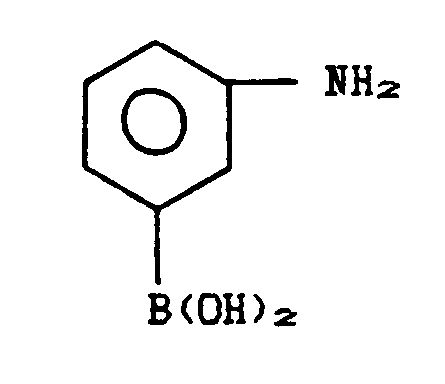
with hydroxybenzaldehyde, to produce an intermediate of formula (II)
- To produce the boron resin, either:
- 1) the transaminated polyacrylic resin is firstly reacted with an epihalohydrin:


- 2) the boroxin (II) is firstly reacted with the epihalohydrin and the product of this reaction reacted with the transaminated polyacrylic resin, the product of this latter reaction then being reduced by NaBH in methanol, to obtain a product of formula (I):

- The preferred conditions for implementing the individual steps of the process in the form of the two alternatives described schematically heretofore are as follows:
- a) Transamination of the polyacrylic matrix: this is conducted by known methods, reacting the polyacrylic matrix with a disubstituted diamine.
- b) Preparation of the boroxin of formula (II): a substituted benzeneboronic acid such as an aminobenzeneboronic or oxybenzeneboronic acid is mixed with p-oxybenzaldehyde in an alcoholic solvent, and left at ambient temperature for 15-24 hours. The crude product can be used for the subsequent reactions after filtration.
- c) Reaction of the transaminated polyacrylic resin with an epihalohydrin: the aminated acrylic resin is pretreated by a process comprising regeneration in Cl⁻ form by reaction with a dilute NaCl and HCl solution at about ambient temperature, washing with demineralised water until neutral, regeneration in OH⁻ form by treatment in aqueous ammonia at around ambient temperature, washing with demineralised water until neutral, washing with acetone and drying under vacuum.
At this point the resin is placed in a polar aprotic solvent such as dioxane, and heated under reflux with epichlorohydrin dissolved in the same solvent, triggering the reaction with potassium iodide and heating under reflux between 40 and 100°C for 15-25 hours. After filtration and repeated washes with the same solvent, the crude product is ready for the subsequent reactions. - d) Reaction of the product obtained in c) with the boroxin of formula (II) followed by reduction: this process is conducted by suspending the product obtained in c) in a polar aprotic solvent such as dioxane, then adding the product obtained in b). The suspension is kept at ambient temperature for 15-30 hours under agitation. It is filtered and the product taken up in alcohol. The suspension is treated with NaBH for 8-12 hours at a temperature of about 10-20°C.
After filtration¸ the resin is washed repeatedly by kneading with ethanol and with a mixture of ethanol and dilute hydrochloric acid, and finally with dilute hydrochloric acid alone. - e) Reaction of the boroxin of formula (II) with the epihalohydrin: the crude product obtained in b) is dissolved in the epihalohydrin and the mixture heated at 30-50°C for 15-24 hours. The excess epihalohydrin is then distilled off at reduced pressure at a temperature not exceeding 50°C.
The residue is taken up in alcohol and left under agitation under cold conditions for some hours.
The mixture is filtered under reduced pressure to recover the required product. - f) reaction of the product obtained in e) with the aminated acrylic resin followed by reduction: the aminated acrylic resin, pretreated as described in c) above, is placed in a solvent of the type used in d), such as dioxane, a product such as that obtained in e) is added, the reaction triggered with potassium iodide and the mixture heated under reflux at a temperature of between 40 and 80°C for 15-25 hours.
It is then filtered through a Buchner funnel and the residue obtained is taken up in alcohol. It is then reduced with NaBH and purazine as indicated for the step described in d) above. - Some practical embodiments of the processes and resin of the present invention are given hereinafter in order to make the processes and resin more easily reproducible.
-

- 25 g of m-aminobenzeneboronic acid are dissolved in 200 ml of ethanol. 32 g of p-oxybenzaldehyde dissolved in 150 ml of the same solvent are then added.
- The mixture is left to stand at ambient temperature for 18 hours.
- On termination, the product obtained (40 g) is filtered off. The product is used crude in the subsequent reactions.
- 45 g of acrylo-amine resin obtained by known methods are subjected to the following sequence of operations:
- the resin is regenerated in Cl⁻ form by treatment with 130 ml of an NaCl solution of 100 g/l concentration at a temperature of 20°C for 60 minutes; the regeneration is completed by treatment with 150 ml of a 10% HCl solution at a temperature of 20°C for 40 minutes;
- the resin is washed with demineralised water until neutral;
- the resin is regenerated in OH⁻ form by treatment with 200 ml of an NH₃ solution of 40 g/l concentration at a temperature of 20°C for a time of 90 minutes;
- the resin is washed with demineralised water until neutral;
- it is washed with acetone and dried by heating under vacuum to 55°C for 8 hours;
- 200 ml of dioxane are added to the resin and the resin left in dioxane at ambient temperature for 24 hours.
- 40 g of the resin treated in this manner, corresponding to 160 ml, are fed into a glass flask fitted with a reflux condenser, a CaCl₂ tube, thermometer and mechanical agitator.
- 20g of epichlorohydrin dissolved in 500 ml of dioxane and 20 g of KI are then added. The mixture is suitably agitated and kept at 50°C for 24 hours.
- On termination of the reaction, the mixture is filtered through a Buchner funnel and washed by mashing three times with 500 ml of dioxane followed by filtration in succession.
- The product is used crude for the next reaction.
- The crude epoxy resin from the previous reaction is taken up in 1000 ml of dioxane. 65 g of the product obtained in Example 1 are then added.
- The suspension is kept at ambient temperature for 24 hours under agitation. On termination of the reaction the mixture is filtered through a Buchner funnel and the resin obtained is taken up in 1000 ml of ethanol.
- The suspension is placed in a flask fitted with an agitator and 8 g of NaBH₄ are added, the mixture then being kept under agitation at 10-15°C for 8 hours.
- On termination of the reaction the mixture is filtered through a Buchner funnel and then washed by three successive mashing and filtration operations, namely a first mashing in 250 ml of ethanol, a second mashing in 250 ml of an ethanol/0.5 N HCl mixture in a 2/1 volume ratio, and finally a third mashing in 300 ml of 0.2 N HCl.
- 31 g of resin are obtained having the following characteristics:
- degree of functionalisation 3.5 meq of B per gram of dry resin - percentage of cross-linkage 4% - pore diameter 1000 Å - specific surface area 19 m²/g - apparent density 0.8 g/ml - real density 1.45 g/ml - particle size 0.2-0.4 mm (75%) - 40 g of crude product obtained in Example 1 are dissolved in 200 ml of epichlorohydrin.
- The mixture is heated to 35-40°C for 18 hours.
- On termination, the excess solvent is distilled off under vacuum while maintaining the temperature less than 45°C.
- The residue is taken up in 150 ml of methanol and kept under agitation under cold conditions for 2 hours.
- It is filtered under vacuum to obtain 35 g of the required product.
- The product is crystallised from methylene chloride.
- The acrylo-amine resin is suitably pretreated as described in the aforesaid Example 2.
- 20 g of the resin pretreated in this manner, corresponding to 80 ml, are placed in a glass flask fitted with a reflux condenser,a CaCl₂ tube, thermometer and mechanical agitator. 600 ml of dioxane, 42 g of the product obtained under point b) and 10 g of KI are then added. The mixture is agitated, heated to 50°C and kept under these conditions for 24 hours.
- On termination of the reaction, the mixture is filtered through a Buchner funnel and the residue obtained is taken up in 500 ml of ethanol.
- The suspension is placed in a flask fitted with an agitator and 4 g of NaBH₄ are added, the mixture then being kept under agitation at 10-15°C for 8 hours.
- On termination of the reaction the mixture is filtered through a Buchner funnel and then washed by three successive mashing and filtering operations, namely a first mashing in 250 ml of ethanol, a second mashing in 250 of an ethanol/0.5 N HCl mixture in a 2/1 volume ratio, and finally a third mashing in 300 ml of 0.2 N HCl.
- 31 g of resin are obtained having the same characteristics as the resin obtained in Example B.
- A boron resin of the characteristics of example 2b is rehydrated in deionised water for 8 hours.
- 100 cc of this resin are placed in a 26 mm diameter column and fed for 60 minutes with 50 cc of a lactulose syrup solution (lactulose 50% by weight, lactose 4% by weight, galactose 4.5% by weight, other sugars 7% by weight) diluted 1 to 2 with deionised water and alkalinised to give a final solution of pH 8. By elution with a mobile phase of the same pH, 190 cc of a solution are obtained containing 26 g of unretained sugars, comprising:
lactulose 21 g
lactose 2.4 g
galactose 2.6 g - The column is then eluted with a 1 N HCl solution to obtain 150 cc of a lactose-free solution containing:
lactulose 11 g
galactose 0.2 g

Claims (5)
- A process for producing boron resins of formula (I):
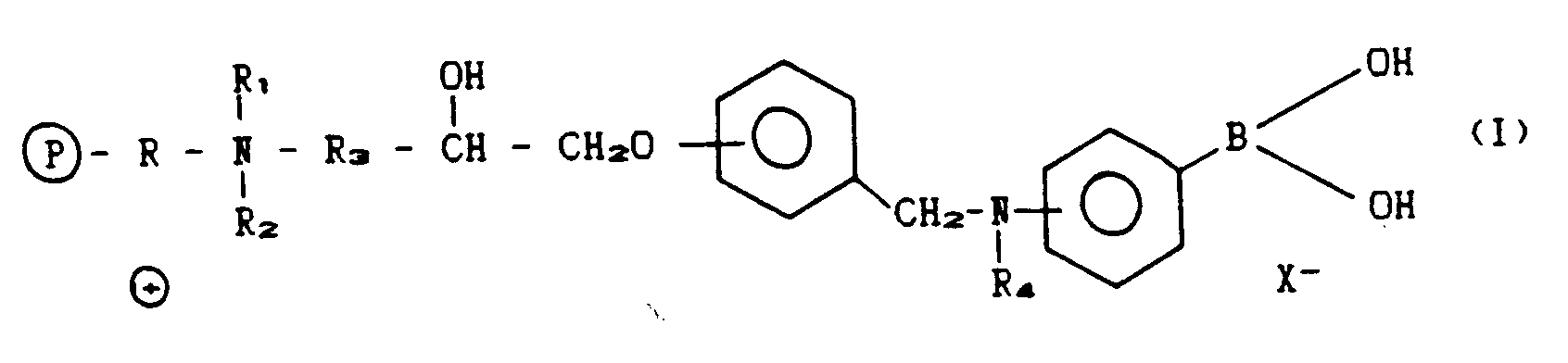
Ⓟ is a polyacrylic matrix
R is -(CH₂)n- where n lies between 0 and 5
R₁ and R₂, which can be the same or different, are C₁-C₅ alkyl
R₃ is -(CnH2n)- where n varies from 1 to 5
R₄ is H or C₁-C₅ alkyl
X is an anion chosen from halogens and hydroxyl.
characterized in that a transaminated polyacrylic resin of formula


- A process for producing boron resins of formula (I) as defined in claim 1, characterized in that a boroxin of formula


- The use of boron resins of formula (I):

Ⓟ is a polyacrylic matrix
R is -(CH₂)n- where n lies between 0 and 5
R₁ and R₂, which can be the same or different, are C₁-C₅ alkyl
R₃ is -(CnH2n)- where n varies from 1 to 5
R₄ is H or C₁-C₅ alkyl
X- is an anion chosen from halogens and hydroxyl.
for separating carbohydrate mixtures by selective absorption. - The use of boron resins of formula (I):

Ⓟ is a polyacrylic matrix
R is -(CH₂)n- where n lies between 0 and 5
R₁ and R₂, which can be the same or different, are C₁-C₅ alkyl
R₃ is -(CnH2n)- where n varies from 1 to 5
R₄ is H or C₁-C₅ alkyl
X- is an anion chosen from halogens and hydroxyl.
for absorbing lactulose from solutions containing it in mixtures with other carbohydrates.
Priority Applications (1)
| Application Number | Priority Date | Filing Date | Title |
|---|---|---|---|
| AT88104553T ATE72250T1 (en) | 1987-04-03 | 1988-03-22 | STABLE BORON RESINS WITH HIGH SELECTIVE ABSORPTION EFFECT. |
Applications Claiming Priority (2)
| Application Number | Priority Date | Filing Date | Title |
|---|---|---|---|
| IT1996587 | 1987-04-03 | ||
| IT8719965A IT1215406B (en) | 1987-04-03 | 1987-04-03 | STABLE BORONIC RESINS OF HIGH SELECTIVE ABSORBENT POYTERE. |
Publications (2)
| Publication Number | Publication Date |
|---|---|
| EP0284959A1 EP0284959A1 (en) | 1988-10-05 |
| EP0284959B1 true EP0284959B1 (en) | 1992-01-29 |
Family
ID=11162693
Family Applications (1)
| Application Number | Title | Priority Date | Filing Date |
|---|---|---|---|
| EP88104553A Expired - Lifetime EP0284959B1 (en) | 1987-04-03 | 1988-03-22 | Stable boron resins of high selective absorbent power |
Country Status (8)
| Country | Link |
|---|---|
| US (2) | US4937294A (en) |
| EP (1) | EP0284959B1 (en) |
| JP (1) | JPH0617398B2 (en) |
| KR (1) | KR960015309B1 (en) |
| AT (1) | ATE72250T1 (en) |
| CA (1) | CA1291126C (en) |
| DE (1) | DE3868106D1 (en) |
| IT (1) | IT1215406B (en) |
Families Citing this family (4)
| Publication number | Priority date | Publication date | Assignee | Title |
|---|---|---|---|---|
| KR930001305B1 (en) * | 1989-10-19 | 1993-02-25 | 니뽕 유우시 가부시끼가이샤 | Polymer Complexes of Sugar Response Type |
| DE4029652A1 (en) * | 1990-09-19 | 1992-03-26 | Hoechst Ag | POLYMERE AMMONIUM BORATE AND METHOD FOR THE PRODUCTION THEREOF |
| IT1271449B (en) * | 1993-04-28 | 1997-05-28 | Inalco Spa | PROCEDURE FOR THE PREPARATION OF CRYSTALLINE LACTULOSE FROM COMMERCIAL SYRUP |
| GB9401603D0 (en) * | 1994-01-27 | 1994-03-23 | Univ Strathclyde | Purification of plant-derived polynucleotides |
Family Cites Families (4)
| Publication number | Priority date | Publication date | Assignee | Title |
|---|---|---|---|---|
| US3663659A (en) * | 1970-05-22 | 1972-05-16 | Us Health Education & Welfare | Process for the preparation of hydroxylated block polymers |
| US4355140A (en) * | 1976-12-10 | 1982-10-19 | Rohm And Haas Company | Borane reducing resins |
| DE3201780A1 (en) * | 1982-01-21 | 1983-08-25 | Henkel KGaA, 4000 Düsseldorf | NEW POLYMERS ORGANO BORON COMPOUNDS AND THEIR USE |
| IT1173459B (en) * | 1984-03-22 | 1987-06-24 | Sirac Spa | STABLE BORONIC RESINS WITH HIGH SELECTIVE ABSORBING POWER |
-
1987
- 1987-04-03 IT IT8719965A patent/IT1215406B/en active
-
1988
- 1988-03-21 US US07/171,447 patent/US4937294A/en not_active Expired - Fee Related
- 1988-03-22 AT AT88104553T patent/ATE72250T1/en not_active IP Right Cessation
- 1988-03-22 DE DE8888104553T patent/DE3868106D1/en not_active Expired - Lifetime
- 1988-03-22 EP EP88104553A patent/EP0284959B1/en not_active Expired - Lifetime
- 1988-03-30 CA CA000562951A patent/CA1291126C/en not_active Expired - Lifetime
- 1988-04-02 KR KR1019880003708A patent/KR960015309B1/en not_active Expired - Lifetime
- 1988-04-04 JP JP63081442A patent/JPH0617398B2/en not_active Expired - Lifetime
-
1990
- 1990-05-24 US US07/527,837 patent/US5011535A/en not_active Expired - Fee Related
Also Published As
| Publication number | Publication date |
|---|---|
| DE3868106D1 (en) | 1992-03-12 |
| CA1291126C (en) | 1991-10-22 |
| US5011535A (en) | 1991-04-30 |
| US4937294A (en) | 1990-06-26 |
| ATE72250T1 (en) | 1992-02-15 |
| KR960015309B1 (en) | 1996-11-07 |
| JPH0617398B2 (en) | 1994-03-09 |
| IT1215406B (en) | 1990-02-08 |
| JPS63273605A (en) | 1988-11-10 |
| IT8719965A0 (en) | 1987-04-03 |
| KR890016083A (en) | 1989-11-28 |
| EP0284959A1 (en) | 1988-10-05 |
Similar Documents
| Publication | Publication Date | Title |
|---|---|---|
| CN113214480B (en) | Synthesis method and adsorption application of cationic framework material | |
| CN114736338A (en) | Cationic covalent organic framework material and preparation method and application thereof | |
| CN108187765B (en) | PP-ST-DVB-based cation exchange fiber and synthetic method thereof | |
| US4937294A (en) | Stable boron resins of high selective absorbent power | |
| US4032482A (en) | Process for producing chelating resin and product produced thereby | |
| CN112111060B (en) | Porous organic framework material, preparation method thereof and application thereof in selective separation of perrhenate | |
| EP0284960B1 (en) | Boron resins of high selective absorbent power | |
| EP0159521B1 (en) | Stable boron resins of high selective absorbent power | |
| US8062526B2 (en) | Separation of platinum group metals | |
| CN115260401A (en) | Chelating resin for capturing electronic-grade hexafluorobutadiene metal ions and preparation method thereof | |
| US6787117B1 (en) | Porous hollow fiber membrane having chelate formability and method for recovery of germanium oxide using the porous hollow fiber membrane | |
| CN114471699B (en) | A kind of catalyst composition for ammoximation reaction of cyclododecanone and its application | |
| US4406870A (en) | Method for the separation of carbon isotopes by chemical exchange method | |
| US3410811A (en) | Porous weak base anion exchange resins from polyvinyl chloride and amines | |
| US4450287A (en) | Butenyl acetate production | |
| SU1479460A1 (en) | Method of producing boron-selective sorbent | |
| JPH0660201B2 (en) | Method for producing water-soluble cellulose derivative | |
| US4450289A (en) | Butenyl acetate production | |
| CN120040671B (en) | Amphoteric ion exchange resin and preparation method and application thereof | |
| SU1028682A1 (en) | Network poly-2,5-dimethycryloyl-1,6-didesoxy-3,4-isoprpylidene mannite as anionite with improved exchange capacity | |
| CN120484210B (en) | A guanidinyl-thioether covalent organic polymer for efficiently capturing iodide ions and its preparation method | |
| CN121975052A (en) | A chelating resin for removing calcium and magnesium ions from water, its preparation method and application | |
| Hradil et al. | Reactive polymers: 54. Synthesis of methacrylate copolymers with tributylammonium groups | |
| CN121108388A (en) | An amino resin and its preparation method, and a method for preparing allyl glycidyl ether. | |
| CN122037026A (en) | Imidazole group grafted modified polystyrene resin material, and preparation method and application thereof |
Legal Events
| Date | Code | Title | Description |
|---|---|---|---|
| PUAI | Public reference made under article 153(3) epc to a published international application that has entered the european phase |
Free format text: ORIGINAL CODE: 0009012 |
|
| AK | Designated contracting states |
Kind code of ref document: A1 Designated state(s): AT BE CH DE ES FR GB GR IT LI LU NL SE |
|
| 17P | Request for examination filed |
Effective date: 19890325 |
|
| RAP1 | Party data changed (applicant data changed or rights of an application transferred) |
Owner name: INALCO SPA |
|
| 17Q | First examination report despatched |
Effective date: 19900626 |
|
| GRAA | (expected) grant |
Free format text: ORIGINAL CODE: 0009210 |
|
| AK | Designated contracting states |
Kind code of ref document: B1 Designated state(s): AT BE CH DE ES FR GB GR IT LI LU NL SE |
|
| PG25 | Lapsed in a contracting state [announced via postgrant information from national office to epo] |
Ref country code: SE Effective date: 19920129 Ref country code: LI Effective date: 19920129 Ref country code: GR Free format text: LAPSE BECAUSE OF FAILURE TO SUBMIT A TRANSLATION OF THE DESCRIPTION OR TO PAY THE FEE WITHIN THE PRESCRIBED TIME-LIMIT Effective date: 19920129 Ref country code: CH Effective date: 19920129 Ref country code: BE Effective date: 19920129 Ref country code: AT Effective date: 19920129 |
|
| REF | Corresponds to: |
Ref document number: 72250 Country of ref document: AT Date of ref document: 19920215 Kind code of ref document: T |
|
| ET | Fr: translation filed | ||
| REF | Corresponds to: |
Ref document number: 3868106 Country of ref document: DE Date of ref document: 19920312 |
|
| ITF | It: translation for a ep patent filed | ||
| PG25 | Lapsed in a contracting state [announced via postgrant information from national office to epo] |
Ref country code: LU Free format text: LAPSE BECAUSE OF NON-PAYMENT OF DUE FEES Effective date: 19920331 |
|
| REG | Reference to a national code |
Ref country code: CH Ref legal event code: PL |
|
| PLBE | No opposition filed within time limit |
Free format text: ORIGINAL CODE: 0009261 |
|
| STAA | Information on the status of an ep patent application or granted ep patent |
Free format text: STATUS: NO OPPOSITION FILED WITHIN TIME LIMIT |
|
| 26N | No opposition filed | ||
| PGFP | Annual fee paid to national office [announced via postgrant information from national office to epo] |
Ref country code: GB Payment date: 19930312 Year of fee payment: 6 |
|
| PGFP | Annual fee paid to national office [announced via postgrant information from national office to epo] |
Ref country code: ES Payment date: 19930315 Year of fee payment: 6 |
|
| PGFP | Annual fee paid to national office [announced via postgrant information from national office to epo] |
Ref country code: FR Payment date: 19930330 Year of fee payment: 6 |
|
| PGFP | Annual fee paid to national office [announced via postgrant information from national office to epo] |
Ref country code: NL Payment date: 19930331 Year of fee payment: 6 |
|
| PGFP | Annual fee paid to national office [announced via postgrant information from national office to epo] |
Ref country code: DE Payment date: 19930524 Year of fee payment: 6 |
|
| PG25 | Lapsed in a contracting state [announced via postgrant information from national office to epo] |
Ref country code: GB Effective date: 19940322 |
|
| PG25 | Lapsed in a contracting state [announced via postgrant information from national office to epo] |
Ref country code: ES Free format text: LAPSE BECAUSE OF NON-PAYMENT OF DUE FEES Effective date: 19940323 |
|
| PG25 | Lapsed in a contracting state [announced via postgrant information from national office to epo] |
Ref country code: NL Effective date: 19941001 |
|
| GBPC | Gb: european patent ceased through non-payment of renewal fee |
Effective date: 19940322 |
|
| NLV4 | Nl: lapsed or anulled due to non-payment of the annual fee | ||
| PG25 | Lapsed in a contracting state [announced via postgrant information from national office to epo] |
Ref country code: FR Effective date: 19941130 |
|
| PG25 | Lapsed in a contracting state [announced via postgrant information from national office to epo] |
Ref country code: DE Effective date: 19941201 |
|
| REG | Reference to a national code |
Ref country code: FR Ref legal event code: ST |
|
| REG | Reference to a national code |
Ref country code: ES Ref legal event code: FD2A Effective date: 19950411 |
|
| PG25 | Lapsed in a contracting state [announced via postgrant information from national office to epo] |
Ref country code: IT Free format text: LAPSE BECAUSE OF NON-PAYMENT OF DUE FEES;WARNING: LAPSES OF ITALIAN PATENTS WITH EFFECTIVE DATE BEFORE 2007 MAY HAVE OCCURRED AT ANY TIME BEFORE 2007. THE CORRECT EFFECTIVE DATE MAY BE DIFFERENT FROM THE ONE RECORDED. Effective date: 20050322 |