EP0284316A2 - Track transportation systems - Google Patents
Track transportation systems Download PDFInfo
- Publication number
- EP0284316A2 EP0284316A2 EP88302433A EP88302433A EP0284316A2 EP 0284316 A2 EP0284316 A2 EP 0284316A2 EP 88302433 A EP88302433 A EP 88302433A EP 88302433 A EP88302433 A EP 88302433A EP 0284316 A2 EP0284316 A2 EP 0284316A2
- Authority
- EP
- European Patent Office
- Prior art keywords
- vehicle
- track
- junction
- transportation system
- wheels
- Prior art date
- Legal status (The legal status is an assumption and is not a legal conclusion. Google has not performed a legal analysis and makes no representation as to the accuracy of the status listed.)
- Withdrawn
Links
Images
Classifications
-
- B—PERFORMING OPERATIONS; TRANSPORTING
- B61—RAILWAYS
- B61B—RAILWAY SYSTEMS; EQUIPMENT THEREFOR NOT OTHERWISE PROVIDED FOR
- B61B13/00—Other railway systems
-
- E—FIXED CONSTRUCTIONS
- E01—CONSTRUCTION OF ROADS, RAILWAYS, OR BRIDGES
- E01B—PERMANENT WAY; PERMANENT-WAY TOOLS; MACHINES FOR MAKING RAILWAYS OF ALL KINDS
- E01B25/00—Tracks for special kinds of railways
- E01B25/28—Rail tracks for guiding vehicles when running on road or similar surface
Definitions
- the track may comprise structures which are at ground level or are elevated, and which provide such guide surfaces as are required for the functions mentioned above.
- the vehicles may be of two main types:
- Bottom supported vehicles are known, in which the vehicle is supported on a number of wheels, for example four wheels, at the bottom of the vehicle.
- a conventional motor car or a conventional railway train is a "bottom supported” vehicle. If a bottom supported vehicle travels along a track it may be guided by engagement of its support wheels with a guideway, as is the case with a conventional railway train, or it may be guided by special guide wheels which engage vertical surfaces at the sides of the track. Righting couples to prevent rolling may be provided by differences in loading between laterally separated support wheels.
- Cantilever supported vehicles are also known, in which upper and lower vertically spaced guide surfaces on the track are engaged by cantilever support means on one side of the vehicle, so that the vehicle is supported on the track from one side only. Since the centre of gravity of the vehicle is near the middle of the vehicle, the weight of the vehicle produces a rolling couple and this is opposed by a righting couple produced by engagement of the cantilever support means with the guide surfaces on the track.
- the upper and lower guide surfaces on the track are engaged respectively by upper and lower cantilever support means, usually guide wheels, on one side of the vehicle.
- Cantilever supported vehicles allow the use of tracks which are narrower than the tracks required for bottom supported vehicles. In the case of elevated tracks, this permits economy in the use of materials and, in addition, tracks for travel in two opposite directions may be provided on opposite sides of the same track structure.
- the upper and lower guide surfaces may be connected and mounted on a support structure by means of vertically extending structural members. However, this arrangement creates problems if it is required to include in the track a junction where the vehicle may follow one of a number of alternative routes.
- each vehicle is provided with cantilever support means on both sides of the vehicle, so that the vehicle can optionally be cantilever supported from either side.
- cantilever support guide surfaces on the track are simultaneously offered to both sides of the vehicle and a switching device is preset to select one or other of the guide surfaces so that the vehicle is cantilever supported from the appropriate side, depending on the route which it is to follow out of the junction.
- the two guideways then diverge.
- a complex sequence of load changes takes place in the vicinity of the junction, between various support and guide surfaces and the associated wheels on the vehicle.
- the invention also provides a transportation system having a novel guide means for guiding the vehicle through a junction.
- This aspect of the invention is, again, particularly applicable to systems having cantilever supported vehicles, but is not limited to such systems.
- a transportation system comprising a track and at least one vehicle adapted to travel along the track, the track including at least one junction where the vehicle can follow one of a number of alternative routes, and the track including, at the junction, a substantially flat horizontal surface and the vehicle having a plurality of bottom support wheels which may run on said flat surface and support the weight of the vehicle, there being provided guide means for guiding the vehicle as it travels across said flat surface, which guide means comprise at least one guideway recessed in said flat horizontal surface and defining a route across the junction, and follower means on the vehicle selectively engageable with said guideway according to the route which the vehicle is required to follow across the junction.
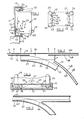
- the vehicle 10 is cantilever supported on a track 11.
- the track 11 is an elevated track extending between spaced vertical support posts 12.
- the track 11 comprises a vertical wall portion 13 connecting a lower horizontal flange 14 and an upper horizontal flange 15.
- the lower flange 14 is formed at its extremity with an upstanding side wall 16 and the upper flange 15 is formed at its extremity with a depending wall 17.
- the lower portion of the main wall 13 of the track defines a further vertical side wall 18.
- the vehicle 10 is provided at the bottom with bottom support wheels 19, 20, 21 and 22 rotatable about horizontal axes, only the rear wheels 19 and 20 being seen in Figure 1.
- the wheels 19, 20, 21 and 22 are provided with resiliently flexible tyres, for example pneumatic rubber tyres.
- the vehicle 10 travels around the elevated track 11 cantilevered from its left hand side.
- One or more of the bottom support wheels may be power driven to drive the vehicle around the track, or any other suitable form of drive may be employed.
- the junction is shown diagrammatically in plan view in Figure 3, which shows the bottom vertical side wall portion 18 of the track, the lower horizontal flange 14 and the short vertical side wall 16.
- the upper flange 15 and upper side wall 17 are not shown.
- the corresponding parts of the track on the two alternative routes out of the junction are indicated at 14a, 16a, 18a and 14b, 16b and 18b respectively.
- the lower horizontal flanges 14, 14a and 14b of the different portions of the track are all co-planar with, and lead onto, a substantially flat continuous horizontal surface 34.
- the left hand side of the surface 34 (looking in the direction of travel from left to right in Figure 3) is bounded by the side wall portions 18 and 18a, whereas the right hand side is bounded by a vertical guide wall 35 which is curved to correspond to the curved path leading from the flange portion 14 to the flange portion 14b.
- a portion of the upstanding side wall 16 on the track is removed to provide an elongate gap 36 extending across the central portion of the horizontal surface 34.
- the horizontal surface 34 is formed with two guideways 37, 38 recessed into the surface thereof, which guideways extend across the junction.
- One of the guideways, 37 is straight and is parallel to the portion of the track provided by the flanges 14, 14a.
- the other guideway, 38 is curved and follows the curvature, across the junction, between the flanges 14, 14b.
- rocker arms 39, 40 which are pivotally mounted on the vehicle to swing about a central longitudinal horizontal axis, indicated at 41.
- the rocker arms carry at their ends respectively steel flanged wheels 42, 43 which act as followers for cooperation with the recessed guideways 38 and 37 respectively.
- the follower system 39-43 is duplicated at the forward end of the vehicle.
- the vehicle As the vehicle approaches the junction, for example in the position indicated at A, the vehicle is cantilevered from the left, as shown in Figure 1.
- the outer bottom support wheels 20 and 22 of the vehicle run onto the horizontal track surface 34 of the junction, which may be slightly ramped upwards at position B to facilitate this.
- the vehicle then is entirely bottom supported and the load on the upper cantilever support wheels 25, 26 is removed.
- the lower part of the vehicle when in this position is shown, enlarged, in Figure 4. It will be seen that, in this position, the left hand lower guide wheels 27 engage the left hand wall portion 18 of the main wall of the track whereas the right hand guide wheels 28 engage the boundary wall 35 on the horizontal surface 34.
- the rocker arms 39 are swung downwardly to bring the left hand follower wheels 42 into engagement with the recessed guideways 38.
- the right hand follower wheels 43 are raised out of engagement with the guideway 37, as shown in Figure 4.
- the vehicle then continues to the position indicated at C.
- the left hand bottom support wheels 19 and 21 reach the gap 36 in the upstanding flange 16 and the upper guide wheels 25, 26 meet a corresponding gap in the depending side wall 17 at the upper part of the track.
- the bottom supported vehicle is thus free to follow the curved path of the recessed guideway 38, being guided along that guideway by engagement of the guideway by the follower wheels 42.
- the lower guide wheels 28 remain in engagement with the wall 35, but as the vehicle moves across the surface 34 the left hand lower guide wheels 27 are brought out of engagement with the wall portion 18.
- the left hand bottom support wheels 19, 21 engage the lower flange 14b, between the outer wall portion 18b and the upstanding wall 16b.
- the upper guide wheels 25 and 26 enter between the upper side wall 17 and the upper part of the main wall 13 of the track.
- the other rocker arms 40 are swung downwardly to bring the right hand guide wheels 43 into engagement with the straight recessed guideway 37.
- the cooperation of the wheels 43 with the guideway 37 then cause the vehicle to be guided straight ahead so that the left hand lower guide wheels 27 remain in engagement with the wall portion 18 and the right hand lower guide wheels 28 are brought out of engagement with the wall 35.
- rocker mounted guide wheels cooperating with recessed guideways may also be used to guide the vehicle if it is required that it should temporarily leave the cantilever track altogether and travel over a greater length of flat surface on bottom support.
- the vehicle may even travel over ordinary roads provided the roads are formed with suitable recessed guideways.
- it may be advantageous to arrange the rocker arms so that all four guide wheels can be lowered simultaneously for engagement with two parallel recessed guideways to provide more stable guidance to the vehicle.
- the recessed guideways 37 and 38 are illustrated as being simple grooves in the surface 34, but it will be appreciated that they might instead be in the form of recessed spaced rails, similar to tramlines. It will be appreciated that certain fundamental problems of using tramlines for guidance are overcome in the present construction.
- the downward loading upon the steel wheels 42 and 43 is light, because they do not have to support the weight of the vehicle, the weight being supported on the pneumatic tyred wheels 19, 20, 21 and 22.
- the arrangement of the wheels 42, 43 on the rocker arms is such that they can sustain heavy horizontal transverse loads, if necessary, as previously described.
- the recessed guideways 37 and 38, and the guide wheels 42 and 43 are dispensed with. Since, at the junction, the normally cantilever supported vehicle is bottom supported, it becomes possible to steer the vehicle through the junction, either automatically or manually, by providing for certain of the bottom support wheels, usually the front wheels 21 and 22, to be steerable. Thus, when position B is reached in Figure 3, the front wheels of the vehicle may be steered to the right so as to bias the vehicle to the right and thus to maintain the right hand guide wheels 28 in engagement with the wall 35. The vehicle will thus automatically follow the curved path to the right until the cantilever support wheels again engage the track at position F. Similarly, in order for the vehicle to continue straight ahead, the steerable wheels will be turned to the left so as to bias the vehicle to the left and maintain the left hand guide wheels 27 in engagement with the wall part 18.
- Figure 5 shows a divergent junction on a track where the vehicle is constantly bottom supported throughout the track.
- the vehicle is provided only with the bottom support wheels 19, 20, 21 and 22 and the lower guide wheels 27 and 28.
- the bottom support wheels run on the flat lower surface 40 of the track and the guide wheels 27 engage upstanding side walls 41 and 42 respectively.
- the flat substantially continuous horizontal surface of the track is formed with recessed guideways 43, 44 which correspond to the guideways 37 and 38 respectively of Figure 3.
- the vehicle is provided with rocker and guide wheel systems corresponding to the system 39-43 of Figures 2 and 4 and the vehicle is guided to a selected route out of the junction by lowering the appropriate guide wheel as previously described.
Landscapes
- Engineering & Computer Science (AREA)
- Mechanical Engineering (AREA)
- Transportation (AREA)
- Architecture (AREA)
- Civil Engineering (AREA)
- Structural Engineering (AREA)
- Platform Screen Doors And Railroad Systems (AREA)
Abstract
Description
- The invention relates to transportation systems and concerns systems which comprise a track and one or more vehicles adapted to travel along the track, and in which the track comprises means to support the weight of the vehicles, to guide them laterally to prevent yawing, and to provide transverse righting couples as necessary to prevent rolling of the vehicles about their longitudinal axis.
- The track may comprise structures which are at ground level or are elevated, and which provide such guide surfaces as are required for the functions mentioned above. The vehicles may be of two main types:
- "Bottom supported" vehicles are known, in which the vehicle is supported on a number of wheels, for example four wheels, at the bottom of the vehicle. Thus, a conventional motor car or a conventional railway train is a "bottom supported" vehicle. If a bottom supported vehicle travels along a track it may be guided by engagement of its support wheels with a guideway, as is the case with a conventional railway train, or it may be guided by special guide wheels which engage vertical surfaces at the sides of the track. Righting couples to prevent rolling may be provided by differences in loading between laterally separated support wheels.
- "Cantilever supported" vehicles are also known, in which upper and lower vertically spaced guide surfaces on the track are engaged by cantilever support means on one side of the vehicle, so that the vehicle is supported on the track from one side only. Since the centre of gravity of the vehicle is near the middle of the vehicle, the weight of the vehicle produces a rolling couple and this is opposed by a righting couple produced by engagement of the cantilever support means with the guide surfaces on the track. For this purpose the upper and lower guide surfaces on the track are engaged respectively by upper and lower cantilever support means, usually guide wheels, on one side of the vehicle.
- Cantilever supported vehicles allow the use of tracks which are narrower than the tracks required for bottom supported vehicles. In the case of elevated tracks, this permits economy in the use of materials and, in addition, tracks for travel in two opposite directions may be provided on opposite sides of the same track structure. The upper and lower guide surfaces may be connected and mounted on a support structure by means of vertically extending structural members. However, this arrangement creates problems if it is required to include in the track a junction where the vehicle may follow one of a number of alternative routes.
- For example, in the case of a divergent junction where a vehicle on one ingoing guideway can follow either of two alternative outgoing guideways, the two divergent outgoing guideways are initially necessarily close together. Consequently, it is difficult to locate the vertical structural members supporting each guideway without blocking the path of vehicles travelling along the other guideway. Several partial solutions are known, but each has its own serious disadvantages.
- "Overpass" and "underpass" systems are known. In such systems the outgoing guideways are diverged vertically before being diverged horizontally. However, this necessitates a large, expensive and unsightly support structure.
- "Throughpass" systems are also known in which the vertically extending structural members are omitted in the vicinity of the junction to allow one vehicle to pass between the upper and lower guide surfaces supporting the other vehicle. However, the omission of the structural members weakens the structure so that it is only suitable for very light vehicles.
- "Alternative cantilevering" systems are known in which each vehicle is provided with cantilever support means on both sides of the vehicle, so that the vehicle can optionally be cantilever supported from either side. In such an arrangement, cantilever support guide surfaces on the track are simultaneously offered to both sides of the vehicle and a switching device is preset to select one or other of the guide surfaces so that the vehicle is cantilever supported from the appropriate side, depending on the route which it is to follow out of the junction. The two guideways then diverge. In such an arrangement a complex sequence of load changes takes place in the vicinity of the junction, between various support and guide surfaces and the associated wheels on the vehicle.
- The present invention, in one aspect, provides a transportation system for cantilever supported vehicles which is free from all or some of the above defects.
- According to this aspect of the invention there is provided a transportation system comprising a track providing upper and lower guide surfaces and at least one vehicle having upper and lower cantilever support means on one side of the vehicle for engagement respectively with said guide surfaces, whereby the vehicle is cantilever supported from one side only on the guide surfaces as it travels around the track, the track including at least one junction where the vehicle can follow one of a number of alternative routes, and the track including, at the junction, a substantially flat horizontal surface and the vehicle having a plurality of bottom support wheels which may run on said flat surface and support the weight of the vehicle, the aforesaid cantilever support means being capable of temporary disengagement from said guide surfaces when the weight of the vehicle is supported on said flat horizontal surface at the junction, selectively operable guide means being provided to direct the vehicle to follow a required route at the junction, while it is temporarily supported on said flat horizontal surface.
- The selectively operable guide means may comprise means for steering the bottom support wheels of the vehicle, which steering may be automatic but which could be under manual control, in similar manner to a motor car. Precise transverse location may be provided by supplementary vertical guide surfaces, automatic steering being provided to urge the vehicle against a selected guide surface according to the route required out of the junction.
- The invention also provides a transportation system having a novel guide means for guiding the vehicle through a junction. This aspect of the invention is, again, particularly applicable to systems having cantilever supported vehicles, but is not limited to such systems.
- According to this aspect of the invention there is provided a transportation system comprising a track and at least one vehicle adapted to travel along the track, the track including at least one junction where the vehicle can follow one of a number of alternative routes, and the track including, at the junction, a substantially flat horizontal surface and the vehicle having a plurality of bottom support wheels which may run on said flat surface and support the weight of the vehicle, there being provided guide means for guiding the vehicle as it travels across said flat surface, which guide means comprise at least one guideway recessed in said flat horizontal surface and defining a route across the junction, and follower means on the vehicle selectively engageable with said guideway according to the route which the vehicle is required to follow across the junction.
- The following is detailed description of embodiments of the invention, reference being made to the accompanying diagrammatic drawings in which:
- Figure 1 is a rear elevation of a cantilever supported vehicle on its track, the track being shown in vertical section,
- Figure 2 is a diagrammatic plan view of the vehicle showing the relative disposition of its support and guidance wheels,
- Figure 3 is a diagrammatic plan view of a portion of the track, at a divergent junction,
- Figure 4 is a rear elevation of the lower part of the vehicle, on an enlarged scale, showing the lower part of the track in section, and
- Figure 5 is a plan view of an alternative form of track, at a divergent junction.
- Referring to Figure 1, the
vehicle 10 is cantilever supported on atrack 11. Thetrack 11 is an elevated track extending between spacedvertical support posts 12. - The
track 11 comprises avertical wall portion 13 connecting a lowerhorizontal flange 14 and an upperhorizontal flange 15. Thelower flange 14 is formed at its extremity with anupstanding side wall 16 and theupper flange 15 is formed at its extremity with a dependingwall 17. The lower portion of themain wall 13 of the track defines a furthervertical side wall 18. - The
vehicle 10 is provided at the bottom withbottom support wheels rear wheels wheels - As best seen in Figure 1, the left hand
bottom support wheels lower flange 14 of the track. The centre of gravity of the vehicle, indicated at 23, is located at approximately the middle of the vehicle and the weight of the vehicle therefore applies a clockwise couple thereto, as indicated at 24 in Figure 1. To oppose this couple, the vehicle is provided withupper guide wheels upper side wall 17. The distance of theside wall 17 from themain wall 13 of the track is greater than the diameter of thewheels main wall 13. - Adjacent the
bottom support wheels rear guide wheels vertical wall part 18 of themain wall 13 of the track. - To minimise risk of derailment, rollers, such as indicated at 29, are coaxial with the bottom support wheels respectively and can cooperate with the
upstanding side wall 16 to limit displacement of the vehicle to the right in Figure 1. Similarly, rollers such as 30 are coaxial with thelower guide wheels inward flange 31 on the inner surface of themain wall 13 of the track to limit vertical displacement of the vehicle. - In normal operation the
vehicle 10 travels around theelevated track 11 cantilevered from its left hand side. One or more of the bottom support wheels may be power driven to drive the vehicle around the track, or any other suitable form of drive may be employed. - Although the invention is applicable to arrangements in which the vehicle is capable of being cantilever supported from only one side, arrangements are possible where the vehicle may optionally be cantilever supported from either side. In this case, further upper guide wheels, such as are indicated in dotted lines at 32 and 33, may also be provided on the upper part of the right hand side of the vehicle.
- As previously mentioned, problems can arise in arranging for such cantilever supported vehicles to be guided through the required route at a divergent junction, and there will now be described methods of guiding the cantilevered vehicle of Figure 1 through such a junction, where the vehicle can follow either of two alternative routes out of the junction.
- The junction is shown diagrammatically in plan view in Figure 3, which shows the bottom vertical
side wall portion 18 of the track, the lowerhorizontal flange 14 and the shortvertical side wall 16. Theupper flange 15 andupper side wall 17 are not shown. The corresponding parts of the track on the two alternative routes out of the junction are indicated at 14a, 16a, 18a and 14b, 16b and 18b respectively. - Across the junction, the lower
horizontal flanges 14, 14a and 14b of the different portions of the track are all co-planar with, and lead onto, a substantially flat continuoushorizontal surface 34. The left hand side of the surface 34 (looking in the direction of travel from left to right in Figure 3) is bounded by theside wall portions 18 and 18a, whereas the right hand side is bounded by avertical guide wall 35 which is curved to correspond to the curved path leading from theflange portion 14 to the flange portion 14b. A portion of theupstanding side wall 16 on the track is removed to provide anelongate gap 36 extending across the central portion of thehorizontal surface 34. - The
horizontal surface 34 is formed with twoguideways flanges 14, 14a. The other guideway, 38, is curved and follows the curvature, across the junction, between theflanges 14, 14b. - Mounted in the lower part of the vehicle are two sets of
rocker arms flanged wheels guideways - The passage of the vehicle through the junction shown in Figure 3 will now be described, reference being made to the various positions indicated on Figure 3 with the references A to G.
- As the vehicle approaches the junction, for example in the position indicated at A, the vehicle is cantilevered from the left, as shown in Figure 1. On reaching position B the outer
bottom support wheels horizontal track surface 34 of the junction, which may be slightly ramped upwards at position B to facilitate this. The vehicle then is entirely bottom supported and the load on the uppercantilever support wheels lower guide wheels 27 engage the lefthand wall portion 18 of the main wall of the track whereas the righthand guide wheels 28 engage theboundary wall 35 on thehorizontal surface 34. - Assuming that it is wished to divert the cantilevered vehicle to the right hand route out of the junction, the
rocker arms 39 are swung downwardly to bring the lefthand follower wheels 42 into engagement with the recessedguideways 38. The righthand follower wheels 43 are raised out of engagement with theguideway 37, as shown in Figure 4. The vehicle then continues to the position indicated at C. At this position the left handbottom support wheels gap 36 in theupstanding flange 16 and theupper guide wheels side wall 17 at the upper part of the track. The bottom supported vehicle is thus free to follow the curved path of the recessedguideway 38, being guided along that guideway by engagement of the guideway by thefollower wheels 42. Thelower guide wheels 28 remain in engagement with thewall 35, but as the vehicle moves across thesurface 34 the left handlower guide wheels 27 are brought out of engagement with thewall portion 18. - When position F is reached, the left hand
bottom support wheels outer wall portion 18b and the upstanding wall 16b. Similarly, at the same time, theupper guide wheels upper side wall 17 and the upper part of themain wall 13 of the track. - As the vehicle continues to position G its right hand
bottom support wheels edge 39 of thesurface 34, which may be sloped downwardly to provide a smooth transition, so that the vehicle is no longer bottom supported but is again cantilevered from the left hand side in the position corresponding to that shown in Figure 1. - If it is required, when the vehicle is in position B, that the vehicle should leave the junction along the straight ahead route, that is to say along the route of the flange 14a of the track, the
other rocker arms 40 are swung downwardly to bring the righthand guide wheels 43 into engagement with the straight recessedguideway 37. The cooperation of thewheels 43 with theguideway 37 then cause the vehicle to be guided straight ahead so that the left handlower guide wheels 27 remain in engagement with thewall portion 18 and the right handlower guide wheels 28 are brought out of engagement with thewall 35. The vehicle continues along the straight ahead path until the position D is reached where theupper guide wheels side wall 17 and the main wall of the track whereafter, at position E, thehorizontal surface 34 slopes downwardly to remove the support from the right handbottom support wheels - Although the arrangement is shown as applied to a divergent junction having two alternative exit routes, it will be appreciated that a similar arrangement may be applied to a convergent junction.
- The arrangement of rocker mounted guide wheels cooperating with recessed guideways may also be used to guide the vehicle if it is required that it should temporarily leave the cantilever track altogether and travel over a greater length of flat surface on bottom support. For example, the vehicle may even travel over ordinary roads provided the roads are formed with suitable recessed guideways. In this case, it may be advantageous to arrange the rocker arms so that all four guide wheels can be lowered simultaneously for engagement with two parallel recessed guideways to provide more stable guidance to the vehicle.
- Referring to Figure 4, it will be seen that the disposition of the
guide wheels central pivot axis 41 is above the point of contact between the wheels and the guideway. As a result of this, a transverse load on the vehicle results in a reaction force which is inclined downwardly, thereby having a vertical component tending to urge the guide wheel downwardly into engagement with its guideway. If desired, this downward force may be reinforced, for example by a compression spring acting to urge the rocker downwardly. - In the arrangement shown, the recessed
guideways surface 34, but it will be appreciated that they might instead be in the form of recessed spaced rails, similar to tramlines. It will be appreciated that certain fundamental problems of using tramlines for guidance are overcome in the present construction. In the arrangement described the downward loading upon thesteel wheels tyred wheels wheels - In an alternative arrangement for guiding the vehicle across the junction, the recessed
guideways guide wheels front wheels hand guide wheels 28 in engagement with thewall 35. The vehicle will thus automatically follow the curved path to the right until the cantilever support wheels again engage the track at position F. Similarly, in order for the vehicle to continue straight ahead, the steerable wheels will be turned to the left so as to bias the vehicle to the left and maintain the lefthand guide wheels 27 in engagement with thewall part 18. - The bottom support wheels of the vehicle, and particularly the steerable front wheels, are preferably provided with a castor action for stability.
- It will be appreciated that the arrangement described above, whereby the vehicle is guided by means of follower wheels engaging recessed guideways, is not restricted to systems where the vehicle is normally cantilever supported. Figure 5 shows a divergent junction on a track where the vehicle is constantly bottom supported throughout the track. In this case the vehicle is provided only with the
bottom support wheels lower guide wheels lower surface 40 of the track and theguide wheels 27 engageupstanding side walls - At the junction, the flat substantially continuous horizontal surface of the track is formed with recessed
guideways guideways - It is to be understood that in the arrangements described the
rocker arms guide wheels
Claims (10)
Applications Claiming Priority (2)
| Application Number | Priority Date | Filing Date | Title |
|---|---|---|---|
| GB878706741A GB8706741D0 (en) | 1987-03-20 | 1987-03-20 | Hire cars & cantilevering |
| GB8706741 | 1987-03-20 |
Publications (2)
| Publication Number | Publication Date |
|---|---|
| EP0284316A2 true EP0284316A2 (en) | 1988-09-28 |
| EP0284316A3 EP0284316A3 (en) | 1989-03-29 |
Family
ID=10614371
Family Applications (1)
| Application Number | Title | Priority Date | Filing Date |
|---|---|---|---|
| EP88302433A Withdrawn EP0284316A3 (en) | 1987-03-20 | 1988-03-21 | Track transportation systems |
Country Status (2)
| Country | Link |
|---|---|
| EP (1) | EP0284316A3 (en) |
| GB (1) | GB8706741D0 (en) |
Cited By (8)
| Publication number | Priority date | Publication date | Assignee | Title |
|---|---|---|---|---|
| FR2637860A1 (en) * | 1988-10-17 | 1990-04-20 | Adl Automation | Free transfer machine with independent, motorised carriages, and a module for orienting such carriages |
| EP0365446A1 (en) * | 1988-10-17 | 1990-04-25 | Adl Automation Societe A Responsabilite Limitee : | Transfer machine with independent motorized carriages and with an orientation module for such carriages |
| RU2153430C1 (en) * | 1999-12-29 | 2000-07-27 | Государственное предприятие "Московский институт теплотехники" | Overhead transportation system |
| CN102320302A (en) * | 2011-04-28 | 2012-01-18 | 北京建筑工程学院 | High-speed mobile communication monitored delivery system |
| CN102648318A (en) * | 2009-10-02 | 2012-08-22 | 罗尔工业公司 | Transversal joining device comprising two transverse end portions facing one another of two successive pavement precast elements and connecting system thereof |
| CN110735368A (en) * | 2019-10-23 | 2020-01-31 | 上海宝冶集团有限公司 | equipment rail installation system and method |
| WO2022101146A1 (en) * | 2020-11-11 | 2022-05-19 | Urban.MASS Ltd | Improvements to vehicles capable of operating on both ground and cantilevered support and to their tracks |
| WO2024188904A1 (en) * | 2023-03-10 | 2024-09-19 | Urban.MASS Ltd | Vehicles capable of operating on cantilevered supports, guideway tracks, and conventional roadways |
Family Cites Families (4)
| Publication number | Priority date | Publication date | Assignee | Title |
|---|---|---|---|---|
| US3451351A (en) * | 1968-06-14 | 1969-06-24 | Alan B Hawes | Monorail switching system |
| DE2163825A1 (en) * | 1971-12-17 | 1973-06-20 | Monocab Inc | DIVERSION DEVICE FOR SUSPENSION TRACKS |
| DE2162738A1 (en) * | 1971-12-17 | 1973-06-20 | Otto Prof Dr Ing Lutz | DRIVE ARRANGEMENT FOR SELF-STEERING VEHICLES |
| DE2627523C2 (en) * | 1976-06-18 | 1985-04-04 | Daimler-Benz Ag, 7000 Stuttgart | Traffic system with fairway and mechanically transversely guided road vehicles |
-
1987
- 1987-03-20 GB GB878706741A patent/GB8706741D0/en active Pending
-
1988
- 1988-03-21 EP EP88302433A patent/EP0284316A3/en not_active Withdrawn
Cited By (10)
| Publication number | Priority date | Publication date | Assignee | Title |
|---|---|---|---|---|
| FR2637860A1 (en) * | 1988-10-17 | 1990-04-20 | Adl Automation | Free transfer machine with independent, motorised carriages, and a module for orienting such carriages |
| EP0365446A1 (en) * | 1988-10-17 | 1990-04-25 | Adl Automation Societe A Responsabilite Limitee : | Transfer machine with independent motorized carriages and with an orientation module for such carriages |
| US5044283A (en) * | 1988-10-17 | 1991-09-03 | Adl Automation | Free transfer machine, with independent, motorized carriages and with module for orientation of such carriages |
| RU2153430C1 (en) * | 1999-12-29 | 2000-07-27 | Государственное предприятие "Московский институт теплотехники" | Overhead transportation system |
| CN102648318A (en) * | 2009-10-02 | 2012-08-22 | 罗尔工业公司 | Transversal joining device comprising two transverse end portions facing one another of two successive pavement precast elements and connecting system thereof |
| CN102648318B (en) * | 2009-10-02 | 2014-07-23 | 罗尔工业公司 | Joint device between two prefabricated elements and method for its use and assembly |
| CN102320302A (en) * | 2011-04-28 | 2012-01-18 | 北京建筑工程学院 | High-speed mobile communication monitored delivery system |
| CN110735368A (en) * | 2019-10-23 | 2020-01-31 | 上海宝冶集团有限公司 | equipment rail installation system and method |
| WO2022101146A1 (en) * | 2020-11-11 | 2022-05-19 | Urban.MASS Ltd | Improvements to vehicles capable of operating on both ground and cantilevered support and to their tracks |
| WO2024188904A1 (en) * | 2023-03-10 | 2024-09-19 | Urban.MASS Ltd | Vehicles capable of operating on cantilevered supports, guideway tracks, and conventional roadways |
Also Published As
| Publication number | Publication date |
|---|---|
| GB8706741D0 (en) | 1987-04-23 |
| EP0284316A3 (en) | 1989-03-29 |
Similar Documents
| Publication | Publication Date | Title |
|---|---|---|
| US3628462A (en) | Vehicle switching apparatus | |
| US4821845A (en) | Traversing elevator | |
| US6012396A (en) | Electric rail transportation system, vehicle, and rail used in the transportation system | |
| US4620486A (en) | Rail-guard transportation system | |
| US3830163A (en) | Monorail vehicle switching arrangement | |
| US4027596A (en) | Rapid transit system | |
| SU1366048A3 (en) | Transportation system | |
| US4794866A (en) | Linear motor driven railway car | |
| US2825291A (en) | Overhead urban railway | |
| US5450797A (en) | Transporting system with a floor conveyor device guided on guide rails | |
| EP0284316A2 (en) | Track transportation systems | |
| US6253685B1 (en) | Guide rail for automatic controlled road vehicles | |
| US4532385A (en) | Load transporting device and electric supply track therefor | |
| US3788233A (en) | Guided transportation system | |
| US4658731A (en) | Apparatus for transporting goods to and from shelves having dual function guide rollers | |
| JP2002037059A (en) | Rail truck system with branch | |
| US5829356A (en) | Switching device for use in suspended conveyors | |
| US6393993B1 (en) | Transit switching system for monorail vehicles | |
| US2162351A (en) | Combined road and rail vehicle and track system therefor | |
| GB2025870A (en) | Double-track Overhead Conveyors | |
| US3916798A (en) | Guiding system for a computer controlled vehicle | |
| US4152992A (en) | Track switching arrangement | |
| US4032095A (en) | Central guide system for vehicles | |
| US4721043A (en) | Track guided transportation system | |
| US3854409A (en) | Guide system for vehicle carriages |
Legal Events
| Date | Code | Title | Description |
|---|---|---|---|
| PUAI | Public reference made under article 153(3) epc to a published international application that has entered the european phase |
Free format text: ORIGINAL CODE: 0009012 |
|
| AK | Designated contracting states |
Kind code of ref document: A2 Designated state(s): BE CH DE ES FR GB IT LI NL |
|
| PUAL | Search report despatched |
Free format text: ORIGINAL CODE: 0009013 |
|
| AK | Designated contracting states |
Kind code of ref document: A3 Designated state(s): BE CH DE ES FR GB IT LI NL |
|
| 17P | Request for examination filed |
Effective date: 19890505 |
|
| 17Q | First examination report despatched |
Effective date: 19900514 |
|
| STAA | Information on the status of an ep patent application or granted ep patent |
Free format text: STATUS: THE APPLICATION IS DEEMED TO BE WITHDRAWN |
|
| 18D | Application deemed to be withdrawn |
Effective date: 19900924 |