EP0284027B1 - Anaerobically curing adhesive sealing composition - Google Patents
Anaerobically curing adhesive sealing composition Download PDFInfo
- Publication number
- EP0284027B1 EP0284027B1 EP88104574A EP88104574A EP0284027B1 EP 0284027 B1 EP0284027 B1 EP 0284027B1 EP 88104574 A EP88104574 A EP 88104574A EP 88104574 A EP88104574 A EP 88104574A EP 0284027 B1 EP0284027 B1 EP 0284027B1
- Authority
- EP
- European Patent Office
- Prior art keywords
- sealing composition
- adhesive sealing
- parts
- meth
- weight
- Prior art date
- Legal status (The legal status is an assumption and is not a legal conclusion. Google has not performed a legal analysis and makes no representation as to the accuracy of the status listed.)
- Expired - Lifetime
Links
- 239000000203 mixture Substances 0.000 title claims description 83
- 238000007789 sealing Methods 0.000 title claims description 69
- 239000000853 adhesive Substances 0.000 title claims description 44
- 230000001070 adhesive effect Effects 0.000 title claims description 44
- NIXOWILDQLNWCW-UHFFFAOYSA-M Acrylate Chemical compound [O-]C(=O)C=C NIXOWILDQLNWCW-UHFFFAOYSA-M 0.000 claims description 27
- JOYRKODLDBILNP-UHFFFAOYSA-N urethane group Chemical group NC(=O)OCC JOYRKODLDBILNP-UHFFFAOYSA-N 0.000 claims description 13
- 239000003085 diluting agent Substances 0.000 claims description 12
- 239000000178 monomer Substances 0.000 claims description 9
- 150000001875 compounds Chemical class 0.000 claims description 6
- 125000002496 methyl group Chemical group [H]C([H])([H])* 0.000 claims description 6
- 125000004435 hydrogen atom Chemical group [H]* 0.000 claims description 3
- 239000003999 initiator Substances 0.000 claims description 3
- MUBZPKHOEPUJKR-UHFFFAOYSA-N Oxalic acid Chemical compound OC(=O)C(O)=O MUBZPKHOEPUJKR-UHFFFAOYSA-N 0.000 description 33
- 238000001723 curing Methods 0.000 description 22
- 239000003921 oil Substances 0.000 description 17
- RZVINYQDSSQUKO-UHFFFAOYSA-N 2-phenoxyethyl prop-2-enoate Chemical compound C=CC(=O)OCCOC1=CC=CC=C1 RZVINYQDSSQUKO-UHFFFAOYSA-N 0.000 description 14
- JMIZWXDKTUGEES-UHFFFAOYSA-N 2,2-di(cyclopenten-1-yloxy)ethyl 2-methylprop-2-enoate Chemical compound C=1CCCC=1OC(COC(=O)C(=C)C)OC1=CCCC1 JMIZWXDKTUGEES-UHFFFAOYSA-N 0.000 description 12
- FRIBMENBGGCKPD-UHFFFAOYSA-N 3-(2,3-dimethoxyphenyl)prop-2-enal Chemical compound COC1=CC=CC(C=CC=O)=C1OC FRIBMENBGGCKPD-UHFFFAOYSA-N 0.000 description 12
- 238000006116 polymerization reaction Methods 0.000 description 12
- 239000003109 Disodium ethylene diamine tetraacetate Substances 0.000 description 11
- ZGTMUACCHSMWAC-UHFFFAOYSA-L EDTA disodium salt (anhydrous) Chemical compound [Na+].[Na+].OC(=O)CN(CC([O-])=O)CCN(CC(O)=O)CC([O-])=O ZGTMUACCHSMWAC-UHFFFAOYSA-L 0.000 description 11
- 235000019301 disodium ethylene diamine tetraacetate Nutrition 0.000 description 11
- 239000000463 material Substances 0.000 description 11
- GUYMMHOQXYZMJQ-UHFFFAOYSA-N n-ethyl-3-methylaniline Chemical compound CCNC1=CC=CC(C)=C1 GUYMMHOQXYZMJQ-UHFFFAOYSA-N 0.000 description 11
- 235000006408 oxalic acid Nutrition 0.000 description 11
- CVHZOJJKTDOEJC-UHFFFAOYSA-N saccharin Chemical compound C1=CC=C2C(=O)NS(=O)(=O)C2=C1 CVHZOJJKTDOEJC-UHFFFAOYSA-N 0.000 description 11
- 230000000052 comparative effect Effects 0.000 description 10
- 230000008859 change Effects 0.000 description 9
- -1 ketone peroxides Chemical class 0.000 description 9
- 239000003505 polymerization initiator Substances 0.000 description 8
- 238000012360 testing method Methods 0.000 description 8
- 150000002009 diols Chemical class 0.000 description 7
- XEEYBQQBJWHFJM-UHFFFAOYSA-N iron Substances [Fe] XEEYBQQBJWHFJM-UHFFFAOYSA-N 0.000 description 7
- VZXPHDGHQXLXJC-UHFFFAOYSA-N 1,6-diisocyanato-5,6-dimethylheptane Chemical compound O=C=NC(C)(C)C(C)CCCCN=C=O VZXPHDGHQXLXJC-UHFFFAOYSA-N 0.000 description 6
- 125000005442 diisocyanate group Chemical group 0.000 description 6
- RRAMGCGOFNQTLD-UHFFFAOYSA-N hexamethylene diisocyanate Chemical compound O=C=NCCCCCCN=C=O RRAMGCGOFNQTLD-UHFFFAOYSA-N 0.000 description 6
- 239000005057 Hexamethylene diisocyanate Substances 0.000 description 5
- 239000004721 Polyphenylene oxide Substances 0.000 description 5
- 239000007788 liquid Substances 0.000 description 5
- 229920000728 polyester Polymers 0.000 description 5
- 229920000570 polyether Polymers 0.000 description 5
- 229920005862 polyol Polymers 0.000 description 5
- 150000003077 polyols Chemical class 0.000 description 5
- NLZUEZXRPGMBCV-UHFFFAOYSA-N Butylhydroxytoluene Chemical compound CC1=CC(C(C)(C)C)=C(O)C(C(C)(C)C)=C1 NLZUEZXRPGMBCV-UHFFFAOYSA-N 0.000 description 4
- CERQOIWHTDAKMF-UHFFFAOYSA-M Methacrylate Chemical compound CC(=C)C([O-])=O CERQOIWHTDAKMF-UHFFFAOYSA-M 0.000 description 4
- 150000001252 acrylic acid derivatives Chemical class 0.000 description 4
- WERYXYBDKMZEQL-UHFFFAOYSA-N butane-1,4-diol Chemical compound OCCCCO WERYXYBDKMZEQL-UHFFFAOYSA-N 0.000 description 4
- 239000000498 cooling water Substances 0.000 description 4
- 238000005227 gel permeation chromatography Methods 0.000 description 4
- 239000003112 inhibitor Substances 0.000 description 4
- 229920005906 polyester polyol Polymers 0.000 description 4
- 239000003566 sealing material Substances 0.000 description 4
- LYCAIKOWRPUZTN-UHFFFAOYSA-N Ethylene glycol Chemical compound OCCO LYCAIKOWRPUZTN-UHFFFAOYSA-N 0.000 description 3
- UFHFLCQGNIYNRP-UHFFFAOYSA-N Hydrogen Chemical compound [H][H] UFHFLCQGNIYNRP-UHFFFAOYSA-N 0.000 description 3
- 229920001730 Moisture cure polyurethane Polymers 0.000 description 3
- DNIAPMSPPWPWGF-UHFFFAOYSA-N Propylene glycol Chemical compound CC(O)CO DNIAPMSPPWPWGF-UHFFFAOYSA-N 0.000 description 3
- UKLDJPRMSDWDSL-UHFFFAOYSA-L [dibutyl(dodecanoyloxy)stannyl] dodecanoate Chemical compound CCCCCCCCCCCC(=O)O[Sn](CCCC)(CCCC)OC(=O)CCCCCCCCCCC UKLDJPRMSDWDSL-UHFFFAOYSA-L 0.000 description 3
- 239000000654 additive Substances 0.000 description 3
- 230000005540 biological transmission Effects 0.000 description 3
- 125000003178 carboxy group Chemical group [H]OC(*)=O 0.000 description 3
- 239000003054 catalyst Substances 0.000 description 3
- 239000012975 dibutyltin dilaurate Substances 0.000 description 3
- 238000011156 evaluation Methods 0.000 description 3
- 125000005843 halogen group Chemical group 0.000 description 3
- 229910052739 hydrogen Inorganic materials 0.000 description 3
- 239000001257 hydrogen Substances 0.000 description 3
- 125000002887 hydroxy group Chemical group [H]O* 0.000 description 3
- 238000007654 immersion Methods 0.000 description 3
- 239000004814 polyurethane Substances 0.000 description 3
- 229920002635 polyurethane Polymers 0.000 description 3
- 238000002360 preparation method Methods 0.000 description 3
- PUPZLCDOIYMWBV-UHFFFAOYSA-N (+/-)-1,3-Butanediol Chemical compound CC(O)CCO PUPZLCDOIYMWBV-UHFFFAOYSA-N 0.000 description 2
- ZXHZWRZAWJVPIC-UHFFFAOYSA-N 1,2-diisocyanatonaphthalene Chemical compound C1=CC=CC2=C(N=C=O)C(N=C=O)=CC=C21 ZXHZWRZAWJVPIC-UHFFFAOYSA-N 0.000 description 2
- APLQXUAECQNQFE-UHFFFAOYSA-N 2-methoxyanthracene-9,10-dione Chemical compound C1=CC=C2C(=O)C3=CC(OC)=CC=C3C(=O)C2=C1 APLQXUAECQNQFE-UHFFFAOYSA-N 0.000 description 2
- KWOLFJPFCHCOCG-UHFFFAOYSA-N Acetophenone Chemical compound CC(=O)C1=CC=CC=C1 KWOLFJPFCHCOCG-UHFFFAOYSA-N 0.000 description 2
- PEDCQBHIVMGVHV-UHFFFAOYSA-N Glycerine Chemical compound OCC(O)CO PEDCQBHIVMGVHV-UHFFFAOYSA-N 0.000 description 2
- 239000002202 Polyethylene glycol Substances 0.000 description 2
- WNLRTRBMVRJNCN-UHFFFAOYSA-N adipic acid Chemical compound OC(=O)CCCCC(O)=O WNLRTRBMVRJNCN-UHFFFAOYSA-N 0.000 description 2
- 150000001298 alcohols Chemical class 0.000 description 2
- 125000000217 alkyl group Chemical group 0.000 description 2
- 125000002947 alkylene group Chemical group 0.000 description 2
- 229910052782 aluminium Inorganic materials 0.000 description 2
- XAGFODPZIPBFFR-UHFFFAOYSA-N aluminium Chemical compound [Al] XAGFODPZIPBFFR-UHFFFAOYSA-N 0.000 description 2
- QVGXLLKOCUKJST-UHFFFAOYSA-N atomic oxygen Chemical compound [O] QVGXLLKOCUKJST-UHFFFAOYSA-N 0.000 description 2
- 230000015572 biosynthetic process Effects 0.000 description 2
- 125000004432 carbon atom Chemical group C* 0.000 description 2
- 238000006243 chemical reaction Methods 0.000 description 2
- 238000001035 drying Methods 0.000 description 2
- 125000001183 hydrocarbyl group Chemical group 0.000 description 2
- 150000002432 hydroperoxides Chemical class 0.000 description 2
- 238000010348 incorporation Methods 0.000 description 2
- 229910052742 iron Inorganic materials 0.000 description 2
- IQPQWNKOIGAROB-UHFFFAOYSA-N isocyanate group Chemical group [N-]=C=O IQPQWNKOIGAROB-UHFFFAOYSA-N 0.000 description 2
- 229910052760 oxygen Inorganic materials 0.000 description 2
- 239000001301 oxygen Substances 0.000 description 2
- 150000002978 peroxides Chemical class 0.000 description 2
- 125000000864 peroxy group Chemical group O(O*)* 0.000 description 2
- 229920001223 polyethylene glycol Polymers 0.000 description 2
- 239000011541 reaction mixture Substances 0.000 description 2
- 229920005989 resin Polymers 0.000 description 2
- 239000011347 resin Substances 0.000 description 2
- 238000003786 synthesis reaction Methods 0.000 description 2
- DVKJHBMWWAPEIU-UHFFFAOYSA-N toluene 2,4-diisocyanate Chemical compound CC1=CC=C(N=C=O)C=C1N=C=O DVKJHBMWWAPEIU-UHFFFAOYSA-N 0.000 description 2
- 239000010723 turbine oil Substances 0.000 description 2
- DNIAPMSPPWPWGF-VKHMYHEASA-N (+)-propylene glycol Chemical compound C[C@H](O)CO DNIAPMSPPWPWGF-VKHMYHEASA-N 0.000 description 1
- HHQAGBQXOWLTLL-UHFFFAOYSA-N (2-hydroxy-3-phenoxypropyl) prop-2-enoate Chemical compound C=CC(=O)OCC(O)COC1=CC=CC=C1 HHQAGBQXOWLTLL-UHFFFAOYSA-N 0.000 description 1
- SWFHGTMLYIBPPA-UHFFFAOYSA-N (4-methoxyphenyl)-phenylmethanone Chemical compound C1=CC(OC)=CC=C1C(=O)C1=CC=CC=C1 SWFHGTMLYIBPPA-UHFFFAOYSA-N 0.000 description 1
- UYEDESPZQLZMCL-UHFFFAOYSA-N 1,2-dimethylthioxanthen-9-one Chemical compound C1=CC=C2C(=O)C3=C(C)C(C)=CC=C3SC2=C1 UYEDESPZQLZMCL-UHFFFAOYSA-N 0.000 description 1
- YPFDHNVEDLHUCE-UHFFFAOYSA-N 1,3-propanediol Substances OCCCO YPFDHNVEDLHUCE-UHFFFAOYSA-N 0.000 description 1
- 239000012956 1-hydroxycyclohexylphenyl-ketone Substances 0.000 description 1
- PIZHFBODNLEQBL-UHFFFAOYSA-N 2,2-diethoxy-1-phenylethanone Chemical compound CCOC(OCC)C(=O)C1=CC=CC=C1 PIZHFBODNLEQBL-UHFFFAOYSA-N 0.000 description 1
- KWVGIHKZDCUPEU-UHFFFAOYSA-N 2,2-dimethoxy-2-phenylacetophenone Chemical compound C=1C=CC=CC=1C(OC)(OC)C(=O)C1=CC=CC=C1 KWVGIHKZDCUPEU-UHFFFAOYSA-N 0.000 description 1
- ODBCKCWTWALFKM-UHFFFAOYSA-N 2,5-bis(tert-butylperoxy)-2,5-dimethylhex-3-yne Chemical compound CC(C)(C)OOC(C)(C)C#CC(C)(C)OOC(C)(C)C ODBCKCWTWALFKM-UHFFFAOYSA-N 0.000 description 1
- VZSRBBMJRBPUNF-UHFFFAOYSA-N 2-(2,3-dihydro-1H-inden-2-ylamino)-N-[3-oxo-3-(2,4,6,7-tetrahydrotriazolo[4,5-c]pyridin-5-yl)propyl]pyrimidine-5-carboxamide Chemical compound C1C(CC2=CC=CC=C12)NC1=NC=C(C=N1)C(=O)NCCC(N1CC2=C(CC1)NN=N2)=O VZSRBBMJRBPUNF-UHFFFAOYSA-N 0.000 description 1
- XMLYCEVDHLAQEL-UHFFFAOYSA-N 2-hydroxy-2-methyl-1-phenylpropan-1-one Chemical compound CC(C)(O)C(=O)C1=CC=CC=C1 XMLYCEVDHLAQEL-UHFFFAOYSA-N 0.000 description 1
- OMIGHNLMNHATMP-UHFFFAOYSA-N 2-hydroxyethyl prop-2-enoate Chemical compound OCCOC(=O)C=C OMIGHNLMNHATMP-UHFFFAOYSA-N 0.000 description 1
- 229920000178 Acrylic resin Polymers 0.000 description 1
- 239000004925 Acrylic resin Substances 0.000 description 1
- HANKSFAYJLDDKP-UHFFFAOYSA-N C(CC1C2)C2C2C1C=CC2 Chemical compound C(CC1C2)C2C2C1C=CC2 HANKSFAYJLDDKP-UHFFFAOYSA-N 0.000 description 1
- WOBHKFSMXKNTIM-UHFFFAOYSA-N Hydroxyethyl methacrylate Chemical compound CC(=C)C(=O)OCCO WOBHKFSMXKNTIM-UHFFFAOYSA-N 0.000 description 1
- 244000028419 Styrax benzoin Species 0.000 description 1
- 235000000126 Styrax benzoin Nutrition 0.000 description 1
- 235000008411 Sumatra benzointree Nutrition 0.000 description 1
- ZJCCRDAZUWHFQH-UHFFFAOYSA-N Trimethylolpropane Chemical compound CCC(CO)(CO)CO ZJCCRDAZUWHFQH-UHFFFAOYSA-N 0.000 description 1
- KXBFLNPZHXDQLV-UHFFFAOYSA-N [cyclohexyl(diisocyanato)methyl]cyclohexane Chemical compound C1CCCCC1C(N=C=O)(N=C=O)C1CCCCC1 KXBFLNPZHXDQLV-UHFFFAOYSA-N 0.000 description 1
- BWLKKFSDKDJGDZ-UHFFFAOYSA-N [isocyanato(phenyl)methyl]benzene Chemical compound C=1C=CC=CC=1C(N=C=O)C1=CC=CC=C1 BWLKKFSDKDJGDZ-UHFFFAOYSA-N 0.000 description 1
- DHKHKXVYLBGOIT-UHFFFAOYSA-N acetaldehyde Diethyl Acetal Natural products CCOC(C)OCC DHKHKXVYLBGOIT-UHFFFAOYSA-N 0.000 description 1
- NIXOWILDQLNWCW-UHFFFAOYSA-N acrylic acid group Chemical group C(C=C)(=O)O NIXOWILDQLNWCW-UHFFFAOYSA-N 0.000 description 1
- 239000001361 adipic acid Substances 0.000 description 1
- 235000011037 adipic acid Nutrition 0.000 description 1
- 239000012615 aggregate Substances 0.000 description 1
- 229920000180 alkyd Polymers 0.000 description 1
- 150000003973 alkyl amines Chemical class 0.000 description 1
- 230000008901 benefit Effects 0.000 description 1
- 229960002130 benzoin Drugs 0.000 description 1
- RWCCWEUUXYIKHB-UHFFFAOYSA-N benzophenone Chemical compound C=1C=CC=CC=1C(=O)C1=CC=CC=C1 RWCCWEUUXYIKHB-UHFFFAOYSA-N 0.000 description 1
- 239000012965 benzophenone Substances 0.000 description 1
- MQDJYUACMFCOFT-UHFFFAOYSA-N bis[2-(1-hydroxycyclohexyl)phenyl]methanone Chemical compound C=1C=CC=C(C(=O)C=2C(=CC=CC=2)C2(O)CCCCC2)C=1C1(O)CCCCC1 MQDJYUACMFCOFT-UHFFFAOYSA-N 0.000 description 1
- QHIWVLPBUQWDMQ-UHFFFAOYSA-N butyl prop-2-enoate;methyl 2-methylprop-2-enoate;prop-2-enoic acid Chemical compound OC(=O)C=C.COC(=O)C(C)=C.CCCCOC(=O)C=C QHIWVLPBUQWDMQ-UHFFFAOYSA-N 0.000 description 1
- 238000002485 combustion reaction Methods 0.000 description 1
- 239000002826 coolant Substances 0.000 description 1
- 230000008878 coupling Effects 0.000 description 1
- 238000010168 coupling process Methods 0.000 description 1
- 238000005859 coupling reaction Methods 0.000 description 1
- ISAOCJYIOMOJEB-UHFFFAOYSA-N desyl alcohol Natural products C=1C=CC=CC=1C(O)C(=O)C1=CC=CC=C1 ISAOCJYIOMOJEB-UHFFFAOYSA-N 0.000 description 1
- 230000006866 deterioration Effects 0.000 description 1
- 239000012933 diacyl peroxide Substances 0.000 description 1
- 239000000975 dye Substances 0.000 description 1
- 229920001971 elastomer Polymers 0.000 description 1
- 150000002148 esters Chemical class 0.000 description 1
- 125000001495 ethyl group Chemical group [H]C([H])([H])C([H])([H])* 0.000 description 1
- 239000000945 filler Substances 0.000 description 1
- 239000012530 fluid Substances 0.000 description 1
- 239000012208 gear oil Substances 0.000 description 1
- 235000011187 glycerol Nutrition 0.000 description 1
- 235000019382 gum benzoic Nutrition 0.000 description 1
- 238000013007 heat curing Methods 0.000 description 1
- 238000010438 heat treatment Methods 0.000 description 1
- 239000010720 hydraulic oil Substances 0.000 description 1
- 230000006872 improvement Effects 0.000 description 1
- 239000012212 insulator Substances 0.000 description 1
- 230000001678 irradiating effect Effects 0.000 description 1
- NIMLQBUJDJZYEJ-UHFFFAOYSA-N isophorone diisocyanate Chemical compound CC1(C)CC(N=C=O)CC(C)(CN=C=O)C1 NIMLQBUJDJZYEJ-UHFFFAOYSA-N 0.000 description 1
- 230000007246 mechanism Effects 0.000 description 1
- 229910052751 metal Inorganic materials 0.000 description 1
- 239000002184 metal Substances 0.000 description 1
- 150000002739 metals Chemical class 0.000 description 1
- 238000000034 method Methods 0.000 description 1
- 239000010705 motor oil Substances 0.000 description 1
- 239000004745 nonwoven fabric Substances 0.000 description 1
- 229920001568 phenolic resin Polymers 0.000 description 1
- 239000005011 phenolic resin Substances 0.000 description 1
- 125000000951 phenoxy group Chemical group [H]C1=C([H])C([H])=C(O*)C([H])=C1[H] 0.000 description 1
- 238000000016 photochemical curing Methods 0.000 description 1
- 239000004014 plasticizer Substances 0.000 description 1
- 229920001296 polysiloxane Polymers 0.000 description 1
- 229920000166 polytrimethylene carbonate Polymers 0.000 description 1
- 150000003141 primary amines Chemical class 0.000 description 1
- 230000009257 reactivity Effects 0.000 description 1
- 230000009467 reduction Effects 0.000 description 1
- 239000005060 rubber Substances 0.000 description 1
- 238000007650 screen-printing Methods 0.000 description 1
- 150000003335 secondary amines Chemical class 0.000 description 1
- 238000010008 shearing Methods 0.000 description 1
- 229920002050 silicone resin Polymers 0.000 description 1
- 239000003381 stabilizer Substances 0.000 description 1
- 239000000126 substance Substances 0.000 description 1
- 229920003051 synthetic elastomer Polymers 0.000 description 1
- 239000005061 synthetic rubber Substances 0.000 description 1
- 150000003512 tertiary amines Chemical class 0.000 description 1
- CIHOLLKRGTVIJN-UHFFFAOYSA-N tert‐butyl hydroperoxide Chemical compound CC(C)(C)OO CIHOLLKRGTVIJN-UHFFFAOYSA-N 0.000 description 1
- 239000013008 thixotropic agent Substances 0.000 description 1
- QXJQHYBHAIHNGG-UHFFFAOYSA-N trimethylolethane Chemical compound OCC(C)(CO)CO QXJQHYBHAIHNGG-UHFFFAOYSA-N 0.000 description 1
- 239000008096 xylene Substances 0.000 description 1
Classifications
-
- C—CHEMISTRY; METALLURGY
- C08—ORGANIC MACROMOLECULAR COMPOUNDS; THEIR PREPARATION OR CHEMICAL WORKING-UP; COMPOSITIONS BASED THEREON
- C08F—MACROMOLECULAR COMPOUNDS OBTAINED BY REACTIONS ONLY INVOLVING CARBON-TO-CARBON UNSATURATED BONDS
- C08F290/00—Macromolecular compounds obtained by polymerising monomers on to polymers modified by introduction of aliphatic unsaturated end or side groups
- C08F290/08—Macromolecular compounds obtained by polymerising monomers on to polymers modified by introduction of aliphatic unsaturated end or side groups on to polymers modified by introduction of unsaturated side groups
- C08F290/14—Polymers provided for in subclass C08G
- C08F290/147—Polyurethanes; Polyureas
-
- C—CHEMISTRY; METALLURGY
- C09—DYES; PAINTS; POLISHES; NATURAL RESINS; ADHESIVES; COMPOSITIONS NOT OTHERWISE PROVIDED FOR; APPLICATIONS OF MATERIALS NOT OTHERWISE PROVIDED FOR
- C09K—MATERIALS FOR MISCELLANEOUS APPLICATIONS, NOT PROVIDED FOR ELSEWHERE
- C09K3/00—Materials not provided for elsewhere
- C09K3/10—Materials in mouldable or extrudable form for sealing or packing joints or covers
-
- C—CHEMISTRY; METALLURGY
- C09—DYES; PAINTS; POLISHES; NATURAL RESINS; ADHESIVES; COMPOSITIONS NOT OTHERWISE PROVIDED FOR; APPLICATIONS OF MATERIALS NOT OTHERWISE PROVIDED FOR
- C09K—MATERIALS FOR MISCELLANEOUS APPLICATIONS, NOT PROVIDED FOR ELSEWHERE
- C09K3/00—Materials not provided for elsewhere
- C09K3/10—Materials in mouldable or extrudable form for sealing or packing joints or covers
- C09K2003/1034—Materials or components characterised by specific properties
- C09K2003/1065—Anaerobically hardenable materials
-
- C—CHEMISTRY; METALLURGY
- C09—DYES; PAINTS; POLISHES; NATURAL RESINS; ADHESIVES; COMPOSITIONS NOT OTHERWISE PROVIDED FOR; APPLICATIONS OF MATERIALS NOT OTHERWISE PROVIDED FOR
- C09K—MATERIALS FOR MISCELLANEOUS APPLICATIONS, NOT PROVIDED FOR ELSEWHERE
- C09K2200/00—Chemical nature of materials in mouldable or extrudable form for sealing or packing joints or covers
- C09K2200/06—Macromolecular organic compounds, e.g. prepolymers
- C09K2200/0615—Macromolecular organic compounds, e.g. prepolymers obtained by reactions only involving carbon-to-carbon unsaturated bonds
- C09K2200/0625—Polyacrylic esters or derivatives thereof
-
- Y—GENERAL TAGGING OF NEW TECHNOLOGICAL DEVELOPMENTS; GENERAL TAGGING OF CROSS-SECTIONAL TECHNOLOGIES SPANNING OVER SEVERAL SECTIONS OF THE IPC; TECHNICAL SUBJECTS COVERED BY FORMER USPC CROSS-REFERENCE ART COLLECTIONS [XRACs] AND DIGESTS
- Y10—TECHNICAL SUBJECTS COVERED BY FORMER USPC
- Y10S—TECHNICAL SUBJECTS COVERED BY FORMER USPC CROSS-REFERENCE ART COLLECTIONS [XRACs] AND DIGESTS
- Y10S525/00—Synthetic resins or natural rubbers -- part of the class 520 series
- Y10S525/92—Polyurethane having terminal ethylenic unsaturation
Definitions
- This invention relates to an anaerobically curing adhesive sealing composition suitable for sealing a joint composed of different materials having different coefficients of thermal expansion.
- liquid adhesive sealing compositions include alkyd resins, synthetic rubber resins, phenolic resins, acrylic resins and silicone resins.
- the joint surfaces, e.g., flange surfaces, to which an adhesive sealing composition is applied are composed of plural different materials, for example, different metals. Therefore, when heat is applied to such an adherend, the stress imposed on the sealing material on the adherend increases due to a difference in coefficient of thermal expansion among the materials constituting the adherend. As a result, the seal itself is caused to peel off or break so that the seal looses its sealing properties.
- various proposals have been made to impart softness and elasticity to the sealing compound.
- conventional sealing compositions cause oil leakage when applied to parts which are in contact with hydraulic oil and are subjected to temperature changes due to heating.
- the adherend is composed of different materials, it is more difficult to attain satisfactory following properties.
- Acrylic reactive sealing compositions are excellent in oil resistance as described, for example, in U.S. Patent 3,837,963. However, they are inferior in elasticity and following properties and are not applicable to adherends composed of different materials, and particularly those subjected to a large change of temperature.
- EP-A-0008202 discloses anaerobically curing sealing compositions comprising dicyclopentenyloxyethyl methacrylate, possessing seals with reduced hardness and brittleness.
- the present invention relates to an anaerobically curing adhesive sealing composition
- an anaerobically curing adhesive sealing composition comprising (A) 5 to 20% by weight of a mono(meth)acrylate monomer represented by formula (I) wherein R1 represents a hydrogen atom or a methyl group; and R2 represents and (B) 15 to 60% by weight of a (meth)acrylate prepolymer having a urethane structure in the main chain thereof and having an average molecular weight of 10,000 or more.
- the present invention further relates to an anaerobically curing adhesive sealing composition
- an anaerobically curing adhesive sealing composition comprising the above-described components (A) and (B), and further up to 70% by weight of (C) a (meth)acrylate prepolymer having a urethane structure in the main chain thereof and having an average molecular weight of 5,000 or less.
- R2 may be substituted with a methyl group, an ethyl group, a halogen atom, a hydroxy group and/or a carboxyl group.
- the (meth)acrylate prepolymer which can be used as component (B) has a urethane structure in the main chain thereof and has at least one polymerizable ethylenically unsaturated double bond at the terminal thereof.
- the average molecular weight of component (B) is 10,000 or more, and preferably ranges from 10,000 to 100,000. If the average molecular weight of component (B) exceeds 100,000, the reactivity of the prepolymer is reduced, making it difficult to cure the resulting composition at room temperature. If it is lower than 10,000, satisfactory following properties of the cured product cannot be obtained.
- the molecular weight herein defined is measured by gel permeation chromatography.
- the (meth)acrylate prepolymer (B) can be obtained by reacting a polyether polyol and an organic diisocyanate at a molar ratio (the former/the latter) of 1/1 to 2/2 in a diluent to form a polyurethane prepolymer and reacting the resulting prepolymer with a (meth)acrylate monomer having active hydrogen in an amount sufficient to react with all the remaining isocyanate groups of the polyurethane prepolymer.
- polyether polyol to be used examples include those represented by formulae (II) to (V) wherein n1 and n2 each represents an integer of from 1 to 5.
- the polyether polyols may be used alone or as a mixture thereof.
- the component (C) which can be used in the present invention is a urethane type (meth)acrylate prepolymer having a urethane structure in the main chain thereof and having at least one polymerizable double bond in the terminal thereof.
- the average molecular weight of component (C) is 5,000 or less, and preferably ranges from 500 to 5,000. If the average molecular weight is less than 500, the resulting sealing composition becomes hard upon curing so that the property to follow the adherend is reduced. If it exceeds 5,000, the cured product exhibits insufficient releasability.
- the urethane type prepolymer (C) can be obtained, for example, by reacting a polyester diol or polyester polyol represented by formula (VI), (VII) or (VIII) either alone or a mixture thereof with an organic diisocyanate at a molar ratio (the former/the latter) of 1/1 to 1/2 to obtain a polyurethane prepolymer and reacting the resulting prepolymer with a (meth)acrylate monomer having active hydrogen in an amount sufficient to react with all the remaining isocyanate groups in the prepolymer: wherein p and q each represents an integer of from 1 to 5; r represents an integer of from 2 to 6; n3 represents an integer of from 1 to 6; R3 and R4 each represents a hydrocarbon group (e.g., an alkylene group) having from 2 to 6 carbon atoms which may be substituted with a methyl group, a hydroxy group, a carboxyl group and/or a halogen atom; wherein p,
- component (C) improves elasticity, stretchability and releasability of the cured product while its adhesive strength is reduced. Therefore, although the sealing composition containing component (C) is not suitable for application to parts where a high adhesive strength is required, the composition is effective to increase ease of disassembly of flanges and is suitable as a liquid gasket or for use in application to areas where high elasticity is required, such as vibration insulators.
- organic diisocyanate to be reacted with the polyether polyol, polyester diol, or polyester polyol examples include diphenylmethane isocyanate (MDI), tolylene diisocyanate (TDI), xylene diisocyanate (XDI), isophorone diisocyanate (IPDI), naphthalene diisocyanate (NDI), tolidine diisocyanate (TODI), hexamethylene diisocyanate (HDI), dicyclohexylmethane diisocyanate (HMDI), trimethylhexamethylene diisocyanate (TMHDI).
- MDI diphenylmethane isocyanate
- TDI tolylene diisocyanate
- XDI xylene diisocyanate
- IPDI isophorone diisocyanate
- NDI naphthalene diisocyanate
- TODI tolidine diisocyanate
- HDI
- the (meth)acrylate monomer having active hydrogen to be reacted with a prepolymer includes mono(meth)acrylates of dihydric alcohols, e.g., ethylene glycol, propylene glycol, 1,3-propanediol, 1,3-butanediol, 1,4-butanediol, polyethylene glycol; and mono(meth)acrylates or di(meth)acrylates of trihydric alcohols, e.g., trimethylolethane, trimethylolpropane, glycerine. These compounds can be used either individually or in combinations of two or more.
- dihydric alcohols e.g., ethylene glycol, propylene glycol, 1,3-propanediol, 1,3-butanediol, 1,4-butanediol, polyethylene glycol
- mono(meth)acrylates or di(meth)acrylates of trihydric alcohols e.g., trimethylolethan
- the average molecular weights of the components (B) and (C) can be controlled not only by setting the molar ratio of the organic diisocyanate to the polyether polyol, polyester diol, or polyester polyol within the above-recited ranges but also by selecting the amount of the diluent to be used.
- the diluent can be contained in the urethane (meth)acrylate components (B) and (C) so as to suppress increase in viscosity of the urethane (meth)acrylate components during preparation thereof.
- the diluent can also be added to the sealing composition to control the viscosity of the composition.
- the diluent which can be used includes (meth)acrylates represented by the following formulae: wherein X represents a hydrogen atom or a methyl group; and m represents 1 or 2, such as phenoxyethyl acrylate, phenoxy polyethylene glycol acrylate, 2-hydroxy-3-phenoxypropyl acrylate.
- the anaerobically curing adhesive sealing composition of the present invention contains from 5 to 20% by weight of component (A), from 15 to 60% by weight of components (B) and (C) in total, and from 30 to 70% by weight of the diluent.
- Component (C) may be contained in an amount of 70% by weight or less, preferably up to 50% by weight, based on the total weight of components (B) and (C). If the amount of component (A) is less than 5% by weight the stretchability of the resulting cured product tends to be reduced, and if it exceeds 20% by weight the following properties are deteriorated.
- component (B) or components (B) and (C) in combination is less than 15% by weight, the rubber elasticity of the cured product is reduced and if it exceeds 60% by weight, the viscosity of the sealing composition increases so that it becomes difficult to handle the composition. Further, when component (C) is more than 70% by weight based on the total weight of components (B) and (C), the resulting cured product exhibits less elongation. If the amount of the diluent is less than 30% by weight, the viscosity of the sealing composition increases, resulting in difficulty in handling the composition, and if it is more than 70% by weight, the viscosity is too low to use the composition as a sealing material.
- the anaerobically curing adhesive sealing composition according to the present invention further comprises a polymerization accelerator, which may be previously incorporated into component (A), (B) or (C), or may be added to the composition as an independent component.
- a polymerization accelerator which may be previously incorporated into component (A), (B) or (C), or may be added to the composition as an independent component.
- the polymerization initiator to be used is not particularly limited. Any of the conventional polymerization initiators known to be effective in polymerization of (meth)acrylate monomers for obtaining an anaerobically curing alkyl type adhesive composition, such as those described in Japanese Patent Publication No. 20555/76, can be employed. Typical examples of such polymerization initiators are diacyl peroxides, peroxy esters, dialkyl peroxides, hydroperoxides, ketone peroxides and peroxy ketals.
- hydroperoxides e.g., cumene hydroperoxide, t-butyl hydroperoxide, etc.
- dialkyl peroxides e.g., 2,5-dimethyl-2,5-di(t-butylperoxy)hexyne-3
- cyclic peroxy ketals e.g., 3,6,6,9,9-pentamethyl-3-n-butyl-1,2,4,5-tetraoxycyclononane, 3,6,6,9,9-pentamethyl-3-(sec-butyl)-1,2,4,5-tetraoxycyclononane.
- These polymerization initiators may be used either individually or in combinations of two or more.
- the polymerization accelerator to be used is not particularly limited and can be selected appropriately according to the relation to the polymerization initiator used.
- known polymerization accelerators to be used for polymerization of (meth)acrylate monomers in the preparation of an anaerobically curing alkyl type adhesive composition e.g., those disclosed in Japanese Patent Publication No. 20555/76
- Typical examples of such polymerization accelerators include organic sulfonimides, tertiary amines, primary amines (e.g., primary alkyl-amines), and secondary amines (e.g., heterocyclic secondary amines).
- the adhesive sealing compound of the present invention may further contain other additives for the purpose of imparting desired properties to the composition, such as plasticisers, dyes, fillers, thixotropic agents, aggregates, stabilisers and polymerization inhibitors.
- polymerization accelerators can be used arbitrarily insofar as the desired performance properties can be obtained without impairing the anaerobic property and adhesive sealing properties of the sealing composition.
- a photopolymerization initiator e.g., benzophenone, benzoin alkyl ethers, 2,2-dimethoxy-2-phenylacetophenone, 2,2-diethoxyacetophenone, 1-hydroxycyclohexyl phenyl ketone, benzyl dimethyl ketal, benzyl- ⁇ -methoxyethyl acetal, methyl benzoyl, acetophenone, dimethylthioxanthone, 4-methoxybenzophenone, 4-isopropyl-2-hydroxy-2-methylpropiophenone, 2-hydroxy-2-methylpropiophenone, 2-methoxyanthraquinone, can be incorporated into the sealing composition.
- benzophenone benzoin alkyl ethers
- 2,2-dimethoxy-2-phenylacetophenone 2,2-diethoxyacetophenone
- 1-hydroxycyclohexyl phenyl ketone benzyl dimethyl ketal
- the adhesive sealing composition applied onto areas subject to air exposure i.e., surfaces in contact with air or the squeeze-out of the adhesive sealing composition
- the adhesive sealing composition applied onto areas subject to air exposure can be cured easily and completely by irradiating the sealing composition with ultraviolet rays under given conditions.
- incorporation of phosphoric ester type additives into the adhesive sealing composition of the invention is effective to improve adhesion and photo-curing properties as well as heat-curing properties.
- the cured product of the adhesive sealing composition according to the present invention exhibits excellent heat resistance and oil resistance as inherently possessed by acrylate type adhesive composition, combined with excellent properties to follow the surface of adherends and excellent durability. It is particularly suitable for adhesion and sealing of parts composed of plural materials having different coefficients of thermal expansion to markedly ensure sealing performance. Accordingly, the adhesive sealing composition of the present invention is suitably applicable to parts of hydraulic controlling mechanisms and internal combustion engines, such as a joint between a flange part of an oil pan and an engine block, a joint between an engine head and a head cover and a joint of a transmission.
- sealing materials preferably having an elongation of more than about 100% and a tensile strength of not less than 981 kPa 10 kg/cm2 but generally not more than 3923 kPa 40 kg/cm2 are required.
- the sealing composition of the invention is also applicable to large-sized flanges accompanied by large positional deviation on working.
- composition of the present invention can be used in a wide range of applications including the above-described application, such as adhesion of planes, joining of various parts, locking of screws, fixing of shaft couplings, and the like.
- the anaerobically curing adhesive sealing composition of the invention remains uncured in a liquid state for a long period of time while being in contact with air or oxygen, but is readily polymerized upon being applied onto an adhered in an air- or oxygen-free atmosphere or upon excluding air or oxygen after application to an adherend.
- the anaerobically curing adhesive sealing composition of the invention may be formulated into a one-part system room-temperature curing type or two-part system comprising a part containing a polymerization initiator and another part containing a polymerization accelerator which are combined on use.
- a diol (0.19 mol) having formula: wherein n represents an integer of from 1 to 5, and 0.2 mol of TMHDI were mixed in the presence of butylhydroxytoluene (BHT) as polymerization inhibitor, and to the mixture was added dibutyltin dilaurate as catalyst in an amount of 0.01% by weight based on the mixture. Further, phenoxyethyl acrylate was added thereto as diluent in the same weight as that of the diol-TMHDI mixture. The amount of the polymerization inhibitor was 0.4% by weight based on the total weight of the diol, TMHDI, and the diluent. The resulting mixture was allowed to react at 70°C for 2 hours.
- BHT butylhydroxytoluene
- U-1 was estimated to have an average molecular weight between 50,000 and 70,000 as determined by gel-permeation chromatography (GPC).
- a diol (1.4 mol) having formula: and 2 mols of HDI were mixed in the presence of 0.4% by weight, based on the total weight of the diol, DHI and the diluent described later, of BHT as polymerization inhibitor, and to the mixture was added 0.01% by weight, based on the mixture, of dibutyltin dilaurate as catalyst. Further, phenoxyethyl acrylate was added thereto as diluent in the same weight as that of the diol-HDI mixture. The resulting mixture was allowed to react at 70°C for 2 hours.
- U-2 was estimated to have an average molecular weight of about 20,000 as determined by GPC.
- a polyester polyol (1.0 mol) obtained from adipic acid and 1,4-butanediol was mixed with 2 mols of TMHDI in the presence of 0.4%, based on the polyester polyol-TMHDI mixture, of BHT as polymerization initiator.
- BHT polymerization initiator
- To the mixture was added 0.01%, based on the mixture, of dibutyltin dilaurate as catalyst. The resulting mixture was allowed to react at 80°C for 1 hour.
- Sample 1 U-1 70 parts Phenoxyethyl acrylate 20 parts Dicyclopentenyloxyethyl methacrylate 10 parts Disodium ethylenediaminetetraacetate 0.02 part Oxalic acid 0.01 part o-Benzoic acid sulfimide 1 part Cumene hydroperoxide 1 part N-ethylmetatoluidine 0.2 part
- Sample 2 U-1 50 parts U-3 20 parts Phenoxyethyl acrylate 20 parts Dicyclopentenyloxyethyl methacrylate 10 parts Disodium ethylenediaminetetraacetate 0.02 part Oxalic acid 0.01 part o-Benzoic acid sulfimide 1 part Cumene hydroperoxide 1 part N-ethylmetatoluidine 0.2 part
- Sample 2 U-1 50 parts U-3 20 parts Phenoxyethyl acrylate 20 parts Dicyclopentenyloxyethyl methacrylate 10 parts Disodium ethylenediaminetetraacetate
- the cured product of Samples 1 to 11 according to the present invention are excellent in stretchability and elasticity and satisfactorily follow the surface of an adherend. It is also apparent that the cured products of Samples 1, 4, 6, and 10 exhibit high adhesive strength to an adherend and that the cured products of Samples 2, 3, 5, 7, 8, 9, and 11 exhibit excellent releasability.
- Oil A Gear oil (75W-90); 120°C x 7 days
- Oil B Automatic transmission fluid (ATF); 150°C x 7 days
- Oil C Engine oil (10W-30); 120°C x 7 days
- Cooling Water 50% Long life coolant (LLC); 100°C x 7 days.
- Test specimens for determining Fe shearing adhesion were prepared according to JIS G3141. Each of Samples 2, 3, 5, and 8 containing components (A), (B) and (C) was applied to a 10 mm wide overlap of the specimen. After allowing the specimens to stand at 25°C for 24 hours, they were placed in a drying oven at 130°C or 150°C each for 10 days, 20 days or 30 days. The specimens were taken out of the drying oven, cooled to room temperature and evaluated for heat resistance (Fe/Fe) by determining the adhesive strength under shear according to JIS K6850. The results obtained are shown in Table 3.
- the cured products of the samples containing components (A), (B) and (C) according to the present invention exhibit not only excellent releasability but excellent heat resistance as possessed by the conventional acrylate adhesive sealing composition with little change with time.
- the comparative sample suffers large change of heat resistance with time.
- the conventional adhesive sealing composition shows poor properties to follow the surface of the flange due to a difference of coefficient of thermal expansion between the different materials and suffers extreme reduction of sealing performance when subjected to thermal change.
- the sealing compositions according to the present invention exhibit superior sealing properties even when applied to parts that are made of different materials and also subjected to heat change.
- the anaerobically curing composition comprising the components (A) and (B) according to the present invention retains excellent characteristics possessed by acrylate adhesive sealing compositions, such as oil resistance, heat resistance, and the like, and exhibits, upon curing, excellent elasticity and following properties to show satisfactory sealing performance. It is particularly noteworthy that the cured sealing material of the present invention exhibits superior sealing properties because of its excellent following properties even when applied between different materials having different coefficients of thermal expansion and is, therefore, suitable for application to large-sized flanges which are liable to large positional deviation on working.
- anaerobically curing adhesive sealing composition comprising the components (A), (B), and (C) according to the present invention exhibits excellent releasability in addition to the above-described performance properties.
- Such releasability can be taken advantage of when the sealing composition is utilized as, for example, a liquid gasket because it can be easily removed for exchange of parts.
- anaerobically curing adhesive sealing composition according to the present invention exhibits elasticity upon curing, it can be used as impregnated into a porous sheet, non-woven fabric.
Landscapes
- Chemical & Material Sciences (AREA)
- Organic Chemistry (AREA)
- Health & Medical Sciences (AREA)
- Chemical Kinetics & Catalysis (AREA)
- Medicinal Chemistry (AREA)
- Polymers & Plastics (AREA)
- Engineering & Computer Science (AREA)
- Materials Engineering (AREA)
- Macromonomer-Based Addition Polymer (AREA)
- Sealing Material Composition (AREA)
- Adhesives Or Adhesive Processes (AREA)
- Paints Or Removers (AREA)
Description
- This invention relates to an anaerobically curing adhesive sealing composition suitable for sealing a joint composed of different materials having different coefficients of thermal expansion.
- Sealing of joints of automobile engines, such as a joint between an oil pan and an engine block, a joint between an engine head and a head cover, and a joint of a transmission, have hitherto been effected by the use of a liquid adhesive sealing composition. Examples of known liquid adhesive sealing compositions include alkyd resins, synthetic rubber resins, phenolic resins, acrylic resins and silicone resins.
- In recent years, there has been a tendency that the joint surfaces, e.g., flange surfaces, to which an adhesive sealing composition is applied are composed of plural different materials, for example, different metals. Therefore, when heat is applied to such an adherend, the stress imposed on the sealing material on the adherend increases due to a difference in coefficient of thermal expansion among the materials constituting the adherend. As a result, the seal itself is caused to peel off or break so that the seal looses its sealing properties. In order to improve the properties of an adhesive sealing composition to follow the adherend surface (hereinafter referred to as following properties), various proposals have been made to impart softness and elasticity to the sealing compound.
- However, such an improvement of adhesive sealing compositions is accompanied by deterioration of sealing properties, such as chemical resistance, oil resistance, heat resistance or weather resistance. On the other hand, silicone based sealing compositions exhibit excellent elasticity and following properties but are inferior in oil resistance at high temperatures. Hence, none of the conventional sealing compositions show excellent resistance to heat and oil as well as satisfactory softness and elasticity.
- In some cases, conventional sealing compositions cause oil leakage when applied to parts which are in contact with hydraulic oil and are subjected to temperature changes due to heating. When, in particular, the adherend is composed of different materials, it is more difficult to attain satisfactory following properties.
- Acrylic reactive sealing compositions are excellent in oil resistance as described, for example, in U.S. Patent 3,837,963. However, they are inferior in elasticity and following properties and are not applicable to adherends composed of different materials, and particularly those subjected to a large change of temperature.
- EP-A-0008202 discloses anaerobically curing sealing compositions comprising dicyclopentenyloxyethyl methacrylate, possessing seals with reduced hardness and brittleness.
- It is the object of this invention to provide an anaerobically curing adhesive sealing composition which exhibits excellent elasticity and following properties even when applied to an adherend composed of plural materials having different coefficients of thermal expansion or to an adherend subjected to a large change of temperature.
- The present invention relates to an anaerobically curing adhesive sealing composition comprising (A) 5 to 20% by weight of a mono(meth)acrylate monomer represented by formula (I)

wherein R₁ represents a hydrogen atom or a methyl group; and R₂ represents
and (B) 15 to 60% by weight of a (meth)acrylate prepolymer having a urethane structure in the main chain thereof and having an average molecular weight of 10,000 or more. - The present invention further relates to an anaerobically curing adhesive sealing composition comprising the above-described components (A) and (B), and further up to 70% by weight of (C) a (meth)acrylate prepolymer having a urethane structure in the main chain thereof and having an average molecular weight of 5,000 or less.
- In formula (I), R₂ may be substituted with a methyl group, an ethyl group, a halogen atom, a hydroxy group and/or a carboxyl group.
- Specific examples of the mono(meth)acrylate monomer which can be preferably used as component (A) in the present invention are shown below.

The (meth)acrylate prepolymer which can be used as component (B) has a urethane structure in the main chain thereof and has at least one polymerizable ethylenically unsaturated double bond at the terminal thereof. The average molecular weight of component (B) is 10,000 or more, and preferably ranges from 10,000 to 100,000. If the average molecular weight of component (B) exceeds 100,000, the reactivity of the prepolymer is reduced, making it difficult to cure the resulting composition at room temperature. If it is lower than 10,000, satisfactory following properties of the cured product cannot be obtained. The molecular weight herein defined is measured by gel permeation chromatography. - The (meth)acrylate prepolymer (B) can be obtained by reacting a polyether polyol and an organic diisocyanate at a molar ratio (the former/the latter) of 1/1 to 2/2 in a diluent to form a polyurethane prepolymer and reacting the resulting prepolymer with a (meth)acrylate monomer having active hydrogen in an amount sufficient to react with all the remaining isocyanate groups of the polyurethane prepolymer.
- Examples of the polyether polyol to be used includes those represented by formulae (II) to (V)


wherein n₁ and n₂ each represents an integer of from 1 to 5. The polyether polyols may be used alone or as a mixture thereof. - The component (C) which can be used in the present invention is a urethane type (meth)acrylate prepolymer having a urethane structure in the main chain thereof and having at least one polymerizable double bond in the terminal thereof. The average molecular weight of component (C) is 5,000 or less, and preferably ranges from 500 to 5,000. If the average molecular weight is less than 500, the resulting sealing composition becomes hard upon curing so that the property to follow the adherend is reduced. If it exceeds 5,000, the cured product exhibits insufficient releasability.
- The urethane type prepolymer (C) can be obtained, for example, by reacting a polyester diol or polyester polyol represented by formula (VI), (VII) or (VIII) either alone or a mixture thereof with an organic diisocyanate at a molar ratio (the former/the latter) of 1/1 to 1/2 to obtain a polyurethane prepolymer and reacting the resulting prepolymer with a (meth)acrylate monomer having active hydrogen in an amount sufficient to react with all the remaining isocyanate groups in the prepolymer:

wherein p and q each represents an integer of from 1 to 5; r represents an integer of from 2 to 6; n₃ represents an integer of from 1 to 6; R₃ and R₄ each represents a hydrocarbon group (e.g., an alkylene group) having from 2 to 6 carbon atoms which may be substituted with a methyl group, a hydroxy group, a carboxyl group and/or a halogen atom;
wherein p, q, and r are as defined above; and
wherein p and q are as defined above; and R₅ represents
or a hydrocarbon group (e.g., an alkylene group) having from 2 to 6 carbon atoms which may be substituted with a methyl group, a hydroxy group, a carboxyl group and/or a halogen atom. - The incorporation of component (C) into the sealing composition improves elasticity, stretchability and releasability of the cured product while its adhesive strength is reduced. Therefore, although the sealing composition containing component (C) is not suitable for application to parts where a high adhesive strength is required, the composition is effective to increase ease of disassembly of flanges and is suitable as a liquid gasket or for use in application to areas where high elasticity is required, such as vibration insulators.
- In the preparation of the components (B) or (C), specific examples of the organic diisocyanate to be reacted with the polyether polyol, polyester diol, or polyester polyol include diphenylmethane isocyanate (MDI), tolylene diisocyanate (TDI), xylene diisocyanate (XDI), isophorone diisocyanate (IPDI), naphthalene diisocyanate (NDI), tolidine diisocyanate (TODI), hexamethylene diisocyanate (HDI), dicyclohexylmethane diisocyanate (HMDI), trimethylhexamethylene diisocyanate (TMHDI). Of these, preferred are HDI, HMDI, and TMHDI. These organic diisocyanates can be used either individually or in combinations of two or more
The (meth)acrylate monomer having active hydrogen to be reacted with a prepolymer includes mono(meth)acrylates of dihydric alcohols, e.g., ethylene glycol, propylene glycol, 1,3-propanediol, 1,3-butanediol, 1,4-butanediol, polyethylene glycol; and mono(meth)acrylates or di(meth)acrylates of trihydric alcohols, e.g., trimethylolethane, trimethylolpropane, glycerine. These compounds can be used either individually or in combinations of two or more. - The average molecular weights of the components (B) and (C) can be controlled not only by setting the molar ratio of the organic diisocyanate to the polyether polyol, polyester diol, or polyester polyol within the above-recited ranges but also by selecting the amount of the diluent to be used. The diluent can be contained in the urethane (meth)acrylate components (B) and (C) so as to suppress increase in viscosity of the urethane (meth)acrylate components during preparation thereof. The diluent can also be added to the sealing composition to control the viscosity of the composition.
- The diluent which can be used includes (meth)acrylates represented by the following formulae:
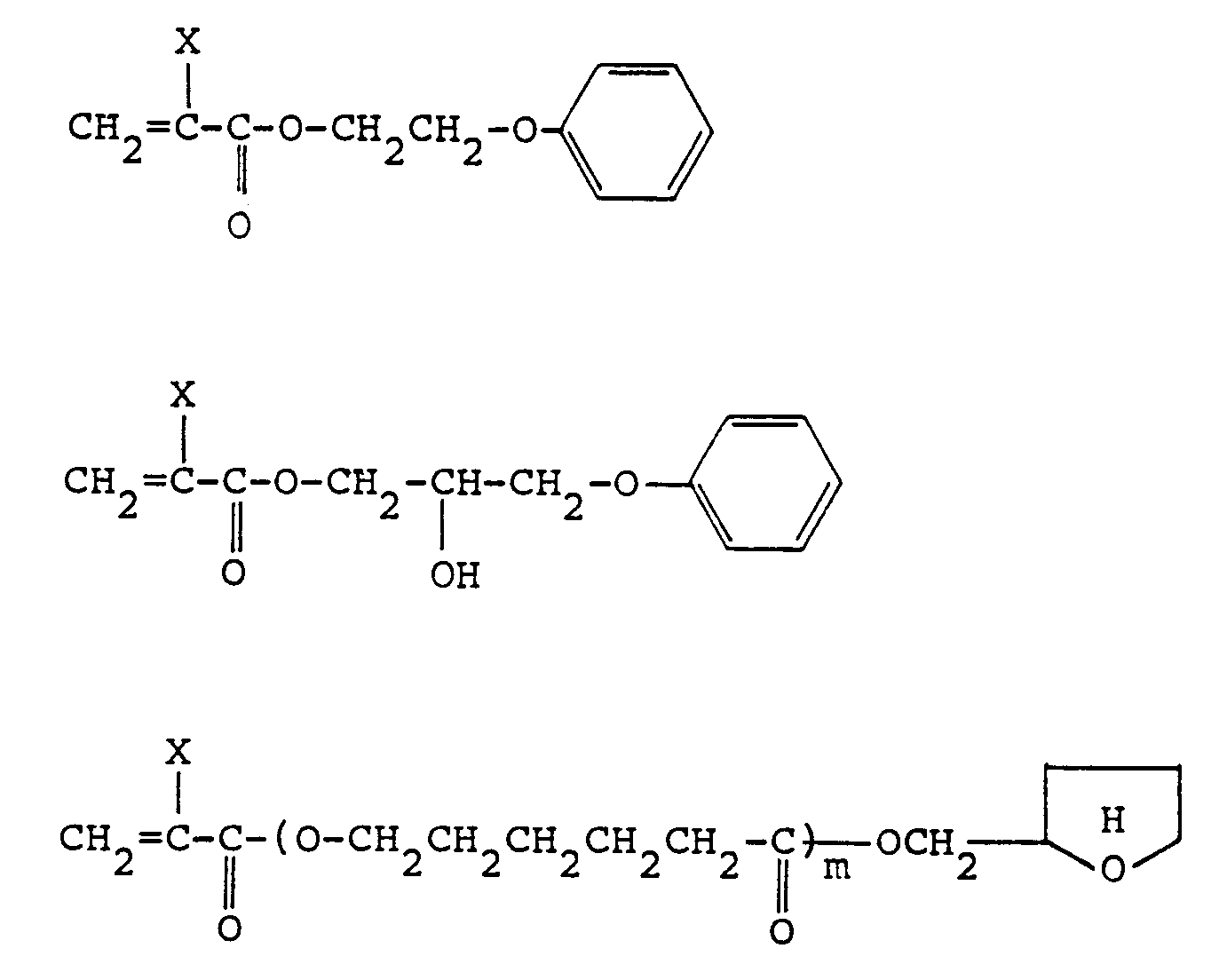
wherein X represents a hydrogen atom or a methyl group; and m represents 1 or 2, such as phenoxyethyl acrylate, phenoxy polyethylene glycol acrylate, 2-hydroxy-3-phenoxypropyl acrylate. - The anaerobically curing adhesive sealing composition of the present invention contains from 5 to 20% by weight of component (A), from 15 to 60% by weight of components (B) and (C) in total, and from 30 to 70% by weight of the diluent. Component (C) may be contained in an amount of 70% by weight or less, preferably up to 50% by weight, based on the total weight of components (B) and (C). If the amount of component (A) is less than 5% by weight the stretchability of the resulting cured product tends to be reduced, and if it exceeds 20% by weight the following properties are deteriorated. If the amount of component (B) or components (B) and (C) in combination is less than 15% by weight, the rubber elasticity of the cured product is reduced and if it exceeds 60% by weight, the viscosity of the sealing composition increases so that it becomes difficult to handle the composition. Further, when component (C) is more than 70% by weight based on the total weight of components (B) and (C), the resulting cured product exhibits less elongation. If the amount of the diluent is less than 30% by weight, the viscosity of the sealing composition increases, resulting in difficulty in handling the composition, and if it is more than 70% by weight, the viscosity is too low to use the composition as a sealing material.
- In addition to the above-described components, the anaerobically curing adhesive sealing composition according to the present invention further comprises a polymerization accelerator, which may be previously incorporated into component (A), (B) or (C), or may be added to the composition as an independent component.
- The polymerization initiator to be used is not particularly limited. Any of the conventional polymerization initiators known to be effective in polymerization of (meth)acrylate monomers for obtaining an anaerobically curing alkyl type adhesive composition, such as those described in Japanese Patent Publication No. 20555/76, can be employed. Typical examples of such polymerization initiators are diacyl peroxides, peroxy esters, dialkyl peroxides, hydroperoxides, ketone peroxides and peroxy ketals. Particularly preferred are hydroperoxides, e.g., cumene hydroperoxide, t-butyl hydroperoxide, etc.; dialkyl peroxides, e.g., 2,5-dimethyl-2,5-di(t-butylperoxy)hexyne-3; and cyclic peroxy ketals, e.g., 3,6,6,9,9-pentamethyl-3-n-butyl-1,2,4,5-tetraoxycyclononane, 3,6,6,9,9-pentamethyl-3-(sec-butyl)-1,2,4,5-tetraoxycyclononane. These polymerization initiators may be used either individually or in combinations of two or more.
- The polymerization accelerator to be used is not particularly limited and can be selected appropriately according to the relation to the polymerization initiator used. For example, known polymerization accelerators to be used for polymerization of (meth)acrylate monomers in the preparation of an anaerobically curing alkyl type adhesive composition, e.g., those disclosed in Japanese Patent Publication No. 20555/76, can be employed. Typical examples of such polymerization accelerators include organic sulfonimides, tertiary amines, primary amines (e.g., primary alkyl-amines), and secondary amines (e.g., heterocyclic secondary amines).
- If desired, the adhesive sealing compound of the present invention may further contain other additives for the purpose of imparting desired properties to the composition, such as plasticisers, dyes, fillers, thixotropic agents, aggregates, stabilisers and polymerization inhibitors.
- The above-described polymerization accelerators, polymerization initiators and other additives can be used arbitrarily insofar as the desired performance properties can be obtained without impairing the anaerobic property and adhesive sealing properties of the sealing composition.
- For the purpose of imparting ultraviolet curing properties to the sealing composition, a photopolymerization initiator, e.g., benzophenone, benzoin alkyl ethers, 2,2-dimethoxy-2-phenylacetophenone, 2,2-diethoxyacetophenone, 1-hydroxycyclohexyl phenyl ketone, benzyl dimethyl ketal, benzyl-β-methoxyethyl acetal, methyl benzoyl, acetophenone, dimethylthioxanthone, 4-methoxybenzophenone, 4-isopropyl-2-hydroxy-2-methylpropiophenone, 2-hydroxy-2-methylpropiophenone, 2-methoxyanthraquinone, can be incorporated into the sealing composition. By incorporating the photopolymerization initiator, the adhesive sealing composition applied onto areas subject to air exposure, i.e., surfaces in contact with air or the squeeze-out of the adhesive sealing composition, can be cured easily and completely by irradiating the sealing composition with ultraviolet rays under given conditions.
- Further, incorporation of phosphoric ester type additives into the adhesive sealing composition of the invention is effective to improve adhesion and photo-curing properties as well as heat-curing properties.
- The cured product of the adhesive sealing composition according to the present invention exhibits excellent heat resistance and oil resistance as inherently possessed by acrylate type adhesive composition, combined with excellent properties to follow the surface of adherends and excellent durability. It is particularly suitable for adhesion and sealing of parts composed of plural materials having different coefficients of thermal expansion to markedly ensure sealing performance. Accordingly, the adhesive sealing composition of the present invention is suitably applicable to parts of hydraulic controlling mechanisms and internal combustion engines, such as a joint between a flange part of an oil pan and an engine block, a joint between an engine head and a head cover and a joint of a transmission. In these uses, sealing materials preferably having an elongation of more than about 100% and a tensile strength of not less than 981 kPa 10 kg/cm² but generally not more than 3923 kPa 40 kg/cm² are required. The sealing composition of the invention is also applicable to large-sized flanges accompanied by large positional deviation on working.
- It has been conventionally proposed to impregnate an anaerobically curing composition mainly comprising a (meth)acrylic ester into a sheet to form a gasket. According to this technique, however, since the cured product is too hard, the resin of the sheet gasket sandwiched between flanges is broken upon application of pressure, thereby lessening the sealing properties. To the contrary, when a sheet gasket impregnated with the anaerobically curing adhesive sealing composition of the present invention is cured under an air-free condition while being pressed between flanges, the cured product is not broken by impact or pressure due to its high elasticity, thus maintaining superior sealing properties.
- In addition, it is possible to apply the adhesive sealing composition according to the present invention by screen printing.
- The composition of the present invention can be used in a wide range of applications including the above-described application, such as adhesion of planes, joining of various parts, locking of screws, fixing of shaft couplings, and the like.
- The anaerobically curing adhesive sealing composition of the invention remains uncured in a liquid state for a long period of time while being in contact with air or oxygen, but is readily polymerized upon being applied onto an adhered in an air- or oxygen-free atmosphere or upon excluding air or oxygen after application to an adherend.
- The anaerobically curing adhesive sealing composition of the invention may be formulated into a one-part system room-temperature curing type or two-part system comprising a part containing a polymerization initiator and another part containing a polymerization accelerator which are combined on use.
- The present invention is now illustrated in greater detail with reference to Examples and Comparative Examples. In these examples, all parts, percents and ratios are by weight unless otherwise indicated.
- A diol (0.19 mol) having formula:

wherein n represents an integer of from 1 to 5, and 0.2 mol of TMHDI were mixed in the presence of butylhydroxytoluene (BHT) as polymerization inhibitor, and to the mixture was added dibutyltin dilaurate as catalyst in an amount of 0.01% by weight based on the mixture. Further, phenoxyethyl acrylate was added thereto as diluent in the same weight as that of the diol-TMHDI mixture. The amount of the polymerization inhibitor was 0.4% by weight based on the total weight of the diol, TMHDI, and the diluent. The resulting mixture was allowed to react at 70°C for 2 hours. - Then, 0.02 x 2 mols of 2-hydroxyethyl methacrylate was (2-HEMA) added to the reaction mixture to synthesize polyurethane methacrylate. The resulting prepolymer was designated as U-1. U-1 was estimated to have an average molecular weight between 50,000 and 70,000 as determined by gel-permeation chromatography (GPC).
- A diol (1.4 mol) having formula:

and 2 mols of HDI were mixed in the presence of 0.4% by weight, based on the total weight of the diol, DHI and the diluent described later, of BHT as polymerization inhibitor, and to the mixture was added 0.01% by weight, based on the mixture, of dibutyltin dilaurate as catalyst. Further, phenoxyethyl acrylate was added thereto as diluent in the same weight as that of the diol-HDI mixture. The resulting mixture was allowed to react at 70°C for 2 hours. - Then, 2 mols of 2-hydroxyethyl acrylate was added to the reaction mixture, and the reaction was continued for an additional 2 hours to synthesize polyurethane methacrylate. The resulting prepolymer was designated as U-2. U-2 was estimated to have an average molecular weight of about 20,000 as determined by GPC.
- A polyester polyol (1.0 mol) obtained from adipic acid and 1,4-butanediol was mixed with 2 mols of TMHDI in the presence of 0.4%, based on the polyester polyol-TMHDI mixture, of BHT as polymerization initiator. To the mixture was added 0.01%, based on the mixture, of dibutyltin dilaurate as catalyst. The resulting mixture was allowed to react at 80°C for 1 hour.
- Then, at least 3 mols of 2-HEMA was added to the mixture, and the reaction was continued for an additional 1 hour to obtain polyurethane methacrylate having an average molecular weight of about 1,000. The resulting urethane prepolymer was designated as U-3.
- The following components were mixed at the indicated composition ratios to obtain various anaerobically curing adhesive sealing compositions (Samples 1-11).
Sample 1: U-1 70 parts Phenoxyethyl acrylate 20 parts Dicyclopentenyloxyethyl methacrylate 10 parts Disodium ethylenediaminetetraacetate 0.02 part Oxalic acid 0.01 part o-Benzoic acid sulfimide 1 part Cumene hydroperoxide 1 part N-ethylmetatoluidine 0.2 part Sample 2: U-1 50 parts U-3 20 parts Phenoxyethyl acrylate 20 parts Dicyclopentenyloxyethyl methacrylate 10 parts Disodium ethylenediaminetetraacetate 0.02 part Oxalic acid 0.01 part o-Benzoic acid sulfimide 1 part Cumene hydroperoxide 1 part N-ethylmetatoluidine 0.2 part Sample 3: U-1 50 parts U-3 20 parts Phenoxyethyl acrylate 25 parts Dicyclopentenyloxyethyl methacrylate 5 parts Disodium ethylenediaminetetraacetate 0.02 part Oxalic acid 0.01 part o-Benzoic acid sulfimide 1 part Cumene hydroperoxide 1 part N-ethylmetatoluidine 0.2 part Sample 4: U-2 75 parts Phenoxyethyl acrylate 25 parts Dicyclopentenyloxyethyl methacrylate 5 parts Disodium ethylenediaminetetraacetate 0.02 part Oxalic acid 0.01 part o-Benzoic acid sulfimide 1 part Cumene hydroperoxide 1 part N-ethylmetatoluidine 0.2 part Sample 5: U-2 50 parts U-3 20 parts Phenoxyethyl acrylate 20 parts Dicyclopentenyloxyethyl methacrylate 10 parts Disodium ethylenediaminetetraacetate 0.02 part Oxalic acid 0.01 part o-Benzoic acid sulfimide 1 part Cumene hydroperoxide 1 part N-ethylmetatoluidine 0.2 part Sample 6: U-1 50 parts Phenoxyethyl acrylate 15 parts Dicyclopentenyloxyethyl methacrylate 15 parts Disodium ethylenediaminetetraacetate 0.02 part Oxalic acid 0.01 part o-Benzoic acid sulfimide 1 part Cumene hydroperoxide 1 part N-ethylmetatoluidine 0.2 part Sample 7: U-1 50 parts U-3 20 parts Phenoxyethyl acrylate 10 parts Dicyclopentenyloxyethyl methacrylate 20 parts Disodium ethylenediaminetetraacetate 0.02 part Oxalic acid 0.01 part o-Benzoic acid sulfimide 1 part Cumene hydroperoxide 1 part N-ethylmetatoluidine 0.2 part Sample 8: U-2 50 parts U-3 35 parts Phenoxyethyl acrylate 5 parts Dicyclopentenyloxyethyl methacrylate 10 parts Disodium ethylenediaminetetraacetate 0.02 part Oxalic acid 0.01 part o-Benzoic acid sulfimide 1 part Cumene hydroperoxide 1 part N-ethylmetatoluidine 0.2 part Sample 9: U-1 20 parts U-2 20 parts U-3 20 parts Phenoxyethyl acrylate 20 parts Dicyclopentenyloxyethyl methacrylate 20 parts Disodium ethylenediaminetetraacetate 0.02 part Oxalic acid 0.01 part o-Benzoic acid sulfimide 1 part Cumene hydroperoxide 1 part N-ethylmetatoluidine 0.2 part Sample 10: U-1 40 parts Phenoxyethyl acrylate 45 parts Dicyclopentenyloxyethyl methacrylate 15 parts Disodium ethylenediaminetetraacetate 0.02 part Oxalic acid 0.01 part o-Benzoic acid sulfimide 1 part Cumene hydroperoxide 1 part N-ethylmetatoluidine 0.2 part Sample 11: U-1 40 parts U-3 40 parts Phenoxyethyl acrylate 10 parts Dicyclopentenyloxyethyl methacrylate 10 parts Disodium ethylenediaminetetraacetate 0.02 part Oxalic acid 0.01 part o-Benzoic acid sulfimide 1 part Cumene hydroperoxide 1 part N-ethylmetatoluidine 0.2 part - A cured product of each of Samples 1 and 11 was evaluated for hardness (Shore hardness, A scale), elongation, tensile strength, and peel strength. These tests were carried out using No. 2 dumbbell specimens prepared according to JIS K6301. The results obtained are shown in Table 1 below.
- For comparison, the same evaluations were made on "TB 1131" (polyester methacrylate produced by Three Bonds Co., Ltd.) as comparative sample (Comparative Example 1).
Table 1 Sample No. Hardness Elongation (%) Tensile Strength kPa(kgf/cm²) Strength (kg ) 1 32 190 1569(16) 2.5 2 36 170 1765(18) 0.4 3 26 200 1177(12) 0.3 4 20 240 883(9) 2.0 5 34 180 1569(16) 0.4 6 40 150 2157(22) 3.0 7 60 110 3138(32) 0.6 8 34 175 1667(17) 0.3 9 72 90 3923(40) 0.4 10 45 160 2354(24) 1.8 11 38 165 1667(17) 0.3 Comparative Example 1 90 30 4903(50) 1.0 - As can be seen from Table 1, the cured product of Samples 1 to 11 according to the present invention are excellent in stretchability and elasticity and satisfactorily follow the surface of an adherend. It is also apparent that the cured products of Samples 1, 4, 6, and 10 exhibit high adhesive strength to an adherend and that the cured products of Samples 2, 3, 5, 7, 8, 9, and 11 exhibit excellent releasability.
- No. 2 dumbbell specimens for testing oil resistance were prepared from Samples 1, 2, 3, 5, 6, 8, and 10 in the same manner as in Test 1. In order to evaluate resistance to oil and cooling water, the specimen was immersed in oil A, B or C or cooling water hereinafter described under the conditions shown, and a percent change in weight between before and after the immersion was determined from the following equation

wherein W is the weight of the specimen before the immersion and W₁ is that after the immersion. The results obtained are shown in Table 2.
Oil A: Gear oil (75W-90); 120°C x 7 days
Oil B: Automatic transmission fluid (ATF); 150°C x 7 days
Oil C: Engine oil (10W-30); 120°C x 7 days
Cooling Water: 50% Long life coolant (LLC); 100°C x 7 days.
- It is apparent from the results of Table 2 that the cured products of the present invention retain excellent resistance to oil and cooling water as possessed by acrylate adhesive sealing compositions.
- Test specimens for determining Fe shearing adhesion (100 mm x 25 mm x 1.6 mm) were prepared according to JIS G3141. Each of Samples 2, 3, 5, and 8 containing components (A), (B) and (C) was applied to a 10 mm wide overlap of the specimen. After allowing the specimens to stand at 25°C for 24 hours, they were placed in a drying oven at 130°C or 150°C each for 10 days, 20 days or 30 days. The specimens were taken out of the drying oven, cooled to room temperature and evaluated for heat resistance (Fe/Fe) by determining the adhesive strength under shear according to JIS K6850. The results obtained are shown in Table 3.
- For comparison, the same evaluation was made on "TB 1131" (Comparative Example 2).
Table 3 Sample No. Blank (kgf/cm²) Temperature After Strength kPa (kg/cm²) 10 Days 20 Days 30 Days 2 23.0 130°C 2373(24.2) 3275(33.4) 3119(31.8) 150°C 2589(26.4) 3413(34.8) 3648(37.2) 3 21.0 130°C 2275(23.2) 2991(30.5) 3060(31.2) 150°C 2452(25.0) 3275(33.4) 3746(38.2) 5 24.0 130°C 2471(25.2) 3373(34.4) 3481(35.5) 150°C 2667(27.2) 3825(39.0) 3874(39.5) 8 22.0 130°C 2393(24.4) 3383(34.5) 3452(35.2) 150°C 2628(26.8) 3874(39.5) 4040(41.2) Comparative Example 2 64.0 130°C 8140(83.0) 9218(94.0) 10787(110.0) 150°C 8728(89.0) 9316(95.0) 11768(120.0) - As is shown in Table 3, the cured products of the samples containing components (A), (B) and (C) according to the present invention exhibit not only excellent releasability but excellent heat resistance as possessed by the conventional acrylate adhesive sealing composition with little change with time. On the other hand, the comparative sample suffers large change of heat resistance with time.
- Each of Samples 1, 2, 3, 5, 6, 8, and 10 was applied between a pair of flanges, one made of iron and the other made of aluminum, each having an inner diameter of 100 mm and a 10 mm wide overlap, and the flange joint was pressed under a pressure of 3923 kPa (40 kg/cm²), followed by allowing to stand for 24 hours. The joint was placed in a thermal cycle tester and subjected to thermal change, one hour at -40°C and one hour at 120°C making a cycle. After 100 cycles, the joint was taken out of the tester and sealing properties were determined using turbing oil as a medium to be sealed up. The results obtained are shown in Table 4 below, in which the values [kPa (kg/cm²)] mean the force imposed on the turbine oil at the point when the turbine oil leaks from the sealed joint.
- For comparison, the same evaluation was made using TB 1110B or TB 1131 (products of Three Bonds Co., Ltd.) (Comparative Examples 3 and 4).
Table 4 Sample No. Blank kPa(kg/cm²) After 100 Cycles (kg/cm²) 1 2648(27) 2059(21) 2 2354(24) 1863(19) 3 2157(22) 1765(18) 5 2354(24) 1863(19) 6 2746(28) 1961(20) 8 2157(22) 1863(19) 10 2550(26) 1863(19) Comparative Example 3 1765(18) 294(3) Comparative Example 4 2157(22) 392(4) - From the results of Table 4, it can be seen that when a flange joint is composed of different materials, i.e., iron and aluminum, the conventional adhesive sealing composition shows poor properties to follow the surface of the flange due to a difference of coefficient of thermal expansion between the different materials and suffers extreme reduction of sealing performance when subjected to thermal change. To the contrary, the sealing compositions according to the present invention exhibit superior sealing properties even when applied to parts that are made of different materials and also subjected to heat change.
- As described above, the anaerobically curing composition comprising the components (A) and (B) according to the present invention retains excellent characteristics possessed by acrylate adhesive sealing compositions, such as oil resistance, heat resistance, and the like, and exhibits, upon curing, excellent elasticity and following properties to show satisfactory sealing performance. It is particularly noteworthy that the cured sealing material of the present invention exhibits superior sealing properties because of its excellent following properties even when applied between different materials having different coefficients of thermal expansion and is, therefore, suitable for application to large-sized flanges which are liable to large positional deviation on working.
- Further, the anaerobically curing adhesive sealing composition comprising the components (A), (B), and (C) according to the present invention exhibits excellent releasability in addition to the above-described performance properties. Such releasability can be taken advantage of when the sealing composition is utilized as, for example, a liquid gasket because it can be easily removed for exchange of parts.
- Moreover, since the anaerobically curing adhesive sealing composition according to the present invention exhibits elasticity upon curing, it can be used as impregnated into a porous sheet, non-woven fabric.
Claims (7)
- An anaerobically curing adhesive sealing composition comprising(A) 5 to 20% by weight of a mono(meth)acrylate monomer represented by formula (I)

 (B) 15 to 60% by weight of a (meth)acrylate prepolymer having a urethane structure in the main chain thereof and having an average molecular weight of at least 10,000.
 - The anaerobically curing adhesive sealing composition of claim 1, wherein said mono(meth)acrylate monomer is a compound represented by


- The anaerobically curing adhesive sealing composition of claim 1, wherein said (meth)acrylate prepolymer has an average molecular weight of from 10,000 to 100,000.
- The anaerobically curing adhesive sealing composition of claim 1, which further comprises(C) up to 70% by weight of a (meth)acrylate prepolymer having a urethane structure in the main chain thereof and an average molecular weight of at most 5,000.
- The anaerobically curing adhesive sealing composition of claim 4, wherein said (meth)acrylate prepolymer as component (C) has an average molecular weight of from 500 to 5,000.
- The anaerobically curing adhesive sealing composition of claim 1, which further comprises a photopolymerization initiator.
- The anaerobically curing adhesive sealing composition of claim 1 or 4 which further comprises 30 to 70% by weight of a diluent.
Applications Claiming Priority (4)
| Application Number | Priority Date | Filing Date | Title |
|---|---|---|---|
| JP69782/87 | 1987-03-24 | ||
| JP6978287 | 1987-03-24 | ||
| JP8144/88 | 1988-01-18 | ||
| JP63008144A JP2568421B2 (en) | 1987-03-24 | 1988-01-18 | Anaerobic curable adhesive sealant composition |
Publications (3)
| Publication Number | Publication Date |
|---|---|
| EP0284027A2 EP0284027A2 (en) | 1988-09-28 |
| EP0284027A3 EP0284027A3 (en) | 1989-11-15 |
| EP0284027B1 true EP0284027B1 (en) | 1994-02-16 |
Family
ID=26342597
Family Applications (1)
| Application Number | Title | Priority Date | Filing Date |
|---|---|---|---|
| EP88104574A Expired - Lifetime EP0284027B1 (en) | 1987-03-24 | 1988-03-22 | Anaerobically curing adhesive sealing composition |
Country Status (6)
| Country | Link |
|---|---|
| US (1) | US4985523A (en) |
| EP (1) | EP0284027B1 (en) |
| JP (1) | JP2568421B2 (en) |
| BR (1) | BR8801303A (en) |
| DE (1) | DE3887763T2 (en) |
| HK (1) | HK1007571A1 (en) |
Families Citing this family (24)
| Publication number | Priority date | Publication date | Assignee | Title |
|---|---|---|---|---|
| JPH07103325B2 (en) * | 1987-10-13 | 1995-11-08 | 日立化成工業株式会社 | Concrete protection material |
| DE3901874A1 (en) * | 1989-01-23 | 1990-07-26 | Henkel Kgaa | ANAEROBIC-HARDENING SEALANTS AND THEIR USE FOR SEALING PIPE JOINTS |
| DE3935204A1 (en) * | 1989-10-23 | 1991-04-25 | Henkel Kgaa | ANAEROB-SEALING SEALING MASSES AND THEIR USE FOR SEALING PIPE CONNECTING PIECES |
| US5249101A (en) * | 1992-07-06 | 1993-09-28 | International Business Machines Corporation | Chip carrier with protective coating for circuitized surface |
| US5475038A (en) * | 1993-08-11 | 1995-12-12 | National Starch And Chemical Investment Holding Corporation | U.V. curable laminating adhesive composition |
| US5426166A (en) * | 1994-01-26 | 1995-06-20 | Caschem, Inc. | Urethane adhesive compositions |
| DE4434630A1 (en) * | 1994-09-28 | 1996-04-04 | Nokia Deutschland Gmbh | UV adhesive for fixing coated wires in a moving coil of loudspeaker |
| JP3292348B2 (en) * | 1994-10-11 | 2002-06-17 | ジェイエスアール株式会社 | Liquid curable resin composition |
| JP2000029611A (en) * | 1998-07-15 | 2000-01-28 | Smk Corp | Touch panel input device |
| IE980948A1 (en) * | 1998-11-16 | 2000-05-17 | Loctite R & D Ltd | Method of bonding Aluminium Substrates with Anaerobic Sealants to form a Seal |
| DE19902817A1 (en) * | 1999-01-25 | 2000-07-27 | Loctite Deutschland Gmbh | Method for attaching the oil sump to an internal combustion engine block involves use of a hardenable sealing compound whose adhesion is sufficient for keeping the oil sump attached to the engine block |
| US7186780B2 (en) | 2001-02-28 | 2007-03-06 | Kaneka Corporation | Polymer and liquid gasket for in-place forming |
| US6543404B2 (en) * | 2001-04-04 | 2003-04-08 | Dow Global Technologies, Inc. | Adhesively bonded engine intake manifold assembly |
| US20030024768A1 (en) * | 2001-08-03 | 2003-02-06 | Jones Bart R. | Adhesively bonded oil pan assembly |
| US7360519B2 (en) * | 2003-07-10 | 2008-04-22 | Dow Global Technologies, Inc. | Engine intake manifold assembly |
| JP5294543B2 (en) * | 2006-04-19 | 2013-09-18 | 日本化薬株式会社 | Optical adhesive composition |
| WO2009107537A1 (en) | 2008-02-29 | 2009-09-03 | 株式会社カネカ | Curable composition |
| WO2012077329A1 (en) * | 2010-12-08 | 2012-06-14 | 株式会社ブリヂストン | Adhesive composition |
| RU2540307C1 (en) * | 2013-07-18 | 2015-02-10 | Федеральное государственное унитарное предприятие "Научно-исследовательский институт химии и технологии полимеров имени академика В.А. Каргина с опытным заводом" (ФГУП "НИИ полимеров") | Anaerobic sealing composition |
| WO2015119297A1 (en) * | 2014-02-10 | 2015-08-13 | 日本電産サンキョー株式会社 | Method for sealing optical unit, and optical unit |
| CN104934550A (en) * | 2015-05-07 | 2015-09-23 | 京东方科技集团股份有限公司 | OLED device packaging structure, packaging method and electronic device |
| GB2543756B (en) * | 2015-10-22 | 2017-10-18 | Henkel IP & Holding GmbH | Anaerobically curable compositions |
| CN112175568A (en) * | 2020-09-21 | 2021-01-05 | 禹城市三星科技有限公司 | High-toughness and high-strength anaerobic adhesive and preparation method thereof |
| JP7620461B2 (en) * | 2021-03-23 | 2025-01-23 | サンスター技研株式会社 | Photocurable composition, photocurable foam composition, urethane (meth)acrylate compound, and method for producing foam |
Family Cites Families (7)
| Publication number | Priority date | Publication date | Assignee | Title |
|---|---|---|---|---|
| DE2200021C3 (en) * | 1972-01-03 | 1980-06-19 | Henkel Kgaa | ACRYLIC ACID ESTERS OR METHACRYLIC ACID ESTERS OF OH-GROUPED TRICYCLIC DECANOLS, METHOD FOR THE PRODUCTION AND USE THEREOF |
| US4295909A (en) * | 1975-02-03 | 1981-10-20 | Loctite Corporation | Curable polybutadiene-based resins having improved properties |
| US4234711A (en) * | 1978-08-09 | 1980-11-18 | Rohm And Haas Company | Anaerobic adhesive and/or sealing compositions comprising dicyclopentenyloxyethyl (meth)acrylates |
| JPS5787409A (en) * | 1980-11-20 | 1982-05-31 | Hitachi Chem Co Ltd | Photo-setting resin composition |
| US4446286A (en) * | 1982-08-02 | 1984-05-01 | The B. F. Goodrich Company | Electron beam curable polyrethane compositions |
| US4608409A (en) * | 1985-05-08 | 1986-08-26 | Desoto, Inc. | Polyacrylated oligomers in ultraviolet curable optical fiber coatings |
| US4690501A (en) * | 1985-07-08 | 1987-09-01 | Desoto, Inc. | Ultraviolet curable optical glass fiber coatings from acrylate terminated, end-branched polyurethane polyurea oligomers |
-
1988
- 1988-01-18 JP JP63008144A patent/JP2568421B2/en not_active Expired - Fee Related
- 1988-03-22 DE DE3887763T patent/DE3887763T2/en not_active Expired - Fee Related
- 1988-03-22 EP EP88104574A patent/EP0284027B1/en not_active Expired - Lifetime
- 1988-03-23 BR BR8801303A patent/BR8801303A/en not_active IP Right Cessation
-
1989
- 1989-08-28 US US07/399,083 patent/US4985523A/en not_active Expired - Lifetime
-
1998
- 1998-06-25 HK HK98106745A patent/HK1007571A1/en not_active IP Right Cessation
Non-Patent Citations (1)
| Title |
|---|
| Skeist, Handbook of Adhesives, 2nd Edition, page 564 * |
Also Published As
| Publication number | Publication date |
|---|---|
| DE3887763D1 (en) | 1994-03-24 |
| BR8801303A (en) | 1988-10-25 |
| US4985523A (en) | 1991-01-15 |
| JP2568421B2 (en) | 1997-01-08 |
| DE3887763T2 (en) | 1994-05-19 |
| JPS64112A (en) | 1989-01-05 |
| EP0284027A2 (en) | 1988-09-28 |
| HK1007571A1 (en) | 1999-04-16 |
| EP0284027A3 (en) | 1989-11-15 |
Similar Documents
| Publication | Publication Date | Title |
|---|---|---|
| US4985523A (en) | Anaerobically curing adhesive sealing composition | |
| HK1007571B (en) | Anaerobically curing adhesive sealing composition | |
| JPH01112A (en) | Anaerobic curable adhesive sealant composition | |
| CN111303820B (en) | Double-component polyurethane structural adhesive for bonding power battery and preparation method thereof | |
| CA1179095A (en) | Gasketing and sealing composition | |
| EP1453925B1 (en) | Elastic (meth)acrylic adhesive compositions | |
| JPH04279620A (en) | Wet-curable polyurethane composition containing polyaldimine, water-repellent material, floor material, wall material and coating material respectively containing the composition | |
| EP1086969A1 (en) | Novel polyisocyanate and process for producing the same | |
| US4554301A (en) | Modified two-part type adhesive composition | |
| KR100257205B1 (en) | Curable resin composition | |
| JP3305613B2 (en) | Curable resin composition | |
| JP3305822B2 (en) | Curable resin composition, adhesive and sealant using the same | |
| JPS60163911A (en) | Photocurable rubbery elastic composition | |
| JP2769747B2 (en) | Adhesive composition | |
| GB2084161A (en) | Fast curing phosphate modified anaerobic sealant composition | |
| JP2003064253A (en) | Curable composition and sealant composition | |
| JP4800516B2 (en) | Curable composition and sealant composition | |
| JPH0326779A (en) | Sealing method of member having gap between seal face | |
| JP2002275449A (en) | Two-part separation coating type acrylic urethane adhesive composition | |
| US20240228839A1 (en) | Two-component thermally conductive adhesive composition and two-component thermally conductive gap-filling glue | |
| KR102814763B1 (en) | Adhesive composition for vehicle | |
| KR102675946B1 (en) | Anaerobic adhesive composition with excellent oil resistance and impact resistance and method for preparing the same | |
| KR102754210B1 (en) | Anaerobic adhesive composition with improved curing rate and pot life and method for preparing the same | |
| JPH0326778A (en) | Sealing method of member having gap between seal face | |
| EP0640672B1 (en) | Anaerobically-curable flexible sealant compositions |
Legal Events
| Date | Code | Title | Description |
|---|---|---|---|
| PUAI | Public reference made under article 153(3) epc to a published international application that has entered the european phase |
Free format text: ORIGINAL CODE: 0009012 |
|
| AK | Designated contracting states |
Kind code of ref document: A2 Designated state(s): DE FR GB IT SE |
|
| PUAL | Search report despatched |
Free format text: ORIGINAL CODE: 0009013 |
|
| AK | Designated contracting states |
Kind code of ref document: A3 Designated state(s): DE FR GB IT SE |
|
| 17P | Request for examination filed |
Effective date: 19900207 |
|
| 17Q | First examination report despatched |
Effective date: 19911205 |
|
| ITTA | It: last paid annual fee | ||
| GRAA | (expected) grant |
Free format text: ORIGINAL CODE: 0009210 |
|
| AK | Designated contracting states |
Kind code of ref document: B1 Designated state(s): DE FR GB IT SE |
|
| REF | Corresponds to: |
Ref document number: 3887763 Country of ref document: DE Date of ref document: 19940324 |
|
| ET | Fr: translation filed | ||
| ITF | It: translation for a ep patent filed | ||
| PLBE | No opposition filed within time limit |
Free format text: ORIGINAL CODE: 0009261 |
|
| STAA | Information on the status of an ep patent application or granted ep patent |
Free format text: STATUS: NO OPPOSITION FILED WITHIN TIME LIMIT |
|
| EAL | Se: european patent in force in sweden |
Ref document number: 88104574.4 |
|
| 26N | No opposition filed | ||
| REG | Reference to a national code |
Ref country code: GB Ref legal event code: IF02 |
|
| PGFP | Annual fee paid to national office [announced via postgrant information from national office to epo] |
Ref country code: SE Payment date: 20030306 Year of fee payment: 16 |
|
| PGFP | Annual fee paid to national office [announced via postgrant information from national office to epo] |
Ref country code: FR Payment date: 20030310 Year of fee payment: 16 |
|
| PGFP | Annual fee paid to national office [announced via postgrant information from national office to epo] |
Ref country code: GB Payment date: 20030319 Year of fee payment: 16 |
|
| PGFP | Annual fee paid to national office [announced via postgrant information from national office to epo] |
Ref country code: DE Payment date: 20030403 Year of fee payment: 16 |
|
| PG25 | Lapsed in a contracting state [announced via postgrant information from national office to epo] |
Ref country code: GB Free format text: LAPSE BECAUSE OF NON-PAYMENT OF DUE FEES Effective date: 20040322 |
|
| PG25 | Lapsed in a contracting state [announced via postgrant information from national office to epo] |
Ref country code: SE Free format text: LAPSE BECAUSE OF NON-PAYMENT OF DUE FEES Effective date: 20040323 |
|
| PG25 | Lapsed in a contracting state [announced via postgrant information from national office to epo] |
Ref country code: DE Free format text: LAPSE BECAUSE OF NON-PAYMENT OF DUE FEES Effective date: 20041001 |
|
| EUG | Se: european patent has lapsed | ||
| GBPC | Gb: european patent ceased through non-payment of renewal fee |
Effective date: 20040322 |
|
| PG25 | Lapsed in a contracting state [announced via postgrant information from national office to epo] |
Ref country code: FR Free format text: LAPSE BECAUSE OF NON-PAYMENT OF DUE FEES Effective date: 20041130 |
|
| REG | Reference to a national code |
Ref country code: FR Ref legal event code: ST |
|
| PG25 | Lapsed in a contracting state [announced via postgrant information from national office to epo] |
Ref country code: IT Free format text: LAPSE BECAUSE OF NON-PAYMENT OF DUE FEES;WARNING: LAPSES OF ITALIAN PATENTS WITH EFFECTIVE DATE BEFORE 2007 MAY HAVE OCCURRED AT ANY TIME BEFORE 2007. THE CORRECT EFFECTIVE DATE MAY BE DIFFERENT FROM THE ONE RECORDED. Effective date: 20050322 |