EP0281007A2 - Mail processing machine and method of sorting mails - Google Patents
Mail processing machine and method of sorting mails Download PDFInfo
- Publication number
- EP0281007A2 EP0281007A2 EP88102721A EP88102721A EP0281007A2 EP 0281007 A2 EP0281007 A2 EP 0281007A2 EP 88102721 A EP88102721 A EP 88102721A EP 88102721 A EP88102721 A EP 88102721A EP 0281007 A2 EP0281007 A2 EP 0281007A2
- Authority
- EP
- European Patent Office
- Prior art keywords
- address
- detecting
- character
- detected
- Prior art date
- Legal status (The legal status is an assumption and is not a legal conclusion. Google has not performed a legal analysis and makes no representation as to the accuracy of the status listed.)
- Granted
Links
Images

Classifications
-
- B—PERFORMING OPERATIONS; TRANSPORTING
- B07—SEPARATING SOLIDS FROM SOLIDS; SORTING
- B07C—POSTAL SORTING; SORTING INDIVIDUAL ARTICLES, OR BULK MATERIAL FIT TO BE SORTED PIECE-MEAL, e.g. BY PICKING
- B07C1/00—Measures preceding sorting according to destination
Definitions
- the present invention relates to a mail processing machine (face-canceller) which can arrange mails, cancell postage stamps and sort the mails according to mails whose address is written in print or mails whose address is written in handwriting.
- face-canceller face-canceller
- the mails sorted as that the address characters are written in print are further sorted with respect to Zip codes by a Zip code reader, while the mails sorted as that the address characters are written in handwriting are further sorted with respect to Zip codes by human labor.
- a mail processing machine comprises: (a) feeding means for feeding mails having first and second surfaces one by one; (b) first detecting means for detecting mail address information written on a first surface of a mail; (c) second detecting means for detecting mail address information written on a second surface of the mail; (d) determining means, coupled to said first and second detecting means, for determining a front surface of the mail on which mail address characters are written on the basis of the detected mail address information; (e) third detecting means for detecting mail address character images on the first surface of the mail, when said determining means determines that mail address characters are written on the first surface of the mail; (f) fourth detecting means for detecting mail address character images on the second surface of the mail, when said determining means determines that mail address characters are written on the second surface of the mail; and (g) recognizing means, for recognizing features of mail address character images, said recognizing means being connected to said third detecting means when said determining means determines
- the above mail surface information is a mail address window, label, and the quantity of characters.
- the front of a mail on which a mail address is written is determined by the presence of a postage stamp, and an address window/label. Further, in the case where no postage stamp and no address window/label are present, the mail front is determined by comparing the character areas of both surfaces of the mail (in usual, many characters are written on the front of a mail); (2) an address character position is detected on the basis of a mail address window and/or label.
- surface image signals finely scanned on a mail front are once compressed and then binarized to determined an address character area; and (3) surface image signals corresponding to only the detected address window/label or the determined address character area are recognized to determine whether address characters are printed or handwritten.
- the operation load applied to the recognizer can be minimized by previously detecting a mail front and an address character position or area. Since only a single recognizer is incorporated in the mail processing machine of the present invention, the mail processing speed is high and the machine cost is low as compared with the prior-art machine.
- the mail processing machine reads a Zip code and an address written on a mail, discriminates whether the address characters are written in print or in handwriting, cancels stamps, and sorts the mail into two groups of printed address mails and handwritten address mails.
- a first group of mails sorted as print writing is further sorted automatically by a Zip code reader; while a second group of mails sorted as handwriting is further sorted by manual operation according to Zip codes.
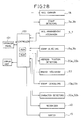
- the mail processing machine shown in Figs. 2A and 2B comprises an operator panel 101, a controller 100, a mail box 1, a mail carrier 1A, two stamp detectors 3a and 3b, a non-inversion path 5 and an inversion path 7 (mail arrangement mechanism), two stamp detectors 9a and 9b, two address position detectors 20a and 20b, a branch mechanism 50, two character detectors 30a and 30b, a recognizer 40, two stamp cancellers 13a and 13b, and a sorter 15 including plural mail sorting boxes 15a to 15e.
- a lot of mails are arranged in a mail box 1.
- Each mail arranged in the mail box 1 is fed one by one to two (postage) stamp detectors 3a and 3b in vertical mail position.
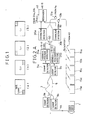
- a postage stamp is attached to a corner of a mail as shown by (a) in Fig. 1
- four different positions (a), (b), ( ) and ( ) can be considered as depicted in Fig. 1, in which solid lines of a stamp indicate that a stamp is attached on the front surface side of a mail and dashed lines thereof indicate that a stamp is attached on the back surface side of a mail.
- the two stamp detectors 3a and 3b are so arranged as to detect the stamp only when the stamp is located at the lower ends of the mail as depicted by (a) and (b) in Fig. 1, respectively. That is, the stamp attached as (a) in Fig. 1 can be detected by the stamp detector 3a, and that attached as (b) in Fig. 1 can be detected by the stamp detector 3b.
- the stamp detector 3a detects the presence of a stamp
- the mail is fed through a non-inversion path 5.
- these two detectors 3a and 3b cannot detect the presence of a stamp or when the stamp is located at the upper ends of the mail as depicted by ( ) and ( ) in Fig.
- the mail is fed through an inversion path 7 to reverse the mail upside down so that the mail is always located as shown by (a) and (b) in Fig. 1.
- the stamp is located as ( ) and reversed, the stamp is located as (a); when stamp is located as ( ) and reversed, the stamp is located as (b) in Fig. 1.
- the mail so arranged that the stamp is located on the lower side thereof is then fed to the next two stamp detectors 9a and 9b to detect the presence or absence of the stamp. Therefore, when the stamp detector 9a or 9b detects the presence of stamp, it is possible to determine that the address is written on the side on which at least one stamp is stuck.
- the address position detector 20a or 20b detects the address character position and the front surface of a mail on which an address is written on the basis of mail surface information. That is, when the presence of stamp is detected by the stamp detector 9a or 9b, the address position detector 20a or 20b next detects the presence of an address window covered by cellophane or an address label on which an address is written in order to detect a mail address character position. When the presence of stamp is not detected by the two stamp detectors 9a and 9b. The quantity of characters or the extent of characters written on one surface of the mail is compared with that on the other surface of the same mail by the two address position detectors 20a and 20b in order to determine the front surface or the back surface of the mail. That is, the surface on which many characters are written is determined as the front surface of the mail.
- the front surface of the mail is determined on the basis of the address window, the address label, or the quantity of characters detected by the address position detector 20a or 20b.
- the quantity of the address characters can be determining by integrating the image signals indicative of address characters.
- the branch mechanism 50 When the address position detector 20a detects the front of a mail, the branch mechanism 50 is actuated so that the mail is fed to the character detector 30a. On the other hand, when the address position detector 20b detects the front of a mail, the branch mechanism 50 is actuated so that the mail is fed to the character detector 30b.
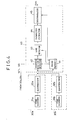
- the address position detector 20a or 20b comprises a light source 21 for emitting a light beam toward a mail fed through a carrying path for scanning, a lens 22 for focusing the light reflected from the mail, a photosensitive element 23 composed of a line image sensor (e.g. charge coupled devices) for detecting characters written on the mail, an amplifier 24 for amplifying the detected character image signal S, and two quantization circuits 25A and 25B.
- the light source 21 and the lens 22 are both disposed relative to the mail in such a way the an incidence angle ⁇ is roughly equal to a reflection angle ⁇ .
- the quantization circuit 25A compares the image signal S detected by the photosensitive element 23 with a slice level B outputted from a controller (not shown), and outputs a window/label signal (W/L SIG) indicative of the presence of a window or label of a high reflectivity, when the level of the image signal S exceeds the slice level B as shown by S C in Fig. 3B.
- the quantization circuit 25B compares the image signal S with a slice level C also outputted from a controller (not shown) and output a paper surface signal S B indicative of the absence of characters of a middle reflectivity, when the level of the image signal S lies between the slice levels B and C.
- the signal S d is determined as a character signal (CHR SIG) indicative of the presence of characters of a low reflectivity. Further, in Fig. 3B, the level A of the image signal S is detected when the mail surface is deep black.
- the resolving power of scanning is not high (e.g. a single scanning line per millimeter) because this detector detects only the position of an address window/label.
- the window/label position can be detected in the form of (x, y) coordinates indicative of the number of the horizontal scanning line from an upper edge and a time period from an edge of the horizontal scanning line, for instance.
- the character signal S d outputted from the quantization circuit 25B is integrated by an integrator 26 and supplied to a comparator 27.
- other character signal S d ⁇ outputted from another quantization circuit 25B ⁇ of the address position detector 20b is integrated by an integrator 26 ⁇ and supplied to the comparator 27.
- the comparator 27 compares these two integrated character signals to determine the front side of a mail. For instance, if the character signals integrated by the integrator 26 is large, the comparator 27 generates a command signal to the branch mechanism 50 to feed the mail toward the character detector 30a. In response to this command signal, character detector 30a is activated to detect the character images.
- Fig. 4 shows the two character detectors 30a and 30b and the recognizer 40.
- Each character detector 30a or 30b comprises a fine scanner 31a or 31b and a quantization circuit 32a or 32b.
- the fine scanner 31a or 31b generates image signals in almost the same way as in the address position detector 20a or 20b by irradiating the mail surface with a light beam and transducing the reflected light beam by photosensitive elements into image signals.
- the resolving power of the fine scanner 31a or 31b is as high as 8 lines per millimeter because this detector detects the features of characters.
- the quantization circuit 32a or 32b compares the detected mail surface image signals with a predetermined slice level and outputs character image signals only when the image signal drops below a slice level (the above processing being referred to as binarization).
- the recognizer 40 comprises an image memory 41, an address position detector 42, a line detector 43, a parameter extractor 44, and a discriminator 45.
- the image memory 41 stores all the scanned and binarized character image signals detected by either one of the character detector 30a or 30b. This is because the front surface of a mail has already been detected by the address position detectors 20a and 20b, and the detected mail is fed to any one of the character detectors 30a and 30b. Therefore, the image memory 41 stores the character image signals corresponding to the detected front surface of a mail and detected by any one of the character detectors 30a and 30b.
- the character tline detector 43 functions as follows: The preceding processings have already detected an address position or area where an address is written. Therefore, in this step, character lines are further detected from the detected address area. That is, since an area where characters are gathered has already been determined, the succeeding step determines how the characters are arranged within the detected address area.
- the number of character image signals are counted along the direction perpendicular to the character lines in order to obtain a histogram.
- the scanning operation is as fine as 8 lines per millimeter, for instance, as compared with the coarse scanning operation (e.g. 1 line per millimeter) of the address position detector 20a or 20b.
- the parameter extractor 44 detects character feature parameters. These parameters are dispersions of various character features such as (1) character height; (2) character lower edge position; (3) character width; (4) character pitch; (5) character area; (6) line arrangement slope; (7) leftmost character position; (8) line space, etc.
- a reference threshold value ⁇ 02 of each of the dispersions of the character features is previously determined.
- Each actual dispersion value ⁇ 2 obtained by calculating image signals read from the image memory 41 is compared with this reference threshold value ⁇ 02.
- the compared result (the difference between the actual dispersion and the reference dispersion) is stored in the image memory 41 and added in sequence to obtain a sum total of the differences between the two of the above-mentioned eight character features.
- the discriminator 45 determines that the sum total of the dispersion differences between the actual values and the reference values exceeds a predetermined value, the characters are discriminated as a handwritten mail. In contrast with this, when the discriminator 45 determines that the sum total of the dispersion differences is less than the predetermined value, the characters are discriminated as a printed mail.
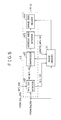
- Fig. 5 is a block diagram showing the address position detector 42, which comprises a W/L signal detector 421, a compressor 422, an address area detector 423 and an image data reader 444.
- the image data reader 444 reads image data corresponding to only the window/label position from the image memory 41.
- the compressor 422 reads the entire image signals from the image memory 41 for compression. For instance, the resolving power of the image signals is reduced from 8 lines per mm to 1 line per mm by simply averaging the eight horizontal scanning line signal levels.
- the address area detector 423 compares averaged signal levels with a slice level for binarization, and determines an address character area on the basis of the binalized character image signals collected at an area on the front surface of a mail. When this address character area has been detected, the image data reader 444 reads image data corresponding to only the determined address character area.
- a stamp canceller 13a or 13b corresponding to the stamp detector 9a and 9b impresses a mark on the detected postage stamp.
- the mails thus detected are sorted and put into five sorting boxes 15a to 15e, in such a way that mails having an address written in print and detected by the character detector 30a are arranged in the box 15a; mails having an address written in handwriting and detected by the character detector 30a are arranged in the box 15b; mails having an address written in print and detected by the character detector 30b are arranged in the box 15c; mails having an address written in handwriting and detected by the character detector 30b are arranged in the box 15d; and other mails determined to be rejected are arranged in the box 15e.
- the address position detector 20a or 20b can detect a window/label position and the front side of the mail (by comparing the quantity of characters) and further the address position detector 42 can determine an address character area, character images corresponding to only the front surface of the mail and only the address position (window or label) or address character area can be read from the image memory 41 for discrimination. Therefore, character image data to be discriminated are not huge, so that it is possible to increase the mail processing speed and therefore decrease the cost of the machine by providing only a single recognizer 40 including the discriminator 45.
- the mails are arranged in the mail box 1 and fed one by one to the stamp detectors 3a and 3b via a path 1A in a vertically arranged position.
- the stamp detector 3a or 3b detects the presence of a stamp attached to the lower side end of the mail, for instance, the mail is fed through the non-inversion path 5.
- the stamp detector 3a or 3b detects the absence of a stamp
- the mail is fed through the inversion path 7.
- the stamp detector 9a or 9b detects the presence or absence of a stamp on the mail.
- this stamp presence signal is applied to the stamper 13a or 13b to impress a mark on the stamp of the mail just before sorting the mails.
- the front side of the mail (on which an address is written) is detected by the two addresses position detectors 20a and 20b. That is, the surface on which many characters are written is determined as the front side surface of the mail.
- the address position (surface information) detector 20a or 20b also detects the position of a window or a label. In this process, when the address position detector 20a detects a mail front, the branch mechanism 50 is actuated so that the mail is fed to the character detector 30a; and when the address position detector 20b detects a mail front, the branch mechanism 50 is actuated so that the mail is fed to the character detector 30b.
- the character detector 30a or 30b detects characters on the front surface of a mail by scanning and quantization.
- the detected character image signals detected by the character detector 30a or 30b are stored in the image memory 41. Further, only the character image signals corresponding to the address position signals (window/label signal) are read from the image memory 41 by the address position detector 42 on the basis of the window/label signal detected by the address position detector 20a or 20b.
- the character features e.g. arrangement order, regularity, size, density, etc.
- the character features are detected by the parameter extractor 44 and discriminated as to printed mail or handwritten mail by comparing the extracted character futures with the stored reference character values by the discriminator 45.
- the address position detector 42 itself determines an address character area by compressing the entire surface image signals and binarizing the compressed signals. When a character area signal is detected, only the character image signals corresponding to the address area signal are read from the image memory 41 for discrimination.
- the mails thus discriminated are stored into the five sorting boxes 15a to 15e.
- the mail processing machine of the present invention has been disclosed with reference to block diagrams (i.e. hardware configuration). In practice, however, the mail processing machine is controlled by the controller 100 provided with a ROM, a ROM, a display unit, a keyboard 101, etc., which is operated in accordance with control programs (i.e. software).
- control programs i.e. software
- the surface information (window or label position, quantity of characters, character block position is first detected and then only the character image signals limited by the surface information are discriminated as to whether the address characters are written in print or handwriting, it is possible to improve the sorting speed of the mail, while reducing the cost of the machine.
Landscapes
- Sorting Of Articles (AREA)
- Character Discrimination (AREA)
- Character Input (AREA)
- Facsimile Scanning Arrangements (AREA)
Abstract
Description
- The present invention relates to a mail processing machine (face-canceller) which can arrange mails, cancell postage stamps and sort the mails according to mails whose address is written in print or mails whose address is written in handwriting.
- The mails sorted as that the address characters are written in print are further sorted with respect to Zip codes by a Zip code reader, while the mails sorted as that the address characters are written in handwriting are further sorted with respect to Zip codes by human labor.
- There exist mail processing machines for facing mails, discriminating whether the characters are written in print or in handwriting, cancelling stamps, and sorting the mail according to printed mails and handwritten mails. In these prior-art mail processing machine, however, since the two entire surfaces of a mail are scanned by two optical character readers (OCRs) to discriminate printed mails from handwritten mails or vice versa, there exist some problems in that the cost of the OCRs is high and the processing time is relatively long. This is because when the front surface or the back surface of a mail is not determined because of the absence of a postage stamp, the mail characters must be read and discriminated on both the surfaces of the mail.
- With these problems in mind, therefore, it is the primary object of the present invention to provide a mail processing machine provided with a single recognizer (OCR).
- To achieve the above-mentioned object, a mail processing machine according to the present invention comprises: (a) feeding means for feeding mails having first and second surfaces one by one; (b) first detecting means for detecting mail address information written on a first surface of a mail; (c) second detecting means for detecting mail address information written on a second surface of the mail; (d) determining means, coupled to said first and second detecting means, for determining a front surface of the mail on which mail address characters are written on the basis of the detected mail address information; (e) third detecting means for detecting mail address character images on the first surface of the mail, when said determining means determines that mail address characters are written on the first surface of the mail; (f) fourth detecting means for detecting mail address character images on the second surface of the mail, when said determining means determines that mail address characters are written on the second surface of the mail; and (g) recognizing means, for recognizing features of mail address character images, said recognizing means being connected to said third detecting means when said determining means determines that the mail address characters are written on the first surface of the mail and to said fourth detecting means when said determining means determines that the mail address characters are written on the second surface of the mail.
- The above mail surface information is a mail address window, label, and the quantity of characters.
- In the mail processing machine of the present invention, in order to minimize the quantity of mail surface image signals to be recognized by the recognizing mean, (1) the front of a mail on which a mail address is written is determined by the presence of a postage stamp, and an address window/label. Further, in the case where no postage stamp and no address window/label are present, the mail front is determined by comparing the character areas of both surfaces of the mail (in usual, many characters are written on the front of a mail); (2) an address character position is detected on the basis of a mail address window and/or label. Further, in the case where no address window/label is present, surface image signals finely scanned on a mail front are once compressed and then binarized to determined an address character area; and (3) surface image signals corresponding to only the detected address window/label or the determined address character area are recognized to determine whether address characters are printed or handwritten.
- In other words, the operation load applied to the recognizer can be minimized by previously detecting a mail front and an address character position or area. Since only a single recognizer is incorporated in the mail processing machine of the present invention, the mail processing speed is high and the machine cost is low as compared with the prior-art machine.
- The features and advantages of the mail processing machine according to the present invention will be more clearly appreciated from the following description of the preferred embodiment of the invention taken in conjunction with the accompanying drawings in which like reference numerals designate the same or similar elements or sections throughout the figures thereof and in which:
- Fig. 1 is an illustration for assistance in explaining four situations of mail fed through the mail processing machine;
- Fig. 2A is a diagrammatical view showing an embodiment of the mail processing machine according to the present invention;
- Fig. 2B is a block diagram showing the mail processing machine of the present invention shown in Fig. 2A;
- Fig. 3A is a block diagram showing an address position detector shown in Fig. 2;
- Fig. 3B is a graphical representation showing signal level of surface information detected by the address position detector shown in Fig. 2;
- Fig. 4 is a block diagram showing character detectors and a recognizer both shown in Fig. 2; and
- Fig. 5 is a block diagram showing an address position detector shown in Fig. 4.
- An embodiment of the mail address processing machine according to the present invention will be described hereinbelow with reference to the attached drawings.
- In Fig. 2A, the mail processing machine reads a Zip code and an address written on a mail, discriminates whether the address characters are written in print or in handwriting, cancels stamps, and sorts the mail into two groups of printed address mails and handwritten address mails. A first group of mails sorted as print writing is further sorted automatically by a Zip code reader; while a second group of mails sorted as handwriting is further sorted by manual operation according to Zip codes.
- The mail processing machine shown in Figs. 2A and 2B comprises an
operator panel 101, acontroller 100, amail box 1, amail carrier 1A, twostamp detectors stamp detectors address position detectors branch mechanism 50, twocharacter detectors recognizer 40, twostamp cancellers 13a and 13b, and asorter 15 including plural mail sorting boxes 15a to 15e. - In more detail with reference to Fig. 2A, a lot of mails are arranged in a
mail box 1. Each mail arranged in themail box 1 is fed one by one to two (postage)stamp detectors ) and ( ) can be considered as depicted in Fig. 1, in which solid lines of a stamp indicate that a stamp is attached on the front surface side of a mail and dashed lines thereof indicate that a stamp is attached on the back surface side of a mail. Here, the two
stamp detectors stamp detector 3a, and that attached as (b) in Fig. 1 can be detected by thestamp detector 3b. When these twodetectors detectors ) and ( ) in Fig. 1, respectively, the mail is fed through an
inversion path 7 to reverse the mail upside down so that the mail is always located as shown by (a) and (b) in Fig. 1. In more detail, when the stamp is located as () and reversed, the stamp is located as (a); when stamp is located as ( ) and reversed, the stamp is located as (b) in Fig. 1.
- The mail so arranged that the stamp is located on the lower side thereof is then fed to the next two
stamp detectors stamp detector - The
address position detector stamp detector address position detector stamp detectors address position detectors - On the basis of the above detected window or label position and the quantity of characters, it is possible to detect the front side or the back side of the mail and the address position or area where an address is written. In other words, even when the
stamp detector address position detector - When the
address position detector 20a detects the front of a mail, thebranch mechanism 50 is actuated so that the mail is fed to thecharacter detector 30a. On the other hand, when theaddress position detector 20b detects the front of a mail, thebranch mechanism 50 is actuated so that the mail is fed to thecharacter detector 30b. - In more detail, with reference to Fig. 3A, the
address position detector light source 21 for emitting a light beam toward a mail fed through a carrying path for scanning, alens 22 for focusing the light reflected from the mail, aphotosensitive element 23 composed of a line image sensor (e.g. charge coupled devices) for detecting characters written on the mail, anamplifier 24 for amplifying the detected character image signal S, and twoquantization circuits light source 21 and thelens 22 are both disposed relative to the mail in such a way the an incidence angle α is roughly equal to a reflection angle β. Thequantization circuit 25A compares the image signal S detected by thephotosensitive element 23 with a slice level B outputted from a controller (not shown), and outputs a window/label signal (W/L SIG) indicative of the presence of a window or label of a high reflectivity, when the level of the image signal S exceeds the slice level B as shown by SC in Fig. 3B. On the other hand, thequantization circuit 25B compares the image signal S with a slice level C also outputted from a controller (not shown) and output a paper surface signal SB indicative of the absence of characters of a middle reflectivity, when the level of the image signal S lies between the slice levels B and C. Further, when the twoquantization circuits - In the
address position detector - When no postage stamp and no address window/label detected, the character signal Sd outputted from the
quantization circuit 25B is integrated by anintegrator 26 and supplied to acomparator 27. On the other hand, other character signal Sdʹ outputted from another quantization circuit 25Bʹ of theaddress position detector 20b is integrated by an integrator 26ʹ and supplied to thecomparator 27. Thecomparator 27 compares these two integrated character signals to determine the front side of a mail. For instance, if the character signals integrated by theintegrator 26 is large, thecomparator 27 generates a command signal to thebranch mechanism 50 to feed the mail toward thecharacter detector 30a. In response to this command signal,character detector 30a is activated to detect the character images. - Fig. 4 shows the two
character detectors recognizer 40. Eachcharacter detector fine scanner quantization circuit 32a or 32b. Thefine scanner address position detector fine scanner - The
quantization circuit 32a or 32b compares the detected mail surface image signals with a predetermined slice level and outputs character image signals only when the image signal drops below a slice level (the above processing being referred to as binarization). - The
recognizer 40 comprises animage memory 41, anaddress position detector 42, aline detector 43, aparameter extractor 44, and adiscriminator 45. - The
image memory 41 stores all the scanned and binarized character image signals detected by either one of thecharacter detector address position detectors character detectors image memory 41 stores the character image signals corresponding to the detected front surface of a mail and detected by any one of thecharacter detectors - The
character tline detector 43 functions as follows: The preceding processings have already detected an address position or area where an address is written. Therefore, in this step, character lines are further detected from the detected address area. That is, since an area where characters are gathered has already been determined, the succeeding step determines how the characters are arranged within the detected address area. - For doing this, the number of character image signals are counted along the direction perpendicular to the character lines in order to obtain a histogram. By detecting the peaks of the histogram indicative of the distribution of the character image signals, it is possible to detect the number of lines. As to the above-mentioned character line detection, if should be nothed that the scanning operation is as fine as 8 lines per millimeter, for instance, as compared with the coarse scanning operation (e.g. 1 line per millimeter) of the
address position detector - The
parameter extractor 44 detects character feature parameters. These parameters are dispersions of various character features such as (1) character height; (2) character lower edge position; (3) character width; (4) character pitch; (5) character area; (6) line arrangement slope; (7) leftmost character position; (8) line space, etc. - To obtain character feature parameters, a reference threshold value δ₀² of each of the dispersions of the character features is previously determined. Each actual dispersion value δ² obtained by calculating image signals read from the
image memory 41 is compared with this reference threshold value δ₀². The compared result (the difference between the actual dispersion and the reference dispersion) is stored in theimage memory 41 and added in sequence to obtain a sum total of the differences between the two of the above-mentioned eight character features. When thediscriminator 45 determines that the sum total of the dispersion differences between the actual values and the reference values exceeds a predetermined value, the characters are discriminated as a handwritten mail. In contrast with this, when thediscriminator 45 determines that the sum total of the dispersion differences is less than the predetermined value, the characters are discriminated as a printed mail. - Fig. 5 is a block diagram showing the
address position detector 42, which comprises a W/L signal detector 421, acompressor 422, anaddress area detector 423 and animage data reader 444. - When the W/
L signal detector 421 detects a presence of W/L signal indicative of a window/label position (x-y coordinates), theimage data reader 444 reads image data corresponding to only the window/label position from theimage memory 41. - When the W/
L signal detector 421 detects an absence of W/L signal, thecompressor 422 reads the entire image signals from theimage memory 41 for compression. For instance, the resolving power of the image signals is reduced from 8 lines per mm to 1 line per mm by simply averaging the eight horizontal scanning line signal levels. Theaddress area detector 423 compares averaged signal levels with a slice level for binarization, and determines an address character area on the basis of the binalized character image signals collected at an area on the front surface of a mail. When this address character area has been detected, theimage data reader 444 reads image data corresponding to only the determined address character area. - When the
stamp detector stamp canceller 13a or 13b corresponding to thestamp detector character detector 30a are arranged in the box 15a; mails having an address written in handwriting and detected by thecharacter detector 30a are arranged in thebox 15b; mails having an address written in print and detected by thecharacter detector 30b are arranged in thebox 15c; mails having an address written in handwriting and detected by thecharacter detector 30b are arranged in thebox 15d; and other mails determined to be rejected are arranged in thebox 15e. - In the prior-art machine, when no stamp is detected, it is necessary to entirely scan both the surfaces of the mail by two optical character readers. Further, even if a stamp is detected, it is necessary to scan the entire surface of the front of the mail, so that the mail processing speed is relatively low. In the machine of the present invention, it should be noted that since the
address position detector address position detector 42 can determine an address character area, character images corresponding to only the front surface of the mail and only the address position (window or label) or address character area can be read from theimage memory 41 for discrimination. Therefore, character image data to be discriminated are not huge, so that it is possible to increase the mail processing speed and therefore decrease the cost of the machine by providing only asingle recognizer 40 including thediscriminator 45. - The operation of the mail processing machine of the present invention will be described hereinbelow.
- The mails are arranged in the
mail box 1 and fed one by one to thestamp detectors path 1A in a vertically arranged position. When thestamp detector stamp detector inversion path 7. Thereafter, thestamp detector stamper 13a or 13b to impress a mark on the stamp of the mail just before sorting the mails. - When no stamp is detected by the two
stamp detectors addresses position detectors - The address position (surface information)
detector address position detector 20a detects a mail front, thebranch mechanism 50 is actuated so that the mail is fed to thecharacter detector 30a; and when theaddress position detector 20b detects a mail front, thebranch mechanism 50 is actuated so that the mail is fed to thecharacter detector 30b. - Since the front surface of a mail has already been detected by the
address position detectors character detectors character detector character detector image memory 41. Further, only the character image signals corresponding to the address position signals (window/label signal) are read from theimage memory 41 by theaddress position detector 42 on the basis of the window/label signal detected by theaddress position detector - The character features (e.g. arrangement order, regularity, size, density, etc.) of the read character image signals are detected by the
parameter extractor 44 and discriminated as to printed mail or handwritten mail by comparing the extracted character futures with the stored reference character values by thediscriminator 45. - Further, where no window/label signal is detected, the
address position detector 42 itself determines an address character area by compressing the entire surface image signals and binarizing the compressed signals. When a character area signal is detected, only the character image signals corresponding to the address area signal are read from theimage memory 41 for discrimination. - The mails thus discriminated are stored into the five sorting boxes 15a to 15e.
- In the above description, the mail processing machine of the present invention has been disclosed with reference to block diagrams (i.e. hardware configuration). In practice, however, the mail processing machine is controlled by the
controller 100 provided with a ROM, a ROM, a display unit, akeyboard 101, etc., which is operated in accordance with control programs (i.e. software). - As described above, in the mail processing machine of the present invention, since the surface information (window or label position, quantity of characters, character block position is first detected and then only the character image signals limited by the surface information are discriminated as to whether the address characters are written in print or handwriting, it is possible to improve the sorting speed of the mail, while reducing the cost of the machine.
Claims (10)
Applications Claiming Priority (2)
| Application Number | Priority Date | Filing Date | Title |
|---|---|---|---|
| JP62039207A JP3038344B2 (en) | 1987-02-24 | 1987-02-24 | Mail reading processor |
| JP39207/87 | 1987-02-24 |
Publications (3)
| Publication Number | Publication Date |
|---|---|
| EP0281007A2 true EP0281007A2 (en) | 1988-09-07 |
| EP0281007A3 EP0281007A3 (en) | 1989-09-27 |
| EP0281007B1 EP0281007B1 (en) | 1994-07-06 |
Family
ID=12546688
Family Applications (1)
| Application Number | Title | Priority Date | Filing Date |
|---|---|---|---|
| EP88102721A Expired - Lifetime EP0281007B1 (en) | 1987-02-24 | 1988-02-24 | Mail processing machine and method of sorting mails |
Country Status (4)
| Country | Link |
|---|---|
| US (1) | US5025475A (en) |
| EP (1) | EP0281007B1 (en) |
| JP (1) | JP3038344B2 (en) |
| DE (1) | DE3850509T2 (en) |
Cited By (9)
| Publication number | Priority date | Publication date | Assignee | Title |
|---|---|---|---|---|
| EP0298769A2 (en) | 1987-07-08 | 1989-01-11 | Kabushiki Kaisha Toshiba | Mail processing machine |
| US5009321A (en) * | 1989-11-13 | 1991-04-23 | Pitney Bowes Inc. | Sorting system for organizing randomly ordered route grouped mail in delivery order sequence |
| DE3943073A1 (en) * | 1989-12-27 | 1991-07-04 | Licentia Gmbh | METHOD FOR THE INPUT OF SCAN ZONE COORDINATES IN AUTOMATIC READING DEVICES FOR LETTERS, FORMS, OR OTHERS. |
| US5042667A (en) * | 1989-11-13 | 1991-08-27 | Pitney Bowes Inc. | Sorting system for organizing in one pass randomly order route grouped mail in delivery order |
| EP0529966A1 (en) * | 1991-08-28 | 1993-03-03 | Nec Corporation | Mail sorting apparatus |
| EP0531229A3 (en) * | 1991-09-06 | 1993-05-12 | Opex Corporation | System for orienting documents in the automated processing of bulk mail and the like |
| DE4239381A1 (en) * | 1992-11-24 | 1994-05-26 | Licentia Gmbh | Postal letter sorting for mail contg. mixture of horizontally- and vertically-oriented address data - scanning and digitising image, selecting region of image for ninety-degree rotation or special processing, and merging with original image |
| EP0462256B1 (en) * | 1989-12-23 | 1994-06-22 | Licentia Patent-Verwaltungs-GmbH | Process for distributing packets or the like |
| US5397003A (en) * | 1986-09-05 | 1995-03-14 | Opex Corporation | Method and apparatus for determining the orientation of a document |
Families Citing this family (29)
| Publication number | Priority date | Publication date | Assignee | Title |
|---|---|---|---|---|
| US5038392A (en) * | 1990-02-12 | 1991-08-06 | International Business Machines Corporation | Method and apparatus for adaptive image processing by recognizing a characterizing indicium in a captured image of a document |
| JP2768814B2 (en) * | 1990-08-27 | 1998-06-25 | 株式会社東芝 | Optical character reader |
| US5721790A (en) * | 1990-10-19 | 1998-02-24 | Unisys Corporation | Methods and apparatus for separating integer and fractional portions of a financial amount |
| US5317654A (en) * | 1991-09-26 | 1994-05-31 | Inscerco Mfg. Inc. | Selective collating and inserting apparatus |
| WO1993018480A1 (en) * | 1992-03-11 | 1993-09-16 | Inscerco Mfg. Inc | Selective collating and inserting apparatus |
| US5311597A (en) * | 1992-09-11 | 1994-05-10 | International Business Machines Corporation | Deferred optical character recognition active pigeon hole sorting of mail pieces |
| JP3388829B2 (en) * | 1993-03-23 | 2003-03-24 | 株式会社東芝 | Character reader |
| SG45100A1 (en) * | 1994-03-07 | 1998-01-16 | Ibm | Improvements in image processing |
| JPH10113618A (en) * | 1996-10-11 | 1998-05-06 | Nec Corp | Sorting information input device |
| JP3246432B2 (en) * | 1998-02-10 | 2002-01-15 | 株式会社日立製作所 | Address reader and mail sorting machine |
| JP2000181993A (en) * | 1998-12-16 | 2000-06-30 | Fujitsu Ltd | Character recognition method and device |
| US6381342B2 (en) * | 1999-01-13 | 2002-04-30 | James E. Foley | Method for reading and sorting documents |
| US6894243B1 (en) * | 1999-08-31 | 2005-05-17 | United States Postal Service | Identification coder reader and method for reading an identification code from a mailpiece |
| US6977353B1 (en) * | 1999-08-31 | 2005-12-20 | United States Postal Service | Apparatus and methods for identifying and processing mail using an identification code |
| US7081595B1 (en) * | 1999-08-31 | 2006-07-25 | United States Postal Service | Apparatus and methods for processing mailpiece information in a mail processing device using sorter application software |
| US6976621B1 (en) | 1999-08-31 | 2005-12-20 | The United States Postal Service | Apparatus and methods for identifying a mailpiece using an identification code |
| US7060925B1 (en) | 1999-08-31 | 2006-06-13 | United States Of America Postal Service | Apparatus and methods for processing mailpiece information by an identification code server |
| DE10001410C2 (en) * | 2000-01-14 | 2001-12-06 | Harman Audio Electronic Sys | Flat speaker arrangement |
| JP4409702B2 (en) * | 2000-03-14 | 2010-02-03 | 株式会社東芝 | Recognition device |
| US6360001B1 (en) * | 2000-05-10 | 2002-03-19 | International Business Machines Corporation | Automatic location of address information on parcels sent by mass mailers |
| JP2002092674A (en) * | 2000-09-20 | 2002-03-29 | Toshiba Corp | Stamp detection device, stamp detection method, letter processing device, and letter processing method |
| US6671577B2 (en) * | 2000-12-01 | 2003-12-30 | United States Postal Service | System and method for directly connecting an advanced facer canceler system to a delivery bar code sorter |
| US20070144947A1 (en) * | 2003-11-18 | 2007-06-28 | Seimens Aktiegesellschaft | Method and apparatus for forwarding a mail item |
| US20070104370A1 (en) * | 2003-11-18 | 2007-05-10 | Siemens Aktiengesellschaft | System and method for smart polling |
| US20070065003A1 (en) * | 2005-09-21 | 2007-03-22 | Lockheed Martin Corporation | Real-time recognition of mixed source text |
| JP4420877B2 (en) * | 2005-09-22 | 2010-02-24 | シャープ株式会社 | Image processing method, image processing apparatus, and image output apparatus |
| US20080110810A1 (en) * | 2006-11-01 | 2008-05-15 | Raf Technology, Inc. | Mailpiece reject processing and labeling |
| US20100042251A1 (en) * | 2008-08-18 | 2010-02-18 | Miyasaka Lawrence S | Machine monitoring apparatus and method |
| US8489231B2 (en) * | 2009-09-18 | 2013-07-16 | Raf Technology, Inc. | Loop mail processing |
Family Cites Families (14)
| Publication number | Priority date | Publication date | Assignee | Title |
|---|---|---|---|---|
| US3432032A (en) * | 1966-06-24 | 1969-03-11 | Fmc Corp | Presorting method and apparatus |
| JPS5427160B2 (en) * | 1973-01-19 | 1979-09-07 | ||
| US3983366A (en) * | 1973-06-27 | 1976-09-28 | Gunn Damon M | Article sorting apparatus and method |
| US4034341A (en) * | 1973-12-17 | 1977-07-05 | Nippon Electric Company, Ltd. | Automatic postal-code-number reading system |
| JPS5845305B2 (en) * | 1976-11-16 | 1983-10-08 | 日本電気株式会社 | Address detection device |
| US4475234A (en) * | 1981-02-04 | 1984-10-02 | Nippon Electric Co., Ltd. | Binary pattern signal producing apparatus for optical character recognition |
| EP0076332B1 (en) * | 1981-09-10 | 1987-09-09 | Kabushiki Kaisha Toshiba | Optical character reader with pre-scanner |
| JPS58130841A (en) * | 1982-01-29 | 1983-08-04 | Nec Corp | Luminescent mark detection device |
| US4516264A (en) * | 1982-01-29 | 1985-05-07 | United States Of America Postal Service | Apparatus and process for scanning and analyzing mail information |
| JPS60147887A (en) * | 1984-01-12 | 1985-08-03 | Toshiba Corp | Sorter of mail |
| US4783825A (en) * | 1985-04-30 | 1988-11-08 | Kabushiki Kaisha Toshiba | Postal material reading apparatus |
| JPS61276080A (en) * | 1985-05-31 | 1986-12-06 | Toshiba Corp | Top and reverse surface deciding device |
| US4845761A (en) * | 1987-04-17 | 1989-07-04 | Recognition Equipment Incorporated | Letter mail address block locator system |
| US4868570A (en) * | 1988-01-15 | 1989-09-19 | Arthur D. Little, Inc. | Method and system for storing and retrieving compressed data |
-
1987
- 1987-02-24 JP JP62039207A patent/JP3038344B2/en not_active Expired - Lifetime
-
1988
- 1988-02-24 EP EP88102721A patent/EP0281007B1/en not_active Expired - Lifetime
- 1988-02-24 US US07/159,927 patent/US5025475A/en not_active Expired - Lifetime
- 1988-02-24 DE DE3850509T patent/DE3850509T2/en not_active Expired - Lifetime
Cited By (15)
| Publication number | Priority date | Publication date | Assignee | Title |
|---|---|---|---|---|
| US5540338A (en) * | 1986-09-05 | 1996-07-30 | Opex Corporation | Method and apparatus for determining the orientation of a document |
| US5397003A (en) * | 1986-09-05 | 1995-03-14 | Opex Corporation | Method and apparatus for determining the orientation of a document |
| EP0298769A3 (en) * | 1987-07-08 | 1989-09-27 | Kabushiki Kaisha Toshiba | Mail processing machine |
| EP0298769A2 (en) | 1987-07-08 | 1989-01-11 | Kabushiki Kaisha Toshiba | Mail processing machine |
| US5009321A (en) * | 1989-11-13 | 1991-04-23 | Pitney Bowes Inc. | Sorting system for organizing randomly ordered route grouped mail in delivery order sequence |
| US5042667A (en) * | 1989-11-13 | 1991-08-27 | Pitney Bowes Inc. | Sorting system for organizing in one pass randomly order route grouped mail in delivery order |
| EP0462256B1 (en) * | 1989-12-23 | 1994-06-22 | Licentia Patent-Verwaltungs-GmbH | Process for distributing packets or the like |
| DE3943073A1 (en) * | 1989-12-27 | 1991-07-04 | Licentia Gmbh | METHOD FOR THE INPUT OF SCAN ZONE COORDINATES IN AUTOMATIC READING DEVICES FOR LETTERS, FORMS, OR OTHERS. |
| US5431288A (en) * | 1991-08-28 | 1995-07-11 | Nec Corporation | Mail sorting apparatus |
| EP0529966A1 (en) * | 1991-08-28 | 1993-03-03 | Nec Corporation | Mail sorting apparatus |
| US5293431A (en) * | 1991-09-06 | 1994-03-08 | Opex Corporation | System for orienting documents in the automated processing of bulk mail and the like |
| EP0531229A3 (en) * | 1991-09-06 | 1993-05-12 | Opex Corporation | System for orienting documents in the automated processing of bulk mail and the like |
| US5675671A (en) * | 1991-09-06 | 1997-10-07 | Hayduchok; George L. | System for orienting documents in the automated processing of bulk mail and the like |
| US6151422A (en) * | 1991-09-06 | 2000-11-21 | Opex Corporation | System for orienting documents in the automated processing of bulk mail and the like |
| DE4239381A1 (en) * | 1992-11-24 | 1994-05-26 | Licentia Gmbh | Postal letter sorting for mail contg. mixture of horizontally- and vertically-oriented address data - scanning and digitising image, selecting region of image for ninety-degree rotation or special processing, and merging with original image |
Also Published As
| Publication number | Publication date |
|---|---|
| EP0281007B1 (en) | 1994-07-06 |
| EP0281007A3 (en) | 1989-09-27 |
| JP3038344B2 (en) | 2000-05-08 |
| JPS63207270A (en) | 1988-08-26 |
| US5025475A (en) | 1991-06-18 |
| DE3850509D1 (en) | 1994-08-11 |
| DE3850509T2 (en) | 1994-12-15 |
Similar Documents
| Publication | Publication Date | Title |
|---|---|---|
| US5025475A (en) | Processing machine | |
| US4998626A (en) | Mail processing machine | |
| HK1001672B (en) | Mail processing machine | |
| US4782238A (en) | Apparatus for generating edge position signals for use in locating an address element on a mailpiece | |
| US4516265A (en) | Optical character reader | |
| US5073954A (en) | Bar code location and recognition processing system | |
| CA2528207C (en) | Identification tag for postal objects by image signature and associated mail handling | |
| JP3124296B2 (en) | How to detect the position and direction of the fiducial mark | |
| US4736441A (en) | Postal material reading apparatus | |
| US5235652A (en) | Qualification system for printed images | |
| US4475234A (en) | Binary pattern signal producing apparatus for optical character recognition | |
| US4783825A (en) | Postal material reading apparatus | |
| US7835540B2 (en) | Method of detecting bunched-together poster items by analyzing images of their edges | |
| Govindaraju et al. | Assessment of image quality to predict readability of documents | |
| US5391889A (en) | Optical character reading apparatus which can reduce reading errors as regards a character image if the character image is in contact with an unnecessary image. | |
| EP0076332B1 (en) | Optical character reader with pre-scanner | |
| Govindaraju et al. | Image quality and readability | |
| JP3715473B2 (en) | Address reader | |
| JP3105918B2 (en) | Character recognition device and character recognition method | |
| JPH0916715A (en) | Character recognition apparatus and method | |
| JPH04134578A (en) | Picture binarizing system | |
| JPS61177581A (en) | Optical character reader | |
| JPH0957202A (en) | Address reading device, mail sorting machine and address reading method | |
| JP2003108920A (en) | Destination recognition device, sorter, destination recognition method and classification method | |
| JPH0739821A (en) | Address reading device and address reading sorting machine |
Legal Events
| Date | Code | Title | Description |
|---|---|---|---|
| PUAI | Public reference made under article 153(3) epc to a published international application that has entered the european phase |
Free format text: ORIGINAL CODE: 0009012 |
|
| 17P | Request for examination filed |
Effective date: 19880224 |
|
| AK | Designated contracting states |
Kind code of ref document: A2 Designated state(s): DE NL |
|
| PUAL | Search report despatched |
Free format text: ORIGINAL CODE: 0009013 |
|
| AK | Designated contracting states |
Kind code of ref document: A3 Designated state(s): DE NL |
|
| 17Q | First examination report despatched |
Effective date: 19910523 |
|
| GRAA | (expected) grant |
Free format text: ORIGINAL CODE: 0009210 |
|
| AK | Designated contracting states |
Kind code of ref document: B1 Designated state(s): DE NL |
|
| REF | Corresponds to: |
Ref document number: 3850509 Country of ref document: DE Date of ref document: 19940811 |
|
| PLBE | No opposition filed within time limit |
Free format text: ORIGINAL CODE: 0009261 |
|
| STAA | Information on the status of an ep patent application or granted ep patent |
Free format text: STATUS: NO OPPOSITION FILED WITHIN TIME LIMIT |
|
| 26N | No opposition filed | ||
| PGFP | Annual fee paid to national office [announced via postgrant information from national office to epo] |
Ref country code: NL Payment date: 19970227 Year of fee payment: 10 |
|
| PG25 | Lapsed in a contracting state [announced via postgrant information from national office to epo] |
Ref country code: NL Free format text: LAPSE BECAUSE OF NON-PAYMENT OF DUE FEES Effective date: 19980901 |
|
| NLV4 | Nl: lapsed or anulled due to non-payment of the annual fee |
Effective date: 19980901 |
|
| PGFP | Annual fee paid to national office [announced via postgrant information from national office to epo] |
Ref country code: DE Payment date: 20070222 Year of fee payment: 20 |