EP0280902A1 - Cyclohexane derivative and liquid crystal composition containing the same - Google Patents
Cyclohexane derivative and liquid crystal composition containing the same Download PDFInfo
- Publication number
- EP0280902A1 EP0280902A1 EP88101603A EP88101603A EP0280902A1 EP 0280902 A1 EP0280902 A1 EP 0280902A1 EP 88101603 A EP88101603 A EP 88101603A EP 88101603 A EP88101603 A EP 88101603A EP 0280902 A1 EP0280902 A1 EP 0280902A1
- Authority
- EP
- European Patent Office
- Prior art keywords
- liquid crystal
- trans
- point
- cyclohexane derivative
- crystal composition
- Prior art date
- Legal status (The legal status is an assumption and is not a legal conclusion. Google has not performed a legal analysis and makes no representation as to the accuracy of the status listed.)
- Granted
Links
- 239000004973 liquid crystal related substance Substances 0.000 title claims abstract description 52
- 239000000203 mixture Substances 0.000 title claims abstract description 40
- 125000000113 cyclohexyl group Chemical class [H]C1([H])C([H])([H])C([H])([H])C([H])(*)C([H])([H])C1([H])[H] 0.000 title claims abstract description 12
- 125000000217 alkyl group Chemical group 0.000 claims abstract description 9
- 229910052794 bromium Inorganic materials 0.000 claims abstract description 5
- 125000004093 cyano group Chemical group *C#N 0.000 claims abstract description 5
- 125000005843 halogen group Chemical group 0.000 claims abstract description 5
- 229910052801 chlorine Inorganic materials 0.000 claims abstract description 4
- 229910052731 fluorine Inorganic materials 0.000 claims abstract description 4
- 125000004435 hydrogen atom Chemical group [H]* 0.000 claims abstract description 4
- 125000004432 carbon atom Chemical group C* 0.000 claims description 6
- 150000001875 compounds Chemical class 0.000 description 40
- YXFVVABEGXRONW-UHFFFAOYSA-N Toluene Chemical compound CC1=CC=CC=C1 YXFVVABEGXRONW-UHFFFAOYSA-N 0.000 description 33
- XEKOWRVHYACXOJ-UHFFFAOYSA-N Ethyl acetate Chemical compound CCOC(C)=O XEKOWRVHYACXOJ-UHFFFAOYSA-N 0.000 description 15
- XLYOFNOQVPJJNP-UHFFFAOYSA-N water Substances O XLYOFNOQVPJJNP-UHFFFAOYSA-N 0.000 description 14
- 239000012071 phase Substances 0.000 description 12
- 239000000126 substance Substances 0.000 description 12
- 229910052799 carbon Inorganic materials 0.000 description 9
- 239000000463 material Substances 0.000 description 8
- 239000000243 solution Substances 0.000 description 8
- 238000005406 washing Methods 0.000 description 8
- VEXZGXHMUGYJMC-UHFFFAOYSA-N Hydrochloric acid Chemical compound Cl VEXZGXHMUGYJMC-UHFFFAOYSA-N 0.000 description 7
- 238000006243 chemical reaction Methods 0.000 description 7
- IMNFDUFMRHMDMM-UHFFFAOYSA-N N-Heptane Chemical compound CCCCCCC IMNFDUFMRHMDMM-UHFFFAOYSA-N 0.000 description 6
- VSCWAEJMTAWNJL-UHFFFAOYSA-K aluminium trichloride Chemical compound Cl[Al](Cl)Cl VSCWAEJMTAWNJL-UHFFFAOYSA-K 0.000 description 6
- 239000000306 component Substances 0.000 description 6
- 0 *C1CCC(*)CC1 Chemical compound *C1CCC(*)CC1 0.000 description 5
- -1 3-fluoro-4-substituted-bromobenzene Chemical class 0.000 description 5
- 210000004027 cell Anatomy 0.000 description 5
- 238000001035 drying Methods 0.000 description 5
- 238000001914 filtration Methods 0.000 description 5
- 239000000047 product Substances 0.000 description 5
- KWOLFJPFCHCOCG-UHFFFAOYSA-N Acetophenone Chemical compound CC(=O)C1=CC=CC=C1 KWOLFJPFCHCOCG-UHFFFAOYSA-N 0.000 description 4
- 150000001934 cyclohexanes Chemical class 0.000 description 4
- 229960000443 hydrochloric acid Drugs 0.000 description 4
- 230000007935 neutral effect Effects 0.000 description 4
- LQNUZADURLCDLV-UHFFFAOYSA-N nitrobenzene Chemical compound [O-][N+](=O)C1=CC=CC=C1 LQNUZADURLCDLV-UHFFFAOYSA-N 0.000 description 4
- FYSNRJHAOHDILO-UHFFFAOYSA-N thionyl chloride Chemical compound ClS(Cl)=O FYSNRJHAOHDILO-UHFFFAOYSA-N 0.000 description 4
- 230000007704 transition Effects 0.000 description 4
- QTBSBXVTEAMEQO-UHFFFAOYSA-N Acetic acid Chemical compound CC(O)=O QTBSBXVTEAMEQO-UHFFFAOYSA-N 0.000 description 3
- UHOVQNZJYSORNB-UHFFFAOYSA-N Benzene Chemical compound C1=CC=CC=C1 UHOVQNZJYSORNB-UHFFFAOYSA-N 0.000 description 3
- HTAPXFSKUGZEEP-UBBSCCEASA-N CCC[C@H]1CC[C@H](CC[C@H]2CC[C@@H](CC2)c2ccc(F)c(F)c2)CC1 Chemical compound CCC[C@H]1CC[C@H](CC[C@H]2CC[C@@H](CC2)c2ccc(F)c(F)c2)CC1 HTAPXFSKUGZEEP-UBBSCCEASA-N 0.000 description 3
- YMWUJEATGCHHMB-UHFFFAOYSA-N Dichloromethane Chemical compound ClCCl YMWUJEATGCHHMB-UHFFFAOYSA-N 0.000 description 3
- PMZURENOXWZQFD-UHFFFAOYSA-L Sodium Sulfate Chemical compound [Na+].[Na+].[O-]S([O-])(=O)=O PMZURENOXWZQFD-UHFFFAOYSA-L 0.000 description 3
- HEMHJVSKTPXQMS-UHFFFAOYSA-M Sodium hydroxide Chemical compound [OH-].[Na+] HEMHJVSKTPXQMS-UHFFFAOYSA-M 0.000 description 3
- JFDZBHWFFUWGJE-UHFFFAOYSA-N benzonitrile Chemical compound N#CC1=CC=CC=C1 JFDZBHWFFUWGJE-UHFFFAOYSA-N 0.000 description 3
- 230000000052 comparative effect Effects 0.000 description 3
- 238000010438 heat treatment Methods 0.000 description 3
- 235000011167 hydrochloric acid Nutrition 0.000 description 3
- 238000010992 reflux Methods 0.000 description 3
- RYHBNJHYFVUHQT-UHFFFAOYSA-N 1,4-Dioxane Chemical compound C1COCCO1 RYHBNJHYFVUHQT-UHFFFAOYSA-N 0.000 description 2
- QDFKKJYEIFBEFC-UHFFFAOYSA-N 1-bromo-3-fluorobenzene Chemical compound FC1=CC=CC(Br)=C1 QDFKKJYEIFBEFC-UHFFFAOYSA-N 0.000 description 2
- NGNBDVOYPDDBFK-UHFFFAOYSA-N 2-[2,4-di(pentan-2-yl)phenoxy]acetyl chloride Chemical compound CCCC(C)C1=CC=C(OCC(Cl)=O)C(C(C)CCC)=C1 NGNBDVOYPDDBFK-UHFFFAOYSA-N 0.000 description 2
- CIBZONWLJYCTKQ-IFSQOONMSA-N C(CC)[C@@H]1CC[C@H](CC1)CC[C@@H]1CC[C@H](CC1)C1=CC(=C(C=C1)C#N)F Chemical compound C(CC)[C@@H]1CC[C@H](CC1)CC[C@@H]1CC[C@H](CC1)C1=CC(=C(C=C1)C#N)F CIBZONWLJYCTKQ-IFSQOONMSA-N 0.000 description 2
- FSGVJIALWCFYKJ-IFSQOONMSA-N C(CCC)[C@@H]1CC[C@H](CC1)CC[C@@H]1CC[C@H](CC1)C1=CC(=C(C=C1)F)F Chemical compound C(CCC)[C@@H]1CC[C@H](CC1)CC[C@@H]1CC[C@H](CC1)C1=CC(=C(C=C1)F)F FSGVJIALWCFYKJ-IFSQOONMSA-N 0.000 description 2
- OLRRTAGESHHXPY-SHTZXODSSA-N C1C[C@@H](CCC)CC[C@@H]1CCC1CCC(=O)CC1 Chemical compound C1C[C@@H](CCC)CC[C@@H]1CCC1CCC(=O)CC1 OLRRTAGESHHXPY-SHTZXODSSA-N 0.000 description 2
- KYYJIBTUSXSVOK-VVPTUSLJSA-N CC[C@H]1CC[C@H](CC[C@H]2CC[C@@H](CC2)c2ccc(F)c(F)c2)CC1 Chemical compound CC[C@H]1CC[C@H](CC[C@H]2CC[C@@H](CC2)c2ccc(F)c(F)c2)CC1 KYYJIBTUSXSVOK-VVPTUSLJSA-N 0.000 description 2
- HEDRZPFGACZZDS-UHFFFAOYSA-N Chloroform Chemical compound ClC(Cl)Cl HEDRZPFGACZZDS-UHFFFAOYSA-N 0.000 description 2
- FFZLOJUCQUFSSH-UBBSCCEASA-N FC1=C(C(=O)O)C=CC(=C1)[C@@H]1CC[C@H](CC1)CC[C@@H]1CC[C@H](CC1)CCC Chemical compound FC1=C(C(=O)O)C=CC(=C1)[C@@H]1CC[C@H](CC1)CC[C@@H]1CC[C@H](CC1)CCC FFZLOJUCQUFSSH-UBBSCCEASA-N 0.000 description 2
- 239000007818 Grignard reagent Substances 0.000 description 2
- FYYHWMGAXLPEAU-UHFFFAOYSA-N Magnesium Chemical compound [Mg] FYYHWMGAXLPEAU-UHFFFAOYSA-N 0.000 description 2
- NBIIXXVUZAFLBC-UHFFFAOYSA-N Phosphoric acid Chemical compound OP(O)(O)=O NBIIXXVUZAFLBC-UHFFFAOYSA-N 0.000 description 2
- 239000007868 Raney catalyst Substances 0.000 description 2
- NPXOKRUENSOPAO-UHFFFAOYSA-N Raney nickel Chemical compound [Al].[Ni] NPXOKRUENSOPAO-UHFFFAOYSA-N 0.000 description 2
- 229910000564 Raney nickel Inorganic materials 0.000 description 2
- 239000004990 Smectic liquid crystal Substances 0.000 description 2
- QAOWNCQODCNURD-UHFFFAOYSA-N Sulfuric acid Chemical compound OS(O)(=O)=O QAOWNCQODCNURD-UHFFFAOYSA-N 0.000 description 2
- WYURNTSHIVDZCO-UHFFFAOYSA-N Tetrahydrofuran Chemical compound C1CCOC1 WYURNTSHIVDZCO-UHFFFAOYSA-N 0.000 description 2
- 239000007864 aqueous solution Substances 0.000 description 2
- 150000001732 carboxylic acid derivatives Chemical class 0.000 description 2
- 239000003054 catalyst Substances 0.000 description 2
- 238000010531 catalytic reduction reaction Methods 0.000 description 2
- 125000000596 cyclohexenyl group Chemical class C1(=CCCCC1)* 0.000 description 2
- 239000002274 desiccant Substances 0.000 description 2
- 150000004795 grignard reagents Chemical class 0.000 description 2
- 239000007788 liquid Substances 0.000 description 2
- 239000011777 magnesium Substances 0.000 description 2
- 229910052749 magnesium Inorganic materials 0.000 description 2
- 238000002156 mixing Methods 0.000 description 2
- VLKZOEOYAKHREP-UHFFFAOYSA-N n-Hexane Chemical compound CCCCCC VLKZOEOYAKHREP-UHFFFAOYSA-N 0.000 description 2
- 239000003960 organic solvent Substances 0.000 description 2
- 239000002994 raw material Substances 0.000 description 2
- 239000007787 solid Substances 0.000 description 2
- 239000002904 solvent Substances 0.000 description 2
- VZGDMQKNWNREIO-UHFFFAOYSA-N tetrachloromethane Chemical compound ClC(Cl)(Cl)Cl VZGDMQKNWNREIO-UHFFFAOYSA-N 0.000 description 2
- JOXIMZWYDAKGHI-UHFFFAOYSA-N toluene-4-sulfonic acid Chemical compound CC1=CC=C(S(O)(=O)=O)C=C1 JOXIMZWYDAKGHI-UHFFFAOYSA-N 0.000 description 2
- LBLYYCQCTBFVLH-UHFFFAOYSA-N 2-Methylbenzenesulfonic acid Chemical compound CC1=CC=CC=C1S(O)(=O)=O LBLYYCQCTBFVLH-UHFFFAOYSA-N 0.000 description 1
- NSGMZTNTQKRAFA-UHFFFAOYSA-N 4-(4-heptylcyclohexyl)benzonitrile Chemical compound C1CC(CCCCCCC)CCC1C1=CC=C(C#N)C=C1 NSGMZTNTQKRAFA-UHFFFAOYSA-N 0.000 description 1
- FURZYCFZFBYJBT-UHFFFAOYSA-N 4-(4-pentylcyclohexyl)benzonitrile Chemical compound C1CC(CCCCC)CCC1C1=CC=C(C#N)C=C1 FURZYCFZFBYJBT-UHFFFAOYSA-N 0.000 description 1
- XXUSEPRYHRDKFV-UHFFFAOYSA-N 4-(4-propylcyclohexyl)benzonitrile Chemical compound C1CC(CCC)CCC1C1=CC=C(C#N)C=C1 XXUSEPRYHRDKFV-UHFFFAOYSA-N 0.000 description 1
- YMQPKONILWWJQG-UHFFFAOYSA-N 4-bromo-1,2-difluorobenzene Chemical compound FC1=CC=C(Br)C=C1F YMQPKONILWWJQG-UHFFFAOYSA-N 0.000 description 1
- VHUUQVKOLVNVRT-UHFFFAOYSA-N Ammonium hydroxide Chemical compound [NH4+].[OH-] VHUUQVKOLVNVRT-UHFFFAOYSA-N 0.000 description 1
- WKBOTKDWSSQWDR-UHFFFAOYSA-N Bromine atom Chemical compound [Br] WKBOTKDWSSQWDR-UHFFFAOYSA-N 0.000 description 1
- HTMXPQLZNILAKM-VVPTUSLJSA-N C(C)[C@@H]1CC[C@H](CC1)CC[C@@H]1CC[C@H](CC1)C1=CC(=C(C=C1)Cl)F Chemical compound C(C)[C@@H]1CC[C@H](CC1)CC[C@@H]1CC[C@H](CC1)C1=CC(=C(C=C1)Cl)F HTMXPQLZNILAKM-VVPTUSLJSA-N 0.000 description 1
- FPBLNESCHKZDSP-IFSQOONMSA-N C(CC)[C@@H]1CC[C@H](CC1)CC[C@@H]1CC[C@H](CC1)C=1C=C(C=CC=1)F Chemical compound C(CC)[C@@H]1CC[C@H](CC1)CC[C@@H]1CC[C@H](CC1)C=1C=C(C=CC=1)F FPBLNESCHKZDSP-IFSQOONMSA-N 0.000 description 1
- LQQUELXLCCXQAX-CHDDOINTSA-N CCCCC[C@H]1CC[C@H](CC[C@H]2CC[C@@H](CC2)c2ccc(F)c(F)c2)CC1 Chemical compound CCCCC[C@H]1CC[C@H](CC[C@H]2CC[C@@H](CC2)c2ccc(F)c(F)c2)CC1 LQQUELXLCCXQAX-CHDDOINTSA-N 0.000 description 1
- VUAJDLZDPGDWSC-UBBSCCEASA-N CCC[C@H]1CC[C@H](CC[C@H]2CC[C@@H](CC2)c2ccc(Cl)c(F)c2)CC1 Chemical compound CCC[C@H]1CC[C@H](CC[C@H]2CC[C@@H](CC2)c2ccc(Cl)c(F)c2)CC1 VUAJDLZDPGDWSC-UBBSCCEASA-N 0.000 description 1
- BPCQBQYNDSUIDD-UBBSCCEASA-N FC1=C(C#N)C=CC(=C1)[C@@H]1CC[C@H](CC1)CC[C@@H]1CC[C@H](CC1)CC Chemical compound FC1=C(C#N)C=CC(=C1)[C@@H]1CC[C@H](CC1)CC[C@@H]1CC[C@H](CC1)CC BPCQBQYNDSUIDD-UBBSCCEASA-N 0.000 description 1
- SGVYSHZMLGOONP-CHDDOINTSA-N FC1=C(C#N)C=CC(=C1)[C@@H]1CC[C@H](CC1)CC[C@@H]1CC[C@H](CC1)CCCC Chemical compound FC1=C(C#N)C=CC(=C1)[C@@H]1CC[C@H](CC1)CC[C@@H]1CC[C@H](CC1)CCCC SGVYSHZMLGOONP-CHDDOINTSA-N 0.000 description 1
- 238000005727 Friedel-Crafts reaction Methods 0.000 description 1
- UFHFLCQGNIYNRP-UHFFFAOYSA-N Hydrogen Chemical compound [H][H] UFHFLCQGNIYNRP-UHFFFAOYSA-N 0.000 description 1
- 239000002841 Lewis acid Substances 0.000 description 1
- 239000004988 Nematic liquid crystal Substances 0.000 description 1
- 229910021627 Tin(IV) chloride Inorganic materials 0.000 description 1
- 238000010521 absorption reaction Methods 0.000 description 1
- WETWJCDKMRHUPV-UHFFFAOYSA-N acetyl chloride Chemical compound CC(Cl)=O WETWJCDKMRHUPV-UHFFFAOYSA-N 0.000 description 1
- 239000012346 acetyl chloride Substances 0.000 description 1
- 239000002253 acid Substances 0.000 description 1
- 150000007513 acids Chemical class 0.000 description 1
- 150000001298 alcohols Chemical class 0.000 description 1
- 239000003513 alkali Substances 0.000 description 1
- 229910000147 aluminium phosphate Inorganic materials 0.000 description 1
- 150000001408 amides Chemical class 0.000 description 1
- QGZKDVFQNNGYKY-UHFFFAOYSA-N ammonia Natural products N QGZKDVFQNNGYKY-UHFFFAOYSA-N 0.000 description 1
- GDTBXPJZTBHREO-UHFFFAOYSA-N bromine Substances BrBr GDTBXPJZTBHREO-UHFFFAOYSA-N 0.000 description 1
- DOBRDRYODQBAMW-UHFFFAOYSA-N copper(i) cyanide Chemical compound [Cu+].N#[C-] DOBRDRYODQBAMW-UHFFFAOYSA-N 0.000 description 1
- 239000013078 crystal Substances 0.000 description 1
- 210000002858 crystal cell Anatomy 0.000 description 1
- 238000006297 dehydration reaction Methods 0.000 description 1
- 239000008367 deionised water Substances 0.000 description 1
- 229910021641 deionized water Inorganic materials 0.000 description 1
- 230000008021 deposition Effects 0.000 description 1
- 239000012769 display material Substances 0.000 description 1
- 230000000694 effects Effects 0.000 description 1
- 230000005611 electricity Effects 0.000 description 1
- 238000000921 elemental analysis Methods 0.000 description 1
- 239000000706 filtrate Substances 0.000 description 1
- 238000005911 haloform reaction Methods 0.000 description 1
- 230000020169 heat generation Effects 0.000 description 1
- 229910052739 hydrogen Inorganic materials 0.000 description 1
- 239000001257 hydrogen Substances 0.000 description 1
- 229910052500 inorganic mineral Inorganic materials 0.000 description 1
- 150000002576 ketones Chemical class 0.000 description 1
- 150000007517 lewis acids Chemical class 0.000 description 1
- 239000007791 liquid phase Substances 0.000 description 1
- 229910052751 metal Inorganic materials 0.000 description 1
- 239000002184 metal Substances 0.000 description 1
- 239000011707 mineral Substances 0.000 description 1
- 125000004123 n-propyl group Chemical group [H]C([H])([H])C([H])([H])C([H])([H])* 0.000 description 1
- 230000005693 optoelectronics Effects 0.000 description 1
- 125000001997 phenyl group Chemical group [H]C1=C([H])C([H])=C(*)C([H])=C1[H] 0.000 description 1
- 238000002360 preparation method Methods 0.000 description 1
- 238000000746 purification Methods 0.000 description 1
- 239000011541 reaction mixture Substances 0.000 description 1
- CRWJEUDFKNYSBX-UHFFFAOYSA-N sodium;hypobromite Chemical compound [Na+].Br[O-] CRWJEUDFKNYSBX-UHFFFAOYSA-N 0.000 description 1
- 125000001424 substituent group Chemical group 0.000 description 1
- YLQBMQCUIZJEEH-UHFFFAOYSA-N tetrahydrofuran Natural products C=1C=COC=1 YLQBMQCUIZJEEH-UHFFFAOYSA-N 0.000 description 1
- HPGGPRDJHPYFRM-UHFFFAOYSA-J tin(iv) chloride Chemical compound Cl[Sn](Cl)(Cl)Cl HPGGPRDJHPYFRM-UHFFFAOYSA-J 0.000 description 1
Classifications
-
- C—CHEMISTRY; METALLURGY
- C07—ORGANIC CHEMISTRY
- C07C—ACYCLIC OR CARBOCYCLIC COMPOUNDS
- C07C255/00—Carboxylic acid nitriles
-
- C—CHEMISTRY; METALLURGY
- C07—ORGANIC CHEMISTRY
- C07C—ACYCLIC OR CARBOCYCLIC COMPOUNDS
- C07C25/00—Compounds containing at least one halogen atom bound to a six-membered aromatic ring
- C07C25/18—Polycyclic aromatic halogenated hydrocarbons
-
- C—CHEMISTRY; METALLURGY
- C09—DYES; PAINTS; POLISHES; NATURAL RESINS; ADHESIVES; COMPOSITIONS NOT OTHERWISE PROVIDED FOR; APPLICATIONS OF MATERIALS NOT OTHERWISE PROVIDED FOR
- C09K—MATERIALS FOR MISCELLANEOUS APPLICATIONS, NOT PROVIDED FOR ELSEWHERE
- C09K19/00—Liquid crystal materials
- C09K19/04—Liquid crystal materials characterised by the chemical structure of the liquid crystal components, e.g. by a specific unit
- C09K19/06—Non-steroidal liquid crystal compounds
- C09K19/08—Non-steroidal liquid crystal compounds containing at least two non-condensed rings
- C09K19/30—Non-steroidal liquid crystal compounds containing at least two non-condensed rings containing saturated or unsaturated non-aromatic rings, e.g. cyclohexane rings
- C09K19/3001—Cyclohexane rings
- C09K19/3028—Cyclohexane rings in which at least two rings are linked by a carbon chain containing carbon to carbon single bonds
Definitions
- This invention relates to a cyclohexane derivative used as a component of liquid crystal materials and a liquid crystal composition containing the same.
- Display devices applying liquid crystals utilize the electro-optical effect based on the anisotropies of the dielectric constant and electrical conductivity of liquid crystal substances.
- Liquid crystal display modes include various modes such as dynamic scattering type, twisted nematic type, phase change type, deformation of vertical aligned phase type, guest-host type, etc.
- Properties required for liquid crystal substances used for liquid crystal display vary depending on the respective liquid crystal display modes, but it is required in common to any of display modes that the substances should have a broad mesomorphic range and should be stable to moisture, air, light, heat, electricity, etc.
- the substances when used for liquid crystal display devices, it is also desired that the response of the display devices be quick and the devices can be driven at a voltage as low as possible.
- there is no single substance which satisfies these requirements hence actually, there have been used liquid crystalline mixtures obtained by blending several kinds of liquid crystal compounds or by blending compounds similar to liquid crystals with several kinds of liquid crystal compounds.
- liquid crystal display As the range of the use of liquid crystal display has been increasing, specific features required for liquid crystal materials have also been becoming severer. Materials used at low temperatures have also been desired. For example, the service temperature range employed particularly for displays loaded on cars is -40° to 100°C.
- An object of the present invention is to provide a compound which has a low viscosity, a positive dielectric anisotropy, a broad nematic phase temperature range, and a good compatibility with other liquid crystal components even at low temperatures.
- Another object of the present invention is to provide a liquid crystal mixture which is capable of realizing a low threshold voltage for driving display elements and also has a low viscosity.
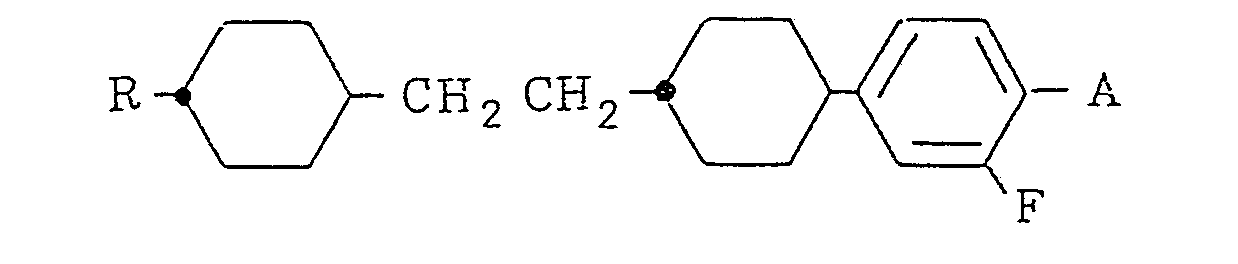
- the present invention resides in a cyclohexane derivative expressed by the formula wherein R represents an alkyl group of 1 to 10 carbon atoms and A represents a hydrogen atom, a halogen atom of F, Cl or Br or a cyano group, and a liquid crystal composition containing the same.
- Cyclohexane derivatives expressed by the formula (I) include compounds expressed by the following formulas (a) - (e), and useful as a component of liquid crystal display materials, and R in the formulas is as defined above:
- These compounds have a broad nematic phase temperature range and exhibit a positive dielectric anisotropy (hereinafter abbreviated to ⁇ ). These compounds have a superior compatibility with other liquid crystal substances, particularly that at low temperatures and the compounds expressed by the formulas (a) to (d) have a low viscosity.
- the compound of the formula (e) has a higher viscosity than those of the compounds of the other formulas, but has a large positive ⁇ value, and when the compound is blended with liquid crystal materials having a relatively low viscosity, it is possible to reduce the driving voltage of the resulting liquid crystal cells.
- R represents a linear chain alkyl group.
- the compounds of the present invention not only have a specific feature of a good compatibility with other liquid crystals at low temperatures, but also have well-balanced specific features preferred as a liquid crystal component, such as low viscosity, broad nematic range and absence of smectic phase or an extremely narrow range of smectic phase, if any.
- a ketone expressed by the formula (II) is reacted with a Grignard reagent (III) obtained from a 3-fluoro-4-substituted-bromobenzene (or 3-fluorobromobenzene) and metal magnesium to obtain an alcohol derivative of the formula (IV), which is then subjected to dehydration reaction in the presence of a catalyst mentioned later in an inert organic solvent at a suitable reflux temperature of the solvent under the atmospheric pressure to obtain a cyclohexene derivative of the formula (V).
- a catalyst mentioned later in an inert organic solvent at a suitable reflux temperature of the solvent under the atmospheric pressure to obtain a cyclohexene derivative of the formula (V).
- the inert organic solvent benzene, toluene, chloroform, carbon tetrachloride, methylene chloride, etc.
- Lewis acids such as aluminum chloride, tin tetrachloride, toluenesulfonic acid, etc. or mineral acids such as sulfuric acid, phosphoric acid, hydrochloric acid, etc. may be used.
- the compound (V) is subjected to catalytic reduction reaction, followed by subjecting the reaction material to a suitable purification treatment to isolate the objective compound (I).
- the compound (e) may be prepared by reacting cuprous cyanide with the compound (d) in a suitable basic solvent or according to a known reaction using the compound (a) as raw material.
- the above compound (a) as a starting raw material is converted into a ketone compound (VI) according to Friedel-Crafts synthesis, which is converted into a carboxylic acid (VII) according to haloform reaction, which is chlorinated into an acid chloride (VIII), which is converted into an amide compound (IX), which is dehydrated to obtain a compound (e).
- the liquid crystal mixture of the present invention in the second aspect comprises at least two liquid crystalline compounds at least one of which is a liquid crystal compound expressed by the formula (I).
- X represents Y represents -CN, halogen atom, R1 or-OR1; and R and R1 each represent an alkyl group.
- C-N point and N-I point represent crystalline-nematic phase transition point and nematic-isotropic liquid phase transition point, respectively.
- This cyclohexene derivative was dissolved in ethyl acetate (200 ml), adding developed Raney nickel (5.0 g) to carry out catalytic reduction reaction at 25°C under the atmospheric pressure till hydrogen absorption ceased, thereafter filtering off Raney nickel, distilling off ethyl acetate from the filtrate and twice recrystallizing the remaining oily substance from n-hexane to obtain the objective compound, [trans-4 ⁇ -(trans-4 ⁇ -propylcyclohexylethyl)cyclohexyl]-3,4-difluorobenzene (11.9 g).
- This product exhibited as broad a nematic temperature range as between 33.3°C (C-N point) and 104.3°C (N-I point). Its viscosity (extrapolated value at 20°C) was as very low as 18 cp.
- This product exhibited as broad a liquid crystal phase as between 64.2°C (C-N point) and 169.6°C (N-I point).
- a liquid crystal composition (A) consisting of trans-4-propyl-(4-cyanophenyl)cyclohexane 30% by weight, trans-4-pentyl-(4-cyanophenyl)cyclohexane 40% by weight and trans-4-heptyl-(4-cyanophenyl)cyclohexane 30% by weight has a N-I point of 52.1°C, a dielectric anisotropy value ( ⁇ ) of 10.7 and a viscosity at 20°C of 22.4 cp.
- This composition was filled in a TN type cell of 10 ⁇ m thick and its characteristics were measured to give a threshold voltage of 1.57 V and a saturation voltage of 2.13 V.
- liquid crystal composition (A) 85 parts by weight used in Use example 1 was added [trans-4 ⁇ -(trans-4 ⁇ -butylcyclohexylethyl)cyclohexyl]-3,4-difluorobenzene (15 parts by weight) to obtain a liquid crystal composition, which exhibited a N-I point of 56.7°C, a ⁇ of 10.2 and a viscosity at 20°C of 22.0 cp. Further this liquid crystal composition was filled in the above-mentioned TN cell. The resulting element exhibited a threshold voltage of 1.53 V and a saturation voltage of 2.47 V.
- the present invention provides a low viscosity liquid crystal having a large positive dielectric anisotropy value and also a good compatibility with existing liquid crystal compounds. Further, using the liquid crystal compound as a component, a nematic liquid crystal mixture having a low viscosity is obtained.
Landscapes
- Chemical & Material Sciences (AREA)
- Organic Chemistry (AREA)
- Crystallography & Structural Chemistry (AREA)
- Engineering & Computer Science (AREA)
- Materials Engineering (AREA)
- Organic Low-Molecular-Weight Compounds And Preparation Thereof (AREA)
- Liquid Crystal Substances (AREA)
Abstract
Description
- This invention relates to a cyclohexane derivative used as a component of liquid crystal materials and a liquid crystal composition containing the same.
- Display devices applying liquid crystals utilize the electro-optical effect based on the anisotropies of the dielectric constant and electrical conductivity of liquid crystal substances. Liquid crystal display modes include various modes such as dynamic scattering type, twisted nematic type, phase change type, deformation of vertical aligned phase type, guest-host type, etc. Properties required for liquid crystal substances used for liquid crystal display vary depending on the respective liquid crystal display modes, but it is required in common to any of display modes that the substances should have a broad mesomorphic range and should be stable to moisture, air, light, heat, electricity, etc. Further, when the substances are used for liquid crystal display devices, it is also desired that the response of the display devices be quick and the devices can be driven at a voltage as low as possible. At present, however, there is no single substance which satisfies these requirements; hence actually, there have been used liquid crystalline mixtures obtained by blending several kinds of liquid crystal compounds or by blending compounds similar to liquid crystals with several kinds of liquid crystal compounds.
- Recently, as the range of the use of liquid crystal display has been increasing, specific features required for liquid crystal materials have also been becoming severer. Materials used at low temperatures have also been desired. For example, the service temperature range employed particularly for displays loaded on cars is -40° to 100°C.
- An object of the present invention is to provide a compound which has a low viscosity, a positive dielectric anisotropy, a broad nematic phase temperature range, and a good compatibility with other liquid crystal components even at low temperatures.
- Further, another object of the present invention is to provide a liquid crystal mixture which is capable of realizing a low threshold voltage for driving display elements and also has a low viscosity.
- The present invention resides in
a cyclohexane derivative expressed by the formula
- Cyclohexane derivatives expressed by the formula (I) include compounds expressed by the following formulas (a) - (e), and useful as a component of liquid crystal display materials, and R in the formulas is as defined above:

- These compounds have a broad nematic phase temperature range and exhibit a positive dielectric anisotropy (hereinafter abbreviated to Δε). These compounds have a superior compatibility with other liquid crystal substances, particularly that at low temperatures and the compounds expressed by the formulas (a) to (d) have a low viscosity.
- The compound of the formula (e) has a higher viscosity than those of the compounds of the other formulas, but has a large positive Δε value, and when the compound is blended with liquid crystal materials having a relatively low viscosity, it is possible to reduce the driving voltage of the resulting liquid crystal cells.
- As to compounds having substituents on the end phenyl ring thereof similar to those of the compounds of the present invention, compounds expressed by the following formulas (1) and (2) are disclosed in U.S.P.s 4,405,488 and 4,536,321. Further, compounds of the following formulas (3) and (4) also similar in the core structure to the compounds of the present invention are disclosed in International Patent Application laid-open No. WO 85/04874:

- In the above formulas, R represents a linear chain alkyl group.
- Comparison of these compounds with those of the present invention will be described later in Comparative test.
- The compounds of the present invention not only have a specific feature of a good compatibility with other liquid crystals at low temperatures, but also have well-balanced specific features preferred as a liquid crystal component, such as low viscosity, broad nematic range and absence of smectic phase or an extremely narrow range of smectic phase, if any.
- Next, an embodiment of preparation of the cyclohexane derivative of the present invention will be described. The compounds of the formulas (a), (b), (c) and (d) may be prepared according to the following equations:

- Namely, a ketone expressed by the formula (II) is reacted with a Grignard reagent (III) obtained from a 3-fluoro-4-substituted-bromobenzene (or 3-fluorobromobenzene) and metal magnesium to obtain an alcohol derivative of the formula (IV), which is then subjected to dehydration reaction in the presence of a catalyst mentioned later in an inert organic solvent at a suitable reflux temperature of the solvent under the atmospheric pressure to obtain a cyclohexene derivative of the formula (V). As the inert organic solvent, benzene, toluene, chloroform, carbon tetrachloride, methylene chloride, etc. are suitable and as the catalyst, Lewis acids such as aluminum chloride, tin tetrachloride, toluenesulfonic acid, etc. or mineral acids such as sulfuric acid, phosphoric acid, hydrochloric acid, etc. may be used. Successively, the compound (V) is subjected to catalytic reduction reaction, followed by subjecting the reaction material to a suitable purification treatment to isolate the objective compound (I). Further, the compound (e) may be prepared by reacting cuprous cyanide with the compound (d) in a suitable basic solvent or according to a known reaction using the compound (a) as raw material.

- Namely, the above compound (a) as a starting raw material is converted into a ketone compound (VI) according to Friedel-Crafts synthesis, which is converted into a carboxylic acid (VII) according to haloform reaction, which is chlorinated into an acid chloride (VIII), which is converted into an amide compound (IX), which is dehydrated to obtain a compound (e).
- The liquid crystal mixture of the present invention in the second aspect comprises at least two liquid crystalline compounds at least one of which is a liquid crystal compound expressed by the formula (I).
- As compounds used in admixture with the compound of the formula (I), as a component of the liquid crystal composition of the present invention, a group of known compounds expressed by the following formulas (i) to (xxxiii) may be illustrated:

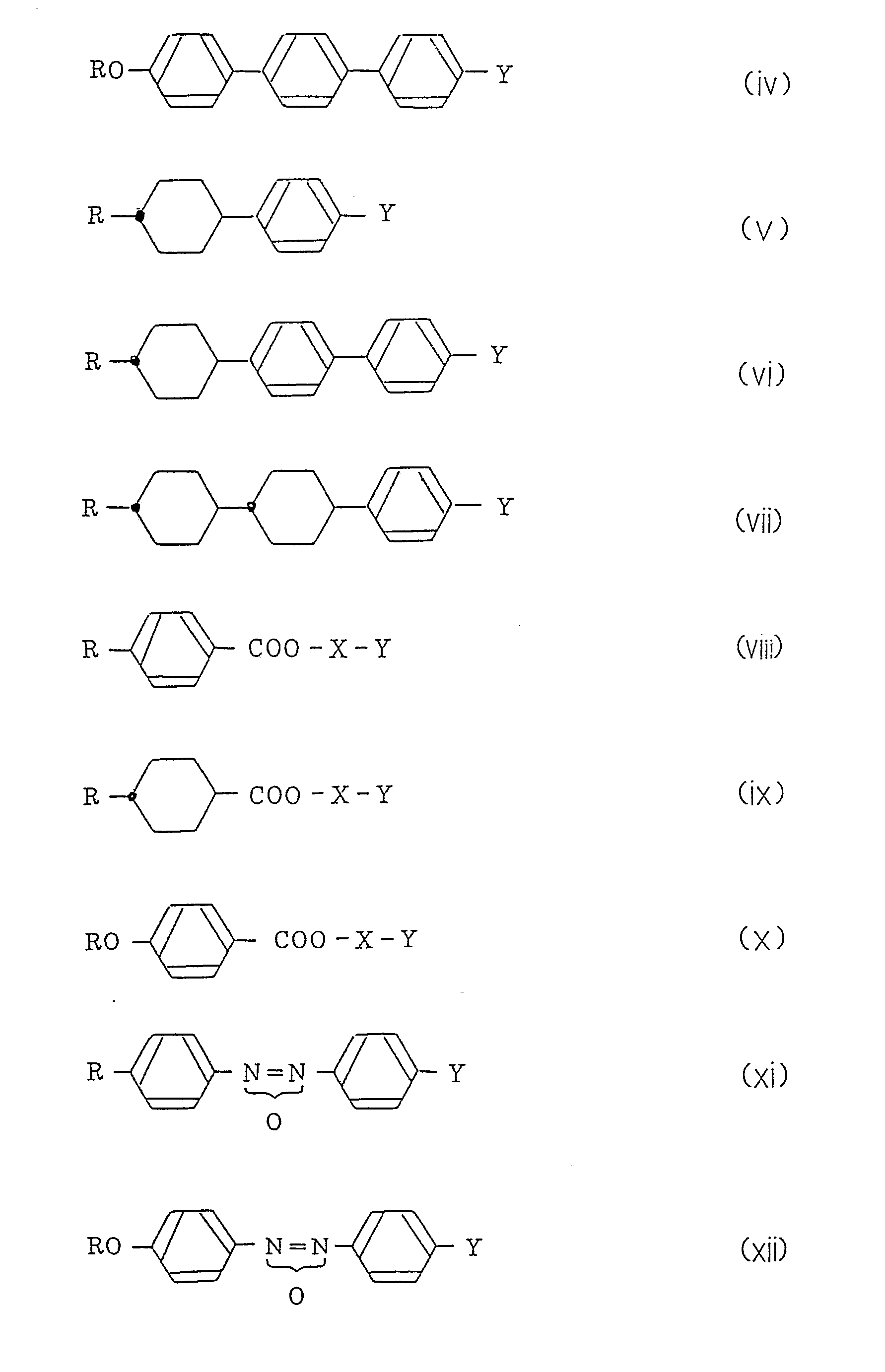


- In the above formulas (i) - (xxxiii), X represents

- The present invention will be described in more detail by way of Examples, but it should not be construed to be limited thereto.
- Further, in Examples, C-N point and N-I point represent crystalline-nematic phase transition point and nematic-isotropic liquid phase transition point, respectively.
- 4-(trans-4ʹ-propylcyclohexylethyl)cyclohexanone (25 g, 0.1 mol) was added to a solution of a Grignard reagent prepared from 3,4-difluorobromobenzene (27.3 g, 0.1 mol) and magnesium (2.43 g, 0.1 mol) in tetrahydrofuran (100 mℓ), at 10°C, followed by reacting at 50°C for 3 hours, allowing the reaction mixture to cool down to room temperature, adding 6N-hydrochloric acid (50 mℓ) and water (200 mℓ) thereto, extracting the resulting freed oily substance with n-heptane (100 mℓ), washing the extract with deionized water till the water became neutral, distilling off n-heptane to obtain an oily substance corresponding to [trans-4ʹ-(trans-4ʺ-propylcyclohexylethyl)-1ʹ-hydroxycyclohexyl]-3,4-difluorobenzene, adding to this oily substance, p-toluenesulfonic acid (1 g) and toluene (200 mℓ), heating the mixture under reflux, removing formed water to the outside of the system, allowing the resulting toluene solution to cool down to room temperature after completion of the reaction, washing it with water till the washing water became neutral, drying with anhydrous sodium sulfate, distilling off toluene and recrystallizing remaining solids from ethyl acetate (50 mℓ) to obtain [trans-4ʹ-(trans-4ʺ-propylcyclohexylethyl)-1ʹ-cyclohexen-1ʹ-yl]-3,4-difluorobenzene (22.9 g). This product exhibited phase transition points of C-N point 36.4°C and N-I point 87.1°.
- This cyclohexene derivative was dissolved in ethyl acetate (200 mℓ), adding developed Raney nickel (5.0 g) to carry out catalytic reduction reaction at 25°C under the atmospheric pressure till hydrogen absorption ceased, thereafter filtering off Raney nickel, distilling off ethyl acetate from the filtrate and twice recrystallizing the remaining oily substance from n-hexane to obtain the objective compound, [trans-4ʹ-(trans-4ʺ-propylcyclohexylethyl)cyclohexyl]-3,4-difluorobenzene (11.9 g). This product exhibited as broad a nematic temperature range as between 33.3°C (C-N point) and 104.3°C (N-I point). Its viscosity (extrapolated value at 20°C) was as very low as 18 cp.
- Further, the elemental analysis values of the product accorded well with the calculated values.

- The following compounds were obtained in the same manner as in Example 1:
[trans-4ʹ-(trans-4ʺ-ethylcyclohexylethyl)cyclohexyl]-3,4-difluorobenzene
C-N point: 27.3°C, N-I point: 73.7°C
[trans-4ʹ-(trans-4ʺ-butylcyclohexylethyl)cyclohexyl]-3,4-difluorobenzene
C-N point: 31.5°C, N-I point: 102.9°C
[trans-4ʹ-(trans-4ʺ-pentylcyclohexylethyl)cyclohexyl]-3,4-difluorobenzene
C-N point: 36.8°C, N-I point: 110.4°C
[trans-4ʹ-(trans-4ʺ-ethylcyclohexylethyl)cyclohexyl]-3-fluoro-4-chlorobenzene
C-N point: 39.6°C, N-I point: 103.7°C
[trans-4ʹ-(trans-4ʺ-propylcyclohexylethyl)cyclohexyl]-3-fluoro-4-chlorobenzene
C-N point: 59.0°C, N-I point: 132.0°C -
- (i) 3-[trans-4ʹ-(trans-4ʺ-propylcyclohexylethyl)cyclohexyl]fluorobenzene (C-N point: 48.4°C, N-I point: 79.4°C) (50 g) obtained from 3-fluorobromobenzene and 4-(trans-4ʹ-propylcyclohexylethyl)cyclohexanone in the same manner as in Example 1, was dissolved in nitrobenzene (100 cc), followed by adding anhydrous aluminum chloride (50.5 g) to the solution, agitating it, dropwise adding acetyl chloride (29 g) to the mixture, heating the resulting mixture on a water bath at 40°C for 2 hours after completion of heat generation to complete reaction, adding the reaction material to a mixture of ice (500 g) with conc. hydrochloric acid (100 cc), vigorously agitating the mixture to decompose the resulting aluminum chloride complex, extracting the freed oily substance with toluene (200 cc), washing the extract solution with water till the washing water became neutral, drying it over anhydrous sodium sulfate, filtering off the drying agent, distilling off toluene and nitrobenzene and recrystallizing a remaining oily substance from ethyl acetate to obtain 2-fluoro-4-[trans-4ʹ-(trans-4ʺ-propylcyclohexylethyl)cyclohexyl]acetophenone (20.2 g). This product exhibited a liquid crystal phase over 62.1°C (C-N point) to 161.4°C (N-I point).
- (ii) 2-Fluoro-4-[trans-4ʹ-(trans-4ʺ-propylcyclohexylethyl)cyclohexyl]acetophenone (10 g) obtained in the above paragraph (i) was dissolved in dioxane (100 cc), followed by adding an aqueous solution of sodium hypobromite prepared from bromine (17 g) and sodium hydroxide (19 g), reacting the mixture at 50°C for 4 hours, allowing the resulting material to cool down after completion of the reaction, adding 6N hydrochloric acid (100 cc), filtering off deposited mass, drying and recrystallizing from acetic acid (160 cc) to obtain acicular 2-fluoro-4-[trans-4ʹ-(trans-4ʺ-propylcyclohexylethyl)cyclohexyl]benzoic acid (8.2 g) (m.p. higher than 250°C).
- (iii) 2-fluoro-4-[trans-4ʹ-(trans-4ʺ-propylcyclohexylethyl)cyclohexyl]benzoic acid obtained in the above paragraph (ii) was reacted with thionyl chloride to obtain an acid chloride (5 g), which was dissolved in dioxane (20 cc), followed by adding the solution to a mixture of ice (100 g) with aqueous ammonia (38% solution) (30 cc), vigorously agitating the mixture, filtering off deposited mass and drying the mass to obtain an acid amide compound (4.5 g).
- (iv) Toluene (50 cc) and thionyl chloride (50 cc) were added to the acid amide (4.5 g) obtained in the above paragraph (iii), followed by reacting the mixture under reflux on heating for 10 hours, allowing the resulting material to cool down after completion of the reaction, adding it into ice (100 g), agitating the mixture, separating the toluene layer, washing it with a dilute alkali aqueous solution, further washing with water till the washing water became neutral, drying the toluene solution over anhydrous sodium sulfate, filtering off the drying agent, distilling off toluene from the toluene solution and recrystallizing remaining solids from ethyl acetate to obtain the objective 2-fluoro-4-trans-4ʹ-(trans-4ʺ-propylcyclohexylethyl)cyclohexyl]benzonitrile (2.2 g).
- This product exhibited as broad a liquid crystal phase as between 64.2°C (C-N point) and 169.6°C (N-I point).
- The following compounds were obtained in the same manner as in Example 7:
2-fluoro-4-[trans-4ʹ-(trans-4ʺ-ethylcyclohexylethyl)cyclohexyl]benzonitrile
C-N point: 70.6°C, N-I point: 145.6°C
2-fluoro-4-[trans-4ʹ-(trans-4ʺ-butylcyclohexylethyl)cyclohexyl]benzonitrile
C-N point: 54.9°C, N-I point: 165.7°C - A liquid crystal composition (A) consisting of
trans-4-propyl-(4-cyanophenyl)cyclohexane
30% by weight,
trans-4-pentyl-(4-cyanophenyl)cyclohexane
40% by weight and
trans-4-heptyl-(4-cyanophenyl)cyclohexane
30% by weight
has a N-I point of 52.1°C, a dielectric anisotropy value (Δε) of 10.7 and a viscosity at 20°C of 22.4 cp. This composition was filled in a TN type cell of 10 µm thick and its characteristics were measured to give a threshold voltage of 1.57 V and a saturation voltage of 2.13 V. - To this liquid crystal composition (A) (85 parts by weight) was added [trans-4ʹ-(trans-4ʺ-propylcyclohexylethyl)cyclohexyl]-3,4-difluorobenzene (15 parts by weight) obtained in Example 1 to prepare a liquid crystal composition. The N-I point rose to 58.0°C. Its Δε was 10.1. The viscosity at 20°C lowered to 21.1 cp. That is, it is seen that the viscosity-reducing effect of the compound of the present invention is superior. When this composition was filled in the above-mentioned TN cell, the resulting element exhibited a threshold voltage of 1.52 V and a saturation voltage of 2.36 V.
- To the liquid crystal composition (A) (85 parts by weight) used in Use example 1 was added [trans-4ʹ-(trans-4ʺ-ethylcyclohexylethyl)cyclohexyl]-3,4-difluorobenzene (15 parts by weight) obtained in Example 2 to prepare a liquid crystal composition. The N-I point rose to 54.1°C. The Δε was 10.0. The viscosity at 20°C lowered to 21.0 cp. Further, this liquid crystal composition was filled in the above-mentioned TN cell. The resulting element exhibited a threshold voltage of 1.52 V and a saturation voltage of 2.36 V.
- To the liquid crystal composition (A) (85 parts by weight) used in Use example 1 was added [trans-4ʹ-(trans-4ʺ-butylcyclohexylethyl)cyclohexyl]-3,4-difluorobenzene (15 parts by weight) to obtain a liquid crystal composition, which exhibited a N-I point of 56.7°C, a Δε of 10.2 and a viscosity at 20°C of 22.0 cp. Further this liquid crystal composition was filled in the above-mentioned TN cell. The resulting element exhibited a threshold voltage of 1.53 V and a saturation voltage of 2.47 V.
- 2-fluoro-4-[trans-4ʹ-(trans-4ʺ-propylcyclohexylethyl)cyclohexyl]benzonitrile (15 parts by weight) was added to the liquid crystal composition (A) (85 parts by weight) used in Use example 1 to obtain a liquid crystal composition, which exhibited a N-I point of 62.5°C, a Δε of 11.3 and a viscosity at 20°C of 24.4 cp. Further, when this liquid crystal composition was filled in the above-mentioned TN cell, the resulting threshold voltage and saturation voltage were 1.52 V and 2.30 V, respectively.
- To the respective compounds of the above-mentioned formulas (1), (2), (3) and (4) wherein R represents n-C₃H₇ (each 15 parts by weight) was added the liquid crystal composition (A) (85 parts by weight) shown in Use example 1 to prepare liquid crystal compositions (1), (2), (3) and (4), respectively. These liquid crystal compositions and the liquid crystal compositions of the present invention prepared in Use Examples 1 and 4 were allowed to stand in a freezer at -40°C for 30 days to observe the presence or absence of crystal deposition and examine their low temperature compatibilities. The results and viscosities at 20°C (abbreviated to η₂₀) together with phase transition points of the respective compounds (15 parts by weight added to the composition (A) (85 parts by weight) are shown in Table 1.

- From the results of this Comparative test, it is seen that the compound of the present invention is superior in the low temperature compatibility and the lower limit temperature of nematic phase of alkylcyclohexylbenzonitrile liquid crystal mixture can be lowered.
- As apparent from the foregoing, the present invention provides a low viscosity liquid crystal having a large positive dielectric anisotropy value and also a good compatibility with existing liquid crystal compounds. Further, using the liquid crystal compound as a component, a nematic liquid crystal mixture having a low viscosity is obtained.
Claims (5)


Priority Applications (1)
| Application Number | Priority Date | Filing Date | Title |
|---|---|---|---|
| AT88101603T ATE69792T1 (en) | 1987-02-06 | 1988-02-04 | CYCLOHEXANA COMBINATION AND LIQUID CRYSTAL COMPOSITION CONTAINING IT. |
Applications Claiming Priority (4)
| Application Number | Priority Date | Filing Date | Title |
|---|---|---|---|
| JP25683/87 | 1987-02-06 | ||
| JP2568387 | 1987-02-06 | ||
| JP62180238A JPS6436A (en) | 1987-02-06 | 1987-07-20 | Cyclohexane derivative |
| JP180238/87 | 1987-07-20 |
Publications (2)
| Publication Number | Publication Date |
|---|---|
| EP0280902A1 true EP0280902A1 (en) | 1988-09-07 |
| EP0280902B1 EP0280902B1 (en) | 1991-11-27 |
Family
ID=26363340
Family Applications (1)
| Application Number | Title | Priority Date | Filing Date |
|---|---|---|---|
| EP88101603A Expired EP0280902B1 (en) | 1987-02-06 | 1988-02-04 | Cyclohexane derivative and liquid crystal composition containing the same |
Country Status (4)
| Country | Link |
|---|---|
| US (1) | US4820443A (en) |
| EP (1) | EP0280902B1 (en) |
| JP (1) | JPS6436A (en) |
| DE (1) | DE3866376D1 (en) |
Cited By (10)
| Publication number | Priority date | Publication date | Assignee | Title |
|---|---|---|---|---|
| US4853152A (en) * | 1987-11-16 | 1989-08-01 | Chisso Corporation | Cyclohexane derivative |
| WO1991003446A1 (en) * | 1989-09-05 | 1991-03-21 | Merck Patent Gesellschaft Mit Beschänkter Haftung | Phenylcyclohexanes and liquid crystal medium |
| WO1991003445A3 (en) * | 1989-08-30 | 1991-04-18 | Merck Patent Gmbh | Halogenated benzene derivatives and liquid crystalline medium |
| WO1991016399A1 (en) * | 1990-04-13 | 1991-10-31 | MERCK Patent Gesellschaft mit beschränkter Haftung | Liquid crystalline medium |
| EP0416117A4 (en) * | 1989-02-14 | 1992-02-19 | Chisso Corporation | Liquid crystal composition |
| EP0568040A1 (en) * | 1992-04-28 | 1993-11-03 | Chisso Corporation | Cyclohexane derivative and liquid crystal composition containing the same |
| US5308543A (en) * | 1991-03-04 | 1994-05-03 | Merck Patent Gesellschaft Mit Besrankter Haftung | Nematic liquid-crystal composition for active matrix application |
| EP0648773A1 (en) * | 1993-10-14 | 1995-04-19 | Shin-Etsu Chemical Co., Ltd. | A silacyclohexane compound, a method of preparing it and a liquid crystal composition containing it |
| EP1352886A1 (en) * | 2002-04-09 | 2003-10-15 | Chisso Corporation | Liquid crystal compound having hydrogen as a terminal group, composition comprising the compound, and liquid crystal display element comprising the composition |
| DE3807958B4 (en) * | 1988-03-10 | 2004-03-18 | Merck Patent Gmbh | Super twisted liquid crystal display element |
Families Citing this family (13)
| Publication number | Priority date | Publication date | Assignee | Title |
|---|---|---|---|---|
| CH660003A5 (en) * | 1984-04-16 | 1987-03-13 | Merck Patent Gmbh | ANISOTROPE COMPOUNDS AND FK MIXTURES WITH THESE. |
| DE3606153A1 (en) * | 1986-02-26 | 1987-08-27 | Merck Patent Gmbh | LIQUID CRYSTAL DISPLAY ELEMENT |
| US5387369A (en) * | 1988-10-20 | 1995-02-07 | Merck Patent Gesellschaft Mit Beschrankter Haftung | Supertwist liquid crystal display |
| DE3835804B4 (en) | 1988-10-20 | 2006-12-28 | Merck Patent Gmbh | Nematic liquid-crystal mixture |
| JP2696557B2 (en) * | 1989-03-07 | 1998-01-14 | チッソ株式会社 | Trifluorobenzene derivative |
| US5064565A (en) * | 1989-07-26 | 1991-11-12 | Chisso Corporation | Cyclohexenylethane compound |
| JPH0662462B2 (en) * | 1989-10-13 | 1994-08-17 | チッソ株式会社 | Dicyclohexyl ethylene derivative |
| US5185098A (en) * | 1990-04-05 | 1993-02-09 | Hoffmann-La Roche Inc. | Liquid crystalline mixtures containing 3,4-difluorophenyl-substituted bicyclohexyls |
| EP0481032A1 (en) * | 1990-04-13 | 1992-04-22 | MERCK PATENT GmbH | Liquid crystalline medium |
| DE4411806B4 (en) * | 1993-04-09 | 2013-11-28 | Merck Patent Gmbh | Liquid crystalline medium |
| DE69519316T2 (en) * | 1994-03-24 | 2001-06-07 | Shin-Etsu Chemical Co., Ltd. | Silacyclohexane compounds as intermediates for the production of liquid crystalline compounds of the silacyclohexane type |
| KR100360488B1 (en) * | 1995-11-30 | 2003-01-24 | 삼성전자 주식회사 | Polymer / liquid crystal membrane solution composition |
| US8778223B2 (en) | 2011-05-24 | 2014-07-15 | Lc Vision, Llc | Liquid crystals having cyclohexyl core structures and fluorinated tails |
Citations (5)
| Publication number | Priority date | Publication date | Assignee | Title |
|---|---|---|---|---|
| EP0102047A1 (en) * | 1982-08-27 | 1984-03-07 | Asahi Glass Company Ltd. | 1-(Trans-4-alkylcyclohexyl)-2-(trans-4'-(p-substituted phenyl)cyclohexyl)ethane and liquid crystal mixture |
| EP0117631A1 (en) * | 1983-01-26 | 1984-09-05 | The Secretary of State for Defence in Her Britannic Majesty's Government of the United Kingdom of Great Britain and | Disubstituted ethanes and their use in liquid crystal materials and devices |
| EP0125563A2 (en) * | 1983-05-14 | 1984-11-21 | MERCK PATENT GmbH | Bicyclohexyl ethanes |
| WO1986005484A1 (en) * | 1985-03-22 | 1986-09-25 | MERCK Patent Gesellschaft mit beschränkter Haftung | Cyclohexane derivatives |
| EP0205998A1 (en) * | 1985-06-10 | 1986-12-30 | Chisso Corporation | Cyclohexane derivative and liquid crystal composition containing same |
Family Cites Families (17)
| Publication number | Priority date | Publication date | Assignee | Title |
|---|---|---|---|---|
| DE2967129D1 (en) * | 1979-05-28 | 1984-08-30 | Merck Patent Gmbh | Liquid-crystal compositions |
| US4405488A (en) * | 1980-10-09 | 1983-09-20 | Chisso Corporation | Liquid-crystalline halogenobenzene derivatives |
| DE3040632A1 (en) * | 1980-10-29 | 1982-05-27 | Merck Patent Gmbh, 6100 Darmstadt | CYCLOHEXYLPHENYL DERIVATIVES, THESE DIELECTRICS AND ELECTROOPTIC DISPLAY ELEMENT |
| DE3042391A1 (en) * | 1980-11-10 | 1982-06-16 | Merck Patent Gmbh, 6100 Darmstadt | FLUORINE CYCLOHEXYLBIPHENYL DERIVATIVES, THESE DIELECTRICS AND ELECTRO-OPTICAL DISPLAY ELEMENT |
| DE3268468D1 (en) * | 1981-02-13 | 1986-02-27 | Secr Defence Brit | Liquid crystal compounds exhibiting a small dielectric anisotropy and liquid crystal materials and devices incorporating such compounds |
| KR840000779A (en) * | 1981-08-12 | 1984-02-27 | 가다야마 니하찌로오 | Refrigeration system having a function of controlling refrigerant flow rate |
| EP0084194B1 (en) * | 1982-01-14 | 1986-04-30 | MERCK PATENT GmbH | Liquid crystal mixtures |
| JPS5916840A (en) * | 1982-07-21 | 1984-01-28 | Chisso Corp | 3-fluoro-4-substituted-(trans-4'-(trans-4"-alkylcyclohexyl) cyclohexyl)benzene |
| EP0107116B1 (en) * | 1982-10-21 | 1986-08-27 | F. HOFFMANN-LA ROCHE & CO. Aktiengesellschaft | Dicyanobenzenes |
| GB2132192B (en) * | 1982-10-30 | 1986-01-22 | Dainippon Ink & Chemicals | Nematic liquid crystalline 3-fluro-4-cyanophenol derivatives |
| US4536321A (en) * | 1983-02-18 | 1985-08-20 | Chisso Corporation | Fluorobenzene derivatives and liquid crystal compositions containing the same |
| US4630896A (en) * | 1983-06-17 | 1986-12-23 | Hoffmann-La Roche Inc. | Benzonitriles |
| EP0133489B1 (en) * | 1983-08-04 | 1988-01-20 | MERCK PATENT GmbH | Nematic compounds |
| DE3401320A1 (en) * | 1984-01-17 | 1985-07-25 | Merck Patent Gmbh, 6100 Darmstadt | ETHAN DERIVATIVES |
| CH660003A5 (en) * | 1984-04-16 | 1987-03-13 | Merck Patent Gmbh | ANISOTROPE COMPOUNDS AND FK MIXTURES WITH THESE. |
| JPS61207347A (en) * | 1985-03-12 | 1986-09-13 | Chisso Corp | Cyclohexane derivative |
| JPH0684230A (en) * | 1992-09-03 | 1994-03-25 | Matsushita Electric Ind Co Ltd | Video tape recorder |
-
1987
- 1987-07-20 JP JP62180238A patent/JPS6436A/en active Granted
-
1988
- 1988-02-01 US US07/151,192 patent/US4820443A/en not_active Expired - Lifetime
- 1988-02-04 DE DE8888101603T patent/DE3866376D1/en not_active Expired - Lifetime
- 1988-02-04 EP EP88101603A patent/EP0280902B1/en not_active Expired
Patent Citations (5)
| Publication number | Priority date | Publication date | Assignee | Title |
|---|---|---|---|---|
| EP0102047A1 (en) * | 1982-08-27 | 1984-03-07 | Asahi Glass Company Ltd. | 1-(Trans-4-alkylcyclohexyl)-2-(trans-4'-(p-substituted phenyl)cyclohexyl)ethane and liquid crystal mixture |
| EP0117631A1 (en) * | 1983-01-26 | 1984-09-05 | The Secretary of State for Defence in Her Britannic Majesty's Government of the United Kingdom of Great Britain and | Disubstituted ethanes and their use in liquid crystal materials and devices |
| EP0125563A2 (en) * | 1983-05-14 | 1984-11-21 | MERCK PATENT GmbH | Bicyclohexyl ethanes |
| WO1986005484A1 (en) * | 1985-03-22 | 1986-09-25 | MERCK Patent Gesellschaft mit beschränkter Haftung | Cyclohexane derivatives |
| EP0205998A1 (en) * | 1985-06-10 | 1986-12-30 | Chisso Corporation | Cyclohexane derivative and liquid crystal composition containing same |
Non-Patent Citations (1)
| Title |
|---|
| MOLECULAR CRYSTALS AND LIQUID CRYSTALS AND LETTERS, vol. 123, nos. 1/4, 1985, pages 1-13, New York, US; P. BALTZWILL et al.: "Fluorination in Nematic systems" * |
Cited By (13)
| Publication number | Priority date | Publication date | Assignee | Title |
|---|---|---|---|---|
| US4853152A (en) * | 1987-11-16 | 1989-08-01 | Chisso Corporation | Cyclohexane derivative |
| DE3807958B4 (en) * | 1988-03-10 | 2004-03-18 | Merck Patent Gmbh | Super twisted liquid crystal display element |
| EP0416117A4 (en) * | 1989-02-14 | 1992-02-19 | Chisso Corporation | Liquid crystal composition |
| US5167860A (en) * | 1989-02-14 | 1992-12-01 | Chisso Corporation | Liquid crystal composition |
| WO1991003445A3 (en) * | 1989-08-30 | 1991-04-18 | Merck Patent Gmbh | Halogenated benzene derivatives and liquid crystalline medium |
| WO1991003446A1 (en) * | 1989-09-05 | 1991-03-21 | Merck Patent Gesellschaft Mit Beschänkter Haftung | Phenylcyclohexanes and liquid crystal medium |
| WO1991016399A1 (en) * | 1990-04-13 | 1991-10-31 | MERCK Patent Gesellschaft mit beschränkter Haftung | Liquid crystalline medium |
| US5308543A (en) * | 1991-03-04 | 1994-05-03 | Merck Patent Gesellschaft Mit Besrankter Haftung | Nematic liquid-crystal composition for active matrix application |
| EP0568040A1 (en) * | 1992-04-28 | 1993-11-03 | Chisso Corporation | Cyclohexane derivative and liquid crystal composition containing the same |
| US5468421A (en) * | 1992-04-28 | 1995-11-21 | Chisso Corporation | Cyclohexane derivative and liquid crystal composition containing the same |
| US5547606A (en) * | 1993-10-14 | 1996-08-20 | Shin-Etsu Chemical Co., Ltd. | Silacyclohexane compound, a method of preparing it and a liquid crystal composition containing it |
| EP0648773A1 (en) * | 1993-10-14 | 1995-04-19 | Shin-Etsu Chemical Co., Ltd. | A silacyclohexane compound, a method of preparing it and a liquid crystal composition containing it |
| EP1352886A1 (en) * | 2002-04-09 | 2003-10-15 | Chisso Corporation | Liquid crystal compound having hydrogen as a terminal group, composition comprising the compound, and liquid crystal display element comprising the composition |
Also Published As
| Publication number | Publication date |
|---|---|
| DE3866376D1 (en) | 1992-01-09 |
| JPS6436A (en) | 1989-01-05 |
| US4820443A (en) | 1989-04-11 |
| JPH0244818B2 (en) | 1990-10-05 |
| EP0280902B1 (en) | 1991-11-27 |
Similar Documents
| Publication | Publication Date | Title |
|---|---|---|
| EP0280902B1 (en) | Cyclohexane derivative and liquid crystal composition containing the same | |
| US4917819A (en) | Cyclohexane derivative and liquid crystal composition containing same | |
| EP0119756B1 (en) | Fluorobenzene derivatives and liquid crystal compositions containing the same | |
| EP0316715B1 (en) | Cyclohexane derivatives | |
| US4583826A (en) | Phenylethanes | |
| US4778620A (en) | Tolan derivative and a liquid crystal mixture containing the same | |
| HK44089A (en) | Liquid crystal benzene derivatives | |
| EP0377469B1 (en) | A liquid crystalline compound | |
| JPS6246527B2 (en) | ||
| US4439340A (en) | Cyano-mono-or diphenylbicyclohexane derivatives | |
| US4211666A (en) | Liquid crystal compounds | |
| US4548731A (en) | 2,4-Difluorobenzene derivatives | |
| US4477369A (en) | New high temperature liquid-crystalline substances consisting of 4 or 5 six-member-rings and liquid-crystalline compositions containing same | |
| JPH0136A (en) | Cyclohexane derivative | |
| EP0330216A2 (en) | A liquid crystal compound | |
| EP0563982A2 (en) | Polycyclic diene derivatives | |
| US4558151A (en) | Nematic liquid crystalline compounds | |
| EP0568040B1 (en) | Cyclohexane derivative and liquid crystal composition containing the same | |
| EP0219975B1 (en) | Fluorophenylcyclohexane derivative | |
| US4908152A (en) | Cyclohexane derivative | |
| US4839091A (en) | Tolan derivative and liquid crystal composition containing the same | |
| EP0423926B1 (en) | Difluorobenzonitrile derivatives | |
| US5342546A (en) | 1,4-substituted dihydrobenzene derivatives | |
| EP0136480A2 (en) | 2,3-Dicyano-5-substituted pyrazines and liquid crystal composition containing them | |
| EP0571652B1 (en) | Liquid crystalline substituted dihydrobenzene derivatives |
Legal Events
| Date | Code | Title | Description |
|---|---|---|---|
| PUAI | Public reference made under article 153(3) epc to a published international application that has entered the european phase |
Free format text: ORIGINAL CODE: 0009012 |
|
| 17P | Request for examination filed |
Effective date: 19880204 |
|
| AK | Designated contracting states |
Kind code of ref document: A1 Designated state(s): AT CH DE FR GB IT LI NL |
|
| 17Q | First examination report despatched |
Effective date: 19900529 |
|
| GRAA | (expected) grant |
Free format text: ORIGINAL CODE: 0009210 |
|
| AK | Designated contracting states |
Kind code of ref document: B1 Designated state(s): AT CH DE FR GB IT LI NL |
|
| REF | Corresponds to: |
Ref document number: 69792 Country of ref document: AT Date of ref document: 19911215 Kind code of ref document: T |
|
| ITF | It: translation for a ep patent filed | ||
| ET | Fr: translation filed | ||
| REF | Corresponds to: |
Ref document number: 3866376 Country of ref document: DE Date of ref document: 19920109 |
|
| PLBE | No opposition filed within time limit |
Free format text: ORIGINAL CODE: 0009261 |
|
| STAA | Information on the status of an ep patent application or granted ep patent |
Free format text: STATUS: NO OPPOSITION FILED WITHIN TIME LIMIT |
|
| 26N | No opposition filed | ||
| PGFP | Annual fee paid to national office [announced via postgrant information from national office to epo] |
Ref country code: CH Payment date: 19960206 Year of fee payment: 9 |
|
| PGFP | Annual fee paid to national office [announced via postgrant information from national office to epo] |
Ref country code: AT Payment date: 19960226 Year of fee payment: 9 |
|
| PGFP | Annual fee paid to national office [announced via postgrant information from national office to epo] |
Ref country code: NL Payment date: 19960229 Year of fee payment: 9 |
|
| PG25 | Lapsed in a contracting state [announced via postgrant information from national office to epo] |
Ref country code: AT Effective date: 19970204 |
|
| PG25 | Lapsed in a contracting state [announced via postgrant information from national office to epo] |
Ref country code: LI Effective date: 19970228 Ref country code: CH Effective date: 19970228 |
|
| PG25 | Lapsed in a contracting state [announced via postgrant information from national office to epo] |
Ref country code: NL Effective date: 19970901 |
|
| REG | Reference to a national code |
Ref country code: CH Ref legal event code: PL |
|
| NLV4 | Nl: lapsed or anulled due to non-payment of the annual fee |
Effective date: 19970901 |
|
| PGFP | Annual fee paid to national office [announced via postgrant information from national office to epo] |
Ref country code: GB Payment date: 19990204 Year of fee payment: 12 |
|
| PGFP | Annual fee paid to national office [announced via postgrant information from national office to epo] |
Ref country code: FR Payment date: 19990209 Year of fee payment: 12 |
|
| PG25 | Lapsed in a contracting state [announced via postgrant information from national office to epo] |
Ref country code: GB Free format text: LAPSE BECAUSE OF NON-PAYMENT OF DUE FEES Effective date: 20000204 |
|
| GBPC | Gb: european patent ceased through non-payment of renewal fee |
Effective date: 20000204 |
|
| PG25 | Lapsed in a contracting state [announced via postgrant information from national office to epo] |
Ref country code: FR Free format text: LAPSE BECAUSE OF NON-PAYMENT OF DUE FEES Effective date: 20001031 |
|
| REG | Reference to a national code |
Ref country code: FR Ref legal event code: ST |
|
| PG25 | Lapsed in a contracting state [announced via postgrant information from national office to epo] |
Ref country code: IT Free format text: LAPSE BECAUSE OF NON-PAYMENT OF DUE FEES;WARNING: LAPSES OF ITALIAN PATENTS WITH EFFECTIVE DATE BEFORE 2007 MAY HAVE OCCURRED AT ANY TIME BEFORE 2007. THE CORRECT EFFECTIVE DATE MAY BE DIFFERENT FROM THE ONE RECORDED. Effective date: 20050204 |
|
| PGFP | Annual fee paid to national office [announced via postgrant information from national office to epo] |
Ref country code: DE Payment date: 20070201 Year of fee payment: 20 |