EP0280275A2 - N-indanyl carboxamide derivative and agricultural/horticultural fungicide containing the derivative as active ingredient - Google Patents
N-indanyl carboxamide derivative and agricultural/horticultural fungicide containing the derivative as active ingredient Download PDFInfo
- Publication number
- EP0280275A2 EP0280275A2 EP19880102727 EP88102727A EP0280275A2 EP 0280275 A2 EP0280275 A2 EP 0280275A2 EP 19880102727 EP19880102727 EP 19880102727 EP 88102727 A EP88102727 A EP 88102727A EP 0280275 A2 EP0280275 A2 EP 0280275A2
- Authority
- EP
- European Patent Office
- Prior art keywords
- group
- general formula
- lower alkyl
- halogen atom
- hydrogen atom
- Prior art date
- Legal status (The legal status is an assumption and is not a legal conclusion. Google has not performed a legal analysis and makes no representation as to the accuracy of the status listed.)
- Granted
Links
- 0 CC(*CC*)(CC1)CC2=CCCC=C2*1[N+](*)[O-] Chemical compound CC(*CC*)(CC1)CC2=CCCC=C2*1[N+](*)[O-] 0.000 description 3
- OLICQMSZRKFIIN-UHFFFAOYSA-N Cc1c[s]nc1C Chemical compound Cc1c[s]nc1C OLICQMSZRKFIIN-UHFFFAOYSA-N 0.000 description 1
Classifications
-
- C—CHEMISTRY; METALLURGY
- C07—ORGANIC CHEMISTRY
- C07D—HETEROCYCLIC COMPOUNDS
- C07D241/00—Heterocyclic compounds containing 1,4-diazine or hydrogenated 1,4-diazine rings
- C07D241/02—Heterocyclic compounds containing 1,4-diazine or hydrogenated 1,4-diazine rings not condensed with other rings
- C07D241/10—Heterocyclic compounds containing 1,4-diazine or hydrogenated 1,4-diazine rings not condensed with other rings having three double bonds between ring members or between ring members and non-ring members
- C07D241/14—Heterocyclic compounds containing 1,4-diazine or hydrogenated 1,4-diazine rings not condensed with other rings having three double bonds between ring members or between ring members and non-ring members with hetero atoms or with carbon atoms having three bonds to hetero atoms with at the most one bond to halogen, e.g. ester or nitrile radicals, directly attached to ring carbon atoms
- C07D241/24—Carbon atoms having three bonds to hetero atoms with at the most one bond to halogen, e.g. ester or nitrile radicals
-
- A—HUMAN NECESSITIES
- A01—AGRICULTURE; FORESTRY; ANIMAL HUSBANDRY; HUNTING; TRAPPING; FISHING
- A01N—PRESERVATION OF BODIES OF HUMANS OR ANIMALS OR PLANTS OR PARTS THEREOF; BIOCIDES, e.g. AS DISINFECTANTS, AS PESTICIDES OR AS HERBICIDES; PEST REPELLANTS OR ATTRACTANTS; PLANT GROWTH REGULATORS
- A01N43/00—Biocides, pest repellants or attractants, or plant growth regulators containing heterocyclic compounds
- A01N43/02—Biocides, pest repellants or attractants, or plant growth regulators containing heterocyclic compounds having rings with one or more oxygen or sulfur atoms as the only ring hetero atoms
- A01N43/04—Biocides, pest repellants or attractants, or plant growth regulators containing heterocyclic compounds having rings with one or more oxygen or sulfur atoms as the only ring hetero atoms with one hetero atom
- A01N43/06—Biocides, pest repellants or attractants, or plant growth regulators containing heterocyclic compounds having rings with one or more oxygen or sulfur atoms as the only ring hetero atoms with one hetero atom five-membered rings
- A01N43/08—Biocides, pest repellants or attractants, or plant growth regulators containing heterocyclic compounds having rings with one or more oxygen or sulfur atoms as the only ring hetero atoms with one hetero atom five-membered rings with oxygen as the ring hetero atom
-
- A—HUMAN NECESSITIES
- A01—AGRICULTURE; FORESTRY; ANIMAL HUSBANDRY; HUNTING; TRAPPING; FISHING
- A01N—PRESERVATION OF BODIES OF HUMANS OR ANIMALS OR PLANTS OR PARTS THEREOF; BIOCIDES, e.g. AS DISINFECTANTS, AS PESTICIDES OR AS HERBICIDES; PEST REPELLANTS OR ATTRACTANTS; PLANT GROWTH REGULATORS
- A01N43/00—Biocides, pest repellants or attractants, or plant growth regulators containing heterocyclic compounds
- A01N43/48—Biocides, pest repellants or attractants, or plant growth regulators containing heterocyclic compounds having rings with two nitrogen atoms as the only ring hetero atoms
- A01N43/60—1,4-Diazines; Hydrogenated 1,4-diazines
-
- A—HUMAN NECESSITIES
- A01—AGRICULTURE; FORESTRY; ANIMAL HUSBANDRY; HUNTING; TRAPPING; FISHING
- A01N—PRESERVATION OF BODIES OF HUMANS OR ANIMALS OR PLANTS OR PARTS THEREOF; BIOCIDES, e.g. AS DISINFECTANTS, AS PESTICIDES OR AS HERBICIDES; PEST REPELLANTS OR ATTRACTANTS; PLANT GROWTH REGULATORS
- A01N43/00—Biocides, pest repellants or attractants, or plant growth regulators containing heterocyclic compounds
- A01N43/72—Biocides, pest repellants or attractants, or plant growth regulators containing heterocyclic compounds having rings with nitrogen atoms and oxygen or sulfur atoms as ring hetero atoms
- A01N43/80—Biocides, pest repellants or attractants, or plant growth regulators containing heterocyclic compounds having rings with nitrogen atoms and oxygen or sulfur atoms as ring hetero atoms five-membered rings with one nitrogen atom and either one oxygen atom or one sulfur atom in positions 1,2
-
- A—HUMAN NECESSITIES
- A01—AGRICULTURE; FORESTRY; ANIMAL HUSBANDRY; HUNTING; TRAPPING; FISHING
- A01N—PRESERVATION OF BODIES OF HUMANS OR ANIMALS OR PLANTS OR PARTS THEREOF; BIOCIDES, e.g. AS DISINFECTANTS, AS PESTICIDES OR AS HERBICIDES; PEST REPELLANTS OR ATTRACTANTS; PLANT GROWTH REGULATORS
- A01N43/00—Biocides, pest repellants or attractants, or plant growth regulators containing heterocyclic compounds
- A01N43/72—Biocides, pest repellants or attractants, or plant growth regulators containing heterocyclic compounds having rings with nitrogen atoms and oxygen or sulfur atoms as ring hetero atoms
- A01N43/82—Biocides, pest repellants or attractants, or plant growth regulators containing heterocyclic compounds having rings with nitrogen atoms and oxygen or sulfur atoms as ring hetero atoms five-membered rings with three ring hetero atoms
-
- C—CHEMISTRY; METALLURGY
- C07—ORGANIC CHEMISTRY
- C07D—HETEROCYCLIC COMPOUNDS
- C07D275/00—Heterocyclic compounds containing 1,2-thiazole or hydrogenated 1,2-thiazole rings
- C07D275/02—Heterocyclic compounds containing 1,2-thiazole or hydrogenated 1,2-thiazole rings not condensed with other rings
- C07D275/03—Heterocyclic compounds containing 1,2-thiazole or hydrogenated 1,2-thiazole rings not condensed with other rings with hetero atoms or with carbon atoms having three bonds to hetero atoms with at the most one bond to halogen, e.g. ester or nitrile radicals, directly attached to ring carbon atoms
-
- C—CHEMISTRY; METALLURGY
- C07—ORGANIC CHEMISTRY
- C07D—HETEROCYCLIC COMPOUNDS
- C07D277/00—Heterocyclic compounds containing 1,3-thiazole or hydrogenated 1,3-thiazole rings
- C07D277/02—Heterocyclic compounds containing 1,3-thiazole or hydrogenated 1,3-thiazole rings not condensed with other rings
- C07D277/20—Heterocyclic compounds containing 1,3-thiazole or hydrogenated 1,3-thiazole rings not condensed with other rings having two or three double bonds between ring members or between ring members and non-ring members
- C07D277/32—Heterocyclic compounds containing 1,3-thiazole or hydrogenated 1,3-thiazole rings not condensed with other rings having two or three double bonds between ring members or between ring members and non-ring members with hetero atoms or with carbon atoms having three bonds to hetero atoms with at the most one bond to halogen, e.g. ester or nitrile radicals, directly attached to ring carbon atoms
- C07D277/56—Carbon atoms having three bonds to hetero atoms with at the most one bond to halogen
-
- C—CHEMISTRY; METALLURGY
- C07—ORGANIC CHEMISTRY
- C07D—HETEROCYCLIC COMPOUNDS
- C07D285/00—Heterocyclic compounds containing rings having nitrogen and sulfur atoms as the only ring hetero atoms, not provided for by groups C07D275/00 - C07D283/00
- C07D285/01—Five-membered rings
- C07D285/02—Thiadiazoles; Hydrogenated thiadiazoles
- C07D285/04—Thiadiazoles; Hydrogenated thiadiazoles not condensed with other rings
- C07D285/06—1,2,3-Thiadiazoles; Hydrogenated 1,2,3-thiadiazoles
-
- C—CHEMISTRY; METALLURGY
- C07—ORGANIC CHEMISTRY
- C07D—HETEROCYCLIC COMPOUNDS
- C07D307/00—Heterocyclic compounds containing five-membered rings having one oxygen atom as the only ring hetero atom
- C07D307/02—Heterocyclic compounds containing five-membered rings having one oxygen atom as the only ring hetero atom not condensed with other rings
- C07D307/34—Heterocyclic compounds containing five-membered rings having one oxygen atom as the only ring hetero atom not condensed with other rings having two or three double bonds between ring members or between ring members and non-ring members
- C07D307/56—Heterocyclic compounds containing five-membered rings having one oxygen atom as the only ring hetero atom not condensed with other rings having two or three double bonds between ring members or between ring members and non-ring members with hetero atoms or with carbon atoms having three bonds to hetero atoms with at the most one bond to halogen, e.g. ester or nitrile radicals, directly attached to ring carbon atoms
- C07D307/68—Carbon atoms having three bonds to hetero atoms with at the most one bond to halogen
Definitions
- a carboxylic acid or a reactive derivative thereof represented by the general formula (II) is reacted with an amino-indane derivative represented by the general formula (III) in the presence or absence of an inert solvent for the reaction.
- the compounds of the present invention manifest extremely high activity on such fungi which are sensitive and, at the same time, resistant to benzimidazole-thiophanate fungicides and cyclic imide fungicides. Thus, they are useful as agricultural/horticultural fungicides.
- a wettable powder prepared by following the procedure of Formulation Example 1 and diluted with water a prescribed concentration, was applied by spraying to aereal parts of plants at a ratio of 10 ml per pot. After the applied solution was air dried, a suspension of spores obtained from wheat leaves which had contracted powdery mildew (Erysiphe graminis) was inoculated by spraying. The wheat plants were left standing at room temperature for 7 to 10 days.
Landscapes
- Chemical & Material Sciences (AREA)
- Organic Chemistry (AREA)
- Life Sciences & Earth Sciences (AREA)
- Agronomy & Crop Science (AREA)
- Pest Control & Pesticides (AREA)
- Plant Pathology (AREA)
- Health & Medical Sciences (AREA)
- Engineering & Computer Science (AREA)
- Dentistry (AREA)
- General Health & Medical Sciences (AREA)
- Wood Science & Technology (AREA)
- Zoology (AREA)
- Environmental Sciences (AREA)
- Agricultural Chemicals And Associated Chemicals (AREA)
- Organic Low-Molecular-Weight Compounds And Preparation Thereof (AREA)
Abstract
Description
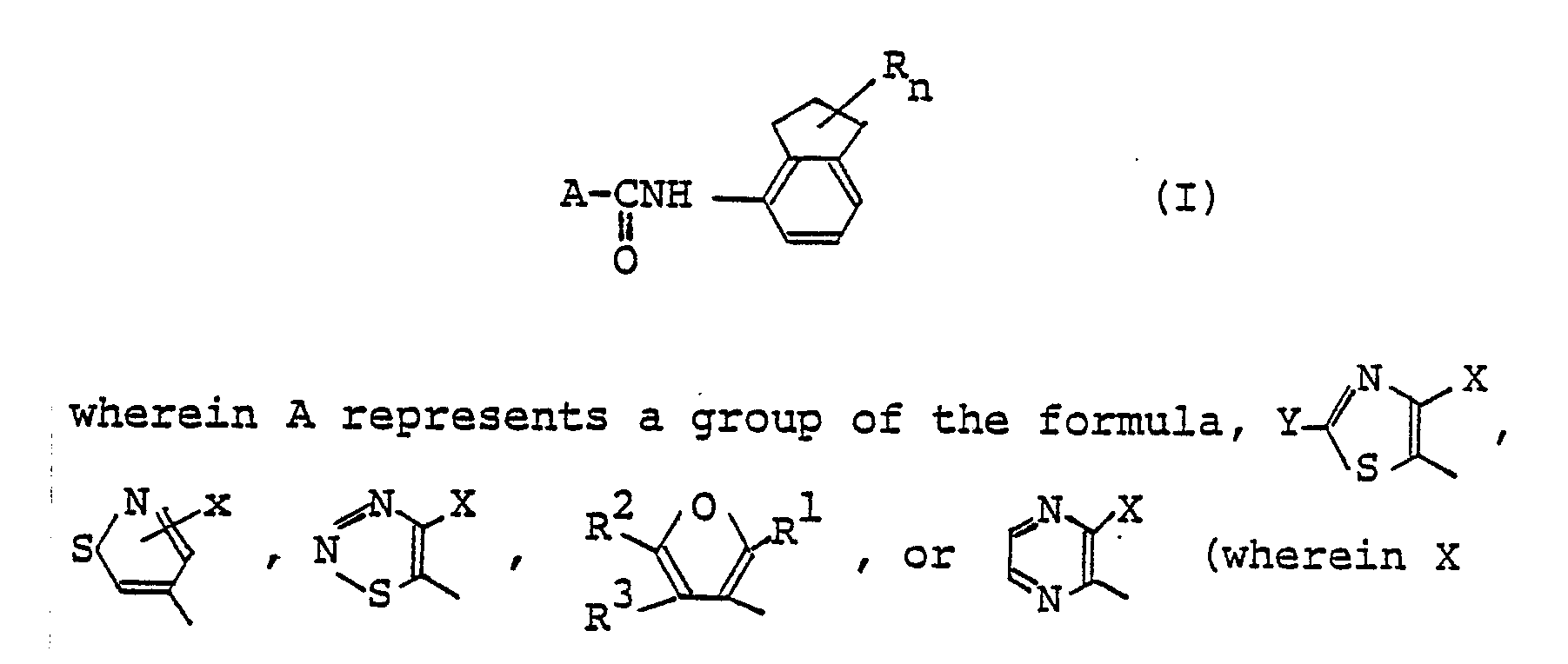
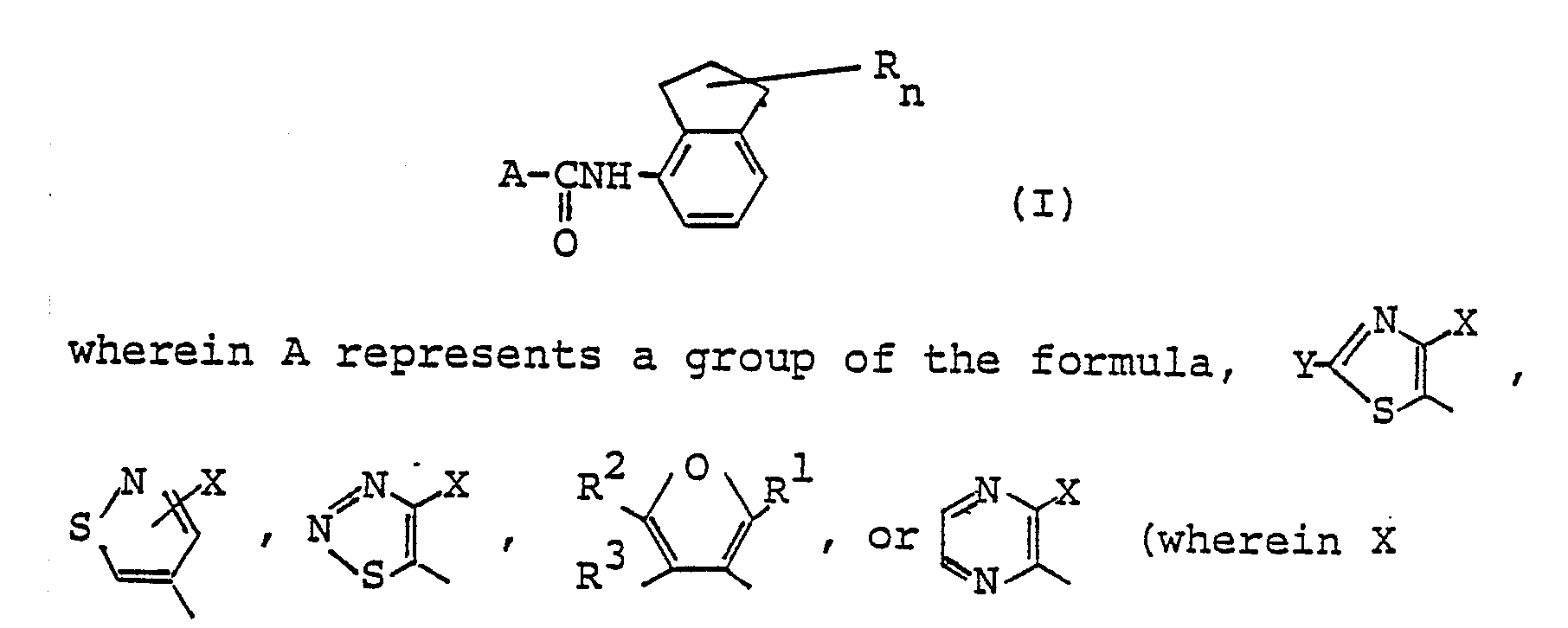
- The present invention relates to an N-indanyl carboxamide derivative and an agricultural/horticultural fungicide containing the derivative as an active ingredient. More in detail, the present invention relates to an N-indanyl carboxamide derivative represented by the following general formula (I):

- It has been known that certain carboxamide derivatives have fungicidal activity and other similar biological activities. For example, such compounds as:

- As shown from biological test examples mentioned later, however, these compounds have not necessarily sufficiently activity as agricultural/horticultural fungicides.
- Benzimidazole-thiophanate fungicides such as benomyl-[methyl-1-(butylcarbamoyl)benzimidazol-2-yl-carbamate] and thiophanate methyl[1,2-bis(3-methoxycarbonyl-2-thioureido)benzene] exhibited outstanding effects in preventing various pathogenic fungi which infest agricultural and horticultural produces and had been popularly used in the form of agricultural/horticultural fungicides since the 1970's. In this while, however, pathogenic fungi capable of exhibiting tolerance for these fungicides (hereinafter referred to as "drug-resistant strains") have spread out widely. Thus, there are times when these fungicides prove to be substantially unusable.
- Cyclic imide fungicides such as purosimidone [N-(3,5-dichlorophenyl)-1,2-dimethylcyclopropane-1,2-dicarboxyimide] exhibited activity against such drug-resistant gray mold germ (Botrylis cinerea) and has found extensive utility as a substitute for the aforementioned benzimidazole-thiophanate fungicides. In recent years, however, resistant strains to these cyclic imide fungicides have appeared. In fact, they have often failed to prove to be usable in the field.
- The N-phenyl carbamate compounds disclosed as in Japanese Patent Application Laid Open (KOKAI) No. 58-126856 (1983) have been reported as exhibiting high activity in controlling such drug-resistant strains as mentioned above. The N-phenyl carbamate compounds, however, exhibit entirely no effect in controlling drug-sensitive strains to benzimidazole or thiophanate fungicides. So that they do not fit independent use at times.
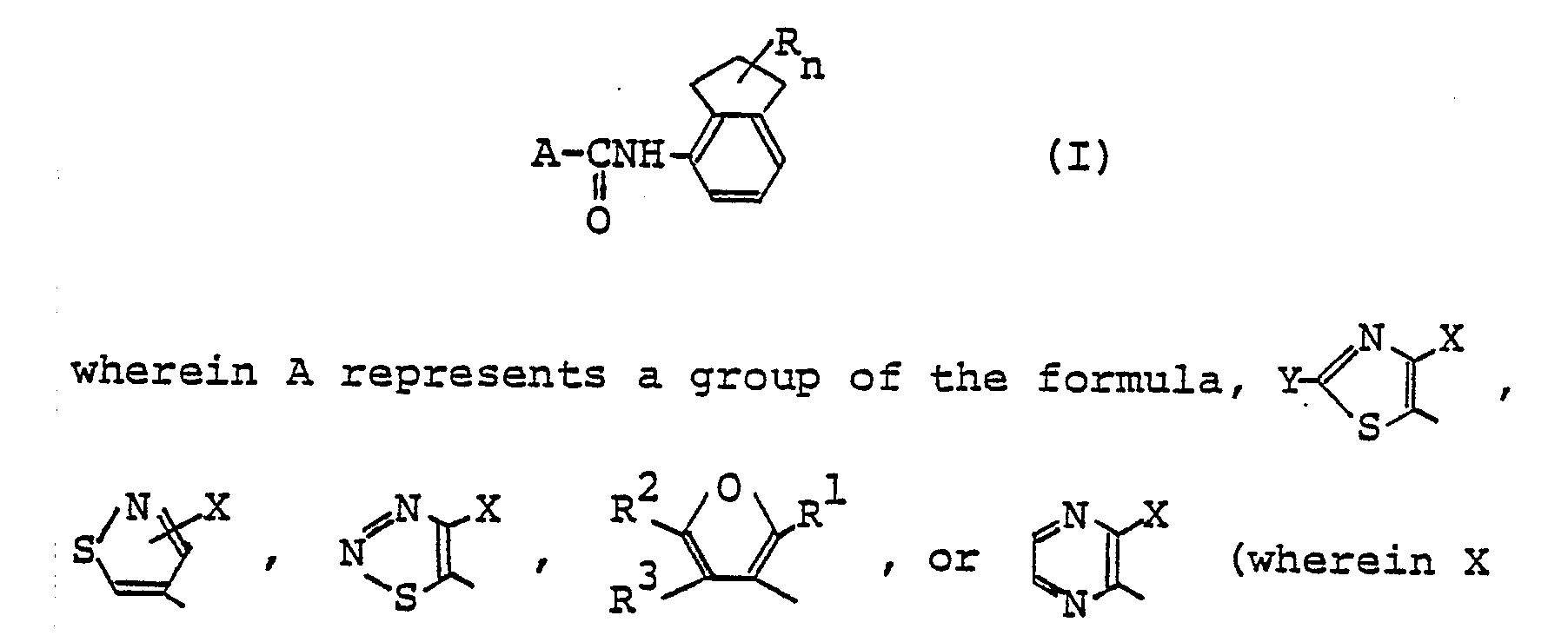
- As a result of the inventors' diligent study in order to solve the various problems mentioned above, it has been found that an N-indanyl carboxamide derivative represented by the following general formula (I):
- In a first aspect of the present invention, there is provided an N-indanyl carboxamide derivative represented by the following general formula (I):

- In a second aspect of the present invention, there is provided an agricultural/horticultural fungicide, comprising as an active ingredient an N-indanyl carboxamide derivative represented by the following general formula (I):

- Specifically, the essence of the present invention lies in an N-indanyl carboxamide derivative represented by the following general formula (I):

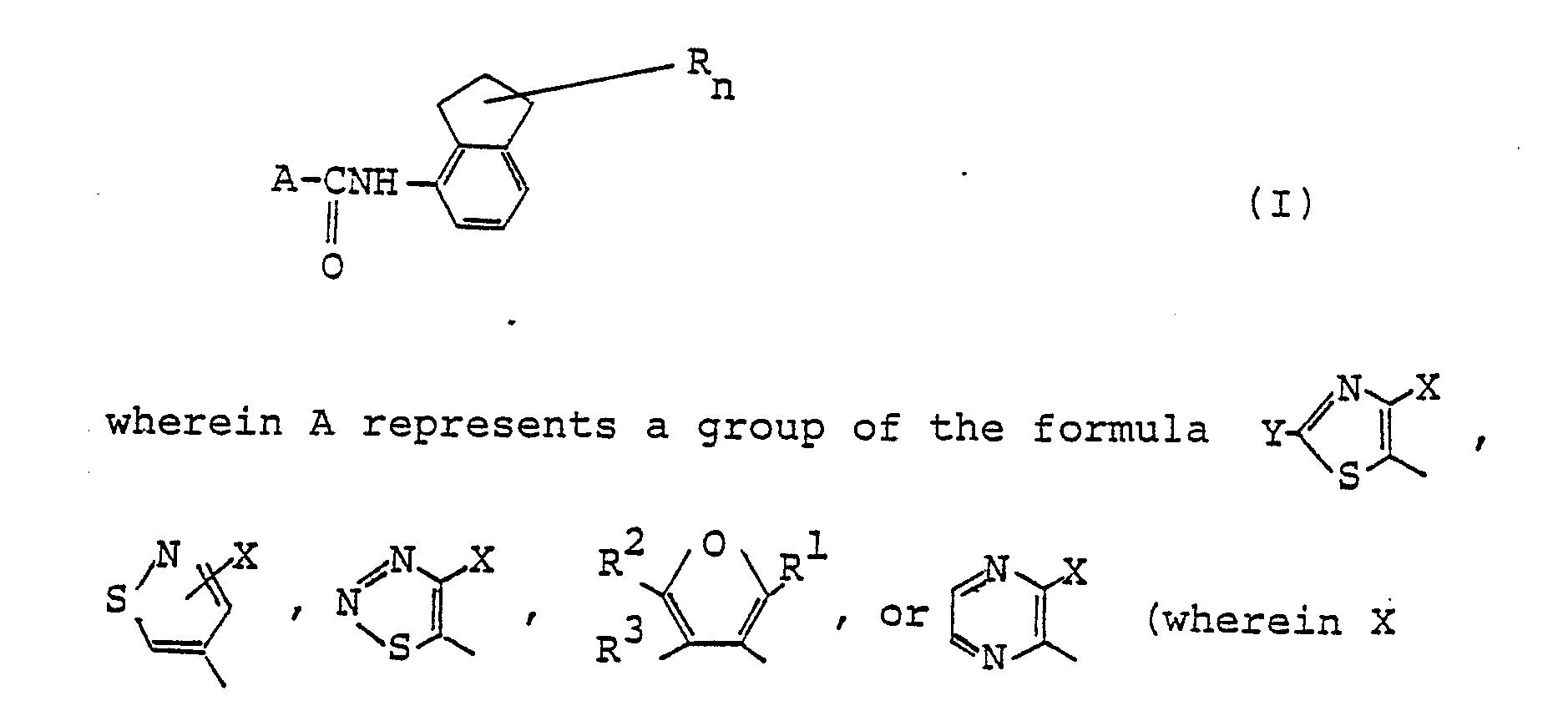
- The compounds of the present invention are represented by the general formula (I). In the general formula (I), A represents a group of the formula,

- In the formulas, R¹ represents a methyl group or a trifluoromethyl group, preferably a methyl group, and R² and R³ independently represents a hydrogen atom or a methyl group. Preferably R³ represents a hydrogen atom.
- In the general formula (I), R represents a lower alkyl group, preferably a lower alkyl group having 1 to 3 carbon atoms, and more preferably a methyl group, and n is an integer of 1 to 6, preferably 1 to 4. Where n is an integer of 2 to 6, the plurality of R's may be equal to or different from each other.
- Concrete examples of the compounds of the present invention represented by the general formula (I) are enumerated in Table 1 to Table 3. The compounds of the general formula (I) are not limited to these examples.


- The compounds of the present invention are all novel and may be synthesized, for instance, according to the following reaction route:

- As indicated by the reaction route, a carboxylic acid or a reactive derivative thereof represented by the general formula (II) is reacted with an amino-indane derivative represented by the general formula (III) in the presence or absence of an inert solvent for the reaction.
- In the reaction, the carboxylic acid or reactive derivative thereof represented by the general formula (II) is used in an amount in the range of 0.5 to 1.5 equivalent, preferably 0.9 to 1.1 equivalent based on the amount of the amino-indane derivative represented by the general formula (III). This reaction can be carried out at a temperature in the range of from -70°C to the boiling point of the solvent used therein, preferably from -40°C to the boiling point of the solvent.
- As examples of the carboxylic acid or reactive derivative represented by the general formula (II), corresponding carboxylic acids, acid anhydrides, acid chlorides and other similar acid halogenides, and carboxylic esters may be exemplified.
- As examples of the solvent usable in the reaction, aromatic hydrocarbons such as benzene and toluene; halogenated hydrocarbons such as carbon tetrachloride and chloroform; aromatic halogenated hydrocarbons such as chlorobenzene; ethers such as diethyl ether, tetrahydrofuran, and dioxane; esters such as ethyl acetate; and polar solvents such as dimethyl sulfoxide, dimethyl formamide, and water may be exemplified.
- In order for this reaction to proceed smoothly, it may use a reaction auxiliary in accordance with the kind of the carboxylic acid or reactive derivative thereof represented by the general formula (II).
- As examples of the reaction auxiliary usable for the purpose, dehydrating agents such as ethoxyacetylene, dicyclohexyl carbodiimide and phosphorus pentoxide may be exemplified in the case where a carboxylic acid is used as (II); tertiary amines such as N-methyl morpholine and triethylamine, and aromatic bases such as pyridine, picoline and N,N-diethyl aniline may be exemplified in the case where an acid anhydride is used as (II), tertiary amines such as triethylamine, aromatic bases such as pyridine and picoline, alkalimetal hydroxides such as sodium hydroxide and potassium hydroxide, alkali metal hydrides such as sodium hydride, and alkali metal alcoholates such as sodium ethylate may be exemplified in the case where an acid halogenide is used as (II); and alkali metal alcoholates such as sodium ethylate may be exemplified in the case where a carboxylic ester is used as (II).
- Such a reaction auxiliary can be used in an amount generally in the range of 0.01 to 2.0 equivalent, preferably 0.9 to 1.1 equivalent based on the amount of the amino-indane derivative represented by the general formula (III).
- The compounds of the present invention can be otherwise produced by the following rearrangement reaction.

- This reaction is carried out in rearranging acyl tetrahydroquinoline derivatives represented by the general formula (IV) in the presence of an acid catalyst at a temperature in the range of -40° to 200°C, preferably 0° to 150°C.
- As examples of the acid catalyst usable for this reaction, sulfuric acid, phosphoric acid, polyphosphoric acid, and Lewis acid may be exemplified. This acid catalyst can be used in an amount in the range of from 0.001 equivalent to a large excess based on the amount of the acyl tetrahydroquinoline derivative.
- The compounds of the present invention, when occasion demands, can be produced by a reaction of the following formula.

- This reaction is carried out in reacting thioamide derivatives or thiourea derivatives represented by the general formula(V) with chloroacetamide derivatives represented by the general formula(VI) in the presence of an inert solvent in the reaction.
- A thioamide derivative or thiourea derivative represented by the general formula (V) in this reaction is used in an amount in the range of 0.5 to 1.5 equivalent, preferably 0.9 to 1.2 equivalent based on the amount of a chloroacetamide derivative represented by the general formula (VI). This reaction can be carried out at a temperature in the range of -70°C to the boiling point of the solvent to be used, preferably -40°C to the boiling point of the solvent.
- As examples of the solvent which is usable for the reaction, aromatic hydrocarbons such as benzene and toluene; ethers such as diethyl ether and tetrahydrofuran; polar solvents such as dimethyl sulfoxide, dimethyl formamide and water; alcohols such as methanol and ethanol; nitriles such as acetonitrile; and ketones such as acetone and methylethyl ketone may be exemplified.
- The compounds of the present invention obtained as described above are novel and are excellent in fungicidal activity. It exhibits an outstanding controlling activity particularly to pathogenic fungi infesting various plants and, therefore, prove to be useful as agricultural/horticultural fungicides.
- The compounds of the present invention may be used in their unaltered form as agricultural/horticultural fungicides. To ensure effective dispersion of an active ingredient on a given agricultural/horticultural field, the compounds are preferable to be used in the form of emulsifiable concentrate, wettable powder, dust, etc. incorporating suitable adjuvants as generally practised.
- As examples of the solvent, one of the agriculturally/horticulturally acceptable adjuvants used in the agricultural/horticultural fungicides of the present invention, water, alcohols such as methyl alcohol, ethyl alcohol and ethylene glycol; ketones such as acetone, methylethyl ketone and cyclohexanone; ethers such as ethyl ether, dioxane and cellosolve; aliphatic hydrocarbons such as kerosene, kerosine and fuel oil; aromatic hydrocarbons such as benzene, toluene, xylene, sorbent naphtha and methyl naphthalene; halogenated hydrocarbons such as dichloroethane, trichlorobenzene and carbon tetrachloride; acid amides such as dimethyl formamide; esters such as ethyl acetate, butyl acetate and glycerine esters of fatty acids; and nitriles such as acetonitrile may be exemplified. One member or a mixture of two or more members selected from the group of solvents enumerated above can be used.
- As examples of the filler usable effectively in the fungicides, clays such as kaolin and bentonite; talcs such as talc and pyrophyllite; mineral powders such as diatomaceous earth, white carbon and other similar oxides; and plant powders such as soybean meal and carboxymethyl cellulose (CMC) may be exemplified. One member or a mixture of two or more members selected from the group of fillers enumerated above can be used.
- A surfactant may be used as a filler, a dispersant, an emulsifier, or a penetrant. As examples of the surfactant to be used as such, nonionic surfactants such as polyoxyethylene alkylaryl ethers and polyoxyethylene sorbitan monolaurate; cationic surfactants such as alkyldimethylbenzyl ammonium chloride and alkyl pyridinium chloride; anionic surfactants such as alkylbenzene sulfonates, lignin sulfonates and higher alcohol sulfates; and amphoteric surfactants such as alkyl dimethyl betaine and dodecyl aminoethyl glycine may be exemplified.
- One member or a mixture of two or more members selected from the group of surfactants enumerated above may be used to suit the purpose for which the surfactant is to be used.
- Regarding the application of an agricultural/horticultural fungicide of the present invention, when the fungicide is to be used in the form of emulsion, a mixture obtained by combining 10 to 50 parts of the compound of the present invention, 10 to 80 parts of a solvent, and 3 to 20 parts of a surfactant is used as the formulation. Prior to use, this formulation is diluted to a prescribed concentration with water and the dilute solution is applied as by spraying, for example.
- When the fungicide is to be used in the form of a wettable powder, a mixture is obtained by combining 5 to 80 parts of the compound of the present invention, 10 to 90 parts of a filler, and 1 to 20 parts of a surfactant. Prior to use, this mixture is diluted with water similar to the emulsion described above.
- When the fungicide is to be used in the formulation of dust, generally a mixture obtained by homogeneously mixing 1 to 5 parts of the compound of the present invention and 95 to 99 parts of an extender such as kaoline, bentonite, or talc.
- Optionally, the agricultural/horticultural fungicide may be used as mixed with other active ingredients such as fungicide, insecticide, or miticide which do not impede the fungicidal effect of the active ingredient of the fungicide.
- The agricultural/horticultural fungicide of the present invention can be applied advantageously to aerial parts of plants or parts of plants submerged under water. The spray of the fungicide to the aerial parts of plants is attained generally by diluting the emulsifiable concentrate or wettable powder with water to produce an aqueous solution containing the active ingredient in a concentration of 10 to 1,000 ppm and applying this aqueous solution at a rate of 10 to 500 liters per 10 ares.
- The compounds of the present invention are novel and possess an outstanding fungicidal activity. For example, they exhibit a powerful fungicidal effect to sheath blight (Rhizoctonia Solani) infesting rice, various forms of rust (Puccinia recondita) infesting wheat and snow blight (Typhula incarnata, T. ishikariensis), leaf rot (Rhizoctonia solani) infesting turf and grass, gray mold rot (Botrytis cinerea) infesting various crops, blast (Pyricularia oryzae) infesting rice, powdery mildew (Erysiphe graminis) infesting various crops, and seed rot (Sclerotinia sclerotiorum) infesting various crops. Particularly in the case of the disease of gray mold rot, the compounds of the present invention manifest extremely high activity on such fungi which are sensitive and, at the same time, resistant to benzimidazole-thiophanate fungicides and cyclic imide fungicides. Thus, they are useful as agricultural/horticultural fungicides.
- Further, the compounds of the present invention possess permeability to plants and yet produce substantially no phytotoxicity on plants and show very low toxicity to men, beasts, and fishes. Thus, they are highly useful for the control of plants diseases.
- The present invention will be more precisely explained while referring to Examples as follows. However, the present invention is not restricted to Examples under mentioned. From the foregoing description, one skilled in the art can easily ascertain the essential characteristics of this invention, and without departing from the spirit and scope thereof, can make various changes and modifications of the invention to adapt it to various usages and conditions.
- "Parts" mentioned hereinafter means "parts by weight". The compounds of the present invention synthetized in the production examples were identified as to their structure by elementary analysis, IR spectrometry, NMR spectrometry, etc.
- To 10 ml of an aqueous solution of 0.45 g (5.9 mmols) of thiourea, 10 ml of an ethanol solution of 0.95 g (3.4 mmols) of 2-aceto-2-chloro-N-(1,1-dimethylindan-4-yl)acetamide was added and the thus obtained mixture was refluxed for 2 hours. The resultant hot reaction solution was left cooling. The cool reaction solution was alkalinized by addition of an aqueous sodium hydroxide solution to educe coarse crystals, and the coarse crystals were separated by filtration. Then, the thus obtained coarse crystals were recrystallized from ether. Thus, 0.95 g of light yellow crystals (Compound No. 1 shown in Table 4) were obtained. The yield was 93%.
- Compound No. 3 shown in Table 4 was prepared by following the procedure described above, excepting 2-aceto-2-chloro-N-(1,1,3-trimethylindan-4-yl)acetamide was used as a starting material.
- To 50 ml of a benzene solution of 1.0 g (3.5 mmols) of 2-aceto-2-chloro-N-(1,1,3-trimethylindan-4-yl)-acetamide, 0.32 g (4.3 mmoles) of thioacetamide was added and the thus obtained mixture was refluxed for 1.5 hours. The resultant hot reaction solution was left cooling. The cool reaction solution was washed with a saturated brine, dried with magnesium sulfate, and concentrated under reduced pressure. The concentrated residue was separated and purified by silica gel column chromatography (eluent: ethyl acetate/hexane = 1/2) to obtain 1.05 g of white crystals (Compound No. 2 shown in Table 4 and m.p.: 117 to 118°C). The yield was 96%.
- Compound No. 5 of the present invention shown in Table 4 was produced according to the procedure described above, excepting a different starting materials was used instead.
- A mixture of 1.7 g (10.3 mmols) of 4-methyl-5-thiazole carboxylic acid and 10 ml of thionyl chloride was refluxed for 1 hour. The reaction solution was distilled under reduced pressure to remove excess thionyl chloride. The residue was dissolved in 10 ml of ethyl acetate. The solution was added to 10 ml of an ethyl acetate solution of 1.8 g (10.3 mmols) of 4-amino-1,1,3-trimethylindane and 4 ml of triethylamine, and the resultant solution was stirred at room temperature for 3 hours. The solution was washed sequentially with water, aqueous sodium hydrogen carbonate solution, water, and saturated brine. The solution was dried with magnesium sulfate and then concentrated under reduced pressure. The concentrated residue was separated and purified by silica gel column chromatography (eluent: ethyl acetate/n-hexane = 1/2), to obtain 1.6 g of amorphous solid substance (Compound No. 6 shown in Table 4). The yield was 50.2%.
- Compounds No. 4 and No. 9 of the present invention shown in Table 4 were produced according to the procedure described above, excepting different starting materials were used instead.
- To 10 ml of an acetone solution of 1.8 g (6 mmols) of 2-aceto-2-chloro-N-(1,1,3-trimethylindan-4-yl)acetamide, 0.75 g (6 mmols) of ammonium dithiocarbamate was added and the thus obtained mixture was stirred at room temperature for 30 minutes. Then, the mixture was refluxed for one hour. After cooling,water and ethyl acetate were added to the solution. The mixture was filtered to separate off insolubles. The organic layer was washed with a saturated brine, dried with magnesium sulfate, and then distilled under reduced pressure to remove the solvent. The obtained residue was purified by silica gel column chromatography (eluent: ethyl acetate/n-hexane = 1/2) and then recrystallized with n-hexane-ethyl acetate, to obtain 0.8 g of light yellow crystals (Compound No. 7 shown in Table 4). The yield was 45%.
- Compound No. 8 of the present invention shown in Table 4 was produced according to the procedure described above, excepting a different starting material was used instead.


- A mixture of 0.5 g (3.57 mmols) of 3-hydroxypyrazine-2-carboxylic acid, 3 ml of phosphorus oxychloride, and one drop of pyridine was refluxed for 3 hours. The resultant reaction solution was distilled to remove excess phosphorus oxychloride. To the residue 5 ml of ethyl acetate was added. The solution was added dropwise to 10 ml of an ethyl acetate solution of 0.53 g (3 mmols) of 4-amino-1,1,3-trimethylindane and 0.4 g (3.96 mmols) of triethylamine. The resultant mixture was stirred at room temperature for 2 hours and then sequentially washed with water, sodium hydrogen carbonate, water, and a saturated brine. The washed solution was dried with magnesium sulfate and then concentrated under reduced pressure. The concentrated residue was separated and purified by silica gel column chromatography (eluent: ethyl acetate/n-hexane = 1/4), to obtain 0.58 g of light yellow crystals (Compound No. 10 shown in Table 5). The yield was 61%.
- Compounds No. 11, No. 12 and No. 13 of the present invention shown in Table 5 were produced according to the procedure described above, excepting different starting materials were used instead.

- A mixture of 1.5 g (10.4 mmols) of 4-methyl-1,2,3-thiadiazole-5-carboxylic acid, 5 ml of thionyl chloride, and one drop of pyridine was refluxed for 1 hour. The resultant solution was distilled under reduced pressure to remove excess thionyl chloride. The obtained residue was dissolved in 10 ml of ethyl acetate. This solution was added to 10 ml of ethyl acetate solution of 1.7 g (9.7 mmols) of 4-amino-1,1,3-trimethylindane and 4 ml of triethylamine, and the resultant solution was stirred at room temperature for 3 hours. The resultant reaction solution was sequentially washed with water, aqueous sodium hydrogen carbonate solution, water, and a saturated brine, and then concentrated under reduced pressure. The concentrated residue was separated and purified by silica gel column chromatography (eluent: ethyl acetate/n-hexane = 1/9), to obtain 2.17 g of white crystals (Compound No. 14 shown in Table 6). The yield was 69.1%.
- Compounds No. 15 and No. 16 shown in Table 6 were produced according to the procedure described above, excepting different starting materials were used instead.
- A mixture of 1.5 g (11.9 mmols) of 2-methyl-3-furan carboxylic acid with 3 ml of thionyl chloride was refluxed for 1 hour. The reaction solution was distilled under reduced pressure to remove excess thionyl chloride. The obtained residue was cooled and 20 ml of ethyl acetate, 2 g (19.8 mmols) of triethylamine, and 1.8 g (10.3 mmols) of 1,1,3-trimethylindane-4 amine were added thereto. The resultant mixture was stirred at room temperature for 2 hours. The reaction solution was sequentially washed with water and brine. The organic layer consequently separated was dried with magnesium sulfate and then concentrated under reduced pressure. The concentrated residue was purified by being recrystallized with ethyl acetate/n-hexane, to obtain 1.8 g of white crystals (Compound No. 17 shown in Table 6). The yield was 65%.
- 20 ml of 85% sulfuric acid solution was added to 2.5 g (9.3 mmols) of 2,2-dimethyl-N-(2-methyl-3-furan carbonyl)- 1,2,3,4-tetrahydroquinoline under water cooling. The mixture was stirred at room temperature for 1 hour and then left standing overnight. Then, the reaction solution was poured into ice water and extracted from ethyl acetate. The resultant organic layer was sequentially washed with water, aqueous sodium hydrogen carbonate solution, water, and brine and then dried with magnesium sulfate. The dried mixture was concentrated. The concentrated residue was purified by being recrystallized with ethyl acetate/n-hexane, to obtain 2.1 g of white crystals (Compound No. 18 shown in Table 6). The yield was 84%.
- A mixture of 0.6 g (4.29 mmols) of 2,5-dimethyl-3-furan carboxylic acid, 5 ml of thionyl chloride, and 1 ml of pyridine was refluxed for 1 hour. The reaction solution was distilled to remove excess thionyl chloride. The obtained residue was cooled and 15 ml of ethyl acetate, 2 ml of pyridine, and 0.75 g (4.29 mmols) of 1,1,3-trimethylidane-4-amine were added thereto. The resultant mixture was stirred at room temperature for 1 hour. The solution was sequentially washed with water, dilute hydrochloric acid, water, and brine. The solution was dried with magnesium sulfate. The residue was purified with silica gel column chromatography (eluent: ethyl acetate/n-hexane = 1/4), to obtain 1.0 g of white crystals (Compound No. 19 shown in Table 6). The yield was 87.4%.
- Compounds No. 21 and No. 22 of the present invention shown in Table 6 were produced according to the procedure described above, excepting different starting materials were used instead.
- To 15 ml of an ether solution of 1.5 g (8.57 mmols) of 1,1-dimethylindane-4-amine,2 ml of N-methyl morpholine and 1.4 g (8.83 mmols) of 2,5-dimethyl-3-furan carboxylic acid chloride were added under cooling. The mixture was stirred at room temperature for 1 hour and then washed sequentially with water and brine. The solution was dried with magnesium sulfate. The resultant concentrate was purified with silica gel column chromatography (solvent for elution; ethyl acetate/n-hexane = 1/4), thereby obtaining 2.1 g of light yellow crystals (Compound No. 20 shown in Table 6). The yield was 85.8%.

- A wettable powder was obtained by homogeneously pulverizing and mixing 20 parts of Compound No. 1, 75 parts of diatomaceous earth, and 5 parts of a surfactant composed mainly of alkylbenzene sulfonate.
- A wettable powder was obtained by homogeneously pulverizing and mixing 40 parts of Compound No. 10, 10 parts of white carbon, 47 parts of diatomaceous earth, and 3 parts of a surfactant composed mainly of polyoxyethylene alkylaryl ether sulfonate (produced by Toho Chemical Industrial Co., Ltd., Solpol 5039).
- An emulsion was prepared by mixing for solution 30 parts of Compound No. 15, 15 parts of a mixture of nonionic surfactant and anionic surfactant (produced by Toho chemical Industrial Co., Ltd., Solpol 3005X), 25 parts of xylene, and 30 parts of dimethyl formamide.
- A dust was obtained by mixing and pulverizing 2 parts of Compound No. 1 and 98 parts of N,N-kaoline clay (product of Tsuchiya Kaoline Co., Ltd.).
- Now, test examples will be cited below to demonstrate the usefulness of the compounds of the present invention as agricultural/horticultural fungicide.
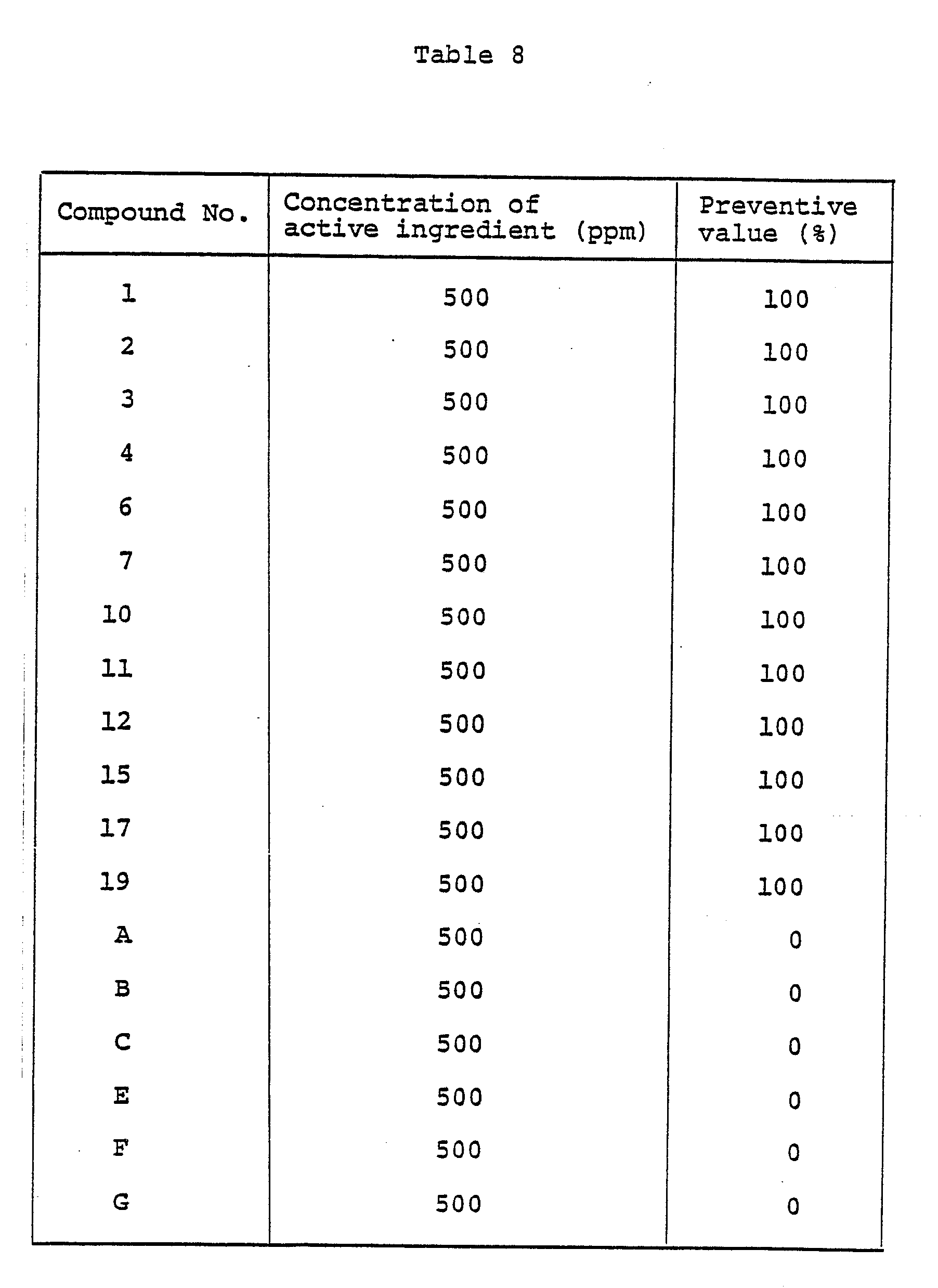
- In the following examples, the compounds of the present invention will be designated by Compound Nos. shown in Tables 4, 5 and 6. The compounds used in comparative experiments are indicated by Compound Symbols shown in Table 7.

- To cucumbers (species: Yotsuba) nursed in pots 6 cm in diameter to the cotyledonal stage, the wettable powder prepared by following the procedure of Formulation Example 1 and diluted with water to a prescribed concentration, was applied by spraying on the aerial parts at a ratio of 10 ml per pot. After the applied solution was air dried, a drug-sensitive strain of Botrytis cinerea was inoculated by spraying to the aereal parts of the cucumbers. The cucumbers were kept in a moist chamber at 23°C for four days. Then, the cucumbers were examined for possible sign of disease contraction. This examination was carried out as follows. The degree of disease contraction was determined by measuring ratio of disease areas of sample leaves, classifying the ratio by the index numbers 0, 1, 3 and 5, assigning numbers of disease leaves to respective index numbers, n₀, n₁, n₃, and n₅, and calculating the following formula using the results of assignment (n represents total number of sample leaves involved).


- Preventive value was calculated in accordance with the following formula.

- The results were as shown in Table 8.
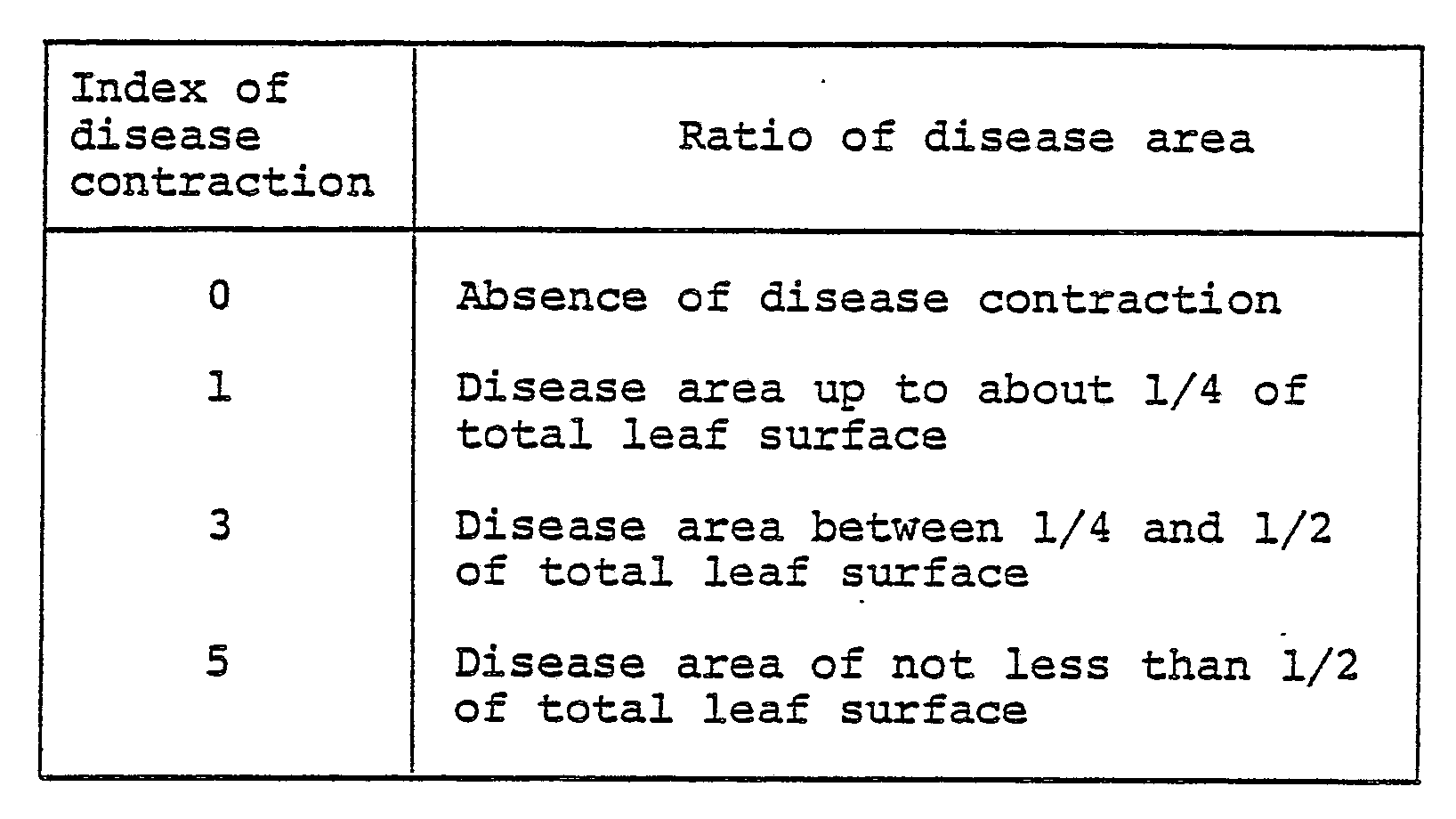
- To cucumbers (species: Yotsuba) nursed in pots 6 cm in diameter to the cotyledonal stage, the wettable powder prepared by following the procedure of Formulation Example 1 and diluted with water to a prescribed concentration, was applied by spraying on the aerial parts at a ratio of 10 ml per pot. After the applied solution was air dried, a drug-resistant strain of Botrytis cinerea was inoculated by spraying to the aereal parts of the cucumbers. The cucumbers were kept in a moist chamber at 23°C for four days. Then, the cucumbers were examined for possible sign of disease contraction. This examination was carried out as follows. The degree of disease contraction was determined by measuring ratio of disease areas of sample leaves, classifying the ratio by the index numbers 0, 1, 3 and 5, assigning numbers of disease leaves to respective index numbers, n₀, n₁, n₃, and n₅, and calculating the following formula using the results of assignment (n represents total number of sample leaves involved).

- Preventive value was calculated in accordance with the following formula.

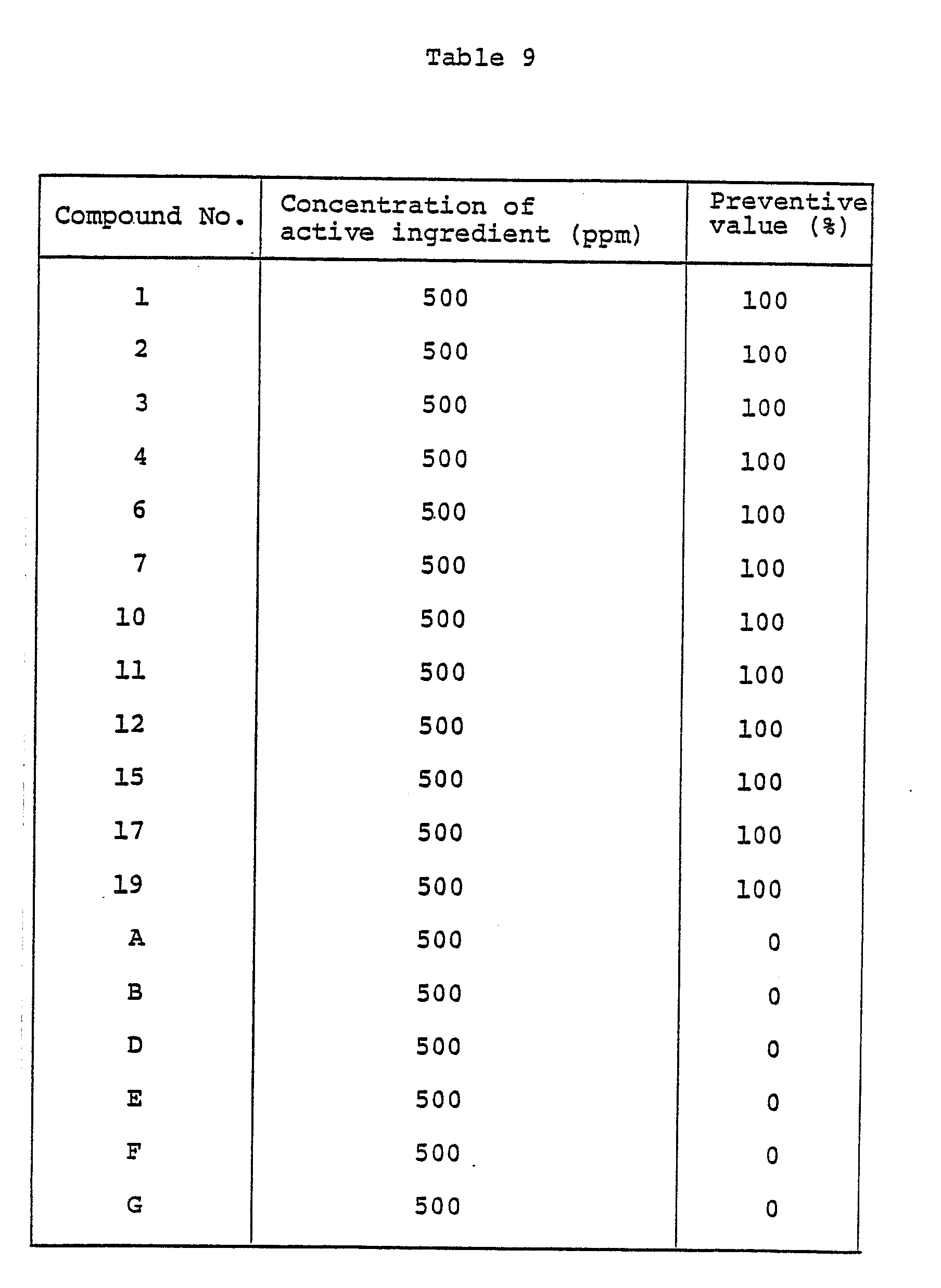
- The results were as shown in Table 9.
- To wheat plants (species: Norin No. 61) nursed in pots 6 cm in diameter to the 1- to 2-leaf stage, a wettable powder prepared by following the procedure of Formulation Example 1 and diluted with water a prescribed concentration, was applied by spraying to aereal parts of plants at a ratio of 10 ml per pot. After the applied solution was air dried, a suspension of spores obtained from wheat leaves which had contracted powdery mildew (Erysiphe graminis) was inoculated by spraying. The wheat plants were left standing at room temperature for 7 to 10 days.
- The effect of control was rated by measuring ratio of disease surfaces of sample leaves and calculating a preventive value in accordance with the following formula using the values obtained by the measurement. The results were as shown in Table 10.

- To rice plants (species: Nipponbare) nursed in pots 6 cm in diameter to the 3 to 4-leaf stage, a wettable powder prepared by following the procedure of Formulation Example 1 and diluted with water to a prescribed concentration, was applied by spraying to aereal parts of plants at a ratio of 10 ml per pot. After the applied solution was air dried, a suspension of hyphae of sheath blight (Rhizoctonia solani) culture in a YG medium was inoculated by spraying. The rice plants were left standing in a moist room at 29°C for 40 hours and then left standing at rest in a water tank at room temperature for 3 days. The effect of control was rated by measuring disease spots as degree of disease contraction and determining a control index in accordance with the following formula using the values obtained by the measurement. The results were as shown in Table 11.


- To wheat plants (species: Norin No. 61) nursed in pots 6 cm in diameter to the 1- to 2-leaf stage, a wettable powder prepared by following the procedure of Test Example 1 and diluted with water to a prescribed concentration, was applied to aereal parts of the wheat plants at a ratio of 10 ml per pot. After the applied solution was air dried, a suspension of spores obtained by grinding wheat which had contracted brown rust (Puccinia recondita) was inoculated by spraying. The wheat plants were kept in a moist chamber at 22°C for 15 hours and then left standing in a glass house at room temperature for 7 days.
- The control effect was rated by measuring ratios of disease spot areas of the leaves and calculating a preventive value in accordance with the following formula using the values found by the measurement.
- The results were as shown in Table 12.


Claims (10)


A - CO₂H (II)
wherein A has the same meaning as defined above, with an amino-indane derivative represented by the general formula (III)





Priority Applications (1)
| Application Number | Priority Date | Filing Date | Title |
|---|---|---|---|
| AT88102727T ATE75469T1 (en) | 1987-02-25 | 1988-02-24 | N-INDANYLCARBOXAMIDE DERIVATIVE AND AGRICULTURAL AND HORTICULTURAL FUNGICIDE CONTAINING SUCH DERIVATIVE AS ACTIVE INGREDIENT. |
Applications Claiming Priority (8)
| Application Number | Priority Date | Filing Date | Title |
|---|---|---|---|
| JP4213687 | 1987-02-25 | ||
| JP42136/87 | 1987-02-25 | ||
| JP93799/87 | 1987-04-16 | ||
| JP62093799A JPS63258868A (en) | 1987-04-16 | 1987-04-16 | Furocarboxylic acid amide derivatives and agricultural and horticultural fungicides containing the same as active ingredients |
| JP26113187 | 1987-10-16 | ||
| JP261131/87 | 1987-10-16 | ||
| JP261132/87 | 1987-10-16 | ||
| JP26113287 | 1987-10-16 |
Publications (3)
| Publication Number | Publication Date |
|---|---|
| EP0280275A2 true EP0280275A2 (en) | 1988-08-31 |
| EP0280275A3 EP0280275A3 (en) | 1989-05-31 |
| EP0280275B1 EP0280275B1 (en) | 1992-04-29 |
Family
ID=27461150
Family Applications (1)
| Application Number | Title | Priority Date | Filing Date |
|---|---|---|---|
| EP88102727A Expired - Lifetime EP0280275B1 (en) | 1987-02-25 | 1988-02-24 | N-indanyl carboxamide derivative and agricultural/horticultural fungicide containing the derivative as active ingredient |
Country Status (7)
| Country | Link |
|---|---|
| US (2) | US4914097A (en) |
| EP (1) | EP0280275B1 (en) |
| KR (1) | KR950012564B1 (en) |
| BR (1) | BR8800876A (en) |
| CA (1) | CA1304380C (en) |
| DE (1) | DE3870478D1 (en) |
| ES (1) | ES2030777T3 (en) |
Cited By (10)
| Publication number | Priority date | Publication date | Assignee | Title |
|---|---|---|---|---|
| US5045554A (en) * | 1988-11-29 | 1991-09-03 | Monsanto Company | Substituted thiazoles and their use as fungicides |
| EP0654464A1 (en) * | 1993-10-22 | 1995-05-24 | Shell Internationale Researchmaatschappij B.V. | Processes for the preparation of pesticides and intermediates |
| US5521317A (en) * | 1993-10-22 | 1996-05-28 | American Cyanamid Co. | Processes for the preparation of pesticides and intermediates |
| WO1998014437A1 (en) * | 1996-09-30 | 1998-04-09 | Nihon Nohyaku Co., Ltd. | 1,2,3-thiadiazole derivatives and salts thereof, disease controlling agents for agricultural and horticultural use, and method for the use thereof |
| US7598395B2 (en) | 2002-10-18 | 2009-10-06 | Syngenta Crop Protection, Inc. | Heterocyclocarboxamide derivatives |
| WO2012084812A1 (en) | 2010-12-20 | 2012-06-28 | Isagro Ricerca S.R.L. | Aminoindanes amides having a high fungicidal activity and their phytosanitary compositions |
| US8859558B2 (en) | 2010-06-07 | 2014-10-14 | Dow Agrosciences, Llc. | Pyrazinyl carboxamides as fungicides |
| WO2017178868A1 (en) | 2016-04-15 | 2017-10-19 | Stichting I-F Product Collaboration | Process for the preparation of 4-aminoindane derivatives and related aminoindane amides |
| US10143200B2 (en) | 2012-06-15 | 2018-12-04 | Stichting I-F Product Collaboration | Synergistic compositions for the protection of agrarian crops and the use thereof |
| IT201900017330A1 (en) | 2019-09-26 | 2021-03-26 | Isagro Spa | PROCESS FOR THE PREPARATION OF (R) -4-AMINOINDANE AND CORRESPONDING AMIDES. |
Families Citing this family (67)
| Publication number | Priority date | Publication date | Assignee | Title |
|---|---|---|---|---|
| US6166054A (en) * | 1995-03-31 | 2000-12-26 | Nihon Nohyaku Co., Ltd. | Agricultural and horticultural disease controller and a method for controlling the diseases |
| US5675024A (en) | 1995-11-22 | 1997-10-07 | Allergan | Aryl or heteroaryl amides of tetrahydronaphthalene, chroman, thiochroman and 1,2,3,4,-tetrahydroquinoline carboxylic acids, having an electron withdrawing substituent in the aromatic or heteroaromatic moiety, having retinoid-like biological activity |
| US8366769B2 (en) | 2000-06-01 | 2013-02-05 | Edwards Lifesciences Corporation | Low-profile, pivotable heart valve sewing ring |
| US6409758B2 (en) * | 2000-07-27 | 2002-06-25 | Edwards Lifesciences Corporation | Heart valve holder for constricting the valve commissures and methods of use |
| ITMI20011012A1 (en) | 2001-05-17 | 2002-11-17 | Ottavio Alfieri | ANNULAR PROSTHESIS FOR MITRAL VALVE |
| US7935145B2 (en) | 2001-05-17 | 2011-05-03 | Edwards Lifesciences Corporation | Annuloplasty ring for ischemic mitral valve insuffuciency |
| US7201771B2 (en) | 2001-12-27 | 2007-04-10 | Arbor Surgical Technologies, Inc. | Bioprosthetic heart valve |
| US7959674B2 (en) | 2002-07-16 | 2011-06-14 | Medtronic, Inc. | Suture locking assembly and method of use |
| DE10250110A1 (en) | 2002-10-28 | 2004-05-13 | Bayer Cropscience Ag | Thiazole (bi) cycloalkylcarboxanilides |
| US8551162B2 (en) | 2002-12-20 | 2013-10-08 | Medtronic, Inc. | Biologically implantable prosthesis |
| US8021421B2 (en) | 2003-08-22 | 2011-09-20 | Medtronic, Inc. | Prosthesis heart valve fixturing device |
| US7871435B2 (en) | 2004-01-23 | 2011-01-18 | Edwards Lifesciences Corporation | Anatomically approximate prosthetic mitral heart valve |
| US20050228494A1 (en) * | 2004-03-29 | 2005-10-13 | Salvador Marquez | Controlled separation heart valve frame |
| US8574257B2 (en) * | 2005-02-10 | 2013-11-05 | Edwards Lifesciences Corporation | System, device, and method for providing access in a cardiovascular environment |
| US7513909B2 (en) * | 2005-04-08 | 2009-04-07 | Arbor Surgical Technologies, Inc. | Two-piece prosthetic valves with snap-in connection and methods for use |
| JP4912395B2 (en) | 2005-05-24 | 2012-04-11 | エドワーズ ライフサイエンシーズ コーポレイション | Rapid placement prosthetic heart valve |
| US8685083B2 (en) * | 2005-06-27 | 2014-04-01 | Edwards Lifesciences Corporation | Apparatus, system, and method for treatment of posterior leaflet prolapse |
| US7776084B2 (en) * | 2005-07-13 | 2010-08-17 | Edwards Lifesciences Corporation | Prosthetic mitral heart valve having a contoured sewing ring |
| US7967857B2 (en) | 2006-01-27 | 2011-06-28 | Medtronic, Inc. | Gasket with spring collar for prosthetic heart valves and methods for making and using them |
| EP2023860A2 (en) | 2006-04-29 | 2009-02-18 | Arbor Surgical Technologies, Inc. | Multiple component prosthetic heart valve assemblies and apparatus and methods for delivering them |
| US8021161B2 (en) * | 2006-05-01 | 2011-09-20 | Edwards Lifesciences Corporation | Simulated heart valve root for training and testing |
| ATE499074T1 (en) * | 2006-05-15 | 2011-03-15 | Edwards Lifesciences Ag | SYSTEM FOR CHANGING THE GEOMETRY OF THE HEART |
| CA2677361C (en) * | 2007-02-09 | 2016-04-05 | Edwards Lifesciences Corporation | Progressively sized annuloplasty rings |
| CA2743719C (en) | 2008-11-25 | 2019-03-19 | Edwards Lifesciences Corporation | Apparatus and method for in situ expansion of prosthetic device |
| US8308798B2 (en) | 2008-12-19 | 2012-11-13 | Edwards Lifesciences Corporation | Quick-connect prosthetic heart valve and methods |
| US9980818B2 (en) * | 2009-03-31 | 2018-05-29 | Edwards Lifesciences Corporation | Prosthetic heart valve system with positioning markers |
| US8348998B2 (en) | 2009-06-26 | 2013-01-08 | Edwards Lifesciences Corporation | Unitary quick connect prosthetic heart valve and deployment system and methods |
| CA2793916C (en) | 2010-05-10 | 2016-10-25 | Edwards Lifesciences Corporation | Prosthetic heart valve |
| US9554901B2 (en) | 2010-05-12 | 2017-01-31 | Edwards Lifesciences Corporation | Low gradient prosthetic heart valve |
| US9370418B2 (en) | 2010-09-10 | 2016-06-21 | Edwards Lifesciences Corporation | Rapidly deployable surgical heart valves |
| US9125741B2 (en) | 2010-09-10 | 2015-09-08 | Edwards Lifesciences Corporation | Systems and methods for ensuring safe and rapid deployment of prosthetic heart valves |
| US8641757B2 (en) | 2010-09-10 | 2014-02-04 | Edwards Lifesciences Corporation | Systems for rapidly deploying surgical heart valves |
| US8845720B2 (en) | 2010-09-27 | 2014-09-30 | Edwards Lifesciences Corporation | Prosthetic heart valve frame with flexible commissures |
| US11213393B2 (en) | 2011-04-01 | 2022-01-04 | Edwards Lifesciences Corporation | Compressible heart valve annulus sizing templates |
| US8945209B2 (en) | 2011-05-20 | 2015-02-03 | Edwards Lifesciences Corporation | Encapsulated heart valve |
| US9078747B2 (en) | 2011-12-21 | 2015-07-14 | Edwards Lifesciences Corporation | Anchoring device for replacing or repairing a heart valve |
| US9693862B2 (en) | 2012-07-31 | 2017-07-04 | Edwards Lifesciences Corporation | Holders for prosthetic heart valves |
| US11007058B2 (en) | 2013-03-15 | 2021-05-18 | Edwards Lifesciences Corporation | Valved aortic conduits |
| EP2967863B1 (en) | 2013-03-15 | 2018-01-31 | Edwards Lifesciences Corporation | Valved aortic conduits |
| US9468527B2 (en) | 2013-06-12 | 2016-10-18 | Edwards Lifesciences Corporation | Cardiac implant with integrated suture fasteners |
| US9919137B2 (en) | 2013-08-28 | 2018-03-20 | Edwards Lifesciences Corporation | Integrated balloon catheter inflation system |
| WO2015042135A1 (en) | 2013-09-20 | 2015-03-26 | Edwards Lifesciences Corporation | Heart valves with increased effective orifice area |
| US20150122687A1 (en) | 2013-11-06 | 2015-05-07 | Edwards Lifesciences Corporation | Bioprosthetic heart valves having adaptive seals to minimize paravalvular leakage |
| US9549816B2 (en) | 2014-04-03 | 2017-01-24 | Edwards Lifesciences Corporation | Method for manufacturing high durability heart valve |
| US9585752B2 (en) | 2014-04-30 | 2017-03-07 | Edwards Lifesciences Corporation | Holder and deployment system for surgical heart valves |
| USD867594S1 (en) | 2015-06-19 | 2019-11-19 | Edwards Lifesciences Corporation | Prosthetic heart valve |
| US12697207B2 (en) | 2014-06-20 | 2026-08-04 | Edwards Lifesciences Corporation | Expandable surgical heart valve indicators |
| CA2914094C (en) | 2014-06-20 | 2021-01-05 | Edwards Lifesciences Corporation | Surgical heart valves identifiable post-implant |
| WO2016022797A1 (en) | 2014-08-06 | 2016-02-11 | Edwards Lifesciences Corporation | Multi-lumen cannulae |
| CN107735051B (en) | 2015-07-02 | 2020-07-31 | 爱德华兹生命科学公司 | Hybrid heart valve suitable for post-implantation expansion |
| US10456246B2 (en) | 2015-07-02 | 2019-10-29 | Edwards Lifesciences Corporation | Integrated hybrid heart valves |
| CN108135592B (en) | 2015-09-02 | 2021-05-14 | 爱德华兹生命科学公司 | Spacers for securing transcatheter valves to bioprosthetic heart structures |
| US10080653B2 (en) | 2015-09-10 | 2018-09-25 | Edwards Lifesciences Corporation | Limited expansion heart valve |
| US10667904B2 (en) | 2016-03-08 | 2020-06-02 | Edwards Lifesciences Corporation | Valve implant with integrated sensor and transmitter |
| CN111839814B (en) | 2016-05-16 | 2024-03-15 | 爱德华兹生命科学公司 | Systems and methods for applying materials to scaffolds |
| USD846122S1 (en) | 2016-12-16 | 2019-04-16 | Edwards Lifesciences Corporation | Heart valve sizer |
| US10463485B2 (en) | 2017-04-06 | 2019-11-05 | Edwards Lifesciences Corporation | Prosthetic valve holders with automatic deploying mechanisms |
| EP3614969B1 (en) | 2017-04-28 | 2023-05-03 | Edwards Lifesciences Corporation | Prosthetic heart valve with collapsible holder |
| CA3065329C (en) | 2017-06-21 | 2024-07-02 | Edwards Lifesciences Corporation | Dual-wireform limited expansion heart valves |
| CA3075819A1 (en) | 2017-10-13 | 2019-04-18 | Edwards Lifesciences Corporation | Method for sterilizing heart valves |
| WO2019147497A1 (en) | 2018-01-23 | 2019-08-01 | Edwards Lifesciences Corporation | Prosthetic valve holders, systems, and methods |
| USD908874S1 (en) | 2018-07-11 | 2021-01-26 | Edwards Lifesciences Corporation | Collapsible heart valve sizer |
| CA3127371A1 (en) | 2019-02-05 | 2020-08-13 | Edwards Lifesciences Corporation | Prosthetic heart valve with suture loop preventing member |
| CA3141348A1 (en) | 2019-08-02 | 2021-02-11 | Edwards Lifesciences Corporation | Rotary application of fibrous material to medical devices |
| EP4009906B1 (en) | 2019-08-05 | 2026-05-06 | Edwards Lifesciences Corporation | Heart valve deployment aid |
| CA3143382A1 (en) | 2019-09-27 | 2021-04-01 | Edwards Lifesciences Corporation | Modified prosthetic heart valve stent |
| CR20210655A (en) | 2019-12-16 | 2022-06-02 | Edwards Lifesciences Corp | Valve holder assembly with suture looping protection |
Family Cites Families (15)
| Publication number | Priority date | Publication date | Assignee | Title |
|---|---|---|---|---|
| US3547917A (en) * | 1966-12-07 | 1970-12-15 | Uniroyal Inc | 2-amino-4-methylthiazole-5-carboxamides |
| CA873888A (en) * | 1967-03-22 | 1971-06-22 | Uniroyal Ltd. - Uniroyal Ltee. | Thiazole derivatives |
| DE1768686B1 (en) * | 1968-06-19 | 1971-05-27 | Basf Ag | Furan-3-carboxylic acid anilides and their use as a fungicide |
| US3959481A (en) * | 1969-02-13 | 1976-05-25 | Uniroyal | Method of protecting plants from fungal diseases using furan-3-carboxamide derivatives |
| DE2132392A1 (en) * | 1971-06-30 | 1973-01-11 | Bayer Ag | 2-mercapto-4-methyl-1,3-thiazole-5-carboxanilides - useful as systemic fungicides |
| NL7402417A (en) * | 1973-03-01 | 1974-09-03 | ||
| US4134987A (en) * | 1976-01-14 | 1979-01-16 | Huppatz John L | Compounds and compositions |
| DE2728523C2 (en) * | 1977-06-23 | 1986-02-27 | Schering AG, 1000 Berlin und 4709 Bergkamen | 4-Methyl-1,2,3-thiadiazole-5-carboxylic acid (cyclohexylmethyl) amide, agents having a herbicidal and growth-regulating action, containing this compound and a process for its preparation |
| DE2922292A1 (en) * | 1978-07-31 | 1980-02-28 | Uniroyal Ltd | Fungicides esp. seed dressings - contg. a furan-3-carboxamide and allyloxy-di:chloro-phenethyl-imidazole and/or 2-thiazolyl-benzimidazole |
| JPS5657776A (en) * | 1979-10-17 | 1981-05-20 | Kumiai Chem Ind Co Ltd | Thiazole derivative and fungicide comprising it |
| OA07237A (en) * | 1981-10-29 | 1984-04-30 | Sumitomo Chemical Co | Fungicidical N-phenylcarbamates. |
| JPS58140054A (en) * | 1982-02-10 | 1983-08-19 | Sumitomo Chem Co Ltd | Indanylbenzamide derivative, its preparation and agricultural and horticultural fungicide containing said derivative as active component |
| BR8506974A (en) * | 1984-10-29 | 1986-12-23 | Sumitomo Chemical Co | PIRAZOLCARBOXAMIDE DERIVATIVE, PROCESS FOR ITS PREPARATION AND FUNGICIDE CONTAINING THE SAME AS AN ACTIVE SUBSTANCE |
| US4837242A (en) * | 1987-01-20 | 1989-06-06 | Sumitomo Chemical Company, Limited | Thiazoles and pyrazoles as fungicides |
| JPH049966A (en) * | 1990-04-27 | 1992-01-14 | Ricoh Co Ltd | Image forming device |
-
1988
- 1988-02-23 US US07/159,277 patent/US4914097A/en not_active Expired - Fee Related
- 1988-02-24 DE DE8888102727T patent/DE3870478D1/en not_active Expired - Lifetime
- 1988-02-24 CA CA000559726A patent/CA1304380C/en not_active Expired - Lifetime
- 1988-02-24 KR KR1019880001934A patent/KR950012564B1/en not_active Expired - Fee Related
- 1988-02-24 EP EP88102727A patent/EP0280275B1/en not_active Expired - Lifetime
- 1988-02-24 ES ES198888102727T patent/ES2030777T3/en not_active Expired - Lifetime
- 1988-02-25 BR BR8800876A patent/BR8800876A/en not_active IP Right Cessation
-
1989
- 1989-11-29 US US07/442,614 patent/US4956375A/en not_active Expired - Fee Related
Cited By (18)
| Publication number | Priority date | Publication date | Assignee | Title |
|---|---|---|---|---|
| US5045554A (en) * | 1988-11-29 | 1991-09-03 | Monsanto Company | Substituted thiazoles and their use as fungicides |
| EP0654464A1 (en) * | 1993-10-22 | 1995-05-24 | Shell Internationale Researchmaatschappij B.V. | Processes for the preparation of pesticides and intermediates |
| US5521317A (en) * | 1993-10-22 | 1996-05-28 | American Cyanamid Co. | Processes for the preparation of pesticides and intermediates |
| WO1998014437A1 (en) * | 1996-09-30 | 1998-04-09 | Nihon Nohyaku Co., Ltd. | 1,2,3-thiadiazole derivatives and salts thereof, disease controlling agents for agricultural and horticultural use, and method for the use thereof |
| US6194444B1 (en) | 1996-09-30 | 2001-02-27 | Nihon Nohyaku Co., Ltd | 1,2,3-Thiadiazole derivatives or salts thereof and agrohorticultural disease controller and method for using the same |
| US6337341B1 (en) | 1996-09-30 | 2002-01-08 | Nihon Nohyaku Co., Ltd. | 1,2,3-Thiadiazole derivatives or salts thereof and agrohorticultural disease controller |
| US7598395B2 (en) | 2002-10-18 | 2009-10-06 | Syngenta Crop Protection, Inc. | Heterocyclocarboxamide derivatives |
| US7994093B2 (en) | 2002-10-18 | 2011-08-09 | Syngenta Crop Protection, Inc. | Heterocyclocarboxamide derivatives |
| US8859558B2 (en) | 2010-06-07 | 2014-10-14 | Dow Agrosciences, Llc. | Pyrazinyl carboxamides as fungicides |
| WO2012084812A1 (en) | 2010-12-20 | 2012-06-28 | Isagro Ricerca S.R.L. | Aminoindanes amides having a high fungicidal activity and their phytosanitary compositions |
| EP2944629A1 (en) | 2010-12-20 | 2015-11-18 | Stichting I-F Product Collaboration | Aminoindanes amides having a high fungicidal activity and their phytosanitary compositions |
| US9192160B2 (en) | 2010-12-20 | 2015-11-24 | Stichting I-F Product Collaboration | Aminoindanes amides having a high fungicidal activity and their phytosanitary compositions |
| US10143200B2 (en) | 2012-06-15 | 2018-12-04 | Stichting I-F Product Collaboration | Synergistic compositions for the protection of agrarian crops and the use thereof |
| WO2017178868A1 (en) | 2016-04-15 | 2017-10-19 | Stichting I-F Product Collaboration | Process for the preparation of 4-aminoindane derivatives and related aminoindane amides |
| US10640454B2 (en) | 2016-04-15 | 2020-05-05 | Stichting I-F Product Collaboration | Processes for preparation of 4-aminoindane compounds and related aminoindane amides |
| US11148995B2 (en) | 2016-04-15 | 2021-10-19 | Stichting I-F Product Collaboration | Processes for preparation of 4-aminoindane compounds and related aminoindane amides |
| US11851388B2 (en) | 2016-04-15 | 2023-12-26 | Fmc Agro Singapore Pte. Ltd. | Compound of 1-acetyl-6-fluoro-2,2,4-trimethyl-1,2,3,4-tetrahydroquinoline |
| IT201900017330A1 (en) | 2019-09-26 | 2021-03-26 | Isagro Spa | PROCESS FOR THE PREPARATION OF (R) -4-AMINOINDANE AND CORRESPONDING AMIDES. |
Also Published As
| Publication number | Publication date |
|---|---|
| KR880009951A (en) | 1988-10-06 |
| CA1304380C (en) | 1992-06-30 |
| EP0280275A3 (en) | 1989-05-31 |
| EP0280275B1 (en) | 1992-04-29 |
| ES2030777T3 (en) | 1992-11-16 |
| KR950012564B1 (en) | 1995-10-19 |
| US4956375A (en) | 1990-09-11 |
| BR8800876A (en) | 1988-10-04 |
| US4914097A (en) | 1990-04-03 |
| DE3870478D1 (en) | 1992-06-04 |
Similar Documents
| Publication | Publication Date | Title |
|---|---|---|
| EP0280275B1 (en) | N-indanyl carboxamide derivative and agricultural/horticultural fungicide containing the derivative as active ingredient | |
| EP0256503B1 (en) | Pyridinecarboxamide derivatives and their use as fungicide | |
| EP0532022B1 (en) | Acrylate compound, preparation process thereof and fungicide using the same | |
| EP0104532B1 (en) | O-halobenzoic acid derivatives, process for their preparation, herbicidal compositions and their use | |
| EP0276177B1 (en) | Heterocyclic derivatives, method for their preparation and fungicides containing them as active ingredients | |
| CZ299375B6 (en) | Phthalimide derivatives or salts thereof, agricultural- horticultural insecticidal agent and application method thereof | |
| CZ20014679A3 (en) | Diamide derivatives of heterocyclic dicarboxylic acid, agricultural and horticultural insecticides and method for using thereof | |
| JP2582863B2 (en) | Gray mold control agent containing N-indanylcarboxylic acid amide derivative as active ingredient | |
| EP0092158A2 (en) | Thiazolidine compound and fungicidal composition containing it | |
| AU606089B2 (en) | Substituted-amido derivatives, method for preparation of the same and phytopathogenic fungicides containing the same | |
| US5178663A (en) | 3-alkoxyalkanoic acid derivative, process for preparing the same and herbicide using the same | |
| KR100291874B1 (en) | Aminopyrimidine Derivatives and Methods for Making and Uses thereof | |
| JPH02157266A (en) | N-indanylcarboxylic acid amide derivatives and agricultural and horticultural fungicides containing the same as active ingredients | |
| JPH054958A (en) | Hydrazinecarboxamide derivative, method for producing the same, use thereof and method of using the same | |
| JPH089601B2 (en) | N-Indanylcarboxylic acid amide derivative and agricultural and horticultural fungicide containing the same | |
| JP3110145B2 (en) | N-substituted-3- (substituted hydrazino) benzenesulfonamide derivatives, process for producing the same and herbicides | |
| US4049820A (en) | Substituted urazole and thiourazole compounds as agricultural fungicidal agents | |
| US5380744A (en) | Phenoxyalkylamine derivative and agricultural and horticultural chemical for controlling noxious organisms containing the same | |
| EP0866056B1 (en) | N- (fluoroalkoxy)phenoxyalkyl]benzamide compounds, intermediates thereof, process for producing the same, and agricultural and horticultural pesticides | |
| JPH04108774A (en) | Optically active n-indanylnicotinic acid amide derivative and agricultural and horticultural fungicide comprising the same derivative as active ingredient | |
| US5252596A (en) | Phenoxyalkylamine derivative and method for controlling noxious organisms containing the same | |
| JP3080284B2 (en) | 3-Alkoxy-N- (N-substituted amino) sulfonylalkanoic acid amide derivatives, their production and herbicides | |
| US4670599A (en) | 2,2-dichloro-3, 3-dimethylcyclopropylmethylamine | |
| RU1787009C (en) | Fungicidal composition | |
| CA1262735A (en) | Pyrazolecarboxamide derivative and fungicide containing it as active ingredient |
Legal Events
| Date | Code | Title | Description |
|---|---|---|---|
| PUAI | Public reference made under article 153(3) epc to a published international application that has entered the european phase |
Free format text: ORIGINAL CODE: 0009012 |
|
| AK | Designated contracting states |
Kind code of ref document: A2 Designated state(s): AT BE CH DE ES FR GB IT LI LU NL |
|
| RAP1 | Party data changed (applicant data changed or rights of an application transferred) |
Owner name: MITSUBISHI KASEI CORPORATION |
|
| PUAL | Search report despatched |
Free format text: ORIGINAL CODE: 0009013 |
|
| AK | Designated contracting states |
Kind code of ref document: A3 Designated state(s): AT BE CH DE ES FR GB IT LI LU NL |
|
| 17P | Request for examination filed |
Effective date: 19890720 |
|
| 17Q | First examination report despatched |
Effective date: 19891017 |
|
| GRAA | (expected) grant |
Free format text: ORIGINAL CODE: 0009210 |
|
| AK | Designated contracting states |
Kind code of ref document: B1 Designated state(s): AT BE CH DE ES FR GB IT LI LU NL |
|
| REF | Corresponds to: |
Ref document number: 75469 Country of ref document: AT Date of ref document: 19920515 Kind code of ref document: T |
|
| RIN1 | Information on inventor provided before grant (corrected) |
Inventor name: NONAKA, NOBUYUKI Inventor name: TOMITA, HIROFUMI Inventor name: SASAKI, NAOKO Inventor name: SAKAKI, TOSHIRO Inventor name: ODA, MASATSUGU 238 MITSUBISHI-KASEI-DAI-NI-APATO |
|
| ITF | It: translation for a ep patent filed | ||
| REF | Corresponds to: |
Ref document number: 3870478 Country of ref document: DE Date of ref document: 19920604 |
|
| ET | Fr: translation filed | ||
| PLBE | No opposition filed within time limit |
Free format text: ORIGINAL CODE: 0009261 |
|
| STAA | Information on the status of an ep patent application or granted ep patent |
Free format text: STATUS: NO OPPOSITION FILED WITHIN TIME LIMIT |
|
| 26N | No opposition filed | ||
| EPTA | Lu: last paid annual fee | ||
| REG | Reference to a national code |
Ref country code: ES Ref legal event code: PC2A Owner name: MITSUBISHI CHEMICAL CORPORATION |
|
| PGFP | Annual fee paid to national office [announced via postgrant information from national office to epo] |
Ref country code: FR Payment date: 19971217 Year of fee payment: 11 |
|
| PGFP | Annual fee paid to national office [announced via postgrant information from national office to epo] |
Ref country code: GB Payment date: 19971222 Year of fee payment: 11 |
|
| PGFP | Annual fee paid to national office [announced via postgrant information from national office to epo] |
Ref country code: BE Payment date: 19971230 Year of fee payment: 11 |
|
| PGFP | Annual fee paid to national office [announced via postgrant information from national office to epo] |
Ref country code: NL Payment date: 19971231 Year of fee payment: 11 |
|
| PGFP | Annual fee paid to national office [announced via postgrant information from national office to epo] |
Ref country code: AT Payment date: 19980114 Year of fee payment: 11 |
|
| PGFP | Annual fee paid to national office [announced via postgrant information from national office to epo] |
Ref country code: CH Payment date: 19980120 Year of fee payment: 11 |
|
| PGFP | Annual fee paid to national office [announced via postgrant information from national office to epo] |
Ref country code: LU Payment date: 19980128 Year of fee payment: 11 |
|
| PGFP | Annual fee paid to national office [announced via postgrant information from national office to epo] |
Ref country code: ES Payment date: 19980210 Year of fee payment: 11 |
|
| PGFP | Annual fee paid to national office [announced via postgrant information from national office to epo] |
Ref country code: DE Payment date: 19980331 Year of fee payment: 11 |
|
| PG25 | Lapsed in a contracting state [announced via postgrant information from national office to epo] |
Ref country code: LU Free format text: LAPSE BECAUSE OF NON-PAYMENT OF DUE FEES Effective date: 19990224 Ref country code: GB Free format text: LAPSE BECAUSE OF NON-PAYMENT OF DUE FEES Effective date: 19990224 Ref country code: AT Free format text: LAPSE BECAUSE OF NON-PAYMENT OF DUE FEES Effective date: 19990224 |
|
| PG25 | Lapsed in a contracting state [announced via postgrant information from national office to epo] |
Ref country code: ES Free format text: LAPSE BECAUSE OF EXPIRATION OF PROTECTION Effective date: 19990225 |
|
| PG25 | Lapsed in a contracting state [announced via postgrant information from national office to epo] |
Ref country code: LI Free format text: LAPSE BECAUSE OF NON-PAYMENT OF DUE FEES Effective date: 19990228 Ref country code: CH Free format text: LAPSE BECAUSE OF NON-PAYMENT OF DUE FEES Effective date: 19990228 Ref country code: BE Free format text: LAPSE BECAUSE OF NON-PAYMENT OF DUE FEES Effective date: 19990228 |
|
| BERE | Be: lapsed |
Owner name: MITSUBISHI CHEMICAL CORP. Effective date: 19990228 |
|
| PG25 | Lapsed in a contracting state [announced via postgrant information from national office to epo] |
Ref country code: NL Free format text: LAPSE BECAUSE OF NON-PAYMENT OF DUE FEES Effective date: 19990901 |
|
| GBPC | Gb: european patent ceased through non-payment of renewal fee |
Effective date: 19990224 |
|
| REG | Reference to a national code |
Ref country code: CH Ref legal event code: PL |
|
| PG25 | Lapsed in a contracting state [announced via postgrant information from national office to epo] |
Ref country code: FR Free format text: LAPSE BECAUSE OF NON-PAYMENT OF DUE FEES Effective date: 19991029 |
|
| PG25 | Lapsed in a contracting state [announced via postgrant information from national office to epo] |
Ref country code: DE Free format text: LAPSE BECAUSE OF NON-PAYMENT OF DUE FEES Effective date: 19991201 |
|
| REG | Reference to a national code |
Ref country code: FR Ref legal event code: ST |
|
| REG | Reference to a national code |
Ref country code: ES Ref legal event code: FD2A Effective date: 20010601 |
|
| PG25 | Lapsed in a contracting state [announced via postgrant information from national office to epo] |
Ref country code: IT Free format text: LAPSE BECAUSE OF NON-PAYMENT OF DUE FEES Effective date: 20050224 |