EP0278633B1 - Colored micaceous pigments - Google Patents
Colored micaceous pigments Download PDFInfo
- Publication number
- EP0278633B1 EP0278633B1 EP88300672A EP88300672A EP0278633B1 EP 0278633 B1 EP0278633 B1 EP 0278633B1 EP 88300672 A EP88300672 A EP 88300672A EP 88300672 A EP88300672 A EP 88300672A EP 0278633 B1 EP0278633 B1 EP 0278633B1
- Authority
- EP
- European Patent Office
- Prior art keywords
- pigment
- platelets
- cation
- mica
- coloured
- Prior art date
- Legal status (The legal status is an assumption and is not a legal conclusion. Google has not performed a legal analysis and makes no representation as to the accuracy of the status listed.)
- Expired - Lifetime
Links
- 239000000049 pigment Substances 0.000 title claims abstract description 116
- 229910052618 mica group Inorganic materials 0.000 claims abstract description 48
- 239000010445 mica Substances 0.000 claims abstract description 47
- 150000001768 cations Chemical class 0.000 claims abstract description 25
- 230000008021 deposition Effects 0.000 claims abstract description 5
- 239000002244 precipitate Substances 0.000 claims abstract description 3
- GWEVSGVZZGPLCZ-UHFFFAOYSA-N Titan oxide Chemical compound O=[Ti]=O GWEVSGVZZGPLCZ-UHFFFAOYSA-N 0.000 claims description 29
- 239000000725 suspension Substances 0.000 claims description 21
- 238000000034 method Methods 0.000 claims description 17
- 229910052751 metal Inorganic materials 0.000 claims description 16
- 239000002184 metal Substances 0.000 claims description 16
- 229920006318 anionic polymer Polymers 0.000 claims description 14
- 239000003973 paint Substances 0.000 claims description 13
- 239000000243 solution Substances 0.000 claims description 13
- HEMHJVSKTPXQMS-UHFFFAOYSA-M Sodium hydroxide Chemical group [OH-].[Na+] HEMHJVSKTPXQMS-UHFFFAOYSA-M 0.000 claims description 12
- XEEYBQQBJWHFJM-UHFFFAOYSA-N Iron Chemical compound [Fe] XEEYBQQBJWHFJM-UHFFFAOYSA-N 0.000 claims description 10
- 230000000694 effects Effects 0.000 claims description 9
- NRCMAYZCPIVABH-UHFFFAOYSA-N Quinacridone Chemical compound N1C2=CC=CC=C2C(=O)C2=C1C=C1C(=O)C3=CC=CC=C3NC1=C2 NRCMAYZCPIVABH-UHFFFAOYSA-N 0.000 claims description 6
- 239000007900 aqueous suspension Substances 0.000 claims description 6
- JEIPFZHSYJVQDO-UHFFFAOYSA-N iron(III) oxide Inorganic materials O=[Fe]O[Fe]=O JEIPFZHSYJVQDO-UHFFFAOYSA-N 0.000 claims description 6
- 238000001556 precipitation Methods 0.000 claims description 6
- 102000009027 Albumins Human genes 0.000 claims description 5
- 108010088751 Albumins Proteins 0.000 claims description 5
- 229910052782 aluminium Inorganic materials 0.000 claims description 5
- 239000007864 aqueous solution Substances 0.000 claims description 5
- 229910052742 iron Inorganic materials 0.000 claims description 5
- -1 tin cations Chemical class 0.000 claims description 5
- 108010010803 Gelatin Proteins 0.000 claims description 4
- XAGFODPZIPBFFR-UHFFFAOYSA-N aluminium Chemical compound [Al] XAGFODPZIPBFFR-UHFFFAOYSA-N 0.000 claims description 4
- 239000006229 carbon black Substances 0.000 claims description 4
- 229910052804 chromium Inorganic materials 0.000 claims description 4
- 239000011651 chromium Substances 0.000 claims description 4
- 229920000159 gelatin Polymers 0.000 claims description 4
- 239000008273 gelatin Substances 0.000 claims description 4
- 235000019322 gelatine Nutrition 0.000 claims description 4
- 235000011852 gelatine desserts Nutrition 0.000 claims description 4
- 150000004676 glycans Chemical class 0.000 claims description 4
- XLYOFNOQVPJJNP-UHFFFAOYSA-M hydroxide Chemical compound [OH-] XLYOFNOQVPJJNP-UHFFFAOYSA-M 0.000 claims description 4
- 229920001282 polysaccharide Polymers 0.000 claims description 4
- 239000005017 polysaccharide Substances 0.000 claims description 4
- 239000002253 acid Substances 0.000 claims description 3
- 229920000615 alginic acid Polymers 0.000 claims description 3
- 235000010443 alginic acid Nutrition 0.000 claims description 3
- 239000010936 titanium Substances 0.000 claims description 3
- VYZAMTAEIAYCRO-UHFFFAOYSA-N Chromium Chemical compound [Cr] VYZAMTAEIAYCRO-UHFFFAOYSA-N 0.000 claims description 2
- 229920002125 Sokalan® Polymers 0.000 claims description 2
- REDXJYDRNCIFBQ-UHFFFAOYSA-N aluminium(3+) Chemical compound [Al+3] REDXJYDRNCIFBQ-UHFFFAOYSA-N 0.000 claims description 2
- 239000000463 material Substances 0.000 claims description 2
- 239000004411 aluminium Substances 0.000 claims 3
- 239000003795 chemical substances by application Substances 0.000 claims 3
- 238000010979 pH adjustment Methods 0.000 claims 3
- FHVDTGUDJYJELY-UHFFFAOYSA-N 6-{[2-carboxy-4,5-dihydroxy-6-(phosphanyloxy)oxan-3-yl]oxy}-4,5-dihydroxy-3-phosphanyloxane-2-carboxylic acid Chemical compound O1C(C(O)=O)C(P)C(O)C(O)C1OC1C(C(O)=O)OC(OP)C(O)C1O FHVDTGUDJYJELY-UHFFFAOYSA-N 0.000 claims 2
- FYYHWMGAXLPEAU-UHFFFAOYSA-N Magnesium Chemical compound [Mg] FYYHWMGAXLPEAU-UHFFFAOYSA-N 0.000 claims 2
- RTAQQCXQSZGOHL-UHFFFAOYSA-N Titanium Chemical compound [Ti] RTAQQCXQSZGOHL-UHFFFAOYSA-N 0.000 claims 2
- HCHKCACWOHOZIP-UHFFFAOYSA-N Zinc Chemical compound [Zn] HCHKCACWOHOZIP-UHFFFAOYSA-N 0.000 claims 2
- QCWXUUIWCKQGHC-UHFFFAOYSA-N Zirconium Chemical compound [Zr] QCWXUUIWCKQGHC-UHFFFAOYSA-N 0.000 claims 2
- 229940072056 alginate Drugs 0.000 claims 2
- PPSZHCXTGRHULJ-UHFFFAOYSA-N dioxazine Chemical compound O1ON=CC=C1 PPSZHCXTGRHULJ-UHFFFAOYSA-N 0.000 claims 2
- 229910052749 magnesium Inorganic materials 0.000 claims 2
- 239000011777 magnesium Substances 0.000 claims 2
- IEQIEDJGQAUEQZ-UHFFFAOYSA-N phthalocyanine Chemical group N1C(N=C2C3=CC=CC=C3C(N=C3C4=CC=CC=C4C(=N4)N3)=N2)=C(C=CC=C2)C2=C1N=C1C2=CC=CC=C2C4=N1 IEQIEDJGQAUEQZ-UHFFFAOYSA-N 0.000 claims 2
- 229910052718 tin Inorganic materials 0.000 claims 2
- 229910052719 titanium Inorganic materials 0.000 claims 2
- 229910052725 zinc Inorganic materials 0.000 claims 2
- 239000011701 zinc Substances 0.000 claims 2
- 229910052726 zirconium Inorganic materials 0.000 claims 2
- ATJFFYVFTNAWJD-UHFFFAOYSA-N Tin Chemical compound [Sn] ATJFFYVFTNAWJD-UHFFFAOYSA-N 0.000 claims 1
- 239000003929 acidic solution Substances 0.000 claims 1
- 239000000549 coloured material Substances 0.000 claims 1
- 229920000831 ionic polymer Polymers 0.000 claims 1
- UQSXHKLRYXJYBZ-UHFFFAOYSA-N iron oxide Inorganic materials [Fe]=O UQSXHKLRYXJYBZ-UHFFFAOYSA-N 0.000 claims 1
- LIKBJVNGSGBSGK-UHFFFAOYSA-N iron(3+);oxygen(2-) Chemical compound [O-2].[O-2].[O-2].[Fe+3].[Fe+3] LIKBJVNGSGBSGK-UHFFFAOYSA-N 0.000 claims 1
- NDLPOXTZKUMGOV-UHFFFAOYSA-N oxo(oxoferriooxy)iron hydrate Chemical compound O.O=[Fe]O[Fe]=O NDLPOXTZKUMGOV-UHFFFAOYSA-N 0.000 claims 1
- 239000004584 polyacrylic acid Substances 0.000 claims 1
- 235000010215 titanium dioxide Nutrition 0.000 claims 1
- OGIDPMRJRNCKJF-UHFFFAOYSA-N titanium oxide Inorganic materials [Ti]=O OGIDPMRJRNCKJF-UHFFFAOYSA-N 0.000 claims 1
- 125000000129 anionic group Chemical group 0.000 abstract description 4
- 239000000126 substance Substances 0.000 abstract description 2
- 238000010521 absorption reaction Methods 0.000 description 28
- XLYOFNOQVPJJNP-UHFFFAOYSA-N water Substances O XLYOFNOQVPJJNP-UHFFFAOYSA-N 0.000 description 18
- 238000000576 coating method Methods 0.000 description 16
- 239000003086 colorant Substances 0.000 description 14
- 239000011248 coating agent Substances 0.000 description 11
- 239000006185 dispersion Substances 0.000 description 10
- 229920000642 polymer Polymers 0.000 description 10
- 239000002245 particle Substances 0.000 description 7
- 239000000203 mixture Substances 0.000 description 6
- 239000000376 reactant Substances 0.000 description 6
- XCJYREBRNVKWGJ-UHFFFAOYSA-N copper(II) phthalocyanine Chemical compound [Cu+2].C12=CC=CC=C2C(N=C2[N-]C(C3=CC=CC=C32)=N2)=NC1=NC([C]1C=CC=CC1=1)=NC=1N=C1[C]3C=CC=CC3=C2[N-]1 XCJYREBRNVKWGJ-UHFFFAOYSA-N 0.000 description 5
- 238000000151 deposition Methods 0.000 description 5
- 239000012065 filter cake Substances 0.000 description 5
- 230000003287 optical effect Effects 0.000 description 5
- 239000000758 substrate Substances 0.000 description 5
- MCMNRKCIXSYSNV-UHFFFAOYSA-N Zirconium dioxide Chemical compound O=[Zr]=O MCMNRKCIXSYSNV-UHFFFAOYSA-N 0.000 description 4
- QDOXWKRWXJOMAK-UHFFFAOYSA-N dichromium trioxide Chemical compound O=[Cr]O[Cr]=O QDOXWKRWXJOMAK-UHFFFAOYSA-N 0.000 description 4
- 238000002156 mixing Methods 0.000 description 4
- XOLBLPGZBRYERU-UHFFFAOYSA-N tin dioxide Chemical compound O=[Sn]=O XOLBLPGZBRYERU-UHFFFAOYSA-N 0.000 description 4
- 229920001285 xanthan gum Polymers 0.000 description 4
- 230000001464 adherent effect Effects 0.000 description 3
- 239000002585 base Substances 0.000 description 3
- BFGKITSFLPAWGI-UHFFFAOYSA-N chromium(3+) Chemical compound [Cr+3] BFGKITSFLPAWGI-UHFFFAOYSA-N 0.000 description 3
- KWYUFKZDYYNOTN-UHFFFAOYSA-M potassium hydroxide Inorganic materials [OH-].[K+] KWYUFKZDYYNOTN-UHFFFAOYSA-M 0.000 description 3
- 150000003839 salts Chemical class 0.000 description 3
- 238000005406 washing Methods 0.000 description 3
- 239000000230 xanthan gum Substances 0.000 description 3
- 235000010493 xanthan gum Nutrition 0.000 description 3
- 229940082509 xanthan gum Drugs 0.000 description 3
- CWYNVVGOOAEACU-UHFFFAOYSA-N Fe2+ Chemical compound [Fe+2] CWYNVVGOOAEACU-UHFFFAOYSA-N 0.000 description 2
- VEXZGXHMUGYJMC-UHFFFAOYSA-N Hydrochloric acid Chemical compound Cl VEXZGXHMUGYJMC-UHFFFAOYSA-N 0.000 description 2
- XLOMVQKBTHCTTD-UHFFFAOYSA-N Zinc monoxide Chemical compound [Zn]=O XLOMVQKBTHCTTD-UHFFFAOYSA-N 0.000 description 2
- WNROFYMDJYEPJX-UHFFFAOYSA-K aluminium hydroxide Chemical compound [OH-].[OH-].[OH-].[Al+3] WNROFYMDJYEPJX-UHFFFAOYSA-K 0.000 description 2
- 230000015572 biosynthetic process Effects 0.000 description 2
- 238000006243 chemical reaction Methods 0.000 description 2
- 239000002537 cosmetic Substances 0.000 description 2
- 150000005125 dioxazines Chemical class 0.000 description 2
- YGANSGVIUGARFR-UHFFFAOYSA-N dipotassium dioxosilane oxo(oxoalumanyloxy)alumane oxygen(2-) Chemical compound [O--].[K+].[K+].O=[Si]=O.O=[Al]O[Al]=O YGANSGVIUGARFR-UHFFFAOYSA-N 0.000 description 2
- GNTDGMZSJNCJKK-UHFFFAOYSA-N divanadium pentaoxide Chemical compound O=[V](=O)O[V](=O)=O GNTDGMZSJNCJKK-UHFFFAOYSA-N 0.000 description 2
- 239000000706 filtrate Substances 0.000 description 2
- QYFRTHZXAGSYGT-UHFFFAOYSA-L hexaaluminum dipotassium dioxosilane oxygen(2-) difluoride hydrate Chemical compound O.[O--].[O--].[O--].[O--].[O--].[O--].[O--].[O--].[O--].[F-].[F-].[Al+3].[Al+3].[Al+3].[Al+3].[Al+3].[Al+3].[K+].[K+].O=[Si]=O.O=[Si]=O.O=[Si]=O.O=[Si]=O.O=[Si]=O.O=[Si]=O QYFRTHZXAGSYGT-UHFFFAOYSA-L 0.000 description 2
- DCYOBGZUOMKFPA-UHFFFAOYSA-N iron(2+);iron(3+);octadecacyanide Chemical compound [Fe+2].[Fe+2].[Fe+2].[Fe+3].[Fe+3].[Fe+3].[Fe+3].N#[C-].N#[C-].N#[C-].N#[C-].N#[C-].N#[C-].N#[C-].N#[C-].N#[C-].N#[C-].N#[C-].N#[C-].N#[C-].N#[C-].N#[C-].N#[C-].N#[C-].N#[C-] DCYOBGZUOMKFPA-UHFFFAOYSA-N 0.000 description 2
- 229910052627 muscovite Inorganic materials 0.000 description 2
- 150000002979 perylenes Chemical class 0.000 description 2
- 229920003023 plastic Polymers 0.000 description 2
- 239000004033 plastic Substances 0.000 description 2
- 239000012266 salt solution Substances 0.000 description 2
- 238000003756 stirring Methods 0.000 description 2
- 239000004408 titanium dioxide Substances 0.000 description 2
- GJCOSYZMQJWQCA-UHFFFAOYSA-N 9H-xanthene Chemical compound C1=CC=C2CC3=CC=CC=C3OC2=C1 GJCOSYZMQJWQCA-UHFFFAOYSA-N 0.000 description 1
- 229920000178 Acrylic resin Polymers 0.000 description 1
- 239000004925 Acrylic resin Substances 0.000 description 1
- NLXLAEXVIDQMFP-UHFFFAOYSA-N Ammonium chloride Substances [NH4+].[Cl-] NLXLAEXVIDQMFP-UHFFFAOYSA-N 0.000 description 1
- VHUUQVKOLVNVRT-UHFFFAOYSA-N Ammonium hydroxide Chemical compound [NH4+].[OH-] VHUUQVKOLVNVRT-UHFFFAOYSA-N 0.000 description 1
- 229910000906 Bronze Inorganic materials 0.000 description 1
- VEXZGXHMUGYJMC-UHFFFAOYSA-M Chloride anion Chemical compound [Cl-] VEXZGXHMUGYJMC-UHFFFAOYSA-M 0.000 description 1
- LFQSCWFLJHTTHZ-UHFFFAOYSA-N Ethanol Chemical compound CCO LFQSCWFLJHTTHZ-UHFFFAOYSA-N 0.000 description 1
- VTLYFUHAOXGGBS-UHFFFAOYSA-N Fe3+ Chemical compound [Fe+3] VTLYFUHAOXGGBS-UHFFFAOYSA-N 0.000 description 1
- 241001251094 Formica Species 0.000 description 1
- IAJILQKETJEXLJ-UHFFFAOYSA-N Galacturonsaeure Natural products O=CC(O)C(O)C(O)C(O)C(O)=O IAJILQKETJEXLJ-UHFFFAOYSA-N 0.000 description 1
- 229910021578 Iron(III) chloride Inorganic materials 0.000 description 1
- 229920000877 Melamine resin Polymers 0.000 description 1
- 229910002651 NO3 Inorganic materials 0.000 description 1
- NHNBFGGVMKEFGY-UHFFFAOYSA-N Nitrate Chemical compound [O-][N+]([O-])=O NHNBFGGVMKEFGY-UHFFFAOYSA-N 0.000 description 1
- CTQNGGLPUBDAKN-UHFFFAOYSA-N O-Xylene Chemical compound CC1=CC=CC=C1C CTQNGGLPUBDAKN-UHFFFAOYSA-N 0.000 description 1
- 229910019142 PO4 Inorganic materials 0.000 description 1
- ABLZXFCXXLZCGV-UHFFFAOYSA-N Phosphorous acid Chemical class OP(O)=O ABLZXFCXXLZCGV-UHFFFAOYSA-N 0.000 description 1
- BQCADISMDOOEFD-UHFFFAOYSA-N Silver Chemical compound [Ag] BQCADISMDOOEFD-UHFFFAOYSA-N 0.000 description 1
- QAOWNCQODCNURD-UHFFFAOYSA-L Sulfate Chemical compound [O-]S([O-])(=O)=O QAOWNCQODCNURD-UHFFFAOYSA-L 0.000 description 1
- PTFCDOFLOPIGGS-UHFFFAOYSA-N Zinc dication Chemical compound [Zn+2] PTFCDOFLOPIGGS-UHFFFAOYSA-N 0.000 description 1
- DPXJVFZANSGRMM-UHFFFAOYSA-N acetic acid;2,3,4,5,6-pentahydroxyhexanal;sodium Chemical compound [Na].CC(O)=O.OCC(O)C(O)C(O)C(O)C=O DPXJVFZANSGRMM-UHFFFAOYSA-N 0.000 description 1
- 230000002378 acidificating effect Effects 0.000 description 1
- 230000002411 adverse Effects 0.000 description 1
- IAJILQKETJEXLJ-QTBDOELSSA-N aldehydo-D-glucuronic acid Chemical compound O=C[C@H](O)[C@@H](O)[C@H](O)[C@H](O)C(O)=O IAJILQKETJEXLJ-QTBDOELSSA-N 0.000 description 1
- JGDITNMASUZKPW-UHFFFAOYSA-K aluminium trichloride hexahydrate Chemical compound O.O.O.O.O.O.Cl[Al](Cl)Cl JGDITNMASUZKPW-UHFFFAOYSA-K 0.000 description 1
- QGZKDVFQNNGYKY-UHFFFAOYSA-N ammonia Natural products N QGZKDVFQNNGYKY-UHFFFAOYSA-N 0.000 description 1
- 235000011114 ammonium hydroxide Nutrition 0.000 description 1
- 150000001450 anions Chemical class 0.000 description 1
- 150000004056 anthraquinones Chemical class 0.000 description 1
- 238000000149 argon plasma sintering Methods 0.000 description 1
- 239000003637 basic solution Substances 0.000 description 1
- 229910052626 biotite Inorganic materials 0.000 description 1
- 239000010974 bronze Substances 0.000 description 1
- 239000001768 carboxy methyl cellulose Substances 0.000 description 1
- 125000002091 cationic group Chemical group 0.000 description 1
- VQWFNAGFNGABOH-UHFFFAOYSA-K chromium(iii) hydroxide Chemical compound [OH-].[OH-].[OH-].[Cr+3] VQWFNAGFNGABOH-UHFFFAOYSA-K 0.000 description 1
- 239000008199 coating composition Substances 0.000 description 1
- KUNSUQLRTQLHQQ-UHFFFAOYSA-N copper tin Chemical compound [Cu].[Sn] KUNSUQLRTQLHQQ-UHFFFAOYSA-N 0.000 description 1
- 238000010790 dilution Methods 0.000 description 1
- 239000012895 dilution Substances 0.000 description 1
- 238000001035 drying Methods 0.000 description 1
- 238000009472 formulation Methods 0.000 description 1
- 229940097043 glucuronic acid Drugs 0.000 description 1
- PCHJSUWPFVWCPO-UHFFFAOYSA-N gold Chemical compound [Au] PCHJSUWPFVWCPO-UHFFFAOYSA-N 0.000 description 1
- 239000010931 gold Substances 0.000 description 1
- 229910052737 gold Inorganic materials 0.000 description 1
- 238000011065 in-situ storage Methods 0.000 description 1
- 238000010348 incorporation Methods 0.000 description 1
- RBTARNINKXHZNM-UHFFFAOYSA-K iron trichloride Chemical compound Cl[Fe](Cl)Cl RBTARNINKXHZNM-UHFFFAOYSA-K 0.000 description 1
- YWBREQLMDUVNIR-UHFFFAOYSA-N iron(2+);hexacyanide Chemical compound [Fe+2].[Fe+2].[Fe+2].N#[C-].N#[C-].N#[C-].N#[C-].N#[C-].N#[C-] YWBREQLMDUVNIR-UHFFFAOYSA-N 0.000 description 1
- 239000004922 lacquer Substances 0.000 description 1
- 239000007788 liquid Substances 0.000 description 1
- 239000002932 luster Substances 0.000 description 1
- JDSHMPZPIAZGSV-UHFFFAOYSA-N melamine Chemical compound NC1=NC(N)=NC(N)=N1 JDSHMPZPIAZGSV-UHFFFAOYSA-N 0.000 description 1
- 229910000000 metal hydroxide Inorganic materials 0.000 description 1
- 150000004692 metal hydroxides Chemical class 0.000 description 1
- 229910021645 metal ion Inorganic materials 0.000 description 1
- 229910044991 metal oxide Inorganic materials 0.000 description 1
- 150000002739 metals Chemical class 0.000 description 1
- 238000003801 milling Methods 0.000 description 1
- 229910000069 nitrogen hydride Inorganic materials 0.000 description 1
- 239000012860 organic pigment Substances 0.000 description 1
- 230000003647 oxidation Effects 0.000 description 1
- 238000007254 oxidation reaction Methods 0.000 description 1
- 229910052628 phlogopite Inorganic materials 0.000 description 1
- NBIIXXVUZAFLBC-UHFFFAOYSA-K phosphate Chemical compound [O-]P([O-])([O-])=O NBIIXXVUZAFLBC-UHFFFAOYSA-K 0.000 description 1
- 239000010452 phosphate Substances 0.000 description 1
- 229920001467 poly(styrenesulfonates) Polymers 0.000 description 1
- 229920002401 polyacrylamide Polymers 0.000 description 1
- 239000011970 polystyrene sulfonate Substances 0.000 description 1
- 239000000276 potassium ferrocyanide Substances 0.000 description 1
- 239000000843 powder Substances 0.000 description 1
- 230000001376 precipitating effect Effects 0.000 description 1
- 239000002243 precursor Substances 0.000 description 1
- 238000002360 preparation method Methods 0.000 description 1
- 239000000047 product Substances 0.000 description 1
- 102000004169 proteins and genes Human genes 0.000 description 1
- 108090000623 proteins and genes Proteins 0.000 description 1
- 239000001054 red pigment Substances 0.000 description 1
- 229910052709 silver Inorganic materials 0.000 description 1
- 239000004332 silver Substances 0.000 description 1
- 235000019812 sodium carboxymethyl cellulose Nutrition 0.000 description 1
- 229920001027 sodium carboxymethylcellulose Polymers 0.000 description 1
- 239000002904 solvent Substances 0.000 description 1
- XOGGUFAVLNCTRS-UHFFFAOYSA-N tetrapotassium;iron(2+);hexacyanide Chemical compound [K+].[K+].[K+].[K+].[Fe+2].N#[C-].N#[C-].N#[C-].N#[C-].N#[C-].N#[C-] XOGGUFAVLNCTRS-UHFFFAOYSA-N 0.000 description 1
- 229920001187 thermosetting polymer Polymers 0.000 description 1
- 230000007704 transition Effects 0.000 description 1
- 229920002554 vinyl polymer Polymers 0.000 description 1
- 238000001429 visible spectrum Methods 0.000 description 1
- 239000008096 xylene Substances 0.000 description 1
Classifications
-
- C—CHEMISTRY; METALLURGY
- C09—DYES; PAINTS; POLISHES; NATURAL RESINS; ADHESIVES; COMPOSITIONS NOT OTHERWISE PROVIDED FOR; APPLICATIONS OF MATERIALS NOT OTHERWISE PROVIDED FOR
- C09B—ORGANIC DYES OR CLOSELY-RELATED COMPOUNDS FOR PRODUCING DYES, e.g. PIGMENTS; MORDANTS; LAKES
- C09B63/00—Lakes
-
- C—CHEMISTRY; METALLURGY
- C09—DYES; PAINTS; POLISHES; NATURAL RESINS; ADHESIVES; COMPOSITIONS NOT OTHERWISE PROVIDED FOR; APPLICATIONS OF MATERIALS NOT OTHERWISE PROVIDED FOR
- C09C—TREATMENT OF INORGANIC MATERIALS, OTHER THAN FIBROUS FILLERS, TO ENHANCE THEIR PIGMENTING OR FILLING PROPERTIES ; PREPARATION OF CARBON BLACK ; PREPARATION OF INORGANIC MATERIALS WHICH ARE NO SINGLE CHEMICAL COMPOUNDS AND WHICH ARE MAINLY USED AS PIGMENTS OR FILLERS
- C09C1/00—Treatment of specific inorganic materials other than fibrous fillers; Preparation of carbon black
- C09C1/0015—Pigments exhibiting interference colours, e.g. transparent platelets of appropriate thinness or flaky substrates, e.g. mica, bearing appropriate thin transparent coatings
-
- C—CHEMISTRY; METALLURGY
- C01—INORGANIC CHEMISTRY
- C01P—INDEXING SCHEME RELATING TO STRUCTURAL AND PHYSICAL ASPECTS OF SOLID INORGANIC COMPOUNDS
- C01P2004/00—Particle morphology
- C01P2004/20—Particle morphology extending in two dimensions, e.g. plate-like
-
- C—CHEMISTRY; METALLURGY
- C01—INORGANIC CHEMISTRY
- C01P—INDEXING SCHEME RELATING TO STRUCTURAL AND PHYSICAL ASPECTS OF SOLID INORGANIC COMPOUNDS
- C01P2004/00—Particle morphology
- C01P2004/80—Particles consisting of a mixture of two or more inorganic phases
- C01P2004/82—Particles consisting of a mixture of two or more inorganic phases two phases having the same anion, e.g. both oxidic phases
- C01P2004/84—Particles consisting of a mixture of two or more inorganic phases two phases having the same anion, e.g. both oxidic phases one phase coated with the other
-
- C—CHEMISTRY; METALLURGY
- C09—DYES; PAINTS; POLISHES; NATURAL RESINS; ADHESIVES; COMPOSITIONS NOT OTHERWISE PROVIDED FOR; APPLICATIONS OF MATERIALS NOT OTHERWISE PROVIDED FOR
- C09C—TREATMENT OF INORGANIC MATERIALS, OTHER THAN FIBROUS FILLERS, TO ENHANCE THEIR PIGMENTING OR FILLING PROPERTIES ; PREPARATION OF CARBON BLACK ; PREPARATION OF INORGANIC MATERIALS WHICH ARE NO SINGLE CHEMICAL COMPOUNDS AND WHICH ARE MAINLY USED AS PIGMENTS OR FILLERS
- C09C2200/00—Compositional and structural details of pigments exhibiting interference colours
- C09C2200/10—Interference pigments characterized by the core material
- C09C2200/102—Interference pigments characterized by the core material the core consisting of glass or silicate material like mica or clays, e.g. kaolin
-
- C—CHEMISTRY; METALLURGY
- C09—DYES; PAINTS; POLISHES; NATURAL RESINS; ADHESIVES; COMPOSITIONS NOT OTHERWISE PROVIDED FOR; APPLICATIONS OF MATERIALS NOT OTHERWISE PROVIDED FOR
- C09C—TREATMENT OF INORGANIC MATERIALS, OTHER THAN FIBROUS FILLERS, TO ENHANCE THEIR PIGMENTING OR FILLING PROPERTIES ; PREPARATION OF CARBON BLACK ; PREPARATION OF INORGANIC MATERIALS WHICH ARE NO SINGLE CHEMICAL COMPOUNDS AND WHICH ARE MAINLY USED AS PIGMENTS OR FILLERS
- C09C2200/00—Compositional and structural details of pigments exhibiting interference colours
- C09C2200/30—Interference pigments characterised by the thickness of the core or layers thereon or by the total thickness of the final pigment particle
- C09C2200/301—Thickness of the core
-
- C—CHEMISTRY; METALLURGY
- C09—DYES; PAINTS; POLISHES; NATURAL RESINS; ADHESIVES; COMPOSITIONS NOT OTHERWISE PROVIDED FOR; APPLICATIONS OF MATERIALS NOT OTHERWISE PROVIDED FOR
- C09C—TREATMENT OF INORGANIC MATERIALS, OTHER THAN FIBROUS FILLERS, TO ENHANCE THEIR PIGMENTING OR FILLING PROPERTIES ; PREPARATION OF CARBON BLACK ; PREPARATION OF INORGANIC MATERIALS WHICH ARE NO SINGLE CHEMICAL COMPOUNDS AND WHICH ARE MAINLY USED AS PIGMENTS OR FILLERS
- C09C2200/00—Compositional and structural details of pigments exhibiting interference colours
- C09C2200/30—Interference pigments characterised by the thickness of the core or layers thereon or by the total thickness of the final pigment particle
- C09C2200/302—Thickness of a layer with high refractive material
-
- C—CHEMISTRY; METALLURGY
- C09—DYES; PAINTS; POLISHES; NATURAL RESINS; ADHESIVES; COMPOSITIONS NOT OTHERWISE PROVIDED FOR; APPLICATIONS OF MATERIALS NOT OTHERWISE PROVIDED FOR
- C09C—TREATMENT OF INORGANIC MATERIALS, OTHER THAN FIBROUS FILLERS, TO ENHANCE THEIR PIGMENTING OR FILLING PROPERTIES ; PREPARATION OF CARBON BLACK ; PREPARATION OF INORGANIC MATERIALS WHICH ARE NO SINGLE CHEMICAL COMPOUNDS AND WHICH ARE MAINLY USED AS PIGMENTS OR FILLERS
- C09C2200/00—Compositional and structural details of pigments exhibiting interference colours
- C09C2200/30—Interference pigments characterised by the thickness of the core or layers thereon or by the total thickness of the final pigment particle
- C09C2200/303—Thickness of a layer with low refractive material
-
- C—CHEMISTRY; METALLURGY
- C09—DYES; PAINTS; POLISHES; NATURAL RESINS; ADHESIVES; COMPOSITIONS NOT OTHERWISE PROVIDED FOR; APPLICATIONS OF MATERIALS NOT OTHERWISE PROVIDED FOR
- C09C—TREATMENT OF INORGANIC MATERIALS, OTHER THAN FIBROUS FILLERS, TO ENHANCE THEIR PIGMENTING OR FILLING PROPERTIES ; PREPARATION OF CARBON BLACK ; PREPARATION OF INORGANIC MATERIALS WHICH ARE NO SINGLE CHEMICAL COMPOUNDS AND WHICH ARE MAINLY USED AS PIGMENTS OR FILLERS
- C09C2200/00—Compositional and structural details of pigments exhibiting interference colours
- C09C2200/40—Interference pigments comprising an outermost surface coating
- C09C2200/402—Organic protective coating
- C09C2200/403—Low molecular weight materials, e.g. fatty acids
-
- C—CHEMISTRY; METALLURGY
- C09—DYES; PAINTS; POLISHES; NATURAL RESINS; ADHESIVES; COMPOSITIONS NOT OTHERWISE PROVIDED FOR; APPLICATIONS OF MATERIALS NOT OTHERWISE PROVIDED FOR
- C09C—TREATMENT OF INORGANIC MATERIALS, OTHER THAN FIBROUS FILLERS, TO ENHANCE THEIR PIGMENTING OR FILLING PROPERTIES ; PREPARATION OF CARBON BLACK ; PREPARATION OF INORGANIC MATERIALS WHICH ARE NO SINGLE CHEMICAL COMPOUNDS AND WHICH ARE MAINLY USED AS PIGMENTS OR FILLERS
- C09C2200/00—Compositional and structural details of pigments exhibiting interference colours
- C09C2200/40—Interference pigments comprising an outermost surface coating
- C09C2200/402—Organic protective coating
- C09C2200/403—Low molecular weight materials, e.g. fatty acids
- C09C2200/404—Low molecular weight materials, e.g. fatty acids comprising additional functional groups, e.g. -NH2, -C=C- or -SO3
-
- C—CHEMISTRY; METALLURGY
- C09—DYES; PAINTS; POLISHES; NATURAL RESINS; ADHESIVES; COMPOSITIONS NOT OTHERWISE PROVIDED FOR; APPLICATIONS OF MATERIALS NOT OTHERWISE PROVIDED FOR
- C09C—TREATMENT OF INORGANIC MATERIALS, OTHER THAN FIBROUS FILLERS, TO ENHANCE THEIR PIGMENTING OR FILLING PROPERTIES ; PREPARATION OF CARBON BLACK ; PREPARATION OF INORGANIC MATERIALS WHICH ARE NO SINGLE CHEMICAL COMPOUNDS AND WHICH ARE MAINLY USED AS PIGMENTS OR FILLERS
- C09C2200/00—Compositional and structural details of pigments exhibiting interference colours
- C09C2200/40—Interference pigments comprising an outermost surface coating
- C09C2200/402—Organic protective coating
- C09C2200/405—High molecular weight materials, e.g. polymers
-
- C—CHEMISTRY; METALLURGY
- C09—DYES; PAINTS; POLISHES; NATURAL RESINS; ADHESIVES; COMPOSITIONS NOT OTHERWISE PROVIDED FOR; APPLICATIONS OF MATERIALS NOT OTHERWISE PROVIDED FOR
- C09C—TREATMENT OF INORGANIC MATERIALS, OTHER THAN FIBROUS FILLERS, TO ENHANCE THEIR PIGMENTING OR FILLING PROPERTIES ; PREPARATION OF CARBON BLACK ; PREPARATION OF INORGANIC MATERIALS WHICH ARE NO SINGLE CHEMICAL COMPOUNDS AND WHICH ARE MAINLY USED AS PIGMENTS OR FILLERS
- C09C2220/00—Methods of preparing the interference pigments
- C09C2220/10—Wet methods, e.g. co-precipitation
Definitions
- This invention deals with colored nacreous pigments and with processes for producing these pigments.
- Nacreous pigments produce pearl-like, metallic, and iridescent effects.
- a widely used type comprises muscovite mica platelets coated with a metallic oxide, such as titanium dioxide.
- a relatively thin titanium dioxide coating produces a pearl-like or silvery luster.
- Mica platelets with thicker coatings produce color, even though the components are colorless, through the phenomenon of light interference; they are known as interference pigments.
- the color called the reflection color is seen most effectively by specular or mirror-like reflection, where the angle of reflection equals the angle of incidence.
- the reflection color is a function of optical thickness, i.e. the geometrical thickness times the refractive index, of the coating.
- Optical thickness of about 80 nm to about 140 nm produce reflections which may be called white, silvery or pearly; optical thickness of about 190 nm or more produce colored reflections.
- the oxide-coated mica pigment is further coated with an absorption pigment or dye, so-called because it absorbs some portion of the visible spectrum. If the absorption colorant has the same hue as the reflection color of the oxide-mica pigment, that color is intensified and is seen over a wide range of angles; if it has a different hue, the reflection color or a color close to it is seen at the specular angle, whereas the hue of the absorption pigment is seen at other angles. In some cases, transition colors may be seen between the extremes. Thus a single pigment has more than one color.
- the absorption colorant coat should be uniform and should adhere firmly to the oxide-coated mica particles.
- the desired results are achieved by depositing the colorant or a precursor on the pigment platelets from aqueous solution.
- iron blue (ferric ferrocyanide) may be precipitated onto TiO2-coated mica by the reaction of ferric chloride and potassium ferrocyanide in aqueous solution.
- Aluminum hydroxide may be precipitated after the iron blue or simultaneously with it, but it is not required for the formation of the iron blue coating.
- U.S. 3,951,679 shows that an Fe(II) phosphate layer may be precipitated onto mica pigments from aqueous solution and then converted in place of ferrous ferrocyanide by reaction with ferrocyanide solution, followed by oxidation in place to ferric ferrocyanide.
- U.S. 4,084,983 describes the formation of colored lakes on mica pigments by first depositing aluminum hydroxide on the surface from soluble reactants and the reacting with a dye in solution.
- Examples are pigments like the phthalocyanines, quinacridones, perylenes, dioxazines, and carbon black. Although insoluble in water, these pigments can be dispersed in water. They have high color intensity, lightfastness and bleed resistance, properties which make the resulting combination pigments suitable for automotive finishes as well as for general use in paints and in plastics incorporation. They are also useful in cosmetics when cosmetically acceptable components are employed.
- an aqueous dispersion of the coloured pigment containing an anionic polymeric substance, such as albumin or xanthan gum is added to a suspension of the mica or oxide-coated mica pigment.
- the hydrous oxide of a polyvalent metal for example chromium(III) or aluminum(III)
- the dispersed pigment particles and the polymer deposit with the hydrous oxide of the polyvalent metal to form a smooth, adherent, uniform coating on the mica platelets. While not wishing to be limited to theory, it is likely that the polymer reacts with the polyvalent metal to form a complex hydrous oxide.
- the resulting combination pigments exhibit brilliant colour and colour play, the specific colours depending on the reflection colour of the original oxide-mica pigment and the colour of the deposited pigment.
- a coloured micaceous pigment comprising micaceous platelets, each platelet being coated with a layer which comprises a polyvalent metal cation, an anionic polymer and a coloured pigment, characterised in that said micaceous pigment is made by combining an aqueous suspension of said micaceous platelets with an aqueous suspension of a water-insoluble coloured pigment which contains said anionic polymer, combining the resulting suspension with an aqueous solution of said polyvalent metal cation, adjusting the pH of the suspension thereby to cause precipitation of a hydroxide or hydrous oxide of said polyvalent metal cation and thereby to effect deposition of said hydrous oxide or hydroxide, the anionic polymer and said coloured pigment onto the platelets, and thereafter recovering the resulting coloured micaceous pigments.
- Coated mica pigments are now well known and widely used to produce pearlescent, metallic, and iridescent effects.
- Colourless oxides such as TiO2 and ZrO2 are described as coatings for mica in U.S. 3,087,828.
- Coloured oxides such as Fe2O3, Cr2O3, etc., appear in U.S. 3,087,829.
- Interference pigments of a colourless oxide coated on mica are of particular interest, because the colour is derived entirely from the interference effect. They make possible combination pigments with the widest range of colours: any described reflection colour is obtainable by controlling the thickness of the oxide coating, and absorption pigments of any desired colour are available for overcoating.
- a blue-reflecting TiO2-coated mica overcoated with a red absorption colourant appears blue at the specular angle and primarily red at other angles.
- the oxide coating consists of or includes a coloured oxide, the pigment itself already has a reflection colour and an absorption colour; the latter modifies the colour of the absorption pigment overcoating.
- the absorption colourant can shift the hue of the reflection colour to some extent. This factor is taken into account in deciding on the thickness of the oxide coating to be deposited on the mica.
- the insoluble pigment In order to utilize an insoluble absorption pigment successfully in combination pigments, the insoluble pigment must be very highly dispersed.
- a convenient starting point is the dry pigment or preferably an aqueous presscake of the pigment.
- dispersion After dilution with water or other liquid, such as alcohol, dispersion is achieved by any one of the usual techniques, such as milling, high shear mixing, or application of ultrasonic energy.
- the desired degree of dispersion is similar to that conventionally used in paint and coating formulations. It is preferred to add the anionic polymer prior to or during the dispersion step in order to assist the dispersion process.
- the polymer-absorption pigment dispersion is combined with a suspension of mica or oxide-coated mica.
- the pH of the resulting suspension should be in the range suitable for precipitation of the desired polyvalent cation hydroxide or hydrous oxide, generally between about pH 1 and 11, and most frequently between about pH 2 and 8.
- a solution of soluble salt of the polyvalent cation is then added to the suspension simultaneously with a quantity of a basic material soluble in the solution sufficient to maintain the pH in the desired precipitation range.
- the absorption pigment is deposited on the platelets to form a smooth, uniform, colored coating.
- the suspension can then be filtered, and the filter cake washed with water and dried, for example, at 120° C to produce an easily dispersible powder of the combination pigment.
- the anionic polymer is a necessary component in this procedure. Without it, the absorption pigment particles are likely to agglomerate during the polyvalent cation addition and do not deposit on the substrate.
- the procedure is effective on mica as well as oxide-coated mica and oxide-coated mica.
- the coatings may be of TiO2, ZrO2, SnO2, ZnO, Fe2O3, Cr2O3, V2O5, and the hydrous form thereof.
- the oxide may be present in various crystalline forms, for example TiO2 can be anatase or rutile. Combinations of oxides of two or more metals may be used.
- the colorless oxides allow the greatest freedom in choice of absorption colorant; the color of the colored oxides influences the choice of absorption colorant because the final absorption color is determined by the mixture of the two colors.
- the oxide coating typically has an optical thickness from about 80 to about 600 nm.
- the mica platelets are from about 3 to about 100 um in their longest direction, and from about 0.1 to 1 um in thickness.
- Suitable types of mica for the micaceous pigments of the invention are muscovite, phlogopite, biotite, and synthetic micas. Muscovite is the preferred natural mica because its own light color does not adversely affect the color of the absorption pigment.
- Absorption pigments which are water insoluble, transparent (i.e. substantially non-light scattering) and which cannot be formed in situ from a water soluble reactant(s) but which may be highly dispersed in water or water-alcohol containing anionic polymer are suitable for the invention.
- These include, for example, carbon black and organic pigments in the following groups: azo compounds, anthraquinones, perinones, perylenes, quinacridones, thioindigos, dioxazines, and phthalocyanines and their metal complexes.
- the pigments depending on their color intensity, are used in concentration range of about 0.01% to about 30% based on the weight of mica pigment, preferably 0.1% to 10%.
- the useful polymers are those which are capable of precipitating with polyvalent cations at the appropriate pH values.
- the polymers are usually anionic, or, like proteins, have both anionic and cationic groups.
- Useful polymers include albumin gelatin, polyacrylamides, polyacrylic acids, polystyrene sulfonates, polyvinyl phosphonates, sodium carboxymethyl cellulose and polysaccharides such as xanthan gum, alginates, and carageenin.
- the polymer content is from about 0.01% to about 20%, preferably from 0.05 to 10%, based on the weight of the mica pigment.
- any polyvalent cation which will form a precipitate with the polymer under given pH conditions can be used.
- Such polyvalent cations are employed in the form of a solution of a soluble salt.
- the cation can be, for example, one or more of Al(III), Cr(III), Zn(II), Mg(II), Ti(IV), Zr(IV), Fe(II), Fe(III), and Sn(IV).
- Suitable anions include chloride, nitrate, sulfate, and the like.
- the quantity of polyvalent metal ion is from about 0.01% to about 20%, preferably about 0.05% to about 10%, of the weight of the mica pigment.
- the preferred pH range for deposition depends on the particular cation being employed. For Al and Cr(III), it is about 4.0 to 8.0. For Zn(IV), it is about 1.0 to 4.0.
- the metal salt solution is usually acidic, and the pH of the suspension is maintained at the desired range by addition of a soluble base, such as sodium hydroxide, potassium hydroxide, or ammonia solution. Where the desired pH of precipitation is lower than that of the salt solution, a soluble acid, such as HCl, is added as required.
- the effect in each case is to deposit on the mica pigment platelets a complex of metal hydroxide or hydrous oxide and polymer which carries the particles of the absorption pigment with it, to produce a combination pigment with a smooth, adherent colored film on the platelets. After the deposition, the film can be fixed by washing and drying the combination pigment.
- chromium as the polyvalent cation for the coating of a rutile-coated mica is of particular interest, inasmuch as chromium hydroxide imparts high resistance to weatherability stress to such pigments, as disclosed in U.S. 4,134,776.
- the products are suitable for exterior use in such applications as automotive finishes, roof tiles, outdoor furniture, and the like.
- the combination pigments of this invention have advantages over multicolor effects obtained by incorporating the mica pigment and absorption pigment separately in a paint or lacquer vehicle. No dispersion step is required for the absorption pigment, since it is already dispersed for maximum effectiveness on the mica pigment surface.
- the oil absorption requirement of the combination pigment is less than that of the sum of the separate pigments.
- the tendency of absorption pigment particles to flocculate is eliminated or greatly reduced when the particles are bound to the micaceous platelets.
- the paint formulator has the convenience of working with fewer components because a two-color effect is achieved by a single pigment.
- Colors may be adjusted if desired by mixing combination pigments. In general, it is preferred to mix pigments of the same or similar reflection color, since reflection colors mix additively and color intensity is reduced when very different reflection colors are mixed.
- the absorption pigment components mix subtractively, and the usual pigment blending procedures are followed.
- the new combination pigments may be used in all the usual applications for nacreous pigments: in paints and other coatings, incorporated in plastics, and in cosmetics when the components are acceptable for this use. Furthermore, the specific colors of the combination pigment may be modified, if desired, by the addition of other absorption colorants to the formulation in the conventional way.
- the mica containing pigment substrate was 50 g of blue-reflecting TiO2-coated muscovite mica (most platelets about 5-50 um long, average thickness about 0.5 um, 46% TiO2), suspendend by stirring in 400 g of water.
- the pH value of the suspension was 9.0, and was adjusted to 6.0 with 0.1N HC1. This suspension was combined with quinacridone red dispersion; there was no significant pH change.
- a solution of 2.64 g. CrCl3.6H2O in 165 g water was added at a uniform rate in 100 minutes while maintaining the pH at 6.0 with 3.5% (by weight) NaOH.
- a paint vehicle of the following composition: Acrylic resin thermosetting, 50% Nv 51.78 Melamine, 60% NV 16.83 Solvent, xylene 30.29 100.00 the combination pigment yielded a two-color paint which, coated on a surface, had a blue highlight on a red background.
- Phthalocyanine blue on pearl-reflecting rutile-coated mica Phthalocyanine blue on pearl-reflecting rutile-coated mica.
- the pigment substrate was 50 g of pearl-reflecting TiO2-coated mica pigment (dimensions as in Example 1; composition 73.8% mica, 26% TiO2, 0.8% SnO2) suspended by stirring in 400 g of water.
- This pigment has a white-pearl of silvery appearance.
- the pH value of the suspension was 9.0, and was adjusted to 6.0 with 0.1N HCl.
- This suspension was combined with the phthalocyanine blue dispersion.
- a solution of 0.80 g CrCl3.6H2O in 50 g water was added at a uniform rate in 30 minutes while maintaining the pH at 6.0 with 3.5% (by weight) NaOH solution.
- the suspension was filtered, and the filter cake was washed with water. The filtrate and washings were clear and colorless.
- the filter cake was dried at 120° C for 1 hour.
- the resulting combination pigment, used in the paint of Example 1 produced a silvery highlight on a blue background.
- Phthalocyanine blue on bronze-reflecting FE2O3-coated mica Phthalocyanine blue on bronze-reflecting FE2O3-coated mica.
- Phthalocyanine blue was dispersed by the technique of Example 1, except that gelatin was used as the polymer in place of xanthan.
- the substrate was a bronze-reflecting Fe2O3-coated mica (32% Fe2O3) which itself had a yellow absorption color.
- the polyvalent cation solution was 2.5 g AlCl3.6H2O in 50 g water.
- the pH was kept constant at 5.5 during the addition of the aluminum solution by the simultaneous addition of 3% NH3 solution.
- the combination pigment had a bronze highlight on a green background, the latter resulting from the color blending of the yellow Fe2O3 with phthalocyanine blue.
- Example 1 The procedure of Example 1 was followed in Examples 4-9, with the various absorption pigments, polymers, substrates, polyvalent cations and precipitation pH values noted in the following table.
- the effect of the combination pigment can be illustrated by its use in an automotive paint.
- a suitably primed curved metal panel was sprayed with a light gray automotive paint base coat.
- the paint of Example 2 was sprayed over it.
- the panel had a silver highlight on a blue background.
- the panel exhibited excellent light and moisture stability.
- Example 9 The pigment of Example 9 was formulated in a similar manner and sprayed over a white base coat. A clear automotive topcoat was then applied. The finish had a gold highlight on a blue background. In automotive two-coat and three-coat systems, the combination pigment may be used in the bottom coat, middle coat, or top coat.
Landscapes
- Chemical & Material Sciences (AREA)
- Organic Chemistry (AREA)
- Pigments, Carbon Blacks, Or Wood Stains (AREA)
- Paints Or Removers (AREA)
- Cosmetics (AREA)
- Silicates, Zeolites, And Molecular Sieves (AREA)
- Medicinal Preparation (AREA)
Abstract
Description
- This invention deals with colored nacreous pigments and with processes for producing these pigments.
- Nacreous pigments produce pearl-like, metallic, and iridescent effects. A widely used type comprises muscovite mica platelets coated with a metallic oxide, such as titanium dioxide. A relatively thin titanium dioxide coating produces a pearl-like or silvery luster. Mica platelets with thicker coatings produce color, even though the components are colorless, through the phenomenon of light interference; they are known as interference pigments. The color called the reflection color, is seen most effectively by specular or mirror-like reflection, where the angle of reflection equals the angle of incidence. The reflection color is a function of optical thickness, i.e. the geometrical thickness times the refractive index, of the coating. Optical thickness of about 80 nm to about 140 nm produce reflections which may be called white, silvery or pearly; optical thickness of about 190 nm or more produce colored reflections.
- Combination pigments are more complex. The oxide-coated mica pigment is further coated with an absorption pigment or dye, so-called because it absorbs some portion of the visible spectrum. If the absorption colorant has the same hue as the reflection color of the oxide-mica pigment, that color is intensified and is seen over a wide range of angles; if it has a different hue, the reflection color or a color close to it is seen at the specular angle, whereas the hue of the absorption pigment is seen at other angles. In some cases, transition colors may be seen between the extremes. Thus a single pigment has more than one color. The absorption colorant coat should be uniform and should adhere firmly to the oxide-coated mica particles.
- In known combination pigments, the desired results are achieved by depositing the colorant or a precursor on the pigment platelets from aqueous solution. For example, U.S. 4,309,480 teaches that iron blue (ferric ferrocyanide) may be precipitated onto TiO₂-coated mica by the reaction of ferric chloride and potassium ferrocyanide in aqueous solution. Aluminum hydroxide may be precipitated after the iron blue or simultaneously with it, but it is not required for the formation of the iron blue coating. U.S. 3,951,679 shows that an Fe(II) phosphate layer may be precipitated onto mica pigments from aqueous solution and then converted in place of ferrous ferrocyanide by reaction with ferrocyanide solution, followed by oxidation in place to ferric ferrocyanide. U.S. 4,084,983 describes the formation of colored lakes on mica pigments by first depositing aluminum hydroxide on the surface from soluble reactants and the reacting with a dye in solution.
- Many colored pigments of very desirable properties cannot be formed from a water-soluble reactant or reactants. In the present invention, such insoluble pigment particles are dispersed in water and then deposited on the surface of the mica platelets to form continuous, adherent, and smooth colored coatings, creating a new class of combination pigments.
- It is an object of the present invention to make combination pigments containing absorption pigments which are not soluble in water and which cannot be formed in place from a water-soluble reactant or reactants. Examples are pigments like the phthalocyanines, quinacridones, perylenes, dioxazines, and carbon black. Although insoluble in water, these pigments can be dispersed in water. They have high color intensity, lightfastness and bleed resistance, properties which make the resulting combination pigments suitable for automotive finishes as well as for general use in paints and in plastics incorporation. They are also useful in cosmetics when cosmetically acceptable components are employed.
- In the present invention, an aqueous dispersion of the coloured pigment containing an anionic polymeric substance, such as albumin or xanthan gum, is added to a suspension of the mica or oxide-coated mica pigment. The hydrous oxide of a polyvalent metal, for example chromium(III) or aluminum(III), is then produced by the simultaneous addition of a solution of the metal salt and of a basic solution. The dispersed pigment particles and the polymer deposit with the hydrous oxide of the polyvalent metal to form a smooth, adherent, uniform coating on the mica platelets. While not wishing to be limited to theory, it is likely that the polymer reacts with the polyvalent metal to form a complex hydrous oxide.
- The resulting combination pigments exhibit brilliant colour and colour play, the specific colours depending on the reflection colour of the original oxide-mica pigment and the colour of the deposited pigment.
- In accordance with one aspect of the present invention, therefore, there is provided a coloured micaceous pigment comprising micaceous platelets, each platelet being coated with a layer which comprises a polyvalent metal cation, an anionic polymer and a coloured pigment, characterised in that said micaceous pigment is made by combining an aqueous suspension of said micaceous platelets with an aqueous suspension of a water-insoluble coloured pigment which contains said anionic polymer, combining the resulting suspension with an aqueous solution of said polyvalent metal cation, adjusting the pH of the suspension thereby to cause precipitation of a hydroxide or hydrous oxide of said polyvalent metal cation and thereby to effect deposition of said hydrous oxide or hydroxide, the anionic polymer and said coloured pigment onto the platelets, and thereafter recovering the resulting coloured micaceous pigments.
- Coated mica pigments are now well known and widely used to produce pearlescent, metallic, and iridescent effects. Colourless oxides, such as TiO₂ and ZrO₂, are described as coatings for mica in U.S. 3,087,828. Coloured oxides, such as Fe₂O₃, Cr₂O₃, etc., appear in U.S. 3,087,829. Interference pigments of a colourless oxide coated on mica are of particular interest, because the colour is derived entirely from the interference effect. They make possible combination pigments with the widest range of colours: any described reflection colour is obtainable by controlling the thickness of the oxide coating, and absorption pigments of any desired colour are available for overcoating. For example, a blue-reflecting TiO₂-coated mica overcoated with a red absorption colourant appears blue at the specular angle and primarily red at other angles. If the oxide coating consists of or includes a coloured oxide, the pigment itself already has a reflection colour and an absorption colour; the latter modifies the colour of the absorption pigment overcoating.
- In some cases, the absorption colourant can shift the hue of the reflection colour to some extent. This factor is taken into account in deciding on the thickness of the oxide coating to be deposited on the mica.
- In order to utilize an insoluble absorption pigment successfully in combination pigments, the insoluble pigment must be very highly dispersed. A convenient starting point is the dry pigment or preferably an aqueous presscake of the pigment. After dilution with water or other liquid, such as alcohol, dispersion is achieved by any one of the usual techniques, such as milling, high shear mixing, or application of ultrasonic energy. The desired degree of dispersion is similar to that conventionally used in paint and coating formulations. It is preferred to add the anionic polymer prior to or during the dispersion step in order to assist the dispersion process.
- The polymer-absorption pigment dispersion is combined with a suspension of mica or oxide-coated mica. The pH of the resulting suspension should be in the range suitable for precipitation of the desired polyvalent cation hydroxide or hydrous oxide, generally between about pH 1 and 11, and most frequently between about pH 2 and 8. A solution of soluble salt of the polyvalent cation is then added to the suspension simultaneously with a quantity of a basic material soluble in the solution sufficient to maintain the pH in the desired precipitation range. The absorption pigment is deposited on the platelets to form a smooth, uniform, colored coating. The suspension can then be filtered, and the filter cake washed with water and dried, for example, at 120° C to produce an easily dispersible powder of the combination pigment.
- The anionic polymer is a necessary component in this procedure. Without it, the absorption pigment particles are likely to agglomerate during the polyvalent cation addition and do not deposit on the substrate.
- The procedure is effective on mica as well as oxide-coated mica and oxide-coated mica. The coatings may be of TiO₂, ZrO₂, SnO₂, ZnO, Fe₂O₃, Cr₂O₃, V₂O₅, and the hydrous form thereof. The oxide may be present in various crystalline forms, for example TiO₂ can be anatase or rutile. Combinations of oxides of two or more metals may be used. The colorless oxides allow the greatest freedom in choice of absorption colorant; the color of the colored oxides influences the choice of absorption colorant because the final absorption color is determined by the mixture of the two colors.
- The oxide coating typically has an optical thickness from about 80 to about 600 nm. The mica platelets are from about 3 to about 100 um in their longest direction, and from about 0.1 to 1 um in thickness.
- Suitable types of mica for the micaceous pigments of the invention are muscovite, phlogopite, biotite, and synthetic micas. Muscovite is the preferred natural mica because its own light color does not adversely affect the color of the absorption pigment.
- Absorption pigments which are water insoluble, transparent (i.e. substantially non-light scattering) and which cannot be formed in situ from a water soluble reactant(s) but which may be highly dispersed in water or water-alcohol containing anionic polymer are suitable for the invention. These include, for example, carbon black and organic pigments in the following groups: azo compounds, anthraquinones, perinones, perylenes, quinacridones, thioindigos, dioxazines, and phthalocyanines and their metal complexes. The pigments, depending on their color intensity, are used in concentration range of about 0.01% to about 30% based on the weight of mica pigment, preferably 0.1% to 10%.
- The useful polymers are those which are capable of precipitating with polyvalent cations at the appropriate pH values. Thus, the polymers are usually anionic, or, like proteins, have both anionic and cationic groups. Useful polymers include albumin gelatin, polyacrylamides, polyacrylic acids, polystyrene sulfonates, polyvinyl phosphonates, sodium carboxymethyl cellulose and polysaccharides such as xanthan gum, alginates, and carageenin. The polymer content is from about 0.01% to about 20%, preferably from 0.05 to 10%, based on the weight of the mica pigment.
- Any polyvalent cation which will form a precipitate with the polymer under given pH conditions can be used. Such polyvalent cations are employed in the form of a solution of a soluble salt. Thus, the cation can be, for example, one or more of Al(III), Cr(III), Zn(II), Mg(II), Ti(IV), Zr(IV), Fe(II), Fe(III), and Sn(IV). Suitable anions include chloride, nitrate, sulfate, and the like. The quantity of polyvalent metal ion is from about 0.01% to about 20%, preferably about 0.05% to about 10%, of the weight of the mica pigment.
- The preferred pH range for deposition depends on the particular cation being employed. For Al and Cr(III), it is about 4.0 to 8.0. For Zn(IV), it is about 1.0 to 4.0. The metal salt solution is usually acidic, and the pH of the suspension is maintained at the desired range by addition of a soluble base, such as sodium hydroxide, potassium hydroxide, or ammonia solution. Where the desired pH of precipitation is lower than that of the salt solution, a soluble acid, such as HCl, is added as required.
- The effect in each case is to deposit on the mica pigment platelets a complex of metal hydroxide or hydrous oxide and polymer which carries the particles of the absorption pigment with it, to produce a combination pigment with a smooth, adherent colored film on the platelets. After the deposition, the film can be fixed by washing and drying the combination pigment.
- The use of chromium as the polyvalent cation for the coating of a rutile-coated mica is of particular interest, inasmuch as chromium hydroxide imparts high resistance to weatherability stress to such pigments, as disclosed in U.S. 4,134,776. The products are suitable for exterior use in such applications as automotive finishes, roof tiles, outdoor furniture, and the like.
- The combination pigments of this invention have advantages over multicolor effects obtained by incorporating the mica pigment and absorption pigment separately in a paint or lacquer vehicle. No dispersion step is required for the absorption pigment, since it is already dispersed for maximum effectiveness on the mica pigment surface. The oil absorption requirement of the combination pigment is less than that of the sum of the separate pigments. The tendency of absorption pigment particles to flocculate is eliminated or greatly reduced when the particles are bound to the micaceous platelets. Also, the paint formulator has the convenience of working with fewer components because a two-color effect is achieved by a single pigment.
- Colors may be adjusted if desired by mixing combination pigments. In general, it is preferred to mix pigments of the same or similar reflection color, since reflection colors mix additively and color intensity is reduced when very different reflection colors are mixed. The absorption pigment components mix subtractively, and the usual pigment blending procedures are followed.
- The new combination pigments may be used in all the usual applications for nacreous pigments: in paints and other coatings, incorporated in plastics, and in cosmetics when the components are acceptable for this use. Furthermore, the specific colors of the combination pigment may be modified, if desired, by the addition of other absorption colorants to the formulation in the conventional way.
- The preparation of the combination pigments are best illustrated by the following non-limiting examples:
- An aqueous presscake of quinacridone red (Sunfast Red 19, Sum Chemical Co., 23.7% pigment) was diluted to 0.50% pigment with water. To 250 g of this suspension was added 0.1 g xanthan gum (Kelzan, a microbiolal polysaccharide containing glucuronic acid, Kelco Division). Ultrasonic energy was applied by means of a Sonifier® Model 350 (Branson Sonic Power Co.) for 30 minutes to disperse the pigment.
- The mica containing pigment substrate was 50 g of blue-reflecting TiO₂-coated muscovite mica (most platelets about 5-50 um long, average thickness about 0.5 um, 46% TiO₂), suspendend by stirring in 400 g of water. The pH value of the suspension was 9.0, and was adjusted to 6.0 with 0.1N HC1. This suspension was combined with quinacridone red dispersion; there was no significant pH change. A solution of 2.64 g. CrCl₃.6H₂O in 165 g water was added at a uniform rate in 100 minutes while maintaining the pH at 6.0 with 3.5% (by weight) NaOH.
- Examination of the resulting suspension by optical microscope at 1000x magnification showed that all the red pigment was deposited on the micaceous platelets to form a smooth, uniform red coating. The suspension was filtered, and the filter cake was washed with water. The filtrate and washings were clear and colorless. The filter cake was dried at 120° C for 1 hour.
- Incorporated at 3% by weight in a paint vehicle of the following composition:
Acrylic resin thermosetting, 50% Nv 51.78 Melamine, 60% NV 16.83 Solvent, xylene 30.29 100.00
the combination pigment yielded a two-color paint which, coated on a surface, had a blue highlight on a red background. - An aqueous presscake of phthalocyanlne blue (Sunfast Blue 15:3, Sun Chemical Co., 34.6% pigment) was diluted to 0.50% pigment with water. To 250 g of this suspension was added 0.1 g albumin. Dispersion was achieved as in Example 1.
- The pigment substrate was 50 g of pearl-reflecting TiO₂-coated mica pigment (dimensions as in Example 1; composition 73.8% mica, 26% TiO₂, 0.8% SnO₂) suspended by stirring in 400 g of water. This pigment has a white-pearl of silvery appearance. The pH value of the suspension was 9.0, and was adjusted to 6.0 with 0.1N HCl. This suspension was combined with the phthalocyanine blue dispersion. A solution of 0.80 g CrCl₃.6H₂O in 50 g water was added at a uniform rate in 30 minutes while maintaining the pH at 6.0 with 3.5% (by weight) NaOH solution. The suspension was filtered, and the filter cake was washed with water. The filtrate and washings were clear and colorless. The filter cake was dried at 120° C for 1 hour. The resulting combination pigment, used in the paint of Example 1, produced a silvery highlight on a blue background.
- Phthalocyanine blue was dispersed by the technique of Example 1, except that gelatin was used as the polymer in place of xanthan. The substrate was a bronze-reflecting Fe₂O₃-coated mica (32% Fe₂O₃) which itself had a yellow absorption color. The polyvalent cation solution was 2.5 g AlCl₃.6H₂O in 50 g water. The pH was kept constant at 5.5 during the addition of the aluminum solution by the simultaneous addition of 3% NH₃ solution. The combination pigment had a bronze highlight on a green background, the latter resulting from the color blending of the yellow Fe₂O₃ with phthalocyanine blue.
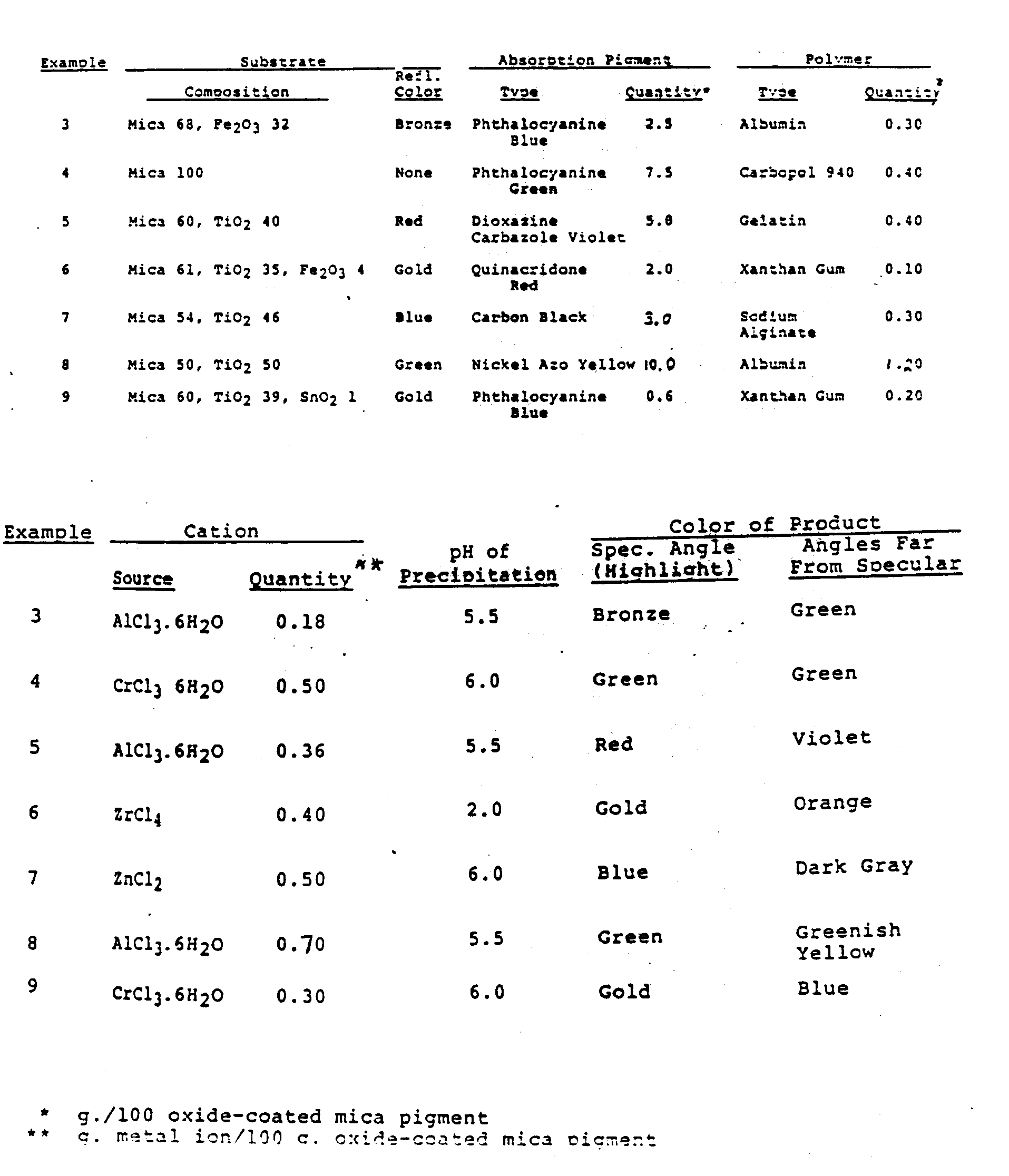
- The procedure of Example 1 was followed in Examples 4-9, with the various absorption pigments, polymers, substrates, polyvalent cations and precipitation pH values noted in the following table.
- The effect of the combination pigment can be illustrated by its use in an automotive paint. A suitably primed curved metal panel was sprayed with a light gray automotive paint base coat. The paint of Example 2 was sprayed over it. The panel had a silver highlight on a blue background. The panel exhibited excellent light and moisture stability.
- The pigment of Example 9 was formulated in a similar manner and sprayed over a white base coat. A clear automotive topcoat was then applied. The finish had a gold highlight on a blue background. In automotive two-coat and three-coat systems, the combination pigment may be used in the bottom coat, middle coat, or top coat.
- Other uses will be evident to those skilled in the art.
Claims (18)
- A coloured micaceous pigment comprising micaceous platelets, each platelet being coated with a layer which comprises a polyvalent metal cation, an anionic polymer and a coloured pigment, characterised in that said micaceous pigment is made by combining an aqueous suspension of said micaceous platelets with an aqueous suspension of a water-insoluble coloured pigment which contains said anionic polymer, combining the resulting suspension with an aqueous solution of said polyvalent metal cation, adjusting the pH of the suspension thereby to cause or allow precipitation of a hydroxide or hydrous oxide of said polyvalent metal cation and thereby to effect deposition of said hydrous oxide or hydroxide, the anionic polymer and said coloured pigment onto the platelets, and thereafter recovering the resulting coloured micaceous pigments.
- A pigment as claimed in claim 1, characterised in that said metal cation is selected from aluminium, chromium, titanium, zinc, magnesium, zirconium, iron and tin cations.
- A pigment as claimed in claim 1 or claim 2, characterised in that said cation is a chromium cation.
- A pigment as claimed in claim 1 or claim 2, characterised in that said cation is an aluminium cation.
- A pigment as claimed in any preceding claim, characterised in that said mica platelets are coated with an oxide.
- A pigment as claimed in any preceding claim, characterised in that said mica platelets are coated with a titanium (IV) oxide.
- A pigment as claimed in any of claims 1 to 5, characterised in that said mica platelets are coated with an iron (III) oxide.
- A pigment as claimed in any preceding claim, characterised in that said anionic polymer is selected from albumin, gelatin, polyacrylic acid, alginate and polysaccharide.
- A pigment as claimed in any preceding claim, characterised in that said water-insoluble colour is selected from phthalocyanine, quinacridone, dioxazine and carbon black.
- A paint comprising a paint vehicle and a coloured micaceous pigment as claimed in any preceding claim.
- A method of preparing a coloured micaceous pigment, which method comprises the steps of:-
combining an aqueous suspension of micaceous platelets with an aqueous suspension of a water-insoluble coloured pigment containing an anionic polymer;
combining the resulting suspension with an aqueous acidic solution of a polyvalent metal cation which forms a precipitate with said anionic polymer at a given pH and a quantity of a pH adjustment agent to provide said given pH;
and thereafter recovering the resulting coloured micaceous pigment. - A method as claimed in claim 11, characterised in that said pH adjustment agent is a base.
- A method as claimed in claim 11 or claim 12, characterised in that said pH adjustment agent is sodium hydroxide.
- A method as claimed in any of claims 11 to 13, characterised in that said cation is selected from aluminium, chronium, titanium, zinc, magnesium, zirconium, iron and tin, further characterised in that said platelets are mica or mica coated with an oxide platelets.
- A method as claimed in any of claims 11 to 14, characterised in that said ionic polymer is selected from albumin, gelatin, pelyacrylic acid, alginate and polysaccharide, and further characterised in that said water-insoluble colour is selected from phthalocyanine, quinacridone, dioxazine and carbon black.
- A method as claimed in any of claims 11 to 15 characterised in that said cation is an aluminium or chromium cation, said platelets are mica platelets or mica platelets coated with titanium oxide or ferric oxide, and said given pH is about 4 to about 8.
- A method as claimed in any of claims 12 to 16, characterised in that said base and acid solution are simultaneously added to said resulting suspension.
- A method as claimed in any of claims 11 to 17, characterised in that the quantities of colour material, anionic polymer and polyvalent cation employed are given as follows:
Coloured Material: 0.01% - 30% Anionic Polymer: 0.01% - 20% Cation: 0.01% - 20%
Priority Applications (1)
| Application Number | Priority Date | Filing Date | Title |
|---|---|---|---|
| AT88300672T ATE79127T1 (en) | 1987-02-09 | 1988-01-27 | COLORED MICA-LIKE PIGMENTS. |
Applications Claiming Priority (2)
| Application Number | Priority Date | Filing Date | Title |
|---|---|---|---|
| US12185 | 1987-02-09 | ||
| US07/012,185 US4755229A (en) | 1987-02-09 | 1987-02-09 | Colored micaceous pigments |
Publications (3)
| Publication Number | Publication Date |
|---|---|
| EP0278633A2 EP0278633A2 (en) | 1988-08-17 |
| EP0278633A3 EP0278633A3 (en) | 1989-03-08 |
| EP0278633B1 true EP0278633B1 (en) | 1992-08-05 |
Family
ID=21753766
Family Applications (1)
| Application Number | Title | Priority Date | Filing Date |
|---|---|---|---|
| EP88300672A Expired - Lifetime EP0278633B1 (en) | 1987-02-09 | 1988-01-27 | Colored micaceous pigments |
Country Status (8)
| Country | Link |
|---|---|
| US (1) | US4755229A (en) |
| EP (1) | EP0278633B1 (en) |
| JP (1) | JPS63243168A (en) |
| AT (1) | ATE79127T1 (en) |
| BR (1) | BR8800597A (en) |
| CA (1) | CA1307874C (en) |
| DE (1) | DE3873369T2 (en) |
| GR (1) | GR3006082T3 (en) |
Cited By (2)
| Publication number | Priority date | Publication date | Assignee | Title |
|---|---|---|---|---|
| DE10209359A1 (en) * | 2002-03-02 | 2003-09-18 | Merck Patent Gmbh | Coated flake pigment for use as an effect pigment, e.g. in paint or cosmetics, comprises an inorganic substrate such as mica coated with hardened melamine-formaldehyde resin |
| DE102012112092A1 (en) | 2011-12-21 | 2013-07-11 | Silberline Manufacturing Company, Inc. | Colored tiles |
Families Citing this family (71)
| Publication number | Priority date | Publication date | Assignee | Title |
|---|---|---|---|---|
| JPS6346265A (en) * | 1986-08-13 | 1988-02-27 | Merck Japan Kk | Novel colored thin leaf pigment and production thereof |
| US5008143A (en) * | 1987-07-06 | 1991-04-16 | The Mearl Corporation | Decorative objects with multi-color effects |
| US5667847A (en) * | 1987-07-31 | 1997-09-16 | Basf Lacke+Farben Aktiengesellschaft | Process for the production of a multicoat protective and/or decorative coating and water-dilutable coating compositions |
| US4968351A (en) * | 1988-11-02 | 1990-11-06 | The Mearl Corporation | Nacreous pigments colored by adsorbed dyes |
| DE4009567A1 (en) * | 1990-03-24 | 1991-09-26 | Merck Patent Gmbh | COATING WITH ORGANIC COLORS |
| US5154765A (en) * | 1990-12-11 | 1992-10-13 | The Mearl Corporation | Decorative objects with multicolor effects |
| FR2680684B1 (en) * | 1991-08-29 | 1993-11-12 | Oreal | COSMETIC FILTERING COMPOSITION COMPRISING A METAL OXIDE NANOPIGMENT AND A FILTERED POLYMER. |
| JP2835796B2 (en) * | 1992-02-06 | 1998-12-14 | メルク・ジヤパン株式会社 | New flaky pigment |
| US6019831A (en) * | 1993-11-25 | 2000-02-01 | Merck Patent Gesellschaft Mit Beschrankter Haftung | Non-lustrous pigments |
| DE19503906A1 (en) * | 1994-03-30 | 1995-10-05 | Merck Patent Gmbh | Carbonaceous pigments |
| JP3508031B2 (en) * | 1994-08-18 | 2004-03-22 | 株式会社コーセー | Composite pigment and cosmetic containing the same |
| US5648408A (en) * | 1995-06-07 | 1997-07-15 | Ciba-Geigy Corporation | Organic stir-in pigments |
| US5584922A (en) * | 1994-09-14 | 1996-12-17 | Ciba-Geigy Corporation | Stir-in organic pigments |
| US5599530A (en) * | 1994-12-16 | 1997-02-04 | Revlon Consumer Products Corporation | Surface treated pigments |
| US5650003A (en) * | 1995-12-18 | 1997-07-22 | Nord Naolin Company | Cationized pigments and their use in papermaking |
| US6045914A (en) * | 1996-06-03 | 2000-04-04 | Engelhard Corporation | Pearlescent glass pigment |
| EP1019454B1 (en) | 1997-01-09 | 2001-11-07 | Ciba SC Holding AG | Composite pigment |
| US5824144A (en) * | 1997-04-11 | 1998-10-20 | Engelhard Corporation | Powder coating composition and method |
| US6107244A (en) * | 1997-10-15 | 2000-08-22 | Nashua Corporation | Verification methods employing thermally--imageable substrates |
| US6113683A (en) * | 1997-11-25 | 2000-09-05 | Ciba Specialty Chemicals Corporation | Colored pearlescent pigments |
| US6290766B1 (en) | 1999-02-24 | 2001-09-18 | Engelhard Corporation | Lustrous interference pigments with black absorption color |
| US6471762B1 (en) | 2000-08-23 | 2002-10-29 | Engelhard Corp. | Bonded metal-hydroxide-organic composite polymer films on lamellar pigments |
| US6533858B1 (en) | 2000-10-10 | 2003-03-18 | Engelhard Corporation | Effect pigments with improved colorant adhesion |
| JP2002241225A (en) * | 2001-02-15 | 2002-08-28 | Kose Corp | Makeup cosmetic |
| CN1281690C (en) * | 2001-08-10 | 2006-10-25 | 日本光研工业株式会社 | Highly iridescent titanium oxide composition and its preparation method |
| US6485556B1 (en) * | 2001-10-10 | 2002-11-26 | Engelhard Corporation | Interference pigments |
| US7189454B2 (en) * | 2003-05-19 | 2007-03-13 | Engelhard Corporation | Carbon coated high luster materials |
| US7029525B1 (en) | 2003-10-21 | 2006-04-18 | The Standard Register Company | Optically variable water-based inks |
| DE10358092A1 (en) * | 2003-12-10 | 2005-07-14 | Merck Patent Gmbh | Surface modified particles |
| US7507285B2 (en) | 2004-05-11 | 2009-03-24 | Basf Corporation | Aluminum effect pigment blends |
| DE102004051554B4 (en) * | 2004-10-22 | 2011-07-21 | Schwan-STABILO Cosmetics GmbH & Co. KG, 90562 | Process for the production of pigment and / or effect-containing mines |
| CA2593205C (en) * | 2005-01-07 | 2010-11-30 | The Sherwin-Williams Company | Slip-resistant coatings and substrates coated therewith |
| CA2618223A1 (en) * | 2005-08-09 | 2007-02-22 | Soane Labs, Llc | Hair hold formulations |
| WO2007021731A2 (en) * | 2005-08-09 | 2007-02-22 | Soane Laboratories, Llc. | Dye-attached and/or surface-modified pigments |
| US20070048239A1 (en) * | 2005-08-26 | 2007-03-01 | Engelhard Corporation | Cosmetic and Personal Care Formulations with Goniochromatic Non-Quarter Wave Multi-Quadrant Multi-Layer Effect Materials |
| JP2007197372A (en) * | 2006-01-27 | 2007-08-09 | Pola Chem Ind Inc | Powder for cosmetic and cosmetic containing the powder |
| US20090165976A1 (en) * | 2006-02-03 | 2009-07-02 | Nanopaper, Llc | Expansion agents for paper-based materials |
| CA2641309A1 (en) | 2006-02-03 | 2007-08-16 | Nanopaper Llc | Functionalization of paper components with an amine-containing polymer |
| US7820563B2 (en) * | 2006-10-23 | 2010-10-26 | Hawaii Nanosciences, Llc | Compositions and methods for imparting oil repellency and/or water repellency |
| US8894980B2 (en) | 2007-11-19 | 2014-11-25 | U.S. Cosmetics Corporation | Wet cake composition for cosmetic products and methods of use |
| EP2727577A1 (en) * | 2007-05-07 | 2014-05-07 | U.S. Cosmetics Corporation | Colour pigment powder, pigment dispersion and method of manufacture |
| US20100095618A1 (en) * | 2008-10-20 | 2010-04-22 | Basf Corporation | Roofing Materials with Metallic Appearance |
| US8079183B2 (en) * | 2009-05-15 | 2011-12-20 | Lenney Robert C | De-iced gutter debris preclusion system |
| WO2011028291A2 (en) | 2009-09-04 | 2011-03-10 | Commercial Gutter, Inc. | Corrugated mesh gutter leaf preclusion system |
| US8479454B2 (en) * | 2009-09-23 | 2013-07-09 | Gutterglove, Inc. | Supported mesh debris preclusion system for gutters |
| US8511712B2 (en) * | 2009-11-24 | 2013-08-20 | Jds Uniphase Corporation | Mixture of magnetically orientable color shifting flakes and non-magnetically orientable color shifting flakes exhibiting a common color |
| JP5491922B2 (en) * | 2010-01-06 | 2014-05-14 | Toto株式会社 | Photocatalyst paint |
| US8475846B2 (en) * | 2010-03-09 | 2013-07-02 | Basf Corporation | Colored micaceous pigments having bismuth oxychloride appearance and performance effects |
| JP5413702B2 (en) * | 2011-09-09 | 2014-02-12 | Dic株式会社 | Composite pigment and method for producing the same |
| US20140215929A1 (en) * | 2011-09-21 | 2014-08-07 | Robert C. Lenney | Raised arc rain gutter debris preclusion device |
| US20140069028A1 (en) | 2011-12-08 | 2014-03-13 | Robert C. Lenney | Gutter guard barier |
| US20220275648A1 (en) * | 2011-12-08 | 2022-09-01 | Gutterglove, Inc. | Gutter guard barrier |
| WO2015021233A1 (en) * | 2013-08-07 | 2015-02-12 | Gutter Glove, Inc. | Gutter debris preclusion device with multiple manipulations and patterns thereof |
| CN103788718B (en) * | 2014-01-18 | 2015-12-09 | 南京理工大学 | Doped composite oxide coated mica pearlescent composite pigment and preparation |
| CA2939381C (en) | 2014-02-12 | 2022-04-05 | Robert C. Lenney | Self-supporting bi-directional corrugated mesh leaf preclusion device |
| EP3172281B1 (en) | 2014-07-25 | 2019-02-20 | Merck Patent GmbH | Colored effect pigments |
| US11034841B2 (en) | 2014-11-24 | 2021-06-15 | Basf Corporation | Carbon black in effect pigments |
| WO2017162302A1 (en) | 2016-03-24 | 2017-09-28 | Hp Indigo B.V. | Electrophotographic ink including pearlescent pigment |
| US10827821B2 (en) | 2016-12-09 | 2020-11-10 | Gutterglove, Inc. | Universal gutter guard cleaning brush |
| CA3031972A1 (en) | 2018-01-31 | 2019-07-31 | All Weather Armour, Llc | Fascia-mounted gutter debris barrier system |
| US11118061B2 (en) * | 2018-12-17 | 2021-09-14 | Viavi Solutions Inc. | Article including at least one metal portion |
| US11740532B2 (en) | 2018-12-17 | 2023-08-29 | Viavi Solutions Inc. | Article including light valves |
| US11713580B2 (en) | 2019-05-01 | 2023-08-01 | Gutterglove, Inc. | Single piece gutter guard with girder |
| US11965338B2 (en) | 2019-05-01 | 2024-04-23 | Gutterglove, Inc. | Gutter guard with truss |
| US12018490B2 (en) | 2019-05-01 | 2024-06-25 | Gutterglove, Inc. | Single piece gutter guard with truss |
| US11566428B2 (en) | 2019-05-01 | 2023-01-31 | Gutterglove, Inc. | Gutter guard with girder |
| US11384544B2 (en) | 2019-05-01 | 2022-07-12 | Gutterglove, Inc. | Gutter guard with irregular grooves |
| WO2021003199A1 (en) | 2019-07-01 | 2021-01-07 | Gutterglove, Inc. | Stepped gutter guard |
| US20240041721A1 (en) * | 2020-12-18 | 2024-02-08 | Shiseido Company, Ltd. | Metallic powder |
| JP7684349B2 (en) * | 2022-02-03 | 2025-05-27 | ベック株式会社 | Water-based coating material |
| WO2025143012A1 (en) * | 2023-12-27 | 2025-07-03 | 日本板硝子株式会社 | Glitter pigment and method for producing glitter pigment |
Family Cites Families (10)
| Publication number | Priority date | Publication date | Assignee | Title |
|---|---|---|---|---|
| US3087828A (en) * | 1961-06-28 | 1963-04-30 | Du Pont | Nacreous pigment compositions |
| US3647492A (en) * | 1970-11-20 | 1972-03-07 | Douglas W Chapman | Method of making colored pigments having pearlescent qualities |
| DE2313332C3 (en) * | 1973-03-17 | 1978-10-05 | Merck Patent Gmbh, 6100 Darmstadt | Colored pigments |
| DE2429762C2 (en) * | 1974-06-21 | 1984-08-30 | Merck Patent Gmbh, 6100 Darmstadt | Dye-containing luster pigments |
| US4205996A (en) * | 1979-04-26 | 1980-06-03 | Scm Corporation | CoO Free black spinel ceramic pigment containing NiO, Fe2 O3 and Cr2 O3 |
| DE2928287A1 (en) * | 1979-07-13 | 1981-01-29 | Merck Patent Gmbh | PEARL SHINE PIGMENTS, METHOD FOR THEIR PRODUCTION AND THEIR USE |
| US4309480A (en) * | 1980-02-28 | 1982-01-05 | The Mearl Corporation | Iron blue nacreous pigments |
| JPS5876461A (en) * | 1981-10-26 | 1983-05-09 | メルク・パテント・ゲゼルシヤフト・ミツト・ベシユレンクテル・ハフツング | Transparent coloring pigment and manufacture |
| DE3151355A1 (en) * | 1981-12-24 | 1983-07-07 | Merck Patent Gmbh, 6100 Darmstadt | "PEARL SHINE PIGMENTS WITH IMPROVED LIGHT RESISTANCE, THEIR PRODUCTION AND USE" |
| IN165908B (en) * | 1985-10-25 | 1990-02-10 | Merck Patent Gmbh |
-
1987
- 1987-02-09 US US07/012,185 patent/US4755229A/en not_active Expired - Lifetime
-
1988
- 1988-01-27 AT AT88300672T patent/ATE79127T1/en not_active IP Right Cessation
- 1988-01-27 EP EP88300672A patent/EP0278633B1/en not_active Expired - Lifetime
- 1988-01-27 DE DE8888300672T patent/DE3873369T2/en not_active Expired - Lifetime
- 1988-02-08 CA CA000558387A patent/CA1307874C/en not_active Expired - Lifetime
- 1988-02-09 BR BR8800597A patent/BR8800597A/en not_active IP Right Cessation
- 1988-02-09 JP JP63028622A patent/JPS63243168A/en active Granted
-
1992
- 1992-10-26 GR GR920402411T patent/GR3006082T3/el unknown
Cited By (2)
| Publication number | Priority date | Publication date | Assignee | Title |
|---|---|---|---|---|
| DE10209359A1 (en) * | 2002-03-02 | 2003-09-18 | Merck Patent Gmbh | Coated flake pigment for use as an effect pigment, e.g. in paint or cosmetics, comprises an inorganic substrate such as mica coated with hardened melamine-formaldehyde resin |
| DE102012112092A1 (en) | 2011-12-21 | 2013-07-11 | Silberline Manufacturing Company, Inc. | Colored tiles |
Also Published As
| Publication number | Publication date |
|---|---|
| BR8800597A (en) | 1988-09-27 |
| DE3873369T2 (en) | 1992-12-10 |
| GR3006082T3 (en) | 1993-06-21 |
| EP0278633A2 (en) | 1988-08-17 |
| US4755229A (en) | 1988-07-05 |
| ATE79127T1 (en) | 1992-08-15 |
| JPH0587101B2 (en) | 1993-12-15 |
| DE3873369D1 (en) | 1992-09-10 |
| JPS63243168A (en) | 1988-10-11 |
| EP0278633A3 (en) | 1989-03-08 |
| CA1307874C (en) | 1992-09-29 |
Similar Documents
| Publication | Publication Date | Title |
|---|---|---|
| US4755229A (en) | Colored micaceous pigments | |
| EP0912640B1 (en) | Pearlescent glass | |
| CA1184004A (en) | Nacreous pigments, their preparation, and their use | |
| US7045007B2 (en) | Effect pigment | |
| US4828623A (en) | Water resistant nacreous pigment and process for producing the same | |
| US5009711A (en) | Golden color luster pigments | |
| AU779826B2 (en) | Precious metal color effect materials and production thereof | |
| US3087829A (en) | Micaceous pigment composition | |
| EP0367236B2 (en) | Nacreous pigments colored by adsorbed dyes | |
| CA2512875C (en) | Multi-layer effect pigment | |
| US6533858B1 (en) | Effect pigments with improved colorant adhesion | |
| JP2000517374A (en) | Multilayer interference pigment | |
| DE60122594T2 (en) | MATERIALS WITH ALLOY COLOR EFFECT AND ITS MANUFACTURE | |
| EP0484108B1 (en) | Pigment and process for producing the same | |
| AU2001296646A1 (en) | Effect pigments with improved colorant adhesion | |
| EP1751237A1 (en) | Organic dyes suitable for use in drugs and cosmetics laked onto a platy titanium dioxide pigment | |
| CS241529B2 (en) | Nacre glossy pigment and method of its preparation | |
| MXPA98010149A (en) | Aperl glass |
Legal Events
| Date | Code | Title | Description |
|---|---|---|---|
| PUAI | Public reference made under article 153(3) epc to a published international application that has entered the european phase |
Free format text: ORIGINAL CODE: 0009012 |
|
| AK | Designated contracting states |
Kind code of ref document: A2 Designated state(s): AT BE CH DE ES FR GB GR IT LI LU NL SE |
|
| PUAL | Search report despatched |
Free format text: ORIGINAL CODE: 0009013 |
|
| AK | Designated contracting states |
Kind code of ref document: A3 Designated state(s): AT BE CH DE ES FR GB GR IT LI LU NL SE |
|
| 17P | Request for examination filed |
Effective date: 19890810 |
|
| 17Q | First examination report despatched |
Effective date: 19910222 |
|
| GRAA | (expected) grant |
Free format text: ORIGINAL CODE: 0009210 |
|
| AK | Designated contracting states |
Kind code of ref document: B1 Designated state(s): AT BE CH DE ES FR GB GR IT LI LU NL SE |
|
| PG25 | Lapsed in a contracting state [announced via postgrant information from national office to epo] |
Ref country code: BE Effective date: 19920805 Ref country code: SE Free format text: LAPSE BECAUSE OF FAILURE TO SUBMIT A TRANSLATION OF THE DESCRIPTION OR TO PAY THE FEE WITHIN THE PRESCRIBED TIME-LIMIT Effective date: 19920805 Ref country code: FR Effective date: 19920805 |
|
| REF | Corresponds to: |
Ref document number: 79127 Country of ref document: AT Date of ref document: 19920815 Kind code of ref document: T |
|
| REF | Corresponds to: |
Ref document number: 3873369 Country of ref document: DE Date of ref document: 19920910 |
|
| ITF | It: translation for a ep patent filed | ||
| EN | Fr: translation not filed | ||
| REG | Reference to a national code |
Ref country code: ES Ref legal event code: BA2A |
|
| REG | Reference to a national code |
Ref country code: GR Ref legal event code: FG4A Free format text: 3006082 |
|
| PLBE | No opposition filed within time limit |
Free format text: ORIGINAL CODE: 0009261 |
|
| STAA | Information on the status of an ep patent application or granted ep patent |
Free format text: STATUS: NO OPPOSITION FILED WITHIN TIME LIMIT |
|
| 26N | No opposition filed | ||
| PGFP | Annual fee paid to national office [announced via postgrant information from national office to epo] |
Ref country code: ES Payment date: 19940111 Year of fee payment: 7 |
|
| PGFP | Annual fee paid to national office [announced via postgrant information from national office to epo] |
Ref country code: SE Payment date: 19940128 Year of fee payment: 7 |
|
| EPTA | Lu: last paid annual fee | ||
| PG25 | Lapsed in a contracting state [announced via postgrant information from national office to epo] |
Ref country code: ES Free format text: LAPSE BECAUSE OF NON-PAYMENT OF DUE FEES Effective date: 19950128 |
|
| REG | Reference to a national code |
Ref country code: CH Ref legal event code: PUE Owner name: THE MEARL CORPORATION TRANSFER- ENGELHARD CORPORAT |
|
| REG | Reference to a national code |
Ref country code: GB Ref legal event code: 732E |
|
| NLS | Nl: assignments of ep-patents |
Owner name: ENGELHARD CORPORATION |
|
| REG | Reference to a national code |
Ref country code: GB Ref legal event code: IF02 |
|
| PGFP | Annual fee paid to national office [announced via postgrant information from national office to epo] |
Ref country code: AT Payment date: 20020103 Year of fee payment: 15 |
|
| PGFP | Annual fee paid to national office [announced via postgrant information from national office to epo] |
Ref country code: CH Payment date: 20020107 Year of fee payment: 15 |
|
| PGFP | Annual fee paid to national office [announced via postgrant information from national office to epo] |
Ref country code: LU Payment date: 20020117 Year of fee payment: 15 |
|
| PGFP | Annual fee paid to national office [announced via postgrant information from national office to epo] |
Ref country code: GR Payment date: 20020124 Year of fee payment: 15 |
|
| PG25 | Lapsed in a contracting state [announced via postgrant information from national office to epo] |
Ref country code: AT Free format text: LAPSE BECAUSE OF NON-PAYMENT OF DUE FEES Effective date: 20030127 Ref country code: LU Free format text: LAPSE BECAUSE OF NON-PAYMENT OF DUE FEES Effective date: 20030127 |
|
| PG25 | Lapsed in a contracting state [announced via postgrant information from national office to epo] |
Ref country code: LI Free format text: LAPSE BECAUSE OF NON-PAYMENT OF DUE FEES Effective date: 20030131 Ref country code: CH Free format text: LAPSE BECAUSE OF NON-PAYMENT OF DUE FEES Effective date: 20030131 |
|
| PG25 | Lapsed in a contracting state [announced via postgrant information from national office to epo] |
Ref country code: GR Free format text: LAPSE BECAUSE OF NON-PAYMENT OF DUE FEES Effective date: 20030804 |
|
| REG | Reference to a national code |
Ref country code: CH Ref legal event code: PL |
|
| REG | Reference to a national code |
Ref country code: ES Ref legal event code: FD2A Effective date: 19960210 |
|
| PG25 | Lapsed in a contracting state [announced via postgrant information from national office to epo] |
Ref country code: IT Free format text: LAPSE BECAUSE OF NON-PAYMENT OF DUE FEES;WARNING: LAPSES OF ITALIAN PATENTS WITH EFFECTIVE DATE BEFORE 2007 MAY HAVE OCCURRED AT ANY TIME BEFORE 2007. THE CORRECT EFFECTIVE DATE MAY BE DIFFERENT FROM THE ONE RECORDED. Effective date: 20050127 |
|
| PGFP | Annual fee paid to national office [announced via postgrant information from national office to epo] |
Ref country code: NL Payment date: 20070124 Year of fee payment: 20 |
|
| PGFP | Annual fee paid to national office [announced via postgrant information from national office to epo] |
Ref country code: GB Payment date: 20070125 Year of fee payment: 20 |
|
| PGFP | Annual fee paid to national office [announced via postgrant information from national office to epo] |
Ref country code: DE Payment date: 20070228 Year of fee payment: 20 |
|
| REG | Reference to a national code |
Ref country code: GB Ref legal event code: PE20 |
|
| NLV7 | Nl: ceased due to reaching the maximum lifetime of a patent |
Effective date: 20080127 |
|
| PG25 | Lapsed in a contracting state [announced via postgrant information from national office to epo] |
Ref country code: NL Free format text: LAPSE BECAUSE OF EXPIRATION OF PROTECTION Effective date: 20080127 |
|
| PG25 | Lapsed in a contracting state [announced via postgrant information from national office to epo] |
Ref country code: GB Free format text: LAPSE BECAUSE OF EXPIRATION OF PROTECTION Effective date: 20080126 |