EP0275609B1 - Manufacture of shaped articles from refractory powder - Google Patents
Manufacture of shaped articles from refractory powder Download PDFInfo
- Publication number
- EP0275609B1 EP0275609B1 EP87202636A EP87202636A EP0275609B1 EP 0275609 B1 EP0275609 B1 EP 0275609B1 EP 87202636 A EP87202636 A EP 87202636A EP 87202636 A EP87202636 A EP 87202636A EP 0275609 B1 EP0275609 B1 EP 0275609B1
- Authority
- EP
- European Patent Office
- Prior art keywords
- refractory powder
- clay
- hardening
- mixture
- refractory
- Prior art date
- Legal status (The legal status is an assumption and is not a legal conclusion. Google has not performed a legal analysis and makes no representation as to the accuracy of the status listed.)
- Expired - Lifetime
Links
- 239000000843 powder Substances 0.000 title claims abstract description 24
- 238000004519 manufacturing process Methods 0.000 title claims abstract description 7
- 239000000203 mixture Substances 0.000 claims abstract description 18
- 238000000034 method Methods 0.000 claims abstract description 12
- 229910019142 PO4 Inorganic materials 0.000 claims abstract description 11
- 239000010452 phosphate Substances 0.000 claims abstract description 11
- NBIIXXVUZAFLBC-UHFFFAOYSA-K phosphate Chemical compound [O-]P([O-])([O-])=O NBIIXXVUZAFLBC-UHFFFAOYSA-K 0.000 claims abstract description 11
- 230000002378 acidificating effect Effects 0.000 claims abstract description 8
- 239000004033 plastic Substances 0.000 claims abstract description 7
- 229920003023 plastic Polymers 0.000 claims abstract description 7
- 238000005245 sintering Methods 0.000 claims abstract description 7
- NBIIXXVUZAFLBC-UHFFFAOYSA-N Phosphoric acid Chemical compound OP(O)(O)=O NBIIXXVUZAFLBC-UHFFFAOYSA-N 0.000 claims description 10
- PNEYBMLMFCGWSK-UHFFFAOYSA-N aluminium oxide Inorganic materials [O-2].[O-2].[O-2].[Al+3].[Al+3] PNEYBMLMFCGWSK-UHFFFAOYSA-N 0.000 claims description 10
- CPLXHLVBOLITMK-UHFFFAOYSA-N magnesium oxide Inorganic materials [Mg]=O CPLXHLVBOLITMK-UHFFFAOYSA-N 0.000 claims description 10
- 239000000463 material Substances 0.000 claims description 9
- 239000011230 binding agent Substances 0.000 claims description 8
- 239000004927 clay Substances 0.000 claims description 8
- 239000002245 particle Substances 0.000 claims description 8
- 229910000147 aluminium phosphate Inorganic materials 0.000 claims description 7
- 239000000395 magnesium oxide Substances 0.000 claims description 6
- 239000010427 ball clay Substances 0.000 claims description 5
- NLYAJNPCOHFWQQ-UHFFFAOYSA-N kaolin Chemical compound O.O.O=[Al]O[Si](=O)O[Si](=O)O[Al]=O NLYAJNPCOHFWQQ-UHFFFAOYSA-N 0.000 claims description 4
- 230000001427 coherent effect Effects 0.000 claims description 3
- WNROFYMDJYEPJX-UHFFFAOYSA-K aluminium hydroxide Chemical compound [OH-].[OH-].[OH-].[Al+3] WNROFYMDJYEPJX-UHFFFAOYSA-K 0.000 claims description 2
- 229910021502 aluminium hydroxide Inorganic materials 0.000 claims description 2
- ILRRQNADMUWWFW-UHFFFAOYSA-K aluminium phosphate Chemical compound O1[Al]2OP1(=O)O2 ILRRQNADMUWWFW-UHFFFAOYSA-K 0.000 claims description 2
- 229940001007 aluminium phosphate Drugs 0.000 claims description 2
- AXZKOIWUVFPNLO-UHFFFAOYSA-N magnesium;oxygen(2-) Chemical compound [O-2].[Mg+2] AXZKOIWUVFPNLO-UHFFFAOYSA-N 0.000 claims description 2
- 238000007493 shaping process Methods 0.000 abstract description 2
- 239000004615 ingredient Substances 0.000 description 3
- 238000012360 testing method Methods 0.000 description 3
- GWEVSGVZZGPLCZ-UHFFFAOYSA-N Titan oxide Chemical compound O=[Ti]=O GWEVSGVZZGPLCZ-UHFFFAOYSA-N 0.000 description 2
- MCMNRKCIXSYSNV-UHFFFAOYSA-N Zirconium dioxide Chemical compound O=[Zr]=O MCMNRKCIXSYSNV-UHFFFAOYSA-N 0.000 description 2
- 239000004570 mortar (masonry) Substances 0.000 description 2
- 239000011819 refractory material Substances 0.000 description 2
- DLYUQMMRRRQYAE-UHFFFAOYSA-N tetraphosphorus decaoxide Chemical compound O1P(O2)(=O)OP3(=O)OP1(=O)OP2(=O)O3 DLYUQMMRRRQYAE-UHFFFAOYSA-N 0.000 description 2
- XLYOFNOQVPJJNP-UHFFFAOYSA-N water Substances O XLYOFNOQVPJJNP-UHFFFAOYSA-N 0.000 description 2
- 229910052845 zircon Inorganic materials 0.000 description 2
- GFQYVLUOOAAOGM-UHFFFAOYSA-N zirconium(iv) silicate Chemical compound [Zr+4].[O-][Si]([O-])([O-])[O-] GFQYVLUOOAAOGM-UHFFFAOYSA-N 0.000 description 2
- AZUYLZMQTIKGSC-UHFFFAOYSA-N 1-[6-[4-(5-chloro-6-methyl-1H-indazol-4-yl)-5-methyl-3-(1-methylindazol-5-yl)pyrazol-1-yl]-2-azaspiro[3.3]heptan-2-yl]prop-2-en-1-one Chemical compound ClC=1C(=C2C=NNC2=CC=1C)C=1C(=NN(C=1C)C1CC2(CN(C2)C(C=C)=O)C1)C=1C=C2C=NN(C2=CC=1)C AZUYLZMQTIKGSC-UHFFFAOYSA-N 0.000 description 1
- 229920000271 Kevlar® Polymers 0.000 description 1
- FYYHWMGAXLPEAU-UHFFFAOYSA-N Magnesium Chemical compound [Mg] FYYHWMGAXLPEAU-UHFFFAOYSA-N 0.000 description 1
- BPQQTUXANYXVAA-UHFFFAOYSA-N Orthosilicate Chemical compound [O-][Si]([O-])([O-])[O-] BPQQTUXANYXVAA-UHFFFAOYSA-N 0.000 description 1
- 239000004952 Polyamide Substances 0.000 description 1
- 239000004743 Polypropylene Substances 0.000 description 1
- 239000000654 additive Substances 0.000 description 1
- XAGFODPZIPBFFR-UHFFFAOYSA-N aluminium Chemical compound [Al] XAGFODPZIPBFFR-UHFFFAOYSA-N 0.000 description 1
- 229910052782 aluminium Inorganic materials 0.000 description 1
- 239000004411 aluminium Substances 0.000 description 1
- 230000015572 biosynthetic process Effects 0.000 description 1
- 239000011449 brick Substances 0.000 description 1
- 238000005266 casting Methods 0.000 description 1
- 239000000919 ceramic Substances 0.000 description 1
- 238000000576 coating method Methods 0.000 description 1
- RPUZVWKKWXPKIP-UHFFFAOYSA-H dialuminum;hydrogen phosphate Chemical compound [Al+3].[Al+3].OP([O-])([O-])=O.OP([O-])([O-])=O.OP([O-])([O-])=O RPUZVWKKWXPKIP-UHFFFAOYSA-H 0.000 description 1
- 239000000945 filler Substances 0.000 description 1
- 238000007676 flexural strength test Methods 0.000 description 1
- 239000003365 glass fiber Substances 0.000 description 1
- 238000010438 heat treatment Methods 0.000 description 1
- 239000004761 kevlar Substances 0.000 description 1
- 239000007788 liquid Substances 0.000 description 1
- 239000011777 magnesium Substances 0.000 description 1
- 229910052749 magnesium Inorganic materials 0.000 description 1
- 230000014759 maintenance of location Effects 0.000 description 1
- 239000010445 mica Substances 0.000 description 1
- 229910052618 mica group Inorganic materials 0.000 description 1
- 229920002239 polyacrylonitrile Polymers 0.000 description 1
- 229920002647 polyamide Polymers 0.000 description 1
- -1 polypropylene Polymers 0.000 description 1
- 229920001155 polypropylene Polymers 0.000 description 1
- 229920002689 polyvinyl acetate Polymers 0.000 description 1
- 239000011118 polyvinyl acetate Substances 0.000 description 1
- 239000004576 sand Substances 0.000 description 1
- 229910052596 spinel Inorganic materials 0.000 description 1
- 239000011029 spinel Substances 0.000 description 1
- 239000000454 talc Substances 0.000 description 1
- 229910052623 talc Inorganic materials 0.000 description 1
- 239000010456 wollastonite Substances 0.000 description 1
- 229910052882 wollastonite Inorganic materials 0.000 description 1
Classifications
-
- C—CHEMISTRY; METALLURGY
- C04—CEMENTS; CONCRETE; ARTIFICIAL STONE; CERAMICS; REFRACTORIES
- C04B—LIME, MAGNESIA; SLAG; CEMENTS; COMPOSITIONS THEREOF, e.g. MORTARS, CONCRETE OR LIKE BUILDING MATERIALS; ARTIFICIAL STONE; CERAMICS; REFRACTORIES; TREATMENT OF NATURAL STONE
- C04B40/00—Processes, in general, for influencing or modifying the properties of mortars, concrete or artificial stone compositions, e.g. their setting or hardening ability
- C04B40/0028—Aspects relating to the mixing step of the mortar preparation
- C04B40/005—High shear mixing; Obtaining macro-defect free materials
Definitions
- This invention relates to the manufacture of sheet-form material from refractory powder.
- Such material can be made, without using the high temperatures required for sintering, by using as binder prior to the shaping operation an organic polymeric material, for example a partially hydrolysed polyvinylacetate at a level of about 10% by weight.
- an organic polymeric material for example a partially hydrolysed polyvinylacetate at a level of about 10% by weight.
- Such a binder is, however, combustible above about 250° C, and when it burns the sheet is seriously weakened by its loss.
- the present invention utilises an incombustible, inorganic binder, namely an aqueous acidic phosphate solution.
- an incombustible, inorganic binder namely an aqueous acidic phosphate solution.
- aqueous acidic phosphate solution Two well-known examples of such a solution are aqueous phosphoric acid and aqueous aluminium hydrogen phosphate solution, both of which have for many years been used as binders in the manufacture of unfired chemically bonded bricks from high-alumina aggregrates, that is to say, high-alumina material whose particles are predominantly fairly coarse, typically 3 mm in largest dimension.
- aqueous acidic phosphate solutions as non-combustible binders for refractories is described in GB-A-2 004 266, US-A-3 379 544 and EP-A-0 178 154.
- a refractory mix composition is prepared from refractory powder comprising mainly alumina and, as binder, aqueous 85% phosphoric acid.
- the mixture of powder and aqueous phosphoric acid is subjected to high intensity mixing.
- the products of high intensity mixing are allowed to set in air for 24 hours and then hardened at 104° C or 816° C.
- gunning or ramming mixtures are prepared by mixing a magnesium aluminium spinel refractory with an acidic phosphate and water, and optionally with a non-reactive filler such as tabular alumina.
- the present invention provides phosphate-bonded refractory material which is in sheet form and is of relatively high flexural strength.
- aqueous acidic phosphate solution required to form a suitable mixture is, perhaps owing to the viscous nature of these solutions, relatively small; and the mixture itself, which takes the form of a damp crumbly mass, undergoes a remarkable change in consistency on being subjected to high shear by means of a twin-roll mill, forming a cohesive plastic mass.
- the plastic mass formed by high shear will ordinarily end up adhering to one only of the rolls, and can easily be parted therefrom as a unitary mass, and then laid flat in a tray for hardening.
- hardening may be possible at ambient temperature, for example 20° C, as in Example 1a later in this specification. Often, however, it will be desired to expedite hardening and/or improve strength, and this can be done by heating above 50° C, preferably above 200° C, as in Example 1b. It will sometimes be convenient to carry out at least the initial stage of hardening under pressure, in order to consolidate and prevent distortion of the mass.
- the invention can be applied to the treatment of a wide range of refractory powders, for example alumina, titania, zirconia, zircon, and calcined clays.
- an ordinary clay such as one of the kaolinitic clays ball clay and china clay, is included in the refractory powder to improve its plasticity under high shear, in an amount up to 10% by weight of the whole, ie of the shaped mass to be hardened.
- magnesium oxide up to about 15% by weight of the whole
- aluminium hydroxide up to about 20%.
- inorganic fibres such as glass fibres, fibrous wollastonite or ceramic fibres may be included in the mixture; and impact strength can also be improved by inclusion of non-fibrous particles of a layer silicate such as mica or talc.
- Such additives for improving strength may form up to 25% by weight of the whole.
- Organic fibres such as fibres of polyacrylonitrile, polypropylene, or the kind of polyamide available under the registered trade mark KEVLAR, may be included to give impact strength at temperatures up to about 200°C, at a level no greater than about 2% by weight, so that the loss of hot strength if they are burnt out is not serious.
- Calcined alumina powder (particle size 45 ⁇ m; surface area, 1 m2/gram) was mixed in a Z-blade mixer with dead-burnt magnesia (91% MgO; particle size ⁇ 0.2 mm) and ball clay (particle size: 90% ⁇ 5 ⁇ m; 60% ⁇ 0.5 ⁇ m) and aluminium phosphate solution (40% aqueous Al(H2PO4)3; pH 0.8) was added. Mixing was continued until a crumbly mass had formed. Its composition was: % by weight Alumina 75 Magnesia 1 Ball clay 7 Al phosphate solution 17 100%
- the crumbly mass was removed from the Z-blade mixer and charged to a twin-roll mill (roll diameter, 0.3 m; nip, 4mm; speed, 10 rpm) and was repeatedly passed through the nip of the mill until it had become a cohesive plastic mass adhering to one of the two roll.
- the mass was removed from the roll as a coherent sheet, of thickness about 4mm, and the sheet was set aside to harden at ambient temperature.
- sheet material was prepared from the following ingredients in the following proportions by weight: % by weight Calcined china clay 38 Alumina 38 Magnesia 2 Ball clay 2 Al phosphate solution 20 100%
- the calcined china clay was that sold under the trade mark MOLOCHITE, calcined at 1350°C and with particle size 98% ⁇ 75 ⁇ m.
- flexural strength was 30 MPa.
- the product had excellent resistance to thermal stock, as assessed by a standard arc-resistance test.
Landscapes
- Chemical & Material Sciences (AREA)
- Engineering & Computer Science (AREA)
- Ceramic Engineering (AREA)
- Materials Engineering (AREA)
- Structural Engineering (AREA)
- Organic Chemistry (AREA)
- Compositions Of Oxide Ceramics (AREA)
- Ceramic Products (AREA)
- Producing Shaped Articles From Materials (AREA)
- Glass Compositions (AREA)
- Manufacturing Of Micro-Capsules (AREA)
- Building Environments (AREA)
- Preparation Of Clay, And Manufacture Of Mixtures Containing Clay Or Cement (AREA)
- Physical Or Chemical Processes And Apparatus (AREA)
- Glanulating (AREA)
Abstract
Description
- This invention relates to the manufacture of sheet-form material from refractory powder.
- Such material can be made, without using the high temperatures required for sintering, by using as binder prior to the shaping operation an organic polymeric material, for example a partially hydrolysed polyvinylacetate at a level of about 10% by weight. Such a binder is, however, combustible above about 250° C, and when it burns the sheet is seriously weakened by its loss.
- The present invention utilises an incombustible, inorganic binder, namely an aqueous acidic phosphate solution. Two well-known examples of such a solution are aqueous phosphoric acid and aqueous aluminium hydrogen phosphate solution, both of which have for many years been used as binders in the manufacture of unfired chemically bonded bricks from high-alumina aggregrates, that is to say, high-alumina material whose particles are predominantly fairly coarse, typically 3 mm in largest dimension.
- The use of aqueous acidic phosphate solutions as non-combustible binders for refractories is described in GB-A-2 004 266, US-A-3 379 544 and EP-A-0 178 154.
- In GB-A-2 004 266 a refractory mix composition is prepared from refractory powder comprising mainly alumina and, as binder, aqueous 85% phosphoric acid. The mixture of powder and aqueous phosphoric acid is subjected to high intensity mixing. To test their suitability for use as plastic ramming masses, the products of high intensity mixing are allowed to set in air for 24 hours and then hardened at 104° C or 816° C.
- In US-A-3 379 544 there is described an air-setting dry particulate mortar mixture prepared by mixing 2-12% by weight of liquid phosphoric acid of high phosphorus pentoxide content with a refractory high alumina material, a clay or zircon sand.
- In EP-A-0 178 154 mortars, coatings, and casting, gunning or ramming mixtures are prepared by mixing a magnesium aluminium spinel refractory with an acidic phosphate and water, and optionally with a non-reactive filler such as tabular alumina.
- The present invention provides phosphate-bonded refractory material which is in sheet form and is of relatively high flexural strength.
- According to the invention, there is provided a method of making sheet-form material from refractory powder, by
- (a) mixing the powder with an aqueous acidic phosphate solution and a plasticity-improving clay, to form a mixture free from combustible binder;
- (b) subjecting the mixture to high shear; and
- (c) hardening the product of (b) in shaped form, at a temperature below the sintering temperature of the refractory powder; characterised in that
- i at least 50% by weight of the refractory powder is of particle size below 200 micrometers,
- ii the clay is included in the mixture in an amount not greater than 10% by weight, and
- iii the mixture is subjected to high shear by passing it through a twin-roll mill, and the cohesive plastic mass thus formed is hardened as a coherent sheet below the sintering temperature of the refractory powder.
- The proportion of aqueous acidic phosphate solution required to form a suitable mixture is, perhaps owing to the viscous nature of these solutions, relatively small; and the mixture itself, which takes the form of a damp crumbly mass, undergoes a remarkable change in consistency on being subjected to high shear by means of a twin-roll mill, forming a cohesive plastic mass.
- The plastic mass formed by high shear will ordinarily end up adhering to one only of the rolls, and can easily be parted therefrom as a unitary mass, and then laid flat in a tray for hardening.
- Depending on the precise nature of the ingredients present in the refractory powder, hardening may be possible at ambient temperature, for example 20° C, as in Example 1a later in this specification. Often, however, it will be desired to expedite hardening and/or improve strength, and this can be done by heating above 50° C, preferably above 200° C, as in Example 1b. It will sometimes be convenient to carry out at least the initial stage of hardening under pressure, in order to consolidate and prevent distortion of the mass.
- The invention can be applied to the treatment of a wide range of refractory powders, for example alumina, titania, zirconia, zircon, and calcined clays.
- As already indicated, an ordinary clay, such as one of the kaolinitic clays ball clay and china clay, is included in the refractory powder to improve its plasticity under high shear, in an amount up to 10% by weight of the whole, ie of the shaped mass to be hardened. To speed up hardening at ambient temperature, there may be included in the refractory powder magnesium oxide (up to about 15% by weight of the whole) or aluminium hydroxide (up to about 20%).
- To improve the flexural strength and impact strength of the hardened product, inorganic fibres such as glass fibres, fibrous wollastonite or ceramic fibres may be included in the mixture; and impact strength can also be improved by inclusion of non-fibrous particles of a layer silicate such as mica or talc. Such additives for improving strength may form up to 25% by weight of the whole.
- Organic fibres, such as fibres of polyacrylonitrile, polypropylene, or the kind of polyamide available under the registered trade mark KEVLAR, may be included to give impact strength at temperatures up to about 200°C, at a level no greater than about 2% by weight, so that the loss of hot strength if they are burnt out is not serious.
- The following Examples further illustrate the invention and in particular show its application to the production of strong, refractory sheet material having good machinability and useful flexural strength at elevated temperatures (eg 850°C, at the level encountered during the operation of electrical switchgear.
- Calcined alumina powder (particle size 45 µm; surface area, 1 m²/gram) was mixed in a Z-blade mixer with dead-burnt magnesia (91% MgO; particle size<0.2 mm) and ball clay (particle size: 90%<5 µm; 60% <0.5 µm) and aluminium phosphate solution (40% aqueous Al(H₂PO₄)₃; pH 0.8) was added. Mixing was continued until a crumbly mass had formed. Its composition was:
% by weight Alumina 75 Magnesia 1 Ball clay 7 Al phosphate solution 17 100% - The crumbly mass was removed from the Z-blade mixer and charged to a twin-roll mill (roll diameter, 0.3 m; nip, 4mm; speed, 10 rpm) and was repeatedly passed through the nip of the mill until it had become a cohesive plastic mass adhering to one of the two roll. The mass was removed from the roll as a coherent sheet, of thickness about 4mm, and the sheet was set aside to harden at ambient temperature.
- After 3 days the sheet was cut into strips for testing.
- a) One batch was subjected to flexural strength tests 7 days after initial formation. Average flexurual strength was 38 MPa at room temperature. The strips showed negligible creep at 500°C, good retention of strength at that temperature and useful flexural strength at 850°C.
- b) Two further batches were put into furnaces, at 400°C and 600°C respectively. After 4 hours they were removed, allowed to cool and tested for flexural strength at room temperature. Results were:
- (i) '400°C' sample: 40 MPa
- (ii) '600°C' sample: 51 MPa
- c) Samples b(i) were immersed in water at 20°C for 24 hours and then tested for flexural strength. On average, this was 28 MPa.
- Following generally the procedure of Example 1, sheet material was prepared from the following ingredients in the following proportions by weight:
% by weight Calcined china clay 38 Alumina 38 Magnesia 2 Ball clay 2 Al phosphate solution 20 100% - The calcined china clay was that sold under the trade mark MOLOCHITE, calcined at 1350°C and with particle size 98%<75 µm.
- After hardening at room temperature for 7 days, flexural strength was 30 MPa. The product had excellent resistance to thermal stock, as assessed by a standard arc-resistance test.
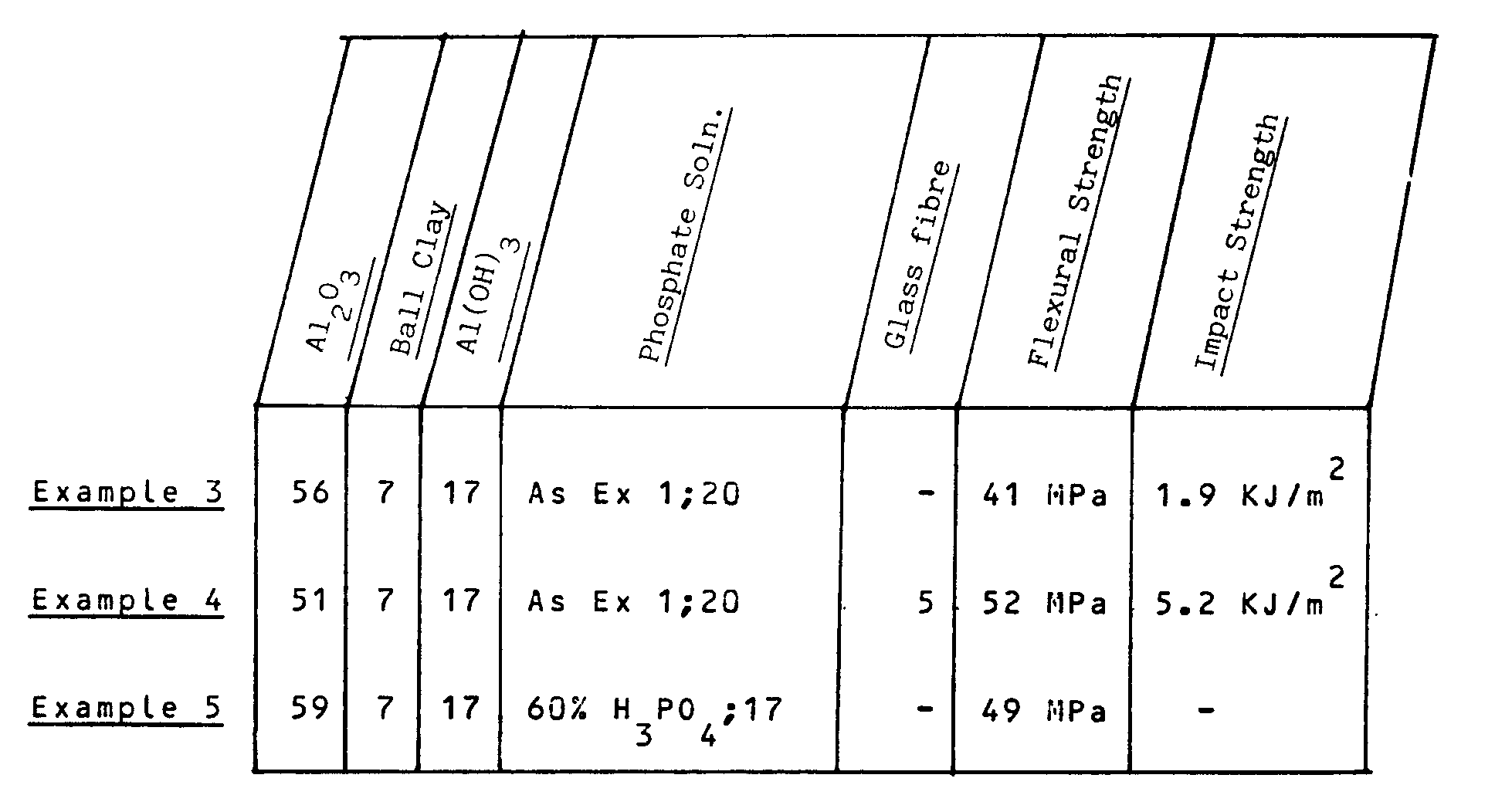
- Following generally the procedure of Example 1, products were prepared from the following ingredients in the following weight proportions , with hardening at room temperature, and were found to have the strengths shown.
Claims (10)
- A method of making sheet-form material from refractory powder, by(a) mixing the powder with an aqueous acidic phosphate solution and a plasticity-improving clay, to form a mixture free from combustible binder;(b) subjecting the mixture to high shear; and(c) hardening the product of (b) in shaped form, at a temperature below the sintering temperature of the refractory powder; characterised in thati at least 50% by weight of the refractory powder is of particle size below 200 micrometersii the clay is included in the mixture in an amount not greater than 10% by weight, andiii the mixture is subjected to high shear by passing it through a twin-roll mill, and the cohesive plastic mass thus formed is hardened as a coherent sheet below the sintering temperature of the refractory powder.
- A method according to claim 1 in which hardening is carried out at a temperature above 50° C.
- A method according to claim 1 in which hardening is carried out at a temperature above 200° C.
- A method according to any of claims 1 to 3 in which at least the initial stage of hardening is carried out under pressure.
- A method according to any of claims 1 to 4 in which the refractory powder comprises alumina.
- A method according to any of claims 1 to 4 in which the refractory powder comprises a calcined clay.
- A method according to any of claims 1 to 6 in which the plasticity-improving clay is ball clay or china clay.
- A method according to any of claims 1 to 7 in which the refractory powder also contains magnesium oxide or aluminium hydroxide.
- A method according to any of claims 1 to 8 in which the aqueous acidic phosphate solution is a solution of aluminium phosphate.
- A method according to any of claims 1 to 8 in which the phosphate solution is phosphoric acid.
Priority Applications (1)
| Application Number | Priority Date | Filing Date | Title |
|---|---|---|---|
| AT87202636T ATE71072T1 (en) | 1987-01-23 | 1987-12-29 | MANUFACTURE OF MOLDED ARTICLES FROM REFRACTORY POWDER. |
Applications Claiming Priority (2)
| Application Number | Priority Date | Filing Date | Title |
|---|---|---|---|
| GB8701538 | 1987-01-23 | ||
| GB8701538A GB2200107B (en) | 1987-01-23 | 1987-01-23 | Manufacture of sheet-form material from refractory powder. |
Publications (2)
| Publication Number | Publication Date |
|---|---|
| EP0275609A1 EP0275609A1 (en) | 1988-07-27 |
| EP0275609B1 true EP0275609B1 (en) | 1992-01-02 |
Family
ID=10611140
Family Applications (1)
| Application Number | Title | Priority Date | Filing Date |
|---|---|---|---|
| EP87202636A Expired - Lifetime EP0275609B1 (en) | 1987-01-23 | 1987-12-29 | Manufacture of shaped articles from refractory powder |
Country Status (8)
| Country | Link |
|---|---|
| US (1) | US4898701A (en) |
| EP (1) | EP0275609B1 (en) |
| JP (1) | JPS63190751A (en) |
| AT (1) | ATE71072T1 (en) |
| AU (1) | AU597775B2 (en) |
| DE (1) | DE3775747D1 (en) |
| GB (1) | GB2200107B (en) |
| NO (1) | NO880264L (en) |
Families Citing this family (4)
| Publication number | Priority date | Publication date | Assignee | Title |
|---|---|---|---|---|
| FR2809391B1 (en) * | 2000-05-29 | 2003-05-09 | Rhodia Chimie Sa | NEW PHOSPHOMAGNESIAN MORTAR, PROCESS FOR OBTAINING THIS MORTAR |
| US7628951B1 (en) * | 2005-10-21 | 2009-12-08 | Ceramatec, Inc. | Process for making ceramic insulation |
| US20100090168A1 (en) * | 2008-10-06 | 2010-04-15 | Grancrete, Inc. | Radiation shielding structure composition |
| WO2011089699A1 (en) | 2010-01-21 | 2011-07-28 | パイオニア株式会社 | Power generating apparatus and power generating method |
Citations (1)
| Publication number | Priority date | Publication date | Assignee | Title |
|---|---|---|---|---|
| EP0178154A2 (en) * | 1984-10-09 | 1986-04-16 | The Dow Chemical Company | Refractory materials, their production and use |
Family Cites Families (9)
| Publication number | Priority date | Publication date | Assignee | Title |
|---|---|---|---|---|
| GB922384A (en) * | 1959-10-30 | 1963-03-27 | Artrite Resins Ltd | Inorganic polymeric materials |
| US3352814A (en) * | 1963-06-28 | 1967-11-14 | Teleflex Inc | Method for making ceramic bodies |
| US3316110A (en) * | 1964-10-07 | 1967-04-25 | Monsanto Co | Refractory compositions and processes |
| US3379544A (en) * | 1966-03-07 | 1968-04-23 | Richard O. Burhans | Refractory bonding mortar |
| CA1093103A (en) * | 1977-09-15 | 1981-01-06 | Thomas H. Fitzpatrick | Refractory mix composition and method of preparation |
| US4379108A (en) * | 1980-02-19 | 1983-04-05 | Fmc Corporation | Strengthening phosphate shale briquettes |
| US4504555A (en) * | 1982-09-07 | 1985-03-12 | Masonite Corporation | Composition and process for forming inorganic resins and resulting product |
| US4548646A (en) * | 1982-11-15 | 1985-10-22 | Sermatech International Incorporated | Thixotropic coating compositions and methods |
| JPS60251167A (en) * | 1984-05-24 | 1985-12-11 | 松下電工株式会社 | Manufacture of forming material |
-
1987
- 1987-01-23 GB GB8701538A patent/GB2200107B/en not_active Expired - Fee Related
- 1987-12-29 EP EP87202636A patent/EP0275609B1/en not_active Expired - Lifetime
- 1987-12-29 AT AT87202636T patent/ATE71072T1/en not_active IP Right Cessation
- 1987-12-29 DE DE8787202636T patent/DE3775747D1/en not_active Expired - Fee Related
- 1987-12-30 US US07/139,762 patent/US4898701A/en not_active Expired - Fee Related
-
1988
- 1988-01-22 JP JP63011051A patent/JPS63190751A/en active Pending
- 1988-01-22 AU AU10704/88A patent/AU597775B2/en not_active Ceased
- 1988-01-22 NO NO880264A patent/NO880264L/en unknown
Patent Citations (1)
| Publication number | Priority date | Publication date | Assignee | Title |
|---|---|---|---|---|
| EP0178154A2 (en) * | 1984-10-09 | 1986-04-16 | The Dow Chemical Company | Refractory materials, their production and use |
Also Published As
| Publication number | Publication date |
|---|---|
| NO880264L (en) | 1988-07-25 |
| EP0275609A1 (en) | 1988-07-27 |
| ATE71072T1 (en) | 1992-01-15 |
| JPS63190751A (en) | 1988-08-08 |
| GB2200107A (en) | 1988-07-27 |
| US4898701A (en) | 1990-02-06 |
| DE3775747D1 (en) | 1992-02-13 |
| AU1070488A (en) | 1988-07-28 |
| NO880264D0 (en) | 1988-01-22 |
| AU597775B2 (en) | 1990-06-07 |
| GB2200107B (en) | 1990-06-20 |
| GB8701538D0 (en) | 1987-02-25 |
Similar Documents
| Publication | Publication Date | Title |
|---|---|---|
| JP5879414B2 (en) | Sintered refractories with improved thermal shock resistance | |
| US5900201A (en) | Binder coagulation casting | |
| DE69735116T2 (en) | Hydraulic monolithic refractory containing a non-calzinc binder and consisting of hydrogenation-activatable alumina and magnesia | |
| US4171984A (en) | Refractory composition for flow casting | |
| KR20180088658A (en) | Refractory Magnesia Cement | |
| CA1105500A (en) | Refractory for aluminum-melting furnaces | |
| US3652307A (en) | Alumina refractories | |
| JPH03153566A (en) | Spinel combined ceramic composition | |
| RU2140407C1 (en) | Refractory concrete mix | |
| CA1055053A (en) | Monolithic refractories | |
| CZ20003060A3 (en) | Basic, free flowing casting material and shaped parts produced from such material | |
| US4898701A (en) | Manufacture of shaped articles from refractory powder | |
| US3379544A (en) | Refractory bonding mortar | |
| CA1331631C (en) | Rebonded fused brick | |
| JPS61291465A (en) | Monolithic refractory composition | |
| SU1719364A1 (en) | Process for making silica-quartzite refractory products without firing | |
| US3384500A (en) | Refractory | |
| DE69606976T2 (en) | Wet spraying process | |
| KR100356369B1 (en) | Batch composition of chshion mortar for area of blast furnace | |
| RU2303582C2 (en) | Method of production of dry refractory ceramoconcrete mix for lining the thermal units, mainly in non-ferrous metallurgy | |
| JPS6120511B2 (en) | ||
| JPS63162579A (en) | Thermosettable monolithic refractories | |
| Cichocki et al. | The Binding of non-cement refractory castables using the technology of in-situ sol-gel formation | |
| JP2817953B2 (en) | Inorganic molded article and method for producing the same | |
| JP2715300B2 (en) | Ceramic fiber based heat insulating refractory composition |
Legal Events
| Date | Code | Title | Description |
|---|---|---|---|
| PUAI | Public reference made under article 153(3) epc to a published international application that has entered the european phase |
Free format text: ORIGINAL CODE: 0009012 |
|
| AK | Designated contracting states |
Kind code of ref document: A1 Designated state(s): AT BE CH DE FR IT LI NL SE |
|
| 17P | Request for examination filed |
Effective date: 19881217 |
|
| 17Q | First examination report despatched |
Effective date: 19901217 |
|
| GRAA | (expected) grant |
Free format text: ORIGINAL CODE: 0009210 |
|
| ITF | It: translation for a ep patent filed | ||
| AK | Designated contracting states |
Kind code of ref document: B1 Designated state(s): AT BE CH DE FR IT LI NL SE |
|
| REF | Corresponds to: |
Ref document number: 71072 Country of ref document: AT Date of ref document: 19920115 Kind code of ref document: T |
|
| REF | Corresponds to: |
Ref document number: 3775747 Country of ref document: DE Date of ref document: 19920213 |
|
| ET | Fr: translation filed | ||
| PLBE | No opposition filed within time limit |
Free format text: ORIGINAL CODE: 0009261 |
|
| STAA | Information on the status of an ep patent application or granted ep patent |
Free format text: STATUS: NO OPPOSITION FILED WITHIN TIME LIMIT |
|
| PGFP | Annual fee paid to national office [announced via postgrant information from national office to epo] |
Ref country code: FR Payment date: 19921111 Year of fee payment: 6 |
|
| PGFP | Annual fee paid to national office [announced via postgrant information from national office to epo] |
Ref country code: AT Payment date: 19921112 Year of fee payment: 6 |
|
| PGFP | Annual fee paid to national office [announced via postgrant information from national office to epo] |
Ref country code: CH Payment date: 19921116 Year of fee payment: 6 |
|
| PGFP | Annual fee paid to national office [announced via postgrant information from national office to epo] |
Ref country code: SE Payment date: 19921118 Year of fee payment: 6 |
|
| PGFP | Annual fee paid to national office [announced via postgrant information from national office to epo] |
Ref country code: DE Payment date: 19921125 Year of fee payment: 6 |
|
| PGFP | Annual fee paid to national office [announced via postgrant information from national office to epo] |
Ref country code: BE Payment date: 19921126 Year of fee payment: 6 |
|
| 26N | No opposition filed | ||
| PGFP | Annual fee paid to national office [announced via postgrant information from national office to epo] |
Ref country code: NL Payment date: 19921231 Year of fee payment: 6 |
|
| PG25 | Lapsed in a contracting state [announced via postgrant information from national office to epo] |
Ref country code: AT Effective date: 19931229 |
|
| PG25 | Lapsed in a contracting state [announced via postgrant information from national office to epo] |
Ref country code: SE Effective date: 19931230 |
|
| PG25 | Lapsed in a contracting state [announced via postgrant information from national office to epo] |
Ref country code: LI Effective date: 19931231 Ref country code: CH Effective date: 19931231 Ref country code: BE Effective date: 19931231 |
|
| BERE | Be: lapsed |
Owner name: T&N MATERIALS RESEARCH LTD Effective date: 19931231 |
|
| PG25 | Lapsed in a contracting state [announced via postgrant information from national office to epo] |
Ref country code: NL Effective date: 19940701 |
|
| NLV4 | Nl: lapsed or anulled due to non-payment of the annual fee | ||
| PG25 | Lapsed in a contracting state [announced via postgrant information from national office to epo] |
Ref country code: FR Effective date: 19940831 |
|
| REG | Reference to a national code |
Ref country code: CH Ref legal event code: PL |
|
| PG25 | Lapsed in a contracting state [announced via postgrant information from national office to epo] |
Ref country code: DE Effective date: 19940901 |
|
| REG | Reference to a national code |
Ref country code: FR Ref legal event code: ST |
|
| EUG | Se: european patent has lapsed |
Ref document number: 87202636.4 Effective date: 19940710 |
|
| PG25 | Lapsed in a contracting state [announced via postgrant information from national office to epo] |
Ref country code: IT Free format text: LAPSE BECAUSE OF NON-PAYMENT OF DUE FEES Effective date: 20051229 |