EP0274789A2 - Method for manufacturing a layered construction, and construction obtained thereby - Google Patents
Method for manufacturing a layered construction, and construction obtained thereby Download PDFInfo
- Publication number
- EP0274789A2 EP0274789A2 EP87202484A EP87202484A EP0274789A2 EP 0274789 A2 EP0274789 A2 EP 0274789A2 EP 87202484 A EP87202484 A EP 87202484A EP 87202484 A EP87202484 A EP 87202484A EP 0274789 A2 EP0274789 A2 EP 0274789A2
- Authority
- EP
- European Patent Office
- Prior art keywords
- contact surfaces
- solvent
- temperature
- construction
- weight
- Prior art date
- Legal status (The legal status is an assumption and is not a legal conclusion. Google has not performed a legal analysis and makes no representation as to the accuracy of the status listed.)
- Withdrawn
Links
Images
Classifications
-
- B—PERFORMING OPERATIONS; TRANSPORTING
- B32—LAYERED PRODUCTS
- B32B—LAYERED PRODUCTS, i.e. PRODUCTS BUILT-UP OF STRATA OF FLAT OR NON-FLAT, e.g. CELLULAR OR HONEYCOMB, FORM
- B32B3/00—Layered products comprising a layer with external or internal discontinuities or unevennesses, or a layer of non-planar shape; Layered products comprising a layer having particular features of form
- B32B3/10—Layered products comprising a layer with external or internal discontinuities or unevennesses, or a layer of non-planar shape; Layered products comprising a layer having particular features of form characterised by a discontinuous layer, i.e. formed of separate pieces of material
- B32B3/12—Layered products comprising a layer with external or internal discontinuities or unevennesses, or a layer of non-planar shape; Layered products comprising a layer having particular features of form characterised by a discontinuous layer, i.e. formed of separate pieces of material characterised by a layer of regularly- arranged cells, e.g. a honeycomb structure
-
- B—PERFORMING OPERATIONS; TRANSPORTING
- B29—WORKING OF PLASTICS; WORKING OF SUBSTANCES IN A PLASTIC STATE IN GENERAL
- B29D—PRODUCING PARTICULAR ARTICLES FROM PLASTICS OR FROM SUBSTANCES IN A PLASTIC STATE
- B29D24/00—Producing articles with hollow walls
- B29D24/002—Producing articles with hollow walls formed with structures, e.g. cores placed between two plates or sheets, e.g. partially filled
- B29D24/005—Producing articles with hollow walls formed with structures, e.g. cores placed between two plates or sheets, e.g. partially filled the structure having joined ribs, e.g. honeycomb
-
- B—PERFORMING OPERATIONS; TRANSPORTING
- B32—LAYERED PRODUCTS
- B32B—LAYERED PRODUCTS, i.e. PRODUCTS BUILT-UP OF STRATA OF FLAT OR NON-FLAT, e.g. CELLULAR OR HONEYCOMB, FORM
- B32B27/00—Layered products comprising a layer of synthetic resin
- B32B27/06—Layered products comprising a layer of synthetic resin as the main or only constituent of a layer, which is next to another layer of the same or of a different material
- B32B27/08—Layered products comprising a layer of synthetic resin as the main or only constituent of a layer, which is next to another layer of the same or of a different material of synthetic resin
-
- B—PERFORMING OPERATIONS; TRANSPORTING
- B32—LAYERED PRODUCTS
- B32B—LAYERED PRODUCTS, i.e. PRODUCTS BUILT-UP OF STRATA OF FLAT OR NON-FLAT, e.g. CELLULAR OR HONEYCOMB, FORM
- B32B27/00—Layered products comprising a layer of synthetic resin
- B32B27/34—Layered products comprising a layer of synthetic resin comprising polyamides
-
- B—PERFORMING OPERATIONS; TRANSPORTING
- B32—LAYERED PRODUCTS
- B32B—LAYERED PRODUCTS, i.e. PRODUCTS BUILT-UP OF STRATA OF FLAT OR NON-FLAT, e.g. CELLULAR OR HONEYCOMB, FORM
- B32B37/00—Methods or apparatus for laminating, e.g. by curing or by ultrasonic bonding
- B32B37/12—Methods or apparatus for laminating, e.g. by curing or by ultrasonic bonding characterised by using adhesives
-
- B—PERFORMING OPERATIONS; TRANSPORTING
- B32—LAYERED PRODUCTS
- B32B—LAYERED PRODUCTS, i.e. PRODUCTS BUILT-UP OF STRATA OF FLAT OR NON-FLAT, e.g. CELLULAR OR HONEYCOMB, FORM
- B32B37/00—Methods or apparatus for laminating, e.g. by curing or by ultrasonic bonding
- B32B37/14—Methods or apparatus for laminating, e.g. by curing or by ultrasonic bonding characterised by the properties of the layers
- B32B37/146—Methods or apparatus for laminating, e.g. by curing or by ultrasonic bonding characterised by the properties of the layers whereby one or more of the layers is a honeycomb structure
-
- B—PERFORMING OPERATIONS; TRANSPORTING
- B32—LAYERED PRODUCTS
- B32B—LAYERED PRODUCTS, i.e. PRODUCTS BUILT-UP OF STRATA OF FLAT OR NON-FLAT, e.g. CELLULAR OR HONEYCOMB, FORM
- B32B2305/00—Condition, form or state of the layers or laminate
- B32B2305/02—Cellular or porous
- B32B2305/024—Honeycomb
-
- B—PERFORMING OPERATIONS; TRANSPORTING
- B32—LAYERED PRODUCTS
- B32B—LAYERED PRODUCTS, i.e. PRODUCTS BUILT-UP OF STRATA OF FLAT OR NON-FLAT, e.g. CELLULAR OR HONEYCOMB, FORM
- B32B2309/00—Parameters for the laminating or treatment process; Apparatus details
- B32B2309/02—Temperature
-
- B—PERFORMING OPERATIONS; TRANSPORTING
- B32—LAYERED PRODUCTS
- B32B—LAYERED PRODUCTS, i.e. PRODUCTS BUILT-UP OF STRATA OF FLAT OR NON-FLAT, e.g. CELLULAR OR HONEYCOMB, FORM
- B32B2309/00—Parameters for the laminating or treatment process; Apparatus details
- B32B2309/04—Time
-
- B—PERFORMING OPERATIONS; TRANSPORTING
- B32—LAYERED PRODUCTS
- B32B—LAYERED PRODUCTS, i.e. PRODUCTS BUILT-UP OF STRATA OF FLAT OR NON-FLAT, e.g. CELLULAR OR HONEYCOMB, FORM
- B32B2309/00—Parameters for the laminating or treatment process; Apparatus details
- B32B2309/12—Pressure
Definitions
- the invention relates to a method for manufacturing a layered construction, for example a laminate or sandwich panel, which construction comprises at least two parts adhered to each other with co-operating contact surfaces and containing thermoplastic material at least in the area of the contact surfaces, in accordance with which method the contact surfaces are pressed toward each other for a period of time while temperature is increased and the thus obtained construction is subsequently allowed to cool.
- Sandwich panels are used in cases where the sheet material must on the one hand possess a great bending rigidity and must on the other hand be light.
- a sheet of light core material is provided on both sides with a comparatively thin layer of supporting material.
- wood was employed as the core material, while the coating layers consisted in many cases of aluminium.
- a light filler such as hard foam plastic can be used as core material.
- the core materrial can have a honeycomb construction. Very suitable for this purpose is the Nomex paper. Nomex is a trademark of the Dupont-de Nemours company.
- Sandwich panels are much used in aircraft and yacht building.
- the connection between the coating layers and the core is effected by means of an adhesive process.
- a thermoplastic plastic reinforced with fibres is used as coating layer.
- the core material can in that case be provided on either side with a thin layer of thermoplastic material.
- the skin layers are then adhered to the core by fusing at an increased temperature.
- the temperature of the panel has to be increased to above the melt temperature of the thermoplastic material used.
- the coating layers and the core have hereby to be pressed onto each other with a certain pressure, for instance in the order of 0.5-5 bar, in order to ensure homogeneous contact between the core and the coating sheets.
- a certain pressure for instance in the order of 0.5-5 bar
- the necessity to heat the combination to the melt temperature of the thermoplastic material can result in drawbacks for the core material. This is clearly illustrated with the adhesion of fibre reinforced plastic coating layers, in which the thermoplastic polyetherimide is used, onto Nomex honeycomb provided with a thin layer of polyetherimide as thermoplastic adhesive layer.
- the temperature at which polyetherimide becomes sufficiently soft to bring about an acceptable adhesion under pressure between the plastic coating sheets and the honeycomb core lies between 230°C and 300°C.
- the permissible usage temperature of the honeycomb core material however is approximately 170°C. The obtaining of a good adhesion will therefore also involve a degradation of the core material.
- the invention has for its object to now perform the said method such that an excellent adhesion is obtained between the co-operating contact surfaces without this being accompanied by degradation of the core material.
- the invention proposes a method of the type mentioned in the preamble which displays the feature that a quantity of solvent is applied to the contact surfaces of the parts such that some softening occurs locally and that an increase of temperature is caused to occur up to a temperature that is considerably lower than the softening temperature of the relevant thermoplastic material.
- thermoplastic material into which the solvent is absorbed beforehand can for example be applied between the contact surfaces.
- Very good results are achieved with a method whereby the solvent is added at a concentration of between approximately 10 and 40 percent by weight. Very good results are achieved with a method whereby use is made of a concentration of between approximately 20 and 30 percent by weight. Use is preferably made of a concentration of between approximately 22 and 28 percent by weight, and even more preferably of a concentration of between approximately 24 and 26 percent by weight, while in some conditions the best results are obtained with a concentration of approximately 25 percent by weight.
- the method according to the invention is recommended because of the notably short pressing time that is necessary to bring about an excellent adhesion.
- the accommodation time in a heated press can consequently also be considerably shortened, which results in cost saving in the manufacture of thermoplastic sandwich panels.
- the drying process has then to be performed in controlled circumstances and interrupted when the desired concentration of solvent has been reached. If the adhesive layer is applied in another manner or an adhesive layer applied by means of the solvent method contains insufficient solvent the latter can be raised to the correct concentration in entirely analogous manner by exposing the coated core material to the solvent.
- the invention further relates to a layered construction, for example a laminate or a sandwich panel, obtained through application of the method as according to the invention.
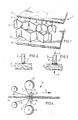
- Fig. 1 shows a sandwich panel 1 which comprises a Nomex honeycomb core 2, on either side of which are arranged skin layers 3, 4, to which the core is adhered with the contact surfaces generally designated with 5.
- Fig. 2 shows a detail of the arrangement of the lower skin layer 3 with the honeycomb 2 in the phase where the contact surfaces 5 are not yet adhered to each other. In the area of the contact surfaces some solvent is however already present, this being suitable for softening the thermoplastic material present on contact surfaces 5.
- Fig. 3 shows how, after diffusion of the solvent, heating and applying of pressure in the direction indicated by arrows 6, a flow zone 7 is obtained at the location of the contact surfaces 5.
- This flow zone 7 consists in the end-product practically entirely of the relevant thermoplastic material.
- Fig. 4 shows by way of example a device 8 for continuous manufacture of a sandwich panel.
- the honeycomb 2 is transported by pre-heated pressure rolls 10 in the direction of arrow 9.
- the coating layers 3, 4 are rolled off from supply rolls 11, 12.
- Fed in between honeycomb 2 and coating layers 3, 4 are sheets of thermoplastic material 13, 14, these sheets having been pre-treated with a solvent. This solvent is also suitable for softening the thermoplastic material on the contact surfaces of the honeycomb 2 on the one hand and the coating layers 3, 4 on the other.
- the rolls 10 are pressed towards each other with a desired pressure and heat the input arrangement to the required temperature. After cooling a finished sandwich panel is obtained at the end of the device 8.
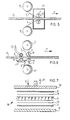
- Fig. 5 shows a device whereby no use is made of the integrated adhering sheets 13, 14, but whereby the rolls 10 are accommodated in a chamber 15 through which also runs a portion of the coating layer material of the coating layers 3, 4, and in which chamber 15 solvent is present in gas form or vapour form.
- the length of the portion over which the coating layer strips 3, 4 and the honeycomb 2 run through the chamber up to where the heating and pressuring treatment by the rolls 10 takes place must be selected with respect to the transporting speed as according to arrow 9 such that the solvent has the opportunity to act on the contact surfaces in sufficient measure through diffusion.
- Fig. 6 shows a variant in which honeycomb 2 is provided on both sides with solvent 17 by means of rolls 16 passing through a liquid bath.
- the treated honeycomb then enters the heating and pressing station, namely the rolls 10, together with the coating layers 3, 4.
- This last method has the advantage that solvent is supplied only to the contact surfaces, which in the case of a honeycomb are in any event comparatively small.
- the figures 4, 5 and 6 relate to a continuous performing of the method according to the invention. Should the pressing time be insufficient another series of pressure rolls can be added to pressure rolls 10, being placed downstream relative thereto.
- the method according to the invention can also be performed intermittently in a fixed, heatable press.
- Fig. 7 shows a device 18 of this intermittent type.
- Device 18 comprises a base-plate 19 and a pressure plate 20 which can be moved up and downward as according to arrow 21. Between the plates 19 and 20 can be placed the arrangement of honeycomb 2, adhesive layers 13, 14 and coating layers 3, 4. Plates 19, 20 are moved towards each other whereby the temperature of these plates is increased to a temperature considerably lower than the softening temperature of the relevant thermoplastic material. The pressure as according to arrow 6 can be adjusted as required.
- the solvent in the coating is reduced by means of drying in an oven suitable for this purpose to a value of between 22 and 28 percent by weight.
- the amount of coating applied is chosen such that with the stated solvent content the weight of plastic is sufficient to effect a good adhesion.
- the weight necessary depends upon the type of core material.
- thermosetting phenol resin lies between 10 and 20 N/cm.
Landscapes
- Engineering & Computer Science (AREA)
- Mechanical Engineering (AREA)
- Laminated Bodies (AREA)
- Lining Or Joining Of Plastics Or The Like (AREA)
Abstract
Description
- The invention relates to a method for manufacturing a layered construction, for example a laminate or sandwich panel, which construction comprises at least two parts adhered to each other with co-operating contact surfaces and containing thermoplastic material at least in the area of the contact surfaces, in accordance with which method the contact surfaces are pressed toward each other for a period of time while temperature is increased and the thus obtained construction is subsequently allowed to cool.
- Sandwich panels are used in cases where the sheet material must on the one hand possess a great bending rigidity and must on the other hand be light. For this purpose a sheet of light core material is provided on both sides with a comparatively thin layer of supporting material. In the past wood was employed as the core material, while the coating layers consisted in many cases of aluminium. For low load panels a light filler such as hard foam plastic can be used as core material. For high-grade applications the core materrial can have a honeycomb construction. Very suitable for this purpose is the Nomex paper. Nomex is a trademark of the Dupont-de Nemours company.
- Sandwich panels are much used in aircraft and yacht building. The connection between the coating layers and the core is effected by means of an adhesive process. In new developments in the field of fibre reinforced materials a thermoplastic plastic reinforced with fibres is used as coating layer. The core material can in that case be provided on either side with a thin layer of thermoplastic material. The skin layers are then adhered to the core by fusing at an increased temperature.
- If adhesion has to be performed in this manner by fusion, then the temperature of the panel has to be increased to above the melt temperature of the thermoplastic material used. The coating layers and the core have hereby to be pressed onto each other with a certain pressure, for instance in the order of 0.5-5 bar, in order to ensure homogeneous contact between the core and the coating sheets. Particularly with the use of high-quality thermoplastics the necessity to heat the combination to the melt temperature of the thermoplastic material can result in drawbacks for the core material. This is clearly illustrated with the adhesion of fibre reinforced plastic coating layers, in which the thermoplastic polyetherimide is used, onto Nomex honeycomb provided with a thin layer of polyetherimide as thermoplastic adhesive layer. The temperature at which polyetherimide becomes sufficiently soft to bring about an acceptable adhesion under pressure between the plastic coating sheets and the honeycomb core lies between 230°C and 300°C. The permissible usage temperature of the honeycomb core material however is approximately 170°C. The obtaining of a good adhesion will therefore also involve a degradation of the core material.
- The invention has for its object to now perform the said method such that an excellent adhesion is obtained between the co-operating contact surfaces without this being accompanied by degradation of the core material.
- In order to achieve this aim the invention proposes a method of the type mentioned in the preamble which displays the feature that a quantity of solvent is applied to the contact surfaces of the parts such that some softening occurs locally and that an increase of temperature is caused to occur up to a temperature that is considerably lower than the softening temperature of the relevant thermoplastic material.
- A layer of thermoplastic material into which the solvent is absorbed beforehand can for example be applied between the contact surfaces.
- Very good results are achieved with a method whereby the solvent is added at a concentration of between approximately 10 and 40 percent by weight. Very good results are achieved with a method whereby use is made of a concentration of between approximately 20 and 30 percent by weight. Use is preferably made of a concentration of between approximately 22 and 28 percent by weight, and even more preferably of a concentration of between approximately 24 and 26 percent by weight, while in some conditions the best results are obtained with a concentration of approximately 25 percent by weight.
- It is noted by way of explanation that as a result of the presence in comparatively small concentration of the solvent the adhesion is brought about not by a melt process but by a diffusion process. This takes place at a considerably lower temperature than that necessary for the adhesion of the contact surfaces to each other by fusion.
- Tests, whereby sandwich panels were manufactured at a temperature of only 160°C, and thus well below the temperature permissible for Nomex honeycomb, have shown that a very good adhesion is already achieved at the small pressure of roughly 0.5 bar for a pressing time of about 15 minutes. The adhesion strength is even so great here that it is no longer possible to break off the adhesive layer, as the core material is first to disintegrate.
- Also in the case of the combination of core materials with fibre reinforced coating layers, whereby the melt temperature of the thermoplastic used does not cause any danger of degradation of the core, the method according to the invention is recommended because of the notably short pressing time that is necessary to bring about an excellent adhesion. The accommodation time in a heated press can consequently also be considerably shortened, which results in cost saving in the manufacture of thermoplastic sandwich panels. If the application of the adhesive layer to the core is performed by coating of the core with a quantity of thermoplastic dissolved in solvent, the necessary amount of solvent in the adhesive layer can if desired be obtained by not evaporating out all the solvent after coating of the core material. The drying process has then to be performed in controlled circumstances and interrupted when the desired concentration of solvent has been reached. If the adhesive layer is applied in another manner or an adhesive layer applied by means of the solvent method contains insufficient solvent the latter can be raised to the correct concentration in entirely analogous manner by exposing the coated core material to the solvent.
- It will be apparent that the nature of the solvent will depend on the thermoplastic material employed.
- The invention further relates to a layered construction, for example a laminate or a sandwich panel, obtained through application of the method as according to the invention.
- The invention will now be elucidated with reference to the annexed drawing, in which:
- Fig. 1 shows a partly broken away, perspective detail view of a sandwich panel according to the invention with honeycomb core;
- fig. 2 shows a cross section through a detail as in fig. 1 in the construction stage;
- fig. 3 is the detail as in fig. 2 after adhesion has been effected;
- fig. 4 shows in schematic form a device for performing a method according to the invention;
- fig. 5 is an alternative to fig. 4;
- fig. 6 is a further alternative; and
- fig. 7 shows a final embodiment of a device for performing the method according to the invention.
- Fig. 1 shows a sandwich panel 1 which comprises a Nomex
honeycomb core 2, on either side of which are arrangedskin layers - Fig. 2 shows a detail of the arrangement of the
lower skin layer 3 with thehoneycomb 2 in the phase where thecontact surfaces 5 are not yet adhered to each other. In the area of the contact surfaces some solvent is however already present, this being suitable for softening the thermoplastic material present oncontact surfaces 5. - Fig. 3 shows how, after diffusion of the solvent, heating and applying of pressure in the direction indicated by arrows 6, a
flow zone 7 is obtained at the location of thecontact surfaces 5. Thisflow zone 7 consists in the end-product practically entirely of the relevant thermoplastic material. - Fig. 4 shows by way of example a
device 8 for continuous manufacture of a sandwich panel. Thehoneycomb 2 is transported bypre-heated pressure rolls 10 in the direction of arrow 9. Thecoating layers supply rolls honeycomb 2 andcoating layers thermoplastic material honeycomb 2 on the one hand and thecoating layers rolls 10 are pressed towards each other with a desired pressure and heat the input arrangement to the required temperature. After cooling a finished sandwich panel is obtained at the end of thedevice 8. - Fig. 5 shows a device whereby no use is made of the integrated
adhering sheets rolls 10 are accommodated in achamber 15 through which also runs a portion of the coating layer material of thecoating layers chamber 15 solvent is present in gas form or vapour form. The length of the portion over which the coating layer strips 3, 4 and thehoneycomb 2 run through the chamber up to where the heating and pressuring treatment by therolls 10 takes place must be selected with respect to the transporting speed as according to arrow 9 such that the solvent has the opportunity to act on the contact surfaces in sufficient measure through diffusion. - Fig. 6 shows a variant in which honeycomb 2 is provided on both sides with
solvent 17 by means ofrolls 16 passing through a liquid bath. The treated honeycomb then enters the heating and pressing station, namely therolls 10, together with thecoating layers - The figures 4, 5 and 6 relate to a continuous performing of the method according to the invention. Should the pressing time be insufficient another series of pressure rolls can be added to
pressure rolls 10, being placed downstream relative thereto. - The method according to the invention can also be performed intermittently in a fixed, heatable press.
- Fig. 7 shows a
device 18 of this intermittent type.Device 18 comprises a base-plate 19 and apressure plate 20 which can be moved up and downward as according toarrow 21. Between theplates honeycomb 2,adhesive layers coating layers Plates - After coating with a solution of the thermoplastic plastic, the viscosity of which lies between 10,000 and 40,000 centipoise, the solvent in the coating is reduced by means of drying in an oven suitable for this purpose to a value of between 22 and 28 percent by weight.
- The amount of coating applied is chosen such that with the stated solvent content the weight of plastic is sufficient to effect a good adhesion. The weight necessary depends upon the type of core material.
- For a Nomex honeycomb core with a specific weight of 18 kg/m³ and a cell size of 3.2 mm a weight of thermoplastic between 80 and 120 grams per square metre per side is sufficient to effect a very good adhesion.
- This adhesion, measured in accordance with the German DAN406 Luftfahrt norm 53295 lies between 20 and 40 N/cm under the stated conditions.
- The adhesion obtained with a thermosetting phenol resin lies between 10 and 20 N/cm.
Claims (8)
characterized in that
a quantity of solvent is applied to said contact surfaces of said parts such that some softening occurs locally and that said increase of temperature is caused to occur up to a temperature that is considerably lower than the softening temperature of the relevant thermoplastic material.
Applications Claiming Priority (2)
| Application Number | Priority Date | Filing Date | Title |
|---|---|---|---|
| NL8603228A NL8603228A (en) | 1986-12-18 | 1986-12-18 | METHOD FOR MANUFACTURING A LAYERED CONSTRUCTION AND CONSTRUCTION OBTAINED THEREFROM |
| NL8603228 | 1986-12-18 |
Publications (2)
| Publication Number | Publication Date |
|---|---|
| EP0274789A2 true EP0274789A2 (en) | 1988-07-20 |
| EP0274789A3 EP0274789A3 (en) | 1988-07-27 |
Family
ID=19849018
Family Applications (1)
| Application Number | Title | Priority Date | Filing Date |
|---|---|---|---|
| EP87202484A Withdrawn EP0274789A3 (en) | 1986-12-18 | 1987-12-10 | Method for manufacturing a layered construction, and construction obtained thereby |
Country Status (3)
| Country | Link |
|---|---|
| EP (1) | EP0274789A3 (en) |
| JP (1) | JPS63166517A (en) |
| NL (1) | NL8603228A (en) |
Cited By (11)
| Publication number | Priority date | Publication date | Assignee | Title |
|---|---|---|---|---|
| EP0400599A3 (en) * | 1989-05-30 | 1991-07-03 | Phillips Petroleum Company | Composite cellular sandwich structure |
| EP0345855B1 (en) * | 1988-05-26 | 1991-07-31 | Schreiner Luchtvaart Groep B.V. | Process for adhering materials together |
| US5186999A (en) * | 1989-02-17 | 1993-02-16 | Schreiner Luchtvaart Groep B.V. | Sandwich material provided with a local reinforcement |
| US5192482A (en) * | 1989-02-17 | 1993-03-09 | Schreiner Luchtvaart Groep B.V. | Method of producing a local reinforcement in a sandwich structure |
| DE4131394A1 (en) * | 1991-09-20 | 1993-04-01 | Pelz Ernst Empe Werke | Low weight laminar sound absorbing sheet - has skin(s) of porous fibre materials with glass cloth and honeycomb type core layer with infill and with walls at right angles to skin |
| FR2686044A1 (en) * | 1991-11-07 | 1993-07-16 | Honicel Nederland Bv | METHOD AND DEVICE FOR MANUFACTURING A SANDWICH PANEL. |
| EP0750006A1 (en) | 1995-06-23 | 1996-12-27 | Technische Universiteit Delft | Method of making a foamable film |
| WO1997019814A1 (en) * | 1995-11-30 | 1997-06-05 | Steinhoff Laminat Gmbh | Recyclable laminate and method of manufacturing the same |
| WO2009013124A2 (en) | 2007-07-20 | 2009-01-29 | Fritz Egger Gmbh & Co. | Lightweight building panel |
| WO2009130060A1 (en) * | 2008-04-25 | 2009-10-29 | Fritz Egger Gmbh & Co. | Method for the production of a lightweight building panel for furniture construction |
| EP2946924A1 (en) * | 2014-05-23 | 2015-11-25 | Airbus Defence and Space GmbH | Sandwich component and method for producing a sandwich component |
Families Citing this family (4)
| Publication number | Priority date | Publication date | Assignee | Title |
|---|---|---|---|---|
| NL2000570C2 (en) * | 2007-04-03 | 2008-10-06 | Stork Fokker Aesp Bv | Method for manufacturing a connection between composite parts. |
| US8999094B2 (en) | 2010-10-13 | 2015-04-07 | Ikea Supply Ag | Method of continuous manufacture of a composite hollow board material, and machine and computer program |
| FR3103704B1 (en) | 2019-11-29 | 2022-07-08 | Oreal | Composition comprising a UV filter, an ethylenic polymer with a phosphonic acid group and a hydrocarbon oil |
| WO2026042435A1 (en) * | 2024-08-21 | 2026-02-26 | 森六株式会社 | Resin molded article |
Family Cites Families (7)
| Publication number | Priority date | Publication date | Assignee | Title |
|---|---|---|---|---|
| CH380368A (en) * | 1959-01-24 | 1964-07-31 | Detag | Plastic composite panel and process for its manufacture |
| DE1238191B (en) * | 1964-11-13 | 1967-04-06 | Kapillar Plastik G M B H & Co | Process for the production of composite building boards, in particular translucent composite building boards |
| GB1150656A (en) * | 1966-06-06 | 1969-04-30 | Yuzo Kawamura | Improvements in and relating to Methods of Manufacturing Synthetic Resin Structures |
| US3480497A (en) * | 1967-03-27 | 1969-11-25 | Kemlite Corp | Method of making a reinforced resin panel using a soluble cover sheet |
| US3817808A (en) * | 1969-09-29 | 1974-06-18 | Rohr Industries Inc | Method of forming core panels |
| NL6917630A (en) * | 1969-11-21 | 1971-05-25 | Laminated building panels | |
| DE2461572A1 (en) * | 1975-01-15 | 1976-07-08 | Robert Wimmer | METHOD FOR MANUFACTURING COMPOSITE BODIES |
-
1986
- 1986-12-18 NL NL8603228A patent/NL8603228A/en not_active Application Discontinuation
-
1987
- 1987-12-10 EP EP87202484A patent/EP0274789A3/en not_active Withdrawn
- 1987-12-17 JP JP62320023A patent/JPS63166517A/en active Pending
Cited By (16)
| Publication number | Priority date | Publication date | Assignee | Title |
|---|---|---|---|---|
| EP0345855B1 (en) * | 1988-05-26 | 1991-07-31 | Schreiner Luchtvaart Groep B.V. | Process for adhering materials together |
| US5186999A (en) * | 1989-02-17 | 1993-02-16 | Schreiner Luchtvaart Groep B.V. | Sandwich material provided with a local reinforcement |
| US5192482A (en) * | 1989-02-17 | 1993-03-09 | Schreiner Luchtvaart Groep B.V. | Method of producing a local reinforcement in a sandwich structure |
| EP0400599A3 (en) * | 1989-05-30 | 1991-07-03 | Phillips Petroleum Company | Composite cellular sandwich structure |
| DE4131394A1 (en) * | 1991-09-20 | 1993-04-01 | Pelz Ernst Empe Werke | Low weight laminar sound absorbing sheet - has skin(s) of porous fibre materials with glass cloth and honeycomb type core layer with infill and with walls at right angles to skin |
| FR2686044A1 (en) * | 1991-11-07 | 1993-07-16 | Honicel Nederland Bv | METHOD AND DEVICE FOR MANUFACTURING A SANDWICH PANEL. |
| EP0750006A1 (en) | 1995-06-23 | 1996-12-27 | Technische Universiteit Delft | Method of making a foamable film |
| WO1997019814A1 (en) * | 1995-11-30 | 1997-06-05 | Steinhoff Laminat Gmbh | Recyclable laminate and method of manufacturing the same |
| WO2009013124A2 (en) | 2007-07-20 | 2009-01-29 | Fritz Egger Gmbh & Co. | Lightweight building panel |
| WO2009013124A3 (en) * | 2007-07-20 | 2009-06-18 | Fritz Egger Gmbh & Co | Lightweight building panel |
| RU2446055C2 (en) * | 2007-07-20 | 2012-03-27 | Фриц Эггер Гмбх Унд Ко.Ог | Light construction plate |
| WO2009130060A1 (en) * | 2008-04-25 | 2009-10-29 | Fritz Egger Gmbh & Co. | Method for the production of a lightweight building panel for furniture construction |
| DE102008020976B4 (en) * | 2008-04-25 | 2017-02-16 | Fritz Egger Gmbh & Co. Og | Method for producing a lightweight board for furniture construction |
| EP2946924A1 (en) * | 2014-05-23 | 2015-11-25 | Airbus Defence and Space GmbH | Sandwich component and method for producing a sandwich component |
| US20150336350A1 (en) * | 2014-05-23 | 2015-11-26 | Airbus Defence and Space GmbH | Sandwich Component and Method for Producing a Sandwich Component |
| US10414116B2 (en) | 2014-05-23 | 2019-09-17 | Airbus Defence and Space GmbH | Sandwich component and method for producing a sandwich component |
Also Published As
| Publication number | Publication date |
|---|---|
| EP0274789A3 (en) | 1988-07-27 |
| JPS63166517A (en) | 1988-07-09 |
| NL8603228A (en) | 1988-07-18 |
Similar Documents
| Publication | Publication Date | Title |
|---|---|---|
| US5316604A (en) | Process for the preparation of thermoplastic sandwich structures | |
| US4496415A (en) | Method for impregnating resin powder directly into a laminate lay up | |
| US5238725A (en) | Method for forming a structural panel with decorative facing and product thereof | |
| US5087500A (en) | Multilayer panel | |
| US4812186A (en) | Process for the manufacture of cellular core laminated elements | |
| US3547742A (en) | Laminator apparatus | |
| US6039832A (en) | Thermoplastic titanium honeycomb panel | |
| US20040188027A1 (en) | Method of partially embedding non-woven fiber mat to reinforcing fibers impregnated with a thermoplastic resin | |
| CZ285662B6 (en) | Composite board of cellular core and at least one cover layer and process for producing thereof | |
| CA2056867A1 (en) | Process for the preparation of thermoplastic honeycomb sandwich structures | |
| EP1418046B1 (en) | Composite sheet material | |
| CA2045987A1 (en) | Continuous production of metal clad laminates | |
| JPS63166517A (en) | Laminated structure and manufacture thereof | |
| JP3363641B2 (en) | High-strength composite board and method of manufacturing the same | |
| US6360803B1 (en) | Laminator | |
| GB1303301A (en) | ||
| US4690721A (en) | Apparatus and process for the production of multilayer laminated plates | |
| US20110086211A1 (en) | Method of insulation formation and application | |
| US4469737A (en) | Process for laminating mirror with protective backing and product resulting therefrom | |
| GB1232648A (en) | ||
| JPH04323024A (en) | Surface treating method of continuous frp article | |
| JPS647578B2 (en) | ||
| JPH047697B2 (en) | ||
| JPS62244637A (en) | Continuous manufacture of laminated board | |
| JPH07112501A (en) | Composite laminated structure |
Legal Events
| Date | Code | Title | Description |
|---|---|---|---|
| PUAI | Public reference made under article 153(3) epc to a published international application that has entered the european phase |
Free format text: ORIGINAL CODE: 0009012 |
|
| PUAL | Search report despatched |
Free format text: ORIGINAL CODE: 0009013 |
|
| AK | Designated contracting states |
Kind code of ref document: A2 Designated state(s): AT BE CH DE ES FR GB GR IT LI LU NL SE |
|
| AK | Designated contracting states |
Kind code of ref document: A3 Designated state(s): AT BE CH DE ES FR GB GR IT LI LU NL SE |
|
| 17P | Request for examination filed |
Effective date: 19890125 |
|
| 17Q | First examination report despatched |
Effective date: 19900402 |
|
| STAA | Information on the status of an ep patent application or granted ep patent |
Free format text: STATUS: THE APPLICATION IS DEEMED TO BE WITHDRAWN |
|
| 18D | Application deemed to be withdrawn |
Effective date: 19901013 |
|
| RIN1 | Information on inventor provided before grant (corrected) |
Inventor name: VAN DREUMEL, WILHELMUS HENDRIKUS MARIA Inventor name: BRUNS, FRANS BERNARD |