EP0274449A2 - Künstliches Spielzeugauge - Google Patents
Künstliches Spielzeugauge Download PDFInfo
- Publication number
- EP0274449A2 EP0274449A2 EP88300147A EP88300147A EP0274449A2 EP 0274449 A2 EP0274449 A2 EP 0274449A2 EP 88300147 A EP88300147 A EP 88300147A EP 88300147 A EP88300147 A EP 88300147A EP 0274449 A2 EP0274449 A2 EP 0274449A2
- Authority
- EP
- European Patent Office
- Prior art keywords
- eye
- housing
- inner body
- artificial eye
- doll
- Prior art date
- Legal status (The legal status is an assumption and is not a legal conclusion. Google has not performed a legal analysis and makes no representation as to the accuracy of the status listed.)
- Withdrawn
Links
Images

Classifications
-
- A—HUMAN NECESSITIES
- A63—SPORTS; GAMES; AMUSEMENTS
- A63H—TOYS, e.g. TOPS, DOLLS, HOOPS OR BUILDING BLOCKS
- A63H3/00—Dolls
- A63H3/36—Details; Accessories
- A63H3/38—Dolls' eyes
- A63H3/40—Dolls' eyes movable
Definitions
- the present invention relates to an artificial eye for toys such as dolls.
- the eyes of the toy In order to improve the appeal of the toys such as toy animals and especially dolls, it is well known to provide for movement of the eyes of the toy.
- the so called “sleeping eye” has become popular.
- the eye has two alternatively viewable portions, one depicting the pupil etc and the other depicting an eye lid.
- the pupil or eye lid is vieweable in accordance with the vertical or horizontal position of the toy. That is, in the case of a doll, the doll's eyes open and close as the doll is moved between standing and lying positions.
- Eye movement is one aspect of increased realism in toys. Another such aspect is the provision of a water reservoir within the toy with ducting to enable water to be expelled to simulate tears.
- the present invention resides, at least partially, in a combination of these eye movement and simulated tear features.
- an artificial eye for a toy comprising: a primary housing, a secondary housing pivotally retained in the primary housing, an inner body pivotally retained in the secondary housing, balance means arranged to result in relative pivotal motion between the primary and secondary housings and relative pivotal motion between the secondary housing and the inner body upon respective movements of the primary housing, and tear duct means which enable liquid to escape from the eye to simulate tears.
- the drawings illustrate an artificial eye particularly suitable for dolls. Two such eyes are located in respective sockets in a doll's head.
- the artificial eye has an eye lid which closes so as to cover the iris and pupil.
- the iris and pupil themselves are capable of left/right movement relative to the eye lid and in addition the eye is provided with a tear duct so that water can be made to escape from the eye to simulate tears.
- the construction of the eye is such that movement of the eye lid and left/right movement of the iris and pupil is synchronized between two eyes set in a doll's head, even though the eyes operate separately.
- the eye comprises a two part primary housing 10 a secondary housing 12, an inner body 14 and a counterweight 16.
- the primary housing 10 comprises a front casing 18 and a rear casing 20.
- Rear casing 20 is formed of a moulded plastics material and comprises a hollow cylindrical section 22 closed at one end by a hollow frusto-conical section 24 and circular surface 34.
- the outer cylindrical surface of portion 22 is recessed from the open end of the rear casing and this recess 26 is engaged by a short cylindrical section 28 of the front casing 18, thus joining the two parts 18 and 20 together.
- Recess 26 incorporates upper and lower flat platforms 27 ( Figure 1) which assist in alignment and mutual retention of the two parts 18 and 20.
- the remainder of front casing 18 is in the form of a hollow hemisphere 30 which is provided with a central aperture 32.
- the front casing 18 is formed of metal and this has a number of advantages.
- forming the front casing 18 of metal enables the part to have a much thinner cross-section, as contrasted with forming the part of a plastics material.
- the metal casing 18 can exhibit an improved resilience in mating with casing 20, as contrasted with a plastics material.
- the circular surface 34 which closes the frusto-conical section 24 of casing 20 has an integral hollow pipe 35 projecting outwardly from the centre thereof. Pipe 35 is attached, in a manner to be described, to a water reservoir within the doll thus enabling water to enter the inside of the eye.
- the recessed portion of the cylindrical section 22 of casing 20 is provided with two slots 38 located diametrically opposite each other.
- the slots 38 extend into the cylindrical portion 22 from the open end thereof.
- Secondary body 12 is provided with two spigots 40 which extend into respective slots 38 and which are retained therein by the front covering 18.
- the secondary housing 12 is thus pivotally retained within the primary housing 10.
- the spigots 40 lie along a common axis X and, with the doll in a standing position, axis X lies in the central horizontal plane of the eye.
- Secondary housing 12 has in its vertical cross-section, the form of a partial hollow sphere, as shown in Figure 2.
- the front part of the housing 12 is provided with an aperture 34 of substantially the same shape and size as aperture 32.
- the secondary housing 12 is however provided with an outwardly projecting flange 36 which extends through aperture 32. From figure 2, it will be apparent that flange 36 acts as a stop at both extremes of pivotal movement of housing 12 within housing 10. Artificial eye lashes 38 are attached to flange 36.
- the secondary housing 12 is formed of a moulded plastics material.
- Inner body 14 represents the eye ball and comprises a partially spherical body of moulded plastics material.
- Inner body 14 is provided with two integral spigots 42 which extend into circular apertures 44 provided in the secondary housing 12.
- Spigots 42 lie on a common axis Y which is perpendicular to axis X. With the doll in the standing position, axis Y is inclined at an angle of approximately 30° to the vertical. Spigots 42 snap-fit into apertures 44.
- Inner body 14 is provided with a shallow cylindrical recess 46 extending inwardly from the front surface thereof.
- the diameter of recess 46 is almost as large as the height of aperture 34, as can be seen from figure 2.
- a recess 48 having a diameter of approximately 0.4 of that of recess 46 extends deeper into body 14 and in fact passes therethrough.
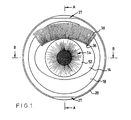
- Apertures 46 and 48 together receive a round headed stud 50 which represents the iris and pupil of the eye.
- Stud 50 is formed of a translucent material and the depth of the shank 52 forms a dark circular area representing the pupil, when viewed through the head of the stud.
- the lesser depth of material for the remainder of the head of the stud and the reflective properties of the bottom of recess 46 together produce the appearance of an iris surrounding the pupil. This effect can be significantly enhanced by the provision of radial grooves 5a in the underside of the head of the stud. This is best seen in figure 1.
- Stud 50 is frictionally engaged in recesses 46 and 48.
- Counterweight 16 is received in a recess 56 provided in a boss 58 projecting from the lower portion of the rear of inner body 14.
- Counterweight 16 is formed of a sufficiently dense material such as lead and may be held in recess 56 by frictional engagement.
- body 14 is moulded onto weight 16.
- Counterweight 16 is in the form of solid cylinder, its longitudinal axis Z being perpendicular to axis Y.
- Counterweight 16 is, however, sufficiently heavy as to resist movement of the inner body 14 which thus pivots in the secondary housing 12 about axis Y. Since the inner body 14 effectively remains stationary during left/right movement of the doll's head, the apparent motion of the two eyes relative to the doll's head is synchronized. Of course, rotation of the doll's head while moving the doll from a standing to a lying position will result in simultaneous rotation about axes X and Y.
- the whole of the unit shown in the drawings snap-fits into an eye socket provided in the doll's head.
- the eye socket is provided with an aperture to receive pipe 35 which projects from the back of primary housing 10.
- a plastic tube is located inside the doll's head and is retained over pipe 35. It may be necessary to use a tool such as a pair of long-nosed plyers in order to achieve this operation.
- the plastic tube connects pipe 35 to a water reservoir which is housed, preferably, within the doll's head.
- the reservoir is filled via a feed tube which is connected to an orifice representing the doll's mouth.
- the feed tube may be provided with a valve such that water in the reservoir does not flow back out of the doll's mouth.
- a bung perhaps representing a teething ring, is inserted into the doll's mouth after the reservoir has been filled.
- An air bellows is located in the doll's body and is connected to the reservoir in a known manner. The result is that squeezing the doll's body applies air pressure to the water reservoir which results in water travelling via the plastic tube and pipe 35 into the primary housing 10.
- the water collects inside primary housing 10 and as the water level there increases, or as the doll's head is tilted forwards, the water passes between the secondary housing 12 and the front casing 18 to escape from the front of the eye, simulating tears.
- the components of the eye are preferably formed of water resistant materials or are provided with a water resistant coating. Stud 52 is, in this respect, particularly beneficial as contrasted with the conventional cardboard or paper insert carrying a painted iris and pupil.
Landscapes
- Toys (AREA)
Applications Claiming Priority (2)
| Application Number | Priority Date | Filing Date | Title |
|---|---|---|---|
| GB08700510A GB2199759A (en) | 1987-01-09 | 1987-01-09 | An artificial eye for toys |
| GB8700510 | 1987-01-09 |
Publications (2)
| Publication Number | Publication Date |
|---|---|
| EP0274449A2 true EP0274449A2 (de) | 1988-07-13 |
| EP0274449A3 EP0274449A3 (en) | 1989-10-18 |
Family
ID=10610504
Family Applications (1)
| Application Number | Title | Priority Date | Filing Date |
|---|---|---|---|
| EP88300147A Withdrawn EP0274449A3 (en) | 1987-01-09 | 1988-01-08 | An artifical eye for toys |
Country Status (2)
| Country | Link |
|---|---|
| EP (1) | EP0274449A3 (de) |
| GB (1) | GB2199759A (de) |
Cited By (5)
| Publication number | Priority date | Publication date | Assignee | Title |
|---|---|---|---|---|
| ES2120341A1 (es) * | 1995-10-23 | 1998-10-16 | Promotora De Arrendamientos Te | Ojo movil para jugueteria con movimientos de pupila y parpado. |
| EP1224961A1 (de) * | 2001-01-19 | 2002-07-24 | PMS International Group PLC | Augeneinrichtung für spielzeug |
| US7189137B2 (en) | 2004-05-17 | 2007-03-13 | Steven Ellman | Tearing mechanism for a toy, such as a doll, having fixed or movable eyes |
| US7322874B2 (en) | 2004-06-02 | 2008-01-29 | Steven Ellman | Expression mechanism for a toy, such as a doll, having fixed or moveable eyes |
| US7841920B2 (en) | 2006-06-08 | 2010-11-30 | Mattel, Inc, | Crying toy dolls |
Families Citing this family (1)
| Publication number | Priority date | Publication date | Assignee | Title |
|---|---|---|---|---|
| DE9100362U1 (de) * | 1991-01-14 | 1991-04-04 | Noris-Vertriebs-GmbH, O-5812 Waltershausen | Anordnung zur Bewegung von sogenannten Schelmenaugen von Puppen |
Family Cites Families (8)
| Publication number | Priority date | Publication date | Assignee | Title |
|---|---|---|---|---|
| GB214722A (en) * | 1923-01-25 | 1924-04-25 | Alan Ross Munyard | Improvements in dolls and the like |
| FR1123065A (fr) * | 1955-04-22 | 1956-09-17 | Successeurs De L Sappey | Oeil riboulant pour poupée |
| US3091891A (en) * | 1957-03-18 | 1963-06-04 | Dollac Corp | Tearing eye |
| US3091893A (en) * | 1961-05-22 | 1963-06-04 | Dollac Corp | Rolling and sleeping eye for dolls |
| US3193968A (en) * | 1962-04-04 | 1965-07-13 | Jacoby Bender | Tear duct device for sleeping doll eye |
| ES321723A1 (es) * | 1965-04-07 | 1966-06-16 | American Character Inc | Perfeccionamientos en ojos para muñecos. |
| DK384983A (da) * | 1982-08-26 | 1984-02-27 | Cpg Prod Corp | Dukke |
| FR2537450A1 (fr) * | 1982-12-14 | 1984-06-15 | Berchet Ind Sa | Oeil mobile pour jouets, tels que poupees, animaux |
-
1987
- 1987-01-09 GB GB08700510A patent/GB2199759A/en not_active Withdrawn
-
1988
- 1988-01-08 EP EP88300147A patent/EP0274449A3/en not_active Withdrawn
Cited By (5)
| Publication number | Priority date | Publication date | Assignee | Title |
|---|---|---|---|---|
| ES2120341A1 (es) * | 1995-10-23 | 1998-10-16 | Promotora De Arrendamientos Te | Ojo movil para jugueteria con movimientos de pupila y parpado. |
| EP1224961A1 (de) * | 2001-01-19 | 2002-07-24 | PMS International Group PLC | Augeneinrichtung für spielzeug |
| US7189137B2 (en) | 2004-05-17 | 2007-03-13 | Steven Ellman | Tearing mechanism for a toy, such as a doll, having fixed or movable eyes |
| US7322874B2 (en) | 2004-06-02 | 2008-01-29 | Steven Ellman | Expression mechanism for a toy, such as a doll, having fixed or moveable eyes |
| US7841920B2 (en) | 2006-06-08 | 2010-11-30 | Mattel, Inc, | Crying toy dolls |
Also Published As
| Publication number | Publication date |
|---|---|
| EP0274449A3 (en) | 1989-10-18 |
| GB8700510D0 (en) | 1987-02-11 |
| GB2199759A (en) | 1988-07-20 |
Similar Documents
| Publication | Publication Date | Title |
|---|---|---|
| US6422916B1 (en) | Toy doll | |
| US4356663A (en) | Crying doll | |
| JPH08500313A (ja) | 連結おもちゃの形をした菓子類等の食品用容器 | |
| US5540612A (en) | Simulated eyes for toys having convex lens body | |
| US6537131B1 (en) | Realistic doll head mounting assembly | |
| US5577723A (en) | Squeezable toy ball | |
| US20230147198A1 (en) | Plush toy including snow globe eyes | |
| EP0274449A2 (de) | Künstliches Spielzeugauge | |
| US3769745A (en) | Tearing doll with rotatable head | |
| US3952449A (en) | Articulated figure toy | |
| US4875888A (en) | Eye construction for toy doll | |
| US4033071A (en) | Sucking doll with cheekflexing means operated by turning bottle | |
| GB2199761A (en) | Growing toys, eg dolls | |
| US6419546B1 (en) | Doll movable structure for loin and groin | |
| US3445955A (en) | Changeable feature figure toy | |
| US4471565A (en) | Articulated doll mounted on a ball | |
| US4900287A (en) | Tearing eye doll | |
| RU2083255C1 (ru) | Сборная игрушка, имеющая, к примеру, вид небольшого животного или куклы | |
| EP1224961A1 (de) | Augeneinrichtung für spielzeug | |
| US2777250A (en) | Dolls' eyes | |
| US3043051A (en) | Eye for dolls | |
| US2627701A (en) | Doll eye | |
| US20130280986A1 (en) | Toy figure with coordinated movements | |
| CA1168447A (en) | Winking apparatus for a figure toy | |
| US3883986A (en) | Doll with eye-closing means responding to lateral tilting and separate eye-closing means responding to rearward tilting |
Legal Events
| Date | Code | Title | Description |
|---|---|---|---|
| PUAI | Public reference made under article 153(3) epc to a published international application that has entered the european phase |
Free format text: ORIGINAL CODE: 0009012 |
|
| AK | Designated contracting states |
Kind code of ref document: A2 Designated state(s): DE FR GB IT |
|
| PUAL | Search report despatched |
Free format text: ORIGINAL CODE: 0009013 |
|
| AK | Designated contracting states |
Kind code of ref document: A3 Designated state(s): DE FR GB IT |
|
| STAA | Information on the status of an ep patent application or granted ep patent |
Free format text: STATUS: THE APPLICATION IS DEEMED TO BE WITHDRAWN |
|
| 18D | Application deemed to be withdrawn |
Effective date: 19900419 |