EP0274428A2 - Organoalkoxysilane-containing coating composition - Google Patents
Organoalkoxysilane-containing coating composition Download PDFInfo
- Publication number
- EP0274428A2 EP0274428A2 EP88300076A EP88300076A EP0274428A2 EP 0274428 A2 EP0274428 A2 EP 0274428A2 EP 88300076 A EP88300076 A EP 88300076A EP 88300076 A EP88300076 A EP 88300076A EP 0274428 A2 EP0274428 A2 EP 0274428A2
- Authority
- EP
- European Patent Office
- Prior art keywords
- group
- weight
- parts
- coating composition
- resistance
- Prior art date
- Legal status (The legal status is an assumption and is not a legal conclusion. Google has not performed a legal analysis and makes no representation as to the accuracy of the status listed.)
- Granted
Links
- HFNQSVDOAVIZIS-UHFFFAOYSA-N COC(C1C(C(OC)=O)=CCCC1)=O Chemical compound COC(C1C(C(OC)=O)=CCCC1)=O HFNQSVDOAVIZIS-UHFFFAOYSA-N 0.000 description 1
Classifications
-
- C—CHEMISTRY; METALLURGY
- C09—DYES; PAINTS; POLISHES; NATURAL RESINS; ADHESIVES; COMPOSITIONS NOT OTHERWISE PROVIDED FOR; APPLICATIONS OF MATERIALS NOT OTHERWISE PROVIDED FOR
- C09D—COATING COMPOSITIONS, e.g. PAINTS, VARNISHES OR LACQUERS; FILLING PASTES; CHEMICAL PAINT OR INK REMOVERS; INKS; CORRECTING FLUIDS; WOODSTAINS; PASTES OR SOLIDS FOR COLOURING OR PRINTING; USE OF MATERIALS THEREFOR
- C09D143/00—Coating compositions based on homopolymers or copolymers of compounds having one or more unsaturated aliphatic radicals, each having only one carbon-to-carbon double bond, and containing boron, silicon, phosphorus, selenium, tellurium, or a metal; Coating compositions based on derivatives of such polymers
- C09D143/04—Homopolymers or copolymers of monomers containing silicon
-
- C—CHEMISTRY; METALLURGY
- C09—DYES; PAINTS; POLISHES; NATURAL RESINS; ADHESIVES; COMPOSITIONS NOT OTHERWISE PROVIDED FOR; APPLICATIONS OF MATERIALS NOT OTHERWISE PROVIDED FOR
- C09D—COATING COMPOSITIONS, e.g. PAINTS, VARNISHES OR LACQUERS; FILLING PASTES; CHEMICAL PAINT OR INK REMOVERS; INKS; CORRECTING FLUIDS; WOODSTAINS; PASTES OR SOLIDS FOR COLOURING OR PRINTING; USE OF MATERIALS THEREFOR
- C09D183/00—Coating compositions based on macromolecular compounds obtained by reactions forming in the main chain of the macromolecule a linkage containing silicon, with or without sulfur, nitrogen, oxygen, or carbon only; Coating compositions based on derivatives of such polymers
- C09D183/04—Polysiloxanes
-
- C—CHEMISTRY; METALLURGY
- C08—ORGANIC MACROMOLECULAR COMPOUNDS; THEIR PREPARATION OR CHEMICAL WORKING-UP; COMPOSITIONS BASED THEREON
- C08L—COMPOSITIONS OF MACROMOLECULAR COMPOUNDS
- C08L2205/00—Polymer mixtures characterised by other features
- C08L2205/02—Polymer mixtures characterised by other features containing two or more polymers of the same C08L -group
-
- C—CHEMISTRY; METALLURGY
- C08—ORGANIC MACROMOLECULAR COMPOUNDS; THEIR PREPARATION OR CHEMICAL WORKING-UP; COMPOSITIONS BASED THEREON
- C08L—COMPOSITIONS OF MACROMOLECULAR COMPOUNDS
- C08L83/00—Compositions of macromolecular compounds obtained by reactions forming in the main chain of the macromolecule a linkage containing silicon with or without sulfur, nitrogen, oxygen or carbon only; Compositions of derivatives of such polymers
- C08L83/04—Polysiloxanes
Definitions
- This invention relates to a coating composition. More particularly, this invention relates to a coating composition comprising at least one compound selected from the group consisting of an organoalkoxysilane, a hydrolyzate of the organoalkoxysilane and a partial condensate of the organoalkoxysilane; colloidal alumina; an organopolysiloxane and/or a silyl group-containing vinyl resin and an organic solvent.
- a coating composition that has an excellent storage stability, can be hardened at low temperatures and can form a coating film superior in heat resistance, water resistance, boiling water resistance, organic chemical resistance, acid resistance, alkali resistance, corrosion resistance, absorbability and radiatability of heat and light, friction resistance, weather resistance, moisture resistance, salt water resistance, adhesion, hardness and smoothness.
- a coating composition satisfying only some of the above requirements is proposed in USP 3,986,997 and USP 4,027,073, which is an aqueous acidic composition comprising a partial condensate of a silanol and colloidal silica.
- the present inventors have made research on the above technical problems and, as a result, have found a coating composition which has an excellent stability, can be hardened at low temperatures and can form a coating film superior in heat resistance, water resistance, boiling water resistance, organic chemical resistance, acid resistance, alkali resistance, corrosion resistance, absorbability and radiatability of heat and light, friction resistance, weather resistance, moisture resistance, salt water resistance, adhesion, hardness and smoothness.
- a coating composition comprising:
- the component (a) is at least one compound selected from the group consisting of (a') an organoalkoxysilane represented by the general formula (I), (a") a hydrolyzate of the organoalkoxysilane and (a"') a partial condensate thereof and acts as a binder in the composition of this invention.
- R in the formula (I) for the organoalkoxysilane (a') is an organic group having 1-8 carbon atoms and includes, for example, alkyl groups (e.g. methyl, ethyl, propyl and the like), gamma-chloropropyl group, vinyl group, 3,3,3-trifluoropropyl group, gamma-glycidoxypropyl group, gamma-methacryloyloxypropyl group, gamma-mercaptopropyl group, phenyl group, 3,4-epoxycyclohexylethyl group, etc.
- alkyl groups e.g. methyl, ethyl, propyl and the like
- gamma-chloropropyl group vinyl group, 3,3,3-trifluoropropyl group
- gamma-glycidoxypropyl group gamma-methacryloyloxypropyl group
- R 1 in the formula (I) for the organoalkoxysilane (a') is an alkyl group having 1-5 carbon atoms or an acyl group having 1-4 carbon atoms and includes, for example, methyl group, ethyl group, propyl group, butyl group, formyl group and acetyl group.
- organoalkoxysilane (a') examples include methyltrimethoxysilane, methyltriethoxysilane, methyltriacetoxysilane, methyltripropionyloxysilane, ethyltrimethoxysilane, ethyltriethoxysilane, propyltrimethoxysilane, propyltriethoxysilane, gamma-chloropropyltrimethoxysilane, gamma-chloropropyltriethoxysilane, vinyltrimethoxysilane, vinyltriethoxysilane, 3,3,3-trifluoropropyltrimethoxysilane, 3,3,3-trifluoropropyltriethoxysilane, gamma-glycidoxypropyltrimethoxysilane, gamma-glycidoxypropyltriethoxysilane, gamma-methacryloyloxypropyloxy
- organoalkoxysilanes (a') can be used alone or in combination of two or more.
- the organoalkoxysilane (a') represented by the general formula (1) contains at least 80 mole % of CH3Si(OR?)s.
- the component (a) is a partial condensate (a"') of the organoalkoxysilane.
- the partial condensate has a polystyrene-reduced weight average molecular weight of preferably 500-50,000, more preferably 3,000-20,000.
- the molecular weight is less than 500, the resulting composition gives a coating film of poor adhesion.
- the molecular weight is more than 50,000, the resulting composition has a reduced storage stability, in some cases.
- the colloidal alumina (b) is used for the purpose of preventing the gelation and thickening of the composition of this invention, dispersing the optionally used fillers, enhancing the heat resistance, hardness. and adhesion of the coating film formed by coating a substrate with the filler-containing composition, and imparting antistatic property.
- the colloidal alumina (b) is usually an alumina sol having a pH of 2.5-6 in which water is a dispersing medium, contains about 5-25% by weight in total of alumina, quasi-boehmite and boehmite and also an acid (e.g. nitric acid, hydrochloric acid, acetic acid or the like) as a stabilizer, and has an average particle diameter of 5-200 m ⁇ , preferably 10-100 m ⁇ .
- the alumina sol includes, for example, ALUMINUMSOL-100, ALUMINUMSOL-200 and ALUMINUMSOL-520 (products of Nissan Chemical Industries, Ltd.).
- the colloidal alumina (b) may also be those obtained by hydrolysis of anhydrous aluminum chloride or hydrolysis of an aluminum alkoxide represented by the general formula (II): wherein R 2 is an alkyl group having 1-4 carbon atoms such as methyl, ethyl, n-butyl or the like, for example, a colloidal alumina consisting of 5-25% by weight of finely divided alumina having an average particle diameter of 5-200 m ⁇ , preferably 10-100 m ⁇ , 75-95% by weight of water and 0.05-5% by weight of an acid such as acetic acid, hydrochloric acid or the like.
- R 2 is an alkyl group having 1-4 carbon atoms such as methyl, ethyl, n-butyl or the like
- a colloidal alumina consisting of 5-25% by weight of finely divided alumina having an average particle diameter of 5-200 m ⁇ , preferably 10-100 m ⁇ , 75-95% by weight of water and 0.05-5% by
- the colloidal alumina (b) may be an aqueous acidic dispersion (pH 2-6) of fine alumina particles having an average particle diameter of 5-200 m ⁇ , preferably 10-100 mp..
- the fine alumina particles include, for example, Aluminum Oxide C (a product of Degusa Co., Germany).
- the proportion of the colloidal alumina (b) in the present composition is 5-50 parts by weight, preferably 8-40 parts by weight, as solids per 100 parts by weight (in terms of organoalkoxysilane) of the component (a).
- the proportion is less than 5 parts by weight, it is not sufficient to prevent the composition of this invention from gelling, being thickened and forming a thick coating film; the dispersion of the optionally used fillers in the composition is not sufficient; and the coating film formed from the composition has no sufficient hardness and tends to be cracked.
- the proportion is more than 50 parts by weight, the proportions of the other components in the composition inevitably are relatively lessened to cause excessive thickening of the composition and reduction of intimate adhesion of the coating film formed from the composition.
- the organopolysiloxane (c) is an organopolysiloxane having at least one reactive functional group in the molecule.
- the organopolysiloxane (c) is, for example, an organopolysiloxane having a unit structure represented by the general formula (III): wherein R 3 is an organic group having 1-8 carbon atoms and a is a positive number of 1.1-1.8, and having, in the molecule, at least one reactive functional group represented by -OX' (X' is a hydrogen atom or an alkyl group having 1-5 carbon atoms) bonded to the silicon atom.
- R 3 in the general formula (III) is an organic group and includes, for example, alkyl groups (e.g. methyl, ethyl, propyl and the like), gamma-chloropropyl group, vinyl group, 3,3,3-trifluoropropyl group, gamma-glycidoxypropyl group, gamma-methacryloyloxypropyl group, gamma-mercaptopropyl group, phenyl group, 3,4-epoxycyclohexylethyl group and gamma-aminopropyl group. Of these groups, preferred are methyl and phenyl groups.
- alkyl groups e.g. methyl, ethyl, propyl and the like
- gamma-chloropropyl group vinyl group, 3,3,3-trifluoropropyl group, gamma-glycidoxypropyl group, gamma-methacryloyloxypropyl group
- a is a positive number of 1.1-1.8, preferably 1.2-1.6.
- a is less than 1.1, the coating film formed from the resulting composition is cracked in some cases.
- a is more than 1.8, the coating film is difficult to harden in some cases.
- the organopolysiloxane (c) has, in the molecule, at least one, preferably 3-30 reactive functional groups (e.g. -OX' group) bonded to the silicon atoms of the organopolysiloxane.
- X' of the -OX' group is a hydrogen atom or an alkyl group having 1-5 carbon atoms such as methyl, ethyl, propyl, butyl or the like.
- organopolysiloxane (c) has no reactive functional group in the molecule, the hardening reaction of the resulting composition does not proceed sufficiently.
- organopolysiloxane (c) examples include silicone resins such as Silicone Varnishes TSR 160, TSR 145, TSR 127B, TSR 165, YR 3187 and YR 3168 (these are products of TOSHIBA SILICONE K.K.); Silicone Varnishes SH 6018 and Q 1-37 (these are products of TORAY SILICONE K.K.); Silicone Intermediates KR 211, KR 212, KR 213, KR 214, KR 216 and KR 218 (these are products of Shin-Etsu Chemical Co., Ltd.); and Intermediates SY 409 and SY 430 (these are products of Wacker Chemicals Co.).
- silicone resins such as Silicone Varnishes TSR 160, TSR 145, TSR 127B, TSR 165, YR 3187 and YR 3168 (these are products of TOSHIBA SILICONE K.K.); Silicone Varnishes SH 6018 and Q 1-37
- the proportion of the organopolysiloxane (c) in the present composition is 2-200 parts by weight, preferably 5-50 parts by weight per 100 parts by weight of the component (a) (in terms of organoalkoxysilane).
- the proportion is less than 2 parts by weight, the water resistance and alkali resistance of the coating film are reduced.
- the proportion is more than 200 parts by weight, the hardness and solvent resistance are reduced.
- the organopolysiloxanes (c) can be used alone or in admixture of two or more.
- the silyl group-containing vinyl resin (d) has the main chain consisting of a vinyl polymer and, at the terminal(s) or side chain(s) of the polymer molecule, at least one, preferably at least two silyl groups each having a silicon atom having bounded thereto a hydrolyzable group.
- silyl groups are represented by the general formula (IV): wherein X is a hydrolyzable group such as halogen atom, hydroxyl group, alkoxy group, acyloxy group, phenoxy group, thioalkoxy group, amino group or the like, R 4 is a hydrogen atom, an alkyl group having 1-10 carbon atoms or an aralkyl group having 7-10 carbon atoms, and n is an integer of 1-3.
- X is a hydrolyzable group such as halogen atom, hydroxyl group, alkoxy group, acyloxy group, phenoxy group, thioalkoxy group, amino group or the like
- R 4 is a hydrogen atom, an alkyl group having 1-10 carbon atoms or an aralkyl group having 7-10 carbon atoms
- n is an integer of 1-3.
- X are halogen atoms such as chlorine atom, bromine atom and the like; alkoxy groups such as methoxy, ethoxy, propoxy and the like; acyloxy groups such as acetyl, propionyl and the like; and thioalkoxy groups such as methylmercapto, ethylmercapto and the like.
- R 4 are alkyl groups having 1-10 carbon atoms such as methyl, ethyl, propyl, octyl, nonyl and the like; and aralkyl groups having 7-10 carbon atoms such as benzyl, phenethyl, cumyl and the like.
- the hydrosilane compound used in the production method (i) includes, for example, halogenated silanes such as methyldichlorosilane, trichlorosilane, phenyldichlorosilane and the like; alkoxysilanes such as methyldiethoxysilane, methyldimethoxysilane, phenyl dimethoxysilane, trimethoxysilane, triethoxysilane and the like; and acyloxysilanes such as methyldiacetoxysilane, phenyldiacetoxysilane, triacetoxysilane and the like.
- halogenated silanes such as methyldichlorosilane, trichlorosilane, phenyldichlorosilane and the like
- alkoxysilanes such as methyldiethoxysilane, methyldimethoxysilane, phenyl dimethoxysilane, trim
- the vinyl resin used in the production method (i) may be any other vinyl resin than hydroxyl group-containing vinyl resins.
- Suitable as the vinyl resin are polymers of vinyl compounds selected from (meth)acrylic acid esters such as methyl (meth)acrylate, ethyl (meth)acrylate, butyl (meth)acrylate, 2-ethylhexyl (meth)acrylate and the like; carboxylic acids such as (meth)acrylic acid, itaconic acid, fumaric acid and the like; acid anhydrides such as maleic anhydride and the like; epoxy compounds such as glycidyl (meth)acrylate and the like; amino compounds such as diethylaminoethyl (meth)acrylate, aminoethyl vinyl ether and the like; amide compounds such as (meth)acrylamide, itaconic acid diamide, alpha-ethylacrylamide, crotonic acid amide, fumaric acid diamide, maleic acid diamide, N-
- the silane compound used in the production method (ii) includes, for example, 1 method (ii) includes, for example, and
- vinyl compound used in the production method (ii) it is possible to employ the vinyl compounds which are used in the polymerization in the production method (i).
- hydroxyl-group containing vinyl compounds such as 2-hydroxyethyl (meth)acrylate, 2-hydroxypropyl (meth)acrylate, 2-hydroxypropylvinyl ether, N-methylolacrylamide and the like.
- silyl group-containing vinyl resin (d) examples include KANEKA GEMLAK® and KANEKA SILYL® (products of Kanegafuchi Chemical Industry Co., Ltd.), Silicone Acryl Varnish TSR 171 (a product of TOSHIBA SILICONE K.K.) and the like.
- the proportion of the silyl group-containing vinyl resin (d) in the present composition is 3-6,000 parts by weight, preferably 10-3,000 parts by weight, more preferably 10-2,000 parts by weight, most preferably 10-200 parts by weight, per 100 parts by weight of the component (a) (in terms of organoalkoxysllane).
- the proportion is less than 3 parts by weight, the alkali resistance of the coating film formed is low.
- the proportion is more than 6,000 parts by weight, the weather resistance and hardness of the coating film formed is reduced.
- the silyl group-containing vinyl resin (d) can be used alone or in admixture of two or more.
- composition of this invention can be prepared by uniformly mixing and dispersing essential components (a) and (b) and components (c) and/or (d) and (e) an organic solvent to control the concentrations of the components (a) to (d), make the composition applicable to various coating methods, and enhance the dispersion stability and storage stability of the composition.
- the organic solvent (e) includes hydrophilic organic solvents, which may be present in the colloidal alumina (b) in the case where a hydrophilic organic solvent is contained as a dispersing medium for the component (b).
- the organic solvent (e) is not critical and may be any solvents as long as the components (a) to (d) can uniformly dispersed therein, but an alcohol, an aromatic hydrocarbon, an ether, a ketone, an ester or the like may be appropriately used.
- the alcohol examples include methyl alcohol, ethyl alcohol, n-propyl alcohol, isopropyl alcohol, n-butyl alcohol, isobutyl alcohol, sec-butyl alcohol, tert-butyl alcohol, ethylene glycol, diethylene glycol, triethylene glycol, ethylene glycol monobutyl ether, ethylene glycol monoethyl ether, ethylene glycol monomethyl ether and the like.
- aromatic hydrocarbon examples include benzene, toluene, xylene and the like.
- ether examples include tetrahydrofuran, dioxane, ethylene glycol monoethyl ether acetate, and the like.
- ketone examples include acetone, methyl ethyl ketone, methyl isobutyl ketone, diisobutyl ketone and the like.
- ester examples include ethyl acetate, propyl acetate, butyl acetate, propylene carbonate and the like.
- organic solvents can be used alone or in admixture of two or more.
- the composition of this invention comprising the components (a) to (e) has a total solids content of preferably 10-50% by weight, particularly preferably 15-350/0 by weight.
- the concentration is too low and the coating film formed from the resulting composition do not exhibit heat resistance, water resistance, chemical resistance, weather resistance, etc. in some cases and there are cases where pin holes appear in the film.
- the concentration is too high and there are cases where the resulting composition has a poor storate stability and it becomes difficult to form a uniform coating film by coating the composition on a substrate.
- the composition may further comprise fillers if necessary.
- the fillers are water-insoluble fillers and include, for example, organic and inorganic pigments. Besides, there can also be used metals, alloys, and their oxides, hydroxides, carbonates, nitrides, sulfides, etc. in the form of particles or fibers.
- Specific examples thereof include iron, copper, aluminum, nickel, silver, zinc, lead, chromium, ferrite, carbon black, stainless steel, silicon dioxide, titanium oxide, aluminum oxide, chromium oxide, manganese oxide, iron oxide, zirconium oxide, cobalt oxide, tin oxide, copper oxide, synthetic mullite, zircon (zirconia silicate), aluminum hydroxide, iron hydroxide, silicon carbide, silicon nitride, boron nitride and molybdenum disulfide in the form of particles or fibers.
- the fillers are not limited thereto.
- These fillers have usually an average particle diameter or average length of 0.05-50 ⁇ m, preferably 0.1-5 ⁇ m.
- average particle diameter or average length is less than 0.05 ⁇ m, the viscosity of the composition is increased and the desired film thickness cannot be achieved in some cases.
- average particle diameter or average length is more than 50 ⁇ m, the resulting composition tends to have a poor dispersibility.
- the proportion of the fillers optionally used in the present composition is usually 50-500 parts by weight, preferably 80-300 parts by weight, per 100 parts by weight of the component (a) (in terms of organoalkoxy silane).
- the proportion is less than 50 parts by weight, the fillers cannot impart the desired properties sufficiently to the present composition.
- the proportion is more than 500 parts by weight, the resulting composition gels in some cases and, as a result, the coating film formed from the composition has a deteriorated hardness, a deteriorated adhesion to substrates and a low work efficiency.
- a hardening accelerator may be used under some hardening conditions. Co-use of hardening accelerators is effective for conducting the hardening at relatively low temperatures.
- the hardening accelerator includes, for example, alkaline compounds such as sodium hydroxide, potassium hydroxide and the like; acidic compounds such as alkyl titanate, phosphoric acid, p-toluenesulfonic acid, phthalic acid and the like; amine compounds such as ethylenediamine, hexanediamine, diethylenetriamine, triethylenetetramine, tetraethylenepentamine, piperidine, piperazine, meta-phenylenediamine, ethanolamine, triethylamine, various modified amines used as a hardening agent for epoxy resins and the like; amine type silane coupling agents such as gamma-aminopropyltriethoxysilane, gamma-(2-aminoethyl)aminopropyltriethoxysilane, gamma-(2aminoethyl)aminopropylmethyldimethoxysilane, gamma-anilinopropy
- the proportion of the hardening accelerator in the composition of this invention is usually not more than 15 parts by weight, preferably 0.01-10 parts by weight, per 100 parts by weight of the present composition.
- the present composition can further comprise other conventionally known additives such as surfactants, other silane coupling agents than those mentioned above; titanium coupling agents; alkali metal salts of naphthenic acid, octylic acid, nitrous acid, sulfurous acid, aluminum hydroxide trihydrate, carbonic acid and the like; dyes; and the like.
- additives such as surfactants, other silane coupling agents than those mentioned above; titanium coupling agents; alkali metal salts of naphthenic acid, octylic acid, nitrous acid, sulfurous acid, aluminum hydroxide trihydrate, carbonic acid and the like; dyes; and the like.
- composition of this invention can be coated on the surface of an object substrate by a coating means such as brushing, spraying, dipping or the like, in a film thickness of about 5-50 ⁇ m in the case of single coating and of about 10-150 ⁇ m in the case of double or triple coating.
- the film is heated for about 10 minutes to 12 hours at temperatures of from room temperature to about 300° C to obtain a dry and hard coating film.
- the substrate to which the present composition can be applied includes, for example, stainless steel, aluminum, ceramics, concrete, paper, glass, plastics and the like.
- part and 0/ 0 are by weight unless otherwise specified.
- the 2,000-hour irradiation test specified by JIS K 5400 was conducted using a weatherometer, and the condition of the coating film after the test was observed.
- a temperature cycle consisting of heating for 30 min at 200° C and cooling for 30 min at -20° C was repeated 100 times, and the condition of the coating film after the test was observed.
- a sample containing no hardening accelerator was stored in a tightly stoppered polyethylene bottle and the occurrence of gelation in the sample was examined visually.
- the sample after storage was measured for viscosity in accordance with JIS K 5400 and, when the viscosity change was 100/0 or less, the storage stability of the sample was indicated as "no change".
- a sample containing a hardening accelerator was stored in a tightly stoppered polyethylene bottle and the occurrence of gelation in the sample was examined visually.
- test piece having a coating film thereon was immersed in tap water for 60 days at room temperature and the condition of the coating film after the immersion was observed.
- test piece having a coating film thereon was placed in boiling tap water for 16 hours and the condition of the coating film after the treatment was observed.
- a test piece having a coating film thereon was immersed in a saturated aqueous slaked lime solution for 30 days and water-rinsed, after which the condition of the coating film was observed.
- composition was subjected to centrifugation to remove the alumina portion.
- the resulting supernatant was filtered through a filter having a pore diameter of 0.45 pm.
- the resulting filtrate was subjected to GPC, whereby the partial condensate (a"') was found to have a polystyrene-reduced weight average molecular weight of 7,300.
- Coating compositions R to V shown in Table 2 were obtained in the same manner as in Example 1.
- compositions A to Q obtained in Example 1 and all of the compositions R to V obtained in Comparative Example 1 with or without hardening accelerators shown in Table 3 were coated on the following test pieces (1) and (2) using an air spray gun and hardened at a temperature of from room temperature to 150°C to form coating films:
- each of the coating compositions A to Q shown in Table 2 was used as a binder, and fillers shown in Table 4 were added to each binder. They were mixed for 5 hours using a ball mill, whereby coating compositions a to q shown in Table 4 were obtained.
- Coating compositions r to v shown in Table 4 were obtained in the same manner as in Example 2.
- compositions a to q obtained in Example 2 and all of the compositions r to v obtained in Comparative Example 2 with or without hardening accelerators shown in Table 5 were coated on the previously mentioned test pieces (1) and (2) using an air spray gun and hardened at room temperature to 150°C to form coating films.
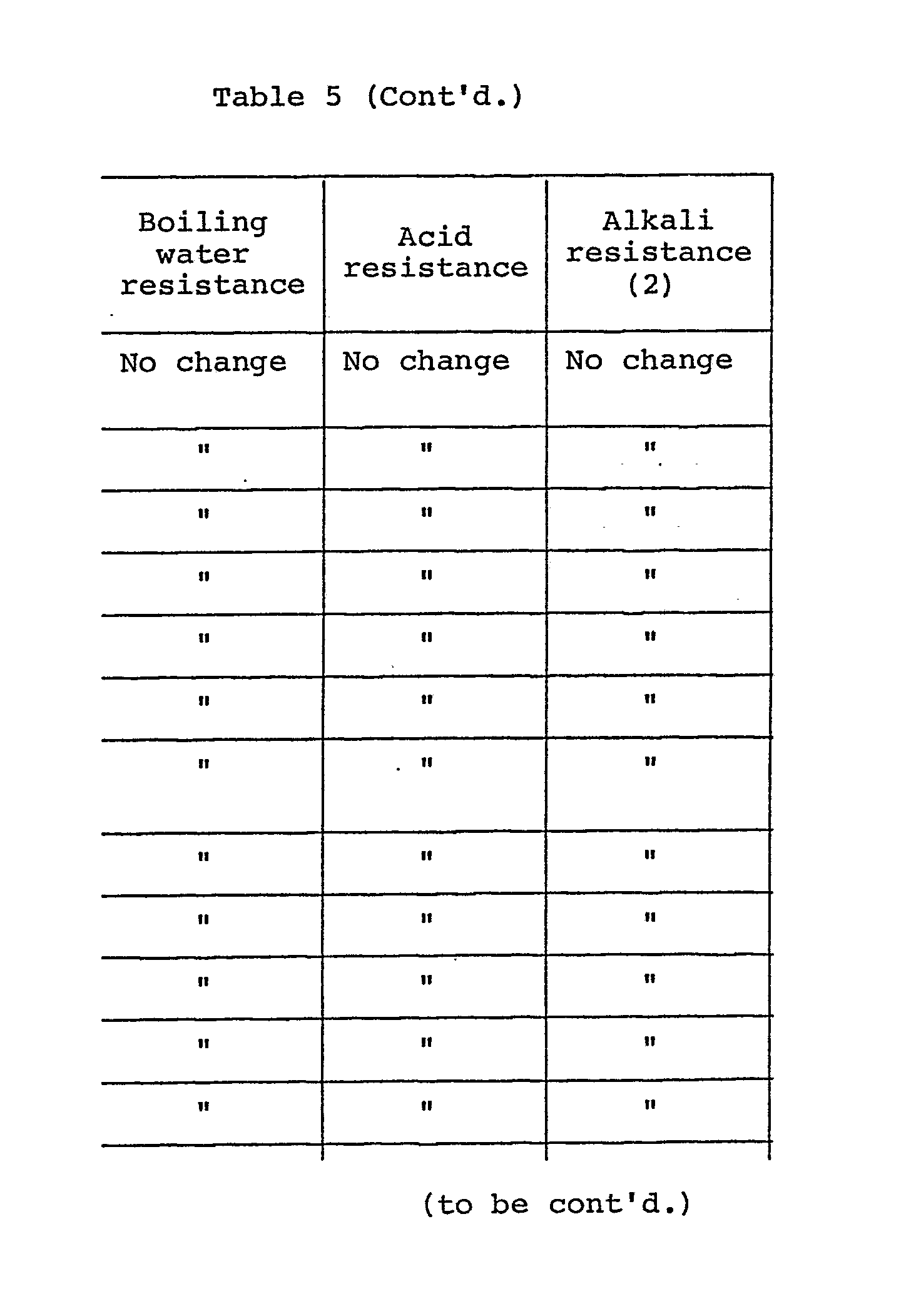
- Each of the above coating films was measured for adhesion, hardness, temperature cycle test, boiling water reistance, water resistance, acid resistance, alkali resistance, weather resistance, storage stability and pot file. The results are shown in Table 5.
Landscapes
- Chemical & Material Sciences (AREA)
- Life Sciences & Earth Sciences (AREA)
- Engineering & Computer Science (AREA)
- Materials Engineering (AREA)
- Wood Science & Technology (AREA)
- Organic Chemistry (AREA)
- Chemical Kinetics & Catalysis (AREA)
- Paints Or Removers (AREA)
- Compositions Of Macromolecular Compounds (AREA)
Abstract
- A coating composition comprising: (a) 100 parts by weight (in terms of organoalkoxysilane) of at least one compound selected from the group consisting of (a') an organoalkoxysilane represented by the general formula (I):

- (b) 5-50 parts by weight (as solids) of colloidal alumina, and
- (c) 2-200 parts by weight of at least one organopolysiloxane having at least one reactive functional group in the polymer molecule and/or
- (d) 3-6,000 parts by weight of at least one silyl group-containing vinyl polymer having, at the terminal(s) or side chain(s) of the polymer molecule, at least one silyl group having a silicon atom having bonded thereto a hydrolyzable group, and
- (e) an organic solvent. Said coating composition is excellent in storage stability, can be used at low temperatures and can form a coating film superior in heat resistance, water resistance, boiling water resistance, organic chemical resistance, acid resistance, alkali resistance, corrosion resistance, absorbability and radiatability of heat and light, friction resistance, weather resistance, moisture resistance, salt water resistance, adhesion, hardness and smoothness.
Description
- This invention relates to a coating composition. More particularly, this invention relates to a coating composition comprising at least one compound selected from the group consisting of an organoalkoxysilane, a hydrolyzate of the organoalkoxysilane and a partial condensate of the organoalkoxysilane; colloidal alumina; an organopolysiloxane and/or a silyl group-containing vinyl resin and an organic solvent.
- In recent years, there has been required such a coating composition that has an excellent storage stability, can be hardened at low temperatures and can form a coating film superior in heat resistance, water resistance, boiling water resistance, organic chemical resistance, acid resistance, alkali resistance, corrosion resistance, absorbability and radiatability of heat and light, friction resistance, weather resistance, moisture resistance, salt water resistance, adhesion, hardness and smoothness.
- A coating composition satisfying only some of the above requirements is proposed in USP 3,986,997 and USP 4,027,073, which is an aqueous acidic composition comprising a partial condensate of a silanol and colloidal silica.
- The coating compositions described in USP 3,986,997 and USP 4,027,073, however, are disadvantageous in that the condensation of the trisilanol contained therein does not proceed sufficiently during the aging of the composition at ordinary temperature and that the coating film formed from the composition has an insufficient adhesion to substrates and has a poor alkali resistance.
- The present inventors have made research on the above technical problems and, as a result, have found a coating composition which has an excellent stability, can be hardened at low temperatures and can form a coating film superior in heat resistance, water resistance, boiling water resistance, organic chemical resistance, acid resistance, alkali resistance, corrosion resistance, absorbability and radiatability of heat and light, friction resistance, weather resistance, moisture resistance, salt water resistance, adhesion, hardness and smoothness.
- According to this invention, there is provided a coating composition comprising:
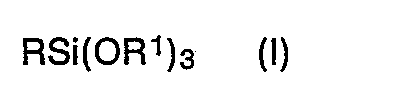
- (a) 100 parts by weight (in terms of organoalkoxysilane) of at least one compound selected from the group consisting of an organoalkoxysilane represented by the general formula (I) :
- (b) 5-50 parts by weight (as solids) of colloidal alumina [hereinafter referred to as the colloidal alumina (b)], and
- (c) 2-200 parts by weight of an organopolysiloxane having at least one reactive functional group in the polymer molecule [hereinafter referred to as the organopolysiloxane (c)] and/or
- (d) 3-6,000 parts by weight of a silyl group-containing vinyl resin having, at the terminal(s) or side chain(s) of the polymer molecule, at least one silyl group having a silicon atom bonded to a hydrolyzable group [the resin being hereinafter referred to as the silyl group-containing vinyl resin (d)], and
- (e) an organic solvent. Each of the essential constituents of the composition of this invention will be described in detail below.
- The component (a) is at least one compound selected from the group consisting of (a') an organoalkoxysilane represented by the general formula (I), (a") a hydrolyzate of the organoalkoxysilane and (a"') a partial condensate thereof and acts as a binder in the composition of this invention.
- R in the formula (I) for the organoalkoxysilane (a') is an organic group having 1-8 carbon atoms and includes, for example, alkyl groups (e.g. methyl, ethyl, propyl and the like), gamma-chloropropyl group, vinyl group, 3,3,3-trifluoropropyl group, gamma-glycidoxypropyl group, gamma-methacryloyloxypropyl group, gamma-mercaptopropyl group, phenyl group, 3,4-epoxycyclohexylethyl group, etc.
- R1 in the formula (I) for the organoalkoxysilane (a') is an alkyl group having 1-5 carbon atoms or an acyl group having 1-4 carbon atoms and includes, for example, methyl group, ethyl group, propyl group, butyl group, formyl group and acetyl group.
- Specific examples of the organoalkoxysilane (a') include methyltrimethoxysilane, methyltriethoxysilane, methyltriacetoxysilane, methyltripropionyloxysilane, ethyltrimethoxysilane, ethyltriethoxysilane, propyltrimethoxysilane, propyltriethoxysilane, gamma-chloropropyltrimethoxysilane, gamma-chloropropyltriethoxysilane, vinyltrimethoxysilane, vinyltriethoxysilane, 3,3,3-trifluoropropyltrimethoxysilane, 3,3,3-trifluoropropyltriethoxysilane, gamma-glycidoxypropyltrimethoxysilane, gamma-glycidoxypropyltriethoxysilane, gamma-methacryloyloxypropyltrimethoxysilane, gamma-methacryloyloxypropyltriethoxysilane, gamma-mercaptopropyltrimethoxysilane, gamma- mercaptopropyltriethoxysilane, phenyltrimethoxysilane, phenyltriethoxysilane, 3,4-epoxycyclohexylethyltrimethoxysilane and 3,4-epoxycyclohexylethyltriethoxysilane. Of these, preferred are methyltrimethoxysilane and methyltriethoxysilane.
- These organoalkoxysilanes (a') can be used alone or in combination of two or more.
- It is preferable that the organoalkoxysilane (a') represented by the general formula (1) contains at least 80 mole % of CH3Si(OR?)s.
- Preferably, the component (a) is a partial condensate (a"') of the organoalkoxysilane. The partial condensate has a polystyrene-reduced weight average molecular weight of preferably 500-50,000, more preferably 3,000-20,000. When the molecular weight is less than 500, the resulting composition gives a coating film of poor adhesion. When the molecular weight is more than 50,000, the resulting composition has a reduced storage stability, in some cases.
- The colloidal alumina (b) is used for the purpose of preventing the gelation and thickening of the composition of this invention, dispersing the optionally used fillers, enhancing the heat resistance, hardness. and adhesion of the coating film formed by coating a substrate with the filler-containing composition, and imparting antistatic property.
- The colloidal alumina (b) is usually an alumina sol having a pH of 2.5-6 in which water is a dispersing medium, contains about 5-25% by weight in total of alumina, quasi-boehmite and boehmite and also an acid (e.g. nitric acid, hydrochloric acid, acetic acid or the like) as a stabilizer, and has an average particle diameter of 5-200 mµ, preferably 10-100 mµ. The alumina sol includes, for example, ALUMINUMSOL-100, ALUMINUMSOL-200 and ALUMINUMSOL-520 (products of Nissan Chemical Industries, Ltd.).
- The colloidal alumina (b) may also be those obtained by hydrolysis of anhydrous aluminum chloride or hydrolysis of an aluminum alkoxide represented by the general formula (II):

- The colloidal alumina (b) may be an aqueous acidic dispersion (pH 2-6) of fine alumina particles having an average particle diameter of 5-200 mµ, preferably 10-100 mp..
- The fine alumina particles include, for example, Aluminum Oxide C (a product of Degusa Co., Germany).
- The proportion of the colloidal alumina (b) in the present composition is 5-50 parts by weight, preferably 8-40 parts by weight, as solids per 100 parts by weight (in terms of organoalkoxysilane) of the component (a). When the proportion is less than 5 parts by weight, it is not sufficient to prevent the composition of this invention from gelling, being thickened and forming a thick coating film; the dispersion of the optionally used fillers in the composition is not sufficient; and the coating film formed from the composition has no sufficient hardness and tends to be cracked. When the proportion is more than 50 parts by weight, the proportions of the other components in the composition inevitably are relatively lessened to cause excessive thickening of the composition and reduction of intimate adhesion of the coating film formed from the composition.
- The organopolysiloxane (c) is an organopolysiloxane having at least one reactive functional group in the molecule.
- The organopolysiloxane (c) is, for example, an organopolysiloxane having a unit structure represented by the general formula (III):

- R3 in the general formula (III) is an organic group and includes, for example, alkyl groups (e.g. methyl, ethyl, propyl and the like), gamma-chloropropyl group, vinyl group, 3,3,3-trifluoropropyl group, gamma-glycidoxypropyl group, gamma-methacryloyloxypropyl group, gamma-mercaptopropyl group, phenyl group, 3,4-epoxycyclohexylethyl group and gamma-aminopropyl group. Of these groups, preferred are methyl and phenyl groups.
- In the general formula (III), a is a positive number of 1.1-1.8, preferably 1.2-1.6. When a is less than 1.1, the coating film formed from the resulting composition is cracked in some cases. When a is more than 1.8, the coating film is difficult to harden in some cases.
- The organopolysiloxane (c) has, in the molecule, at least one, preferably 3-30 reactive functional groups (e.g. -OX' group) bonded to the silicon atoms of the organopolysiloxane.
- X' of the -OX' group is a hydrogen atom or an alkyl group having 1-5 carbon atoms such as methyl, ethyl, propyl, butyl or the like.
- If the organopolysiloxane (c) has no reactive functional group in the molecule, the hardening reaction of the resulting composition does not proceed sufficiently.
- Specific examples of the organopolysiloxane (c) include silicone resins such as Silicone Varnishes TSR 160, TSR 145, TSR 127B, TSR 165, YR 3187 and YR 3168 (these are products of TOSHIBA SILICONE K.K.); Silicone Varnishes SH 6018 and Q 1-37 (these are products of TORAY SILICONE K.K.); Silicone Intermediates KR 211, KR 212, KR 213, KR 214, KR 216 and KR 218 (these are products of Shin-Etsu Chemical Co., Ltd.); and Intermediates SY 409 and SY 430 (these are products of Wacker Chemicals Co.).
- The proportion of the organopolysiloxane (c) in the present composition is 2-200 parts by weight, preferably 5-50 parts by weight per 100 parts by weight of the component (a) (in terms of organoalkoxysilane). When the proportion is less than 2 parts by weight, the water resistance and alkali resistance of the coating film are reduced. When the proportion is more than 200 parts by weight, the hardness and solvent resistance are reduced.
- The organopolysiloxanes (c) can be used alone or in admixture of two or more.
- The silyl group-containing vinyl resin (d) has the main chain consisting of a vinyl polymer and, at the terminal(s) or side chain(s) of the polymer molecule, at least one, preferably at least two silyl groups each having a silicon atom having bounded thereto a hydrolyzable group. Many of said silyl groups are represented by the general formula (IV):

- The silyl group-containing vinyl resin (d) can be produced by (i) reacting a hydrosilane compound with a vinyl resin having carbon to carbon double bonds or by (ii) polymerizing a vinyl compound with a silane compound represented by the general formula (V):


- The hydrosilane compound used in the production method (i) includes, for example, halogenated silanes such as methyldichlorosilane, trichlorosilane, phenyldichlorosilane and the like; alkoxysilanes such as methyldiethoxysilane, methyldimethoxysilane, phenyl dimethoxysilane, trimethoxysilane, triethoxysilane and the like; and acyloxysilanes such as methyldiacetoxysilane, phenyldiacetoxysilane, triacetoxysilane and the like.
- The vinyl resin used in the production method (i) may be any other vinyl resin than hydroxyl group-containing vinyl resins. Suitable as the vinyl resin are polymers of vinyl compounds selected from (meth)acrylic acid esters such as methyl (meth)acrylate, ethyl (meth)acrylate, butyl (meth)acrylate, 2-ethylhexyl (meth)acrylate and the like; carboxylic acids such as (meth)acrylic acid, itaconic acid, fumaric acid and the like; acid anhydrides such as maleic anhydride and the like; epoxy compounds such as glycidyl (meth)acrylate and the like; amino compounds such as diethylaminoethyl (meth)acrylate, aminoethyl vinyl ether and the like; amide compounds such as (meth)acrylamide, itaconic acid diamide, alpha-ethylacrylamide, crotonic acid amide, fumaric acid diamide, maleic acid diamide, N-butoxymethyl(meth)acrylamide and the like; acrylonitrile; styrene; alpha-methylstyrene; vinyl chloride; vinyl acetate; vinyl propionate; and so forth.
- In the production of a polymer of such a vinyl compound, it is possible to introduce carbon to carbon double bonds necessary for hydrosilylation into the vinyl resin by copolymerizing allyl acrylate, allyl methacrylate, diallyl phthalate or the like.
- The silane compound used in the production method (ii) includes, for example, 1 method (ii) includes, for example,


- As the vinyl compound used in the production method (ii), it is possible to employ the vinyl compounds which are used in the polymerization in the production method (i). In addition thereto, there can also be used hydroxyl-group containing vinyl compounds such as 2-hydroxyethyl (meth)acrylate, 2-hydroxypropyl (meth)acrylate, 2-hydroxypropylvinyl ether, N-methylolacrylamide and the like.
- Specific examples of the silyl group-containing vinyl resin (d) are KANEKA GEMLAK® and KANEKA SILYL® (products of Kanegafuchi Chemical Industry Co., Ltd.), Silicone Acryl Varnish TSR 171 (a product of TOSHIBA SILICONE K.K.) and the like.
- The proportion of the silyl group-containing vinyl resin (d) in the present composition is 3-6,000 parts by weight, preferably 10-3,000 parts by weight, more preferably 10-2,000 parts by weight, most preferably 10-200 parts by weight, per 100 parts by weight of the component (a) (in terms of organoalkoxysllane). When the proportion is less than 3 parts by weight, the alkali resistance of the coating film formed is low. When the proportion is more than 6,000 parts by weight, the weather resistance and hardness of the coating film formed is reduced.
- The silyl group-containing vinyl resin (d) can be used alone or in admixture of two or more.
- The composition of this invention can be prepared by uniformly mixing and dispersing essential components (a) and (b) and components (c) and/or (d) and (e) an organic solvent to control the concentrations of the components (a) to (d), make the composition applicable to various coating methods, and enhance the dispersion stability and storage stability of the composition.
- The organic solvent (e) includes hydrophilic organic solvents, which may be present in the colloidal alumina (b) in the case where a hydrophilic organic solvent is contained as a dispersing medium for the component (b).
- The organic solvent (e) is not critical and may be any solvents as long as the components (a) to (d) can uniformly dispersed therein, but an alcohol, an aromatic hydrocarbon, an ether, a ketone, an ester or the like may be appropriately used.
- Specific examples of the alcohol include methyl alcohol, ethyl alcohol, n-propyl alcohol, isopropyl alcohol, n-butyl alcohol, isobutyl alcohol, sec-butyl alcohol, tert-butyl alcohol, ethylene glycol, diethylene glycol, triethylene glycol, ethylene glycol monobutyl ether, ethylene glycol monoethyl ether, ethylene glycol monomethyl ether and the like.
- Specific examples of the aromatic hydrocarbon include benzene, toluene, xylene and the like.
- Specific examples of the ether include tetrahydrofuran, dioxane, ethylene glycol monoethyl ether acetate, and the like.
- Specific examples of the ketone include acetone, methyl ethyl ketone, methyl isobutyl ketone, diisobutyl ketone and the like.
- Specific examples of the ester include ethyl acetate, propyl acetate, butyl acetate, propylene carbonate and the like.
- These organic solvents can be used alone or in admixture of two or more.
- The composition of this invention comprising the components (a) to (e) has a total solids content of preferably 10-50% by weight, particularly preferably 15-350/0 by weight. When the solids content is less than 100/0 by weight, the concentration is too low and the coating film formed from the resulting composition do not exhibit heat resistance, water resistance, chemical resistance, weather resistance, etc. in some cases and there are cases where pin holes appear in the film. When the solids content is more than 500/0 by weight, the concentration is too high and there are cases where the resulting composition has a poor storate stability and it becomes difficult to form a uniform coating film by coating the composition on a substrate.
- The composition may further comprise fillers if necessary. The fillers are water-insoluble fillers and include, for example, organic and inorganic pigments. Besides, there can also be used metals, alloys, and their oxides, hydroxides, carbonates, nitrides, sulfides, etc. in the form of particles or fibers. Specific examples thereof include iron, copper, aluminum, nickel, silver, zinc, lead, chromium, ferrite, carbon black, stainless steel, silicon dioxide, titanium oxide, aluminum oxide, chromium oxide, manganese oxide, iron oxide, zirconium oxide, cobalt oxide, tin oxide, copper oxide, synthetic mullite, zircon (zirconia silicate), aluminum hydroxide, iron hydroxide, silicon carbide, silicon nitride, boron nitride and molybdenum disulfide in the form of particles or fibers. The fillers are not limited thereto.
- These fillers have usually an average particle diameter or average length of 0.05-50 µm, preferably 0.1-5 µm. When the average particle diameter or average length is less than 0.05 µm, the viscosity of the composition is increased and the desired film thickness cannot be achieved in some cases. When the average particle diameter or average length is more than 50 µm, the resulting composition tends to have a poor dispersibility.
- The proportion of the fillers optionally used in the present composition is usually 50-500 parts by weight, preferably 80-300 parts by weight, per 100 parts by weight of the component (a) (in terms of organoalkoxy silane). When the proportion is less than 50 parts by weight, the fillers cannot impart the desired properties sufficiently to the present composition. When the proportion is more than 500 parts by weight, the resulting composition gels in some cases and, as a result, the coating film formed from the composition has a deteriorated hardness, a deteriorated adhesion to substrates and a low work efficiency.
- For faster hardening the present composition, a hardening accelerator may be used under some hardening conditions. Co-use of hardening accelerators is effective for conducting the hardening at relatively low temperatures.
- The hardening accelerator includes, for example, alkaline compounds such as sodium hydroxide, potassium hydroxide and the like; acidic compounds such as alkyl titanate, phosphoric acid, p-toluenesulfonic acid, phthalic acid and the like; amine compounds such as ethylenediamine, hexanediamine, diethylenetriamine, triethylenetetramine, tetraethylenepentamine, piperidine, piperazine, meta-phenylenediamine, ethanolamine, triethylamine, various modified amines used as a hardening agent for epoxy resins and the like; amine type silane coupling agents such as gamma-aminopropyltriethoxysilane, gamma-(2-aminoethyl)aminopropyltriethoxysilane, gamma-(2aminoethyl)aminopropylmethyldimethoxysilane, gamma-anilinopropyltrimethoxysilane and the like; and organotin compounds, for example, (C4H9)2Sn(OCOC11H23)2, (C4H9)2Sn(OCOCH = CHCOOCH3)2, (C4H9)2Sn(OCOCH = CHCOOC4H9)2, (C8H17)2Sn(OCOC11H23)2, (C8H17)2Sn(OCOCH=CHCOOCH3)2, (C8H17)2Sn(OCOCH=CHCOOC4H9)2, (C8H17)2Sn(OCOCH=CHCOOC8H17)2, (C4Hs)2Sn(SCH2COO), (C4H9)2Sn(SCH2COOC8H17)2, (C8Hi7)2Sn(SCH2COO), (C8H17)2Sn(SCH2CH2COO), (C8H17)2Sn(SCH2COOCH2CH2OCOCH2S), (C8Hi7)2Sn(SCH2COOCH2CH2CH2CH20COCH2S), (C8H17)2Sn(SCH2COOC8H17)2, (C8H17)2Sn(SCH2COOC12H25)2,


- The proportion of the hardening accelerator in the composition of this invention is usually not more than 15 parts by weight, preferably 0.01-10 parts by weight, per 100 parts by weight of the present composition.
- The present composition can further comprise other conventionally known additives such as surfactants, other silane coupling agents than those mentioned above; titanium coupling agents; alkali metal salts of naphthenic acid, octylic acid, nitrous acid, sulfurous acid, aluminum hydroxide trihydrate, carbonic acid and the like; dyes; and the like.
- The composition of this invention can be coated on the surface of an object substrate by a coating means such as brushing, spraying, dipping or the like, in a film thickness of about 5-50 µm in the case of single coating and of about 10-150 µm in the case of double or triple coating. The film is heated for about 10 minutes to 12 hours at temperatures of from room temperature to about 300° C to obtain a dry and hard coating film.
- The substrate to which the present composition can be applied includes, for example, stainless steel, aluminum, ceramics, concrete, paper, glass, plastics and the like.
- This invention will be explained in more detail below referring to Examples. However, this invention should not be interpreted to be restricted to these Examples.
- In the Examples, part and 0/0 are by weight unless otherwise specified.
- Also in the Examples, the determination of polystyrene-reduced weight average molecular weight by gel permeation chromatography (GPC) and measurements of other properties were conducted as follows:
- Under the following conditions, a solution of 1 g of an organopolysiloxane in 100 cc of tetrahydrofuran was used as a sample, and as the standard polystyrene, there was used a standard polystyrene manufactured by Pressure Chemical Co., U.S.A.:
- Apparatus: Model 150-C ALC/GPC, a high-temperature, high-speed gel permeation chromatograph manufactured by Waters Co., U.S.A.
- Column: SHODEX A-80M (length: 50 cm) manufactured by Showa Denko K.K.
- According to the crosscut adhesive test specified by JIS K5400, tape peeling was conducted three times and an average of the resulting three values was used as the adhesion.
- Measured according to the pencil hardness test specified by JIS K 5400.
- The 2,000-hour irradiation test specified by JIS K 5400 was conducted using a weatherometer, and the condition of the coating film after the test was observed.
- A temperature cycle consisting of heating for 30 min at 200° C and cooling for 30 min at -20° C was repeated 100 times, and the condition of the coating film after the test was observed.
- A sample containing no hardening accelerator was stored in a tightly stoppered polyethylene bottle and the occurrence of gelation in the sample was examined visually. When the sample caused no gelation, the sample after storage was measured for viscosity in accordance with JIS K 5400 and, when the viscosity change was 100/0 or less, the storage stability of the sample was indicated as "no change".
- A sample containing a hardening accelerator was stored in a tightly stoppered polyethylene bottle and the occurrence of gelation in the sample was examined visually.
- A test piece having a coating film thereon was immersed in tap water for 60 days at room temperature and the condition of the coating film after the immersion was observed.
- A test piece having a coating film thereon was placed in boiling tap water for 16 hours and the condition of the coating film after the treatment was observed.
- 1 ml of 200/0 sulfuric acid was dropped on a coating film formed on a test piece. The test piece was then allowed to stand for 1 day in a laboratory dish with a lid and water-rinsed, after which the condiction of the coating film was observed.
- 1 ml of a 3°10 aqueous sodium hydroxide solution was dropped on a coating film formed on a test piece. The test piece was then allowed to stand for 1 day in a laboratory dish with a lid and water-rinsed, after which the condition of the coating film was observed.
- A test piece having a coating film thereon was immersed in a saturated aqueous slaked lime solution for 30 days and water-rinsed, after which the condition of the coating film was observed.
- In a reactor equipped with a reflux condenser and a stirrer were placed (a') 100 parts of methyltrimethoxysilane, (b) 50 parts of Alumina Sol 520 (an aqueous dispersion of alumina having a solids content of 200/0, manufactured by Nissan Chemical Industries, Ltd.) and (e) 15 parts of isopropyl alcohol. They were subjected to reaction for 4 hours at 60°C, after which (e) 100 parts of isopropyl alcohol (hereinafter referred to simply as "additional isopropyl alcohol") was further added to obtain an inorganic binder (1).
- The thus obtained composition was subjected to centrifugation to remove the alumina portion. The resulting supernatant was filtered through a filter having a pore diameter of 0.45 pm. The resulting filtrate was subjected to GPC, whereby the partial condensate (a"') was found to have a polystyrene-reduced weight average molecular weight of 7,300.
- The above procedure was repeated, except that the types and amounts of the organoalkoxysilane (a') and the colloidal alumina (b) and the reaction temperature were varied as shown in Table 1, to obtain inorganic binders (2) to (6). The inorganic binders (1) to (6) were used in Examples and Comparative Examples.
- To each of the inorganic binders (1) to (6) obtained in Reference Example 1 and shown in Table 1 were added (c) an organopolysiloxane and/or (d) a silyl group-containing vinyl resin and (e) a solvent as shown in Table 2, whereby coating compositions A to Q shown in Table 2 were obtained.
- Coating compositions R to V shown in Table 2 were obtained in the same manner as in Example 1.
- The compositions A to Q obtained in Example 1 and all of the compositions R to V obtained in Comparative Example 1 with or without hardening accelerators shown in Table 3 were coated on the following test pieces (1) and (2) using an air spray gun and hardened at a temperature of from room temperature to 150°C to form coating films:
- Test piece (1): An asbestos sheet (JIS A 5403)
- Test piece (2): An aluminum plate (JIS H 4000, A1050P)
- Each of the above coating films was measured for adhesion, hardness, weather resistance, temperature cycle test, alkali resistance, storage stability and pot life. The results are shown in Table 3.
- Each of the coating compositions A to Q shown in Table 2 was used as a binder, and fillers shown in Table 4 were added to each binder. They were mixed for 5 hours using a ball mill, whereby coating compositions a to q shown in Table 4 were obtained.
- Coating compositions r to v shown in Table 4 were obtained in the same manner as in Example 2.
- The compositions a to q obtained in Example 2 and all of the compositions r to v obtained in Comparative Example 2 with or without hardening accelerators shown in Table 5 were coated on the previously mentioned test pieces (1) and (2) using an air spray gun and hardened at room temperature to 150°C to form coating films. Each of the above coating films was measured for adhesion, hardness, temperature cycle test, boiling water reistance, water resistance, acid resistance, alkali resistance, weather resistance, storage stability and pot file. The results are shown in Table 5.
-




Claims (13)


Applications Claiming Priority (2)
| Application Number | Priority Date | Filing Date | Title |
|---|---|---|---|
| JP209/87 | 1987-01-06 | ||
| JP20987 | 1987-01-06 |
Publications (3)
| Publication Number | Publication Date |
|---|---|
| EP0274428A2 true EP0274428A2 (en) | 1988-07-13 |
| EP0274428A3 EP0274428A3 (en) | 1989-05-31 |
| EP0274428B1 EP0274428B1 (en) | 1992-03-18 |
Family
ID=33428335
Family Applications (1)
| Application Number | Title | Priority Date | Filing Date |
|---|---|---|---|
| EP88300076A Expired - Lifetime EP0274428B1 (en) | 1987-01-06 | 1988-01-06 | Organoalkoxysilane-containing coating composition |
Country Status (5)
| Country | Link |
|---|---|
| US (1) | US4904721A (en) |
| EP (1) | EP0274428B1 (en) |
| JP (1) | JPH0819381B2 (en) |
| KR (1) | KR960005174B1 (en) |
| DE (1) | DE3869139D1 (en) |
Cited By (13)
| Publication number | Priority date | Publication date | Assignee | Title |
|---|---|---|---|---|
| EP0427293A1 (en) * | 1989-11-10 | 1991-05-15 | Kanegafuchi Kagaku Kogyo Kabushiki Kaisha | Coating composition |
| EP0401540A3 (en) * | 1989-05-12 | 1992-03-11 | Union Carbide Chemicals And Plastics Company, Inc. | Process for crosslinking hydrolyzable copolymers |
| WO1993013179A1 (en) * | 1991-12-20 | 1993-07-08 | Courtaulds Coatings (Holdings) Limited | Coating compositions |
| EP0555879A1 (en) * | 1992-02-13 | 1993-08-18 | Japan Synthetic Rubber Co., Ltd. | Coating composition and process for manufacturing the same |
| US5340620A (en) * | 1993-09-13 | 1994-08-23 | International Paper Company | Process for producing an improved oxygen barrier structure on paper |
| EP0656409A3 (en) * | 1993-11-30 | 1996-04-17 | Shinetsu Chemical Co | Coating compositions. |
| US5663215A (en) * | 1991-12-20 | 1997-09-02 | Courtaulds Coatings (Holdings) Limited | Coating compositions |
| EP1054047A3 (en) * | 1999-05-21 | 2001-10-10 | JSR Corporation | A coating composition, and a coated film and glass each having a coating layer comprised thereof |
| EP1146099A3 (en) * | 2000-04-13 | 2002-03-20 | JSR Corporation | Coating composition, method for producing the same, cured product and coating film |
| WO2007095927A3 (en) * | 2006-02-24 | 2008-02-14 | Gerhard Heiche Gmbh | Corrosion-resistant substrate and method for its production |
| CN102559038A (en) * | 2012-02-16 | 2012-07-11 | 长沙市原鹏化工科技有限公司 | Organosilicon-modified polyurethane-acrylic ester photocurable coating and preparation method thereof |
| DE102011084183A1 (en) | 2011-03-25 | 2012-09-27 | Evonik Degussa Gmbh | Aqueous silane-based anti-corrosive formulation |
| EP3398998A1 (en) | 2017-05-03 | 2018-11-07 | Evonik Degussa GmbH | Aqueous brine-gel compound as storage-stable precursor for zinc-rich primers |
Families Citing this family (22)
| Publication number | Priority date | Publication date | Assignee | Title |
|---|---|---|---|---|
| JPH01245062A (en) * | 1988-03-25 | 1989-09-29 | Asahi Glass Co Ltd | Coating composition and plastic molded article with film therefrom |
| US5089303A (en) * | 1989-04-24 | 1992-02-18 | Akzo America Inc. | Blend of solvent and photocurable arylsiloxane materials |
| US5106658A (en) * | 1989-04-24 | 1992-04-21 | Akzo Nv | Hardness improvement of film containing arylsiloxane and organosilicate |
| US5118742A (en) * | 1989-04-24 | 1992-06-02 | Akzo Nv | Blend of silicate and photocurable arylsiloxane materials |
| KR0128354B1 (en) * | 1989-04-27 | 1998-04-03 | 사까노 쓰네까즈 | Resim composition and process for forming transparent thin film |
| DE4138218C2 (en) * | 1991-11-21 | 1994-08-04 | Doerken Ewald Ag | Use of post-dipping agents for the post-treatment of chromated or passivated galvanizing layers |
| DE4338361A1 (en) * | 1993-11-10 | 1995-05-11 | Inst Neue Mat Gemein Gmbh | Process for the preparation of compositions based on silanes containing epoxy groups |
| US5688851A (en) * | 1995-09-18 | 1997-11-18 | Ceramal Research & Development Corporation | Gel coat and method for manufacture thereof |
| US5785914A (en) * | 1995-11-22 | 1998-07-28 | Kress; Russel L. | Process of producing ceramic polymer composite tool |
| JP2008274306A (en) * | 1998-05-26 | 2008-11-13 | Jsr Corp | Composition |
| EP1190277B1 (en) * | 1999-06-10 | 2009-10-07 | AlliedSignal Inc. | Semiconductor having spin-on-glass anti-reflective coatings for photolithography |
| JP3580356B2 (en) * | 1999-08-25 | 2004-10-20 | 信越化学工業株式会社 | Method for producing room temperature curable organopolysiloxane composition |
| JP4596091B2 (en) * | 1999-11-05 | 2010-12-08 | Jsr株式会社 | Coating composition |
| JP2001146572A (en) | 1999-11-19 | 2001-05-29 | Jsr Corp | Coating composition and cured film obtained therefrom |
| US6368400B1 (en) | 2000-07-17 | 2002-04-09 | Honeywell International | Absorbing compounds for spin-on-glass anti-reflective coatings for photolithography |
| JP4101632B2 (en) * | 2002-11-01 | 2008-06-18 | 株式会社カネカ | CURABLE COMPOSITION AND METHOD OF IMPROVING RESTORE AND CREEP |
| US8053159B2 (en) | 2003-11-18 | 2011-11-08 | Honeywell International Inc. | Antireflective coatings for via fill and photolithography applications and methods of preparation thereof |
| JP2008019403A (en) * | 2006-07-14 | 2008-01-31 | Jsr Corp | Oxide fine particle-containing resin composition and method for producing the same |
| US8642246B2 (en) * | 2007-02-26 | 2014-02-04 | Honeywell International Inc. | Compositions, coatings and films for tri-layer patterning applications and methods of preparation thereof |
| US8557877B2 (en) | 2009-06-10 | 2013-10-15 | Honeywell International Inc. | Anti-reflective coatings for optically transparent substrates |
| US8864898B2 (en) | 2011-05-31 | 2014-10-21 | Honeywell International Inc. | Coating formulations for optical elements |
| JP6803842B2 (en) | 2015-04-13 | 2020-12-23 | ハネウェル・インターナショナル・インコーポレーテッドHoneywell International Inc. | Polysiloxane formulations and coatings for optoelectronic applications |
Family Cites Families (8)
| Publication number | Priority date | Publication date | Assignee | Title |
|---|---|---|---|---|
| US3983265A (en) * | 1973-05-11 | 1976-09-28 | Rhone-Poulenc S.A. | Method of coating a substrate with curable organopolysiloxane compositions |
| JPS6050226B2 (en) * | 1977-09-14 | 1985-11-07 | 東芝シリコ−ン株式会社 | Surface treatment method |
| US4157321A (en) * | 1978-07-18 | 1979-06-05 | Union Carbide Corporation | Stabilized polymeric organosilane compositions |
| JPS57172949A (en) * | 1981-04-17 | 1982-10-25 | Kanegafuchi Chem Ind Co Ltd | One-pack composition |
| JPS5819361A (en) * | 1981-07-27 | 1983-02-04 | Kanegafuchi Chem Ind Co Ltd | One-pack type room temperature curing composition |
| JPS5893033A (en) * | 1981-11-30 | 1983-06-02 | Hitachi Ltd | Composition for coating of liquid crystal oriented film by printing |
| US4450255A (en) * | 1983-01-10 | 1984-05-22 | Dow Corning Corporation | Alumina-containing organosilicon resins |
| JPS6018544A (en) * | 1983-07-11 | 1985-01-30 | Toshiba Silicone Co Ltd | Room temperature curing polyorganosiloxane composition |
-
1987
- 1987-12-02 JP JP62303087A patent/JPH0819381B2/en not_active Expired - Lifetime
-
1988
- 1988-01-05 US US07/140,998 patent/US4904721A/en not_active Expired - Lifetime
- 1988-01-05 KR KR1019880000011A patent/KR960005174B1/en not_active Expired - Lifetime
- 1988-01-06 DE DE8888300076T patent/DE3869139D1/en not_active Expired - Lifetime
- 1988-01-06 EP EP88300076A patent/EP0274428B1/en not_active Expired - Lifetime
Cited By (21)
| Publication number | Priority date | Publication date | Assignee | Title |
|---|---|---|---|---|
| EP0401540A3 (en) * | 1989-05-12 | 1992-03-11 | Union Carbide Chemicals And Plastics Company, Inc. | Process for crosslinking hydrolyzable copolymers |
| US5223495A (en) * | 1989-11-10 | 1993-06-29 | Kanegafuchi Kagaku Kogyo Kabushiki Kaisha | Coating composition containing a hydrolyzable silyl group containing vinylic polymer |
| EP0427293A1 (en) * | 1989-11-10 | 1991-05-15 | Kanegafuchi Kagaku Kogyo Kabushiki Kaisha | Coating composition |
| GB2277093A (en) * | 1991-12-20 | 1994-10-19 | Courtaulds Coatings | Coating compositions |
| WO1993013179A1 (en) * | 1991-12-20 | 1993-07-08 | Courtaulds Coatings (Holdings) Limited | Coating compositions |
| US5663215A (en) * | 1991-12-20 | 1997-09-02 | Courtaulds Coatings (Holdings) Limited | Coating compositions |
| GB2277093B (en) * | 1991-12-20 | 1996-06-19 | Courtaulds Coatings | Coating compositions |
| US5306759A (en) * | 1992-02-13 | 1994-04-26 | Japan Synthetic Rubber Co., Ltd. | Coating composition and process for manufacturing the same |
| EP0555879A1 (en) * | 1992-02-13 | 1993-08-18 | Japan Synthetic Rubber Co., Ltd. | Coating composition and process for manufacturing the same |
| US5340620A (en) * | 1993-09-13 | 1994-08-23 | International Paper Company | Process for producing an improved oxygen barrier structure on paper |
| EP0656409A3 (en) * | 1993-11-30 | 1996-04-17 | Shinetsu Chemical Co | Coating compositions. |
| EP1054047A3 (en) * | 1999-05-21 | 2001-10-10 | JSR Corporation | A coating composition, and a coated film and glass each having a coating layer comprised thereof |
| EP1146099A3 (en) * | 2000-04-13 | 2002-03-20 | JSR Corporation | Coating composition, method for producing the same, cured product and coating film |
| US6756124B2 (en) | 2000-04-13 | 2004-06-29 | Jsr Corporation | Coating composition, method for producing the same, cured product and coating film |
| WO2007095927A3 (en) * | 2006-02-24 | 2008-02-14 | Gerhard Heiche Gmbh | Corrosion-resistant substrate and method for its production |
| US8592029B2 (en) | 2006-02-24 | 2013-11-26 | Gerhard Heiche Gmbh | Corrosion resistant substrate and method for producing the same |
| DE102011084183A1 (en) | 2011-03-25 | 2012-09-27 | Evonik Degussa Gmbh | Aqueous silane-based anti-corrosive formulation |
| WO2012130544A1 (en) | 2011-03-25 | 2012-10-04 | Evonik Degussa Gmbh | Aqueous corrosion protection formulation based on silanes |
| CN102559038A (en) * | 2012-02-16 | 2012-07-11 | 长沙市原鹏化工科技有限公司 | Organosilicon-modified polyurethane-acrylic ester photocurable coating and preparation method thereof |
| EP3398998A1 (en) | 2017-05-03 | 2018-11-07 | Evonik Degussa GmbH | Aqueous brine-gel compound as storage-stable precursor for zinc-rich primers |
| WO2018202472A1 (en) | 2017-05-03 | 2018-11-08 | Evonik Degussa Gmbh | Aqueous sol gel composition as a storage-stable precursor for zinc powder paints |
Also Published As
| Publication number | Publication date |
|---|---|
| JPS63308077A (en) | 1988-12-15 |
| KR880009094A (en) | 1988-09-14 |
| US4904721A (en) | 1990-02-27 |
| EP0274428A3 (en) | 1989-05-31 |
| KR960005174B1 (en) | 1996-04-22 |
| JPH0819381B2 (en) | 1996-02-28 |
| DE3869139D1 (en) | 1992-04-23 |
| EP0274428B1 (en) | 1992-03-18 |
Similar Documents
| Publication | Publication Date | Title |
|---|---|---|
| EP0274428B1 (en) | Organoalkoxysilane-containing coating composition | |
| EP0555879B1 (en) | Coating composition and process for manufacturing the same | |
| EP0853645B1 (en) | Aqueous curable silane/polymer compositions | |
| US4435536A (en) | One-pack composition | |
| JP3493959B2 (en) | Composition for coating | |
| JPH1060280A (en) | Aqueous dispersion | |
| JPH11209695A (en) | Coating composition and cured product | |
| EP1799750A1 (en) | Polyether-functional siloxanes, polyether siloxane-containing compositions, methods for the production thereof and use thereof | |
| JP2003519712A (en) | Coating composition that cures at ambient temperature | |
| CA2326231A1 (en) | Coating composition and hardened film obtained therefrom | |
| JP3120617B2 (en) | Composition for coating | |
| EP3820947A1 (en) | Tie-coat composition | |
| JPH08151552A (en) | Hard coat film | |
| JP3279015B2 (en) | Composition for coating | |
| JPH0816209B2 (en) | Coating composition | |
| JPH011769A (en) | Coating composition | |
| EP0381384B1 (en) | Primer composition | |
| JPH10273623A (en) | Coating composition and cured product | |
| JP2841113B2 (en) | Paint composition | |
| JPH1161044A (en) | Building materials | |
| KR100648563B1 (en) | Coating Composition and Curing Body | |
| JP3218948B2 (en) | Composition for coating | |
| JP4913952B2 (en) | Curable composition for paint and painted product | |
| JP2002275409A (en) | Hydrophilic hard coat film and method for producing the same | |
| JPH01115966A (en) | Composition for coating |
Legal Events
| Date | Code | Title | Description |
|---|---|---|---|
| PUAI | Public reference made under article 153(3) epc to a published international application that has entered the european phase |
Free format text: ORIGINAL CODE: 0009012 |
|
| AK | Designated contracting states |
Kind code of ref document: A2 Designated state(s): DE FR GB |
|
| PUAL | Search report despatched |
Free format text: ORIGINAL CODE: 0009013 |
|
| AK | Designated contracting states |
Kind code of ref document: A3 Designated state(s): DE FR GB |
|
| 17P | Request for examination filed |
Effective date: 19890720 |
|
| 17Q | First examination report despatched |
Effective date: 19901105 |
|
| GRAA | (expected) grant |
Free format text: ORIGINAL CODE: 0009210 |
|
| AK | Designated contracting states |
Kind code of ref document: B1 Designated state(s): DE FR GB |
|
| REF | Corresponds to: |
Ref document number: 3869139 Country of ref document: DE Date of ref document: 19920423 |
|
| ET | Fr: translation filed | ||
| PLBE | No opposition filed within time limit |
Free format text: ORIGINAL CODE: 0009261 |
|
| STAA | Information on the status of an ep patent application or granted ep patent |
Free format text: STATUS: NO OPPOSITION FILED WITHIN TIME LIMIT |
|
| 26N | No opposition filed | ||
| PGFP | Annual fee paid to national office [announced via postgrant information from national office to epo] |
Ref country code: GB Payment date: 19951228 Year of fee payment: 9 |
|
| PGFP | Annual fee paid to national office [announced via postgrant information from national office to epo] |
Ref country code: FR Payment date: 19960109 Year of fee payment: 9 |
|
| PGFP | Annual fee paid to national office [announced via postgrant information from national office to epo] |
Ref country code: DE Payment date: 19960115 Year of fee payment: 9 |
|
| PG25 | Lapsed in a contracting state [announced via postgrant information from national office to epo] |
Ref country code: GB Effective date: 19970106 |
|
| GBPC | Gb: european patent ceased through non-payment of renewal fee |
Effective date: 19970106 |
|
| PG25 | Lapsed in a contracting state [announced via postgrant information from national office to epo] |
Ref country code: FR Effective date: 19970930 |
|
| PG25 | Lapsed in a contracting state [announced via postgrant information from national office to epo] |
Ref country code: DE Effective date: 19971001 |
|
| REG | Reference to a national code |
Ref country code: FR Ref legal event code: ST |