EP0273399B1 - Optically active 2,3-dihydrobenzoaxine derivatives and process for preparing the same - Google Patents
Optically active 2,3-dihydrobenzoaxine derivatives and process for preparing the same Download PDFInfo
- Publication number
- EP0273399B1 EP0273399B1 EP87119158A EP87119158A EP0273399B1 EP 0273399 B1 EP0273399 B1 EP 0273399B1 EP 87119158 A EP87119158 A EP 87119158A EP 87119158 A EP87119158 A EP 87119158A EP 0273399 B1 EP0273399 B1 EP 0273399B1
- Authority
- EP
- European Patent Office
- Prior art keywords
- benzoxazine
- mixture
- methyl
- optically active
- group
- Prior art date
- Legal status (The legal status is an assumption and is not a legal conclusion. Google has not performed a legal analysis and makes no representation as to the accuracy of the status listed.)
- Expired - Lifetime
Links
- 238000004519 manufacturing process Methods 0.000 claims abstract description 3
- 150000001875 compounds Chemical class 0.000 claims description 15
- -1 3,4-dihydro-2H-[1,4]-benzoxazine compound Chemical class 0.000 claims description 10
- 239000003638 chemical reducing agent Substances 0.000 claims description 9
- 125000002496 methyl group Chemical group [H]C([H])([H])* 0.000 claims description 7
- 125000001495 ethyl group Chemical group [H]C([H])([H])C([H])([H])* 0.000 claims description 5
- 125000005843 halogen group Chemical group 0.000 claims description 4
- 150000003839 salts Chemical class 0.000 claims description 3
- BLQUEQUJBDELIP-UHFFFAOYSA-N 7,8-difluoro-3-methyl-2h-1,4-benzoxazine Chemical compound C1=C(F)C(F)=C2OCC(C)=NC2=C1 BLQUEQUJBDELIP-UHFFFAOYSA-N 0.000 claims description 2
- 229910052731 fluorine Inorganic materials 0.000 claims description 2
- 125000001153 fluoro group Chemical group F* 0.000 claims description 2
- BGDOLELXXPTPFX-UHFFFAOYSA-N 3,4-dihydro-2h-1,2-benzoxazine Chemical class C1=CC=C2ONCCC2=C1 BGDOLELXXPTPFX-UHFFFAOYSA-N 0.000 abstract description 5
- CMLFRMDBDNHMRA-UHFFFAOYSA-N 2h-1,2-benzoxazine Chemical compound C1=CC=C2C=CNOC2=C1 CMLFRMDBDNHMRA-UHFFFAOYSA-N 0.000 abstract description 4
- 230000002194 synthesizing effect Effects 0.000 abstract description 3
- 239000000203 mixture Substances 0.000 description 29
- YMWUJEATGCHHMB-UHFFFAOYSA-N Dichloromethane Chemical compound ClCCl YMWUJEATGCHHMB-UHFFFAOYSA-N 0.000 description 27
- RTZKZFJDLAIYFH-UHFFFAOYSA-N Diethyl ether Chemical compound CCOCC RTZKZFJDLAIYFH-UHFFFAOYSA-N 0.000 description 27
- LFQSCWFLJHTTHZ-UHFFFAOYSA-N Ethanol Chemical compound CCO LFQSCWFLJHTTHZ-UHFFFAOYSA-N 0.000 description 19
- 239000002904 solvent Substances 0.000 description 19
- UHOVQNZJYSORNB-UHFFFAOYSA-N Benzene Chemical compound C1=CC=CC=C1 UHOVQNZJYSORNB-UHFFFAOYSA-N 0.000 description 18
- 239000000047 product Substances 0.000 description 17
- 239000000243 solution Substances 0.000 description 17
- HEDRZPFGACZZDS-UHFFFAOYSA-N Chloroform Chemical compound ClC(Cl)Cl HEDRZPFGACZZDS-UHFFFAOYSA-N 0.000 description 12
- VEXZGXHMUGYJMC-UHFFFAOYSA-N Hydrochloric acid Chemical compound Cl VEXZGXHMUGYJMC-UHFFFAOYSA-N 0.000 description 12
- 239000007864 aqueous solution Substances 0.000 description 12
- 150000002466 imines Chemical class 0.000 description 12
- 125000004432 carbon atom Chemical group C* 0.000 description 10
- HEMHJVSKTPXQMS-UHFFFAOYSA-M Sodium hydroxide Chemical compound [OH-].[Na+] HEMHJVSKTPXQMS-UHFFFAOYSA-M 0.000 description 8
- 125000004423 acyloxy group Chemical group 0.000 description 8
- XLYOFNOQVPJJNP-UHFFFAOYSA-N water Substances O XLYOFNOQVPJJNP-UHFFFAOYSA-N 0.000 description 8
- 230000003287 optical effect Effects 0.000 description 7
- BVHSAZFNVBBGNX-YFKPBYRVSA-N (3s)-7,8-difluoro-3-methyl-3,4-dihydro-2h-1,4-benzoxazine Chemical compound C1=CC(F)=C(F)C2=C1N[C@@H](C)CO2 BVHSAZFNVBBGNX-YFKPBYRVSA-N 0.000 description 6
- QTBSBXVTEAMEQO-UHFFFAOYSA-N Acetic acid Chemical compound CC(O)=O QTBSBXVTEAMEQO-UHFFFAOYSA-N 0.000 description 6
- WFDIJRYMOXRFFG-UHFFFAOYSA-N Acetic anhydride Chemical compound CC(=O)OC(C)=O WFDIJRYMOXRFFG-UHFFFAOYSA-N 0.000 description 6
- WEVYAHXRMPXWCK-UHFFFAOYSA-N Acetonitrile Chemical compound CC#N WEVYAHXRMPXWCK-UHFFFAOYSA-N 0.000 description 6
- PAYRUJLWNCNPSJ-UHFFFAOYSA-N Aniline Chemical compound NC1=CC=CC=C1 PAYRUJLWNCNPSJ-UHFFFAOYSA-N 0.000 description 6
- XEKOWRVHYACXOJ-UHFFFAOYSA-N Ethyl acetate Chemical compound CCOC(C)=O XEKOWRVHYACXOJ-UHFFFAOYSA-N 0.000 description 6
- UIIMBOGNXHQVGW-UHFFFAOYSA-M Sodium bicarbonate Chemical class [Na+].OC([O-])=O UIIMBOGNXHQVGW-UHFFFAOYSA-M 0.000 description 6
- HEDRZPFGACZZDS-MICDWDOJSA-N Trichloro(2H)methane Chemical compound [2H]C(Cl)(Cl)Cl HEDRZPFGACZZDS-MICDWDOJSA-N 0.000 description 6
- ZMANZCXQSJIPKH-UHFFFAOYSA-N Triethylamine Chemical compound CCN(CC)CC ZMANZCXQSJIPKH-UHFFFAOYSA-N 0.000 description 6
- 125000000217 alkyl group Chemical group 0.000 description 6
- QYGDWCNBYYYCDR-UHFFFAOYSA-N 2-[(2,3-difluoro-6-nitrophenoxy)methyl]-2-methyl-1,3-dioxolane Chemical compound FC=1C(F)=CC=C([N+]([O-])=O)C=1OCC1(C)OCCO1 QYGDWCNBYYYCDR-UHFFFAOYSA-N 0.000 description 5
- IAZDPXIOMUYVGZ-UHFFFAOYSA-N Dimethylsulphoxide Chemical compound CS(C)=O IAZDPXIOMUYVGZ-UHFFFAOYSA-N 0.000 description 5
- PMZURENOXWZQFD-UHFFFAOYSA-L Sodium Sulfate Chemical compound [Na+].[Na+].[O-]S([O-])(=O)=O PMZURENOXWZQFD-UHFFFAOYSA-L 0.000 description 5
- 239000003153 chemical reaction reagent Substances 0.000 description 5
- 238000001914 filtration Methods 0.000 description 5
- 238000010992 reflux Methods 0.000 description 5
- GSDSWSVVBLHKDQ-UHFFFAOYSA-N 9-fluoro-3-methyl-10-(4-methylpiperazin-1-yl)-7-oxo-2,3-dihydro-7H-[1,4]oxazino[2,3,4-ij]quinoline-6-carboxylic acid Chemical compound FC1=CC(C(C(C(O)=O)=C2)=O)=C3N2C(C)COC3=C1N1CCN(C)CC1 GSDSWSVVBLHKDQ-UHFFFAOYSA-N 0.000 description 4
- VYPSYNLAJGMNEJ-UHFFFAOYSA-N Silicium dioxide Chemical compound O=[Si]=O VYPSYNLAJGMNEJ-UHFFFAOYSA-N 0.000 description 4
- WYURNTSHIVDZCO-UHFFFAOYSA-N Tetrahydrofuran Chemical compound C1CCOC1 WYURNTSHIVDZCO-UHFFFAOYSA-N 0.000 description 4
- 238000001816 cooling Methods 0.000 description 4
- 239000000543 intermediate Substances 0.000 description 4
- VLKZOEOYAKHREP-UHFFFAOYSA-N n-Hexane Chemical compound CCCCCC VLKZOEOYAKHREP-UHFFFAOYSA-N 0.000 description 4
- 239000011541 reaction mixture Substances 0.000 description 4
- 239000000741 silica gel Substances 0.000 description 4
- 229910002027 silica gel Inorganic materials 0.000 description 4
- 229960001866 silicon dioxide Drugs 0.000 description 4
- 238000005160 1H NMR spectroscopy Methods 0.000 description 3
- WRTFIOJWCZRDDR-UHFFFAOYSA-N 3,4-difluoro-2-[(2-methyl-1,3-dioxolan-2-yl)methoxy]aniline Chemical compound NC=1C=CC(F)=C(F)C=1OCC1(C)OCCO1 WRTFIOJWCZRDDR-UHFFFAOYSA-N 0.000 description 3
- LYCAIKOWRPUZTN-UHFFFAOYSA-N Ethylene glycol Chemical compound OCCO LYCAIKOWRPUZTN-UHFFFAOYSA-N 0.000 description 3
- OKKJLVBELUTLKV-UHFFFAOYSA-N Methanol Chemical compound OC OKKJLVBELUTLKV-UHFFFAOYSA-N 0.000 description 3
- RWRDLPDLKQPQOW-UHFFFAOYSA-N Pyrrolidine Chemical compound C1CCNC1 RWRDLPDLKQPQOW-UHFFFAOYSA-N 0.000 description 3
- FAPWRFPIFSIZLT-UHFFFAOYSA-M Sodium chloride Chemical class [Na+].[Cl-] FAPWRFPIFSIZLT-UHFFFAOYSA-M 0.000 description 3
- YXFVVABEGXRONW-UHFFFAOYSA-N Toluene Chemical compound CC1=CC=CC=C1 YXFVVABEGXRONW-UHFFFAOYSA-N 0.000 description 3
- 229910052783 alkali metal Inorganic materials 0.000 description 3
- 125000003545 alkoxy group Chemical group 0.000 description 3
- 238000004458 analytical method Methods 0.000 description 3
- 150000005130 benzoxazines Chemical class 0.000 description 3
- 230000015572 biosynthetic process Effects 0.000 description 3
- 238000006243 chemical reaction Methods 0.000 description 3
- KRKNYBCHXYNGOX-UHFFFAOYSA-N citric acid Chemical compound OC(=O)CC(O)(C(O)=O)CC(O)=O KRKNYBCHXYNGOX-UHFFFAOYSA-N 0.000 description 3
- 239000012280 lithium aluminium hydride Substances 0.000 description 3
- 229960001699 ofloxacin Drugs 0.000 description 3
- 239000012279 sodium borohydride Substances 0.000 description 3
- 229910000033 sodium borohydride Inorganic materials 0.000 description 3
- 238000003786 synthesis reaction Methods 0.000 description 3
- HSNCMAULVXJUDZ-QMMMGPOBSA-N (2s)-1-(2-methylpropoxycarbonyl)pyrrolidine-2-carboxylic acid Chemical compound CC(C)COC(=O)N1CCC[C@H]1C(O)=O HSNCMAULVXJUDZ-QMMMGPOBSA-N 0.000 description 2
- QPFMBZIOSGYJDE-UHFFFAOYSA-N 1,1,2,2-tetrachloroethane Chemical compound ClC(Cl)C(Cl)Cl QPFMBZIOSGYJDE-UHFFFAOYSA-N 0.000 description 2
- WSLDOOZREJYCGB-UHFFFAOYSA-N 1,2-Dichloroethane Chemical compound ClCCCl WSLDOOZREJYCGB-UHFFFAOYSA-N 0.000 description 2
- XNIVKSPSCYJKBL-UHFFFAOYSA-N 2h-1,2-benzoxazine-6-carboxylic acid Chemical compound O1NC=CC2=CC(C(=O)O)=CC=C21 XNIVKSPSCYJKBL-UHFFFAOYSA-N 0.000 description 2
- KZMGYPLQYOPHEL-UHFFFAOYSA-N Boron trifluoride etherate Chemical compound FB(F)F.CCOCC KZMGYPLQYOPHEL-UHFFFAOYSA-N 0.000 description 2
- 0 C[C@](COc1c(c(F)c2)N3CC*CC3)N(C=C3C(O)=O)c1c2C3=O Chemical compound C[C@](COc1c(c(F)c2)N3CC*CC3)N(C=C3C(O)=O)c1c2C3=O 0.000 description 2
- XTHFKEDIFFGKHM-UHFFFAOYSA-N Dimethoxyethane Chemical compound COCCOC XTHFKEDIFFGKHM-UHFFFAOYSA-N 0.000 description 2
- UFHFLCQGNIYNRP-UHFFFAOYSA-N Hydrogen Chemical compound [H][H] UFHFLCQGNIYNRP-UHFFFAOYSA-N 0.000 description 2
- OJGMBLNIHDZDGS-UHFFFAOYSA-N N-Ethylaniline Chemical compound CCNC1=CC=CC=C1 OJGMBLNIHDZDGS-UHFFFAOYSA-N 0.000 description 2
- ZLMJMSJWJFRBEC-UHFFFAOYSA-N Potassium Chemical compound [K] ZLMJMSJWJFRBEC-UHFFFAOYSA-N 0.000 description 2
- JUJWROOIHBZHMG-UHFFFAOYSA-N Pyridine Chemical compound C1=CC=NC=C1 JUJWROOIHBZHMG-UHFFFAOYSA-N 0.000 description 2
- CDBYLPFSWZWCQE-UHFFFAOYSA-L Sodium Carbonate Chemical compound [Na+].[Na+].[O-]C([O-])=O CDBYLPFSWZWCQE-UHFFFAOYSA-L 0.000 description 2
- 239000007983 Tris buffer Substances 0.000 description 2
- 150000001340 alkali metals Chemical class 0.000 description 2
- 239000003242 anti bacterial agent Substances 0.000 description 2
- 125000001797 benzyl group Chemical group [H]C1=C([H])C([H])=C(C([H])=C1[H])C([H])([H])* 0.000 description 2
- UORVGPXVDQYIDP-UHFFFAOYSA-N borane Chemical compound B UORVGPXVDQYIDP-UHFFFAOYSA-N 0.000 description 2
- 244000309464 bull Species 0.000 description 2
- 239000003054 catalyst Substances 0.000 description 2
- 238000001035 drying Methods 0.000 description 2
- 238000004128 high performance liquid chromatography Methods 0.000 description 2
- 229910052739 hydrogen Inorganic materials 0.000 description 2
- 239000001257 hydrogen Substances 0.000 description 2
- 238000011835 investigation Methods 0.000 description 2
- 150000002828 nitro derivatives Chemical class 0.000 description 2
- 125000000449 nitro group Chemical group [O-][N+](*)=O 0.000 description 2
- BKIMMITUMNQMOS-UHFFFAOYSA-N nonane Chemical compound CCCCCCCCC BKIMMITUMNQMOS-UHFFFAOYSA-N 0.000 description 2
- 238000000655 nuclear magnetic resonance spectrum Methods 0.000 description 2
- 125000001997 phenyl group Chemical group [H]C1=C([H])C([H])=C(*)C([H])=C1[H] 0.000 description 2
- 229910052700 potassium Inorganic materials 0.000 description 2
- 239000011591 potassium Substances 0.000 description 2
- BWHMMNNQKKPAPP-UHFFFAOYSA-L potassium carbonate Chemical compound [K+].[K+].[O-]C([O-])=O BWHMMNNQKKPAPP-UHFFFAOYSA-L 0.000 description 2
- 238000000746 purification Methods 0.000 description 2
- 239000007787 solid Substances 0.000 description 2
- YLQBMQCUIZJEEH-UHFFFAOYSA-N tetrahydrofuran Natural products C=1C=COC=1 YLQBMQCUIZJEEH-UHFFFAOYSA-N 0.000 description 2
- FYSNRJHAOHDILO-UHFFFAOYSA-N thionyl chloride Chemical compound ClS(Cl)=O FYSNRJHAOHDILO-UHFFFAOYSA-N 0.000 description 2
- JOXIMZWYDAKGHI-UHFFFAOYSA-N toluene-4-sulfonic acid Chemical compound CC1=CC=C(S(O)(=O)=O)C=C1 JOXIMZWYDAKGHI-UHFFFAOYSA-N 0.000 description 2
- CGPHGPCHVUSFFA-NSHDSACASA-N (2s)-1-(4-methylphenyl)sulfonylpyrrolidine-2-carboxylic acid Chemical compound C1=CC(C)=CC=C1S(=O)(=O)N1[C@H](C(O)=O)CCC1 CGPHGPCHVUSFFA-NSHDSACASA-N 0.000 description 1
- JXGVXCZADZNAMJ-NSHDSACASA-N (2s)-1-phenylmethoxycarbonylpyrrolidine-2-carboxylic acid Chemical compound OC(=O)[C@@H]1CCCN1C(=O)OCC1=CC=CC=C1 JXGVXCZADZNAMJ-NSHDSACASA-N 0.000 description 1
- IFVSGHNBQJMMHC-NSHDSACASA-N (2s)-1-phenylmethoxypyrrolidine-2-carboxylic acid Chemical compound OC(=O)[C@@H]1CCCN1OCC1=CC=CC=C1 IFVSGHNBQJMMHC-NSHDSACASA-N 0.000 description 1
- PPTXVXKCQZKFBN-UHFFFAOYSA-N (S)-(-)-1,1'-Bi-2-naphthol Chemical group C1=CC=C2C(C3=C4C=CC=CC4=CC=C3O)=C(O)C=CC2=C1 PPTXVXKCQZKFBN-UHFFFAOYSA-N 0.000 description 1
- SCYULBFZEHDVBN-UHFFFAOYSA-N 1,1-Dichloroethane Chemical compound CC(Cl)Cl SCYULBFZEHDVBN-UHFFFAOYSA-N 0.000 description 1
- ZJVPAAJHCJMGGL-UHFFFAOYSA-N 1-(2,3-difluoro-6-nitrophenoxy)propan-2-one Chemical compound CC(=O)COC1=C(F)C(F)=CC=C1[N+]([O-])=O ZJVPAAJHCJMGGL-UHFFFAOYSA-N 0.000 description 1
- PVOAHINGSUIXLS-UHFFFAOYSA-N 1-Methylpiperazine Chemical compound CN1CCNCC1 PVOAHINGSUIXLS-UHFFFAOYSA-N 0.000 description 1
- MWFDNXJPZUOTJB-UHFFFAOYSA-N 1-bromo-3-methyl-5-nitrobenzene Chemical compound CC1=CC(Br)=CC([N+]([O-])=O)=C1 MWFDNXJPZUOTJB-UHFFFAOYSA-N 0.000 description 1
- NGNBDVOYPDDBFK-UHFFFAOYSA-N 2-[2,4-di(pentan-2-yl)phenoxy]acetyl chloride Chemical compound CCCC(C)C1=CC=C(OCC(Cl)=O)C(C(C)CCC)=C1 NGNBDVOYPDDBFK-UHFFFAOYSA-N 0.000 description 1
- NNOHXABAQAGKRZ-UHFFFAOYSA-N 3,5-dinitrobenzoyl chloride Chemical compound [O-][N+](=O)C1=CC(C(Cl)=O)=CC([N+]([O-])=O)=C1 NNOHXABAQAGKRZ-UHFFFAOYSA-N 0.000 description 1
- XVMSFILGAMDHEY-UHFFFAOYSA-N 6-(4-aminophenyl)sulfonylpyridin-3-amine Chemical compound C1=CC(N)=CC=C1S(=O)(=O)C1=CC=C(N)C=N1 XVMSFILGAMDHEY-UHFFFAOYSA-N 0.000 description 1
- VHUUQVKOLVNVRT-UHFFFAOYSA-N Ammonium hydroxide Chemical compound [NH4+].[OH-] VHUUQVKOLVNVRT-UHFFFAOYSA-N 0.000 description 1
- PIZZLMNYQWSSLI-CETLDXLHSA-N CC/C(/C)=N\c(ccc([F][C@H](C)CCC1(COc(c(F)c(cc2)F)c2N)OCCO1)c1F)c1O Chemical compound CC/C(/C)=N\c(ccc([F][C@H](C)CCC1(COc(c(F)c(cc2)F)c2N)OCCO1)c1F)c1O PIZZLMNYQWSSLI-CETLDXLHSA-N 0.000 description 1
- DGAQECJNVWCQMB-PUAWFVPOSA-M Ilexoside XXIX Chemical compound C[C@@H]1CC[C@@]2(CC[C@@]3(C(=CC[C@H]4[C@]3(CC[C@@H]5[C@@]4(CC[C@@H](C5(C)C)OS(=O)(=O)[O-])C)C)[C@@H]2[C@]1(C)O)C)C(=O)O[C@H]6[C@@H]([C@H]([C@@H]([C@H](O6)CO)O)O)O.[Na+] DGAQECJNVWCQMB-PUAWFVPOSA-M 0.000 description 1
- GSDSWSVVBLHKDQ-JTQLQIEISA-N Levofloxacin Chemical compound C([C@@H](N1C2=C(C(C(C(O)=O)=C1)=O)C=C1F)C)OC2=C1N1CCN(C)CC1 GSDSWSVVBLHKDQ-JTQLQIEISA-N 0.000 description 1
- WHXSMMKQMYFTQS-UHFFFAOYSA-N Lithium Chemical compound [Li] WHXSMMKQMYFTQS-UHFFFAOYSA-N 0.000 description 1
- CSNNHWWHGAXBCP-UHFFFAOYSA-L Magnesium sulfate Chemical compound [Mg+2].[O-][S+2]([O-])([O-])[O-] CSNNHWWHGAXBCP-UHFFFAOYSA-L 0.000 description 1
- CYTYCFOTNPOANT-UHFFFAOYSA-N Perchloroethylene Chemical group ClC(Cl)=C(Cl)Cl CYTYCFOTNPOANT-UHFFFAOYSA-N 0.000 description 1
- FEWJPZIEWOKRBE-UHFFFAOYSA-N Tartaric acid Natural products [H+].[H+].[O-]C(=O)C(O)C(O)C([O-])=O FEWJPZIEWOKRBE-UHFFFAOYSA-N 0.000 description 1
- 238000010521 absorption reaction Methods 0.000 description 1
- 125000003668 acetyloxy group Chemical group [H]C([H])([H])C(=O)O[*] 0.000 description 1
- 239000002253 acid Substances 0.000 description 1
- 125000002252 acyl group Chemical group 0.000 description 1
- AZDRQVAHHNSJOQ-UHFFFAOYSA-N alumane Chemical class [AlH3] AZDRQVAHHNSJOQ-UHFFFAOYSA-N 0.000 description 1
- 229910052782 aluminium Inorganic materials 0.000 description 1
- XAGFODPZIPBFFR-UHFFFAOYSA-N aluminium Chemical compound [Al] XAGFODPZIPBFFR-UHFFFAOYSA-N 0.000 description 1
- 150000001414 amino alcohols Chemical class 0.000 description 1
- QGZKDVFQNNGYKY-UHFFFAOYSA-N ammonia Natural products N QGZKDVFQNNGYKY-UHFFFAOYSA-N 0.000 description 1
- 125000003710 aryl alkyl group Chemical group 0.000 description 1
- 238000011914 asymmetric synthesis Methods 0.000 description 1
- 239000012298 atmosphere Substances 0.000 description 1
- 125000001231 benzoyloxy group Chemical group C(C1=CC=CC=C1)(=O)O* 0.000 description 1
- 229910000085 borane Inorganic materials 0.000 description 1
- 229910052799 carbon Inorganic materials 0.000 description 1
- 230000003197 catalytic effect Effects 0.000 description 1
- 239000013078 crystal Substances 0.000 description 1
- KWGRBVOPPLSCSI-UHFFFAOYSA-N d-ephedrine Natural products CNC(C)C(O)C1=CC=CC=C1 KWGRBVOPPLSCSI-UHFFFAOYSA-N 0.000 description 1
- 238000010908 decantation Methods 0.000 description 1
- LTMHNWPUDSTBKD-UHFFFAOYSA-N diethyl 2-(ethoxymethylidene)propanedioate Chemical compound CCOC=C(C(=O)OCC)C(=O)OCC LTMHNWPUDSTBKD-UHFFFAOYSA-N 0.000 description 1
- 230000000694 effects Effects 0.000 description 1
- 239000003480 eluent Substances 0.000 description 1
- 150000002148 esters Chemical class 0.000 description 1
- 125000001301 ethoxy group Chemical group [H]C([H])([H])C([H])([H])O* 0.000 description 1
- DQYBDCGIPTYXML-UHFFFAOYSA-N ethoxyethane;hydrate Chemical compound O.CCOCC DQYBDCGIPTYXML-UHFFFAOYSA-N 0.000 description 1
- 230000002349 favourable effect Effects 0.000 description 1
- 239000000706 filtrate Substances 0.000 description 1
- 229910052736 halogen Inorganic materials 0.000 description 1
- 150000002367 halogens Chemical class 0.000 description 1
- 238000010438 heat treatment Methods 0.000 description 1
- 125000000623 heterocyclic group Chemical group 0.000 description 1
- 150000004678 hydrides Chemical class 0.000 description 1
- 125000004435 hydrogen atom Chemical group [H]* 0.000 description 1
- 125000002510 isobutoxy group Chemical group [H]C([H])([H])C([H])(C([H])([H])[H])C([H])([H])O* 0.000 description 1
- 125000001449 isopropyl group Chemical group [H]C([H])([H])C([H])(*)C([H])([H])[H] 0.000 description 1
- 239000003446 ligand Substances 0.000 description 1
- 229910052744 lithium Inorganic materials 0.000 description 1
- 238000001819 mass spectrum Methods 0.000 description 1
- 229910052751 metal Inorganic materials 0.000 description 1
- 239000002184 metal Substances 0.000 description 1
- 125000000956 methoxy group Chemical group [H]C([H])([H])O* 0.000 description 1
- 125000000325 methylidene group Chemical group [H]C([H])=* 0.000 description 1
- 238000002156 mixing Methods 0.000 description 1
- 238000012986 modification Methods 0.000 description 1
- 230000004048 modification Effects 0.000 description 1
- 239000012299 nitrogen atmosphere Substances 0.000 description 1
- 125000003884 phenylalkyl group Chemical group 0.000 description 1
- 229910000027 potassium carbonate Inorganic materials 0.000 description 1
- 239000000843 powder Substances 0.000 description 1
- 150000003147 proline derivatives Chemical class 0.000 description 1
- UMJSCPRVCHMLSP-UHFFFAOYSA-N pyridine Natural products COC1=CC=CN=C1 UMJSCPRVCHMLSP-UHFFFAOYSA-N 0.000 description 1
- 238000004445 quantitative analysis Methods 0.000 description 1
- 238000001953 recrystallisation Methods 0.000 description 1
- 229910052703 rhodium Inorganic materials 0.000 description 1
- 239000010948 rhodium Substances 0.000 description 1
- MHOVAHRLVXNVSD-UHFFFAOYSA-N rhodium atom Chemical compound [Rh] MHOVAHRLVXNVSD-UHFFFAOYSA-N 0.000 description 1
- 229910052708 sodium Inorganic materials 0.000 description 1
- 239000011734 sodium Substances 0.000 description 1
- 229910000030 sodium bicarbonate Inorganic materials 0.000 description 1
- 235000017557 sodium bicarbonate Nutrition 0.000 description 1
- 229910000029 sodium carbonate Inorganic materials 0.000 description 1
- QAOWNCQODCNURD-UHFFFAOYSA-N sulfuric acid Substances OS(O)(=O)=O QAOWNCQODCNURD-UHFFFAOYSA-N 0.000 description 1
- 239000011975 tartaric acid Substances 0.000 description 1
- 235000002906 tartaric acid Nutrition 0.000 description 1
- 125000004213 tert-butoxy group Chemical group [H]C([H])([H])C(O*)(C([H])([H])[H])C([H])([H])[H] 0.000 description 1
- 230000001988 toxicity Effects 0.000 description 1
- 231100000419 toxicity Toxicity 0.000 description 1
- LENZDBCJOHFCAS-UHFFFAOYSA-N tris Chemical compound OCC(N)(CO)CO LENZDBCJOHFCAS-UHFFFAOYSA-N 0.000 description 1
Classifications
-
- C—CHEMISTRY; METALLURGY
- C07—ORGANIC CHEMISTRY
- C07D—HETEROCYCLIC COMPOUNDS
- C07D265/00—Heterocyclic compounds containing six-membered rings having one nitrogen atom and one oxygen atom as the only ring hetero atoms
- C07D265/28—1,4-Oxazines; Hydrogenated 1,4-oxazines
- C07D265/34—1,4-Oxazines; Hydrogenated 1,4-oxazines condensed with carbocyclic rings
- C07D265/36—1,4-Oxazines; Hydrogenated 1,4-oxazines condensed with carbocyclic rings condensed with one six-membered ring
Definitions
- This invention relates to optically active 3,4-dihydrobenzoxazine derivatives and to a process for preparing the same. These compounds are useful as intermediates for preparing excellent antibacterial agents.
- Ofloxacin has an asymmetric carbon atom at the 3-position and is obtained as a racemic mixture.
- the 3S-methyl compound (IS) which is represented by the following formula was confirmed to have higher activity and reduced toxicity in comparison with the racemic compound or 3R-methyl compound (IR).
- the synthesis of the compound represented by the formula (IS) was achieved by converting the optically active benzoxazine intermediates which were obtained by the optical resolution of appropriate racemic benzoxazine derivatives, as described in EP-A-206,283.
- An object of this invention is to provide novel intermediates which allow an improved synthesis of compounds of the above mentioned type.
- the 3S-isomer of Ofloxacin and its analogs are preferable.
- the synthesis of compound (IS) and its analogues is best achieved by starting from the optically active compound (IIIS).
- This optically active compound (IIIS) is easily prepared by asymmetric reduction of compound (II) using chiral reducing agents.
- Suitable chiral reducing agents include a number of different reagents applicable for the present invention, e.g., chiral complex of borohydrides or aluminum hydrides, and chiral complex of metal catalysts.
- Such complexes are exemplified as follows: chiral acyloxy borohydrides (as disclosed in T. Iwakuma et al., Chem. Pharm. Bull.
- the reagent is represented by the following formula: MBH 4-n (RCOO) n wherein M represents an alkali metal such as lithium, sodium and potassium; and n represents an integer of from 1 to 3; and RCOO represents an acyloxy residue such as an acetoxy, a propionyloxy, a chloroacetoxy, or a benzoyloxy residue or a residue represented by the following formula: wherein R2 and R3, which may be the same or different, each represents a hydrogen atom or an alkyl group having 1 to 6 carbon atoms such as a methyl group, an ethyl group, an isopropyl group, or an aralkyl group, for example, an unsubstituted or substituted phenylalkyl group having from 1 to 3 carbon atoms in the alkyl moiety thereof, such as a benzyl group, or substituted benzyl group; or R2 and R3 may combine and represent a methylene chain such as -(CH2)
- (S)-amino acid especially N-acyl-(S)-proline
- These chiral acyloxy borohydrides are easily prepared from alkali metal borohydride and N-acyl-(S)-proline in tetrahydrofuran as reported by Iwakuma et al. ( J. Synth. Org. Chem., Japan , 41 , 453 (1983); Chem. Pharm. Bull. , 31 , 70 (1983)).
- n which means a number of the acyloxy residue in the reducing agent is in the range of 1 to 3, and is preferably 3 for the higher optical purity of the reduced product as reported in literature references.
- the molar ratio of 2H-benzoxazine derivative (II) and the reducing agent is in the range of from 1:1 to 1:5, preferably 1:2.5.
- the reduction with the chiral acyloxy borohydrides may be carried out in a solvent inert to the reaction, such as diethyl ether, 1,2-dimethoxyethane, acetonitrile, toluene, ethyl acetate, 1,1,2,2-tetrachloroethane, 1,1,2,2-tetrachloroethylene, 1,1-dichloroethane, 1,2-dichloroethane, dichloromethane and the like. Of these solvents, halogen-containing solvents are preferred.
- the amount of the solvent can be in the range of from 5 to 50 parts by volume, and preferably in the range of from 5 to 20 parts by volume, to the amount of the benzoxazine derivative (II).
- the reduction can be performed by mixing a solution of an acyloxy borohydride and a solution of 2H-benzoxazine in a solvent mentioned above.
- the chirality of the resulting reduction product corresponds to that of the ligand of the reducing agent used. That is, when acyloxy borohydride derived from S-amino acid is used, the reduction product has S-configuration.
- optically pure 3,4-dihydrobenzoxazine is readily obtained from a crude mixture by a simple purification, e.g., recrystallization.
- the purification of a mixture in which one isomer is present in a larger amount than the other is much easier than a mixture containing an equal amount of the isomers.
- the reduction can be performed at a temperature in the range of from about -60°C to about 60°C, preferably from -45°C to 20°C, for a period of from about 10 minutes to about 48 hours.
- the end of the reaction can be detected by TLC.
- Tris[(S)-N-isobutyloxycarbonylpropyloxy]hydroborate was prepared from sodium borohydride and N-isobutyloxycarbonyl-(S)-proline and a solution of 15.5 g of this hydride in 30 ml of anhydrous dichloromethane was cooled to -41°C. To this was added a solution of the imine (II) obtained above in 15 ml of anhydrous dichloromethane was added under a nitrogen atmosphere (at the end of the addition, the internal temperature raised to -34°C).
- the ratio of the S-isomer and R-isomer was 21:3:1 (91% ee*) using the analytical method mentioned in Example 2 below. culated as follows. wherein [R] represents a molar ratio of one isomer in percent, and [S] represents that of the other isomer, when [R]+[S] is taken as 100%. * Note: "% ee” is an abreviation for % enantiomer excess, and is a measure of an optical purity of an optically active compound (see, for example, Asymmetric Synthesis , Vol. 1, p. 45, 60, Academic Press, New York (1983), edited by J.D. Morrison et al.). The % ee is cal
- the collected yellow powder was suspended in 5 ml of 95% methanol and to this was added 1 ml of triethylamine. The mixture was heated under reflux for 25 hours. The solvent was removed under reduced pressure and the residue was dissolved in 10 ml of 10% hydrochloric acid. After this solution was extracted with chloroform three times, the aqueous layer was rendered basic to pH 11 using a sodium hydroxide aqueous solution. The pH of this solution was readjusted to 7.3 using 1N hydrochloric acid, and the solution was extracted with three 15 ml portions of chloroform. After drying over anhydrous sodium sulfate, the solvent was removed under reduced pressure.
Landscapes
- Chemical & Material Sciences (AREA)
- Organic Chemistry (AREA)
- Heterocyclic Carbon Compounds Containing A Hetero Ring Having Nitrogen And Oxygen As The Only Ring Hetero Atoms (AREA)
- Nitrogen And Oxygen Or Sulfur-Condensed Heterocyclic Ring Systems (AREA)
- Organic Low-Molecular-Weight Compounds And Preparation Thereof (AREA)
Abstract
Description
- This invention relates to optically active 3,4-dihydrobenzoxazine derivatives and to a process for preparing the same. These compounds are useful as intermediates for preparing excellent antibacterial agents.
- Ofloxacin (I), ((±)-9-fluoro-3-methyl-10-(4-methyl-1-piperazinyl)-7-oxo-2,3-dihydro-7H-pyrido[1,2,3-de][1,4]-benzoxazine-6-carboxylic acid) is known and employed as an excellent synthetic antibacterial agent.
- Ofloxacin has an asymmetric carbon atom at the 3-position and is obtained as a racemic mixture. Of the two isomers, the 3S-methyl compound (IS) which is represented by the following formula was confirmed to have higher activity and reduced toxicity in comparison with the racemic compound or 3R-methyl compound (IR).

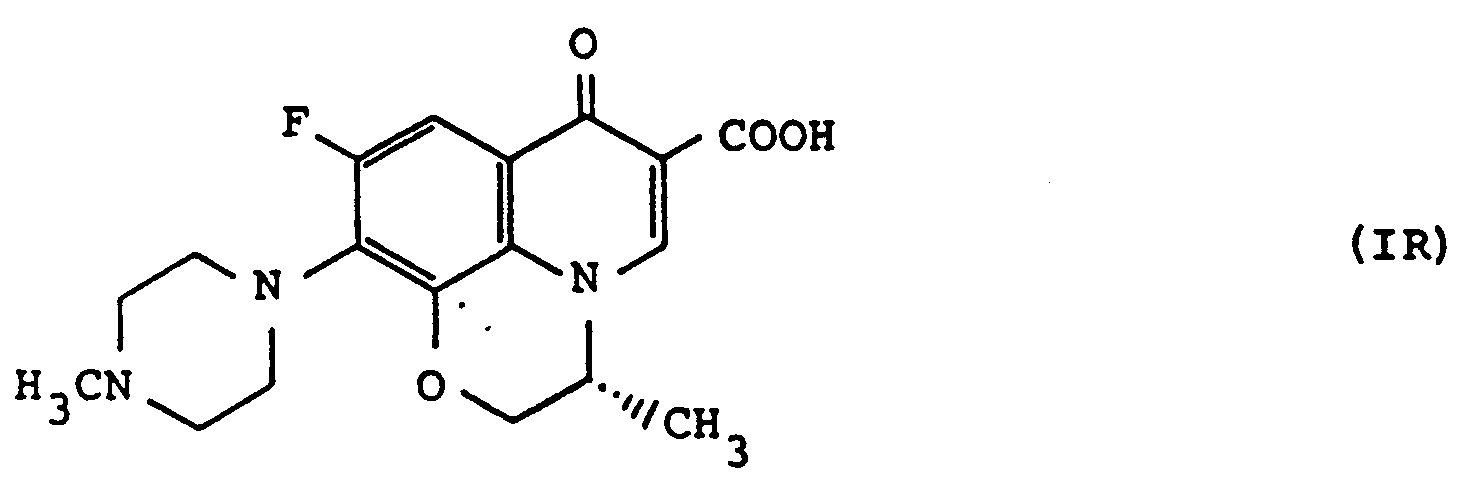
The synthesis of the compound represented by the formula (IS) was achieved by converting the optically active benzoxazine intermediates which were obtained by the optical resolution of appropriate racemic benzoxazine derivatives, as described in EP-A-206,283. - An object of this invention is to provide novel intermediates which allow an improved synthesis of compounds of the above mentioned type.
- After extensive investigations, it has been found that asymmetric reduction of 3-alkyl-2H-[1,4]benzoxazine by chiral reducing agents gave optically active 3-alkyl-3,4-dihydro-2H-[1,4]benzoxazine in high optical purity.
- As a result of extensive investigations in synthesizing optically active 3-alkyl-3,4-dihydro-2H-[1,4]benzoxazine derivatives, especially the 3S-isomer, it has now been found that compounds having the formula (II) are useful as intermediates for synthesizing the optically active isomer of 3,4-dihydrobenzoxazines represented by the formula (IIIS) by reduction with chiral reducing agents as shown in the following reaction scheme:
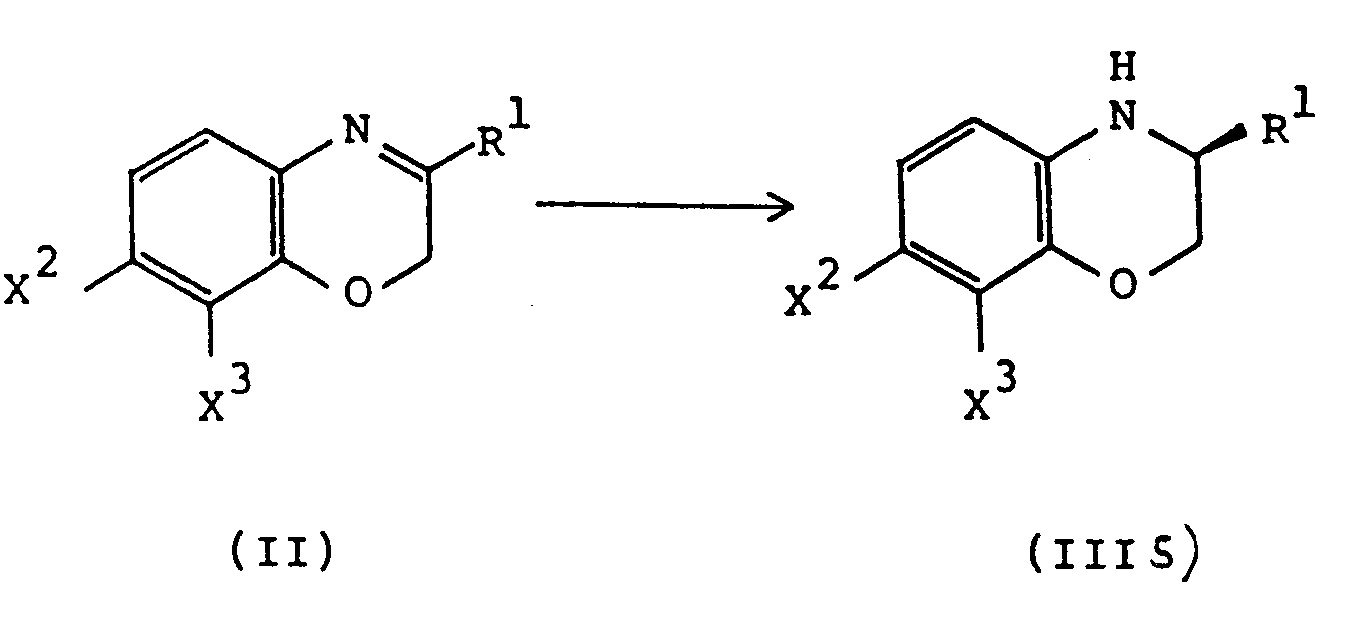
The invention therefore relates to the above mentioned compounds of formulae II and IIIS,
wherein X² represents a fluorine atom, X³ represents a halogen atom, and R¹ represents a methyl or ethyl group, and the salts thereof. - As mentioned above, the 3S-isomer of Ofloxacin and its analogs are preferable. The synthesis of compound (IS) and its analogues is best achieved by starting from the optically active compound (IIIS). This optically active compound (IIIS) is easily prepared by asymmetric reduction of compound (II) using chiral reducing agents. Suitable chiral reducing agents include a number of different reagents applicable for the present invention, e.g., chiral complex of borohydrides or aluminum hydrides, and chiral complex of metal catalysts. Such complexes are exemplified as follows: chiral acyloxy borohydrides (as disclosed in T. Iwakuma et al., Chem. Pharm. Bull., 31, 70 (1983)); complex of chiral amino alcohol and borane (as disclosed in S. Ituno et al., J. Chem. Sco., Perkin Trans. I, 2039 (1985)); potassium 9-0-(1,2:5,6-di-O-isopropylidene-alpha-D-glucofuranosyl)-9-boratabicyclo[3,3,1]nonane (as disclosed in H.C. Brown, J. Org. Chem., 51, 3396 (1986); complex of (-)-ephedrin, N-ethylaniline and lithium aluminum hydride (as disclosed in K. Koga et al., Tetra. Lett., 275 (1980)); complex of (S)-2-(2,6-xylidomethyl)pyrrolidine and lithium aluminum hydride (as disclosed in M. Mukaiyama et al., Heterocycles, 12, 499 (1979); complex of 2,2'-dihydroxy-1,1'-binaphthyl, hydroxylic compound and lithium aluminum hydride (as disclosed in R. Noyori et al., J. Am. Chem. Soc., 101, 3129 (1979)); nickel-palladium-kieselguhr modified with tartaric acid (as disclosed in Y. Orido et al., J. Synth. Org. Chem., Japan, 34, 672 (1976)); complex of pyrrolidinobiphosphines and rhodium (as disclosed in K. Achiwa et al., Tetra. Lett., 4477 (1986)) and the like. The disclosures of these references are herein incorporated by reference. Among these chiral reducing agents, chiral alkali metal acyloxy borohydrides are most preferable, for high optical purity of the product is attained with this reagent. Further, this reagent is easily prepared from sodium borohydride and proline derivatives and the reagent is less dangerous than the aluminum complex.
- The reagent is represented by the following formula:
MBH4-n(RCOO)n
wherein M represents an alkali metal such as lithium, sodium and potassium; and n represents an integer of from 1 to 3; and RCOO represents an acyloxy residue such as an acetoxy, a propionyloxy, a chloroacetoxy, or a benzoyloxy residue or a residue represented by the following formula:
wherein R² and R³, which may be the same or different, each represents a hydrogen atom or an alkyl group having 1 to 6 carbon atoms such as a methyl group, an ethyl group, an isopropyl group, or an aralkyl group, for example, an unsubstituted or substituted phenylalkyl group having from 1 to 3 carbon atoms in the alkyl moiety thereof, such as a benzyl group, or substituted benzyl group; or R² and R³ may combine and represent a methylene chain such as -(CH₂)m-, where m represents an integer of from 2 to 4; R⁴ represents an alkyl group having from 1 to 6 carbon atoms such as a methyl group, an ethyl group, etc.; a phenyl group which may be substituted with alkyl group(s) havinf from 1 to 6 carbon atoms, halogen atom(s), nitro group(s), alkoxy group(s) having from 1 to 6 carbon atoms and the like; an alkoxy group having from 1 to 6 carbon atoms such as a methoxy group, an ethoxy group, an iso- or tert-butoxy group, etc.; or a phenylalkyloxy group in which the alkyl moiety has from 1 to 2 carbon atoms and the phenyl group may be substituted with alkyl group(s) having from 1 to 6 carbon atoms, halogen atom(s), nitro group(s), alkoxy group(s) having from 1 to 6 carbon atoms and the like. - As for the acyl residue of the chiral acyloxy borohydride, (S)-amino acid, especially N-acyl-(S)-proline, is most favourable; e.g., (S)-N-isobutyloxycarbonylproline or (S)-N-benzyloxycarbonylproline and the like. These chiral acyloxy borohydrides are easily prepared from alkali metal borohydride and N-acyl-(S)-proline in tetrahydrofuran as reported by Iwakuma et al. (J. Synth. Org. Chem., Japan, 41, 453 (1983); Chem. Pharm. Bull., 31, 70 (1983)). The n which means a number of the acyloxy residue in the reducing agent is in the range of 1 to 3, and is preferably 3 for the higher optical purity of the reduced product as reported in literature references. The molar ratio of 2H-benzoxazine derivative (II) and the reducing agent is in the range of from 1:1 to 1:5, preferably 1:2.5.
- The reduction with the chiral acyloxy borohydrides may be carried out in a solvent inert to the reaction, such as diethyl ether, 1,2-dimethoxyethane, acetonitrile, toluene, ethyl acetate, 1,1,2,2-tetrachloroethane, 1,1,2,2-tetrachloroethylene, 1,1-dichloroethane, 1,2-dichloroethane, dichloromethane and the like. Of these solvents, halogen-containing solvents are preferred. The amount of the solvent can be in the range of from 5 to 50 parts by volume, and preferably in the range of from 5 to 20 parts by volume, to the amount of the benzoxazine derivative (II). The reduction can be performed by mixing a solution of an acyloxy borohydride and a solution of 2H-benzoxazine in a solvent mentioned above. The chirality of the resulting reduction product corresponds to that of the ligand of the reducing agent used. That is, when acyloxy borohydride derived from S-amino acid is used, the reduction product has S-configuration.
- Even when the optical purity of the product is not very high, optically pure 3,4-dihydrobenzoxazine is readily obtained from a crude mixture by a simple purification, e.g., recrystallization. The purification of a mixture in which one isomer is present in a larger amount than the other is much easier than a mixture containing an equal amount of the isomers.
- The reduction can be performed at a temperature in the range of from about -60°C to about 60°C, preferably from -45°C to 20°C, for a period of from about 10 minutes to about 48 hours.
- The end of the reaction can be detected by TLC.
- This invention is illustrated in greater detail by reference to the following examples, but it should be understood that they are not intended to limit the present invention. Unless otherwise indicated herein, all parts, percents, ratios and the like are by weight.
-

A mixture of 4.6 g of 3,4-difluoro-2-(2-oxopropyloxy)nitrobenzene (1), 1,5 g of ethylene glycol, a catalytic amount of p-toluenesulfonic acid and 60 ml of anhydrous benzene was heated under reflux for 18 hours while removing water using a Dean-Stark apparatus. After cooling, the mixture was washed twice with a saturated sodium bicarbonate aqueous solution and with water. The solvent was removed in vacuo, and the residue was purified through an 80 g silica-gel colum which was eluted by chloroform to yield 5 g of a nitro derivative as a yellow oily product (2).
¹H-NMR(CDCl₃) δ ppm:
1.50 (3H, s, -CH₃), 4.00 (4H, s, -OCH₂CH₂O-), 4.16 (2H, AB-q, J=10.5 Hz, -CH₂C<), 7.0 (1H, ddd, J=10.5, 9, 8 Hz, arm.), 7.66 (1H, ddd, J=9.5, 5.5, 3 Hz, arm.) -

To a solution of 1.6 g of the nitro derivative (2) obtained as described in Reference Example 1 in 70 ml of anhydrous ethanol was added 2.0 g of 5%-palladium on charcoal (50% wet). The mixture was shaken under a hydrogen atmosphere until hydrogen absorption ceased. After removing the catalyst by filtration, the solvent of the filtrate was removed under reduced pressure to give 1.3 g of an aniline as an oily product (3).
¹H-NMR(CDCl₃) δ ppm:
1.50 (3H, s, -CH₃), 3.96 (2H, s, -OCH₂C<), 4.04 (4H, s, -OCH₂CH₂O-), 3.8-4.2 (2H, br.m, NH₂), 6.36 (1H, ddd, J=9.5, 5.5, 3 Hz, arm.), 6.70 (1H, ddd, J=11, 9.5, 9 Hz, arm.) -

A mixture of 1.3 g of the aniline (3) obtained as described in Reference Example 2, 30 ml of 2N hydrochloric acid and 30 ml of benzene was heated under reflux for 2 hours. After cooling, sodium bicarbonate was added until the aqueous layer was neutralized. The mixture was extracted with benzene three times, and the extract was washed with water, then dried. The solvent was removed under reduced pressure to yield a bonzoxazine (II) as a yellow oily product.
¹H-NMR(CDCl₃) δ ppm:
2.16 (3H, s, -CH₃), 4.60 (2H, s, -OCH₂-), 6.26 (1H, ddd, J=9, 5, 3 Hz, C₅-H), 6.5-6.8 (1H, m, C₆-H) -

A mixture of 1.81 g of the aniline (3) and 9 ml of 35% hydrochloric acid was stirred at 70 to 80°C for 1 minute. The mixture was cooled on an ice bath and this solution was added dropwise to a 14.5 ml of ice-cooled 28% aqueous ammonia. Precipitated imine (II) was extracted with three 10 ml portions of dichloromethane, and the extract was washed with 5 ml of saturated sodium chloride aqueous solution and dried over anhydrous magnesium sulfate. The solvent was removed under reduced pressure to yield a crystalline residue. The NMR spectrum of this residue was identical to that obtained in Reference Example 2 and this melted at 51.2°C.
Mass spectrum: m/Z = 183 (M⁺)Elementary Analysis for C₉H₇F₂NO: Calculated: C 59.02; H 3.85; N 7.65 Found: C 58.91; H 3.89; N 7.49 - Tris[(S)-N-isobutyloxycarbonylpropyloxy]hydroborate was prepared from sodium borohydride and N-isobutyloxycarbonyl-(S)-proline and a solution of 15.5 g of this hydride in 30 ml of anhydrous dichloromethane was cooled to -41°C. To this was added a solution of the imine (II) obtained above in 15 ml of anhydrous dichloromethane was added under a nitrogen atmosphere (at the end of the addition, the internal temperature raised to -34°C). The reaction mixture was stirred at -40 to -5°C for 40 minutes, then the mixture was washed with a 5% citric acid aqueous solution, 10% sodium carbonate aqueous solution and water. The amount of (S)-7,8-difluoro-3,4-dihydro-3-methyl-2H-[1,4]benzoxazine (IIIS) was calculated to be 1.2945 g by the quantitative analysis of the dichloromethane solution using high pressure liquid chromatography (column: YMC-Pack®, A-312 ODS; eluent: mixture of acetonitrile and water (5:3 by volume); speed: 1 ml/min.). The ratio of the S-isomer and R-isomer was 21:3:1 (91% ee*) using the analytical method mentioned in Example 2 below. culated as follows.

wherein [R] represents a molar ratio of one isomer in percent, and [S] represents that of the other isomer, when [R]+[S] is taken as 100%.
* Note: "% ee" is an abreviation for % enantiomer excess, and is a measure of an optical purity of an optically active compound (see, for example, Asymmetric Synthesis, Vol. 1, p. 45, 60, Academic Press, New York (1983), edited by J.D. Morrison et al.). The % ee is cal - To a mixture of 3.7 g of tris[(S)-N-benzyloxycarbonylpropyloxy]hydroborate prepared conventionally from sodium borohydride and (S)-N-benzyloxyproline and 30 ml of anhydrous dichloromethane was added a solution of 250 mg of the cyclic imine (II) in 15 ml of anhydrous dichloromethane and the resulting mixture was stirred at room temperature (about 20 to 30°C) for 24 hours. The mixture was washed with a saturated sodium bicarbonate aqueous solution and water, then dried over anhydrous sodium sulfate. The solvent was removed in vacuo, and the residue was purified through a 40 g silica-gel column eluted with chloroform to yield 150 mg of yellowish oily (S)-7,8-difluoro-3,4-dihydro-3-methyl-2H-[1,4]benzoxazine (IIIS). The Rf value on TLC and the NMR spectrum were identical to those of the racemic compound. The optical purity of this product was determined in the form of the N-3,5-dinitrobenzoyl derivative which was obtained by heating a mixture of 3,5-dinitrobenzoyl chloride (54 mg), the product (III) (19.7 mg), pyridine (16.4 mg) and tetrahydrofuran (0.5 ml) at 30 to 40°C for 30 minutes. The analysis was performed by high pressure liquid chromatography (column: OA-4200, 4.6 mm x 250 mm, available from Sumitomo Chemical Co., Ltd.; solvent: n-hexane:1,2-dichloroethane:ethanol = 10:0.9:0.1 by volume; speed: 1.0 ml/min.). It was revealed that the more preferable S-isomer (IIIS) was obtained as a major product in a ratio of 89:11 (78% ee) by this reduction.
- To a solution of 150 mg of the benzoxazine derivative obtained as described in Example 2 and 0.2 ml of pyridine in 5 ml of anhydrous dichloromethane was added dropwise a dichloromethane (5 ml) solution of the acid chloride prepared from 300 mg of (S)-N-p-toluenesulfonylproline and thionyl chloride, and the mixture was stirred at room temperature for 4 hours. The reaction mixture was washed with 10% hydrochloric acid and a saturated sodium bicarbonate aqueous solution, and then dried over anhydrous sodium sulfate. The solvent was removed under reduced pressure, and the oily residue was purified through a silica-gel column eluted with a mixture of benzene and ethyl acetate (3:1 by volume) to yield an oily product. This product was obtained as crystals after the oil was dissovled in 2.5 ml of ethanol and the solution allowed to stand at room temperature for a day. Ethanol was removed under reduced pressure. To the crystalline residue was added a mixture of diethyl ether and n-hexane, then a crystalline product was collected by filtration. Drying under reduced pressure, 270 mg of 3S-(+)-7,8-difluoro-3,4-dihydro-3-methyl-4-[(S)-p-toluenesulfonyl]prolyl-2H-[1,4]benzoxazine; m.p.: 107-108°C.
- A solution of 250 mg of the product obtained as described above and 5 ml of a 1N sodium hydroxide aqueous solution and 10 ml of ethanol was heated under reflux for 3 hours. The solvent was removed under reduced pressure and the oily residue was extracted with benzene. The extract was washed with a saturated sodium chloride aqueous solution and dried over anhydrous sodium sulfate. After removing the solvent under reduced pressure, the residue was purified through a 200 g of silica-gel column eluted with benzene to yield 100 mg of oily (S)-(-)-7,8-difluoro-3,4-dihydro-3-methyl-2H-[1,4]benzoxazine (IIIS); [α]D -9.4° (c=1.50, chloroform).
- A mixture of 100 mg of (S)-(-)-7,8-difluoro-3,4-dihydro-3-methyl-2H-[1,4]benzoxazine (IIIS) and 160 mg of diethyl ethoxymethylenemalonate was heated at 130 to 140°C in vacuo for 1 hour. After cooling, the reaction mixture was dissolved in 1 ml of acetic anhydride. This solution was cooled on an ice bath and to this was added 1.6 ml of a mixture of acetic anhydride and concentrated sulfuric acid (2:1 by volume) dropwise. The mixture was stirred at room temperature for 1 hour, then heated at 50 to 60°C for 30 minutes. To the mixture was added ice and water, the mixture was neutralized by adding powdered potassium carbonate. After the reaction mixture was extracted with chloroform, the extract was washed with a saturated sodium bicarbonate aqueous solution and a saturated sodium chloride aqueous solution and dried over anhydrous sodium sulfate. The solvent was removed under reduced pressure and diethyl ether was added to the residue. The crystalline product was collected by filtration to yield 125 mg of ethyl (S)-(-)-7,8-difluoro-2,3-dihydro-3-methyl-7-oxo-7H-pyrido[1,2,3-de][1,4] benzoxazine-6-carboxylate; m.p.: 257-258°C; [α]D -68.1° (c=0.25, acetic acid).
- A solution of 120 mg of the ester derivative obtained above, 3 ml of concentrated hydrochloric acid and 2 ml of acetic acid was heated under reflux for 3 hours. After cooling, the resulting crystalline product was collected by filtration and washed successively with water, ethanol and diethyl ether, and dried to yield 100 mg of (S)-(-)-7,8-difluoro-2,3-dihydro-3-methyl-7-oxo-7H-pyrido-[1,2,3-de][1,4]benzoxazine-6-carboxylic acid; m.p. >300°C; [α]D -65.6°(c=0.985, DMSO).
- A mixture of 100 mg of the acid derivative obtained as described above, 1 ml of boron trifluoride diethyl etherate and 5 ml of diethyl ether was stirred at room temperature for 5 hours. The solvent was removed by decantation and diethyl ether was added to the residue. The solid mass was collected by filtration and washed with diethyl ether and dried under reduced pressure. This solid was dissolved in 2 ml of dimethyl sulfoxide and to this were added 0.2 ml of triethylamine and 0.5 ml of N-methylpiperazine. The mixture was stirred at room temperature for 18 hours. The solvent was removed under reduced pressure and diethyl ether was added to the residue. The collected yellow powder was suspended in 5 ml of 95% methanol and to this was added 1 ml of triethylamine. The mixture was heated under reflux for 25 hours. The solvent was removed under reduced pressure and the residue was dissolved in 10 ml of 10% hydrochloric acid. After this solution was extracted with chloroform three times, the aqueous layer was rendered basic to pH 11 using a sodium hydroxide aqueous solution. The pH of this solution was readjusted to 7.3 using 1N hydrochloric acid, and the solution was extracted with three 15 ml portions of chloroform. After drying over anhydrous sodium sulfate, the solvent was removed under reduced pressure. The crystalline residue was recrystallized from a mixture of ethanol and diethyl ether to yield 83 mg of (S)-(-)-9-fluoro-2,3-dihydro-3-methyl-10-(4-methyl-1-piperazinyl)-7-oxo-7H-pyrido[1,2,3-de][1,4]benzoxazine-6-carboxylic acid (IS); m.p.: 226-230°C (dec.); [α]D -76.90° (c=0.655, 0.05N-NaOH aqueous solution).
- While the invention has been described in detail and with reference to specific embodiments thereof, it will be apparent to one skilled in the art that various changes and modifications can be made therein without departing from the spirit and scope thereof.
Claims (5)
- A 3,4-dihydro-2H-[1,4]-benzoxazine compound represented by the formula (IIIS)

- The compound as claimed in claim 1, which is S-7,8-difluoro-3,4-dihydro-3-methyl-2H-[1,4]-benzoxazine.
- A 2H-[1,4]-benzoxazine compound represented by the Formula (II)

- The benzoxazine compound as claimed in claim 3 which is 7,8-difluoro-3-methyl-2H-[1,4]-benzoxazine.
- A process for preparing the compounds of claims 1 or 2, which comprises treating a 2H-[1,4]benzoxazine compound represented by the formula (II)

Applications Claiming Priority (2)
| Application Number | Priority Date | Filing Date | Title |
|---|---|---|---|
| JP31409586 | 1986-12-25 | ||
| JP314095/86 | 1986-12-25 |
Publications (2)
| Publication Number | Publication Date |
|---|---|
| EP0273399A1 EP0273399A1 (en) | 1988-07-06 |
| EP0273399B1 true EP0273399B1 (en) | 1994-08-17 |
Family
ID=18049180
Family Applications (1)
| Application Number | Title | Priority Date | Filing Date |
|---|---|---|---|
| EP87119158A Expired - Lifetime EP0273399B1 (en) | 1986-12-25 | 1987-12-23 | Optically active 2,3-dihydrobenzoaxine derivatives and process for preparing the same |
Country Status (8)
| Country | Link |
|---|---|
| US (1) | US4895944A (en) |
| EP (1) | EP0273399B1 (en) |
| KR (1) | KR950012563B1 (en) |
| AT (1) | ATE110061T1 (en) |
| CA (1) | CA1305705C (en) |
| DE (1) | DE3750396T2 (en) |
| ES (1) | ES2061481T3 (en) |
| PH (1) | PH23992A (en) |
Families Citing this family (6)
| Publication number | Priority date | Publication date | Assignee | Title |
|---|---|---|---|---|
| AU4376589A (en) * | 1988-11-07 | 1990-05-10 | Gist-Brocades N.V. | Optically active benzoxazines and benzothiazines |
| ES2055656B1 (en) * | 1992-10-07 | 1995-11-16 | Etilo Derivados | PROCEDURE FOR OBTAINING USEFUL BENZOXAZINES FOR SYNTHESIS OF OFLOXACIN, LEVOFLOXACIN AND DERIVATIVES. |
| ES2077497B1 (en) * | 1993-06-10 | 1996-10-16 | Elmuquimica Farm Sl | NEW PROCEDURE FOR OBTAINING THE ACID 9-FLUORO-2,3-DIHIDRO-3-METHYL-10- (N-METHYLPIPERAZINYL -7-OXO-7H-PIRIDO (1,2,3-DE) -1,4-BERNZOXACIN- 6-CARBOXYLLIC. |
| US5686095A (en) * | 1995-10-23 | 1997-11-11 | Price, Jr.; Francis W. | Method of treating canker sores |
| CN103360410B (en) * | 2012-04-06 | 2016-01-13 | 天方药业有限公司 | Ofloxacine USP 23 preparation method |
| IN2014DN09251A (en) * | 2012-05-08 | 2015-07-10 | Ishihara Sangyo Kaisha |
Family Cites Families (4)
| Publication number | Priority date | Publication date | Assignee | Title |
|---|---|---|---|---|
| JPS5746986A (en) * | 1980-09-02 | 1982-03-17 | Dai Ichi Seiyaku Co Ltd | Pyrido(1,2,3-de)(1,4)benzoxazine derivative |
| US4601745A (en) * | 1983-12-12 | 1986-07-22 | Ciba-Geigy Corporation | Composition for the protection of cultivated plants against the phytotoxic action of herbicides |
| NO166131C (en) * | 1985-06-20 | 1991-06-05 | Daiichi Seiyaku Co | ANALOGUE PROCEDURE FOR THE PREPARATION OF S (-) - PYRIDOBENZOKSAZINE COMPOUNDS. |
| JP2816844B2 (en) * | 1988-03-29 | 1998-10-27 | 日本高圧電気株式会社 | Method for producing granite-like inorganic decorative board |
-
1987
- 1987-12-23 ES ES87119158T patent/ES2061481T3/en not_active Expired - Lifetime
- 1987-12-23 AT AT87119158T patent/ATE110061T1/en not_active IP Right Cessation
- 1987-12-23 DE DE3750396T patent/DE3750396T2/en not_active Expired - Lifetime
- 1987-12-23 EP EP87119158A patent/EP0273399B1/en not_active Expired - Lifetime
- 1987-12-24 CA CA000555410A patent/CA1305705C/en not_active Expired - Lifetime
- 1987-12-24 KR KR1019870014904A patent/KR950012563B1/en not_active Expired - Lifetime
- 1987-12-28 US US07/138,117 patent/US4895944A/en not_active Expired - Lifetime
- 1987-12-28 PH PH36310A patent/PH23992A/en unknown
Also Published As
| Publication number | Publication date |
|---|---|
| DE3750396T2 (en) | 1995-01-05 |
| EP0273399A1 (en) | 1988-07-06 |
| KR950012563B1 (en) | 1995-10-19 |
| DE3750396D1 (en) | 1994-09-22 |
| US4895944A (en) | 1990-01-23 |
| ATE110061T1 (en) | 1994-09-15 |
| KR880007499A (en) | 1988-08-27 |
| PH23992A (en) | 1990-02-09 |
| CA1305705C (en) | 1992-07-28 |
| ES2061481T3 (en) | 1994-12-16 |
Similar Documents
| Publication | Publication Date | Title |
|---|---|---|
| KR940003757B1 (en) | Process for preparation of optical activated pyridobenzoxazin derivatives | |
| CA3111466A1 (en) | Salts of methyl 6-(2,4-dichlorophenyl)-5-[4-[(3s)-1-(3-fluoropropyl)pyrrolidin-3-yl]oxyphenyl]-8,9-dihydro-7h-benzo[7]annulene-2-carboxylate and preparation process thereof | |
| Atarashi et al. | Asymmetric reduction of 7, 8‐difluoro‐3‐methyl‐2H‐1, 4‐benzoxazine. Synthesis of a key intermediate of (S)‐(‐)‐ofloxacin (DR‐3355) | |
| EP2189442B1 (en) | Process and intermediates for the preparation of aliskiren | |
| US5521310A (en) | Process to obtain benzoxazines to be used for the synthesis of ofloxazine, levofloxazine and derivatives | |
| US4895944A (en) | Benzoxazine intermediates | |
| KR910007887B1 (en) | Method for preparing 1,4-diazabicyclo [3.2.2] nonane | |
| JP2876712B2 (en) | Optically active pyranobenzoxadiazole derivative | |
| US5179212A (en) | Process for the preparation of 3-pyrrolidinols and intermediates therefor | |
| KR900004145B1 (en) | Process for preparation of tricyclic compounds | |
| HUT54128A (en) | Process for producing optically active benzoxazines and benzothiazines | |
| EP0829472B1 (en) | Improved process for producing 4-hydroxy-2-pyrrolidone | |
| JP2573269B2 (en) | Optically active benzoxazine | |
| KR0134534B1 (en) | Method for preparing (-) 3 (S) -methylbenzoxazine derivative | |
| KR100341556B1 (en) | Method for preparing allylquinone derivatives and intermediates thereof | |
| JPH04169583A (en) | Phenothiazine derivative and its production | |
| FR2826005A1 (en) | TOTAL SYNTHESIS OF GALANTHAMINE, ITS ANALOGUES AND ITS DERIVATIVES | |
| JP2724383B2 (en) | Method for producing (S) -benzoxazine derivative | |
| JP3759772B2 (en) | Acrylamide derivative and method for producing the same | |
| EP0304684A1 (en) | Process for the preparation of benzoxazine derivatives | |
| US5053504A (en) | Process for benzazepine intermediates | |
| KR19990047362A (en) | Method for preparing (-)-3 (S) -methylpyridobenzoxazine intermediate derivative | |
| EP0949247B1 (en) | Process for the preparation of piperidinylidene derivatives | |
| JP2978491B2 (en) | 7-Amino-5-substituted-5-azaspiro [2.4] heptane derivatives | |
| SI9011872A (en) | Process for production of optically active 2-(tetrahydropyran-2-yloxy)-1-propanol, new intermediate used in this process and its preparation |
Legal Events
| Date | Code | Title | Description |
|---|---|---|---|
| PUAI | Public reference made under article 153(3) epc to a published international application that has entered the european phase |
Free format text: ORIGINAL CODE: 0009012 |
|
| AK | Designated contracting states |
Kind code of ref document: A1 Designated state(s): AT BE CH DE ES FR GB GR IT LI NL SE |
|
| 17P | Request for examination filed |
Effective date: 19890105 |
|
| 17Q | First examination report despatched |
Effective date: 19901017 |
|
| RAP1 | Party data changed (applicant data changed or rights of an application transferred) |
Owner name: DAIICHI PHARMACEUTICAL CO., LTD. |
|
| GRAA | (expected) grant |
Free format text: ORIGINAL CODE: 0009210 |
|
| AK | Designated contracting states |
Kind code of ref document: B1 Designated state(s): AT BE CH DE ES FR GB GR IT LI NL SE |
|
| REF | Corresponds to: |
Ref document number: 110061 Country of ref document: AT Date of ref document: 19940915 Kind code of ref document: T |
|
| REF | Corresponds to: |
Ref document number: 3750396 Country of ref document: DE Date of ref document: 19940922 |
|
| ITF | It: translation for a ep patent filed | ||
| ET | Fr: translation filed | ||
| REG | Reference to a national code |
Ref country code: ES Ref legal event code: FG2A Ref document number: 2061481 Country of ref document: ES Kind code of ref document: T3 |
|
| ITTA | It: last paid annual fee | ||
| K2C1 | Correction of patent specification (title page) published |
Effective date: 19940817 |
|
| EAL | Se: european patent in force in sweden |
Ref document number: 87119158.1 |
|
| REG | Reference to a national code |
Ref country code: GR Ref legal event code: FG4A Free format text: 3013995 |
|
| PLBE | No opposition filed within time limit |
Free format text: ORIGINAL CODE: 0009261 |
|
| STAA | Information on the status of an ep patent application or granted ep patent |
Free format text: STATUS: NO OPPOSITION FILED WITHIN TIME LIMIT |
|
| 26N | No opposition filed | ||
| EUG | Se: european patent has lapsed | ||
| REG | Reference to a national code |
Ref country code: GB Ref legal event code: IF02 |
|
| PGFP | Annual fee paid to national office [announced via postgrant information from national office to epo] |
Ref country code: GR Payment date: 20061121 Year of fee payment: 20 |
|
| PGFP | Annual fee paid to national office [announced via postgrant information from national office to epo] |
Ref country code: SE Payment date: 20061206 Year of fee payment: 20 |
|
| PGFP | Annual fee paid to national office [announced via postgrant information from national office to epo] |
Ref country code: FR Payment date: 20061208 Year of fee payment: 20 |
|
| PGFP | Annual fee paid to national office [announced via postgrant information from national office to epo] |
Ref country code: AT Payment date: 20061213 Year of fee payment: 20 |
|
| PGFP | Annual fee paid to national office [announced via postgrant information from national office to epo] |
Ref country code: NL Payment date: 20061217 Year of fee payment: 20 |
|
| PGFP | Annual fee paid to national office [announced via postgrant information from national office to epo] |
Ref country code: GB Payment date: 20061220 Year of fee payment: 20 |
|
| PGFP | Annual fee paid to national office [announced via postgrant information from national office to epo] |
Ref country code: DE Payment date: 20061221 Year of fee payment: 20 |
|
| PGFP | Annual fee paid to national office [announced via postgrant information from national office to epo] |
Ref country code: CH Payment date: 20061227 Year of fee payment: 20 |
|
| PGFP | Annual fee paid to national office [announced via postgrant information from national office to epo] |
Ref country code: ES Payment date: 20061228 Year of fee payment: 20 |
|
| PGFP | Annual fee paid to national office [announced via postgrant information from national office to epo] |
Ref country code: IT Payment date: 20061231 Year of fee payment: 20 |
|
| PGFP | Annual fee paid to national office [announced via postgrant information from national office to epo] |
Ref country code: BE Payment date: 20070222 Year of fee payment: 20 |
|
| BE20 | Be: patent expired |
Owner name: *DAIICHI PHARMACEUTICAL CO. LTD Effective date: 20071223 |
|
| REG | Reference to a national code |
Ref country code: GB Ref legal event code: PE20 |
|
| PG25 | Lapsed in a contracting state [announced via postgrant information from national office to epo] |
Ref country code: NL Free format text: LAPSE BECAUSE OF EXPIRATION OF PROTECTION Effective date: 20071223 |
|
| REG | Reference to a national code |
Ref country code: CH Ref legal event code: PL |
|
| EUG | Se: european patent has lapsed | ||
| NLV7 | Nl: ceased due to reaching the maximum lifetime of a patent |
Effective date: 20071223 |
|
| REG | Reference to a national code |
Ref country code: ES Ref legal event code: FD2A Effective date: 20071224 |
|
| PG25 | Lapsed in a contracting state [announced via postgrant information from national office to epo] |
Ref country code: GB Free format text: LAPSE BECAUSE OF EXPIRATION OF PROTECTION Effective date: 20071222 Ref country code: ES Free format text: LAPSE BECAUSE OF EXPIRATION OF PROTECTION Effective date: 20071224 |