EP0271884A2 - Vinyl chloride graft copolymer and process for its preparation - Google Patents
Vinyl chloride graft copolymer and process for its preparation Download PDFInfo
- Publication number
- EP0271884A2 EP0271884A2 EP87118597A EP87118597A EP0271884A2 EP 0271884 A2 EP0271884 A2 EP 0271884A2 EP 87118597 A EP87118597 A EP 87118597A EP 87118597 A EP87118597 A EP 87118597A EP 0271884 A2 EP0271884 A2 EP 0271884A2
- Authority
- EP
- European Patent Office
- Prior art keywords
- copolymer
- weight
- vinyl chloride
- units
- formula
- Prior art date
- Legal status (The legal status is an assumption and is not a legal conclusion. Google has not performed a legal analysis and makes no representation as to the accuracy of the status listed.)
- Withdrawn
Links
Classifications
-
- C—CHEMISTRY; METALLURGY
- C08—ORGANIC MACROMOLECULAR COMPOUNDS; THEIR PREPARATION OR CHEMICAL WORKING-UP; COMPOSITIONS BASED THEREON
- C08F—MACROMOLECULAR COMPOUNDS OBTAINED BY REACTIONS ONLY INVOLVING CARBON-TO-CARBON UNSATURATED BONDS
- C08F255/00—Macromolecular compounds obtained by polymerising monomers on to polymers of hydrocarbons as defined in group C08F10/00
-
- C—CHEMISTRY; METALLURGY
- C08—ORGANIC MACROMOLECULAR COMPOUNDS; THEIR PREPARATION OR CHEMICAL WORKING-UP; COMPOSITIONS BASED THEREON
- C08F—MACROMOLECULAR COMPOUNDS OBTAINED BY REACTIONS ONLY INVOLVING CARBON-TO-CARBON UNSATURATED BONDS
- C08F257/00—Macromolecular compounds obtained by polymerising monomers on to polymers of aromatic monomers as defined in group C08F12/00
- C08F257/02—Macromolecular compounds obtained by polymerising monomers on to polymers of aromatic monomers as defined in group C08F12/00 on to polymers of styrene or alkyl-substituted styrenes
Definitions
- the invention relates to a process for the preparation of a vinyl chloride graft copolymer according to claim 1 and a vinyl chloride graft copolymer according to claim 6.
- the graft polymers described in US Pat. No. 4,212,958 are of interest, which are composed of 50 to 90% by weight of a rubber-like substrate made of a hydrogenated butadiene polymer or butadiene-styrene copolymer, 50 to 3.7% by weight .-% of a (meth) acrylate graft Monomers and 0 to 35 wt .-% of a vinyl aromatic graft monomer exist.
- These graft polymers can be used as modifiers for polyvinyl chloride to improve impact resistance, and their composition can be adjusted so that transparent articles can be produced.
- a disadvantage of such polymer mixtures is that inhomogeneities can occur due to separation phenomena, which adversely affect the quality of the molded bodies produced. Furthermore, in order to make the graft polymer described manageable and compatible with polyvinyl chloride, comparatively complex graft monomers which do not improve the impact resistance must be used.
- copolymer as described in the previous paragraph is known and corresponding products are available on the market.
- Such copolymers can be produced, for example, by copolymerizing at least one of the compounds: styrene, o-methoxy styrene and p-methoxy styrene with 1,3-butadiene and / or 2-methyl-1,3-butadiene.
- the polymer is then hydrogenated, for example with a nickel- or cobalt-containing catalyst.
- a possible method of manufacture is described in US Pat. No. 4,212,958, column 3, lines 26 to 68.
- 2.4 to 24 parts by weight of the copolymer are used per 100 parts by weight of monomers in order to obtain a graft copolymer which takes into account a monomer conversion of 77 to 96% and 3 to 20% by weight of that originally used Contains copolymers. If the copolymer content is less than 3% by weight, the graft copolymer does not generally show a sufficient improvement in impact resistance compared to a vinyl chloride homopolymer which would justify the higher production costs of the graft copolymer. Above 20 wt .-% copolymer content no additional improving effect was found on the graft copolymer, however, with significantly higher contents, certain properties of the molded articles produced from the graft copolymer can become less favorable.
- 3.2 to 13.1 parts by weight of the copolymer are preferably used in the polymerization in order to obtain a graft copolymer which is 4 to 12% by weight, based on the graft copolymer , contains copolymers.
- the copolymer should preferably 45 to 55% by weight of units of the formula contain.
- the units of the last-mentioned formula originate from the 1,2- or 1,4-polymerization of 1,3-butadiene or 2-methyl-1,3-butadiene.
- the average chain length of the units in the copolymer characterized by the solution viscosity, measured as a 20% strength by weight solution in toluene at 25 ° C., can vary within considerable ranges. If this viscosity is below 100 mPa ⁇ s, the mechanical values of the moldings which are produced from the graft copolymer prepared according to the invention are generally good, but they are not yet optimal. At solution viscosities> 5000 mPa s, difficulties may arise in graft polymerization to an increasing extent, in particular if the copolymer is to be used in solution in the monomer according to a preferred embodiment of the process according to the invention.
- a copolymer is preferably used which has a solution viscosity of 100 to 5000 mPas. Particularly good results are obtained with a copolymer whose solution viscosity is in the range from 300 to 1600 mPa s.
- a vinyl chloride is used as the monomer, which may contain up to 20% by weight of at least one monomer copolymerizable with vinyl chloride.
- Suitable monomers are, for example, olefins, such as ethylene or propylene; Vinyl esters of straight-chain or branched carboxylic acids having 2 to 20, preferably 2 to 4, carbon atoms, such as vinyl acetate, propionate, butyrate, -2-ethylhexoate; Vinyl isotridecanoic acid ester; Vinyl halides such as vinyl fluoride, vinylidene fluoride, vinylidene chloride; Vinyl ether; Vinyl pyridine; unsaturated acids, such as maleic, fumaric, acrylic, methacrylic acid and their mono- or diesters with mono- or dialcohols with 1 to 10 carbon atoms; Maleic anhydride; Maleimide and their N-substitution products with aromatic, cycloaliphatic and optionally branched aliphatic substituents.
- the polymerization is carried out in pressure-resistant apparatus while moving the polymerization liquor at temperatures from 45 to 75 ° C.
- 100 parts of monomeric vinyl chloride used approximately 150 to 300 parts of water, 0.001 to 3, preferably 0.01 to 0.3 parts of an oil-soluble, free-radical-decomposing catalyst known for the suspension polymerization of vinyl chloride or a mixture of several such catalysts and 05 to 3 parts by weight of a known suspending agent customary for the suspension polymerization of vinyl chloride, for example a cellulose ether or partially saponified polyvinyl acetate, or else mixtures of several such suspending agents.
- a known suspending agent customary for the suspension polymerization of vinyl chloride for example a cellulose ether or partially saponified polyvinyl acetate, or else mixtures of several such suspending agents.
- the polymerization can be carried out in the presence of 0.01 to 1 part by weight per 100 parts by weight of monomer or monomer mixture of one or more emulsifiers, in particular nonionic emulsifiers, for example polyoxyethylene esters of fatty acids or polypropylene oxide-polyethylene oxide condensation products or sorbitan esters .
- emulsifiers in particular nonionic emulsifiers, for example polyoxyethylene esters of fatty acids or polypropylene oxide-polyethylene oxide condensation products or sorbitan esters .
- suspending agents and, if appropriate, emulsifiers, known buffer substances, molecular size regulators or also antioxidants and further polymerization auxiliaries can be used.
- suitable polymerization auxiliaries can be found in H.Kainer "Polyvinyl chloride and vinyl chloride copolymers" edition 1965, pages 13 to 34.
- the polymerization is expediently continued up to a conversion of 77 to 96% by weight, based on the monomer used.
- graft copolymers which are still useful in the context of the invention are obtained even at lower degrees of conversion, lower degrees of conversion are less economical and generally offer no other advantages.
- the polymerization is optionally carried out under reflux cooling, using two or more stirring speeds and / or temperature levels.
- the pH of the polymerization liquor should be between 2 and about 10.
- One or more substances can be added during the polymerization, if necessary while keeping the filling volume of the polymerization vessel constant.
- the graft copolymers prepared according to the invention can be freed of residual monomers, in particular vinyl chloride, either in aqueous dispersion as a water-moist cake or in the powdery moist or dry state by known processes.
- the aqueous polymer dispersion is worked up to the dry powder likewise by known methods, for example by decanting the majority of the aqueous phase in a decanter centrifuge and drying the water-moist cake thus obtained in a current or fluidized bed dryer.
- Powdered graft copolymers thus obtained can, for example, suspension polymers of vinyl chloride which have been customary hitherto processed by extrusion, injection molding or calendering, thermoplastically.
- the last-described graft copolymers can be prepared, for example, by the process described at the outset.
- the new vinyl chloride graft copolymers can be processed to give shaped articles which are notable for good impact strength and exceptionally good transparency, a combination of properties which has hitherto been difficult to achieve. As already mentioned above, they have the advantage over simple polymer mixtures that they give better homogeneous products. They can be produced using commercially available copolymers.
- the light of an incandescent lamp operated with constant voltage is concentrated by means of a collector on an aperture with a vertical gap.
- This light gap is projected by means of optics through an opening into an Ulbricht sphere, which contains a so-called "light trap" opposite the light entry opening and to which a photocell is attached in an opening perpendicular to the direction of radiation.
- the electric current generated by the photocell in the event of light is measured after amplification using a moving coil instrument.
- a sample holder for samples of 10 ⁇ 10 cm and a vertical axis is attached to the light entry opening of the Ulbricht ball, about which the Ulbricht ball can be pivoted sideways from its rest position by a certain angle, so that the image of the light gap is not falls more into the "light trap", but next to it onto the uniformly reflecting inner surface of the Ulbricht sphere.
- This position is referred to below as “bright", the position in which the image of the slit falls into the light trap as "dark”.
- the Ulbricht sphere is pivoted into the "bright" position and the total light without sample G is determined by measurement on the moving-coil instrument. Now, a plane-parallel plate of dimensions 10 ⁇ 10 cm and 1 mm thick, produced by pressing, is brought into the sample holder at the light entry opening of the Ulbricht sphere as a sample and the total light is measured with sample G p . This measurement is carried out on three different plates, all of which were produced with the same raw material and the same recipe, and the mean value of all three measurements is used to calculate the light transmittance according to the following equation:
- the Ulbricht sphere is pivoted into the "dark" position and, without a sample, the light S scattered on the apparatus is determined by reading the moving-coil instrument. Now the same three samples as above are placed one after the other in the sample holder at the light entry opening of the Ulbricht sphere and the light scattered in the direction of radiation is determined with sample S p .
- the scattered light (Str) based on the light transmitted by the sample is:
- the press plates produced as samples are produced as follows: 100 parts by weight of polymer or polymer mixture 2 parts by weight of a barium-cadmium stabilizer (Lankromark®LP 125 from Lankro, Drugsbos / Belgium) 0.5 part by weight of alkyl aryl phosphite (type LE 98 from Lankro) 2 parts by weight of an epoxidized soybean oil (Edenol® D 81 from Henkel Loxstedt / BR Germany) 0.5 part by weight of a hydrocarbon wax (Irganox® 366 from Ciba Geigy Marienberg / BR Germany) is mixed thoroughly with one another, then 0.3 mm thick skins are produced from them by rolling at 175 ° C. for 5 minutes.
- the measured values determined are listed in a table below.
- Example 2 The procedure is as described in Example 1, but the copolymer used is a fully hydrogenated 1,3-butadiene-styrene copolymer which contains 51% by weight, based on the copolymer, of polymerized styrene units and 20% by weight.
- solution in toluene at 25 ° C, as measured above, has a solution viscosity of 210 mPa s. It is polymerized up to a pressure drop of 0.55 MPa, the conversion of monomeric vinyl chloride is 90%.
- the values determined on the finished, dried polymer are listed in the table below.
- a polymer mixture is prepared from 92.8 parts by weight of a vinyl chloride homopolymer with a K value of 66 and a bulk density of 560 g / dm3, and 7. 2 parts by weight of the fully hydrogenated 1,3-butadiene-styrene copolymer, which was used in Example 2 for the graft copolymerization.
- the values determined on this polymer mixture are listed in the table below.
- EPDC ethylene-propylene-diene copolymer (origin described above) The meaning of the other abbreviations are explained in the description of the measurement methods.
- the vinyl chloride graft copolymer prepared according to comparative experiment A is clearly inferior in transparency (comparatively low light transmission with a high proportion of scattered light) to the invention.
- the polymer mixture produced according to comparative experiment B which has practically the same composition as the graft copolymer produced according to example 2, shows completely unusable values with regard to impact strength (a K23 ) and transparency.
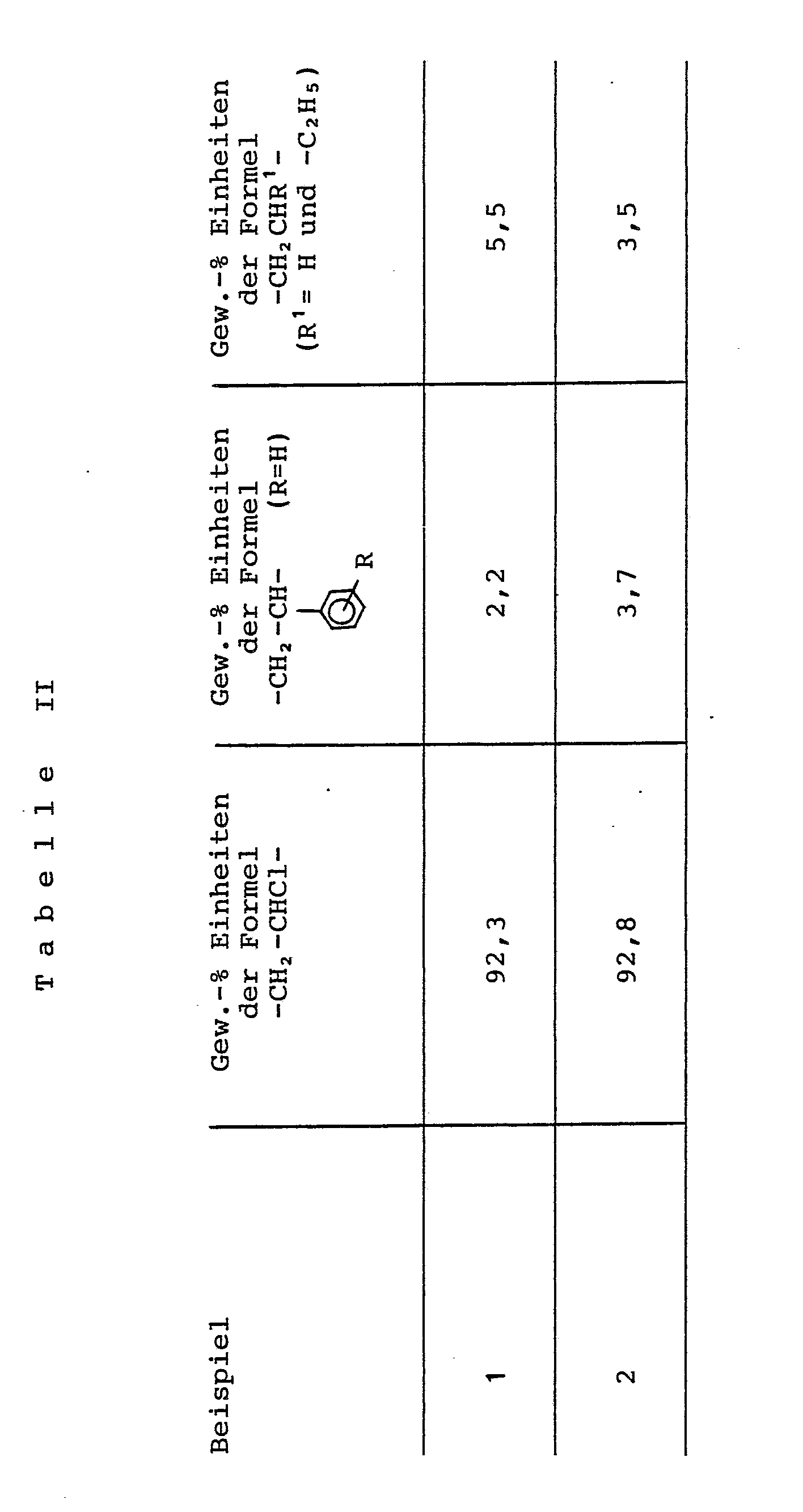
- the polymers prepared according to Examples 1 and 2 according to the invention have the following composition:
Landscapes
- Chemical & Material Sciences (AREA)
- Health & Medical Sciences (AREA)
- Chemical Kinetics & Catalysis (AREA)
- Medicinal Chemistry (AREA)
- Polymers & Plastics (AREA)
- Organic Chemistry (AREA)
- Graft Or Block Polymers (AREA)
Abstract
Description
Die Erfindung betrifft ein Verfahren zur Herstellung eines Vinylchlorid-Pfropf-Mischpolymerisates nach Anspruch 1 sowie ein Vinylchlorid-Pfropf-Mischpolymerisat nach Anspruch 6.The invention relates to a process for the preparation of a vinyl chloride graft copolymer according to claim 1 and a vinyl chloride graft copolymer according to claim 6.
Es ist bereits seit längerer Zeit üblich, Vinylchlorid-Polymerisate durch Modifikation schlagzäher zu machen. Viele Verfahren sind hierzu bekannt, eine entsprechende Modifikation durch einfaches Zumischen eines anderen Polymerisates sowie auch durch Misch- oder Pfropf-Mischpolymerisation des Vinylchlorids mit copolymerisierbaren Monomeren und/oder pfropfcopolymerisierbaren Polymeren zu erreichen. Die Vielzahl dieser Verfahren zeigt, daß es offenbar sehr schwierig, wenn nicht gar unmöglich ist, ein für alle Anforderungen optimales Polymerisat zu erhalten. Es ist demnach nützlich, viele Herstellungsverfahren anhand zu haben, um für den jeweiligen Anwendungszweck ein nach Eigenschaften und Kosten optimales Polymerisat erzeugen zu können.It has been customary for a long time to make vinyl chloride polymers more impact-resistant by modification. Many processes are known to achieve a corresponding modification by simply admixing another polymer and also by copolymerizing or graft-copolymerizing the vinyl chloride with copolymerizable monomers and / or graft-copolymerizable polymers. The large number of these processes shows that it is obviously very difficult, if not impossible, to obtain a polymer which is optimal for all requirements. It is therefore useful to have many manufacturing processes on the basis of which it is possible to produce a polymer which is optimal in terms of properties and costs for the respective application.
In bezug auf die vorliegende Erfindung sind die in der US-PS 4,212,958 beschriebenen Pfropfpolymere von Interesse, die aus 50 bis 90 Gew.-% eines gummiartigen Substrates aus einem hydrierten Butadien-Polymerisat oder Butadien-Styrol-Copolymerisat, 50 bis 3,7 Gew.-% eines (Meth-) Acrylat-Pfropf- Monomeren und 0 bis 35 Gew.-% eines vinylaromatischen Pfropfmonomeren bestehen. Diese Pfropfpolymerenkönnen als Modifikatoren für Polyvinylchlorid verwendet werden, um die Schlagzähigkeit zu verbessern, wobei ihre Zusammensetzung so eingestellt werden kann, daß transparente Artikel erzeugt werden können.In relation to the present invention, the graft polymers described in US Pat. No. 4,212,958 are of interest, which are composed of 50 to 90% by weight of a rubber-like substrate made of a hydrogenated butadiene polymer or butadiene-styrene copolymer, 50 to 3.7% by weight .-% of a (meth) acrylate graft Monomers and 0 to 35 wt .-% of a vinyl aromatic graft monomer exist. These graft polymers can be used as modifiers for polyvinyl chloride to improve impact resistance, and their composition can be adjusted so that transparent articles can be produced.
Ein Nachteil solcher Polymermischungen ist, daß Inhomogenitäten durch Entmischungserscheinungen auftreten können, die die Qualität der erzeugten Formkörper ungünstig beeinflussen. Ferner müssen, um das beschriebene Pfropfpolymere handhabbar und mit Polyvinylchlorid verträglich zu machen, vergleichsweise aufwendige Pfropfmonomere verwendet werden, die die Schlagzähigkeit nicht verbessern.A disadvantage of such polymer mixtures is that inhomogeneities can occur due to separation phenomena, which adversely affect the quality of the molded bodies produced. Furthermore, in order to make the graft polymer described manageable and compatible with polyvinyl chloride, comparatively complex graft monomers which do not improve the impact resistance must be used.
Es wurde nun ein Verfahren gefunden, mit dem Pfropfpolymere herstellbar sind, die die genannten Nachteile nicht aufweisen. Es handelt sich um ein Verfahren zur Herstellung eines Vinylchlorid-Pfropf-Mischpolymerisates durch Polymerisation von Vinylchlorid in wäßriger Suspension, in Gegenwart eines Copolymeren, mindestens eines öllöslichen Katalysators,mindestens eines Suspendiermittels sowie gegebenenfalls weiterer Polymerisationshilfsstoffe und Aufarbeitung der fertig polymerisierten Mischung zum trockenen Pfropf-Mischpolymerisat, dadurch gekennzeichnet, daß eingesetzt werden:
100 Gew.-Teile Vinylchlorid und
2,4 bis 24 Gew.-Teile eines Copolymeren, das seinerseits besteht aus
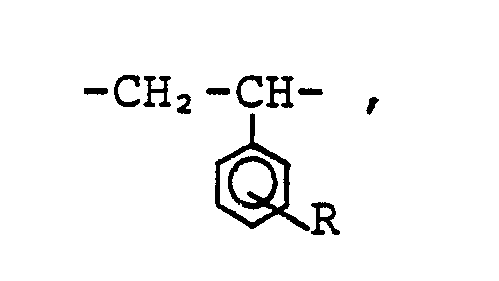
- a) 20 bis 60 Gew.-%, bezogen auf das Copolymere, Einheiten der Formel

- b) 80 bis 40 Gew.-%, bezogen auf das Copolymere, Einheiten der Formel -CH₂-CHR¹-, worin bedeutet R¹ = H oder eine Alkylgruppe mit 1 bis 3 C-Atomen und
- c) einem Rest, bestehend im wesentlichen aus H-Endgruppen, mit der Maßgabe, daß die Summe a + b + c 100 Gew.-%, bezogen auf das Copolymere, beträgt.
100 parts by weight of vinyl chloride and
2.4 to 24 parts by weight of a copolymer, which in turn consists of
- a) 20 to 60 wt .-%, based on the copolymer, units of the formula
- b) 80 to 40 wt .-%, based on the copolymer, units of the formula -CH₂-CHR¹-, wherein R¹ = H or an alkyl group having 1 to 3 carbon atoms and
- c) a radical consisting essentially of H end groups, with the proviso that the sum a + b + c is 100% by weight, based on the copolymer.
Die Herstellung eines Copolymeren, wie im vorangegangenen Absatz beschrieben, ist bekannt,und entsprechende Produkte sind am Markt erhältlich. Solche Copolymere können beispielsweise hergestellt werden durch Copolymerisation von mindestens einer der Verbindungen: Styrol, o-Methoxy-Styrol und p-Methoxy-Styrol mit 1,3-Butadien und/oder 2-Methyl-1,3-Butadien. Anschließend wird das Polymere hydriert, beispielsweise mit einem nickel- oder cobalthaltigen Katalysator. Eine mögliche Herstellart ist beschrieben in US-PS 4,212,958, Spalte 3, Zeilen 26 bis 68.The preparation of a copolymer as described in the previous paragraph is known and corresponding products are available on the market. Such copolymers can be produced, for example, by copolymerizing at least one of the compounds: styrene, o-methoxy styrene and p-methoxy styrene with 1,3-butadiene and / or 2-methyl-1,3-butadiene. The polymer is then hydrogenated, for example with a nickel- or cobalt-containing catalyst. A possible method of manufacture is described in US Pat. No. 4,212,958, column 3, lines 26 to 68.
Von dem Copolymeren werden 2,4 bis 24 Gew.-Teile je 100 Gew.-Teile Monomere eingesetzt, um unter Berücksichtigung eines Monomerumsatzes von 77 bis 96 % ein Pfropf-Mischpolymerisat zu erhalten, das 3 bis 20 Gew.-% des ursprünglich eingesetzten Copolymerisates enthält. Unter 3 Gew.-% Copolymergehalt zeigt das Pfropfmischpolymerisat im allgemeinen keine ausreichende Schlagzähigkeitsverbesserung gegenüber einem Vinylchlorid-Homopolymerisat, die die höheren Herstellkosten des Pfropfmischpolymerisates rechtfertigen würde. Oberhalb 20 Gew.-% Copolymergehalt wird an dem Pfropfmischpolymerisat kein zusätzlich verbessernder Effekt mehr festgestellt, bei deutlich höheren Gehalten können dagegen bestimmte Eigenschaften der aus dem Pfropf-Mischpolymerisat erzeugten Formkörper ungünstiger werden. Vorzugsweise werden je 100 Gew.-Teile Monomere 3,2 bis 13,1 Gew.-Teile des Copolymeren bei der Polymerisation eingesetzt, um ein Pfropf-Mischpolymerisat zu erhalten, das 4 bis 12 Gew.-%, bezogen auf das Pfropf-Mischpolymerisat, an Copolymeren enthält.2.4 to 24 parts by weight of the copolymer are used per 100 parts by weight of monomers in order to obtain a graft copolymer which takes into account a monomer conversion of 77 to 96% and 3 to 20% by weight of that originally used Contains copolymers. If the copolymer content is less than 3% by weight, the graft copolymer does not generally show a sufficient improvement in impact resistance compared to a vinyl chloride homopolymer which would justify the higher production costs of the graft copolymer. Above 20 wt .-% copolymer content no additional improving effect was found on the graft copolymer, however, with significantly higher contents, certain properties of the molded articles produced from the graft copolymer can become less favorable. Per 100 parts by weight of monomers, 3.2 to 13.1 parts by weight of the copolymer are preferably used in the polymerization in order to obtain a graft copolymer which is 4 to 12% by weight, based on the graft copolymer , contains copolymers.
Wegen der leichten Zugänglichkeit sind für das erfindungsgemäße Verfahren Copolymere bevorzugt, die aus Einheiten der obengenannten Formeln bestehen, in denen R = H und R¹ = H und/oder -C₂H₅ sind. Solche Produkte werden, wie oben beschrieben, durch Copolymerisation von Styrol mit 1,3-Butadien und nachfolgende Hydrierung erhalten.Because of the easy accessibility, copolymers are preferred for the process according to the invention which consist of units of the formulas mentioned above in which R = H and R¹ = H and / or -C₂H₅. As described above, such products are obtained by copolymerization of styrene with 1,3-butadiene and subsequent hydrogenation.
Das für die Pfropfpolymerisation verwendete Copolymere soll 20 bis 60 Gew.-%, bezogen auf das Copolymere, Einheiten der Formel


Der Rest des für das erfindungsgemäße Verfahren einzusetzenden Copolymeren besteht aus Einheiten der Formel -CH₂-CHR¹-, worin bedeutet R¹ = H und/oder eine Alkylgruppe mit 1 bis 3 C-Atomen, außerdem einen vergleichsweise geringen Rest, der im wesentlichen aus H-Endgruppen besteht. Die Einheiten der zuletzt genannten Formel stammen aus der 1,2- oder 1,4-Polymerisation des 1,3-Butadiens oder des 2-Methyl-1,3-Butadiens. In der Regel enthalten die Copolymerisate Mischungen von Einheiten der Formel -CH₂-CHR¹-, worin R¹ = H und -C₂H₅ bedeutet, wenn für die Herstellung des Copolymeren 1,3-Butadien eingesetzt wurde und es bedeutet R¹ = -CH₃ sowie -C₃H₇, wenn zur Herstellung des Copolymeren 2-Methyl-1,3-Butadien verwendet wurde. Das Copolymere kann auch Mischungen von Einheiten der Formel

Die mittlere Kettenlänge der Einheiten im Copolymeren charakterisiert durch die Lösungsviskosität, gemessen als 20 gew.-%ige Lösung in Toluol bei 25 °C, kann in erheblichen Bereichen schwanken. Liegt diese Viskosität unter 100 mPa · s, so sind im allgemeinen die mechanischen Werte der Formkörper, die aus dem erfindungsgemäß hergestellten Pfropfmischpolymerisat erzeugt werden, zwar schon gut, aber noch nicht optimal. Bei Lösungsviskositäten >5000 mPa s können in zunehmendem Maße Schwierigkeiten bei der Pfropfpolymerisation auftreten, insbesondere, wenn das Copolymere nach einer bevorzugten Ausführungsform des erfindungsgemäßen Verfahrens im Monomeren gelöst angewendet werden soll. Es wird vorzugsweise ein Copolymeres eingesetzt, das eine Lösungsviskosität von 100 bis 5000 mPa s aufweist. Besonders gute Ergebnisse werden erhalten mit einem Copolymeren, dessen Lösungsviskosität im Bereich von 300 bis 1600 mPa s liegt.The average chain length of the units in the copolymer, characterized by the solution viscosity, measured as a 20% strength by weight solution in toluene at 25 ° C., can vary within considerable ranges. If this viscosity is below 100 mPa · s, the mechanical values of the moldings which are produced from the graft copolymer prepared according to the invention are generally good, but they are not yet optimal. At solution viscosities> 5000 mPa s, difficulties may arise in graft polymerization to an increasing extent, in particular if the copolymer is to be used in solution in the monomer according to a preferred embodiment of the process according to the invention. A copolymer is preferably used which has a solution viscosity of 100 to 5000 mPas. Particularly good results are obtained with a copolymer whose solution viscosity is in the range from 300 to 1600 mPa s.
Wie oben bereits erwähnt, ist es vorteilhaft, das Copolymere vor der Polymerisation im monomeren Vinylchlorid zu lösen.As already mentioned above, it is advantageous to dissolve the copolymer in the monomeric vinyl chloride before the polymerization.
Als Monomeres wird ein Vinylchlorid verwendet, das bis zu 20 Gew.-% von mindestens einem mit Vinylchlorid copolymerisierbaren Monomeren enthalten kann. Geeignete Monomere sind beispielsweise Olefine, wie Ethylen oder Propylen; Vinylester von geradkettigen oder verzweigten Carbonsäuren mit 2 bis 20, vcrzugsweise 2 bis 4 Kohlenstoffatomen, wie Vinylacetat, -propionat, -butyrat, -2-ethylhexoat; Vinylisotridecansäureester; Vinylhalogenide, wie Vinylfluorid, Vinylidenfluorid, Vinylidenchlorid; Vinylether; Vinylpyridin; ungesättigte Säuren, wie Malein-, Fumar-, Acryl-, Methacrylsäure und deren Mono- oder Diester mit Mono- oder Dialkoholen mit 1 bis 10 Kohlenstoffatomen; Maleinsäureanhydrid; Maleinsäureimid sowie deren N-Substitutionsprodukte mit aromatischen, cycloaliphatischen sowie gegebenenfalls verzweigten aliphatischen Substituenten.A vinyl chloride is used as the monomer, which may contain up to 20% by weight of at least one monomer copolymerizable with vinyl chloride. Suitable monomers are, for example, olefins, such as ethylene or propylene; Vinyl esters of straight-chain or branched carboxylic acids having 2 to 20, preferably 2 to 4, carbon atoms, such as vinyl acetate, propionate, butyrate, -2-ethylhexoate; Vinyl isotridecanoic acid ester; Vinyl halides such as vinyl fluoride, vinylidene fluoride, vinylidene chloride; Vinyl ether; Vinyl pyridine; unsaturated acids, such as maleic, fumaric, acrylic, methacrylic acid and their mono- or diesters with mono- or dialcohols with 1 to 10 carbon atoms; Maleic anhydride; Maleimide and their N-substitution products with aromatic, cycloaliphatic and optionally branched aliphatic substituents.
Im allgemeinen werden jedoch mit reinem Vinylchlorid als Monomerem bereits sehr gute Werte erhalten, weshalb diese Art der Polymerisation bevorzugt ist.In general, however, very good values are already obtained with pure vinyl chloride as the monomer, which is why this type of polymerization is preferred.
Die Polymerisation wird in druckfesten Apparaturen unter Bewegung der Polymerisationsflotte bei Temperaturen von 45 bis 75 °C durchgeführt. Je 100 Teile eingesetzten monomeren Vinylchlorids werden zweckmäßig etwa 150 bis 300 Teile Wasser, 0,001 bis 3, vorzugsweise 0,01 bis 0,3 Teile eines für die Suspensionspolymerisation von Vinylchlorid bekannten öllöslichen, radikalisch zerfallenden Katalysators oder eines Gemisches aus mehreren solcher Katalysatoren sowie 0,05 bis 3 Gew.-Teile eines für die Suspensionspolymerisation von Vinylchlorid üblichen bekannten Suspendiermittels, beispielsweise eines Celluloseethers oder teilverseiften Polyvinylacetats oder auch Gemische mehrerer solcher Suspendiermittel,eingesetzt. Die Polymerisation kann in Gegenwart von 0,01 bis 1 Gew.-Teil je 100 Gew.-Teile eingesetztes Monomeres beziehungsweise Monomerengemisch von einem oder mehreren Emulgatoren, insbesondere nichtionischen Emulgatoren, beispielsweise Polyoxyethylenester von Fettsäuren oder Polypropylenoxid-Polyethylenoxid-Kondensationsprodukte oder Sorbitanester, durchgeführt werden.The polymerization is carried out in pressure-resistant apparatus while moving the polymerization liquor at temperatures from 45 to 75 ° C. For every 100 parts of monomeric vinyl chloride used, approximately 150 to 300 parts of water, 0.001 to 3, preferably 0.01 to 0.3 parts of an oil-soluble, free-radical-decomposing catalyst known for the suspension polymerization of vinyl chloride or a mixture of several such catalysts and 05 to 3 parts by weight of a known suspending agent customary for the suspension polymerization of vinyl chloride, for example a cellulose ether or partially saponified polyvinyl acetate, or else mixtures of several such suspending agents. The polymerization can be carried out in the presence of 0.01 to 1 part by weight per 100 parts by weight of monomer or monomer mixture of one or more emulsifiers, in particular nonionic emulsifiers, for example polyoxyethylene esters of fatty acids or polypropylene oxide-polyethylene oxide condensation products or sorbitan esters .
Neben Katalysatoren, Suspendiermitteln und gegebenenfalls Emulgatoren können bekannte Puffersubstanzen, Molekülgrößenregler oder auch Antioxidantien sowie weitere Polymerisationshilfsstoffe verwendet werden. Beispiele solcher geeigneter Polymerisationshilfsstoffe finden sich in H.Kainer "Polyvinylchlorid und Vinylchlorid-Mischpolymerisate" Auflage 1965, Seiten 13 bis 34.In addition to catalysts, suspending agents and, if appropriate, emulsifiers, known buffer substances, molecular size regulators or also antioxidants and further polymerization auxiliaries can be used. Examples of such suitable polymerization auxiliaries can be found in H.Kainer "Polyvinyl chloride and vinyl chloride copolymers" edition 1965, pages 13 to 34.
Die Polymerisation wird zweckmäßig bis zu Umsätzen von 77 bis 96 Gew.-%, bezogen auf eingesetztes Monomeres fortgeführt. Es werden zwar auch bei geringeren Umsatzgraden noch im Sinne der Erfindung gut brauchbare Pfropf-Mischpolymerisate erhalten, doch sind niedrigere Umsatzgrade weniger wirtschaftlich und bieten im allgemeinen keine sonstigen Vorteile. Ebenso ist die Weiterführung der Polymerisation zu Umsätzen von über 96 Gew.-% Monomeres möglich, wobei aber erheblich verlängerte Polymerisationszeiten benötigt werden, die die Raum-Zeit-Ausbeute an Polymeren deutlich vermindern. Vorzugsweise wird im Bereich von 85 bis 95 Gew.-% Monomeren-Umsatz gearbeitet.The polymerization is expediently continued up to a conversion of 77 to 96% by weight, based on the monomer used. Although graft copolymers which are still useful in the context of the invention are obtained even at lower degrees of conversion, lower degrees of conversion are less economical and generally offer no other advantages. It is also possible to continue the polymerization at conversions of more than 96% by weight of monomer, but considerably longer polymerization times are required which significantly reduce the space-time yield of polymers. It is preferable to work in the range from 85 to 95% by weight of monomer conversion.
Die Polymerisation wird gegebenenfalls unter Rückflußkühlung, Verwendung von zwei oder mehreren Rührgeschwindigkeiten und/oder Temperaturstufen ausgeführt. Der pH-Wert der Polymerisationsflotte sollte zwischen 2 und etwa 10 liegen. Während der Polymerisation können ein oder mehrere Stoffe,gegebenenfalls unter Konstanthaltung des Füllvolumens des Polymerisationsgefäßes,zugegeben werden.The polymerization is optionally carried out under reflux cooling, using two or more stirring speeds and / or temperature levels. The pH of the polymerization liquor should be between 2 and about 10. One or more substances can be added during the polymerization, if necessary while keeping the filling volume of the polymerization vessel constant.
Die erfindungsgemäß hergestellten Pfropf-Mischpolymerisate können nach bekannten Verfahren sowohl in wäßriger Dispersion als wasserfeuchter Kuchen oder im pulverförmigen feuchten oder trockenen Zustand von restlichen Monomeren, insbesondere Vinylchlorid, befreit werden. Die Aufarbeitung der wäßrigen Polymerisat-Dispersion zum trockenen Pulver erfolgt ebenfalls nach bekannten Methoden, beispielsweise durch Dekantieren der Hauptmenge der wäßrigen Phase in einer Dekanter-Zentrifuge und Trocknen des so erhaltenen wasserfeuchten Kuchens in einem Strom- oder Wirbelbett-Trockner. So erhaltene pulverförmige Pfropf-Mischpolymerisate können wie bisher übliche Suspensionspolymerisate des Vinylchlorids, beispielsweise durch Extrudieren, Spritzgießen oder Kalandrieren, thermoplastisch verarbeitet werden.The graft copolymers prepared according to the invention can be freed of residual monomers, in particular vinyl chloride, either in aqueous dispersion as a water-moist cake or in the powdery moist or dry state by known processes. The aqueous polymer dispersion is worked up to the dry powder likewise by known methods, for example by decanting the majority of the aqueous phase in a decanter centrifuge and drying the water-moist cake thus obtained in a current or fluidized bed dryer. Powdered graft copolymers thus obtained can, for example, suspension polymers of vinyl chloride which have been customary hitherto processed by extrusion, injection molding or calendering, thermoplastically.
Gegenstand der Erfindung ist auch ein Vinylchlorid-Pfropf-Mischpolymerisat, das neben Resten von Polymerisations-Hilfsstoffen ein Pfropf-Mischpolymerisat folgender Zusammensetzung enthält:
- d) 97 bis 80 Gew.-% Einheiten der Formel -CH₂-CHCl-
- e) 0,6 bis 12 Gew.-% Einheiten der Formel

- f) 1,2 bis 16 Gew.-% Einheiten der Formel -CH₂-CHR¹- worin bedeutet, R¹ = H oder Alkylgruppe mit 1 bis 3 C-Atomen und
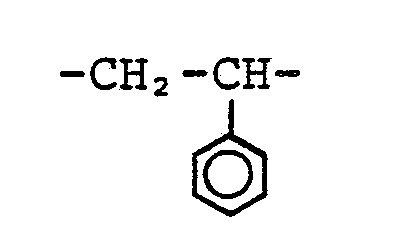
- g) einen Rest, bestehend im wesentlichen aus H-Endgruppen mit der Maßgabe, daß die Summe d + e + f + g = 3 bis 20 Gew.-%, alle Gew.-%-Angaben bezogen auf das Pfropf-Mischpolymerisat, beträgt.
- d) 97 to 80% by weight of units of the formula -CH₂-CHCl-
- e) 0.6 to 12 wt .-% units of the formula
- f) 1.2 to 16 wt .-% units of the formula -CH₂-CHR¹- wherein, R¹ = H or alkyl group having 1 to 3 carbon atoms and
- g) a radical consisting essentially of H-end groups with the proviso that the sum d + e + f + g = 3 to 20% by weight, all% by weight, based on the graft copolymer .
Wegen der leichten Zugänglichkeit des für die Pfropf-Mischpolymerisation notwendigen Copolymeren ist ein Pfropf-Mischpolymerisat, wie im vorgehenden Absatz beschrieben, bevorzugt, das als Komponente e) Einheiten der Formel

Wegen seiner besonders günstigen Eigenschaftskombination der damit erzeugten Formkörper und kostengünstigen Herstellbarkeit, ist ein Mischpolymerisat, wie im vorletzten Absatz beschrieben, bevorzugt, das neben Resten von Polymersations-Hilfsstoffen ein Pfropf-Mischpolymerisat folgender Zusammensetzung enthält:
- d) 96 bis 88 Gew.-%
- e) 1,35 bis 11 Gew.-%
- f) 1,35 bis 11 Gew.-% und
- g) einen Rest, bestehend im wesentlichen aus H-Endgruppen, mit der Maßgabe, daß die Summe d + e + f + g = 4 bis 12 Gew.-%, alle Gew.-%-Angaben bezogen auf das Pfropf-Mischpolymerisat, beträgt.
- d) 96 to 88% by weight
- e) 1.35 to 11% by weight
- f) 1.35 to 11 wt .-% and
- g) a radical consisting essentially of H-end groups, with the proviso that the sum d + e + f + g = 4 to 12% by weight, all% by weight - data based on the graft copolymer, is.
Die zuletzt beschriebenen Pfropf-Mischpolymerisate können beispielsweise hergestellt werden, nach dem eingangs beschriebenen Verfahren.The last-described graft copolymers can be prepared, for example, by the process described at the outset.
Die neuen Vinylchlorid-Pfropf-Mischpolymerisate sind zu Formkörpern verarbeitbar, die sich durch gute Schlagzähigkeit neben außergewöhnlich guter Transparenz auszeichnen, eine Eigenschaftskombination, die bisher nur schwer erreichbar war. Wie weiter oben bereits erwähnt, haben sie gegenüber einfachen Polymermischungen den Vorteil, besser homogene Produkte zu ergeben. Die Herstellung kann unter Verwendung von marktüblichen Copolymeren erfolgen.The new vinyl chloride graft copolymers can be processed to give shaped articles which are notable for good impact strength and exceptionally good transparency, a combination of properties which has hitherto been difficult to achieve. As already mentioned above, they have the advantage over simple polymer mixtures that they give better homogeneous products. They can be produced using commercially available copolymers.
Nachfolgende Beispiele und Vergleichsversuche sollen die Erfindung näher erläutern. Die nachfolgenden Meßwerte wurden nach folgenden Methoden ermittelt:
Schüttgewicht (SG) in g/dm³ nach DIN 53468
Kerbschlagzähigkeit (aK23) in mJ/m² nach DIN 53453 bei 23 °C.
Transparenz charakterisiert durch die Lichtdurchlässigkeit (Ld) in % und das Streulicht in Durchstrahlungsrichtung (Str) in % nach folgender Methode:The following examples and comparative experiments are intended to explain the invention in more detail. The following measured values were determined using the following methods:
Bulk weight (SG) in g / dm³ according to DIN 53468
Notched impact strength (a K23 ) in mJ / m² according to DIN 53453 at 23 ° C.
Transparency characterized by the light transmission (Ld) in% and the scattered light in the direction of radiation (Str) in% according to the following method:
Das Licht einer mit konstanter Spannung betriebenen Glühlampe wird vermittels eines Kollektors auf eine Blende mit senkrechtem Spalt konzentriert. Dieser Lichtspalt wird vermittels einer Optik durch eine Öffnung in eine Ulbricht'sche Kugel projiziert, die gegenüber der Lichteintrittsöffnung eine sogenannte "Lichtfalle" enthält und an der senkrecht zur Durchstrahlungsrichtung in einer Öffnung eine Fotozelle angebracht ist. Der von der Fotozelle bei Lichteinfall erzeugte elektrische Strom wird nach Verstärkung mit einem Drehspul-Instrument gemessen. An der Lichteintrittsöffnung der Ulbricht'schen Kugel ist ein Probenhalter für Proben von 10 × 10 cm und eine senkrechte Achse angebracht, um die die Ulbricht'sche Kugel aus ihrer Ruhelage seitwärts um einen gewissen Winkel geschwenkt werden kann, so daß das Bild des Lichtspaltes nicht mehr in die "Lichtfalle" fällt, sondern daneben auf die gleichmäßig reflektierende Innenoberfläche der Ulbricht'schen Kugel. Diese Stellung wird nachfolgend als "hell" bezeichnet, die Stellung, bei der das Bild des Spaltes in die Lichtfalle fällt, als "dunkel".The light of an incandescent lamp operated with constant voltage is concentrated by means of a collector on an aperture with a vertical gap. This light gap is projected by means of optics through an opening into an Ulbricht sphere, which contains a so-called "light trap" opposite the light entry opening and to which a photocell is attached in an opening perpendicular to the direction of radiation. The electric current generated by the photocell in the event of light is measured after amplification using a moving coil instrument. A sample holder for samples of 10 × 10 cm and a vertical axis is attached to the light entry opening of the Ulbricht ball, about which the Ulbricht ball can be pivoted sideways from its rest position by a certain angle, so that the image of the light gap is not falls more into the "light trap", but next to it onto the uniformly reflecting inner surface of the Ulbricht sphere. This position is referred to below as "bright", the position in which the image of the slit falls into the light trap as "dark".
Zur Messung der Lichtdurchlässigkeit (Ld) wird die Ulbricht'sche Kugel in Stellung "hell" geschwenkt und so das Gesamtlicht ohne Probe G durch Messung am Drehspul-Instrument ermittelt. Nun wird als Probe eine durch Pressen erzeugte planparallele Platte von den Abmessungen 10 × 10 cm mit 1 mm Dicke in den Probenhalter an der Lichteintrittsöffnung der Ulbricht'schen Kugel gebracht und das Gesamtlicht mit Probe Gp gemessen. Diese Messung wird an drei verschiedenen Platten, die alle mit dem gleichen Rohstoff und dem gleichen Rezept erzeugt wurden, durchgeführt und der Mittelwert aller drei Messungen für die Errechnung der Lichtdurchlässigkeit nach folgender Gleichung verwendet:
Zur Messung des Streulichtes (Str) wird die Ulbricht'sche Kugel in Stellung "dunkel" geschwenkt und zunächst ohne Probe, das an der Apparatur gestreute Licht S durch Ablesen des Drehspulinstrumentes festgestellt. Nun werden die gleichen drei Proben wie oben nacheinander in den Probenhalter an der Lichteintrittsöffnung der Ulbricht'schen Kugel gebracht und das in Durchstrahlungsrichtung gestreute Licht mit Probe Sp bestimmt. Das Streulicht (Str) bezogen auf das von der Probe durchgelassene Licht ist: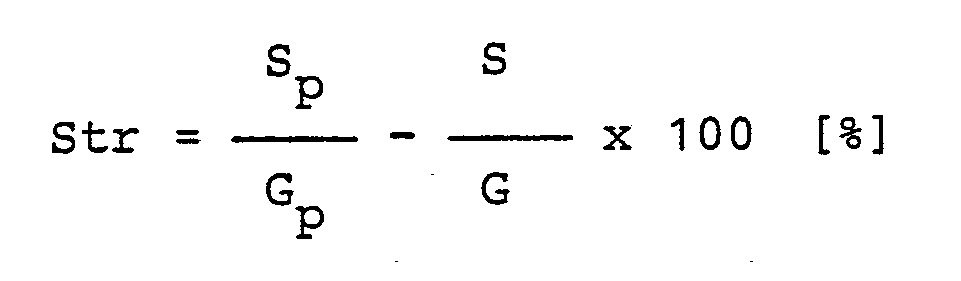
Die als Proben hergestellten Pressplatten werden wie folgt erzeugt:
100 Gew.-Teile Polymerisat beziehungsweise Polymerisat-Mischung
2 Gew.-Teile eines Barium-Kadmium-Stabilisators (Lankromark®LP 125 der Firma Lankro, Drogenbos/Belgien)
0,5 Gew.-Teile Alkyl-Aryl--Phosphit (Typ LE 98 der Firma Lankro)
2 Gew.-Teile eines epoxydierten Sojabohnenöls (Edenol® D 81 der Firma Henkel Loxstedt/BR Deutschland)
0,5 Gew.-Teile eines Kohlenwasserstoffwachses (Irganox® 366 der Firma Ciba Geigy Marienberg/BR Deutschland) werden sorgfältig miteinander vermischt, dann werden 5 Minuten bei 175 °C 0,3 mm starke Felle durch Walzen daraus hergestellt. 4 dieser Walzfelle werden übereinander gelegt und in einer Presse zwischen hochglanzverchromten Blechen bei 175 °C zu einer 1 mm starken Platte gepreßt, aus der anschließend das Probenstück mit den Abmessungen 10 × 10 cm herausgeschnitten wird.The press plates produced as samples are produced as follows:
100 parts by weight of polymer or polymer mixture
2 parts by weight of a barium-cadmium stabilizer (Lankromark®LP 125 from Lankro, Drugsbos / Belgium)
0.5 part by weight of alkyl aryl phosphite (type LE 98 from Lankro)
2 parts by weight of an epoxidized soybean oil (Edenol® D 81 from Henkel Loxstedt / BR Germany)
0.5 part by weight of a hydrocarbon wax (Irganox® 366 from Ciba Geigy Marienberg / BR Germany) is mixed thoroughly with one another, then 0.3 mm thick skins are produced from them by rolling at 175 ° C. for 5 minutes. 4 of these rolled skins are placed on top of each other and pressed in a press between high-gloss chrome-plated sheets at 175 ° C to form a 1 mm thick plate, from which the sample piece with the dimensions 10 × 10 cm is then cut out.
Die ermittelten Meßwerte sind nachfolgend in einer Tabelle aufgeführt.The measured values determined are listed in a table below.
In einen druckfesten Polymerisationskessel aus rostfreiem Stahl, der mit Doppelmantel zur Temperierung und einem stufenlos regelbaren Impeller-Rührer ausgerüstet ist, werden eingegeben:
15 000 Gew.-Teile entionisiertes Wasser,
2 Gew.-Teile Diisopropylperoxydicarbonat,
4 Gew.-Teile t-Butylpervivalat,
700 Gew.-Teile eines vollhydrierten Copolymeren aus 1,3-Butadien und Styrol, das 29 Gew.-%, bezogen auf das Copolymere, polymerisierte Einheiten des Styrols enthält und eine Viskosität der 20%igen Lösung in Toluol bei 25 °C gemessen mit einem Brookfield-Viskosimeter (Modell RVT) von 480 mPa s.
Unter Rühren der Flüssigkeit wird die im Kessel enthaltene Luft sorgfältig durch Stickstoff verdrängt und 10 000 Gew.-Teile monomeres Vinylchlorid unter Druck zugegeben. Diese Mischung wird eine Stunde kräftig gerührt, dann werden weiter zugegeben:
6 Gew.-Teile einer Methylhydroxypropylcellulose mit einem molaren Substitutionsgrad der Methoxygruppe von 1,8 und einem molaren Substitutionsgrad der Hydroxypropylgruppe von 0,13 sowie einer Viskosität, gemessen in 2 gew.-%iger wäßriger Lösung bei 20 °C von 40 × 10⁻³ Pa s,
10 Gew.-Teile einer Hydroxyethylcellulose mit einem molaren Substitutionsgrad der Hydroxyethylgruppe von 1,65 und einer Viskosität, gemessen als 2 gew.-%ige wäßrige Lösung bei 20 °C von 350 × 10⁻³ Pa s. Es wird noch weitere 10 Minuten bei Raumtemperatur gerührt, dann wird die Mischung auf 60 °C erwärmt und unter Konstanthalten dieser Temperatur bis zu einem Druckabfall um 0,4 MPa polymerisiert. Dies entspricht einem Vinylchlorid-Umsatz von 84 %. Danach wird der Polymersationskessel entspannt, der Inhalt zur Entfernung von restlichen Monomeren nach bekanntem Verfahren behandelt, anschließend der gebildete Feststoff mit einer Zentrifuge von der flüssigen, wäßrigen Phase getrennt und in einem Stromtrockner auf eine Restfeuchte von > 0,3 Gew.-% Wasser, bezogen auf das Polymerisat,getrocknet. An diesem Polymerisat werden die weiter oben beschriebenen Messungen durchgeführt, Werte siehe Tabelle.In a pressure-resistant polymerization kettle made of stainless steel, which is equipped with a double jacket for temperature control and an infinitely variable impeller stirrer, the following are entered:
15,000 parts by weight of deionized water,
2 parts by weight of diisopropyl peroxydicarbonate,
4 parts by weight of t-butyl survivalate,
700 parts by weight of a fully hydrogenated copolymer of 1,3-butadiene and styrene which contains 29% by weight, based on the copolymer, of polymerized units of styrene and a viscosity of the 20% solution in toluene at 25 ° C. measured with a Brookfield viscometer (model RVT) of 480 mPa s.
While stirring the liquid, the air in the boiler is carefully replaced by nitrogen and 10,000 parts by weight of monomeric vinyl chloride are added under pressure. This mixture is stirred vigorously for one hour, then further are added:
6 parts by weight of a methyl hydroxypropyl cellulose with a molar degree of substitution of the methoxy group of 1.8 and a molar degree of substitution of the hydroxypropyl group of 0.13 and a viscosity, measured in 2 wt .-% aqueous solution at 20 ° C of 40 × 10⁻ ³ Pa s,
10 parts by weight of a hydroxyethyl cellulose with a molar degree of substitution of the hydroxyethyl group of 1.65 and a viscosity, measured as a 2 wt .-% aqueous solution at 20 ° C of 350 × 10⁻³ Pa s. It will still be Stirred for a further 10 minutes at room temperature, then the mixture is heated to 60 ° C. and polymerized while maintaining this temperature until the pressure drops by 0.4 MPa. This corresponds to a vinyl chloride conversion of 84%. The polymerization vessel is then depressurized, the contents are treated to remove residual monomers by a known method, and then the solid formed is separated from the liquid, aqueous phase using a centrifuge and subjected to a residual moisture of> 0.3% by weight of water in a stream dryer. based on the polymer, dried. The measurements described above are carried out on this polymer, for values see table.
Es wird verfahren wie im Beispiel 1 beschrieben, jedoch wird als Copolymeres ein vollständig hydriertes 1,3- Butadien-Styrol-Copolymerisat eingesetzt, das 51 Gew.-%,bezogen auf das Copolymere,polymerisierte Styrol Einheiten enthält und dessen 20 gew.-%ige Lösung in Toluol bei 25 °C, wie weiter oben beschrieben gemessen, eine Lösungsviskosität von 210 mPa s aufweist. Es wird polymerisiert bis zu einem Druckabfall um 0,55 MPa, der Umsatz an monomerem Vinylchlorid beträgt 90 %. Die am fertigen, getrockneten Polymerisat ermittelten Werte sind in nachfolgender Tabelle aufgeführt.The procedure is as described in Example 1, but the copolymer used is a fully hydrogenated 1,3-butadiene-styrene copolymer which contains 51% by weight, based on the copolymer, of polymerized styrene units and 20% by weight. solution in toluene at 25 ° C, as measured above, has a solution viscosity of 210 mPa s. It is polymerized up to a pressure drop of 0.55 MPa, the conversion of monomeric vinyl chloride is 90%. The values determined on the finished, dried polymer are listed in the table below.
Es wird verfahren wie in Beispiel 1 beschrieben, jedoch wird anstelle des vollhydrierten Butadien-Styrol-Copolymerisates ein fein zerkleinertes Ethylen-Propylen-Diencopolymerisat (Buna® 147 der Firma Chemische Werke Hüls Marl/BR Deutschland) eingesetzt. Die am fertigen, getrockneten Polymerisat ermittelten Werte, sind in nachfolgender Tabelle aufgeführt.The procedure is as described in Example 1, but instead of the fully hydrogenated butadiene-styrene copolymer, a finely comminuted ethylene-propylene-diene copolymer (Buna® 147 from Chemische Werke Hüls Marl / BR Germany) is used. The values determined on the finished, dried polymer are in listed in the table below.
Analog der Zusammensetzung des in Beispiel 2 erhaltenen Vinylchlorid-Pfropf-Mischpolymerisates wird eine Polymer-Mischung hergestellt aus 92,8 Gew.-Teilen eines Vinylchlorid-Homopolymerisates vom K-Wert 66, das ein Schüttgewicht von 560 g/dm³ aufweist,und 7,2 Gew.-Teilen des vollhydrierten 1,3-Butadien-Styrol-Copolymerisates, das in Beispiel 2 für die Pfropf-Mischpolymerisation eingesetzt wurde. Die an dieser Polymer-Mischung ermittelten Werte sind in nachfolgender Tabelle aufgeführt.Analogously to the composition of the vinyl chloride graft copolymer obtained in Example 2, a polymer mixture is prepared from 92.8 parts by weight of a vinyl chloride homopolymer with a K value of 66 and a bulk density of 560 g / dm³, and 7. 2 parts by weight of the fully hydrogenated 1,3-butadiene-styrene copolymer, which was used in Example 2 for the graft copolymerization. The values determined on this polymer mixture are listed in the table below.
In dieser Tabelle bedeuten:
GewT = Gewichtsteile
Hydr.B/St = vollhydriertes 1,3-Butadien-Styrol Copolymerisat
EPDC = Ethylen-Propylen-Dien-Copolymerisat (Herkunft weiter oben beschrieben)
Die Bedeutung der weiteren Abkürzungen sind in der Beschreibung der Meßmethoden erklärt.

GewT = parts by weight
Hydr.B / St = fully hydrogenated 1,3-butadiene-styrene copolymer
EPDC = ethylene-propylene-diene copolymer (origin described above)
The meaning of the other abbreviations are explained in the description of the measurement methods.
Wie ersichtlich, ist das nach Vergleichsversuch A hergestellte Vinylchlorid-Pfropf-Mischpolymerisat den erfindungsgemäßen in der Transparenz (vergleichsweise niedrige Lichtdurchlässigkeit bei hohem Streulichtanteil) deutlich unterlegen. Die nach Vergleichsversuch B erzeugte Polymerenmischung, die praktisch die gleiche Zusammensetzung hat wie das nach Beispiel 2 erzeugte Pfropf-Mischpolymere zeigt völlig unbrauchbare Werte bezüglich Schlagzugzähigkeit (aK23) und Transparenz.As can be seen, the vinyl chloride graft copolymer prepared according to comparative experiment A is clearly inferior in transparency (comparatively low light transmission with a high proportion of scattered light) to the invention. The polymer mixture produced according to comparative experiment B, which has practically the same composition as the graft copolymer produced according to example 2, shows completely unusable values with regard to impact strength (a K23 ) and transparency.
Die nach Beispiel 1 und 2 erfindungsgemäß hergestellten Polymerisate haben folgende Zusammensetzung:
Claims (8)
100 Gew.-Teile Vinylchlorid und
2,4 bis 24 Gew.-Teile eines Copolymeren, das seinerseits besteht aus
mit der Maßgabe, daß die Summe a + b + c = 100 Gew.-%, bezogen auf das Copolymere, beträgt.
100 parts by weight of vinyl chloride and
2.4 to 24 parts by weight of a copolymer, which in turn consists of
with the proviso that the sum a + b + c = 100 wt .-%, based on the copolymer.
45 bis 55 Gew.-%, bezogen auf das Copolymere, Einheiten der Formel

45 to 55 wt .-%, based on the copolymer, units of the formula

bedeuten R = H; o-Methoxy- oder p-Methoxy-;
mean R = H; o-methoxy or p-methoxy;
mit der Maßgabe, daß die Summe aus d + e + f + g = 4 bis 12 Gew.-%, alle Gew.-%-Angaben bezogen auf das Pfropf-Mischpolymerisat, beträgt.
with the proviso that the sum of d + e + f + g = 4 to 12% by weight, all% by weight, based on the graft copolymer.
Applications Claiming Priority (2)
| Application Number | Priority Date | Filing Date | Title |
|---|---|---|---|
| DE19863642985 DE3642985A1 (en) | 1986-12-17 | 1986-12-17 | VINYL CHLORIDE-GRAFT MIXED POLYMER AND METHOD FOR PRODUCING A VINYL CHLORIDE-Graft MIXED POLYMER |
| DE3642985 | 1986-12-17 |
Publications (2)
| Publication Number | Publication Date |
|---|---|
| EP0271884A2 true EP0271884A2 (en) | 1988-06-22 |
| EP0271884A3 EP0271884A3 (en) | 1990-05-02 |
Family
ID=6316325
Family Applications (1)
| Application Number | Title | Priority Date | Filing Date |
|---|---|---|---|
| EP87118597A Withdrawn EP0271884A3 (en) | 1986-12-17 | 1987-12-15 | Vinyl chloride graft copolymer and process for its preparation |
Country Status (2)
| Country | Link |
|---|---|
| EP (1) | EP0271884A3 (en) |
| DE (1) | DE3642985A1 (en) |
Cited By (1)
| Publication number | Priority date | Publication date | Assignee | Title |
|---|---|---|---|---|
| EP2430060A1 (en) * | 2009-05-15 | 2012-03-21 | Arkema France | Method for preparing a suspension of pvc grafted onto an elastomer |
Family Cites Families (3)
| Publication number | Priority date | Publication date | Assignee | Title |
|---|---|---|---|---|
| US3100757A (en) * | 1959-06-03 | 1963-08-13 | William H Smyers | Polymerization of aliphatic monomers in presence of aromatic-olefin copolymer and resulting product |
| US3742091A (en) * | 1970-08-17 | 1973-06-26 | Phillips Petroleum Co | Vinyl monomer polymerization process |
| US4212958A (en) * | 1978-08-10 | 1980-07-15 | Borg-Warner Corporation | Graft polyblend flow improvers for PVC |
-
1986
- 1986-12-17 DE DE19863642985 patent/DE3642985A1/en not_active Withdrawn
-
1987
- 1987-12-15 EP EP87118597A patent/EP0271884A3/en not_active Withdrawn
Cited By (1)
| Publication number | Priority date | Publication date | Assignee | Title |
|---|---|---|---|---|
| EP2430060A1 (en) * | 2009-05-15 | 2012-03-21 | Arkema France | Method for preparing a suspension of pvc grafted onto an elastomer |
Also Published As
| Publication number | Publication date |
|---|---|
| DE3642985A1 (en) | 1988-06-30 |
| EP0271884A3 (en) | 1990-05-02 |
Similar Documents
| Publication | Publication Date | Title |
|---|---|---|
| DE1520119C3 (en) | Process for the preparation of a stable dispersion of an addition polymer in an organic liquid | |
| DE2256154C3 (en) | Process for the preparation of aqueous dispersions of polymers of monoolefinically unsaturated carboxylic acid esters | |
| DE3038643C2 (en) | ||
| DE2341123A1 (en) | ACRYLIC BLENDED POLYMERS | |
| DE1520310B2 (en) | Process for the production of a graft polymer composition | |
| EP0313507B1 (en) | Process for the preparation of an acrylic-acid ester-vinyl chloride graft copolymer | |
| EP0040759A1 (en) | Use of a vinyl-chloride graft polymer in processing plastisols | |
| EP0472852B1 (en) | Preparation of a shock resistant polyacrylic ester-polyvinylchloride graft polymer | |
| DE2003331B2 (en) | PROCESS FOR THE PREPARATION OF A VINYL CHLORIDE GOP POLYMERIZATE | |
| EP0033893B1 (en) | Process for the polymerisation of vinyl chloride in the aqueous phase | |
| DE2140391C3 (en) | Process for the polymerisation of fluorine-containing olefins and use of the polymers obtained for the production of coatings and paints | |
| EP0271884A2 (en) | Vinyl chloride graft copolymer and process for its preparation | |
| DE2310277A1 (en) | ANTISTATIC VINYL CHLORIDE POLYMERISATES, METHOD FOR THEIR PRODUCTION AND THEIR USE | |
| EP0073015B1 (en) | Process to polymerize vinyl chloride in aqueous emulsion | |
| DE69106299T3 (en) | Peroxyester and its use as a polymerization initiator and curing agent. | |
| EP0391398B1 (en) | Vinyl chloride copolymers with improved thermal stability and heat resistance | |
| EP0447924B1 (en) | Process to produce a vinylchloride resin | |
| EP0036624B1 (en) | Use of mixed esters as a dispersion and in the polymerisation of vinyl chloride | |
| DE2949843C2 (en) | Process for the production of crosslinked polycarboxylic acids | |
| EP0222983A1 (en) | Process for the preparation of vinyl chloride polymers | |
| DE1251025B (en) | Process for the production of copolymers of ethylene with N-Vmyllactamen | |
| DE2323191B2 (en) | Process for the preparation of a polymer from vinyl halide by a two-stage bulk polymerization process | |
| DE1494125C3 (en) | Thermopastic molding compound | |
| AT232276B (en) | Polymeric compositions | |
| DE2227887A1 (en) | Vinylchloride suspension copolymer - in presence of a methyloxazoline/propyloxazoline copolymer as stabiliser |
Legal Events
| Date | Code | Title | Description |
|---|---|---|---|
| PUAI | Public reference made under article 153(3) epc to a published international application that has entered the european phase |
Free format text: ORIGINAL CODE: 0009012 |
|
| AK | Designated contracting states |
Kind code of ref document: A2 Designated state(s): DE FR NL |
|
| PUAL | Search report despatched |
Free format text: ORIGINAL CODE: 0009013 |
|
| STAA | Information on the status of an ep patent application or granted ep patent |
Free format text: STATUS: THE APPLICATION HAS BEEN WITHDRAWN |
|
| AK | Designated contracting states |
Kind code of ref document: A3 Designated state(s): DE FR NL |
|
| 18W | Application withdrawn |
Withdrawal date: 19900419 |