EP0271349B1 - Thermoplastic resin composition - Google Patents
Thermoplastic resin composition Download PDFInfo
- Publication number
- EP0271349B1 EP0271349B1 EP87310898A EP87310898A EP0271349B1 EP 0271349 B1 EP0271349 B1 EP 0271349B1 EP 87310898 A EP87310898 A EP 87310898A EP 87310898 A EP87310898 A EP 87310898A EP 0271349 B1 EP0271349 B1 EP 0271349B1
- Authority
- EP
- European Patent Office
- Prior art keywords
- weight
- rubber
- compound
- composition
- maleimide
- Prior art date
- Legal status (The legal status is an assumption and is not a legal conclusion. Google has not performed a legal analysis and makes no representation as to the accuracy of the status listed.)
- Expired - Lifetime
Links
- 239000011342 resin composition Substances 0.000 title claims description 23
- 229920005992 thermoplastic resin Polymers 0.000 title claims description 23
- 239000000203 mixture Substances 0.000 claims description 62
- PPBRXRYQALVLMV-UHFFFAOYSA-N Styrene Chemical compound C=CC1=CC=CC=C1 PPBRXRYQALVLMV-UHFFFAOYSA-N 0.000 claims description 56
- 229920005989 resin Polymers 0.000 claims description 51
- 239000011347 resin Substances 0.000 claims description 51
- -1 maleimide compound Chemical class 0.000 claims description 44
- PEEHTFAAVSWFBL-UHFFFAOYSA-N Maleimide Chemical compound O=C1NC(=O)C=C1 PEEHTFAAVSWFBL-UHFFFAOYSA-N 0.000 claims description 30
- 239000000178 monomer Substances 0.000 claims description 30
- 229920000515 polycarbonate Polymers 0.000 claims description 26
- 239000004417 polycarbonate Substances 0.000 claims description 26
- 229920000642 polymer Polymers 0.000 claims description 25
- 229920001971 elastomer Polymers 0.000 claims description 23
- 239000002245 particle Substances 0.000 claims description 22
- 239000005060 rubber Substances 0.000 claims description 10
- 229920000181 Ethylene propylene rubber Polymers 0.000 claims description 9
- 229920003244 diene elastomer Polymers 0.000 claims description 9
- 229920000800 acrylic rubber Polymers 0.000 claims description 8
- 229920000058 polyacrylate Polymers 0.000 claims description 8
- 230000000379 polymerizing effect Effects 0.000 claims description 7
- NLHHRLWOUZZQLW-UHFFFAOYSA-N Acrylonitrile Chemical compound C=CC#N NLHHRLWOUZZQLW-UHFFFAOYSA-N 0.000 claims description 6
- XYLMUPLGERFSHI-UHFFFAOYSA-N alpha-Methylstyrene Chemical compound CC(=C)C1=CC=CC=C1 XYLMUPLGERFSHI-UHFFFAOYSA-N 0.000 claims description 6
- HIDBROSJWZYGSZ-UHFFFAOYSA-N 1-phenylpyrrole-2,5-dione Chemical compound O=C1C=CC(=O)N1C1=CC=CC=C1 HIDBROSJWZYGSZ-UHFFFAOYSA-N 0.000 claims description 5
- 125000003342 alkenyl group Chemical group 0.000 claims description 5
- 150000001875 compounds Chemical class 0.000 claims description 4
- 229920001897 terpolymer Polymers 0.000 claims description 4
- KPQOXMCRYWDRSB-UHFFFAOYSA-N 1-(2-chlorophenyl)pyrrole-2,5-dione Chemical compound ClC1=CC=CC=C1N1C(=O)C=CC1=O KPQOXMCRYWDRSB-UHFFFAOYSA-N 0.000 claims description 3
- 150000001993 dienes Chemical class 0.000 claims description 3
- BQTPKSBXMONSJI-UHFFFAOYSA-N 1-cyclohexylpyrrole-2,5-dione Chemical compound O=C1C=CC(=O)N1C1CCCCC1 BQTPKSBXMONSJI-UHFFFAOYSA-N 0.000 claims description 2
- GHAZCVNUKKZTLG-UHFFFAOYSA-N N-ethyl-succinimide Natural products CCN1C(=O)CCC1=O GHAZCVNUKKZTLG-UHFFFAOYSA-N 0.000 claims description 2
- HDFGOPSGAURCEO-UHFFFAOYSA-N N-ethylmaleimide Chemical compound CCN1C(=O)C=CC1=O HDFGOPSGAURCEO-UHFFFAOYSA-N 0.000 claims description 2
- SEEYREPSKCQBBF-UHFFFAOYSA-N n-methylmaleimide Chemical compound CN1C(=O)C=CC1=O SEEYREPSKCQBBF-UHFFFAOYSA-N 0.000 claims description 2
- 230000000052 comparative effect Effects 0.000 description 20
- 239000000126 substance Substances 0.000 description 13
- 238000012360 testing method Methods 0.000 description 13
- 229920001577 copolymer Polymers 0.000 description 12
- 238000006116 polymerization reaction Methods 0.000 description 11
- 238000002156 mixing Methods 0.000 description 8
- 239000000243 solution Substances 0.000 description 8
- ZWEHNKRNPOVVGH-UHFFFAOYSA-N 2-Butanone Chemical compound CCC(C)=O ZWEHNKRNPOVVGH-UHFFFAOYSA-N 0.000 description 6
- 239000003350 kerosene Substances 0.000 description 5
- 238000004519 manufacturing process Methods 0.000 description 5
- 229920002943 EPDM rubber Polymers 0.000 description 4
- 239000008188 pellet Substances 0.000 description 4
- 229920002857 polybutadiene Polymers 0.000 description 4
- JLBJTVDPSNHSKJ-UHFFFAOYSA-N 4-Methylstyrene Chemical compound CC1=CC=C(C=C)C=C1 JLBJTVDPSNHSKJ-UHFFFAOYSA-N 0.000 description 3
- YMWUJEATGCHHMB-UHFFFAOYSA-N Dichloromethane Chemical compound ClCCl YMWUJEATGCHHMB-UHFFFAOYSA-N 0.000 description 3
- 239000005062 Polybutadiene Substances 0.000 description 3
- YXFVVABEGXRONW-UHFFFAOYSA-N Toluene Chemical compound CC1=CC=CC=C1 YXFVVABEGXRONW-UHFFFAOYSA-N 0.000 description 3
- 229920001400 block copolymer Polymers 0.000 description 3
- 238000012662 bulk polymerization Methods 0.000 description 3
- 238000000034 method Methods 0.000 description 3
- 238000000465 moulding Methods 0.000 description 3
- 239000002904 solvent Substances 0.000 description 3
- 238000003756 stirring Methods 0.000 description 3
- 229920003048 styrene butadiene rubber Polymers 0.000 description 3
- 238000010557 suspension polymerization reaction Methods 0.000 description 3
- CYLVUSZHVURAOY-UHFFFAOYSA-N 2,2-dibromoethenylbenzene Chemical compound BrC(Br)=CC1=CC=CC=C1 CYLVUSZHVURAOY-UHFFFAOYSA-N 0.000 description 2
- OZAIFHULBGXAKX-UHFFFAOYSA-N 2-(2-cyanopropan-2-yldiazenyl)-2-methylpropanenitrile Chemical compound N#CC(C)(C)N=NC(C)(C)C#N OZAIFHULBGXAKX-UHFFFAOYSA-N 0.000 description 2
- YMOONIIMQBGTDU-UHFFFAOYSA-N 2-bromoethenylbenzene Chemical compound BrC=CC1=CC=CC=C1 YMOONIIMQBGTDU-UHFFFAOYSA-N 0.000 description 2
- OFNISBHGPNMTMS-UHFFFAOYSA-N 3-methylideneoxolane-2,5-dione Chemical compound C=C1CC(=O)OC1=O OFNISBHGPNMTMS-UHFFFAOYSA-N 0.000 description 2
- 239000004342 Benzoyl peroxide Substances 0.000 description 2
- OMPJBNCRMGITSC-UHFFFAOYSA-N Benzoylperoxide Chemical compound C=1C=CC=CC=1C(=O)OOC(=O)C1=CC=CC=C1 OMPJBNCRMGITSC-UHFFFAOYSA-N 0.000 description 2
- 229930185605 Bisphenol Natural products 0.000 description 2
- SOGAXMICEFXMKE-UHFFFAOYSA-N Butylmethacrylate Chemical compound CCCCOC(=O)C(C)=C SOGAXMICEFXMKE-UHFFFAOYSA-N 0.000 description 2
- RTZKZFJDLAIYFH-UHFFFAOYSA-N Diethyl ether Chemical compound CCOCC RTZKZFJDLAIYFH-UHFFFAOYSA-N 0.000 description 2
- BAPJBEWLBFYGME-UHFFFAOYSA-N Methyl acrylate Chemical compound COC(=O)C=C BAPJBEWLBFYGME-UHFFFAOYSA-N 0.000 description 2
- VVQNEPGJFQJSBK-UHFFFAOYSA-N Methyl methacrylate Chemical compound COC(=O)C(C)=C VVQNEPGJFQJSBK-UHFFFAOYSA-N 0.000 description 2
- GYCMBHHDWRMZGG-UHFFFAOYSA-N Methylacrylonitrile Chemical compound CC(=C)C#N GYCMBHHDWRMZGG-UHFFFAOYSA-N 0.000 description 2
- 235000019400 benzoyl peroxide Nutrition 0.000 description 2
- IISBACLAFKSPIT-UHFFFAOYSA-N bisphenol A Chemical compound C=1C=C(O)C=CC=1C(C)(C)C1=CC=C(O)C=C1 IISBACLAFKSPIT-UHFFFAOYSA-N 0.000 description 2
- 239000000470 constituent Substances 0.000 description 2
- 238000007720 emulsion polymerization reaction Methods 0.000 description 2
- SUPCQIBBMFXVTL-UHFFFAOYSA-N ethyl 2-methylprop-2-enoate Chemical compound CCOC(=O)C(C)=C SUPCQIBBMFXVTL-UHFFFAOYSA-N 0.000 description 2
- 238000010528 free radical solution polymerization reaction Methods 0.000 description 2
- 229920000126 latex Polymers 0.000 description 2
- FPYJFEHAWHCUMM-UHFFFAOYSA-N maleic anhydride Chemical compound O=C1OC(=O)C=C1 FPYJFEHAWHCUMM-UHFFFAOYSA-N 0.000 description 2
- 150000002978 peroxides Chemical class 0.000 description 2
- 239000002685 polymerization catalyst Substances 0.000 description 2
- 238000010526 radical polymerization reaction Methods 0.000 description 2
- 229920005604 random copolymer Polymers 0.000 description 2
- 238000010998 test method Methods 0.000 description 2
- NVZWEEGUWXZOKI-UHFFFAOYSA-N 1-ethenyl-2-methylbenzene Chemical compound CC1=CC=CC=C1C=C NVZWEEGUWXZOKI-UHFFFAOYSA-N 0.000 description 1
- WAEOXIOXMKNFLQ-UHFFFAOYSA-N 1-methyl-4-prop-2-enylbenzene Chemical group CC1=CC=C(CC=C)C=C1 WAEOXIOXMKNFLQ-UHFFFAOYSA-N 0.000 description 1
- QEDJMOONZLUIMC-UHFFFAOYSA-N 1-tert-butyl-4-ethenylbenzene Chemical compound CC(C)(C)C1=CC=C(C=C)C=C1 QEDJMOONZLUIMC-UHFFFAOYSA-N 0.000 description 1
- IGGDKDTUCAWDAN-UHFFFAOYSA-N 1-vinylnaphthalene Chemical compound C1=CC=C2C(C=C)=CC=CC2=C1 IGGDKDTUCAWDAN-UHFFFAOYSA-N 0.000 description 1
- RNFJDJUURJAICM-UHFFFAOYSA-N 2,2,4,4,6,6-hexaphenoxy-1,3,5-triaza-2$l^{5},4$l^{5},6$l^{5}-triphosphacyclohexa-1,3,5-triene Chemical compound N=1P(OC=2C=CC=CC=2)(OC=2C=CC=CC=2)=NP(OC=2C=CC=CC=2)(OC=2C=CC=CC=2)=NP=1(OC=1C=CC=CC=1)OC1=CC=CC=C1 RNFJDJUURJAICM-UHFFFAOYSA-N 0.000 description 1
- CISIJYCKDJSTMX-UHFFFAOYSA-N 2,2-dichloroethenylbenzene Chemical compound ClC(Cl)=CC1=CC=CC=C1 CISIJYCKDJSTMX-UHFFFAOYSA-N 0.000 description 1
- YAJYJWXEWKRTPO-UHFFFAOYSA-N 2,3,3,4,4,5-hexamethylhexane-2-thiol Chemical compound CC(C)C(C)(C)C(C)(C)C(C)(C)S YAJYJWXEWKRTPO-UHFFFAOYSA-N 0.000 description 1
- GOXQRTZXKQZDDN-UHFFFAOYSA-N 2-Ethylhexyl acrylate Chemical compound CCCCC(CC)COC(=O)C=C GOXQRTZXKQZDDN-UHFFFAOYSA-N 0.000 description 1
- SBYMUDUGTIKLCR-UHFFFAOYSA-N 2-chloroethenylbenzene Chemical compound ClC=CC1=CC=CC=C1 SBYMUDUGTIKLCR-UHFFFAOYSA-N 0.000 description 1
- WDQMWEYDKDCEHT-UHFFFAOYSA-N 2-ethylhexyl 2-methylprop-2-enoate Chemical compound CCCCC(CC)COC(=O)C(C)=C WDQMWEYDKDCEHT-UHFFFAOYSA-N 0.000 description 1
- BTOVVHWKPVSLBI-UHFFFAOYSA-N 2-methylprop-1-enylbenzene Chemical compound CC(C)=CC1=CC=CC=C1 BTOVVHWKPVSLBI-UHFFFAOYSA-N 0.000 description 1
- AYKYXWQEBUNJCN-UHFFFAOYSA-N 3-methylfuran-2,5-dione Chemical compound CC1=CC(=O)OC1=O AYKYXWQEBUNJCN-UHFFFAOYSA-N 0.000 description 1
- NIXOWILDQLNWCW-UHFFFAOYSA-M Acrylate Chemical compound [O-]C(=O)C=C NIXOWILDQLNWCW-UHFFFAOYSA-M 0.000 description 1
- 229920000178 Acrylic resin Polymers 0.000 description 1
- 239000004925 Acrylic resin Substances 0.000 description 1
- 229920000089 Cyclic olefin copolymer Polymers 0.000 description 1
- JIGUQPWFLRLWPJ-UHFFFAOYSA-N Ethyl acrylate Chemical compound CCOC(=O)C=C JIGUQPWFLRLWPJ-UHFFFAOYSA-N 0.000 description 1
- 239000004952 Polyamide Substances 0.000 description 1
- 239000002174 Styrene-butadiene Substances 0.000 description 1
- 239000002253 acid Substances 0.000 description 1
- 150000008065 acid anhydrides Chemical class 0.000 description 1
- 150000007513 acids Chemical class 0.000 description 1
- 229920000122 acrylonitrile butadiene styrene Polymers 0.000 description 1
- 239000000654 additive Substances 0.000 description 1
- 150000001335 aliphatic alkanes Chemical class 0.000 description 1
- 125000001931 aliphatic group Chemical group 0.000 description 1
- 125000005250 alkyl acrylate group Chemical group 0.000 description 1
- 239000003963 antioxidant agent Substances 0.000 description 1
- 230000003078 antioxidant effect Effects 0.000 description 1
- 239000002216 antistatic agent Substances 0.000 description 1
- 125000003118 aryl group Chemical group 0.000 description 1
- AOJOEFVRHOZDFN-UHFFFAOYSA-N benzyl 2-methylprop-2-enoate Chemical compound CC(=C)C(=O)OCC1=CC=CC=C1 AOJOEFVRHOZDFN-UHFFFAOYSA-N 0.000 description 1
- GCTPMLUUWLLESL-UHFFFAOYSA-N benzyl prop-2-enoate Chemical compound C=CC(=O)OCC1=CC=CC=C1 GCTPMLUUWLLESL-UHFFFAOYSA-N 0.000 description 1
- WXCZUWHSJWOTRV-UHFFFAOYSA-N but-1-ene;ethene Chemical compound C=C.CCC=C WXCZUWHSJWOTRV-UHFFFAOYSA-N 0.000 description 1
- MPMBRWOOISTHJV-UHFFFAOYSA-N but-1-enylbenzene Chemical compound CCC=CC1=CC=CC=C1 MPMBRWOOISTHJV-UHFFFAOYSA-N 0.000 description 1
- MTAZNLWOLGHBHU-UHFFFAOYSA-N butadiene-styrene rubber Chemical compound C=CC=C.C=CC1=CC=CC=C1 MTAZNLWOLGHBHU-UHFFFAOYSA-N 0.000 description 1
- CQEYYJKEWSMYFG-UHFFFAOYSA-N butyl acrylate Chemical compound CCCCOC(=O)C=C CQEYYJKEWSMYFG-UHFFFAOYSA-N 0.000 description 1
- QYMGIIIPAFAFRX-UHFFFAOYSA-N butyl prop-2-enoate;ethene Chemical compound C=C.CCCCOC(=O)C=C QYMGIIIPAFAFRX-UHFFFAOYSA-N 0.000 description 1
- 239000003054 catalyst Substances 0.000 description 1
- 238000005520 cutting process Methods 0.000 description 1
- OIWOHHBRDFKZNC-UHFFFAOYSA-N cyclohexyl 2-methylprop-2-enoate Chemical compound CC(=C)C(=O)OC1CCCCC1 OIWOHHBRDFKZNC-UHFFFAOYSA-N 0.000 description 1
- KBLWLMPSVYBVDK-UHFFFAOYSA-N cyclohexyl prop-2-enoate Chemical compound C=CC(=O)OC1CCCCC1 KBLWLMPSVYBVDK-UHFFFAOYSA-N 0.000 description 1
- 235000014113 dietary fatty acids Nutrition 0.000 description 1
- GMSCBRSQMRDRCD-UHFFFAOYSA-N dodecyl 2-methylprop-2-enoate Chemical compound CCCCCCCCCCCCOC(=O)C(C)=C GMSCBRSQMRDRCD-UHFFFAOYSA-N 0.000 description 1
- 239000000839 emulsion Substances 0.000 description 1
- 229920006351 engineering plastic Polymers 0.000 description 1
- 239000005038 ethylene vinyl acetate Substances 0.000 description 1
- 229920006245 ethylene-butyl acrylate Polymers 0.000 description 1
- 229920006225 ethylene-methyl acrylate Polymers 0.000 description 1
- 229920005674 ethylene-propylene random copolymer Polymers 0.000 description 1
- 238000001125 extrusion Methods 0.000 description 1
- 229930195729 fatty acid Natural products 0.000 description 1
- 239000000194 fatty acid Substances 0.000 description 1
- 239000003063 flame retardant Substances 0.000 description 1
- 238000010097 foam moulding Methods 0.000 description 1
- 239000004088 foaming agent Substances 0.000 description 1
- 239000003365 glass fiber Substances 0.000 description 1
- 238000010559 graft polymerization reaction Methods 0.000 description 1
- LNCPIMCVTKXXOY-UHFFFAOYSA-N hexyl 2-methylprop-2-enoate Chemical compound CCCCCCOC(=O)C(C)=C LNCPIMCVTKXXOY-UHFFFAOYSA-N 0.000 description 1
- LNMQRPPRQDGUDR-UHFFFAOYSA-N hexyl prop-2-enoate Chemical compound CCCCCCOC(=O)C=C LNMQRPPRQDGUDR-UHFFFAOYSA-N 0.000 description 1
- 238000002347 injection Methods 0.000 description 1
- 239000007924 injection Substances 0.000 description 1
- 238000001746 injection moulding Methods 0.000 description 1
- PBOSTUDLECTMNL-UHFFFAOYSA-N lauryl acrylate Chemical compound CCCCCCCCCCCCOC(=O)C=C PBOSTUDLECTMNL-UHFFFAOYSA-N 0.000 description 1
- 239000000314 lubricant Substances 0.000 description 1
- 125000005397 methacrylic acid ester group Chemical group 0.000 description 1
- 239000012778 molding material Substances 0.000 description 1
- IJGRMHOSHXDMSA-UHFFFAOYSA-N nitrogen Substances N#N IJGRMHOSHXDMSA-UHFFFAOYSA-N 0.000 description 1
- 229910052757 nitrogen Inorganic materials 0.000 description 1
- QJGQUHMNIGDVPM-UHFFFAOYSA-N nitrogen group Chemical group [N] QJGQUHMNIGDVPM-UHFFFAOYSA-N 0.000 description 1
- HMZGPNHSPWNGEP-UHFFFAOYSA-N octadecyl 2-methylprop-2-enoate Chemical compound CCCCCCCCCCCCCCCCCCOC(=O)C(C)=C HMZGPNHSPWNGEP-UHFFFAOYSA-N 0.000 description 1
- FSAJWMJJORKPKS-UHFFFAOYSA-N octadecyl prop-2-enoate Chemical compound CCCCCCCCCCCCCCCCCCOC(=O)C=C FSAJWMJJORKPKS-UHFFFAOYSA-N 0.000 description 1
- NZIDBRBFGPQCRY-UHFFFAOYSA-N octyl 2-methylprop-2-enoate Chemical compound CCCCCCCCOC(=O)C(C)=C NZIDBRBFGPQCRY-UHFFFAOYSA-N 0.000 description 1
- 229940065472 octyl acrylate Drugs 0.000 description 1
- ANISOHQJBAQUQP-UHFFFAOYSA-N octyl prop-2-enoate Chemical compound CCCCCCCCOC(=O)C=C ANISOHQJBAQUQP-UHFFFAOYSA-N 0.000 description 1
- 239000003960 organic solvent Substances 0.000 description 1
- GYDSPAVLTMAXHT-UHFFFAOYSA-N pentyl 2-methylprop-2-enoate Chemical compound CCCCCOC(=O)C(C)=C GYDSPAVLTMAXHT-UHFFFAOYSA-N 0.000 description 1
- ULDDEWDFUNBUCM-UHFFFAOYSA-N pentyl prop-2-enoate Chemical compound CCCCCOC(=O)C=C ULDDEWDFUNBUCM-UHFFFAOYSA-N 0.000 description 1
- PNJWIWWMYCMZRO-UHFFFAOYSA-N pent‐4‐en‐2‐one Natural products CC(=O)CC=C PNJWIWWMYCMZRO-UHFFFAOYSA-N 0.000 description 1
- QIWKUEJZZCOPFV-UHFFFAOYSA-N phenyl 2-methylprop-2-enoate Chemical compound CC(=C)C(=O)OC1=CC=CC=C1 QIWKUEJZZCOPFV-UHFFFAOYSA-N 0.000 description 1
- WRAQQYDMVSCOTE-UHFFFAOYSA-N phenyl prop-2-enoate Chemical compound C=CC(=O)OC1=CC=CC=C1 WRAQQYDMVSCOTE-UHFFFAOYSA-N 0.000 description 1
- 230000000704 physical effect Effects 0.000 description 1
- 229920001084 poly(chloroprene) Polymers 0.000 description 1
- 229920001200 poly(ethylene-vinyl acetate) Polymers 0.000 description 1
- 229920002647 polyamide Polymers 0.000 description 1
- 229920005668 polycarbonate resin Polymers 0.000 description 1
- 239000004431 polycarbonate resin Substances 0.000 description 1
- 229920001955 polyphenylene ether Polymers 0.000 description 1
- 238000002360 preparation method Methods 0.000 description 1
- NHARPDSAXCBDDR-UHFFFAOYSA-N propyl 2-methylprop-2-enoate Chemical compound CCCOC(=O)C(C)=C NHARPDSAXCBDDR-UHFFFAOYSA-N 0.000 description 1
- PNXMTCDJUBJHQJ-UHFFFAOYSA-N propyl prop-2-enoate Chemical compound CCCOC(=O)C=C PNXMTCDJUBJHQJ-UHFFFAOYSA-N 0.000 description 1
- 238000001256 steam distillation Methods 0.000 description 1
- 229920000638 styrene acrylonitrile Polymers 0.000 description 1
- 239000011115 styrene butadiene Substances 0.000 description 1
- 150000003440 styrenes Chemical class 0.000 description 1
- 150000003462 sulfoxides Chemical class 0.000 description 1
- 150000003512 tertiary amines Chemical class 0.000 description 1
- 239000006097 ultraviolet radiation absorber Substances 0.000 description 1
- 238000007666 vacuum forming Methods 0.000 description 1
- 229920001567 vinyl ester resin Polymers 0.000 description 1
- 125000000391 vinyl group Chemical group [H]C([*])=C([H])[H] 0.000 description 1
- 229920002554 vinyl polymer Polymers 0.000 description 1
- 239000004711 α-olefin Substances 0.000 description 1
Images

Classifications
-
- C—CHEMISTRY; METALLURGY
- C08—ORGANIC MACROMOLECULAR COMPOUNDS; THEIR PREPARATION OR CHEMICAL WORKING-UP; COMPOSITIONS BASED THEREON
- C08L—COMPOSITIONS OF MACROMOLECULAR COMPOUNDS
- C08L51/00—Compositions of graft polymers in which the grafted component is obtained by reactions only involving carbon-to-carbon unsaturated bonds; Compositions of derivatives of such polymers
- C08L51/04—Compositions of graft polymers in which the grafted component is obtained by reactions only involving carbon-to-carbon unsaturated bonds; Compositions of derivatives of such polymers grafted on to rubbers
-
- C—CHEMISTRY; METALLURGY
- C08—ORGANIC MACROMOLECULAR COMPOUNDS; THEIR PREPARATION OR CHEMICAL WORKING-UP; COMPOSITIONS BASED THEREON
- C08L—COMPOSITIONS OF MACROMOLECULAR COMPOUNDS
- C08L51/00—Compositions of graft polymers in which the grafted component is obtained by reactions only involving carbon-to-carbon unsaturated bonds; Compositions of derivatives of such polymers
-
- C—CHEMISTRY; METALLURGY
- C08—ORGANIC MACROMOLECULAR COMPOUNDS; THEIR PREPARATION OR CHEMICAL WORKING-UP; COMPOSITIONS BASED THEREON
- C08L—COMPOSITIONS OF MACROMOLECULAR COMPOUNDS
- C08L69/00—Compositions of polycarbonates; Compositions of derivatives of polycarbonates
Definitions
- thermoplastic resin composition excellent in heat resistance, moldability and impact resistance and particularly in chemical resistance. More particularly, this invention relates to a thermoplastic resin composition consisting essentially of a polycarbonate, a maleimide resin and a styrene resin.
- polycarbonates have excellent impact resistance and heat resistance. However, they have a high melt viscosity and hence are inferior in moldability.
- compositions are superior in heat resistance, impact resistance and moldability, but inferior in chemical resistance and kerosene resistance. Thus, they do not have sufficient performance for use as a functional resin.
- thermoplastic resin compositions having the desired physical properties can be obtained by mixing a polycarbonate, a maleimide resin and a styrene resin in specific proportions.
- thermoplastic resin composition consisting essentially of:
- thermoplastic resin composition of this invention can be obtained by mixing (A) a polycarbonate, (B) a maleimide resin and (C) a styrene resin in the specific proportions.
- the polycarbonate (A) used in this invention includes aromatic polycarbonates, aliphatic polycarbonates, aliphatic-aromatic polycarbonates.
- the polycarbonate there may generally be used a polymer or copolymer derived from a bisphenol such as 2,2-bis(4-oxyphenyl)alkane, bis(4-oxyphenyl)ether, bis(4-oxyphenyl)sulfone sulfide or sulfoxide.
- a polymer derived from a halogen-substituted bisphenol there may be used.
- the type of polycarbonate, the method of producing polycarbonate are described in detail in "Polycarbonate Resins" published by The Nikkan Kogyo Shimbun, Ltd. on Sept. 30, 1969.
- the molecular weight of the polycarbonate is generally 14,000 to 27,000, preferably 15,000 to 26,000, in terms of viscosity-average molecular weight (Mv).
- Mv viscosity-average molecular weight
- the content of the polycarbonate in the composition of this invention is 20 to 80% by weight, preferably 30 to 70% by weight. When the content exceeds 80% by weight, the moldability of the composition is deteriorated. When the content is less than 20% by weight, the heat resistance of the composition becomes low.
- the maleimide resin (B) used in this invention is obtained by polymerizing 95 to 35 parts by weight of a monomer mixture consisting of 10 to 70% by weight of a maleimide compound, 25 to 80% by weight of an aromatic alkenyl compound, 5 to 40% by weight of an alkenyl cyanide compound and optionally 50% by weight or less of a monomer copolymerizable therewith, in the presence of 5 to 65 parts by weight of at least one rubber-like polymer selected from the group consisting of an ethylene-propylene-nonconjugated diene rubber (EPDM), an ethylene-propylene rubber (EPR) and an acrylic rubber.
- EPDM ethylene-propylene-nonconjugated diene rubber
- EPR ethylene-propylene rubber
- the average particle diameter of the rubber-like polymer component dispersed in the copolymer produced is preferably 0.1 to 2 ⁇ m.
- the rubber-like polymer used in the production of the maleimide resin (B) is selected from the group consisting of an ethylene-propylene-nonconjugated diene rubber (EPDM), an ethylene-propylene rubber (EPR) and an acrylic rubber. These rubbers may be commercially available ones. They may be used alone or in combination of two or more. Of these rubbers, EPDM and EPR are particularly preferred. When these rubber-like polymers are used, it follows that their dispersed particles contain grafted components therein, whereby the thermoplastic resin composition can be improved in impact resistance and chemical resistance (kerosene resistance).
- the amount of the rubber-like polymer used is generally 5 to 65 parts by weight, preferably 10 to 60 parts by weight, particularly preferably 10 to 55 parts by weight.
- the average particle diameter of the rubber-like polymer component dispersed in the copolymer produced is preferably 0.1 to 2 ⁇ m, more preferably 0.15 to 1.5 ⁇ m.
- the diameter is less than 0.1 ⁇ m, the improvement in impact resistance of the resulting composition tends to be small.
- the diameter exceeds 2 ⁇ m the appearance or gloss of the molded article of the composition tends to be deteriorated.
- the particle diameters of the rubber-like polymer component dispersed in the copolymer produced can be determined by observing a section of pieces obtained by cutting pellets or molded articles of the thermoplastic resin composition by means of a microtome using an electron microscope.
- the average particle diameter is calculated using the following equation: Average particle diameter wherein n i is the number of dispersed particles and R i is the diameter of the n i particle.
- the dispersed particles of the rubber-like polymer component are not truly spherical when observed through an electron microscope. Therefore, the particle diameter of a particle is taken as the average of the largest diameter and the smallest diameter.
- Control of the average particle diameter of the rubber-like polymer component in the copolymer product can generally be conducted by controlling the speed of stirring during polymerization. It is possible to use, as a part of the rubber-like polymer, up to 30% by weight, preferably up to 10% by weight of a rubber other than an ethylene-propylene-nonconjugated diene rubber (EPDM), an ethylene-propylene rubber (EPR) and an acrylic rubber. However, use of a larger amount of a diene rubber such as a polybutadiene rubber results in a reduction of the chemical resistance of the resulting thermoplastic resin composition.
- EPDM ethylene-propylene-nonconjugated diene rubber
- EPR ethylene-propylene rubber
- acrylic rubber acrylic rubber
- the maleimide compound used in this invention includes, for example, maleimide, N-methylmaleimide, N-ethylmaleimide, N-phenylmaleimide, N-o-chlorophenylmaleimide, N-cyclohexylmaleimide. Particularly preferred are N-phenylmaleimide, N-o-chlorophenylmaleimide and N-cyclohexylamleimide. They may be used alone or in combination of two or more.
- the amount of the maleimide compound used is generally 10 to 70% by weight, preferably 15 to 65% by weight, based on the weight of the monomer mixture. When the amount is less than 10% by weight, the oil resistance of the resulting composition is deteriorated. When the amount is more than 70% by weight, the moldability of the composition has deteriorated.
- the aromatic alkenyl compound includes styrene, alpha-methyl styrene, methylstyrene, monobromostyrene, dibromostyrene. They may be used alone or in combination of two or more. Preferred are styrene and alpha-methylstyrene.
- the amount of the aromatic alkenyl compound used is generally 25 to 80% by weight, preferably 30 to 75% by weight. When the amount is less than 25% by weight, the moldability of the resulting composition is deteriorated. When the amount is more than 80% by weight, the heat resistance of the composition is reduced.
- the alkenyl cyanide compound includes acrylonitrile and methacrylonitrile. It is used in an amount of 5 to 40% by weight, preferably 10 to 35% by weight. When the amount is less than 5% by weight, the kerosene resistance of the resulting composition is deteriorated. When the amount is more than 40% by weight, the moldability of the composition is deteriorated.
- other copolymerizable monomers can also be copolymerized.
- Such other monomers include methacrylic acid esters such as methyl methacrylate, ethyl methacrylate; unsaturated acid anhydrides such as maleic anhydride, itaconic anhydride. They may be used alone or in combination of two or more.
- the amount of the monomer used is up to 50% by weight, preferably up to 30% by weight, more preferably up to 20% by weight.
- the styrene may be partly or wholely replaced by alpha-methylstyrene to give a maleimide copolymer having higher heat resistance.
- flame retardancy can be imparted to the maleimide copolymer by substituting a halogenated styrene for a part or the whole of styrene.
- the polymerization catalyst which can be used in the polymerization may be a peroxide, an azo compound as employed in the radical polymerization of general vinyl monomers.
- the polymerization temperature is preferably from room temperature to 350°C, more preferably from 40° to 300°C.
- the polymerization is conducted at a temperature ranging from room temperature to 350°C, preferably from 100° to 300°C, using a polymerization catalyst such as a tertiary amine.
- the average particle diameter of the rubber-like component in the maleimide resin (B) nay be controlled by adjusting the diameters of the rubber-like polymer particles in the rubber latex.
- the average particle diameter of the rubber-like polymer component in the maleimide resin (B) can be controlled by adjusting the viscosity of the rubber-like polymer solution by changing the solvent type and the monomer amount, or controlled by appropriately adjusting the stirring speed during polymerization. In general, the lower the solution viscosity and the faster the stirring speed, the smaller the diameter of the rubber-like polymer component particles dispersed in the maleimide resin.
- the amount of the maleimide resin (B) in the thermoplastic resin composition of this invention is 10 to 70% by weight, preferably 15 to 65% by weight. When the amount is less than 10% by weight, the heat resistance and chemical resistance of the resulting composition are low. When the amount is more than 70% by weight, the moldability and impact resistance of the composition are deteriorated.
- the styrene resin(C) used in the thermoplastic resin composition of this invention is obtained by polymerizing a monomer mixture (resin constituents) consisting of an aromatic alkenyl compound, an alkenyl cyanide compound and optionally at least one other alkenyl monomer copolymerizable therewith, in the presence of a rubbery polymer.
- the rubbery polymer includes ethylene-alpha-olefin copolymers such as ethylene-propylene random or block copolymer, ethylene-butene random or block copolymer; ethylene-unsaturated carboxylic acid ester copolymers such as ethylene-methyl acrylate copolymer, ethylene-butyl acrylate copolymer; ethylene-vinyl ester of fatty acid copolymers such as ethylene-vinyl acetate copolymer; ethylene-propylene-nonconjugated diene terpolymers such as ethylene-propylene-hexadiene terpolymer; diene rubbers such as polybutadiene, styrene-butadiene random or block copolymer, acrylonitrile-butadiene copolymer, butadiene-isoprene copolymer; butylene-isoprene copolymer; acrylic rubber; chloroprene rubber.
- ethylene-propylene-nonconjugated diene terpolymers acrylic rubber and diene rubbers are preferred in view of impact resistance and other aspects. More preferable are polybutadiene and styrene-butadiene copolymer.
- the styrene content in the styrene-butadiene copolymer is preferably 50% by weight or less.
- the rubbery polymer is used in an amount of 5 to 80 parts by weight, preferably 10 to 70 parts by weight. When the amount is less than 5 parts by weight, the impact resistance of the resulting composition becomes low. When the amount is more than 80 parts by weight, the heat resistance of the composition is deteriorated.
- the alkenyl cyanide compound includes acrylonitrile, methacrylonitrile. Acrylonitrile is preferred.
- the alkenyl cyanide compound is used in an amount of 5 to 40% by weight, preferably 10 to 35% by weight, based on the weight of the monomer mixture.
- the amount is less than 5% by weight, the kerosene resistance of the resulting composition is deteriorated.
- the amount is more than 40% by weight, the moldability of the composition is deteriorated.
- the aromatic alkenyl compound includes styrene, alpha-methylstyrene, methylstyrene, vinylxylene, monochlorostyrene, dichlorostyrene, monobromostyrene, dibromostyrene, p-tert-butylstyrene, ethylstyrene, vinylnaphthalene, o-methylstyrene, p-methylstyrene, dimethylstyrene. They can be used alone or in combination of two or more. Of these, styrene and alpha-methylstyrene are preferred. It is preferable that styrene be used in an amount of at least 50% by weight when two or more aromatic alkenyl compounds are used in combination.
- the aromatic alkenyl compound is generally used in an amount of 5 to 95% by weight, preferably 10 to 85% by weight, more preferably 10 to 80% by weight. When the amount is less than 5% by weight, the moldability of the resulting composition is deteriorated. When the amount is more than 95% by weight, the heat resistance of the composition is deteriorated.
- alkenyl monomers copolymerizable with the aromatic alkenyl compound and the alkenyl cyanide compound include alkyl acrylates such as methyl acrylate, ethyl acrylate, propyl acrylate, butyl acrylate, amyl acrylate, hexyl acrylate, octyl acrylate, 2-ethylhexyl acrylate, cyclohexyl acrylate, dodecyl acrylate, octadecyl acrylate; aryl acrylates such as phenyl acrylate, benzyl acrylate; alkyl methacrylates such as methyl methacrylate, ethyl methacrylate, propyl methacrylate, butyl methacrylate, amyl methacrylate, hexyl methacrylate, octyl methacrylate, 2-ethylhexyl methacrylate, cyclohex
- Said other copolymerizable monomers are incorporated into the monomer mixture (the resin constituents) in an amount of 70% by weight or less, preferably 50% by weight or less, more preferably 30% by weight or less.
- the styrene resin (C) can be produced by graft-polymerization, that is, polymerizing a monomer mixture consisting of an aromatic alkenyl compound, an alkenyl cyanide compound and other monomers copolymerizable with said compounds, in the presence of a rubbery polymer.
- the polymerization is conducted according to bulk polymerization, solution polymerization, suspension polymerization, emulsion polymerization or their combination.
- This polymerization is usually a radical polymerization and uses a catalyst such as an azo compound, a peroxide.
- the polymerization temperature is usually from room temperature to 250°C, preferably 40° to 180°C.
- the amount of the styrene resin (C) in the thermoplastic resin composition of this invention is 5 to 70% by weight, preferably 10 to 65% by weight. When the amount is less than 5% by weight, the impact resistance of the resulting composition is deteriorated. When the amount is more than 70% by weight, the heat resistance of the composition is deteriorated.
- thermoplastic resin composition of this invention can be produced by one of the following methods:
- a known mixing apparatus such as a Banbury mixer, a kneader or the like can be used in the above methods.
- thermoplastic resin composition may be obtained by further adding, to the present thermoplastic resin composition, other thermoplastic resins, for example, polyphenylene ether, polyamide, acrylic resin or other polymers, and melt mixing the resulting mixture by an extruder.
- other thermoplastic resins for example, polyphenylene ether, polyamide, acrylic resin or other polymers
- thermoplastic resin composition of this invention can be subjected to injection molding, sheet extrusion, vacuum forming, profile molding, foam molding to obtain a desired shaped article.
- thermoplastic resin composition of this invention can be incorporated, prior to the actual use, various known additives which are conventionally used such as an antioxidant, an ultraviolet absorber, a lubricant, a flame retardant, an antistatic agent, a foaming agent, a glass fiber.
- thermoplastic resin composition of this invention is excellent in balance of properties in respect of heat resistance, moldability, impact resistance and chemical resistance, and accordingly, is an excellent molding material which has been freed from the drawbacks of conventional polycarbonate-ABS resin compositions.
- Fig. 1 is a perspective view of a testing means for evaluating the oil resistances of thermoplastic resin compositions
- Fig. 2 is a figure for showing the places on which to measure the dimensions required for calculation of a critical strain as a yardstick of oil resistance.
- a base rubber (the rubber-like polymer component), N-phenylmaleimide and acrylonitrile as shown in Table 1, and 100 parts of toluene. They were stirred at 50°C until the rubber-like polymer component and the N-phenylmaleimide were dissolved completely. Thereto were added the remaining monomer or monomers 0.1 part of t-dodecylmercaptan and 0.4 part of benzoyl peroxide. The mixture was polymerized for 2 hours at 100°C and then for a further 3 hours at 120°C, when the polymerization was substantially completed.
- thermoplastic resin composition Production of thermoplastic resin composition
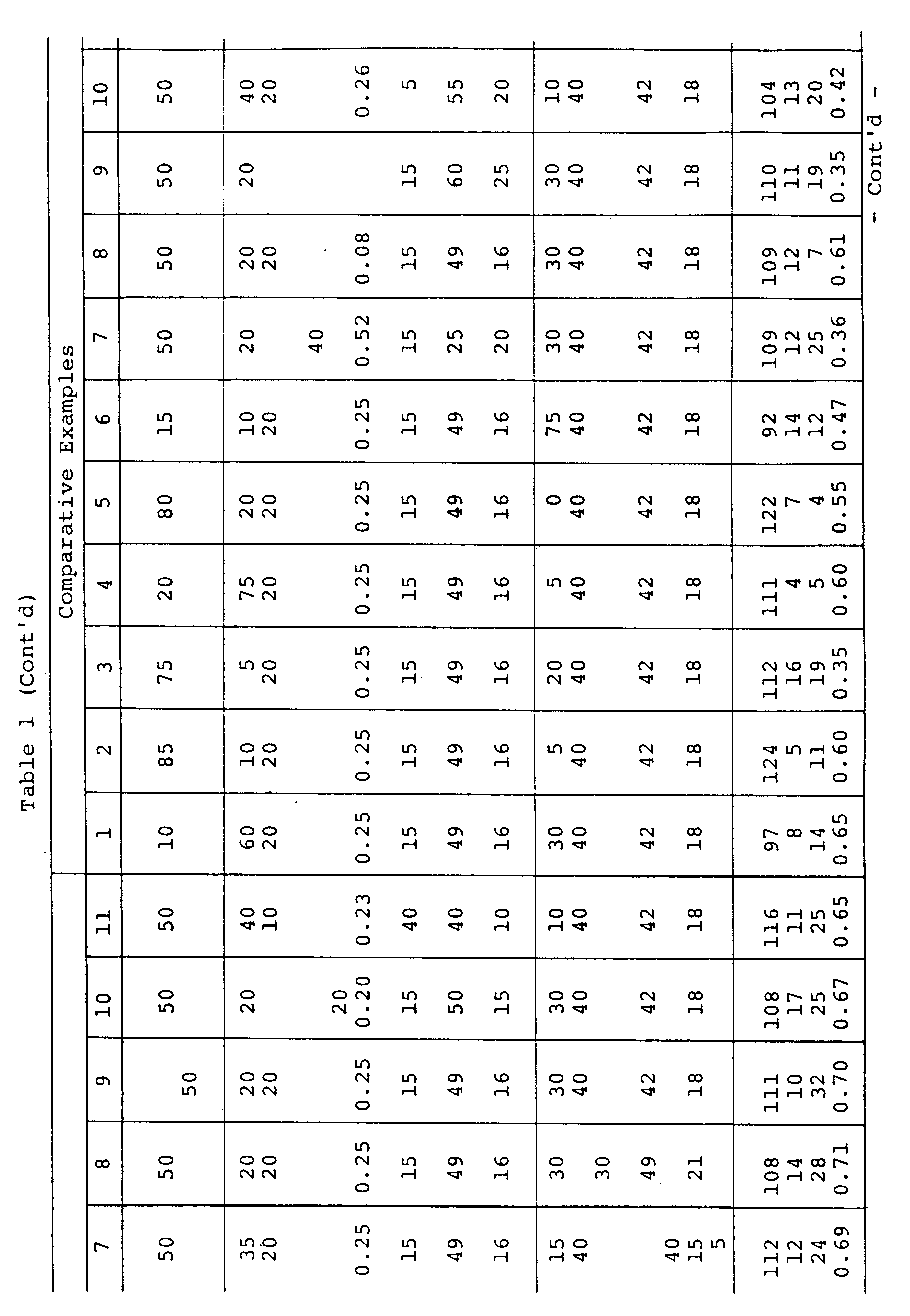
- a polycarbonate having a viscosity-average molecular weight as shown in Table 1 (A2200 grade having a viscosity-average molecular weight of 21,600, A2500 grade having a viscosity-average molecular weight of 23,200 or A3000 grade having a viscosity-average molecular weight of 28,100, all manufactured by Idemitsu Petrochemical, Co., Ltd.) was mixed with the maleimide resin (B) obtained above and the styrene resin (C) obtained above in the proportions shown in Table 1. The resulting mixture was extruded at 260°C using a biaxial kneader to obtain pellets. The pellets were dried thoroughly and then molded at 240°C using an injection machine to obtain test pieces. These test pieces were measured for the following properties according to the following test methods, to obtain the results shown in Table 1:
- Comparative Examples 1 to 14 gave the following results: In Comparative Examples 1 and 2, the polycarbonate amount is outside the range of this invention. Therefore, the composition of Comparative Example 1 has low heat resistance and the composition of Comparative Example 2 has low fluidity.
- Comparative Examples 3 and 4 the maleimide resin amount is outside the range of this invention. Therefore, the composition of Comparative Example 3 has poor chemical resistance and the composition of Comparative Example 4 has low fluidity and low impact resistance.
- Comparative Examples 5 and 6 the styrene resin amount is outside the range of this invention. Therefore, the composition of Comparative Example 5 has low impact resistance and the composition of Comparative Example 6 has low heat resistance and low impact resistance.
- Comparative Example 7 which contains a polybutadiene as a rubber in the maleimide resin has poor chemical resistance.
- composition of Comparative Example 9 contains a maleimide resin free of the rubbery polymer and has poor chemical resistance.
- the composition of Comparative Example 10 contains a maleimide resin having a low maleimide content and has poor heat resistance and poor chemical resistance.
- the composition of Comparative Example 14 contains a maleimide resin having a high maleimide content and a low acrylonitrile content and has poor fluidity and poor chemical resistance.
- the composition of Comparative Example 11 contains a styrene resin having a low acrylonitrle content and has poor chemical resistance.
- the composition of Comparative Example 13 contains a styrene resin free of the rubbery polymer and has low impact resistance.
- the composition of Comparative Example 12 contains a polycarbonate having a large molecular weight and has poor fluidity.
Landscapes
- Chemical & Material Sciences (AREA)
- Health & Medical Sciences (AREA)
- Chemical Kinetics & Catalysis (AREA)
- Medicinal Chemistry (AREA)
- Polymers & Plastics (AREA)
- Organic Chemistry (AREA)
- Compositions Of Macromolecular Compounds (AREA)
Description
- This invention relates to a thermoplastic resin composition excellent in heat resistance, moldability and impact resistance and particularly in chemical resistance. More particularly, this invention relates to a thermoplastic resin composition consisting essentially of a polycarbonate, a maleimide resin and a styrene resin.
- With the recent diversification of their application fields, resin moldings tend to be more complicated and large-sized. In order to respond thereto, the need for highly functional resins has increased. As such highly functional resins, engineering plastics such as polycarbonates have heretofore been used.
- It is widely known that polycarbonates have excellent impact resistance and heat resistance. However, they have a high melt viscosity and hence are inferior in moldability.
- In order to solve the problem of polycarbonates in respect of molding, there have already been proposed, for example, a composition obtained by mixing a polycarbonate with a rubber-reinforced styrene resin [see Japanese Patent Application Kokai (Laid-Open) No. 41447/74] and a composition obtained by mixing a polycarbonate with an acrylate-based rubbery polymer [see Japanese Patent Application Kokai (Laid-Open) No. 12946/77].
- These compositions are superior in heat resistance, impact resistance and moldability, but inferior in chemical resistance and kerosene resistance. Thus, they do not have sufficient performance for use as a functional resin.
- As a result of extensive study, the present inventors have found that thermoplastic resin compositions having the desired physical properties can be obtained by mixing a polycarbonate, a maleimide resin and a styrene resin in specific proportions.
- According to this invention, there is provided a thermoplastic resin composition consisting essentially of:
- (A) 20 to 80% by weight of a polycarbonate having a viscosity-average molecular weight of 14,000 to 27,000,
- (B) 10 to 70% by weight of a maleimide resin obtained by polymerizing 95 to 35 parts by weight of a monomer mixture consisting of 10 to 70% by weight of a maleimide compound, 25 to 80% by weight of an aromatic alkenyl compound, 5 to 40% by weight of an alkenyl cyanide compound and optionally 50% by weight or less of a monomer copolymerizable therewith, in the presence of 5 to 65 parts by weight of at least one rubber-like polymer selected from the group consisting of an ethylene-propylene-nonconjugated diene rubber, an ethylene-propylene rubber and an acrylic rubber, and
- (C) 5 to 70% by weight of a styrene resin obtained by polymerizing 95 to 20 parts by weight of a monomer mixture consisting of 5 to 40% by weight of an alkenyl cyanide compound, 10 to 95% by weight of an aromatic alkenyl compound and optionally 0 to 70% by weight of at least one other alkenyl monomer copolymerizable therewith, in the presence of 5 to 80 parts by weight of a rubbery polymer.
- The thermoplastic resin composition of this invention can be obtained by mixing (A) a polycarbonate, (B) a maleimide resin and (C) a styrene resin in the specific proportions.
- The polycarbonate (A) used in this invention includes aromatic polycarbonates, aliphatic polycarbonates, aliphatic-aromatic polycarbonates. As the polycarbonate, there may generally be used a polymer or copolymer derived from a bisphenol such as 2,2-bis(4-oxyphenyl)alkane, bis(4-oxyphenyl)ether, bis(4-oxyphenyl)sulfone sulfide or sulfoxide. For some purposes, there may be used a polymer derived from a halogen-substituted bisphenol. The type of polycarbonate, the method of producing polycarbonate, are described in detail in "Polycarbonate Resins" published by The Nikkan Kogyo Shimbun, Ltd. on Sept. 30, 1969.
- The molecular weight of the polycarbonate is generally 14,000 to 27,000, preferably 15,000 to 26,000, in terms of viscosity-average molecular weight (Mv). When the viscosity-average molecular weight is less than 14,000, the thermoplastic resin composition of this invention has low impact resistance. When the molecular weight is more than 27,000, the moldability of the composition is deteriorated. The viscosity-average molecular weight of the polycarbonate was determined by firstly measuring a viscosity of a solution of the polycarbonate in methylene chloride, at 20°C using an Ubbellohde's viscometer and then calculating according to the following Schnell's viscosity equation [H. Schnell: Angewandte Chemie 68 633 (1956)]:

- The content of the polycarbonate in the composition of this invention is 20 to 80% by weight, preferably 30 to 70% by weight. When the content exceeds 80% by weight, the moldability of the composition is deteriorated. When the content is less than 20% by weight, the heat resistance of the composition becomes low.
- The maleimide resin (B) used in this invention is obtained by polymerizing 95 to 35 parts by weight of a monomer mixture consisting of 10 to 70% by weight of a maleimide compound, 25 to 80% by weight of an aromatic alkenyl compound, 5 to 40% by weight of an alkenyl cyanide compound and optionally 50% by weight or less of a monomer copolymerizable therewith, in the presence of 5 to 65 parts by weight of at least one rubber-like polymer selected from the group consisting of an ethylene-propylene-nonconjugated diene rubber (EPDM), an ethylene-propylene rubber (EPR) and an acrylic rubber. The average particle diameter of the rubber-like polymer component dispersed in the copolymer produced is preferably 0.1 to 2 µm.
- The rubber-like polymer used in the production of the maleimide resin (B) is selected from the group consisting of an ethylene-propylene-nonconjugated diene rubber (EPDM), an ethylene-propylene rubber (EPR) and an acrylic rubber. These rubbers may be commercially available ones. They may be used alone or in combination of two or more. Of these rubbers, EPDM and EPR are particularly preferred. When these rubber-like polymers are used, it follows that their dispersed particles contain grafted components therein, whereby the thermoplastic resin composition can be improved in impact resistance and chemical resistance (kerosene resistance). The amount of the rubber-like polymer used is generally 5 to 65 parts by weight, preferably 10 to 60 parts by weight, particularly preferably 10 to 55 parts by weight. When the amount is less than 5 parts by weight, the impact resistance of the resulting composition is low, and when the amount is more than 65 parts by weight, the moldability of the composition is deteriorated. The average particle diameter of the rubber-like polymer component dispersed in the copolymer produced is preferably 0.1 to 2 µm, more preferably 0.15 to 1.5µm. When the diameter is less than 0.1µm, the improvement in impact resistance of the resulting composition tends to be small. When the diameter exceeds 2µm, the appearance or gloss of the molded article of the composition tends to be deteriorated.
- The particle diameters of the rubber-like polymer component dispersed in the copolymer produced can be determined by observing a section of pieces obtained by cutting pellets or molded articles of the thermoplastic resin composition by means of a microtome using an electron microscope. The average particle diameter is calculated using the following equation:
Average particle diameter
wherein ni is the number of dispersed particles and Ri is the diameter of the ni particle. - The dispersed particles of the rubber-like polymer component are not truly spherical when observed through an electron microscope. Therefore, the particle diameter of a particle is taken as the average of the largest diameter and the smallest diameter.
- Control of the average particle diameter of the rubber-like polymer component in the copolymer product can generally be conducted by controlling the speed of stirring during polymerization. It is possible to use, as a part of the rubber-like polymer, up to 30% by weight, preferably up to 10% by weight of a rubber other than an ethylene-propylene-nonconjugated diene rubber (EPDM), an ethylene-propylene rubber (EPR) and an acrylic rubber. However, use of a larger amount of a diene rubber such as a polybutadiene rubber results in a reduction of the chemical resistance of the resulting thermoplastic resin composition.
- The maleimide compound used in this invention includes, for example, maleimide, N-methylmaleimide, N-ethylmaleimide, N-phenylmaleimide, N-o-chlorophenylmaleimide, N-cyclohexylmaleimide. Particularly preferred are N-phenylmaleimide, N-o-chlorophenylmaleimide and N-cyclohexylamleimide. They may be used alone or in combination of two or more.
- The amount of the maleimide compound used is generally 10 to 70% by weight, preferably 15 to 65% by weight, based on the weight of the monomer mixture. When the amount is less than 10% by weight, the oil resistance of the resulting composition is deteriorated. When the amount is more than 70% by weight, the moldability of the composition has deteriorated.
- The aromatic alkenyl compound includes styrene, alpha-methyl styrene, methylstyrene, monobromostyrene, dibromostyrene. They may be used alone or in combination of two or more. Preferred are styrene and alpha-methylstyrene.
- The amount of the aromatic alkenyl compound used is generally 25 to 80% by weight, preferably 30 to 75% by weight. When the amount is less than 25% by weight, the moldability of the resulting composition is deteriorated. When the amount is more than 80% by weight, the heat resistance of the composition is reduced.
- The alkenyl cyanide compound includes acrylonitrile and methacrylonitrile. It is used in an amount of 5 to 40% by weight, preferably 10 to 35% by weight. When the amount is less than 5% by weight, the kerosene resistance of the resulting composition is deteriorated. When the amount is more than 40% by weight, the moldability of the composition is deteriorated.
- Together with the above-mentioned essential components, other copolymerizable monomers can also be copolymerized. Such other monomers include methacrylic acid esters such as methyl methacrylate, ethyl methacrylate; unsaturated acid anhydrides such as maleic anhydride, itaconic anhydride. They may be used alone or in combination of two or more. The amount of the monomer used is up to 50% by weight, preferably up to 30% by weight, more preferably up to 20% by weight.
- Preferred specific combinations of the above monomers are:
- (1) maleimide compound-styrene-acrylonitrile
- (2) maleimide compound-styrene-acrylonitrile-methyl methacrylate.
- In these combinations, the styrene may be partly or wholely replaced by alpha-methylstyrene to give a maleimide copolymer having higher heat resistance. Also, flame retardancy can be imparted to the maleimide copolymer by substituting a halogenated styrene for a part or the whole of styrene.
- Bulk polymerization, solution polymerisation, suspension polymerization, emulsion polymerization are suitable for production of a malemide resin [the (B) component]. The polymerization catalyst which can be used in the polymerization may be a peroxide, an azo compound as employed in the radical polymerization of general vinyl monomers. The polymerization temperature is preferably from room temperature to 350°C, more preferably from 40° to 300°C.
- Specifically, the polymerization is conducted at a temperature ranging from room temperature to 350°C, preferably from 100° to 300°C, using a polymerization catalyst such as a tertiary amine.
- Since in the case of emulsion polymerisation, a rubber latex is used as the base rubber-like polymer, the average particle diameter of the rubber-like component in the maleimide resin (B) nay be controlled by adjusting the diameters of the rubber-like polymer particles in the rubber latex. In the case of bulk polymerization, suspension polymerization or solution polymerization, the average particle diameter of the rubber-like polymer component in the maleimide resin (B) can be controlled by adjusting the viscosity of the rubber-like polymer solution by changing the solvent type and the monomer amount, or controlled by appropriately adjusting the stirring speed during polymerization. In general, the lower the solution viscosity and the faster the stirring speed, the smaller the diameter of the rubber-like polymer component particles dispersed in the maleimide resin.
- The amount of the maleimide resin (B) in the thermoplastic resin composition of this invention is 10 to 70% by weight, preferably 15 to 65% by weight. When the amount is less than 10% by weight, the heat resistance and chemical resistance of the resulting composition are low. When the amount is more than 70% by weight, the moldability and impact resistance of the composition are deteriorated.
- The styrene resin(C) used in the thermoplastic resin composition of this invention is obtained by polymerizing a monomer mixture (resin constituents) consisting of an aromatic alkenyl compound, an alkenyl cyanide compound and optionally at least one other alkenyl monomer copolymerizable therewith, in the presence of a rubbery polymer.
- The rubbery polymer includes ethylene-alpha-olefin copolymers such as ethylene-propylene random or block copolymer, ethylene-butene random or block copolymer; ethylene-unsaturated carboxylic acid ester copolymers such as ethylene-methyl acrylate copolymer, ethylene-butyl acrylate copolymer; ethylene-vinyl ester of fatty acid copolymers such as ethylene-vinyl acetate copolymer; ethylene-propylene-nonconjugated diene terpolymers such as ethylene-propylene-hexadiene terpolymer; diene rubbers such as polybutadiene, styrene-butadiene random or block copolymer, acrylonitrile-butadiene copolymer, butadiene-isoprene copolymer; butylene-isoprene copolymer; acrylic rubber; chloroprene rubber. They may be used alone or in combination of two or more.
- Of the above rubbery polymers, ethylene-propylene-nonconjugated diene terpolymers, acrylic rubber and diene rubbers are preferred in view of impact resistance and other aspects. More preferable are polybutadiene and styrene-butadiene copolymer. The styrene content in the styrene-butadiene copolymer is preferably 50% by weight or less.
- The rubbery polymer is used in an amount of 5 to 80 parts by weight, preferably 10 to 70 parts by weight. When the amount is less than 5 parts by weight, the impact resistance of the resulting composition becomes low. When the amount is more than 80 parts by weight, the heat resistance of the composition is deteriorated.
- The alkenyl cyanide compound includes acrylonitrile, methacrylonitrile. Acrylonitrile is preferred.
- The alkenyl cyanide compound is used in an amount of 5 to 40% by weight, preferably 10 to 35% by weight, based on the weight of the monomer mixture. When the amount is less than 5% by weight, the kerosene resistance of the resulting composition is deteriorated. When the amount is more than 40% by weight, the moldability of the composition is deteriorated.
- The aromatic alkenyl compound includes styrene, alpha-methylstyrene, methylstyrene, vinylxylene, monochlorostyrene, dichlorostyrene, monobromostyrene, dibromostyrene, p-tert-butylstyrene, ethylstyrene, vinylnaphthalene, o-methylstyrene, p-methylstyrene, dimethylstyrene. They can be used alone or in combination of two or more. Of these, styrene and alpha-methylstyrene are preferred. It is preferable that styrene be used in an amount of at least 50% by weight when two or more aromatic alkenyl compounds are used in combination.
- The aromatic alkenyl compound is generally used in an amount of 5 to 95% by weight, preferably 10 to 85% by weight, more preferably 10 to 80% by weight. When the amount is less than 5% by weight, the moldability of the resulting composition is deteriorated. When the amount is more than 95% by weight, the heat resistance of the composition is deteriorated.
- Other alkenyl monomers copolymerizable with the aromatic alkenyl compound and the alkenyl cyanide compound include alkyl acrylates such as methyl acrylate, ethyl acrylate, propyl acrylate, butyl acrylate, amyl acrylate, hexyl acrylate, octyl acrylate, 2-ethylhexyl acrylate, cyclohexyl acrylate, dodecyl acrylate, octadecyl acrylate; aryl acrylates such as phenyl acrylate, benzyl acrylate; alkyl methacrylates such as methyl methacrylate, ethyl methacrylate, propyl methacrylate, butyl methacrylate, amyl methacrylate, hexyl methacrylate, octyl methacrylate, 2-ethylhexyl methacrylate, cyclohexyl methacrylate, dodecyl methacrylate, octadecyl methacrylate; aryl methacrylates such as phenyl methacrylate, benzyl methacrylate; unsaturated acids such as maleic anhydride, itaconic anhydride, citraconic anhydride. They can be used alone or in combination of two or more.
- Said other copolymerizable monomers are incorporated into the monomer mixture (the resin constituents) in an amount of 70% by weight or less, preferably 50% by weight or less, more preferably 30% by weight or less.
- The styrene resin (C) can be produced by graft-polymerization, that is, polymerizing a monomer mixture consisting of an aromatic alkenyl compound, an alkenyl cyanide compound and other monomers copolymerizable with said compounds, in the presence of a rubbery polymer. The polymerization is conducted according to bulk polymerization, solution polymerization, suspension polymerization, emulsion polymerization or their combination.
- This polymerization is usually a radical polymerization and uses a catalyst such as an azo compound, a peroxide. The polymerization temperature is usually from room temperature to 250°C, preferably 40° to 180°C.
- The amount of the styrene resin (C) in the thermoplastic resin composition of this invention is 5 to 70% by weight, preferably 10 to 65% by weight. When the amount is less than 5% by weight, the impact resistance of the resulting composition is deteriorated. When the amount is more than 70% by weight, the heat resistance of the composition is deteriorated.
- The thermoplastic resin composition of this invention can be produced by one of the following methods:
- (1) Each component is separately dissolved in and swallen with an organic solvent, the resulting solutions are mixed and the resulting mixture is then dried.
- (2) All components are mixed using a mixer, and the resulting mixture is subjected to melt mixing by an extruder and then pelletized.
- (3) A non-solvent is added to the solution obtained in (1) above, and the resulting particles are collected, subjected to melt mixing by an extruder and then pelletized.
- (4) The pellets or particles obtained in the above (1), (2) or (3) are mixed with one another in the presence or absence of additional components.
- A known mixing apparatus such as a Banbury mixer, a kneader or the like can be used in the above methods.
- A thermoplastic resin composition may be obtained by further adding, to the present thermoplastic resin composition, other thermoplastic resins, for example, polyphenylene ether, polyamide, acrylic resin or other polymers, and melt mixing the resulting mixture by an extruder.
- The thermoplastic resin composition of this invention can be subjected to injection molding, sheet extrusion, vacuum forming, profile molding, foam molding to obtain a desired shaped article.
- With thermoplastic resin composition of this invention can be incorporated, prior to the actual use, various known additives which are conventionally used such as an antioxidant, an ultraviolet absorber, a lubricant, a flame retardant, an antistatic agent, a foaming agent, a glass fiber.
- The thermoplastic resin composition of this invention is excellent in balance of properties in respect of heat resistance, moldability, impact resistance and chemical resistance, and accordingly, is an excellent molding material which has been freed from the drawbacks of conventional polycarbonate-ABS resin compositions.
- This invention will be described in more detail below referring to Examples and the accompanying drawings; however, these Examples are only by way of illustration. In the accompanying drawings, Fig. 1 is a perspective view of a testing means for evaluating the oil resistances of thermoplastic resin compositions; and Fig. 2 is a figure for showing the places on which to measure the dimensions required for calculation of a critical strain as a yardstick of oil resistance.
- In the following Examples and Comparative Examples, parts and % are by weight.
- Into a reactor having an internal volume of 30 liters equipped with ribbon-shaped blades were charged a base rubber (the rubber-like polymer component), N-phenylmaleimide and acrylonitrile as shown in Table 1, and 100 parts of toluene. They were stirred at 50°C until the rubber-like polymer component and the N-phenylmaleimide were dissolved completely. Thereto were added the remaining monomer or monomers 0.1 part of t-dodecylmercaptan and 0.4 part of benzoyl peroxide. The mixture was polymerized for 2 hours at 100°C and then for a further 3 hours at 120°C, when the polymerization was substantially completed. Thereafter, the solvent was removed by steam distillation and the residue was ground and dried to obtain a maleimide resin. The diameters of the particles of the base rubber (the rubber-like polymer) dispersed in the maleimide resin were measured to obtain the result shown in Table 1.
- Into an autoclave equipped with a stirrer was charged a monomer mixture as shown in Table 1, in an amount as shown in Table 1. Also, 100 parts of methyl ethyl ketone was charged together with small pieces of a base rubber (a rubbery polymer component) in an amount as shown in Table 1. They were stirred for 24 hours at room temperature to dissolve the rubber. The atmosphere in the autoclave was replaced with nitrogen and the resulting solution was heated to 85°C. While keeping the temperature at 85°C, a solution of 0.075 part of benzoyl peroxide and 0.075 part of azobisisobutyronitrile in 250 parts of methyl ethyl ketone was continuously added over 8 hours, after which the temperature was kept at 85°C for a further 3 hours, to obtain a styrene resin.
- A polycarbonate having a viscosity-average molecular weight as shown in Table 1 (A2200 grade having a viscosity-average molecular weight of 21,600, A2500 grade having a viscosity-average molecular weight of 23,200 or A3000 grade having a viscosity-average molecular weight of 28,100, all manufactured by Idemitsu Petrochemical, Co., Ltd.) was mixed with the maleimide resin (B) obtained above and the styrene resin (C) obtained above in the proportions shown in Table 1. The resulting mixture was extruded at 260°C using a biaxial kneader to obtain pellets. The pellets were dried thoroughly and then molded at 240°C using an injection machine to obtain test pieces. These test pieces were measured for the following properties according to the following test methods, to obtain the results shown in Table 1:
- Measured at 1,82 MPa (264 psi) according to ASTM D 648 using a test piece of 12,7 mm (1/2") in thickness.
- Measured according to ASTM D 256 using a notched test piece of 6,35 mm (1/4") in thickness.
- Measured at 240°C and 10 kg according to JIS K 7210.
- Evaluated based on critical strain.
-
- (1) 1/4 Ellipse-shaped testing apparatus
A 1/4 ellipse-shaped testing apparatus as shown in Fig. 1, provided with a means for fixing a test piece was used. - (2) Desiccator
- (3) Thermostat
-
- (1) A press-molded sheet is used.
- (2) The standard thickness of the sheet is 2 mm.
- (3) The sheet is cut into a size of about 40 mm in width and about 160 mm in length. The length is adapted to the length of the testing apparatus.
-
- (1) After the test piece was mounted on the testing apparatus, the apparatus was immersed in kerosene.
- (2) The apparatus was allowed to stand for 24 hours at 5°C.
- (3) Then, the place on the test piece at which a crack occurred was visually detected and given a mark.
- (4) The distance (x) of the crack-occurring place from the ellipse center (base point in Fig. 2) shown in Fig. 2 was measured.
- (5) A critical strain was calculated using the following equation:

Wherein ε = critical strain (%), a = half of the major axis of the ellipse (mm), b = half of the minor axis of the ellipse (mm), x = distance (mm) from the ellipse center to the crack-occurring place, and t = thickness (mm) of a sample. In the above equation, a, b and x are values of a, b, x shown in Fig. 2, respectively. - As seen from Table 1, Comparative Examples 1 to 14 gave the following results:
In Comparative Examples 1 and 2, the polycarbonate amount is outside the range of this invention. Therefore, the composition of Comparative Example 1 has low heat resistance and the composition of Comparative Example 2 has low fluidity. - In Comparative Examples 3 and 4, the maleimide resin amount is outside the range of this invention. Therefore, the composition of Comparative Example 3 has poor chemical resistance and the composition of Comparative Example 4 has low fluidity and low impact resistance.
- In Comparative Examples 5 and 6, the styrene resin amount is outside the range of this invention. Therefore, the composition of Comparative Example 5 has low impact resistance and the composition of Comparative Example 6 has low heat resistance and low impact resistance.
- The composition of Comparative Example 7 which contains a polybutadiene as a rubber in the maleimide resin has poor chemical resistance.
- In Comparative Example 8, the diameters of particles of the rubber in the maleimide resin are outside (smaller than) the range of this invention. Accordingly, the composition has low impact resistance.
- The composition of Comparative Example 9 contains a maleimide resin free of the rubbery polymer and has poor chemical resistance.
- The composition of Comparative Example 10 contains a maleimide resin having a low maleimide content and has poor heat resistance and poor chemical resistance.
- The composition of Comparative Example 14 contains a maleimide resin having a high maleimide content and a low acrylonitrile content and has poor fluidity and poor chemical resistance.
- The composition of Comparative Example 11 contains a styrene resin having a low acrylonitrle content and has poor chemical resistance.
- The composition of Comparative Example 13 contains a styrene resin free of the rubbery polymer and has low impact resistance.
- The composition of Comparative Example 12 contains a polycarbonate having a large molecular weight and has poor fluidity.


Claims (6)
- A thermoplastic resin composition consisting essentially of:(A) 20 to 80% by weight of a polycarbonate having a viscosity-average molecular weight of 14,000 to 27,000,(B) 10 to 70% by weight of a maleimide resin obtained by polymerizing 95 to 35 parts by weight of a monomer mixture consisting of 10 to 70% by weight of a maleimide compound, 25 to 80% by weight of an aromatic alkenyl compound, 5 to 40% by weight of an alkenyl cyanide compound and optionally 50% by weight or less of a monomer copolymerizable with said compounds, in the presence of 5 to 65 parts by weight of at least one rubber-like polymer selected from the group consisting of an ethylene-propylene-nonconjugated diene rubber, an ethylene-propylene rubber and an acrylic rubber, and(C) 5 to 70% by weight of a styrene resin obtained by polymerizing 95 to 20 parts by weight of a monomer mixture consisting of 5 to 40% by weight of an alkenyl cyanide compound, 10 to 95% by weight of an aromatic alkenyl compound and optionally 0 to 70% by weight of at least one other alkenyl monomer copolymerizable with said compounds, in the presence of 5 to 80 parts by weight of a rubbery polymer.
- The composition according to Claim 1, wherein the contents of the polycarbonate (A), the maleimide resin (B) and the styrene resin (C) are 30 to 70% by weight, 15 to 65% by weight and 10 to 65% by weight, respectively.
- The composition according to Claim 1, wherein the aromatic alkenyl compound is styrene, alpha-methylstyrene or both thereof and the alkenyl cyanide compound is acrylonitrile.
- The composition according to Claim 1, wherein the grafted rubber-like polymer component is dispersed in the maleimide resin (B) in the form of particles having a weight-average particle diameter of 0.1 to 2 µm.
- The composition according to Claim 1, wherein the maleimide compound is at least one compound selected from the group consisting of N-methylmaleimide, N-ethylmaleimide, N-phenylmaleimide, N-o-chlorophenylmaleimide and N-cyclohexylmaleimide.
- The composition according to Claim 1, wherein the rubbery polymer component in the styrene resin (C) is at least one rubber selected from the group consisting of ethylene-propylene-nonconjugated diene terpolymers, acrylic rubbers and diene rubbers.
Applications Claiming Priority (2)
| Application Number | Priority Date | Filing Date | Title |
|---|---|---|---|
| JP294526/86 | 1986-12-10 | ||
| JP61294526A JPS63146960A (en) | 1986-12-10 | 1986-12-10 | Thermoplastic resin composition |
Publications (3)
| Publication Number | Publication Date |
|---|---|
| EP0271349A2 EP0271349A2 (en) | 1988-06-15 |
| EP0271349A3 EP0271349A3 (en) | 1989-10-25 |
| EP0271349B1 true EP0271349B1 (en) | 1993-09-08 |
Family
ID=17808924
Family Applications (1)
| Application Number | Title | Priority Date | Filing Date |
|---|---|---|---|
| EP87310898A Expired - Lifetime EP0271349B1 (en) | 1986-12-10 | 1987-12-10 | Thermoplastic resin composition |
Country Status (5)
| Country | Link |
|---|---|
| US (1) | US4792585A (en) |
| EP (1) | EP0271349B1 (en) |
| JP (1) | JPS63146960A (en) |
| KR (1) | KR960004684B1 (en) |
| DE (1) | DE3787354T2 (en) |
Families Citing this family (16)
| Publication number | Priority date | Publication date | Assignee | Title |
|---|---|---|---|---|
| CA2047667A1 (en) * | 1989-03-08 | 1990-09-09 | Michael K. Laughner | Molding compositions comprising carbonate polymer, rubber modified vinyl aromatic-nitrile graft copolymer and methyl(meth)acrylate-butadiene-styrene graft copolymer and blow molding and thermoforming processes using such compositions |
| US5008330A (en) * | 1989-03-08 | 1991-04-16 | The Dow Chemical Company | Molding compositions with acrylonitrile-EPDM-styrene copolymers |
| US5091470A (en) * | 1989-04-26 | 1992-02-25 | The Dow Chemical Company | Molding resin |
| CA2058343C (en) * | 1991-01-07 | 2002-08-13 | Charles E. Lundy | Pigmented polycarbonate composition having high impact strength and good cosmetics |
| US5262476A (en) * | 1992-03-10 | 1993-11-16 | The Dow Chemical Company | Polycarbonate/polyester blends modified with poly(phenylene ether) |
| US5539030A (en) * | 1992-03-10 | 1996-07-23 | The Dow Chemical Company | Polycarbonate compositions modified with poly(phenylene ether) |
| JPH06248160A (en) * | 1993-02-26 | 1994-09-06 | Japan Synthetic Rubber Co Ltd | Flame-retardant desin composition |
| EP0743343B9 (en) * | 1995-05-17 | 2007-05-23 | Mitsubishi Engineering-Plastics Corporation | Polycarbonate composition for profile extrusion |
| TW386099B (en) * | 1995-07-26 | 2000-04-01 | Gen Electric | Flame resistant compositions of polycarbonate and monovinylidene aromatic compounds |
| KR100397675B1 (en) * | 1998-12-16 | 2004-02-14 | 제일모직주식회사 | Thermoplastic resin composition excellent in heat resistance |
| US6913922B1 (en) * | 1999-05-18 | 2005-07-05 | Crucell Holland B.V. | Serotype of adenovirus and uses thereof |
| KR100467780B1 (en) * | 2002-09-30 | 2005-01-24 | 주식회사 엘지화학 | Thermoplastic resin composition and method for preparing thereof |
| JP7017333B2 (en) * | 2017-07-18 | 2022-02-08 | テクノUmg株式会社 | Resin composition for painting and molded products |
| KR102858645B1 (en) * | 2019-04-26 | 2025-09-10 | 덴카 주식회사 | Thermoplastic resin composition and molded article thereof |
| JP7298518B2 (en) * | 2020-03-06 | 2023-06-27 | 味の素株式会社 | Resin composition, cured product of resin composition, resin sheet, printed wiring board and semiconductor device |
| KR20220153394A (en) * | 2021-05-11 | 2022-11-18 | 현대자동차주식회사 | Antimicrobial composition with excellent antimicrobial property and improved chemical resistance and molded article comprising the same |
Citations (1)
| Publication number | Priority date | Publication date | Assignee | Title |
|---|---|---|---|---|
| EP0104695A1 (en) * | 1982-09-11 | 1984-04-04 | Stamicarbon B.V. | Polymer composition |
Family Cites Families (8)
| Publication number | Priority date | Publication date | Assignee | Title |
|---|---|---|---|---|
| DE2712171C2 (en) * | 1977-03-19 | 1984-09-27 | Bayer Ag, 5090 Leverkusen | Thermoplastic molding compounds |
| US4122130A (en) * | 1977-05-06 | 1978-10-24 | Arco Polymers Inc. | Moldable blend of polycarbonate and terpolymer of rubber styrene-maleimide |
| NL8105437A (en) * | 1981-12-02 | 1983-07-01 | Stamicarbon | POLYMER COMPOSITION. |
| US4491647A (en) * | 1983-12-05 | 1985-01-01 | Atlantic Richfield Company | Polymer composition containing polycarbonate and a copolymer of methylmethacrylate with N-phenylmaleimide |
| JPS60208351A (en) * | 1984-03-31 | 1985-10-19 | Denki Kagaku Kogyo Kk | Hot water-resistant resin composition |
| JPH06885B2 (en) * | 1984-07-17 | 1994-01-05 | 電気化学工業株式会社 | Heat resistant resin composition |
| JPH0635525B2 (en) * | 1985-07-19 | 1994-05-11 | 電気化学工業株式会社 | Discoloration resistant resin composition |
| JPH07100755B2 (en) * | 1986-04-25 | 1995-11-01 | 電気化学工業株式会社 | Thermoplastic resin composition |
-
1986
- 1986-12-10 JP JP61294526A patent/JPS63146960A/en active Pending
-
1987
- 1987-12-01 US US07/127,047 patent/US4792585A/en not_active Expired - Lifetime
- 1987-12-09 KR KR1019870014014A patent/KR960004684B1/en not_active Expired - Fee Related
- 1987-12-10 EP EP87310898A patent/EP0271349B1/en not_active Expired - Lifetime
- 1987-12-10 DE DE87310898T patent/DE3787354T2/en not_active Expired - Fee Related
Patent Citations (1)
| Publication number | Priority date | Publication date | Assignee | Title |
|---|---|---|---|---|
| EP0104695A1 (en) * | 1982-09-11 | 1984-04-04 | Stamicarbon B.V. | Polymer composition |
Also Published As
| Publication number | Publication date |
|---|---|
| JPS63146960A (en) | 1988-06-18 |
| KR960004684B1 (en) | 1996-04-11 |
| DE3787354T2 (en) | 1994-03-17 |
| KR880007662A (en) | 1988-08-29 |
| US4792585A (en) | 1988-12-20 |
| DE3787354D1 (en) | 1993-10-14 |
| EP0271349A3 (en) | 1989-10-25 |
| EP0271349A2 (en) | 1988-06-15 |
Similar Documents
| Publication | Publication Date | Title |
|---|---|---|
| KR0145067B1 (en) | Filled polymeric blend | |
| US4792585A (en) | Thermoplastic resin composition | |
| US6380304B1 (en) | Mass polymerized rubber-modified monovinylidene aromatic copolymer compositions | |
| US5714537A (en) | Filled carbonate polymer blend compositions | |
| EP0376081B1 (en) | A polypropylene-based resin composition | |
| GB1571014A (en) | Graft copolymer and process for producing the same | |
| US5302664A (en) | ABS molding compounds | |
| EP0462220A1 (en) | Molding compositions comprising carbonate polymer, nitrile-butadiene-vinyl aromatic graft copolymer and methyl(meth)acrylate-butadiene-styrene graft copolymer and blow molding and thermoforming processes using such compositions | |
| EP1937773B1 (en) | Improved low gloss mass polymerized rubber-modified monovinylidene aromatic copolymer composition | |
| US5302663A (en) | ABS molding compounds | |
| WO2006070986A1 (en) | Thermoplastic resin composition for refrigerator having improved environmental stress crack resistance | |
| EP0375648A2 (en) | Resin compositions | |
| US5747587A (en) | HCFC resistant resin composition | |
| KR19980026163A (en) | Thermoplastic resin composition | |
| US6306962B1 (en) | Flow carbonate polymer blends | |
| EP0741165B1 (en) | Thermoplastic resin composition and automotive trim parts | |
| EP0381358B1 (en) | Low gloss agents, process for production thereof, low gloss thermoplastic resin compositions and molded articles | |
| US4906688A (en) | Thermoplastic moulding compositions of the ABS type of improved toughness and processability | |
| EP4108725B1 (en) | Thermoplastic resin composition, method for preparing the same, and molded product comprising the same | |
| US5180780A (en) | Rubber-modified styrene-based copolymer | |
| EP4101895B1 (en) | Thermoplastic resin composition, preparation method therefor, and molded article comprising same | |
| EP0714941B1 (en) | Impact modified alpha-alkyl vinyl aromatic-vinyl cyanide copolymer compositions | |
| EP0378410B1 (en) | Rubber-modified styrene-based copolymer | |
| EP0462185A1 (en) | Molding compositions comprising carbonate polymer, rubber modified vinyl aromatic-nitrile graft copolymer and methyl(meth)acrylate-butadiene-styrene graft copolymer and blow molding and thermoforming processes using such compositions | |
| EP0714942B1 (en) | Impact modified alpha alkyl vinyl aromatic-vinyl cyanide composition |
Legal Events
| Date | Code | Title | Description |
|---|---|---|---|
| PUAI | Public reference made under article 153(3) epc to a published international application that has entered the european phase |
Free format text: ORIGINAL CODE: 0009012 |
|
| AK | Designated contracting states |
Kind code of ref document: A2 Designated state(s): DE FR GB |
|
| PUAL | Search report despatched |
Free format text: ORIGINAL CODE: 0009013 |
|
| AK | Designated contracting states |
Kind code of ref document: A3 Designated state(s): DE FR GB |
|
| 17P | Request for examination filed |
Effective date: 19900312 |
|
| 17Q | First examination report despatched |
Effective date: 19910719 |
|
| GRAA | (expected) grant |
Free format text: ORIGINAL CODE: 0009210 |
|
| AK | Designated contracting states |
Kind code of ref document: B1 Designated state(s): DE FR GB |
|
| PG25 | Lapsed in a contracting state [announced via postgrant information from national office to epo] |
Ref country code: FR Effective date: 19930908 |
|
| REF | Corresponds to: |
Ref document number: 3787354 Country of ref document: DE Date of ref document: 19931014 |
|
| EN | Fr: translation not filed | ||
| PLBE | No opposition filed within time limit |
Free format text: ORIGINAL CODE: 0009261 |
|
| STAA | Information on the status of an ep patent application or granted ep patent |
Free format text: STATUS: NO OPPOSITION FILED WITHIN TIME LIMIT |
|
| 26N | No opposition filed | ||
| REG | Reference to a national code |
Ref country code: GB Ref legal event code: IF02 |
|
| PGFP | Annual fee paid to national office [announced via postgrant information from national office to epo] |
Ref country code: GB Payment date: 20031210 Year of fee payment: 17 |
|
| PGFP | Annual fee paid to national office [announced via postgrant information from national office to epo] |
Ref country code: DE Payment date: 20031218 Year of fee payment: 17 |
|
| PG25 | Lapsed in a contracting state [announced via postgrant information from national office to epo] |
Ref country code: GB Free format text: LAPSE BECAUSE OF NON-PAYMENT OF DUE FEES Effective date: 20041210 |
|
| PG25 | Lapsed in a contracting state [announced via postgrant information from national office to epo] |
Ref country code: DE Free format text: LAPSE BECAUSE OF NON-PAYMENT OF DUE FEES Effective date: 20050701 |
|
| GBPC | Gb: european patent ceased through non-payment of renewal fee |
Effective date: 20041210 |