EP0271253B1 - Process for recovering a polyarylene sulfide - Google Patents
Process for recovering a polyarylene sulfide Download PDFInfo
- Publication number
- EP0271253B1 EP0271253B1 EP87310409A EP87310409A EP0271253B1 EP 0271253 B1 EP0271253 B1 EP 0271253B1 EP 87310409 A EP87310409 A EP 87310409A EP 87310409 A EP87310409 A EP 87310409A EP 0271253 B1 EP0271253 B1 EP 0271253B1
- Authority
- EP
- European Patent Office
- Prior art keywords
- solvent
- polyarylene sulfide
- cake
- alkali metal
- water
- Prior art date
- Legal status (The legal status is an assumption and is not a legal conclusion. Google has not performed a legal analysis and makes no representation as to the accuracy of the status listed.)
- Expired - Lifetime
Links
Images
Classifications
-
- C—CHEMISTRY; METALLURGY
- C08—ORGANIC MACROMOLECULAR COMPOUNDS; THEIR PREPARATION OR CHEMICAL WORKING-UP; COMPOSITIONS BASED THEREON
- C08G—MACROMOLECULAR COMPOUNDS OBTAINED OTHERWISE THAN BY REACTIONS ONLY INVOLVING UNSATURATED CARBON-TO-CARBON BONDS
- C08G61/00—Macromolecular compounds obtained by reactions forming a carbon-to-carbon link in the main chain of the macromolecule
- C08G61/02—Macromolecular compounds containing only carbon atoms in the main chain of the macromolecule, e.g. polyxylylenes
- C08G61/10—Macromolecular compounds containing only carbon atoms in the main chain of the macromolecule, e.g. polyxylylenes only aromatic carbon atoms, e.g. polyphenylenes
-
- C—CHEMISTRY; METALLURGY
- C08—ORGANIC MACROMOLECULAR COMPOUNDS; THEIR PREPARATION OR CHEMICAL WORKING-UP; COMPOSITIONS BASED THEREON
- C08G—MACROMOLECULAR COMPOUNDS OBTAINED OTHERWISE THAN BY REACTIONS ONLY INVOLVING UNSATURATED CARBON-TO-CARBON BONDS
- C08G75/00—Macromolecular compounds obtained by reactions forming a linkage containing sulfur with or without nitrogen, oxygen, or carbon in the main chain of the macromolecule
- C08G75/02—Polythioethers
- C08G75/0204—Polyarylenethioethers
- C08G75/0277—Post-polymerisation treatment
- C08G75/0281—Recovery or purification
-
- C—CHEMISTRY; METALLURGY
- C08—ORGANIC MACROMOLECULAR COMPOUNDS; THEIR PREPARATION OR CHEMICAL WORKING-UP; COMPOSITIONS BASED THEREON
- C08G—MACROMOLECULAR COMPOUNDS OBTAINED OTHERWISE THAN BY REACTIONS ONLY INVOLVING UNSATURATED CARBON-TO-CARBON BONDS
- C08G75/00—Macromolecular compounds obtained by reactions forming a linkage containing sulfur with or without nitrogen, oxygen, or carbon in the main chain of the macromolecule
- C08G75/02—Polythioethers
- C08G75/0204—Polyarylenethioethers
- C08G75/0209—Polyarylenethioethers derived from monomers containing one aromatic ring
- C08G75/0213—Polyarylenethioethers derived from monomers containing one aromatic ring containing elements other than carbon, hydrogen or sulfur
-
- C—CHEMISTRY; METALLURGY
- C08—ORGANIC MACROMOLECULAR COMPOUNDS; THEIR PREPARATION OR CHEMICAL WORKING-UP; COMPOSITIONS BASED THEREON
- C08G—MACROMOLECULAR COMPOUNDS OBTAINED OTHERWISE THAN BY REACTIONS ONLY INVOLVING UNSATURATED CARBON-TO-CARBON BONDS
- C08G75/00—Macromolecular compounds obtained by reactions forming a linkage containing sulfur with or without nitrogen, oxygen, or carbon in the main chain of the macromolecule
- C08G75/02—Polythioethers
- C08G75/0204—Polyarylenethioethers
- C08G75/025—Preparatory processes
- C08G75/0254—Preparatory processes using metal sulfides
Definitions
- This invention relates to a process for industrially advantageously recovering a polyarylene sulfide having a low content of electrolytic ions from a mixture obtained through a reaction between a polyhalogenated aromatic compound and an alkali metal sulfide containing water in an organic polar solvent.
- the polymer obtained by the process of the present invention is particularly useful for use in molded articles such as electronic and electric components and films, sheets and fibers.
- Polyarylene sulfide is produced by carrying out a polycondensation reaction between a halogenated aromatic compound and an alkali metal sulfide in a water-soluble polar solvent having a high boiling point and in the presence of a small amount of water, the reaction being conducted under pressure and at a relatively high temperature. i.e., 200 to 280°C, at which the resulting polyarylene sulfide melts.
- the product of the reaction is a slurry consisting of polyarylene sulfide, an alkali metal halide, water, a small amount of unreacted matter, an oligomer which is a low-molecular weight polyarylene sulfide, and the above-described solvent.
- U.S. Patent No. 3,478,000 discloses a process wherein the reaction mixture is heated under reduced pressure to evaporate the solvent, water and the unreacted matter, and the separated powdery solid matter is mixed with water to elute the alkali metal halide and then dried to thereby recover polyarylene sulfide.
- the recovery is carried out under a vacuum in order to lower the heating temperature.
- the cost of the evacuation equipment is high and the running cost is increased, and if the degree of vacuum is lowered, the recovery time is increased, and this leads to lowering of productivity.
- this process is not economical.
- the relationship between the recovery temperature and the difficulty of eluting electrolytic ions by means of water has not yet been clarified, it may be considered that, when polyarylene sulfide is exposed to high temperatures, minute irregularities on the surface of particles of polyarylene sulfide powder are smoothed and this leads to a reduction in the surface area and, at the same time, causes metal ions to be wrapped and held in the polymer.
- U.S. Patent No. 3,687,907 discloses a process wherein the reaction product is mixed with water which is a bad solvent for polyphenylene sulfide and the temperature of the mixture is lowered to prepare a polyphenylene sulfide slurry which is then filtered to recover polyphenylene sulfide. According to this process, chloroform or the like is added to the filtrate consisting of water having an alkali metal halide dissolved therein and an organic polar solvent to cause extractive distillation of the polar solvent, thereby recovering the solvent.
- the present invention relates to a process for recovering a polyarylene sulfide from a mixture consisting mainly of polyarylene sulfide and an alkali metal halide (the mixture is obtainable by reacting a polyhalogenated aromatic compound and an alkali metal sulfide containing, eg a small amount, of water in an organic polar solvent), the process comprising step 1 and the subsequent steps:
- the dehydration should be conducted to such an extent that no alkali metal halide is substantially dissolved in the reaction mixture. If the water is not substantially removed, the water and the alkali metal halide dissolved therein may undesirably be mixed with the filtrate obtained during the solid-liquid separation carried out in the subsequent step, resulting undesirably in deposition of the alkali metal halide in the distillation column and a lowering in the separation efficiency during the distillation of the mixture, which consists of the separated filtrate and a cake-washing solvent which is a bad solvent for both polyarylene sulfide and alkali metal halide and which is soluble in the organic polar solvent, carried out to separate and recover the bad solvent and the organic polar solvent (described later). In the dehydration by distillation, it is preferable to minimize the distillate of the organic polar solvent by giving an appropriate reflux ratio so that it is possible
- the dehydration by distillation may be conducted in a reaction vessel, or it is also possible to move the reaction mixture to another tank by, for example, utilizing the head difference in a state wherein pressure equalization has been reached, and then carry out the dehydration in this tank. It is also possible to move the reaction mixture to another tank by the use of the pressure in the reaction vessel and, at the same time, introduce part of the flashing steam from the tank to the distillation column to thereby carry out dehydration.
- the organic polar solvent used in the reaction It is also possible to recover by evaporation 90% or less of the organic polar solvent used in the reaction. If the recovery rate exceeds 90%, the amount of electrolytic ions remaining in the recovered polyarylene sulfide is unfavorably increased. It is preferable to set the recovery rate of the organic polar solvent at 80% or less from the viewpoint of the content of electrolytic ions in the recovered polyarylene sulfide.
- the bad solvent may be added either when polyarylene sulfide is in a dissolved state or when it has been separated out by cooling the dehydrated mixture to 230 to 200°C or less. In the case where the bad solvent is added when polyarylene sulfide is in a dissolved state, if the polyarylene sulfide is still in the dissolved state after the addition of the solvent, the mixture must be cooled below the separating point to form a slurry.
- the amount of the bad solvent added may be in the range of 100 to 2000, 150 to 1500, 200 to 500, parts by weight with respect to 100 parts by weight of polyarylene sulfide.
- An amount of bad solvent less than 100 parts by weight may make it difficult to form a transferable slurry and also may make it difficult to obtain a cake having a low liquid content in the solid-liquid separation and further unfavorably lowers the replacing efficiency in the operation wherein the cake is washed with the added bad solvent to replace the organic polar solvent in the cake with it.
- the amount of the bad solvent exceeds 2000 parts by weight, it may unfavourably cost a great deal to recover the bad solvent.
- the bad solvent may be a C1-C8 alcohol, such as methyl alcohol, ethyl alcohol, propyl alcohol, isopropyl alcohol, or tetrahydrofuran, chloroform, acetone.
- the solid-liquid separation may be conducted by any means which is usually employed for industrial purposes, for example, centrifugal filtration, vacuum filtration, centrifugal settling, etc. Among them, centrifugal filtration is most preferable from the viewpoint of the time required for the solid-liquid separation and facilitation of the washing of the cake carried out in the subsequent step.
- the washing with the bad solvent may be conducted by any means.
- the higher the degree of replacement of the organic polar solvent with the bad solvent the more preferable. It is desirable to reduce the amount of organic polar solvent remaining in the cake to 10, preferably 5, parts or less by weight with respect to 100 parts by weight of polyarylene sulfide. If the amount of residual organic polar solvent exceeds this level, much time may be required to recover the organic polar solvent in the subsequent step, and if it is intended to reduce the recovery time, it is necessary to increase the recovery temperature, or the solvent must be discarded without being recovered.
- the heating is usually carried out by passing steam or hot water through a jacket.
- a vacuum pump in order to lower the internal temperature and introduce an inert gas such as N2 or the like to encourage the evaporation of the solvents.
- a cake temperature higher than 140°C may lower the efficiency of removing the residual electrolytic ions from the recovered polyarylene sulfide, perhaps resulting unfavourably in an increase in time and energy required in the subsequent washing step.
- Preferable organic polar solvents usable in the present invention are aprotic polar solvents which are stable at high temperatures.
- aprotic polar solvents which are stable at high temperatures. Examples of them include urea, amides such as N,N-dimethylacetamide, N-ethyl-2-pyrrolidone, N-methyl-2-pyrrolidone, hexamethylphosphoramide, tetramethylurea, 1,3-dimethyl-2-imidazolidinone or the like, sulfolanes such as sulfolane, dimethyl sulfolane or the like, ketones such as methyl phenyl ketone or the like, and mixtures thereof.
- Polyhalogenated aromatic compounds usable in the present invention are halogenated aromatic compounds in which two or more halogen atoms are bonded directly to the aromatic nucleus.
- halogenated aromatic compounds in which two or more halogen atoms are bonded directly to the aromatic nucleus.
- examples of them include p-dichlorobenzene, o-dichlorobenzene, diiodonaphthalene, dichlorobiphenyl, dibromobiphenyl, dichlorodiphenyl sulfone, dibromodiphenyl sulfone, diiododiphenyl sulfone, dichlorodiphenyl ether, dichlorobenzophenone, dibromobenzophenone, dichlorodiphenyl sulfide or the like, and mixtures thereof.
- Alkali metal sulfides usable in the present invention include lithium sulfide, sodium sulfide, potassium sulfide, and mixtures thereof.
- An alkali metal hydrosulfide and an alkali metal hydroxide may be mixed to produce an alkali metal sulfide in situ.
- the reaction mixture was stirred, the remaining water and the unreacted dichlorobenzene were simultaneously distilled out by using the aforementioned distillation column. At this time, 590 g of a distillate were removed. The water content in this distillate was 58%. Subsequently, the reaction mixture was cooled to 100°C and 3000 g of ethyl alcohol were added. The resultant slurry was placed in a centrifugal separator to separate it into a cake consisting mainly of polyphenylene sulfide, salt, N-methylpyrrolidone and ethyl alcohol and 6810 g of a filtrate consisting essentially of N-methylpyrrolidone and ethyl alcohol.
- the filtrate was subjected to distillation to separate a small amount of solid matter undesirably mixed therewith and polyphenylene sulfide oligomer so as to be reused. Then, with the centrifugal separator being rotated, 3000 g of ethyl alcohol was poured onto the cake layer to wash the latter, thereby replacing 97% of N-methylpyrrolidone in the cake with the alcohol. The filtrate was readily separated into alcohol and N-methylpyrrolidone in the distillation column so as to be reused.
- the cake was returned to the autoclave where it was heated to 100°C with stirring. Thus, 99.9% or more of ethyl alcohol contained in the cake was recovered through evaporation.
- Example 1 The reaction mixture obtained in the same way as in Example 1 was subjected to distillation to remove the remaining water and the unreacted dichlorobenzene in the same manner as in Example 1. The distillation was further continued to distill out about 60% of the remaining N-methylpyrrolidone (2900 g). At this time, the internal temperature was 150°C. Thereafter, the procedure of Example 1 was repeated. The content of sodium ions in the thus obtained polyphenylene sulfide was 120 ppm.
- Example 2 The reaction mixture obtained in the same way as in Example 1 was subjected to distillation to remove the remaining water and the unreacted dichlorobenzene in the same manner as in Example 1. Subsequently, the reaction mixture was cooled to 120°C, and 3000 g of isopropyl alcohol were added. Thereafter, the procedure of Example 1 was repeated except that isopropyl alcohol was employed instead of ethyl alcohol. The content of sodium ions in the thus obtained polyphenylene sulfide was 96 ppm.
- the reaction mixture obtained in the same way as in Example 1 was heated to 155°C under a vacuum and with stirring, whereby the remaining water, unreacted dichlorobenzene and N-methylpyrrolidone serving as a solvent, were evaporated to obtain a solid powder consisting essentially of polyphenylene sulfide and salt. By this operation, 99% of the N-methylpyrrolidone was recovered through evaporation. To the solid powder, 8000 g of pure water was added and the water slurry was heated to 40°C with stirring to dissolve the salt. The slurry was dehydrated in the centrifugal separator again and washed with water.
- the obtained cake was returned to the autoclave where 8000 g of pure water was poured on the cake and the water slurry was heated for 30 minutes at 180°C with stirring. After being cooled, this slurry was dehydrated in the centrifugal separator and washed with water. The obtained cake was dried overnight by heating with a hot-air drier to obtain 1460 g of polyphenylene sulfide.
- the content of sodium ions in the thus obtained polyphenylene sulfide was 1900 ppm.
- Comparative Example 1 The operation in Comparative Example 1, in which 8000 g of pure water was poured onto the cake and the water slurry was heated for 30 minutes at 180°C with stirring, and cooled, dehydrated in the centrifugal separator and then washed with water, was repeated four times.
- the content of sodium ions in the thus obtained polyphenylene sulfide was 800 ppm.
- the content of sodium ions in the polymers shown in the Examples and Comparative Examples was measured by (a) subjecting about 0.5 g of a sample to wet decomposition with about 10 ml of nitric acid in a quartz beaker, (b) adding thereto pure (deionized) water to prepare a solution of a predetermined amount and then (c) subjecting the solution to atomic absorption spectrometry.
- the present invention may enable polyarylene sulfide having a low content of electrolytic ions to be industrially advantageously recovered from the reaction mixture.
Landscapes
- Chemical & Material Sciences (AREA)
- Health & Medical Sciences (AREA)
- Chemical Kinetics & Catalysis (AREA)
- Medicinal Chemistry (AREA)
- Polymers & Plastics (AREA)
- Organic Chemistry (AREA)
- General Chemical & Material Sciences (AREA)
- Polymers With Sulfur, Phosphorus Or Metals In The Main Chain (AREA)
Description
- This invention relates to a process for industrially advantageously recovering a polyarylene sulfide having a low content of electrolytic ions from a mixture obtained through a reaction between a polyhalogenated aromatic compound and an alkali metal sulfide containing water in an organic polar solvent. The polymer obtained by the process of the present invention is particularly useful for use in molded articles such as electronic and electric components and films, sheets and fibers.
- Polyarylene sulfide is produced by carrying out a polycondensation reaction between a halogenated aromatic compound and an alkali metal sulfide in a water-soluble polar solvent having a high boiling point and in the presence of a small amount of water, the reaction being conducted under pressure and at a relatively high temperature. i.e., 200 to 280°C, at which the resulting polyarylene sulfide melts. The product of the reaction is a slurry consisting of polyarylene sulfide, an alkali metal halide, water, a small amount of unreacted matter, an oligomer which is a low-molecular weight polyarylene sulfide, and the above-described solvent. Various processes for recovering polyarylene sulfide from the reaction mixture have been proposed. For example, U.S. Patent No. 3,478,000 discloses a process wherein the reaction mixture is heated under reduced pressure to evaporate the solvent, water and the unreacted matter, and the separated powdery solid matter is mixed with water to elute the alkali metal halide and then dried to thereby recover polyarylene sulfide.
- This process suffers, however, from the following problems. Organic polar solvents which are employed for reaction are generally expensive and must be evaporated substantially completely in the course of recovery through evaporation from the viewpoint of disposal of waste water. Since such solvents have high boiling points, heating must be carried out at high temperatures. Polyarylene sulfide which is recovered by such a prior art process has a relatively high content of electrolytic ions because electrolytic ions remaining in the polymer are not readily eluted by washing with water, a process which is carried out in the subsequent step. The amount of residual electrolytic ions is demanded to be reduced in specific uses, for example, when polyarylene sulfide is used as a sealing material for ICs.
- According to another conventional process, the recovery is carried out under a vacuum in order to lower the heating temperature. However, since it is necessary to produce a high degree of vacuum, the cost of the evacuation equipment is high and the running cost is increased, and if the degree of vacuum is lowered, the recovery time is increased, and this leads to lowering of productivity. Thus, this process is not economical. Although the relationship between the recovery temperature and the difficulty of eluting electrolytic ions by means of water has not yet been clarified, it may be considered that, when polyarylene sulfide is exposed to high temperatures, minute irregularities on the surface of particles of polyarylene sulfide powder are smoothed and this leads to a reduction in the surface area and, at the same time, causes metal ions to be wrapped and held in the polymer.
- U.S. Patent No. 3,687,907 discloses a process wherein the reaction product is mixed with water which is a bad solvent for polyphenylene sulfide and the temperature of the mixture is lowered to prepare a polyphenylene sulfide slurry which is then filtered to recover polyphenylene sulfide. According to this process, chloroform or the like is added to the filtrate consisting of water having an alkali metal halide dissolved therein and an organic polar solvent to cause extractive distillation of the polar solvent, thereby recovering the solvent.
- Although it is considered to be easy to extract electrolytic ions remaining in the polyphenylene sulfide with water through this process, as compared to the previous process, there is an increase in the cost of recovering the organic polar solvent remaining in the extraction residue consisting mainly of water and an alkali metal halide. More specifically, if it is intended to recover the residual organic polar solvent by distillation, it is necessary to evaporate a large amount of water which has a lower boiling point and a greater latent heat in evaporation than those of the solvent, whereas, if it is intended to recover the residual organic polar solvent by extraction with chloroform or the like, it costs a great deal to install equipment for extracting the organic polar solvent from a liquid of low concentration, to run the equipment, and to conduct separation of the materials for reuse.
- It is therefore an object of the present invention to provide a process for economically recovering a polyarylene sulfide having a low content of electrolytic ions.
- Other objects and advantages of the present invention will become apparent to those skilled in the art from the following description and disclosure.
- The present invention relates to a process for recovering a polyarylene sulfide from a mixture consisting mainly of polyarylene sulfide and an alkali metal halide (the mixture is obtainable by reacting a polyhalogenated aromatic compound and an alkali metal sulfide containing, eg a small amount, of water in an organic polar solvent), the
process comprising step 1 and the subsequent steps: - It is preferable from the viewpoint of energy cost to utilize the sensible heat of the reaction mixture for the energy required for the dehydration. The dehydration should be conducted to such an extent that no alkali metal halide is substantially dissolved in the reaction mixture. If the water is not substantially removed, the water and the alkali metal halide dissolved therein may undesirably be mixed with the filtrate obtained during the solid-liquid separation carried out in the subsequent step, resulting undesirably in deposition of the alkali metal halide in the distillation column and a lowering in the separation efficiency during the distillation of the mixture, which consists of the separated filtrate and a cake-washing solvent which is a bad solvent for both polyarylene sulfide and alkali metal halide and which is soluble in the organic polar solvent, carried out to separate and recover the bad solvent and the organic polar solvent (described later). In the dehydration by distillation, it is preferable to minimize the distillate of the organic polar solvent by giving an appropriate reflux ratio so that it is possible to omit the operation of recovering the organic polar solvent from the distilled water.
- The dehydration by distillation may be conducted in a reaction vessel, or it is also possible to move the reaction mixture to another tank by, for example, utilizing the head difference in a state wherein pressure equalization has been reached, and then carry out the dehydration in this tank. It is also possible to move the reaction mixture to another tank by the use of the pressure in the reaction vessel and, at the same time, introduce part of the flashing steam from the tank to the distillation column to thereby carry out dehydration.
- It should be noted that it is preferable, in the dehydration by distillation, to subsequently distill the unreacted polyhalogenated aromatic compound as much as possible with a view to facilitating the operation of separating and recovering the organic polar solvent (described later) and the operation of recovering the polyhalogenated aromatic compound (also described later).
- It is also possible to recover by evaporation 90% or less of the organic polar solvent used in the reaction. If the recovery rate exceeds 90%, the amount of electrolytic ions remaining in the recovered polyarylene sulfide is unfavorably increased. It is preferable to set the recovery rate of the organic polar solvent at 80% or less from the viewpoint of the content of electrolytic ions in the recovered polyarylene sulfide.
- There is no specific restriction on the time at which this bad solvent is added. The bad solvent may be added either when polyarylene sulfide is in a dissolved state or when it has been separated out by cooling the dehydrated mixture to 230 to 200°C or less. In the case where the bad solvent is added when polyarylene sulfide is in a dissolved state, if the polyarylene sulfide is still in the dissolved state after the addition of the solvent, the mixture must be cooled below the separating point to form a slurry. The amount of the bad solvent added may be in the range of 100 to 2000, 150 to 1500, 200 to 500, parts by weight with respect to 100 parts by weight of polyarylene sulfide. An amount of bad solvent less than 100 parts by weight may make it difficult to form a transferable slurry and also may make it difficult to obtain a cake having a low liquid content in the solid-liquid separation and further unfavorably lowers the replacing efficiency in the operation wherein the cake is washed with the added bad solvent to replace the organic polar solvent in the cake with it. On the other hand, if the amount of the bad solvent exceeds 2000 parts by weight, it may unfavourably cost a great deal to recover the bad solvent. The bad solvent may be a C₁-C₈ alcohol, such as methyl alcohol, ethyl alcohol, propyl alcohol, isopropyl alcohol, or tetrahydrofuran, chloroform, acetone.
- The solid-liquid separation may be conducted by any means which is usually employed for industrial purposes, for example, centrifugal filtration, vacuum filtration, centrifugal settling, etc. Among them, centrifugal filtration is most preferable from the viewpoint of the time required for the solid-liquid separation and facilitation of the washing of the cake carried out in the subsequent step.
- The washing with the bad solvent may be conducted by any means. For example, it is possible to adopt a means wherein, after the bad solvent has been added to and mixed with the cake in a stirring tank, the mixture is subjected to repeated solid-liquid separation. However, it is convenient in terms of the arrangement and operation of the system and also economical to adopt a method wherein the bad solvent is poured over the cake on the filter cloth or filter medium after centrifugal filtration and this cake is then subjected to centrifugal washing. The higher the degree of replacement of the organic polar solvent with the bad solvent, the more preferable. It is desirable to reduce the amount of organic polar solvent remaining in the cake to 10, preferably 5, parts or less by weight with respect to 100 parts by weight of polyarylene sulfide. If the amount of residual organic polar solvent exceeds this level, much time may be required to recover the organic polar solvent in the subsequent step, and if it is intended to reduce the recovery time, it is necessary to increase the recovery temperature, or the solvent must be discarded without being recovered.
- The heating is usually carried out by passing steam or hot water through a jacket. In this case, it is possible to maintain the inside of the tank under a vacuum by means of a vacuum pump in order to lower the internal temperature and introduce an inert gas such as N₂ or the like to encourage the evaporation of the solvents. A cake temperature higher than 140°C may lower the efficiency of removing the residual electrolytic ions from the recovered polyarylene sulfide, perhaps resulting unfavourably in an increase in time and energy required in the subsequent washing step.
- Instead of heating the water slurry, another means, for example the pouring of hot water, may, of course, be adopted. The resultant slurry is subjected to solid-liquid separation to obtain a cake of polyarylene sulfide, and the operation in which water is added and solid-liquid separation is conducted is repeated according to need, thereby removing the residual alkali metal halide.
- Preferable organic polar solvents usable in the present invention are aprotic polar solvents which are stable at high temperatures. Examples of them include urea, amides such as N,N-dimethylacetamide, N-ethyl-2-pyrrolidone, N-methyl-2-pyrrolidone, hexamethylphosphoramide, tetramethylurea, 1,3-dimethyl-2-imidazolidinone or the like, sulfolanes such as sulfolane, dimethyl sulfolane or the like, ketones such as methyl phenyl ketone or the like, and mixtures thereof.
- Polyhalogenated aromatic compounds usable in the present invention are halogenated aromatic compounds in which two or more halogen atoms are bonded directly to the aromatic nucleus. Examples of them include p-dichlorobenzene, o-dichlorobenzene, diiodonaphthalene, dichlorobiphenyl, dibromobiphenyl, dichlorodiphenyl sulfone, dibromodiphenyl sulfone, diiododiphenyl sulfone, dichlorodiphenyl ether, dichlorobenzophenone, dibromobenzophenone, dichlorodiphenyl sulfide or the like, and mixtures thereof.
- Alkali metal sulfides usable in the present invention include lithium sulfide, sodium sulfide, potassium sulfide, and mixtures thereof. An alkali metal hydrosulfide and an alkali metal hydroxide may be mixed to produce an alkali metal sulfide in situ.
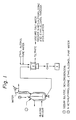
- The present invention will be explained more specifically below by way of Examples, which refer to the accompanying drawing, in which Figure 1 is a flow sheet showing Example 1. However, the present invention is in no way restricted to these Examples.
- In a stainless steel 15-liter autoclave were placed 4900 g of N-methylpyrrolidone and 1880 g of Na₂S·2.6H₂O. They were subjected to jacket heating with stirring, and dehydrated under refluxing with steam introduced to a distillation column attached to the autoclave. The dehydration was suspended when the internal temperature reached 200°C. By this operation, 370 g of a distillation consisting mainly of water was removed. Then, the system was cooled until the internal temperature was 170°C, and 2130 g of p-dichlorobenzene was added. The system was re-heated to 250°C. Polymerization was conducted for 3 hours at that temperature. After the completion of the polymerization, the reaction mixture was stirred, the remaining water and the unreacted dichlorobenzene were simultaneously distilled out by using the aforementioned distillation column. At this time, 590 g of a distillate were removed. The water content in this distillate was 58%. Subsequently, the reaction mixture was cooled to 100°C and 3000 g of ethyl alcohol were added. The resultant slurry was placed in a centrifugal separator to separate it into a cake consisting mainly of polyphenylene sulfide, salt, N-methylpyrrolidone and ethyl alcohol and 6810 g of a filtrate consisting essentially of N-methylpyrrolidone and ethyl alcohol. The filtrate was subjected to distillation to separate a small amount of solid matter undesirably mixed therewith and polyphenylene sulfide oligomer so as to be reused. Then, with the centrifugal separator being rotated, 3000 g of ethyl alcohol was poured onto the cake layer to wash the latter, thereby replacing 97% of N-methylpyrrolidone in the cake with the alcohol. The filtrate was readily separated into alcohol and N-methylpyrrolidone in the distillation column so as to be reused.
- The cake was returned to the autoclave where it was heated to 100°C with stirring. Thus, 99.9% or more of ethyl alcohol contained in the cake was recovered through evaporation.
- Then, 8000 g of pure water was poured onto the cake and the water slurry was then heated to 40°C with stirring to dissolve the salt. This slurry was dehydrated in the centrifugal separator and then washed with water. The cake was returned to the autoclave, and 8000 g of water was poured onto the cake. The water slurry was heated with stirring for 30 minutes at 180°C. After being cooled, the slurry was dehydrated in the centrifugal separator and washed with water. The resultant cake was dried overnight with a hot-air drier to obtain 1470 g of polyphenylene sulfide. The sodium ion content in the thus obtained polyphenylene sulfide was 85 ppm.
- The reaction mixture obtained in the same way as in Example 1 was subjected to distillation to remove the remaining water and the unreacted dichlorobenzene in the same manner as in Example 1. The distillation was further continued to distill out about 60% of the remaining N-methylpyrrolidone (2900 g). At this time, the internal temperature was 150°C. Thereafter, the procedure of Example 1 was repeated. The content of sodium ions in the thus obtained polyphenylene sulfide was 120 ppm.
- The reaction mixture obtained in the same way as in Example 1 was subjected to distillation to remove the remaining water and the unreacted dichlorobenzene in the same manner as in Example 1. Subsequently, the reaction mixture was cooled to 120°C, and 3000 g of isopropyl alcohol were added. Thereafter, the procedure of Example 1 was repeated except that isopropyl alcohol was employed instead of ethyl alcohol. The content of sodium ions in the thus obtained polyphenylene sulfide was 96 ppm.
- The reaction mixture obtained in the same way as in Example 1 was heated to 155°C under a vacuum and with stirring, whereby the remaining water, unreacted dichlorobenzene and N-methylpyrrolidone serving as a solvent, were evaporated to obtain a solid powder consisting essentially of polyphenylene sulfide and salt. By this operation, 99% of the N-methylpyrrolidone was recovered through evaporation. To the solid powder, 8000 g of pure water was added and the water slurry was heated to 40°C with stirring to dissolve the salt. The slurry was dehydrated in the centrifugal separator again and washed with water. The obtained cake was returned to the autoclave where 8000 g of pure water was poured on the cake and the water slurry was heated for 30 minutes at 180°C with stirring. After being cooled, this slurry was dehydrated in the centrifugal separator and washed with water. The obtained cake was dried overnight by heating with a hot-air drier to obtain 1460 g of polyphenylene sulfide. The content of sodium ions in the thus obtained polyphenylene sulfide was 1900 ppm.
- The operation in Comparative Example 1, in which 8000 g of pure water was poured onto the cake and the water slurry was heated for 30 minutes at 180°C with stirring, and cooled, dehydrated in the centrifugal separator and then washed with water, was repeated four times. The content of sodium ions in the thus obtained polyphenylene sulfide was 800 ppm.
- It should be noted that the content of sodium ions in the polymers shown in the Examples and Comparative Examples was measured by (a) subjecting about 0.5 g of a sample to wet decomposition with about 10 ml of nitric acid in a quartz beaker, (b) adding thereto pure (deionized) water to prepare a solution of a predetermined amount and then (c) subjecting the solution to atomic absorption spectrometry.
- As is obvious from the above explanation, the present invention may enable polyarylene sulfide having a low content of electrolytic ions to be industrially advantageously recovered from the reaction mixture.
Claims (5)
- A process for recovering a polyarylene sulfide from a mixture consisting mainly of polyarylene sulfide and an alkali metal halide which mixture is obtainable by reacting a polyhalogenated aromatic compound and an alkali metal sulfide containing water in an organic polar solvent, the process comprising the steps of: dehydrating the mixture by distillation; mixing the dehydrated mixture with a solvent which is a bad solvent for both the polyarylene sulfide and alkali metal halide soluble in the organic polar solvent to prepare a slurry consisting essentially of the polyarylene sulfide and the alkali metal halide; subjecting the slurry to solid-liquid separation; washing a resultant cake with the solvent; drying the cake; adding water to the cake to wash away the alkali metal halide through dissolution; and subjecting the slurry to solid-liquid separation to recover the polyarylene sulfide; characterised in that the solvent is a bad solvent for both the polyarylene sulfide and alkali metal halide and the said bad solvent is a C₁-C₈ alcohol, tetrahydrofuran, chloroform, or acetone.
- A process according to Claim 1 characterised in that the bad solvent is added in the range of 100 to 2000 parts by weight with respect to 100 parts by weight of polyarylene sulfide.
- A process according to Claim 1 or 2 characterised in that the amount of organic polar solvent remaining in the cake is reduced to 5 parts or less by weight with respect to 100 parts by weight of polyarylene sulfide by washing the cake with the bad solvent.
- A process according to any one of Claims 1 to 3 characterised in that the drying of the cake is conducted at a temperature of 140°C or less.
- A process as claimed in any one of Claims 1 to 4 characterised in that the bad solvent is methyl alcohol, ethyl alcohol, propyl alcohol or isopropyl alcohol.
Applications Claiming Priority (2)
| Application Number | Priority Date | Filing Date | Title |
|---|---|---|---|
| JP278785/86 | 1986-11-25 | ||
| JP61278785A JPH0788427B2 (en) | 1986-11-25 | 1986-11-25 | Method for recovering polyarylensulfide |
Publications (3)
| Publication Number | Publication Date |
|---|---|
| EP0271253A2 EP0271253A2 (en) | 1988-06-15 |
| EP0271253A3 EP0271253A3 (en) | 1990-02-28 |
| EP0271253B1 true EP0271253B1 (en) | 1993-03-03 |
Family
ID=17602144
Family Applications (1)
| Application Number | Title | Priority Date | Filing Date |
|---|---|---|---|
| EP87310409A Expired - Lifetime EP0271253B1 (en) | 1986-11-25 | 1987-11-25 | Process for recovering a polyarylene sulfide |
Country Status (6)
| Country | Link |
|---|---|
| US (1) | US4789729A (en) |
| EP (1) | EP0271253B1 (en) |
| JP (1) | JPH0788427B2 (en) |
| KR (1) | KR880006285A (en) |
| CA (1) | CA1279748C (en) |
| DE (1) | DE3784463T2 (en) |
Families Citing this family (12)
| Publication number | Priority date | Publication date | Assignee | Title |
|---|---|---|---|---|
| US5043421A (en) * | 1989-08-04 | 1991-08-27 | General Electric Company | Extruder isolation of polymers from solution |
| US5128445A (en) * | 1990-06-14 | 1992-07-07 | Phillips Petroleum Company | Method to recover poly(arylene sulfide) polymers with water-polar organic compound |
| JP3143977B2 (en) * | 1991-08-14 | 2001-03-07 | 東ソー株式会社 | Purification method of polyarylene sulfide |
| DE69613309T2 (en) * | 1995-10-20 | 2002-05-02 | Mitsubishi Chemical Corp., Tokio/Tokyo | Process for the separation of cyclohexene |
| US6331608B1 (en) | 1999-09-13 | 2001-12-18 | Phillips Petroleum Company | Process for producing poly(arylene sulfide) |
| US6437024B1 (en) * | 1999-09-13 | 2002-08-20 | Phillips Petroleum Company | Menthanol extraction of polar organic compounds and modifier compounds from poly(arylene sulfide) polymer and oligomer streams |
| JP3882562B2 (en) * | 2001-10-02 | 2007-02-21 | 東ソー株式会社 | Method for recovering polyarylene sulfide |
| KR102251792B1 (en) * | 2018-10-19 | 2021-05-13 | 주식회사 엘지화학 | Process for recovering polyarylene sulfide |
| CN113680128B (en) * | 2021-07-27 | 2023-06-06 | 山东明化新材料有限公司 | Continuous washing and purifying system and purifying method for polyarylene sulfide resin |
| CN117916001A (en) * | 2021-09-08 | 2024-04-19 | 提克纳有限责任公司 | Anti-solvent technology for recovering organic solvents from polyarylene sulfide waste sludge |
| KR20240060812A (en) | 2021-09-08 | 2024-05-08 | 티코나 엘엘씨 | Extraction technology for recovering organic solvents from polyarylene sulfide waste sludge |
| CN114854016B (en) * | 2022-06-14 | 2023-09-05 | 四川中科兴业高新材料有限公司 | Preparation method of low-ion precipitation polyphenylene sulfide resin |
Family Cites Families (6)
| Publication number | Priority date | Publication date | Assignee | Title |
|---|---|---|---|---|
| US3478000A (en) * | 1967-11-20 | 1969-11-11 | Phillips Petroleum Co | Recovery of poly(arylene sulfides) |
| US3687907A (en) * | 1970-11-09 | 1972-08-29 | Phillips Petroleum Co | Recovery of solvent in arylene sulfide polymer production |
| US4415729A (en) * | 1982-06-04 | 1983-11-15 | Phillips Petroleum Company | Recovering granular poly(arylene sulfide) particles from a poly(arylene sulfide) reaction mixture |
| JPS5989327A (en) * | 1982-09-27 | 1984-05-23 | フイリツプス・ペトロリユ−ム・コンパニ− | Recovery of granular polyarylene sulfide by use of evaporation |
| JPS61255933A (en) * | 1985-05-08 | 1986-11-13 | Kureha Chem Ind Co Ltd | Treatment of polymer slurry |
| JPH072847B2 (en) * | 1986-04-28 | 1995-01-18 | 大日本インキ化学工業株式会社 | Method for purifying polyphenylene sulfide |
-
1986
- 1986-11-25 JP JP61278785A patent/JPH0788427B2/en not_active Expired - Fee Related
-
1987
- 1987-11-23 CA CA000552482A patent/CA1279748C/en not_active Expired - Lifetime
- 1987-11-24 KR KR870013232A patent/KR880006285A/en not_active Withdrawn
- 1987-11-25 US US07/125,667 patent/US4789729A/en not_active Expired - Lifetime
- 1987-11-25 DE DE8787310409T patent/DE3784463T2/en not_active Expired - Fee Related
- 1987-11-25 EP EP87310409A patent/EP0271253B1/en not_active Expired - Lifetime
Also Published As
| Publication number | Publication date |
|---|---|
| JPH0788427B2 (en) | 1995-09-27 |
| US4789729A (en) | 1988-12-06 |
| JPS63132941A (en) | 1988-06-04 |
| CA1279748C (en) | 1991-01-29 |
| DE3784463D1 (en) | 1993-04-08 |
| KR880006285A (en) | 1988-07-22 |
| EP0271253A2 (en) | 1988-06-15 |
| EP0271253A3 (en) | 1990-02-28 |
| DE3784463T2 (en) | 1993-06-17 |
Similar Documents
| Publication | Publication Date | Title |
|---|---|---|
| EP0202537B1 (en) | Process for treating a polymer slurry | |
| US4789729A (en) | Process for recovering a polyarylene sulfide | |
| US4841022A (en) | Method for removing impurities from polyphenylene sulfide resin | |
| KR20130026454A (en) | Process for production of polyarylene sulfides, and polyarylene sulfides | |
| JPS63289025A (en) | Improved manufacture of poly(p-phenylenesulfide) | |
| CN107207743B (en) | Process for producing fine powder polyarylene sulfide and fine powder polyarylene sulfide | |
| US7317072B2 (en) | Process for the production of polyarylene sulfide resins | |
| JPH11349566A (en) | Recovery and purification of n-methyl-2-pyrrolidone | |
| US3956060A (en) | Removal of reaction diluent from poly(arylene sulfide) reaction slurry | |
| EP3766867B1 (en) | Method for recovering amide-based compound | |
| TWI795604B (en) | Separation and purification method of polyarylene sulfide and preparation method of polyarylene sulfide | |
| EP0104560B1 (en) | Granular poly(arylene sulfide) recovery using evaporation | |
| KR102608800B1 (en) | Method for preparing polyphenylene sulfide and apparatus for preparing polyphenylene sulfide | |
| EP0594189A1 (en) | Production of poly(arylene sulfide)polymers containing reduced amounts of oligomers | |
| US3697487A (en) | Recovery of diluent in arylene sulfide polymer production | |
| JPS6153325A (en) | Method of recovering solvent from polyarylene sulfide reaction solution slurry and of purification through distillation | |
| US11597800B2 (en) | Separation and recovery method of polyarlene sulfide | |
| JPH04318027A (en) | Isolation and purification of arylene polysulfide | |
| US5091509A (en) | Recovery of poly(arylene sulfide ketone) and poly(arylene sulfide diketone) resins | |
| US5247063A (en) | Process for the purification of polyarylene sulphides | |
| JPS62177028A (en) | Method for recovering polymerization auxiliary in production of polyarylene sulfide | |
| KR950002618B1 (en) | Polyarylene sulfide separation method and apparatus | |
| CN119931052A (en) | A method for treating waste viscous liquid in the production process of polyphenylene sulfide | |
| JP2007262341A (en) | Purification method of polyarylene sulfide resin | |
| CN112744844A (en) | Method for recovering lithium chloride used as catalyst for synthesizing polyphenylene sulfide |
Legal Events
| Date | Code | Title | Description |
|---|---|---|---|
| PUAI | Public reference made under article 153(3) epc to a published international application that has entered the european phase |
Free format text: ORIGINAL CODE: 0009012 |
|
| AK | Designated contracting states |
Kind code of ref document: A2 Designated state(s): BE CH DE FR GB IT LI NL |
|
| PUAL | Search report despatched |
Free format text: ORIGINAL CODE: 0009013 |
|
| AK | Designated contracting states |
Kind code of ref document: A3 Designated state(s): BE CH DE FR GB IT LI NL |
|
| 17P | Request for examination filed |
Effective date: 19900817 |
|
| 17Q | First examination report despatched |
Effective date: 19911008 |
|
| RAP1 | Party data changed (applicant data changed or rights of an application transferred) |
Owner name: TOSO SUSTEEL CO., LTD. Owner name: TOSOH CORPORATION |
|
| GRAA | (expected) grant |
Free format text: ORIGINAL CODE: 0009210 |
|
| AK | Designated contracting states |
Kind code of ref document: B1 Designated state(s): BE CH DE FR GB IT LI NL |
|
| PG25 | Lapsed in a contracting state [announced via postgrant information from national office to epo] |
Ref country code: NL Effective date: 19930303 Ref country code: LI Effective date: 19930303 Ref country code: CH Effective date: 19930303 Ref country code: BE Effective date: 19930303 |
|
| ITF | It: translation for a ep patent filed | ||
| REF | Corresponds to: |
Ref document number: 3784463 Country of ref document: DE Date of ref document: 19930408 |
|
| ET | Fr: translation filed | ||
| REG | Reference to a national code |
Ref country code: CH Ref legal event code: PL |
|
| NLV1 | Nl: lapsed or annulled due to failure to fulfill the requirements of art. 29p and 29m of the patents act | ||
| PLBE | No opposition filed within time limit |
Free format text: ORIGINAL CODE: 0009261 |
|
| STAA | Information on the status of an ep patent application or granted ep patent |
Free format text: STATUS: NO OPPOSITION FILED WITHIN TIME LIMIT |
|
| 26N | No opposition filed | ||
| REG | Reference to a national code |
Ref country code: GB Ref legal event code: IF02 |
|
| PGFP | Annual fee paid to national office [announced via postgrant information from national office to epo] |
Ref country code: FR Payment date: 20031110 Year of fee payment: 17 |
|
| PGFP | Annual fee paid to national office [announced via postgrant information from national office to epo] |
Ref country code: GB Payment date: 20031119 Year of fee payment: 17 |
|
| PGFP | Annual fee paid to national office [announced via postgrant information from national office to epo] |
Ref country code: DE Payment date: 20031204 Year of fee payment: 17 |
|
| PG25 | Lapsed in a contracting state [announced via postgrant information from national office to epo] |
Ref country code: GB Free format text: LAPSE BECAUSE OF NON-PAYMENT OF DUE FEES Effective date: 20041125 |
|
| PG25 | Lapsed in a contracting state [announced via postgrant information from national office to epo] |
Ref country code: DE Free format text: LAPSE BECAUSE OF NON-PAYMENT OF DUE FEES Effective date: 20050601 |
|
| GBPC | Gb: european patent ceased through non-payment of renewal fee |
Effective date: 20041125 |
|
| PG25 | Lapsed in a contracting state [announced via postgrant information from national office to epo] |
Ref country code: FR Free format text: LAPSE BECAUSE OF NON-PAYMENT OF DUE FEES Effective date: 20050729 |
|
| REG | Reference to a national code |
Ref country code: FR Ref legal event code: ST |
|
| PG25 | Lapsed in a contracting state [announced via postgrant information from national office to epo] |
Ref country code: IT Free format text: LAPSE BECAUSE OF NON-PAYMENT OF DUE FEES;WARNING: LAPSES OF ITALIAN PATENTS WITH EFFECTIVE DATE BEFORE 2007 MAY HAVE OCCURRED AT ANY TIME BEFORE 2007. THE CORRECT EFFECTIVE DATE MAY BE DIFFERENT FROM THE ONE RECORDED. Effective date: 20051125 |