EP0266403B1 - Method for controlling a fodder mixing plant and fodder mixing plant for carrying out the method - Google Patents
Method for controlling a fodder mixing plant and fodder mixing plant for carrying out the method Download PDFInfo
- Publication number
- EP0266403B1 EP0266403B1 EP87903271A EP87903271A EP0266403B1 EP 0266403 B1 EP0266403 B1 EP 0266403B1 EP 87903271 A EP87903271 A EP 87903271A EP 87903271 A EP87903271 A EP 87903271A EP 0266403 B1 EP0266403 B1 EP 0266403B1
- Authority
- EP
- European Patent Office
- Prior art keywords
- fodder
- pellets
- plant
- raw materials
- pellet
- Prior art date
- Legal status (The legal status is an assumption and is not a legal conclusion. Google has not performed a legal analysis and makes no representation as to the accuracy of the status listed.)
- Expired - Lifetime
Links
- 238000000034 method Methods 0.000 title claims abstract description 23
- 238000002156 mixing Methods 0.000 title claims description 26
- 239000008188 pellet Substances 0.000 claims abstract description 84
- 239000002994 raw material Substances 0.000 claims abstract description 62
- 238000004519 manufacturing process Methods 0.000 claims abstract description 27
- 239000000203 mixture Substances 0.000 claims abstract description 27
- 238000005070 sampling Methods 0.000 claims abstract description 16
- 230000003750 conditioning effect Effects 0.000 claims abstract description 14
- XLYOFNOQVPJJNP-UHFFFAOYSA-N water Substances O XLYOFNOQVPJJNP-UHFFFAOYSA-N 0.000 claims description 24
- 230000000050 nutritive effect Effects 0.000 claims description 19
- 238000005457 optimization Methods 0.000 claims description 16
- 238000001816 cooling Methods 0.000 claims description 13
- 238000005303 weighing Methods 0.000 claims description 10
- 238000004458 analytical method Methods 0.000 claims description 6
- 239000000654 additive Substances 0.000 claims description 5
- 230000015572 biosynthetic process Effects 0.000 claims description 4
- 238000005265 energy consumption Methods 0.000 claims description 4
- 238000012423 maintenance Methods 0.000 claims description 4
- 230000001143 conditioned effect Effects 0.000 claims description 3
- 238000004364 calculation method Methods 0.000 claims description 2
- 238000012545 processing Methods 0.000 claims description 2
- 235000019628 coolness Nutrition 0.000 claims 1
- 230000000704 physical effect Effects 0.000 abstract 1
- 238000003908 quality control method Methods 0.000 description 6
- 238000003825 pressing Methods 0.000 description 4
- 238000010586 diagram Methods 0.000 description 3
- 238000012360 testing method Methods 0.000 description 3
- 239000011230 binding agent Substances 0.000 description 2
- 238000010521 absorption reaction Methods 0.000 description 1
- 150000001413 amino acids Chemical class 0.000 description 1
- 238000000576 coating method Methods 0.000 description 1
- 238000007599 discharging Methods 0.000 description 1
- 238000009826 distribution Methods 0.000 description 1
- 239000000428 dust Substances 0.000 description 1
- 238000011156 evaluation Methods 0.000 description 1
- 230000004927 fusion Effects 0.000 description 1
- 230000005484 gravity Effects 0.000 description 1
- 238000000227 grinding Methods 0.000 description 1
- 239000004615 ingredient Substances 0.000 description 1
- 229910052500 inorganic mineral Inorganic materials 0.000 description 1
- 239000007788 liquid Substances 0.000 description 1
- 239000000463 material Substances 0.000 description 1
- 238000005259 measurement Methods 0.000 description 1
- 239000011707 mineral Substances 0.000 description 1
- 238000012544 monitoring process Methods 0.000 description 1
- 230000001095 motoneuron effect Effects 0.000 description 1
- 235000015097 nutrients Nutrition 0.000 description 1
- 229940095674 pellet product Drugs 0.000 description 1
- 230000003449 preventive effect Effects 0.000 description 1
- 102000004169 proteins and genes Human genes 0.000 description 1
- 108090000623 proteins and genes Proteins 0.000 description 1
- 238000011144 upstream manufacturing Methods 0.000 description 1
Images
Classifications
-
- A—HUMAN NECESSITIES
- A23—FOODS OR FOODSTUFFS; TREATMENT THEREOF, NOT COVERED BY OTHER CLASSES
- A23N—MACHINES OR APPARATUS FOR TREATING HARVESTED FRUIT, VEGETABLES OR FLOWER BULBS IN BULK, NOT OTHERWISE PROVIDED FOR; PEELING VEGETABLES OR FRUIT IN BULK; APPARATUS FOR PREPARING ANIMAL FEEDING- STUFFS
- A23N17/00—Apparatus specially adapted for preparing animal feeding-stuffs
- A23N17/007—Apparatus specially adapted for preparing animal feeding-stuffs for mixing feeding-stuff components
-
- B—PERFORMING OPERATIONS; TRANSPORTING
- B01—PHYSICAL OR CHEMICAL PROCESSES OR APPARATUS IN GENERAL
- B01F—MIXING, e.g. DISSOLVING, EMULSIFYING OR DISPERSING
- B01F23/00—Mixing according to the phases to be mixed, e.g. dispersing or emulsifying
- B01F23/50—Mixing liquids with solids
- B01F23/59—Mixing systems, i.e. flow charts or diagrams
Definitions
- the invention relates to a method for controlling a fodder mixing plant for the production of fodder pellets, whereby organic and inorganic raw materials are mixed, the mixture is conditioned by the adding of water and/or fat, the mixture is compressed for the formation of fodder pellets, and the pellets are cooled and stored for subsequent delivery.
- Fodder mixing plants of this type are being increasingly used due to a demand for a rational and economically advantageous method for manufacturing fodder pellets.
- Control is thus effected on the basis of a measuring of the pellets after having been pressed out and prior to their being cooled in order to establish the dust percentage. These measurements form the basis of the adjustment of those factors that influence the pellet and the pellet press, whether this be temperature, conditioning means and motor effect absorption.
- the recipe may constantly be optimized during production, which ensures optimum pellet quality in relation to production costs.
- the invention also relates to a fodder mixing plant for carrying out the mentioned method, said plant being of the type that comprises a number of raw material silos, sieves and grinders for processing the raw materials, at least one mixing plant for mixing raw materials supplied from the said silos, at least one fodder pellet press designed so that it can press a mixture received from the mixing device or mixing devices for the formation of fodder pellets, conditioning and cooling devices for conditioning and cooling the fodder pellets, at least one finished product silo for receiving and storing the finished fodder pellets, transport elements between the individual parts of the plant for transportation of the raw materials, the mixture and the fodder pellets, as well as weighing means; said plant being characteristic in that the plant has measuring means designed for measuring on a continuous basis the physical quality and nutritive content of such raw materials as are suited for fodder pellet production before they are supplied into a raw material silo, in that the plant has measuring means designed for measuring on a continuous basis the nutritive content of a mixture produced in a mixing device or
- fig. 1 is shown an example of a fodder mixing plant where, only a single pellet press 16 is shown. It will be understood, however, that the method comprises control means for plants with any required number of pellet presses connected to the surrounding equipment, but the method is sufficiently clearly described on the basis of one single press 16.
- the raw materials 1 are weighed at 2 and through gravity feed supplied to the individual raw material silos 3 and may be of any organic or mineral sort.
- the raw materials are discharged from the silos 3 and weighed at 4 and 5 before they are delivered to a sieve 6 and mill or grinder 7 and end up in a mixer 8 in to which may be added any required additives from the silos 3.
- a weighing device 9 the material is carried to a further mixer 10 where liquid may be added, such as water from a tank 11.
- the mixture of raw materials is carried to a conditioning plant 13, in which binders, water or steam may be added before the mixture is supplied into the actual pellet press 16.
- the raw material mixture may via a transport device 15 be carried to a silo 20, from which the raw material mixture may be delivered.
- the pellets After pressing in the press 16, the pellets are led through a cooler 17 and a sieve to a finishing device where water or fat can be added to the surface of the pellets, before, perhaps via a weighing device 18, they end up in their various finished product silos 20. There may be provided a further silo 19 for pellets that, if required, are to be returned to the pellet press 16.
- the central computer 23 is connected to subordinate computer units of which unit 24 controls the raw material stock via a connection to the weighing device 2 and to the sampling points 28 and 29 upstream of to the individual silos 3.
- another subordinate computer 25 controls the batching of the raw materials via dosage elements 30 being connected with the weighing devices 4, 5 and 9 as well as with the sample point 31 for the mixture, before adding water, if so required.
- a subordinate computer unit 26 controls the pellet pressing by controlling the additives by means of valves 34 for the conditioning unit 13, by means of a drive motor 33 and a motor 35 and valve 36, as well as by sampling at 37 of the pellets before cooling but after the dosage of fat and water has been sprayed onto the pellets on the die; afterwards any additives may further be added by a coating process.
- subordinate computer unit 27 which controls the stock via the sampling 40, the dosage elements 41 and the weighing device 21.
- the central computer 23 has the following steps and functions:
- the subordinate computer 24 has the following steps and functions:
- the subordinate computer 42 has the following steps and functions:
- the subordinate computer 26 has the following steps and functions:
- subordinate computer 27 has the following steps and functions:
- the central computer 23 can calculate the cheapest possible composition of the recipe, taking into account only the biological values of the raw materials.
- it is in practice difficult to compose a recipe merely on the basis of the biological values as is necessary to take into consideration the influence of the raw materials on the physical characteristics of the pellets.
- each individual raw material has, apart from its biological values, been given a priority rating 44, depending on its influence on the quality of the finished product.
- the weighed out amount is now carried forward for grinding and mixing, and from mixing to the actual pelletting plant which is controlled by the subordinate computer 26. This automatically controls the pelletting lines and optimizes their production.
- the physical quality of the pressed out pellets is continuously monitored at 61.
- the result is recorded by the subordinate computer 26 in which are programmed the limits for the quality, as well as an upper and a lower control limit. At the same time, the water content of the pellets is automatically measured at 62.
- the subordinate computer 26 will automatically interfere in various ways. If the quality is, for example, too poor, the subordinate computer may try to adapt the production process technologically, in order that a better quality is achieved. This may be effected by reducing the production speed in order that a higher degree of fusion in the die is produced, or by changing the fat content in order that fat will automatically be removed from the raw material mixture, which amount of fat may instead be applied to the pellets at 38.
- the temperature of the raw material mixture which is conditioned by steam 34, can moreover be changed in a downward direction in order that more friction in the die is achieved.
- a binder 34 can be added immediately prior to the pressing, in order that the pellets become better.
- the press rolls in the die may be adjusted in order that a better quality or larger capacity is achieved.
- the subordinate computer 26 will be in direct contact with the central computer 23, which will now optimize a new recipe with raw materials which are more capable of being pressed and therefore provide a better quality.
- the subordinate computer 26 informs the central computer 23 that the quality is better than necessary, and it will therefore optimize a new recipe which is cheaper than the one measured.
- the central computer 23 will thus optimize a new recipe which will automatically be transferred to the subordinate computer 25 after an acceptance procedure, if so required.
- the subordinate computer 25 now weighs out a new recipe, and since the central computer 23 controls the transport to the presses, this will record when the new recipe composition reaches the presses, whereafter it automatically in the subordinate computer 26 will test the new recipe in comparison to the previous recipe and establish its position within the set limits, and it will if necessary repeat this procedure until optimization has taken place.
- the water content may form an ingredient in the economical optimization of the recipe, just as the water may be taken into consideration when changing the quality on line with the other factors, such as energy consumption and temperature.
- Measuring the nutritive content of the cooled pellets at 59 may likewise form part of the recipe optimization, since the subordinate computer 26 transfers these data to the central computer 23 in order to obtain the most exact composition of the recipe.
- the central computer 23, via the subordinate computer 27, includes control at 64 of the stock in the finished product silos 19, 20, and control of the delivery at 65 via a weighing out system 21.
- data concerning the nutritive content may be collected from the subordinate computer 27 via a measuring instrument 41 in order that this may be compared with the guaranteed content, and these data can be transmitted via the subordinate computer 27 to the central computer 23, where they form part of the statistics and the quality control 65.
- the central computer 23 contains an information system, in which the energy consumption of the entire plant is controlled at 47, just as the individual part processes are recorded.
- a preventive maintenance program is incorporated in the central computer 23 via the subordinate computer 42, which controls hours of operation for each machine element 64 and prints out maintenance orders 65 according to a predetermined program.
- the quality of the product forms a decisive parameter in connection with optimization of the recipe, just as water content and any nutritive content in the manufactured pellets are recorded and together with the production costs are entered as a parameter in the optimization of the recipe.
Landscapes
- Chemical & Material Sciences (AREA)
- Life Sciences & Earth Sciences (AREA)
- Food Science & Technology (AREA)
- Chemical Kinetics & Catalysis (AREA)
- Animal Husbandry (AREA)
- Engineering & Computer Science (AREA)
- Dispersion Chemistry (AREA)
- Polymers & Plastics (AREA)
- Apparatuses For Bulk Treatment Of Fruits And Vegetables And Apparatuses For Preparing Feeds (AREA)
- Fodder In General (AREA)
- Catching Or Destruction (AREA)
- Heterocyclic Carbon Compounds Containing A Hetero Ring Having Oxygen Or Sulfur (AREA)
- Control Of Non-Electrical Variables (AREA)
Abstract
Description
- The invention relates to a method for controlling a fodder mixing plant for the production of fodder pellets, whereby organic and inorganic raw materials are mixed, the mixture is conditioned by the adding of water and/or fat, the mixture is compressed for the formation of fodder pellets, and the pellets are cooled and stored for subsequent delivery.
- Fodder mixing plants of this type are being increasingly used due to a demand for a rational and economically advantageous method for manufacturing fodder pellets.
- From the specification of Danish patent application no. 2163/83 corresponding to EP-A-40,406, a method is known for controlling a fodder dice pressing plant, which contains a fodder dice press comprising a ring die and a cooler for cooling the produced fodder dice, by which known method at least one parameter for the dice quality is measured between the fodder dice press and the cooler, whereafter this parameter is used for controlling the fodder dice press.
- Control is thus effected on the basis of a measuring of the pellets after having been pressed out and prior to their being cooled in order to establish the dust percentage. These measurements form the basis of the adjustment of those factors that influence the pellet and the pellet press, whether this be temperature, conditioning means and motor effect absorption.
- This known adjustment plant is, however, not sufficient for achieving optimization of production since there is no possibility of allowing for changes in the composition of the raw materials, additives and the like before the quality of the fodder pellets is established by measuring of the finished pellets, and thereby this will involve a considerable delay and a consequent loss due to adjustments which may be necessary.
- It is the object of the invention to provide a method for controlling a plant with several production lines, where the pellets are manufactured on a continuous basis taking into account an overall evaluation and optimization of their quality, including their physical quality, and production price.
- This is achieved by a method of the above mentioned type, said method being characteristic in that samples are continuously taken of the raw materials before they are mixed, and the physical quality and nutritive content of the individual raw materials are analyzed, in that samples are continuously taken of the mixture produced by the mixing and the nutritive content of the mixture is analyzed, in that the finished fodder pellets are continuously analyzed in order to record their content of water and/or fat, in that the fodder pellets are continuously analyzed after the adding of water and/or fat for recording their physical quality and nutritive content, in that the physical state of the conditioning and cooling devices situated both before and after the pellet press or pellet presses is continuously analyzed, in that the results of the individual samples and analyses are continuously compared with predetermined values in order to establish any deviations, and in that the quantitative ratio between the raw materials is continuously given a different order of priority in accordance with the established deviations and/or in that the setting of the conditioning and cooling devices is changed for optimization of the nutritive content, physical quality and price of the fodder pellets.
- There is, hereby, achieved a unique control and adjustment of a fodder mixing plant in that the adjustment ensures that the pellets are produced according to a recipe in so that their physical quality, including their nutrient and water content, forms a decisive factor in the recipe together with the production costs of the manufacturing process. Hereby the recipe may be optimized in order that fodder pellets may be produced as economically as possible taking their quality into account.
- By, as referred to in
claim 2, continuously monitoring these factors, the recipe may constantly be optimized during production, which ensures optimum pellet quality in relation to production costs. - The invention also relates to a fodder mixing plant for carrying out the mentioned method, said plant being of the type that comprises a number of raw material silos, sieves and grinders for processing the raw materials, at least one mixing plant for mixing raw materials supplied from the said silos, at least one fodder pellet press designed so that it can press a mixture received from the mixing device or mixing devices for the formation of fodder pellets, conditioning and cooling devices for conditioning and cooling the fodder pellets, at least one finished product silo for receiving and storing the finished fodder pellets, transport elements between the individual parts of the plant for transportation of the raw materials, the mixture and the fodder pellets, as well as weighing means; said plant being characteristic in that the plant has measuring means designed for measuring on a continuous basis the physical quality and nutritive content of such raw materials as are suited for fodder pellet production before they are supplied into a raw material silo, in that the plant has measuring means designed for measuring on a continuous basis the nutritive content of a mixture produced in a mixing device or mixing devices, in that the plant has a first set of pellet sampling means designed to measure the content of water and/or fat of pellets produced in the pellet press or presses, in that the plant has a second set of pellet sampling means designed to measure the content of water and/or fat of fodder pellets cooled in the cooling device, in that the plant has means for measuring the finished products designed to measure the amount of fodder pellets added to a finished products silo and dosage elements for delivering finished products from a finished pro- ' ducts silo, whereby the plant has a central computer and subordinate computers designed to adjust the quantitative ratio between the raw materials and the amount of the conditioning means, such as water and/or fat, for optimization of the nutritive value, physical quality and price of the fodder pellets, said adjustment being made on the basis of data derived from the means for measuring the raw materials, the means for measuring the mixture and from the first and second set of pellet sampling means as well as from the means for measuring the finished products.
- Hereby is achieved a plant for use when carrying out the method according to the invention, which plant ensures an optimization of the production of fodder pellets and allows for changing conditions, whether these be raw materials or costs.
- Finally it is expedient to construct the plant in the manner referred to in
claim 4, whereby pellets are produced of the highest possible quality in relation to the production costs. - In the following the invention will be described in further detail with reference to the drawing, in which
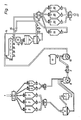
- fig. 1 shows a block diagram of a single press line in the plant from supply of raw materials to the discharging of the finished product,
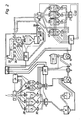
- fig. 2 shows a block diagram of the same press line showing the computers, and
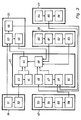
- fig. 3 shows a block diagram of the individual computers and their steps.
- In fig. 1 is shown an example of a fodder mixing plant where, only a
single pellet press 16 is shown. It will be understood, however, that the method comprises control means for plants with any required number of pellet presses connected to the surrounding equipment, but the method is sufficiently clearly described on the basis of onesingle press 16. - The raw materials 1 are weighed at 2 and through gravity feed supplied to the individual
raw material silos 3 and may be of any organic or mineral sort. - The raw materials are discharged from the
silos 3 and weighed at 4 and 5 before they are delivered to asieve 6 and mill orgrinder 7 and end up in a mixer 8 in to which may be added any required additives from thesilos 3. - Via a
weighing device 9 the material is carried to afurther mixer 10 where liquid may be added, such as water from atank 11. - From here the mixture of raw materials is carried to a
conditioning plant 13, in which binders, water or steam may be added before the mixture is supplied into theactual pellet press 16. - If no pellets are to be produced in the plant, the raw material mixture may via a
transport device 15 be carried to asilo 20, from which the raw material mixture may be delivered. - After pressing in the
press 16, the pellets are led through acooler 17 and a sieve to a finishing device where water or fat can be added to the surface of the pellets, before, perhaps via aweighing device 18, they end up in their various finishedproduct silos 20. There may be provided afurther silo 19 for pellets that, if required, are to be returned to thepellet press 16. - In fig. 2 the same plant is shown with a schematic view of the computers. These comprise a
central computer 23, which coordinates and controls the whole plant. - The
central computer 23 is connected to subordinate computer units of whichunit 24 controls the raw material stock via a connection to theweighing device 2 and to thesampling points 28 and 29 upstream of to theindividual silos 3. - Moreover, another
subordinate computer 25 controls the batching of the raw materials viadosage elements 30 being connected with theweighing devices sample point 31 for the mixture, before adding water, if so required. - A
subordinate computer unit 26 controls the pellet pressing by controlling the additives by means ofvalves 34 for theconditioning unit 13, by means of adrive motor 33 and a motor 35 and valve 36, as well as by sampling at 37 of the pellets before cooling but after the dosage of fat and water has been sprayed onto the pellets on the die; afterwards any additives may further be added by a coating process. - Finally, there is shown a
subordinate computer unit 27 which controls the stock via thesampling 40, thedosage elements 41 and theweighing device 21. - All these
subordinate computer units subordinate computer unit 42 shown in fig. 3 for recording the costs, are connected to thecentral computer 23. - In fig. 3 is shown in a schematic view the primary functions of each subordinate computer unit and the connections between the units.
- The
central computer 23 has the following steps and functions: - Receives and stores analysis of the biological and
physical characteristics 43 of the raw materials, - Priority of the individual
raw materials 44, - Recipe print out for the cheapest
possible pellets 45, - Analysis of changes in the
raw materials 46, - Analysis of
energy consumption 47, - Continuous adjustment of
recipe 48, - Adjustment of operation costs in relation to
pellet quality 49, and - Adjustment of transport through the plant via
subordinate computers 50. - The
subordinate computer 24 has the following steps and functions: - Adjustment of raw materials to the
silo plant 51, and - Sampling and
quality control 52. - The
subordinate computer 42 has the following steps and functions: - Maintenance programs for the
machine elements 53, - Recording of
operation hours 54, - Print out of
maintenance order 55, and - Summary of operation costs 56.
- The
subordinate computer 25 has the following steps and functions:- Batching and mixing according to the
recipe 57, - Recording of
raw material consumption 58, and - Sampling and
quality control 59.
- Batching and mixing according to the
- The
subordinate computer 26 has the following steps and functions: - Technological optimization of the pellet manufacturing 60.
- Sampling and
quality control 61, - Finishing with water and/or
fat 62, and - Sampling and
quality control 63. - Finally, the
subordinate computer 27 has the following steps and functions: - Adjustment of finished products in the
silo plant 64, - Sampling and
quality control 65, and - Batching for
distribution 66. - The method will now be described in closer detail.
- When the recipe is composed from the beginning and thus before test production, this happens on the basis of the amount of the various raw materials placed in the
raw material silos 3 and the exact analysis of the nutritive content of these raw materials, in order that when the nutritive content of the recipe in the form of protein, fat, amino acid etc. is known, thecentral computer 23 can calculate the cheapest possible composition of the recipe, taking into account only the biological values of the raw materials. However, it is in practice difficult to compose a recipe merely on the basis of the biological values as is necessary to take into consideration the influence of the raw materials on the physical characteristics of the pellets. - This means, that in practice there are certain limits to the possibilities of the
central computer 23 for optimization as for each raw material it is necessary to state a minimum and maximum in the recipe, depending on their influence on the quality of the pellets. - To prevent the pellet product becoming more expensive, each individual raw material has, apart from its biological values, been given a
priority rating 44, depending on its influence on the quality of the finished product. - When the recipe has thus been optimized, with the limits transmitted from the
central computer 23 to thesubordinate computer 25, the individual raw materials can be batched via the various weighingdevices - The weighed out amount is now carried forward for grinding and mixing, and from mixing to the actual pelletting plant which is controlled by the
subordinate computer 26. This automatically controls the pelletting lines and optimizes their production. - Concurrently with the production, the physical quality of the pressed out pellets is continuously monitored at 61.
- The result is recorded by the
subordinate computer 26 in which are programmed the limits for the quality, as well as an upper and a lower control limit. At the same time, the water content of the pellets is automatically measured at 62. - If the test result is below or above the control limits, the
subordinate computer 26 will automatically interfere in various ways. If the quality is, for example, too poor, the subordinate computer may try to adapt the production process technologically, in order that a better quality is achieved. This may be effected by reducing the production speed in order that a higher degree of fusion in the die is produced, or by changing the fat content in order that fat will automatically be removed from the raw material mixture, which amount of fat may instead be applied to the pellets at 38. - The temperature of the raw material mixture, which is conditioned by
steam 34, can moreover be changed in a downward direction in order that more friction in the die is achieved. Moreover, abinder 34 can be added immediately prior to the pressing, in order that the pellets become better. Finally, the press rolls in the die may be adjusted in order that a better quality or larger capacity is achieved. - Should none of these changes help, the
subordinate computer 26 will be in direct contact with thecentral computer 23, which will now optimize a new recipe with raw materials which are more capable of being pressed and therefore provide a better quality. - Should the sampling of the pellets show that the quality is better than necessary, the only solution is either to increase production or to apply a cheaper recipe.
- In almost all cases it will be economically expedient that the
subordinate computer 26 informs thecentral computer 23 that the quality is better than necessary, and it will therefore optimize a new recipe which is cheaper than the one measured. - The
central computer 23 will thus optimize a new recipe which will automatically be transferred to thesubordinate computer 25 after an acceptance procedure, if so required. - The
subordinate computer 25 now weighs out a new recipe, and since thecentral computer 23 controls the transport to the presses, this will record when the new recipe composition reaches the presses, whereafter it automatically in thesubordinate computer 26 will test the new recipe in comparison to the previous recipe and establish its position within the set limits, and it will if necessary repeat this procedure until optimization has taken place. - It is moreover possible to optimize via the water content of the recipe, which is measured at 39, directly after the
cooling process 17. The water content may form an ingredient in the economical optimization of the recipe, just as the water may be taken into consideration when changing the quality on line with the other factors, such as energy consumption and temperature. - Measuring the nutritive content of the cooled pellets at 59 may likewise form part of the recipe optimization, since the
subordinate computer 26 transfers these data to thecentral computer 23 in order to obtain the most exact composition of the recipe. Apart from optimization of the production processes, thecentral computer 23, via thesubordinate computer 27, includes control at 64 of the stock in thefinished product silos system 21. - In connection with this delivery of the finished product, data concerning the nutritive content may be collected from the
subordinate computer 27 via a measuringinstrument 41 in order that this may be compared with the guaranteed content, and these data can be transmitted via thesubordinate computer 27 to thecentral computer 23, where they form part of the statistics and thequality control 65. - Also in connection with the weighing in of the raw materials to the
raw material silo 3 control is exercised over thestock 64 via thesubordinate computer 24, where the supplied raw material amount is recorded, and via thesubordinate computer 25, where the consumed raw material amount is recorded. - Apart from optimization of the production processes the
central computer 23 contains an information system, in which the energy consumption of the entire plant is controlled at 47, just as the individual part processes are recorded. - Finally, a preventive maintenance program is incorporated in the
central computer 23 via thesubordinate computer 42, which controls hours of operation for eachmachine element 64 and prints outmaintenance orders 65 according to a predetermined program. - When any repair work is carried out, such work is inputted in the
subordinate computer 42 in order to be recorded in the maintenance program and to form part of the economic calculations of production costs 56. - By this method the quality of the product forms a decisive parameter in connection with optimization of the recipe, just as water content and any nutritive content in the manufactured pellets are recorded and together with the production costs are entered as a parameter in the optimization of the recipe.
Claims (4)
Priority Applications (1)
| Application Number | Priority Date | Filing Date | Title |
|---|---|---|---|
| AT87903271T ATE59268T1 (en) | 1986-04-29 | 1987-04-28 | METHOD FOR CONTROLLING A FEED MIXING PLANT, AND FEED MIXING PLANT FOR CARRYING OUT THE PROCEDURE. |
Applications Claiming Priority (2)
| Application Number | Priority Date | Filing Date | Title |
|---|---|---|---|
| DK1967/86 | 1986-04-29 | ||
| DK196786A DK196786A (en) | 1986-04-29 | 1986-04-29 | PROCEDURE AND MEASURES FOR MANAGING A FEED MIXTURE PLANT |
Publications (2)
| Publication Number | Publication Date |
|---|---|
| EP0266403A1 EP0266403A1 (en) | 1988-05-11 |
| EP0266403B1 true EP0266403B1 (en) | 1990-12-27 |
Family
ID=8109191
Family Applications (1)
| Application Number | Title | Priority Date | Filing Date |
|---|---|---|---|
| EP87903271A Expired - Lifetime EP0266403B1 (en) | 1986-04-29 | 1987-04-28 | Method for controlling a fodder mixing plant and fodder mixing plant for carrying out the method |
Country Status (8)
| Country | Link |
|---|---|
| US (1) | US4786182A (en) |
| EP (1) | EP0266403B1 (en) |
| JP (1) | JPS63503114A (en) |
| AT (1) | ATE59268T1 (en) |
| AU (1) | AU7397687A (en) |
| DE (1) | DE3767125D1 (en) |
| DK (1) | DK196786A (en) |
| WO (1) | WO1987006434A1 (en) |
Cited By (1)
| Publication number | Priority date | Publication date | Assignee | Title |
|---|---|---|---|---|
| EP0652824B2 (en) † | 1993-06-02 | 2001-04-25 | Buehler Ag | Worm extruder |
Families Citing this family (31)
| Publication number | Priority date | Publication date | Assignee | Title |
|---|---|---|---|---|
| NL8702774A (en) * | 1987-11-19 | 1989-06-16 | Grint & Zandexpl Mij Vh Smals | METHOD AND INSTALLATION FOR WINNING GRANULAR MATERIAL IN A DEFINED MIXTURE RATIO AND MIXING UNIT. |
| US4994286A (en) * | 1988-05-09 | 1991-02-19 | Agrichem, Inc. | Grain conditioning method |
| US4993316A (en) * | 1988-05-09 | 1991-02-19 | Agrichem, Inc. | Seed grain conditioning apparatus |
| US4898092B1 (en) * | 1988-05-09 | 1993-10-26 | Agrichem, Inc. | Feed grain conditioning apparatus |
| US5033004A (en) * | 1988-12-23 | 1991-07-16 | Vandivier Iii John C | Method and system for blending coal and other natural resources |
| CA1329849C (en) * | 1989-01-03 | 1994-05-24 | Blair Gordon | Computerized monitoring system for animal feed ration processing mills |
| US5021940A (en) * | 1989-01-12 | 1991-06-04 | Automatic Control Electronics Company | Synergetic automatic control system for pellet mill |
| IE61634B1 (en) * | 1990-03-12 | 1994-11-16 | David Patton Milltown Mills Li | A method of producing pelletised animal fodder |
| US5240324A (en) * | 1992-06-05 | 1993-08-31 | Bluffton Agri/Industrial Corp. | Continuous flow system for mixing and processing bulk ingredients |
| US5194275A (en) * | 1992-08-13 | 1993-03-16 | Agrichem, Inc. | Grain processing apparatus |
| JP3234949B2 (en) * | 1992-12-14 | 2001-12-04 | ハネウエル・インコーポレーテッド | Flexible way to create recipes in process control systems |
| GB2285207B (en) * | 1993-12-29 | 1997-06-04 | Munster Mills Limited | Animal feedstuff production |
| DE60029596T2 (en) * | 1999-08-31 | 2007-07-26 | Adisseo France S.A.S. | IMPROVEMENTS IN THE MANUFACTURE OF ANIMAL FEED |
| US6745131B2 (en) | 1999-08-31 | 2004-06-01 | Adisseo France S.A.S. | Feedstuffs and methods for obtaining them |
| FR2798261B1 (en) * | 1999-09-13 | 2001-12-07 | Dussau Distrib | PLANT FOR THE MANUFACTURE AND DISTRIBUTION OF DRY POWDERY FEEDSTUFFS |
| DE10105344A1 (en) * | 2001-02-05 | 2002-08-08 | Buehler Ag | Cooling process and equipment |
| US20030084791A1 (en) * | 2001-11-08 | 2003-05-08 | Trenhaile Sara J. | Method and system for optimizing ingredient blending |
| DE102005048219A1 (en) * | 2005-09-29 | 2007-04-05 | Basf Ag | Method and system for optimizing a dosing amount of a feed additive |
| GB0703825D0 (en) * | 2007-02-28 | 2007-04-11 | Datastor Systems L | Apparatus and method for adding an ingredient to a material during a product process |
| US8369975B2 (en) * | 2007-09-21 | 2013-02-05 | Fisher-Rosemount Systems, Inc. | Online recipe synchronization in a real-time batch executive environment |
| US8150541B2 (en) * | 2007-11-13 | 2012-04-03 | Fisher-Rosemount Systems, Inc. | Methods and apparatus to modify a recipe process flow associated with a process control system during recipe execution |
| US8825189B2 (en) * | 2007-11-13 | 2014-09-02 | Fisher Rosemount Systems, Inc. | Methods and apparatus to execute an auxiliary recipe and a batch recipe associated with a process control system |
| US8260623B2 (en) * | 2008-05-02 | 2012-09-04 | Rich Products Corporation | Systems and methods for selecting flour |
| HRP20131155T1 (en) | 2009-05-07 | 2014-02-28 | Gea Pharma Systems Limited | Tablet production module and method for continuous production of tablets |
| CA2732030C (en) * | 2010-07-28 | 2016-01-12 | Premier Tech Technologies Ltee | Blending scale |
| CN102360203A (en) * | 2011-08-02 | 2012-02-22 | 常熟市京海机械制造有限公司 | Method for controlling asphalt batching system |
| SE537291C2 (en) | 2013-08-20 | 2015-03-31 | Uny Konsult Ab | Method for monitoring, sampling and controlling wood pellet manufacturing |
| DE102013109944A1 (en) * | 2013-09-10 | 2015-03-12 | Th. Buschhoff Gmbh & Co. | Process for the preparation of animal feed from feed components and apparatus therefor |
| CN109988910B (en) * | 2019-04-28 | 2020-12-04 | 湖南长天自控工程有限公司 | A method and device for adjusting the amount of water added to a pelletizing machine |
| CN109988909B (en) * | 2019-04-28 | 2020-12-04 | 中冶长天国际工程有限责任公司 | A kind of material adjustment method and device for pelletizing machine |
| CN117205815B (en) * | 2023-11-08 | 2024-01-23 | 四川信特农牧科技有限公司 | A kind of feed production control method |
Citations (5)
| Publication number | Priority date | Publication date | Assignee | Title |
|---|---|---|---|---|
| DE2208946A1 (en) | 1972-02-25 | 1973-09-06 | Wieneke Franz | Fodder compacting press - with automatic control of moisture content and of pressure |
| US3932736A (en) | 1974-04-08 | 1976-01-13 | Beta Corporation Of St. Louis | Automatic pellet producing system |
| WO1981003076A1 (en) | 1980-04-14 | 1981-10-29 | Beta Corp St Louis | Automatic control for a pellet producing apparatus |
| EP0040406A1 (en) | 1980-05-19 | 1981-11-25 | Bühler AG | A method of controlling a feed pelleting press installation and a feed pelleting press installation for carrying out this method |
| US4561781A (en) | 1984-05-31 | 1985-12-31 | Sperry Corporation | Agricultural feed blending apparatus |
Family Cites Families (7)
| Publication number | Priority date | Publication date | Assignee | Title |
|---|---|---|---|---|
| GB910614A (en) * | 1960-01-27 | 1962-11-14 | Thompson Ramo Wooldridge Inc | Method and apparatus for mixing materials |
| US3181482A (en) * | 1962-01-18 | 1965-05-04 | Midwest Feed & Peileting Co In | Portable pellet mill apparatus |
| US3473008A (en) * | 1964-06-12 | 1969-10-14 | Leeds & Northrup Co | System for feed blending control |
| US4171164A (en) * | 1977-12-12 | 1979-10-16 | The Kartridg Pak Co. | Continuous X-ray analysis for meat blending system |
| US4183675A (en) * | 1978-10-20 | 1980-01-15 | Feed Pelleting, Inc. | Energy conserving method and apparatus for pelleting particulate animal feed |
| US4463430A (en) * | 1981-08-31 | 1984-07-31 | Beta Corporation | Microprocessor based pellet mill control |
| US4588091A (en) * | 1983-05-27 | 1986-05-13 | Intersystems, Inc. | Method and apparatus to determine quality of particulate material |
-
1986
- 1986-04-29 DK DK196786A patent/DK196786A/en not_active Application Discontinuation
- 1986-11-24 US US06/934,021 patent/US4786182A/en not_active Expired - Fee Related
-
1987
- 1987-04-28 JP JP62503026A patent/JPS63503114A/en active Pending
- 1987-04-28 AT AT87903271T patent/ATE59268T1/en not_active IP Right Cessation
- 1987-04-28 AU AU73976/87A patent/AU7397687A/en not_active Abandoned
- 1987-04-28 WO PCT/DK1987/000045 patent/WO1987006434A1/en not_active Ceased
- 1987-04-28 DE DE8787903271T patent/DE3767125D1/en not_active Expired - Lifetime
- 1987-04-28 EP EP87903271A patent/EP0266403B1/en not_active Expired - Lifetime
Patent Citations (5)
| Publication number | Priority date | Publication date | Assignee | Title |
|---|---|---|---|---|
| DE2208946A1 (en) | 1972-02-25 | 1973-09-06 | Wieneke Franz | Fodder compacting press - with automatic control of moisture content and of pressure |
| US3932736A (en) | 1974-04-08 | 1976-01-13 | Beta Corporation Of St. Louis | Automatic pellet producing system |
| WO1981003076A1 (en) | 1980-04-14 | 1981-10-29 | Beta Corp St Louis | Automatic control for a pellet producing apparatus |
| EP0040406A1 (en) | 1980-05-19 | 1981-11-25 | Bühler AG | A method of controlling a feed pelleting press installation and a feed pelleting press installation for carrying out this method |
| US4561781A (en) | 1984-05-31 | 1985-12-31 | Sperry Corporation | Agricultural feed blending apparatus |
Non-Patent Citations (2)
| Title |
|---|
| FEED MANUFACTURING TECHNOLOGY, 1976, pages 34, 35; 44, 45 ; 205 - 210 ; 249 , 253 - 256, XP055266085 |
| LOUIS DAVID, CONDUITE ET ENTRETIEN DES PRESSES, 1973, pages 43 - 46, XP055266084 |
Cited By (1)
| Publication number | Priority date | Publication date | Assignee | Title |
|---|---|---|---|---|
| EP0652824B2 (en) † | 1993-06-02 | 2001-04-25 | Buehler Ag | Worm extruder |
Also Published As
| Publication number | Publication date |
|---|---|
| DK196786D0 (en) | 1986-04-29 |
| DE3767125D1 (en) | 1991-02-07 |
| EP0266403A1 (en) | 1988-05-11 |
| ATE59268T1 (en) | 1991-01-15 |
| AU7397687A (en) | 1987-11-24 |
| WO1987006434A1 (en) | 1987-11-05 |
| DK196786A (en) | 1987-10-30 |
| US4786182A (en) | 1988-11-22 |
| JPS63503114A (en) | 1988-11-17 |
Similar Documents
| Publication | Publication Date | Title |
|---|---|---|
| US4786182A (en) | Method and means for controlling a fodder mixing plant | |
| EP0050150B1 (en) | Automatic control for a pellet producting apparatus | |
| US5754423A (en) | Method and apparatus for preparing a mixture of materials | |
| CA1179899A (en) | Apparatus and method for feeding pulverized solid fuel to a burner | |
| JPS6332504B2 (en) | ||
| CN101920530B (en) | Continuous proportioning system and method for refractory synthesis material | |
| US4742463A (en) | Method and apparatus for a pellet mill controller with die temperature control | |
| CN103388983A (en) | Automatic proportioning, loading and unloading control system of ferroalloy submerged-arc furnace | |
| IE61634B1 (en) | A method of producing pelletised animal fodder | |
| CN104615074B (en) | Intelligent control system and method for cement grinding | |
| CN114376255B (en) | Method for regulating and controlling uniformity of threshing and redrying formula | |
| Audet | Emerging feed mill technology: keeping competitive | |
| CN86108905A (en) | Automatic Control System of Raw Material Composition Ratio in Shaft Kiln Cement Plant | |
| CN107752106A (en) | Homogenize production equipment and its regulation and control method that homogenizes of a kind of feed | |
| EP1020267B2 (en) | Dryer control system for a gypsum board production line | |
| CA2071784A1 (en) | Process for the preparation of a dry aggregate for the production of electrodes | |
| GB2145052A (en) | Apparatus for delivering loose material from a pressure vessel to a feed pipe | |
| CN114967583B (en) | Automatic feed discharging control and regulation system for feed mixer | |
| CN205909922U (en) | Accurate batching control system of carbide raw materials | |
| US4725958A (en) | Pellet mill controller with non-contacting temperature sensor | |
| Gaponyuk et al. | Optimization of press-granulator work in smart technologies system. | |
| KR880001180B1 (en) | Manufacturing Equipment of Cattle Feed | |
| CN205855450U (en) | A kind of feed proportioning system prepared for piglet feed | |
| GB2115303A (en) | A method of and apparatus for mixing separately stored materials | |
| CN2411055Y (en) | Material feeding device |
Legal Events
| Date | Code | Title | Description |
|---|---|---|---|
| PUAI | Public reference made under article 153(3) epc to a published international application that has entered the european phase |
Free format text: ORIGINAL CODE: 0009012 |
|
| 17P | Request for examination filed |
Effective date: 19871223 |
|
| AK | Designated contracting states |
Kind code of ref document: A1 Designated state(s): AT BE CH DE FR GB IT LI LU NL SE |
|
| 17Q | First examination report despatched |
Effective date: 19900109 |
|
| GRAA | (expected) grant |
Free format text: ORIGINAL CODE: 0009210 |
|
| AK | Designated contracting states |
Kind code of ref document: B1 Designated state(s): AT BE CH DE FR GB IT LI LU NL SE |
|
| REF | Corresponds to: |
Ref document number: 59268 Country of ref document: AT Date of ref document: 19910115 Kind code of ref document: T |
|
| ITF | It: translation for a ep patent filed | ||
| REF | Corresponds to: |
Ref document number: 3767125 Country of ref document: DE Date of ref document: 19910207 |
|
| ET | Fr: translation filed | ||
| PLBI | Opposition filed |
Free format text: ORIGINAL CODE: 0009260 |
|
| 26 | Opposition filed |
Opponent name: BUEHLER AG Effective date: 19910205 |
|
| REG | Reference to a national code |
Ref country code: CH Ref legal event code: PL |
|
| PGFP | Annual fee paid to national office [announced via postgrant information from national office to epo] |
Ref country code: AT Payment date: 19910424 Year of fee payment: 5 |
|
| ITTA | It: last paid annual fee | ||
| PG25 | Lapsed in a contracting state [announced via postgrant information from national office to epo] |
Ref country code: LU Free format text: LAPSE BECAUSE OF NON-PAYMENT OF DUE FEES Effective date: 19910430 Ref country code: LI Free format text: LAPSE BECAUSE OF NON-PAYMENT OF DUE FEES Effective date: 19910430 Ref country code: CH Free format text: LAPSE BECAUSE OF NON-PAYMENT OF DUE FEES Effective date: 19910430 Ref country code: BE Effective date: 19910430 |
|
| PGFP | Annual fee paid to national office [announced via postgrant information from national office to epo] |
Ref country code: FR Payment date: 19910430 Year of fee payment: 5 |
|
| PGFP | Annual fee paid to national office [announced via postgrant information from national office to epo] |
Ref country code: DE Payment date: 19910531 Year of fee payment: 5 |
|
| NLR1 | Nl: opposition has been filed with the epo |
Opponent name: BUEHLER AG |
|
| BERE | Be: lapsed |
Owner name: LARSEN EBBE BUSCH Effective date: 19910430 |
|
| PG25 | Lapsed in a contracting state [announced via postgrant information from national office to epo] |
Ref country code: AT Effective date: 19920428 |
|
| PGFP | Annual fee paid to national office [announced via postgrant information from national office to epo] |
Ref country code: SE Payment date: 19920430 Year of fee payment: 6 Ref country code: NL Payment date: 19920430 Year of fee payment: 6 |
|
| PGFP | Annual fee paid to national office [announced via postgrant information from national office to epo] |
Ref country code: GB Payment date: 19920505 Year of fee payment: 6 |
|
| PG25 | Lapsed in a contracting state [announced via postgrant information from national office to epo] |
Ref country code: FR Effective date: 19921230 |
|
| PG25 | Lapsed in a contracting state [announced via postgrant information from national office to epo] |
Ref country code: DE Effective date: 19930101 |
|
| REG | Reference to a national code |
Ref country code: FR Ref legal event code: ST |
|
| PG25 | Lapsed in a contracting state [announced via postgrant information from national office to epo] |
Ref country code: GB Effective date: 19930428 |
|
| PG25 | Lapsed in a contracting state [announced via postgrant information from national office to epo] |
Ref country code: SE Effective date: 19930429 |
|
| PLAB | Opposition data, opponent's data or that of the opponent's representative modified |
Free format text: ORIGINAL CODE: 0009299OPPO |
|
| R26 | Opposition filed (corrected) |
Opponent name: BUEHLER AG Effective date: 19910205 |
|
| RDAG | Patent revoked |
Free format text: ORIGINAL CODE: 0009271 |
|
| STAA | Information on the status of an ep patent application or granted ep patent |
Free format text: STATUS: PATENT REVOKED |
|
| NLV4 | Nl: lapsed or anulled due to non-payment of the annual fee | ||
| GBPC | Gb: european patent ceased through non-payment of renewal fee |
Effective date: 19930428 |
|
| 27W | Patent revoked |
Effective date: 19930909 |
|
| REG | Reference to a national code |
Ref country code: CH Ref legal event code: PL |
|
| EUG | Se: european patent has lapsed |
Ref document number: 87903271.2 Effective date: 19931110 |