EP0265079A2 - Apparatus for learning and controlling air/fuel ratio in internal combustion engine - Google Patents
Apparatus for learning and controlling air/fuel ratio in internal combustion engine Download PDFInfo
- Publication number
- EP0265079A2 EP0265079A2 EP87308337A EP87308337A EP0265079A2 EP 0265079 A2 EP0265079 A2 EP 0265079A2 EP 87308337 A EP87308337 A EP 87308337A EP 87308337 A EP87308337 A EP 87308337A EP 0265079 A2 EP0265079 A2 EP 0265079A2
- Authority
- EP
- European Patent Office
- Prior art keywords
- correction coefficient
- learning
- air
- indiscriminate
- fuel ratio
- Prior art date
- Legal status (The legal status is an assumption and is not a legal conclusion. Google has not performed a legal analysis and makes no representation as to the accuracy of the status listed.)
- Granted
Links
- 239000000446 fuel Substances 0.000 title claims abstract description 299
- 238000002485 combustion reaction Methods 0.000 title claims description 22
- 238000012937 correction Methods 0.000 claims abstract description 252
- 238000002347 injection Methods 0.000 claims abstract description 131
- 239000007924 injection Substances 0.000 claims abstract description 131
- 230000000052 comparative effect Effects 0.000 claims description 16
- GXCLVBGFBYZDAG-UHFFFAOYSA-N N-[2-(1H-indol-3-yl)ethyl]-N-methylprop-2-en-1-amine Chemical compound CN(CCC1=CNC2=C1C=CC=C2)CC=C GXCLVBGFBYZDAG-UHFFFAOYSA-N 0.000 claims description 11
- 230000002401 inhibitory effect Effects 0.000 claims description 11
- 230000001133 acceleration Effects 0.000 claims description 9
- 238000001514 detection method Methods 0.000 claims description 8
- 239000000203 mixture Substances 0.000 claims description 8
- 230000003247 decreasing effect Effects 0.000 claims description 7
- 239000006185 dispersion Substances 0.000 abstract description 9
- 230000009194 climbing Effects 0.000 description 6
- 238000010586 diagram Methods 0.000 description 6
- 238000012545 processing Methods 0.000 description 6
- 230000006870 function Effects 0.000 description 5
- 238000007796 conventional method Methods 0.000 description 4
- XLYOFNOQVPJJNP-UHFFFAOYSA-N water Substances O XLYOFNOQVPJJNP-UHFFFAOYSA-N 0.000 description 4
- 206010010904 Convulsion Diseases 0.000 description 3
- 239000003054 catalyst Substances 0.000 description 3
- 230000007423 decrease Effects 0.000 description 3
- 230000000694 effects Effects 0.000 description 3
- 230000002829 reductive effect Effects 0.000 description 3
- 239000000498 cooling water Substances 0.000 description 2
- 230000010354 integration Effects 0.000 description 2
- 230000001052 transient effect Effects 0.000 description 2
- 230000001174 ascending effect Effects 0.000 description 1
- 230000015556 catabolic process Effects 0.000 description 1
- 230000010485 coping Effects 0.000 description 1
- 238000006731 degradation reaction Methods 0.000 description 1
- 238000002474 experimental method Methods 0.000 description 1
- 230000000977 initiatory effect Effects 0.000 description 1
- 238000000034 method Methods 0.000 description 1
- 230000000717 retained effect Effects 0.000 description 1
- 230000000087 stabilizing effect Effects 0.000 description 1
- 230000001360 synchronised effect Effects 0.000 description 1
- 238000011144 upstream manufacturing Methods 0.000 description 1
Images




Classifications
-
- F—MECHANICAL ENGINEERING; LIGHTING; HEATING; WEAPONS; BLASTING
- F02—COMBUSTION ENGINES; HOT-GAS OR COMBUSTION-PRODUCT ENGINE PLANTS
- F02D—CONTROLLING COMBUSTION ENGINES
- F02D41/00—Electrical control of supply of combustible mixture or its constituents
- F02D41/24—Electrical control of supply of combustible mixture or its constituents characterised by the use of digital means
- F02D41/2406—Electrical control of supply of combustible mixture or its constituents characterised by the use of digital means using essentially read only memories
- F02D41/2425—Particular ways of programming the data
- F02D41/2487—Methods for rewriting
-
- F—MECHANICAL ENGINEERING; LIGHTING; HEATING; WEAPONS; BLASTING
- F02—COMBUSTION ENGINES; HOT-GAS OR COMBUSTION-PRODUCT ENGINE PLANTS
- F02D—CONTROLLING COMBUSTION ENGINES
- F02D41/00—Electrical control of supply of combustible mixture or its constituents
- F02D41/24—Electrical control of supply of combustible mixture or its constituents characterised by the use of digital means
- F02D41/2406—Electrical control of supply of combustible mixture or its constituents characterised by the use of digital means using essentially read only memories
- F02D41/2425—Particular ways of programming the data
- F02D41/2429—Methods of calibrating or learning
- F02D41/2451—Methods of calibrating or learning characterised by what is learned or calibrated
- F02D41/2454—Learning of the air-fuel ratio control
-
- F—MECHANICAL ENGINEERING; LIGHTING; HEATING; WEAPONS; BLASTING
- F02—COMBUSTION ENGINES; HOT-GAS OR COMBUSTION-PRODUCT ENGINE PLANTS
- F02D—CONTROLLING COMBUSTION ENGINES
- F02D41/00—Electrical control of supply of combustible mixture or its constituents
- F02D41/24—Electrical control of supply of combustible mixture or its constituents characterised by the use of digital means
- F02D41/2406—Electrical control of supply of combustible mixture or its constituents characterised by the use of digital means using essentially read only memories
- F02D41/2425—Particular ways of programming the data
- F02D41/2429—Methods of calibrating or learning
- F02D41/2441—Methods of calibrating or learning characterised by the learning conditions
- F02D41/2445—Methods of calibrating or learning characterised by the learning conditions characterised by a plurality of learning conditions or ranges
-
- F—MECHANICAL ENGINEERING; LIGHTING; HEATING; WEAPONS; BLASTING
- F02—COMBUSTION ENGINES; HOT-GAS OR COMBUSTION-PRODUCT ENGINE PLANTS
- F02D—CONTROLLING COMBUSTION ENGINES
- F02D41/00—Electrical control of supply of combustible mixture or its constituents
- F02D41/24—Electrical control of supply of combustible mixture or its constituents characterised by the use of digital means
- F02D41/2406—Electrical control of supply of combustible mixture or its constituents characterised by the use of digital means using essentially read only memories
- F02D41/2425—Particular ways of programming the data
- F02D41/2429—Methods of calibrating or learning
- F02D41/2441—Methods of calibrating or learning characterised by the learning conditions
- F02D41/2448—Prohibition of learning
Definitions
- the present invention relates to an apparatus for learning and controlling an air/fuel ratio in an automobile internal combustion engine having an electronically controlled fuel injection apparatus with an air/fuel ratio feedback control function. More specifically, the present invention relates to an apparatus for controlling and learning the air/fuel ratio, which can cope with the change of the air density which is due to the altitude.
- An apparatus for learning and controlling the air/fuel ratio as disclosed in the specification of U.S. Patent No. 4,615,319, is adopted in an automobile internal combustion engine having an electronically controlled fuel injection apparatus with an air/fuel ratio feedback control function.
- the basic fuel injection quantity is corrected by the learning correction coefficient for each area so that the basic air/fuel ratio obtained by the fuel injection quantity computed without correction by the feedback correction coefficient becomes in agreement with the aimed air/fuel ratio, and during the feedback control of the air/fuel ratio, this is further corrected by the feedback correction coefficient to compute the fuel injection quantity.
- This over-rich state is also produced because of the large deviation of the basic air/fuel ratio from the aimed air/fuel ratio at the stoppage of the air/fuel ratio feedback control. Appearance of this over-rich state results in occurrence of troubles such as reduction of the drivability, stalling of the engine and worsening of the restarting property.
- the reason is as follows. Although it is necessary to learn and correct the change of the density of air from the deviation of the feedback correction coefficient from the reference value during the air/fuel feedback control, since the learned deviation includes the deviation of the basic air/fuel ration which depends on dispersion of parts such as a fuel injecting valve or a throttle body and this deviation cannot be separated from the deviation due to the change of the air density, the deviation corresponding to the change of the air density, which can be inherently indiscriminately learned, should be learned for respective areas of the driving state of the engine, and in the case where the autmobile abruptly ascends to an upland, learning for the respective areas is impossible and learning is not substantially advanced.
- the premise of learning is that the air/fuel ratio feedback control is carried out.
- the air/fuel ratio feedback control is carried out only in the low-rotation low-load region (inclusive of the medium-rotation medium-load region) set as the air/fuel ratio feedback control region.
- the reason is that if the feedback control to the theoretical air/fuel ratio, that is, the aimed air/fuel ratio, is carried out in the high-rotation or high-load region, there is a risk of seizure of the engine or burning of the catalyst by elevation of the temperature, and therefore, in this region, the feedback correction coefficient is clamped and a rich output air/fuel ratio is separately obtained to prevent seizure of the engine.
- the learning correction coefficient is divided into an indiscriminate learning correction coefficient for indisciminately learning the deviation corresponding to the change of the air density mainly for correction of the deviation due to the altitude and an area-wise learning correction coefficient for learning the deviation depending on dispersion of a part or the like for the respective areas of the engine driving state, and under conditions where only the deviation corresponding to the change of the air density can be learned, that is, in the region where the deviation of the system by the change of the opening degree of the throttle valve is not caused and the sucked air flow quantity is hardly changed by the change of opening degree of the throttle valve at each engine rotation number, the deviation corresponding to the change of the air density is indiscriminately learned and the indiscriminate learning correction coefficient is rewritten, and in the other region, the deviation depending on dispersion of a part or the like is learned for the respective areas and the area-wise learning correction coefficient is rewritten.
- an apparatus for learning and controlling the air/fuel ratio in an internal combustion engine which comprises:
- the basic fuel injection quantity setting means sets the basic fuel injection quantity corresponding to the aimed air/fuel ratio based on the parameter participating in the quantity of air sucked in the engine.
- the area-wise learning correction coefficient retrieving means retrieves the area-wise learning correction coefficient of the area corresponding to the actual engine driving state from the area-wise learning correction coefficient storing means.
- the feedback correction coefficient setting means compares the actual air/fuel ratio with the aimed air/fuel ratio and increases or decreases by a predetermined quantity and sets the feedback correction coefficient to bring the actual air/fuel ratio close to the aimed air/fuel ratio.
- the fuel injection quantity computing means corrects the basic fuel injection quantity by the indiscriminate learning correction coefficient stored in the indiscriminate learning correction coefficient storing means, by the area-wise learning correction coefficient and further by the feedback correction coefficient and computes the fuel injection quantity.
- the fuel injection means is actuated by a driving pulse signal corresponding to this fuel injection quantity.
- the indiscriminate region detecting means detects whether or not the region is a predetermined region where the sucked air flow quantity is not substantially changed according to the change of the opening degree of the throttle valve at each engine rotation number. In the case where said predetermined region is detected, the deviation of the feedback correction coefficient from the reference value is learned by the indiscriminate learning correction coefficient modifying means, and the indiscriminate learning correction coefficient is modified so as to reduce this deviation and the data in the indiscriminate learning correction coefficient storing means is rewritten.
- the deviation by the change of the air density is preferentially learned indiscriminately.
- any deviation by dispersion of a part or the like is not present, but since the opening degree of the throttle valve is high and the main deviation by dispersion of a part, that is, the deviation of the pulse width-injection flow quantity of the fuel injection valve or the deviation of the intake quantity characteristic by the opening degree of the throttle valve, is much smaller than in the region where the opening degree of the throttle valve is low, and this deviation can be learned while it is absorbed in the deviation by the change of the air density.
- the area-wise learning correction coefficient modifying means In case of the region other than the above-mentioned predetermined region, by the area-wise learning correction coefficient modifying means, the deviation of the feedback correction coefficient from the reference value is learned for the respective areas of the engine driving state and the area-wise learning correction coefficient corresponding to the area of the engine driving state is modified to reduce the deviation and rewrites the data of the area-wise learning correction coefficient storing means is rewritten.
- the deviation by dispersion of a part or the like is learned for the respective areas.
- the basic fuel injection quantity setting means estimates the sucked air flow quantity, for example, from the opening degree of the throttle valve and the engine rotation number and sets the basic fuel injection quantity from this sucked air flow quantity and the engine rotation number.
- the sucked air flow quantity is directly detected.
- the storing areas of the area-wise learning correction coefficient storing means are sorted, for example, based on the engine rotation number and the basic fuel injection quantity, but other parameters may be used.
- the indiscriminate learning region detecting means retrieving a comparison value of, for example, the opening degree of the throttle valve determined according to the engine rotation number, compares the actual opening degree of the throttle valve with the comparative value and detects the indiscriminate learning region when the actual opening degree of the throttle valve is larger than the comparative value. It is sufficient if the indiscriminate learning region detecting means can detect the predetermined region where the sucked air flow quantity is not substantially changed by the change of the opening degree of the throttle valve at each engine rotation number.
- the present invention provides additional structural elements for learning the deviation by the change of the air density more precisely.
- the learning of the indiscriminate learning correction coefficient is inhibited in the distribution-worsening region predetermined by the engine rotation number and the opening degree of the throttle valve and in the predetermined engine driving state continuing for a predetermined time after the acceleration, whereby the accuracy of learning is increased.
- the present invention provides an additional structural element for increasing the opportunity of learning of the deviation by the change of the air density in the system where the low-rotation low-load region is set as the air/fuel ratio feedback control region.
- the air/fuel ratio feedback control region which is the low-rotation low-load region shifts to the region where the feedback control of the air/fuel ratio is not performed
- the air/fuel ratio feedback control is continued for a predetermined time so that learning can be performed during this time, whereby the opportunity of learning of the deviation by the change of the air density is increased at the time of mountain climbing or the like.
- air/fuel ratio feedback control instructions are kept put out for a predetermined time by said delay means to perform the air/fuel ratio feedback control by the feedback correction coefficient setting means. If predetermined conditions are satisfied during this predetermined time, learning is performed by the indiscriminate learning correction coefficient modifying means, whereby the opportunity of learning is increased even at the time of mountain climbing or the like and the deviation by the change of the air density can be learned at a high speed.
- the term "predetermined time” used does not absolutely mean "a certain time”, but the delay time can be changed according to the circumstance. For example, completion of at least one learning (rewriting of the indiscriminate learning correction coefficient) is inspected, and the air/fuel ratio feedback control is continued until this learning is completed.
- air is sucked into an engine through an air cleaner 2, a throttle body 3 and an intake manifold 4.
- a throttle valve 5 interlocking with an accelerating pedal not shown in the drawings is disposed, and a fuel injection valve 6 is arranged as the fuel injecting means upstream of the throttle valve 5.
- the fuel injection valve 6 is an electromagnetic fuel injection valve which is opened when a solenoid is actuated and is closed when the solenoid is de-energized. Namely, the solenoid is actuated by a driving pulse signal from a control unit 14 described hererinafter to open the fuel injection valve 6, and a compressed fuel fed from a fuel pump not shown in the drawings is injected and supplied while the pressure of the fuel is adjusted to a predetermined level by a pressure regulator.
- a single-point injection system is adopted, but there may be adopted a multi-point injection system in which fuel injection valves are arranged for the respective cylinders in a branching portion of the intake manifold or in an intake port of the engine.
- An ignition plug 7 is arranged in a combustion chamber of the engine 1, and a high voltage generated in a spark coil 6 based on an ignition signal from the control unit 14 is applied to the ignition plug 7 through a distributor 9 to fire and burn an air/fuel mixture by the spark ignition.
- An exhaust gas is discharged from the engine 1 through an exhaust manifold 10, an exhaust duct 11, a ternary catalyst 12 and a muffler 13.
- the control unit 14 comprises a micro-computer including CPU, ROM, A/D converter and input-output interface, and the control unit 14 receives input signals from various sensors and performs computing processings described hereinafter to control the operations of the fuel injection valve 6 and an ignition coil 8.
- a potentiometer type throttle sensor 15 arranged in the throttle valve 5 to put out a voltage signal corresponding to the opening degree of the throttle valve and an idle switch 16 arranged in the throttle sensor 15, which is turned on when the throttle valve 5 is located at the fully closed position.
- a crank angle sensor 17 is built in the distributor 9 to put out position signals by every crank angle of 2° and reference signals by every crank of 180° (in case of a 4-cylinder engine).
- the engine rotation number N can be calculated by measuring the pulse number of position signals per unit time or the frequency of reference signals.
- a water temperature sensor 18 for detecting the temperature Tw of engine-cooling water and a car speed sensor 19 for detecting a car speed VSP.
- throttle sensor 15 and crank angle sensor 17 are disposed as the engine driving state detecting means.
- An O2 sensor 20 is arranged in the exhaust manifold 10.
- This O2 sensor is a known sensor in which the electromotive force abruptly change at the boundary where the air/fuel mixture is burnt in the vicinity of the theoretical air/fuel ratio which is the aimed air/fuel ratio. Accordingly, the O2 sensor 20 acts as the means for detecting the air/fuel ratio (rich or lean).
- a battery 21 is connected to the control unit 14 through an engine key switch 22 as a power source for the control unit 14 or as means for detecting the power source voltage.
- a battery 21 is connected to the control unit 14 through an appropriate stabilizing power source, not through the engine key switch 22, so that the memory content can be retained even after the engine key switch 22 is turned off.
- CPU built in the micro-computer 14 performs computing processings according to programs (fuel injection quantity computing routine, feedback control zone judging routine, proportional-integrating control routine, learning routine, K ALT learning sub-routine, K MAP learning sub-routine and initializing routine) on ROM, as shown in the block diagram of Fig. 2, in detail in flow charts of Figs. 3 through 9, to control the injection of the fuel.
- programs fuel injection quantity computing routine, feedback control zone judging routine, proportional-integrating control routine, learning routine, K ALT learning sub-routine, K MAP learning sub-routine and initializing routine
- the control unit 14 functions as rewritable indiscriminate learning correction coefficient storing means 101 which stores an indiscriminate learning correction coefficient K ALT (the initial value is, for example, 0) which is indiscriminate over all the areas of the engine driving state and as rewritable area-wise learning correction coefficient storing means 102 which stores an area-wise learning correction coefficient K MAP (the initial value is, for example, 0) for the respective areas of the engine rotation number N and engine load (basic fuel injection quantity Tp) indicating the driving state of the engine.
- K ALT the initial value is, for example, 0
- K MAP the initial value is, for example, 0
- control unit 14 since CPU of the micro-computer of the control unit 14 performs computing according to the programs on ROM, the control unit 14 also functions as basic fuel injection quantity setting means 103, area-wise learning correction coefficient retrieving means 104, air/fuel ratio feedback control region detecting means 105, delay means 106, feedback correction coefficient setting means 107, fuel injection quantity computing means 108, indiscriminate learning region detecting means 109, indiscriminate learning correction coefficient modifying means 110, area-wise learning correction coefficient modifying means 111 and indiscriminate learning inhibiting means 112.
- the basic fuel injection quantity setting means 103 sets the basic fuel injection quantity Tp corresponding to the aimed air/fuel ratio based on the opening degree ⁇ of the throttle valve and the engine rotation number N, which are parameters participating in the quantity of air sucked in the engine.
- the area-wise learning correction coefficient retrieving means 104 retrieves the area-wise learning correction coefficient K MAP of the area corresponding to the actual engine driving state (N and Tp) from the area-wise learning correction coefficient storing means 102.
- the feedback correction coefficient setting means 107 compares the actual air/fuel ratio with the aimed air/fuel ratio while air/fuel ratio feedback control instructions are put out by the air/fuel ratio feedback control region detecting means 105, that is, the low-rotation low-load air/fuel ratio feedback control region hatched in Fig. 10, and sets the feedback correction coefficient LAMBDA (the reference value is, for example, 1) by increasing or decreasing the feedback correction coefficient LAMBDA by a predetermined proportional constant P or integrating constant I based on the proportional-integrating control so that the actual air/fuel ratio is brought close to the aimed air/fuel ratio.
- the fuel injection valve 6 as the fuel injection means is operated by a driving pulse signal corresponding to this fuel injection quantity Ti.
- the indiscriminate learning region detecting means 109 detects whether or not the region is the predetermined high-load region (hereinafter referred to as "Q flat region") where the sucked air flow quantity Q is hardly changed by the change of the throttle valve opening degree ⁇ , which region is hatched in Fig. 11.
- the deviation ⁇ LAMBDA of the feedback correction coefficient LAMBDA from the reference value (for example, 1) is learned by the indiscriminate learning correction coefficient modifying means 110, and the indiscriminate learning correction coefficient K ALT is modified to reduce this deviation, whereby the date of the indiscriminate learning correction coefficient storing means 101 is rewritten. More specifically, the indiscriminate learning correction coefficient K ALT is renewed by adding a predetermined proportion of the deviation ⁇ LAMBDA to the present indiscriminate learning correction coefficient K ALT according to the following formula: K ALT ⁇ K ALT + M ALT ⁇ LAMBDA wherein M ALT represents the predetermined addition proportion.
- the deviation ⁇ LAMBDA of the feedback correction coefficient LAMBDA from the reference value for the respective areas of the engine rotation number N and basic fuel injection quantity Tp indicating the engine driving state is learned by the area-wise learning correction coefficient modifying means 111, and the area-wise learning correction coefficient K MAP of the area corresponding to the actual engine driving state is modified so that this deviation is reduced and the data of the area-wise learning correction coefficient storing means 102 is rewritten.
- the area-wise learning correction coefficient K MAP is renewed by adding a predetermined proportion of the deviation ⁇ LAMBDA to the present area-wise learning correction coefficient K MAP according to the following formula: K MAP ⁇ K MAP + M MAP ⁇ ⁇ LAMBDA wherein M MAP represents the predetermined addition proportion.
- the air/fuel ratio feedback control instructions are kept put out for a predetermined time by the delay means 106, and the air/fuel ratio feedback control is preformed by the feedback correction coefficient setting means 107.
- learning is performed by the indiscriminate learning correction coefficient modifying means 110 or area-wise learning correction coefficient mpdofying means 111. Accordingly, the opportunity of learning is increased at the time of mountain climbing or the like and deviation by the change of the air density can be learned at a high speed.
- step 1 represented by S1 in the drawings; subsequent steps will be similarly represented
- the throttle valve opening degree ⁇ detected based on the signal from the throttle sensor 15 and the engine rotation number N calculated based on the signal from the crank angle sensor 17 are read in.
- the sucked air flow quantity Q corresponding to the actual throttle valve opening degree ⁇ and engine rotation number N is retrieved and read in the micro-computer with reference to the map on ROM in which values Q corresponding to value ⁇ and N, which have been determined in advance by experiments or the like, are stored.
- the basic fuel injection quantity Tp K ⁇ Q/N (K is a constant) corresponding to the quantity of air sucked in the engine 1 per unit rotation is computed from the sucked air flow quantity Q and the engine rotation number N.
- the portion of these steps 1 through 3 corresponds to the basic fuel injection quantity setting means.
- Various correction coefficient COEF including the ratio of the change of the throttle valve opening degree ⁇ detected based on the signal from the throttle sensor 15, the acceleration correction coefficient by on-to-off changeover of the idle switch 16, the water temperature correction coefficient corresponding to the engine-cooling water temperature Tw detected based on the signal from the water temperature sensor 18 and the mixture ratio correction coefficient corresponding to the engine rotation number N and basic fuel injection quantity Tp are set at step 4.
- the indiscriminate learning correction coefficient K ALT stored at a predetermined address of RAM as the indiscriminate learning correction coefficient storing means is read in.
- the indiscriminate learning correction coefficient K ALT is stored as the initial value of 0, and this initial value is read in.
- step 6 by referring to the map on RAM as the area-wise learning correction coefficient storing means, in which the area-wise learning correction coefficient K MAP corresponding to the engine rotation number N and basic fuel injection quantity Tp indicating the engine driving state is stored, K MAP corresponding to actual N and Tp are retrieved and read in.
- the portion of this step corresponds to the area-wise correction coefficient retrieving means.
- the map of the area-wise learning correction coefficient K MAP the engine rotation number N is plotted on the ordinate and the basic fuel injection quantity Tp is plotted on the abscissa, and the engine driving state is divided into areas by a lattice of about 8 ⁇ 8.
- the area-wise learning correction coefficient K MAP is stored for each area, and at the point when learning is not initiated, the initial value of 0 is stored for all the areas.
- the feedback correction coefficient LAMBDA set by the proportional-integrating control routine shown in Fig. 5, which will be described hereinafter, is read in.
- the reference value of the feedback correction coefficient LAMBDA is 1.
- the voltage correction portion Ts is set based on the voltage value of the battery 21 to correct the change of the injection flow quantity of the fuel injection valve by the variation of the battery voltage.
- computed Ti is set at an output resistor.
- a driving pulse signal having a pulse width of Ti is given to the fuel injeition valve 6 to perform injection of the fuel.
- Fig. 4 shows the feedback control zone judging routine, which is disposed in principle for performing the air/fuel feedback control in the low-rotation low-load region (hatched region in Fig. 10) and stopping the air/fuel feedback control in the high-rotation or high-load region.
- comparative Tp is retrieved from the engine rotation number N, and at step 22, the actual fuel injection quantity Tp (actual Tp) is compared with comparative Tp.
- the routine goes into step 23 and a delay timer (counting up by a clock signal) is reset, and the routine goes into step 26 and ⁇ controlling flag is set at 1.
- This is for performing the air/fuel ratio feedback control in case of the low-rotation low-load region.
- the portion of steps 21 and 22 corresponds to the air/fuel ratio feedback control region detecting means for discriminating the engine driving state, detecting the air/fuel ratio feedback control region, which is the low-rotation low-load region, and putting out air/fuel ratio feedback control instructions.
- step 27 the routine goes into step 27 and ⁇ controlling flag is set at 0. This is for stopping the air/fuel ratio feedback control and obtaining a rich output air/fuel ratio by means of another way to control the elevation of the exhaust temperature and prevent seizure of the engine 1 and burning of the catalyst 12.
- step 24 by comparing the value of the delay timer with the predetermined value at step 24, the routine goes into step 26 to keep ⁇ controlling flag set at 1 for a predetermined time (for example, 10 seconds) after shifting to the high-rotation or high-load region, whereby the air/fuel ratio feedback control is continued for this predetermined time.
- a predetermined time for example, 10 seconds
- the portion of step 24 corresponds to the delay means for continuing to put out the air/fuel ratio feedback control instructions for a predetermined time when the air/fuel raito feedback control region shifts to the other region.
- the air/fuel ratio feedback control is stopped for safety's sake.
- Fig. 5 shows the proportional-integrating routine, and the processing of this routine is performed at predetermined intervals (for example, 10 ms), whereby the feedback correction coefficient LAMBDA is set. Accordingly, this routine corresponds to the feedback correction coefficient setting means.
- step 31 the value of ⁇ controlling flag is judged, and if that value is 0, this routine is ended.
- the feedback correction coefficient LAMBDA is clamped to precedent value (or the reference value of 1), and the air/fuel ratio feedback control is stopped.
- the routine goes into step 32 and the output voltage V02 of the O2 sensor is read in, and at subsequent step 33, the output voltage V02 is compared with the slice level voltage V ref corresponding to the theoretical air/fuel ratio and it is judged whether the air/fuel ratio is rich or lean.
- the routine goes into step 34 from step 33, it is judged whether or not the rich value is reversed to the lean value (just after the reversion), and when the reversion is judged, the routine goes into step 35 and the precedent value of the feedback correction coefficient LAMBDA is increased by the predetermined proportional constant P to obtain the present valve.
- the routine goes into step 36, the precedent value of the feedback correction coefficient LAMBDA is increased by the predetermined integration constant I to obtain the present valve.
- the feedback correction coefficient LAMBDA is increased at a certain gradient. Incidentally, the relation of P » I is established.
- the routine goes into step 37 from step 33 and it is judged whether the lean value is reversed to the rich value (just after the reversion), and when the reversion is judged, the routine goes into step 38 and the precedent value of the feedback correction coefficient LAMBDA is decreased by the predetermined proportional constant P.
- the precedent value of the feedback correction coefficient LAMBDA is decreased by the integration constant I.
- the feedback correction coefficient LAMBDA is decreased at a certain gradient.
- Fig. 6 shows the learning routine
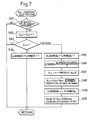
- Fig. 7 shows the K ALT learning sub-routine
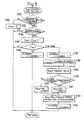
- Fig. 8 shows the K MAP learning sub-routine.
- step 41 in Fig. 6 the value of ⁇ controlling flag is judged, and when this value is 0, the routine goes into step 42 and count values C ALT and C MAP are cleared. Thus, the routine is ended.
- the reason is that when the air/fuel feedback control is stopped, learning cannot be performed.
- the K ALT learning is preferentially performed in the Q flat region (hatched region in Fig. 11) where the sucked air quantity Q is hardly changed by the change of the throttle valve opening degree ⁇ at each engine rotation number N, and the K MAP learning is performed in the other region.
- the comparative value ⁇ 1 is retrieved from the engine rotation number N, and at step 44, the actual throttle valve opening degree ⁇ (actual ⁇ ) is compared with comparative ⁇ 1.
- the portion of steps 43 and 44 corresponds to the indiscriminate learning region detecting means.
- the distribution-worsening region is allocated according to the opening degree of the throttle valve relatively to the engine rotation number, and if the throttle valve opening degree exceeds this critical level, the K ALT learning is inhibited. Accordingly, at step 45, comparative ⁇ 2 is retrieved from the engine rotation number N, and at step 46, actual ⁇ is compared with comparative ⁇ 2 and in case of actual ⁇ > comparative ⁇ 2, the routine goes into steps 50 and 51 and the count value C ALT is cleared. Then, the routine is changed over to the K MAP learning sub- routine shown in Fig. 8.
- the routine is changed over to the K MAP learning sub-routine shown in Fig. 8.
- the acceleration is detected based on the change ratio of the throttle valve opening degree ⁇ detected based on the signal from the throttle sensor 15 or based on on-to-off changeover of the idle switch 16.
- step 45, 46 and 47 corresponds to the indiscriminate learning inhibiting means.
- This K ALT learning sub-routine corresponds to the indiscriminate learning correction coefficient modifying means.
- step 61 it is judged whether or not the output of the O2 sensor 20 is reversed, that is, whether or not the increase or decrease direction of the feedback correction coefficient LAMBDA is reversed.
- the count value C ALT indicating the frequency of reversion is counted up by 1 at step 62.
- C ALT becomes, for example, equal to 3
- the routine goes into step 64 from step 63, and the deviation (LAMBDA - 1) of the present feedback correction coefficient LAMBDA from the reference value of 1 is temporarily stored as ⁇ LAMBDA1 and learning is initiated.
- the routine goes into step 65 from step 63, and the deviation (LAMBDA - 1) of the present feedback correction coefficient LAMBDA from the reference value of 1 is temporarily stored as ⁇ LAMBDA2.
- ⁇ LAMBDA1 and ⁇ LAMBDA2 are upper and lower peak values of the deviation of the feedback correction coefficient LAMBDA from the reference value of 1 during the period from the preceding reversion (for example, the third reversion) to the present reversion (for example, the fourth reversion).
- a new indiscriminate learning correction coefficient K ALT is computed by adding a predetermined proportion of the avarage value of the deviation of the feedback correction coefficient from the reference value to the present indiscriminate learning correction coefficient K ALT , and the data of the indiscriminate learning correction coefficient at the predetermined address of RAM is modified and rewritten as indicated by the following formula: K ALT ⁇ K ALT + M ALT ⁇ wherein M ALT stands for the addition proportion constant, which is in the range of 0 ⁇ M ALT ⁇ 1.
- ⁇ LAMBDA2 is substituted for ⁇ LAMBDA1 for the subsequent learning.
- the value of the K ALT learning counter is counted up by 1.
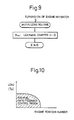
- the K ALT learning counter is set at 0 by the initializing routine shown in Fig. 9, which is carried out when the engine key switch 22 (or the start switch) is turned on, and this counter counts the frequency of learning after turning-on of the engine key switch 22.
- the K MAP learning sub-routine shown in Fig. 8 will be described. This K MAP learning sub-routine corresponds to the area-wise learning correction coefficient modifying means.
- step 81 it is judged whether or not the engine rotation number N and basic fuel injection quantity Tp, both indicating the engine driving state, are in the same area as the preceding area. In the case where the area is changed, the routine goes into step 82 and the count value C MAP is cleared. Thus, this sub-routine is ended.
- step 83 it is judged whether or not the output of the 02 sensor 20 is reversed, that is, whether or not the increase or decrease direction of the feedback correction coefficient LAMBDA is reversed. Every time this sub-routine is reversed repeatedly, the count value C MAP indicating the frequency of reversion is counted up by 1 at step 84.
- the routine goes into step 86 from step 85, and the deviation (LAMBDA - 1) of the present feedback correction coefficient LAMBDA from the reference value of 1 is temporarily stored as ⁇ LAMBDA1 and learning is initiated.
- step 87 the routine goes into step 87 from step 85, and the deviation (LAMBDA - 1) of the present feedback correction coefficient LAMBDA from the reference value of 1 is temporarily stored as ⁇ LAMBDA2.
- the routine goes into step 88 and the average value is calculated.
- the routine goes into step 89, and the stored area-wise learning correction coefficient K MAP (the initial value is 0) corresponding to the present area in the map on RAM is retrieved and read out.
- the routine goes into step 90, the value of the K ALT counter is compared with the predetermined value, and when the value of the K ALT counter is smaller than the predetermined value, the addition proportion constant (weighting constant) M MAP is set at a relatively small value M0 including the minimum value of 0 at step 91.
- the addition proportion constant (weighting constant) M MAP is set at a relatively large value M1. Incidentally, the relation of M1 « M ALT is established.
- a new area-wise learning correction coefficient K MAP is computed by adding a proportion, determined by the addition proportion constant M MAP , of the average value of the deviation of the feedback correction coefficient from the reference value to the present area-wise learning correction coefficient K MAP according to the following formula: K MAP ⁇ K MAP + M MAP ⁇ and the data of the area-wise learning correction coefficient of the same area of the map on RAM is modified and rewritten.
- ⁇ LAMBDA2 is substituted for ⁇ LAMBDA1 for the subsequent learning.
- M MAP is changed according to the frequency of the K ALT learning after turning-on of the engine key switch 22 (or the start switch) is that advance of the K MAP learning is controlled before the K ALT learning is experienced and in the extreme case, M MAP is set at 0 to inhibit the K MAP learning.
- the deviation by the change of the air density is preferentially learned indiscriminately in the Q flat region, the deviation by the change of the air density can be learned at a high speed, and there can be attained an effect of performing good learning and control of the air/fuel ratio against the deviation by the change of the air density even at mountain climbing or the like.
- the air/fuel ratio feedback control region which is the low-rotation low-load region shifts to the region where the air/fuel ratio feedback control is not performed
- the air/fuel ratio feedback control is continued for a predetermined time to increase the opportunity of learning and sufficient chance is given to learning of the deviation by the change of the air density. Accordingly, there can be attained an effect of coping efficiently with the deviation by the change of the air density.
Landscapes
- Engineering & Computer Science (AREA)
- Chemical & Material Sciences (AREA)
- Combustion & Propulsion (AREA)
- Mechanical Engineering (AREA)
- General Engineering & Computer Science (AREA)
- Electrical Control Of Air Or Fuel Supplied To Internal-Combustion Engine (AREA)
Abstract
Description
- The present invention relates to an apparatus for learning and controlling an air/fuel ratio in an automobile internal combustion engine having an electronically controlled fuel injection apparatus with an air/fuel ratio feedback control function. More specifically, the present invention relates to an apparatus for controlling and learning the air/fuel ratio, which can cope with the change of the air density which is due to the altitude.
- An apparatus for learning and controlling the air/fuel ratio, as disclosed in the specification of U.S. Patent No. 4,615,319, is adopted in an automobile internal combustion engine having an electronically controlled fuel injection apparatus with an air/fuel ratio feedback control function.
- In the control system where a basic fuel injection quantity calculated from a parameter of an engine driving state, which participates in the quantity of air sucked in an engine, is corrected by a feedback correction coefficient set by a proportional-integrating control based on a signal from an air/fuel ratio sensor, such as an O₂ sensor, disposed in the exhaust system of the engine to compute a fuel injection quantity and the air/fuel ratio is feedback-controlled to an aimed air/fuel ratio, according to the above-mentioned conventional technique, the deviation of the feedback correction coefficient from the reference value during the feedback control of the air/fuel ratio is learned for the respective predetermind areas of the engine driving state to determine a learning correction coefficient. In computing the fuel injection quantity, the basic fuel injection quantity is corrected by the learning correction coefficient for each area so that the basic air/fuel ratio obtained by the fuel injection quantity computed without correction by the feedback correction coefficient becomes in agreement with the aimed air/fuel ratio, and during the feedback control of the air/fuel ratio, this is further corrected by the feedback correction coefficient to compute the fuel injection quantity.
- According to this conventional technique, during the feedback control of the air/fuel ratio, follow-up delay of the feedback control can be prevented at the transient driving, and the desired air/fuel ratio can be precisely obtained at the stoppage of the feedback control of the air/fuel ratio.
- Furthermore, there is known the system where the basic fuel injection quantity Tp is determined from the throttle valve opening degree α and the engine rotation number N, for example, the sucked air flow quantity Q is determined from α and N by referring to a map and Tp is computed according to the formula of Tp = K·Q/N(K is a constant), and there is also known another system where the sucked air flow quantity Q is detected by an air flow meter and the basic fuel injection quantity is computed from the flow quantity Q and the engine rotation number N according to the formula of Tp = K·Q/N. In the case where a flap type air flow meter (volume flow rate-detecting type ) is used as the air flow meter, the change of the density of air is not reflected on the computation of the basic fuel injection quantity, but if the above-mentioned learning control is performed, the computation can cope with the change of the density of air due to the altitude or the temperature of sucked air, so far as learning is advanced in a good condition.
- However, in the case where an automobile abruptly ascends to an upland (mountain) from a low land, since the ascending driving is a kind of the transient driving, according to the system where learning is performed for the respective areas of the engine driving state, the area for learning is not fixed and even if learning is possible, learning-possible areas are limited while learning is hardly advanced in the majority of areas. Accordingly, in case of the ordinary driving or re-starting of the engine at a flat ground in the vicinity of the summit of the mountain, because of the control delay in the air/fuel ratio feedback control, an over-rich state in the air-fuel mixture gas is produced. This over-rich state is also produced because of the large deviation of the basic air/fuel ratio from the aimed air/fuel ratio at the stoppage of the air/fuel ratio feedback control. Appearance of this over-rich state results in occurrence of troubles such as reduction of the drivability, stalling of the engine and worsening of the restarting property.
- The reason is as follows. Although it is necessary to learn and correct the change of the density of air from the deviation of the feedback correction coefficient from the reference value during the air/fuel feedback control, since the learned deviation includes the deviation of the basic air/fuel ration which depends on dispersion of parts such as a fuel injecting valve or a throttle body and this deviation cannot be separated from the deviation due to the change of the air density, the deviation corresponding to the change of the air density, which can be inherently indiscriminately learned, should be learned for respective areas of the driving state of the engine, and in the case where the autmobile abruptly ascends to an upland, learning for the respective areas is impossible and learning is not substantially advanced.
- The premise of learning is that the air/fuel ratio feedback control is carried out. However, in the conventional techniques, the air/fuel ratio feedback control is carried out only in the low-rotation low-load region (inclusive of the medium-rotation medium-load region) set as the air/fuel ratio feedback control region. The reason is that if the feedback control to the theoretical air/fuel ratio, that is, the aimed air/fuel ratio, is carried out in the high-rotation or high-load region, there is a risk of seizure of the engine or burning of the catalyst by elevation of the temperature, and therefore, in this region, the feedback correction coefficient is clamped and a rich output air/fuel ratio is separately obtained to prevent seizure of the engine.
- Accordingly, when the automobile ascends to a mountain, the driving is performed mainly in the high-load region and the air/fuel ratio feedback control is hardly performed, and hence, learning is not substantially carried out. This is another reason why the deviation corresponding to the change of the air density cannot be promptly learned.
- It is a primary object of the present invention to solve the foregoing problems of the conventional techniques and provide an apparatus for learning and controlling the air/fuel ratio in an internal combustion engine, in which the deviation corresponding to the change of the air density can be learned at a high speed and the air/fuel ratio can be learned and controlled in a good condition even at the time of mountain climbing or the like.
- In order to attain this object, according to the present invention, the learning correction coefficient is divided into an indiscriminate learning correction coefficient for indisciminately learning the deviation corresponding to the change of the air density mainly for correction of the deviation due to the altitude and an area-wise learning correction coefficient for learning the deviation depending on dispersion of a part or the like for the respective areas of the engine driving state, and under conditions where only the deviation corresponding to the change of the air density can be learned, that is, in the region where the deviation of the system by the change of the opening degree of the throttle valve is not caused and the sucked air flow quantity is hardly changed by the change of opening degree of the throttle valve at each engine rotation number, the deviation corresponding to the change of the air density is indiscriminately learned and the indiscriminate learning correction coefficient is rewritten, and in the other region, the deviation depending on dispersion of a part or the like is learned for the respective areas and the area-wise learning correction coefficient is rewritten.
- More specifically, in accordance with the present invention, there is provided an apparatus for learning and controlling the air/fuel ratio in an internal combustion engine, which comprises:
- (A) engine driving state detecting means for detecting an engine driving state including at least a parameter participating in the quantity of air sucked in the engine;
- (B) air/fuel ratio detecting means for detecting an exhaust component of the engine and detecting the air/fuel ratio in an air/fuel mixture sucked in the engine;
- (C) basic fuel injection quantity setting means for setting the basic fuel injection quantity based on the parameter detected by the engine driving state detecting means;
- (D) rewritable indiscriminate learning correction coefficient storing means which stores therein an indiscriminate learning correction coefficient for indiscriminately correcting the basic fuel injection quantity for all the areas of the engine driving state;
- (E) rewritable area-wise learning correction coefficient storing means which stores therein an area-wise learning correction coefficient for correcting the basic fuel injection quantity for the respective areas of the engine driving state;
- (F) area-wise learning correction coefficient retrieving means for retrieving an area-wise learning correction coefficient of the corresponding area of the engine driving state from the area-wise learning correction coefficient storing means based on the actual engine driving state;
- (G) feedback correction coefficient setting means for comparing the air/fuel ratio detected by the air/fuel ratio detecting means with an aimed air/fuel ratio and increasing or decreasing by a predertermined quantity a feedback correction coefficient for correcting the basic fuel injection quantity to bring the actual air/fuel ratio close to the aimed air/fuel ratio;
- (H) fuel injection quantity computing means for computing the fuel injection quantity based on the basic fuel injection quantity set by the basic fuel injection quantity setting means, the indiscriminate learning correction coefficient stored in the indiscriminate learning correction coefficient storing means, the area-wise learning correction coefficient retrieved by the area-wise learning correction coefficient retrieving means and the feedback correction set by the feedback correction coefficient setting means;
- (I) fuel injection means for injecting and supplying a fuel to the engine in an on-off manner according to a driving pulse signal corresponding to the fuel injection quantity computed by the injection quantity computing means;
- (J) indiscriminate learning region detecting means for detecting a predetermined region where the sucked sir flow quantity is not substantially changed according to the change of the opening degree of the throttle valve at each engine rotation number;
- (K) indiscriminate learning correction coefficient modifying means for, on detection of the predetermined region by the indiscriminate learning region detecting means, learning the deviation of the feedback correction coefficient from the reference value and modifying and rewriting the indiscriminate learning correction coefficient of the indiscriminate learning correction coefficient storing means so as to reduce the deviation; and
- (L) area-wise learning correction coefficient modifying means for, on non-detection of the predetermined region by the indiscriminate learning region detecting means, learning the deviation of the feedback correction coefficient from the reference value for the respective areas of the engine driving state and modifying and rewriting the area-wise learning correction coefficient of the area-wise learning correction coefficient storing means so as to reduce the deviation.
- Namely, the basic fuel injection quantity setting means sets the basic fuel injection quantity corresponding to the aimed air/fuel ratio based on the parameter participating in the quantity of air sucked in the engine. The area-wise learning correction coefficient retrieving means retrieves the area-wise learning correction coefficient of the area corresponding to the actual engine driving state from the area-wise learning correction coefficient storing means. The feedback correction coefficient setting means compares the actual air/fuel ratio with the aimed air/fuel ratio and increases or decreases by a predetermined quantity and sets the feedback correction coefficient to bring the actual air/fuel ratio close to the aimed air/fuel ratio. The fuel injection quantity computing means corrects the basic fuel injection quantity by the indiscriminate learning correction coefficient stored in the indiscriminate learning correction coefficient storing means, by the area-wise learning correction coefficient and further by the feedback correction coefficient and computes the fuel injection quantity. The fuel injection means is actuated by a driving pulse signal corresponding to this fuel injection quantity.
- The indiscriminate region detecting means detects whether or not the region is a predetermined region where the sucked air flow quantity is not substantially changed according to the change of the opening degree of the throttle valve at each engine rotation number. In the case where said predetermined region is detected, the deviation of the feedback correction coefficient from the reference value is learned by the indiscriminate learning correction coefficient modifying means, and the indiscriminate learning correction coefficient is modified so as to reduce this deviation and the data in the indiscriminate learning correction coefficient storing means is rewritten. Thus, under conditions where only the deviation corresponding to the change of the air density can be learned, that is, in the region where the deviation of the system by the change of the opening degree of the throttle valve is not caused and the sucked air flow quantity is hardly changed by the change of the opening degree of the throttle valve at each engine rotation number, the deviation by the change of the air density is preferentially learned indiscriminately. Incidentally, it is not always true that in this region, any deviation by dispersion of a part or the like is not present, but since the opening degree of the throttle valve is high and the main deviation by dispersion of a part, that is, the deviation of the pulse width-injection flow quantity of the fuel injection valve or the deviation of the intake quantity characteristic by the opening degree of the throttle valve, is much smaller than in the region where the opening degree of the throttle valve is low, and this deviation can be learned while it is absorbed in the deviation by the change of the air density.
- In case of the region other than the above-mentioned predetermined region, by the area-wise learning correction coefficient modifying means, the deviation of the feedback correction coefficient from the reference value is learned for the respective areas of the engine driving state and the area-wise learning correction coefficient corresponding to the area of the engine driving state is modified to reduce the deviation and rewrites the data of the area-wise learning correction coefficient storing means is rewritten. Thus, the deviation by dispersion of a part or the like is learned for the respective areas.
- Incidentally, the basic fuel injection quantity setting means estimates the sucked air flow quantity, for example, from the opening degree of the throttle valve and the engine rotation number and sets the basic fuel injection quantity from this sucked air flow quantity and the engine rotation number. However, there may be adopted a method in which the sucked air flow quantity is directly detected. The storing areas of the area-wise learning correction coefficient storing means are sorted, for example, based on the engine rotation number and the basic fuel injection quantity, but other parameters may be used. The indiscriminate learning region detecting means retrieving a comparison value of, for example, the opening degree of the throttle valve determined according to the engine rotation number, compares the actual opening degree of the throttle valve with the comparative value and detects the indiscriminate learning region when the actual opening degree of the throttle valve is larger than the comparative value. It is sufficient if the indiscriminate learning region detecting means can detect the predetermined region where the sucked air flow quantity is not substantially changed by the change of the opening degree of the throttle valve at each engine rotation number.
- Furthermore, the present invention provides additional structural elements for learning the deviation by the change of the air density more precisely.
- In the case where the present invention is applied to a single-point injection system comprising common fuel injection means for all the cylinders, which is arranged in a collective portion of intake passages of the engine, in the region where the opening degree of the throttle valve is very large, the flow rate of sucked air is reduced and distribution of fuel into the respective cylinders is worsened, and the air/fuel ratio becomes uneven among the respective cylinders, with the result that it becomes impossible to precisely learn the deviation by the change of the air density. In the above-mentioned system, since the distance between the fuel injection means and the combustion chamber of each cylinder is long, the air/fuel ratio in each cylinder is distributed by the influence of fuel flowing on the wall during high acceleration and precise learning of the deviation by the change of the air density becomes impossible.
- Accordingly, the following means (M) is disposed in addition to the above-mentioned means (A) through (L):
- (M) indiscriminate learning inhibiting means for inhibiting the learning by the indiscriminate learning correction coefficient modifying means in a predetermined engine driving state.
- Thus, even in the region where the sucked air flow quantity is not substantially changed by the change of the opening degree of the throttle valve at each engine rotation number, the learning of the indiscriminate learning correction coefficient is inhibited in the distribution-worsening region predetermined by the engine rotation number and the opening degree of the throttle valve and in the predetermined engine driving state continuing for a predetermined time after the acceleration, whereby the accuracy of learning is increased.
- Furthermore, the present invention provides an additional structural element for increasing the opportunity of learning of the deviation by the change of the air density in the system where the low-rotation low-load region is set as the air/fuel ratio feedback control region.
- Namely, even if the air/fuel ratio feedback control region which is the low-rotation low-load region shifts to the region where the feedback control of the air/fuel ratio is not performed, the air/fuel ratio feedback control is continued for a predetermined time so that learning can be performed during this time, whereby the opportunity of learning of the deviation by the change of the air density is increased at the time of mountain climbing or the like.
- In this case, with respect to the feedback correction coefficient setting means, indiscriminate learning correction coefficient modifying means and area-wise learning correction coefficient modifying means, it is required that it should be one of the operational conditions that feedback control instructions are being put out, and the following means (N) and (O) are additionally disposed:
- (N) air/fuel ratio feedback control region detecting means for discriminating the engine driving state, detecting the air/fuel ratio control region which is the low-rotation low-load region and putting out air/fuel ratio feedback control instructions; and
- (O) delay means for continuing to put out air/fuel ratio feedback control instructions for a predetermined time when the air/fuel ratio feedback control region to other region.
- According to this embodiment, in the case where the air/fuel ratio feedback control region which is the low-rotation low-loaded region shifts to the region where the feedback control of the air/fuel ratio is not performed, air/fuel ratio feedback control instructions are kept put out for a predetermined time by said delay means to perform the air/fuel ratio feedback control by the feedback correction coefficient setting means. If predetermined conditions are satisfied during this predetermined time, learning is performed by the indiscriminate learning correction coefficient modifying means, whereby the opportunity of learning is increased even at the time of mountain climbing or the like and the deviation by the change of the air density can be learned at a high speed.
- Incidentally, although the air/fuel ratio feedback control is continued for a predetermined time when the air/fuel ratio feedback control region shifts to the region where the air/fuel ratio feedback control is not performed, the term "predetermined time" used does not absolutely mean "a certain time", but the delay time can be changed according to the circumstance. For example, completion of at least one learning (rewriting of the indiscriminate learning correction coefficient) is inspected, and the air/fuel ratio feedback control is continued until this learning is completed.
- Example of the present invention will now be described with reference to the accompanying drawings in which:-
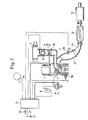
- Fig. 1 is a schematic view of an internal combustion engine, which illustrates one embodiment of the present invention.
- Fig. 2 is a function block diagram showing the fuel injection control in the control unit shown in Fig. 1.
- Fig. 3 is a flow chart showing the fuel injection quantity computing routine.
- Fig. 4 is a flow chart showing the feedback control zone judging routine.
- Fig. 5 is a flow chart showing the proportional-integrating control routine.
- Fig. 6 is a flow chart showing the learning routine.
- Fig. 7 is a flow chart showing the KALT learning sub-routine in Fig. 6.
- Fig. 8 is a flow chart showing the KMAP learning sub-routine in Fig. 6.
- Fig. 9 is a flow chart showing the initializing routine.
- Fig. 10 is a diagram illustrating the air/fuel ratio feedback control region.
- Fig. 11 is a diagram illustrating the learning region for the indiscriminate learning correction coefficient.
- Fig. 12 is a diagram illustrating the change of the feedback correction coefficient.
- Referring to Fig. 1, air is sucked into an engine through an
air cleaner 2, athrottle body 3 and anintake manifold 4. - In the
throttle body 3, athrottle valve 5 interlocking with an accelerating pedal not shown in the drawings is disposed, and a fuel injection valve 6 is arranged as the fuel injecting means upstream of thethrottle valve 5. The fuel injection valve 6 is an electromagnetic fuel injection valve which is opened when a solenoid is actuated and is closed when the solenoid is de-energized. Namely, the solenoid is actuated by a driving pulse signal from acontrol unit 14 described hererinafter to open the fuel injection valve 6, and a compressed fuel fed from a fuel pump not shown in the drawings is injected and supplied while the pressure of the fuel is adjusted to a predetermined level by a pressure regulator. In the present embodiment, a single-point injection system is adopted, but there may be adopted a multi-point injection system in which fuel injection valves are arranged for the respective cylinders in a branching portion of the intake manifold or in an intake port of the engine. - An ignition plug 7 is arranged in a combustion chamber of the
engine 1, and a high voltage generated in a spark coil 6 based on an ignition signal from thecontrol unit 14 is applied to the ignition plug 7 through adistributor 9 to fire and burn an air/fuel mixture by the spark ignition. - An exhaust gas is discharged from the
engine 1 through anexhaust manifold 10, anexhaust duct 11, aternary catalyst 12 and amuffler 13. - The
control unit 14 comprises a micro-computer including CPU, ROM, A/D converter and input-output interface, and thecontrol unit 14 receives input signals from various sensors and performs computing processings described hereinafter to control the operations of the fuel injection valve 6 and an ignition coil 8. - As the sensors, there can be mentioned a potentiometer
type throttle sensor 15 arranged in thethrottle valve 5 to put out a voltage signal corresponding to the opening degree of the throttle valve and anidle switch 16 arranged in thethrottle sensor 15, which is turned on when thethrottle valve 5 is located at the fully closed position. - A
crank angle sensor 17 is built in thedistributor 9 to put out position signals by every crank angle of 2° and reference signals by every crank of 180° (in case of a 4-cylinder engine). The engine rotation number N can be calculated by measuring the pulse number of position signals per unit time or the frequency of reference signals. - There are disposed a
water temperature sensor 18 for detecting the temperature Tw of engine-cooling water and acar speed sensor 19 for detecting a car speed VSP. - These
throttle sensor 15 and crankangle sensor 17 are disposed as the engine driving state detecting means. - An
O₂ sensor 20 is arranged in theexhaust manifold 10. This O₂ sensor is a known sensor in which the electromotive force abruptly change at the boundary where the air/fuel mixture is burnt in the vicinity of the theoretical air/fuel ratio which is the aimed air/fuel ratio. Accordingly, theO₂ sensor 20 acts as the means for detecting the air/fuel ratio (rich or lean). - A
battery 21 is connected to thecontrol unit 14 through an enginekey switch 22 as a power source for thecontrol unit 14 or as means for detecting the power source voltage. As the power source for the operation of RAM in thecontrol unit 14, abattery 21 is connected to thecontrol unit 14 through an appropriate stabilizing power source, not through the enginekey switch 22, so that the memory content can be retained even after the enginekey switch 22 is turned off. - In this embodiment, CPU built in the micro-computer 14 performs computing processings according to programs (fuel injection quantity computing routine, feedback control zone judging routine, proportional-integrating control routine, learning routine, KALT learning sub-routine, KMAP learning sub-routine and initializing routine) on ROM, as shown in the block diagram of Fig. 2, in detail in flow charts of Figs. 3 through 9, to control the injection of the fuel.
- The summary of the computing processings of the micro-computer in the control unit will now be described with reference to the block diagram of Fig. 2.
- Referring to Fig. 2, by RAM of the micro-computer the
control unit 14 functions as rewritable indiscriminate learning correction coefficient storing means 101 which stores an indiscriminate learning correction coefficient KALT (the initial value is, for example, 0) which is indiscriminate over all the areas of the engine driving state and as rewritable area-wise learning correction coefficient storing means 102 which stores an area-wise learning correction coefficient KMAP (the initial value is, for example, 0) for the respective areas of the engine rotation number N and engine load (basic fuel injection quantity Tp) indicating the driving state of the engine. - Furthermore, since CPU of the micro-computer of the
control unit 14 performs computing according to the programs on ROM, thecontrol unit 14 also functions as basic fuel injection quantity setting means 103, area-wise learning correction coefficient retrieving means 104, air/fuel ratio feedback control region detecting means 105, delay means 106, feedback correction coefficient setting means 107, fuel injection quantity computing means 108, indiscriminate learning region detecting means 109, indiscriminate learning correction coefficient modifying means 110, area-wise learning correction coefficient modifying means 111 and indiscriminatelearning inhibiting means 112. - The basic fuel injection quantity setting means 103 sets the basic fuel injection quantity Tp corresponding to the aimed air/fuel ratio based on the opening degree α of the throttle valve and the engine rotation number N, which are parameters participating in the quantity of air sucked in the engine.
- The area-wise learning correction coefficient retrieving means 104 retrieves the area-wise learning correction coefficient KMAP of the area corresponding to the actual engine driving state (N and Tp) from the area-wise learning correction coefficient storing means 102.
- The feedback correction coefficient setting means 107 compares the actual air/fuel ratio with the aimed air/fuel ratio while air/fuel ratio feedback control instructions are put out by the air/fuel ratio feedback control region detecting means 105, that is, the low-rotation low-load air/fuel ratio feedback control region hatched in Fig. 10, and sets the feedback correction coefficient LAMBDA (the reference value is, for example, 1) by increasing or decreasing the feedback correction coefficient LAMBDA by a predetermined proportional constant P or integrating constant I based on the proportional-integrating control so that the actual air/fuel ratio is brought close to the aimed air/fuel ratio.
- The fuel injection quantity computing means 108 corrects the basic fuel injection quantity Tp by the indiscriminate learning correction coefficient KALT stored in the indiscriminate learning correction coefficient storing means 101, by the area-wise learnig correction coefficient KMAP and further by the feedback correction coefficient LAMBDA, whereby the fuel injection quantity Ti =Tp·(LAMBDA + KALT + KMAP) is computed. The fuel injection valve 6 as the fuel injection means is operated by a driving pulse signal corresponding to this fuel injection quantity Ti.
- The indiscriminate learning region detecting means 109 detects whether or not the region is the predetermined high-load region (hereinafter referred to as "Q flat region") where the sucked air flow quantity Q is hardly changed by the change of the throttle valve opening degree α, which region is hatched in Fig. 11.
- In case of the Q flat region, while the air/fuel ratio feedback control instructions are being put out, the deviation ΔLAMBDA of the feedback correction coefficient LAMBDA from the reference value (for example, 1) is learned by the indiscriminate learning correction coefficient modifying means 110, and the indiscriminate learning correction coefficient KALT is modified to reduce this deviation, whereby the date of the indiscriminate learning correction coefficient storing means 101 is rewritten. More specifically, the indiscriminate learning correction coefficient KALT is renewed by adding a predetermined proportion of the deviation ΔLAMBDA to the present indiscriminate learning correction coefficient KALT according to the following formula:
KALT← KALT + MALT·ΔLAMBDA
wherein MALT represents the predetermined addition proportion. - In the above-mentionde manner, under conditions where only the deviation by the change of the air density can be learned, that is, in the region where no deviation of the system is caused by the change of the opening degree of the
throttle valve 5, the deviation by the change of the air density is preferentially learned indiscriminately. - However, in the single-point injection system, even in the Q flat region, learning of the indiscriminate learning correction coefficient KALT is inhibited by the indiscriminate
learning inhibiting means 112 in the distribution-worsening region and/or until a predetermined time passes after the acceleration (until the wall flow become stationary), whereby the accuracy of learning is increased. - In the region other than the above-mentioned Q flat region, while the air/fuel ratio feedback control instruction are being put out, the deviation ΔLAMBDA of the feedback correction coefficient LAMBDA from the reference value for the respective areas of the engine rotation number N and basic fuel injection quantity Tp indicating the engine driving state is learned by the area-wise learning correction coefficient modifying means 111, and the area-wise learning correction coefficient KMAP of the area corresponding to the actual engine driving state is modified so that this deviation is reduced and the data of the area-wise learning correction coefficient storing means 102 is rewritten. More specifically, the area-wise learning correction coefficient KMAP is renewed by adding a predetermined proportion of the deviation ΔLAMBDA to the present area-wise learning correction coefficient KMAP according to the following formula:
KMAP← KMAP + MMAP · ΔLAMBDA
wherein MMAP represents the predetermined addition proportion. - In the above-mentioned manner, the deviation by dispersion of a part or the like is learned for the respective areas.
- In this embodiment, when the air-fuel ratio feedback control region which is the low-rotation low-load region shifts to the region where the air/fuel ratio feedback control is not preformed, the air/fuel ratio feedback control instructions are kept put out for a predetermined time by the delay means 106, and the air/fuel ratio feedback control is preformed by the feedback correction coefficient setting means 107. During this period, learning is performed by the indiscriminate learning correction coefficient modifying means 110 or area-wise learning correction coefficient mpdofying means 111. Accordingly, the opportunity of learning is increased at the time of mountain climbing or the like and deviation by the change of the air density can be learned at a high speed.
- The computing processings by the micro-computer in the
control unit 14 will now be described in detail with reference to the flow charts of Figs. 3 through 9. - In the fuel injection quantity computing routine shown in Fig. 3, at step 1 (represented by S1 in the drawings; subsequent steps will be similarly represented), the throttle valve opening degree α detected based on the signal from the
throttle sensor 15 and the engine rotation number N calculated based on the signal from thecrank angle sensor 17 are read in. - At
step 2, the sucked air flow quantity Q corresponding to the actual throttle valve opening degree α and engine rotation number N is retrieved and read in the micro-computer with reference to the map on ROM in which values Q corresponding to value α and N, which have been determined in advance by experiments or the like, are stored. - At
step 3, the basic fuel injection quantity Tp = K·Q/N (K is a constant) corresponding to the quantity of air sucked in theengine 1 per unit rotation is computed from the sucked air flow quantity Q and the engine rotation number N. The portion of thesesteps 1 through 3 corresponds to the basic fuel injection quantity setting means. - Various correction coefficient COEF including the ratio of the change of the throttle valve opening degree α detected based on the signal from the
throttle sensor 15, the acceleration correction coefficient by on-to-off changeover of theidle switch 16, the water temperature correction coefficient corresponding to the engine-cooling water temperature Tw detected based on the signal from thewater temperature sensor 18 and the mixture ratio correction coefficient corresponding to the engine rotation number N and basic fuel injection quantity Tp are set atstep 4. - At
step 5, the indiscriminate learning correction coefficient KALT stored at a predetermined address of RAM as the indiscriminate learning correction coefficient storing means is read in. Incidentally, before initiation of learning, the indiscriminate learning correction coefficient KALT is stored as the initial value of 0, and this initial value is read in. - At step 6, by referring to the map on RAM as the area-wise learning correction coefficient storing means, in which the area-wise learning correction coefficient KMAP corresponding to the engine rotation number N and basic fuel injection quantity Tp indicating the engine driving state is stored, KMAP corresponding to actual N and Tp are retrieved and read in. The portion of this step corresponds to the area-wise correction coefficient retrieving means. In the map of the area-wise learning correction coefficient KMAP, the engine rotation number N is plotted on the ordinate and the basic fuel injection quantity Tp is plotted on the abscissa, and the engine driving state is divided into areas by a lattice of about 8 × 8. The area-wise learning correction coefficient KMAP is stored for each area, and at the point when learning is not initiated, the initial value of 0 is stored for all the areas.
- At step 7, the feedback correction coefficient LAMBDA set by the proportional-integrating control routine shown in Fig. 5, which will be described hereinafter, is read in. Incidentally, the reference value of the feedback correction coefficient LAMBDA is 1.
- At step 8, the voltage correction portion Ts is set based on the voltage value of the
battery 21 to correct the change of the injection flow quantity of the fuel injection valve by the variation of the battery voltage. - At
step 9, the fuel injection quantity Ti is computed according to the formula of Ti = Tp·COEF·(LAMBDA + KALT + KMAP) + Ts, and the portion of this step corresponds to the fuel injection quantity computing means. - At
step 10, computed Ti is set at an output resistor. Thus, at a fuel injection timing synchronous with a predetermined engine rotation number (for example, every 1/2 rotation), a driving pulse signal having a pulse width of Ti is given to the fuel injeition valve 6 to perform injection of the fuel. - Fig. 4 shows the feedback control zone judging routine, which is disposed in principle for performing the air/fuel feedback control in the low-rotation low-load region (hatched region in Fig. 10) and stopping the air/fuel feedback control in the high-rotation or high-load region.
- At
step 21, comparative Tp is retrieved from the engine rotation number N, and atstep 22, the actual fuel injection quantity Tp (actual Tp) is compared with comparative Tp. - In case of actual Tp ≦ comparative Tp, that is, in case of the low-rotation low-load region, the routine goes into
step 23 and a delay timer (counting up by a clock signal) is reset, and the routine goes into step 26 and λ controlling flag is set at 1. This is for performing the air/fuel ratio feedback control in case of the low-rotation low-load region. Accordingly, the portion ofsteps - In case of actual Tp > comparative Tp, that is, at a high rotation or high load, in principle, the routine goes into step 27 and λ controlling flag is set at 0. This is for stopping the air/fuel ratio feedback control and obtaining a rich output air/fuel ratio by means of another way to control the elevation of the exhaust temperature and prevent seizure of the
engine 1 and burning of thecatalyst 12. - Incidentally, even at a high rotation or high load, by comparing the value of the delay timer with the predetermined value at step 24, the routine goes into step 26 to keep λ controlling flag set at 1 for a predetermined time (for example, 10 seconds) after shifting to the high-rotation or high-load region, whereby the air/fuel ratio feedback control is continued for this predetermined time. This is for increasing the opportunity of learning of the indiscriminate learning correction coefficient KALT because mountain climbing is performed in the high-load region. Accordingly, the portion of step 24 corresponds to the delay means for continuing to put out the air/fuel ratio feedback control instructions for a predetermined time when the air/fuel raito feedback control region shifts to the other region.
- Incidentally, in the case where the judgement at
step 25 indicates that the engine rotation number N exceeds a predetermined value (for example, 3800 rpm) or in the case where this excess is continued for a predetermined time, the air/fuel ratio feedback control is stopped for safety's sake. - Fig. 5 shows the proportional-integrating routine, and the processing of this routine is performed at predetermined intervals (for example, 10 ms), whereby the feedback correction coefficient LAMBDA is set. Accordingly, this routine corresponds to the feedback correction coefficient setting means.
- At step 31, the value of λ controlling flag is judged, and if that value is 0, this routine is ended. In this case, the feedback correction coefficient LAMBDA is clamped to precedent value (or the reference value of 1), and the air/fuel ratio feedback control is stopped.
- In the case where the value of λ controlling flag is 1, the routine goes into step 32 and the output voltage V₀₂ of the O₂ sensor is read in, and at subsequent step 33, the output voltage V₀₂ is compared with the slice level voltage Vref corresponding to the theoretical air/fuel ratio and it is judged whether the air/fuel ratio is rich or lean.
- In the case where the air/fuel ratio is lean (V₀₂ < Vref), the routine goes into
step 34 from step 33, it is judged whether or not the rich value is reversed to the lean value (just after the reversion), and when the reversion is judged, the routine goes intostep 35 and the precedent value of the feedback correction coefficient LAMBDA is increased by the predetermined proportional constant P to obtain the present valve. When the case other than the reversion is judged, the routine goes intostep 36, the precedent value of the feedback correction coefficient LAMBDA is increased by the predetermined integration constant I to obtain the present valve. Thus, the feedback correction coefficient LAMBDA is increased at a certain gradient. Incidentally, the relation of P » I is established. - In the case where the air/fuel ratio is rich (V₀₂ > Vref), the routine goes into step 37 from step 33 and it is judged whether the lean value is reversed to the rich value (just after the reversion), and when the reversion is judged, the routine goes into step 38 and the precedent value of the feedback correction coefficient LAMBDA is decreased by the predetermined proportional constant P. When the case other than the reversion is judged, the precedent value of the feedback correction coefficient LAMBDA is decreased by the integration constant I. Thus, the feedback correction coefficient LAMBDA is decreased at a certain gradient.
- Fig. 6 shows the learning routine, Fig. 7 shows the KALT learning sub-routine, and Fig. 8, shows the KMAP learning sub-routine.
- At step 41 in Fig. 6, the value of λ controlling flag is judged, and when this value is 0, the routine goes into step 42 and count values CALT and CMAP are cleared. Thus, the routine is ended. The reason is that when the air/fuel feedback control is stopped, learning cannot be performed.
- In the case where the value of λ controlling flag is 1, that is, during the air/fuel raito feedback control, the routine goes into step 43, and subsequent steps, changeover is effected between the learning of the indiscriminate learning correction coefficient KALT (hereinafter referred to as "KALT learning") and the learning of the area-wise learning correction coefficient KMAP (hereinafter referred to as "KMAP learning").
- More specifically, the KALT learning is preferentially performed in the Q flat region (hatched region in Fig. 11) where the sucked air quantity Q is hardly changed by the change of the throttle valve opening degree α at each engine rotation number N, and the KMAP learning is performed in the other region. Accordingly, at step 43, the comparative value α₁ is retrieved from the engine rotation number N, and at step 44, the actual throttle valve opening degree α (actual α) is compared with comparative α₁. The portion of steps 43 and 44 corresponds to the indiscriminate learning region detecting means.
- In case of actual α ≧ comparative α₁ (Q flat region ), the routine goes, in principle, into steps 48 and 49, and the count value CMAP is cleared and the processing is carried out along the KALT learning sub-routine.
- However, in case of the single-point injection system, in the region where the opening degree of the
throttle valve 5 is very large, the flow rate of sucked air is reduced and the distribution of the fuel to the respective cylinders is worsened. Accordingly, the distribution-worsening region is allocated according to the opening degree of the throttle valve relatively to the engine rotation number, and if the throttle valve opening degree exceeds this critical level, the KALT learning is inhibited. Accordingly, at step 45, comparative α₂ is retrieved from the engine rotation number N, and at step 46, actual α is compared with comparative α₂ and in case of actual α > comparative α₂, the routine goes intosteps 50 and 51 and the count value CALT is cleared. Then, the routine is changed over to the KMAP learning sub- routine shown in Fig. 8. - In case of the single-point injection system, since the distance between the fuel injection valve 6 and the combustion chamber of the
engine 1 is long and the air/fuel ratio in each cylinder is disturbed by the influence of the fuel flowing on the wall during high acceleration, precise KALT learning is impossible. Therefore, in the case where the engine driving state goes into the Q flat region after high acceleration, the KALT learning is carried out after the lapse of a predetermined time, that is, after the water flow becomes stationary. Accordingly, at step 47, it is judged whether or not a predetermined time has passed from the point of acceleration, and when it is judged that the predetermined time has not passed, the routine goes intosteps 50 and 51 and the count value CALT is cleared. Then, the routine is changed over to the KMAP learning sub-routine shown in Fig. 8. Incidentally, the acceleration is detected based on the change ratio of the throttle valve opening degree α detected based on the signal from thethrottle sensor 15 or based on on-to-off changeover of theidle switch 16. - The portion of step 45, 46 and 47 corresponds to the indiscriminate learning inhibiting means.
- In the case where actual α < comparative α₁ is judged at step 44, the routine goes into
steps 50 and 51, and the count value CALT is cleared and the routine is changed over to the KMAP learning sub-routine shown in Fig. 8. - The KALT learning sub-routine shown in Fig. 7 will now be described. This KALT learning sub-routine corresponds to the indiscriminate learning correction coefficient modifying means.
- At step 61, it is judged whether or not the output of the
O₂ sensor 20 is reversed, that is, whether or not the increase or decrease direction of the feedback correction coefficient LAMBDA is reversed. When this sub-routine is reversed repeatedly, the count value CALT indicating the frequency of reversion is counted up by 1 at step 62. When CALT becomes, for example, equal to 3, the routine goes into step 64 from step 63, and the deviation (LAMBDA - 1) of the present feedback correction coefficient LAMBDA from the reference value of 1 is temporarily stored as ΔLAMBDA₁ and learning is initiated. - When CALT becomes 4 or more, the routine goes into step 65 from step 63, and the deviation (LAMBDA - 1) of the present feedback correction coefficient LAMBDA from the reference value of 1 is temporarily stored as ΔLAMBDA₂. As shown in Fig. 12, thus stored ΔLAMBDA₁ and ΔLAMBDA₂ are upper and lower peak values of the deviation of the feedback correction coefficient LAMBDA from the reference value of 1 during the period from the preceding reversion (for example, the third reversion) to the present reversion (for example, the fourth reversion).
- When the upper and lower peak values ΔLAMBDA₁ and ΔLAMBDA₂ of the feedback correction coefficient LAMBDA from the reference value of 1 are thus determined, the routine goes into step 66 and average valueis determined according to the following formula:

= (ΔLAMBDA₁ + ΔLAMBDA₂)/2
- Then, the routine goes into step 67 and the present indiscriminate learning correction coefficient KALT (initial value = 0) stored at a predetermined address of RAM is read out.
- Then, the routine goes into step 68 and a new indiscriminate learning correction coefficient KALT is computed by adding a predetermined proportion of the avarage valueof the deviation of the feedback correction coefficient from the reference value to the present indiscriminate learning correction coefficient KALT, and the data of the indiscriminate learning correction coefficient at the predetermined address of RAM is modified and rewritten as indicated by the following formula:

KALT←KALT + MALT·
wherein MALT stands for the addition proportion constant, which is in the range of 0 < MALT < 1. - The, at step 69, ΔLAMBDA₂ is substituted for ΔLAMBDA₁ for the subsequent learning.
- Then, at step 70, the value of the KALT learning counter is counted up by 1. Incidentally, the KALT learning counter is set at 0 by the initializing routine shown in Fig. 9, which is carried out when the engine key switch 22 (or the start switch) is turned on, and this counter counts the frequency of learning after turning-on of the engine
key switch 22. - The KMAP learning sub-routine shown in Fig. 8 will be described. This KMAP learning sub-routine corresponds to the area-wise learning correction coefficient modifying means.
- At step 81, it is judged whether or not the engine rotation number N and basic fuel injection quantity Tp, both indicating the engine driving state, are in the same area as the preceding area. In the case where the area is changed, the routine goes into step 82 and the count value CMAP is cleared. Thus, this sub-routine is ended.
- In the case where it is judged that the area is the same as the preceding area, at step 83 it is judged whether or not the output of the 0₂
sensor 20 is reversed, that is, whether or not the increase or decrease direction of the feedback correction coefficient LAMBDA is reversed. Every time this sub-routine is reversed repeatedly, the count value CMAP indicating the frequency of reversion is counted up by 1 at step 84. When the value of CMAP becomes equal to, for example, 3, the routine goes into step 86 from step 85, and the deviation (LAMBDA - 1) of the present feedback correction coefficient LAMBDA from the reference value of 1 is temporarily stored as ΔLAMBDA₁ and learning is initiated. - When the value of CMAP becomes 4 or more, the routine goes into step 87 from step 85, and the deviation (LAMBDA - 1) of the present feedback correction coefficient LAMBDA from the reference value of 1 is temporarily stored as ΔLAMBDA₂.
- When the upper and lower peak values ΔLAMBDA₁ and ΔLAMBDA₂ of the deviation of the feedback correction coefficient LAMBDA from the reference value of 1 are thus determined, the routine goes into step 88 and the average valueis calculated.

- Then, the routine goes into
step 89, and the stored area-wise learning correction coefficient KMAP (the initial value is 0) corresponding to the present area in the map on RAM is retrieved and read out. - Then, the routine goes into step 90, the value of the KALT counter is compared with the predetermined value, and when the value of the KALT counter is smaller than the predetermined value, the addition proportion constant (weighting constant) MMAP is set at a relatively small value M₀ including the minimum value of 0 at step 91. On the other hand, when the value of the KALT counter is equal to or larger than the predetermined value, the addition proportion constant (weighting constant) MMAP is set at a relatively large value M₁. Incidentally, the relation of M₁ « MALT is established.
- The, the routine goes into step 93, and a new area-wise learning correction coefficient KMAP is computed by adding a proportion, determined by the addition proportion constant MMAP, of the average valueof the deviation of the feedback correction coefficient from the reference value to the present area-wise learning correction coefficient KMAP according to the following formula:

KMAP←KMAP + MMAP·
and the data of the area-wise learning correction coefficient of the same area of the map on RAM is modified and rewritten. - At step 94, ΔLAMBDA₂ is substituted for ΔLAMBDA₁ for the subsequent learning.
- The reason why the requirement of MALT » MMAP is set with respect to the addition proportion constant (weighting constant) is that the KALT learning preferentially performed by imposing a large weight on the learned value in modifying the indiscriminate learning correction coefficient KALT and imposing a small weight on the learned value in modifying the area-wise learning correction coefficient KMAP, since the KALT learning is first carried out and the area-wise KMAP learning is then performed.
- The reason why the value of MMAP is changed according to the frequency of the KALT learning after turning-on of the engine key switch 22 (or the start switch) is that advance of the KMAP learning is controlled before the KALT learning is experienced and in the extreme case, MMAP is set at 0 to inhibit the KMAP learning.
- In the case where the KALT learning is always made preferential to the KMAP learning in the above-mentioned manner, it becomes possible to prevent degradation of the driving and emision characteristics, which is caused by large gaps of the area-wise learning correction coefficient KMAP among the areas, which gaps are produced when the KMAP learning inclusive of learning of the deviation by the change of the air density is advanced only in limited areas without sufficient advance of the KALT learning in the case where an automobile ascends to an upland by such driving that the driving state hardly enters into the Q flat region.
- As is apparent from the foregoing illustration, according to the present invention, since the deviation by the change of the air density is preferentially learned indiscriminately in the Q flat region, the deviation by the change of the air density can be learned at a high speed, and there can be attained an effect of performing good learning and control of the air/fuel ratio against the deviation by the change of the air density even at mountain climbing or the like.
- Furthermore, when the present invention is applied to the single-point injection system, there can be attained an effect of increasing the accuracy of learning while taking the characteristics of this system into consideration.
- Moreover, according to the present invention, in the case where the air/fuel ratio feedback control region which is the low-rotation low-load region shifts to the region where the air/fuel ratio feedback control is not performed, the air/fuel ratio feedback control is continued for a predetermined time to increase the opportunity of learning and sufficient chance is given to learning of the deviation by the change of the air density. Accordingly, there can be attained an effect of coping efficiently with the deviation by the change of the air density.
Claims (13)
engine driving state detecting means for detecting an engine driving state including at least a parameter participating in the quantity of air sucked in the engine;
air/fuel ratio detecting means for detecting an exhaust component of the engine and thereby detecting the air/fuel ratio in an air/fuel mixture sucked in the engine;
basic fuel injection quantity setting means for setting the basic fuel injection quantity based on said parameter detected by said engine driving state detecting means;
rewritable indiscriminate learning correction coefficient storing means which stores therein an indiscriminate learning correction coefficient for indiscriminately correcting said basic fuel injection quantity for all the areas of the engine driving state;
rewritable area-wise learning correction coefficient storing means which stores therein an area-wise learing correction coefficient for correcting said basic fuel injection quantity for the respective areas of the engine driving state;
area-wise learning correction coefficient retrieving means for retrieving an area-wise learning correction coefficient of the corresponding area of the engine driving state from said area-wise learning correction coefficient storing means based on the actual engine driving state;
feedback correction coefficient setting means for comparing the air/fuel ratio detected by said air/fuel ratio detecting means with an aimed air/fuel ratio and increasing or descreasing by a predetermined quantity a feedback correction coefficient for correcting said basic fuel injection quantity to bring the actual air/fuel ratio close to the aimed air/fuel ratio;
fuel injection quantity computing means for computing the fuel injection quantity based on the basic fuel injection quantity set by said basic fuel injection quantity setting means, the indiscriminate learning correction coefficient stored in said indiscriminate learning correction coefficient storing means, the area-wise learning correction coefficient retrieved by said area-wise learning correction coefficient retrieving means and the feedback correction coefficient set by said feedback correction coefficient setting means;
fuel injection means for injecting and supplying a fuel to the engine in an on-off manner according to a driving pulse signal corresponding to the fuel injection quantity computed by said fuel injection quantity computing means;
indiscriminate learning region detecting means for detecting a predetermined high load region of the engine where the sucked air flow quantity is not substantially changed according to the change of the opening degree of a throttle valve at each engine speed;
indiscriminate learning correction coefficient modifying means for, on detection of said predetermined region by said indiscriminate learning region detecting means, learning the deviation of the feedback correction coefficient from a reference value and modifying and rewriting the indiscriminate learning correction coefficient of said indiscriminate learning correction coefficient storing means so as to reduce said deviation; and
area-wise learning correction coefficient modifying means for, on non-detection of said predetermined region by said indiscriminate learning region detcting means, learning the deviation of the feedback correction coefficient from a reference value for the respective areas of the engine driving state and modifying and rewriting the area-wise learning correction coefficient of said area-wise learning correction coefficient storing means so as to reduce said deviation.
engine driving state detecting means for detecting an engine driving state including at least a parameter participating in the quantity of air sucked in the engine;
air/fuel ratio detecting means for detecting an exhaust component of the engine and thereby detecting the air/fuel ratio in air/fuel mixture sucked in the engine;
basic fuel injection quantity setting means for setting the basic fuel injection quantity based on said parameter detected by said engine driving state detecting means;
rewritable indiscriminate learning correction coefficient storing means which stores therein an indiscriminate learning correction coefficient for indiscriminately correcting said basic fuel injection quantity for all the areas of the engine driving state;
rewritable area-wise learning correction coefficient storing means which stores therein an area-wise learning correction coefficient for correcting said basic fuel injection quantity for the respective areas of the engine driving state;
area-wise learnig correction coefficient retrieving means for retrieving an area-wise learning correction coefficient of the corresponding area of the engine driving state from said area-wise learning correction coefficient storing means based on the actual engine driving state;
feedback correction coefficient setting means for comparing the air/fuel ratio detected by said air/fuel ratio detecting means with an aimed air/fuel ratio and increasing or decreasing by a predetermined quantity a feedback correction coefficient for correcting said basic fuel injection quantity to bring the actual air/fuel ratio close to the aimed air/fuel ratio;
fuel injection quantity computing means for computing the fuel injection quantity based on the basic fuel injection quantity set by said basic fuel injection quantity setting means, the indiscriminate learning correction coefficient stored in said indiscriminate learning correction coefficient storing means, the area-wise learning correction coefficient retrieved by said area-wise learning correction coefficient retrieving means and the feedback correction coefficient set by said feedback correction coefficient setting means;
fuel injection means for injecting and supplying a fuel to a corrective portion of intake paths in the engine in an on-off manner according to a driving pulse signal corresponding to the fuel injection quantity computed by said fuel injection quantity computing means;
indiscriminate learning region detecting means for detecting a predetermined region where the sucked air flow quantity is not substantially changed according to the change of the opening degree of the throttle valve at each engine rotation number;
indiscriminate learning correction coefficient modifying means for, on detection of said predetermined region by said indiscriminate learning region detecting means, learning the deviation of the feedback correction coefficient from the reference value and modifying and rewriting the indiscriminate learning correction coefficient of said indiscriminate learning correction coefficient storing means so as to reduce said deviation;
area-wise learning correction coefficient modifying means for, on non-detection of said predetermined region by said indiscriminate learning region detecting means, learning the deviation of the feedback correction coefficient from the reference value for the respective areas of the engine driving state and modifying and rewriting the area-wise learning correction coefficient of said area-wise learning correction coefficient storing means so as to reduce said deviation; and
indiscriminate learning inhibiting means for inhibiting the learning by the indiscriminate learning corretion coefficient modifying means in a predetermined engine driving state.
engine driving state detecting means for detecing an engine driving state including at least a parameter participating in the quantity of air sucked in the engine;
air/fuel ratio detecting means for detecting an exhaust component of the engine and thereby detecting the air/fuel ratio in an air/fuel mixture sucked in the engine;
basic fuel injection quantity setting means for setting the basic fuel injection quantity based on said parameter detected by said engine driving state detcting means;
rewritable indiscriminate learning correction coefficient storing means which stores therein an indiscriminate learning correction coefficient for indiscriminately correcting said basic fuel injection quantity for all the areas of the engine driving state;
rewritable area-wise learning correction coefficient storing means which stores therein an area-wise learning correction coefficient for correcting said basic fuel injection quantity for the respective areas of the engine driving state;
area-wise learning correction coefficient retrieving means for retrieving an area-wise learning correction coefficient of the corresponding area of the engine driving state from said area-wise learning correction coefficient storing means based on the actual engine state;
air/fuel ratio feedback control region detecting means for discriminating the engine driving state, detecting the air/fuel ratio control region which is the low-rotation number low-load region and putting out air/fuel ratio feedback control instructions;
delay means for continuing to put out air/fuel ratio feedback control instructions for a predetermined time after when the air/fuel ratio feedback control region shifts to the other region ;
feedback correction coefficient setting means for comparing the air/fuel ratio detected by said air/fuel ratio detecting means with an aimed air/fuel ratio while said air/fuel ratio feedback control instructions are being put out and increasing or decreasing by a predetermined quantity a feedback correction coefficient for correcting said basic fuel injection quantity to bring the actual air/fuel ratio close to the aimed air/fuel ratio;
fuel injection quantity computing means for computing the fuel injection quantity based on the basic fuel injection quantity set by said basic fuel injection quantity setting means, the indiscriminate learning correction coefficient stored in said indiscriminate learning correction coefficient storing means, the area-wise learning correction coefficient retrieved by said area-wise learning correction coefficient retrieving means and the feedback correction coefficient set by said feedback correction coefficient setting means;
fuel injection means for injecting and supplying a fuel to the engine in an on-off manner according to a driving pulse signal corresponding to the fuel injection quantity computed by said fuel injection quantity computing means;
indiscriminate learning region detecting means for detecting a predetermined region were the sucked air flow quantity is not substantially changed according to the change of the opening degree of the throttle valve at each engine rotation number;
indiscriminate learning correction coefficient modifying means for, on detection of said predetermined region by said indiscriminate learning region detecting means while said air/fuel ratio feedback control instructions are being put out, learning the deviation of the feedback correction coefficient from the reference value and modifying and rewriting the indiscriminate learning correction coefficient of said indiscriminate learning correction coefficient storing means so as to reduce said deviation; and
area-wise learning correction coefficient modifying means for, on non-detection of said predetermined region by said indiscriminate learning region detecting means while said air/fuel ratio feedback control instructions are being put out, learning the deviation of the feedback correction coefficient from the reference value for the respective areas of the engine driving state and modifying and rewriting the area-wise learning correction coefficient of said area-wise learning correction coefficient storing means so as to reduce said deviation.
Applications Claiming Priority (4)
| Application Number | Priority Date | Filing Date | Title |
|---|---|---|---|
| JP248315/86 | 1986-10-21 | ||
| JP24831586A JPS63105258A (en) | 1986-10-21 | 1986-10-21 | Air-fuel ratio learning control device for internal combustion engines |
| JP16005786U JPH0450448Y2 (en) | 1986-10-21 | 1986-10-21 | |
| JP160057/86 | 1986-10-21 |
Publications (3)
| Publication Number | Publication Date |
|---|---|
| EP0265079A2 true EP0265079A2 (en) | 1988-04-27 |
| EP0265079A3 EP0265079A3 (en) | 1988-12-07 |
| EP0265079B1 EP0265079B1 (en) | 1991-11-06 |
Family
ID=26486659
Family Applications (1)
| Application Number | Title | Priority Date | Filing Date |
|---|---|---|---|
| EP87308337A Expired EP0265079B1 (en) | 1986-10-21 | 1987-09-21 | Apparatus for learning and controlling air/fuel ratio in internal combustion engine |
Country Status (3)
| Country | Link |
|---|---|
| US (1) | US4850326A (en) |
| EP (1) | EP0265079B1 (en) |
| DE (1) | DE3774392D1 (en) |
Cited By (3)
| Publication number | Priority date | Publication date | Assignee | Title |
|---|---|---|---|---|
| EP3492725A1 (en) * | 2017-11-30 | 2019-06-05 | Toyota Jidosha Kabushiki Kaisha | Fuel injection controller and controlling method for engine |
| IT201800003377A1 (en) * | 2018-03-08 | 2019-09-08 | Fpt Ind Spa | METHOD OF MANAGING A POWER SUPPLY OF AN INTERNAL COMBUSTION ENGINE WITH COMMANDED IGNITION AND IMPLEMENTING POWER SUPPLY SYSTEM SAID METHOD |
| WO2023175409A1 (en) * | 2022-03-15 | 2023-09-21 | ロベルト·ボッシュ·ゲゼルシャフト·ミト•ベシュレンクテル·ハフツング | Consumed fuel amount calculation method and common-rail fuel injection control device |
Families Citing this family (4)
| Publication number | Priority date | Publication date | Assignee | Title |
|---|---|---|---|---|
| JP2545438B2 (en) * | 1988-04-26 | 1996-10-16 | 株式会社日立製作所 | Fuel supply amount control device |
| JP3750157B2 (en) * | 1995-08-29 | 2006-03-01 | トヨタ自動車株式会社 | Fuel injection amount control device for internal combustion engine |
| DE102006044073B4 (en) * | 2006-09-20 | 2017-02-23 | Bayerische Motoren Werke Aktiengesellschaft | Use of an electronic control device for controlling the internal combustion engine in a motor vehicle |
| KR101827140B1 (en) * | 2016-08-23 | 2018-02-07 | 현대자동차주식회사 | Method and Vehicle for Control Fuel Injection Quantity using Lambda Sensor |
Family Cites Families (18)
| Publication number | Priority date | Publication date | Assignee | Title |
|---|---|---|---|---|
| JPS5853184B2 (en) * | 1975-03-17 | 1983-11-28 | 日産自動車株式会社 | Engine fuel control device and its adjustment method |
| JPS5813130A (en) * | 1981-07-15 | 1983-01-25 | Nippon Denso Co Ltd | Air-fuel ratio control method |
| JPS5827819A (en) * | 1981-08-11 | 1983-02-18 | Toyota Motor Corp | Method of controlling air-fuel ratio of fuel injection electronic control type internal combustion engine |
| JPS5910764A (en) * | 1982-07-12 | 1984-01-20 | Toyota Motor Corp | Control method of air-fuel ratio in internal-combustion engine |
| US4615319A (en) * | 1983-05-02 | 1986-10-07 | Japan Electronic Control Systems Co., Ltd. | Apparatus for learning control of air-fuel ratio of airfuel mixture in electronically controlled fuel injection type internal combustion engine |
| JPS59203828A (en) * | 1983-05-02 | 1984-11-19 | Japan Electronic Control Syst Co Ltd | Air-fuel ratio learning control apparatus for electronically controlled fuel injection type internal-combustion engine |
| JPS59203829A (en) * | 1983-05-02 | 1984-11-19 | Japan Electronic Control Syst Co Ltd | Air-fuel ratio learning control device for electronically controlled fuel injection internal combustion engines |
| JPS59211742A (en) * | 1983-05-18 | 1984-11-30 | Japan Electronic Control Syst Co Ltd | Memory backup monitoring device in learning control device for automobile internal combustion engine |
| JPS59211738A (en) * | 1983-05-18 | 1984-11-30 | Japan Electronic Control Syst Co Ltd | Learning control device for idle speed of internal combustion engine |
| JPS6090944A (en) * | 1983-10-24 | 1985-05-22 | Japan Electronic Control Syst Co Ltd | Air-fuel ratio learning control device for electronically controlled fuel injection internal combustion engines |
| JPS6093143A (en) * | 1983-10-28 | 1985-05-24 | Japan Electronic Control Syst Co Ltd | Internal combustion engine idle speed control device |
| DE3341015C2 (en) * | 1983-11-12 | 1987-03-26 | Robert Bosch Gmbh, 7000 Stuttgart | Device for a fuel metering system in an internal combustion engine |
| GB2165063B (en) * | 1984-01-24 | 1987-08-12 | Japan Electronic Control Syst | Air/fuel mixture ratio learning controller in electronic control fuel injection internal combustion engine |
| JPS6138135A (en) * | 1984-07-27 | 1986-02-24 | Fuji Heavy Ind Ltd | Air-fuel ratio control system in automobile engine |
| JPS61169634A (en) * | 1985-01-21 | 1986-07-31 | Aisan Ind Co Ltd | Fuel feed amount control device for air-fuel mixture feed system of internal-combustion engine |
| DE3505965A1 (en) * | 1985-02-21 | 1986-08-21 | Robert Bosch Gmbh, 7000 Stuttgart | METHOD AND DEVICE FOR CONTROL AND REGULATING METHOD FOR THE OPERATING CHARACTERISTICS OF AN INTERNAL COMBUSTION ENGINE |
| US4729359A (en) * | 1985-06-28 | 1988-03-08 | Japan Electronic Control Systems Co., Ltd. | Learning and control apparatus for electronically controlled internal combustion engine |
| US4715344A (en) * | 1985-08-05 | 1987-12-29 | Japan Electronic Control Systems, Co., Ltd. | Learning and control apparatus for electronically controlled internal combustion engine |
-
1987
- 1987-09-17 US US07/097,682 patent/US4850326A/en not_active Expired - Lifetime
- 1987-09-21 DE DE8787308337T patent/DE3774392D1/en not_active Expired - Lifetime
- 1987-09-21 EP EP87308337A patent/EP0265079B1/en not_active Expired
Cited By (7)
| Publication number | Priority date | Publication date | Assignee | Title |
|---|---|---|---|---|
| EP3492725A1 (en) * | 2017-11-30 | 2019-06-05 | Toyota Jidosha Kabushiki Kaisha | Fuel injection controller and controlling method for engine |
| US10598111B2 (en) | 2017-11-30 | 2020-03-24 | Toyota Jidosha Kabushiki Kaisha | Fuel injection controller and controlling method for engine |
| IT201800003377A1 (en) * | 2018-03-08 | 2019-09-08 | Fpt Ind Spa | METHOD OF MANAGING A POWER SUPPLY OF AN INTERNAL COMBUSTION ENGINE WITH COMMANDED IGNITION AND IMPLEMENTING POWER SUPPLY SYSTEM SAID METHOD |
| WO2019171343A1 (en) * | 2018-03-08 | 2019-09-12 | Fpt Industrial S.P.A. | Method for managing a fuel supply of a spark ignition internal combustion engine and a supply system implementing said method |
| CN112041550A (en) * | 2018-03-08 | 2020-12-04 | Fpt工业股份公司 | Method of managing fuel supply to a spark ignition internal combustion engine and supply system implementing the method |
| CN112041550B (en) * | 2018-03-08 | 2024-03-26 | Fpt工业股份公司 | Method for managing the fuel supply of a spark-ignition internal combustion engine and supply system for implementing said method |
| WO2023175409A1 (en) * | 2022-03-15 | 2023-09-21 | ロベルト·ボッシュ·ゲゼルシャフト·ミト•ベシュレンクテル·ハフツング | Consumed fuel amount calculation method and common-rail fuel injection control device |
Also Published As
| Publication number | Publication date |
|---|---|
| EP0265079A3 (en) | 1988-12-07 |
| EP0265079B1 (en) | 1991-11-06 |
| DE3774392D1 (en) | 1991-12-12 |
| US4850326A (en) | 1989-07-25 |
Similar Documents
| Publication | Publication Date | Title |
|---|---|---|
| US5711272A (en) | Fuel property detection for an engine using engine speed | |
| EP0275507B1 (en) | Method and device for learn-controlling the air-fuel ratio of an internal combustion engine | |
| US4854287A (en) | Apparatus for learning and controlling air/fuel ratio in internal combustion engine | |
| US5934247A (en) | Engine deceleration control device | |
| JPS6411814B2 (en) | ||
| EP0431627B1 (en) | Process and apparatus for learning and controlling air/fuel ratio in internal combustion engine | |
| EP0265079B1 (en) | Apparatus for learning and controlling air/fuel ratio in internal combustion engine | |
| JPH0689690B2 (en) | Air-fuel ratio learning controller for internal combustion engine | |
| US5517970A (en) | Fuel feeding system and method for internal combustion engine | |
| JPH0515552Y2 (en) | ||
| JPH0523809Y2 (en) | ||
| JPH0450449Y2 (en) | ||
| JP2582558B2 (en) | Learning control device for air-fuel ratio of internal combustion engine | |
| JPH0833130B2 (en) | Learning control device for air-fuel ratio of internal combustion engine | |
| JPH0450448Y2 (en) | ||
| JPH0553937B2 (en) | ||
| JPH0455236Y2 (en) | ||
| JPH0529777B2 (en) | ||
| JPS63277837A (en) | Air-fuel ratio learning control device for internal combustion engines | |
| JPH0557426B2 (en) | ||
| JPS63297752A (en) | Learning controller for air-fuel ratio for internal combustion engine | |
| JP2631579B2 (en) | Air-fuel ratio learning control device for internal combustion engine | |
| JPH0544554B2 (en) | ||
| JPH0623552B2 (en) | Internal combustion engine learning control device | |
| JPH0545781B2 (en) |
Legal Events
| Date | Code | Title | Description |
|---|---|---|---|
| PUAI | Public reference made under article 153(3) epc to a published international application that has entered the european phase |
Free format text: ORIGINAL CODE: 0009012 |
|
| AK | Designated contracting states |
Kind code of ref document: A2 Designated state(s): DE FR GB |
|
| PUAL | Search report despatched |
Free format text: ORIGINAL CODE: 0009013 |
|
| AK | Designated contracting states |
Kind code of ref document: A3 Designated state(s): DE FR GB |
|
| 17P | Request for examination filed |
Effective date: 19890510 |
|
| 17Q | First examination report despatched |
Effective date: 19900112 |
|
| GRAA | (expected) grant |
Free format text: ORIGINAL CODE: 0009210 |
|
| AK | Designated contracting states |
Kind code of ref document: B1 Designated state(s): DE FR GB |
|
| REF | Corresponds to: |
Ref document number: 3774392 Country of ref document: DE Date of ref document: 19911212 |
|
| ET | Fr: translation filed | ||
| PLBE | No opposition filed within time limit |
Free format text: ORIGINAL CODE: 0009261 |
|
| STAA | Information on the status of an ep patent application or granted ep patent |
Free format text: STATUS: NO OPPOSITION FILED WITHIN TIME LIMIT |
|
| 26N | No opposition filed | ||
| REG | Reference to a national code |
Ref country code: GB Ref legal event code: IF02 |
|
| PGFP | Annual fee paid to national office [announced via postgrant information from national office to epo] |
Ref country code: FR Payment date: 20040908 Year of fee payment: 18 |
|
| PGFP | Annual fee paid to national office [announced via postgrant information from national office to epo] |
Ref country code: GB Payment date: 20040915 Year of fee payment: 18 |
|
| PGFP | Annual fee paid to national office [announced via postgrant information from national office to epo] |
Ref country code: DE Payment date: 20040916 Year of fee payment: 18 |
|
| REG | Reference to a national code |
Ref country code: GB Ref legal event code: 732E |
|
| REG | Reference to a national code |
Ref country code: GB Ref legal event code: 732E |
|
| PG25 | Lapsed in a contracting state [announced via postgrant information from national office to epo] |
Ref country code: GB Free format text: LAPSE BECAUSE OF NON-PAYMENT OF DUE FEES Effective date: 20050921 |
|
| REG | Reference to a national code |
Ref country code: FR Ref legal event code: TP Ref country code: FR Ref legal event code: CD |
|
| PG25 | Lapsed in a contracting state [announced via postgrant information from national office to epo] |
Ref country code: DE Free format text: LAPSE BECAUSE OF NON-PAYMENT OF DUE FEES Effective date: 20060401 |
|
| GBPC | Gb: european patent ceased through non-payment of renewal fee |
Effective date: 20050921 |
|
| PG25 | Lapsed in a contracting state [announced via postgrant information from national office to epo] |
Ref country code: FR Free format text: LAPSE BECAUSE OF NON-PAYMENT OF DUE FEES Effective date: 20060531 |
|
| REG | Reference to a national code |
Ref country code: FR Ref legal event code: ST Effective date: 20060531 |