EP0263911B1 - Low-foam alkali-stable amphoteric surface active agents - Google Patents
Low-foam alkali-stable amphoteric surface active agents Download PDFInfo
- Publication number
- EP0263911B1 EP0263911B1 EP87102958A EP87102958A EP0263911B1 EP 0263911 B1 EP0263911 B1 EP 0263911B1 EP 87102958 A EP87102958 A EP 87102958A EP 87102958 A EP87102958 A EP 87102958A EP 0263911 B1 EP0263911 B1 EP 0263911B1
- Authority
- EP
- European Patent Office
- Prior art keywords
- surface active
- carbon atoms
- group
- active agent
- aqueous formulation
- Prior art date
- Legal status (The legal status is an assumption and is not a legal conclusion. Google has not performed a legal analysis and makes no representation as to the accuracy of the status listed.)
- Expired
Links
Classifications
-
- C—CHEMISTRY; METALLURGY
- C11—ANIMAL OR VEGETABLE OILS, FATS, FATTY SUBSTANCES OR WAXES; FATTY ACIDS THEREFROM; DETERGENTS; CANDLES
- C11D—DETERGENT COMPOSITIONS; USE OF SINGLE SUBSTANCES AS DETERGENTS; SOAP OR SOAP-MAKING; RESIN SOAPS; RECOVERY OF GLYCEROL
- C11D1/00—Detergent compositions based essentially on surface-active compounds; Use of these compounds as a detergent
- C11D1/88—Ampholytes; Electroneutral compounds
- C11D1/92—Sulfobetaines ; Sulfitobetaines
-
- Y—GENERAL TAGGING OF NEW TECHNOLOGICAL DEVELOPMENTS; GENERAL TAGGING OF CROSS-SECTIONAL TECHNOLOGIES SPANNING OVER SEVERAL SECTIONS OF THE IPC; TECHNICAL SUBJECTS COVERED BY FORMER USPC CROSS-REFERENCE ART COLLECTIONS [XRACs] AND DIGESTS
- Y10—TECHNICAL SUBJECTS COVERED BY FORMER USPC
- Y10S—TECHNICAL SUBJECTS COVERED BY FORMER USPC CROSS-REFERENCE ART COLLECTIONS [XRACs] AND DIGESTS
- Y10S516/00—Colloid systems and wetting agents; subcombinations thereof; processes of
- Y10S516/01—Wetting, emulsifying, dispersing, or stabilizing agents
- Y10S516/03—Organic sulfoxy compound containing
- Y10S516/05—Organic amine, amide, or n-base containing
Definitions
- the present invention relates to low-foam alkali-stable surface active agents which are amphoteric.
- the subject materials are hydroxypropyl sultaines.
- U.S. Patent 2,198,822 describes certain amphoteric shapoo materials including products of the formula: wherein R is a hydrocarbon radical of 6-24 carbon atoms, Y is aliphatic hydrocarbon of 1-6 carbons or -R1-O(R1O) x H wherein R1 is alkylene of 2-4 carbons and x is 0-15 and M is hydrogen, sodium, potassium or other alkali metal.
- U.S. Patent 2,168,538 describes certain amide derivatives of the general formula: wherein R is hydrocarbon of 4 to 18 carbon atoms, R3 is alkylene of 2 to 4 carbons, R2 is alkylene or hydroxy alkylene of 2 to 6 carbon atoms or an alkylene oxide adduct thereof and R1 is hydrogen, alkyl, hydroxy alkyl or an alkylene oxide adduct thereof, M is hydrogen or an alkali metal.
- R is hydrocarbon of 4 to 18 carbon atoms
- R3 is alkylene of 2 to 4 carbons
- R2 is alkylene or hydroxy alkylene of 2 to 6 carbon atoms or an alkylene oxide adduct thereof
- R1 is hydrogen, alkyl, hydroxy alkyl or an alkylene oxide adduct thereof
- M is hydrogen or an alkali metal.
- U.S. Patent 4,246,194 (Ferguson assigned to Research Organics Inc. issued January 20, 1981) discloses compounds inter alia of the formula: wherein A and B are each hydrogen, aliphatic, cycloaliphatic or hydroxyalkiphatic and n is 1 or 2.
- a and B are each hydrogen, aliphatic, cycloaliphatic or hydroxyalkiphatic and n is 1 or 2.
- the compounds are stated to be useful as hydrogen ion buffers in a desirable pKa range for biological research. No suggestion is made that the products should be quaternized. Nor is there any suggestion that quaternized products would be useful.
- the products are obtained by reaction of a glycidyl ether with an excess of an N-hydroxy-C 2-4 -alkyl-C 2-6 -alkylene diamine and then N-alkylating the product with an excess of halo C 2-4 alkanoic acid or halo C 2-4 hydroxyalkane sulfonic acid.
- the compounds produced are ones that have "the probable formulae":
- the products formed are shown to be good foamers and stable in either 20% NaOH or 209 H2SO4.
- the surface tension of 20% NaOH containing either 1% or 5% of the subject product was only reduced to 66.4 dyne/cm indicating very poor surface activity in such a solution.
- Alkylamino sulfonic acids are also described in U.S. Patents 4,481,150; 4,138,345; 3,998,796; 3,075,899; and 1,994,300. None of these claim any particular alkali stability for the products disclosed.
- Triton BG-10 The only product currently on the market that is stable in concentrated alkali (30-50% solutions of NaOH) is that sold under the trademark Triton BG-10. This product is comprised of higher alkyl monosaccharides and higher alkyl oligosaccharides of the type described in U.S. Patent 3,839,318. Triton BG-10 has several shortcomings: it is quite dark, viscous, has a burnt odor, only slowly dissolves in 50% NaOH, does not reduce the surface tension of 50% NaOH to any great extent, and produces considerable foam as well.
- R is selected from alkyl, aryl, or alkylaryl groups of 2-18 carbon atoms or alkoxymethylene wherein the alkoxy group contains 2-18 carbon atoms.
- R2 and R3 are individually selected from the group consisting of methyl; alkyl of 2-6 carbon atoms, where said alkyl group is substituted by an electron-donating group on the beta carbon atom thereof; polyoxyethylene and polyoxypropylene.
- R2 and R3 may together be -CH2CH2OCH2CH2- or -CH2CH2SCH2CH2- (i.e. together with nitrogen constitute a morpholine or thiomorpholine ring).
- Q is a covalent bond or: wherein R1 is independently selected from the same groups as R2 and R3 or is -CH2CH(OH)CH2SO3M where M is hydrogen or an alkali metal cation; n is 0 or 1 and X is hydrogen or an electron-donating group such as OH, SH, CH3O or CH3S.
- R group contains 4-14, commonly 4-8 carbon atoms.
- R is alkoxymethylene containing 4-8 carbon atoms in the alkoxy group such as butoxymethylene, hexyloxymethylene, 2-ethylhexyloxy-methylene.
- R2 and R3 are each preferably methyl, hydroxyethyl, 2-hydroxypropyl, or together, and with the nitrogen atom to which they are bound, form a morpholine ring.
- X is preferably hydrogen and n is preferably 1.
- the present invention therefore provides an aqueous formulation comprising from 10 to 60 percent by weight of alkali, preferably sodium hydroxide or sodium carbonate and a surface active agent as described.
- R is selected from the group consisting of alkyl, aryl, alkylaryl groups of 4-18 carbons and alkoxymethyl wherein the alkoxy group is of 4-18 carbon atoms
- R2 and R3 are individually selected from the group consisting of methyl; alkyl of 2 to 6 carbon atoms wherein said alkyl group is substituted by an electron-donating group on the beta carbon atoms thereof; polyoxyethylene and polyoxypropylene or R2 and R3 may jointly form a -CH2CH2OCH2CH2-or CH2CH2SCH2CH2- group so as to form, together with the nitrogen atom to which they are bound, a morpholine or thiomorpholine ring M is hydrogen or an alkali metal cation, n is 0 or 1, and X is hydrogen or on electron-donating group.
- alkali-stability of the products of the present invention derives from the general provision of electron-donating groups on carbon atoms in positions beta to quaternary nitrogen.
- Such groups make the hydrogens of beta carbon atoms less acidic and thereby counteract degradative processes such as those described by Hofmann (ber., 14, 659 (1881).
- Such groups include hydroxy, alkoxy, mercapto, and alkylthio.
- Suitable alkoxy and alklythio groups contain 1-4 carbon atoms.
- the products of the present invention are prepared by alkylation of a compound of the formula: with an alkylating agent of the formula: where Hal is halogen, typically chlorine and M is an alkali metal cation, typically sodium.
- Intermediate amino compounds (2) and (3) are prepared by reaction of a suitable secondary amine or a disubstituted aminoalkyl primary amine with a suitable 1, 2-epoxyalkane or, more preferably, with a suitable alkylglycidyl ether.
- Suitable amines include dimethylamine, diethanolamine, diisopropanolamine, morpholine, 3-dimethylaminopropylamine, 3- bis (2-hydroxyethyl) aminopropylamine, and 2- bis (2-hydroxyethyl) aminoethylamine. This reaction may be run with or without a solvent and at a temperature generally ranging from 20-100°C.
- the reaction is often exothermic and the temperature may be controlled by the addition of a solvent or by controlling the rate of addition of the epoxide to the amine or amine solution. Even lower temperatures may be employed for this reaction, but then reaction times must be extended. The choice of solvent and of temperature for this reaction is largely dependent on which starting amine is used. Thus, with dimethylamine, it is convenient to run the reaction in water and, because of the volatility of this amine, to maintain the temperature below 40°C.
- a suitable intermediate More critical to the production of a suitable intermediate is the molar ratio of starting amine to epoxide.
- a 1:1 molar ratio is usually satisfactory since this ratio is all the stoichiometry requires.
- an excess of amine is typically employed to offset losses due to its volatility.
- disubstituted aminoalkyl primary amines are used, a molar excess of amine to epoxide generally within the range 1.5-2.0:1.0 is used. This excess minimizes the formation of dialkylation product of the structure:
- the second stage, alkylation with alkali metal salt of 3-halo-2-hydroxypropanesulfonic acid is typically carried out at an elevated temperature, frequently between 50 and 100°C, in an aqueous environment.
- the most commonly used alkylating agent is the sodium salt of 3-chloro-2-hydroxypropane sulfonic acid. This is obtained by reaction of epichlorohydrin with sodium metabisulfite in water by methods well known to those skilled in the art. It may be desirable to mix the alkylating agent and amino intermediate at a temperature in the range 55-60°C and then raise this temperature after the initial admixture is complete, for example, to a temperature in the range 85-95°C. An alkaline pH will normally be maintained during the alkylation, for example, in the range 8.0-9.0. This is normally accomplished by the incremental addition of sodium hydroxide (usually a 25-50% solution).
- the products of the present invention find a variety of uses. Typically, they are incorporated in cleaning and similar compositions having a relatively high alkali content, for example, in the range 5-50% sodium or potassium hydroxide or equivalent such as strong sodium carbonate solutions.
- Such compositions include formulations for produce peeling, hard-surface cleaners, over cleaners, wax strippers, degreasers, aluminum cleaners, bottle washing formulations and, when the caustic content is at the lower end of the range, these products may be used in laundry and dishwashing detergents, hand cleansers, and concentrates for producing such cleaners.
- Such formulations may also contain conventional additives therefor including silicates, phosphates, pyrophosphates and polyphosphates for example in the form of the sodium salts.
- additives that may be present include lower alcohols of 1-6 carbons, glycols, glycol ethers, chelating agents, thickeners such as amides, cellulose derivatives and polyacrylates.
- additional anionic, nonionic or amphoteric surface active agents may also be present.
- the products of the present invention will be present in amounts of from 0.1 to 10 percent by weight of a formulation as used. Concentrates which are to be diluted will generally contain higher percentages (within this range) of products of the present invention. Blends of various individual products of the present invention will frequently optimize several of the stated objects of this invention better than any single product.
- NE neutralization equivalent
- the title alkylating agent was made by reacting sodium metabisulfite (104.5g) with epichlorohydrin (101.8g) in water (481g). To this solution of alkylating agent at 50-60°C was added the product from Part A (157g). This mixture was stirred and heated to 85-90°C. Reaction was continued with the pH maintained in the range 8 to 9 by the incremental addition of 50% aqueous NaOH. Reaction was continued until the pH had stabilized and the ratio of ionic chloride to total chloride exceeded 0.99. Vacuum was applied to remove water until sufficient water had been removed to give a 50% solids product which was a clear, yellow liquid.
- Example IB The same procedure was used as in Example IB except that 125g of product IIA was added instead of the 157g of product IA. After completion and vacuum stripping to 50% solids, the product obtained was a clear, yellow liquid.
- Example IIB-1 The same procedure was used as for Example IIB-1, except that only one-half the amounts of sodium metabisulfite and epichlorohydrin were employed.
- the product, at 50% solids was a clear, light yellow liquid.
- n-hexyl alcohol 357g, 3.5 moles
- 9g of boron trifluoride in methanol (10-15% BF3) was added.
- Example IB The same procedure was used as in Example IB except that 177.6g of product III B was added instead of 157g of product IA and the amount of water was adjusted to give a 36% solids product.
- Example IB The same procedure was used as in Example IB except that 180g of product IV A was used instead of 157g of product IA, and the amount of water was adjusted to give a 50% solids product.
- Example IV A The procedure given for Example IV A was used except that 2-ethylhexylglycidyl ether (186g, 1.0 mole) was reacted with 40% dimethylamine (225g, 2.0 moles) and the temperature maintained at 40-50°C. the resulting product, after removal of essentially all the water, had a NE of 244 (theoretical NE-231 for a 1:1 adduct).
- Example IB The same procedure was used as in Example IB except that 244g of product V A was used instead of 157g of product IA, and the amount of water adjusted to give a 50% solids product.
- Example IB The procedure for Example IB was used, substituting 162.7g of product VI A instead of 157g of product IA, and the amount of water was adjusted to give a 50% solids product.
- Example II Part A and Part B1
- t-butyl glycidyl ether was added instead of butyl glycidyl ether and the final product (VII B) was adjusted to 50% solids.
- Example IA The same procedure was used as for Example IA except aminoethylethanol amine (208g, 2.0 moles) was used in place of dimethylaminopropyl amine.
- Example II The same procedure was used as for Example IB, except that 149.8g of product from Part A of this Example was added instead of 157g of product IA and the solids were adjusted to 30%.
- the product of this Comparative Example is similar to that of Example II of Leender's U.S. Patent 4,214,102.
- Blends of products IV B and V B were added at a level of 0.5% (solids content) to various solutions of mineral acids and surface tensions of the solutions were measured. Surface tensions were again measured after 1 week storage at room temperature and, in all cases, showed little change from the initial values. Results are tabulated below.
Landscapes
- Chemical & Material Sciences (AREA)
- Life Sciences & Earth Sciences (AREA)
- Engineering & Computer Science (AREA)
- Chemical Kinetics & Catalysis (AREA)
- Oil, Petroleum & Natural Gas (AREA)
- Wood Science & Technology (AREA)
- Organic Chemistry (AREA)
- Detergent Compositions (AREA)
- Heterocyclic Carbon Compounds Containing A Hetero Ring Having Nitrogen And Oxygen As The Only Ring Hetero Atoms (AREA)
- Emulsifying, Dispersing, Foam-Producing Or Wetting Agents (AREA)
- Cosmetics (AREA)
Description
- The present invention relates to low-foam alkali-stable surface active agents which are amphoteric. The subject materials are hydroxypropyl sultaines.
- U.S. Patent 2,198,822 describes certain amphoteric shapoo materials including products of the formula:

wherein R is a hydrocarbon radical of 6-24 carbon atoms, Y is aliphatic hydrocarbon of 1-6 carbons or -R¹-O(R¹O) x H wherein R¹ is alkylene of 2-4 carbons and x is 0-15 and M is hydrogen, sodium, potassium or other alkali metal. - These products are not stated to have any stability in strong alkali. Also, U.S. Patent 2,168,538 describes certain amide derivatives of the general formula:

wherein R is hydrocarbon of 4 to 18 carbon atoms, R³ is alkylene of 2 to 4 carbons, R² is alkylene or hydroxy alkylene of 2 to 6 carbon atoms or an alkylene oxide adduct thereof and R¹ is hydrogen, alkyl, hydroxy alkyl or an alkylene oxide adduct thereof, M is hydrogen or an alkali metal. Reference is made to possible quaternized oligomers of these compounds but there is no exemplification of such products. - These products also are not stated to possess any special stability toward alkali.
- U.S. Patent 4,246,194 (Ferguson assigned to Research Organics Inc. issued January 20, 1981) discloses compounds inter alia of the formula:

wherein A and B are each hydrogen, aliphatic, cycloaliphatic or hydroxyalkiphatic and n is 1 or 2. The compounds are stated to be useful as hydrogen ion buffers in a desirable pKa range for biological research. No suggestion is made that the products should be quaternized. Nor is there any suggestion that quaternized products would be useful. - The need for surface active agents that are stable in moderately strong alkali is discussed in U.S. Patent 4,214,102. This patent teaches that the presence of an amide linkage destablizes many materials in strong acids and strong alkalies since this linkage readily breaks down in such media resulting in turbid solutions. The objective of the invention described therein is said to be "the development of amphoteric surface-active compounds which are stable over a wide pH range from acidic to alkaline over long periods of time and which have at least three hydroxyl and/or ether groups to give a greater hydrophilic effect to the molecule". The products are obtained by reaction of a glycidyl ether with an excess of an N-hydroxy-C 2-4-alkyl-C 2-6-alkylene diamine and then N-alkylating the product with an excess of halo C2-4 alkanoic acid or halo C2-4 hydroxyalkane sulfonic acid. Among the compounds produced are ones that have "the probable formulae":

- The products formed are shown to be good foamers and stable in either 20% NaOH or 209 H₂SO₄. However, the surface tension of 20% NaOH containing either 1% or 5% of the subject product was only reduced to 66.4 dyne/cm indicating very poor surface activity in such a solution.
- Zielinska, Chemical Abstracts 104:209195c describes surface active agents of the formula
ROCH₂CH(OH)CH₂N⊕(R')₂CH₂CH(OH)CH₂X⊖
wherein R is C10-14 alkyl, R' is methyl or ethyl and X⊖ may be SO₃⊖. There is, however, no indication that these compounds are stable in alkali. Somewhat similar compounds are disclosed in German OS 2632988. - Alkylamino sulfonic acids are also described in U.S. Patents 4,481,150; 4,138,345; 3,998,796; 3,075,899; and 1,994,300. None of these claim any particular alkali stability for the products disclosed.
- There has long been a need for alkali-stable surface active agents. The only product currently on the market that is stable in concentrated alkali (30-50% solutions of NaOH) is that sold under the trademark Triton BG-10. This product is comprised of higher alkyl monosaccharides and higher alkyl oligosaccharides of the type described in U.S. Patent 3,839,318. Triton BG-10 has several shortcomings: it is quite dark, viscous, has a burnt odor, only slowly dissolves in 50% NaOH, does not reduce the surface tension of 50% NaOH to any great extent, and produces considerable foam as well.
- It is an object of the present invention to produce materials that are compatible with aqueous solutions of NaOH containing up to 50% NaOH. It is a further object of this invention to produce materials that dissolve readily in concentrated aqueous NaOH and that appreciably reduce the surface tension of such solutions. A further object is to produce materials that will remain dissolved when concentrated NaOH containing these materisls is diluted with water to normal use concentrations of 5-20% NaOH and will significantly lower the surface tension of such solutions. A further object is to produce materials that will generate little or no foam in solutions containing 50% or less NaOH. Still a further object of the present invention is to produce materials that will remain unchanged in solutions containing 5-20% NaOH upon extended boiling of such solutions.
- These and other objects are achieved by use of materials of the general formula:

wherein R is selected from alkyl, aryl, or alkylaryl groups of 2-18 carbon atoms or alkoxymethylene wherein the alkoxy group contains 2-18 carbon atoms. R² and R³ are individually selected from the group consisting of methyl; alkyl of 2-6 carbon atoms, where said alkyl group is substituted by an electron-donating group on the beta carbon atom thereof; polyoxyethylene and polyoxypropylene. Alternatively, R² and R³ may together be -CH₂CH₂OCH₂CH₂- or -CH₂CH₂SCH₂CH₂- (i.e. together with nitrogen constitute a morpholine or thiomorpholine ring). - Q is a covalent bond or:

wherein R¹ is independently selected from the same groups as R² and R³ or is -CH₂CH(OH)CH₂SO₃M where M is hydrogen or an alkali metal cation; n is 0 or 1 and X is hydrogen or an electron-donating group such as OH, SH, CH₃O or CH₃S. - Typically the R group contains 4-14, commonly 4-8 carbon atoms. Preferably, R is alkoxymethylene containing 4-8 carbon atoms in the alkoxy group such as butoxymethylene, hexyloxymethylene, 2-ethylhexyloxy-methylene. R² and R³ are each preferably methyl, hydroxyethyl, 2-hydroxypropyl, or together, and with the nitrogen atom to which they are bound, form a morpholine ring. when Q is not a covalent bond, X is preferably hydrogen and n is preferably 1.
- The present invention therefore provides an aqueous formulation comprising from 10 to 60 percent by weight of alkali, preferably sodium hydroxide or sodium carbonate and a surface active agent as described.
- Certain of the compounds described above are novel, namely those having the formula
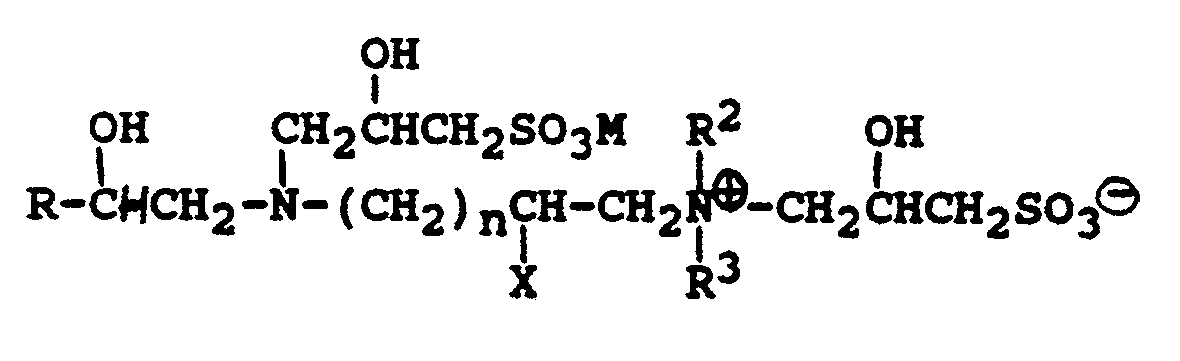
wherein R is selected from the group consisting of alkyl, aryl, alkylaryl groups of 4-18 carbons and alkoxymethyl wherein the alkoxy group is of 4-18 carbon atoms,
R² and R³ are individually selected from the group consisting of methyl; alkyl of 2 to 6 carbon atoms wherein said alkyl group is substituted by an electron-donating group on the beta carbon atoms thereof; polyoxyethylene and polyoxypropylene or R² and R³ may jointly form a -CH₂CH₂OCH₂CH₂-or CH₂CH₂SCH₂CH₂- group so as to form, together with the nitrogen atom to which they are bound, a morpholine or thiomorpholine ring
M is hydrogen or an alkali metal cation, n is 0 or 1, and
X is hydrogen or on electron-donating group. - Without wishing to be bound by any theory, it is believed that the alkali-stability of the products of the present invention derives from the general provision of electron-donating groups on carbon atoms in positions beta to quaternary nitrogen. Such groups make the hydrogens of beta carbon atoms less acidic and thereby counteract degradative processes such as those described by Hofmann (ber., 14, 659 (1881). Typically such groups include hydroxy, alkoxy, mercapto, and alkylthio. Suitable alkoxy and alklythio groups contain 1-4 carbon atoms.
- The products of the present invention are prepared by alkylation of a compound of the formula:

with an alkylating agent of the formula:
where Hal is halogen, typically chlorine and M is an alkali metal cation, typically sodium. - It will be appreciated that when the compound being alkylated contains two nitrogen atoms, mono-or dialkylation may occur depending on the amount of alkylating agent used. In such cases, it is preferable to employ sufficient alkylating agent for dialkylation.
- Intermediate amino compounds (2) and (3) are prepared by reaction of a suitable secondary amine or a disubstituted aminoalkyl primary amine with a suitable 1, 2-epoxyalkane or, more preferably, with a suitable alkylglycidyl ether. Suitable amines include dimethylamine, diethanolamine, diisopropanolamine, morpholine, 3-dimethylaminopropylamine, 3- bis (2-hydroxyethyl) aminopropylamine, and 2- bis (2-hydroxyethyl) aminoethylamine. This reaction may be run with or without a solvent and at a temperature generally ranging from 20-100°C. The reaction is often exothermic and the temperature may be controlled by the addition of a solvent or by controlling the rate of addition of the epoxide to the amine or amine solution. Even lower temperatures may be employed for this reaction, but then reaction times must be extended. The choice of solvent and of temperature for this reaction is largely dependent on which starting amine is used. Thus, with dimethylamine, it is convenient to run the reaction in water and, because of the volatility of this amine, to maintain the temperature below 40°C.
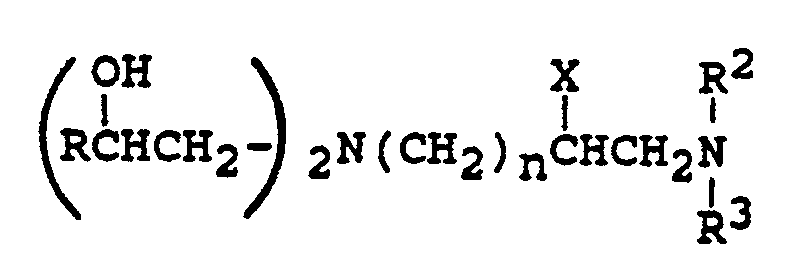
- More critical to the production of a suitable intermediate is the molar ratio of starting amine to epoxide. For secondary amines, a 1:1 molar ratio is usually satisfactory since this ratio is all the stoichiometry requires. However, for very volatile amines such as dimethylamine, an excess of amine is typically employed to offset losses due to its volatility. When disubstituted aminoalkyl primary amines are used, a molar excess of amine to epoxide generally within the range 1.5-2.0:1.0 is used. This excess minimizes the formation of dialkylation product of the structure:
- When excess amine is employed in making the intermediate product, it is removed from this product before further reaction. This is usually accomplished by distillation, employing vacuum if necessary. However, other suitable methods such as solvent extraction may also be used to remove excess amine.
- The second stage, alkylation with alkali metal salt of 3-halo-2-hydroxypropanesulfonic acid, is typically carried out at an elevated temperature, frequently between 50 and 100°C, in an aqueous environment. The most commonly used alkylating agent is the sodium salt of 3-chloro-2-hydroxypropane sulfonic acid. This is obtained by reaction of epichlorohydrin with sodium metabisulfite in water by methods well known to those skilled in the art. It may be desirable to mix the alkylating agent and amino intermediate at a temperature in the range 55-60°C and then raise this temperature after the initial admixture is complete, for example, to a temperature in the range 85-95°C. An alkaline pH will normally be maintained during the alkylation, for example, in the range 8.0-9.0. This is normally accomplished by the incremental addition of sodium hydroxide (usually a 25-50% solution).
- The products of the present invention find a variety of uses. Typically, they are incorporated in cleaning and similar compositions having a relatively high alkali content, for example, in the range 5-50% sodium or potassium hydroxide or equivalent such as strong sodium carbonate solutions. Such compositions include formulations for produce peeling, hard-surface cleaners, over cleaners, wax strippers, degreasers, aluminum cleaners, bottle washing formulations and, when the caustic content is at the lower end of the range, these products may be used in laundry and dishwashing detergents, hand cleansers, and concentrates for producing such cleaners.
- Compounds typically present in such formulations include those produced by the illustrative examples which are believed to be predominantly of the formulae:

wherein R represents the residue of its glycidyl ether of a lauryl myristyl alcohol mixture. - Such formulations may also contain conventional additives therefor including silicates, phosphates, pyrophosphates and polyphosphates for example in the form of the sodium salts. Other additives that may be present include lower alcohols of 1-6 carbons, glycols, glycol ethers, chelating agents, thickeners such as amides, cellulose derivatives and polyacrylates. In some cases, additional anionic, nonionic or amphoteric surface active agents may also be present.
- Typically, the products of the present invention will be present in amounts of from 0.1 to 10 percent by weight of a formulation as used. Concentrates which are to be diluted will generally contain higher percentages (within this range) of products of the present invention. Blends of various individual products of the present invention will frequently optimize several of the stated objects of this invention better than any single product.
- This invention wil now be illustrated by the following Examples:
- 3-Dimethylaminopropylamine (204g, 2.0 moles) was added to a reaction flask equipped with a mechanical stirrer, reflux condenser, thermometer, and addition funnel. While stirring, the amine was heated to 90-100°C. To this was added 2-ethylhexyl glycidyl ether (186g, 1.0 mole) at such a rate as to maintain a reaction temperature of 90-100°C without supplying heat. Addition time was about 1 hour. The reaction mixture was stirred for an additional period at 90-100°C until reaction was complete as judged by the disappearance of epoxide absorbances at 850, 915, and 1250 cm⁻¹. When reaction was complete, vacuum was applied to strip out unreacted 3-dimethylaminopropylamine. The product had a neutralization equivalent (NE) of 157 (theortetical NE=144 for a 1:1 adduct).
- The title alkylating agent was made by reacting sodium metabisulfite (104.5g) with epichlorohydrin (101.8g) in water (481g). To this solution of alkylating agent at 50-60°C was added the product from Part A (157g). This mixture was stirred and heated to 85-90°C. Reaction was continued with the pH maintained in the range 8 to 9 by the incremental addition of 50% aqueous NaOH. Reaction was continued until the pH had stabilized and the ratio of ionic chloride to total chloride exceeded 0.99. Vacuum was applied to remove water until sufficient water had been removed to give a 50% solids product which was a clear, yellow liquid.
- The same procedure was used as for Example IA except butyl glycidyl ether (130g, 1.0 mole) was used with 3-dimethylaminopropyl amine (204g, 2.0 moles). The product's measured NE was 125 (theoretical NE=116 for a 1:1 adduct).
- The same procedure was used as in Example IB except that 125g of product IIA was added instead of the 157g of product IA. After completion and vacuum stripping to 50% solids, the product obtained was a clear, yellow liquid.
- The same procedure was used as for Example IIB-1, except that only one-half the amounts of sodium metabisulfite and epichlorohydrin were employed. The product, at 50% solids was a clear, light yellow liquid.
- To a reaction flask equipped with a mechanical stirrer, reflux condenser, thermometer, and addition funnel was added n-hexyl alcohol (357g, 3.5 moles) along with 9g of boron trifluoride in methanol (10-15% BF₃).
- This mixture was stirred and heated to 90-100°C. Epichlorohydrin (92.5g, 1.0 mole) was added at such a rate as to maintain 90-100°C. Addition time was about 1 hour. Reaction was complete after about 2 more hours at this temperature as judged by virtual disappearance of epoxide absorbances at about 850, 915 and 1250 cm⁻¹. The excess hexyl alcohol was stripped off at 55-60°C and 10 mm Hg vacuum. The product was distilled at 10 mm Hg removing as a forerun material boiling below 120°C. The product was collected at 120-125°C/10 mm Hg. Analysis indicated that distillate consisted of approximately 20% hexyl glycidyl ether and 80% of 3-chloro-2-hydroxypropyl hexyl ether.
- The distillate from Part A (192.5g) was added to 3-dimethylaminopropyl amine (153g, 1.5 moles) at 90-100°C at such a rate as to maintain that temperature without supplying heat. Addition time was about 1 hour. After an additional 3 hours at 90-100°C, the ratio of ionic chloride to total chloride was greater than 0.99. Temperature was maintained in this range for 1 more hour until the typical epoxide absorbances had disappeared, then unreacted amine was removed at a temperature up to 120°C at 5-10 mm Hg. To the remaining material was added 88g of 50% aqueous NaOH plus sufficient water (about 150 cc) to dissolve the salt that formed. The aqueous phase was removed and the product washed twice with saturated salt solution. The product's NE was 177.6 (theoretical NE=130 for a 1:1:1).
- The same procedure was used as in Example IB except that 177.6g of product III B was added instead of 157g of product IA and the amount of water was adjusted to give a 36% solids product.
- To a reaction flask equipped with a mechanical stirrer, reflux condenser, thermometer, and addition funnel was added 40% aqueous dimethylamine (247.5g, 2.2 moles). Butyl glycidyl ether (154g, 1.18 moles) was added to the stirred amine solution at 30-40°C. The rate of addition was maintained in the 30-40°C range until reaction was complete as judged by disapperance of epoxide absorbances from the IR spectrum. Excess dimethylamine was removed by heating the reaction mixture to 90°C while purging with nitrogen (off gases were passed through a dilute sulfuric acid solution to neutralize the entrained amine). The product was then subjected to 100 mm Hg vacuum at 60-70°C to remove any remaining dimethylamine as well as the water. The resulting product had a NE of 180 (theoretical NE=175 for a 1:1 adduct).
- The same procedure was used as in Example IB except that 180g of product IV A was used instead of 157g of product IA, and the amount of water was adjusted to give a 50% solids product.
- The procedure given for Example IV A was used except that 2-ethylhexylglycidyl ether (186g, 1.0 mole) was reacted with 40% dimethylamine (225g, 2.0 moles) and the temperature maintained at 40-50°C. the resulting product, after removal of essentially all the water, had a NE of 244 (theoretical NE-231 for a 1:1 adduct).
- The same procedure was used as in Example IB except that 244g of product V A was used instead of 157g of product IA, and the amount of water adjusted to give a 50% solids product.
- The procedure given for Example IV A was used, but styrene oxide (120g, 1.0 mole) was used in place of butyl glycidyl ether. The resulting product, after removal of water and unreacted dimethylamine had a NE of 162.7 (theoretical NE=165 for a 1:1 adduct).
- The procedure for Example IB was used, substituting 162.7g of product VI A instead of 157g of product IA, and the amount of water was adjusted to give a 50% solids product.
- An identical procedure was used as for Example II (Part A and Part B1) except that t-butyl glycidyl ether was added instead of butyl glycidyl ether and the final product (VII B) was adjusted to 50% solids.
- The same procedure was used as for Example IA except aminoethylethanol amine (208g, 2.0 moles) was used in place of dimethylaminopropyl amine. When reaction was complete, the separated product's NE measured 149.8 (theoretical NE=145 for a 1:1 adduct).
- The same procedure was used as for Example IB, except that 149.8g of product from Part A of this Example was added instead of 157g of product IA and the solids were adjusted to 30%. The product of this Comparative Example is similar to that of Example II of Leender's U.S. Patent 4,214,102.
- The stability of the products of the present invention in aqueous sodium hydroxide is shown by the following table:

- All products above, with the exception of those noted as insoluble and product VI B, remained dissolved in the 50% NaOH for at least 1 week. Several samples exhibited no change in appearance or in surface tension even after 1 month. For all products in 10% NaOH, boiling for 16 hours had no appreciable effect on the measured surface tension.
- Blends of products IV B and V B were added at a level of 0.5% (solids content) to various solutions of mineral acids and surface tensions of the solutions were measured. Surface tensions were again measured after 1 week storage at room temperature and, in all cases, showed little change from the initial values. Results are tabulated below.

Claims (16)
- An aqueous formulation comprising 10 to 60 percent by weight of alkali, preferably sodium hydroxide or sodium carbonate and a surface active agent of the formula:

R² and R³ are individually selected from the group consisting of methyl; alkyl of 2 to 6 carbon atoms wherein said alkyl group is substituted by an electron-donating group on the beta carbon atoms thereof; polyoxyethylene and polyoxypropylene or R² and R³ may jointly form a -CH₂CH₂OCH₂CH₂- or CH₂CH₂SCH₂CH₂- group so as to form, together with the nitrogen atom to which they are bound, a morpholine or thiomorpholine ring
Q is a covalent bond or

X is hydrogen or an electron-donating group. - An aqueous formulation according to claim 1, wherein in said surface active agent R contains 4-14 carbon atoms, preferably 4-8 carbon atoms.
- An aqueous formulation according to either of claims 1 and 2, wherein in said surface active agent R is phenyl or alkoxy methylene of 4-8 carbon atoms in the alkoxy group.
- An aqueous formulation according to any one of the preceding claims, wherein in said surface active agent X is hydroxy.
- An aqueous formulation according to any one of the preceding claims, wherein in said surface active agent R² is methyl, hydroxymethyl, 2-hydroxypropyl, and polyoxyalkylene.
- An aqueous formulation according to any one of the preceding claims, wherein in said surface active agent R³ is methyl.
- An aqueous formulation according to any one of the preceding claims, wherein in said surface active agent Q is

- An aqueous formulation according to claim 1 comprising a surface active agent selected from the following:


- An aqueous formulation as claimed in any one of the preceding claims, comprising from 0.1 to 10 percent by weight of a surface active agent as specified in claim 1 and preferably 25 to 50 percent by weight alkali.
- Surface active compounds of the formula

R² and R³ are individually selected from the group consisting of methyl; alkyl of 2 to 6 carbon atoms wherein said alkyl group is substituted by an electron-donating group on the beta carbon atoms thereof; polyoxyethylene and polyoxypropylene or R² and R³ may jointly form a -CH₂CH₂OCH₂CH₂- or CH₂CH₂SCH₂CH₂- group so as to form, together with the nitrogen atom to which they are bound, a morpholine or thiomorpholine ring
M is hydrogen or an alkali metal cation, n is 0 or 1, and
X is hydrogen or an electron-donating group. - Surface active compounds according to claim 10, wherein R contains 4-14 carbon atoms, preferably 4-8 carbon atoms.
- Surface active compounds according to either of claims 10 and 11, wherein R is phenyl or alkoxy methylene of 4-8 carbon atoms in the alkoxy group.
- Surface active agents according to any one of claims 10 to 12, wherein X is hydroxy.
- Surface active agents according to any one of claims 10 to 13, wherein R² is methyl, hydroxymethyl, 2-hydroxypropyl, and polyoxyalkylene.
- Surface active agents according to any one of claims 10 to 14, wherein R³ is methyl.
- A surface active agent as claimed in claim 10 selected from:

Applications Claiming Priority (2)
| Application Number | Priority Date | Filing Date | Title |
|---|---|---|---|
| US901268 | 1986-08-27 | ||
| US06/901,268 US4891159A (en) | 1986-08-27 | 1986-08-27 | Low-foam alkali-stable amphoteric surface active agents |
Publications (2)
| Publication Number | Publication Date |
|---|---|
| EP0263911A1 EP0263911A1 (en) | 1988-04-20 |
| EP0263911B1 true EP0263911B1 (en) | 1991-08-21 |
Family
ID=25413846
Family Applications (1)
| Application Number | Title | Priority Date | Filing Date |
|---|---|---|---|
| EP87102958A Expired EP0263911B1 (en) | 1986-08-27 | 1987-03-02 | Low-foam alkali-stable amphoteric surface active agents |
Country Status (6)
| Country | Link |
|---|---|
| US (2) | US4891159A (en) |
| EP (1) | EP0263911B1 (en) |
| JP (2) | JPH083116B2 (en) |
| CA (1) | CA1326024C (en) |
| DE (1) | DE3772318D1 (en) |
| ES (1) | ES2025566T3 (en) |
Families Citing this family (23)
| Publication number | Priority date | Publication date | Assignee | Title |
|---|---|---|---|---|
| US4891159A (en) * | 1986-08-27 | 1990-01-02 | Miranol Inc. | Low-foam alkali-stable amphoteric surface active agents |
| IT1211792B (en) * | 1987-09-21 | 1989-11-03 | Sigma Tau Ind Farmaceuti | O-ALCANOIL ACID DERIVATIVES 3 AMINO 2- HYDROXYPROPANSULPHONIC ANTICONVULSIVE ADAPTITY AND THEIR PHARMACEUTICAL COMPOSITIONS FOR THE THERAPEUTIC TREATMENT OF EPILEPSY |
| US4982000A (en) * | 1989-11-03 | 1991-01-01 | Sherex Chemical Co., Inc. | Process for preparing quaternary ammonium compounds |
| JP2801723B2 (en) * | 1990-01-26 | 1998-09-21 | 花王株式会社 | Novel betaine and dispersant containing it |
| US5239980A (en) * | 1992-05-19 | 1993-08-31 | Hilt Fay E J | Forced air furnace control system and method of operation |
| US5269974A (en) * | 1992-09-01 | 1993-12-14 | The Procter & Gamble Company | Liquid or gel dishwashing detergent composition containing alkyl amphocarboxylic acid and magnesium or calcium ions |
| US5654480A (en) * | 1995-05-19 | 1997-08-05 | Rhone-Poulenc Surfactants & Specialties, L.P. | Recovery and reuse of surfactants from aqueous solutions |
| US6013185A (en) * | 1997-09-25 | 2000-01-11 | Rhodia Inc. | Recovery and reuse of nonionic surfactants from aqueous solutions |
| AU1943199A (en) * | 1998-01-30 | 1999-08-16 | Rhodia Inc. | Low foaming surfactant compositions useful in highly alkaline caustic cleaners |
| WO2002010506A1 (en) * | 2000-07-27 | 2002-02-07 | Ashland Inc. | Process for digesting woodchips and digester additives |
| US6551452B2 (en) | 2000-07-27 | 2003-04-22 | Ashland Inc. | Process for digesting woodchips and digester additives |
| US20060124246A1 (en) * | 2004-12-14 | 2006-06-15 | Pitney Bowes Incorporated | Moistening fluids that destroy and/or inhibit the growth of biological organisms |
| US20100000579A1 (en) * | 2008-07-03 | 2010-01-07 | Reinbold Robert S | Compositions And Methods For Removing Scale And Inhibiting Formation Thereof |
| US20150344820A1 (en) * | 2014-05-30 | 2015-12-03 | The Procter & Gamble Company | Compositions and methods for biofilm treatment |
| US20150344818A1 (en) * | 2014-05-30 | 2015-12-03 | The Procter & Gamble Company | Water cluster-dominant alkali surfactant compositions and their use |
| US20150344819A1 (en) * | 2014-05-30 | 2015-12-03 | The Procter & Gamble Company | Water cluster-dominant alkali surfactant compositions and their use |
| US20150344817A1 (en) * | 2014-05-30 | 2015-12-03 | The Procter & Gamble Company | Water cluster-dominant boronic acid alkali surfactant compositions and their use |
| US9765286B2 (en) | 2014-12-22 | 2017-09-19 | Ecolab Usa Inc. | Warewashing composition containing alkanol amine phosphonate and methods of use |
| EP3749639B1 (en) | 2018-02-06 | 2022-11-23 | Evonik Operations GmbH | Highly stable and alkaline cleaning solutions and soluble surfactants |
| CN109810027A (en) * | 2019-03-26 | 2019-05-28 | 黑龙江信维源化工有限公司 | A kind of anacardol and saturation anacardol based surfactants and preparation method and application |
| US11821287B2 (en) | 2020-01-21 | 2023-11-21 | Solenis Technologies, L.P. | Geothermal well stimulation and silca based deposit removal |
| CN116693429B (en) * | 2023-03-29 | 2024-01-26 | 重庆市泓择石油科技有限公司 | Variable viscosity amphiphilic structure type fracturing fluid thickener and preparation method and application thereof |
| WO2026034171A1 (en) * | 2024-08-09 | 2026-02-12 | Agcセイミケミカル株式会社 | Compound, surfactant, and surfactant composition |
Family Cites Families (10)
| Publication number | Priority date | Publication date | Assignee | Title |
|---|---|---|---|---|
| US3280179A (en) * | 1961-03-16 | 1966-10-18 | Textilana Corp | Processes for producing acyclic surfactant sulfobetaines |
| US4107095A (en) * | 1973-04-11 | 1978-08-15 | Colgate-Palmolive Company | Liquid olefin sulfonate detergent compositions containing anti-gelling agents |
| LU68355A1 (en) * | 1973-09-04 | 1975-05-21 | ||
| DE2619093A1 (en) * | 1976-05-03 | 1977-12-01 | Henkel & Cie Gmbh | HYDROXYSULFONATE BETAINS AND THEIR USE FOR THE ANTISTATIC EQUIPMENT OF SYNTHESIS FIBER MATERIAL |
| DE2632988A1 (en) * | 1976-07-22 | 1978-02-02 | Henkel Kgaa | HYDROXYBETAIN AND THEIR USE FOR ANTISTATIC EQUIPMENT OF SYNTHESIS FIBER MATERIAL |
| US4214102A (en) * | 1978-04-14 | 1980-07-22 | Henkel Inc. | Amino-ether amphoteric surface-active compounds |
| JPS57105497A (en) * | 1980-12-22 | 1982-06-30 | Lion Corp | Acidic liquid detergent composition for clothes |
| US4891159A (en) * | 1986-08-27 | 1990-01-02 | Miranol Inc. | Low-foam alkali-stable amphoteric surface active agents |
| JP3757468B2 (en) * | 1996-06-20 | 2006-03-22 | 松下電器産業株式会社 | Clothes dryer |
| JPH113000A (en) * | 1998-05-25 | 1999-01-06 | Ricoh Co Ltd | Fuzzy control system for image forming apparatus |
-
1986
- 1986-08-27 US US06/901,268 patent/US4891159A/en not_active Expired - Lifetime
-
1987
- 1987-02-26 CA CA000530712A patent/CA1326024C/en not_active Expired - Fee Related
- 1987-02-27 JP JP62045059A patent/JPH083116B2/en not_active Expired - Lifetime
- 1987-03-02 ES ES198787102958T patent/ES2025566T3/en not_active Expired - Lifetime
- 1987-03-02 DE DE8787102958T patent/DE3772318D1/en not_active Expired - Lifetime
- 1987-03-02 EP EP87102958A patent/EP0263911B1/en not_active Expired
-
1989
- 1989-09-25 US US07/412,274 patent/US4978781A/en not_active Expired - Lifetime
-
1995
- 1995-07-10 JP JP7173430A patent/JP2612155B2/en not_active Expired - Lifetime
Also Published As
| Publication number | Publication date |
|---|---|
| JP2612155B2 (en) | 1997-05-21 |
| US4891159A (en) | 1990-01-02 |
| DE3772318D1 (en) | 1991-09-26 |
| JPH083116B2 (en) | 1996-01-17 |
| JPS6357695A (en) | 1988-03-12 |
| CA1326024C (en) | 1994-01-11 |
| EP0263911A1 (en) | 1988-04-20 |
| US4978781A (en) | 1990-12-18 |
| ES2025566T3 (en) | 1992-04-01 |
| JPH08176591A (en) | 1996-07-09 |
Similar Documents
| Publication | Publication Date | Title |
|---|---|---|
| US4891159A (en) | Low-foam alkali-stable amphoteric surface active agents | |
| US4228048A (en) | Foam cleaner for food plants | |
| US4086279A (en) | Nonionic surfactants | |
| US3228979A (en) | Hydroxypropane sulfonates | |
| US4792419A (en) | Ether sulfonates | |
| US4438014A (en) | Nonionic surfactants for automatic dishwasher detergents | |
| US4650865A (en) | Process for preparing tertiary ether amines | |
| US7504498B2 (en) | Process for the manufacture of methyl cellulose ether | |
| GB849907A (en) | Dichlorocyanuric acid and compositions containing the same | |
| US4608197A (en) | Alkoxylated ether sulfate anionic surfactants from branched chain plasticizer alcohols | |
| US4592875A (en) | Alkoxylated ether sulfate anionic surfactants from plasticizer alcohol mixtures | |
| KR20000010805A (en) | Alkyl polyglycoside ether carboxylates | |
| NZ210337A (en) | Bleach composition containing alkali metal hypochlorite and amine thickener | |
| US3350462A (en) | Preparation of nonionic surface active agents of high wetting power | |
| US5077039A (en) | Substituted glucosides | |
| US2932616A (en) | Detergent compositions | |
| US4443353A (en) | Aqueous bleaching agent with cleaning action | |
| US3081354A (en) | Method of preparing adducts of ethenoxy-substituted glycidyl ethers and alcohols or mercaptans | |
| JPH0238424A (en) | polyether | |
| US2427577A (en) | Production of ether sulphonates | |
| US4436642A (en) | Nonionic surfactants for automatic dishwasher detergents | |
| US4855075A (en) | Ethoxylates of alkyl and alkenyl catechols | |
| JP2000160190A (en) | Low foam detergent | |
| US3350460A (en) | Method for the preparation of glycerol alpha ethers and thio ethers | |
| EP0059043B1 (en) | Surface active compositions |
Legal Events
| Date | Code | Title | Description |
|---|---|---|---|
| PUAI | Public reference made under article 153(3) epc to a published international application that has entered the european phase |
Free format text: ORIGINAL CODE: 0009012 |
|
| AK | Designated contracting states |
Kind code of ref document: A1 Designated state(s): BE CH DE ES FR GB IT LI NL SE |
|
| 17P | Request for examination filed |
Effective date: 19880624 |
|
| 17Q | First examination report despatched |
Effective date: 19900322 |
|
| GRAA | (expected) grant |
Free format text: ORIGINAL CODE: 0009210 |
|
| RAP1 | Party data changed (applicant data changed or rights of an application transferred) |
Owner name: RHONE-POULENC INC. |
|
| AK | Designated contracting states |
Kind code of ref document: B1 Designated state(s): BE CH DE ES FR GB IT LI NL SE |
|
| REF | Corresponds to: |
Ref document number: 3772318 Country of ref document: DE Date of ref document: 19910926 |
|
| ET | Fr: translation filed | ||
| ITF | It: translation for a ep patent filed | ||
| REG | Reference to a national code |
Ref country code: ES Ref legal event code: FG2A Ref document number: 2025566 Country of ref document: ES Kind code of ref document: T3 |
|
| PLBE | No opposition filed within time limit |
Free format text: ORIGINAL CODE: 0009261 |
|
| STAA | Information on the status of an ep patent application or granted ep patent |
Free format text: STATUS: NO OPPOSITION FILED WITHIN TIME LIMIT |
|
| 26N | No opposition filed | ||
| EAL | Se: european patent in force in sweden |
Ref document number: 87102958.3 |
|
| PGFP | Annual fee paid to national office [announced via postgrant information from national office to epo] |
Ref country code: CH Payment date: 19980311 Year of fee payment: 12 |
|
| PGFP | Annual fee paid to national office [announced via postgrant information from national office to epo] |
Ref country code: SE Payment date: 19980317 Year of fee payment: 12 |
|
| PGFP | Annual fee paid to national office [announced via postgrant information from national office to epo] |
Ref country code: NL Payment date: 19980326 Year of fee payment: 12 |
|
| PGFP | Annual fee paid to national office [announced via postgrant information from national office to epo] |
Ref country code: ES Payment date: 19980327 Year of fee payment: 12 |
|
| PGFP | Annual fee paid to national office [announced via postgrant information from national office to epo] |
Ref country code: BE Payment date: 19980518 Year of fee payment: 12 |
|
| REG | Reference to a national code |
Ref country code: CH Ref legal event code: PUE Owner name: RHONE-POULENC INC. TRANSFER- RHODIA INC. |
|
| NLS | Nl: assignments of ep-patents |
Owner name: RHODIA INC. A DELAWARE CORPORATION |
|
| REG | Reference to a national code |
Ref country code: FR Ref legal event code: TP |
|
| REG | Reference to a national code |
Ref country code: ES Ref legal event code: PC2A |
|
| BECA | Be: change of holder's address |
Free format text: 980707 *RHODIA INC.:259 PROSPECT PLAINS ROAD, CRANBURY N.J. 08512 |
|
| PG25 | Lapsed in a contracting state [announced via postgrant information from national office to epo] |
Ref country code: ES Free format text: LAPSE BECAUSE OF NON-PAYMENT OF DUE FEES Effective date: 19990303 Ref country code: SE Free format text: LAPSE BECAUSE OF NON-PAYMENT OF DUE FEES Effective date: 19990303 |
|
| PG25 | Lapsed in a contracting state [announced via postgrant information from national office to epo] |
Ref country code: CH Free format text: LAPSE BECAUSE OF NON-PAYMENT OF DUE FEES Effective date: 19990331 Ref country code: LI Free format text: LAPSE BECAUSE OF NON-PAYMENT OF DUE FEES Effective date: 19990331 Ref country code: BE Free format text: LAPSE BECAUSE OF NON-PAYMENT OF DUE FEES Effective date: 19990331 |
|
| BERE | Be: lapsed |
Owner name: RHODIA INC. Effective date: 19990331 |
|
| PG25 | Lapsed in a contracting state [announced via postgrant information from national office to epo] |
Ref country code: NL Free format text: LAPSE BECAUSE OF NON-PAYMENT OF DUE FEES Effective date: 19991001 |
|
| EUG | Se: european patent has lapsed |
Ref document number: 87102958.3 |
|
| REG | Reference to a national code |
Ref country code: CH Ref legal event code: PL |
|
| NLV4 | Nl: lapsed or anulled due to non-payment of the annual fee |
Effective date: 19991001 |
|
| EUG | Se: european patent has lapsed |
Ref document number: 87102958.3 |
|
| REG | Reference to a national code |
Ref country code: GB Ref legal event code: 732E |
|
| REG | Reference to a national code |
Ref country code: ES Ref legal event code: FD2A Effective date: 20010503 |
|
| REG | Reference to a national code |
Ref country code: GB Ref legal event code: IF02 |
|
| PG25 | Lapsed in a contracting state [announced via postgrant information from national office to epo] |
Ref country code: IT Free format text: LAPSE BECAUSE OF NON-PAYMENT OF DUE FEES;WARNING: LAPSES OF ITALIAN PATENTS WITH EFFECTIVE DATE BEFORE 2007 MAY HAVE OCCURRED AT ANY TIME BEFORE 2007. THE CORRECT EFFECTIVE DATE MAY BE DIFFERENT FROM THE ONE RECORDED. Effective date: 20050302 |
|
| PGFP | Annual fee paid to national office [announced via postgrant information from national office to epo] |
Ref country code: DE Payment date: 20060223 Year of fee payment: 20 |
|
| PGFP | Annual fee paid to national office [announced via postgrant information from national office to epo] |
Ref country code: GB Payment date: 20060301 Year of fee payment: 20 |
|
| PGFP | Annual fee paid to national office [announced via postgrant information from national office to epo] |
Ref country code: FR Payment date: 20060308 Year of fee payment: 20 |
|
| PG25 | Lapsed in a contracting state [announced via postgrant information from national office to epo] |
Ref country code: GB Free format text: LAPSE BECAUSE OF EXPIRATION OF PROTECTION Effective date: 20070301 |
|
| REG | Reference to a national code |
Ref country code: GB Ref legal event code: PE20 |