EP0259966A1 - Platinum coated filaments of platinum and rhodium; method of preparation and use in ammonia oxidation - Google Patents
Platinum coated filaments of platinum and rhodium; method of preparation and use in ammonia oxidation Download PDFInfo
- Publication number
- EP0259966A1 EP0259966A1 EP87306781A EP87306781A EP0259966A1 EP 0259966 A1 EP0259966 A1 EP 0259966A1 EP 87306781 A EP87306781 A EP 87306781A EP 87306781 A EP87306781 A EP 87306781A EP 0259966 A1 EP0259966 A1 EP 0259966A1
- Authority
- EP
- European Patent Office
- Prior art keywords
- platinum
- catalytic element
- ammonia
- gauze
- surface area
- Prior art date
- Legal status (The legal status is an assumption and is not a legal conclusion. Google has not performed a legal analysis and makes no representation as to the accuracy of the status listed.)
- Granted
Links
Images



Classifications
-
- C—CHEMISTRY; METALLURGY
- C01—INORGANIC CHEMISTRY
- C01B—NON-METALLIC ELEMENTS; COMPOUNDS THEREOF; METALLOIDS OR COMPOUNDS THEREOF NOT COVERED BY SUBCLASS C01C
- C01B21/00—Nitrogen; Compounds thereof
- C01B21/20—Nitrogen oxides; Oxyacids of nitrogen; Salts thereof
- C01B21/24—Nitric oxide (NO)
- C01B21/26—Preparation by catalytic or non-catalytic oxidation of ammonia
- C01B21/267—Means for preventing deterioration or loss of catalyst or for recovering lost catalyst
-
- B—PERFORMING OPERATIONS; TRANSPORTING
- B01—PHYSICAL OR CHEMICAL PROCESSES OR APPARATUS IN GENERAL
- B01J—CHEMICAL OR PHYSICAL PROCESSES, e.g. CATALYSIS OR COLLOID CHEMISTRY; THEIR RELEVANT APPARATUS
- B01J23/00—Catalysts comprising metals or metal oxides or hydroxides, not provided for in group B01J21/00
- B01J23/38—Catalysts comprising metals or metal oxides or hydroxides, not provided for in group B01J21/00 of noble metals
- B01J23/40—Catalysts comprising metals or metal oxides or hydroxides, not provided for in group B01J21/00 of noble metals of the platinum group metals
-
- B—PERFORMING OPERATIONS; TRANSPORTING
- B01—PHYSICAL OR CHEMICAL PROCESSES OR APPARATUS IN GENERAL
- B01J—CHEMICAL OR PHYSICAL PROCESSES, e.g. CATALYSIS OR COLLOID CHEMISTRY; THEIR RELEVANT APPARATUS
- B01J35/00—Catalysts, in general, characterised by their form or physical properties
- B01J35/50—Catalysts, in general, characterised by their form or physical properties characterised by their shape or configuration
- B01J35/58—Fabrics or filaments
-
- C—CHEMISTRY; METALLURGY
- C01—INORGANIC CHEMISTRY
- C01B—NON-METALLIC ELEMENTS; COMPOUNDS THEREOF; METALLOIDS OR COMPOUNDS THEREOF NOT COVERED BY SUBCLASS C01C
- C01B21/00—Nitrogen; Compounds thereof
- C01B21/20—Nitrogen oxides; Oxyacids of nitrogen; Salts thereof
- C01B21/24—Nitric oxide (NO)
- C01B21/26—Preparation by catalytic or non-catalytic oxidation of ammonia
- C01B21/265—Preparation by catalytic or non-catalytic oxidation of ammonia characterised by the catalyst
-
- B—PERFORMING OPERATIONS; TRANSPORTING
- B01—PHYSICAL OR CHEMICAL PROCESSES OR APPARATUS IN GENERAL
- B01J—CHEMICAL OR PHYSICAL PROCESSES, e.g. CATALYSIS OR COLLOID CHEMISTRY; THEIR RELEVANT APPARATUS
- B01J23/00—Catalysts comprising metals or metal oxides or hydroxides, not provided for in group B01J21/00
- B01J23/38—Catalysts comprising metals or metal oxides or hydroxides, not provided for in group B01J21/00 of noble metals
- B01J23/40—Catalysts comprising metals or metal oxides or hydroxides, not provided for in group B01J21/00 of noble metals of the platinum group metals
- B01J23/42—Platinum
-
- B—PERFORMING OPERATIONS; TRANSPORTING
- B01—PHYSICAL OR CHEMICAL PROCESSES OR APPARATUS IN GENERAL
- B01J—CHEMICAL OR PHYSICAL PROCESSES, e.g. CATALYSIS OR COLLOID CHEMISTRY; THEIR RELEVANT APPARATUS
- B01J23/00—Catalysts comprising metals or metal oxides or hydroxides, not provided for in group B01J21/00
- B01J23/38—Catalysts comprising metals or metal oxides or hydroxides, not provided for in group B01J21/00 of noble metals
- B01J23/40—Catalysts comprising metals or metal oxides or hydroxides, not provided for in group B01J21/00 of noble metals of the platinum group metals
- B01J23/46—Ruthenium, rhodium, osmium or iridium
- B01J23/464—Rhodium
Definitions
- exothermic heterogeneous catalytic oxidation of from 1 to 3.5% hydrogen in air on the surface of the catalyst gauzes is used to provide uniform heating of the gauzes prior to passage of ammonia and air mixture over the gauzes.
- the mixture of hydrogen and oxygen contacted with the gauzes is said to be at a temperature of 140-250°C.
- Ammonia is oxidized easily at lower temperatures over platinum containing gauzes bearing a platinum coating preferably having a surface area in excess of 50 cm2/g. These gauzes may be heated to a temperature which is sufficient to initiate ammonia oxidation by passing hydrogen in air over these gauzes at temperatures below 75°C, most preferably at temperatures of less than 50°C.
- This application claims a catalyst gauze bearing a high surface area coating of platinum thereupon and methods of using that gauze in oxidation of ammonia as well as a method of low temperature start-up of ammonia oxidation plants by passing hydrogen and oxygen over these high surface area gauzes thereby heating them to temperatures which are sufficient for catalytic oxidation of ammonia.
- the ammonia-air mixture in commercial nitric acid plants is commonly ignited using a hydrogen torch directed to a spot on the gauze which has been preheated with compressed hot air. After the spot begins to glow, ammonia is gradually added at an increasing flow rate until ignition is observed. Thereafter, heat conduction from the hot spot brings the remainder of the gauze up to the ignition temperature. Difficulties in properly manipulating the hydrogen torch are common especially for large gauzes. Too frequently, the torch burns a hole in either catalyst or recovery gauze while in other cases, initial ignition is slow or the spread of ignition is slow and uneven. We reduce these problems greatly by using catalyst gauzes with improved ignition characteristics which also protect the getter gauzes by reducing ammonia by pass during start-up.
- ignition stability is also significantly improved so that once ignition is obtained on a gauze, it can be sustained at even lower temperatures than the initial ignition temperature, in some cases even when the temperature of the inlet stream approaches ambient.
- This wide temperature range between ignition and extinction are important advantages for stable reactor operation during and following start-up.
- these gauzes may be preheated by catalytic combustion of hydrogen occurring at relatively low temperatures usually obtainable in the plant flow stream.
- Catalyst gauzes of the present invention are produced by forming an extremely catalytically active coating on conventional ammonia oxidation catalyst gauzes.
- gauzes typically consist of platinum group metal alloys primarily 90%Pt:10%Rh and 90%Pt:5%Rh:5%Pd and are typically woven meshes of about 0.003 of an inch diameter wires at about 80 wires per lineal inch. Other combinations of mesh and wire diameter may be used to advantage.
- Roberts and Gillespie "Estimation of Platinum Catalyst Requirement for Ammonia Oxidation" 45 Advances in Chemistry Series No. 133, Chemical Reaction Engineering II page 600-611. See also U.S. Patent 3,660,024.
- the catalytic coating may be applied by a variety of methods with those producing extremely high surface areas being greatly preferred although other forms of coating layers of substantially pure platinum onto the above mentioned alloys can be used to advantage providing decreased light off temperature upon a strong thermally stable base.
- Preferred high surface area coatings may typically be formed by decomposing platinum metal precursors on the catalyst gauze after it has been woven and cut to shape.
- the preferred platinum metal precursors are aqueous admixtures bearing thermally decomposable platinum metal compounds although other solvents including hydrocarbons, particularly butanol, may also be used to easily provide high uniformity coatings.
- the preferred method of applying these coatings to the gauze is by spraying, with electrostatic spraying being greatly preferred.
- the precursor admixture may also be applied by dipping the gauze in the admixture, precipitation methods such as electroless deposition, electroplating, electrodeposition, or brushing or painting the admixture on, much as paint is applied with a brush. More esoteric methods such as chemical vapor deposition, sputtering and other forms of physical vapor deposition may also be used.
- ignition temperature correlates well with surface area of platinum coated gauzes prepared from solutions of chloroplatinic acid in either normal-butanol or water with the ignition temperatures of the water based coatings being higher however than those of the butanol based coatings, probably due to difficulty of obtaining a uniform coating with aqueous based systems, this difficulty being manageable by proper use of surfactants, such as Igelpal CO-630, Colloids 211 and 209 which do not poison platinum.
- the preferred platinum coated gauzes of the present invention are characterized by a surface area preferably in excess of about 50 cm2/g, and more preferably in excess of about 250 cm2/g and most preferably in excess of about 350 cm2/g.
- the platinum loading is preferably at least about 0.5 grams of platinum metal per square meter of bulk gauze area coated essentially uniformly onto the gauze.
- bulk gauze area we mean not the actual or total surface area of the aggregate of the wires in the gauze considered for example as cylinders but rather the area of the gauze considered as a sheet of material. For example, a one meter by one meter sheet of any gauze would be said to have a bulk gauze area of one square meter. More preferably the platinum loading is at least about 3.0g/m2 and more preferably at least about 4.0g/m2 or about 1% of the weight of the gauze.
- Preferred gauzes of the present invention exhibit ignition temperatures of less than about 275°C, preferably less than about 260° and most preferably less than about 250°C in a plant operating at a mass throughput of about 8500 lbs/ft2-hr.
- ignition temperature over catalytic gauzes depends strongly on the flow rate over the gauze, to facilitate comparisons, throughout this application, all ignition temperatures are as measured at this standard flow rate of 8500 lbs/ft2-hr unless otherwise specified.
- Figure 2 illustrates the expected variation in ignition temperature expected with variations in the flow rate as well as the variation actually observed in a laboratory unit.
- the light off temperature of the catalyst gauze be no more than the ignition temperature of ammonia on the recovery gauze.
- ammonia will ignite on high palladium content gauzes at temperatures of around 260 °C at the standard flow rate of 8500 lbs/ft2 - hr
- Gauzes of the present invention are not only easily ignited with a hydrogen torch but may also be ignited by low temperature catalytic combustion of hydrogen on the surface of the gauzes thus obviating the uniformity problems inherent in hydrogen torch ignition. While oxidation could be initiated over previous known gauzes using a flow of hydrogen through the reactor, preheaters and burners were required to bring the gauzes up to the hydrogen ignition temperature of about 80 to 125°C.
- the ignition temperature of hydrogen over gauzes of the present invention having surface areas of about 500cm2/g is at about room temperature, hydrogen can be ignited over these gauzes using the preheat supplied by the compressor, then the amount of hydrogen increased to in the range of from about 3 to about 5% thereby heating the gauze to the ammonia ignition temperature of about 250°C to 300°C.
- Figure 3 illustrates the ignition temperature of hydrogen on platinum coated gauze as a function of the surface area of the gauze.
- Gauzes of the present invention not only light off easily but they also provide another unexpected benefit as illustrated in Figures 4 and 5 in that the NO x yield during the first few days of operation seems to be markedly higher than with prior art gauzes. While this advantage subsides after a few days, over the entire cycle, it can amount to about one quarter of a percent or more increase in yield. Unfortunately these coatings do not retain their high surface area during prolonged use so that the increased yield does not persist throughout the cycle.
- the most preferred method of forming the coated gauzes of the present invention is by electrostatic spraying in which droplets of the coating precursor admixture are provided with an electrostatic charge as they pass through a high resistance (around 10 mega ohm) electrode at high voltage comprising an array of fine wires near the fluid nozzle of the spray apparatus and thus can be gathered on grounded gauze targets with high efficiency, even depositing on the side of the wires away from the spray gun.
- a high resistance (around 10 mega ohm) electrode at high voltage comprising an array of fine wires near the fluid nozzle of the spray apparatus and thus can be gathered on grounded gauze targets with high efficiency, even depositing on the side of the wires away from the spray gun.
- This example illustrates formation of high surface area coatings using platinum precursors carried in n-butanol.
- Catalyst gauzes of 90% Pt:10% Rh with 80 wires per inch and 0.0031 inch diameter were cleaned in an ultrasonic bath and washed with deionized water, then dried in air.
- Figure 7 is a photomicrogaph illustrating the high uniformity of the Pt coating demonstrating how use of N-butanol as a solvent allows uniform coatings presumably by virtue of its excellent atomizing and wetting characteristics.
- This example illustrates formation of high surface area coatings using platinum precursors carried in aqueous admixtures.
- Catalyst gauzes of 90% Pt:5% Rh:5% Pd with 80 wires per inch and 0.0031 inch diameter were cleaned in an ultrasonic bath and washed with deionized water. After drying in air, the aqueous chloroplatinic acid admixture with 5% Pt by weight was sprayed onto the cleaned Pt/Rh/Pd gauze. After the carrier was removed, another coating of precursor was applied, and the salt converted to platinum as described in Example I. Similarly, admixtures of chloroplatinic acid in water were applied to other gauzes as set forth in Table II which also reports the surface areas of the resulting gauzes.
- Figure 8 is a photomicrograph illustrating a typical coating obtained by this method. The tendency of these coatings to agglomerate or thicken near wire intersections should be noted.
- catalyst gauzes of 90%Pt:5%Rh:5%Pd were coated with high surface area platinum using the procedures of Example II surfactants such as Igelpal CO-630, Colloid 211, etc., were added to the aqueous admixture to improve wetting characteristics of the Pt salt solution and thereby to increase the uniformity of the applied coatings while minimizing bridging problems in wire meshes.
- Example II surfactants such as Igelpal CO-630, Colloid 211, etc.
- Table III also sets forth the surface areas obtained along with a qualitative judgement of coating uniformity for each surfactant.
- Catalytic performance of catalyst gauze pack samples was evaluated as follows using the laboratory ammonia oxidation reactor described in USP 4,497,657 which had been modified to allow for placement of a thermocouple in the catalyst gauze pack.
- Ignition tests were conducted with five-ply packs of gauze samples at 100 psig reactor pressure and 9000 lbs/ft2-hr throughput. A thermocouple was embedded between the second and third layers of the gauze pack to determine light-off temperature.
- the ignition temperature was measured as the lowest temperature at which the ammonia/air mixture spontaneously started to be combusted.
- Table IV reports the light-off temperature obtained with each sample while Figure 1 presents these results in graphic form.
- a gauze pack consisting of five layers of Pt-coated gauze with an average surface area of 385 cm2/g, which were prepared as in Example I, followed by a five-ply pad of conventional 90%Pt:5%Rh:5%Pd gauze was tested to measure the NO x yield profile during start-up.
- the light-off temperature was measured to be 248°C with 2.5% ammonia feed as illustrated in Example IV.
- a gaseous stream of air containing about 11% ammonia by volume under a pressure of 100 psig was introduced to the laboratory reactor, described in U.S. Patent No. 4,497,657, at a nitrogen loading of about 65 tons nitrogen (calculated as ammonia) per square meter of the bulk cross-sectional area of the experimental gauze per day (i.e., 65T(N)/m2/day).
- the gauze exit temperature was maintained at a relatively constant 860°C while the air preheat temperature was around 200°C.
- NO x yield as a function of time was determined with both the experimental gauze packs as well as a typical pack consisting of 10 layers of conventional 90%Pt:5%Rh:5%Pd gauze.
- a NO x yield of 92% was obtained with the Pt-coated gauze pack 20 minutes after start-up and a peak NO x yield of 97% was achieved after about 2.5 hours on-stream.
- a similar Pt-coated gauze pack with a surface area of 1894 cm2/g reached a peak efficiency of 98% 45 minutes after start-up, while the conventional gauze pack required about 4 hours to reach this level, as illustrated in Figure 4.
- a commercial scale catalyst gauze pack was prepared by air-assisted spraying of 5% chloroplatinic acid/n-butanol solution as set forth in Example I.
- This gauze pack consisting of the top five layers of Pt-coated gauze followed by seventeen layers of conventional 90%Pt: 5%Rh: 5%Pd was evaluated in a commercial plant operating at: Operating Pressure : 125 psig Air Preheat Temp. : 270°C Ammonia Feed : 10.1% Gauze Exit Temp. : 950°C N-Loading : 70 T (N)/m2 day Gauze Cycle : 81 Days
- Figure 5 illustrates the improvement in overall NO x production graphically.
- Catalyst gauzes prepared as set forth in Examples I were placed in the laboratory ammonia oxidation reactor described above then 1% hydrogen in air passed through the gauzes of a flow rate of 8500 lb/ft2-hr with the temperature being steadily increased until ignition was observed. This procedure was repeated using 3% hydrogen. Table VII sets forth the ignition temperature for each of these gauzes.
- FIG 3 illustrates the very low hydrogen ignition temperatures obtained with gauzes of this invention.
- Example II Catalyst gauzes prepared as in Example I were tested for ignition at varying gas throughputs as set forth in Table VIII which also presents ignition data for an ammonia feed concentration of 2.5% at 100 psig reactor pressure. Ignition temperature was reduced by 25°C as mass throughput decreased from 10,320 to 2750 lb/ft2-hr. Further decreases in the ignition temperature are expected for low/medium pressure plant conditions as illustrated in Figure 2.
- a series of platinum coated catalyst gauzes were prepared as described in Example I except that the platinum precursor decomposition temperature was varied between 400 and 600°C.
- Table IX sets forth the results of characterization of these samples including platinum loading surface area and the percentage of platinum not fully converted to the metal from the precursor.
- catalyst gauzes prepared as set forth in Examples I were tested in the laboratory reactor mentioned above by passing 1% hydrogen in air over the gauze which was initially at 23°C until an exotherm was observed, the concentration of hydrogen in the feed was then increased slowly until an exit temperature of 325°C was observed whereupon ammonia initially at a concentration of 5% was passed over the gauzes until a further exotherm was observed whereupon the flow of hydrogen was discontinued and the flow of ammonia increased to about 11% to verify that satisfactory ignition had been obtained.
- the air preheat temperature was gradually reduced until the ignition was extinguished. As the inlet temperature decreased, the gauze surface temperature started to cool down and eventually ignition could not be sustained. Accordingly, a minimum air preheat temperature to sustain ignition was measured as the extinction temperature.
- Table X sets forth the test results of the ignition and extinction temperatures for multiple steady states on the conventional and Pt-coated gauzes at 8500 lb/ft2-hr throughput and 100 psig reactor pressure.
Landscapes
- Chemical & Material Sciences (AREA)
- Organic Chemistry (AREA)
- Chemical Kinetics & Catalysis (AREA)
- Engineering & Computer Science (AREA)
- Materials Engineering (AREA)
- Inorganic Chemistry (AREA)
- Catalysts (AREA)
Abstract
Description
- Start-up problems have long plagued manufacturers of nitric acid. In typical operations, catalytic oxidation of ammonia in heated air is initiated over platinum containing gauze using a hydrogen torch while operations are controlled manually based upon visual observation of the gauze. Not only is it possible to damage the catalyst gauze with the hydrogen torch but also unconverted ammonia is often nonselectively decomposed on the recovery gauze during start-up due to by passing of ammonia through the catalyst gauze resulting from wide variation in temperature between the hot portion of the gauze heated by the torch and remote cooler regions. Even worse, mixing of NOx and unconverted ammonia in the getter gauze can lead to unfavorable reactions which may damage some types of very high efficiency recovery gauzes particularly in plants operating at very high throughputs and pressures. Thus, at best, traditional methods of starting up plants using conventional catalyst gauzes have been tricky and time consuming while wasting significant amounts of ammonia, but, in some cases, also resulting in expensive damage to catalyst or recovery gauzes.
- Methods of alleviating these problems have been sought widely. One purported solution (USP 4,435,373) involves pads made by agglomeration of randomly oriented platinum group metal fibers produced by melt extraction or melt spinning. It is said that these pads exhibit..."more rapid light-off, better conversion efficiency and increased life...". The alloys used in these pads are 90% Pt:10% Rh and 90% Pt:5% Rh:5% Pd alloys. In example 3 of this Patent, the surface area of
melt spun 90% Pt:10%Rh fibers is said to be 8.3m²/g, the surface area ofmelt spun 90% Pt:5% Rh:5% Pd fibers is said to be 13.3m²/g as compared to conventional 90%Pt:10% Rh wire having a surface area of 6.9m²/g. These figures are almost certainly intended to be in cm²/g as 6.9 m²/g is at least four orders of magnitude larger than the surface area of conventional platinum rhodium wire. - In British Patent 1,426,875, ammonia combustion is initiated over cobalt oxide containing catalysts by homogeneously combusting hydrogen upstream of the catalyst and passing the combustion products over the catalyst bed thereby mitigating the difficulties of localized deactivation and unsatisfactory propagation of reaction through the catalyst which are said to result from heating the catalyst locally with a hydrogen flame to initiate oxidation. A similar method is disclosed for plants using catalytic gauzes in USP 2,185,607.
- In USSR Inventors Certificate 858905, exothermic heterogeneous catalytic oxidation of from 1 to 3.5% hydrogen in air on the surface of the catalyst gauzes is used to provide uniform heating of the gauzes prior to passage of ammonia and air mixture over the gauzes. The mixture of hydrogen and oxygen contacted with the gauzes is said to be at a temperature of 140-250°C.
- Handforth and Tilley, Catalysts for Oxidation of Ammonia to Oxides of Nitrogen, Industrial and Engineering Chemistry Volume 26 no. 12 pp. 1287-1292 reference reportedly unsuccessful efforts to use refractory base metal substrates clad with platinum group metal for ammonia oxidation which were said to fail as volatilization removed the active material and the underlying metal quickly poisoned the coating.
- USP 1,321,376, Jones and Parsons suggests the use of "platinum gauze which has been "platinized" or coated with platinum black [i.e. platinum oxide] or platinum sponge by depositing upon it more platinum from solution".
- It is an object of the present invention to provide a catalyst gauze which will light off quickly and easily at lower temperatures than the known gauzes or pads and, also, a method of initiating uniform ammonia oxidation over these gauzes starting from more accessible temperatures obtainable by compression of air so that preheaters and burners are not required.
- Ammonia is oxidized easily at lower temperatures over platinum containing gauzes bearing a platinum coating preferably having a surface area in excess of 50 cm²/g. These gauzes may be heated to a temperature which is sufficient to initiate ammonia oxidation by passing hydrogen in air over these gauzes at temperatures below 75°C, most preferably at temperatures of less than 50°C.
- This application claims a catalyst gauze bearing a high surface area coating of platinum thereupon and methods of using that gauze in oxidation of ammonia as well as a method of low temperature start-up of ammonia oxidation plants by passing hydrogen and oxygen over these high surface area gauzes thereby heating them to temperatures which are sufficient for catalytic oxidation of ammonia.
-
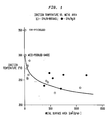
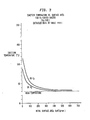
- Figure 1 illustrates the decline in light off temperature observed with gauzes having increased surface area at constant flow rate. Figure 2 illustrates predicted and observed variations in ignition temperature with flow rate for coated gauzes of the present invention.
- Figure 3 illustrates the ignition temperature of hydrogen observed over gauzes of the present invention.
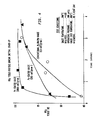
- Figure 4 illustrates the improved selectivity and conversion efficiency observed with gauzes of the present invention during the first days following start-up.
- Figure 5 illustrates the increased production rate of nitric acid experienced with gauzes of the present invention during the first few days following start-up.
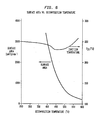
- Figure 6 illustrates the variation in surface area of coated gauzes with the temperature at which the coating precursor is decomposed and also illustrates the effect of decomposition temperature on ignition temperature.
- Figure 7 is a photomicrograph of a high surface area platinum coating of a gauze of the present invention.
- Figure 8 is a photomicrograph of a non-uniform coating prepared with an aqueous chloroplatinic acid solution.
- The ammonia-air mixture in commercial nitric acid plants is commonly ignited using a hydrogen torch directed to a spot on the gauze which has been preheated with compressed hot air. After the spot begins to glow, ammonia is gradually added at an increasing flow rate until ignition is observed. Thereafter, heat conduction from the hot spot brings the remainder of the gauze up to the ignition temperature. Difficulties in properly manipulating the hydrogen torch are common especially for large gauzes. Too frequently, the torch burns a hole in either catalyst or recovery gauze while in other cases, initial ignition is slow or the spread of ignition is slow and uneven. We reduce these problems greatly by using catalyst gauzes with improved ignition characteristics which also protect the getter gauzes by reducing ammonia by pass during start-up. In addition, ignition stability is also significantly improved so that once ignition is obtained on a gauze, it can be sustained at even lower temperatures than the initial ignition temperature, in some cases even when the temperature of the inlet stream approaches ambient. This wide temperature range between ignition and extinction are important advantages for stable reactor operation during and following start-up. Further, these gauzes may be preheated by catalytic combustion of hydrogen occurring at relatively low temperatures usually obtainable in the plant flow stream.
- Catalyst gauzes of the present invention are produced by forming an extremely catalytically active coating on conventional ammonia oxidation catalyst gauzes. Such gauzes typically consist of platinum group metal alloys primarily 90%Pt:10%Rh and 90%Pt:5%Rh:5%Pd and are typically woven meshes of about 0.003 of an inch diameter wires at about 80 wires per lineal inch. Other combinations of mesh and wire diameter may be used to advantage. For a detailed report, see Roberts and Gillespie, "Estimation of Platinum Catalyst Requirement for Ammonia Oxidation" 45 Advances in Chemistry Series No. 133, Chemical Reaction Engineering II page 600-611. See also U.S. Patent 3,660,024.
- The catalytic coating may be applied by a variety of methods with those producing extremely high surface areas being greatly preferred although other forms of coating layers of substantially pure platinum onto the above mentioned alloys can be used to advantage providing decreased light off temperature upon a strong thermally stable base.
- Preferred high surface area coatings may typically be formed by decomposing platinum metal precursors on the catalyst gauze after it has been woven and cut to shape. For ease of manufacturing, the preferred platinum metal precursors are aqueous admixtures bearing thermally decomposable platinum metal compounds although other solvents including hydrocarbons, particularly butanol, may also be used to easily provide high uniformity coatings. The preferred method of applying these coatings to the gauze is by spraying, with electrostatic spraying being greatly preferred. The precursor admixture may also be applied by dipping the gauze in the admixture, precipitation methods such as electroless deposition, electroplating, electrodeposition, or brushing or painting the admixture on, much as paint is applied with a brush. More esoteric methods such as chemical vapor deposition, sputtering and other forms of physical vapor deposition may also be used.
- As shown in Figure 1, ignition temperature correlates well with surface area of platinum coated gauzes prepared from solutions of chloroplatinic acid in either normal-butanol or water with the ignition temperatures of the water based coatings being higher however than those of the butanol based coatings, probably due to difficulty of obtaining a uniform coating with aqueous based systems, this difficulty being manageable by proper use of surfactants, such as Igelpal CO-630, Colloids 211 and 209 which do not poison platinum. The preferred platinum coated gauzes of the present invention are characterized by a surface area preferably in excess of about 50 cm²/g, and more preferably in excess of about 250 cm²/g and most preferably in excess of about 350 cm²/g. The platinum loading is preferably at least about 0.5 grams of platinum metal per square meter of bulk gauze area coated essentially uniformly onto the gauze. By bulk gauze area, we mean not the actual or total surface area of the aggregate of the wires in the gauze considered for example as cylinders but rather the area of the gauze considered as a sheet of material. For example, a one meter by one meter sheet of any gauze would be said to have a bulk gauze area of one square meter. More preferably the platinum loading is at least about 3.0g/m² and more preferably at least about 4.0g/m² or about 1% of the weight of the gauze. Preferred gauzes of the present invention exhibit ignition temperatures of less than about 275°C, preferably less than about 260° and most preferably less than about 250°C in a plant operating at a mass throughput of about 8500 lbs/ft²-hr. As the ignition temperature over catalytic gauzes depends strongly on the flow rate over the gauze, to facilitate comparisons, throughout this application, all ignition temperatures are as measured at this standard flow rate of 8500 lbs/ft²-hr unless otherwise specified. Figure 2 illustrates the expected variation in ignition temperature expected with variations in the flow rate as well as the variation actually observed in a laboratory unit.
- To protect the getter gauzes, it is extremely advantageous that the light off temperature of the catalyst gauze be no more than the ignition temperature of ammonia on the recovery gauze. Typically ammonia will ignite on high palladium content gauzes at temperatures of around 260 °C at the standard flow rate of 8500 lbs/ft² - hr
- Gauzes of the present invention are not only easily ignited with a hydrogen torch but may also be ignited by low temperature catalytic combustion of hydrogen on the surface of the gauzes thus obviating the uniformity problems inherent in hydrogen torch ignition. While oxidation could be initiated over previous known gauzes using a flow of hydrogen through the reactor, preheaters and burners were required to bring the gauzes up to the hydrogen ignition temperature of about 80 to 125°C. Since the ignition temperature of hydrogen over gauzes of the present invention having surface areas of about 500cm²/g is at about room temperature, hydrogen can be ignited over these gauzes using the preheat supplied by the compressor, then the amount of hydrogen increased to in the range of from about 3 to about 5% thereby heating the gauze to the ammonia ignition temperature of about 250°C to 300°C. Figure 3 illustrates the ignition temperature of hydrogen on platinum coated gauze as a function of the surface area of the gauze. Thus it can be seen that even gauzes with lower surface areas can ignite hydrogen at the temperatures typically encountered in pressurized air from the compressor.
- Gauzes of the present invention not only light off easily but they also provide another unexpected benefit as illustrated in Figures 4 and 5 in that the NOx yield during the first few days of operation seems to be markedly higher than with prior art gauzes. While this advantage subsides after a few days, over the entire cycle, it can amount to about one quarter of a percent or more increase in yield. Unfortunately these coatings do not retain their high surface area during prolonged use so that the increased yield does not persist throughout the cycle.
- The most preferred method of forming the coated gauzes of the present invention is by electrostatic spraying in which droplets of the coating precursor admixture are provided with an electrostatic charge as they pass through a high resistance (around 10 mega ohm) electrode at high voltage comprising an array of fine wires near the fluid nozzle of the spray apparatus and thus can be gathered on grounded gauze targets with high efficiency, even depositing on the side of the wires away from the spray gun.
- The following examples are provided to illustrate various embodiments of the invention in a concrete fashion.
- This example illustrates formation of high surface area coatings using platinum precursors carried in n-butanol. Catalyst gauzes of 90% Pt:10% Rh with 80 wires per inch and 0.0031 inch diameter were cleaned in an ultrasonic bath and washed with deionized water, then dried in air.
- Two coats of high surface area platinum precursor were applied to both sides of the gauze by spraying chloroplatinic acid in n-butanol with a platinum content of 5% by weight onto the cleaned gauze then removing the n-butanol by passing hot air at around 120°C over the gauze. After both coats of precursor were applied, the gauze was slowly heated to, then held for 30 minutes at, 450°C thereby decomposing the precursor to yield a high surface area platinum coating.
- Similarly other gauzes were coated by applying other platinum precursors in n-butanol as set forth in Table I which also reports the surface areas obtained which are from about 5 to about 120 times greater than that of conventional gauzes.
- The measured surface areas, as obtained by cyclic voltammetry are set forth in Table I.
- Figure 7 is a photomicrogaph illustrating the high uniformity of the Pt coating demonstrating how use of N-butanol as a solvent allows uniform coatings presumably by virtue of its excellent atomizing and wetting characteristics.


- This example illustrates formation of high surface area coatings using platinum precursors carried in aqueous admixtures.
- Catalyst gauzes of 90% Pt:5% Rh:5% Pd with 80 wires per inch and 0.0031 inch diameter were cleaned in an ultrasonic bath and washed with deionized water. After drying in air, the aqueous chloroplatinic acid admixture with 5% Pt by weight was sprayed onto the cleaned Pt/Rh/Pd gauze. After the carrier was removed, another coating of precursor was applied, and the salt converted to platinum as described in Example I. Similarly, admixtures of chloroplatinic acid in water were applied to other gauzes as set forth in Table II which also reports the surface areas of the resulting gauzes.

- Figure 8 is a photomicrograph illustrating a typical coating obtained by this method. The tendency of these coatings to agglomerate or thicken near wire intersections should be noted.
- As set forth in Table III catalyst gauzes of 90%Pt:5%Rh:5%Pd were coated with high surface area platinum using the procedures of Example II surfactants such as Igelpal CO-630, Colloid 211, etc., were added to the aqueous admixture to improve wetting characteristics of the Pt salt solution and thereby to increase the uniformity of the applied coatings while minimizing bridging problems in wire meshes.
- Table III also sets forth the surface areas obtained along with a qualitative judgement of coating uniformity for each surfactant.

- Catalytic performance of catalyst gauze pack samples was evaluated as follows using the laboratory ammonia oxidation reactor described in USP 4,497,657 which had been modified to allow for placement of a thermocouple in the catalyst gauze pack.
- Ignition tests were conducted with five-ply packs of gauze samples at 100 psig reactor pressure and 9000 lbs/ft²-hr throughput. A thermocouple was embedded between the second and third layers of the gauze pack to determine light-off temperature.
- To measure ignition temperature of gauzes from Examples I through III, air at a fixed temperature was passed through a catalyst gauze pack and intermittently ammonia was injected to give a concentration of 2.5% ammonia in air through the pack while ammonia was being fed. If a sharp temperature rise was detected by the thermocouple, it was concluded that the fixed temperature of the air was at or above the ignition temperature of ammonia in air over the particular gauze pack in use. If no exotherm is detected the ammonia concentration was increased to 5% to determine whether ignition could be obtained at this higher temperature. If not the temperature of the air stream was increased and this procedure repeated until ignition was detected. Ignition is usually accomplished by speeding up the oxidation reaction by addition of an ammonia feed and the reaction itself releases heat at the gauze surface faster than heat is transferred to the bulk gas stream.
- Thus the ignition temperature was measured as the lowest temperature at which the ammonia/air mixture spontaneously started to be combusted.
- Table IV reports the light-off temperature obtained with each sample while Figure 1 presents these results in graphic form.
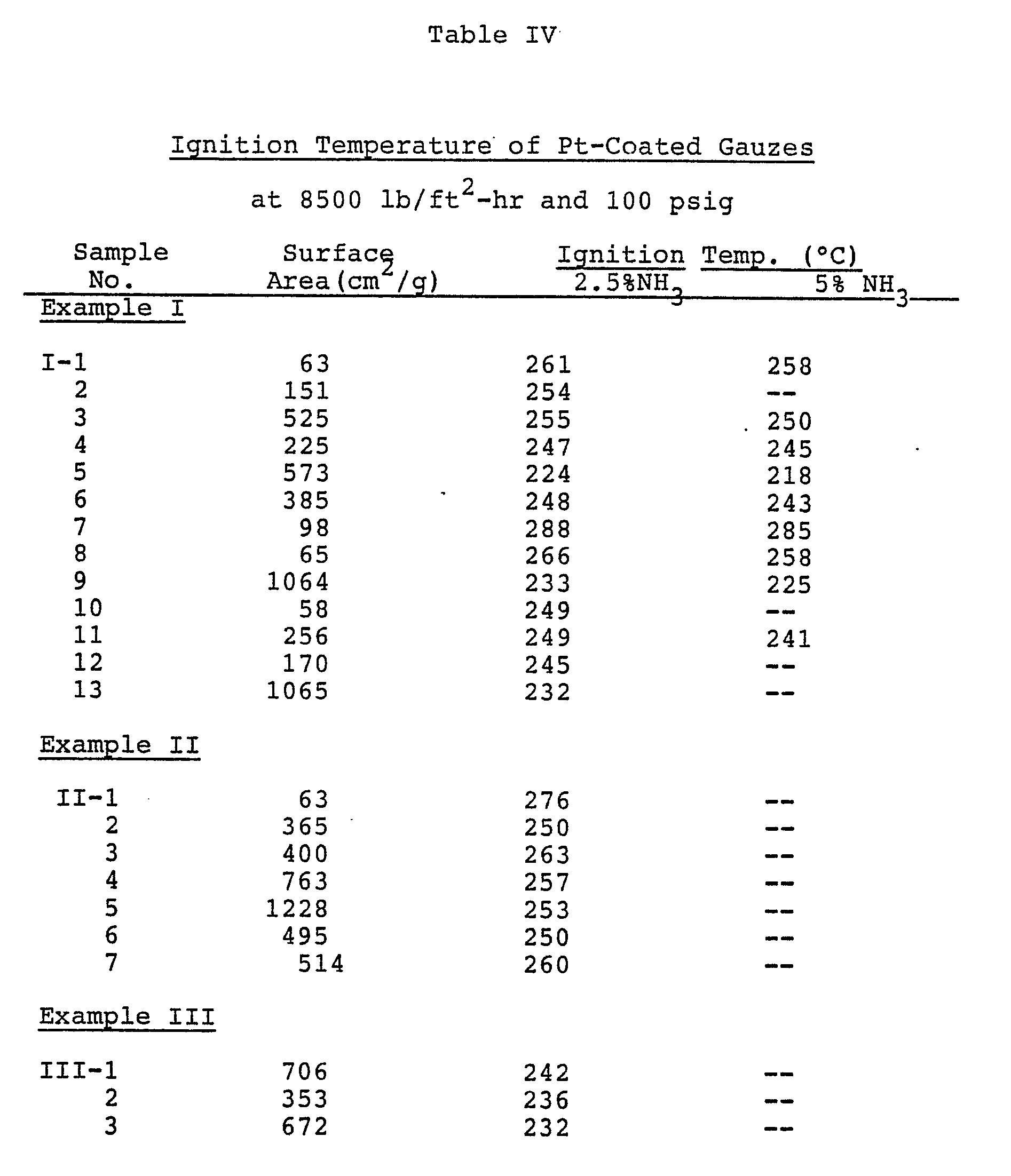
- A gauze pack consisting of five layers of Pt-coated gauze with an average surface area of 385 cm²/g, which were prepared as in Example I, followed by a five-ply pad of conventional 90%Pt:5%Rh:5%Pd gauze was tested to measure the NOx yield profile during start-up.
- Prior to beginning a run, the light-off temperature was measured to be 248°C with 2.5% ammonia feed as illustrated in Example IV. After ignition, a gaseous stream of air containing about 11% ammonia by volume under a pressure of 100 psig was introduced to the laboratory reactor, described in U.S. Patent No. 4,497,657, at a nitrogen loading of about 65 tons nitrogen (calculated as ammonia) per square meter of the bulk cross-sectional area of the experimental gauze per day (i.e., 65T(N)/m²/day). The gauze exit temperature was maintained at a relatively constant 860°C while the air preheat temperature was around 200°C.
- As summarized in Table V, NOx yield as a function of time was determined with both the experimental gauze packs as well as a typical pack consisting of 10 layers of conventional 90%Pt:5%Rh:5%Pd gauze.
- A NOx yield of 92% was obtained with the Pt-coated gauze pack 20 minutes after start-up and a peak NOx yield of 97% was achieved after about 2.5 hours on-stream. In addition, it was observed that a similar Pt-coated gauze pack with a surface area of 1894 cm²/g reached a peak efficiency of 98% 45 minutes after start-up, while the conventional gauze pack required about 4 hours to reach this level, as illustrated in Figure 4.

- A commercial scale catalyst gauze pack was prepared by air-assisted spraying of 5% chloroplatinic acid/n-butanol solution as set forth in Example I.
- This gauze pack consisting of the top five layers of Pt-coated gauze followed by seventeen layers of conventional 90%Pt: 5%Rh: 5%Pd was evaluated in a commercial plant operating at:
Operating Pressure : 125 psig
Air Preheat Temp. : 270°C
Ammonia Feed : 10.1% Gauze Exit Temp. : 950°C
N-Loading : 70 T (N)/m² day Gauze Cycle : 81 Days - Upon start-up, it was observed that the hydrogen torch could be removed after only about 20 seconds while normally the torch is applied for about 2 minutes. It was further observed qualitatively that the ignition spread rapidly over the surface. Measured NOx production is presented in Table VI for the first five days of operation.
- Figure 5 illustrates the improvement in overall NOx production graphically.

- Catalyst gauzes prepared as set forth in Examples I were placed in the laboratory ammonia oxidation reactor described above then 1% hydrogen in air passed through the gauzes of a flow rate of 8500 lb/ft²-hr with the temperature being steadily increased until ignition was observed. This procedure was repeated using 3% hydrogen. Table VII sets forth the ignition temperature for each of these gauzes.

- Figure 3 illustrates the very low hydrogen ignition temperatures obtained with gauzes of this invention.
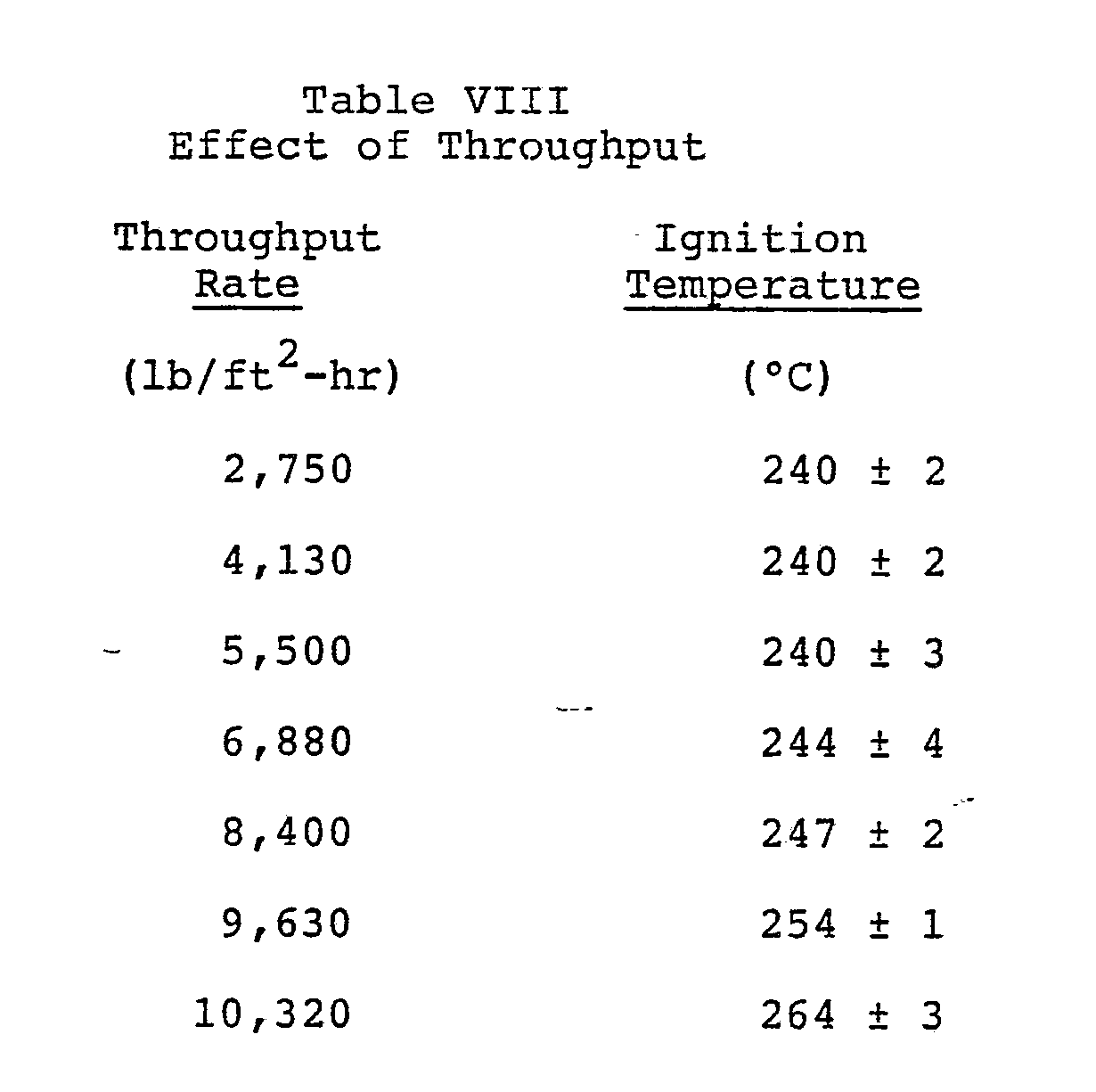
- Catalyst gauzes prepared as in Example I were tested for ignition at varying gas throughputs as set forth in Table VIII which also presents ignition data for an ammonia feed concentration of 2.5% at 100 psig reactor pressure. Ignition temperature was reduced by 25°C as mass throughput decreased from 10,320 to 2750 lb/ft²-hr. Further decreases in the ignition temperature are expected for low/medium pressure plant conditions as illustrated in Figure 2.
- A series of platinum coated catalyst gauzes were prepared as described in Example I except that the platinum precursor decomposition temperature was varied between 400 and 600°C.
- Table IX sets forth the results of characterization of these samples including platinum loading surface area and the percentage of platinum not fully converted to the metal from the precursor.

- Significant weight reductions occurred during precursor decomposition below 450°C, while increasingly severe sintering of the high surface Pt coatings was apparent for gauze samples wherein the precursor was decomposed above 450°C. The lowest light-off temperature was observed with Pt-coated gauzes decomposed at around 450°C, as illustrated in Figure 6.
- To demonstrate the feasibility of start-up from room temperature using a stream of hydrogen in air instead of a hydrogen torch, catalyst gauzes prepared as set forth in Examples I were tested in the laboratory reactor mentioned above by passing 1% hydrogen in air over the gauze which was initially at 23°C until an exotherm was observed, the concentration of hydrogen in the feed was then increased slowly until an exit temperature of 325°C was observed whereupon ammonia initially at a concentration of 5% was passed over the gauzes until a further exotherm was observed whereupon the flow of hydrogen was discontinued and the flow of ammonia increased to about 11% to verify that satisfactory ignition had been obtained.
- After measuring the ignition temperature with 5% ammonia feed as described in Example IV, the air preheat temperature was gradually reduced until the ignition was extinguished. As the inlet temperature decreased, the gauze surface temperature started to cool down and eventually ignition could not be sustained. Accordingly, a minimum air preheat temperature to sustain ignition was measured as the extinction temperature.
- Table X sets forth the test results of the ignition and extinction temperatures for multiple steady states on the conventional and Pt-coated gauzes at 8500 lb/ft²-hr throughput and 100 psig reactor pressure.

Claims (18)
Priority Applications (1)
| Application Number | Priority Date | Filing Date | Title |
|---|---|---|---|
| AT87306781T ATE80330T1 (en) | 1986-08-06 | 1987-07-30 | PLATINUM-COATED PLATINUM AND RHODIUM CATALYST FIBERS, THEIR PREPARATION AND USE FOR THE OXIDATION OF AMMONIA. |
Applications Claiming Priority (4)
| Application Number | Priority Date | Filing Date | Title |
|---|---|---|---|
| US888179 | 1986-08-06 | ||
| US887578 | 1986-08-06 | ||
| US06/888,179 US4863893A (en) | 1986-08-06 | 1986-08-06 | Low temperature light off ammonia oxidation |
| US06/887,578 US5108730A (en) | 1986-08-06 | 1986-08-06 | Low temperatue light off ammonia oxidation |
Publications (2)
| Publication Number | Publication Date |
|---|---|
| EP0259966A1 true EP0259966A1 (en) | 1988-03-16 |
| EP0259966B1 EP0259966B1 (en) | 1992-09-09 |
Family
ID=27128845
Family Applications (1)
| Application Number | Title | Priority Date | Filing Date |
|---|---|---|---|
| EP87306781A Expired - Lifetime EP0259966B1 (en) | 1986-08-06 | 1987-07-30 | Platinum coated filaments of platinum and rhodium; method of preparation and use in ammonia oxidation |
Country Status (3)
| Country | Link |
|---|---|
| EP (1) | EP0259966B1 (en) |
| DE (1) | DE3781629T2 (en) |
| GR (1) | GR3005935T3 (en) |
Cited By (13)
| Publication number | Priority date | Publication date | Assignee | Title |
|---|---|---|---|---|
| WO1992002300A1 (en) * | 1990-07-31 | 1992-02-20 | Alan Edward Heywood | Improvements in or relating to self-gettering catalysts |
| DE4028916A1 (en) * | 1990-09-12 | 1992-03-19 | Heraeus Gmbh W C | METHOD FOR PRODUCING A CATALYST NET, THAN MANUFACTURED CATALYST NET AND ITS USE |
| EP0504723A1 (en) * | 1991-03-16 | 1992-09-23 | Degussa Aktiengesellschaft | Preparation process of permeable precious metal nets for catalytic processes |
| EP0519699A1 (en) * | 1991-06-17 | 1992-12-23 | Johnson Matthey Public Limited Company | Low pressure drop, high surface area oxidation catalyst and catalyst for production of hydrocyanic acid |
| US5268157A (en) * | 1991-03-16 | 1993-12-07 | Degussa Aktiengesellschaft | Process for the production of catalytic gas permeable nets and process for oxidizing ammonia |
| US5278124A (en) * | 1991-06-17 | 1994-01-11 | Johnson Matthey, Inc. | Low pressure drop, high surface area ammonia oxidation catalyst |
| WO1994015711A1 (en) * | 1993-01-06 | 1994-07-21 | Pgp Industries, Inc. | Catalyst packs |
| US5356603A (en) * | 1991-06-17 | 1994-10-18 | Johnson Matthey Inc. | Method for the production of hydrocyanic acid using a corrugated catalyst |
| US5656567A (en) * | 1990-07-31 | 1997-08-12 | Pgp Industries, Inc. | Self-gettering catalysts |
| US5866734A (en) * | 1996-09-05 | 1999-02-02 | Aktiengesellschaft | Hydrogenation process |
| CN110709352A (en) * | 2017-06-01 | 2020-01-17 | 蒂森克虏伯工业解决方案股份公司 | Process for the catalytic oxidation of ammonia |
| EP3900826A1 (en) * | 2020-04-22 | 2021-10-27 | UMICORE AG & Co. KG | Pure metal network for catalysing gas phase reactions |
| EP4310209A1 (en) * | 2022-07-19 | 2024-01-24 | Yara International ASA | Method for recovering volatile pt or pd and system thereof |
Citations (4)
| Publication number | Priority date | Publication date | Assignee | Title |
|---|---|---|---|---|
| FR2133216A5 (en) * | 1971-04-13 | 1972-11-24 | Louyot Comptoir Lyon Alemand | |
| FR2227048A1 (en) * | 1973-04-30 | 1974-11-22 | Universal Oil Prod Co | |
| FR2280430A1 (en) * | 1974-08-03 | 1976-02-27 | Shoei Chemical Ind Co | NEW CATALYST COMPOSITIONS AND METHOD FOR PREPARING THEM |
| FR2445173A1 (en) * | 1978-12-27 | 1980-07-25 | Inst Nawozow Sztucznych | Catalyst contg. platinum and palladium based layers - used in oxidn. of ammonia to form nitric oxide |
Family Cites Families (1)
| Publication number | Priority date | Publication date | Assignee | Title |
|---|---|---|---|---|
| US2719797A (en) * | 1950-05-23 | 1955-10-04 | Baker & Co Inc | Platinizing tantalum |
-
1987
- 1987-07-30 DE DE8787306781T patent/DE3781629T2/en not_active Expired - Fee Related
- 1987-07-30 EP EP87306781A patent/EP0259966B1/en not_active Expired - Lifetime
-
1992
- 1992-10-12 GR GR920402255T patent/GR3005935T3/el unknown
Patent Citations (4)
| Publication number | Priority date | Publication date | Assignee | Title |
|---|---|---|---|---|
| FR2133216A5 (en) * | 1971-04-13 | 1972-11-24 | Louyot Comptoir Lyon Alemand | |
| FR2227048A1 (en) * | 1973-04-30 | 1974-11-22 | Universal Oil Prod Co | |
| FR2280430A1 (en) * | 1974-08-03 | 1976-02-27 | Shoei Chemical Ind Co | NEW CATALYST COMPOSITIONS AND METHOD FOR PREPARING THEM |
| FR2445173A1 (en) * | 1978-12-27 | 1980-07-25 | Inst Nawozow Sztucznych | Catalyst contg. platinum and palladium based layers - used in oxidn. of ammonia to form nitric oxide |
Cited By (21)
| Publication number | Priority date | Publication date | Assignee | Title |
|---|---|---|---|---|
| US5656567A (en) * | 1990-07-31 | 1997-08-12 | Pgp Industries, Inc. | Self-gettering catalysts |
| WO1992002300A1 (en) * | 1990-07-31 | 1992-02-20 | Alan Edward Heywood | Improvements in or relating to self-gettering catalysts |
| US5232891A (en) * | 1990-09-12 | 1993-08-03 | W. C. Heraeus Gmbh | Process for the manufacture of a gauze for a catalytic converter and a gauze for a catalytic converter manufactured according thereto |
| DE4028916A1 (en) * | 1990-09-12 | 1992-03-19 | Heraeus Gmbh W C | METHOD FOR PRODUCING A CATALYST NET, THAN MANUFACTURED CATALYST NET AND ITS USE |
| TR26402A (en) * | 1991-03-16 | 1995-03-15 | Degussa | A PROCESS FOR THE PRODUCTION OF GAS GENERATIVE VALUABLE METAL NETWORKS FOR CATALYSTIC PROCEDURES |
| US5268157A (en) * | 1991-03-16 | 1993-12-07 | Degussa Aktiengesellschaft | Process for the production of catalytic gas permeable nets and process for oxidizing ammonia |
| EP0504723A1 (en) * | 1991-03-16 | 1992-09-23 | Degussa Aktiengesellschaft | Preparation process of permeable precious metal nets for catalytic processes |
| US5278124A (en) * | 1991-06-17 | 1994-01-11 | Johnson Matthey, Inc. | Low pressure drop, high surface area ammonia oxidation catalyst |
| US5356603A (en) * | 1991-06-17 | 1994-10-18 | Johnson Matthey Inc. | Method for the production of hydrocyanic acid using a corrugated catalyst |
| TR26289A (en) * | 1991-06-17 | 1995-03-15 | Johnson Matthey Inc | LOW PRESSURE DROP, HIGH-SIDED AMMONIA OXIDATION CATALYST AND CATALYST FOR HYDROCYANIC ACID PRODUCTION |
| EP0519699A1 (en) * | 1991-06-17 | 1992-12-23 | Johnson Matthey Public Limited Company | Low pressure drop, high surface area oxidation catalyst and catalyst for production of hydrocyanic acid |
| WO1994015711A1 (en) * | 1993-01-06 | 1994-07-21 | Pgp Industries, Inc. | Catalyst packs |
| EA000761B1 (en) * | 1996-09-05 | 2000-04-24 | Басф Акциенгезельшафт | Support catalyst and process for hydrogenation of multiply unsaturated c2-c8 carbons |
| US5866734A (en) * | 1996-09-05 | 1999-02-02 | Aktiengesellschaft | Hydrogenation process |
| CN110709352A (en) * | 2017-06-01 | 2020-01-17 | 蒂森克虏伯工业解决方案股份公司 | Process for the catalytic oxidation of ammonia |
| US11643327B2 (en) | 2017-06-01 | 2023-05-09 | Thyssenkrupp Industrial Solutions Ag | Method for the catalytic oxidation of ammonia gas |
| EP3900826A1 (en) * | 2020-04-22 | 2021-10-27 | UMICORE AG & Co. KG | Pure metal network for catalysing gas phase reactions |
| WO2021214232A1 (en) * | 2020-04-22 | 2021-10-28 | Umicore Ag & Co. Kg | Precious metal grid for catalyzing gas phase reactions |
| US12350657B2 (en) | 2020-04-22 | 2025-07-08 | Umicore Ag & Co. Kg | Precious metal grid for catalyzing gas phase reactions |
| EP4310209A1 (en) * | 2022-07-19 | 2024-01-24 | Yara International ASA | Method for recovering volatile pt or pd and system thereof |
| WO2024017928A1 (en) * | 2022-07-19 | 2024-01-25 | Yara International Asa | Method for selectively recovering volatile pt or pd |
Also Published As
| Publication number | Publication date |
|---|---|
| GR3005935T3 (en) | 1993-06-07 |
| DE3781629D1 (en) | 1992-10-15 |
| EP0259966B1 (en) | 1992-09-09 |
| DE3781629T2 (en) | 1993-02-18 |
Similar Documents
| Publication | Publication Date | Title |
|---|---|---|
| US4863893A (en) | Low temperature light off ammonia oxidation | |
| EP0259966A1 (en) | Platinum coated filaments of platinum and rhodium; method of preparation and use in ammonia oxidation | |
| US7005404B2 (en) | Substrates with small particle size metal oxide and noble metal catalyst coatings and thermal spraying methods for producing the same | |
| US5242882A (en) | Catalyst for the production of nitric acid by oxidation of ammonia | |
| JP3506747B2 (en) | Honeycomb heater | |
| US5217939A (en) | Catalyst for the prduction of nitric acid by oxidation of ammonia | |
| CN1714929B (en) | Activated ignition promoters for metal catalyzed reactions | |
| JPH10328571A (en) | Polybetaine-stabilized palladium-containing nanoparticles, methods of preparing the particles, and catalysts prepared from the particles to produce vinyl acetate | |
| US5108730A (en) | Low temperatue light off ammonia oxidation | |
| CN110479249B (en) | Method for preparing monatomic catalyst by precursor atomization | |
| CN103785487A (en) | Noble metal monolithic catalyst and its preparation method | |
| US4501823A (en) | Catalyst for reforming of methanol and process of preparing same | |
| US5256387A (en) | Catalyst for the production of nitric acid by oxidation of ammonia | |
| CN108598505A (en) | A kind of preparation method and product of vanadium carbide/carbon cloth composite material | |
| US4855274A (en) | Process for making a noble metal on tin oxide catalyst | |
| JP2005518277A (en) | Method for producing shell-type catalyst | |
| JP2004016838A (en) | Exhaust gas purification catalyst and method for producing and using the same | |
| EP3823780A1 (en) | Method for producing an open-pored metal body having an oxide layer and metal body produced by said method | |
| WO2024078481A1 (en) | Heterogeneous dual-catalytic-center catalyst, preparation method therefor, and use thereof | |
| JP2002516750A (en) | Method for producing metal fiber board functionalized by catalyst | |
| Farrauto et al. | Ammonia oxidation catalysts with enhanced activity | |
| US11801491B1 (en) | Three-way catalyst with reduced palladium loading and method of making the three-way catalyst | |
| US20050220678A1 (en) | Exhaust gas clarification catalyst carrying article | |
| JP3847887B2 (en) | Exhaust gas purification catalyst-carrying filter and manufacturing method thereof | |
| JP2557371B2 (en) | Gas turbine combustor catalyst and method for producing the same |
Legal Events
| Date | Code | Title | Description |
|---|---|---|---|
| PUAI | Public reference made under article 153(3) epc to a published international application that has entered the european phase |
Free format text: ORIGINAL CODE: 0009012 |
|
| AK | Designated contracting states |
Kind code of ref document: A1 Designated state(s): AT BE CH DE ES FR GB GR IT LI LU NL SE |
|
| 17P | Request for examination filed |
Effective date: 19880905 |
|
| 17Q | First examination report despatched |
Effective date: 19900226 |
|
| GRAA | (expected) grant |
Free format text: ORIGINAL CODE: 0009210 |
|
| AK | Designated contracting states |
Kind code of ref document: B1 Designated state(s): AT BE CH DE ES FR GB GR IT LI LU NL SE |
|
| PG25 | Lapsed in a contracting state [announced via postgrant information from national office to epo] |
Ref country code: IT Free format text: LAPSE BECAUSE OF FAILURE TO SUBMIT A TRANSLATION OF THE DESCRIPTION OR TO PAY THE FEE WITHIN THE PRESCRIBED TIME-LIMIT;WARNING: LAPSES OF ITALIAN PATENTS WITH EFFECTIVE DATE BEFORE 2007 MAY HAVE OCCURRED AT ANY TIME BEFORE 2007. THE CORRECT EFFECTIVE DATE MAY BE DIFFERENT FROM THE ONE RECORDED. Effective date: 19920909 Ref country code: LI Effective date: 19920909 Ref country code: CH Effective date: 19920909 Ref country code: AT Effective date: 19920909 Ref country code: SE Effective date: 19920909 |
|
| REF | Corresponds to: |
Ref document number: 80330 Country of ref document: AT Date of ref document: 19920915 Kind code of ref document: T |
|
| REF | Corresponds to: |
Ref document number: 3781629 Country of ref document: DE Date of ref document: 19921015 |
|
| ET | Fr: translation filed | ||
| REG | Reference to a national code |
Ref country code: CH Ref legal event code: PL |
|
| PG25 | Lapsed in a contracting state [announced via postgrant information from national office to epo] |
Ref country code: ES Free format text: LAPSE BECAUSE OF FAILURE TO SUBMIT A TRANSLATION OF THE DESCRIPTION OR TO PAY THE FEE WITHIN THE PRESCRIBED TIME-LIMIT Effective date: 19921220 |
|
| REG | Reference to a national code |
Ref country code: GR Ref legal event code: FG4A Free format text: 3005935 |
|
| PLBE | No opposition filed within time limit |
Free format text: ORIGINAL CODE: 0009261 |
|
| STAA | Information on the status of an ep patent application or granted ep patent |
Free format text: STATUS: NO OPPOSITION FILED WITHIN TIME LIMIT |
|
| PG25 | Lapsed in a contracting state [announced via postgrant information from national office to epo] |
Ref country code: LU Free format text: LAPSE BECAUSE OF NON-PAYMENT OF DUE FEES Effective date: 19930731 |
|
| 26N | No opposition filed | ||
| PGFP | Annual fee paid to national office [announced via postgrant information from national office to epo] |
Ref country code: NL Payment date: 20010717 Year of fee payment: 15 |
|
| REG | Reference to a national code |
Ref country code: GB Ref legal event code: IF02 |
|
| PGFP | Annual fee paid to national office [announced via postgrant information from national office to epo] |
Ref country code: GR Payment date: 20020723 Year of fee payment: 16 |
|
| PG25 | Lapsed in a contracting state [announced via postgrant information from national office to epo] |
Ref country code: NL Free format text: LAPSE BECAUSE OF NON-PAYMENT OF DUE FEES Effective date: 20030201 |
|
| NLV4 | Nl: lapsed or anulled due to non-payment of the annual fee |
Effective date: 20030201 |
|
| PG25 | Lapsed in a contracting state [announced via postgrant information from national office to epo] |
Ref country code: GR Free format text: LAPSE BECAUSE OF NON-PAYMENT OF DUE FEES Effective date: 20040205 |
|
| PGFP | Annual fee paid to national office [announced via postgrant information from national office to epo] |
Ref country code: FR Payment date: 20040720 Year of fee payment: 18 |
|
| PGFP | Annual fee paid to national office [announced via postgrant information from national office to epo] |
Ref country code: GB Payment date: 20040721 Year of fee payment: 18 |
|
| PGFP | Annual fee paid to national office [announced via postgrant information from national office to epo] |
Ref country code: BE Payment date: 20040819 Year of fee payment: 18 |
|
| PGFP | Annual fee paid to national office [announced via postgrant information from national office to epo] |
Ref country code: DE Payment date: 20040831 Year of fee payment: 18 |
|
| PG25 | Lapsed in a contracting state [announced via postgrant information from national office to epo] |
Ref country code: GB Free format text: LAPSE BECAUSE OF NON-PAYMENT OF DUE FEES Effective date: 20050730 |
|
| PG25 | Lapsed in a contracting state [announced via postgrant information from national office to epo] |
Ref country code: BE Free format text: LAPSE BECAUSE OF NON-PAYMENT OF DUE FEES Effective date: 20050731 |
|
| PG25 | Lapsed in a contracting state [announced via postgrant information from national office to epo] |
Ref country code: DE Free format text: LAPSE BECAUSE OF NON-PAYMENT OF DUE FEES Effective date: 20060201 |
|
| GBPC | Gb: european patent ceased through non-payment of renewal fee |
Effective date: 20050730 |
|
| PG25 | Lapsed in a contracting state [announced via postgrant information from national office to epo] |
Ref country code: FR Free format text: LAPSE BECAUSE OF NON-PAYMENT OF DUE FEES Effective date: 20060331 |
|
| REG | Reference to a national code |
Ref country code: FR Ref legal event code: ST Effective date: 20060331 |
|
| BERE | Be: lapsed |
Owner name: *ENGELHARD CORP. Effective date: 20050731 |