EP0258692B1 - Surgical prothesis - Google Patents
Surgical prothesis Download PDFInfo
- Publication number
- EP0258692B1 EP0258692B1 EP87111585A EP87111585A EP0258692B1 EP 0258692 B1 EP0258692 B1 EP 0258692B1 EP 87111585 A EP87111585 A EP 87111585A EP 87111585 A EP87111585 A EP 87111585A EP 0258692 B1 EP0258692 B1 EP 0258692B1
- Authority
- EP
- European Patent Office
- Prior art keywords
- laminate
- lactide
- fabric
- psi
- poly
- Prior art date
- Legal status (The legal status is an assumption and is not a legal conclusion. Google has not performed a legal analysis and makes no representation as to the accuracy of the status listed.)
- Expired - Lifetime
Links
- 210000000988 bone and bone Anatomy 0.000 claims description 43
- PNEYBMLMFCGWSK-UHFFFAOYSA-N aluminium oxide Inorganic materials [O-2].[O-2].[O-2].[Al+3].[Al+3] PNEYBMLMFCGWSK-UHFFFAOYSA-N 0.000 claims description 38
- 239000000835 fiber Substances 0.000 claims description 33
- HEDRZPFGACZZDS-UHFFFAOYSA-N Chloroform Chemical compound ClC(Cl)Cl HEDRZPFGACZZDS-UHFFFAOYSA-N 0.000 claims description 32
- 239000000463 material Substances 0.000 claims description 23
- 229920000642 polymer Polymers 0.000 claims description 16
- 238000001727 in vivo Methods 0.000 claims description 12
- 239000011159 matrix material Substances 0.000 claims description 11
- 230000002787 reinforcement Effects 0.000 claims description 8
- 239000003795 chemical substances by application Substances 0.000 claims description 3
- 238000006116 polymerization reaction Methods 0.000 claims description 3
- OFHCOWSQAMBJIW-AVJTYSNKSA-N alfacalcidol Chemical compound C1(/[C@@H]2CC[C@@H]([C@]2(CCC1)C)[C@H](C)CCCC(C)C)=C\C=C1\C[C@@H](O)C[C@H](O)C1=C OFHCOWSQAMBJIW-AVJTYSNKSA-N 0.000 claims description 2
- 239000004744 fabric Substances 0.000 description 38
- 229920001432 poly(L-lactide) Polymers 0.000 description 33
- 230000015556 catabolic process Effects 0.000 description 14
- 238000006731 degradation reaction Methods 0.000 description 14
- 239000002131 composite material Substances 0.000 description 10
- OKKJLVBELUTLKV-UHFFFAOYSA-N Methanol Chemical compound OC OKKJLVBELUTLKV-UHFFFAOYSA-N 0.000 description 9
- 238000007596 consolidation process Methods 0.000 description 9
- 238000010438 heat treatment Methods 0.000 description 8
- 239000000243 solution Substances 0.000 description 8
- 238000000338 in vitro Methods 0.000 description 6
- 238000000034 method Methods 0.000 description 6
- 208000010392 Bone Fractures Diseases 0.000 description 5
- 239000002184 metal Substances 0.000 description 5
- 230000001054 cortical effect Effects 0.000 description 4
- 239000002244 precipitate Substances 0.000 description 4
- YMWUJEATGCHHMB-UHFFFAOYSA-N Dichloromethane Chemical compound ClCCl YMWUJEATGCHHMB-UHFFFAOYSA-N 0.000 description 3
- 230000006835 compression Effects 0.000 description 3
- 238000007906 compression Methods 0.000 description 3
- 230000035876 healing Effects 0.000 description 3
- 238000002513 implantation Methods 0.000 description 3
- 238000005470 impregnation Methods 0.000 description 3
- 238000001356 surgical procedure Methods 0.000 description 3
- 241000283973 Oryctolagus cuniculus Species 0.000 description 2
- 229920002988 biodegradable polymer Polymers 0.000 description 2
- 239000004621 biodegradable polymer Substances 0.000 description 2
- 239000000919 ceramic Substances 0.000 description 2
- 238000007654 immersion Methods 0.000 description 2
- 239000007943 implant Substances 0.000 description 2
- 238000003475 lamination Methods 0.000 description 2
- 238000011068 loading method Methods 0.000 description 2
- -1 poly(glycolic-acid) Polymers 0.000 description 2
- 238000003825 pressing Methods 0.000 description 2
- 239000002904 solvent Substances 0.000 description 2
- 229910001220 stainless steel Inorganic materials 0.000 description 2
- 239000010935 stainless steel Substances 0.000 description 2
- 238000012360 testing method Methods 0.000 description 2
- OKTJSMMVPCPJKN-UHFFFAOYSA-N Carbon Chemical compound [C] OKTJSMMVPCPJKN-UHFFFAOYSA-N 0.000 description 1
- 208000029725 Metabolic bone disease Diseases 0.000 description 1
- 206010049088 Osteopenia Diseases 0.000 description 1
- 208000001132 Osteoporosis Diseases 0.000 description 1
- 229910019142 PO4 Inorganic materials 0.000 description 1
- 229920000954 Polyglycolide Polymers 0.000 description 1
- 229910000831 Steel Inorganic materials 0.000 description 1
- 238000004026 adhesive bonding Methods 0.000 description 1
- 239000007864 aqueous solution Substances 0.000 description 1
- 238000005452 bending Methods 0.000 description 1
- 230000004791 biological behavior Effects 0.000 description 1
- 230000015572 biosynthetic process Effects 0.000 description 1
- 238000009835 boiling Methods 0.000 description 1
- 229910052799 carbon Inorganic materials 0.000 description 1
- 238000000748 compression moulding Methods 0.000 description 1
- 238000005260 corrosion Methods 0.000 description 1
- 230000007797 corrosion Effects 0.000 description 1
- 230000001419 dependent effect Effects 0.000 description 1
- 238000011161 development Methods 0.000 description 1
- 230000000694 effects Effects 0.000 description 1
- 238000002474 experimental method Methods 0.000 description 1
- 229910052588 hydroxylapatite Inorganic materials 0.000 description 1
- 230000000977 initiatory effect Effects 0.000 description 1
- 239000000203 mixture Substances 0.000 description 1
- 229920000620 organic polymer Polymers 0.000 description 1
- 230000000399 orthopedic effect Effects 0.000 description 1
- 239000002245 particle Substances 0.000 description 1
- XYJRXVWERLGGKC-UHFFFAOYSA-D pentacalcium;hydroxide;triphosphate Chemical compound [OH-].[Ca+2].[Ca+2].[Ca+2].[Ca+2].[Ca+2].[O-]P([O-])([O-])=O.[O-]P([O-])([O-])=O.[O-]P([O-])([O-])=O XYJRXVWERLGGKC-UHFFFAOYSA-D 0.000 description 1
- NBIIXXVUZAFLBC-UHFFFAOYSA-K phosphate Chemical compound [O-]P([O-])([O-])=O NBIIXXVUZAFLBC-UHFFFAOYSA-K 0.000 description 1
- 239000010452 phosphate Substances 0.000 description 1
- 230000000704 physical effect Effects 0.000 description 1
- 239000002861 polymer material Substances 0.000 description 1
- 239000000047 product Substances 0.000 description 1
- 230000003014 reinforcing effect Effects 0.000 description 1
- 238000011160 research Methods 0.000 description 1
- 238000000807 solvent casting Methods 0.000 description 1
- 239000010959 steel Substances 0.000 description 1
- 238000003756 stirring Methods 0.000 description 1
- 238000007920 subcutaneous administration Methods 0.000 description 1
- QORWJWZARLRLPR-UHFFFAOYSA-H tricalcium bis(phosphate) Chemical compound [Ca+2].[Ca+2].[Ca+2].[O-]P([O-])([O-])=O.[O-]P([O-])([O-])=O QORWJWZARLRLPR-UHFFFAOYSA-H 0.000 description 1
- 239000002759 woven fabric Substances 0.000 description 1
Images

Classifications
-
- A—HUMAN NECESSITIES
- A61—MEDICAL OR VETERINARY SCIENCE; HYGIENE
- A61L—METHODS OR APPARATUS FOR STERILISING MATERIALS OR OBJECTS IN GENERAL; DISINFECTION, STERILISATION OR DEODORISATION OF AIR; CHEMICAL ASPECTS OF BANDAGES, DRESSINGS, ABSORBENT PADS OR SURGICAL ARTICLES; MATERIALS FOR BANDAGES, DRESSINGS, ABSORBENT PADS OR SURGICAL ARTICLES
- A61L31/00—Materials for other surgical articles, e.g. stents, stent-grafts, shunts, surgical drapes, guide wires, materials for adhesion prevention, occluding devices, surgical gloves, tissue fixation devices
-
- A—HUMAN NECESSITIES
- A61—MEDICAL OR VETERINARY SCIENCE; HYGIENE
- A61L—METHODS OR APPARATUS FOR STERILISING MATERIALS OR OBJECTS IN GENERAL; DISINFECTION, STERILISATION OR DEODORISATION OF AIR; CHEMICAL ASPECTS OF BANDAGES, DRESSINGS, ABSORBENT PADS OR SURGICAL ARTICLES; MATERIALS FOR BANDAGES, DRESSINGS, ABSORBENT PADS OR SURGICAL ARTICLES
- A61L31/00—Materials for other surgical articles, e.g. stents, stent-grafts, shunts, surgical drapes, guide wires, materials for adhesion prevention, occluding devices, surgical gloves, tissue fixation devices
- A61L31/14—Materials characterised by their function or physical properties, e.g. injectable or lubricating compositions, shape-memory materials, surface modified materials
- A61L31/148—Materials at least partially resorbable by the body
-
- A—HUMAN NECESSITIES
- A61—MEDICAL OR VETERINARY SCIENCE; HYGIENE
- A61L—METHODS OR APPARATUS FOR STERILISING MATERIALS OR OBJECTS IN GENERAL; DISINFECTION, STERILISATION OR DEODORISATION OF AIR; CHEMICAL ASPECTS OF BANDAGES, DRESSINGS, ABSORBENT PADS OR SURGICAL ARTICLES; MATERIALS FOR BANDAGES, DRESSINGS, ABSORBENT PADS OR SURGICAL ARTICLES
- A61L31/00—Materials for other surgical articles, e.g. stents, stent-grafts, shunts, surgical drapes, guide wires, materials for adhesion prevention, occluding devices, surgical gloves, tissue fixation devices
- A61L31/12—Composite materials, i.e. containing one material dispersed in a matrix of the same or different material
- A61L31/125—Composite materials, i.e. containing one material dispersed in a matrix of the same or different material having a macromolecular matrix
-
- A—HUMAN NECESSITIES
- A61—MEDICAL OR VETERINARY SCIENCE; HYGIENE
- A61L—METHODS OR APPARATUS FOR STERILISING MATERIALS OR OBJECTS IN GENERAL; DISINFECTION, STERILISATION OR DEODORISATION OF AIR; CHEMICAL ASPECTS OF BANDAGES, DRESSINGS, ABSORBENT PADS OR SURGICAL ARTICLES; MATERIALS FOR BANDAGES, DRESSINGS, ABSORBENT PADS OR SURGICAL ARTICLES
- A61L31/00—Materials for other surgical articles, e.g. stents, stent-grafts, shunts, surgical drapes, guide wires, materials for adhesion prevention, occluding devices, surgical gloves, tissue fixation devices
- A61L31/12—Composite materials, i.e. containing one material dispersed in a matrix of the same or different material
- A61L31/125—Composite materials, i.e. containing one material dispersed in a matrix of the same or different material having a macromolecular matrix
- A61L31/127—Composite materials, i.e. containing one material dispersed in a matrix of the same or different material having a macromolecular matrix containing fillers of phosphorus-containing inorganic materials
-
- A—HUMAN NECESSITIES
- A61—MEDICAL OR VETERINARY SCIENCE; HYGIENE
- A61L—METHODS OR APPARATUS FOR STERILISING MATERIALS OR OBJECTS IN GENERAL; DISINFECTION, STERILISATION OR DEODORISATION OF AIR; CHEMICAL ASPECTS OF BANDAGES, DRESSINGS, ABSORBENT PADS OR SURGICAL ARTICLES; MATERIALS FOR BANDAGES, DRESSINGS, ABSORBENT PADS OR SURGICAL ARTICLES
- A61L2430/00—Materials or treatment for tissue regeneration
- A61L2430/02—Materials or treatment for tissue regeneration for reconstruction of bones; weight-bearing implants
Definitions
- This invention relates to surgical structural elements consisting of bioabsorbable or semi-bioabsorbable composites, as well as to products and applications using these materials.
- Such surgical structural devices may include plates, screws, nails, pegs, rods, pins and any other device which would require a bioabsorbable material with relatively high rigidity and strength.
- internal bone fixation is an established and clinically used technique.
- the two major types of internal fixation devices are bone plates and intramedullary rods.
- the particular form intended for this invention is as an internal bone fixation plate.
- Bone plates are applicable to a large variety of bones including load bearing as well as non-load bearing bones. Presently, more long bone fixations are done with intramedullary rods. Both of these devices are traditionally made of metal, e.g. stainless steel 316. There are two major disadvantages, however, associated with the presently used metal plates:
- the stiffness of a bone plate can be made essentially equal to the modulus of cortical bone. If the low stiffness bone plate is also bioabsorbable, it does not have to be surgically removed. Thus the need for a second surgical procedure is eliminated.
- Bioabsorbable materials with an initial modulus and strength at or near those of cortical bone are useful as internal bone fracture fixation devices for load bearing as well as non-load bearing bones.
- the completely bioabsorbable or semi-absorbable composites of this invention are superior in mechanical properties and in biological behavior to the stainless steel devices presently used.
- the mechanical properties of these composites can be tailored to the specific end-use application.
- the devices of this invention will gradually lose their mechanical properties and will ultimately fully or partially disappear.
- EP-A-0 011 528 discloses a bone fixation plate consisting of poly(l-lactide) reinforced with poly(glycolic-acid) fibers.
- FR-A-2 364 644 discloses a bone prosthetic material utilising an absorbable polymer having an adjuvent of tricalcium phosphat and/or a ceramic hydroxyapatite.
- EP-A-0 146 398 discloses a method of reducing ceramic fibers to small particles that can be sintered into reinforcing filaments. These filaments of fibers are then used with a bioabsorbable polymer matrix to form a bone plate or other orthopedic device.
- WO-A- 8600533 discloses an implant article comprising a composit of fibre material which may not be biodegradable e.g. carbon fibres and is incorporated in a porous matrix of a bio degradable organic polymer material e.g. polylactive.
- a bioabsorbable device with an adjustable initial modulus which can be set at, above or below the modulus of bone, and which loses properties at a controllable, predictable rate after implantation has been invented.
- the device consist of a poly(l-lactide) matrix reinforced with ⁇ -alumina fibers (DuPont Fiber FP®).
- This invention uses a combination of materials which consist of a bioabsorbable polymer and a reinforcement fiber.
- the component materials are combined in such a way as to have bending, axial and torsional stiffness and strength suitable for the biomechanical demands placed upon it.
- the material will, subsequent to implantation, gradually lose both stiffness and strength according to the time frame for which useful properties are required.
- the material will ultimately be completely or partially absorbed by the body, any residue being both inert in the body and bereft of significant mechanical properties. No surgical procedure to remove the device would be required.
- the present inventions provides a semi-absorbable laminated bone fixation device comprising an impregnating agent consisting of an absorbable polymer matrix, said matrix obtained from the polymerization of l-lactide and having an inherent viscosity of 1.5 to 3.5 dl/g (o,5 g/dl in CHCl3), and a nonabsorbable reinforcement material consisting of at least one alumina fiber said device having a flexural modulus of 6.895 x 10³ to 34.475 x 10³ MPa (1 x 10⁶ to 5 x 10⁶ psi) a loss of 25 % of its initial flexural modulus during 3 months in vivo and 45 % during 6 months in vivo.
- a laminated bone fixation device has been invented.
- the device comprises an impregnating agent consisting of an absorbable polymer matrix.
- the polymer is obtained from the polymerization of l-lactide.
- the matrix has an inherent viscosity of about 1.5 to 3.5 dl/g (0.5 g/dl in CHCl3).
- the device also comprises a nonabsorbable reinforcement material.
- the reinforcement material consists essentially of at least one alumina fiber.
- the device has a flexural strength of about 68.95 to 172.38 MPa (10,000 to 25,000 psi); a flexural modulus of 6.895 x 10³ to 34.475 x 10³ (1x10⁶ to 5x10⁶ psi); a loss of 30% of initial flexural strength during 3 months in vivo and 60% during 6 months in vivo; and a loss of 25% of initial flexural modulus during 3 months in vivo and 45% during 6 months in vivo.
- the reinforcement material is more than one alpha alumina fibers. In a specific embodiment, the reinforcement material comprises 10 to 60 volume percent of said fibers. In a more specific embodiment, the device comprises 15 to 40 percent of said fibers. In another embodiment, the device has a flexural strength of 103.4 to 172.38 MPa (15,000 to 25,000 psi). In a further embodiment, the device has a flexural modulus of up to 20.685 x 10³ MPa (3x10⁶ psi).
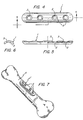
- Figures 4 to 6 show the bone fixation device.
- the device can be manufactured without undue experimentation by methods known in the prior art, e.g. by compression molding.
- the device can be attached to a bone by any means presently known or obvious to a person having ordinary skill in the art, for example by fastening with screws, staples and the like, or by bonding, for example, by gluing the device to the bone.
- FIGs 4 to 6 show holes 2 which are used to each accommodate a screw 5 (shown in Figure 7). To accommodate the screw head, a plurality of holes 2 are countersunk 3 in the device 1.
- FIG 7 the preferred relationship of the device 1 to a mammalian bone 4 fracture is shown. Under many circumstances, the configuration shown in Figure 7 will allow the best possible chance for uniform healing of the fracture in the bone 4.
- Poly(l-lactide)-Alumina Fiber Laminate The laminate was formed from poly(l-lactide) of inherent viscosity 2.68 dl/g (0.5 g/dl in CHCl3, after consolidation) and a fabric made from alumina fiber. Poly(l-lactide) was melt pressed into 10 cm by 10 cm (4" by 4") square films, two films of 0.127 mm (0.005") and two films of 0.584 mm (0.023”) thickness. The laminate was formed by stacking the films and fabric in alternating layers. Three piles of fabric were used. The 0.0127 mm (0.005") thick films were used for the two outside layers.
- the laminate was consolidated by heating to 200°C in a vacuum bag and compressing to a thickness of 1.6 mm (1/16").
- the laminate contained 19% alumina fabric by volume.
- the laminate had the following mechanical properties: FLEXURAL MODULUS 12.479 X 10³ MPa (1.81 X 10⁶ psi) FLEXURAL STRENGTH 1.144 X 10² MPa (16.6 X 10³ psi)
- This material is of particular interest due to it's superior in vivo performance in subcutaneous rabbit implant experiments.
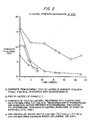
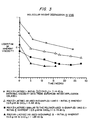
- the degradation of this material in vivo is shown in Figures 1-3.
- Figures 1 and 2 show the physical property degradation profile and
- Figure 3 shows ⁇ she molecular weight degradation profile, as contrasted with materials used in prior art bone fixation devices.
- the initial properties of this composite system can be varied over a wide range by varying fiber loading.
- the degradation profile can be altered by varying the initial molecular weight of the matrix polymer.
- Poly(l-lactide)-Alumina Laminate A laminate was formed which consisted of a poly(l-lactide) of inherent viscosity 1.64 dl/g (0.5 g/dl in CHCl3, after consolidation) and a fabric made from alumina fiber. Poly(l-lactide) was reprecipitated from a chloroform solution into methanol. The dried precipitate was pressed into 10 cm by 10 cm (4" by 4") square mats, two mats of 6.5 g and two mats of 1.2 g. The laminate was formed by stacking the mats and fabric in alternating layers. Three plies of fabric were used. The 1.2 g mats were used for the two outside layers.
- the laminate was consolidated by heating to 195°C in a vacuum bag and compressing to a thickness of 1.6 mm (1/16").
- the laminate contained 17% alumina fabric by volume.
- the laminate had the following mechanical properties: FLEXURAL MODULUS 12.479 X 10³ MPa (1 81 X 106 psi) FLEXURAL STRENGTH 1.372 X 10² MPa (19.9 X 10³ psi)
- Poly(l-lactide)-Alumina Laminate A laminate was formed which consisted of a poly(l-lactide) of inherent viscosity 2.65 dl/g (0.5 g/dl in CHCl3, after consolidation) and a fabric made from alumina fiber. Poly(l-lactide) was reprecipitated from a chloroform solution into methanol. The dried precipitate was pressed into 10 cm by 10 cm (4" by 4") square mats, two mats of 6.5 g and two mats of 1.2 g. The laminate was formed by stacking the mats and fabric in alternating layers. Three plies of fabric were used. The 1.2 g mats were used for the two outside layers.
- the laminate was consolidated by heating to 195°C in a vacuum bag and compressing to a thickness of 1.6 mm (1/16").
- the laminate contained 17% alumina fabric by volume.
- the laminate had the following mechanical properties: FLEXURAL MODULUS 10.480 X 10³ MPa (1.52 X 10⁶ psi) FLEXURAL STRENGTH 1.137 X 10² MPa (16.5 X 10³ psi)
- Poly(l-lactide)-Alumina Laminate A laminate was formed which consisted of a poly(l-lactide) of inherent viscosity 4.14 dl/g (0.5 g/dl in CHCl3, after consolidation) and a fabric made from alumina fiber. Poly(l-lactide) was reprecipitated from a chloroform solution into methanol. The dried precipitate was pressed into 10 cm by 10 cm (4" by 4") square mats, two mats of 6.5 g and two mats of 1.2 g. The laminate was formed by stacking the mats and fabric in alternating layers Three plies of fabric were used. The 1,2 g mats were used for the two outside layers.
- the laminate was consolidated by heating to 195°C in a vacuum bag and compressing to a thickness of 1.6 mm (1/16").
- the laminate contained 17% alumina fabric by volume.
- the laminate had the following mechanical properties: FLEXURAL MODULUS 10.066 X 10³ MPa (1.46 X 10⁶ psi) FLEXURAL STRENGTH 1.034 X 10² MPa (15.0 X 10³ psi)
- a summary of the flexural strength and flexural modulus data for Examples 2 to 4 is contained in the following Table.
- Poly(l-lactide)-Alumina Laminate A laminate was formed which consisted of a poly(l-lactide) of inherent viscosity 2.64 dl/g (0-5 g/dl in CHCl3, before consolidation) and a fabric made from alumina fiber. Poly(l-lactide) was melt pressed into 10 cm by 10 cm (4" by 4") square films, two films of 0.127 mm (0.005") and one film of 1.143 mm (0.045”) thickness. The laminate was formed by stacking the films and fabric in alternating layers. Two plies of fabric were used. The 0.127 mm (0.005") films were used for the two outside layers.
- the laminate was consolidated by heating to 200°C in a vacuum bag and compressing to a thickness of 1.6 mm (1/16").
- the laminate contained 13% alumina fabric by volume.
- the laminate had the following mechanical properties: FLEXURAL MODULUS 14.410 X 10³ MPa (2.09 X 10⁶ psi) FLEXURAL STRENGTH 1.220 X 10² MPa (17.7 X 10³ psi)
- Poly(l-lactide)-Alumina Laminate A laminate was formed which consisted of a poly(l-lactide) of inherent viscosity 2.64 dl/g (0.5 g/dl in CHCl3, before consolidation) and a fabric made from alumina fiber. Poly(l-lactide) was melt pressed into 10 cm by 10 cm (4" by 4") square films, two films of 0.127 mm (0.005") and two films of 0.584 mm (0.023”) thickness. The laminate was formed by stacking the films and fabric alternating layers. Three plies of fabric were used. The 0.127 mm (0.005") films were used for the two outside layers.
- the laminate was consolidated by heating to 200°C in a vacuum bag and compressing to a thickness of 1.6 mm (1/16").
- the laminate contained 19% alumina fabric by volume.
- the laminate had the following mechanical properties: FLEXURAL MODULUS 13.100 X 10³ MPa (1.90 X 10⁶ psi) FLEXURAL STRENGTH 1.220 X 10² MPa (17.7 X 10³ psi)
- Poly(l-lactide)-Alumina Laminate A laminate was formed which consisted of a poly(l-lactide) or inherent viscosity 2.64 dl/g (0.5 g/dl in CHCl3, before consolidation) and a fabric made from alumina fiber. Poly(l-lactide) was melt pressed into 10 cm by 10 cm (4" by 4") square films, two films of 0.127 mm (0.005") and three films of 0.381 mm (0.015”) thickness. The laminate was formed by stacking the films and fabric in alternating layers. Four plies of fabric were used. The 0.127 mm (0.005") films were used for the two outside layers.
- the laminate was consolidated by heating to 200°C in a vacuum bag and compressing to a thickness of 1.6 mm (1/16").
- the laminate contained 24% alumina fabric by volume.
- the laminate had the following mechanical properties: FLEXURAL MODULUS 20.271 X 10³ MPa (2.94 X 10⁶ psi) FLEXURAL STRENGTH 1.489 X 10² MPa (21.6 X 10³ psi)
- Poly(l-lactide)-Alumina Laminate A laminate was formed which consisted of a poly(l-lactide) of inherent viscosity 2.64 dl/g (0.5 g/dl in CHCl3, before consolidation) and a fabric made from alumina fiber. Poly(l-lactide) was melt pressed into 10 cm by 10 cm (4" by 4") square films, two films of 0.127 mm (0.005") and four films of 0.203 mm (0.008”) thickness. The laminate was formed by stacking the films and fabric in alternating layers. Five plies of fabric were used. The 0.127 mm (0.005") films were used for the two outside layers.
- the laminate was consolidated by heating to 200°C in a vacuum bag and compressing to a thickness of 1.6 mm (1/16").
- the laminate contained 30% alumina fabric by volume.
- the laminate had the following mechanical properties: FLEXURAL MODULUS 24.960 X 10³ MPa (3.62 X 10⁶ psi) FLEXURAL STRENGTH 1.661 X 10² MPa (24.1 X 10³ psi)
- a summary of the flexural strength and flexural modulus data for Examples 5 to 8 is contained in the following Table.
- Poly(l-lactide)-Alumina Laminate A laminate was formed by impregnating 12.7 mm (1/2") chopped alumina fiber with poly(l-lactide). The polymer bad an inherent viscosity of 2.64 dl/g (0-5 g/dl in CHCl3, before consolidation). The impregnation was accomplished by dissolving the polymer in chloroform (10 g/dl) followed by stirring in the chopped fiber The mixture was then dried under vacuum to constant weight. The impregnated fiber was consolidated using vacuum and compression at 200°C, forming a laminate containing 30% alumina by volume.
- the laminate had the following mechanical properties: FLEXURAL MODULUS 12.204 X 10³ MPa (1.77 X 10⁶ psi) FLEXURAL STRENGTH 1.055 X 10² MPa (15.3 X 10³ psi)
Landscapes
- Health & Medical Sciences (AREA)
- Epidemiology (AREA)
- Animal Behavior & Ethology (AREA)
- Veterinary Medicine (AREA)
- Public Health (AREA)
- Heart & Thoracic Surgery (AREA)
- Surgery (AREA)
- Vascular Medicine (AREA)
- Life Sciences & Earth Sciences (AREA)
- General Health & Medical Sciences (AREA)
- Chemical & Material Sciences (AREA)
- Composite Materials (AREA)
- Engineering & Computer Science (AREA)
- Materials Engineering (AREA)
- Inorganic Chemistry (AREA)
- Materials For Medical Uses (AREA)
- Prostheses (AREA)
- Organic Low-Molecular-Weight Compounds And Preparation Thereof (AREA)
Description
- This invention relates to surgical structural elements consisting of bioabsorbable or semi-bioabsorbable composites, as well as to products and applications using these materials. Such surgical structural devices may include plates, screws, nails, pegs, rods, pins and any other device which would require a bioabsorbable material with relatively high rigidity and strength.
- The use of internal bone fixation is an established and clinically used technique. The two major types of internal fixation devices are bone plates and intramedullary rods. The particular form intended for this invention is as an internal bone fixation plate.
- Bone plates are applicable to a large variety of bones including load bearing as well as non-load bearing bones. Presently, more long bone fixations are done with intramedullary rods. Both of these devices are traditionally made of metal, e.g. stainless steel 316. There are two major disadvantages, however, associated with the presently used metal plates:
- 1) Metal plates have a modulus approximately one order of magnitude greater than cortical bone. This mismatch in stiffness is known to cause stress protection induced osteoporosis or osteopenia. The increase in porosity and decrease in cortical wall thickness results in a weakened bone which is prone to refracture once the bone plate is removed.
- 2) The metal plates must be removed due to their nonbiodegradable nature coupled with the eventual possibility of corrosion. A second surgical procedure is therefore required which may introduce further complications.
- The use of lower stiffness materials such as non-absorbable composites and tubular steel have been investigated. However, no human trials of these materials are known.
- Lower stiffness bone fixation devices have advantages over metal plates. For example the stiffness of a bone plate can be made essentially equal to the modulus of cortical bone. If the low stiffness bone plate is also bioabsorbable, it does not have to be surgically removed. Thus the need for a second surgical procedure is eliminated.
- Considerable research has therefore been devoted to the development of low stiffness bone plate materials. The properties which are most desirable in a bone plate are:
- 1) The bone plate should provide a firm fixation of the broken bone to promote union during the early stages of healing.
- 2) Once union has occurred, the load which was initially supported by the bone plate, would be gradually transferred back to the bone. This would induce the formation of stronger more dense bone at the fracture site thus accelerating the healing process.
- 3) After the bone heals (3 to 6 months after implantation) the bone plate would completely lose its ability to support a load. The bone would then be once again subjected to its normal stresses.
- Bioabsorbable materials with an initial modulus and strength at or near those of cortical bone are useful as internal bone fracture fixation devices for load bearing as well as non-load bearing bones.
- The completely bioabsorbable or semi-absorbable composites of this invention are superior in mechanical properties and in biological behavior to the stainless steel devices presently used. The mechanical properties of these composites can be tailored to the specific end-use application. The devices of this invention will gradually lose their mechanical properties and will ultimately fully or partially disappear.
- EP-A-0 011 528 discloses a bone fixation plate consisting of poly(l-lactide) reinforced with poly(glycolic-acid) fibers.
- FR-A-2 364 644 discloses a bone prosthetic material utilising an absorbable polymer having an adjuvent of tricalcium phosphat and/or a ceramic hydroxyapatite.
- EP-A-0 146 398 discloses a method of reducing ceramic fibers to small particles that can be sintered into reinforcing filaments. These filaments of fibers are then used with a bioabsorbable polymer matrix to form a bone plate or other orthopedic device.
- WO-A- 8600533 discloses an implant article comprising a composit of fibre material which may not be biodegradable e.g. carbon fibres and is incorporated in a porous matrix of a bio degradable organic polymer material e.g. polylactive.
- A bioabsorbable device with an adjustable initial modulus which can be set at, above or below the modulus of bone, and which loses properties at a controllable, predictable rate after implantation has been invented. The device consist of a poly(l-lactide) matrix reinforced with α-alumina fibers (DuPont Fiber FP®).
- This invention uses a combination of materials which consist of a bioabsorbable polymer and a reinforcement fiber. The component materials are combined in such a way as to have bending, axial and torsional stiffness and strength suitable for the biomechanical demands placed upon it. The material will, subsequent to implantation, gradually lose both stiffness and strength according to the time frame for which useful properties are required. The material will ultimately be completely or partially absorbed by the body, any residue being both inert in the body and bereft of significant mechanical properties. No surgical procedure to remove the device would be required.
- The present inventions provides a semi-absorbable laminated bone fixation device comprising an impregnating agent consisting of an absorbable polymer matrix, said matrix obtained from the polymerization of l-lactide and having an inherent viscosity of 1.5 to 3.5 dl/g (o,5 g/dl in CHCl₃), and a nonabsorbable reinforcement material consisting of at least one alumina fiber said device having a flexural modulus of 6.895 x 10³ to 34.475 x 10³ MPa (1 x 10⁶ to 5 x 10⁶ psi) a loss of 25 % of its initial flexural modulus during 3 months in vivo and 45 % during 6 months in vivo.
- A laminated bone fixation device has been invented. The device comprises an impregnating agent consisting of an absorbable polymer matrix. The polymer is obtained from the polymerization of l-lactide. The matrix has an inherent viscosity of about 1.5 to 3.5 dl/g (0.5 g/dl in CHCl₃). The device also comprises a nonabsorbable reinforcement material. The reinforcement material consists essentially of at least one alumina fiber. The device has a flexural strength of about 68.95 to 172.38 MPa (10,000 to 25,000 psi); a flexural modulus of 6.895 x 10³ to 34.475 x 10³ (1x10⁶ to 5x10⁶ psi); a loss of 30% of initial flexural strength during 3 months in vivo and 60% during 6 months in vivo; and a loss of 25% of initial flexural modulus during 3 months in vivo and 45% during 6 months in vivo.
- In one embodiment, the reinforcement material is more than one alpha alumina fibers. In a specific embodiment, the reinforcement material comprises 10 to 60 volume percent of said fibers. In a more specific embodiment, the device comprises 15 to 40 percent of said fibers. In another embodiment, the device has a flexural strength of 103.4 to 172.38 MPa (15,000 to 25,000 psi). In a further embodiment, the device has a flexural modulus of up to 20.685 x 10³ MPa (3x10⁶ psi).
-
- Figure 1 is a graph showing the in vivo flexural modulus degradation of the device of this invention, as contrasted with the moduli of prior art bone fixation devices;
- Figures 2 and 3 are graphs, similar to that of Figure 1, showing in vivo flexural strength and molecular weight degradation, respectively;
- Figure 4 is a top view of a bone fixation device manufactured from the composite materials of this invention;
- Figure 5 is a partially broken side view of Figure 4;
- Figure 6 is a front view of Figure 5; and
- Figure 7 is a broken perspective view of Figures 4 to 6 showing the use of the device on a mammalian bone.
- The following is a description for making the composite materials used in the bone fixation device of this invention.
-
- A) Solution Impregnation and Laminations: The fiber or woven fabric is immersed in a solution of the biodegradable polymer in a low boiling point solvent (e.g. methylene chloride). The amount of polymer deposited on the fabric, chopped fiber or fiber yarn is dependent on the solution concentration, the polymer molecular weight (which effects solution viscosity), the length of immersion time and the number of immersions. The impregnated chopped fiber, yarn or fabric (prepreg) is then thoroughly dried. The prepreg is laid-up in a mold of a predetermined thickness. Vacuum is applied to the lay-up by use of a vacuum bag. Heat and compression are then applied to consolidate the laminate.
- B) Melt Impregnation and Lamination: Films of the biodegradable polymer are made by solvent casting or melt pressing. Alternatively, fibrous mats are made from polymer by running a solution of the polymer into a non-solvent in a thin stream to form a stringy precipitate, followed by pressing into a mat at room temperature. The films or mats are then laid between yarn or fabric layers in a mold of a predetermined thickness. Vacuum is applied to the lay-up, by vacuum-bagging the mold, and heat and compression are applied to consolidate the laminate.
- Figures 4 to 6 show the bone fixation device. The device can be manufactured without undue experimentation by methods known in the prior art, e.g. by compression molding. The device can be attached to a bone by any means presently known or obvious to a person having ordinary skill in the art, for example by fastening with screws, staples and the like, or by bonding, for example, by gluing the device to the bone.
- Figures 4 to 6
show holes 2 which are used to each accommodate a screw 5 (shown in Figure 7). To accommodate the screw head, a plurality ofholes 2 are countersunk 3 in thedevice 1. - Referring specifically to Figures 4 and 5, four
holes 2 are shown. It is to be understood that any number of holes can be used, provided thedevice 1 is adequately attached to a bone 4 (shown in Figure 7). However, as a minimum, at least twoholes 2 andscrews 5 appear to be necessary. - Referring to Figure 7, the preferred relationship of the
device 1 to a mammalian bone 4 fracture is shown. Under many circumstances, the configuration shown in Figure 7 will allow the best possible chance for uniform healing of the fracture in the bone 4. - The following examples more fully describe the above embodiments.
- Poly(l-lactide)-Alumina Fiber Laminate: The laminate was formed from poly(l-lactide) of inherent viscosity 2.68 dl/g (0.5 g/dl in CHCl₃, after consolidation) and a fabric made from alumina fiber. Poly(l-lactide) was melt pressed into 10 cm by 10 cm (4" by 4") square films, two films of 0.127 mm (0.005") and two films of 0.584 mm (0.023") thickness. The laminate was formed by stacking the films and fabric in alternating layers. Three piles of fabric were used. The 0.0127 mm (0.005") thick films were used for the two outside layers. The laminate was consolidated by heating to 200°C in a vacuum bag and compressing to a thickness of 1.6 mm (1/16"). The laminate contained 19% alumina fabric by volume. The laminate had the following mechanical properties:
FLEXURAL MODULUS 12.479 X 10³ MPa (1.81 X 10⁶ psi)
FLEXURAL STRENGTH 1.144 X 10² MPa (16.6 X 10³ psi)
This material is of particular interest due to it's superior in vivo performance in subcutaneous rabbit implant experiments. The degradation of this material in vivo is shown in Figures 1-3. Figures 1 and 2 show the physical property degradation profile and Figure 3 shows `she molecular weight degradation profile, as contrasted with materials used in prior art bone fixation devices. The initial properties of this composite system can be varied over a wide range by varying fiber loading. In addition, the degradation profile can be altered by varying the initial molecular weight of the matrix polymer. - Mechanical properties declined in a roughly linear manner over a 6 month period in rabbits to a level at 39% of initial flexural strength and 53% of initial flexural modulus. Inherent viscosity data suggest that mass loss of the poly(l-lactide) matrix would begin after approximately 42 weeks. After mass loss onset, the rate of mechanical property degradation should increase and any remaining load bearing capability would quickly deteriorate.
- Poly(l-lactide)-Alumina Laminate: A laminate was formed which consisted of a poly(l-lactide) of inherent viscosity 1.64 dl/g (0.5 g/dl in CHCl₃, after consolidation) and a fabric made from alumina fiber. Poly(l-lactide) was reprecipitated from a chloroform solution into methanol. The dried precipitate was pressed into 10 cm by 10 cm (4" by 4") square mats, two mats of 6.5 g and two mats of 1.2 g. The laminate was formed by stacking the mats and fabric in alternating layers. Three plies of fabric were used. The 1.2 g mats were used for the two outside layers. The laminate was consolidated by heating to 195°C in a vacuum bag and compressing to a thickness of 1.6 mm (1/16"). The laminate contained 17% alumina fabric by volume. The laminate had the following mechanical properties:
FLEXURAL MODULUS 12.479 X 10³ MPa (1 81 X 10⁶ psi)
FLEXURAL STRENGTH 1.372 X 10² MPa (19.9 X 10³ psi) - Poly(l-lactide)-Alumina Laminate: A laminate was formed which consisted of a poly(l-lactide) of inherent viscosity 2.65 dl/g (0.5 g/dl in CHCl₃, after consolidation) and a fabric made from alumina fiber. Poly(l-lactide) was reprecipitated from a chloroform solution into methanol. The dried precipitate was pressed into 10 cm by 10 cm (4" by 4") square mats, two mats of 6.5 g and two mats of 1.2 g. The laminate was formed by stacking the mats and fabric in alternating layers. Three plies of fabric were used. The 1.2 g mats were used for the two outside layers. The laminate was consolidated by heating to 195°C in a vacuum bag and compressing to a thickness of 1.6 mm (1/16"). The laminate contained 17% alumina fabric by volume. The laminate had the following mechanical properties:
FLEXURAL MODULUS 10.480 X 10³ MPa (1.52 X 10⁶ psi)
FLEXURAL STRENGTH 1.137 X 10² MPa (16.5 X 10³ psi) - Poly(l-lactide)-Alumina Laminate: A laminate was formed which consisted of a poly(l-lactide) of inherent viscosity 4.14 dl/g (0.5 g/dl in CHCl₃, after consolidation) and a fabric made from alumina fiber. Poly(l-lactide) was reprecipitated from a chloroform solution into methanol. The dried precipitate was pressed into 10 cm by 10 cm (4" by 4") square mats, two mats of 6.5 g and two mats of 1.2 g. The laminate was formed by stacking the mats and fabric in alternating layers Three plies of fabric were used. The 1,2 g mats were used for the two outside layers. The laminate was consolidated by heating to 195°C in a vacuum bag and compressing to a thickness of 1.6 mm (1/16"). The laminate contained 17% alumina fabric by volume. The laminate had the following mechanical properties:
FLEXURAL MODULUS 10.066 X 10³ MPa (1.46 X 10⁶ psi)
FLEXURAL STRENGTH 1.034 X 10² MPa (15.0 X 10³ psi)
A summary of the flexural strength and flexural modulus data for Examples 2 to 4 is contained in the following Table.
- Poly(l-lactide)-Alumina Laminate: A laminate was formed which consisted of a poly(l-lactide) of inherent viscosity 2.64 dl/g (0-5 g/dl in CHCl₃, before consolidation) and a fabric made from alumina fiber. Poly(l-lactide) was melt pressed into 10 cm by 10 cm (4" by 4") square films, two films of 0.127 mm (0.005") and one film of 1.143 mm (0.045") thickness. The laminate was formed by stacking the films and fabric in alternating layers. Two plies of fabric were used. The 0.127 mm (0.005") films were used for the two outside layers. The laminate was consolidated by heating to 200°C in a vacuum bag and compressing to a thickness of 1.6 mm (1/16"). The laminate contained 13% alumina fabric by volume. The laminate had the following mechanical properties:
FLEXURAL MODULUS 14.410 X 10³ MPa (2.09 X 10⁶ psi)
FLEXURAL STRENGTH 1.220 X 10² MPa (17.7 X 10³ psi) - Poly(l-lactide)-Alumina Laminate: A laminate was formed which consisted of a poly(l-lactide) of inherent viscosity 2.64 dl/g (0.5 g/dl in CHCl₃, before consolidation) and a fabric made from alumina fiber. Poly(l-lactide) was melt pressed into 10 cm by 10 cm (4" by 4") square films, two films of 0.127 mm (0.005") and two films of 0.584 mm (0.023") thickness. The laminate was formed by stacking the films and fabric alternating layers. Three plies of fabric were used. The 0.127 mm (0.005") films were used for the two outside layers. The laminate was consolidated by heating to 200°C in a vacuum bag and compressing to a thickness of 1.6 mm (1/16"). The laminate contained 19% alumina fabric by volume. The laminate had the following mechanical properties:
FLEXURAL MODULUS 13.100 X 10³ MPa (1.90 X 10⁶ psi)
FLEXURAL STRENGTH 1.220 X 10² MPa (17.7 X 10³ psi) - Poly(l-lactide)-Alumina Laminate: A laminate was formed which consisted of a poly(l-lactide) or inherent viscosity 2.64 dl/g (0.5 g/dl in CHCl₃, before consolidation) and a fabric made from alumina fiber. Poly(l-lactide) was melt pressed into 10 cm by 10 cm (4" by 4") square films, two films of 0.127 mm (0.005") and three films of 0.381 mm (0.015") thickness. The laminate was formed by stacking the films and fabric in alternating layers. Four plies of fabric were used. The 0.127 mm (0.005") films were used for the two outside layers. The laminate was consolidated by heating to 200°C in a vacuum bag and compressing to a thickness of 1.6 mm (1/16"). The laminate contained 24% alumina fabric by volume. The laminate had the following mechanical properties:
FLEXURAL MODULUS 20.271 X 10³ MPa (2.94 X 10⁶ psi)
FLEXURAL STRENGTH 1.489 X 10² MPa (21.6 X 10³ psi) - Poly(l-lactide)-Alumina Laminate: A laminate was formed which consisted of a poly(l-lactide) of inherent viscosity 2.64 dl/g (0.5 g/dl in CHCl₃, before consolidation) and a fabric made from alumina fiber. Poly(l-lactide) was melt pressed into 10 cm by 10 cm (4" by 4") square films, two films of 0.127 mm (0.005") and four films of 0.203 mm (0.008") thickness. The laminate was formed by stacking the films and fabric in alternating layers. Five plies of fabric were used. The 0.127 mm (0.005") films were used for the two outside layers. The laminate was consolidated by heating to 200°C in a vacuum bag and compressing to a thickness of 1.6 mm (1/16"). The laminate contained 30% alumina fabric by volume. The laminate had the following mechanical properties:
FLEXURAL MODULUS 24.960 X 10³ MPa (3.62 X 10⁶ psi)
FLEXURAL STRENGTH 1.661 X 10² MPa (24.1 X 10³ psi)
A summary of the flexural strength and flexural modulus data for Examples 5 to 8 is contained in the following Table.
- Poly(l-lactide)-Alumina Laminate: A laminate was formed by impregnating 12.7 mm (1/2") chopped alumina fiber with poly(l-lactide). The polymer bad an inherent viscosity of 2.64 dl/g (0-5 g/dl in CHCl₃, before consolidation). The impregnation was accomplished by dissolving the polymer in chloroform (10 g/dl) followed by stirring in the chopped fiber The mixture was then dried under vacuum to constant weight. The impregnated fiber was consolidated using vacuum and compression at 200°C, forming a laminate containing 30% alumina by volume. The laminate had the following mechanical properties:
FLEXURAL MODULUS 12.204 X 10³ MPa (1.77 X 10⁶ psi)
FLEXURAL STRENGTH 1.055 X 10² MPa (15.3 X 10³ psi) - In Vitro Degradation of Poly(l-lactide)-Alumina Laminates: An accelerated in vitro degradation test was used to assess the relative degradation rates of laminates made with poly(l-lactide)s of different molecular weights reinforced with alumina fabric. The in vitro procedure involved immersing the sample in a pH 6.09 phosphate buffered aqueous solution at 67°C. The samples were removed from the bath, dried and tested for mechanical properties using the ASTM D790 method. Samples from Examples 3, 4 and 5 were used in this study. The results are shown in Table I. These data indicate that the composite fabricated with the lower molecular weight polymer (Example 3) possessed higher initial mechanical properties than the composites made with higher molecular weight polymers. It also appeared to have less scatter in its degradation profile.
- In Vitro Degradation of Poly(l-lactide)-Alumina Laminates: An accelerated in vitro degradation test was used to assess the relative degradation rates of laminates made with poly(l-lactide) reinforced with different loadings of alumina fabric. The in vitro procedure was identical to, that described in Example 10. Samples from Examples 5, 6, 7 and 8 were used in this study. The results are shown in Table II. These data indicate that the composites possessed higher initial mechanical properties as the fabric volume increased. This relationship allows the tailoring of a material to have the mechanical properties desirable for a specific application within a fairly broad range.
Claims (6)
- A semi-absorbable laminated bone fixation device comprising an impregnating agent consisting of an absorbable polymer matrix, said matrix obtained from the polymerization of l-lactide and having an inherent viscosity of 1.5 to 3.5 dl/g (o,5 g/dl in CHCl₃), and a nonabsorbable reinforcement material consisting of at least one alumina fiber said device having a flexural modulus of 6.895 x 10³ to 34.475 x 10³ MPa (1 x 10⁶ to 5 x 10⁶ psi) a loss of 25 % of its initial flexural modulus during 3 months in vivo and 45 % during 6 months in vivo.
- A device of Claim 1 wherein said reinforcement material is more than one alpha alumina fibers.
- A device of Claim 2 wherein the fibers comprise 10 to 60 percent of the volume of said device.
- A device of Claim 2 wherein the fibers comprise 15 to 40 percent of the volume of said device.
- A device of Claim 4 having a flexural strength of 1.034 x 10² to 1.724 x 10² MPa (15.000 to 25.000 psi).
- A device of Claim 5 having a flexural modulus of up to 20.685 x 10³ MPa (3 x 10⁶ psi).
Applications Claiming Priority (2)
| Application Number | Priority Date | Filing Date | Title |
|---|---|---|---|
| US900957 | 1986-08-27 | ||
| US06/900,957 US4781183A (en) | 1986-08-27 | 1986-08-27 | Surgical prosthesis |
Publications (3)
| Publication Number | Publication Date |
|---|---|
| EP0258692A2 EP0258692A2 (en) | 1988-03-09 |
| EP0258692A3 EP0258692A3 (en) | 1990-04-04 |
| EP0258692B1 true EP0258692B1 (en) | 1994-06-15 |
Family
ID=25413362
Family Applications (1)
| Application Number | Title | Priority Date | Filing Date |
|---|---|---|---|
| EP87111585A Expired - Lifetime EP0258692B1 (en) | 1986-08-27 | 1987-08-11 | Surgical prothesis |
Country Status (13)
| Country | Link |
|---|---|
| US (1) | US4781183A (en) |
| EP (1) | EP0258692B1 (en) |
| JP (1) | JPS6389166A (en) |
| KR (1) | KR950008174B1 (en) |
| AU (1) | AU599413B2 (en) |
| CA (1) | CA1263791A (en) |
| DE (1) | DE3750061T2 (en) |
| DK (1) | DK169278B1 (en) |
| ES (1) | ES2054634T3 (en) |
| FI (1) | FI873700L (en) |
| IL (1) | IL83538A (en) |
| NO (1) | NO172169C (en) |
| ZA (1) | ZA876366B (en) |
Families Citing this family (140)
| Publication number | Priority date | Publication date | Assignee | Title |
|---|---|---|---|---|
| JPS6368155A (en) * | 1986-09-11 | 1988-03-28 | グンゼ株式会社 | Bone bonding pin |
| FI81498C (en) * | 1987-01-13 | 1990-11-12 | Biocon Oy | SURGICAL MATERIAL OCH INSTRUMENT. |
| US4966599A (en) * | 1987-04-07 | 1990-10-30 | Pollock Richard A | Anatomical precontoured plating, instruments and methods |
| WO1989004150A1 (en) * | 1987-11-03 | 1989-05-18 | Synthes Ag | Implant for osteosynthesis |
| CH673762A5 (en) * | 1987-12-02 | 1990-04-12 | Synthes Ag | |
| EP0352972A3 (en) * | 1988-07-29 | 1991-01-02 | BAXTER INTERNATIONAL INC. (a Delaware corporation) | Fiber-reinforced expanded fluoroplastic vascular grafts |
| DE3831657A1 (en) * | 1988-09-17 | 1990-03-22 | Boehringer Ingelheim Kg | DEVICE FOR THE OSTEOSYNTHESIS AND METHOD FOR THE PRODUCTION THEREOF |
| GR1002030B (en) * | 1988-11-28 | 1995-10-31 | Evaggelos Ntalas | Deposition of xydroxyapatite on modified polymers |
| DE3841288A1 (en) * | 1988-12-08 | 1990-06-13 | Pertti Prof Dr Toermaelae | OSTEOSYNTHESE IMPLANTS |
| US5290494A (en) * | 1990-03-05 | 1994-03-01 | Board Of Regents, The University Of Texas System | Process of making a resorbable implantation device |
| US5080665A (en) * | 1990-07-06 | 1992-01-14 | American Cyanamid Company | Deformable, absorbable surgical device |
| CA2060635A1 (en) * | 1991-02-12 | 1992-08-13 | Keith D'alessio | Bioabsorbable medical implants |
| EP0523926A3 (en) * | 1991-07-15 | 1993-12-01 | Smith & Nephew Richards Inc | Prosthetic implants with bioabsorbable coating |
| JP2619760B2 (en) * | 1991-12-25 | 1997-06-11 | グンゼ株式会社 | Bone treatment device and method for producing the same |
| US5391768A (en) * | 1993-03-25 | 1995-02-21 | United States Surgical Corporation | Purification of 1,4-dioxan-2-one by crystallization |
| US5721049A (en) * | 1993-11-15 | 1998-02-24 | Trustees Of The University Of Pennsylvania | Composite materials using bone bioactive glass and ceramic fibers |
| US6121172A (en) * | 1993-11-15 | 2000-09-19 | The Trustees Of The University Of Pennsylvania | Composite materials using bone bioactive glass and ceramic fibers |
| US5468544A (en) * | 1993-11-15 | 1995-11-21 | The Trustees Of The University Of Pennsylvania | Composite materials using bone bioactive glass and ceramic fibers |
| US5569250A (en) * | 1994-03-01 | 1996-10-29 | Sarver; David R. | Method and apparatus for securing adjacent bone portions |
| US20020169485A1 (en) | 1995-10-16 | 2002-11-14 | Neuropace, Inc. | Differential neurostimulation therapy driven by physiological context |
| US6944501B1 (en) * | 2000-04-05 | 2005-09-13 | Neurospace, Inc. | Neurostimulator involving stimulation strategies and process for using it |
| US5711958A (en) * | 1996-07-11 | 1998-01-27 | Life Medical Sciences, Inc. | Methods for reducing or eliminating post-surgical adhesion formation |
| US6696499B1 (en) * | 1996-07-11 | 2004-02-24 | Life Medical Sciences, Inc. | Methods and compositions for reducing or eliminating post-surgical adhesion formation |
| ZA978537B (en) | 1996-09-23 | 1998-05-12 | Focal Inc | Polymerizable biodegradable polymers including carbonate or dioxanone linkages. |
| FI105159B (en) * | 1996-10-25 | 2000-06-30 | Biocon Ltd | Surgical implant, agent or part thereof |
| JP3426460B2 (en) * | 1996-10-25 | 2003-07-14 | グンゼ株式会社 | Osteosynthesis |
| JP3718306B2 (en) * | 1997-01-06 | 2005-11-24 | 経憲 武井 | Artificial acetabulum and hip joint |
| JP4467647B2 (en) | 1997-02-11 | 2010-05-26 | ウォーソー・オーソペディック・インコーポレーテッド | Bone plating system |
| ATE309752T1 (en) | 1997-02-11 | 2005-12-15 | Michelson Gary K | SYSTEM FOR ANTERIOR PLATING OF THE CERVICAL SPINE |
| US6211249B1 (en) | 1997-07-11 | 2001-04-03 | Life Medical Sciences, Inc. | Polyester polyether block copolymers |
| US5935127A (en) * | 1997-12-17 | 1999-08-10 | Biomet, Inc. | Apparatus and method for treatment of a fracture in a long bone |
| JPH11206871A (en) * | 1998-01-27 | 1999-08-03 | Bmg:Kk | Biodegradable and absorbable bone fixation material and method for producing the same |
| DE19805673C2 (en) * | 1998-02-12 | 2002-09-26 | Wolfgang Quante | Process and kit for making bone replacement and augmentation material |
| US5938664A (en) * | 1998-03-31 | 1999-08-17 | Zimmer, Inc. | Orthopaedic bone plate |
| US6206883B1 (en) | 1999-03-05 | 2001-03-27 | Stryker Technologies Corporation | Bioabsorbable materials and medical devices made therefrom |
| NZ513746A (en) * | 1999-03-09 | 2001-09-28 | Synthes Ag | Bone plate |
| US6296645B1 (en) | 1999-04-09 | 2001-10-02 | Depuy Orthopaedics, Inc. | Intramedullary nail with non-metal spacers |
| US6783529B2 (en) | 1999-04-09 | 2004-08-31 | Depuy Orthopaedics, Inc. | Non-metal inserts for bone support assembly |
| DE29913390U1 (en) * | 1999-07-31 | 1999-09-23 | Aesculap AG & Co. KG, 78532 Tuttlingen | Plastic bone plate |
| US6473639B1 (en) | 2000-03-02 | 2002-10-29 | Neuropace, Inc. | Neurological event detection procedure using processed display channel based algorithms and devices incorporating these procedures |
| US6466822B1 (en) | 2000-04-05 | 2002-10-15 | Neuropace, Inc. | Multimodal neurostimulator and process of using it |
| US6395033B1 (en) * | 2000-04-10 | 2002-05-28 | Tyco Healthcare Group Lp | Dynamic fusion mechanostat devices |
| US6605090B1 (en) | 2000-10-25 | 2003-08-12 | Sdgi Holdings, Inc. | Non-metallic implant devices and intra-operative methods for assembly and fixation |
| US6529774B1 (en) | 2000-11-09 | 2003-03-04 | Neuropace, Inc. | Extradural leads, neurostimulator assemblies, and processes of using them for somatosensory and brain stimulation |
| US7005135B2 (en) * | 2001-01-30 | 2006-02-28 | Ethicon Inc. | Glass scaffolds with controlled resorption rates and methods for making same |
| KR100383433B1 (en) * | 2001-06-29 | 2003-05-12 | 주식회사 씨엠리서치 | Method for preparing bioabsorbable organic/inorganic composition for bone fixation devices and itself prepared thereby |
| US6747121B2 (en) | 2001-09-05 | 2004-06-08 | Synthes (Usa) | Poly(L-lactide-co-glycolide) copolymers, methods for making and using same, and devices containing same |
| US7682392B2 (en) | 2002-10-30 | 2010-03-23 | Depuy Spine, Inc. | Regenerative implants for stabilizing the spine and devices for attachment of said implants |
| US7951176B2 (en) | 2003-05-30 | 2011-05-31 | Synthes Usa, Llc | Bone plate |
| US11259851B2 (en) | 2003-08-26 | 2022-03-01 | DePuy Synthes Products, Inc. | Bone plate |
| NZ545392A (en) | 2003-08-26 | 2008-03-28 | Synthes Gmbh | Bone plate |
| CN100475168C (en) | 2003-09-08 | 2009-04-08 | 斯恩蒂斯有限公司 | Bone-fixation device |
| US8016865B2 (en) | 2003-09-29 | 2011-09-13 | Depuy Mitek, Inc. | Method of performing anterior cruciate ligament reconstruction using biodegradable interference screw |
| US7699879B2 (en) * | 2003-10-21 | 2010-04-20 | Warsaw Orthopedic, Inc. | Apparatus and method for providing dynamizable translations to orthopedic implants |
| US20050085814A1 (en) * | 2003-10-21 | 2005-04-21 | Sherman Michael C. | Dynamizable orthopedic implants and their use in treating bone defects |
| CA2545019C (en) * | 2003-10-30 | 2012-02-28 | Synthes Gmbh | Bone plate |
| US7655009B2 (en) | 2003-12-01 | 2010-02-02 | Smith & Nephew, Inc. | Humeral nail |
| US20050136764A1 (en) * | 2003-12-18 | 2005-06-23 | Sherman Michael C. | Designed composite degradation for spinal implants |
| US7637928B2 (en) | 2004-01-26 | 2009-12-29 | Synthes Usa, Llc | Variable angle locked bone fixation system |
| US11291484B2 (en) | 2004-01-26 | 2022-04-05 | DePuy Synthes Products, Inc. | Highly-versatile variable-angle bone plate system |
| US8574268B2 (en) | 2004-01-26 | 2013-11-05 | DePuy Synthes Product, LLC | Highly-versatile variable-angle bone plate system |
| US20060173458A1 (en) * | 2004-10-07 | 2006-08-03 | Micah Forstein | Bone fracture fixation system |
| ATE424862T1 (en) * | 2004-10-29 | 2009-03-15 | Smith & Nephew Inc | BIOABSORBABLE POLYMERS WITH CALCIUM CARBONATE |
| US8545866B2 (en) | 2004-10-29 | 2013-10-01 | Smith & Nephew, Inc. | Bioabsorbable polymers |
| US8394130B2 (en) | 2005-03-17 | 2013-03-12 | Biomet C.V. | Modular fracture fixation system |
| US8062296B2 (en) * | 2005-03-17 | 2011-11-22 | Depuy Products, Inc. | Modular fracture fixation plate system with multiple metaphyseal and diaphyseal plates |
| US7410488B2 (en) | 2005-02-18 | 2008-08-12 | Smith & Nephew, Inc. | Hindfoot nail |
| US8470038B2 (en) * | 2005-03-04 | 2013-06-25 | Rti Biologics, Inc. | Adjustable and fixed assembled bone-tendon-bone graft |
| USD583473S1 (en) * | 2005-03-04 | 2008-12-23 | Rti Biologics, Inc. | Set of orthopedic bone block assemblies |
| US7763071B2 (en) * | 2005-03-04 | 2010-07-27 | Rti Biologics, Inc. | Bone block assemblies and their use in assembled bone-tendon-bone grafts |
| US7727278B2 (en) * | 2005-03-04 | 2010-06-01 | Rti Biologics, Inc. | Self fixing assembled bone-tendon-bone graft |
| US7776089B2 (en) * | 2005-03-04 | 2010-08-17 | Rti Biologics, Inc. | Assembled bone-tendon-bone grafts |
| US20060247638A1 (en) * | 2005-04-29 | 2006-11-02 | Sdgi Holdings, Inc. | Composite spinal fixation systems |
| US20070118128A1 (en) * | 2005-11-22 | 2007-05-24 | Depuy Spine, Inc. | Implant fixation methods and apparatus |
| US20070118127A1 (en) * | 2005-11-22 | 2007-05-24 | Depuy Spine, Inc. | Implant fixation methods and apparatus |
| US20070118130A1 (en) * | 2005-11-22 | 2007-05-24 | Depuy Spine, Inc. | Implant fixation methods and apparatus |
| US20070118129A1 (en) * | 2005-11-22 | 2007-05-24 | Depuy Spine, Inc. | Implant fixation methods and apparatus |
| USD583053S1 (en) * | 2005-12-19 | 2008-12-16 | Rti Biologics, Inc. | Orthopedic bone block |
| US20070154514A1 (en) * | 2005-12-30 | 2007-07-05 | Demakas John J | Therapeutic Structures |
| US7867261B2 (en) * | 2006-03-17 | 2011-01-11 | Depuy Products, Inc. | Bone plate with variable torsional stiffness at fixed angle holes |
| US8221468B2 (en) * | 2006-05-11 | 2012-07-17 | Gaines Jr Robert W | Use of bioabsorbable materials for anterior extradiscal correction of thoracolumbar pathologies |
| US7923020B2 (en) * | 2006-09-29 | 2011-04-12 | Depuy Products, Inc. | Composite for implantation in the body of an animal and method for making the same |
| US8007533B2 (en) | 2007-02-12 | 2011-08-30 | Rti Biologics, Inc. | Progressive grip assembled bone-tendon-bone grafts, methods of making, and methods of use |
| JP5419281B2 (en) * | 2007-03-06 | 2014-02-19 | コヴィディエン リミテッド パートナーシップ | Wound closure material |
| US20100076489A1 (en) * | 2007-03-06 | 2010-03-25 | Joshua Stopek | Wound closure material |
| JP5034786B2 (en) * | 2007-08-30 | 2012-09-26 | 東レ株式会社 | Easy degradable film |
| WO2009036783A1 (en) * | 2007-09-18 | 2009-03-26 | Stryker Trauma Gmbh | Angularly stable fixation of an implant |
| US20090138092A1 (en) * | 2007-11-28 | 2009-05-28 | Johnston Brent W | Therapeutic Structures for Utilization in Temporomandibular Joint Replacement Systems |
| US8100949B2 (en) * | 2008-06-03 | 2012-01-24 | Warsaw Orthopedic, Inc. | Transverse rod connectors with osteoconductive material |
| US20100130959A1 (en) * | 2008-10-15 | 2010-05-27 | Palmetto Biomedical, Inc. | Device and method for delivery of therapeutic agents via artificial internal implants |
| US9642658B2 (en) * | 2008-10-15 | 2017-05-09 | Orthoclip Llc | Device and method for delivery of therapeutic agents via internal implants |
| EP2477566B1 (en) | 2009-09-14 | 2017-03-22 | Synthes GmbH | Variable angle compression plate |
| USD642269S1 (en) * | 2009-09-17 | 2011-07-26 | Graham Thomas J | Wave plate |
| US9011494B2 (en) | 2009-09-24 | 2015-04-21 | Warsaw Orthopedic, Inc. | Composite vertebral rod system and methods of use |
| USD641475S1 (en) * | 2010-05-28 | 2011-07-12 | Graham Thomas J | Wave plate |
| USD641474S1 (en) * | 2010-05-28 | 2011-07-12 | Graham Thomas J | Wave plate |
| US8709092B2 (en) | 2011-02-16 | 2014-04-29 | Genesis Medical Devices, LLC | Periprosthetic fracture management enhancements |
| JP6502161B2 (en) * | 2015-05-11 | 2019-04-17 | 帝人メディカルテクノロジー株式会社 | Bone cement |
| US10687874B2 (en) | 2015-08-27 | 2020-06-23 | Globus Medical, Inc | Proximal humeral stabilization system |
| US11076898B2 (en) | 2015-08-27 | 2021-08-03 | Globus Medical, Inc. | Proximal humeral stabilization system |
| US11197682B2 (en) | 2015-08-27 | 2021-12-14 | Globus Medical, Inc. | Proximal humeral stabilization system |
| US10130402B2 (en) | 2015-09-25 | 2018-11-20 | Globus Medical, Inc. | Bone fixation devices having a locking feature |
| US9974581B2 (en) | 2015-11-20 | 2018-05-22 | Globus Medical, Inc. | Expandable intramedullary systems and methods of using the same |
| US9795411B2 (en) | 2016-03-02 | 2017-10-24 | Globus Medical, Inc. | Fixators for bone stabilization and associated systems and methods |
| US10531905B2 (en) | 2016-04-19 | 2020-01-14 | Globus Medical, Inc. | Implantable compression screws |
| US11197701B2 (en) | 2016-08-17 | 2021-12-14 | Globus Medical, Inc. | Stabilization systems |
| US10751098B2 (en) | 2016-08-17 | 2020-08-25 | Globus Medical Inc. | Stabilization systems |
| US10383668B2 (en) | 2016-08-17 | 2019-08-20 | Globus Medical, Inc. | Volar distal radius stabilization system |
| US10420596B2 (en) | 2016-08-17 | 2019-09-24 | Globus Medical, Inc. | Volar distal radius stabilization system |
| US11331128B2 (en) | 2016-08-17 | 2022-05-17 | Globus Medical Inc. | Distal radius stabilization system |
| US11141204B2 (en) | 2016-08-17 | 2021-10-12 | Globus Medical Inc. | Wrist stabilization systems |
| US10575884B2 (en) | 2016-08-17 | 2020-03-03 | Globus Medical, Inc. | Fracture plates, systems, and methods |
| US11213327B2 (en) | 2016-08-17 | 2022-01-04 | Globus Medical, Inc. | Fracture plates, systems, and methods |
| US11432857B2 (en) | 2016-08-17 | 2022-09-06 | Globus Medical, Inc. | Stabilization systems |
| US10687873B2 (en) | 2016-08-17 | 2020-06-23 | Globus Medical Inc. | Stabilization systems |
| US12588937B2 (en) | 2016-08-17 | 2026-03-31 | Globus Medical, Inc. | Volar distal radius stabilization system |
| US10905476B2 (en) | 2016-09-08 | 2021-02-02 | DePuy Synthes Products, Inc. | Variable angle bone plate |
| US10820930B2 (en) | 2016-09-08 | 2020-11-03 | DePuy Synthes Products, Inc. | Variable angle bone plate |
| US10624686B2 (en) | 2016-09-08 | 2020-04-21 | DePuy Synthes Products, Inc. | Variable angel bone plate |
| US10299847B2 (en) | 2016-09-22 | 2019-05-28 | Globus Medical, Inc. | Systems and methods for intramedullary nail implantation |
| US10881438B2 (en) | 2017-03-10 | 2021-01-05 | Globus Medical, Inc. | Clavicle fixation system |
| US10905477B2 (en) | 2017-03-13 | 2021-02-02 | Globus Medical, Inc. | Bone stabilization systems |
| US10368928B2 (en) | 2017-03-13 | 2019-08-06 | Globus Medical, Inc. | Bone stabilization systems |
| US12318122B2 (en) | 2017-09-13 | 2025-06-03 | Globus Medical, Inc. | Bone stabilization systems |
| US10856920B2 (en) | 2017-09-13 | 2020-12-08 | Globus Medical Inc. | Bone stabilization systems |
| US11096730B2 (en) | 2017-09-13 | 2021-08-24 | Globus Medical Inc. | Bone stabilization systems |
| JP6842170B2 (en) * | 2017-09-28 | 2021-03-17 | 国立大学法人 岡山大学 | Manufacturing method of biological tissue adhesive and biological tissue adhesive |
| US11071570B2 (en) | 2018-03-02 | 2021-07-27 | Globus Medical, Inc. | Distal tibial plating system |
| US11224468B2 (en) | 2018-03-02 | 2022-01-18 | Globus Medical, Inc. | Distal tibial plating system |
| US11026727B2 (en) | 2018-03-20 | 2021-06-08 | DePuy Synthes Products, Inc. | Bone plate with form-fitting variable-angle locking hole |
| US10772665B2 (en) | 2018-03-29 | 2020-09-15 | DePuy Synthes Products, Inc. | Locking structures for affixing bone anchors to a bone plate, and related systems and methods |
| US11141172B2 (en) | 2018-04-11 | 2021-10-12 | Globus Medical, Inc. | Method and apparatus for locking a drill guide in a polyaxial hole |
| US11013541B2 (en) | 2018-04-30 | 2021-05-25 | DePuy Synthes Products, Inc. | Threaded locking structures for affixing bone anchors to a bone plate, and related systems and methods |
| US10925651B2 (en) | 2018-12-21 | 2021-02-23 | DePuy Synthes Products, Inc. | Implant having locking holes with collection cavity for shavings |
| US11202663B2 (en) | 2019-02-13 | 2021-12-21 | Globus Medical, Inc. | Proximal humeral stabilization systems and methods thereof |
| US12185995B2 (en) | 2019-10-09 | 2025-01-07 | Globus Medical, Inc. | Bone stabilization systems |
| US11129627B2 (en) | 2019-10-30 | 2021-09-28 | Globus Medical, Inc. | Method and apparatus for inserting a bone plate |
| US11723647B2 (en) | 2019-12-17 | 2023-08-15 | Globus Medical, Inc. | Syndesmosis fixation assembly |
| US12064150B2 (en) | 2022-01-19 | 2024-08-20 | Globus Medical Inc. | System and method for treating bone fractures |
| US12478365B2 (en) | 2022-08-24 | 2025-11-25 | Globus Medical, Inc. | Systems, devices and methods for implanting suture buttons |
Family Cites Families (12)
| Publication number | Priority date | Publication date | Assignee | Title |
|---|---|---|---|---|
| FR11528E (en) * | 1908-09-29 | 1910-03-05 | Maurice Baudou | Puncture-proof and puncture-proof pneumatic tire for the wheels of all vehicles |
| DE2546824C2 (en) * | 1975-10-18 | 1986-05-07 | Ernst Leitz Wetzlar Gmbh, 6330 Wetzlar | Coated endoprosthesis and process for their manufacture |
| FR2364644B1 (en) * | 1976-09-20 | 1981-02-06 | Inst Nat Sante Rech Med | NEW BONE PROSTHESIS MATERIAL AND ITS APPLICATION |
| FR2439003A1 (en) * | 1978-10-20 | 1980-05-16 | Anvar | NEW OSTEOSYNTHESIS PARTS, THEIR PREPARATION AND THEIR APPLICATION |
| US4512038A (en) * | 1979-04-27 | 1985-04-23 | University Of Medicine And Dentistry Of New Jersey | Bio-absorbable composite tissue scaffold |
| US4338926A (en) * | 1980-11-21 | 1982-07-13 | Howmedica, Inc. | Bone fracture prosthesis with controlled stiffness |
| DK154260C (en) * | 1981-02-20 | 1989-05-22 | Mundipharma Gmbh | PROCEDURE FOR THE MANUFACTURING OF A BONE IMPLANT OF FURNISHED TRICAL CUMPHOSPHATE, SPECIFICALLY FOR FILLING OF SPACES OR FOR COMPOSITION OF BONE PARTS AFTER FRACTURE. |
| US4550449A (en) * | 1982-11-08 | 1985-11-05 | Johnson & Johnson Products Inc. | Absorbable bone fixation device |
| ES8507345A1 (en) * | 1982-12-02 | 1985-09-01 | Wallone Region | Bioreactive materials |
| US4655777A (en) * | 1983-12-19 | 1987-04-07 | Southern Research Institute | Method of producing biodegradable prosthesis and products therefrom |
| NL8402178A (en) * | 1984-07-10 | 1986-02-03 | Rijksuniversiteit | ENT PIECE, SUITABLE FOR TREATMENT OF RECONSTRUCTIVE SURGERY OF DAMAGED DAMAGES. |
| US4636526A (en) * | 1985-02-19 | 1987-01-13 | The Dow Chemical Company | Composites of unsintered calcium phosphates and synthetic biodegradable polymers useful as hard tissue prosthetics |
-
1986
- 1986-08-27 US US06/900,957 patent/US4781183A/en not_active Expired - Lifetime
-
1987
- 1987-08-11 ES ES87111585T patent/ES2054634T3/en not_active Expired - Lifetime
- 1987-08-11 EP EP87111585A patent/EP0258692B1/en not_active Expired - Lifetime
- 1987-08-11 DE DE3750061T patent/DE3750061T2/en not_active Expired - Fee Related
- 1987-08-14 IL IL83538A patent/IL83538A/en not_active IP Right Cessation
- 1987-08-25 CA CA000545263A patent/CA1263791A/en not_active Expired
- 1987-08-26 KR KR1019870009363A patent/KR950008174B1/en not_active Expired - Fee Related
- 1987-08-26 FI FI873700A patent/FI873700L/en not_active Application Discontinuation
- 1987-08-26 DK DK446187A patent/DK169278B1/en active
- 1987-08-26 AU AU77464/87A patent/AU599413B2/en not_active Ceased
- 1987-08-26 JP JP62210359A patent/JPS6389166A/en active Pending
- 1987-08-26 NO NO873598A patent/NO172169C/en unknown
- 1987-08-26 ZA ZA876366A patent/ZA876366B/en unknown
Also Published As
| Publication number | Publication date |
|---|---|
| ZA876366B (en) | 1988-04-27 |
| EP0258692A3 (en) | 1990-04-04 |
| FI873700A0 (en) | 1987-08-26 |
| IL83538A0 (en) | 1988-01-31 |
| IL83538A (en) | 1992-03-29 |
| DE3750061T2 (en) | 1995-01-26 |
| NO172169B (en) | 1993-03-08 |
| DK446187D0 (en) | 1987-08-26 |
| DK169278B1 (en) | 1994-10-03 |
| FI873700A7 (en) | 1988-02-28 |
| ES2054634T3 (en) | 1994-08-16 |
| AU7746487A (en) | 1988-03-03 |
| US4781183A (en) | 1988-11-01 |
| EP0258692A2 (en) | 1988-03-09 |
| JPS6389166A (en) | 1988-04-20 |
| KR880002496A (en) | 1988-05-09 |
| NO172169C (en) | 1993-06-16 |
| DK446187A (en) | 1988-02-28 |
| CA1263791A (en) | 1989-12-05 |
| FI873700L (en) | 1988-02-28 |
| KR950008174B1 (en) | 1995-07-26 |
| NO873598L (en) | 1988-02-29 |
| AU599413B2 (en) | 1990-07-19 |
| DE3750061D1 (en) | 1994-07-21 |
| NO873598D0 (en) | 1987-08-26 |
Similar Documents
| Publication | Publication Date | Title |
|---|---|---|
| US4781183A (en) | Surgical prosthesis | |
| FI80605B (en) | BENKIRURGISK BIOKOMPOSITMATERIAL. | |
| Matsusue et al. | In vitro and in vivo studies on bioabsorbable ultra‐high‐strength poly (l‐lactide) rods | |
| EP1009448B1 (en) | Bioactive and biodegradable composites of polymers and ceramics or glasses and method to manufacture such composites | |
| Agrawal et al. | Fabrication and characterization of PLA-PGA orthopedic implants | |
| JP2718428B2 (en) | Absorbable material for tissue fixation | |
| EP1874366A2 (en) | A bioabsorbable and bioactive composite material and a method for manufacturing the composite | |
| Flahiff et al. | Analysis of a biodegradable composite for bone healing | |
| JPH0763504B2 (en) | Material for bone grafting device and method for manufacturing the same | |
| Bleach et al. | Effect of filler type on the mechanical properties of self-reinforced polylactide–calcium phosphate composites | |
| Kettunen et al. | Mechanical properties and strength retention of carbon fibre-reinforced liquid crystalline polymer (LCP/CF) composite: an experimental study on rabbits | |
| Christel et al. | Carbon-reinforced composites in orthopedic surgery | |
| Rodríguez‐Lorenzo et al. | Synthesis, characterization, bioactivity and biocompatibility of nanostructured materials based on the wollastonite‐poly (ethylmethacrylate‐co‐vinylpyrrolidone) system | |
| Hasirci et al. | High strength bioresorbable bone plates: preparation, mechanical properties and in vitro analysis | |
| Charvet et al. | Mechanical and fracture behavior of a fiber-reinforced bioabsorbable material for orthopaedic applications | |
| Dauner et al. | Resorbable continuous-fibre reinforced polymers for osteosynthesis | |
| CN100471912C (en) | A controllable degradable absorbent bioactive composite material and its preparation method | |
| Huttunen et al. | Fiber-reinforced bioactive and bioabsorbable hybrid composites | |
| Chłopek et al. | Non-metallic composite materials for bone surgery | |
| Fitzer et al. | Torsional strength of carbon fibre reinforced composites for the application as internal bone plates | |
| Huang et al. | Repair of bone defect in caprine tibia using a laminated scaffold with bone marrow stromal cells loaded poly (L‐lactic acid)/β‐tricalcium phosphate | |
| Kettunen et al. | Fixation of femoral shaft osteotomy with an intramedullary composite rod: an experimental study on dogs with a two-year follow-up | |
| Kettunen et al. | The fixation properties of carbon fiber‐reinforced liquid crystalline polymer implant in bone: An experimental study in rabbits | |
| Casper et al. | Biodegradable fracture fixation plates for use in maxillofacial surgery | |
| Chłopek et al. | Carbon and polymer composites in bone surgery |
Legal Events
| Date | Code | Title | Description |
|---|---|---|---|
| PUAI | Public reference made under article 153(3) epc to a published international application that has entered the european phase |
Free format text: ORIGINAL CODE: 0009012 |
|
| AK | Designated contracting states |
Kind code of ref document: A2 Designated state(s): BE CH DE ES FR GB IT LI NL SE |
|
| PUAL | Search report despatched |
Free format text: ORIGINAL CODE: 0009013 |
|
| AK | Designated contracting states |
Kind code of ref document: A3 Designated state(s): BE CH DE ES FR GB IT LI NL SE |
|
| 17P | Request for examination filed |
Effective date: 19901004 |
|
| 17Q | First examination report despatched |
Effective date: 19910610 |
|
| RAP1 | Party data changed (applicant data changed or rights of an application transferred) |
Owner name: AMERICAN CYANAMID COMPANY |
|
| GRAA | (expected) grant |
Free format text: ORIGINAL CODE: 0009210 |
|
| AK | Designated contracting states |
Kind code of ref document: B1 Designated state(s): BE CH DE ES FR GB IT LI NL SE |
|
| REF | Corresponds to: |
Ref document number: 3750061 Country of ref document: DE Date of ref document: 19940721 |
|
| REG | Reference to a national code |
Ref country code: ES Ref legal event code: FG2A Ref document number: 2054634 Country of ref document: ES Kind code of ref document: T3 |
|
| ET | Fr: translation filed | ||
| ITF | It: translation for a ep patent filed | ||
| EAL | Se: european patent in force in sweden |
Ref document number: 87111585.3 |
|
| PLBE | No opposition filed within time limit |
Free format text: ORIGINAL CODE: 0009261 |
|
| STAA | Information on the status of an ep patent application or granted ep patent |
Free format text: STATUS: NO OPPOSITION FILED WITHIN TIME LIMIT |
|
| 26N | No opposition filed | ||
| REG | Reference to a national code |
Ref country code: CH Ref legal event code: PUE Owner name: AMERICAN CYANAMID COMPANY TRANSFER- ACUFEX MICROSU Ref country code: CH Ref legal event code: NV Representative=s name: BOVARD AG PATENTANWAELTE |
|
| PGFP | Annual fee paid to national office [announced via postgrant information from national office to epo] |
Ref country code: GB Payment date: 19960802 Year of fee payment: 10 |
|
| PGFP | Annual fee paid to national office [announced via postgrant information from national office to epo] |
Ref country code: FR Payment date: 19960809 Year of fee payment: 10 |
|
| PGFP | Annual fee paid to national office [announced via postgrant information from national office to epo] |
Ref country code: SE Payment date: 19960815 Year of fee payment: 10 |
|
| PGFP | Annual fee paid to national office [announced via postgrant information from national office to epo] |
Ref country code: DE Payment date: 19960816 Year of fee payment: 10 |
|
| PGFP | Annual fee paid to national office [announced via postgrant information from national office to epo] |
Ref country code: CH Payment date: 19960821 Year of fee payment: 10 |
|
| PGFP | Annual fee paid to national office [announced via postgrant information from national office to epo] |
Ref country code: NL Payment date: 19960828 Year of fee payment: 10 |
|
| PGFP | Annual fee paid to national office [announced via postgrant information from national office to epo] |
Ref country code: ES Payment date: 19960830 Year of fee payment: 10 |
|
| REG | Reference to a national code |
Ref country code: FR Ref legal event code: TP |
|
| PGFP | Annual fee paid to national office [announced via postgrant information from national office to epo] |
Ref country code: BE Payment date: 19961003 Year of fee payment: 10 |
|
| REG | Reference to a national code |
Ref country code: ES Ref legal event code: PC2A Owner name: ACUFEX MICROSURGICAL, INC. |
|
| REG | Reference to a national code |
Ref country code: GB Ref legal event code: 732E |
|
| NLS | Nl: assignments of ep-patents |
Owner name: ACUFEX MICROSURGICAL INC. |
|
| PG25 | Lapsed in a contracting state [announced via postgrant information from national office to epo] |
Ref country code: GB Free format text: LAPSE BECAUSE OF NON-PAYMENT OF DUE FEES Effective date: 19970811 |
|
| PG25 | Lapsed in a contracting state [announced via postgrant information from national office to epo] |
Ref country code: SE Free format text: LAPSE BECAUSE OF NON-PAYMENT OF DUE FEES Effective date: 19970812 Ref country code: ES Free format text: THE PATENT HAS BEEN ANNULLED BY A DECISION OF A NATIONAL AUTHORITY Effective date: 19970812 |
|
| PG25 | Lapsed in a contracting state [announced via postgrant information from national office to epo] |
Ref country code: LI Free format text: LAPSE BECAUSE OF NON-PAYMENT OF DUE FEES Effective date: 19970831 Ref country code: CH Free format text: LAPSE BECAUSE OF NON-PAYMENT OF DUE FEES Effective date: 19970831 Ref country code: BE Free format text: LAPSE BECAUSE OF NON-PAYMENT OF DUE FEES Effective date: 19970831 |
|
| BERE | Be: lapsed |
Owner name: ACUFEX MICROSURGICAL INC. Effective date: 19970831 |
|
| PG25 | Lapsed in a contracting state [announced via postgrant information from national office to epo] |
Ref country code: NL Free format text: LAPSE BECAUSE OF NON-PAYMENT OF DUE FEES Effective date: 19980301 |
|
| GBPC | Gb: european patent ceased through non-payment of renewal fee |
Effective date: 19970811 |
|
| REG | Reference to a national code |
Ref country code: CH Ref legal event code: PL |
|
| PG25 | Lapsed in a contracting state [announced via postgrant information from national office to epo] |
Ref country code: FR Free format text: LAPSE BECAUSE OF NON-PAYMENT OF DUE FEES Effective date: 19980430 |
|
| PG25 | Lapsed in a contracting state [announced via postgrant information from national office to epo] |
Ref country code: DE Free format text: LAPSE BECAUSE OF NON-PAYMENT OF DUE FEES Effective date: 19980501 |
|
| EUG | Se: european patent has lapsed |
Ref document number: 87111585.3 |
|
| NLV4 | Nl: lapsed or anulled due to non-payment of the annual fee |
Effective date: 19980301 |
|
| REG | Reference to a national code |
Ref country code: FR Ref legal event code: ST |
|
| REG | Reference to a national code |
Ref country code: ES Ref legal event code: FD2A Effective date: 20001204 |
|
| PGFP | Annual fee paid to national office [announced via postgrant information from national office to epo] |
Ref country code: IT Payment date: 20060831 Year of fee payment: 20 |