EP0258015A2 - Loop fastener portion with thermoplastic resin attaching and anchoring layer - Google Patents
Loop fastener portion with thermoplastic resin attaching and anchoring layer Download PDFInfo
- Publication number
- EP0258015A2 EP0258015A2 EP87307430A EP87307430A EP0258015A2 EP 0258015 A2 EP0258015 A2 EP 0258015A2 EP 87307430 A EP87307430 A EP 87307430A EP 87307430 A EP87307430 A EP 87307430A EP 0258015 A2 EP0258015 A2 EP 0258015A2
- Authority
- EP
- European Patent Office
- Prior art keywords
- fibrous structure
- fastener portion
- loops
- thermoplastic resin
- layer
- Prior art date
- Legal status (The legal status is an assumption and is not a legal conclusion. Google has not performed a legal analysis and makes no representation as to the accuracy of the status listed.)
- Granted
Links
Images
Classifications
-
- B—PERFORMING OPERATIONS; TRANSPORTING
- B24—GRINDING; POLISHING
- B24D—TOOLS FOR GRINDING, BUFFING OR SHARPENING
- B24D11/00—Constructional features of flexible abrasive materials; Special features in the manufacture of such materials
- B24D11/02—Backings, e.g. foils, webs, mesh fabrics
-
- A—HUMAN NECESSITIES
- A44—HABERDASHERY; JEWELLERY
- A44B—BUTTONS, PINS, BUCKLES, SLIDE FASTENERS, OR THE LIKE
- A44B18/00—Fasteners of the touch-and-close type; Making such fasteners
- A44B18/0003—Fastener constructions
- A44B18/0011—Female or loop elements
-
- A—HUMAN NECESSITIES
- A44—HABERDASHERY; JEWELLERY
- A44B—BUTTONS, PINS, BUCKLES, SLIDE FASTENERS, OR THE LIKE
- A44B18/00—Fasteners of the touch-and-close type; Making such fasteners
- A44B18/0069—Details
- A44B18/0073—Attaching means
-
- Y—GENERAL TAGGING OF NEW TECHNOLOGICAL DEVELOPMENTS; GENERAL TAGGING OF CROSS-SECTIONAL TECHNOLOGIES SPANNING OVER SEVERAL SECTIONS OF THE IPC; TECHNICAL SUBJECTS COVERED BY FORMER USPC CROSS-REFERENCE ART COLLECTIONS [XRACs] AND DIGESTS
- Y10—TECHNICAL SUBJECTS COVERED BY FORMER USPC
- Y10T—TECHNICAL SUBJECTS COVERED BY FORMER US CLASSIFICATION
- Y10T428/00—Stock material or miscellaneous articles
- Y10T428/23907—Pile or nap type surface or component
- Y10T428/23979—Particular backing structure or composition
-
- Y—GENERAL TAGGING OF NEW TECHNOLOGICAL DEVELOPMENTS; GENERAL TAGGING OF CROSS-SECTIONAL TECHNOLOGIES SPANNING OVER SEVERAL SECTIONS OF THE IPC; TECHNICAL SUBJECTS COVERED BY FORMER USPC CROSS-REFERENCE ART COLLECTIONS [XRACs] AND DIGESTS
- Y10—TECHNICAL SUBJECTS COVERED BY FORMER USPC
- Y10T—TECHNICAL SUBJECTS COVERED BY FORMER US CLASSIFICATION
- Y10T428/00—Stock material or miscellaneous articles
- Y10T428/24—Structurally defined web or sheet [e.g., overall dimension, etc.]
- Y10T428/24008—Structurally defined web or sheet [e.g., overall dimension, etc.] including fastener for attaching to external surface
- Y10T428/24017—Hook or barb
Definitions
- the present invention relates to fastener portions including loops adapted to be releasably engaged by mating fastener portions which may include hooks or headed stems.
- loop fastener portions including loops (called loop fastener portions herein) adapted to be releasably engaged by other fastener portions which may include hooks or headed stems are well known in the art.
- a loop fastener portion comprises a soft flexible sheet-like fibrous structure having a multiplicity of loops along a first major surface, which fibrous structure may be formed by any of several methods such as weaving, knitting, warp knitting, weft insertion knitting, stitch-sewing or the known methods for making nonwoven structures.
- Such loop fastener portions may also include adhesive coatings (e.g., thickened or foamed latex) to help bond together their fibers at their contact points both to restrict the loops on the loop fastener portions from enlarging and to restrict the fastener portions from tearing when tension is applied to the loops by mating fastener portions with which the looped fastener portions are engaged, such as upon the disengagement of such fastener portions.
- adhesive coatings e.g., thickened or foamed latex
- loop fastener portions are intended to be sewn in place, particularly where they are used on articles (e.g., clothing) that will be washed or dry cleaned.
- Other such loop fastener portions include a layer of pressure sensitive adhesive on their surface opposite their loops, which is often the preferred method of attaching loop fastener portions to objects that do not require launderability or that cannot be sewn.
- the present invention provides a loop fastener portion including a fibrous structure and a simple means by which it may be fastened to an object which allows the loop fastener portion to be easily attached, bonds together the filaments of the fibrous structure to anchor the loops, sufficiently anchors the filaments to the backing so that even fibrous structures with relatively low internal strength and integrity can be used and will still provide loops that will provide shear and peel strengths comparable with loops from tightly woven fibrous structures, and does not present the possibility that loops will become adhered to it even when the fibrous structure is relatively porous.
- a fastener portion including a soft flexible sheet-like fibrous structure having a multiplicity of loops along a first surface adapted to be releasably engaged by a mating fastener portion; and a layer of thermoplastic resin adhered to a major surface of the fibrous structures opposite the loops, which thermoplastic resin anchors the loops in the fibrous structure.
- the fibrous structures of the loop fastener portions may be formed by any known method such as weaving, knitting, warp knitting, weft insertion knitting, stitch-sewing or the known methods for making nonwoven structures.
- the thermoplastic resin may be of any conventional type such as polyethylene, polypropylene, blends and copolymers thereof, ethylene acrylic acid copolymer, nylon copolymers, or ethylene vinyl acetate copolymers and can be applied in any one of several methods such as by extrusion or roll coating of molten thermoplastic material directly onto the fibrous structure or by adhering thermoplastic film to the fibrous structure by hot nip lamination (i.e., softening only one surface portion of the thermoplastic film, pressing that softened surface against the fibrous structure, and allowing it to cool). After application, the thermoplastic resin will bond together the filaments of the fibrous structure to anchor the loops and will anchor the filaments and add sufficient internal strength and integrity to the loop fastener portion so that even very porous nonwoven structures are usable to form the loops.
- thermoplastic resin can be simultaneously applied both to the fibrous structure and to a substrate and thus used to adhere the fibrous structure to a substrate, as may be useful in making the coated abrasive structures described and claimed in U.S. Patent No. 4,609,581, which will issue from U.S. Patent Application No. 723,458 of which this application is a continuation-in-part.
- thermoplastic resin can first be allowed to solidify and adhere to the fibrous structure and can subsequently be softened along its surface opposite the fibrous structure by exposure to heat, as by contact with a heated surface or from an infrared source of radiation, so that it will adhere quickly and securely to a substrate with which it is brought in contact (i.e., the polymeric outer layer of a disposable diaper) and the thermoplastic resin can add sufficient strength so that the loop fastener portion can be handled and applied to such a substrate at high speeds by automated equipment even when the fibrous structure by itself would have insufficient internal strength to afford such handling.
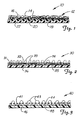
- FIG. 1 there is shown a loop fastener portion according to the present invention generally designated by the reference numeral 10.
- the fastener portion 10 includes a soft flexible sheet-like nonwoven fibrous structure 12 having a multiplicity of loops 14 along a first surface 16 adapted to be releasably engaged by a mating fastener portion (not shown); and a layer 18 of thermoplastic resin adhered to a second major surface 20 of the fibrous structure.
- Thermoplastic resin in the layer 18 anchors the loops 14 in the nonwoven fibrous structure 12 and is softenable by the application of heat to adhere the fastener portion 10 to a substrate such as the substrate 22 which may be a polymeric outer sheet of a diaper.
- the fastener portion 30 includes a soft flexible sheet-like fibrous stitch bonded structure 31 comprising a nonwoven backing 32 having a plurality of through stitches forming a multiplicity of loops 33 along a first surface 34 adapted to be releasably engaged by a mating fastener portion (not shown); and a layer 36 of thermoplastic resin adhered to a second major surface 38 of the fibrous structure 31.
- the layer 36 of thermoplastic resin anchors the stitches and thereby the loops 33 in the fibrous structure 31 and is softenable by the application of heat to afford adhering the fastener portion 30 to a substrate.
- the fastener portion 40 includes a soft flexible sheet-like knitted structure 41 comprising a multiplicity of loops 43 along a first surface 44 adapted to be releasably engaged by a mating fastener portion (not shown); and a layer 46 of thermoplastic resin adhered to a second major surface 48 of the fibrous structure.
- the thermoplastic resin anchors the knitted fibers and thereby the loops 43 in the fibrous structure 41 and is softenable by the application of heat to afford adhering the fastener portion 40 to a substrate.
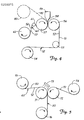
- FIG. 4 there is schematically illustrated one method for applying a layer 50 of thermoplastic resin to a second surface 51 of a fibrous structure 52 having a plurality of loops along a first surface 53 to provide a laminate 60 that could be cut into pieces to provide fastener portions like those described above.
- the fibrous structure 52 is pulled from a supply roll 54 around a guide roller 55 around a first chrome plated application roll 56 and through a nip between the first application roll 56 and a second rubber covered application roll 57.
- a drop die 58 from an extruder 59 deposits molten thermoplastic material along the nip between the second surface 51 of the fibrous structure 52 and the second application roll 57.
- the layer 50 of thermoplastic material is adhered to the fibrous structure 52 at the nip between the application rollers 56 and 57, and the layer 50 passes with the fibrous structure 52 around a portion of the periphery of the second application roll 57, around a second guide roll 61 and onto a wind up roll 62.
- Figure 5 schematically illustrates the subsequent application to a substrate 70 of the laminate 60 of the fibrous structure 52 and the layer 50 of thermoplastic material.
- That laminate 60 is pulled from a supply roll 70 through the nip between spaced application rolls 71 and 72 around a portion of the periphery of the application roll 71 with the layer 50 of thermoplastic material facing outwardly where it will be heated and softened by an infrared heater 73 adjacent the application roll 71.
- the substrate 70 is pulled from a supply roll 74 and passes through the nip adjacent the softened layer 50 of thermoplastic material where it is pressed into contact with and is adhered to by that layer 50.
- the resulting composite 80 is then wound on a wind up roller 76.
- the method illustrated in Figure 5 can easily be modified by known means to cut and apply predetermined lengths of the laminate 60 of the fibrous structure 52 and the layer 60 of thermoplastic material to provide loop fastener portions, and can include subsequent steps of separating the substrate into predetermined lengths of a desired shape after those lengths are applied as may, for example, be done in applying such lengths to disposable diapers.
- laminates 60 suitable for loop fastener portions that have been made using the methods illustrated in Figures 4 and 5.
- a fibrous structure 52 in the form of a warp knitted fabric containing 40 denier polyester fill fibers and 40 denier polyester loop fibers (each with 20 ends per fiber) having 52 courses per inch and 16 wales per inch and a basis weight of 1.5 ounce/yard2 was extrusion coated with an ethylene vinyl acetate copolymer thermoplastic resin containing 18 percent vinyl acetate and having a melt flow index of 8.0 using the method illustrated in Figure 4.
- the extruder 59 provided a thermoplastic resin melt temperature of 420 degrees Fahrenheit.
- the application rolls 56 and 57 were internally chilled. A minimum nip pressure of 40 pounds per square inch was maintained on the rubber covered application roll 57.
- the linear speed of the fibrous structure 52 and the extruder revolutions per minute were adjusted to provide layers 50 of thermoplastic resin from 0.001 inch to 0.002 inch in thickness (i.e., 22 revolutions per minute extruder speed and linear speeds of the fibrous structure of from 85 to 50 feet per minute).
- the resultant laminates 60 of the fibrous structure 52 and the layers 50 of thermoplastic material showed significant reductions in porosity compared to the fibrous structure 52 alone, and were easier to handle than the fibrous structure 53 alone due to a significant reduction in the ability to stretch the laminates 60 compared to the fibrous structure 52 alone.
- the resultant laminates 60 of the fibrous structure 52 and the layers 50 of thermoplastic material were then applied to a substrate 70 using the method illustrated in Figure 2 by passing them over the rubber covered application roll 71 that was maintained at 200 degrees Fahrenheit.
- the substrate 70 consisted of a 0.001 inch thick sheet of low density polyethylene such as is often used as the outer layer of a disposable diaper.
- the chrome plated application roll 72 was maintained at a temperature (i.e., 200 degrees Fahrenheit) below the softening or deformation point of the film 70.
- the infrared heater 73 was located approximately 9 inches from the application roll 71 and produced 5000 watts of radiant energy.
- a minimum of pressure was required to provide adequate contact between the film 70 and layer 50 of thermoplastic material in the nip between the application rolls 71 and 72, and the film 70 was found to be firmly adhered to the layer 50 of thermoplastic material after it had cooled.
- a fibrous structure 52 in the form of a 0.9 ounce/yd2 resin bonded nonwoven polyester with stitchbonded loops consisting of 150 denier texturized polyester with 40 ends stitched on MalimoTM Sewing-knitting equipment at 12 courses per inch and 13 wales per inch to produce an overall basis weight of 2.3 ounce/yd2 was extrusion coated with the device illustrated in Figure 4.
- the thermoplastic resin applied by the extruder 59 was a low density polyethylene with a melt index of 5.0.
- the extruder 59 conditions were such as to provide a melt temperature of 288 degrees Centigrade (550 degrees Fahrenheit).
- Layers 50 of thermoplastic resin 0.001 inch and 0.002 inch thick were obtained using an extruder screw speed of 22 revolutions per minute and speeds of the fibrous structure 52 past the extruder die 58 of 87 feet per minute and 71 feet per minute, respectively.
- the layers 50 of thermoplastic resin adhesively bonded the loops to the nonwoven fabric in the fibrous structure 52 and thus increased the amount of force required in either peel or shear modes to separate a mating fastener portion from the loops as compared to separating that same fastener portion from the loops of the fibrous structure 52 before the layer 50 of thermoplastic material was adhered to it.
- the resultant laminates 60 had greatly increased cross direction strength compared to the fibrous structure 52 alone and therefore were viewed as being more easily handled by high speed application equipment.
- the laminates 60 of the fibrous structure 52 and the adhered layers 50 of thermoplastic material were found to be easily attachable to certain substrates using the method described with reference to Figure 5.
- a fibrous structure 52 in the form of a carded nonwoven web was prepared as follows. Staple fibers (1-1/4 inch cut lengths of 4.75 denier crimped polyester) and binder fibers (1-1/4 inch cut lengths of 8 denier amorphous polyester) were blended at a ratio of 70% to 30% by weight, opened and fed to an even feeder that forms a fiber mat, and then processed in a roller top twin master card which constructed a nonwoven web having a basis weight of 3 ounces/yd2. The web was then thermally set in a hot air oven to provide a lofty nonwoven fibrous structure 52 with low web integrity or internal strength.
- the fibrous structure 52 was then extrusion coated by the method shown in Figure 4 with an ethylene vinyl acetate copolymer resin.
- the resultant laminated structure 60 could be readily attached to a substrate using the method illustrated in Figure 5.
- a fibrous structure 52 was formed from a carrier web of a white Confil wetlaid nonwoven fabric comprising a blend of cellulose and polyester fibers bonded with a polymer believed to be an acrylate adhesive, purchased as Style 1309215 White Confil wetlaid fabric from International Paper Company. That carrier web was stitched on a 14 gauge MalimoTM type Malipol Sewing-knitting Machine operated in its single bar mode with 3 millimeter pile sinkers to produce 14 evenly spaced rows of stitches per inch in a cross web direction and to form 12 stitches per inch along each row and to form loops 14 projecting from the carrier web by about 1 to 2 millimeters.
- the thread 13 used to form the stitches was a commercial grade 150 denier, 34 filament flat polyester thread purchased from Milliken & Co. of Spartanburg, South Carolina.
- This web was laminated to 88.5 pound Sanfast Abrasive Paper (purchased from James River Paper Co., Fitchburg, Massachusetts) using a slot die extruder in a device similar to that described above with reference to Figure 4 except for the addition of a supply roll 80 of the paper 82 (shown in phantom outline in Figure 4) which applied a 0.001 inch thick layer of low density polyethylene extruded at a die temperature of 600-625 degrees Fahrenheit. Excellent paper to fabric bonds were obtained at run speeds of 300 to 400 feet per minute.
- the low density polyethylene not only bonded the fabric to the paper but also locked the stitches for repeated application and release to hook members.
- the resultant laminated web could be used as a substrate for coated abrasives that may be used as described in U.S. Patent No. 4,609,581 which will issue September 2, 1986, the content whereof is incorporated herein by reference.
Landscapes
- Engineering & Computer Science (AREA)
- Mechanical Engineering (AREA)
- Slide Fasteners, Snap Fasteners, And Hook Fasteners (AREA)
- Absorbent Articles And Supports Therefor (AREA)
- Laminated Bodies (AREA)
Abstract
Description
- The present invention relates to fastener portions including loops adapted to be releasably engaged by mating fastener portions which may include hooks or headed stems.
- Fastener portions including loops (called loop fastener portions herein) adapted to be releasably engaged by other fastener portions which may include hooks or headed stems are well known in the art. Typically, such a loop fastener portion comprises a soft flexible sheet-like fibrous structure having a multiplicity of loops along a first major surface, which fibrous structure may be formed by any of several methods such as weaving, knitting, warp knitting, weft insertion knitting, stitch-sewing or the known methods for making nonwoven structures. Such loop fastener portions may also include adhesive coatings (e.g., thickened or foamed latex) to help bond together their fibers at their contact points both to restrict the loops on the loop fastener portions from enlarging and to restrict the fastener portions from tearing when tension is applied to the loops by mating fastener portions with which the looped fastener portions are engaged, such as upon the disengagement of such fastener portions.
- Some such loop fastener portions are intended to be sewn in place, particularly where they are used on articles (e.g., clothing) that will be washed or dry cleaned. Other such loop fastener portions include a layer of pressure sensitive adhesive on their surface opposite their loops, which is often the preferred method of attaching loop fastener portions to objects that do not require launderability or that cannot be sewn.
- Both of these methods of attachment have certain disadvantages, however. Sewing typically is labor intensive and can decrease the area of the fastener portion that can be engaged by a mating fastener portion. Also to facilitate sewing the fibrous structure of the loop fastener portion should have sufficient internal strength and integrity so that it can be held in place with a reasonable number of stitches, and thus it is impractical to sew certain types of loop fastener portions that may have, for example, nonwoven fibrous structures. When pressure sensitive adhesives are used, the fibrous structures must be sufficiently nonporous to prevent the loops from sticking to the adhesives and thus becoming unavailable for engagement with mating fastener portions. Also, prior to use, pressure sensitive adhesives on such loop fastener portions must be protected as by a liner which must be removed before the loop fastener is attached to an object.
- The present invention provides a loop fastener portion including a fibrous structure and a simple means by which it may be fastened to an object which allows the loop fastener portion to be easily attached, bonds together the filaments of the fibrous structure to anchor the loops, sufficiently anchors the filaments to the backing so that even fibrous structures with relatively low internal strength and integrity can be used and will still provide loops that will provide shear and peel strengths comparable with loops from tightly woven fibrous structures, and does not present the possibility that loops will become adhered to it even when the fibrous structure is relatively porous.
- According to the present invention there is provided a fastener portion including a soft flexible sheet-like fibrous structure having a multiplicity of loops along a first surface adapted to be releasably engaged by a mating fastener portion; and a layer of thermoplastic resin adhered to a major surface of the fibrous structures opposite the loops, which thermoplastic resin anchors the loops in the fibrous structure.
- The fibrous structures of the loop fastener portions may be formed by any known method such as weaving, knitting, warp knitting, weft insertion knitting, stitch-sewing or the known methods for making nonwoven structures.
- The thermoplastic resin may be of any conventional type such as polyethylene, polypropylene, blends and copolymers thereof, ethylene acrylic acid copolymer, nylon copolymers, or ethylene vinyl acetate copolymers and can be applied in any one of several methods such as by extrusion or roll coating of molten thermoplastic material directly onto the fibrous structure or by adhering thermoplastic film to the fibrous structure by hot nip lamination (i.e., softening only one surface portion of the thermoplastic film, pressing that softened surface against the fibrous structure, and allowing it to cool). After application, the thermoplastic resin will bond together the filaments of the fibrous structure to anchor the loops and will anchor the filaments and add sufficient internal strength and integrity to the loop fastener portion so that even very porous nonwoven structures are usable to form the loops.
- The thermoplastic resin can be simultaneously applied both to the fibrous structure and to a substrate and thus used to adhere the fibrous structure to a substrate, as may be useful in making the coated abrasive structures described and claimed in U.S. Patent No. 4,609,581, which will issue from U.S. Patent Application No. 723,458 of which this application is a continuation-in-part. Alternatively the thermoplastic resin can first be allowed to solidify and adhere to the fibrous structure and can subsequently be softened along its surface opposite the fibrous structure by exposure to heat, as by contact with a heated surface or from an infrared source of radiation, so that it will adhere quickly and securely to a substrate with which it is brought in contact (i.e., the polymeric outer layer of a disposable diaper) and the thermoplastic resin can add sufficient strength so that the loop fastener portion can be handled and applied to such a substrate at high speeds by automated equipment even when the fibrous structure by itself would have insufficient internal strength to afford such handling.
- The present invention will be further described with reference to the accompanying drawing wherein like numbers refer to like parts in the several views, and wherein:
- Figure 1 is an edge view of a first embodiment of a loop fastener portion according to the present invention shown attached to a substrate;
- Figure 2 is an edge view of a second embodiment of a loop fastener portion according to the present invention;
- Figure 3 is an edge view of a third embodiment of a loop fastener portion according to the present invention;
- Figure 4 schematically illustrates a method for forming loop fastener portions according to the present invention; and
- Figure 5 schematically illustrates application of a loop fastener portion according to the present invention to a substrate.
- Referring now to Figure 1 there is shown a loop fastener portion according to the present invention generally designated by the
reference numeral 10. - The
fastener portion 10 includes a soft flexible sheet-like nonwovenfibrous structure 12 having a multiplicity ofloops 14 along afirst surface 16 adapted to be releasably engaged by a mating fastener portion (not shown); and alayer 18 of thermoplastic resin adhered to a secondmajor surface 20 of the fibrous structure. Thermoplastic resin in thelayer 18 anchors theloops 14 in the nonwovenfibrous structure 12 and is softenable by the application of heat to adhere thefastener portion 10 to a substrate such as thesubstrate 22 which may be a polymeric outer sheet of a diaper. - Referring now to Figure 2 there is shown a second embodiment of a fastener portion according to the present invention generally designated by the
reference numeral 30. Thefastener portion 30 includes a soft flexible sheet-like fibrous stitch bondedstructure 31 comprising anonwoven backing 32 having a plurality of through stitches forming a multiplicity ofloops 33 along afirst surface 34 adapted to be releasably engaged by a mating fastener portion (not shown); and alayer 36 of thermoplastic resin adhered to a second major surface 38 of thefibrous structure 31. Thelayer 36 of thermoplastic resin anchors the stitches and thereby theloops 33 in thefibrous structure 31 and is softenable by the application of heat to afford adhering thefastener portion 30 to a substrate. - Referring now to Figure 3 there is shown yet a third embodiment of a fastener portion according to the present invention generally designated by the reference numeral 40. The fastener portion 40 includes a soft flexible sheet-like knitted
structure 41 comprising a multiplicity ofloops 43 along afirst surface 44 adapted to be releasably engaged by a mating fastener portion (not shown); and alayer 46 of thermoplastic resin adhered to a second major surface 48 of the fibrous structure. The thermoplastic resin anchors the knitted fibers and thereby theloops 43 in thefibrous structure 41 and is softenable by the application of heat to afford adhering the fastener portion 40 to a substrate. - Referring now to Figure 4 there is schematically illustrated one method for applying a
layer 50 of thermoplastic resin to asecond surface 51 of afibrous structure 52 having a plurality of loops along afirst surface 53 to provide alaminate 60 that could be cut into pieces to provide fastener portions like those described above. As illustrated, thefibrous structure 52 is pulled from asupply roll 54 around aguide roller 55 around a first chrome platedapplication roll 56 and through a nip between thefirst application roll 56 and a second rubber coveredapplication roll 57. Adrop die 58 from anextruder 59 deposits molten thermoplastic material along the nip between thesecond surface 51 of thefibrous structure 52 and thesecond application roll 57. Thelayer 50 of thermoplastic material is adhered to thefibrous structure 52 at the nip between theapplication rollers layer 50 passes with thefibrous structure 52 around a portion of the periphery of thesecond application roll 57, around a second guide roll 61 and onto a wind uproll 62. - Figure 5 schematically illustrates the subsequent application to a
substrate 70 of thelaminate 60 of thefibrous structure 52 and thelayer 50 of thermoplastic material. Thatlaminate 60 is pulled from asupply roll 70 through the nip betweenspaced application rolls application roll 71 with thelayer 50 of thermoplastic material facing outwardly where it will be heated and softened by aninfrared heater 73 adjacent theapplication roll 71. Thesubstrate 70 is pulled from asupply roll 74 and passes through the nip adjacent the softenedlayer 50 of thermoplastic material where it is pressed into contact with and is adhered to by thatlayer 50. The resultingcomposite 80 is then wound on a wind uproller 76. - It will be appreciated that the method illustrated in Figure 5 can easily be modified by known means to cut and apply predetermined lengths of the
laminate 60 of thefibrous structure 52 and thelayer 60 of thermoplastic material to provide loop fastener portions, and can include subsequent steps of separating the substrate into predetermined lengths of a desired shape after those lengths are applied as may, for example, be done in applying such lengths to disposable diapers. - The following are examples of
laminates 60 suitable for loop fastener portions that have been made using the methods illustrated in Figures 4 and 5. - A
fibrous structure 52 in the form of a warp knitted fabric containing 40 denier polyester fill fibers and 40 denier polyester loop fibers (each with 20 ends per fiber) having 52 courses per inch and 16 wales per inch and a basis weight of 1.5 ounce/yard² was extrusion coated with an ethylene vinyl acetate copolymer thermoplastic resin containing 18 percent vinyl acetate and having a melt flow index of 8.0 using the method illustrated in Figure 4. Theextruder 59 provided a thermoplastic resin melt temperature of 420 degrees Fahrenheit. Theapplication rolls application roll 57. The linear speed of thefibrous structure 52 and the extruder revolutions per minute were adjusted to providelayers 50 of thermoplastic resin from 0.001 inch to 0.002 inch in thickness (i.e., 22 revolutions per minute extruder speed and linear speeds of the fibrous structure of from 85 to 50 feet per minute). - The
resultant laminates 60 of thefibrous structure 52 and thelayers 50 of thermoplastic material showed significant reductions in porosity compared to thefibrous structure 52 alone, and were easier to handle than thefibrous structure 53 alone due to a significant reduction in the ability to stretch thelaminates 60 compared to thefibrous structure 52 alone. - The
resultant laminates 60 of thefibrous structure 52 and thelayers 50 of thermoplastic material were then applied to asubstrate 70 using the method illustrated in Figure 2 by passing them over the rubber coveredapplication roll 71 that was maintained at 200 degrees Fahrenheit. Thesubstrate 70 consisted of a 0.001 inch thick sheet of low density polyethylene such as is often used as the outer layer of a disposable diaper. The chrome platedapplication roll 72 was maintained at a temperature (i.e., 200 degrees Fahrenheit) below the softening or deformation point of thefilm 70. Theinfrared heater 73 was located approximately 9 inches from theapplication roll 71 and produced 5000 watts of radiant energy. - A minimum of pressure was required to provide adequate contact between the
film 70 andlayer 50 of thermoplastic material in the nip between theapplication rolls film 70 was found to be firmly adhered to thelayer 50 of thermoplastic material after it had cooled. - A
fibrous structure 52 in the form of a 0.9 ounce/yd² resin bonded nonwoven polyester with stitchbonded loops consisting of 150 denier texturized polyester with 40 ends stitched on Malimo™ Sewing-knitting equipment at 12 courses per inch and 13 wales per inch to produce an overall basis weight of 2.3 ounce/yd² was extrusion coated with the device illustrated in Figure 4. The thermoplastic resin applied by theextruder 59 was a low density polyethylene with a melt index of 5.0. Theextruder 59 conditions were such as to provide a melt temperature of 288 degrees Centigrade (550 degrees Fahrenheit).Layers 50 of thermoplastic resin 0.001 inch and 0.002 inch thick were obtained using an extruder screw speed of 22 revolutions per minute and speeds of thefibrous structure 52 past theextruder die 58 of 87 feet per minute and 71 feet per minute, respectively. Thelayers 50 of thermoplastic resin adhesively bonded the loops to the nonwoven fabric in thefibrous structure 52 and thus increased the amount of force required in either peel or shear modes to separate a mating fastener portion from the loops as compared to separating that same fastener portion from the loops of thefibrous structure 52 before thelayer 50 of thermoplastic material was adhered to it. Theresultant laminates 60 had greatly increased cross direction strength compared to thefibrous structure 52 alone and therefore were viewed as being more easily handled by high speed application equipment. Thelaminates 60 of thefibrous structure 52 and the adhered layers 50 of thermoplastic material were found to be easily attachable to certain substrates using the method described with reference to Figure 5. - A
fibrous structure 52 in the form of a carded nonwoven web was prepared as follows. Staple fibers (1-1/4 inch cut lengths of 4.75 denier crimped polyester) and binder fibers (1-1/4 inch cut lengths of 8 denier amorphous polyester) were blended at a ratio of 70% to 30% by weight, opened and fed to an even feeder that forms a fiber mat, and then processed in a roller top twin master card which constructed a nonwoven web having a basis weight of 3 ounces/yd². The web was then thermally set in a hot air oven to provide a lofty nonwovenfibrous structure 52 with low web integrity or internal strength. - The
fibrous structure 52 was then extrusion coated by the method shown in Figure 4 with an ethylene vinyl acetate copolymer resin. The resultantlaminated structure 60 could be readily attached to a substrate using the method illustrated in Figure 5. - A
fibrous structure 52 was formed from a carrier web of a white Confil wetlaid nonwoven fabric comprising a blend of cellulose and polyester fibers bonded with a polymer believed to be an acrylate adhesive, purchased as Style 1309215 White Confil wetlaid fabric from International Paper Company. That carrier web was stitched on a 14 gauge Malimo™ type Malipol Sewing-knitting Machine operated in its single bar mode with 3 millimeter pile sinkers to produce 14 evenly spaced rows of stitches per inch in a cross web direction and to form 12 stitches per inch along each row and to formloops 14 projecting from the carrier web by about 1 to 2 millimeters. The thread 13 used to form the stitches was a commercial grade 150 denier, 34 filament flat polyester thread purchased from Milliken & Co. of Spartanburg, South Carolina. - This web was laminated to 88.5 pound Sanfast Abrasive Paper (purchased from James River Paper Co., Fitchburg, Massachusetts) using a slot die extruder in a device similar to that described above with reference to Figure 4 except for the addition of a
supply roll 80 of the paper 82 (shown in phantom outline in Figure 4) which applied a 0.001 inch thick layer of low density polyethylene extruded at a die temperature of 600-625 degrees Fahrenheit. Excellent paper to fabric bonds were obtained at run speeds of 300 to 400 feet per minute. - The low density polyethylene not only bonded the fabric to the paper but also locked the stitches for repeated application and release to hook members.
- The resultant laminated web could be used as a substrate for coated abrasives that may be used as described in U.S. Patent No. 4,609,581 which will issue September 2, 1986, the content whereof is incorporated herein by reference.
- The present invention has now been described with reference to several embodiments thereof. It will be apparent to those skilled in the art that many changes can be made in the embodiments described without departing from the scope of the present invention. Thus the scope of the present invention should not be limited to the structures described in this application, but only by structures described by the language of the claims and the equivalents of those structures.
Claims (7)
a soft flexible sheet-like fibrous structure (12, 31, 41) having first and second major surfaces (16, 20; 34, 38; 44, 48) and a multiplicity of loops (14, 33, 43) along said first surface (16, 34, 44) adapted to be releasably engaged by a mating fastener portion; and
a layer (18, 36, 46) of thermoplastic resin adhered to the second major surface (20, 38, 48) of said fibrous structure (12, 31, 41), said layer (18, 36, 46) of thermoplastic resin anchoring said loops (14, 33, 43) in said fibrous structure (12, 31, 41) and being softenable by the application of heat to afford adhering said fastener portion (10, 30, 40) to a substrate.
providing a soft flexible sheet-like fibrous structure (52) having first and second major surfaces (53, 51) and a multiplicity of loops along its first surface adapted to be releasably engaged by a mating fastener portion; and
adhering a layer (50) of thermoplastic resin to the second major surface (51) of said fibrous structure (52) to anchor the loops in the fibrous structure (52).
subsequently softening the layer (50) of thermoplastic resin by the application of heat and pressing the softened layer of thermoplastic resin (50) against a substrate (70) to adhere the fastener portion to the substrate (70).
Applications Claiming Priority (2)
| Application Number | Priority Date | Filing Date | Title |
|---|---|---|---|
| US06/902,227 US4761318A (en) | 1985-04-15 | 1986-08-29 | Loop fastener portion with thermoplastic resin attaching and anchoring layer |
| US902227 | 1986-08-29 |
Publications (3)
| Publication Number | Publication Date |
|---|---|
| EP0258015A2 true EP0258015A2 (en) | 1988-03-02 |
| EP0258015A3 EP0258015A3 (en) | 1989-07-26 |
| EP0258015B1 EP0258015B1 (en) | 1993-12-08 |
Family
ID=25415519
Family Applications (1)
| Application Number | Title | Priority Date | Filing Date |
|---|---|---|---|
| EP19870307430 Expired - Lifetime EP0258015B1 (en) | 1986-08-29 | 1987-08-21 | Loop fastener portion with thermoplastic resin attaching and anchoring layer |
Country Status (5)
| Country | Link |
|---|---|
| US (1) | US4761318A (en) |
| EP (1) | EP0258015B1 (en) |
| JP (1) | JP2693156B2 (en) |
| CA (1) | CA1298066C (en) |
| DE (1) | DE3788386T2 (en) |
Cited By (17)
| Publication number | Priority date | Publication date | Assignee | Title |
|---|---|---|---|---|
| WO1995007677A1 (en) * | 1993-09-13 | 1995-03-23 | The Procter & Gamble Company | Reinforced landing surface for mechanical fasteners on disposable products |
| FR2714122A1 (en) * | 1993-12-21 | 1995-06-23 | Kimberly Clark Co | Resilient compression loop structure for hook and loop fastening system. |
| EP0682888A1 (en) * | 1994-04-22 | 1995-11-22 | Ykk Corporation | Surface-type fastener having a thick foundation fabric |
| WO1996022065A1 (en) * | 1995-01-18 | 1996-07-25 | The Procter & Gamble Company | Female component for refastenable fastening device |
| EP0808586A1 (en) * | 1996-05-23 | 1997-11-26 | Aplix | Method to manufacture a layered material comprising one layer with loops |
| EP0815762A1 (en) * | 1996-07-03 | 1998-01-07 | Aplix Société Anonyme | Process for manufacturing a layered product comprising a layer provided with loops |
| EP0875227A1 (en) * | 1997-04-29 | 1998-11-04 | The Procter & Gamble Company | Adhesive-free female fastening portion for a mechanical fastening device |
| EP0928572A3 (en) * | 1998-01-09 | 1999-07-21 | Aplix Société Anonyme | Self-gripping tape and method of manufacture |
| EP0895731A3 (en) * | 1997-08-05 | 1999-09-08 | Ykk Corporation | Female engaging member of surface fastener and method of manufacturing the same |
| WO2000031330A1 (en) * | 1998-11-19 | 2000-06-02 | Sca Hygiene Products Ab | Fastener means |
| WO2000042964A1 (en) * | 1999-01-25 | 2000-07-27 | Firma Carl Freudenberg | Hook and loop fastener for flat materials |
| GB2375571B (en) * | 2001-03-14 | 2004-06-23 | Ykk Corp | Female engaging surface fastener having a backing and a method of making same |
| EP1017562A4 (en) * | 1997-09-03 | 2004-11-24 | Velcro Ind | Loop material, its manufacture, and its use in products |
| EP1493349A1 (en) * | 2003-07-04 | 2005-01-05 | Aplix Société Anonyme | A composite comprising a film and a knitwear or non-woven fabric for a touch fastener, especially for a diaper |
| WO2005072938A3 (en) * | 2004-01-29 | 2006-02-23 | Velcro Ind | Composite products and methods of forming such products |
| DE102011105683A1 (en) | 2010-06-22 | 2012-01-12 | Koester Gmbh & Co. Kg | Projecting active elements-carrying sheet material comprises elements formed from filaments held by anchor filaments comprising a first material, and connected with a film, and a knitted fabric connected with the film |
| WO2015084617A1 (en) | 2013-12-05 | 2015-06-11 | 3M Innovative Properties Company | Container for a spraying device |
Families Citing this family (142)
| Publication number | Priority date | Publication date | Assignee | Title |
|---|---|---|---|---|
| US5032122A (en) * | 1987-04-24 | 1991-07-16 | The Procter & Gamble Company | Loop fastening material for fastening device and method of making same |
| US5380313A (en) * | 1987-06-19 | 1995-01-10 | The Proctor & Gamble Company | Loop fastening material for fastening device and method of making same |
| US5643397A (en) * | 1988-05-13 | 1997-07-01 | Minnesota Mining And Manufacturing Company | Equipment for forming a sheet of loop material |
| US5616394A (en) * | 1988-05-13 | 1997-04-01 | Minnesota Mining And Manufacturing Company | Sheet of loop material, and garments having such loop material incorporated therein |
| US5256231A (en) * | 1988-05-13 | 1993-10-26 | Minnesota Mining And Manufacturing Company | Method for making a sheet of loop material |
| US5254194A (en) * | 1988-05-13 | 1993-10-19 | Minnesota Mining And Manufacturing Company | Coated abrasive sheet material with loop material for attachment incorporated therein |
| US5176671A (en) * | 1988-12-20 | 1993-01-05 | Kimberly-Clark Corporation | Fastening system for disposable diaper with disposability feature |
| US5176670A (en) * | 1988-12-20 | 1993-01-05 | Kimberly-Clark Corporation | Disposable diaper with improved mechanical fastening system |
| US5019073A (en) * | 1988-12-20 | 1991-05-28 | Kimberly-Clark Corporation | Disposable diaper with improved mechanical fastening system |
| US5076870A (en) * | 1989-07-19 | 1991-12-31 | Sanborn Kenneth R | Carpet and method of attachment |
| US5852855A (en) * | 1989-11-17 | 1998-12-29 | Minnesota Mining And Manufacturing Company | Disposable diaper with fastener |
| US5100400A (en) * | 1989-11-17 | 1992-03-31 | Minnesota Mining And Manufacturing Company | Disposable diaper with thermoplastic material anchored hook fastener portion |
| JPH03227469A (en) * | 1990-01-29 | 1991-10-08 | Maaji Kk | Piece of handcraft |
| CA2053110C (en) | 1990-12-17 | 2002-09-10 | Bruce M. Siebers | Diaper or absorbent article with tensioning attachment |
| US5292567A (en) * | 1991-05-17 | 1994-03-08 | Minnesota Mining And Manufacturing Company | Buffing pad |
| JP3187423B2 (en) * | 1991-05-20 | 2001-07-11 | ザ、プロクター、エンド、ギャンブル、カンパニー | Multi-layer female part of refastenable fastening device and method of manufacturing the same |
| US5326612A (en) * | 1991-05-20 | 1994-07-05 | The Procter & Gamble Company | Nonwoven female component for refastenable fastening device and method of making the same |
| US5293884A (en) * | 1992-01-08 | 1994-03-15 | Full Moon Fashion Accessories, Inc. | Loop strap hair tie |
| US5315740A (en) | 1992-08-20 | 1994-05-31 | Velcro Industries, B.V. | Hook for hook and loop fasteners |
| US6203645B1 (en) | 1992-08-31 | 2001-03-20 | Milliken & Company | Female connector fabric |
| US6203880B1 (en) | 1992-08-31 | 2001-03-20 | Milliken & Company | Female connector fabric |
| US5447590A (en) * | 1992-11-23 | 1995-09-05 | Milliken Research Corporation | Method to produce looped fabric with upstanding loops |
| US5374262A (en) * | 1992-12-30 | 1994-12-20 | Kimberly-Clark Corporation | Adjustable garment attachment system |
| US5304162A (en) * | 1992-12-30 | 1994-04-19 | Kimberly-Clark Corporation | Garment and pleated, adjustable strap member therefor |
| KR970009710B1 (en) * | 1992-12-30 | 1997-06-17 | 킴벌리-클라크 코포레이션 | Garment attachment system |
| US5423789A (en) * | 1993-03-31 | 1995-06-13 | Kimberly-Clark Corporation | Garment with selectable fasteners |
| ES2166855T3 (en) † | 1993-04-16 | 2002-05-01 | Minnesota Mining & Mfg | ASSEMBLY OF STORAGE / DISPENSATION OF A BROOCH MATERIAL WITH LOOP. |
| US5466317A (en) * | 1993-04-23 | 1995-11-14 | Aluminum Company Of America | Laminated building panel and method for its production |
| US5436051A (en) * | 1993-07-26 | 1995-07-25 | Velcro Industries, B.V. | Hook and loop fasteners and method of making same |
| US5691027A (en) * | 1993-07-27 | 1997-11-25 | Minnesota Mining And Manufacturing Company | Fastener with a dual purpose cover sheet |
| US5691026A (en) * | 1993-07-27 | 1997-11-25 | Minnesota Mining And Manufacturing Company | Fastener member with a dual purpose cover sheet |
| JPH0739407A (en) * | 1993-07-28 | 1995-02-10 | Minnesota Mining & Mfg Co <3M> | Facing interlocking zipper member and zipper with said zipper member |
| JP3889452B2 (en) * | 1993-07-30 | 2007-03-07 | スリーエム カンパニー | Face-to-face engagement fastener member |
| JPH0742714A (en) * | 1993-08-05 | 1995-02-10 | Minnesota Mining & Mfg Co <3M> | Attaching member for protecting and decorating body and manufacture thereof |
| US5464491A (en) * | 1993-08-12 | 1995-11-07 | Kabushiki Kaisha Risuron | Method of producing mat comprising filament loop aggregate |
| JPH0779810A (en) * | 1993-08-25 | 1995-03-28 | Minnesota Mining & Mfg Co <3M> | Opposite interlocking zipper member and production thereof |
| US5470424A (en) * | 1993-11-30 | 1995-11-28 | Kimberly-Clark Corporation | Process for forming liquid impermeable sheet material having a fibrous surface and products formed thereby |
| US6994698B2 (en) | 1994-12-28 | 2006-02-07 | Kimberly-Clark Worldwide, Inc. | Flexible mechanical fastening tab |
| US5505747A (en) * | 1994-01-13 | 1996-04-09 | Minnesota Mining And Manufacturing Company | Method of making an abrasive article |
| US5785784A (en) * | 1994-01-13 | 1998-07-28 | Minnesota Mining And Manufacturing Company | Abrasive articles method of making same and abrading apparatus |
| TW317223U (en) | 1994-01-13 | 1997-10-01 | Minnesota Mining & Mfg | Abrasive article |
| US5607345A (en) * | 1994-01-13 | 1997-03-04 | Minnesota Mining And Manufacturing Company | Abrading apparatus |
| US5482755A (en) * | 1994-04-28 | 1996-01-09 | Manning; James H. | Readily attachable and detachable coverings for surfaces |
| US5517737A (en) * | 1994-06-06 | 1996-05-21 | The Procter & Gamble Company | Apparatus for continuously stretching or continuously releasing stretching forces from a web using two pairs of opposing non-planar belts |
| US5762645A (en) * | 1994-06-06 | 1998-06-09 | The Procter & Gamble Company | Fastening device and method of use |
| US5547531A (en) * | 1994-06-06 | 1996-08-20 | The Proctor & Gamble Company | Nonwoven female component for refastenable fastening device and method of making the same |
| CA2153375C (en) | 1994-07-26 | 2000-09-12 | Arnold Tobler | Attachment of hook and loop fastener to a compression sleeve |
| US5713111A (en) * | 1994-07-27 | 1998-02-03 | Minnesota Mining And Manufacturing Company | Method for making an interengaging fastener having reduced engagement force |
| US5595567A (en) * | 1994-08-09 | 1997-01-21 | The Procter & Gamble Company | Nonwoven female component for refastenable fastening device |
| US5476702A (en) * | 1994-12-28 | 1995-12-19 | Kimberly-Clark Corporation | Fastening system for absorbent article and method of manufacture |
| US5692949A (en) * | 1995-11-17 | 1997-12-02 | Minnesota Mining And Manufacturing Company | Back-up pad for use with abrasive articles |
| US5614281A (en) * | 1995-11-29 | 1997-03-25 | Kimberly-Clark Corporation | Creped nonwoven laminate loop fastening material for mechanical fastening systems |
| FR2741636B1 (en) † | 1995-11-29 | 1998-02-06 | Aplix Sa | LAMINATE ASSEMBLY CONSISTING OF A KNITTED FABRIC CHAIN OR WEFT WITH LOOPS BACKED ON A SUPPORT, AND ITS MANUFACTURING METHOD |
| US5763041A (en) * | 1995-12-21 | 1998-06-09 | Kimberly-Clark Worldwide, Inc. | Laminate material |
| US5656351A (en) * | 1996-01-16 | 1997-08-12 | Velcro Industries B.V. | Hook and loop fastener including an epoxy binder |
| US5904793A (en) * | 1996-08-14 | 1999-05-18 | Minnesota Mining And Manufacturing Company | Method and equipment for rapid manufacture of loop material |
| US5699593A (en) * | 1996-08-30 | 1997-12-23 | Minnesota Mining & Manufacturing Company | Loop fastening material |
| US5981027A (en) * | 1996-11-26 | 1999-11-09 | Velcro Industries B.V. | Fastening member with loops and process and machine for producing it |
| US5891547A (en) * | 1997-02-04 | 1999-04-06 | Precision Fabrics Group, Inc. | Needle punch nonwoven component for refastenable fastening device |
| US7338698B1 (en) | 1997-02-28 | 2008-03-04 | Columbia Insurance Company | Homogeneously branched ethylene polymer carpet, carpet backing and method for making same |
| US20030211280A1 (en) | 1997-02-28 | 2003-11-13 | Shaw Industries, Inc. | Carpet, carpet backings and methods |
| EP0963475A1 (en) | 1997-02-28 | 1999-12-15 | Shaw Industries, Inc. | Carpet, carpet backings and methods |
| JP3877842B2 (en) * | 1997-03-05 | 2007-02-07 | ユニチカ株式会社 | Method for producing female material for hook-and-loop fastener |
| US6410099B1 (en) | 1997-03-05 | 2002-06-25 | 3M Innovative Properties Company | Readily replaceable image graphic web |
| US5931823A (en) * | 1997-03-31 | 1999-08-03 | Kimberly-Clark Worldwide, Inc. | High permeability liner with improved intake and distribution |
| US5888607A (en) * | 1997-07-03 | 1999-03-30 | Minnesota Mining And Manufacturing Co. | Soft loop laminate and method of making |
| US6869659B2 (en) | 1997-09-03 | 2005-03-22 | Velcro Industries B.V. | Fastener loop material, its manufacture, and products incorporating the material |
| US6329016B1 (en) | 1997-09-03 | 2001-12-11 | Velcro Industries B.V. | Loop material for touch fastening |
| US5997981A (en) * | 1997-09-15 | 1999-12-07 | Kimberly-Clark Worldwide, Inc. | Breathable barrier composite useful as an ideal loop fastener component |
| US6589638B1 (en) | 1997-09-15 | 2003-07-08 | Kimberly-Clark Worldwide, Inc. | Stretch-pillowed bulked laminate useful as an ideal loop fastener component |
| US6238767B1 (en) | 1997-09-15 | 2001-05-29 | Kimberly-Clark Worldwide, Inc. | Laminate having improved barrier properties |
| US6202390B1 (en) | 1997-09-19 | 2001-03-20 | Southpac Trust International, Inc. | Packaging process |
| US6298637B1 (en) | 1997-09-19 | 2001-10-09 | Southpac Trust International, Inc. | Packaging material |
| US6401436B2 (en) | 1997-09-19 | 2002-06-11 | Southpac Trust International, Inc. | Packaging material |
| US6036718A (en) * | 1998-07-02 | 2000-03-14 | Welch Allyn, Inc. | Bladderless blood pressure cuff |
| EP1681155B1 (en) * | 1998-11-06 | 2009-01-07 | Velcro Industries B.V. (NL) | Touch fasteners and their manufacture |
| US6991375B2 (en) | 1998-11-06 | 2006-01-31 | Velcro Industries B.V. | Reclosable packaging |
| US6205623B1 (en) | 1998-11-06 | 2001-03-27 | Velcro Industries B.V. | Composite hook and loop fasteners, and products containing them |
| US8343127B1 (en) | 1999-11-22 | 2013-01-01 | Kimberly-Clark Worldwide, Inc. | Absorbent articles with garment-like refastenable seams |
| US6454751B1 (en) | 1999-11-22 | 2002-09-24 | Kimberly-Clark Worldwide, Inc. | Absorbent articles having hinged fasteners |
| US6761711B1 (en) | 1998-12-18 | 2004-07-13 | Kimberly-Clark Worldwide, Inc. | Absorbent articles with refastenable side seams |
| US6554816B1 (en) | 1999-11-22 | 2003-04-29 | Kimberly-Clarke Worldwide, Inc. | Absorbent articles with shaped fastening component |
| US6645190B1 (en) | 1999-11-22 | 2003-11-11 | Kimberly-Clark Worldwide, Inc. | Absorbent article with non-irritating refastenable seams |
| US6764475B1 (en) | 1998-12-18 | 2004-07-20 | Kimberly-Clark Worldwide, Inc. | Absorbent articles having differential strength refastenable seam |
| US6352528B1 (en) | 1999-11-22 | 2002-03-05 | Kimberly-Clark Worldwide, Inc. | Absorbent articles including hidden graphics |
| US6849067B2 (en) * | 1999-11-22 | 2005-02-01 | Kimberly-Clark Worldwide, Inc. | Absorbent articles with refastenable side seams |
| US6447497B1 (en) | 1999-11-22 | 2002-09-10 | Kimberly-Clark Worldwide, Inc. | Absorbent article with child resistant refastenable seams |
| EP1194290B1 (en) * | 1999-05-28 | 2004-08-25 | Velcro Industries B.V. | Displays and decorations employing detachable fastening |
| JP2001061516A (en) * | 1999-08-27 | 2001-03-13 | Ykk Corp | Female engaging member for hook-and-loop fastener and manufacturing apparatus therefor |
| EP1272139B1 (en) * | 2000-03-14 | 2008-07-16 | Velcro Industries B.V. | Method of forming a stretchable fastener |
| CN1229216C (en) | 2000-03-14 | 2005-11-30 | 维尔克鲁工业公司 | Hook and loop fastening |
| DE60130650D1 (en) * | 2000-05-26 | 2007-11-08 | Velcro Ind | BENDING MATERIAL FOR AN EXCLUSION |
| US7395583B2 (en) * | 2000-05-26 | 2008-07-08 | Valero Industries B.V. | Hook engageable loops |
| BE1014191A3 (en) † | 2001-05-21 | 2003-06-03 | Picanol Nv | WIRE CLAMP a weaving loom AND CONTAINING SUCH WIRE CLIP. |
| EP1408787B1 (en) * | 2001-06-12 | 2007-08-15 | Velcro Industries B.V. | Loop materials for touch fastening |
| US7207979B2 (en) * | 2001-07-05 | 2007-04-24 | Kimberly-Clark Worldwide, Inc. | Refastenable absorbent garment |
| US7297139B2 (en) * | 2001-07-05 | 2007-11-20 | Kimberly-Clark Worldwide, Inc. | Refastenable absorbent garment |
| US6921570B2 (en) * | 2001-12-21 | 2005-07-26 | Kimberly-Clark Worldwide, Inc. | Pattern unbonded nonwoven web and process for making same |
| US20030125705A1 (en) * | 2001-12-31 | 2003-07-03 | Kimberly-Clark Worldwide, Inc. | Absorbent article with improved fastening system and method of fastening thereof |
| US6953452B2 (en) | 2001-12-31 | 2005-10-11 | Kimberly-Clark Worldwide, Inc. | Mechanical fastening system for an absorbent article |
| US6969377B2 (en) | 2001-12-31 | 2005-11-29 | Kimberly-Clark Worldwide, Inc. | Mechanical fastening system for an absorbent article |
| US8007485B2 (en) | 2001-12-31 | 2011-08-30 | Kimberly-Clark Worldwide, Inc. | Mechanical fastening system for an absorbent article |
| US7156939B2 (en) * | 2002-05-30 | 2007-01-02 | Kimberly-Clark Worldwide, Inc. | Apparatus and method for securing engagement between fastening components of pre-fastened garments |
| US7039997B2 (en) * | 2002-05-30 | 2006-05-09 | Kimberly-Clark Worldwide, Inc. | Apparatus and method for securing engagement between fastening components of pre-fastened garments |
| US20030232170A1 (en) * | 2002-06-12 | 2003-12-18 | Gillette Samuel Mark | Spunlaced loop material for a refastenable fastening device and methods of making same |
| US8323435B2 (en) * | 2002-07-31 | 2012-12-04 | Kimberly-Clark Worldwide, Inc. | Mechanical fastening system for an article |
| US7637898B2 (en) * | 2002-08-16 | 2009-12-29 | Kimberly-Clark Wordwide, Inc. | Disposable absorbent pant having refastenable seams |
| US7087046B2 (en) * | 2002-09-09 | 2006-08-08 | Kimberly-Clark Worldwide, Inc. | Absorbent garment with refastenable adhesive elements engaging an elongatable body panel and methods for the use and manufacture thereof |
| US20050034213A1 (en) * | 2002-09-28 | 2005-02-17 | Bamber Jeffrey V. | Sports glove |
| US6964063B2 (en) * | 2002-09-28 | 2005-11-15 | Bamber Jeffrey V | Sports glove |
| US7547469B2 (en) | 2002-12-03 | 2009-06-16 | Velcro Industries B.V. | Forming loop materials |
| FR2855376B1 (en) * | 2003-05-30 | 2005-09-16 | Nordson Corp | METHOD AND DEVICE FOR MANUFACTURING PORTION OF SELF-ATTACHING CLOSURE AND PORTION OF SELF-ATTACHING CLOSURE |
| US8079995B2 (en) | 2003-11-06 | 2011-12-20 | Velcro Industries B.V. | Composite fastener products |
| US20050161851A1 (en) * | 2004-01-23 | 2005-07-28 | Tachauer Ernesto S. | Touch fastener products |
| GB0409253D0 (en) * | 2004-04-26 | 2004-05-26 | Lewmar Ltd | Winch and winch drum |
| US8052666B2 (en) * | 2004-12-30 | 2011-11-08 | Kimberly-Clark Worldwide, Inc. | Fastening system having elastomeric engaging elements and disposable absorbent article made therewith |
| US20060148359A1 (en) * | 2004-12-30 | 2006-07-06 | Kimberly-Clark Worldwide, Inc. | Nonwoven loop material |
| US8034431B2 (en) * | 2006-01-25 | 2011-10-11 | 3M Innovative Properties Company | Intermittently bonded fibrous web laminate |
| DE202006002210U1 (en) † | 2006-02-11 | 2007-06-21 | Coroplast Fritz Müller Gmbh & Co. Kg | Self-windable adhesive tape with textile backing |
| US20080035272A1 (en) * | 2006-08-10 | 2008-02-14 | 3M Innovative Properties Company | Direct printed loop fabric |
| US7790264B2 (en) * | 2007-04-17 | 2010-09-07 | Aplix, Inc. | Loop material for loop and hook type fastener used in a disposable article or garment |
| WO2008154303A1 (en) | 2007-06-07 | 2008-12-18 | Velcro Industries B.V. | Needling loops into carrier sheets |
| WO2008154300A1 (en) | 2007-06-07 | 2008-12-18 | Velcro Industries B.V. | Anchoring loops of fibers needled into a carrier sheet |
| US8047560B2 (en) * | 2007-07-03 | 2011-11-01 | Avery Dennison Corporation | Retention cover for an inflatable object |
| DE102008028427A1 (en) | 2008-05-23 | 2009-11-26 | Tesa Se | Adhesive tape with textile carrier for cable bandaging |
| DE102008059512A1 (en) * | 2008-11-28 | 2010-06-10 | Nordenia Deutschland Gronau Gmbh | Composite element for a Velcro closure |
| US8123733B2 (en) | 2009-01-29 | 2012-02-28 | First Quality Baby Products, Llc | Absorbent article with intermittent side seams |
| CN102947192B (en) | 2010-04-12 | 2015-11-25 | 维尔克工业有限公司 | The sack of Reclosable |
| WO2011137097A1 (en) | 2010-04-27 | 2011-11-03 | Velcro Industries B.V. | Touch fastener configuration and manufacturing |
| US9119443B2 (en) | 2011-08-25 | 2015-09-01 | Velcro Industries B.V. | Loop-engageable fasteners and related systems and methods |
| US9078793B2 (en) | 2011-08-25 | 2015-07-14 | Velcro Industries B.V. | Hook-engageable loop fasteners and related systems and methods |
| KR200470389Y1 (en) * | 2012-01-02 | 2013-12-11 | 이영호 | A method of using a new type of fabric adhesive tape which made of Polyester textile and adhesive tapes which melt with heated when make the fabric materials connected without sewing and knitting. |
| US9051014B2 (en) | 2012-02-09 | 2015-06-09 | Great Dane Limited Partnership | Thermal-insulated wall and liner |
| DE102012017529A1 (en) * | 2012-09-04 | 2014-03-06 | Gottlieb Binder Gmbh & Co. Kg | Covering system for insulation equipment on construction and supporting structures |
| CN203639670U (en) * | 2013-12-16 | 2014-06-11 | 厦门和洁无纺布制品有限公司 | Non-woven fabric coiled material |
| US9072343B1 (en) | 2014-01-02 | 2015-07-07 | John W. Ogilvie | Multigrip touch closure fasteners |
| FR3019491B1 (en) * | 2014-04-08 | 2016-04-01 | Aplix Sa | LOOP STRIP OR RIBBON COMPRISING DIFFERENTIALLY FIXED ZONES AND CULOTTE LAYER COMPRISING SUCH A NAPPE |
| US9070544B1 (en) | 2014-06-04 | 2015-06-30 | Snatcher, LLC | Light bulb installation and removal tool |
| US10821701B2 (en) * | 2016-04-01 | 2020-11-03 | Michael C. LaRocco | Foam reefer wall using “loop” scrim fabric backing |
| WO2018006946A1 (en) * | 2016-07-05 | 2018-01-11 | Sca Hygiene Products Ab | Absorbent article having an improved fastening system and a method to manufacture such absorbent article |
| US10870533B2 (en) * | 2017-03-31 | 2020-12-22 | Michael C. LaRocco | Foam reefer wall backing with spaced rows of loops for better adhesion |
| US10843446B2 (en) * | 2017-12-18 | 2020-11-24 | Terry L. Endres | Unbroken loop polymer film and methods of making the same |
Family Cites Families (12)
| Publication number | Priority date | Publication date | Assignee | Title |
|---|---|---|---|---|
| US3537946A (en) * | 1967-03-30 | 1970-11-03 | Stein Hall & Co Inc | Method of combining textile materials and products thereof |
| US3567565A (en) * | 1967-11-09 | 1971-03-02 | Burlington Industries Inc | Laminate of foam and stitch bonded fabric |
| US3618608A (en) * | 1970-02-16 | 1971-11-09 | Mary E Brink | Diaper with fastener |
| US3694867A (en) * | 1970-08-05 | 1972-10-03 | Kimberly Clark Co | Separable clasp containing high-loft, non woven fabric |
| US3773580A (en) * | 1971-07-27 | 1973-11-20 | American Velcro Inc | Bonding fastening members to a substrate |
| JPS4964106U (en) * | 1972-09-12 | 1974-06-05 | ||
| JPS5333887B2 (en) * | 1972-09-26 | 1978-09-18 | ||
| JPS4967749A (en) * | 1972-10-27 | 1974-07-01 | ||
| US3940525A (en) * | 1974-12-30 | 1976-02-24 | E. I. Du Pont De Nemours And Company | Tufted carpet having a polyolefin film as the secondary backing |
| JPS5717508U (en) * | 1980-07-05 | 1982-01-29 | ||
| JPS617310U (en) * | 1984-06-18 | 1986-01-17 | ワイケイケイ株式会社 | Velcro fastener |
| US4609581A (en) * | 1985-04-15 | 1986-09-02 | Minnesota Mining And Manufacturing Company | Coated abrasive sheet material with loop attachment means |
-
1986
- 1986-08-29 US US06/902,227 patent/US4761318A/en not_active Expired - Lifetime
-
1987
- 1987-07-30 CA CA 543382 patent/CA1298066C/en not_active Expired - Lifetime
- 1987-08-21 DE DE3788386T patent/DE3788386T2/en not_active Expired - Lifetime
- 1987-08-21 EP EP19870307430 patent/EP0258015B1/en not_active Expired - Lifetime
- 1987-08-28 JP JP21494287A patent/JP2693156B2/en not_active Expired - Lifetime
Cited By (26)
| Publication number | Priority date | Publication date | Assignee | Title |
|---|---|---|---|---|
| WO1995007677A1 (en) * | 1993-09-13 | 1995-03-23 | The Procter & Gamble Company | Reinforced landing surface for mechanical fasteners on disposable products |
| FR2714122A1 (en) * | 1993-12-21 | 1995-06-23 | Kimberly Clark Co | Resilient compression loop structure for hook and loop fastening system. |
| WO1995017111A1 (en) * | 1993-12-21 | 1995-06-29 | Kimberly-Clark Corporation | Compressively resilient loop structure for hook and loop fastener systems |
| EP0682888A1 (en) * | 1994-04-22 | 1995-11-22 | Ykk Corporation | Surface-type fastener having a thick foundation fabric |
| WO1996022065A1 (en) * | 1995-01-18 | 1996-07-25 | The Procter & Gamble Company | Female component for refastenable fastening device |
| FR2748911A1 (en) * | 1996-05-23 | 1997-11-28 | Aplix Sa | METHOD FOR MANUFACTURING A LAMINATE ASSEMBLY COMPRISING A LAYER PROVIDED WITH LOOPS |
| EP0808586A1 (en) * | 1996-05-23 | 1997-11-26 | Aplix | Method to manufacture a layered material comprising one layer with loops |
| EP0815762A1 (en) * | 1996-07-03 | 1998-01-07 | Aplix Société Anonyme | Process for manufacturing a layered product comprising a layer provided with loops |
| FR2750711A1 (en) * | 1996-07-03 | 1998-01-09 | Aplix Sa | METHOD FOR MANUFACTURING A LAMINATE ASSEMBLY COMPRISING A LAYER PROVIDED WITH LOOPS |
| EP0875227A1 (en) * | 1997-04-29 | 1998-11-04 | The Procter & Gamble Company | Adhesive-free female fastening portion for a mechanical fastening device |
| EP0895731A3 (en) * | 1997-08-05 | 1999-09-08 | Ykk Corporation | Female engaging member of surface fastener and method of manufacturing the same |
| EP1017562A4 (en) * | 1997-09-03 | 2004-11-24 | Velcro Ind | Loop material, its manufacture, and its use in products |
| EP0928572A3 (en) * | 1998-01-09 | 1999-07-21 | Aplix Société Anonyme | Self-gripping tape and method of manufacture |
| WO2000031330A1 (en) * | 1998-11-19 | 2000-06-02 | Sca Hygiene Products Ab | Fastener means |
| DE19902762C2 (en) * | 1999-01-25 | 2002-02-28 | Freudenberg Carl Kg | Velcro connection for flat structures and method for its production |
| KR100450467B1 (en) * | 1999-01-25 | 2004-09-30 | 칼 프로이덴베르크 카게 | Hook and loop fastener for flat materials |
| WO2000042964A1 (en) * | 1999-01-25 | 2000-07-27 | Firma Carl Freudenberg | Hook and loop fastener for flat materials |
| GB2375571B (en) * | 2001-03-14 | 2004-06-23 | Ykk Corp | Female engaging surface fastener having a backing and a method of making same |
| EP1493349A1 (en) * | 2003-07-04 | 2005-01-05 | Aplix Société Anonyme | A composite comprising a film and a knitwear or non-woven fabric for a touch fastener, especially for a diaper |
| FR2856896A1 (en) * | 2003-07-04 | 2005-01-07 | Aplix Sa | COMPLEX COMPRISING A FILM AND A KNIT OR A NON-WOVEN FABRIC FOR SELF-INSULATING, ESPECIALLY FOR SLEEPERS. |
| WO2005072938A3 (en) * | 2004-01-29 | 2006-02-23 | Velcro Ind | Composite products and methods of forming such products |
| DE102011105683A1 (en) | 2010-06-22 | 2012-01-12 | Koester Gmbh & Co. Kg | Projecting active elements-carrying sheet material comprises elements formed from filaments held by anchor filaments comprising a first material, and connected with a film, and a knitted fabric connected with the film |
| WO2015084617A1 (en) | 2013-12-05 | 2015-06-11 | 3M Innovative Properties Company | Container for a spraying device |
| US10857553B2 (en) | 2013-12-05 | 2020-12-08 | 3M Innovative Properties Company | Container for a spraying device |
| EP3821986A1 (en) | 2013-12-05 | 2021-05-19 | 3M Innovative Properties Co. | Container for a spraying device |
| US11541407B2 (en) | 2013-12-05 | 2023-01-03 | 3M Innovative Properties Company | Container for a spraying device |
Also Published As
| Publication number | Publication date |
|---|---|
| DE3788386T2 (en) | 1994-06-23 |
| DE3788386D1 (en) | 1994-01-20 |
| JP2693156B2 (en) | 1997-12-24 |
| JPS6363405A (en) | 1988-03-19 |
| EP0258015A3 (en) | 1989-07-26 |
| CA1298066C (en) | 1992-03-31 |
| EP0258015B1 (en) | 1993-12-08 |
| US4761318A (en) | 1988-08-02 |
Similar Documents
| Publication | Publication Date | Title |
|---|---|---|
| US4761318A (en) | Loop fastener portion with thermoplastic resin attaching and anchoring layer | |
| US5830298A (en) | Loop fastening material | |
| US5891547A (en) | Needle punch nonwoven component for refastenable fastening device | |
| EP1017562B1 (en) | Loop material, its manufacture, and its use in products | |
| US5162150A (en) | Duct tape | |
| EP0198713B1 (en) | Coated abrasive sheet material with loop attachment means | |
| AU608383B2 (en) | Disposable diaper with improved fastener attachment | |
| US5888607A (en) | Soft loop laminate and method of making | |
| AU661969B2 (en) | Sheet of loop material, and garments having such loop material incorporated therein | |
| US5611791A (en) | Sheet of loop material, and garments having such loop material incorporated therein | |
| US20020022108A1 (en) | Hook and loop fastening | |
| US20020160143A1 (en) | Fastener loop material, its manufacture, and products incorporating the material | |
| SA92130015B1 (en) | A recessed, unwoven component of a fastener that can be removed and re-fastened and a method of manufacturing that component | |
| JPH03268756A (en) | Throwaway diaper and its manufacture | |
| US6681457B2 (en) | Fiber surface fastener and method for finishing same | |
| MXPA99001699A (en) | Loop fastening material |
Legal Events
| Date | Code | Title | Description |
|---|---|---|---|
| PUAI | Public reference made under article 153(3) epc to a published international application that has entered the european phase |
Free format text: ORIGINAL CODE: 0009012 |
|
| AK | Designated contracting states |
Kind code of ref document: A2 Designated state(s): DE FR GB IT |
|
| PUAL | Search report despatched |
Free format text: ORIGINAL CODE: 0009013 |
|
| AK | Designated contracting states |
Kind code of ref document: A3 Designated state(s): DE FR GB IT |
|
| 17P | Request for examination filed |
Effective date: 19900115 |
|
| 17Q | First examination report despatched |
Effective date: 19910524 |
|
| ITF | It: translation for a ep patent filed | ||
| GRAA | (expected) grant |
Free format text: ORIGINAL CODE: 0009210 |
|
| AK | Designated contracting states |
Kind code of ref document: B1 Designated state(s): DE FR GB IT |
|
| REF | Corresponds to: |
Ref document number: 3788386 Country of ref document: DE Date of ref document: 19940120 |
|
| ET | Fr: translation filed | ||
| PLBE | No opposition filed within time limit |
Free format text: ORIGINAL CODE: 0009261 |
|
| STAA | Information on the status of an ep patent application or granted ep patent |
Free format text: STATUS: NO OPPOSITION FILED WITHIN TIME LIMIT |
|
| 26N | No opposition filed | ||
| REG | Reference to a national code |
Ref country code: GB Ref legal event code: IF02 |
|
| PGFP | Annual fee paid to national office [announced via postgrant information from national office to epo] |
Ref country code: GB Payment date: 20060825 Year of fee payment: 20 |
|
| PGFP | Annual fee paid to national office [announced via postgrant information from national office to epo] |
Ref country code: IT Payment date: 20060831 Year of fee payment: 20 Ref country code: FR Payment date: 20060831 Year of fee payment: 20 |
|
| PGFP | Annual fee paid to national office [announced via postgrant information from national office to epo] |
Ref country code: DE Payment date: 20061002 Year of fee payment: 20 |
|
| REG | Reference to a national code |
Ref country code: GB Ref legal event code: PE20 |
|
| PG25 | Lapsed in a contracting state [announced via postgrant information from national office to epo] |
Ref country code: GB Free format text: LAPSE BECAUSE OF EXPIRATION OF PROTECTION Effective date: 20070820 |