EP0257931A1 - Liquid dispenser, particularly for dispensing correction fluid - Google Patents
Liquid dispenser, particularly for dispensing correction fluid Download PDFInfo
- Publication number
- EP0257931A1 EP0257931A1 EP87307185A EP87307185A EP0257931A1 EP 0257931 A1 EP0257931 A1 EP 0257931A1 EP 87307185 A EP87307185 A EP 87307185A EP 87307185 A EP87307185 A EP 87307185A EP 0257931 A1 EP0257931 A1 EP 0257931A1
- Authority
- EP
- European Patent Office
- Prior art keywords
- barrel
- air inlet
- fluid
- dispenser
- outlet
- Prior art date
- Legal status (The legal status is an assumption and is not a legal conclusion. Google has not performed a legal analysis and makes no representation as to the accuracy of the status listed.)
- Withdrawn
Links
- 239000002989 correction material Substances 0.000 title description 6
- 239000007788 liquid Substances 0.000 title description 5
- 239000012530 fluid Substances 0.000 claims abstract description 47
- 238000005096 rolling process Methods 0.000 claims abstract 5
- 238000004891 communication Methods 0.000 claims description 4
- 238000013022 venting Methods 0.000 abstract 1
- 239000000463 material Substances 0.000 description 8
- 239000002991 molded plastic Substances 0.000 description 6
- 239000000049 pigment Substances 0.000 description 4
- 230000007246 mechanism Effects 0.000 description 3
- 230000000717 retained effect Effects 0.000 description 3
- 238000007789 sealing Methods 0.000 description 3
- 239000002904 solvent Substances 0.000 description 3
- 239000011248 coating agent Substances 0.000 description 2
- 238000000576 coating method Methods 0.000 description 2
- 239000006260 foam Substances 0.000 description 2
- 238000004519 manufacturing process Methods 0.000 description 2
- 239000004033 plastic Substances 0.000 description 2
- 229920003023 plastic Polymers 0.000 description 2
- 238000005086 pumping Methods 0.000 description 2
- 239000011347 resin Substances 0.000 description 2
- 229920005989 resin Polymers 0.000 description 2
- 239000000725 suspension Substances 0.000 description 2
- 238000009825 accumulation Methods 0.000 description 1
- 238000013019 agitation Methods 0.000 description 1
- 230000000903 blocking effect Effects 0.000 description 1
- 230000006835 compression Effects 0.000 description 1
- 238000007906 compression Methods 0.000 description 1
- 230000001276 controlling effect Effects 0.000 description 1
- 239000006185 dispersion Substances 0.000 description 1
- 238000001035 drying Methods 0.000 description 1
- 230000000694 effects Effects 0.000 description 1
- 230000005484 gravity Effects 0.000 description 1
- 239000004615 ingredient Substances 0.000 description 1
- 239000002184 metal Substances 0.000 description 1
- 230000002093 peripheral effect Effects 0.000 description 1
- 239000011148 porous material Substances 0.000 description 1
- 230000002035 prolonged effect Effects 0.000 description 1
- 230000001105 regulatory effect Effects 0.000 description 1
- 238000009877 rendering Methods 0.000 description 1
- 239000003381 stabilizer Substances 0.000 description 1
- 210000003813 thumb Anatomy 0.000 description 1
- 239000007966 viscous suspension Substances 0.000 description 1
- 239000000080 wetting agent Substances 0.000 description 1
Images

Classifications
-
- B—PERFORMING OPERATIONS; TRANSPORTING
- B43—WRITING OR DRAWING IMPLEMENTS; BUREAU ACCESSORIES
- B43K—IMPLEMENTS FOR WRITING OR DRAWING
- B43K5/00—Pens with ink reservoirs in holders, e.g. fountain-pens
- B43K5/18—Arrangements for feeding the ink to the nibs
- B43K5/1818—Mechanical feeding means, e.g. valves; Pumps
- B43K5/1827—Valves
- B43K5/1836—Valves automatically closing
- B43K5/1845—Valves automatically closing opened by actuation of the writing point
-
- B—PERFORMING OPERATIONS; TRANSPORTING
- B43—WRITING OR DRAWING IMPLEMENTS; BUREAU ACCESSORIES
- B43K—IMPLEMENTS FOR WRITING OR DRAWING
- B43K7/00—Ball-point pens
- B43K7/02—Ink reservoirs; Ink cartridges
- B43K7/08—Preventing leakage
-
- B—PERFORMING OPERATIONS; TRANSPORTING
- B43—WRITING OR DRAWING IMPLEMENTS; BUREAU ACCESSORIES
- B43L—ARTICLES FOR WRITING OR DRAWING UPON; WRITING OR DRAWING AIDS; ACCESSORIES FOR WRITING OR DRAWING
- B43L19/00—Erasers, rubbers, or erasing devices; Holders therefor
- B43L19/0018—Erasers, rubbers, or erasing devices; Holders therefor with fluids
Definitions
- This invention relates to a dispenser implement, particularly although not exclusively, in the form of a writing or marking implement or pen for dispensing correction fluid.
- a quick drying correction fluid comprising a particulate pigment dispersed in a volatile liquid medium.
- the requirement with such a pen is that it should be capable of dispensing a carefully regulated flow of fluid when a correction is to be made, yet leakage of fluid should be effectively prevented when the pen is not in use.
- a relatively narrow nib outlet is provided and air admission to the interior of the barrel to replace dispensed fluid may be controlled or restricted.
- the nib may be in the form of a capillary tube and a pressurised system may be used whereby prior to dispense a pump mechanism is operated, e.g. by repeatedly pressing a button at the opposite end of the barrel to the nib, to increase the pressure of air within the barrel.
- a pump mechanism e.g. by repeatedly pressing a button at the opposite end of the barrel to the nib, to increase the pressure of air within the barrel.
- the wire itself may be a source of problems in that accumulation of dried material may form around the wire and block the capillary.
- the correction fluid settles out rapidly and it is desirable to accommodate ball bearings within the barrel which act to re-disperse settled material when the pen is shaken.
- the presence of the wire may make it difficult to accommodate such ball bearings or to allow contact with deposits in the region of the outlet to the nib.
- the pen can be difficult or inconvenient to manufacture having regard to the requisite high tolerances of the diameters of the wire and the capillary tube bearing in mind that the differences in such diameters may be of the order of 0.05mm.
- An object of the present invention is to provide a dispenser implement which is simple and convenient to manufacture and with which it is possible to achieve continuous dispense in a satisfactory manner using fluids of a wide range of viscosities.
- a dispenser implement comprising a barrel providing a reservoir for fluid to be dispensed, a dispense outlet in communication with the reservoir at one end of the barrel. a valve for controlling flow of fluid through said outlet, said valve being normally biased to a closed position, and an openable and closable air inlet in communication with the reservoir, said inlet being openable to permit free admission of air from the atmosphere to the reservoir, and said valve being movable to an open position independently of the opening of said air inlet.
- the air inlet may be at the opposite end of the barrel to the dispense outlet and a detachable cap or plug member may be provided for opening and closing the inlet.
- a porous fluid restricting element such as a pad of foam plastics or the like, may be provided across the inlet to restrict or prevent inadvertent outflow of fluid when the inlet is open.
- the valve comprises an elongate valve member which extends through and externally of the outlet and is axially spring biased to a position at which it engages a valve seat around the outlet thereby to seal same, opening of the valve being effected by pushing the valve member axially inwardly so as to clear the seat, and in particular this opening of the valve may be arranged to occur when the outlet end of the dispenser is pressed onto a surface onto which the fluid is required to be dispensed.
- the valve member may be a rod which is tapered towards the outer end thereof so that the periphery of the rod is spring urged tightly into engagement with a circular valve seat around the outlet, which valve seat may be appropriately shaped or covered or otherwise formed to give good contact with the valve member.
- the valve member may be biased to the closed position by means of a spiral spring.
- the valve member and the spiral spring may be formed integrally e.g. as a moulded plastics part.
- the dispenser may be in the form of a hand-held pen, and a cap may be provided to fit tightly over the outlet end of the barrel when the pen is not in use.
- the dispenser may be used for dispensing a correction fluid e.g. consisting of a dispersion of a finely divided pigment in a volatile solvent containing a dissolved coating resin and auxiliary ingredients such as suspension stabilisers and wetting agents may also be included.
- a correction fluid e.g. consisting of a dispersion of a finely divided pigment in a volatile solvent containing a dissolved coating resin and auxiliary ingredients such as suspension stabilisers and wetting agents may also be included.
- the dispenser implement shown in Figure 1 is in the form of a hand-held pen and comprises a tubular barrel 1 of circular cross section. At a rear end of th barrel has a dome-shaped end 2 which is closed exept for a small central hole 3. On the inside of the end 2 there are projecting prongs 4 and a disc 5 of porous material such as a dense foam plastics material is held in position on the prongs 4 over the hole 3. On the outside there is a peripheral rim 6 and an integrally formed cap 7 which can be pivoted, about a hinge joint 8, between a closed position as shown in which a central spike 9 engages and seals the hole 3, and an open position at which the hole 3 is freely open to the atmosphere.
- a hollow tapered end piece 10 which is held in position by interengagement of screw threads 11.
- the end piece 10 tapers to a narrow outlet opening 12 which is bounded by a circular edge 13.
- a valve member comprising a conically tapered moulded plastics rod 14 which extends at its smaller diameter end through the opening 12.
- a moulded plastics spiral spring 15 At its larger diameter end it is formed integrally with one end of a moulded plastics spiral spring 15.
- the other end of the spring 15 bears against the adjacent end of the barrel 1 and is too wide to enter the barrel.
- the spring 15 normally urges the rod 14 to a position at which it fits tightly within the circular edge 13 thereby to seal the opening 12.
- a push-fit cap 16 is provided which fits around the end piece 10 onto the end of the end piece 10 adjacent the barrel 1.
- the barrel 1 is filled with correcting fluid of a conventional kind comprising a viscous suspension of a pigment in a solution of a resin in a volatile solvent.
- correcting fluid of a conventional kind comprising a viscous suspension of a pigment in a solution of a resin in a volatile solvent.
- Two ball bearings 17 are inserted into the barrel 1 and the end piece 10 is screwed into position.
- the suspension in the barrel 1 is first agitated by shaking the pen. It will be noted that the interior of the barrel 1 is relatively free of crevices and projecting parts whereby the ball bearings 17 can freely move around and readily disturb any deposits of settled pigment.
- the pen is then turned upright with the rear end uppermost and the cap 7 is opened.
- the cap 16 is removed and the projecting tip of the rod 14 is pressed onto a surface to which correction fluid is to be dispensed. This causes the rod 14 to move upwardly against the spring 15 whereby fluid flows out of the outlet 12 onto the surface.
- the arrangement of the cap 7 gives good exposure to the atmosphere when required to facilitate prolonged continuous flow yet this is achieved without use of mechanisms which intrude into the barrel 1.
- the pad 5 prevents inadvertent loss of fluid e.g. if the pen is shaken with the cap 7 open.
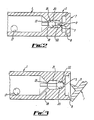
- the device as shown in Figures 2 + 3 may be provided for the purpose of preventing the inadvertent loss of fluid if the pen is shaken with the cap 7 open.
- the barrel 1 is provided at the end 2 with three or some other suitable number, of internal ribs 18.
- the ribs 18 are formed having a lip 19 at their forward ends so as to retain a third ball bearing 20 in the space 21 at the end 2 of the barrel 1.
- the ball bearing 20 is of the same diameter as the ball bearings 17 so that the number of differing parts of the pen is kept to a mimimum.
- each rib 18 At the other end of each rib 18 is formed a wedge surface 22 whereby the ball bearing 20 may be held captive in the tapering socket space formed between the three wedge surfaces 22.
- the spike 9 prevents the ball bearing 20 from being retained by the wedge surfaces 22 so that it may freely move within the space 21 as the pen is shaken, as shown in Figure 2.
- the cap 7 is left open as shown in Figure 3, then on the commencement of shaking the pen, or if the pen is tilted upside down, the ball bearing 20 will move in space 21 and be engaged and retained by the wedge surfaces 22, thereby closing the hole 3 and preventing leakage of the fluid. Closing the cap 7 will disengage the ball bearing 20 from the wedge surfaces 22.
- the length of the ribs 18 is such that the movement of the ball bearing 20 is restricted to approximately 1mm, sufficient to agitate the fluid in the barrel 1.
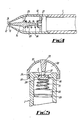
- the barrel 1 has a hollow tapered end piece 10 secured thereto as a push fit, or by screw threads as in the embodiment of Figure 1.
- the end piece 10 has a narrow outlet opening 12 bonded by a circular edge 13.
- a valve member comprising a moulded plastics rod 14 conically tapered towards its ends from a central part having a radial flange 23 therearound.
- One tip end 24 of the rod 14 fits tightly within the circular edge 13 to seal the opening 12 when the dispenser is not in use.
- the other end 25 has a soft metal compression spring 26 located thereon, one end of which bears against the flange 23 and the other end of which bears against an annular spring support 27 which is a push fit within the end piece 10.
- the integrally moulded plastics material spring 15 may not be soft enough to give good application pressure without damage to the surface to which the dispensed fluid is to be applied. However if the spring is too soft proper sealing of the orifice 12 will not occur. In such circumstances the embodiment of Figure 4 as described above may provide a more acceptable working dispenser.
- FIG. 5 there is shown an alternative embodiment of the "rear" end of dispensing implement, in which any risk of leakage of fluid when the implements as described in relation to Figures 1 to 3 are used, such as might occur when those embodiments are shaken or laid down with the flap inadvertently left open, is reduced even further.
- the barrel 1 is closed at the end except for a central hole 3 forming a seating for a conical valve member 28, the end of the barrel 1 being concave outwardly.
- a support ring 29, or separate protrussions if preferred, is formed on the inside of the barrel 1 to restrain movement of a valve base 30, which is formed integrally of moulded plastics material with a spring 31 and the valve member 28.
- valve member 28 is resiliently biassed into sealing contact with the valve seating hole 3.
- a deformable cap 32 is retained on the end of the barrel 1 by means of cooperating lips 33, 34 on the cap 32 and barrel 1 respectively, and a central spike 35 depends from the cap 32.
- the valve member 28 has a central recess 36 which has a diameter large enought to receive the end of the spike 35 therein but is smaller than the diameter of a ball bearing 37 disposed in the sapce 38 beneath the cap 32.
- the ball bearing 37 will roll to the bottom of the concave end of the barrel 1 and locate itself in the recess 36 in the valve member 28. Depression of the cap 32 causes the spike 35 to contact the ball bearing 37 and the valve member 28 is pushed out of contact with the hole 3, thereby allowing air to enter or pass out of the interior of the barrel 1 depending upon the air pressure therein relative to ambient pressure.
- the ball bearing 37 will fall to the bottom of the space 38 and depression of the cap 32 will cause the spike 35 to enter the recess 36 but not operate the valve 28, 3. In consequence leakage of dispensing fluid from the implement is prevented whether the implement is in its operating position or not.
- the pen can be used satisfactorily with fluids of a wide range of viscosities (say giving times of the order of 19 to 35 seconds) and also highly volatile solvents can be used.
- the pen can be manufactured easily and conveniently.
- the air inlets 3, shown in Figures 1, 2, 3 and 5 as being located at the opposite end of the dispenser from the outlet 12, may be provided at any other location on the dispenser.
- the air inlet 3 may be closed by a spring-loaded plunger of the type shown in Figure 4 for the outlet, the plunger being biased by a spring so as to close the inlet 3, and the simple application of thumb pressure to the plunger being used to vent the barrel 1.
Landscapes
- Engineering & Computer Science (AREA)
- Mechanical Engineering (AREA)
- Coating Apparatus (AREA)
- Containers And Packaging Bodies Having A Special Means To Remove Contents (AREA)
Abstract
A dispenser implement for use in dispensing viscous fluids such as document correcting fluid, comprises an elongate barrel (1) having a fluid outlet (12) at one end and an air inlet (3) at the other end. A valve member (14) is biased by a spring (15) to close the outlet (12), and in use pressure of the valve member (14) on a document causes movement of the valve member (14) to allow the fluid to flow from the outlet (12). The air inlet (3) is closable by a cap (7) and movement of the valve member (14) is independent of the opening of air inlet (3), thereby ensuring adequate venting of the barrel (1) and an even flow of fluid through the outlet (12) in use of the dispenser. One or more rolling members (17) may be provided in the barrel (1) for agitating the fluid therein.
Description
- This invention relates to a dispenser implement, particularly although not exclusively, in the form of a writing or marking implement or pen for dispensing correction fluid.
- For correcting errors in document it is well known to use a quick drying correction fluid comprising a particulate pigment dispersed in a volatile liquid medium. Conventionally the practice has been to apply the fluid in a relatively viscous form with a brush, but it is also known to use an applicator pen having a tubular barrel containing the fluid and a nib at one end through which the fluid can be dispensed with a writing or marking action. The requirement with such a pen is that it should be capable of dispensing a carefully regulated flow of fluid when a correction is to be made, yet leakage of fluid should be effectively prevented when the pen is not in use. To achieve this a relatively narrow nib outlet is provided and air admission to the interior of the barrel to replace dispensed fluid may be controlled or restricted. Thus, the nib may be in the form of a capillary tube and a pressurised system may be used whereby prior to dispense a pump mechanism is operated, e.g. by repeatedly pressing a button at the opposite end of the barrel to the nib, to increase the pressure of air within the barrel. With this arrangement in order to prevent the capillary nib from becoming blocked with dried deposits of the coating material it is known to provide a fine wire which extends along the nib and which can be moved backwards and forwards to encourage fluid flow e.g. by virtue of the connection of the wire along the interior of the barrel to the abovementioned pump button.
- However, problems can arise with this known arrangement. Thus, due to the reliance on the use of a capillary nib, the viscosity of the fluid is especially important. If the viscosity is too low (say giving a time of below 19 seconds using a Hegmond 4 cup at 20°C), the fluid tends to drip from the nib; if it is too high (say giving a time above 22 seconds), it is difficult to start the fluid flowing along the nib. Even where the viscosity is within an optimum range, it may be difficult to prevent dripping from the pen in use, and also it may be difficult to start the pen after a period of non-use because of the tendency of the fluid to fall back from the nib due to gravity and/or due to the pumping action, and also because of the tendency for the nib to become blocked at its free end with dried material (especially if the nib is not covered with a cap and for a skin to form on the fluid in the pen. In practice, it may at least be necessary to wait say 15 to 20 seconds for the fluid to re-enter the nib, and in some cases vigorous shaking and pumping for as long as 30 seconds or more may be required to start the fluid flow, the not uncommonly complete blockage rendering the pen useless may occur. The wire itself may be a source of problems in that accumulation of dried material may form around the wire and block the capillary. In addition, especially at lower viscosities the correction fluid settles out rapidly and it is desirable to accommodate ball bearings within the barrel which act to re-disperse settled material when the pen is shaken. The presence of the wire may make it difficult to accommodate such ball bearings or to allow contact with deposits in the region of the outlet to the nib. Moreover, the pen can be difficult or inconvenient to manufacture having regard to the requisite high tolerances of the diameters of the wire and the capillary tube bearing in mind that the differences in such diameters may be of the order of 0.05mm.
- Further, due to the use of a pressurised system it is not possible or practical to achieve continuous dispense. In practice, a small amount of fluid is dispensed and the system then has to be re-pressurised whereby for example it is not possible to 'draw' a long line.
- An object of the present invention is to provide a dispenser implement which is simple and convenient to manufacture and with which it is possible to achieve continuous dispense in a satisfactory manner using fluids of a wide range of viscosities.
- According to the invention therefore there is provided a dispenser implement comprising a barrel providing a reservoir for fluid to be dispensed, a dispense outlet in communication with the reservoir at one end of the barrel. a valve for controlling flow of fluid through said outlet, said valve being normally biased to a closed position, and an openable and closable air inlet in communication with the reservoir, said inlet being openable to permit free admission of air from the atmosphere to the reservoir, and said valve being movable to an open position independently of the opening of said air inlet.
- With this arrangement, due to the use of a valve-controlled outlet it is possible to achieve good flow when required whilst avoiding leakage problems, with fluids of a wide range of viscosities. Due to the use of an independently openable and closable air inlet, air admission can be effected as desired on a continuous basis thereby to permit continuous dispense of fluid, and internal mechanism such as a pump button with a linking wire can be omitted to the extent that the fluid reservoir may be relatively free of crevices in which deposited material can accumulate, and there may be adequate space to accommodate ball bearings or the like to effect agitation of the fluid when the dispenser is shaken.
- The air inlet may be at the opposite end of the barrel to the dispense outlet and a detachable cap or plug member may be provided for opening and closing the inlet. A porous fluid restricting element, such as a pad of foam plastics or the like, may be provided across the inlet to restrict or prevent inadvertent outflow of fluid when the inlet is open.
- With regard to the said valve, this may take any suitable form. Preferably, however, the valve comprises an elongate valve member which extends through and externally of the outlet and is axially spring biased to a position at which it engages a valve seat around the outlet thereby to seal same, opening of the valve being effected by pushing the valve member axially inwardly so as to clear the seat, and in particular this opening of the valve may be arranged to occur when the outlet end of the dispenser is pressed onto a surface onto which the fluid is required to be dispensed. The valve member may be a rod which is tapered towards the outer end thereof so that the periphery of the rod is spring urged tightly into engagement with a circular valve seat around the outlet, which valve seat may be appropriately shaped or covered or otherwise formed to give good contact with the valve member. The valve member may be biased to the closed position by means of a spiral spring. Conveniently the valve member and the spiral spring may be formed integrally e.g. as a moulded plastics part.
- The dispenser may be in the form of a hand-held pen, and a cap may be provided to fit tightly over the outlet end of the barrel when the pen is not in use.
- The dispenser may be used for dispensing a correction fluid e.g. consisting of a dispersion of a finely divided pigment in a volatile solvent containing a dissolved coating resin and auxiliary ingredients such as suspension stabilisers and wetting agents may also be included.
- The invention will now be described further by way of example only and with reference to the accompanying drawings in which:-
- Figure 1 is a diagrammatic sectional view of one form of a dispenser implement according to the invention; and
- Figures 2 + 3 are diagrammatic sectional views of part of a second embodiment.
- Figure 4 is a sectional elevation of part of a third embodiment and
- Figure 5 is a sectional elevation of part of a fourth embodiment.
- The dispenser implement shown in Figure 1 is in the form of a hand-held pen and comprises a tubular barrel 1 of circular cross section. At a rear end of th barrel has a dome-shaped end 2 which is closed exept for a small
central hole 3. On the inside of the end 2 there are projecting prongs 4 and a disc 5 of porous material such as a dense foam plastics material is held in position on the prongs 4 over thehole 3. On the outside there is a peripheral rim 6 and an integrally formed cap 7 which can be pivoted, about ahinge joint 8, between a closed position as shown in which acentral spike 9 engages and seals thehole 3, and an open position at which thehole 3 is freely open to the atmosphere. - At the opposite end of the barrel 1, there is a hollow
tapered end piece 10 which is held in position by interengagement of screw threads 11. Theend piece 10 tapers to a narrow outlet opening 12 which is bounded by acircular edge 13. Within theend piece 10 there is a valve member comprising a conically taperedmoulded plastics rod 14 which extends at its smaller diameter end through theopening 12. At its larger diameter end it is formed integrally with one end of a moulded plasticsspiral spring 15. The other end of thespring 15 bears against the adjacent end of the barrel 1 and is too wide to enter the barrel. Thespring 15 normally urges therod 14 to a position at which it fits tightly within thecircular edge 13 thereby to seal theopening 12. - A push-
fit cap 16 is provided which fits around theend piece 10 onto the end of theend piece 10 adjacent the barrel 1. - With the
end piece 10 removed and the cap 7 closed, the barrel 1 is filled with correcting fluid of a conventional kind comprising a viscous suspension of a pigment in a solution of a resin in a volatile solvent. Two ball bearings 17 are inserted into the barrel 1 and theend piece 10 is screwed into position. - In use, the suspension in the barrel 1 is first agitated by shaking the pen. It will be noted that the interior of the barrel 1 is relatively free of crevices and projecting parts whereby the ball bearings 17 can freely move around and readily disturb any deposits of settled pigment. The pen is then turned upright with the rear end uppermost and the cap 7 is opened. The
cap 16 is removed and the projecting tip of therod 14 is pressed onto a surface to which correction fluid is to be dispensed. This causes therod 14 to move upwardly against thespring 15 whereby fluid flows out of theoutlet 12 onto the surface. - Since the interior of the barrel 1 is freely open to the atmosphere through the
hole 3, correcting fluid can flow out of thehole 12 continuously as long as the tip of the rod is pressed. It is possible to maintain a controlled rate of flow through the narrow gap which is defined between the tip of therod 14 and thecircular edge 13. When therod 14 is lifted away from the surface theoutlet 12 is immediately sealed and flow is cut off. The cap 7 can then be closed and thecap 16 can be replaced. - It will be seen that a relatively wide flow passage can be defined up to the
circular edge 13 whereby a good rate of flow can be achieved even with a very viscous liquid. Moreover, since the fluid is maintained in liquid state within the barrel 1 up to the line of sealing contact between theedge 13 androd 14 it will be appreciated that flow commences promptly when the tip of therod 14 is pressed. When the tip of therod 14 is released theoutlet 12 is sealed promptly and positively so there is little tendency for there to be residual liquid which dries and leaves blocking deposits. - The arrangement of the cap 7 gives good exposure to the atmosphere when required to facilitate prolonged continuous flow yet this is achieved without use of mechanisms which intrude into the barrel 1. The pad 5 prevents inadvertent loss of fluid e.g. if the pen is shaken with the cap 7 open.
- As an alternative to the pad 5, the device as shown in Figures 2 + 3 may be provided for the purpose of preventing the inadvertent loss of fluid if the pen is shaken with the cap 7 open. In the embodiment of Figures 2 + 3 the barrel 1 is provided at the end 2 with three or some other suitable number, of
internal ribs 18. Theribs 18 are formed having alip 19 at their forward ends so as to retain a third ball bearing 20 in thespace 21 at the end 2 of the barrel 1. Preferably theball bearing 20 is of the same diameter as the ball bearings 17 so that the number of differing parts of the pen is kept to a mimimum. At the other end of eachrib 18 is formed awedge surface 22 whereby theball bearing 20 may be held captive in the tapering socket space formed between the three wedge surfaces 22. When the cap 7 is closed thespike 9 prevents the ball bearing 20 from being retained by the wedge surfaces 22 so that it may freely move within thespace 21 as the pen is shaken, as shown in Figure 2. However if the cap 7 is left open as shown in Figure 3, then on the commencement of shaking the pen, or if the pen is tilted upside down, theball bearing 20 will move inspace 21 and be engaged and retained by the wedge surfaces 22, thereby closing thehole 3 and preventing leakage of the fluid. Closing the cap 7 will disengage the ball bearing 20 from the wedge surfaces 22. The length of theribs 18 is such that the movement of theball bearing 20 is restricted to approximately 1mm, sufficient to agitate the fluid in the barrel 1. - Referring now to Figure 4 there is shown an alternative embodiment of the "nib" end of dispensing implement. In this embodiment the barrel 1 has a hollow
tapered end piece 10 secured thereto as a push fit, or by screw threads as in the embodiment of Figure 1. Theend piece 10 has anarrow outlet opening 12 bonded by acircular edge 13. Within theend piece 10 is a valve member comprising a mouldedplastics rod 14 conically tapered towards its ends from a central part having aradial flange 23 therearound. Onetip end 24 of therod 14 fits tightly within thecircular edge 13 to seal theopening 12 when the dispenser is not in use. Theother end 25 has a softmetal compression spring 26 located thereon, one end of which bears against theflange 23 and the other end of which bears against anannular spring support 27 which is a push fit within theend piece 10. In certain cases, i.e. for certain viscosities of working fluid, the integrally mouldedplastics material spring 15 may not be soft enough to give good application pressure without damage to the surface to which the dispensed fluid is to be applied. However if the spring is too soft proper sealing of theorifice 12 will not occur. In such circumstances the embodiment of Figure 4 as described above may provide a more acceptable working dispenser. - Referring now to Figure 5 there is shown an alternative embodiment of the "rear" end of dispensing implement, in which any risk of leakage of fluid when the implements as described in relation to Figures 1 to 3 are used, such as might occur when those embodiments are shaken or laid down with the flap inadvertently left open, is reduced even further. In this embodiment the barrel 1 is closed at the end except for a
central hole 3 forming a seating for aconical valve member 28, the end of the barrel 1 being concave outwardly. Asupport ring 29, or separate protrussions if preferred, is formed on the inside of the barrel 1 to restrain movement of avalve base 30, which is formed integrally of moulded plastics material with aspring 31 and thevalve member 28. In consequence thevalve member 28 is resiliently biassed into sealing contact with thevalve seating hole 3. Adeformable cap 32 is retained on the end of the barrel 1 by means of cooperatinglips cap 32 and barrel 1 respectively, and acentral spike 35 depends from thecap 32. Thevalve member 28 has acentral recess 36 which has a diameter large enought to receive the end of thespike 35 therein but is smaller than the diameter of aball bearing 37 disposed in thesapce 38 beneath thecap 32. - If the dispensing implement is held correctly in its upright working position the
ball bearing 37 will roll to the bottom of the concave end of the barrel 1 and locate itself in therecess 36 in thevalve member 28. Depression of thecap 32 causes thespike 35 to contact theball bearing 37 and thevalve member 28 is pushed out of contact with thehole 3, thereby allowing air to enter or pass out of the interior of the barrel 1 depending upon the air pressure therein relative to ambient pressure. However if the implement is not in the correct upright operating position theball bearing 37 will fall to the bottom of thespace 38 and depression of thecap 32 will cause thespike 35 to enter therecess 36 but not operate thevalve - The pen can be used satisfactorily with fluids of a wide range of viscosities (say giving times of the order of 19 to 35 seconds) and also highly volatile solvents can be used. The pen can be manufactured easily and conveniently.
- It is of course to be understood that the invention is not intended to be restricted to the details of the above embodiments which are described by way of example only.
- For example the
air inlets 3, shown in Figures 1, 2, 3 and 5 as being located at the opposite end of the dispenser from theoutlet 12, may be provided at any other location on the dispenser. Also theair inlet 3 may be closed by a spring-loaded plunger of the type shown in Figure 4 for the outlet, the plunger being biased by a spring so as to close theinlet 3, and the simple application of thumb pressure to the plunger being used to vent the barrel 1.
Claims (10)
1. A dispenser implement comprising an elongate barrel providing a reservoir for fluid to be dispensed, a dispense outlet in communication with the reservoir at one end of the barrel, a valve for controlling the flow of fluid through said outlet, said valve being normally biased to a closed position and an air inlet in communication with said reservoir, characterised in that said air inlet (3) is openable and closable to permit free admission of air from the atmosphere to the reservoir and said valve (12, 14) is movable to an open position independently of the opening of said air inlet (3).
2. A dispenser implement according to claim 1, characterised in that said air inlet (3) is at the opposed end of said barrel (1) from said dispense outlet (12).
3. A dispenser implement according to claim 1 or claim 2, characterised in that said air inlet (3) is closable by means of a vent cap (7).
4. A dispenser implement according to claim 1 or claim 2, characterised in that said air inlet (3) is closable by means of a spring-loaded plunger (28).
5. A dispenser implement according to any one of claims 1 to 4, characterised in that said valve (12, 14) comprises an elongate valve member (14) which extends through and externally of said dispense outlet (12) and is axially biased by a spring (15) to a position in which it engages a valve seat (13) aroung said dispense outlet (12).
6. A dispenser implement according to claim 5, characterised in that said spring (15) is a spiral spring formed integrally with said valve member (14).
7. A dispenser implement according to any one of claims 1 to 6, characterised in that at least one rolling member (17) is provided in said barrel (1).
8. A dispenser implement according to claim 7, characterised in that a second rolling member (20) is provided in a part (21) of said barrel (1) adjacent said air inlet (3), retaining means (18) adapted to releasably retain said second rolling member (20) in an inlet closing position are provided, and air inlet closing means (7, 9) are provided to close said air inlet (3) and to move said second rolling member (20) out of said inlet closing position.
9. A dispenser implement according to any oneof claims 1 to 7, characterised in that a porous fluid restricting element (5) is provided in said barrel (1) adjacent said inlet (3).
10. A dispenser implement according to any one of claims 1 to 9, characterised in that a cap (16) adapted to fit tightly over the outlet end of said barrel (1) is provided to be removably secured thereon when said dispenser implement is not in use.
Applications Claiming Priority (6)
| Application Number | Priority Date | Filing Date | Title |
|---|---|---|---|
| GB868619809A GB8619809D0 (en) | 1986-08-14 | 1986-08-14 | Dispenser implements |
| GB8619809 | 1986-08-14 | ||
| GB868620611A GB8620611D0 (en) | 1986-08-14 | 1986-08-26 | Dispenser implements |
| GB8620611 | 1986-08-26 | ||
| GB8625545 | 1986-10-24 | ||
| GB868625545A GB8625545D0 (en) | 1986-08-14 | 1986-10-24 | Dispenser implements |
Publications (1)
| Publication Number | Publication Date |
|---|---|
| EP0257931A1 true EP0257931A1 (en) | 1988-03-02 |
Family
ID=27263127
Family Applications (1)
| Application Number | Title | Priority Date | Filing Date |
|---|---|---|---|
| EP87307185A Withdrawn EP0257931A1 (en) | 1986-08-14 | 1987-08-14 | Liquid dispenser, particularly for dispensing correction fluid |
Country Status (1)
| Country | Link |
|---|---|
| EP (1) | EP0257931A1 (en) |
Cited By (6)
| Publication number | Priority date | Publication date | Assignee | Title |
|---|---|---|---|---|
| DE8802182U1 (en) * | 1988-02-19 | 1989-06-22 | Tipp-Ex GmbH & Co. KG, 65835 Liederbach | Bottle for dispensing liquid substances, especially correction fluid |
| US5261755A (en) * | 1990-05-25 | 1993-11-16 | The Gillette Company | Fluid dispenser |
| EP0730981A1 (en) * | 1995-03-07 | 1996-09-11 | Zebra Co., Ltd. | Writing tool |
| WO1998021053A1 (en) * | 1996-11-12 | 1998-05-22 | Rotring International Gmbh & Co. Kg | Applicator |
| EP1004457A1 (en) * | 1998-11-24 | 2000-05-31 | Masaaki Fukami | Ball-point pen including a ball ink valve |
| US7264141B2 (en) | 2004-02-19 | 2007-09-04 | Sanford, L.P. | Fluid dispenser with passive pressurization |
Citations (9)
| Publication number | Priority date | Publication date | Assignee | Title |
|---|---|---|---|---|
| US748383A (en) * | 1902-12-23 | 1903-12-29 | John Everard Langill | Marking device. |
| FR1045469A (en) * | 1950-12-04 | 1953-11-26 | Ballpoint pen | |
| US3680968A (en) * | 1970-02-24 | 1972-08-01 | Gilbert Schwartzman | Method of correcting typewritten impressions |
| NL7108297A (en) * | 1971-06-16 | 1972-12-19 | ||
| NL7108646A (en) * | 1971-06-23 | 1972-12-28 | ||
| FR2203750A1 (en) * | 1972-10-19 | 1974-05-17 | Cherrier Yves | |
| US3832071A (en) * | 1973-03-21 | 1974-08-27 | P Chaney | Dispenser for error correcting fluids |
| FR2363299A1 (en) * | 1976-09-02 | 1978-03-31 | Oreal | MAKEUP PEN |
| WO1985004375A1 (en) * | 1984-03-31 | 1985-10-10 | Mazhar Shah | Correction fluid and dispenser |
-
1987
- 1987-08-14 EP EP87307185A patent/EP0257931A1/en not_active Withdrawn
Patent Citations (9)
| Publication number | Priority date | Publication date | Assignee | Title |
|---|---|---|---|---|
| US748383A (en) * | 1902-12-23 | 1903-12-29 | John Everard Langill | Marking device. |
| FR1045469A (en) * | 1950-12-04 | 1953-11-26 | Ballpoint pen | |
| US3680968A (en) * | 1970-02-24 | 1972-08-01 | Gilbert Schwartzman | Method of correcting typewritten impressions |
| NL7108297A (en) * | 1971-06-16 | 1972-12-19 | ||
| NL7108646A (en) * | 1971-06-23 | 1972-12-28 | ||
| FR2203750A1 (en) * | 1972-10-19 | 1974-05-17 | Cherrier Yves | |
| US3832071A (en) * | 1973-03-21 | 1974-08-27 | P Chaney | Dispenser for error correcting fluids |
| FR2363299A1 (en) * | 1976-09-02 | 1978-03-31 | Oreal | MAKEUP PEN |
| WO1985004375A1 (en) * | 1984-03-31 | 1985-10-10 | Mazhar Shah | Correction fluid and dispenser |
Cited By (7)
| Publication number | Priority date | Publication date | Assignee | Title |
|---|---|---|---|---|
| DE8802182U1 (en) * | 1988-02-19 | 1989-06-22 | Tipp-Ex GmbH & Co. KG, 65835 Liederbach | Bottle for dispensing liquid substances, especially correction fluid |
| US5261755A (en) * | 1990-05-25 | 1993-11-16 | The Gillette Company | Fluid dispenser |
| EP0730981A1 (en) * | 1995-03-07 | 1996-09-11 | Zebra Co., Ltd. | Writing tool |
| US5846012A (en) * | 1995-03-07 | 1998-12-08 | Zebra Co. Ltd. | Writing tool |
| WO1998021053A1 (en) * | 1996-11-12 | 1998-05-22 | Rotring International Gmbh & Co. Kg | Applicator |
| EP1004457A1 (en) * | 1998-11-24 | 2000-05-31 | Masaaki Fukami | Ball-point pen including a ball ink valve |
| US7264141B2 (en) | 2004-02-19 | 2007-09-04 | Sanford, L.P. | Fluid dispenser with passive pressurization |
Similar Documents
| Publication | Publication Date | Title |
|---|---|---|
| CA2798015C (en) | Liquid applicator device | |
| EP2825393B1 (en) | Precision liquid applicator | |
| US6641320B1 (en) | Applicator tip for liquid applicator device | |
| CA2767743C (en) | Liquid applicator device | |
| US5186563A (en) | Fluid dispenser with applicator member | |
| TW467851B (en) | Liquid container with extensible dispensing tube | |
| US4281779A (en) | Dispensing valve | |
| US5746529A (en) | Container for a fluid product | |
| AU767404B2 (en) | Hand-held dispenser for applying a flowable correction medium on a substrate surface | |
| US4040753A (en) | Applicator instrument | |
| JPH06501214A (en) | correction fluid dispenser | |
| US5904433A (en) | Fluid applicator and dispensing system for controlling fluid and vapor flow | |
| CN109937146A (en) | Regracting liquid applicator device | |
| EP0257931A1 (en) | Liquid dispenser, particularly for dispensing correction fluid | |
| US5316403A (en) | Apparatus for applying a film of liquid | |
| JPH0572756U (en) | Liquid container | |
| US20190216200A1 (en) | Nail polish removal kit | |
| EP1279616A1 (en) | Applicator | |
| KR200341779Y1 (en) | Liquid cosmetic container | |
| KR940005958Y1 (en) | Ball pen | |
| JPH03289480A (en) | Liquid container | |
| EP0175738A1 (en) | Correction fluid and dispenser |
Legal Events
| Date | Code | Title | Description |
|---|---|---|---|
| PUAI | Public reference made under article 153(3) epc to a published international application that has entered the european phase |
Free format text: ORIGINAL CODE: 0009012 |
|
| AK | Designated contracting states |
Kind code of ref document: A1 Designated state(s): BE DE FR GB GR IT |
|
| STAA | Information on the status of an ep patent application or granted ep patent |
Free format text: STATUS: THE APPLICATION IS DEEMED TO BE WITHDRAWN |
|
| 18D | Application deemed to be withdrawn |
Effective date: 19880903 |