EP0257847B1 - Preformed yarn useful in forming composite articles and process of producing same - Google Patents
Preformed yarn useful in forming composite articles and process of producing same Download PDFInfo
- Publication number
- EP0257847B1 EP0257847B1 EP19870306865 EP87306865A EP0257847B1 EP 0257847 B1 EP0257847 B1 EP 0257847B1 EP 19870306865 EP19870306865 EP 19870306865 EP 87306865 A EP87306865 A EP 87306865A EP 0257847 B1 EP0257847 B1 EP 0257847B1
- Authority
- EP
- European Patent Office
- Prior art keywords
- sleeve
- fibers
- preformed yarn
- mixed powder
- powder
- Prior art date
- Legal status (The legal status is an assumption and is not a legal conclusion. Google has not performed a legal analysis and makes no representation as to the accuracy of the status listed.)
- Expired - Lifetime
Links
- 239000002131 composite material Substances 0.000 title claims description 37
- 238000000034 method Methods 0.000 title claims description 18
- 239000011812 mixed powder Substances 0.000 claims description 35
- 239000000835 fiber Substances 0.000 claims description 29
- 239000002245 particle Substances 0.000 claims description 24
- 239000012783 reinforcing fiber Substances 0.000 claims description 22
- 239000000571 coke Substances 0.000 claims description 20
- 239000011295 pitch Substances 0.000 claims description 17
- 229910052751 metal Inorganic materials 0.000 claims description 14
- 239000002184 metal Substances 0.000 claims description 14
- 239000000843 powder Substances 0.000 claims description 12
- 229920005992 thermoplastic resin Polymers 0.000 claims description 9
- XUIMIQQOPSSXEZ-UHFFFAOYSA-N Silicon Chemical compound [Si] XUIMIQQOPSSXEZ-UHFFFAOYSA-N 0.000 claims description 8
- 239000011233 carbonaceous binding agent Substances 0.000 claims description 7
- 238000007731 hot pressing Methods 0.000 claims description 4
- 229910052710 silicon Inorganic materials 0.000 claims description 4
- 239000010703 silicon Substances 0.000 claims description 4
- 238000002360 preparation method Methods 0.000 claims description 3
- 239000011863 silicon-based powder Substances 0.000 claims description 3
- 239000011800 void material Substances 0.000 claims description 3
- 230000000994 depressogenic effect Effects 0.000 claims description 2
- 229920000049 Carbon (fiber) Polymers 0.000 description 16
- 239000004917 carbon fiber Substances 0.000 description 16
- OKTJSMMVPCPJKN-UHFFFAOYSA-N Carbon Chemical compound [C] OKTJSMMVPCPJKN-UHFFFAOYSA-N 0.000 description 15
- 239000011305 binder pitch Substances 0.000 description 12
- 238000005452 bending Methods 0.000 description 11
- 229910052799 carbon Inorganic materials 0.000 description 11
- 239000004744 fabric Substances 0.000 description 8
- 238000004519 manufacturing process Methods 0.000 description 7
- IJGRMHOSHXDMSA-UHFFFAOYSA-N Atomic nitrogen Chemical compound N#N IJGRMHOSHXDMSA-UHFFFAOYSA-N 0.000 description 6
- 229920005989 resin Polymers 0.000 description 6
- 239000011347 resin Substances 0.000 description 6
- 239000003245 coal Substances 0.000 description 5
- 230000000052 comparative effect Effects 0.000 description 5
- VNWKTOKETHGBQD-UHFFFAOYSA-N methane Chemical compound C VNWKTOKETHGBQD-UHFFFAOYSA-N 0.000 description 5
- 239000003208 petroleum Substances 0.000 description 5
- -1 polyethylene Polymers 0.000 description 5
- 239000011148 porous material Substances 0.000 description 5
- 239000004215 Carbon black (E152) Substances 0.000 description 4
- SMWDFEZZVXVKRB-UHFFFAOYSA-N Quinoline Chemical compound N1=CC=CC2=CC=CC=C21 SMWDFEZZVXVKRB-UHFFFAOYSA-N 0.000 description 4
- 238000003763 carbonization Methods 0.000 description 4
- 239000007789 gas Substances 0.000 description 4
- 229930195733 hydrocarbon Natural products 0.000 description 4
- 150000002430 hydrocarbons Chemical class 0.000 description 4
- 239000011159 matrix material Substances 0.000 description 4
- 238000002156 mixing Methods 0.000 description 4
- 239000000203 mixture Substances 0.000 description 4
- 239000004698 Polyethylene Substances 0.000 description 3
- 239000000654 additive Substances 0.000 description 3
- 230000000996 additive effect Effects 0.000 description 3
- 150000001721 carbon Chemical class 0.000 description 3
- 238000010000 carbonizing Methods 0.000 description 3
- 229910052757 nitrogen Inorganic materials 0.000 description 3
- 239000003921 oil Substances 0.000 description 3
- 229920000573 polyethylene Polymers 0.000 description 3
- 239000002243 precursor Substances 0.000 description 3
- 238000003825 pressing Methods 0.000 description 3
- HBMJWWWQQXIZIP-UHFFFAOYSA-N silicon carbide Chemical compound [Si+]#[C-] HBMJWWWQQXIZIP-UHFFFAOYSA-N 0.000 description 3
- 229910010271 silicon carbide Inorganic materials 0.000 description 3
- 229920001187 thermosetting polymer Polymers 0.000 description 3
- VTYYLEPIZMXCLO-UHFFFAOYSA-L Calcium carbonate Chemical compound [Ca+2].[O-]C([O-])=O VTYYLEPIZMXCLO-UHFFFAOYSA-L 0.000 description 2
- 239000004743 Polypropylene Substances 0.000 description 2
- XLOMVQKBTHCTTD-UHFFFAOYSA-N Zinc monoxide Chemical compound [Zn]=O XLOMVQKBTHCTTD-UHFFFAOYSA-N 0.000 description 2
- 238000005299 abrasion Methods 0.000 description 2
- PNEYBMLMFCGWSK-UHFFFAOYSA-N aluminium oxide Inorganic materials [O-2].[O-2].[O-2].[Al+3].[Al+3] PNEYBMLMFCGWSK-UHFFFAOYSA-N 0.000 description 2
- TZCXTZWJZNENPQ-UHFFFAOYSA-L barium sulfate Chemical compound [Ba+2].[O-]S([O-])(=O)=O TZCXTZWJZNENPQ-UHFFFAOYSA-L 0.000 description 2
- 239000011230 binding agent Substances 0.000 description 2
- 230000015572 biosynthetic process Effects 0.000 description 2
- 239000011300 coal pitch Substances 0.000 description 2
- 238000001816 cooling Methods 0.000 description 2
- QDOXWKRWXJOMAK-UHFFFAOYSA-N dichromium trioxide Chemical compound O=[Cr]O[Cr]=O QDOXWKRWXJOMAK-UHFFFAOYSA-N 0.000 description 2
- 239000003822 epoxy resin Substances 0.000 description 2
- 238000010438 heat treatment Methods 0.000 description 2
- 150000002484 inorganic compounds Chemical class 0.000 description 2
- 229910010272 inorganic material Inorganic materials 0.000 description 2
- 150000002739 metals Chemical class 0.000 description 2
- 229910003465 moissanite Inorganic materials 0.000 description 2
- 239000011301 petroleum pitch Substances 0.000 description 2
- 239000005011 phenolic resin Substances 0.000 description 2
- 229920000647 polyepoxide Polymers 0.000 description 2
- 229920001155 polypropylene Polymers 0.000 description 2
- 239000002994 raw material Substances 0.000 description 2
- 230000002787 reinforcement Effects 0.000 description 2
- 229920001169 thermoplastic Polymers 0.000 description 2
- 229920002972 Acrylic fiber Polymers 0.000 description 1
- 229910052582 BN Inorganic materials 0.000 description 1
- ZOXJGFHDIHLPTG-UHFFFAOYSA-N Boron Chemical compound [B] ZOXJGFHDIHLPTG-UHFFFAOYSA-N 0.000 description 1
- PZNSFCLAULLKQX-UHFFFAOYSA-N Boron nitride Chemical compound N#B PZNSFCLAULLKQX-UHFFFAOYSA-N 0.000 description 1
- 229910017518 Cu Zn Inorganic materials 0.000 description 1
- 229910017752 Cu-Zn Inorganic materials 0.000 description 1
- 229910017943 Cu—Zn Inorganic materials 0.000 description 1
- 229920002292 Nylon 6 Polymers 0.000 description 1
- 239000002033 PVDF binder Substances 0.000 description 1
- 239000004952 Polyamide Substances 0.000 description 1
- 229920001807 Urea-formaldehyde Polymers 0.000 description 1
- 230000002411 adverse Effects 0.000 description 1
- 229910052782 aluminium Inorganic materials 0.000 description 1
- 229910052787 antimony Inorganic materials 0.000 description 1
- 229920006272 aromatic hydrocarbon resin Polymers 0.000 description 1
- 238000010420 art technique Methods 0.000 description 1
- 229910052797 bismuth Inorganic materials 0.000 description 1
- 229910052796 boron Inorganic materials 0.000 description 1
- CXKCTMHTOKXKQT-UHFFFAOYSA-N cadmium oxide Inorganic materials [Cd]=O CXKCTMHTOKXKQT-UHFFFAOYSA-N 0.000 description 1
- 229910000019 calcium carbonate Inorganic materials 0.000 description 1
- 235000010216 calcium carbonate Nutrition 0.000 description 1
- 238000004523 catalytic cracking Methods 0.000 description 1
- 238000005229 chemical vapour deposition Methods 0.000 description 1
- 239000011280 coal tar Substances 0.000 description 1
- 239000011294 coal tar pitch Substances 0.000 description 1
- 238000004581 coalescence Methods 0.000 description 1
- 229910052802 copper Inorganic materials 0.000 description 1
- TVZPLCNGKSPOJA-UHFFFAOYSA-N copper zinc Chemical compound [Cu].[Zn] TVZPLCNGKSPOJA-UHFFFAOYSA-N 0.000 description 1
- 229910052593 corundum Inorganic materials 0.000 description 1
- 238000005336 cracking Methods 0.000 description 1
- 238000000354 decomposition reaction Methods 0.000 description 1
- 230000001747 exhibiting effect Effects 0.000 description 1
- 239000003733 fiber-reinforced composite Substances 0.000 description 1
- 238000009730 filament winding Methods 0.000 description 1
- 239000011521 glass Substances 0.000 description 1
- 239000003365 glass fiber Substances 0.000 description 1
- LNEPOXFFQSENCJ-UHFFFAOYSA-N haloperidol Chemical compound C1CC(O)(C=2C=CC(Cl)=CC=2)CCN1CCCC(=O)C1=CC=C(F)C=C1 LNEPOXFFQSENCJ-UHFFFAOYSA-N 0.000 description 1
- 238000005470 impregnation Methods 0.000 description 1
- 239000012535 impurity Substances 0.000 description 1
- 239000011261 inert gas Substances 0.000 description 1
- 238000002347 injection Methods 0.000 description 1
- 239000007924 injection Substances 0.000 description 1
- 229910052742 iron Inorganic materials 0.000 description 1
- JEIPFZHSYJVQDO-UHFFFAOYSA-N iron(III) oxide Inorganic materials O=[Fe]O[Fe]=O JEIPFZHSYJVQDO-UHFFFAOYSA-N 0.000 description 1
- 229910052745 lead Inorganic materials 0.000 description 1
- XMFOQHDPRMAJNU-UHFFFAOYSA-N lead(II,IV) oxide Inorganic materials O1[Pb]O[Pb]11O[Pb]O1 XMFOQHDPRMAJNU-UHFFFAOYSA-N 0.000 description 1
- 229910052749 magnesium Inorganic materials 0.000 description 1
- CPLXHLVBOLITMK-UHFFFAOYSA-N magnesium oxide Inorganic materials [Mg]=O CPLXHLVBOLITMK-UHFFFAOYSA-N 0.000 description 1
- 239000000463 material Substances 0.000 description 1
- 239000000155 melt Substances 0.000 description 1
- 238000002844 melting Methods 0.000 description 1
- 230000008018 melting Effects 0.000 description 1
- 229910052750 molybdenum Inorganic materials 0.000 description 1
- 239000004745 nonwoven fabric Substances 0.000 description 1
- 229920000620 organic polymer Polymers 0.000 description 1
- 230000003647 oxidation Effects 0.000 description 1
- 238000007254 oxidation reaction Methods 0.000 description 1
- 230000001590 oxidative effect Effects 0.000 description 1
- 230000000704 physical effect Effects 0.000 description 1
- 229920002647 polyamide Polymers 0.000 description 1
- 229920000728 polyester Polymers 0.000 description 1
- 229920002981 polyvinylidene fluoride Polymers 0.000 description 1
- 238000000197 pyrolysis Methods 0.000 description 1
- 239000002296 pyrolytic carbon Substances 0.000 description 1
- 230000003014 reinforcing effect Effects 0.000 description 1
- 238000009877 rendering Methods 0.000 description 1
- 239000004576 sand Substances 0.000 description 1
- 229920002050 silicone resin Polymers 0.000 description 1
- 229910052709 silver Inorganic materials 0.000 description 1
- 238000009987 spinning Methods 0.000 description 1
- 239000007858 starting material Substances 0.000 description 1
- 229920002994 synthetic fiber Polymers 0.000 description 1
- 239000012209 synthetic fiber Substances 0.000 description 1
- 239000011269 tar Substances 0.000 description 1
- 239000004416 thermosoftening plastic Substances 0.000 description 1
- 229910052718 tin Inorganic materials 0.000 description 1
- 229910052719 titanium Inorganic materials 0.000 description 1
- 229910052721 tungsten Inorganic materials 0.000 description 1
- 229920006337 unsaturated polyester resin Polymers 0.000 description 1
- 239000002759 woven fabric Substances 0.000 description 1
- 229910001845 yogo sapphire Inorganic materials 0.000 description 1
- 229910052725 zinc Inorganic materials 0.000 description 1
Images
Classifications
-
- D—TEXTILES; PAPER
- D01—NATURAL OR MAN-MADE THREADS OR FIBRES; SPINNING
- D01F—CHEMICAL FEATURES IN THE MANUFACTURE OF ARTIFICIAL FILAMENTS, THREADS, FIBRES, BRISTLES OR RIBBONS; APPARATUS SPECIALLY ADAPTED FOR THE MANUFACTURE OF CARBON FILAMENTS
- D01F9/00—Artificial filaments or the like of other substances; Manufacture thereof; Apparatus specially adapted for the manufacture of carbon filaments
- D01F9/08—Artificial filaments or the like of other substances; Manufacture thereof; Apparatus specially adapted for the manufacture of carbon filaments of inorganic material
- D01F9/12—Carbon filaments; Apparatus specially adapted for the manufacture thereof
-
- C—CHEMISTRY; METALLURGY
- C04—CEMENTS; CONCRETE; ARTIFICIAL STONE; CERAMICS; REFRACTORIES
- C04B—LIME, MAGNESIA; SLAG; CEMENTS; COMPOSITIONS THEREOF, e.g. MORTARS, CONCRETE OR LIKE BUILDING MATERIALS; ARTIFICIAL STONE; CERAMICS; REFRACTORIES; TREATMENT OF NATURAL STONE
- C04B35/00—Shaped ceramic products characterised by their composition; Ceramics compositions; Processing powders of inorganic compounds preparatory to the manufacturing of ceramic products
- C04B35/71—Ceramic products containing macroscopic reinforcing agents
- C04B35/78—Ceramic products containing macroscopic reinforcing agents containing non-metallic materials
- C04B35/80—Fibres, filaments, whiskers, platelets, or the like
- C04B35/83—Carbon fibres in a carbon matrix
-
- Y—GENERAL TAGGING OF NEW TECHNOLOGICAL DEVELOPMENTS; GENERAL TAGGING OF CROSS-SECTIONAL TECHNOLOGIES SPANNING OVER SEVERAL SECTIONS OF THE IPC; TECHNICAL SUBJECTS COVERED BY FORMER USPC CROSS-REFERENCE ART COLLECTIONS [XRACs] AND DIGESTS
- Y10—TECHNICAL SUBJECTS COVERED BY FORMER USPC
- Y10T—TECHNICAL SUBJECTS COVERED BY FORMER US CLASSIFICATION
- Y10T428/00—Stock material or miscellaneous articles
- Y10T428/23—Sheet including cover or casing
- Y10T428/237—Noninterengaged fibered material encased [e.g., mat, batt, etc.]
-
- Y—GENERAL TAGGING OF NEW TECHNOLOGICAL DEVELOPMENTS; GENERAL TAGGING OF CROSS-SECTIONAL TECHNOLOGIES SPANNING OVER SEVERAL SECTIONS OF THE IPC; TECHNICAL SUBJECTS COVERED BY FORMER USPC CROSS-REFERENCE ART COLLECTIONS [XRACs] AND DIGESTS
- Y10—TECHNICAL SUBJECTS COVERED BY FORMER USPC
- Y10T—TECHNICAL SUBJECTS COVERED BY FORMER US CLASSIFICATION
- Y10T428/00—Stock material or miscellaneous articles
- Y10T428/249921—Web or sheet containing structurally defined element or component
- Y10T428/249924—Noninterengaged fiber-containing paper-free web or sheet which is not of specified porosity
- Y10T428/249928—Fiber embedded in a ceramic, glass, or carbon matrix
-
- Y—GENERAL TAGGING OF NEW TECHNOLOGICAL DEVELOPMENTS; GENERAL TAGGING OF CROSS-SECTIONAL TECHNOLOGIES SPANNING OVER SEVERAL SECTIONS OF THE IPC; TECHNICAL SUBJECTS COVERED BY FORMER USPC CROSS-REFERENCE ART COLLECTIONS [XRACs] AND DIGESTS
- Y10—TECHNICAL SUBJECTS COVERED BY FORMER USPC
- Y10T—TECHNICAL SUBJECTS COVERED BY FORMER US CLASSIFICATION
- Y10T428/00—Stock material or miscellaneous articles
- Y10T428/25—Web or sheet containing structurally defined element or component and including a second component containing structurally defined particles
-
- Y—GENERAL TAGGING OF NEW TECHNOLOGICAL DEVELOPMENTS; GENERAL TAGGING OF CROSS-SECTIONAL TECHNOLOGIES SPANNING OVER SEVERAL SECTIONS OF THE IPC; TECHNICAL SUBJECTS COVERED BY FORMER USPC CROSS-REFERENCE ART COLLECTIONS [XRACs] AND DIGESTS
- Y10—TECHNICAL SUBJECTS COVERED BY FORMER USPC
- Y10T—TECHNICAL SUBJECTS COVERED BY FORMER US CLASSIFICATION
- Y10T428/00—Stock material or miscellaneous articles
- Y10T428/29—Coated or structually defined flake, particle, cell, strand, strand portion, rod, filament, macroscopic fiber or mass thereof
- Y10T428/2913—Rod, strand, filament or fiber
- Y10T428/2918—Rod, strand, filament or fiber including free carbon or carbide or therewith [not as steel]
- Y10T428/292—In coating or impregnation
-
- Y—GENERAL TAGGING OF NEW TECHNOLOGICAL DEVELOPMENTS; GENERAL TAGGING OF CROSS-SECTIONAL TECHNOLOGIES SPANNING OVER SEVERAL SECTIONS OF THE IPC; TECHNICAL SUBJECTS COVERED BY FORMER USPC CROSS-REFERENCE ART COLLECTIONS [XRACs] AND DIGESTS
- Y10—TECHNICAL SUBJECTS COVERED BY FORMER USPC
- Y10T—TECHNICAL SUBJECTS COVERED BY FORMER US CLASSIFICATION
- Y10T428/00—Stock material or miscellaneous articles
- Y10T428/29—Coated or structually defined flake, particle, cell, strand, strand portion, rod, filament, macroscopic fiber or mass thereof
- Y10T428/2913—Rod, strand, filament or fiber
- Y10T428/2929—Bicomponent, conjugate, composite or collateral fibers or filaments [i.e., coextruded sheath-core or side-by-side type]
-
- Y—GENERAL TAGGING OF NEW TECHNOLOGICAL DEVELOPMENTS; GENERAL TAGGING OF CROSS-SECTIONAL TECHNOLOGIES SPANNING OVER SEVERAL SECTIONS OF THE IPC; TECHNICAL SUBJECTS COVERED BY FORMER USPC CROSS-REFERENCE ART COLLECTIONS [XRACs] AND DIGESTS
- Y10—TECHNICAL SUBJECTS COVERED BY FORMER USPC
- Y10T—TECHNICAL SUBJECTS COVERED BY FORMER US CLASSIFICATION
- Y10T428/00—Stock material or miscellaneous articles
- Y10T428/29—Coated or structually defined flake, particle, cell, strand, strand portion, rod, filament, macroscopic fiber or mass thereof
- Y10T428/2913—Rod, strand, filament or fiber
- Y10T428/2933—Coated or with bond, impregnation or core
-
- Y—GENERAL TAGGING OF NEW TECHNOLOGICAL DEVELOPMENTS; GENERAL TAGGING OF CROSS-SECTIONAL TECHNOLOGIES SPANNING OVER SEVERAL SECTIONS OF THE IPC; TECHNICAL SUBJECTS COVERED BY FORMER USPC CROSS-REFERENCE ART COLLECTIONS [XRACs] AND DIGESTS
- Y10—TECHNICAL SUBJECTS COVERED BY FORMER USPC
- Y10T—TECHNICAL SUBJECTS COVERED BY FORMER US CLASSIFICATION
- Y10T428/00—Stock material or miscellaneous articles
- Y10T428/29—Coated or structually defined flake, particle, cell, strand, strand portion, rod, filament, macroscopic fiber or mass thereof
- Y10T428/2913—Rod, strand, filament or fiber
- Y10T428/2933—Coated or with bond, impregnation or core
- Y10T428/2964—Artificial fiber or filament
-
- Y—GENERAL TAGGING OF NEW TECHNOLOGICAL DEVELOPMENTS; GENERAL TAGGING OF CROSS-SECTIONAL TECHNOLOGIES SPANNING OVER SEVERAL SECTIONS OF THE IPC; TECHNICAL SUBJECTS COVERED BY FORMER USPC CROSS-REFERENCE ART COLLECTIONS [XRACs] AND DIGESTS
- Y10—TECHNICAL SUBJECTS COVERED BY FORMER USPC
- Y10T—TECHNICAL SUBJECTS COVERED BY FORMER US CLASSIFICATION
- Y10T428/00—Stock material or miscellaneous articles
- Y10T428/29—Coated or structually defined flake, particle, cell, strand, strand portion, rod, filament, macroscopic fiber or mass thereof
- Y10T428/2913—Rod, strand, filament or fiber
- Y10T428/2973—Particular cross section
- Y10T428/2978—Surface characteristic
-
- Y—GENERAL TAGGING OF NEW TECHNOLOGICAL DEVELOPMENTS; GENERAL TAGGING OF CROSS-SECTIONAL TECHNOLOGIES SPANNING OVER SEVERAL SECTIONS OF THE IPC; TECHNICAL SUBJECTS COVERED BY FORMER USPC CROSS-REFERENCE ART COLLECTIONS [XRACs] AND DIGESTS
- Y10—TECHNICAL SUBJECTS COVERED BY FORMER USPC
- Y10T—TECHNICAL SUBJECTS COVERED BY FORMER US CLASSIFICATION
- Y10T428/00—Stock material or miscellaneous articles
- Y10T428/30—Self-sustaining carbon mass or layer with impregnant or other layer
Definitions
- This invention relates to a preformed yarn useful in forming fiber-reinforced carbon composite articles.
- Inorganic fiber-reinforced carbon composites such as carbon fiber-reinforced carbon composites (generally known as "C-C composites") in which reinforcing fibers are dispersed within a matrix of carbon, have excellent mechanical properties at high temperatures, such as a high bending strength and a high resistance to abrasion at high temperatures, and are used in a wide variety of applications, for example, for aerospace parts such as rocket nozzles, aerocraft parts such as sliders of brakes, working machine parts such as dies of high temperature hot press meachines, and as materials for atomic reactor parts.
- aerospace parts such as rocket nozzles
- aerocraft parts such as sliders of brakes
- working machine parts such as dies of high temperature hot press meachines
- materials for atomic reactor parts for example, for aerospace parts such as rocket nozzles, aerocraft parts such as sliders of brakes, working machine parts such as dies of high temperature hot press meachines, and as materials for atomic reactor parts.
- One known method for the production of such C-C composites is a so-called CVD method in which a premold of carbon fibers having a desired shape is heated in a furnace to a high temperature while feeding a hydrocarbon gas to the furnace, so that the hydrocarbon is thermally cracked to form carbon which deposits on the surface of the premold (JP-A-60200860).
- a process is also known in which yarns or woven or non-woven fabrics of carbon fibers are shaped into a desired structure with the use of a thermosetting resin binder such as a phenol resin or epoxy resin, the shaped body being subsequently heated in an inert gas atmosphere to carbonize the resin (JP-A-60191057).
- EP-A-127491 disclose a composite material which essentially consists of reinforcement fibres (eg of carbon, silicon carbide, boron or boron nitride) which have been pre-coated with carbon by a pyrolysis process and which are embedded in a carbon matrix which itself is formed by impregnating the carbon-coated reinforcement fibres with a resin and then carbonizing the resin. Pores formed within the matrix during this carbonization step may, if desired, be filled e.g. with pyrolytic carbon, coke, tar, etc.
- reinforcement fibres eg of carbon, silicon carbide, boron or boron nitride
- DE-A-2038949 discloses the manufacture of carbon fibres from composite fibres formed by co-extruding a core of pitch surrounded by a sheath of a thermoplastic organic polymer.
- the resulting composite fibres are converted into carbon fibres by an oxidation treatment at 200°-500°C followed by a carbonization treatment in nitrogen at at least 800°C.
- FR-A-2548048 disclose a flexible composite material which essentially consists of a core of reinforcing fibres, e.g. glass or carbon fibres, impregnated with particles of a thermoplastic resin and surrounded by a sheath of a thermoplastic polymer.
- the present invention aims to provide a novel preformed yarn which is useful as a precursor for fibre-reinforced carbon composites, being excellent workable and processable in the fabrication of composite articles and which gives highly heat-resisting composite articles exhibiting high and uniform mechanical strengths.
- a preformed yarn useful in forming composite articles comprising: a core of a multiplicity of inorganic reinforcing fibers; a mixed powder provided in the interstices between said fibers and including carbonaceous binder pitch with an average particle size of 0.5-60 ⁇ m and coke with an average particle size of 0.5-30 ⁇ m; and a flexible sleeve formed of a thermoplastic resin and surrounding said core.
- the present invention provides a process for the preparation of a preformed yarn useful in forming composite articles, comprising the steps of: continuously passing a multiplicity of inorganic reinforcing fibers through a bed of a mixed powder including carbonaceous binder pitch with an average particle size of 0.5-60 ⁇ m and coke with an average particle size of 0.5-30 ⁇ m so that the mixed powder is taken into the interstices between said fibers; assembling said mixed powder-carrying fibers to form a tow with said mixed powder being held between said fibers; and extruding a thermoplastic resin over said tow to form a sleeve surrounding said tow.
- the reference numeral 10 designates inorganic reinforcing fibers, generally continuous fibers, constituting a core or tow.
- the reinforcing fibers 10 may be, for example, carbon fibers, SiC fibers, alumina fibers, glass fibers and mixtures thereof. Of these, the use of carbon fibers is preferred. Flame proof fibers, infusible pitch fibers and surface-treated fibers thereof, which are precursors of carbon fibers, can also be suitably used for the purpose of the present invention.
- the first method uses petroleum pitch or coal tar pitch as a precursor raw material whereas the second method carbonizes natural or synthetic fibers used as a raw material. Carbon fibers obtained by both of these methods may be used in the present invention.
- pitch is first treated to obtain spinnable pitch, spinning the pitch, rendering the spun fibers infusible and then carbonizing the infusible fibers.
- pitch is reformed to have a softening point of 180-300 °C, spun into fibers at a temperature of 250-300 °C and treated with an oxidizing gas at 150-300 °C to obtain infusible fibers which in turn are carbonized at 800-2500 °C.
- organic fibers such as cellulose fibers and acrylic fibers are processed to have flame-resistant properties and are then carbonized.
- the inorganic reinforcing fibers preferably have a filament tex (denier) number ranging from about 0.0056 to about 67 (about 0.05 to about 600) and filament counts ranging from about 50 to about 300,000, more preferably a filament tex (denier) number ranging from about 0.028 to about 1.8 (about 0.25 to about 16) and filament counts ranging from about 100 to about 48,000.
- the amount of the reinforcing fibers is preferably 5-70 %, more preferably 20-60 % based on the total volume of the preformed yarn.
- the content of the reinforcing fibers is below 5 % by volume, the carbonized composite articles obtained therefrom tend to be unsatisfactory in bending strength.
- the amount of the reinforcing fibers exceeds 70 % by volume, the fibers in the carbonized composite articles tend to become low in mechanical strength because of the lack of the binder.
- finely divided, mixed powder 20 including finely divided caronaceous binder pitch and finely divided coke.
- the carbonaceous binder pitch is preferably petroleum or coal binder pitch, more preferably isotropic, latently anisotropic or anisotropic binder pitch derived from petroleum or coal and having a melting point of 60-320 °C, more preferably 180-300 °C, a quinoline insoluble content of 0-80 % by weight, more preferably 30-70 % by weight, and a volatile matter content of 5-60 % by weight, more preferably 10-30 % by weight.
- pitch obtained by heating a petroleum-derived heavy hydrocarbon oil such as an atmospheric residue, a vacuum residue or a catalytic cracking residue or a coal-derived heavy hydrocarbon oil such as coal tar or a sand oil at an elevated temperature, generally 350-500 °C.
- a petroleum-derived heavy hydrocarbon oil such as an atmospheric residue, a vacuum residue or a catalytic cracking residue or a coal-derived heavy hydrocarbon oil such as coal tar or a sand oil
- Mesophase spheres obtained from such a petroluem or coal pitch and bulk mesophase obtained from the mesophase spheres by growth and coalescence thereof may also be suitably used for the purpose of the present invention.
- the carbonaceous binder pitch has an average particle diameter of 0.5-60 ⁇ m, preferably 3-20 ⁇ m. Binder pitch with an average particle diameter of less than 0.5 ⁇ m tends to lose fluidity and becomes difficult to uniformly fill the interstices of the inorganic reinforcing fibers. On the other hand, too large an average particle diameter in excess of 60 ⁇ m also causes difficulties in being uniformly dispersed into the void spaces between the reinforcing fibers.
- the finely divided coke to be mixed with the carbonaceous binder pitch is preferably a substantially unsoftenable coke having a volatile matter content of 10 % by weight or less, more preferably 2 % or less.
- a volatile matter content of the coke above 10 % by weight tends to cause the formation of crack in the carbonized articles obtained therefrom.
- Coke derived from petroleum or coal may be suitably used.
- the average particle size of the coke should be in the range of 0.5 to 30 ⁇ m, preferably 1 to 20 ⁇ m.
- An average particle size of below 0.5 ⁇ m tends to cause difficulties in uniformly distributing the coke particles within the interstices of reinforcing fibers due to low fluidity. Too large an average particle size in excess of 30 ⁇ m, on the other hand, tends to injure the reinforcing fibers and to cause the formation of pores or cracks in the carbonized products.
- the blending ratio by weight of the binder pitch to the coke varies with the intended use of the carbonized articles to be produced, but generally in the range of 9:1 to 1:9.
- the blending ratio is preferably 7:3 to 3:7 for reasons of capability of minimizing the size and number of pores in the carbonized product and of reducing the occurrence of cracking.
- the mixed powder to be incorporated between the reinforcing fibers may further contain silicon powder or powder of a metal capable of forming a metal carbide when the preformed yarn is subjected to carbonization conditions.
- a metal capable of forming a metal carbide when the preformed yarn is subjected to carbonization conditions.
- metals include Ti, Fe, W and Mo.
- the silicon or metal forms a carbide during carbonization treatment of the yarn and serve to improve the abrasion resistance, hardness and mechnical strength of the carbonized composite articles.
- the silicon or metal powder should have an average particle size in the range of 0.5 to 30 ⁇ m.
- the content of the metal powder is preferably 0.5 to 50, more preferably 3-20 % based on the total weight of the mixed powder.
- an additive such as a metal, an inorganic compound or a thermosetting resin may be incorporated into the mixed powder.
- suitable metals include Cu, Al, Sn, Pb, Bi, Sb, Zn, Mg, Ag and Cu-Zn.
- inorganic compounds include SiC, Pb3O4, CdO, Al2O3, MgO, Fe2O3, ZnO, Cr2O3, CaCO3 and BaSO4.
- thermosetting resins include a phenol resin, unsaturated polyester resins, epoxy resins, silicone resins, aromatic hydrocarbon resins and urea resins.
- Such an additive has preferably an average particle size of 0.5 to 30 ⁇ m.
- the amount of the additive to be blended into the mixed powder is preferably 0.5-50 %, more preferably 3-20 % based on the total weight of the mixed powder.
- the tow or core of a multiplicity of the reinforcing fibers 10 holding therebetween the mixed powder 20 is covered with a sleeve or sheath 30 formed of a thermoplastic resin.
- the sleeve 30 is preferably formed of an easily decomposable and vaporizable, low softening point thermoplastic resin such as a polyamide, a polyethylene, a polypropylene, a polyester or polyvinylidene fluoride. Above all, the use of a polyethylene or polypropylene is preferred for reasons of inexpensiveness and capability of forming a thin sleeve.
- the thickness of the sleeve 30 is not specifically limited. However, as long as the workability or processability of the preformed yarn is not adversely affected, the use of a thinner sleeve is more preferred for improving the properties of composite articles. The use of a sleeve with a thickness of 7-30 ⁇ m is recommended.
- the core of the fibers 10 and mixed powder 20 is protected from inclusion of impurities or moisture therein and from being damaged or fuzzed. It is preferred that the sleeve 30 be in close contact or shrunk fit with the core so as to minimize the void space between the core and sleeve and within the core. Such a close contact is desirable for minimizing the inclusion of air in the preformed yarn and, therefore, minimizing the occurrence of pores within the final composite articles.
- the fibers 10 holding the mixed powder therebetween are then assembled into a core or tow which is then covered with a sleeve in a sleeve forming device composed of a cross head 4 and an extruder 5.
- a vacuum pump connected to the cross head 4 for shrinkingly fitting the sleeve over the core and for providing tight bonding between the sleeve and the core.
- the tow provided with the sleeve therearound may be processed, before cooling, by means of a stamping or knot forming device to form a plurality of axially spaced apart, thin, annular, depressed portions on the outer periphery of the sleeve by radially inwardly pressing, with heating, the preformed yarn so as to tighten the sleeve and the core together.
- the provision of the knots is desirable in an instance where the preformed yarn is cut into a desired length, since escape of the mixed powder from the yarn can be minimized.
- the preformed yarn according to the present invention finds utility in, for example, the production of inorganic fiber-reinforced composite articles which are to be used under high temperature and high mechanical stress conditions.
- Such composite articles may be easily prepared by, for example, filament winding or hot pressing.
- the preformed yarn according to the present invention When the preformed yarn according to the present invention is subjected to hot pressing at a temperature of 400 °C or more, especially 600 °C or more, the shaped body produced is almost free of volatile matter and, therefore, the succeeding carbonizing or graphitizing treatment can be performed without encountering problems of generation of gases.
- the composite articles obtained with the use of the preformed yarns of this invention can be substantially free of pores.
- the binder pitch powder and coke powder are homogeneously distributed in the interstices of the reinforcing fibers (in other words, the reinforcing fibers are homogeneously dispersed in the matrix of binder pitch and coke powder), the composite articles obtained therefrom are uniform in physical properties.
- the preformed yarn is also very suited for the production of composite articles having complex shapes and small radii of curvature.
- a bundle of carbon fibers having a filament counts of 3000, a filament diameter of 10 ⁇ m, a tensile strength of 3.04x10⁹ Pa (310 kg/mm2), a modulus of 2.16x10¹¹ Pa (22x103 kg/mm2) and a elongation of 1.4 % was continuously passed through a mass of mixed powder at a rate of 50 m/min and a drawing tension of 0.29 N (30 g).
- the thus obtained preformed yarn was wound around a bobbin at a rate of 50 m/min.
- the preformed yarn was constituted of 58 % by volume of the mixed powder, 34 % by volume of the carbon fibers and 8 % by volume of the sleeve.
- the yarn was woven to form uni-directional sheets and 12 sheets of the woven sheets are superimposed on one another and subjected to hot press at a temperature of 600 °C, a pressure of 49x106 Pa (500 kg/cm2) and a pressing time of 20 minutes to obtain a composite material having a bending strength of 147x106 Pa 1500 kg/cm2), a density of 1.58 g/cm3 and a fiber content of 40 % by volume.
- the composite material was then calcined at 1500 °C for 30 minutes to obtain a C-C composite having a bending strength of 128x106 Pa (1300 kg/cm2) and a density of 1.80 g/cm3.
- the preformed yarn obtained in Example 1 was woven by means of a rapier loom to obtain a plain weave fabric. 20 Sheets of the fabrics were superimposed and subjected to hot press at a temperature of 600 °C, a pressure of 49x106 Pa (500 kg/cm2) and a pressing time of 20 minutes to obtain a composite material having a bending strength of 98.1x10⁶ Pa (1000 kg/cm2) and a density of 1.65 g/cm3.
- Example 1 was repeated in the same manner as described except that a silicon metal powder with a particle size of 3-10 ⁇ m was added to the mixed powder in an amount of 5 % based on the weight of the coke powder.
- a composite material having a bending strength of 169x106 Pa (1720 kg/cm2) and a density of 1.61 g/cm3 was obtained.
- the composite material was then calcined at 1600 °C for 30 minutes in the atmosphere of nitrogen to obtain a C-C composite having a bending strength of 166x106 Pa (1690 kg/cm2) and a density of 1.83 g/cm3.
- Example 2 The 1:1 (by weight) mixture of the binder pitch and coke used in Example 1 was heated to 370 °C to obtain a melt in which a plain weave carbon fiber fabric was immersed for impregnation. 20 Sheets of the thus treated fabrics having a fiber content of 40 % by volume were superimposed and subjected to hot press in the same manner as in Example 1 to obtain a composite material having a bending strength of 40.2x10⁶ Pa (410 kg/cm2) and a density of 1.60 g/cm3.
- Example 2 The 1:1 (by weight) mixture of the binder pitch and coke used in Example 1 was scattered over plain weave carbon fiber fabric. Another sheet of the fabric was then superimposed on the mixed powder layer, on which another mixed powder layer was provided. The same procedure was repeated to obtain a laminate composed of alternately superimposed 20 sheets of carbon fiber fabrics and 20 layers of the mixed powder and having a carbon fiber content of 40 % by volume. The laminate was subjected to hot press in the same manner as in Example 1 to obtain a composite material having a bending strength of 20.6x10⁶ Pa (210 kg/cm2) and a density of 1.60 g/cm3.
- Example 2 was repeated in the same manner as described except that nylon-6 (thermoplastic resin) having a particle size of 20-40 ⁇ m was substituted for the mixed powder.
- the composite material obtained by the hot press was crumbly due to the decomposition of the thermoplastic resin during the hot pressing.
- Example 2 was repeated in the same manner as described except that the binder pitch powder alone was used in place of the mixed powder.
- the composite material obtained as a result of the hot press had a bending strength of 44.1x10⁶ Pa (450 kg/cm2), a density of 1.58 g/cm3 and a carbon fiber content of 45 % by volume. Cracks were observed in the composite material.
- Example 2 was repeated in the same manner as described except that the coke powder alone was used in place of the mixed powder. Hot press of the fabric failed to give a composite material.
Landscapes
- Chemical & Material Sciences (AREA)
- Engineering & Computer Science (AREA)
- Ceramic Engineering (AREA)
- Chemical Kinetics & Catalysis (AREA)
- Organic Chemistry (AREA)
- Manufacturing & Machinery (AREA)
- Materials Engineering (AREA)
- Structural Engineering (AREA)
- Composite Materials (AREA)
- General Chemical & Material Sciences (AREA)
- Textile Engineering (AREA)
- Ceramic Products (AREA)
- Reinforced Plastic Materials (AREA)
- Laminated Bodies (AREA)
- Inorganic Fibers (AREA)
- Yarns And Mechanical Finishing Of Yarns Or Ropes (AREA)
Description
- This invention relates to a preformed yarn useful in forming fiber-reinforced carbon composite articles.
- Inorganic fiber-reinforced carbon composites such as carbon fiber-reinforced carbon composites (generally known as "C-C composites") in which reinforcing fibers are dispersed within a matrix of carbon, have excellent mechanical properties at high temperatures, such as a high bending strength and a high resistance to abrasion at high temperatures, and are used in a wide variety of applications, for example, for aerospace parts such as rocket nozzles, aerocraft parts such as sliders of brakes, working machine parts such as dies of high temperature hot press meachines, and as materials for atomic reactor parts.
- One known method for the production of such C-C composites is a so-called CVD method in which a premold of carbon fibers having a desired shape is heated in a furnace to a high temperature while feeding a hydrocarbon gas to the furnace, so that the hydrocarbon is thermally cracked to form carbon which deposits on the surface of the premold (JP-A-60200860). A process is also known in which yarns or woven or non-woven fabrics of carbon fibers are shaped into a desired structure with the use of a thermosetting resin binder such as a phenol resin or epoxy resin, the shaped body being subsequently heated in an inert gas atmosphere to carbonize the resin (JP-A-60191057).
- These prior art techniques encounter problems because the C-C composites obtained are not uniform in their physical and mechanical properties such as bending strength and density and because the processes are complicated and time consuming.
- EP-A-127491 (and US-A-4748079) disclose a composite material which essentially consists of reinforcement fibres (eg of carbon, silicon carbide, boron or boron nitride) which have been pre-coated with carbon by a pyrolysis process and which are embedded in a carbon matrix which itself is formed by impregnating the carbon-coated reinforcement fibres with a resin and then carbonizing the resin. Pores formed within the matrix during this carbonization step may, if desired, be filled e.g. with pyrolytic carbon, coke, tar, etc.
- DE-A-2038949 (and US-A-3639953) disclose the manufacture of carbon fibres from composite fibres formed by co-extruding a core of pitch surrounded by a sheath of a thermoplastic organic polymer. The resulting composite fibres are converted into carbon fibres by an oxidation treatment at 200°-500°C followed by a carbonization treatment in nitrogen at at least 800°C.
- FR-A-2548048 (and US-A-4614678) disclose a flexible composite material which essentially consists of a core of reinforcing fibres, e.g. glass or carbon fibres, impregnated with particles of a thermoplastic resin and surrounded by a sheath of a thermoplastic polymer.
- The present invention aims to provide a novel preformed yarn which is useful as a precursor for fibre-reinforced carbon composites, being excellent workable and processable in the fabrication of composite articles and which gives highly heat-resisting composite articles exhibiting high and uniform mechanical strengths.
- In accordance with one aspect of the present invention, there is provided a preformed yarn useful in forming composite articles, comprising:
a core of a multiplicity of inorganic reinforcing fibers;
a mixed powder provided in the interstices between said fibers and including carbonaceous binder pitch with an average particle size of 0.5-60 µm and coke with an average particle size of 0.5-30 µm; and
a flexible sleeve formed of a thermoplastic resin and surrounding said core. - In another aspect the present invention provides a process for the preparation of a preformed yarn useful in forming composite articles, comprising the steps of:
continuously passing a multiplicity of inorganic reinforcing fibers through a bed of a mixed powder including carbonaceous binder pitch with an average particle size of 0.5-60 µm and coke with an average particle size of 0.5-30 µm so that the mixed powder is taken into the interstices between said fibers;
assembling said mixed powder-carrying fibers to form a tow with said mixed powder being held between said fibers; and
extruding a thermoplastic resin over said tow to form a sleeve surrounding said tow. - The present invention will now be described in detail below with reference to the accompanying drawings, in which:
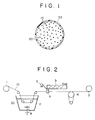
- Fig. 1 is a schematic section of a preformed yarn according to an embodiment of the present invention; and
- Fig 2 is a diagrammatic illustration of an apparatus suitable for the preparation of the preformed yarn according to the present invention.
- Referring first to Fig. 1, the
reference numeral 10 designates inorganic reinforcing fibers, generally continuous fibers, constituting a core or tow. The reinforcingfibers 10 may be, for example, carbon fibers, SiC fibers, alumina fibers, glass fibers and mixtures thereof. Of these, the use of carbon fibers is preferred. Flame proof fibers, infusible pitch fibers and surface-treated fibers thereof, which are precursors of carbon fibers, can also be suitably used for the purpose of the present invention. - Methods of the fabrication of carbon fibers are generally classified into two groups according to the types of the starting materials. The first method uses petroleum pitch or coal tar pitch as a precursor raw material whereas the second method carbonizes natural or synthetic fibers used as a raw material. Carbon fibers obtained by both of these methods may be used in the present invention. In the first method, pitch is first treated to obtain spinnable pitch, spinning the pitch, rendering the spun fibers infusible and then carbonizing the infusible fibers. For example, pitch is reformed to have a softening point of 180-300 °C, spun into fibers at a temperature of 250-300 °C and treated with an oxidizing gas at 150-300 °C to obtain infusible fibers which in turn are carbonized at 800-2500 °C. In the second method, organic fibers such as celullose fibers and acrylic fibers are processed to have flame-resistant properties and are then carbonized.
- The inorganic reinforcing fibers preferably have a filament tex (denier) number ranging from about 0.0056 to about 67 (about 0.05 to about 600) and filament counts ranging from about 50 to about 300,000, more preferably a filament tex (denier) number ranging from about 0.028 to about 1.8 (about 0.25 to about 16) and filament counts ranging from about 100 to about 48,000.
- The amount of the reinforcing fibers is preferably 5-70 %, more preferably 20-60 % based on the total volume of the preformed yarn. When the content of the reinforcing fibers is below 5 % by volume, the carbonized composite articles obtained therefrom tend to be unsatisfactory in bending strength. On the other hand when the amount of the reinforcing fibers exceeds 70 % by volume, the fibers in the carbonized composite articles tend to become low in mechanical strength because of the lack of the binder.
- Referring still to Fig. 1, in the interstices between the reinforcing
fibers 10 are provided finely divided, mixedpowder 20 including finely divided caronaceous binder pitch and finely divided coke. - The carbonaceous binder pitch is preferably petroleum or coal binder pitch, more preferably isotropic, latently anisotropic or anisotropic binder pitch derived from petroleum or coal and having a melting point of 60-320 °C, more preferably 180-300 °C, a quinoline insoluble content of 0-80 % by weight, more preferably 30-70 % by weight, and a volatile matter content of 5-60 % by weight, more preferably 10-30 % by weight. As the petroleum or coal pitch, there may be mentioned pitch obtained by heating a petroleum-derived heavy hydrocarbon oil such as an atmospheric residue, a vacuum residue or a catalytic cracking residue or a coal-derived heavy hydrocarbon oil such as coal tar or a sand oil at an elevated temperature, generally 350-500 °C. Mesophase spheres obtained from such a petroluem or coal pitch and bulk mesophase obtained from the mesophase spheres by growth and coalescence thereof may also be suitably used for the purpose of the present invention.
- For use in the invention, the carbonaceous binder pitch has an average particle diameter of 0.5-60 µm, preferably 3-20 µm. Binder pitch with an average particle diameter of less than 0.5 µm tends to lose fluidity and becomes difficult to uniformly fill the interstices of the inorganic reinforcing fibers. On the other hand, too large an average particle diameter in excess of 60 µm also causes difficulties in being uniformly dispersed into the void spaces between the reinforcing fibers.
- The finely divided coke to be mixed with the carbonaceous binder pitch is preferably a substantially unsoftenable coke having a volatile matter content of 10 % by weight or less, more preferably 2 % or less. A volatile matter content of the coke above 10 % by weight tends to cause the formation of crack in the carbonized articles obtained therefrom. Coke derived from petroleum or coal may be suitably used.
- The average particle size of the coke should be in the range of 0.5 to 30 µm, preferably 1 to 20 µm. An average particle size of below 0.5 µm tends to cause difficulties in uniformly distributing the coke particles within the interstices of reinforcing fibers due to low fluidity. Too large an average particle size in excess of 30 µm, on the other hand, tends to injure the reinforcing fibers and to cause the formation of pores or cracks in the carbonized products.
- The blending ratio by weight of the binder pitch to the coke varies with the intended use of the carbonized articles to be produced, but generally in the range of 9:1 to 1:9. The blending ratio is preferably 7:3 to 3:7 for reasons of capability of minimizing the size and number of pores in the carbonized product and of reducing the occurrence of cracking.
- The mixed powder to be incorporated between the reinforcing fibers may further contain silicon powder or powder of a metal capable of forming a metal carbide when the preformed yarn is subjected to carbonization conditions. Examples of such metals include Ti, Fe, W and Mo. The silicon or metal forms a carbide during carbonization treatment of the yarn and serve to improve the abrasion resistance, hardness and mechnical strength of the carbonized composite articles. The silicon or metal powder should have an average particle size in the range of 0.5 to 30 µm. The content of the metal powder is preferably 0.5 to 50, more preferably 3-20 % based on the total weight of the mixed powder.
- Further, for the purpose of improving mechanical properties at high temperature of the carbonized product, an additive such as a metal, an inorganic compound or a thermosetting resin may be incorporated into the mixed powder. Examples of suitable metals include Cu, Al, Sn, Pb, Bi, Sb, Zn, Mg, Ag and Cu-Zn. Examples of inorganic compounds include SiC, Pb₃O₄, CdO, Al₂O₃, MgO, Fe₂O₃, ZnO, Cr₂O₃, CaCO₃ and BaSO₄. Examples of thermosetting resins include a phenol resin, unsaturated polyester resins, epoxy resins, silicone resins, aromatic hydrocarbon resins and urea resins. Such an additive has preferably an average particle size of 0.5 to 30 µm. The amount of the additive to be blended into the mixed powder is preferably 0.5-50 %, more preferably 3-20 % based on the total weight of the mixed powder.
- As shown in Fig. 1, the tow or core of a multiplicity of the reinforcing
fibers 10 holding therebetween the mixedpowder 20 is covered with a sleeve orsheath 30 formed of a thermoplastic resin. - The
sleeve 30 is preferably formed of an easily decomposable and vaporizable, low softening point thermoplastic resin such as a polyamide, a polyethylene, a polypropylene, a polyester or polyvinylidene fluoride. Above all, the use of a polyethylene or polypropylene is preferred for reasons of inexpensiveness and capability of forming a thin sleeve. The thickness of thesleeve 30 is not specifically limited. However, as long as the workability or processability of the preformed yarn is not adversely affected, the use of a thinner sleeve is more preferred for improving the properties of composite articles. The use of a sleeve with a thickness of 7-30 µm is recommended. Because of the presence of thesleeve 30, the core of thefibers 10 andmixed powder 20 is protected from inclusion of impurities or moisture therein and from being damaged or fuzzed. It is preferred that thesleeve 30 be in close contact or shrunk fit with the core so as to minimize the void space between the core and sleeve and within the core. Such a close contact is desirable for minimizing the inclusion of air in the preformed yarn and, therefore, minimizing the occurrence of pores within the final composite articles. - The process for the fabrication of the above-described preformed yarn in accordance with the present invention will now be described below with reference to Fig. 2. A bundle of continuous reinforcing
fibers 10 wound on a bobbin (not shown) is continuously fed through an unwinding equipment 1 to achamber 2 containing a mass of amixed powder 20 including binder pitch and coke. An agitator 8 is disposed in thechamber 2 for mixing thepowder 20. The mixing of thepowder 20 may also be effected by feeding a fluidizing gas such as air or nitrogen from the bottom of thechamber 2 so as to maintain themixed powder 20 in a fluidized state. The bundle of thefibers 10 is spread or loosened by any suitable means such as air injection device or rollers and thespread fibers 10 are brought into contact with themixed powder 20 so that themixed powder 20 is taken in between thefibers 10. - The
fibers 10 holding the mixed powder therebetween are then assembled into a core or tow which is then covered with a sleeve in a sleeve forming device composed of across head 4 and anextruder 5. Designated as 3 is a vacuum pump connected to thecross head 4 for shrinkingly fitting the sleeve over the core and for providing tight bonding between the sleeve and the core. - The preformed yarn thus prepared is then cooled in a cooling zone (not shown) and wound on a take-up
roller 7. Designated as 6 is a feed roller for drawing the preformed yarn at a constant speed. - If desired, the tow provided with the sleeve therearound may be processed, before cooling, by means of a stamping or knot forming device to form a plurality of axially spaced apart, thin, annular, depressed portions on the outer periphery of the sleeve by radially inwardly pressing, with heating, the preformed yarn so as to tighten the sleeve and the core together. The provision of the knots is desirable in an instance where the preformed yarn is cut into a desired length, since escape of the mixed powder from the yarn can be minimized.
- The preformed yarn according to the present invention finds utility in, for example, the production of inorganic fiber-reinforced composite articles which are to be used under high temperature and high mechanical stress conditions. Such composite articles may be easily prepared by, for example, filament winding or hot pressing.
- When the preformed yarn according to the present invention is subjected to hot pressing at a temperature of 400 °C or more, especially 600 °C or more, the shaped body produced is almost free of volatile matter and, therefore, the succeeding carbonizing or graphitizing treatment can be performed without encountering problems of generation of gases. Thus, the composite articles obtained with the use of the preformed yarns of this invention can be substantially free of pores. Moreover, since the binder pitch powder and coke powder are homogeneously distributed in the interstices of the reinforcing fibers (in other words, the reinforcing fibers are homogeneously dispersed in the matrix of binder pitch and coke powder), the composite articles obtained therefrom are uniform in physical properties. The preformed yarn is also very suited for the production of composite articles having complex shapes and small radii of curvature.
- The following examples will further illustrate the present invention.
- A bundle of carbon fibers having a filament counts of 3000, a filament diameter of 10 µm, a tensile strength of 3.04x10⁹ Pa (310 kg/mm²), a modulus of 2.16x10¹¹ Pa (22x10³ kg/mm²) and a elongation of 1.4 % was continuously passed through a mass of mixed powder at a rate of 50 m/min and a drawing tension of 0.29 N (30 g). The mixed powder was a 1:1 (by weight) mixture of a petroleum binder pitch having a particle size of 3-20 µm, a softening point of 260 °C, a volatile matter content of 30 weight % and a quinoline insoluble content of 50 weight % and a coal-derived coke having a particle size of 3-10 µm and a volatile matter content of 1 weight %. The carbon fibers between which the mixed powder was held were then fed to a sleeve-forming cross head connected to an extruder where a polyethylene was extruded over the carbon fibers to form a sleeve therearound. The sleeve had a thickness of 8 µm and an inner diameter of 2.5 mm. The thus obtained preformed yarn was wound around a bobbin at a rate of 50 m/min. The preformed yarn was constituted of 58 % by volume of the mixed powder, 34 % by volume of the carbon fibers and 8 % by volume of the sleeve.
- The yarn was woven to form uni-directional sheets and 12 sheets of the woven sheets are superimposed on one another and subjected to hot press at a temperature of 600 °C, a pressure of 49x10⁶ Pa (500 kg/cm²) and a pressing time of 20 minutes to obtain a composite material having a bending strength of 147x10⁶ Pa 1500 kg/cm²), a density of 1.58 g/cm³ and a fiber content of 40 % by volume. The composite material was then calcined at 1500 °C for 30 minutes to obtain a C-C composite having a bending strength of 128x10⁶ Pa (1300 kg/cm²) and a density of 1.80 g/cm³.
- The preformed yarn obtained in Example 1 was woven by means of a rapier loom to obtain a plain weave fabric. 20 Sheets of the fabrics were superimposed and subjected to hot press at a temperature of 600 °C, a pressure of 49x10⁶ Pa (500 kg/cm²) and a pressing time of 20 minutes to obtain a composite material having a bending strength of 98.1x10⁶ Pa (1000 kg/cm²) and a density of 1.65 g/cm³.
- Example 1 was repeated in the same manner as described except that a silicon metal powder with a particle size of 3-10 µm was added to the mixed powder in an amount of 5 % based on the weight of the coke powder. A composite material having a bending strength of 169x10⁶ Pa (1720 kg/cm²) and a density of 1.61 g/cm³ was obtained. The composite material was then calcined at 1600 °C for 30 minutes in the atmosphere of nitrogen to obtain a C-C composite having a bending strength of 166x10⁶ Pa (1690 kg/cm²) and a density of 1.83 g/cm³.
- The 1:1 (by weight) mixture of the binder pitch and coke used in Example 1 was heated to 370 °C to obtain a melt in which a plain weave carbon fiber fabric was immersed for impregnation. 20 Sheets of the thus treated fabrics having a fiber content of 40 % by volume were superimposed and subjected to hot press in the same manner as in Example 1 to obtain a composite material having a bending strength of 40.2x10⁶ Pa (410 kg/cm²) and a density of 1.60 g/cm³.
- The 1:1 (by weight) mixture of the binder pitch and coke used in Example 1 was scattered over plain weave carbon fiber fabric. Another sheet of the fabric was then superimposed on the mixed powder layer, on which another mixed powder layer was provided. The same procedure was repeated to obtain a laminate composed of alternately superimposed 20 sheets of carbon fiber fabrics and 20 layers of the mixed powder and having a carbon fiber content of 40 % by volume. The laminate was subjected to hot press in the same manner as in Example 1 to obtain a composite material having a bending strength of 20.6x10⁶ Pa (210 kg/cm²) and a density of 1.60 g/cm³.
- Example 2 was repeated in the same manner as described except that nylon-6 (thermoplastic resin) having a particle size of 20-40 µm was substituted for the mixed powder. The composite material obtained by the hot press was crumbly due to the decomposition of the thermoplastic resin during the hot pressing.
- Example 2 was repeated in the same manner as described except that the binder pitch powder alone was used in place of the mixed powder. The composite material obtained as a result of the hot press had a bending strength of 44.1x10⁶ Pa (450 kg/cm²), a density of 1.58 g/cm³ and a carbon fiber content of 45 % by volume. Cracks were observed in the composite material.
- Example 2 was repeated in the same manner as described except that the coke powder alone was used in place of the mixed powder. Hot press of the fabric failed to give a composite material.
Claims (10)
- A preformed yarn useful in forming composite articles, comprising:
a core of a multiplicity of inorganic reinforcing fibers;
a mixed powder provided in the interstices, between said fibers and including carbonaceous binder pitch with an average particle size of 0.5-60 µm and coke with an average particle size of 0.5-30 µm; and
a flexible sleeve formed of a thermoplastic resin and surrounding said core. - A preformed yarn according to claim 1, wherein the weight ratio of said pitch to said coke is in the range of 1:9 to 9:1.
- A preformed yarn according to claim 1 or claim 2, wherein the content of said inorganic reinforcing fibers is in the range of 5 to 70 % based on the volume of the preformed yarn.
- A preformed yarn according to any preceding claim, wherein said mixed powder further includes silicon powder or powder of a metal capable of forming a metal carbide when the preformed yarn is subjected to conditions under which said coke and pitch are carbonized, said silicon or metal powder having an average particle size of 0.5-30 µm.
- A preformed yarn according to any preceding claim, wherein said sleeve is in close contact with the periphery of said core.
- A preformed yarn according to any preceding claim, wherein the outer periphery of said sleeve is provided with a plurality of longitudinally spaced apart, thin, annular, pressed portions so that said sleeve and said core are tightened together at the pressed portions.
- A process for the preparation of a preformed yarn useful in forming composite articles, comprising the steps of:
continuously passing a multiplicity of inorganic reinforcing fibers through a bed of a mixed powder including carbonaceous binder pitch with an average particle size of 0.5-60 µm and coke with an average particle size of 0.5-30 µm, so that the mixed powder is taken into the interstices between said fibers;
assembling said mixed powder-carrying fibers to form a tow with said mixed powder being held between said fibers; and
extruding a thermoplastic resin over said tow to form a sleeve surrounding said tow. - A process according to claim 7, wherein said mixed powder further includes silicon powder or powder of a metal capable of forming a metal carbide when the preformed yarn is subjected to conditions under which said coke and pitch are carbonized, said silicon or metal powder having an average particle size of 0.5-30 µm.
- A process according to claim 7 or claim 8, wherein said extruding step is carried out while maintaining said tow under reduced pressures so as to substantially reduce void spaces between the fibers and between the tow and said sleeve.
- A process according to any one of claims 7-9, further comprising radially inwardly hot-pressing the sleeve after said extruding step to form a plurality of longitudinally spaced apart, thin, annular, depressed portions on the periphery of said sleeve so that said sleeve and said core are tightened together at the hot-pressed portions.
Applications Claiming Priority (2)
| Application Number | Priority Date | Filing Date | Title |
|---|---|---|---|
| JP182483/86 | 1986-08-02 | ||
| JP61182483A JPS6340764A (en) | 1986-08-02 | 1986-08-02 | Flexible intermediate material for inorganic fiber reinforced carbon composite material and manufacture |
Publications (3)
| Publication Number | Publication Date |
|---|---|
| EP0257847A2 EP0257847A2 (en) | 1988-03-02 |
| EP0257847A3 EP0257847A3 (en) | 1989-06-07 |
| EP0257847B1 true EP0257847B1 (en) | 1993-01-27 |
Family
ID=16119062
Family Applications (1)
| Application Number | Title | Priority Date | Filing Date |
|---|---|---|---|
| EP19870306865 Expired - Lifetime EP0257847B1 (en) | 1986-08-02 | 1987-08-03 | Preformed yarn useful in forming composite articles and process of producing same |
Country Status (5)
| Country | Link |
|---|---|
| US (2) | US4772502A (en) |
| EP (1) | EP0257847B1 (en) |
| JP (1) | JPS6340764A (en) |
| KR (1) | KR950001655B1 (en) |
| DE (1) | DE3783836T2 (en) |
Families Citing this family (46)
| Publication number | Priority date | Publication date | Assignee | Title |
|---|---|---|---|---|
| FR2619399B1 (en) * | 1987-08-11 | 1991-10-25 | Brochier Sa | TEXTILE STRUCTURE FOR THE PRODUCTION OF LAMINATES WITH HIGH MECHANICAL PROPERTIES |
| US5206085A (en) * | 1987-08-13 | 1993-04-27 | Across Co., Ltd. | Preformed yarn useful for forming composite articles and process for producing same |
| US4966817A (en) * | 1987-09-23 | 1990-10-30 | Temple University | Transition-metal-carbon composites and methods for making |
| US5004574A (en) * | 1987-12-28 | 1991-04-02 | Hartley Sandt | Method of making a composite structural element |
| US5138719A (en) * | 1988-12-01 | 1992-08-18 | Hutchinson, S.A. | Gloves, finger stalls and similar protective and operational articles, and processes for their manufacture |
| JPH02157158A (en) * | 1988-12-08 | 1990-06-15 | Kanto Yakin Kogyo Kk | Production of carbon fiber molded body for use at high temperature |
| US5360671A (en) * | 1990-07-06 | 1994-11-01 | The University Of Akron | Thermoplastic polymides and composites therefrom |
| FR2673568A1 (en) * | 1991-03-08 | 1992-09-11 | Atochem | DEVICE FOR AN EXTRUDER FOR STITCHING AT LEAST TWO AMES BY A MATERIAL OF THE SAME NATURE. METHOD OF RESULTING GAINING. |
| US5137781A (en) * | 1991-03-22 | 1992-08-11 | E. I. Du Pont De Nemours And Company | Protected brittle fiber yarns |
| FR2684097B1 (en) * | 1991-11-21 | 1997-01-03 | Aerospatiale | PROCESS AND DEVICE FOR THE CONTINUOUS MANUFACTURE OF PROFILES OF CARBON-CARBON COMPOSITE MATERIALS OF LOW SECTION AND LARGE LENGTH. |
| US5334414A (en) * | 1993-01-22 | 1994-08-02 | Clemson University | Process for coating carbon fibers with pitch and composites made therefrom |
| JP3045889B2 (en) * | 1993-03-15 | 2000-05-29 | 株式会社アクロス | Method of manufacturing coil spring made of carbon fiber carbon composite material |
| DE69410581T2 (en) * | 1993-12-29 | 1998-11-26 | Across Co. Ltd., Warabi, Saitama | Heat-resistant material and conveyor belt made of this material |
| US5678809A (en) * | 1994-06-01 | 1997-10-21 | Across Co., Ltd. | Spring members |
| US5562946A (en) * | 1994-11-02 | 1996-10-08 | Tissue Engineering, Inc. | Apparatus and method for spinning and processing collagen fiber |
| US5756206A (en) * | 1995-03-15 | 1998-05-26 | Custom Composite Materials, Inc. | Flexible low bulk pre-impregnated tow |
| US5911942A (en) * | 1995-11-02 | 1999-06-15 | Tissue Engineering, Inc. | Method for spinning and processing collagen fiber |
| US6074716A (en) * | 1997-06-10 | 2000-06-13 | Mcdonnell Douglas Corporation | Weavable metal matrix impregnated tow composite material |
| US6051167A (en) * | 1997-06-24 | 2000-04-18 | Materials And Electrochemical Research (Mer) Corporation | Process of making carbon-carbon composites |
| US5962348A (en) * | 1998-03-05 | 1999-10-05 | Xc Associates | Method of making thermal core material and material so made |
| JP3987656B2 (en) * | 1999-03-30 | 2007-10-10 | 財団法人鉄道総合技術研究所 | Titanium copper carbon composite material for sliding current collection and manufacturing method of titanium copper carbon composite material for sliding current collection |
| US7560424B2 (en) * | 2001-04-30 | 2009-07-14 | Zystor Therapeutics, Inc. | Targeted therapeutic proteins |
| EP1341251A1 (en) * | 2002-02-28 | 2003-09-03 | OMG AG & Co. KG | PEM fuel cell stack |
| US6878331B2 (en) * | 2002-12-03 | 2005-04-12 | Ucar Carbon Company Inc. | Manufacture of carbon composites by hot pressing |
| US7207424B2 (en) * | 2002-12-03 | 2007-04-24 | Ucar Carbon Company Inc. | Manufacture of carbon/carbon composites by hot pressing |
| US6949622B2 (en) * | 2003-08-26 | 2005-09-27 | General Electric Company | Method of separating a polymer from a solvent |
| US7276284B2 (en) * | 2003-12-18 | 2007-10-02 | Sgl-Carbon Ag | Carbon fiber reinforced coke from the delayed coker |
| DE102006004775A1 (en) * | 2006-02-02 | 2007-08-09 | Zwilling J. A. Henckels Ag | Cookware, in particular pot, pan or the like |
| JP5046276B2 (en) * | 2007-03-14 | 2012-10-10 | 東レ株式会社 | Concrete or mortar structure and method for producing concrete or mortar structure |
| US8616104B2 (en) | 2010-07-12 | 2013-12-31 | Robert Bosch Gmbh | Portable table saw |
| USD636417S1 (en) | 2010-07-26 | 2011-04-19 | Robert Bosch Tool Corporation | Support assembly for a table saw |
| EP2697043A1 (en) | 2011-04-12 | 2014-02-19 | Ticona LLC | Continious fiber reinforced thermoplastic rod and pultrusion method for its manufacture |
| TW201308362A (en) | 2011-04-12 | 2013-02-16 | Ticona Llc | Composite core for electrical transmission cables |
| CN103477020A (en) | 2011-04-12 | 2013-12-25 | 提克纳有限责任公司 | Umbilicals for subsea applications |
| USD663328S1 (en) | 2011-11-04 | 2012-07-10 | Robert Bosch Gmbh | Table saw |
| FR2991901B1 (en) * | 2012-06-14 | 2014-07-04 | S Ara Composite | METHOD FOR OBTAINING A BODY OF A FORM GIVEN FROM A THREAD OR THE LIKE |
| JP6035084B2 (en) * | 2012-08-29 | 2016-11-30 | 株式会社Cfcデザイン | Intermediate material for carbon / carbon composite |
| FR3001452B1 (en) * | 2013-01-29 | 2015-02-13 | Herakles | METHOD OF MANUFACTURING A CURVED SHAPE ACOUSTICAL ATTENUATION PANEL |
| FR3001409B1 (en) | 2013-01-29 | 2015-07-03 | Herakles | METHOD FOR MANUFACTURING ALVEOLAR STRUCTURE OF CURVED SHAPE IN COMPOSITE MATERIAL |
| JP6780921B2 (en) * | 2015-06-26 | 2020-11-04 | 株式会社Cfcデザイン | High-performance carbon / carbon composite material with high carbon fiber contribution |
| US10151026B2 (en) * | 2016-08-05 | 2018-12-11 | Honeywell International Inc. | Vibration assisted densification of a carbon fiber preform |
| US9931818B1 (en) * | 2017-04-05 | 2018-04-03 | General Electric Company | Method for forming CMC article |
| US20220064407A1 (en) * | 2017-12-01 | 2022-03-03 | The University Of Newcastle | Carbon fibre |
| US11795114B1 (en) | 2020-10-22 | 2023-10-24 | Witold Kowbel | Process far revolutionary, very thick and very high thermal conductivity carbon-carbon composites |
| WO2024119186A1 (en) * | 2022-12-02 | 2024-06-06 | Triton Systems, Inc. | Tps material with enhanced toughness and interlaminar strength |
| WO2025049334A1 (en) * | 2023-08-25 | 2025-03-06 | University Of Wyoming | Thermoplastic polymer-coal composites |
Family Cites Families (11)
| Publication number | Priority date | Publication date | Assignee | Title |
|---|---|---|---|---|
| US2806248A (en) * | 1944-06-09 | 1957-09-17 | Burnie J Craig | Apparatus for making a threadlike member |
| NO117374B (en) * | 1965-04-27 | 1969-08-04 | Standard Tel Kabelfab As | |
| US3579623A (en) * | 1968-07-24 | 1971-05-18 | Philip Morris Inc | Forming filled continuous plastic rod such as plastic cigarette filter rod filled with a tow of cellulose acetate |
| GB1361596A (en) * | 1970-10-16 | 1974-07-30 | Coal Industry Patents Ltd | Composite materials |
| JPS5143501B2 (en) * | 1973-01-27 | 1976-11-22 | ||
| GB1514171A (en) * | 1974-01-11 | 1978-06-14 | Atomic Energy Authority Uk | Manufacture of porous carbon bodies |
| US3953637A (en) * | 1974-10-31 | 1976-04-27 | United Technologies Corporation | Slender rod for fishing rods and method of making the same |
| DE3002523C2 (en) * | 1980-01-24 | 1982-02-25 | Siemens AG, 1000 Berlin und 8000 München | Method for producing a stranding unit and device for carrying out the method |
| FR2544661A1 (en) * | 1983-04-19 | 1984-10-26 | Europ Propulsion | COMPOSITE MATERIALS CONSISTING OF A RESIN CARBON COKE MATRIX, REINFORCED BY REFRACTORY FIBERS COATED WITH PYROLYTIC CARBON, AND PROCESS FOR OBTAINING THEM |
| FR2548084B1 (en) * | 1983-06-28 | 1985-12-13 | Ato Chimie | PROCESS FOR MANUFACTURING COMPOSITE OBJECTS AND COMPOSITE OBJECTS OBTAINED |
| EP0133825B1 (en) * | 1983-06-28 | 1987-09-09 | Elf Atochem S.A. | Flexible composite material and process for its production |
-
1986
- 1986-08-02 JP JP61182483A patent/JPS6340764A/en active Granted
-
1987
- 1987-07-29 US US07/078,978 patent/US4772502A/en not_active Expired - Lifetime
- 1987-08-01 KR KR1019870008472A patent/KR950001655B1/en not_active Expired - Lifetime
- 1987-08-03 DE DE8787306865T patent/DE3783836T2/en not_active Expired - Lifetime
- 1987-08-03 EP EP19870306865 patent/EP0257847B1/en not_active Expired - Lifetime
-
1988
- 1988-06-02 US US07/201,451 patent/US4902453A/en not_active Expired - Lifetime
Also Published As
| Publication number | Publication date |
|---|---|
| DE3783836D1 (en) | 1993-03-11 |
| KR880003043A (en) | 1988-05-13 |
| EP0257847A3 (en) | 1989-06-07 |
| US4902453A (en) | 1990-02-20 |
| EP0257847A2 (en) | 1988-03-02 |
| JPH0472791B2 (en) | 1992-11-19 |
| US4772502A (en) | 1988-09-20 |
| DE3783836T2 (en) | 1993-07-22 |
| KR950001655B1 (en) | 1995-02-27 |
| JPS6340764A (en) | 1988-02-22 |
Similar Documents
| Publication | Publication Date | Title |
|---|---|---|
| US4902453A (en) | Process for the preparation of a fiber-reinforced carbon composite | |
| EP0402915B1 (en) | Hybrid carbon/carbon composite material | |
| EP1305268B1 (en) | Carbon-matrix composites compositions and methods related thereto | |
| US5688577A (en) | Multi-directional friction materials | |
| EP1416185B1 (en) | Fibre-reinforced ceramic brake lining | |
| US20110171452A1 (en) | Procedure for making pre-impregnated reinforced composite, as well as fiber reinforced composite, and their application | |
| US6447893B2 (en) | Fibrous composite material and process for producing the same | |
| EP0297695B1 (en) | Process for fabricating carbon/carbon fibre composite | |
| EP1340733B1 (en) | Ceramic composite with unidirectional alignment of the reinforcement fibers and method of their production | |
| EP0601808B1 (en) | Process for producing carbon preform | |
| EP0554024B1 (en) | Process for preparing carbon/carbon composite preform and carbon/carbon composite | |
| EP1908740B1 (en) | CARBON-FIBER-REINFORCED SiC COMPOSITE MATERIAL AND SLIDE MEMBER | |
| US3407038A (en) | Shredded carbonaceous fiber compactions and method of making the same | |
| EP0280233B1 (en) | Method for producing carbon-carbon composite materials | |
| US5554354A (en) | Carbon fiber-reinforced carbon composite material and process for producing the same | |
| US6162544A (en) | Kiln tool with good workability | |
| EP0803487B1 (en) | Process for producing carbonaceous preform | |
| JPH0255393B2 (en) | ||
| EP1382879B1 (en) | Use of friction materials for wet friction couples | |
| JP4209066B2 (en) | Sleeve guide for steel guide | |
| JPS6138231B2 (en) | ||
| Bradshaw et al. | Development of Manufacturing Process for Large-Diameter Composite Monofilaments by Pyrolysis of Resin-Impregnated Carbon-Fiber Bundles. | |
| JPH01229820A (en) | Pitch based carbon fiber bundle of less than 1000 filaments and production thereof | |
| JPH07300373A (en) | Carbon fiber reinforced carbon material with high unidirectional thermal conductivity | |
| JP2000289032A (en) | Mold for molding and mouth |
Legal Events
| Date | Code | Title | Description |
|---|---|---|---|
| PUAI | Public reference made under article 153(3) epc to a published international application that has entered the european phase |
Free format text: ORIGINAL CODE: 0009012 |
|
| AK | Designated contracting states |
Kind code of ref document: A2 Designated state(s): CH DE FR GB IT LI NL SE |
|
| PUAL | Search report despatched |
Free format text: ORIGINAL CODE: 0009013 |
|
| RHK1 | Main classification (correction) |
Ipc: D01F 9/14 |
|
| AK | Designated contracting states |
Kind code of ref document: A3 Designated state(s): CH DE FR GB IT LI NL SE |
|
| 17P | Request for examination filed |
Effective date: 19891205 |
|
| 17Q | First examination report despatched |
Effective date: 19910725 |
|
| GRAA | (expected) grant |
Free format text: ORIGINAL CODE: 0009210 |
|
| AK | Designated contracting states |
Kind code of ref document: B1 Designated state(s): CH DE FR GB IT LI NL SE |
|
| ET | Fr: translation filed | ||
| REF | Corresponds to: |
Ref document number: 3783836 Country of ref document: DE Date of ref document: 19930311 |
|
| ITF | It: translation for a ep patent filed | ||
| PLBE | No opposition filed within time limit |
Free format text: ORIGINAL CODE: 0009261 |
|
| STAA | Information on the status of an ep patent application or granted ep patent |
Free format text: STATUS: NO OPPOSITION FILED WITHIN TIME LIMIT |
|
| 26N | No opposition filed | ||
| EAL | Se: european patent in force in sweden |
Ref document number: 87306865.4 |
|
| REG | Reference to a national code |
Ref country code: GB Ref legal event code: IF02 |
|
| PGFP | Annual fee paid to national office [announced via postgrant information from national office to epo] |
Ref country code: DE Payment date: 20060727 Year of fee payment: 20 Ref country code: CH Payment date: 20060727 Year of fee payment: 20 |
|
| PGFP | Annual fee paid to national office [announced via postgrant information from national office to epo] |
Ref country code: GB Payment date: 20060802 Year of fee payment: 20 |
|
| PGFP | Annual fee paid to national office [announced via postgrant information from national office to epo] |
Ref country code: NL Payment date: 20060803 Year of fee payment: 20 |
|
| PGFP | Annual fee paid to national office [announced via postgrant information from national office to epo] |
Ref country code: FR Payment date: 20060808 Year of fee payment: 20 |
|
| PGFP | Annual fee paid to national office [announced via postgrant information from national office to epo] |
Ref country code: IT Payment date: 20060831 Year of fee payment: 20 |
|
| REG | Reference to a national code |
Ref country code: GB Ref legal event code: PE20 |
|
| REG | Reference to a national code |
Ref country code: CH Ref legal event code: PL |
|
| NLV7 | Nl: ceased due to reaching the maximum lifetime of a patent |
Effective date: 20070803 |
|
| EUG | Se: european patent has lapsed | ||
| PG25 | Lapsed in a contracting state [announced via postgrant information from national office to epo] |
Ref country code: GB Free format text: LAPSE BECAUSE OF EXPIRATION OF PROTECTION Effective date: 20070802 |
|
| PG25 | Lapsed in a contracting state [announced via postgrant information from national office to epo] |
Ref country code: NL Free format text: LAPSE BECAUSE OF EXPIRATION OF PROTECTION Effective date: 20070803 |
|
| PGFP | Annual fee paid to national office [announced via postgrant information from national office to epo] |
Ref country code: SE Payment date: 20060804 Year of fee payment: 20 |