EP0256533A2 - Method and apparatus for reduction of the nitrogen oxide content in effluent gases from absorption column for manufacture of nitric acid - Google Patents
Method and apparatus for reduction of the nitrogen oxide content in effluent gases from absorption column for manufacture of nitric acid Download PDFInfo
- Publication number
- EP0256533A2 EP0256533A2 EP87111782A EP87111782A EP0256533A2 EP 0256533 A2 EP0256533 A2 EP 0256533A2 EP 87111782 A EP87111782 A EP 87111782A EP 87111782 A EP87111782 A EP 87111782A EP 0256533 A2 EP0256533 A2 EP 0256533A2
- Authority
- EP
- European Patent Office
- Prior art keywords
- plates
- column
- absorption
- liquid level
- oxidation
- Prior art date
- Legal status (The legal status is an assumption and is not a legal conclusion. Google has not performed a legal analysis and makes no representation as to the accuracy of the status listed.)
- Granted
Links
Images

Classifications
-
- C—CHEMISTRY; METALLURGY
- C01—INORGANIC CHEMISTRY
- C01B—NON-METALLIC ELEMENTS; COMPOUNDS THEREOF; METALLOIDS OR COMPOUNDS THEREOF NOT COVERED BY SUBCLASS C01C
- C01B21/00—Nitrogen; Compounds thereof
- C01B21/20—Nitrogen oxides; Oxyacids of nitrogen; Salts thereof
- C01B21/38—Nitric acid
- C01B21/40—Preparation by absorption of oxides of nitrogen
-
- Y—GENERAL TAGGING OF NEW TECHNOLOGICAL DEVELOPMENTS; GENERAL TAGGING OF CROSS-SECTIONAL TECHNOLOGIES SPANNING OVER SEVERAL SECTIONS OF THE IPC; TECHNICAL SUBJECTS COVERED BY FORMER USPC CROSS-REFERENCE ART COLLECTIONS [XRACs] AND DIGESTS
- Y02—TECHNOLOGIES OR APPLICATIONS FOR MITIGATION OR ADAPTATION AGAINST CLIMATE CHANGE
- Y02P—CLIMATE CHANGE MITIGATION TECHNOLOGIES IN THE PRODUCTION OR PROCESSING OF GOODS
- Y02P20/00—Technologies relating to chemical industry
- Y02P20/10—Process efficiency
- Y02P20/129—Energy recovery, e.g. by cogeneration, H2recovery or pressure recovery turbines
Definitions
- the present invention relates to a method for reduction of the nitrogen oxide content, especially nitrogen dioxide, in effluent gases from an absorption column for manufacture of nitric acid by countercurrent absorption of nitrogen oxides produced by catalytic oxidation of ammonia by air or oxygen enriched air, in water or diluted nitric acid at a total pressure between 3 and 30 bar.
- the column is divided in a number of stages by horizontal perforated plates where the nitrogen oxides in the gases are partly absorbed, and the free gas volume above these plates where the nitrogen monoxide (NO) partially reacts with oxygen to nitrogen dioxide (NO2). Cooling is provided on at least some of the plates.
- the remaining gas from the uppermost absorption stage will, after having been heated, pass through an expansion turbine for recovering pressure energy before the gases are discharged to the atmosphere.
- the invention also comprises an apparatus for manufacture of nitric acid, comprising an absorption column having horizontal plates, with a certain level of liquid, and a gas volume, i.e. oxidation volume between the plates for oxidation of NO to NO2.
- the apparatus also comprises means for supply of nitrogen oxide containing gases in the lower part of the column and an aqueous solution in the upper part of the column and discharge means for the gas from the semi-spherical top of the column.
- Nitric acid is made from the reaction products of combustion of ammonia with air or oxygen enriched air. Accordingly, one has a gas containing different nitrogen oxides, oxygen and inert gases. When this gas mixture is brought in contact with an aqueous nitric acid containing solution, nitric acid is formed as the nitrogen oxides, primarily NO2 or NO2O4 are absorbed and react with water. This reaction results in formation of NO which must be oxidized to NO2. The reaction velocity corresponds to the pressure in the 2-3 power.
- a simplified gross reaction in the column can be stated as:
- NO is accordingly formed during the whole absorption process on the plates and in the subsequent oxidation space it will be partly oxidized to NO2.
- emission regulations were not as strict as today, at least 90% of the absorption of the nitric gases would take place in the lowest 2/3 of the column, while the remaining absorption took place in the upper third.
- nitrogen oxides in the effluent gases could be allowed if only economic considerations were made. But in view of environmental requirements the content of nitrogen oxide in the effluent gases should be kept as low as possible, and the limit in most of the industrialized countries today is 200 ppm nitrogen oxides.
- Norwegian Patent No. 139.633 describes a method by which H2O2 is added in order to secure oxidation of NO to NO2 and further to HNO3.
- the object of the present invention was to reduce the emission of nitorgen oxides from pressure absorption plants comprising plate column, but without addition of extra chemicals, and simultaneously obtain an effluent gas being as colourless as possible. Another object was to arrive at an improved absorption column for carrying out the method.
- Manufacture of nitric acid comprises several parameters both for the gas and the liquid phase which must be considered. The technical requirement will be:
- the economic requirement can simply be divided in investment and production requirements.
- the price of the column will for instance increase by its height and number of horizontal plates, but in general increased height and number of plates will result in better absorption of nitrogen oxides.
- the inventors started by studying a conventional modern nitric acid column from which the emission was close to the present environmental requirements. The first question raised was whether the investment cost could be lower without substantially increasing the running cost, and at the same time keep the emission constant or lower. As the absorption of nitrogen oxide actually implies absorption of NO2, it is accordingly important that efficient absorption of NO2 is secured as soon as NO is oxidized. One has to make certain that as much as possible of the NO content of the gases be comes oxidized to NO2. A central parameter during absorption is the available contact area between gas and liquid.
- a large contact area can be obtained by using a column having several plates with a high liquid level, but as mentioned above, increase of the height of the column and/or increasing number of plates will increase the cost of the column.
- the distance between the plates must also be large enough for making a necessarily large oxidation volume such that oxidation of NO to NO2 between each absorption stage is obtained.
- the relative amount NO2 could be reduced further by reduring the oxidation space above the last plate.
- a conven tional absorption column has a semispherical top and thereby a relatively large oxidation space above the last plate is formed. From an environmental point of view the only effect thereby attained is that a large part of the remaining NO is oxidized to NO2, resulting in extra colour of the effluent gases.
- the inventors found that the oxidation space could be reduced without disturbing the performance of the column by putting in an extra perforated plate in the top of the column above the last absorption level.
- Said plate can be horizontal, conical or curved and have a necessary free passage for gas to allow equalization of the pressure difference over the plate.
- the effluent gases can then be transported out of the column by a gas pipe through the partly closed top space.
- a pressure released dead space is thereby obtained at the column's top, and this does not lead to undesired oxidation of the remaining NO in the effluent gases.
- Fig. 1 a conventional column 1 with an upper part A for manufacture of nitric acid by absorption of nitrogen oxides in an aqueous nitric acid containing solution.
- Nitrogen oxide containing gases 7 from a plant for catalytic oxidation of ammonia are supplied to the lower part of column 1 countercurrently to the absorption liquid 8.
- the effluent gases containing non-absorbed nitrogen oxides leave the column 1 through discharge means 5.
- the upper part 2 of the column above the last plate 6 is semispherical.
- the six upper plates 6 are shown on the figure. On each plate is a liquid level having a height a ⁇ .
- the absorption liquid flows downwards from plate to plate as shown. Between each plate 6 there is an oxidation space 9.
- the distances between all plates are the same and the liquid level a ⁇ on the upper plates is the same as the level b ⁇ on the plates further down.
- Product acid is delivered through the acid outlet 11.
- Fig. 2 shows the upper part B of a column 1 according to the invention.
- a plate 4 which separates the upper semispherical part 2 of the column from the oxidation space 9 above the upper plate 6 with liquid level a.
- a pipe 3 allows the effluent gases to leave the upper oxidation space 9 directly out of the column 1.
- openings 10 Between the pipe 3 and the plate 4 there are openings 10 whereby communication between the spaces 2 and 9 is provided such that a pressure relieved dead space in the upper part of the column 1 is attained.
- the contact area is increased by installing several extra plates 6 in the upper part of the column, but then with a liquid level b.
- the contact area might be stated as liquid level times number of plates.
- the number of oxidation spaces 9 will also increase, but each space will be smaller and the total oxidation space available will only be reduced unessentially. In a conventional column the height of the oxidation spaces 9 is about 3 m, while the liquid level on the plates 6 is about 20 cm. Installation of more plates 6 or increase of the liquid level a, will accordingly result in small changes of the available oxidation space.
- This example shows manufacture of nitric acid in a conventional pressure absorption column having a distance between the plates of 3,3 m and a liquid overflow height of 0,2 m.
- the gas load was 200000 Nm3/h and the diameter of the column was 6 m.
- the stack diameter was 1,5 m. Recordings were made on the upper 18 plates as it is only absorption on the upper plates of the column (part A, Fig. 1) which here is of interest.
- Each stage in the column comprises a horizontal plate with a liquid level and the subsequent oxidation volume up to the next plate.
- the nitrogen oxide containing gas leaving stage No. 30 (i.e. the gas in on plate No. 31) had a total pressure of 10,2 bar under the given conditions (that is 20°C and 2,5 volume% O2) and a content of nitrogen oxides (NO x ) of 200 ppm out of which 85 ppm was NO2. Analysis of the gases leaving the remaining stages gave the following results:
- This example shows the effect of increasing the contact area during the absorption.
- This example shows the effect of increasing the contact area during absorption by increasing the number of plates in the upper part of the column.
- the liquid level on each plate was 0,2 m.
Landscapes
- Chemical & Material Sciences (AREA)
- Organic Chemistry (AREA)
- Inorganic Chemistry (AREA)
- Treating Waste Gases (AREA)
- Gas Separation By Absorption (AREA)
- Organic Low-Molecular-Weight Compounds And Preparation Thereof (AREA)
Abstract
Description
- The present invention relates to a method for reduction of the nitrogen oxide content, especially nitrogen dioxide, in effluent gases from an absorption column for manufacture of nitric acid by countercurrent absorption of nitrogen oxides produced by catalytic oxidation of ammonia by air or oxygen enriched air, in water or diluted nitric acid at a total pressure between 3 and 30 bar. The column is divided in a number of stages by horizontal perforated plates where the nitrogen oxides in the gases are partly absorbed, and the free gas volume above these plates where the nitrogen monoxide (NO) partially reacts with oxygen to nitrogen dioxide (NO₂). Cooling is provided on at least some of the plates. The remaining gas from the uppermost absorption stage will, after having been heated, pass through an expansion turbine for recovering pressure energy before the gases are discharged to the atmosphere.
- The invention also comprises an apparatus for manufacture of nitric acid, comprising an absorption column having horizontal plates, with a certain level of liquid, and a gas volume, i.e. oxidation volume between the plates for oxidation of NO to NO₂. The apparatus also comprises means for supply of nitrogen oxide containing gases in the lower part of the column and an aqueous solution in the upper part of the column and discharge means for the gas from the semi-spherical top of the column.
- Nitric acid is made from the reaction products of combustion of ammonia with air or oxygen enriched air. Accordingly, one has a gas containing different nitrogen oxides, oxygen and inert gases. When this gas mixture is brought in contact with an aqueous nitric acid containing solution, nitric acid is formed as the nitrogen oxides, primarily NO₂ or NO₂O₄ are absorbed and react with water. This reaction results in formation of NO which must be oxidized to NO₂. The reaction velocity corresponds to the pressure in the 2-3 power. A simplified gross reaction in the column can be stated as:
- 1. 2 NO + O₂→2 NO₂
- 2. 3 NO₂ + H₂O→2 HNO₃ + 2 NO
- NO is accordingly formed during the whole absorption process on the plates and in the subsequent oxidation space it will be partly oxidized to NO₂. In older plants, where emission regulations were not as strict as today, at least 90% of the absorption of the nitric gases would take place in the lowest 2/3 of the column, while the remaining absorption took place in the upper third. During manufacture of nitric acid quite large losses, for instance 2000 ppm, of nitrogen oxides in the effluent gases could be allowed if only economic considerations were made. But in view of environmental requirements the content of nitrogen oxide in the effluent gases should be kept as low as possible, and the limit in most of the industrialized countries today is 200 ppm nitrogen oxides. In addition to the requirement regarding low total emission of nitrogen oxide (NOx) it is desired to have an effluent gas being as colourless as possible. It is NO₂ which gives the effluent gases colour, and therefore it is not only the total content of nitrogen oxide which is of interest, but also the relative amount of NO₂ and NO in the effluent gases. Colourless gas is defined by the "stack formula":
ppm NO₂ in effluent gas≦
D is the stack diameter in meter. - The most economical way of manufacturing nitric acid and at the same time trying to meet the emission requirements set by the environmental authorities, can be carried out in different ways. Modern plants usually apply absorption under pressure, for instance 3-30 bar, in plate columns where cooling is provided on several of the plates. Several different types of plates are used, and in the following the concept "plate" comprises usually used perforated plates or bubble cap plates.
- During manufacture of nitric acid the gases usually pass countercurrently to the absorption liquid and leave the column at its upper semispherical top. Such a column is for instance described in Ullmann Encyklopädie der technischen Chemie, 4. Auflage, Band 20, pp 306-331.
- More specific ways of reducing the emission of nitrogen oxides are application of chemicals, for instance alkalic absorption using Na₂O which is added as NaOH or Na₂CO₃.
- Further, Norwegian Patent No. 139.633 describes a method by which H₂O₂ is added in order to secure oxidation of NO to NO₂ and further to HNO₃.
- From US-patent No. 4,372,935 it is known to reduce the NOx-content in the gases discharged to the atmosphere from a nitric acid plant by increasing the liquid level on the plates in part of the absorption tower. In a tower having 50 plates the liquid level on the 20 last plates is increased, while the distance between the plates is constant. Thus the NOx-content of effluent gas was reduced to 376 vpm compared to 968 vpm for a known absorption tower having the same liquid level on all plates. The increased contact time for the NOx-containing gases with the liquid obviously will increase the total absorption of NOx, but this method does not describe how the NO/NO₂ ratio in the effluent gases can be regulated for obtaining colourless gases from a nitric acid plant.
- The object of the present invention was to reduce the emission of nitorgen oxides from pressure absorption plants comprising plate column, but without addition of extra chemicals, and simultaneously obtain an effluent gas being as colourless as possible. Another object was to arrive at an improved absorption column for carrying out the method.
- Manufacture of nitric acid comprises several parameters both for the gas and the liquid phase which must be considered. The technical requirement will be:
- a) acid having a desired strength and
- b) the emissions shall be within the requirement set by the environmental authorities.
- The economic requirement can simply be divided in investment and production requirements. The price of the column will for instance increase by its height and number of horizontal plates, but in general increased height and number of plates will result in better absorption of nitrogen oxides.
- It is evident that the complicated chemical and physical conditions present, in addition to the economic requirements, will result in compromises between strong reduction of emission and economical performance of the plant.
- The inventors started by studying a conventional modern nitric acid column from which the emission was close to the present environmental requirements. The first question raised was whether the investment cost could be lower without substantially increasing the running cost, and at the same time keep the emission constant or lower. As the absorption of nitrogen oxide actually implies absorption of NO₂, it is accordingly important that efficient absorption of NO₂ is secured as soon as NO is oxidized. One has to make certain that as much as possible of the NO content of the gases be comes oxidized to NO₂. A central parameter during absorption is the available contact area between gas and liquid. A large contact area can be obtained by using a column having several plates with a high liquid level, but as mentioned above, increase of the height of the column and/or increasing number of plates will increase the cost of the column. The distance between the plates must also be large enough for making a necessarily large oxidation volume such that oxidation of NO to NO₂ between each absorption stage is obtained. One should also secure that the pressure drop over the column does not increase substantially, as this will increase the running cost because then only a minor part of the compression energy can be recovered in the expansion turbine.
- By evaluation of the relative importance of each parameter and the partly conflicting considerations which have to be done, one will end up with compromises, and several such ones are known. The inventors, however, chose an isolated investigation of available contact area between gas and liquid. Further studies of this showed that even a small increase of the liquid level on the plates could give positive effect totally and reduce the emission of nitrogen oxides substantially. Especially high effect was achieved by increasing the liquid level on the upper plates in the column. Then the oxidation space between these plates became less, but this did not result in determining reduction of the oxidation of NO to NO₂. By increasing the liquid level on the three upper plates, one obtained for instance far lower NO₂-concentration in the effluent gases compared to a conventional column. The relative amounts of NO₂ were also less as larger amounts of NO₂ were absorbed on the last plate than on one having half the liquid level.
- The relative amount NO₂ could be reduced further by reduring the oxidation space above the last plate. A conven tional absorption column has a semispherical top and thereby a relatively large oxidation space above the last plate is formed. From an environmental point of view the only effect thereby attained is that a large part of the remaining NO is oxidized to NO₂, resulting in extra colour of the effluent gases. The inventors found that the oxidation space could be reduced without disturbing the performance of the column by putting in an extra perforated plate in the top of the column above the last absorption level. Said plate can be horizontal, conical or curved and have a necessary free passage for gas to allow equalization of the pressure difference over the plate. The effluent gases can then be transported out of the column by a gas pipe through the partly closed top space. A pressure released dead space is thereby obtained at the column's top, and this does not lead to undesired oxidation of the remaining NO in the effluent gases.
- The idea of increasing the contact area gas/liquid was further developed and it was found that one could obtain cleaner effluent gases having relatively low content of NO₂ by increasing the liquid level on the plates. This would not disturb the performance of the column, and a column having fewer plates would be provided. An alternative was of increasing the contact area would be to apply more plates in the upper part of the column, but with a normal liquid level. One would also then obtain a lower column, but the number of plates would be higher compared to a column having increased liquid level. As more plates increase the investment costs, this solution would in most cases be less favourable economically.
- The special features of the invention are as defined in the attached claims 1-8.
- The invention will be further explained in connection with the description of the figures and the examples.
- Fig. 1 shows a known absorption column for manufacture of nitric acid.
- Fig. 2 shows the upper part of a column according to the invention.
- In Fig. 1 is shown a
conventional column 1 with an upper part A for manufacture of nitric acid by absorption of nitrogen oxides in an aqueous nitric acid containing solution. Nitrogenoxide containing gases 7 from a plant for catalytic oxidation of ammonia are supplied to the lower part ofcolumn 1 countercurrently to theabsorption liquid 8. The effluent gases containing non-absorbed nitrogen oxides leave thecolumn 1 through discharge means 5. Theupper part 2 of the column above thelast plate 6 is semispherical. The sixupper plates 6 are shown on the figure. On each plate is a liquid level having a height aʹ. The absorption liquid flows downwards from plate to plate as shown. Between eachplate 6 there is anoxidation space 9. The distances between all plates are the same and the liquid level aʹ on the upper plates is the same as the level bʹ on the plates further down. Product acid is delivered through theacid outlet 11. - Fig. 2 shows the upper part B of a
column 1 according to the invention. Above the inlet forabsorption liquid 8 there is aplate 4 which separates the uppersemispherical part 2 of the column from theoxidation space 9 above theupper plate 6 with liquid level a. Apipe 3 allows the effluent gases to leave theupper oxidation space 9 directly out of thecolumn 1. Between thepipe 3 and theplate 4 there areopenings 10 whereby communication between thespaces column 1 is attained. - On the
upper plates 6 there is a liquid level a, while theplates 6 further below have a liquid level b. The height of the level a>b. This change of the height of liquid level on the plates relative to a conventional column results in an increase in contact area for absorption of nitrogen oxides. The relation between this contact area and the free gas space for oxidation in the upper 1-8 stages of the column is hereby increased by a factor of 1,5-5 compared to the plates further below where the liquid level is b. It has been found that if the liquid level on the upper 2-4 plates is increased by a factor of 2-3 compared to theplates 6 further below, a substantial reduction of emission of nitrogen oxides is obtained. Almost the same effect can be attained if the contact area is increased by installing severalextra plates 6 in the upper part of the column, but then with a liquid level b. The contact area might be stated as liquid level times number of plates. The number ofoxidation spaces 9 will also increase, but each space will be smaller and the total oxidation space available will only be reduced unessentially. In a conventional column the height of theoxidation spaces 9 is about 3 m, while the liquid level on theplates 6 is about 20 cm. Installation ofmore plates 6 or increase of the liquid level a, will accordingly result in small changes of the available oxidation space. - This example shows manufacture of nitric acid in a conventional pressure absorption column having a distance between the plates of 3,3 m and a liquid overflow height of 0,2 m. The gas load was 200000 Nm³/h and the diameter of the column was 6 m. The stack diameter was 1,5 m. Recordings were made on the upper 18 plates as it is only absorption on the upper plates of the column (part A, Fig. 1) which here is of interest. Each stage in the column comprises a horizontal plate with a liquid level and the subsequent oxidation volume up to the next plate.
- The nitrogen oxide containing gas leaving stage No. 30 (i.e. the gas in on plate No. 31) had a total pressure of 10,2 bar under the given conditions (that is 20°C and 2,5 volume% O₂) and a content of nitrogen oxides (NOx) of 200 ppm out of which 85 ppm was NO₂. Analysis of the gases leaving the remaining stages gave the following results:

- Not till after 48 stages did the effluent gas become colourless, as its content of NO₂ was under 40 ppm in accordance with the above "stack formula".
- This example shows the effect of increasing the contact area during the absorption.
- First the liquid level on plates Nos. 38, 39 and 40 was increased to 0.4 m. This gave the following analysis of the gases leaving after stage No. 41:

- Without this increase of liquid level it would have been necessary to use 46,5 stages for obtaining correspondingly low NO₂-amounts in the effluent gas.
- If in addition to increasing the liquid level, the oxidation space is also reduced above the upper plate by separation of the upper part of the tower as shown on Fig. 2 and equivalent to a reduction of free height above the upper plate from 3,3 m to 1,95 m, the relative amounts of NO₂ in effluent gas were reduced as follows:
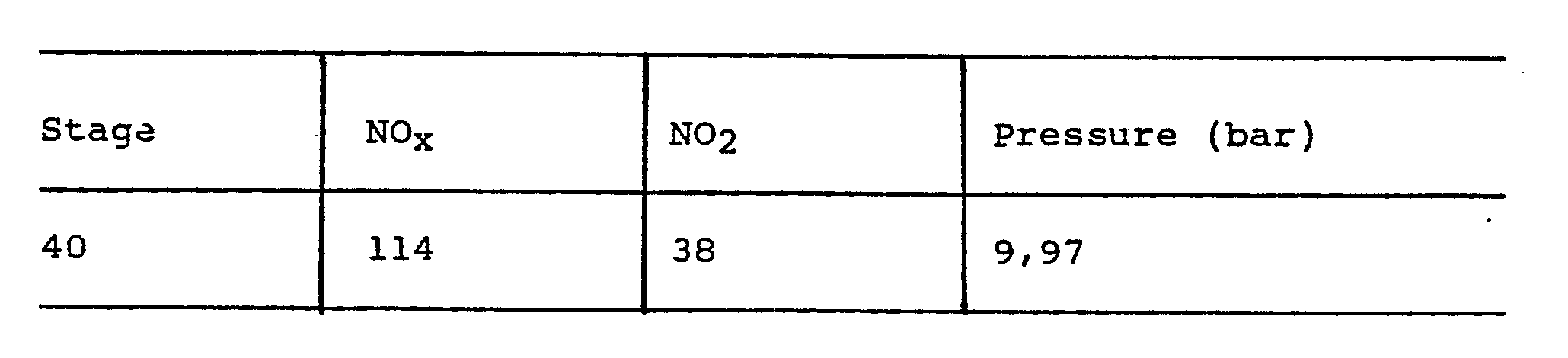
- In this way it was already by 40 plates achieved a colourless effluent gas.
- This example shows the effect of increasing the contact area during absorption by increasing the number of plates in the upper part of the column. The liquid level on each plate was 0,2 m.
- Between plates Nos. 37, 38, 39 and 40 it was installed altogether three extra plates such that the oxidation spaces between the plates were reduced by about 50%. The height of the column was unchanged, but the total number of plates was increased to 43. Also in this case the upper part of the column was separated corresponding to a difference between the upper plate 43 and the separating plate of 1,75 m. Analysis of the effluent gases leaving the column gave the following result:

- As can be seen from the table installation of three extra plates gave almost the same effect as doubling the liquid level on the three upper plates.
- The pressure drop due to these small changes will be immaterial compared to that resulting from increasing the liquid level on the 20 last plates as recommended in the above referred US-patent 4,372,935.
- By the small changes of the contact area, which do not disturb the performance of the absorption column, one has by the present invention obtained reduction of NOx-emission at the same time as the effluent gases become substantially colourless. One has also obtained an improved column which totally requires smaller investment than a conventional column giving the same NOx-emission.
Claims (8)
characterized in that
the absorption in the upper 1-8 stages, preferably the upper 2-4 stages, is carried out at a relation between the contact area in the liquid level for absorption on the plates and the free gas space for oxidation of 1,5-5, preferably of 2-3 larger than the corresponding relation for the horizontal plates below.
characterized in that
the relation between contact area and free gas space is adjusted by increasing the overflow height for the liquid volume on the upper plates by a factor of 1,5-5, preferably by a factor of 2-3 compared to the plates further below.
characterized in that
the relation between contact area and gas space is adjusted by reducing the distances between the upper plates by a factor of 1,5-3 compared to the plates further below.
characterized in that
the volume above the upper plate is reduced by closing off a dead space which is pressure relieved by means of a non-perforated plate at the top of the column.
characterized in that
the relation between available contact area for absorption on the plate (6) and total free gas space (9) for oxidation at the upper 1-8 stages of the column, preferably the upper 2-4 stages, is 1,5-5 times larger than in the lower part of the column (1).
characterized in that
the overflow height on the upper 1-8 plates (6) in the column (1) is adjusted to give a liquid level (a) 1,5-5 times the liquid level (b) on the plates (6) further below, preferably (a) = (2-3).(b).
characterized in that
the liquid level (a) is of the same height on all plates (6) and that the distance (c) between the plates (6) is 1/3-2/3 of the distance (c) between the plates further below.
characterized in that
the semispherical part (2) of the column (1) is separated from the upper oxidation volume (9) by a non-perforated plate (4), and such communication between the two volumes is provided for pressure equalization via openings (10) between/in the plate (4) and that a pipe (3) is arranged for transporting the effluent gases out of the column (1).
Priority Applications (1)
| Application Number | Priority Date | Filing Date | Title |
|---|---|---|---|
| AT87111782T ATE81836T1 (en) | 1986-08-13 | 1987-08-13 | METHOD AND DEVICE FOR REDUCING THE CONTENT OF NITROGEN OXIDES IN EXHAUST GASES FROM THE ABSORPTION COLUMN FOR THE PRODUCTION OF NITRIC ACID. |
Applications Claiming Priority (2)
| Application Number | Priority Date | Filing Date | Title |
|---|---|---|---|
| NO863274A NO162336C (en) | 1986-08-13 | 1986-08-13 | METHOD AND APPARATUS FOR REDUCING NITROGEN OXIDE CONTENT IN EXHAUST GAS FROM THE ABSORPTION COLUMN FOR THE PREPARATION OF SALPETIC ACID. |
| NO863274 | 1986-08-13 |
Publications (3)
| Publication Number | Publication Date |
|---|---|
| EP0256533A2 true EP0256533A2 (en) | 1988-02-24 |
| EP0256533A3 EP0256533A3 (en) | 1988-07-27 |
| EP0256533B1 EP0256533B1 (en) | 1992-10-28 |
Family
ID=19889135
Family Applications (1)
| Application Number | Title | Priority Date | Filing Date |
|---|---|---|---|
| EP87111782A Expired - Lifetime EP0256533B1 (en) | 1986-08-13 | 1987-08-13 | Method and apparatus for reduction of the nitrogen oxide content in effluent gases from absorption column for manufacture of nitric acid |
Country Status (5)
| Country | Link |
|---|---|
| EP (1) | EP0256533B1 (en) |
| AT (1) | ATE81836T1 (en) |
| DE (2) | DE3782374T2 (en) |
| ES (1) | ES2035006T3 (en) |
| NO (1) | NO162336C (en) |
Cited By (7)
| Publication number | Priority date | Publication date | Assignee | Title |
|---|---|---|---|---|
| EP0326664A1 (en) * | 1988-01-20 | 1989-08-09 | Uhde GmbH | Process and apparatus for the production of nitric acid by oxidation and absorption of nitrogen oxides |
| RU2203851C2 (en) * | 2000-09-27 | 2003-05-10 | Открытое акционерное общество "Концерн Стирол" | Apparatus for producing nitric acid |
| RU2241663C2 (en) * | 2000-12-19 | 2004-12-10 | Открытое акционерное общество "Концерн Стирол" | Nitric acid production process |
| RU2248936C2 (en) * | 2000-12-19 | 2005-03-27 | Открытое акционерное общество "Концерн Стирол" | Method for production of nitric acid |
| EP3904280A1 (en) | 2020-04-29 | 2021-11-03 | Yara International ASA | Absorption column comprising a feed box having a serrated weir and a structured packing and process for the production of nitric acid |
| CN114288835A (en) * | 2021-12-02 | 2022-04-08 | 赛鼎工程有限公司 | Structure and method for improving oxidation degree and efficiency in 65% -68% high-concentration dilute acid preparation process |
| CN114307595A (en) * | 2021-12-02 | 2022-04-12 | 赛鼎工程有限公司 | Efficient absorption tower for producing composite nitric acid and method for preparing acid |
Families Citing this family (1)
| Publication number | Priority date | Publication date | Assignee | Title |
|---|---|---|---|---|
| CN108479349B (en) * | 2018-04-25 | 2020-12-11 | 金智慧 | Industrial nitric acid preparation system |
Family Cites Families (3)
| Publication number | Priority date | Publication date | Assignee | Title |
|---|---|---|---|---|
| US2206495A (en) * | 1938-03-30 | 1940-07-02 | American Cyanamid Co | Absorption system for nitric acid |
| BE599188A (en) * | 1960-01-20 | |||
| FR2486513A1 (en) * | 1980-07-11 | 1982-01-15 | Rhone Poulenc Ind | PROCESS FOR TREATING A GAS STREAM CONTAINING NITROGEN OXIDES AND OXYGEN |
-
1986
- 1986-08-13 NO NO863274A patent/NO162336C/en unknown
-
1987
- 1987-08-13 ES ES198787111782T patent/ES2035006T3/en not_active Expired - Lifetime
- 1987-08-13 DE DE8787111782T patent/DE3782374T2/en not_active Expired - Fee Related
- 1987-08-13 DE DE198787111782T patent/DE256533T1/en active Pending
- 1987-08-13 EP EP87111782A patent/EP0256533B1/en not_active Expired - Lifetime
- 1987-08-13 AT AT87111782T patent/ATE81836T1/en not_active IP Right Cessation
Cited By (9)
| Publication number | Priority date | Publication date | Assignee | Title |
|---|---|---|---|---|
| EP0326664A1 (en) * | 1988-01-20 | 1989-08-09 | Uhde GmbH | Process and apparatus for the production of nitric acid by oxidation and absorption of nitrogen oxides |
| RU2203851C2 (en) * | 2000-09-27 | 2003-05-10 | Открытое акционерное общество "Концерн Стирол" | Apparatus for producing nitric acid |
| RU2241663C2 (en) * | 2000-12-19 | 2004-12-10 | Открытое акционерное общество "Концерн Стирол" | Nitric acid production process |
| RU2248936C2 (en) * | 2000-12-19 | 2005-03-27 | Открытое акционерное общество "Концерн Стирол" | Method for production of nitric acid |
| EP3904280A1 (en) | 2020-04-29 | 2021-11-03 | Yara International ASA | Absorption column comprising a feed box having a serrated weir and a structured packing and process for the production of nitric acid |
| WO2021219733A1 (en) | 2020-04-29 | 2021-11-04 | Yara International Asa | Absorption column comprising a feed box having a serrated weir and a structured packing and process for the production of nitric acid |
| EP4143132B1 (en) * | 2020-04-29 | 2024-07-03 | Yara International ASA | Absorption column comprising a feed box having a serrated weir and a structured packing and process for the production of nitric acid |
| CN114288835A (en) * | 2021-12-02 | 2022-04-08 | 赛鼎工程有限公司 | Structure and method for improving oxidation degree and efficiency in 65% -68% high-concentration dilute acid preparation process |
| CN114307595A (en) * | 2021-12-02 | 2022-04-12 | 赛鼎工程有限公司 | Efficient absorption tower for producing composite nitric acid and method for preparing acid |
Also Published As
| Publication number | Publication date |
|---|---|
| ES2035006T3 (en) | 1993-04-16 |
| EP0256533B1 (en) | 1992-10-28 |
| NO863274L (en) | 1988-02-15 |
| ATE81836T1 (en) | 1992-11-15 |
| DE3782374T2 (en) | 1993-03-11 |
| DE256533T1 (en) | 1988-06-09 |
| NO162336C (en) | 1989-12-13 |
| EP0256533A3 (en) | 1988-07-27 |
| DE3782374D1 (en) | 1992-12-03 |
| NO863274D0 (en) | 1986-08-13 |
| NO162336B (en) | 1989-09-04 |
Similar Documents
| Publication | Publication Date | Title |
|---|---|---|
| US6165435A (en) | Method and production of nitric acid | |
| EP0384565B1 (en) | Treatment of nitrogen oxides | |
| CA1142326A (en) | High pressure process for recovery of sulphur from gases | |
| EP0808797B1 (en) | Direct oxygen injection in nitric acid production | |
| US5827493A (en) | Process for producing hydrogen peroxide | |
| AU1357301A (en) | Method for making sulfur trioxide, sulfuric acid, and oleum from sulfur dioxide | |
| EP0256533B1 (en) | Method and apparatus for reduction of the nitrogen oxide content in effluent gases from absorption column for manufacture of nitric acid | |
| US4973457A (en) | Method for the reduction of nitrogen oxide | |
| US4183906A (en) | Oxygen-enrichment columnar absorption process for making nitric acid | |
| US20230074083A1 (en) | Absorption tower for a nitric acid plant method for producing nitric acid | |
| US4370151A (en) | Process and apparatus for gassing liquids | |
| US3542510A (en) | Production of highly concentrated nitric acid | |
| WO2020169465A1 (en) | Bleaching tower and method for nitric acid production | |
| US4151265A (en) | Method and apparatus for removing nitrogen oxides from a gas stream | |
| CA1069675A (en) | Nitrogen oxide conversion process | |
| US4372935A (en) | NOx Removal from NOx /O2 gaseous feedstreams | |
| US5167935A (en) | Apparatus for treatment of nitrogen oxides | |
| EP4143132B1 (en) | Absorption column comprising a feed box having a serrated weir and a structured packing and process for the production of nitric acid | |
| US7090817B2 (en) | Process for the preparation of hydroxylammonium | |
| US4219534A (en) | Method for removing nitrogen oxides from a gas stream | |
| AU2001256312B2 (en) | Method for the catalytic conversion of gases with a high sulfur dioxide content | |
| US4081518A (en) | Gaseous product stream | |
| RU2012154915A (en) | METHOD FOR PRODUCING TETRAOXIDE DYNITROGEN | |
| EP4077212B1 (en) | A venturi absorber tube for absorbing sulfur trioxide in sulfuric acid | |
| CA1155639A (en) | Process and apparatus for gassing liquids |
Legal Events
| Date | Code | Title | Description |
|---|---|---|---|
| PUAI | Public reference made under article 153(3) epc to a published international application that has entered the european phase |
Free format text: ORIGINAL CODE: 0009012 |
|
| AK | Designated contracting states |
Kind code of ref document: A2 Designated state(s): AT DE ES FR GB NL |
|
| TCNL | Nl: translation of patent claims filed | ||
| EL | Fr: translation of claims filed | ||
| PUAL | Search report despatched |
Free format text: ORIGINAL CODE: 0009013 |
|
| DET | De: translation of patent claims | ||
| AK | Designated contracting states |
Kind code of ref document: A3 Designated state(s): AT DE ES FR GB NL |
|
| REG | Reference to a national code |
Ref country code: DE Ref legal event code: 8580 Free format text: ES ERFOLGT NEUDRUCK DER FEHLERHAFT GEDRUCKTEN DE/EP-SCHRIFT |
|
| 17P | Request for examination filed |
Effective date: 19890110 |
|
| 17Q | First examination report despatched |
Effective date: 19901112 |
|
| GRAA | (expected) grant |
Free format text: ORIGINAL CODE: 0009210 |
|
| AK | Designated contracting states |
Kind code of ref document: B1 Designated state(s): AT DE ES FR GB NL |
|
| PG25 | Lapsed in a contracting state [announced via postgrant information from national office to epo] |
Ref country code: AT Effective date: 19921028 |
|
| REF | Corresponds to: |
Ref document number: 81836 Country of ref document: AT Date of ref document: 19921115 Kind code of ref document: T |
|
| REF | Corresponds to: |
Ref document number: 3782374 Country of ref document: DE Date of ref document: 19921203 |
|
| ET | Fr: translation filed | ||
| REG | Reference to a national code |
Ref country code: ES Ref legal event code: FG2A Ref document number: 2035006 Country of ref document: ES Kind code of ref document: T3 |
|
| PLBE | No opposition filed within time limit |
Free format text: ORIGINAL CODE: 0009261 |
|
| STAA | Information on the status of an ep patent application or granted ep patent |
Free format text: STATUS: NO OPPOSITION FILED WITHIN TIME LIMIT |
|
| 26N | No opposition filed | ||
| REG | Reference to a national code |
Ref country code: GB Ref legal event code: IF02 |
|
| PGFP | Annual fee paid to national office [announced via postgrant information from national office to epo] |
Ref country code: GB Payment date: 20020807 Year of fee payment: 16 |
|
| PGFP | Annual fee paid to national office [announced via postgrant information from national office to epo] |
Ref country code: FR Payment date: 20020808 Year of fee payment: 16 |
|
| PGFP | Annual fee paid to national office [announced via postgrant information from national office to epo] |
Ref country code: DE Payment date: 20020821 Year of fee payment: 16 |
|
| PGFP | Annual fee paid to national office [announced via postgrant information from national office to epo] |
Ref country code: ES Payment date: 20020826 Year of fee payment: 16 |
|
| PGFP | Annual fee paid to national office [announced via postgrant information from national office to epo] |
Ref country code: NL Payment date: 20020829 Year of fee payment: 16 |
|
| PG25 | Lapsed in a contracting state [announced via postgrant information from national office to epo] |
Ref country code: GB Free format text: LAPSE BECAUSE OF NON-PAYMENT OF DUE FEES Effective date: 20030813 |
|
| PG25 | Lapsed in a contracting state [announced via postgrant information from national office to epo] |
Ref country code: ES Free format text: LAPSE BECAUSE OF NON-PAYMENT OF DUE FEES Effective date: 20030814 |
|
| PG25 | Lapsed in a contracting state [announced via postgrant information from national office to epo] |
Ref country code: NL Free format text: LAPSE BECAUSE OF NON-PAYMENT OF DUE FEES Effective date: 20040301 |
|
| PG25 | Lapsed in a contracting state [announced via postgrant information from national office to epo] |
Ref country code: DE Free format text: LAPSE BECAUSE OF NON-PAYMENT OF DUE FEES Effective date: 20040302 |
|
| GBPC | Gb: european patent ceased through non-payment of renewal fee |
Effective date: 20030813 |
|
| PG25 | Lapsed in a contracting state [announced via postgrant information from national office to epo] |
Ref country code: FR Free format text: LAPSE BECAUSE OF NON-PAYMENT OF DUE FEES Effective date: 20040430 |
|
| NLV4 | Nl: lapsed or anulled due to non-payment of the annual fee |
Effective date: 20040301 |
|
| REG | Reference to a national code |
Ref country code: FR Ref legal event code: ST |
|
| REG | Reference to a national code |
Ref country code: ES Ref legal event code: FD2A Effective date: 20030814 |