EP0256472A2 - Cosmetic agent for application to skin - Google Patents
Cosmetic agent for application to skin Download PDFInfo
- Publication number
- EP0256472A2 EP0256472A2 EP87111541A EP87111541A EP0256472A2 EP 0256472 A2 EP0256472 A2 EP 0256472A2 EP 87111541 A EP87111541 A EP 87111541A EP 87111541 A EP87111541 A EP 87111541A EP 0256472 A2 EP0256472 A2 EP 0256472A2
- Authority
- EP
- European Patent Office
- Prior art keywords
- skin
- cosmetic agent
- group
- compound
- salts
- Prior art date
- Legal status (The legal status is an assumption and is not a legal conclusion. Google has not performed a legal analysis and makes no representation as to the accuracy of the status listed.)
- Withdrawn
Links
- 239000002537 cosmetic Substances 0.000 title claims abstract description 31
- MMXZSJMASHPLLR-UHFFFAOYSA-N pyrroloquinoline quinone Chemical compound C12=C(C(O)=O)C=C(C(O)=O)N=C2C(=O)C(=O)C2=C1NC(C(=O)O)=C2 MMXZSJMASHPLLR-UHFFFAOYSA-N 0.000 claims abstract description 35
- 150000001875 compounds Chemical class 0.000 claims abstract description 29
- 235000019162 flavin adenine dinucleotide Nutrition 0.000 claims abstract description 17
- 239000011714 flavin adenine dinucleotide Substances 0.000 claims abstract description 17
- BAWFJGJZGIEFAR-NNYOXOHSSA-N NAD zwitterion Chemical compound NC(=O)C1=CC=C[N+]([C@H]2[C@@H]([C@H](O)[C@@H](COP([O-])(=O)OP(O)(=O)OC[C@@H]3[C@H]([C@@H](O)[C@@H](O3)N3C4=NC=NC(N)=C4N=C3)O)O2)O)=C1 BAWFJGJZGIEFAR-NNYOXOHSSA-N 0.000 claims abstract description 10
- RGJOEKWQDUBAIZ-IBOSZNHHSA-N CoASH Chemical compound O[C@@H]1[C@H](OP(O)(O)=O)[C@@H](COP(O)(=O)OP(O)(=O)OCC(C)(C)[C@@H](O)C(=O)NCCC(=O)NCCS)O[C@H]1N1C2=NC=NC(N)=C2N=C1 RGJOEKWQDUBAIZ-IBOSZNHHSA-N 0.000 claims abstract description 5
- RGJOEKWQDUBAIZ-UHFFFAOYSA-N coenzime A Natural products OC1C(OP(O)(O)=O)C(COP(O)(=O)OP(O)(=O)OCC(C)(C)C(O)C(=O)NCCC(=O)NCCS)OC1N1C2=NC=NC(N)=C2N=C1 RGJOEKWQDUBAIZ-UHFFFAOYSA-N 0.000 claims abstract description 5
- 239000005516 coenzyme A Substances 0.000 claims abstract description 5
- 229940093530 coenzyme a Drugs 0.000 claims abstract description 5
- KDTSHFARGAKYJN-UHFFFAOYSA-N dephosphocoenzyme A Natural products OC1C(O)C(COP(O)(=O)OP(O)(=O)OCC(C)(C)C(O)C(=O)NCCC(=O)NCCS)OC1N1C2=NC=NC(N)=C2N=C1 KDTSHFARGAKYJN-UHFFFAOYSA-N 0.000 claims abstract description 5
- VWWQXMAJTJZDQX-UYBVJOGSSA-N flavin adenine dinucleotide Chemical compound C1=NC2=C(N)N=CN=C2N1[C@@H]([C@H](O)[C@@H]1O)O[C@@H]1CO[P@](O)(=O)O[P@@](O)(=O)OC[C@@H](O)[C@@H](O)[C@@H](O)CN1C2=NC(=O)NC(=O)C2=NC2=C1C=C(C)C(C)=C2 VWWQXMAJTJZDQX-UYBVJOGSSA-N 0.000 claims abstract description 5
- 229940093632 flavin-adenine dinucleotide Drugs 0.000 claims abstract description 5
- XJLXINKUBYWONI-NNYOXOHSSA-N NADP zwitterion Chemical compound NC(=O)C1=CC=C[N+]([C@H]2[C@@H]([C@H](O)[C@@H](COP([O-])(=O)OP(O)(=O)OC[C@@H]3[C@H]([C@@H](OP(O)(O)=O)[C@@H](O3)N3C4=NC=NC(N)=C4N=C3)O)O2)O)=C1 XJLXINKUBYWONI-NNYOXOHSSA-N 0.000 claims abstract 2
- 150000003839 salts Chemical class 0.000 claims description 26
- XLYOFNOQVPJJNP-UHFFFAOYSA-N water Chemical compound O XLYOFNOQVPJJNP-UHFFFAOYSA-N 0.000 claims description 26
- 125000004432 carbon atom Chemical group C* 0.000 claims description 10
- 125000004435 hydrogen atom Chemical group [H]* 0.000 claims description 9
- 239000003755 preservative agent Substances 0.000 claims description 9
- 239000004094 surface-active agent Substances 0.000 claims description 9
- 239000003906 humectant Substances 0.000 claims description 8
- 125000002252 acyl group Chemical group 0.000 claims description 7
- 230000002335 preservative effect Effects 0.000 claims description 7
- 239000008213 purified water Substances 0.000 claims description 7
- 125000000217 alkyl group Chemical group 0.000 claims description 4
- 125000005843 halogen group Chemical group 0.000 claims description 4
- 125000003277 amino group Chemical group 0.000 claims description 3
- 125000004103 aminoalkyl group Chemical group 0.000 claims description 3
- 125000002887 hydroxy group Chemical group [H]O* 0.000 claims description 3
- 125000000446 sulfanediyl group Chemical group *S* 0.000 claims description 3
- 125000003396 thiol group Chemical group [H]S* 0.000 claims description 3
- 150000001768 cations Chemical class 0.000 claims description 2
- GFFGJBXGBJISGV-UHFFFAOYSA-N Adenine Chemical compound NC1=NC=NC2=C1N=CN2 GFFGJBXGBJISGV-UHFFFAOYSA-N 0.000 claims 1
- 229930024421 Adenine Natural products 0.000 claims 1
- 229910019142 PO4 Inorganic materials 0.000 claims 1
- 229960000643 adenine Drugs 0.000 claims 1
- NBIIXXVUZAFLBC-UHFFFAOYSA-K phosphate Chemical compound [O-]P([O-])([O-])=O NBIIXXVUZAFLBC-UHFFFAOYSA-K 0.000 claims 1
- 239000010452 phosphate Substances 0.000 claims 1
- 210000003491 skin Anatomy 0.000 abstract description 65
- 230000000694 effects Effects 0.000 abstract description 29
- 239000006071 cream Substances 0.000 abstract description 19
- 230000032683 aging Effects 0.000 abstract description 13
- 230000001737 promoting effect Effects 0.000 abstract description 9
- 210000004927 skin cell Anatomy 0.000 abstract description 5
- NYHBQMYGNKIUIF-UUOKFMHZSA-N Guanosine Chemical compound C1=NC=2C(=O)NC(N)=NC=2N1[C@@H]1O[C@H](CO)[C@@H](O)[C@H]1O NYHBQMYGNKIUIF-UUOKFMHZSA-N 0.000 abstract description 4
- 230000004060 metabolic process Effects 0.000 abstract description 4
- 230000003213 activating effect Effects 0.000 abstract description 3
- MIKUYHXYGGJMLM-GIMIYPNGSA-N Crotonoside Natural products C1=NC2=C(N)NC(=O)N=C2N1[C@H]1O[C@@H](CO)[C@H](O)[C@@H]1O MIKUYHXYGGJMLM-GIMIYPNGSA-N 0.000 abstract description 2
- NYHBQMYGNKIUIF-UHFFFAOYSA-N D-guanosine Natural products C1=2NC(N)=NC(=O)C=2N=CN1C1OC(CO)C(O)C1O NYHBQMYGNKIUIF-UHFFFAOYSA-N 0.000 abstract description 2
- 230000001815 facial effect Effects 0.000 abstract description 2
- 229940029575 guanosine Drugs 0.000 abstract description 2
- 239000011734 sodium Substances 0.000 description 31
- LFQSCWFLJHTTHZ-UHFFFAOYSA-N Ethanol Chemical compound CCO LFQSCWFLJHTTHZ-UHFFFAOYSA-N 0.000 description 21
- 239000006210 lotion Substances 0.000 description 21
- 239000000126 substance Substances 0.000 description 20
- -1 NADH sodium salt Chemical class 0.000 description 18
- 238000000034 method Methods 0.000 description 18
- ZOOGRGPOEVQQDX-UUOKFMHZSA-N 3',5'-cyclic GMP Chemical compound C([C@H]1O2)OP(O)(=O)O[C@H]1[C@@H](O)[C@@H]2N1C(N=C(NC2=O)N)=C2N=C1 ZOOGRGPOEVQQDX-UUOKFMHZSA-N 0.000 description 17
- 102000008186 Collagen Human genes 0.000 description 15
- 108010035532 Collagen Proteins 0.000 description 15
- 229920001436 collagen Polymers 0.000 description 15
- 229930027945 nicotinamide-adenine dinucleotide Natural products 0.000 description 14
- 239000005515 coenzyme Substances 0.000 description 13
- XJLXINKUBYWONI-NNYOXOHSSA-O NADP(+) Chemical compound NC(=O)C1=CC=C[N+]([C@H]2[C@@H]([C@H](O)[C@@H](COP(O)(=O)OP(O)(=O)OC[C@@H]3[C@H]([C@@H](OP(O)(O)=O)[C@@H](O3)N3C4=NC=NC(N)=C4N=C3)O)O2)O)=C1 XJLXINKUBYWONI-NNYOXOHSSA-O 0.000 description 12
- 239000000203 mixture Substances 0.000 description 12
- 239000000243 solution Substances 0.000 description 11
- 210000002950 fibroblast Anatomy 0.000 description 10
- 102000016942 Elastin Human genes 0.000 description 9
- 108010014258 Elastin Proteins 0.000 description 9
- 230000005856 abnormality Effects 0.000 description 9
- 229920002549 elastin Polymers 0.000 description 9
- 239000003921 oil Substances 0.000 description 9
- 235000019198 oils Nutrition 0.000 description 9
- 241000700159 Rattus Species 0.000 description 8
- 230000009471 action Effects 0.000 description 8
- 230000006870 function Effects 0.000 description 8
- 235000013336 milk Nutrition 0.000 description 8
- 210000004080 milk Anatomy 0.000 description 8
- 238000012360 testing method Methods 0.000 description 8
- 206010040880 Skin irritation Diseases 0.000 description 7
- 230000006872 improvement Effects 0.000 description 7
- 150000007523 nucleic acids Chemical class 0.000 description 7
- 102000039446 nucleic acids Human genes 0.000 description 7
- 108020004707 nucleic acids Proteins 0.000 description 7
- 239000002304 perfume Substances 0.000 description 7
- XAEFZNCEHLXOMS-UHFFFAOYSA-M potassium benzoate Chemical compound [K+].[O-]C(=O)C1=CC=CC=C1 XAEFZNCEHLXOMS-UHFFFAOYSA-M 0.000 description 7
- 230000036556 skin irritation Effects 0.000 description 7
- 231100000475 skin irritation Toxicity 0.000 description 7
- OKKJLVBELUTLKV-UHFFFAOYSA-N Methanol Chemical compound OC OKKJLVBELUTLKV-UHFFFAOYSA-N 0.000 description 6
- 210000004027 cell Anatomy 0.000 description 6
- 238000011156 evaluation Methods 0.000 description 6
- 102000009024 Epidermal Growth Factor Human genes 0.000 description 5
- 101800003838 Epidermal growth factor Proteins 0.000 description 5
- 229920003171 Poly (ethylene oxide) Polymers 0.000 description 5
- XJLXINKUBYWONI-DQQFMEOOSA-N [[(2r,3r,4r,5r)-5-(6-aminopurin-9-yl)-3-hydroxy-4-phosphonooxyoxolan-2-yl]methoxy-hydroxyphosphoryl] [(2s,3r,4s,5s)-5-(3-carbamoylpyridin-1-ium-1-yl)-3,4-dihydroxyoxolan-2-yl]methyl phosphate Chemical compound NC(=O)C1=CC=C[N+]([C@@H]2[C@H]([C@@H](O)[C@H](COP([O-])(=O)OP(O)(=O)OC[C@@H]3[C@H]([C@@H](OP(O)(O)=O)[C@@H](O3)N3C4=NC=NC(N)=C4N=C3)O)O2)O)=C1 XJLXINKUBYWONI-DQQFMEOOSA-N 0.000 description 5
- 239000003153 chemical reaction reagent Substances 0.000 description 5
- 235000014113 dietary fatty acids Nutrition 0.000 description 5
- 229930195729 fatty acid Natural products 0.000 description 5
- 239000000194 fatty acid Substances 0.000 description 5
- 230000004151 fermentation Effects 0.000 description 5
- 238000000855 fermentation Methods 0.000 description 5
- 238000010438 heat treatment Methods 0.000 description 5
- 238000004519 manufacturing process Methods 0.000 description 5
- BOPGDPNILDQYTO-NNYOXOHSSA-N nicotinamide-adenine dinucleotide Chemical compound C1=CCC(C(=O)N)=CN1[C@H]1[C@H](O)[C@H](O)[C@@H](COP(O)(=O)OP(O)(=O)OC[C@@H]2[C@H]([C@@H](O)[C@@H](O2)N2C3=NC=NC(N)=C3N=C2)O)O1 BOPGDPNILDQYTO-NNYOXOHSSA-N 0.000 description 5
- 230000002265 prevention Effects 0.000 description 5
- VBEQCZHXXJYVRD-GACYYNSASA-N uroanthelone Chemical compound C([C@@H](C(=O)N[C@H](C(=O)N[C@@H](CS)C(=O)N[C@@H](CC(N)=O)C(=O)N[C@@H](CS)C(=O)N[C@H](C(=O)N[C@@H]([C@@H](C)CC)C(=O)NCC(=O)N[C@@H](CC=1C=CC(O)=CC=1)C(=O)N[C@@H](CO)C(=O)NCC(=O)N[C@@H](CC(O)=O)C(=O)N[C@@H](CCCNC(N)=N)C(=O)N[C@@H](CS)C(=O)N[C@@H](CCC(N)=O)C(=O)N[C@@H]([C@@H](C)O)C(=O)N[C@@H](CCCNC(N)=N)C(=O)N[C@@H](CC(O)=O)C(=O)N[C@@H](CC(C)C)C(=O)N[C@@H](CCCNC(N)=N)C(=O)N[C@@H](CC=1C2=CC=CC=C2NC=1)C(=O)N[C@@H](CC=1C2=CC=CC=C2NC=1)C(=O)N[C@@H](CCC(O)=O)C(=O)N[C@@H](CC(C)C)C(=O)N[C@@H](CCCNC(N)=N)C(O)=O)C(C)C)[C@@H](C)O)NC(=O)[C@H](CO)NC(=O)[C@H](CC(O)=O)NC(=O)[C@H](CC(C)C)NC(=O)[C@H](CO)NC(=O)[C@H](CCC(O)=O)NC(=O)[C@@H](NC(=O)[C@H](CC=1NC=NC=1)NC(=O)[C@H](CCSC)NC(=O)[C@H](CS)NC(=O)[C@@H](NC(=O)CNC(=O)CNC(=O)[C@H](CC(N)=O)NC(=O)[C@H](CC(C)C)NC(=O)[C@H](CS)NC(=O)[C@H](CC=1C=CC(O)=CC=1)NC(=O)CNC(=O)[C@H](CC(O)=O)NC(=O)[C@H](CC=1C=CC(O)=CC=1)NC(=O)[C@H](CO)NC(=O)[C@H](CO)NC(=O)[C@H]1N(CCC1)C(=O)[C@H](CS)NC(=O)CNC(=O)[C@H]1N(CCC1)C(=O)[C@H](CC=1C=CC(O)=CC=1)NC(=O)[C@H](CO)NC(=O)[C@@H](N)CC(N)=O)C(C)C)[C@@H](C)CC)C1=CC=C(O)C=C1 VBEQCZHXXJYVRD-GACYYNSASA-N 0.000 description 5
- 239000007864 aqueous solution Substances 0.000 description 4
- 230000002500 effect on skin Effects 0.000 description 4
- 239000000839 emulsion Substances 0.000 description 4
- 150000004665 fatty acids Chemical class 0.000 description 4
- 238000005469 granulation Methods 0.000 description 4
- 230000003179 granulation Effects 0.000 description 4
- 230000012010 growth Effects 0.000 description 4
- 239000008267 milk Substances 0.000 description 4
- 229950006238 nadide Drugs 0.000 description 4
- 239000011715 vitamin B12 Substances 0.000 description 4
- 235000019163 vitamin B12 Nutrition 0.000 description 4
- PMMYEEVYMWASQN-DMTCNVIQSA-N Hydroxyproline Chemical compound O[C@H]1CN[C@H](C(O)=O)C1 PMMYEEVYMWASQN-DMTCNVIQSA-N 0.000 description 3
- 239000004166 Lanolin Substances 0.000 description 3
- DNIAPMSPPWPWGF-UHFFFAOYSA-N Propylene glycol Chemical compound CC(O)CO DNIAPMSPPWPWGF-UHFFFAOYSA-N 0.000 description 3
- 229930003779 Vitamin B12 Natural products 0.000 description 3
- 238000013019 agitation Methods 0.000 description 3
- 150000001298 alcohols Chemical class 0.000 description 3
- 150000001413 amino acids Chemical class 0.000 description 3
- 239000003963 antioxidant agent Substances 0.000 description 3
- 239000002738 chelating agent Substances 0.000 description 3
- 239000003795 chemical substances by application Substances 0.000 description 3
- KRKNYBCHXYNGOX-UHFFFAOYSA-N citric acid Chemical compound OC(=O)CC(O)(C(O)=O)CC(O)=O KRKNYBCHXYNGOX-UHFFFAOYSA-N 0.000 description 3
- AGVAZMGAQJOSFJ-WZHZPDAFSA-M cobalt(2+);[(2r,3s,4r,5s)-5-(5,6-dimethylbenzimidazol-1-yl)-4-hydroxy-2-(hydroxymethyl)oxolan-3-yl] [(2r)-1-[3-[(1r,2r,3r,4z,7s,9z,12s,13s,14z,17s,18s,19r)-2,13,18-tris(2-amino-2-oxoethyl)-7,12,17-tris(3-amino-3-oxopropyl)-3,5,8,8,13,15,18,19-octamethyl-2 Chemical compound [Co+2].N#[C-].[N-]([C@@H]1[C@H](CC(N)=O)[C@@]2(C)CCC(=O)NC[C@@H](C)OP(O)(=O)O[C@H]3[C@H]([C@H](O[C@@H]3CO)N3C4=CC(C)=C(C)C=C4N=C3)O)\C2=C(C)/C([C@H](C\2(C)C)CCC(N)=O)=N/C/2=C\C([C@H]([C@@]/2(CC(N)=O)C)CCC(N)=O)=N\C\2=C(C)/C2=N[C@]1(C)[C@@](C)(CC(N)=O)[C@@H]2CCC(N)=O AGVAZMGAQJOSFJ-WZHZPDAFSA-M 0.000 description 3
- RMRCNWBMXRMIRW-BYFNXCQMSA-M cyanocobalamin Chemical compound N#C[Co+]N([C@]1([H])[C@H](CC(N)=O)[C@]\2(CCC(=O)NC[C@H](C)OP(O)(=O)OC3[C@H]([C@H](O[C@@H]3CO)N3C4=CC(C)=C(C)C=C4N=C3)O)C)C/2=C(C)\C([C@H](C/2(C)C)CCC(N)=O)=N\C\2=C\C([C@H]([C@@]/2(CC(N)=O)C)CCC(N)=O)=N\C\2=C(C)/C2=N[C@]1(C)[C@@](C)(CC(N)=O)[C@@H]2CCC(N)=O RMRCNWBMXRMIRW-BYFNXCQMSA-M 0.000 description 3
- 235000000639 cyanocobalamin Nutrition 0.000 description 3
- 239000011666 cyanocobalamin Substances 0.000 description 3
- PMMYEEVYMWASQN-UHFFFAOYSA-N dl-hydroxyproline Natural products OC1C[NH2+]C(C([O-])=O)C1 PMMYEEVYMWASQN-UHFFFAOYSA-N 0.000 description 3
- 239000003814 drug Substances 0.000 description 3
- 229940116977 epidermal growth factor Drugs 0.000 description 3
- 229960002591 hydroxyproline Drugs 0.000 description 3
- 235000019388 lanolin Nutrition 0.000 description 3
- 229940039717 lanolin Drugs 0.000 description 3
- 239000000463 material Substances 0.000 description 3
- 230000003647 oxidation Effects 0.000 description 3
- 238000007254 oxidation reaction Methods 0.000 description 3
- 230000035755 proliferation Effects 0.000 description 3
- 210000002966 serum Anatomy 0.000 description 3
- 159000000000 sodium salts Chemical class 0.000 description 3
- FGMPLJWBKKVCDB-UHFFFAOYSA-N trans-L-hydroxy-proline Natural products ON1CCCC1C(O)=O FGMPLJWBKKVCDB-UHFFFAOYSA-N 0.000 description 3
- 239000003643 water by type Substances 0.000 description 3
- 230000037303 wrinkles Effects 0.000 description 3
- PUPZLCDOIYMWBV-UHFFFAOYSA-N (+/-)-1,3-Butanediol Chemical compound CC(O)CCO PUPZLCDOIYMWBV-UHFFFAOYSA-N 0.000 description 2
- 241000894006 Bacteria Species 0.000 description 2
- 241000700199 Cavia porcellus Species 0.000 description 2
- LYCAIKOWRPUZTN-UHFFFAOYSA-N Ethylene glycol Chemical compound OCCO LYCAIKOWRPUZTN-UHFFFAOYSA-N 0.000 description 2
- PEDCQBHIVMGVHV-UHFFFAOYSA-N Glycerine Chemical compound OCC(O)CO PEDCQBHIVMGVHV-UHFFFAOYSA-N 0.000 description 2
- DGAQECJNVWCQMB-PUAWFVPOSA-M Ilexoside XXIX Chemical compound C[C@@H]1CC[C@@]2(CC[C@@]3(C(=CC[C@H]4[C@]3(CC[C@@H]5[C@@]4(CC[C@@H](C5(C)C)OS(=O)(=O)[O-])C)C)[C@@H]2[C@]1(C)O)C)C(=O)O[C@H]6[C@@H]([C@H]([C@@H]([C@H](O6)CO)O)O)O.[Na+] DGAQECJNVWCQMB-PUAWFVPOSA-M 0.000 description 2
- KFZMGEQAYNKOFK-UHFFFAOYSA-N Isopropanol Chemical compound CC(C)O KFZMGEQAYNKOFK-UHFFFAOYSA-N 0.000 description 2
- WHXSMMKQMYFTQS-UHFFFAOYSA-N Lithium Chemical compound [Li] WHXSMMKQMYFTQS-UHFFFAOYSA-N 0.000 description 2
- 108090000854 Oxidoreductases Proteins 0.000 description 2
- 102000004316 Oxidoreductases Human genes 0.000 description 2
- 239000002202 Polyethylene glycol Substances 0.000 description 2
- ZTHYODDOHIVTJV-UHFFFAOYSA-N Propyl gallate Chemical compound CCCOC(=O)C1=CC(O)=C(O)C(O)=C1 ZTHYODDOHIVTJV-UHFFFAOYSA-N 0.000 description 2
- LCTONWCANYUPML-UHFFFAOYSA-N Pyruvic acid Chemical compound CC(=O)C(O)=O LCTONWCANYUPML-UHFFFAOYSA-N 0.000 description 2
- 230000004913 activation Effects 0.000 description 2
- 239000000654 additive Substances 0.000 description 2
- WPYMKLBDIGXBTP-UHFFFAOYSA-N benzoic acid Chemical compound OC(=O)C1=CC=CC=C1 WPYMKLBDIGXBTP-UHFFFAOYSA-N 0.000 description 2
- 230000015572 biosynthetic process Effects 0.000 description 2
- GDTBXPJZTBHREO-UHFFFAOYSA-N bromine Chemical compound BrBr GDTBXPJZTBHREO-UHFFFAOYSA-N 0.000 description 2
- 239000004359 castor oil Substances 0.000 description 2
- 235000019438 castor oil Nutrition 0.000 description 2
- 238000001816 cooling Methods 0.000 description 2
- PGRHXDWITVMQBC-UHFFFAOYSA-N dehydroacetic acid Chemical compound CC(=O)C1C(=O)OC(C)=CC1=O PGRHXDWITVMQBC-UHFFFAOYSA-N 0.000 description 2
- 229940079593 drug Drugs 0.000 description 2
- 238000006911 enzymatic reaction Methods 0.000 description 2
- NUVBSKCKDOMJSU-UHFFFAOYSA-N ethylparaben Chemical compound CCOC(=O)C1=CC=C(O)C=C1 NUVBSKCKDOMJSU-UHFFFAOYSA-N 0.000 description 2
- ZEMPKEQAKRGZGQ-XOQCFJPHSA-N glycerol triricinoleate Natural products CCCCCC[C@@H](O)CC=CCCCCCCCC(=O)OC[C@@H](COC(=O)CCCCCCCC=CC[C@@H](O)CCCCCC)OC(=O)CCCCCCCC=CC[C@H](O)CCCCCC ZEMPKEQAKRGZGQ-XOQCFJPHSA-N 0.000 description 2
- 229910003002 lithium salt Inorganic materials 0.000 description 2
- 159000000002 lithium salts Chemical class 0.000 description 2
- 239000004292 methyl p-hydroxybenzoate Substances 0.000 description 2
- 235000010270 methyl p-hydroxybenzoate Nutrition 0.000 description 2
- LXCFILQKKLGQFO-UHFFFAOYSA-N methylparaben Chemical compound COC(=O)C1=CC=C(O)C=C1 LXCFILQKKLGQFO-UHFFFAOYSA-N 0.000 description 2
- 229960002216 methylparaben Drugs 0.000 description 2
- 238000002156 mixing Methods 0.000 description 2
- 230000004048 modification Effects 0.000 description 2
- 238000012986 modification Methods 0.000 description 2
- GLDOVTGHNKAZLK-UHFFFAOYSA-N octadecan-1-ol Chemical compound CCCCCCCCCCCCCCCCCCO GLDOVTGHNKAZLK-UHFFFAOYSA-N 0.000 description 2
- 239000002504 physiological saline solution Substances 0.000 description 2
- 229920001223 polyethylene glycol Polymers 0.000 description 2
- 159000000001 potassium salts Chemical class 0.000 description 2
- 102000004169 proteins and genes Human genes 0.000 description 2
- 108090000623 proteins and genes Proteins 0.000 description 2
- 230000009711 regulatory function Effects 0.000 description 2
- 238000011076 safety test Methods 0.000 description 2
- YGSDEFSMJLZEOE-UHFFFAOYSA-N salicylic acid Chemical compound OC(=O)C1=CC=CC=C1O YGSDEFSMJLZEOE-UHFFFAOYSA-N 0.000 description 2
- 229910052708 sodium Inorganic materials 0.000 description 2
- PRAKJMSDJKAYCZ-UHFFFAOYSA-N squalane Chemical compound CC(C)CCCC(C)CCCC(C)CCCCC(C)CCCC(C)CCCC(C)C PRAKJMSDJKAYCZ-UHFFFAOYSA-N 0.000 description 2
- 125000001424 substituent group Chemical group 0.000 description 2
- 238000003786 synthesis reaction Methods 0.000 description 2
- 239000002562 thickening agent Substances 0.000 description 2
- 210000001519 tissue Anatomy 0.000 description 2
- 235000013343 vitamin Nutrition 0.000 description 2
- 239000011782 vitamin Substances 0.000 description 2
- 229940088594 vitamin Drugs 0.000 description 2
- 229930003231 vitamin Natural products 0.000 description 2
- DSEKYWAQQVUQTP-XEWMWGOFSA-N (2r,4r,4as,6as,6as,6br,8ar,12ar,14as,14bs)-2-hydroxy-4,4a,6a,6b,8a,11,11,14a-octamethyl-2,4,5,6,6a,7,8,9,10,12,12a,13,14,14b-tetradecahydro-1h-picen-3-one Chemical compound C([C@H]1[C@]2(C)CC[C@@]34C)C(C)(C)CC[C@]1(C)CC[C@]2(C)[C@H]4CC[C@@]1(C)[C@H]3C[C@@H](O)C(=O)[C@@H]1C DSEKYWAQQVUQTP-XEWMWGOFSA-N 0.000 description 1
- OAJLVMGLJZXSGX-SLAFOUTOSA-L (2s,3s,4r,5r)-2-(6-aminopurin-9-yl)-5-methanidyloxolane-3,4-diol;cobalt(3+);[(2r,3s,4r,5s)-5-(5,6-dimethylbenzimidazol-1-yl)-4-hydroxy-2-(hydroxymethyl)oxolan-3-yl] [(2r)-1-[3-[(1r,2r,3r,4z,7s,9z,12s,13s,14z,17s,18s,19r)-2,13,18-tris(2-amino-2-oxoethyl)-7 Chemical compound [Co+3].O[C@H]1[C@@H](O)[C@@H]([CH2-])O[C@@H]1N1C2=NC=NC(N)=C2N=C1.[N-]([C@@H]1[C@H](CC(N)=O)[C@@]2(C)CCC(=O)NC[C@@H](C)OP([O-])(=O)O[C@H]3[C@H]([C@H](O[C@@H]3CO)N3C4=CC(C)=C(C)C=C4N=C3)O)\C2=C(C)/C([C@H](C\2(C)C)CCC(N)=O)=N/C/2=C\C([C@H]([C@@]/2(CC(N)=O)C)CCC(N)=O)=N\C\2=C(C)/C2=N[C@]1(C)[C@@](C)(CC(N)=O)[C@@H]2CCC(N)=O OAJLVMGLJZXSGX-SLAFOUTOSA-L 0.000 description 1
- WRIDQFICGBMAFQ-UHFFFAOYSA-N (E)-8-Octadecenoic acid Natural products CCCCCCCCCC=CCCCCCCC(O)=O WRIDQFICGBMAFQ-UHFFFAOYSA-N 0.000 description 1
- FFJCNSLCJOQHKM-CLFAGFIQSA-N (z)-1-[(z)-octadec-9-enoxy]octadec-9-ene Chemical compound CCCCCCCC\C=C/CCCCCCCCOCCCCCCCC\C=C/CCCCCCCC FFJCNSLCJOQHKM-CLFAGFIQSA-N 0.000 description 1
- QMMJWQMCMRUYTG-UHFFFAOYSA-N 1,2,4,5-tetrachloro-3-(trifluoromethyl)benzene Chemical compound FC(F)(F)C1=C(Cl)C(Cl)=CC(Cl)=C1Cl QMMJWQMCMRUYTG-UHFFFAOYSA-N 0.000 description 1
- 229940058015 1,3-butylene glycol Drugs 0.000 description 1
- VBICKXHEKHSIBG-UHFFFAOYSA-N 1-monostearoylglycerol Chemical compound CCCCCCCCCCCCCCCCCC(=O)OCC(O)CO VBICKXHEKHSIBG-UHFFFAOYSA-N 0.000 description 1
- IIZPXYDJLKNOIY-JXPKJXOSSA-N 1-palmitoyl-2-arachidonoyl-sn-glycero-3-phosphocholine Chemical compound CCCCCCCCCCCCCCCC(=O)OC[C@H](COP([O-])(=O)OCC[N+](C)(C)C)OC(=O)CCC\C=C/C\C=C/C\C=C/C\C=C/CCCCC IIZPXYDJLKNOIY-JXPKJXOSSA-N 0.000 description 1
- SPSPIUSUWPLVKD-UHFFFAOYSA-N 2,3-dibutyl-6-methylphenol Chemical compound CCCCC1=CC=C(C)C(O)=C1CCCC SPSPIUSUWPLVKD-UHFFFAOYSA-N 0.000 description 1
- FKOKUHFZNIUSLW-UHFFFAOYSA-N 2-Hydroxypropyl stearate Chemical compound CCCCCCCCCCCCCCCCCC(=O)OCC(C)O FKOKUHFZNIUSLW-UHFFFAOYSA-N 0.000 description 1
- RFVNOJDQRGSOEL-UHFFFAOYSA-N 2-hydroxyethyl octadecanoate Chemical compound CCCCCCCCCCCCCCCCCC(=O)OCCO RFVNOJDQRGSOEL-UHFFFAOYSA-N 0.000 description 1
- LQJBNNIYVWPHFW-UHFFFAOYSA-N 20:1omega9c fatty acid Natural products CCCCCCCCCCC=CCCCCCCCC(O)=O LQJBNNIYVWPHFW-UHFFFAOYSA-N 0.000 description 1
- HIQIXEFWDLTDED-UHFFFAOYSA-N 4-hydroxy-1-piperidin-4-ylpyrrolidin-2-one Chemical compound O=C1CC(O)CN1C1CCNCC1 HIQIXEFWDLTDED-UHFFFAOYSA-N 0.000 description 1
- QSBYPNXLFMSGKH-UHFFFAOYSA-N 9-Heptadecensaeure Natural products CCCCCCCC=CCCCCCCCC(O)=O QSBYPNXLFMSGKH-UHFFFAOYSA-N 0.000 description 1
- 239000005711 Benzoic acid Substances 0.000 description 1
- 108091003079 Bovine Serum Albumin Proteins 0.000 description 1
- 241000700198 Cavia Species 0.000 description 1
- KZBUYRJDOAKODT-UHFFFAOYSA-N Chlorine Chemical compound ClCl KZBUYRJDOAKODT-UHFFFAOYSA-N 0.000 description 1
- 244000060011 Cocos nucifera Species 0.000 description 1
- 235000013162 Cocos nucifera Nutrition 0.000 description 1
- 239000004287 Dehydroacetic acid Substances 0.000 description 1
- 101710088194 Dehydrogenase Proteins 0.000 description 1
- 108020005199 Dehydrogenases Proteins 0.000 description 1
- 201000004624 Dermatitis Diseases 0.000 description 1
- ZGTMUACCHSMWAC-UHFFFAOYSA-L EDTA disodium salt (anhydrous) Chemical compound [Na+].[Na+].OC(=O)CN(CC([O-])=O)CCN(CC(O)=O)CC([O-])=O ZGTMUACCHSMWAC-UHFFFAOYSA-L 0.000 description 1
- 108090000790 Enzymes Proteins 0.000 description 1
- 102000004190 Enzymes Human genes 0.000 description 1
- 206010014970 Ephelides Diseases 0.000 description 1
- 101710163305 Fibril protein Proteins 0.000 description 1
- XLRHXNIVIZZOON-WFUPGROFSA-L Flavin adenine dinucleotide disodium Chemical compound [Na+].[Na+].C1=NC2=C(N)N=CN=C2N1[C@@H]([C@H](O)[C@@H]1O)O[C@@H]1COP([O-])(=O)OP([O-])(=O)OC[C@@H](O)[C@@H](O)[C@@H](O)CN1C2=NC(=O)NC(=O)C2=NC2=C1C=C(C)C(C)=C2 XLRHXNIVIZZOON-WFUPGROFSA-L 0.000 description 1
- 241000282412 Homo Species 0.000 description 1
- VEXZGXHMUGYJMC-UHFFFAOYSA-N Hydrochloric acid Chemical compound Cl VEXZGXHMUGYJMC-UHFFFAOYSA-N 0.000 description 1
- 208000003351 Melanosis Diseases 0.000 description 1
- 241001465754 Metazoa Species 0.000 description 1
- 102000019010 Methylmalonyl-CoA Mutase Human genes 0.000 description 1
- 108010051862 Methylmalonyl-CoA mutase Proteins 0.000 description 1
- 239000005642 Oleic acid Substances 0.000 description 1
- ZQPPMHVWECSIRJ-UHFFFAOYSA-N Oleic acid Natural products CCCCCCCCC=CCCCCCCCC(O)=O ZQPPMHVWECSIRJ-UHFFFAOYSA-N 0.000 description 1
- 102000035195 Peptidases Human genes 0.000 description 1
- 108091005804 Peptidases Proteins 0.000 description 1
- ZLMJMSJWJFRBEC-UHFFFAOYSA-N Potassium Chemical compound [K] ZLMJMSJWJFRBEC-UHFFFAOYSA-N 0.000 description 1
- 239000004365 Protease Substances 0.000 description 1
- 206010070835 Skin sensitisation Diseases 0.000 description 1
- HVUMOYIDDBPOLL-XWVZOOPGSA-N Sorbitan monostearate Chemical compound CCCCCCCCCCCCCCCCCC(=O)OC[C@@H](O)[C@H]1OC[C@H](O)[C@H]1O HVUMOYIDDBPOLL-XWVZOOPGSA-N 0.000 description 1
- 235000021355 Stearic acid Nutrition 0.000 description 1
- VBIIFPGSPJYLRR-UHFFFAOYSA-M Stearyltrimethylammonium chloride Chemical compound [Cl-].CCCCCCCCCCCCCCCCCC[N+](C)(C)C VBIIFPGSPJYLRR-UHFFFAOYSA-M 0.000 description 1
- 229930006000 Sucrose Natural products 0.000 description 1
- 206010047601 Vitamin B1 deficiency Diseases 0.000 description 1
- 101100020289 Xenopus laevis koza gene Proteins 0.000 description 1
- 238000010521 absorption reaction Methods 0.000 description 1
- DPXJVFZANSGRMM-UHFFFAOYSA-N acetic acid;2,3,4,5,6-pentahydroxyhexanal;sodium Chemical compound [Na].CC(O)=O.OCC(O)C(O)C(O)C(O)C=O DPXJVFZANSGRMM-UHFFFAOYSA-N 0.000 description 1
- 230000021736 acetylation Effects 0.000 description 1
- 238000006640 acetylation reaction Methods 0.000 description 1
- 239000002253 acid Substances 0.000 description 1
- 239000004480 active ingredient Substances 0.000 description 1
- 239000008186 active pharmaceutical agent Substances 0.000 description 1
- 239000013543 active substance Substances 0.000 description 1
- 230000007059 acute toxicity Effects 0.000 description 1
- 231100000403 acute toxicity Toxicity 0.000 description 1
- 230000000996 additive effect Effects 0.000 description 1
- 108010048916 alcohol dehydrogenase (acceptor) Proteins 0.000 description 1
- 229910052783 alkali metal Inorganic materials 0.000 description 1
- 150000001340 alkali metals Chemical class 0.000 description 1
- 208000026935 allergic disease Diseases 0.000 description 1
- 239000003945 anionic surfactant Substances 0.000 description 1
- 230000003078 antioxidant effect Effects 0.000 description 1
- 125000003118 aryl group Chemical group 0.000 description 1
- 125000004429 atom Chemical group 0.000 description 1
- 235000013871 bee wax Nutrition 0.000 description 1
- 239000012166 beeswax Substances 0.000 description 1
- 229940092738 beeswax Drugs 0.000 description 1
- 235000010233 benzoic acid Nutrition 0.000 description 1
- 229960004365 benzoic acid Drugs 0.000 description 1
- 208000002894 beriberi Diseases 0.000 description 1
- 238000002306 biochemical method Methods 0.000 description 1
- 229910021538 borax Inorganic materials 0.000 description 1
- KGBXLFKZBHKPEV-UHFFFAOYSA-N boric acid Chemical compound OB(O)O KGBXLFKZBHKPEV-UHFFFAOYSA-N 0.000 description 1
- 239000004327 boric acid Substances 0.000 description 1
- 229910052794 bromium Inorganic materials 0.000 description 1
- 235000019437 butane-1,3-diol Nutrition 0.000 description 1
- CZBZUDVBLSSABA-UHFFFAOYSA-N butylated hydroxyanisole Chemical compound COC1=CC=C(O)C(C(C)(C)C)=C1.COC1=CC=C(O)C=C1C(C)(C)C CZBZUDVBLSSABA-UHFFFAOYSA-N 0.000 description 1
- 235000010354 butylated hydroxytoluene Nutrition 0.000 description 1
- 239000001768 carboxy methyl cellulose Substances 0.000 description 1
- 206010061592 cardiac fibrillation Diseases 0.000 description 1
- 239000003093 cationic surfactant Substances 0.000 description 1
- 230000010261 cell growth Effects 0.000 description 1
- 229960000541 cetyl alcohol Drugs 0.000 description 1
- 229910052801 chlorine Inorganic materials 0.000 description 1
- 239000000460 chlorine Substances 0.000 description 1
- 235000019646 color tone Nutrition 0.000 description 1
- 239000008278 cosmetic cream Substances 0.000 description 1
- 235000019258 dehydroacetic acid Nutrition 0.000 description 1
- 229940061632 dehydroacetic acid Drugs 0.000 description 1
- 239000001177 diphosphate Substances 0.000 description 1
- XPPKVPWEQAFLFU-UHFFFAOYSA-J diphosphate(4-) Chemical compound [O-]P([O-])(=O)OP([O-])([O-])=O XPPKVPWEQAFLFU-UHFFFAOYSA-J 0.000 description 1
- 235000011180 diphosphates Nutrition 0.000 description 1
- BNIILDVGGAEEIG-UHFFFAOYSA-L disodium hydrogen phosphate Chemical compound [Na+].[Na+].OP([O-])([O-])=O BNIILDVGGAEEIG-UHFFFAOYSA-L 0.000 description 1
- 210000002615 epidermis Anatomy 0.000 description 1
- 150000002148 esters Chemical class 0.000 description 1
- 239000004403 ethyl p-hydroxybenzoate Substances 0.000 description 1
- 235000010228 ethyl p-hydroxybenzoate Nutrition 0.000 description 1
- 230000003203 everyday effect Effects 0.000 description 1
- 239000003925 fat Substances 0.000 description 1
- 239000012091 fetal bovine serum Substances 0.000 description 1
- 230000002600 fibrillogenic effect Effects 0.000 description 1
- 229910052731 fluorine Inorganic materials 0.000 description 1
- 125000001153 fluoro group Chemical group F* 0.000 description 1
- 229930195712 glutamate Natural products 0.000 description 1
- 235000011187 glycerol Nutrition 0.000 description 1
- BXWNKGSJHAJOGX-UHFFFAOYSA-N hexadecan-1-ol Chemical compound CCCCCCCCCCCCCCCCO BXWNKGSJHAJOGX-UHFFFAOYSA-N 0.000 description 1
- SFFVATKALSIZGN-UHFFFAOYSA-N hexadecan-7-ol Chemical compound CCCCCCCCCC(O)CCCCCC SFFVATKALSIZGN-UHFFFAOYSA-N 0.000 description 1
- 229940088597 hormone Drugs 0.000 description 1
- 239000005556 hormone Substances 0.000 description 1
- 229930195733 hydrocarbon Natural products 0.000 description 1
- 150000002430 hydrocarbons Chemical class 0.000 description 1
- 229910052739 hydrogen Inorganic materials 0.000 description 1
- 239000001257 hydrogen Substances 0.000 description 1
- 235000004867 hydroxocobalamin Nutrition 0.000 description 1
- 239000011704 hydroxocobalamin Substances 0.000 description 1
- YOZNUFWCRFCGIH-BYFNXCQMSA-L hydroxocobalamin Chemical compound O[Co+]N([C@]1([H])[C@H](CC(N)=O)[C@]\2(CCC(=O)NC[C@H](C)OP(O)(=O)OC3[C@H]([C@H](O[C@@H]3CO)N3C4=CC(C)=C(C)C=C4N=C3)O)C)C/2=C(C)\C([C@H](C/2(C)C)CCC(N)=O)=N\C\2=C\C([C@H]([C@@]/2(CC(N)=O)C)CCC(N)=O)=N\C\2=C(C)/C2=N[C@]1(C)[C@@](C)(CC(N)=O)[C@@H]2CCC(N)=O YOZNUFWCRFCGIH-BYFNXCQMSA-L 0.000 description 1
- WGCNASOHLSPBMP-UHFFFAOYSA-N hydroxyacetaldehyde Natural products OCC=O WGCNASOHLSPBMP-UHFFFAOYSA-N 0.000 description 1
- PNDPGZBMCMUPRI-UHFFFAOYSA-N iodine Chemical compound II PNDPGZBMCMUPRI-UHFFFAOYSA-N 0.000 description 1
- 239000002563 ionic surfactant Substances 0.000 description 1
- 230000000622 irritating effect Effects 0.000 description 1
- QXJSBBXBKPUZAA-UHFFFAOYSA-N isooleic acid Natural products CCCCCCCC=CCCCCCCCCC(O)=O QXJSBBXBKPUZAA-UHFFFAOYSA-N 0.000 description 1
- 229940119170 jojoba wax Drugs 0.000 description 1
- 239000000787 lecithin Substances 0.000 description 1
- 235000010445 lecithin Nutrition 0.000 description 1
- 229940067606 lecithin Drugs 0.000 description 1
- 229940057995 liquid paraffin Drugs 0.000 description 1
- 229910052744 lithium Inorganic materials 0.000 description 1
- 230000008558 metabolic pathway by substance Effects 0.000 description 1
- JXTPJDDICSTXJX-UHFFFAOYSA-N n-Triacontane Natural products CCCCCCCCCCCCCCCCCCCCCCCCCCCCCC JXTPJDDICSTXJX-UHFFFAOYSA-N 0.000 description 1
- GOQYKNQRPGWPLP-UHFFFAOYSA-N n-heptadecyl alcohol Natural products CCCCCCCCCCCCCCCCCO GOQYKNQRPGWPLP-UHFFFAOYSA-N 0.000 description 1
- 239000005445 natural material Substances 0.000 description 1
- 231100000957 no side effect Toxicity 0.000 description 1
- 239000002736 nonionic surfactant Substances 0.000 description 1
- QIQXTHQIDYTFRH-UHFFFAOYSA-N octadecanoic acid Chemical compound CCCCCCCCCCCCCCCCCC(O)=O QIQXTHQIDYTFRH-UHFFFAOYSA-N 0.000 description 1
- OQCDKBAXFALNLD-UHFFFAOYSA-N octadecanoic acid Natural products CCCCCCCC(C)CCCCCCCCC(O)=O OQCDKBAXFALNLD-UHFFFAOYSA-N 0.000 description 1
- ZQPPMHVWECSIRJ-KTKRTIGZSA-N oleic acid Chemical compound CCCCCCCC\C=C/CCCCCCCC(O)=O ZQPPMHVWECSIRJ-KTKRTIGZSA-N 0.000 description 1
- 239000004006 olive oil Substances 0.000 description 1
- 235000008390 olive oil Nutrition 0.000 description 1
- 150000002894 organic compounds Chemical class 0.000 description 1
- 229940094443 oxytocics prostaglandins Drugs 0.000 description 1
- FJKROLUGYXJWQN-UHFFFAOYSA-N papa-hydroxy-benzoic acid Natural products OC(=O)C1=CC=C(O)C=C1 FJKROLUGYXJWQN-UHFFFAOYSA-N 0.000 description 1
- 230000035790 physiological processes and functions Effects 0.000 description 1
- 239000000049 pigment Substances 0.000 description 1
- 239000000419 plant extract Substances 0.000 description 1
- 235000010483 polyoxyethylene sorbitan monopalmitate Nutrition 0.000 description 1
- 239000000249 polyoxyethylene sorbitan monopalmitate Substances 0.000 description 1
- 229920002503 polyoxyethylene-polyoxypropylene Polymers 0.000 description 1
- 229910052700 potassium Inorganic materials 0.000 description 1
- 239000011591 potassium Substances 0.000 description 1
- 239000000473 propyl gallate Substances 0.000 description 1
- 235000010388 propyl gallate Nutrition 0.000 description 1
- 229940075579 propyl gallate Drugs 0.000 description 1
- 235000013772 propylene glycol Nutrition 0.000 description 1
- 229940093625 propylene glycol monostearate Drugs 0.000 description 1
- 150000003180 prostaglandins Chemical class 0.000 description 1
- 229940107700 pyruvic acid Drugs 0.000 description 1
- 238000006479 redox reaction Methods 0.000 description 1
- 230000009467 reduction Effects 0.000 description 1
- 230000000241 respiratory effect Effects 0.000 description 1
- 229960004889 salicylic acid Drugs 0.000 description 1
- 238000009958 sewing Methods 0.000 description 1
- 239000002884 skin cream Substances 0.000 description 1
- 231100000370 skin sensitisation Toxicity 0.000 description 1
- 235000019812 sodium carboxymethyl cellulose Nutrition 0.000 description 1
- 229920001027 sodium carboxymethylcellulose Polymers 0.000 description 1
- 229940080236 sodium cetyl sulfate Drugs 0.000 description 1
- 239000001509 sodium citrate Substances 0.000 description 1
- NLJMYIDDQXHKNR-UHFFFAOYSA-K sodium citrate Chemical compound O.O.[Na+].[Na+].[Na+].[O-]C(=O)CC(O)(CC([O-])=O)C([O-])=O NLJMYIDDQXHKNR-UHFFFAOYSA-K 0.000 description 1
- RYYKJJJTJZKILX-UHFFFAOYSA-M sodium octadecanoate Chemical compound [Na+].CCCCCCCCCCCCCCCCCC([O-])=O RYYKJJJTJZKILX-UHFFFAOYSA-M 0.000 description 1
- 239000004328 sodium tetraborate Substances 0.000 description 1
- 235000010339 sodium tetraborate Nutrition 0.000 description 1
- JNUMDLCHLVUHFS-QYZPTAICSA-M sodium;[[(2r,3r,4r,5r)-5-(6-aminopurin-9-yl)-3-hydroxy-4-phosphonooxyoxolan-2-yl]methoxy-oxidophosphoryl] [(2r,3s,4r,5r)-5-(3-carbamoylpyridin-1-ium-1-yl)-3,4-dihydroxyoxolan-2-yl]methyl phosphate Chemical compound [Na+].NC(=O)C1=CC=C[N+]([C@H]2[C@@H]([C@H](O)[C@@H](COP([O-])(=O)OP([O-])(=O)OC[C@@H]3[C@H]([C@@H](OP(O)(O)=O)[C@@H](O3)N3C4=NC=NC(N)=C4N=C3)O)O2)O)=C1 JNUMDLCHLVUHFS-QYZPTAICSA-M 0.000 description 1
- OGCURMAMSJFXSG-QYZPTAICSA-M sodium;[[(2r,3s,4r,5r)-5-(6-aminopurin-9-yl)-3,4-dihydroxyoxolan-2-yl]methoxy-oxidophosphoryl] [(2r,3s,4r,5r)-5-(3-carbamoylpyridin-1-ium-1-yl)-3,4-dihydroxyoxolan-2-yl]methyl phosphate Chemical compound [Na+].NC(=O)C1=CC=C[N+]([C@H]2[C@@H]([C@H](O)[C@@H](COP([O-])(=O)OP([O-])(=O)OC[C@@H]3[C@H]([C@@H](O)[C@@H](O3)N3C4=NC=NC(N)=C4N=C3)O)O2)O)=C1 OGCURMAMSJFXSG-QYZPTAICSA-M 0.000 description 1
- GGHPAKFFUZUEKL-UHFFFAOYSA-M sodium;hexadecyl sulfate Chemical compound [Na+].CCCCCCCCCCCCCCCCOS([O-])(=O)=O GGHPAKFFUZUEKL-UHFFFAOYSA-M 0.000 description 1
- 239000001587 sorbitan monostearate Substances 0.000 description 1
- 235000011076 sorbitan monostearate Nutrition 0.000 description 1
- 229940035048 sorbitan monostearate Drugs 0.000 description 1
- 239000012177 spermaceti Substances 0.000 description 1
- 229940084106 spermaceti Drugs 0.000 description 1
- 229940032094 squalane Drugs 0.000 description 1
- SFVFIFLLYFPGHH-UHFFFAOYSA-M stearalkonium chloride Chemical compound [Cl-].CCCCCCCCCCCCCCCCCC[N+](C)(C)CC1=CC=CC=C1 SFVFIFLLYFPGHH-UHFFFAOYSA-M 0.000 description 1
- 239000008117 stearic acid Substances 0.000 description 1
- 229940012831 stearyl alcohol Drugs 0.000 description 1
- 150000003431 steroids Chemical class 0.000 description 1
- 208000003265 stomatitis Diseases 0.000 description 1
- 239000005720 sucrose Substances 0.000 description 1
- 238000001308 synthesis method Methods 0.000 description 1
- 238000010189 synthetic method Methods 0.000 description 1
- 125000004001 thioalkyl group Chemical group 0.000 description 1
- 238000006276 transfer reaction Methods 0.000 description 1
- 230000004102 tricarboxylic acid cycle Effects 0.000 description 1
- LENZDBCJOHFCAS-UHFFFAOYSA-N tris Chemical compound OCC(N)(CO)CO LENZDBCJOHFCAS-UHFFFAOYSA-N 0.000 description 1
- 239000001993 wax Substances 0.000 description 1
- 230000003313 weakening effect Effects 0.000 description 1
Classifications
-
- A—HUMAN NECESSITIES
- A61—MEDICAL OR VETERINARY SCIENCE; HYGIENE
- A61Q—SPECIFIC USE OF COSMETICS OR SIMILAR TOILETRY PREPARATIONS
- A61Q19/00—Preparations for care of the skin
- A61Q19/08—Anti-ageing preparations
-
- A—HUMAN NECESSITIES
- A61—MEDICAL OR VETERINARY SCIENCE; HYGIENE
- A61K—PREPARATIONS FOR MEDICAL, DENTAL OR TOILETRY PURPOSES
- A61K8/00—Cosmetics or similar toiletry preparations
- A61K8/02—Cosmetics or similar toiletry preparations characterised by special physical form
- A61K8/0212—Face masks
-
- A—HUMAN NECESSITIES
- A61—MEDICAL OR VETERINARY SCIENCE; HYGIENE
- A61K—PREPARATIONS FOR MEDICAL, DENTAL OR TOILETRY PURPOSES
- A61K8/00—Cosmetics or similar toiletry preparations
- A61K8/18—Cosmetics or similar toiletry preparations characterised by the composition
- A61K8/30—Cosmetics or similar toiletry preparations characterised by the composition containing organic compounds
- A61K8/49—Cosmetics or similar toiletry preparations characterised by the composition containing organic compounds containing heterocyclic compounds
- A61K8/4906—Cosmetics or similar toiletry preparations characterised by the composition containing organic compounds containing heterocyclic compounds with one nitrogen as the only hetero atom
- A61K8/4926—Cosmetics or similar toiletry preparations characterised by the composition containing organic compounds containing heterocyclic compounds with one nitrogen as the only hetero atom having six membered rings
-
- A—HUMAN NECESSITIES
- A61—MEDICAL OR VETERINARY SCIENCE; HYGIENE
- A61K—PREPARATIONS FOR MEDICAL, DENTAL OR TOILETRY PURPOSES
- A61K8/00—Cosmetics or similar toiletry preparations
- A61K8/18—Cosmetics or similar toiletry preparations characterised by the composition
- A61K8/30—Cosmetics or similar toiletry preparations characterised by the composition containing organic compounds
- A61K8/60—Sugars; Derivatives thereof
- A61K8/606—Nucleosides; Nucleotides; Nucleic acids
-
- A—HUMAN NECESSITIES
- A61—MEDICAL OR VETERINARY SCIENCE; HYGIENE
- A61K—PREPARATIONS FOR MEDICAL, DENTAL OR TOILETRY PURPOSES
- A61K8/00—Cosmetics or similar toiletry preparations
- A61K8/18—Cosmetics or similar toiletry preparations characterised by the composition
- A61K8/30—Cosmetics or similar toiletry preparations characterised by the composition containing organic compounds
- A61K8/67—Vitamins
- A61K8/673—Vitamin B group
-
- A—HUMAN NECESSITIES
- A61—MEDICAL OR VETERINARY SCIENCE; HYGIENE
- A61K—PREPARATIONS FOR MEDICAL, DENTAL OR TOILETRY PURPOSES
- A61K8/00—Cosmetics or similar toiletry preparations
- A61K8/18—Cosmetics or similar toiletry preparations characterised by the composition
- A61K8/30—Cosmetics or similar toiletry preparations characterised by the composition containing organic compounds
- A61K8/67—Vitamins
- A61K8/673—Vitamin B group
- A61K8/675—Vitamin B3 or vitamin B3 active, e.g. nicotinamide, nicotinic acid, nicotinyl aldehyde
-
- A—HUMAN NECESSITIES
- A61—MEDICAL OR VETERINARY SCIENCE; HYGIENE
- A61Q—SPECIFIC USE OF COSMETICS OR SIMILAR TOILETRY PREPARATIONS
- A61Q19/00—Preparations for care of the skin
-
- A—HUMAN NECESSITIES
- A61—MEDICAL OR VETERINARY SCIENCE; HYGIENE
- A61Q—SPECIFIC USE OF COSMETICS OR SIMILAR TOILETRY PREPARATIONS
- A61Q19/00—Preparations for care of the skin
- A61Q19/02—Preparations for care of the skin for chemically bleaching or whitening the skin
Definitions
- the present invention relates to agents for application to the skin, such as facial creams, which have the effects of activating dermal cells and promoting metabolism and which are used for preventing aging of the skin and providing wrinkle-free, smooth, moist, and young-looking skin.
- the present invention has been achieved on the basis of the knowledge that the above-described problems can be effectively solved by mixing into a cosmetic agent for application to the skin some specific coenzyems which are present in small amounts in various tissues and cells of organisms and serve as the essential components of various enzyme reactions supporting the metabolism of various substances, or specific nucleic acid related substances which are thought to have various regulatory functions.
- cosmetic agents for application to the skin comprising at least one compound selected from the group consisting of 5 ⁇ -deoxyadenosylcobalamine or salts thereof, flavin adenine dinucleotide or salts thereof; ⁇ -nicotinamide adenine dinucleotide, a reduced form thereof, or their salts; ⁇ -nicotinamide adenine dinucleotide phosphate, a reduced form thereof, or their salts; coenzyme A or salts thereof; pyrroloquinoline quinone or salts thereof; and compounds having a fundamental skeleton given by the following formula:
- CoB12 5 ⁇ -deoxyadenosylcobalamine used in the present invention is called coenzyme B12 (referred to as CoB12 hereinafter) and is a substance differing from cyanocobalamine, hydroxocobalamine, and methylcobalamine which are generally used as vitamins B12 in pharmaceuticals or cosmetics. It is known that CoB12 is widely present in very small amounts in biological tissues and cells and is an essential component as a coenzyme for enzymes which are important in the metabolism of substances, such as methylmalonyl-CoA mutase.
- CoB12 is available only as a biochemical reagent on the market at the present, it can be produced from vitamin B12 (cyanocobalamine) by an organic chemical method or biochemical method ("Vitamins and Coenzymes” in Seikagaku Jikken Koza, Vol. 13, the last volume, pp455 - 458).
- Salts of CoB12 can also be used in the present invention and examples of such salts include CoB12 sodium salt (CoB12 Na) and CoB12 potassium salt (CoB12 K).
- Flavin adenine dinucleotide (referred to as FAD hereinafter) is known as an important substance which takes part as a coenzyme of oxidoreductase in the general oxidation of organic compounds in an organism.
- FAD is widely used as a pharmaceutical material for the relief of dermatitis, allergic diseases, stomatitis, and beriberi, and as an active ingredient of eye lotions.
- FAD is industrially produced by fermentation or synthesis methods and can easily be obtained.
- Salts of FAD can also be used in the present invention, and examples of such salts include FAD sodium salt (FAD 2Na) and FAD potassium salt (FAD 2K).
- NAD ⁇ -nicotinamide adenine dinucleotide
- NADP ⁇ -nicotinamide adenine dinucleotide phosphate
- a coenzyme A takes part in the transfer reaction of an acyl group in an organism, and is known as an important substance which serves as a carrier for acyl groups in various enzyme reactions such as the oxidation of fatty acids, the synthesis of fatty acids, the synthesis of steroids, the oxidation of pyruvic acid, the metabolism of amino acids and biological acetylation.
- CoA is used as a pharmaceutical material in Europe and CoA produced by fermentation methods is available on the market in Japan in the form of diagnostic medicines and reagents.
- Salts of CoA can also be used in the present invention, and examples of such salts include CoA sodium salts (CoA Na, CoA 3Na), CoA lithium salts (CoA Li, CoA 3Li), and CoA potassium salts (CoA K, CoA 3K).
- PQQ Pyrrolo-quinoline quinone
- PQQ produced by fermentation using bacteria which oxidize methanol is currently available as a biochemical reagent on the market.
- Salts of PQQ can also be used in the present invention and examples of such salts include PQQ potassium salt (PQQ 2K) and PQQ sodium salt (PQQ 2Na).
- any compounds having the fundamental skeleton expressed by Formula [I] can be used in the present invention.
- guanosine 3 ⁇ ,5 ⁇ -cyclic monophosphate referred to as cGMP hereinafter
- R1, R2, R3, R4, X and M are each a hydrogen compound
- specific derivatives thereof, or their salts can be used.
- R1, R2, R3, and R4 are each a hydrogen atom, an acyl group having 1 to 22 carbon atoms, or an alkyl group having 1 to 22 carbon atoms;
- X is a hydrogen atom, a halogen atom, a mercapto group, a thio-containing group, an amino group, an aminoalkyl group, or a hydroxyl group; and
- M is a hydrogen atom or a salt-forming cation).
- each of R1, R2, R3, and R4 in Formula [II] be a hydrogen atom; an acyl group having 1 to 22 carbon atoms, more particularly 1 to 12 carbon atoms; or an alkyl group having 1 to 22 carbon atoms, more particularly 1 to 12 carbon atoms.
- X is preferably a hydrogen atom, a halogen atom such as a bromine, iodine, chlorine, or fluorine atom, a mercapto group, a thio-containing group such as a thioalkyl group having 1 to 4 carbon atoms, a 4-chlorophenylthio group, or a thiobenzyl group, an amino group, an aminoalkyl group having 1 to 4 carbon atoms, or a hydroxyl group; and M is preferably a hydrogen atom, an atom of an alkali metal such as sodium, potassium, or lithium, or tris(hydroxymethyl)aminomethane.
- a halogen atom such as a bromine, iodine, chlorine, or fluorine atom
- a mercapto group such as a thioalkyl group having 1 to 4 carbon atoms, a 4-chlorophenylthio group, or a thiobenzyl group, an amino
- An acyl group and an alkyl group may each have a substituent such as a halogen atom or an aromatic ring, and an acyl group may be originated from a dibasic acid.
- cGMP used in the present invention is present in a very small amount in organisms and has recently been recognized to have importance in that it has regulatory functions with respect to various hormone actions.
- cGMP and various derivatives thereof which are produced by fermentation or synthetic methods are available as biochemical reagents on the market.
- Examples of compounds expressed by Formula [II] are given in Table 1, and mixtures of one or more of these compounds and sodium salts, potassium salts, or lithium salts thereof are used in the present invention.
- ClPhS represents a 4-chlorophenylthio group.
- coenzymes and nucleic acid related substances which are used in the present invention are generally contained in amounts of 0.001 to 5% by weight (referred to as % hereinafter), preferably 0.01 to 2%, in various types of cosmetic agents for application to the skin.
- other materials which are ordinarily used in cosmetic agents for application to the skin can be mixed into the cosmetic agent for application to the skin of the present invention.
- oil, water, surfactants, humectants, lower alcohols, thickening agents, antioxidants, chelating agents, pH-adjustors, preservatives, perfumes, or color additives can be mixed into the agent.
- oils examples include fats and oils such as olive oil, jojoba oil, and hardened oil; waxes such as spermaceti, beeswax, and lanolin; hydrocarbons such as liquid paraffin, ceresin, and squalane; fatty acids such as stearic acid and oleic acid; alcohols such as cetanol, stearyl alcohol, lanolin alcohol, and hexyl decanol; and esters such as isopropyl myristate and butyl stearate.
- oils include fats and oils such as olive oil, jojoba oil, and hardened oil; waxes such as spermaceti, beeswax, and lanolin; hydrocarbons such as liquid paraffin, ceresin, and squalane; fatty acids such as stearic acid and oleic acid; alcohols such as cetanol, stearyl alcohol, lanolin alcohol, and hexyl decanol; and est
- surfactants include anionic surfactants such as sodium stearate, sodium cetylsulfate, polyoxyethylene laurylether phosphate, sodium N-acyl glutamate; cationic surfactants such as stearyldimethylbenzylammonium chloride and stearyltrimethylammonium chloride; ampholytic surfactants such as alkylaminoethylglycine hydrochloride solutions and lecithin; and nonionic surfactants such as glycerin monostearate, sorbitan monostearate, sucrose fatty acid esters, propylene glycol monostearate, polyoxyethylene oleylether, polyethylene glycol monostearate, polyoxyethylene sorbitan monopalmitate, polyoxyethylene coconut fatty acid monoethanolamide, polyoxyethylene polyoxypropylene glycol, polyoxyethylene castor oil, and polyoxyethylene lanolin.
- anionic surfactants such as sodium stearate, sodium cetylsulfate, polyoxyethylene la
- humectants include glycerin, 1,3-butylene glycol, and propylene glycol; examples of lower alcohols include ethanol and isopropanol; examples of thickening agents include polyethylene glycol and sodium carboxymethylcellulose; examples of antioxidants include dibutylhydroxytoluene, butylhydroxyanisole, and propyl gallate; examples of chelating agents include disodium edetate and ethanehydroxy diphosphate; examples of pH adjustors include citric acid, sodium citrate, boric acid, borax, and disodium hydrogen phosphate; and examples of preservatives include methyl para hydroxybenzoate, ethyl para-hydroxybenzoate, dehydroacetic acid, salicylic acid, and benzoic acid.
- Optional components are not limited to these compounds. Appropriate mixing of the above-described essential components and optional components enables them to be used in various product forms such as toilet waters, creams, packs, lotions, skin milks, or milky lotions.
- An example of a cosmetic agent for application to skin is a composition containing 0.001 to 5% of the essential components of the present invention, 0.5 to 12% of a surfactant, 2 to 15% of a humectant, 0 to 80% of an oil, very small amount of preservative and 11 to 95% of purified water.
- An example of a toilet water is a composition containing 0.01 to 2% of the essential components of the present invention, 2 to 10% of a lower alcohol, 0.5 to 1% of a surfactant, 3 to 7% of a humectant, 0.05 to 0.2% of a pH adjustor, 80 to 95% of purified water, and very small amounts of preservative, color additive, and perfume.
- An example of a skin cream is a composition containing 0.01 to 2% of the essential components, 20 to 70% of oil, 2 to 7% of a surfactant, 5 to 10% of a humectant, 11 to 73% of purified water, and very small amounts of preservative and perfume.
- An example of a lotion is a composition containing 0.01 to 2% of the essential components, 5 to 10% of a lower alcohol, 0.5 to 2% of a surfactant, 2 to 8% of a humectant, 0.01 to 0.05% of an antioxidant, 0.02 to 0.1% of a chelating agent, 0.1 to 1% of a pH adjustor, 77 to 92% of purified water, and very small amounts of preservative and perfume.
- An example of a skin milk is a composition containing 0.01 to 2% of the essential components, 20 to 40% of oil, 2 to 5% of a surfactant, 53 to 78% of purified water, and very small amounts of preservative and perfume.
- An example of a milky lotion is a composition containing 0.01 to 2% of the essential components, 10 to 30% of oil, 1 to 5% of a surfactant, 5 to 10% of a humectant, 53 to 84% of purified water, and very small amounts of preservative and perfume.
- a major cause for the aging of the skin is based on the decrease of an amount of fibril proteins such as collagen and elastin constituting the derma, the modification of the structure thereof and weakening thereof, rather than the modification of the epidermis on the surface of the skin.
- the cosmetics of the present invention when the cosmetics of the present invention are applied to the skin, the cosmetics exhibit the above-described excellent function as a result of the action of promoting the growth of dermal fibroblasts, the action of promoting the production of collagen elastin fibrils and the action of promoting the respiratory ability of dermal cells, as well as the action of activating the TCA cycle of dermal cells, which actions are caused by endermic absorption.
- the cosmetic agents for application to the skin of the present invention can be widely used in various forms such as various kinds of cosmetic creams, toilet waters, lotions, skin milks, milky lotions and packs.
- Fibroblasts originating in the human skin were cultured in media to which the above-described compounds had been added and to which no such compound was added under serum controlled conditions and the effect of the compounds on proliferation was examined. That is, the above-described fibroblasts were cultured in a Co2-incubator at 37°C for 24 hours in Eagle's MEM medium (pH 7.6) to which were added 10% of fetal bovine serum and the like. The medium was then changed to a medium in which the serum was lowered 1% and in which the fibroblasts were then cultured for 24 hours. The medium was then changed into a medium containing 10 ⁇ 5 M of a substance for examination and 1% of serum in which the culture was continued.
- the fibroblasts present in the corium of the skin are cells which produce constitutive proteins such as collagen and elastin which support the flexibility and elasticity of the skin. Therefore, promotion of the proliferation of these fibroblasts is a necessary condition for promotion of the production of collagen or elastin and, consequently, improvement of the flexibility and elasticity of the skin.
- the back of the rat was cut along the median line of the back by a scalpel to make a linear cut portion having a length of 4 cm, and the cut portion was sewed up at 3 positions at equally spaced intervals by Michel's clips.
- the Michel's clips were removed 3 days after the sewing.
- 0.1 ml of each of physiological saline containing 50 mM of the above described compound or a physiological saline containing no compound (control) was repeatedly applied to the cut portion once a day for 7 days.
- Each rat was killed on the eighth day, and the skin of the cut portion was cut out to prepare three samples per rat, each sample being a strip of skin having a width of 1 cm crossing the cutting line.
- the tensile strength of the sample up to breakage point was measured by a tensiometer to determine the strength of reproduced collagen elastin fibril. The results obtained are shown in Table 4. In the Table, values of the strength are shown as relative values obtained on the assumption that those of the control were 100.
- CoA 3Na, some cGMP derivatives and CoB12 show particularly excellent effect. These facts show the possibility of increasing elasticity and flexibility of skin since the tensile strength of collagen elastin fibril is increased.
- the toilet water I of the present invention containing CoB12 exhibited an excellent effect with respect to improvement in terms of elasticity, complexion, roughness, and wrinkling of the skin, as compared with the toilet water II containing vitamin B12 (cyanocobalamine) and the toilet water III to which none of such substances was added.
- CoB12 has excellent effects in terms of activation of the skin and prevention of aging of the skin.
- the components 1 to 6 and the components 7 to 10 shown in Table 8 were separately dissolved by heating them and they were then mixed and emulsified.
- the component 11 was added to the emulsion while it was being cooled and uniformly dispersed therein to prepare each of the creams shown in Table 8.
- the cream of the present invention with which FAD 2Na was mixed exhibits an excellent effect in all of the evaluation items, as compared with the comparison cream to which FAD 2Na was not added.
- no abnormality was observed in the state of the skin.
- the pack of the present invention with which NAD Na was mixed exhibits an excellent effect in all of the evaluation items, as compared with the comparison pack to which NAD Na was not added.
- no abnormality was observed in the state of the skin.
- the components 1 to 6 and the components 7 to 11 shown in Table 12 were separately mixed and dissolved and a solution containing components 7 to 11 was then added to a solution containing components 1 to 6 under agitation to prepare each of the lotions shown in Table 12.
- the lotion of the present invention with which NADP Na was mixed exhibits an excellent effect in all of the evaluation items, as compared with the comparison pack to which NADP Na was not added.
- no abnormality was observed in the state of the skin.
- NADP Na has a very high level of safety.
- the skin milk of the present invention with which CoA 3Na was mixed exhibits an excellent effect in all of the evaluation items, as compared with the comparison skin milk to which CoA 3Na was not added.
- no abnormality was observed in the state of the skin.
- the milky lotion of the present invention with which PQQ 2Na was mixed exhibits an excellent effect in all of the evaluation items, as compared with the comparison milky lotion to which PQQ 2Na was not added.
- no abnormality was observed in the state of the skin.
- the toilet water samples of the present invention and of the comparison were applied separately to the right and left face portions, respectively, of each woman in a group comprising 20 women (30 to 50 years old) by a half face method twice a day (in the morning and at night) for 3 months.
- the degree of improvement in terms of elasticity, complexion, roughness, and wrinkles of the skin was then examined. The results are shown in Table 19.
- the toilet water of the present invention containing N2,O2 ⁇ -DBcGMP Na exhibited an excellent effect with respect to improvement in terms of elasticity, complexion, roughness, and wrinkling of the skin, as compared with the toilet water to which N2,O2 ⁇ -DBcGMP Na was not added.
- N2,O2 ⁇ -DBcGMP Na has an excellent effect in terms of activation of the skin and prevention of aging of the skin.
- N2,O2 ⁇ -BDcGMP has a very high level of safety.
- the components 1 to 5 and the components 6 to 10 shown in Table 20 were separately dissolved by heating at 80°C and the two solutions were mixed and emulsified. Component 11 was then added to the obtained emulsion under cooling and uniformly dispersed therein to prepare each of the milky lotions shown in Table 20.
- the milky lotion of the present invention with which cGMP Na was mixed exhibited an excellent effect with respect to all of the evaluation items, as compared with the milky lotion in which cGMP Na was not mixed.
- no abnormality was observed in the state of the skin.
- Example 7 When the effect of preventing the aging of the skin was examined in a similar way to that of Example 7 except that N2-MBcGMP Na, O 2 ⁇ -MBcGMP Na, N2,O 2 ⁇ -DScGMP Na, or 8-BrcGMP Na was used in place of N2,O 2 ⁇ -DBcGMP Na, excellent effects similar to those of Example 7 were obtained.
- the cream with which cGMP Na or its derivatives was mixed has an excellent decoloration effect as compared with the control.
- Creams having the compositions shown in Table 23 were prepared and then applied to a discolored spot or freckled portion of the skin of each of 6 men and women in the morning and at night twice a day for 3 months.
- the lightness of the discolored spot portions was measured by a color-difference meter before and after the application.
- the results are shown in Table 24.
- the numerical values obtained before and after the application shown in the table are L-values (lightness).
- the cream with which N2,O2 ⁇ -DBcGMP Na or cGMP Na was mixed exhibits an increased lightness of the pigment spots, as compared with the comparison cream with which none of these substances was mixed.
- no abnormality was observed in the state of the skin.
- cGMP and derivatives thereof have the effect of suppressing discolored spots and freckles in addition to the effect of preventing aging of the skin.
- Creams were prepared by the same method as set forth in Example 11, except that N2-MBcGMP Na, O 2 ⁇ -MBcGMP Na or ⁇ -BrcGMP Na was used instead of N2,O 2 ⁇ -DBcGMP Na and cGMP Na.
- the properties of the creams were determined by the same method as set forth in Example 11 and the results similar to those in Example 11 were obtained.
Landscapes
- Health & Medical Sciences (AREA)
- Life Sciences & Earth Sciences (AREA)
- Public Health (AREA)
- Veterinary Medicine (AREA)
- Animal Behavior & Ethology (AREA)
- General Health & Medical Sciences (AREA)
- Epidemiology (AREA)
- Birds (AREA)
- Dermatology (AREA)
- Chemical & Material Sciences (AREA)
- Biochemistry (AREA)
- Molecular Biology (AREA)
- Gerontology & Geriatric Medicine (AREA)
- Cosmetics (AREA)
- Pharmaceuticals Containing Other Organic And Inorganic Compounds (AREA)
Abstract
Description
- The present invention relates to agents for application to the skin, such as facial creams, which have the effects of activating dermal cells and promoting metabolism and which are used for preventing aging of the skin and providing wrinkle-free, smooth, moist, and young-looking skin.
- Although animal and plant extracts, vitamins, amino acids, and nucleic acids which are extracted from natural substances have been conventionally mixed into cosmetics for the purpose of preventing aging of the skin, no marked effect concerning the prevention of aging can be expected, even if a relatively large amount of these is mixed in, because they have only auxiliary functions.
- It has also been proposed that prostaglandins which are physiologically active substances present in small amounts in organisms (Japanese Patent Un-Examined Publication (KOKAI) No.18436/1973), EGF (epidermal growth factor), or urogastrone could be utilized in cosmetics (Japanese Patent Un-Examined Publication (KOKAI) No.5006/1986). These methods, however, are of little practical use for the following reasons:
- (i) Since these compounds are substances having high molecular weights, they are not able to penetrate skin cells easily and thus cannot exhibit sufficient effect.
- (ii) Since EGF and urogastrone are proteins, they are easily decomposed by the proteases in cells and thus cannot exhibit sufficient effect.
- (iii) In addition, there are problems with respect to safety such as danger of side-effects.
- It is a primary object of the present invention to provide cosmetic agents for application to the skin which exhibit excellent effects concerning the prevention of aging of the skin and which have no side-effects, are extremely safe, and are practicable.
- This and other objects of the present invention will be clear from the following description.
- The present invention has been achieved on the basis of the knowledge that the above-described problems can be effectively solved by mixing into a cosmetic agent for application to the skin some specific coenzyems which are present in small amounts in various tissues and cells of organisms and serve as the essential components of various enzyme reactions supporting the metabolism of various substances, or specific nucleic acid related substances which are thought to have various regulatory functions.
- In accordance with the present invention there are provided cosmetic agents for application to the skin, comprising at least one compound selected from the group consisting of 5ʹ-deoxyadenosylcobalamine or salts thereof, flavin adenine dinucleotide or salts thereof; β-nicotinamide adenine dinucleotide, a reduced form thereof, or their salts; β-nicotinamide adenine dinucleotide phosphate, a reduced form thereof, or their salts; coenzyme A or salts thereof; pyrroloquinoline quinone or salts thereof; and compounds having a fundamental skeleton given by the following formula:

- 5ʹ-deoxyadenosylcobalamine used in the present invention is called coenzyme B₁₂ (referred to as CoB₁₂ hereinafter) and is a substance differing from cyanocobalamine, hydroxocobalamine, and methylcobalamine which are generally used as vitamins B₁₂ in pharmaceuticals or cosmetics. It is known that CoB₁₂ is widely present in very small amounts in biological tissues and cells and is an essential component as a coenzyme for enzymes which are important in the metabolism of substances, such as methylmalonyl-CoA mutase. Although CoB₁₂ is available only as a biochemical reagent on the market at the present, it can be produced from vitamin B₁₂ (cyanocobalamine) by an organic chemical method or biochemical method ("Vitamins and Coenzymes" in Seikagaku Jikken Koza, Vol. 13, the last volume, pp455 - 458).
- Salts of CoB₁₂ can also be used in the present invention and examples of such salts include CoB₁₂ sodium salt (CoB₁₂ Na) and CoB₁₂ potassium salt (CoB₁₂ K).
- Flavin adenine dinucleotide (referred to as FAD hereinafter) is known as an important substance which takes part as a coenzyme of oxidoreductase in the general oxidation of organic compounds in an organism. In addition, FAD is widely used as a pharmaceutical material for the relief of dermatitis, allergic diseases, stomatitis, and beriberi, and as an active ingredient of eye lotions.
- Currently, FAD is industrially produced by fermentation or synthesis methods and can easily be obtained. Salts of FAD can also be used in the present invention, and examples of such salts include FAD sodium salt (FAD 2Na) and FAD potassium salt (FAD 2K).
- β-nicotinamide adenine dinucleotide (referred to as NAD hereinafter) and β-nicotinamide adenine dinucleotide phosphate (referred to as NADP hereinafter) are known as important substances which serve as coenzymes of various dehydrogenases in redox reactions in organisms. These coenzymes are currently used as diagnostic medicines and biochemical reagents, and coenzymes mainly produced by fermentation methods are available on the market. Reduced forms of NAD and NADP (referred to as NADH and NADPH, respectively) can also be used in the present invention. Examples of such substances which can be used in the present invention include NAD sodium salt (NAD Na), NAD lithium salt (NAD Li), NAD potassium salt (NAD K), NADP sodium salt (NADP Na), NADP potassium salt (NADP K), NADP tris-salt, NADH sodium salt (NADH 2Na), NADH potassium salt (NADH 2K), NADH cyclohexylamine salt, NADH tris-salt, NADPH sodium salt (NADPH Na), NADPH potassium salt (NADPH K) NADPH cyclohexylamine salt, and NADPH tris-salt.
- A coenzyme A (referred to as CoA hereinafter) takes part in the transfer reaction of an acyl group in an organism, and is known as an important substance which serves as a carrier for acyl groups in various enzyme reactions such as the oxidation of fatty acids, the synthesis of fatty acids, the synthesis of steroids, the oxidation of pyruvic acid, the metabolism of amino acids and biological acetylation. CoA is used as a pharmaceutical material in Europe and CoA produced by fermentation methods is available on the market in Japan in the form of diagnostic medicines and reagents. Salts of CoA can also be used in the present invention, and examples of such salts include CoA sodium salts (CoA Na, CoA 3Na), CoA lithium salts (CoA Li, CoA 3Li), and CoA potassium salts (CoA K, CoA 3K).
- Pyrrolo-quinoline quinone (referred to as PQQ hereinafter) has been vigorously studied and has been known to be widely distributed in organisms since it was discovered in 1979 as a coenzyme of methanol dehydrogenase with respect to bacteria which oxidize methanol. Although it has been reported that PQQ has a coenzyme function for dehydrogenase or oxidase and a promotion function of cell growth (Japanese Patent Un-Examined Publication (KOKAI) No.58584/1986), there has been no report on any other physiological functions of PQQ.
- PQQ produced by fermentation using bacteria which oxidize methanol, is currently available as a biochemical reagent on the market. Salts of PQQ can also be used in the present invention and examples of such salts include PQQ potassium salt (PQQ 2K) and PQQ sodium salt (PQQ 2Na).
- In addition, any compounds having the fundamental skeleton expressed by Formula [I] can be used in the present invention. Preferably, guanosine 3ʹ,5ʹ-cyclic monophosphate (referred to as cGMP hereinafter) expressed by the Formula below (where R₁, R₂, R₃, R₄, X and M are each a hydrogen compound), specific derivatives thereof, or their salts can be used.

- It is preferable that each of R₁, R₂, R₃, and R₄ in Formula [II] be a hydrogen atom; an acyl group having 1 to 22 carbon atoms, more particularly 1 to 12 carbon atoms; or an alkyl group having 1 to 22 carbon atoms, more particularly 1 to 12 carbon atoms.
- In addition, X is preferably a hydrogen atom, a halogen atom such as a bromine, iodine, chlorine, or fluorine atom, a mercapto group, a thio-containing group such as a thioalkyl group having 1 to 4 carbon atoms, a 4-chlorophenylthio group, or a thiobenzyl group, an amino group, an aminoalkyl group having 1 to 4 carbon atoms, or a hydroxyl group; and M is preferably a hydrogen atom, an atom of an alkali metal such as sodium, potassium, or lithium, or tris(hydroxymethyl)aminomethane.
- An acyl group and an alkyl group may each have a substituent such as a halogen atom or an aromatic ring, and an acyl group may be originated from a dibasic acid.
- cGMP used in the present invention is present in a very small amount in organisms and has recently been recognized to have importance in that it has regulatory functions with respect to various hormone actions. At present, cGMP and various derivatives thereof which are produced by fermentation or synthetic methods are available as biochemical reagents on the market.
- Examples of compounds expressed by Formula [II] are given in Table 1, and mixtures of one or more of these compounds and sodium salts, potassium salts, or lithium salts thereof are used in the present invention.
- In Table 1, ClPhS represents a 4-chlorophenylthio group.


- The above-described coenzymes and nucleic acid related substances which are used in the present invention are generally contained in amounts of 0.001 to 5% by weight (referred to as % hereinafter), preferably 0.01 to 2%, in various types of cosmetic agents for application to the skin.
- In addition to the above-described essential components, other materials which are ordinarily used in cosmetic agents for application to the skin, can be mixed into the cosmetic agent for application to the skin of the present invention. For example, oil, water, surfactants, humectants, lower alcohols, thickening agents, antioxidants, chelating agents, pH-adjustors, preservatives, perfumes, or color additives can be mixed into the agent. Examples of oils include fats and oils such as olive oil, jojoba oil, and hardened oil; waxes such as spermaceti, beeswax, and lanolin; hydrocarbons such as liquid paraffin, ceresin, and squalane; fatty acids such as stearic acid and oleic acid; alcohols such as cetanol, stearyl alcohol, lanolin alcohol, and hexyl decanol; and esters such as isopropyl myristate and butyl stearate. Examples of surfactants include anionic surfactants such as sodium stearate, sodium cetylsulfate, polyoxyethylene laurylether phosphate, sodium N-acyl glutamate; cationic surfactants such as stearyldimethylbenzylammonium chloride and stearyltrimethylammonium chloride; ampholytic surfactants such as alkylaminoethylglycine hydrochloride solutions and lecithin; and nonionic surfactants such as glycerin monostearate, sorbitan monostearate, sucrose fatty acid esters, propylene glycol monostearate, polyoxyethylene oleylether, polyethylene glycol monostearate, polyoxyethylene sorbitan monopalmitate, polyoxyethylene coconut fatty acid monoethanolamide, polyoxyethylene polyoxypropylene glycol, polyoxyethylene castor oil, and polyoxyethylene lanolin. Examples of humectants include glycerin, 1,3-butylene glycol, and propylene glycol; examples of lower alcohols include ethanol and isopropanol; examples of thickening agents include polyethylene glycol and sodium carboxymethylcellulose; examples of antioxidants include dibutylhydroxytoluene, butylhydroxyanisole, and propyl gallate; examples of chelating agents include disodium edetate and ethanehydroxy diphosphate; examples of pH adjustors include citric acid, sodium citrate, boric acid, borax, and disodium hydrogen phosphate; and examples of preservatives include methyl para hydroxybenzoate, ethyl para-hydroxybenzoate, dehydroacetic acid, salicylic acid, and benzoic acid. Optional components are not limited to these compounds. Appropriate mixing of the above-described essential components and optional components enables them to be used in various product forms such as toilet waters, creams, packs, lotions, skin milks, or milky lotions. An example of a cosmetic agent for application to skin is a composition containing 0.001 to 5% of the essential components of the present invention, 0.5 to 12% of a surfactant, 2 to 15% of a humectant, 0 to 80% of an oil, very small amount of preservative and 11 to 95% of purified water.
- An example of a toilet water is a composition containing 0.01 to 2% of the essential components of the present invention, 2 to 10% of a lower alcohol, 0.5 to 1% of a surfactant, 3 to 7% of a humectant, 0.05 to 0.2% of a pH adjustor, 80 to 95% of purified water, and very small amounts of preservative, color additive, and perfume.
- An example of a skin cream is a composition containing 0.01 to 2% of the essential components, 20 to 70% of oil, 2 to 7% of a surfactant, 5 to 10% of a humectant, 11 to 73% of purified water, and very small amounts of preservative and perfume.
- An example of a lotion is a composition containing 0.01 to 2% of the essential components, 5 to 10% of a lower alcohol, 0.5 to 2% of a surfactant, 2 to 8% of a humectant, 0.01 to 0.05% of an antioxidant, 0.02 to 0.1% of a chelating agent, 0.1 to 1% of a pH adjustor, 77 to 92% of purified water, and very small amounts of preservative and perfume.
- An example of a skin milk is a composition containing 0.01 to 2% of the essential components, 20 to 40% of oil, 2 to 5% of a surfactant, 53 to 78% of purified water, and very small amounts of preservative and perfume.
- An example of a milky lotion is a composition containing 0.01 to 2% of the essential components, 10 to 30% of oil, 1 to 5% of a surfactant, 5 to 10% of a humectant, 53 to 84% of purified water, and very small amounts of preservative and perfume.
- Although it is not known in detail how the cosmetics of the present invention exhibit an excellent function of preventing the aging of the skin, it is assumed that a major cause for the aging of the skin is based on the decrease of an amount of fibril proteins such as collagen and elastin constituting the derma, the modification of the structure thereof and weakening thereof, rather than the modification of the epidermis on the surface of the skin. Therefore, as a result of broad study based on the later mentioned test samples to find out the chemical compounds of promoting the growth of dermal fibroblasts which produce and secrete collagen and elastin in the derma, it was made clear that the essential components of the present invention have excellent function of promoting the production of collagen and its fibrillation and also it was confirmed that the cosmetics of the present invention have an excellent function of preventing the aging of the skin to humans, as shown in the examples. Therefore, when the cosmetics of the present invention are applied to the skin, the cosmetics exhibit the above-described excellent function as a result of the action of promoting the growth of dermal fibroblasts, the action of promoting the production of collagen elastin fibrils and the action of promoting the respiratory ability of dermal cells, as well as the action of activating the TCA cycle of dermal cells, which actions are caused by endermic absorption.
- The above-described coenzymes and nucleic acid related substances used in the present invention are widely present in organisms and are thus thought to be extremely safe. When the level of safety was checked in order to make sure, no substantial problem was observed with respect to acute toxicity or skin irritation, skin sensitization, and a high level of safety was recognized.
- In accordance with the present invention, it is possible to provide cosmetic agents for application to the skin which can prevent the occurrence of wrinkles and produce smooth, moist, young-looking skin, and which exhibit a remarkably excellent effect as compared with conventional agents, as well as a very high level of safety.
- Therefore, the cosmetic agents for application to the skin of the present invention can be widely used in various forms such as various kinds of cosmetic creams, toilet waters, lotions, skin milks, milky lotions and packs.
- The present invention will now be described in detail with reference to tests and examples.
- The action of promoting the growth of dermal fibroblasts by the coenzymes and nucleic acid related substances used in the present invention was evaluated in accordance with the following method:
- Fibroblasts originating in the human skin were cultured in media to which the above-described compounds had been added and to which no such compound was added under serum controlled conditions and the effect of the compounds on proliferation was examined. That is, the above-described fibroblasts were cultured in a Co₂-incubator at 37°C for 24 hours in Eagle's MEM medium (pH 7.6) to which were added 10% of fetal bovine serum and the like. The medium was then changed to a medium in which the serum was lowered 1% and in which the fibroblasts were then cultured for 24 hours. The medium was then changed into a medium containing 10⁻⁵ M of a substance for examination and 1% of serum in which the culture was continued.
- The medium was then changed on alternate days. The results obtained are shown in Table 2 in which the number of cells for each case is shown by a relative value obtained by assuming the number of cells after 14 days to be 100 in the case of the control in which no substance for examination was added.
- The abbreviations given below are used in Table 2.
MB: monobutyryl
MS: monosuccinyl
ClPhS: 4-chlorophenylthio
DB: dibutyryl
DS: disuccinyl - In addition, the position of the substituents in cGMP derivatives is shown as follows:
N²: substituted in R₂ or R₃
O2ʹ: substituted in R4
8: substituted in X

- It can be seen from Table 2 that all the effective components of the present invention exhibit remarkable growth promotion functions for human fibroblasts. Among these substances, CoB₁₂, CoA 3Na and some of the cGMP derivatives exhibit particularly excellent effects.
- The fibroblasts present in the corium of the skin are cells which produce constitutive proteins such as collagen and elastin which support the flexibility and elasticity of the skin. Therefore, promotion of the proliferation of these fibroblasts is a necessary condition for promotion of the production of collagen or elastin and, consequently, improvement of the flexibility and elasticity of the skin.
- The action of promoting the production of collagen by the coenzymes and the nucleic acid related substances used in the present invention was evaluated in accordance with the following method:
- After hair had been removed from the back of each rat in a group comprising six Wistar 6-week old male rats, a circle of skin was cut off (diameter; about 15 mm) and 0.1 ml of each of 10% ethanol solutions containing 50 mM of the above-described compounds or a 10% ethanol solution containing no compound (control) was repeatedly applied to the skin-free area twice a day for 6 days. Each rat was killed on the seventh day, and then the circular portion was cut out and the weight of granulation (derma) and the amount of hydroxyproline, which is a specific amino acid constituting collagen, were measured as an index of the amount of reproduced collagen. The results are shown in Table 3 in which weights of granulation and amounts of hydroxyproline are shown by relative values obtained on the assumption that those of the control were considered to be 100.


- As seen from the results shown in Table 3, increases in the weights of regenerated granulation and the amounts of hydroxyproline are apparent in respect of all the active principles of the present invention. This result means that the amount of collagen in the derma increases. Among these substances, CoA, CoB₁₂ and some of the cGMP derivatives exhibited particularly excellent effects.
- The above results show that, as a result of the promotion of the proliferation of fibroblasts present in the derma of the skin, increase in the weight of dermal granulation and promotion of the production of collagen enable the prevention and remedy of the aging of the skin such as reduction in elasticity and the occurrence of wrinkles.
- The effect of the coenzymes and the nucleic acid related substances against the strength of collagen elastin fibril was conducted as follows:
- After hair had been removed from the back of each rat in a group comprising eight Wistar 6-week old male rats, the back of the rat was cut along the median line of the back by a scalpel to make a linear cut portion having a length of 4 cm, and the cut portion was sewed up at 3 positions at equally spaced intervals by Michel's clips. The Michel's clips were removed 3 days after the sewing. 0.1 ml of each of physiological saline containing 50 mM of the above described compound or a physiological saline containing no compound (control) was repeatedly applied to the cut portion once a day for 7 days. Each rat was killed on the eighth day, and the skin of the cut portion was cut out to prepare three samples per rat, each sample being a strip of skin having a width of 1 cm crossing the cutting line.
- The tensile strength of the sample up to breakage point was measured by a tensiometer to determine the strength of reproduced collagen elastin fibril. The results obtained are shown in Table 4. In the Table, values of the strength are shown as relative values obtained on the assumption that those of the control were 100.

- In the above test, a relative value of the strength of more than 110 is considered to show an increase in the tensile strength. Therefore, from the test result shown in Table 4, increases in the tensile strength of collagen elastin fibril are apparent in respect of all the active components of the present invention.
- Among these, CoA 3Na, some cGMP derivatives and CoB₁₂ show particularly excellent effect. These facts show the possibility of increasing elasticity and flexibility of skin since the tensile strength of collagen elastin fibril is increased.
- Polyoxyethylene castor oil, a perfume, and methyl parahydroxybenzoate were dissolved in ethanol and the ethanol solution was added to an aqueous solution in which components other than these compounds had been dissolved so that the compounds became soluble in the aqueous solution. In this way, each of the toilet water samples I to III was prepared. The components used in these toilet water samples are shown in Table 5 in which the numerical values are shown in terms of % by weight (those in the following tables are shown in the same way also).

- The effectiveness of the toilet water samples I to III prepared by the above-described method was evaluated in accordance with the following method:
- Two groups each of which comprised 20 statistically-equivalent women (30 to 50 years old) were selected and the toilet water samples I and II were applied separately to the right and left face portions, respectively, of each woman in one group and the toilet water samples I and III were respectively applied to same portions of each woman in the other group by a half face method twice a day (in the morning and at night) for 3 months. The degree of improvement in terms of elasticity, complexion, roughness, and wrinkling of the skin were then examined. The results are shown in Tables 6 and 7.

- As seen from the results shown in Tables 6 and 7, the toilet water I of the present invention containing CoB₁₂ exhibited an excellent effect with respect to improvement in terms of elasticity, complexion, roughness, and wrinkling of the skin, as compared with the toilet water II containing vitamin B₁₂ (cyanocobalamine) and the toilet water III to which none of such substances was added.
- On the other hand, slight improvements were recognized in the toilet water II to which vitamin B₁₂ was added but these effects were greatly inferior to those of the toilet water I.
- It is apparent from these results that CoB₁₂ has excellent effects in terms of activation of the skin and prevention of aging of the skin.
- In addition, during and after the use of the toilet water samples I to III for 3 months, no abnormality was observed in the state of the skin. The results of safety tests conducted for CoB₁₂ which was used in the toilet water I of the present invention are shown below.

- The components 1 to 6 and the components 7 to 10 shown in Table 8 were separately dissolved by heating them and they were then mixed and emulsified. The component 11 was added to the emulsion while it was being cooled and uniformly dispersed therein to prepare each of the creams shown in Table 8.
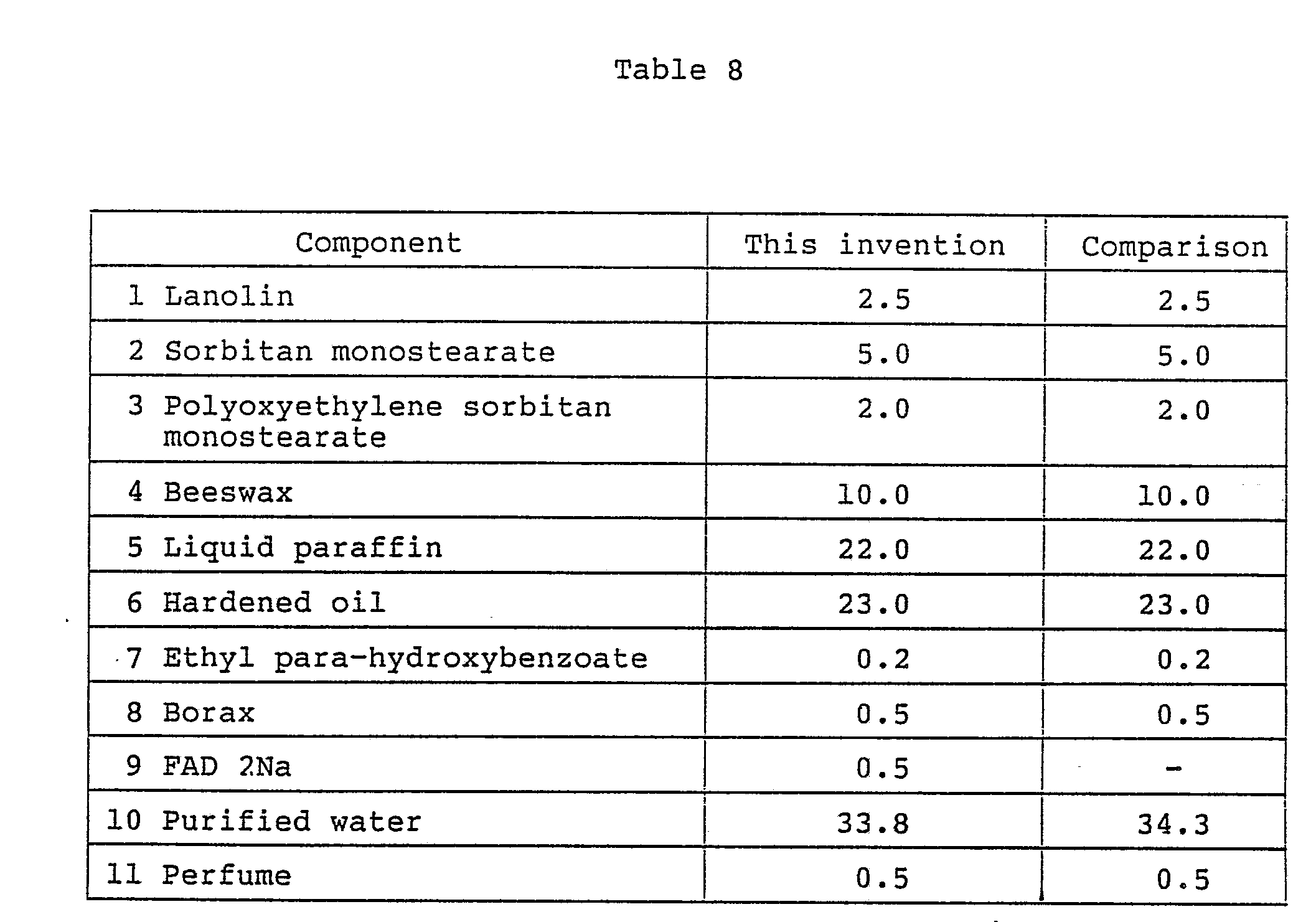
- The effectiveness of the thus-prepared creams was measured in accordance with the following method:
- The samples of the cream of the present invention and of the comparison cream were applied separately to the right and left face portions, respectively, of each woman in a group comprising 20 women (30 to 50 years old) twice a day (in the morning and at night) by a half face method for 3 months. The degree of improvement in terms of elasticity, complexion, roughness and wrinkling of the skin was then examined. The results obtained are shown in table 9.

- As seen from the results shown in Table 9, the cream of the present invention with which FAD 2Na was mixed exhibits an excellent effect in all of the evaluation items, as compared with the comparison cream to which FAD 2Na was not added. In addition, during and after the use of the cream of the present invention for 3 months, no abnormality was observed in the state of the skin.
- When the safety of FAD 2Na was tested in the same way as in Example 1, no problem was observed with respect to skin irritation, etc., and it was thus confirmed that FAD 2Na has a very high level of safety.
- The components 1 and 2 shown in Table 10 were uniformly mixed and component 7 was added to the mixture under agitation. After components 1 and 2 had been completely dissolved in component 7 at about 60°C, an ethanol (component 3) solution in which components 5 and 6 had been uniformly mixed and dissolved and component 4 were added in turn to the aqueous solution and mixed therein to prepare each of the face packs shown in Table 10.

- The effectiveness of each pack was evaluated in the same way as that of Example 1 except that each of the packs was used on the women's faces twice a week for 6 months. The results are shown in Table 11.

- As seen from the results shown in Table 11, the pack of the present invention with which NAD Na was mixed exhibits an excellent effect in all of the evaluation items, as compared with the comparison pack to which NAD Na was not added. In addition, during and after the use of the pack of the present invention for 6 months, no abnormality was observed in the state of the skin.
- When the safety of NAD Na was tested in the same way as in Example 1, no problem was observed with respect to skin irritation, etc., and it was thus confirmed that NAD Na has a very high level of safety.
- The components 1 to 6 and the components 7 to 11 shown in Table 12 were separately mixed and dissolved and a solution containing components 7 to 11 was then added to a solution containing components 1 to 6 under agitation to prepare each of the lotions shown in Table 12.

- The effectiveness of each lotion was tested in a similar manner to that of Example 1. The results are shown in Table 13.

- As seen from the results shown in Table 13, the lotion of the present invention with which NADP Na was mixed exhibits an excellent effect in all of the evaluation items, as compared with the comparison pack to which NADP Na was not added. In addition, during and after the use of the lotion of the present invention for 3 months, no abnormality was observed in the state of the skin.
- When the safety of NADP Na was tested in the same way as in Example 1, no problem was observed with respect to skin irritation, etc., and it was thus confirmed that NADP Na has a very high level of safety.
- The components 1 to 3 shown in Table 14 were mixed under agitation and then dissolved by heating at 80°C. Components 4 to 6 and component 8 were added in turn to the obtained solution and uniformly emulsified therein. Component 7 was added to the resulting emulsion and the obtained mixture was then cooled to room temperature to prepare each of the homogeneous skin milks shown in Table 14.

- The effectiveness of the thus-obtained skin milks was tested in a similar manner to that of Example 1. The results are shown in Table 15.
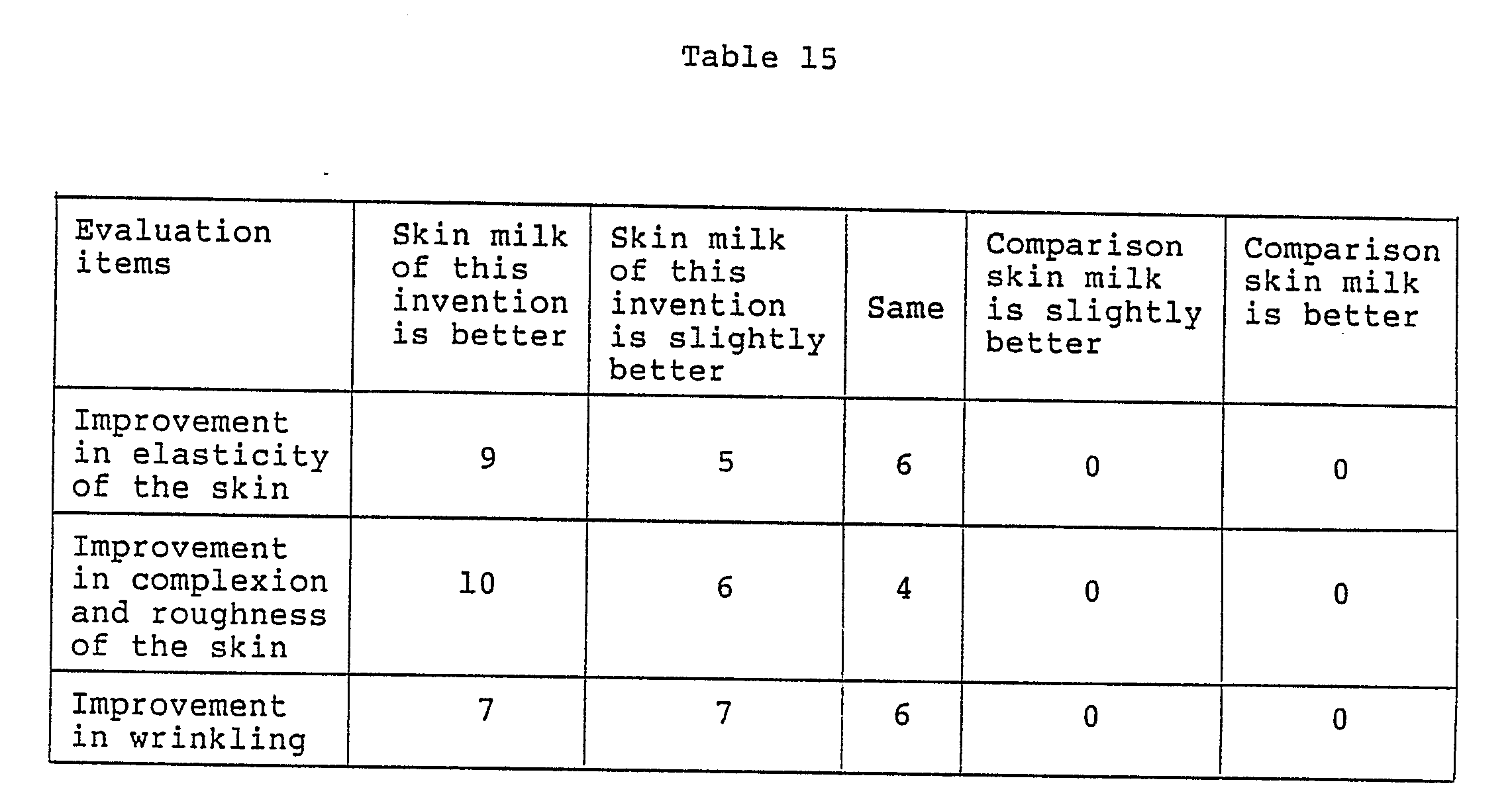
- As seen from the results shown in Table 15, the skin milk of the present invention with which CoA 3Na was mixed exhibits an excellent effect in all of the evaluation items, as compared with the comparison skin milk to which CoA 3Na was not added. In addition, during and after the use of the skin milk of the present invention for 3 months, no abnormality was observed in the state of the skin.
- When the safety of CoA 3Na was tested in the same way as in Example 1, no problem was observed with respect to skin irritation, etc., and it was thus confirmed that CoA 3Na has a very high level of safety.
- The components 1 to 4 shown in Table 16 were dissolved by heating at 80°C. On the other hand, components 5 to 9 were dissolved by heating at 80°C and the obtained solution was then added to the oil phase solution (containing the components 1 to 4) which had been separately produced. The resulting mixture was emulsified and component 10 was then added to the obtained emulsion in the course of cooling to room temperature to prepare each of the milky lotions shown in Table 16.

- The effectiveness of thus-prepared milky lotions was tested in a similar manner to that of Example 1. The results are shown in Table 17.

- As seen from the results shown in Table 17, the milky lotion of the present invention with which PQQ 2Na was mixed exhibits an excellent effect in all of the evaluation items, as compared with the comparison milky lotion to which PQQ 2Na was not added. In addition, during and after the use of the milky lotion of the present invention for 3 months, no abnormality was observed in the state of the skin.
- When the safety of PQQ 2Na was tested in the same way as in Example 1, no problem was observed with respect to skin irritation, etc., and it was thus confirmed that PQQ 2Na has a very high level of safety.
- A uniform mixture of the components 3 and 7 to 9 shown in Table 18 was added to an aqueous solution in which other components were dissolved so as to become soluble therein to prepare each of the toilet water samples shown in Table 18.

- The effectiveness of thus-prepared toilet waters was actually measured by the same method as set forth in Example 1.
- The toilet water samples of the present invention and of the comparison were applied separately to the right and left face portions, respectively, of each woman in a group comprising 20 women (30 to 50 years old) by a half face method twice a day (in the morning and at night) for 3 months. The degree of improvement in terms of elasticity, complexion, roughness, and wrinkles of the skin was then examined. The results are shown in Table 19.

- As seen from the results shown in Table 19, the toilet water of the present invention containing N²,O²ʹ-DBcGMP Na exhibited an excellent effect with respect to improvement in terms of elasticity, complexion, roughness, and wrinkling of the skin, as compared with the toilet water to which N²,O²ʹ-DBcGMP Na was not added.
- It is apparent from these results that N²,O²ʹ-DBcGMP Na has an excellent effect in terms of activation of the skin and prevention of aging of the skin.
- In addition, during and after the use of the toilet water samples I to III for 3 months, no abnormality was observed in the state of the skin. The safety tests for N²,O²ʹ-DBcGMP Na were conducted by the same method as set forth in Example 1, and problems such as skin irritating property were not found.
- It was not confirmed by the above-described results that N²,O²ʹ-BDcGMP has a very high level of safety.
- The components 1 to 5 and the components 6 to 10 shown in Table 20 were separately dissolved by heating at 80°C and the two solutions were mixed and emulsified. Component 11 was then added to the obtained emulsion under cooling and uniformly dispersed therein to prepare each of the milky lotions shown in Table 20.

- The effectiveness of the thus-prepared milky lotions was examined by allowing 20 women to use them in a similar way to that of Example 1. The results are shown in Table 21.

- As seen from the results shown in Table 21, the milky lotion of the present invention with which cGMP Na was mixed exhibited an excellent effect with respect to all of the evaluation items, as compared with the milky lotion in which cGMP Na was not mixed. In addition, during and after the use of the milky lotion of the present invention for 3 months, no abnormality was observed in the state of the skin.
- When the safety of cGMP Na was tested by the same method as that of Example 1, it was confirmed that cGMP Na had no problem with respect to skin irritation, etc., and had an extremely high level of safety.
- When the effect of preventing the aging of the skin was examined in a similar way to that of Example 7 except that N²-MBcGMP Na, O2ʹ-MBcGMP Na, N²,O2ʹ-DScGMP Na, or 8-BrcGMP Na was used in place of N²,O2ʹ-DBcGMP Na, excellent effects similar to those of Example 7 were obtained.
- The effectiveness of cGMP which is an active principle of the present invention and its derivatives was tested in accordance with the following method:
- After hair had been removed from the back of each colored guinea pig (3 guinea pigs in a group), a cream with which 0.5% of an active principle was mixed (cGMP or its derivatives in place of FAD 2Na used in Example 2) and a cream containing no active principle were respectively applied to the back of each guinea pig twice a day (in the morning and at night) every day for 14 days. The difference in colour tone of the skin before and after the application was measured by a color-difference meter. The results are shown in Table 22.

- As seen from the results shown in Table 22, the cream with which cGMP Na or its derivatives was mixed has an excellent decoloration effect as compared with the control.
- Creams having the compositions shown in Table 23 were prepared and then applied to a discolored spot or freckled portion of the skin of each of 6 men and women in the morning and at night twice a day for 3 months. The lightness of the discolored spot portions was measured by a color-difference meter before and after the application. The results are shown in Table 24.

- As seen from the results shown in Table 24, the cream with which N²,O²ʹ-DBcGMP Na or cGMP Na was mixed exhibits an increased lightness of the pigment spots, as compared with the comparison cream with which none of these substances was mixed. In addition, during and after the use of the creams for 3 months, no abnormality was observed in the state of the skin.
- It is also clear from the above results that cGMP and derivatives thereof have the effect of suppressing discolored spots and freckles in addition to the effect of preventing aging of the skin.
- Creams were prepared by the same method as set forth in Example 11, except that N²-MBcGMP Na, O2ʹ-MBcGMP Na or ε-BrcGMP Na was used instead of N²,O2ʹ-DBcGMP Na and cGMP Na. The properties of the creams were determined by the same method as set forth in Example 11 and the results similar to those in Example 11 were obtained.
Claims (10)


Applications Claiming Priority (4)
| Application Number | Priority Date | Filing Date | Title |
|---|---|---|---|
| JP187983/86 | 1986-08-11 | ||
| JP18798386 | 1986-08-11 | ||
| JP22021286 | 1986-09-18 | ||
| JP220212/86 | 1986-09-18 |
Publications (2)
| Publication Number | Publication Date |
|---|---|
| EP0256472A2 true EP0256472A2 (en) | 1988-02-24 |
| EP0256472A3 EP0256472A3 (en) | 1988-09-07 |
Family
ID=26504682
Family Applications (1)
| Application Number | Title | Priority Date | Filing Date |
|---|---|---|---|
| EP87111541A Withdrawn EP0256472A3 (en) | 1986-08-11 | 1987-08-10 | Cosmetic agent for application to skin |
Country Status (1)
| Country | Link |
|---|---|
| EP (1) | EP0256472A3 (en) |
Cited By (18)
| Publication number | Priority date | Publication date | Assignee | Title |
|---|---|---|---|---|
| EP0344708A3 (en) * | 1988-05-31 | 1990-04-11 | Lion Corporation | Composition for external application to skin |
| FR2668366A1 (en) * | 1990-10-30 | 1992-04-30 | Oreal | COSMETIC USE OF A COMPOSITION HAVING ANTIETHYTHHEMAL ACTIVITY AND CORRESPONDING COMPOSITION. |
| DE4117666A1 (en) * | 1991-05-29 | 1992-12-03 | Sieglinde Haas | Skin cream - has body cleaning and nutrient materials mixed with carrier to smooth skin wrinkles |
| EP0260697B1 (en) * | 1986-09-18 | 1993-03-17 | Lion Corporation | Composition for application to hair |
| WO1993010784A1 (en) * | 1991-11-25 | 1993-06-10 | University Of Michigan | Therapeutic composition and method for preventing reperfusion injury |
| FR2703591A1 (en) * | 1993-04-06 | 1994-10-14 | Sederma Sa | Cosmetic and dermopharmaceutical and/or dietetic compositions containing coenzyme A combined with coenzyme Q10 |
| EP0722734A1 (en) * | 1995-01-17 | 1996-07-24 | Birkmayer U.S.A. | NADH and NADPH therapeutic agents for nasal, sublingual, rectal and dermal administration |
| DE19545107A1 (en) * | 1995-12-04 | 1997-06-05 | Beiersdorf Ag | Use of adenosine |
| US5668114A (en) * | 1996-05-08 | 1997-09-16 | Birkmayer Pharmaceuticals | NADH and NADPH pharmaceuticals for treating hypertension |
| US5712259A (en) * | 1996-04-22 | 1998-01-27 | Birkmayer Pharmaceuticals | NADH and NADPH pharmaceuticals for treating chronic fatigue syndrome |
| WO2002083087A1 (en) * | 2001-04-13 | 2002-10-24 | Otsuka Pharmaceutical Co., Ltd. | Sugar intake promoters |
| WO2007066889A1 (en) * | 2005-12-09 | 2007-06-14 | Korea Research Institute Of Chemical Technology | Compositions for external application, containing adenosyl cobalamin for improvement of skin diseases |
| WO2008007728A1 (en) * | 2006-07-13 | 2008-01-17 | Kaneka Corporation | Oral preparation in the form enclosed in lipid membrane structure, and fatigue-ameliorating agent comprising coenzyme a as active ingredient |
| US7557093B2 (en) | 2003-10-08 | 2009-07-07 | Otsuka Pharmaceutical Co., Ltd. | Composition for promoting collagen production |
| US7794739B2 (en) | 2002-04-09 | 2010-09-14 | Otsuka Pharmaceutical Co., Ltd. | Nucleic acid based composition for cell proliferation |
| CN103458865A (en) * | 2011-04-07 | 2013-12-18 | 日本乐敦制药株式会社 | Composition for external application |
| EP2717693A4 (en) * | 2011-06-06 | 2015-06-24 | Us Cosmeceutechs Llc | Skin treatments containing pyrroloquinoline quinine (pqq) esters and methods of preparation and use thereof |
| US9655916B2 (en) | 2005-12-09 | 2017-05-23 | Korea Research Institute Of Chemical Technology | Compositions for external application, containing adenosylcobalamin for improvement of skin diseases |
Family Cites Families (6)
| Publication number | Priority date | Publication date | Assignee | Title |
|---|---|---|---|---|
| DE2139183A1 (en) * | 1971-08-05 | 1973-02-15 | Lingner Werke Gmbh | Sustained action cosmetic and/or pharm compsns - contg addns of cyclic adenosine-monophosphoric acid |
| DE2141764A1 (en) * | 1971-08-20 | 1973-03-01 | Henkel & Cie Gmbh | Scleroprotein - (esp hair-) reforming agent - contg protein disulphide reductase |
| GB1426479A (en) * | 1972-07-10 | 1976-02-25 | Nelson Research Dev Co | Dermatological composition and method |
| JPS5031051A (en) * | 1973-07-26 | 1975-03-27 | ||
| JPS53142515A (en) * | 1977-05-19 | 1978-12-12 | Ichimaru Boeki | Production of stabilized melanin production controlling agent by mixing enzymatic decomposition substance of placenta tissue and yeast extract0 |
| JPS61137820A (en) * | 1984-12-07 | 1986-06-25 | Yoshiaki Oshima | Male hormone blended agent for application |
-
1987
- 1987-08-10 EP EP87111541A patent/EP0256472A3/en not_active Withdrawn
Cited By (26)
| Publication number | Priority date | Publication date | Assignee | Title |
|---|---|---|---|---|
| EP0260697B1 (en) * | 1986-09-18 | 1993-03-17 | Lion Corporation | Composition for application to hair |
| EP0344708A3 (en) * | 1988-05-31 | 1990-04-11 | Lion Corporation | Composition for external application to skin |
| FR2668366A1 (en) * | 1990-10-30 | 1992-04-30 | Oreal | COSMETIC USE OF A COMPOSITION HAVING ANTIETHYTHHEMAL ACTIVITY AND CORRESPONDING COMPOSITION. |
| EP0484199A1 (en) * | 1990-10-30 | 1992-05-06 | L'oreal | Cosmetic use of an anti-erythema composition |
| US5250290A (en) * | 1990-10-30 | 1993-10-05 | L'oreal | Cosmetic use of a composition having antierythemal activity and corresponding composition |
| DE4117666A1 (en) * | 1991-05-29 | 1992-12-03 | Sieglinde Haas | Skin cream - has body cleaning and nutrient materials mixed with carrier to smooth skin wrinkles |
| WO1993010784A1 (en) * | 1991-11-25 | 1993-06-10 | University Of Michigan | Therapeutic composition and method for preventing reperfusion injury |
| FR2703591A1 (en) * | 1993-04-06 | 1994-10-14 | Sederma Sa | Cosmetic and dermopharmaceutical and/or dietetic compositions containing coenzyme A combined with coenzyme Q10 |
| US5750512A (en) * | 1995-01-17 | 1998-05-12 | Birkmayer Pharmaceuticals, Inc. | NADH and NADPH therapeutic agents for nasal, sublingual, rectal and dermal administration |
| EP0722734A1 (en) * | 1995-01-17 | 1996-07-24 | Birkmayer U.S.A. | NADH and NADPH therapeutic agents for nasal, sublingual, rectal and dermal administration |
| US5952312A (en) * | 1995-01-17 | 1999-09-14 | Birkmayer Pharmaceuticals, Inc. | NADH and NADPH therapeutic agents for nasal, sublingual, rectal and dermal administration |
| DE19545107A1 (en) * | 1995-12-04 | 1997-06-05 | Beiersdorf Ag | Use of adenosine |
| US5712259A (en) * | 1996-04-22 | 1998-01-27 | Birkmayer Pharmaceuticals | NADH and NADPH pharmaceuticals for treating chronic fatigue syndrome |
| US5668114A (en) * | 1996-05-08 | 1997-09-16 | Birkmayer Pharmaceuticals | NADH and NADPH pharmaceuticals for treating hypertension |
| US7820636B2 (en) | 2001-04-13 | 2010-10-26 | Otsuka Pharmaceutical Co., Ltd. | Sugar intake promoters |
| AU2002238988B2 (en) * | 2001-04-13 | 2006-11-16 | Otsuka Pharmaceutical Co., Ltd. | Sugar intake promoters |
| WO2002083087A1 (en) * | 2001-04-13 | 2002-10-24 | Otsuka Pharmaceutical Co., Ltd. | Sugar intake promoters |
| US7794739B2 (en) | 2002-04-09 | 2010-09-14 | Otsuka Pharmaceutical Co., Ltd. | Nucleic acid based composition for cell proliferation |
| US7557093B2 (en) | 2003-10-08 | 2009-07-07 | Otsuka Pharmaceutical Co., Ltd. | Composition for promoting collagen production |
| WO2007066889A1 (en) * | 2005-12-09 | 2007-06-14 | Korea Research Institute Of Chemical Technology | Compositions for external application, containing adenosyl cobalamin for improvement of skin diseases |
| AU2006323567B2 (en) * | 2005-12-09 | 2010-02-18 | Hanall Biopharma Co., Ltd. | Compositions for external application, containing adenosyl cobalamin for improvement of skin diseases |
| US9655916B2 (en) | 2005-12-09 | 2017-05-23 | Korea Research Institute Of Chemical Technology | Compositions for external application, containing adenosylcobalamin for improvement of skin diseases |
| WO2008007728A1 (en) * | 2006-07-13 | 2008-01-17 | Kaneka Corporation | Oral preparation in the form enclosed in lipid membrane structure, and fatigue-ameliorating agent comprising coenzyme a as active ingredient |
| CN103458865A (en) * | 2011-04-07 | 2013-12-18 | 日本乐敦制药株式会社 | Composition for external application |
| EP2717693A4 (en) * | 2011-06-06 | 2015-06-24 | Us Cosmeceutechs Llc | Skin treatments containing pyrroloquinoline quinine (pqq) esters and methods of preparation and use thereof |
| US10799441B2 (en) | 2011-06-06 | 2020-10-13 | Pcr Technology Holdings, Lc | Skin treatments containing pyrroloquinoline quinone (PQQ) esters and methods of preparation and use thereof |
Also Published As
| Publication number | Publication date |
|---|---|
| EP0256472A3 (en) | 1988-09-07 |
Similar Documents
| Publication | Publication Date | Title |
|---|---|---|
| JP2926432B2 (en) | Hair restorer | |
| EP0482766B1 (en) | Whitening cosmetic composition | |
| US5045559A (en) | Treatment of skin disorders | |
| JPS60202806A (en) | Whitening cosmetic | |
| JPS61289016A (en) | Skin external agent | |
| EP0561305B1 (en) | Skin whitening composition containing teprenone | |
| JPS63152309A (en) | External preparation of skin | |
| US4946832A (en) | Cosmetic base composition with therapeutic properties | |
| JPH07277939A (en) | Skin external preparation | |
| JPS6236306A (en) | Skin-beautifying cosmetic | |
| US5849309A (en) | Skin activator with glycosaminoglycan production-accelerating effect | |
| EP0402858B1 (en) | Melanogenesis-inhibiting preparation for external application | |
| JP2844103B2 (en) | External preparation for skin | |
| JPH0672845A (en) | Skin color-lightening agent | |
| KR100419527B1 (en) | Use of sulfites and metabisulfites for manufacturing cosmetic or pharmaceutical compositions, notably in dermatology, with melanogenesis-inhibiting effect or with depigmenting activity | |
| CN114795996A (en) | Composition containing nucleoside components and application thereof | |
| EP0260697B1 (en) | Composition for application to hair | |
| EP0797978B1 (en) | Hair-growing agent comprising a specific inhibitor of protein kinase C | |
| JPH1192326A (en) | Skin preparation for external use | |
| JP2004107269A (en) | Carbonylation inhibiting agent for protein, skin care preparation for external use, and method | |
| EP0241573A1 (en) | Topical agents for inhibiting the melanin generation | |
| JPS63183518A (en) | hair composition | |
| JPH02229102A (en) | Skin drug for external use | |
| JP2609884B2 (en) | Skin cosmetics | |
| JP2005213198A (en) | Skin preparation |
Legal Events
| Date | Code | Title | Description |
|---|---|---|---|
| PUAI | Public reference made under article 153(3) epc to a published international application that has entered the european phase |
Free format text: ORIGINAL CODE: 0009012 |
|
| AK | Designated contracting states |
Kind code of ref document: A2 Designated state(s): AT BE CH DE ES FR GB IT LI NL SE |
|
| PUAL | Search report despatched |
Free format text: ORIGINAL CODE: 0009013 |
|
| AK | Designated contracting states |
Kind code of ref document: A3 Designated state(s): AT BE CH DE ES FR GB IT LI NL SE |
|
| STAA | Information on the status of an ep patent application or granted ep patent |
Free format text: STATUS: THE APPLICATION IS DEEMED TO BE WITHDRAWN |
|
| 18D | Application deemed to be withdrawn |
Effective date: 19890308 |
|
| RIN1 | Information on inventor provided before grant (corrected) |
Inventor name: YAMAMOTO, IKUO Inventor name: TAKADA, KOJI Inventor name: SUGIYAMA, KEIKICHI |