EP0254976B1 - Process for the preparation of vinyl ethers - Google Patents
Process for the preparation of vinyl ethers Download PDFInfo
- Publication number
- EP0254976B1 EP0254976B1 EP87110281A EP87110281A EP0254976B1 EP 0254976 B1 EP0254976 B1 EP 0254976B1 EP 87110281 A EP87110281 A EP 87110281A EP 87110281 A EP87110281 A EP 87110281A EP 0254976 B1 EP0254976 B1 EP 0254976B1
- Authority
- EP
- European Patent Office
- Prior art keywords
- dioxolane
- methoxy
- catalyst
- trimethylborate
- phenyl
- Prior art date
- Legal status (The legal status is an assumption and is not a legal conclusion. Google has not performed a legal analysis and makes no representation as to the accuracy of the status listed.)
- Expired - Lifetime
Links
- 238000000034 method Methods 0.000 title claims description 30
- QYKIQEUNHZKYBP-UHFFFAOYSA-N Vinyl ether Chemical class C=COC=C QYKIQEUNHZKYBP-UHFFFAOYSA-N 0.000 title claims description 12
- 238000002360 preparation method Methods 0.000 title description 2
- 238000006243 chemical reaction Methods 0.000 claims description 50
- 239000000203 mixture Substances 0.000 claims description 41
- 239000003054 catalyst Substances 0.000 claims description 28
- -1 polymethylene chain Polymers 0.000 claims description 20
- 239000004327 boric acid Substances 0.000 claims description 14
- 125000000217 alkyl group Chemical group 0.000 claims description 12
- VYPSYNLAJGMNEJ-UHFFFAOYSA-N Silicium dioxide Chemical compound O=[Si]=O VYPSYNLAJGMNEJ-UHFFFAOYSA-N 0.000 claims description 11
- PNEYBMLMFCGWSK-UHFFFAOYSA-N aluminium oxide Inorganic materials [O-2].[O-2].[O-2].[Al+3].[Al+3] PNEYBMLMFCGWSK-UHFFFAOYSA-N 0.000 claims description 10
- 229910052739 hydrogen Inorganic materials 0.000 claims description 10
- 239000001257 hydrogen Substances 0.000 claims description 10
- KGBXLFKZBHKPEV-UHFFFAOYSA-N boric acid Chemical compound OB(O)O KGBXLFKZBHKPEV-UHFFFAOYSA-N 0.000 claims description 9
- 239000000376 reactant Substances 0.000 claims description 9
- 230000002378 acidificating effect Effects 0.000 claims description 8
- 239000008246 gaseous mixture Substances 0.000 claims description 7
- UFHFLCQGNIYNRP-UHFFFAOYSA-N Hydrogen Chemical compound [H][H] UFHFLCQGNIYNRP-UHFFFAOYSA-N 0.000 claims description 6
- 125000002496 methyl group Chemical group [H]C([H])([H])* 0.000 claims description 5
- 125000001997 phenyl group Chemical group [H]C1=C([H])C([H])=C(*)C([H])=C1[H] 0.000 claims description 5
- CPLXHLVBOLITMK-UHFFFAOYSA-N Magnesium oxide Chemical compound [Mg]=O CPLXHLVBOLITMK-UHFFFAOYSA-N 0.000 claims description 4
- MCMNRKCIXSYSNV-UHFFFAOYSA-N Zirconium dioxide Chemical compound O=[Zr]=O MCMNRKCIXSYSNV-UHFFFAOYSA-N 0.000 claims description 4
- 238000009835 boiling Methods 0.000 claims description 4
- 229910052799 carbon Inorganic materials 0.000 claims description 4
- 239000002638 heterogeneous catalyst Substances 0.000 claims description 4
- 150000002431 hydrogen Chemical group 0.000 claims description 4
- 125000004432 carbon atom Chemical group C* 0.000 claims description 3
- 125000001495 ethyl group Chemical group [H]C([H])([H])C([H])([H])* 0.000 claims description 3
- 239000000377 silicon dioxide Substances 0.000 claims description 3
- 241000893044 Chalcides Species 0.000 claims description 2
- 239000011248 coating agent Substances 0.000 claims description 2
- 238000000576 coating method Methods 0.000 claims description 2
- QDOXWKRWXJOMAK-UHFFFAOYSA-N dichromium trioxide Chemical compound O=[Cr]O[Cr]=O QDOXWKRWXJOMAK-UHFFFAOYSA-N 0.000 claims description 2
- 150000004862 dioxolanes Chemical class 0.000 claims description 2
- 125000004435 hydrogen atom Chemical group [H]* 0.000 claims description 2
- 239000000395 magnesium oxide Substances 0.000 claims description 2
- 238000004519 manufacturing process Methods 0.000 claims description 2
- CWQXQMHSOZUFJS-UHFFFAOYSA-N molybdenum disulfide Chemical compound S=[Mo]=S CWQXQMHSOZUFJS-UHFFFAOYSA-N 0.000 claims description 2
- JKQOBWVOAYFWKG-UHFFFAOYSA-N molybdenum trioxide Chemical compound O=[Mo](=O)=O JKQOBWVOAYFWKG-UHFFFAOYSA-N 0.000 claims description 2
- 150000002894 organic compounds Chemical class 0.000 claims description 2
- ZCUFMDLYAMJYST-UHFFFAOYSA-N thorium dioxide Chemical compound O=[Th]=O ZCUFMDLYAMJYST-UHFFFAOYSA-N 0.000 claims description 2
- OKKJLVBELUTLKV-UHFFFAOYSA-N methanol Natural products OC OKKJLVBELUTLKV-UHFFFAOYSA-N 0.000 description 48
- WNXJIVFYUVYPPR-UHFFFAOYSA-N 1,3-dioxolane Chemical compound C1COCO1 WNXJIVFYUVYPPR-UHFFFAOYSA-N 0.000 description 19
- LCGLNKUTAGEVQW-UHFFFAOYSA-N methyl monoether Natural products COC LCGLNKUTAGEVQW-UHFFFAOYSA-N 0.000 description 19
- WRECIMRULFAWHA-UHFFFAOYSA-N trimethyl borate Chemical compound COB(OC)OC WRECIMRULFAWHA-UHFFFAOYSA-N 0.000 description 18
- SIJBDWPVNAYVGY-UHFFFAOYSA-N 2,2-dimethyl-1,3-dioxolane Chemical compound CC1(C)OCCO1 SIJBDWPVNAYVGY-UHFFFAOYSA-N 0.000 description 13
- CSCPPACGZOOCGX-UHFFFAOYSA-N acetone Substances CC(C)=O CSCPPACGZOOCGX-UHFFFAOYSA-N 0.000 description 13
- YOWQWFMSQCOSBA-UHFFFAOYSA-N 2-methoxypropene Chemical compound COC(C)=C YOWQWFMSQCOSBA-UHFFFAOYSA-N 0.000 description 12
- UHOVQNZJYSORNB-UHFFFAOYSA-N Benzene Chemical compound C1=CC=CC=C1 UHOVQNZJYSORNB-UHFFFAOYSA-N 0.000 description 9
- 239000012808 vapor phase Substances 0.000 description 8
- 150000001875 compounds Chemical class 0.000 description 7
- SIZDIMDMQQFWLM-UHFFFAOYSA-N 1-methoxyethenylbenzene Chemical compound COC(=C)C1=CC=CC=C1 SIZDIMDMQQFWLM-UHFFFAOYSA-N 0.000 description 5
- 230000015572 biosynthetic process Effects 0.000 description 5
- 239000000047 product Substances 0.000 description 5
- GAOQAPRPYXWTFK-UHFFFAOYSA-N 2-methyl-2-phenyl-1,3-dioxolane Chemical compound C=1C=CC=CC=1C1(C)OCCO1 GAOQAPRPYXWTFK-UHFFFAOYSA-N 0.000 description 4
- KWOLFJPFCHCOCG-UHFFFAOYSA-N Acetophenone Natural products CC(=O)C1=CC=CC=C1 KWOLFJPFCHCOCG-UHFFFAOYSA-N 0.000 description 4
- LYCAIKOWRPUZTN-UHFFFAOYSA-N Ethylene glycol Chemical group OCCO LYCAIKOWRPUZTN-UHFFFAOYSA-N 0.000 description 4
- 150000000475 acetylene derivatives Chemical class 0.000 description 4
- 238000007664 blowing Methods 0.000 description 4
- 238000007086 side reaction Methods 0.000 description 4
- CTDQAGUNKPRERK-UHFFFAOYSA-N spirodecane Chemical compound C1CCCC21CCCCC2 CTDQAGUNKPRERK-UHFFFAOYSA-N 0.000 description 4
- 239000007858 starting material Substances 0.000 description 4
- 238000003786 synthesis reaction Methods 0.000 description 4
- LFQSCWFLJHTTHZ-UHFFFAOYSA-N Ethanol Chemical compound CCO LFQSCWFLJHTTHZ-UHFFFAOYSA-N 0.000 description 3
- 239000005909 Kieselgur Substances 0.000 description 3
- 150000001241 acetals Chemical class 0.000 description 3
- 125000003545 alkoxy group Chemical group 0.000 description 3
- HZFQGYWRFABYSR-UHFFFAOYSA-N cyclohexanone enol methyl ether Natural products COC1=CCCCC1 HZFQGYWRFABYSR-UHFFFAOYSA-N 0.000 description 3
- VLKZOEOYAKHREP-UHFFFAOYSA-N n-Hexane Chemical compound CCCCCC VLKZOEOYAKHREP-UHFFFAOYSA-N 0.000 description 3
- 239000002245 particle Substances 0.000 description 3
- RTZKZFJDLAIYFH-UHFFFAOYSA-N Diethyl ether Chemical compound CCOCC RTZKZFJDLAIYFH-UHFFFAOYSA-N 0.000 description 2
- OFBQJSOFQDEBGM-UHFFFAOYSA-N Pentane Chemical compound CCCCC OFBQJSOFQDEBGM-UHFFFAOYSA-N 0.000 description 2
- DHKHKXVYLBGOIT-UHFFFAOYSA-N acetaldehyde Diethyl Acetal Natural products CCOC(C)OCC DHKHKXVYLBGOIT-UHFFFAOYSA-N 0.000 description 2
- 150000001298 alcohols Chemical class 0.000 description 2
- KDKYADYSIPSCCQ-UHFFFAOYSA-N but-1-yne Chemical group CCC#C KDKYADYSIPSCCQ-UHFFFAOYSA-N 0.000 description 2
- 238000006555 catalytic reaction Methods 0.000 description 2
- 238000004587 chromatography analysis Methods 0.000 description 2
- 238000004821 distillation Methods 0.000 description 2
- 150000002334 glycols Chemical class 0.000 description 2
- WGCNASOHLSPBMP-UHFFFAOYSA-N hydroxyacetaldehyde Natural products OCC=O WGCNASOHLSPBMP-UHFFFAOYSA-N 0.000 description 2
- 150000002576 ketones Chemical class 0.000 description 2
- 239000008188 pellet Substances 0.000 description 2
- 238000000926 separation method Methods 0.000 description 2
- 125000001424 substituent group Chemical group 0.000 description 2
- 238000004227 thermal cracking Methods 0.000 description 2
- XLYOFNOQVPJJNP-UHFFFAOYSA-N water Substances O XLYOFNOQVPJJNP-UHFFFAOYSA-N 0.000 description 2
- HTWIZMNMTWYQRN-UHFFFAOYSA-N 2-methyl-1,3-dioxolane Chemical compound CC1OCCO1 HTWIZMNMTWYQRN-UHFFFAOYSA-N 0.000 description 1
- IKHGUXGNUITLKF-UHFFFAOYSA-N Acetaldehyde Natural products CC=O IKHGUXGNUITLKF-UHFFFAOYSA-N 0.000 description 1
- BTBUEUYNUDRHOZ-UHFFFAOYSA-N Borate Chemical compound [O-]B([O-])[O-] BTBUEUYNUDRHOZ-UHFFFAOYSA-N 0.000 description 1
- ZOXJGFHDIHLPTG-UHFFFAOYSA-N Boron Chemical compound [B] ZOXJGFHDIHLPTG-UHFFFAOYSA-N 0.000 description 1
- XDTMQSROBMDMFD-UHFFFAOYSA-N Cyclohexane Chemical compound C1CCCCC1 XDTMQSROBMDMFD-UHFFFAOYSA-N 0.000 description 1
- 238000005727 Friedel-Crafts reaction Methods 0.000 description 1
- CIUQDSCDWFSTQR-UHFFFAOYSA-N [C]1=CC=CC=C1 Chemical group [C]1=CC=CC=C1 CIUQDSCDWFSTQR-UHFFFAOYSA-N 0.000 description 1
- 238000010521 absorption reaction Methods 0.000 description 1
- SPEUIVXLLWOEMJ-UHFFFAOYSA-N acetaldehyde dimethyl acetal Natural products COC(C)OC SPEUIVXLLWOEMJ-UHFFFAOYSA-N 0.000 description 1
- 230000004913 activation Effects 0.000 description 1
- 125000003158 alcohol group Chemical group 0.000 description 1
- 150000001299 aldehydes Chemical class 0.000 description 1
- 150000001338 aliphatic hydrocarbons Chemical class 0.000 description 1
- 239000003513 alkali Substances 0.000 description 1
- 229910052783 alkali metal Inorganic materials 0.000 description 1
- 150000001340 alkali metals Chemical class 0.000 description 1
- HSFWRNGVRCDJHI-UHFFFAOYSA-N alpha-acetylene Natural products C#C HSFWRNGVRCDJHI-UHFFFAOYSA-N 0.000 description 1
- 238000013459 approach Methods 0.000 description 1
- 239000007864 aqueous solution Substances 0.000 description 1
- 150000004945 aromatic hydrocarbons Chemical class 0.000 description 1
- 239000002585 base Substances 0.000 description 1
- 229910052796 boron Inorganic materials 0.000 description 1
- 150000001728 carbonyl compounds Chemical class 0.000 description 1
- 230000003197 catalytic effect Effects 0.000 description 1
- 239000007809 chemical reaction catalyst Substances 0.000 description 1
- 239000007795 chemical reaction product Substances 0.000 description 1
- 125000001309 chloro group Chemical group Cl* 0.000 description 1
- 238000009833 condensation Methods 0.000 description 1
- 230000005494 condensation Effects 0.000 description 1
- 238000007334 copolymerization reaction Methods 0.000 description 1
- 125000004093 cyano group Chemical group *C#N 0.000 description 1
- 125000004122 cyclic group Chemical group 0.000 description 1
- JHIVVAPYMSGYDF-UHFFFAOYSA-N cyclohexyloxide Natural products O=C1CCCCC1 JHIVVAPYMSGYDF-UHFFFAOYSA-N 0.000 description 1
- 230000000994 depressogenic effect Effects 0.000 description 1
- JKWMSGQKBLHBQQ-UHFFFAOYSA-N diboron trioxide Chemical compound O=BOB=O JKWMSGQKBLHBQQ-UHFFFAOYSA-N 0.000 description 1
- 150000001993 dienes Chemical class 0.000 description 1
- 150000002148 esters Chemical class 0.000 description 1
- 125000001301 ethoxy group Chemical group [H]C([H])([H])C([H])([H])O* 0.000 description 1
- 125000002534 ethynyl group Chemical group [H]C#C* 0.000 description 1
- 239000002816 fuel additive Substances 0.000 description 1
- 125000005843 halogen group Chemical group 0.000 description 1
- 125000002887 hydroxy group Chemical group [H]O* 0.000 description 1
- 229910052751 metal Inorganic materials 0.000 description 1
- 239000002184 metal Substances 0.000 description 1
- 125000000956 methoxy group Chemical group [H]C([H])([H])O* 0.000 description 1
- XJRBAMWJDBPFIM-UHFFFAOYSA-N methyl vinyl ether Chemical compound COC=C XJRBAMWJDBPFIM-UHFFFAOYSA-N 0.000 description 1
- 239000000178 monomer Substances 0.000 description 1
- 125000000449 nitro group Chemical group [O-][N+](*)=O 0.000 description 1
- 229920000642 polymer Polymers 0.000 description 1
- 239000001294 propane Substances 0.000 description 1
- MWWATHDPGQKSAR-UHFFFAOYSA-N propyne Chemical group CC#C MWWATHDPGQKSAR-UHFFFAOYSA-N 0.000 description 1
- 238000000746 purification Methods 0.000 description 1
- 238000010992 reflux Methods 0.000 description 1
- 239000007787 solid Substances 0.000 description 1
- 238000000638 solvent extraction Methods 0.000 description 1
- 238000005809 transesterification reaction Methods 0.000 description 1
- 125000002023 trifluoromethyl group Chemical group FC(F)(F)* 0.000 description 1
- 238000009834 vaporization Methods 0.000 description 1
- 230000008016 vaporization Effects 0.000 description 1
- 125000000391 vinyl group Chemical group [H]C([*])=C([H])[H] 0.000 description 1
- 229920002554 vinyl polymer Polymers 0.000 description 1
Classifications
-
- C—CHEMISTRY; METALLURGY
- C07—ORGANIC CHEMISTRY
- C07C—ACYCLIC OR CARBOCYCLIC COMPOUNDS
- C07C41/00—Preparation of ethers; Preparation of compounds having groups, groups or groups
- C07C41/01—Preparation of ethers
-
- C—CHEMISTRY; METALLURGY
- C07—ORGANIC CHEMISTRY
- C07C—ACYCLIC OR CARBOCYCLIC COMPOUNDS
- C07C2601/00—Systems containing only non-condensed rings
- C07C2601/12—Systems containing only non-condensed rings with a six-membered ring
- C07C2601/16—Systems containing only non-condensed rings with a six-membered ring the ring being unsaturated
Definitions
- the present invention refers to a new process for the synthesis of vinyl ethers.
- the present invention relates to a process for preparing a vinyl ether of general formula I wherein
- alkyl radical designates a straight or branched alkyl radical containing from 1 to 10 carbon atoms.
- substituted phenyl identifies a phenyl radical bearing 1 to 3 substituents which may be the same or different, must be inert toward boric acid esters and should permit vaporization of the starting dioxolane of formula II at a temperature below 400 ° C.
- Suitable substituents are for instance lower alkyl groups, preferably methyl or ethyl, lower alkoxy groups, preferably methoxy or ethoxy, halogen atoms, preferably chlorine atoms, nitro, cyano, trifluoromethyl, lower-alkyl-carbonyl, and lower-alkoxy-carbonyl groups.
- Vinyl ethers are chemical compounds well known in the open and patent literature which find many and interesting applications in homo- and co-polymerization processes as well as in the synthesis of several products of commercial significance (see for instance "High polymers” - Volume 24 entitled “Vinyl and Diene Monomers”, Ed. E.C.Leonard - Part 1 - Chapter 7 - Vinyl Ethers - Wiley-Interscience Publ. (1970)).
- the process of the present invention is actually carried out by blowing a gaseous mixture of the two reaction partners of formulas II and III over a catalyst consisting of one or more acidic oxides.
- the heterogeneous catalyst which can suitably be employed in the process of the present invention is one of the so-called solid acidic oxides, generally named as chalcides : said group includes alumina, silica, and the mixtures of alumina and silica, either natural or synthetic, in which other oxides such as chromia, magnesia, boria, molybdena, thoria and zirconia may also be present, as well as molybdenum sulfide (see to this purpose Friedel-Crafts Chemistry - Wiley - Interscience Publisher - (1973) - pp. 343-55).
- chalcides said group includes alumina, silica, and the mixtures of alumina and silica, either natural or synthetic, in which other oxides such as chromia, magnesia, boria, molybdena, thoria and zirconia may also be present, as well as molybdenum sulfide (
- the vapor-phase process of the present invention operates with a dioxolane-to-boric-acid-ester molar feed ratio of between 10 : 1 and 0.5 : 1.
- reaction rate does not vary to a great extent with trialkylborate concentration
- a high dioxolane-to-boric-acid-ester molar ratio is employed as the almost complete conversion of the trialkylborate can thus be achieved.
- 3 : 1 dioxolane-to-boric-acid-ester molar ratio affords % conversions of the starting dioxolane of formula II comparable to those which can be obtained with lower molar ratios but it brings about the almost complete conversion of the boric acid ester of formula III.
- the optimum range, as far as the molar ratio between the reactants is concerned, is therefore comprised between 5 : 1 and 1 : 1.
- temperatures and pressures are those which allow contacting of the reactants with the catalyst in the vapor phase. In general, temperatures comprised between 100 and 400 ° C proved to be particularly useful to this purpose. A preferred temperature range is however comprised between 180 and 280 ° C, and a most preferred range is between 200 and 250 ° C.
- the reaction may conveniently be carried out under atmospheric pressure, however higher or lower pressure values may as well be applied provided the reaction temperature is such that passing of the reactants over the catalyst occurs in the vapor phase.
- the reaction like all the vapor-phase catalytic reactions, is preferably carried out by blowing a gaseous mixture of the reactants over the catalyst in the suitably selected operating conditions and collecting the exit stream.
- the reaction may also be carried out blowing over the catalyst a gaseous mixture which contains, in addition to the reactants, also a carrier.
- Said carrier should be selected from the low-boiling inert organic compounds, such as for instance the aliphatic or aromatic hydrocarbons e.g. pentane, hexane, cyclohexane, benzene, and the like, or the corresponding alkanols ROH wherein R has the same meaning as in the starting boric acid ester.
- the reaction between the cyclic ketal or acetal and the boric acid ester mainly involves the exchange between the dioxolane glycol moiety and the boric acid ester alcohol moiety, to give a mixture of products essentially consisting of the desired vinyl ether of formula I, the alcohol ROH, and mixed boric esters containing both glycol and alkoxy residues.
- the main product of the reaction of a dioxolane II and a trialkyl borate III is a boric acid ester of formula IV
- This compound can be easily separated from the other reaction products, and reacted with the alcohol ROH to afford the starting trialkylborate III, which can be recycled as such, and the glycol V which can be converted into the dioxolane II and then recycled.
- both the boric acid esters of formula IV and the glycols of formula V are compounds of commercial significance.
- the boric acid ester of formula IV wherein R represents a methyl group and R 4 , Rs, R 6 , and R 7 are hydrogen, is useful as fuel additive.
- the exit stream is collected and partially condensed in order to perform a preliminary rough separation between the higher boiling compounds which condensate and the lower boiling ones which remain in the vapor phase. These last ones are separately condensed and separated by distillation.
- the unreacted starting compounds are recycled while, if desired, the thus obtained product of formula I is further purified by means of conventional purification techniques well known to the ordinarily skilled chemist, such as chromatography, solvent extraction and distillation techniques.
- the process of the present invention can also be carried out by feeding the reactor with a gaseous mixture containing also substantial amounts of a carrier, such as for instance an alcohol with the same alkoxy residue of the starting boric acid ester. Therefore, the azeotrope can be recycled as such.
- a carrier such as for instance an alcohol with the same alkoxy residue of the starting boric acid ester. Therefore, the azeotrope can be recycled as such.
- the exit stream which is obtained from the reaction between a dioxolane II, wherein R 1 and R 2 are hydrogen, R 3 is methyl and R 4 , R s , R s , and R 7 , each independently, represent hydrogen or an alkyl group, and a boric acid ester III wherein R is a straight alkyl group, may be heated to the reflux temperature, thus converting the obtained alkyl vinyl ether into the corresponding 2,2-dialkoxy-propane, according to the teachings of co-pending European patent application 87 108 873.8 (EP-A 251 092).
- the cyclic acetals and ketals employed as starting materials in the process of the present invention can be easily synthetised by known literature methods, e.g. by reacting aldehydes or ketones with ox- iranes or glycols in the presence of acidic catalysts.
- the boric acid esters III can be easily prepared starting from boric acid or boric anhydride and the alcohol ROH or by transesterification of conventional boric acid esters with the alcohol ROH.
- AI 2 O 3 pellets, 2 to 5 mm in diameter, (100 g) are soaked with an aqueous solution containing H 3 BO 3 (25 g). Water is slowly evaporated off, the residue is dried in the oven at 120 ° C and then calcined at 400 °C for 4 hours.
- the vaporized charge is pre-heated to the reaction temperature before entering the reactor.
- the exiting vapor has the following composition :
- Trimethylborate and 2,2-dimethyl-1,3-dioxolane % conversion is 65.85 % and 32.83 % respectively.
- Selectivity in 2-methoxy-propene is 89.59 % calculated on the converted dioxolane.
- Trimethylborate and 2,2-dimethyl-1,3-dioxolane % conversion is 99.1 % and 30.93 % respectively.
- Selectivity in 2-methoxy-propene, based on the converted dioxolane, is 95.48 %.
- Trimethylborate and 2,2-dimethyl-1,3-dioxolane % conversion is 41.7%.
- AI 2 O 3 pellets (100 ml corresponding to 73 g) 2+5 mm in diameter, previously activated at 400 ° C for 4 hours, are charged into a jacketed tubular reactor.
- the temperature within the reactor is brought to 200 °C and trimethylborate, vaporized at the same temperature, is fed from the top to the bottom of the reactor with a flow rate of 50 g/h.
- the exiting vapor contains trimethylborate and substantial amounts of methanol produced in the reaction of trimethylborate with alumina hydroxy groups. Methanol formation and boron absorption by the catalyst subsides after 2 hours.
- the exit stream has the following composition :
- Trimethylborate and 2,2-dimethyl-1,3-dioxolane conversion is 47.38 % and 46.32 % respectively.
- Selectivity in 2-methoxy-propene is 94.84 % of the converted dioxolane.
- Trimethylborate and 2,2-dimethyl-1,3-dioxolane % conversion is 43.96 % and 42.57 %, respectively.
- the exit stream has the following composition :
- Trimethylborate and 2,2-dimethyl-1,3-dioxolane % conversion is 42.54 % and 83.5 % respectively.
- Selectivity in 2-methoxy-propene corresponds to 96.79 % of the converted dioxolane.
- Trimethylborate and 2,2-dimethyl-1,3-dioxolane conversion is 14.51 % and 23.1 % respectively.
- Selectivity in 2-methoxy-propene corresponds to 83.3 % of the converted dioxolane.
- the exit stream has the following composition :
- Trimethylborate and 2,2-dimethyl-1,3-dioxolane % conversion is 48.77 % and 64.70 % respectively.
- Selectivity in 2-methoxy-propene corresponds to 62.61 % of the converted dioxolane.
- the operating temperature is brought to 200 °C and a mixture of :
- the exit vapor has the following composition :
- Trimethylborate and 2,2-dimethyl-1,3-dioxolane % conversion is 56.5 % and 28 % respectively.
- Selectivity in 2-methoxy-propene corresponds to 97.2 % of the converted dioxolane.
- Trimethylborate and 2,2-dimethyl-1,3-dioxolane % conversion is 61.8 % and 30.6 % respectively.
- Selectivity in 2-methoxy-propene corresponds to 98.1 % of the converted dioxolane.
- Trimethylborate and 2,2-dimethyl-1,3-dioxolane % conversion is 90.2 % and 44.7 % respectively.
- Selectivity in 2-methoxy-propene corresponds to 98 % of the converted dioxolane.
- Trimethylborate and 2,2-dimethyl-1,3-dioxolane % conversion is 71.6 % and 71.7 % respectively.
- Selectivity in 2-methoxy-propene corresponds to 98.1 % of the converted dioxolane.
- Trimethylborate and 2,2-dimethyl-1,3-dioxolane % conversion is 61.6 % and 61.3 % respectively.
- Selectivity in 2-methoxy-propene corresponds to 98.2 % of the converted dioxolane.
- the operating temperature is brought to 250 °C and a mixture of :
- Trimethylborate and 1,4-dioxa[4,5]spirodecane % conversion is 40 % and 39.7 % respectively.
- Selectivity in 1-methoxy-cyclohexene corresponds to 99 % of the converted 1,4-dioxa[4,5]spirodecane.
- Trimethylborate and 2-methyl-1,3-dioxolane % conversion is 23.5 % and 22 % respectively.
- Selectivity in methyl vinyl ether corresponds to 91.9 % of the converted dioxolane.
- the temperature is brought to 250°C and a vaporized mixture of :
- the exit stream which is collected has the following composition :
- 2-Methyl-2-phenyl-1,3-dioxolane conversion is 37.3 % and selectivity in 1-methoxy-1-phenyl-ethene is 93.8 %.
- 2-Methyl-2-phenyl-1,3-dioxolane conversion is 47.5 % and selectivity in 1-methoxy-1-phenyl-ethene is 95.1 %.
- the operating temperature is brought to 270 ° C and the flow rate of the vaporized charge is reduced to 30 ml/h.
- the exit stream has the following composition :
- 2-Methyl-2-phenyl-1,3-dioxolane conversion is 66 % and selectivity in 1-methoxy-1-phenyl-ethene is 95.2%.
- the exit stream which is collected has the following composition :
- 2-Methyl-2-phenyl-1,3-dioxolane conversion is 29.3 % and selectivity in 1-methoxy-1-phenyl-ethene is 97.7 %.
- the temperature is brought to 270 ° C and the collected exit stream has the following composition:
- 2-Methyl-2-phenyl-1,3-dioxolahe conversion is 40 % and selectivity in 1-methoxy-1-phenyl-ethene is 98.2%.
Landscapes
- Chemical & Material Sciences (AREA)
- Organic Chemistry (AREA)
- Organic Low-Molecular-Weight Compounds And Preparation Thereof (AREA)
- Catalysts (AREA)
- Low-Molecular Organic Synthesis Reactions Using Catalysts (AREA)
- Heterocyclic Compounds That Contain Two Or More Ring Oxygen Atoms (AREA)
Description
- The present invention refers to a new process for the synthesis of vinyl ethers.
- More particularly, the present invention relates to a process for preparing a vinyl ether of general formula I

- R1 and R2, each independently, represent hydrogen or a primary, secondary or tertiary alkyl group, R3
- is hydrogen, a primary alkyl, phenyl, or substituted phenyl group, or
- R2 and Ra, taken together, represent a polymethylene chain containing from 3 to 10 carbon atoms wherein one or more hydrogens can be replaced by methyl or ethyl groups, and
- R is a primary, secondary or tertiary alkyl group, which comprises reacting a suitably selected dioxolane derivative of formula ll
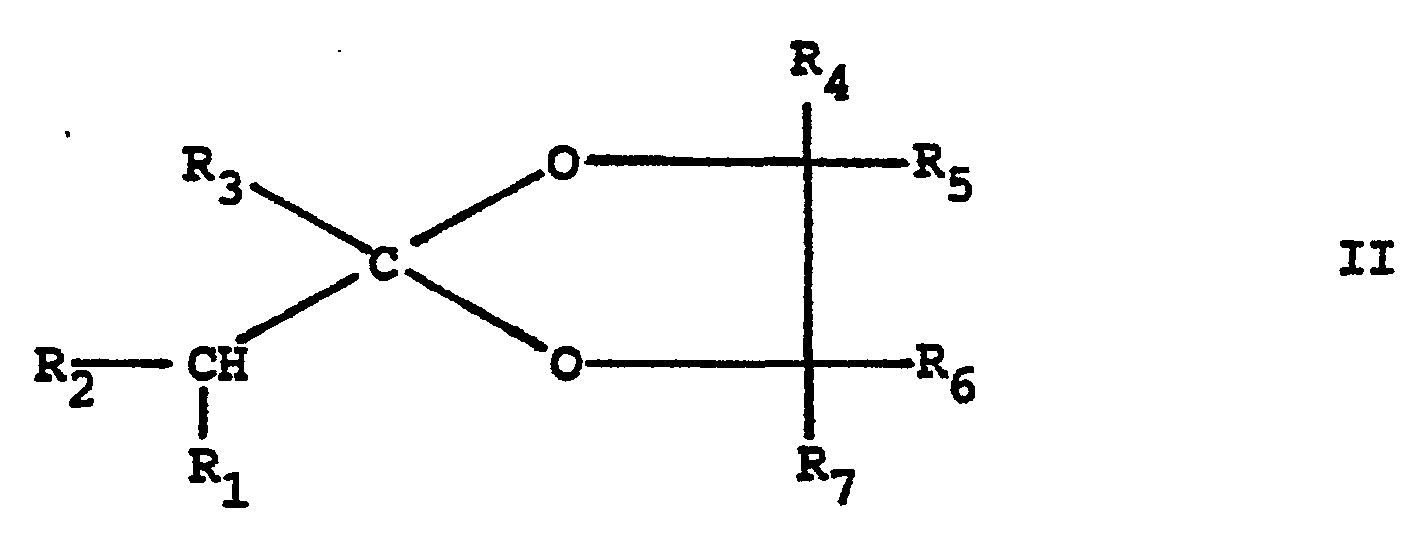
- Ri, R2, and R3 are as defined above, and
- R4, Rs, Rs, and R7, each independently, represent hydrogen or an alkyl group,
- with a boric acid ester of formula III
- B(OR)a III
- wherein
- R is as defined above,
- in the vapor phase, at a temperature comprised between 100 and 400 °C, and in the presence of an acidic heterogeneous catalyst.
- For the purposes of the present invention, the term "alkyl radical" designates a straight or branched alkyl radical containing from 1 to 10 carbon atoms.
- The term "substituted phenyl" identifies a phenyl radical bearing 1 to 3 substituents which may be the same or different, must be inert toward boric acid esters and should permit vaporization of the starting dioxolane of formula II at a temperature below 400 °C.
- Suitable substituents are for instance lower alkyl groups, preferably methyl or ethyl, lower alkoxy groups, preferably methoxy or ethoxy, halogen atoms, preferably chlorine atoms, nitro, cyano, trifluoromethyl, lower-alkyl-carbonyl, and lower-alkoxy-carbonyl groups.
- Vinyl ethers are chemical compounds well known in the open and patent literature which find many and interesting applications in homo- and co-polymerization processes as well as in the synthesis of several products of commercial significance (see for instance "High polymers" - Volume 24 entitled "Vinyl and Diene Monomers", Ed. E.C.Leonard - Part 1 - Chapter 7 - Vinyl Ethers - Wiley-Interscience Publ. (1970)).
- A number of different synthetic approaches to vinyl ethers are known in literature. However the processes of commercial importance are only the following ones :
- a) treatment of the respective alcohols with acetylene or higher acetylenes under high pressures (10-30 atm = 10.13-30.40 bar), at a temperature comprised between 150 and 200°C and in the presence of a strong base (alkali metals or hydoxides may be used or the alkali alcoholate may conveniently be employed). Precautions for insuring safety at the high pressure required for acceptable reaction rates must be taken. It should be borne in mind in fact that acetylene derivatives can easily give rise to uncontrolled reactions; and
- b) thermal cracking of acetals in the presence of platinum group metals; this method however cannot be employed for the synthesis of vinyl ethers from ketone acetals (ketals) because of the known difficulties in preparing these compounds.
- It has now surprisingly been found that it is possible to prepare vinyl ethers of formula I, including also those compounds wherein R3 is a primary alkyl group, in high yields, through vapor-phase reaction of a cyclic acetal or ketal of formula II and a boric acid ester of formula III, in the presence of an acidic heterogeneous catalyst.
- The process of the present invention is actually carried out by blowing a gaseous mixture of the two reaction partners of formulas II and III over a catalyst consisting of one or more acidic oxides.
- The heterogeneous catalyst which can suitably be employed in the process of the present invention is one of the so-called solid acidic oxides, generally named as chalcides : said group includes alumina, silica, and the mixtures of alumina and silica, either natural or synthetic, in which other oxides such as chromia, magnesia, boria, molybdena, thoria and zirconia may also be present, as well as molybdenum sulfide (see to this purpose Friedel-Crafts Chemistry - Wiley - Interscience Publisher - (1973) - pp. 343-55).
- Among the above mentioned compounds, alumina in its various forms and the diatomaceous earths generally used as catalysis supports or chromatography filters, such as dicalite, celite and chromosorb, proved to be particularly useful as the reaction catalyst.
- Good results are obtained by using the above products previously activated at temperatures comprised between 200 and 1300°C. Also good results are obtained by using catalytic compositions obtained by wet-coating one of the above mentioned oxides or oxide mixtures with boric acid, followed by its activation at temperatures comprised between 200 and 600°C.
- The vapor-phase process of the present invention operates with a dioxolane-to-boric-acid-ester molar feed ratio of between 10 : 1 and 0.5 : 1.
- As the reaction rate does not vary to a great extent with trialkylborate concentration, according to a preferred embodiment of the present invention, a high dioxolane-to-boric-acid-ester molar ratio is employed as the almost complete conversion of the trialkylborate can thus be achieved.
- As an example, 3 : 1 dioxolane-to-boric-acid-ester molar ratio affords % conversions of the starting dioxolane of formula II comparable to those which can be obtained with lower molar ratios but it brings about the almost complete conversion of the boric acid ester of formula III. The optimum range, as far as the molar ratio between the reactants is concerned, is therefore comprised between 5 : 1 and 1 : 1.
- Operating temperatures and pressures are those which allow contacting of the reactants with the catalyst in the vapor phase. In general, temperatures comprised between 100 and 400°C proved to be particularly useful to this purpose. A preferred temperature range is however comprised between 180 and 280°C, and a most preferred range is between 200 and 250°C.
- At a temperature lower than 180°C the reaction rate is in fact much lower, while at temperatures higher than 280°C, a higher % conversion but a lower selectivity is obtained. At a temperature higher than 280°C, in fact, also the reaction rates of some undesired side-reactions steadily increase. The most important of said side-reactions is the condensation of two alcohol hydroxy groups to give a glycol- or dialkyl (R20) ether. Water which forms in this side-reaction combines with the obtained vinyl ether affording the starting carbonyl compound and alcohol, and considerably lowering the overall yields. As it has been found that this side-reaction can be depressed lowering the reaction temperature, it is therefore advisable - in order to optimize the process - to carry out the process at the lowest temperature which still provides for an acceptable reaction rate.
- The reaction may conveniently be carried out under atmospheric pressure, however higher or lower pressure values may as well be applied provided the reaction temperature is such that passing of the reactants over the catalyst occurs in the vapor phase. The reaction, like all the vapor-phase catalytic reactions, is preferably carried out by blowing a gaseous mixture of the reactants over the catalyst in the suitably selected operating conditions and collecting the exit stream.
- More particularly, optimum results have been obtained with a contact time of the reactants with the catalyst comprised between 10 and 600 sec.. The longer the contact time, the higher is the conversion of the reactants; thus, working at 200°C and with a molar ratio of 1, it is possible to get the almost complete conversion of the reactants with a contact time of 2-4 minutes, while with a contact time of 1 minute a conversion of about 40 % is obtained.
- The reaction may also be carried out blowing over the catalyst a gaseous mixture which contains, in addition to the reactants, also a carrier. Said carrier should be selected from the low-boiling inert organic compounds, such as for instance the aliphatic or aromatic hydrocarbons e.g. pentane, hexane, cyclohexane, benzene, and the like, or the corresponding alkanols ROH wherein R has the same meaning as in the starting boric acid ester.
- The reaction between the cyclic ketal or acetal and the boric acid ester mainly involves the exchange between the dioxolane glycol moiety and the boric acid ester alcohol moiety, to give a mixture of products essentially consisting of the desired vinyl ether of formula I, the alcohol ROH, and mixed boric esters containing both glycol and alkoxy residues.
- As for the obtained mixed boric acid esters, the main product of the reaction of a dioxolane II and a trialkyl borate III is a boric acid ester of formula IV

- This compound, can be easily separated from the other reaction products, and reacted with the alcohol ROH to afford the starting trialkylborate III, which can be recycled as such, and the glycol V

- Furthermore, both the boric acid esters of formula IV and the glycols of formula V are compounds of commercial significance. In particular, the boric acid ester of formula IV wherein R represents a methyl group and R4, Rs, R6, and R7 are hydrogen, is useful as fuel additive.
- At the end of the reaction, the exit stream is collected and partially condensed in order to perform a preliminary rough separation between the higher boiling compounds which condensate and the lower boiling ones which remain in the vapor phase. These last ones are separately condensed and separated by distillation. The unreacted starting compounds are recycled while, if desired, the thus obtained product of formula I is further purified by means of conventional purification techniques well known to the ordinarily skilled chemist, such as chromatography, solvent extraction and distillation techniques.
- Separation of the alcohol/trialkylborate azeotrope is, however, not strictly required because, as already pointed out, the process of the present invention can also be carried out by feeding the reactor with a gaseous mixture containing also substantial amounts of a carrier, such as for instance an alcohol with the same alkoxy residue of the starting boric acid ester. Therefore, the azeotrope can be recycled as such.
- If desired, the exit stream which is obtained from the reaction between a dioxolane II, wherein R1 and R2 are hydrogen, R3 is methyl and R4, Rs, Rs, and R7, each independently, represent hydrogen or an alkyl group, and a boric acid ester III wherein R is a straight alkyl group, may be heated to the reflux temperature, thus converting the obtained alkyl vinyl ether into the corresponding 2,2-dialkoxy-propane, according to the teachings of co-pending European patent application 87 108 873.8 (EP-A 251 092).
- The cyclic acetals and ketals employed as starting materials in the process of the present invention can be easily synthetised by known literature methods, e.g. by reacting aldehydes or ketones with ox- iranes or glycols in the presence of acidic catalysts. Also the boric acid esters III can be easily prepared starting from boric acid or boric anhydride and the alcohol ROH or by transesterification of conventional boric acid esters with the alcohol ROH.
- The process of the present invention offers the following advantages over the above cited prior art processes :
- - it does not share the safety problems of the method which involves treatment of the alcohols with acetylenes;
- - the starting compounds, unlike the higher acetylenes such as methylacetylene, ethylacetylene etc., are easily available;
- - unlike thermal cracking of acetals, it may be used also for the synthesis of vinyl ethers starting from ketones;
- - it allows preparation of all the desired vinyl ethers from a common dioxolane starting compound, just suitably selecting the trialkylborate reaction partner.
- The following examples better illustrate the process of the present invention without representing a limitation to the scopes thereof.
- AI2O3 pellets, 2 to 5 mm in diameter, (100 g) are soaked with an aqueous solution containing H3BO3 (25 g). Water is slowly evaporated off, the residue is dried in the oven at 120 °C and then calcined at 400 °C for 4 hours. The thus obtained catalyst (100 ml corresponding to 73 g) is poured into a jacketed tubular reactor (Øi = 2,54 cm; h = 25 cm). The temperature is brought to 200°C and a mixture consisting of
- - trimethylborate 33.65 %
- - 2,2-dimethyl-1,3-dioxolane 66.35 %
is continuously passed over the catalyst with a flow rate of 35 g/h. - The vaporized charge is pre-heated to the reaction temperature before entering the reactor.
- The exiting vapor has the following composition :
- - dimethylether 0.62 % w.
- - methanol 6.12 % w.
- - acetone 0.78 % w.
- - 2-methoxy-propene 13.78 % w.
- - trimethylborate 11.49 % w.
- - 2,2-dimethoxypropane 0.92 % w.
- - 2,2-dimethyl-1,3-dioxolane 44.55 % w.
- - 2-methoxy-1,3,2-dioxaborolane 21.72 % w.
- Trimethylborate and 2,2-dimethyl-1,3-dioxolane % conversion is 65.85 % and 32.83 % respectively. Selectivity in 2-methoxy-propene is 89.59 % calculated on the converted dioxolane.
- After 2 hours running of the catalyst of example 1, 35 g/h of a mixture consisting of :
- - trimethylborate 24.1 % w.
- - 2,2-dimethyl-1,3-dioxolane 75.9 % w.
is passed through the reactor, in the vapor phase, at 200°C. The effluent which is obtained has the following composition : - - dimethylether 0.34 % w.
- - methanol 7.03 % w.
- - acetone 0.43 % w.
- - 2-methoxy-propene 15.83 % w.
- - trimethylborate 0.22 % w.
- - 2,2-dimethoxypropane 0.31 % w.
- - 2,2-dimethyl-1,3-dioxolane 52.42 % w.
- - 2-methoxy-1,3,2-dioxaborolane 23.42 % w.
- Trimethylborate and 2,2-dimethyl-1,3-dioxolane % conversion is 99.1 % and 30.93 % respectively. Selectivity in 2-methoxy-propene, based on the converted dioxolane, is 95.48 %.
- After about 40 hours running of the catalyst of the foregoing example, a gaseous mixture consisting of :
- - trimethylborate 50.42 % w.
- - 2,2-dimethyl-1,3-dioxolane 49.58 % w.
is blown through the reactor with a flow rate of 40 g/h at 200 °C. The effluent which is obtained has the following composition : - - dimethylether 0.65 % w.
- - methanol 5.92 % w.
- - acetone 0.82 % w.
- - 2-methoxy-propene 13.32 % w.
- - trimethylborate 29.39 % w.
- - 2,2-dimethoxypropane 0.37 % w.
- - 2,2-dimethyi-1,3-dioxolane 28.9 % w.
- - 2-methoxy-1,3,2-dioxaborolane 20.63 % w.
- Trimethylborate and 2,2-dimethyl-1,3-dioxolane % conversion is 41.7%.
- Selectivity in 2-methoxy-propene, based on the converted dioxolane, is 91.21 %.
- AI2O3 pellets (100 ml corresponding to 73 g) 2+5 mm in diameter, previously activated at 400°C for 4 hours, are charged into a jacketed tubular reactor.
- The temperature within the reactor is brought to 200 °C and trimethylborate, vaporized at the same temperature, is fed from the top to the bottom of the reactor with a flow rate of 50 g/h.
- The exiting vapor contains trimethylborate and substantial amounts of methanol produced in the reaction of trimethylborate with alumina hydroxy groups. Methanol formation and boron absorption by the catalyst subsides after 2 hours.
- A gaseous mixture of :
- - trimethylborate 49.67 % w.
- - 2,2-dimethyl-1,3-dioxolane 50.33 % w.
pre-heated to 200°C is then passed through the reactor with a flow rate of 35 g/h. - The exit stream has the following composition :
- - dimethylether 0.28 % w.
- - methanol 6.81 % w.
- - acetone 0.35 % w.
- - 2-methoxy-propene 15.61 % w.
- - trimethylborate 26.13 % w.
- - 2,2-dimethoxypropane 0.60 % w.
- - 2,2-dimethyl-1,3-dioxolane 27.19% w.
- - 2-methoxy-1,3,2-dioxaborolane 23.09 % w.
- Trimethylborate and 2,2-dimethyl-1,3-dioxolane conversion is 47.38 % and 46.32 % respectively. Selectivity in 2-methoxy-propene is 94.84 % of the converted dioxolane.
- A mixture consisting of :
- - trimethylborate 63.5 % w.
- - 2,2-dimethyl-1,3-dioxolane 36.5 % w.
vaporized at 200cC, is continuously passed, with a flow rate of 35 g/h, over the catalyst described in example 4, after 40 hours running. The effluent which is obtained has the following composition : - - dimethylether 0.36 % w.
- - methanol 4.76 % w.
- - acetone 0.45 % w.
- -2-methoxy-propene 10.71 % w.
- - trimethylborate 47.18 % w.
- - 2,2-dimethoxypropane 0.08 % w.
- - 2,2-dimethyl-1,3-dioxolane 20.45 % w.
- - 2-methoxy-1,3,2-dioxaborolane 16.01 % w.
- Trimethylborate and 2,2-dimethyl-1,3-dioxolane % conversion is 43.96 % and 42.57 %, respectively.
- After 70 hours running of the same catalyst, a mixture consisting of :
- - trimethylborate 33.72 % w.
- - 2,2-dimethyl-1,3-dioxolane 66.28 % w.
is fed to the reactor, vaporized at 200°C, with a flow rate of 35 g/h. - The exit stream has the following composition :
- - dimethylether 0.40 % w.
- - methanol 8.03 % w.
- - acetone 0.49 % w.
- - 2-methoxy-propene 19.27 % w.
- - trimethylborate 5.58 % w.
- - 2,2-dimethoxypropane 0.05 % w.
- - 2,2-dimethyl-1,3-dioxolane 38.05 % w.
- - 2-methoxy-1,3,2-dioxaborolane 28.13 % w.
- Trimethylborate and 2,2-dimethyl-1,3-dioxolane % conversion is 42.54 % and 83.5 % respectively. Selectivity in 2-methoxy-propene corresponds to 96.79 % of the converted dioxolane.
- After 80 hours running of the same catalyst of the foregoing example, a mixture consisting of :
- - trimethylborate 61.94 % w.
- - 2,2-dimethyl-1,3-dioxolane 38.06 % w.
vaporized at 170°C, is passed through the reactor with a flow rate of 35 g/h. The exit stream has the following composition: - - dimethylether 0.19 % w.
- - methanol 2.3 % w.
- - acetone 0.24 % w.
- - 2-methoxy-propene 5.17 % w.
- - trimethylborate 52.95 % w.
- - 2,2-dimethoxypropane 1.09 % w.
- - 2,2-dimethyl-1,3-dioxolane 29.27 % w.
- - 2-methoxy-1,3,2-dioxaborolane 8.79 % w.
- Trimethylborate and 2,2-dimethyl-1,3-dioxolane conversion is 14.51 % and 23.1 % respectively. Selectivity in 2-methoxy-propene corresponds to 83.3 % of the converted dioxolane.
- After 90 hours running of the catalyst of the foregoing example, a mixture consisting of :
- - trimethylborate 57.08 % w.
- - 2,2-dimethyl-1,3-dioxolane 42.92 % w.
vaporized at 220°C, is blown over the catalyst with a flow rate of 40 g/h. - The exit stream has the following composition :
- - dimethylether 4.47 % w.
- - methanol 5.10 % w.
- - acetone 5.63 % w.
- - 2-methoxy-propene 12.27 % w.
- - trimethylborate 29.24 % w.
- - 2,2-dimethoxypropane 0.47 % w.
- - 2,2-dimethyl-1,3-dioxolane 15.15 % w.
- - 2-methoxy-1,3,2-dioxaborolane 27.67 % w.
- Trimethylborate and 2,2-dimethyl-1,3-dioxolane % conversion is 48.77 % and 64.70 % respectively. Selectivity in 2-methoxy-propene corresponds to 62.61 % of the converted dioxolane.
- A diatomaceous earth (100 ml corresponding to 37 g) calcined and grinded in particles of 30+60 mesh, with a surface area comprised between 4 and 6 m2/g, is charged into a jacketed tubular reactor (oi = 2,54 cm; h = 25 cm).
- The operating temperature is brought to 200 °C and a mixture of :
- - trimethylborate 33.51 % w.
- - 2,2-dimethyl-1,3-dioxolane 66.49 % w.
previously vaporized at the same temperature, is continuously blown through the reactor with a flow rate of 30 g/h. - The exit vapor has the following composition :
- - dimethylether 0.02 % w.
- - methanol 5.67 % w.
- - acetone 0.03 % w.
- - 2-methoxy-propene 12.76 % w.
- - trimethylborate 14.59 % w.
- - 2,2-dimethoxypropane 0.48 % w.
- - 2,2-dimethyl-1,3-dioxolane 47.89 % w.
- - 2-methoxy-1,3,2-dioxaborolane 18.56 % w.
- Trimethylborate and 2,2-dimethyl-1,3-dioxolane % conversion is 56.5 % and 28 % respectively. Selectivity in 2-methoxy-propene corresponds to 97.2 % of the converted dioxolane.
- After 8 hours running of the catalyst described in example 9 under the same reaction conditions, the temperature of the reactor and of the vaporized charge is brought to 220°C. With the same feeding mixture, an effluent having the following composition is collected:
- - dimethylether 0.03 % w.
- - methanol 6.26 % w.
- - acetone 0.04 % w.
- - 2-methoxy-propene 14.1 % w.
- - trimethylborate 12.79 % w.
- - 2,2-dimethoxypropane 0.34 % w.
- - 2,2-dimethyl-1,3-dioxolane 46.12 % w.
- - 2-methoxy-1,3,2-dioxaborolane 20.32 % w.
- Trimethylborate and 2,2-dimethyl-1,3-dioxolane % conversion is 61.8 % and 30.6 % respectively. Selectivity in 2-methoxy-propene corresponds to 98.1 % of the converted dioxolane.
- After 26 hours running, by feeding the same mixture as in the foregoing examples, at a temperature of 250 °C and with a flow rate of 30 g/h, an exit stream with the following composition is obtained:
- - dimethylether 0.12 % w.
- - methanol 9.13 % w.
- - acetone 0.15 % w.
- - 2-methoxy-propene 20.56 % w.
- - trimethylborate 3.27 % w.
- - 2,2-dimethoxypropane 0.34 % w.
- - 2,2-dimethyl-1,3-dioxolane 36.77 % w.
- - 2-methoxy-1,3,2-dioxaborolane 29.65 % w.
- Trimethylborate and 2,2-dimethyl-1,3-dioxolane % conversion is 90.2 % and 44.7 % respectively. Selectivity in 2-methoxy-propene corresponds to 98 % of the converted dioxolane.
- After 40 hours overall running, blowing a mixture of :
- - trimethylborate 50.47 % w.
- - 2,2-dimethyl-1,3-dioxolane 49.53 % w.
- over the same catalyst of the preceding example, at the operating temperature of 250°C and with a flow rate of 20 g/h, an effluent with the following composition is obtained :
- - dimethylether 0.17 % w.
- - methanol 10.93 % w.
- - acetone 0.21 % w.
- - 2-methoxy-propene 24.61 % w.
- - trimethylborate 14.34 % w.
- - 2,2-dimethoxypropane 0.29 % w.
- - 2,2-dimethyl-1,3-dioxolane 14.01 % w.
- - 2-methoxy-1,3,2-dioxaborolane 35.44 % w.
- Trimethylborate and 2,2-dimethyl-1,3-dioxolane % conversion is 71.6 % and 71.7 % respectively. Selectivity in 2-methoxy-propene corresponds to 98.1 % of the converted dioxolane.
- After 60 hours overall running of the catalyst of the foregoing examples, a mixture consisting of :
- - methanol 8.0 % w.
- - trimethylborate 46.3 % w.
- - 2,2-dimethyl-1,3-dioxolane 45.7 % w.
- is passed through the reactorwith a flow rate of 30 g/h, at the operating temperature of 250 °C. The effluent which is collected has the following composition :
- - dimethylether 0.19 % w.
- - methanol 16.63 % w.
- - acetone 0.24 % w.
- - 2-methoxy-propene 19.42 % w.
- - trimethylborate 17.78 % w.
- - 2,2-dimethoxypropane 0.10 % w.
- - 2,2-dimethyl-1,3-dioxolane 17.68 % w.
- - 2-methoxy-1,3,2-dioxaborolane 27.96 % w.
- Trimethylborate and 2,2-dimethyl-1,3-dioxolane % conversion is 61.6 % and 61.3 % respectively. Selectivity in 2-methoxy-propene corresponds to 98.2 % of the converted dioxolane.
- A diatomaceous earth (100 ml corresponding to 37 g) calcined and grinded in particles of 30+60 mesh, is charged into a jacketed tubular reactor (Øi = 2,54 cm; h = 25 cm).
- The operating temperature is brought to 250 °C and a mixture of :
- - trimethylborate 42.1 % w.
- - 1,4-dioxa-[4,5]spirodecane 57.9 % w.
- previously vaporized at the same temperature, is blown from the top of the bottom of the reactor with a flow rate of 30 g/h.
- The exit vapor has the following composition :
- - dimethylether 0.06 % w.
- - methanol 5.07 % w.
- - trimethylborate 25.27 % w.
- - cyclohexanone 0.13 % w.
- - 1-methoxy-cyclohexene 17.71 % w.
- - 1,1-dimethoxy-cyclohexane 0.37 % w.
- - 1,4-dioxa-[4,5]spirodecane 34.89 % w.
- - 2-methoxy-1,3,2-dioxaborolane 16.50 % w.
- Trimethylborate and 1,4-dioxa[4,5]spirodecane % conversion is 40 % and 39.7 % respectively. Selectivity in 1-methoxy-cyclohexene corresponds to 99 % of the converted 1,4-dioxa[4,5]spirodecane.
- A mixture of
- - trimethylborate 53.28 % w.
- - 2-methyl-1,3-dioxolane 46.72 % w.
- is passed through the same reactor as in the foregoing example, at an operating temperature of 250 °C and a flow rate of 40 g/h.
- The effluent which is collected has the following composition :
- - dimethylether 0.06 % w.
- - methanol 3.55 % w.
- - acetaldehyde 0.06 % w.
- - methoxy-ethylene 6.43 % w.
- - trimethylborate 40.78 % w.
- - 1,1-dimethoxyethane 0.75 % w.
- - 2-methyl-1,3-dioxolane 36.11 % w.
- - 2-methoxy-1,3,2-dioxaborolane 12.26 % w.
- Trimethylborate and 2-methyl-1,3-dioxolane % conversion is 23.5 % and 22 % respectively. Selectivity in methyl vinyl ether corresponds to 91.9 % of the converted dioxolane.
- A diatomaceous earth (100 ml corresponding to 37 g) calcined and grinded in particles of 30+60 mesh, is charged into a jacketed tubular reactor (Øi = 2,54 cm; h = 25 cm).
- The temperature is brought to 250°C and a vaporized mixture of :
- - trimethylborate 67.6 % w.
- - 2-methyl-2-phenyl-1,3-dioxolane 32.4 % w.
- pre-heated at the operating temperature, is blown from the top of the bottom of the reactor with a flow rate of 50 ml/h.
- The exit stream which is collected has the following composition :
- - dimethylether 0.05 % w.
- - methanol 2.21 % w.
- - trimethylborate 59.93 % w.
- - acetophenone 0.12 % w.
- -1-methoxy-1-phenyl-ethene 9.27 % w.
- -1,1-dimethoxy-1-phenyl-ethane 0.59 % w.
- - 2-methyl-2-phenyl-1,3-dioxolane 20.30 % w.
- - 2-methoxy-1,3,2-dioxaborolane 7.52 % w.
- 2-Methyl-2-phenyl-1,3-dioxolane conversion is 37.3 % and selectivity in 1-methoxy-1-phenyl-ethene is 93.8 %.
- After 10 hurs running of the catalyst of the foregoing example under the same reaction conditions, flow rate is reduced to 30 ml/h, and the collected exit stream has the following composition :
- - dimethylether 0.05 % w.
- - methanol 2.85 % w.
- - trimethylborate 57.84 % w.
- - acetophenone 0.12 % w.
- - 1-methoxy-1-phenyl-ethene11.97 % w.
- -1,1-dimethoxy-1-phenyl-ethane 0.60 % w.
- - 2-methyl-2-phenyl-1,3-dioxolane 17.00 % w.
- - 2-methoxy-1,3,2-dioxaborolane 9.57 % w.
- 2-Methyl-2-phenyl-1,3-dioxolane conversion is 47.5 % and selectivity in 1-methoxy-1-phenyl-ethene is 95.1 %.
- After 20 hours running of the catalyst of example 16, the operating temperature is brought to 270°C and the flow rate of the vaporized charge is reduced to 30 ml/h.
- The exit stream has the following composition :
- - dimethylether 0.15 % w.
- - methanol 4.01 % w.
- - trimethylborate 53.97 % w.
- - acetophenone 0.40 % w.
- - -methoxy-1-phenyl-ethene16.78 % w.
- - 1,1-dimethoxy-1-phenyl-ethane 0.50 % w.
- - 2-methyl-2-phenyl-1,3-dioxolane 11.12 % w.
- - 2-methoxy-1,3,2-dioxaborolane 13.07 % w.
- 2-Methyl-2-phenyl-1,3-dioxolane conversion is 66 % and selectivity in 1-methoxy-1-phenyl-ethene is 95.2%.
- A vaporized mixture of :
- - trimethylborate 18.9 % w.
- - 2-methyl-2-phenyl-1,3-dioxolane 29.8 % w.
- - benzene 51.3 % w.
- pre-heated at the operating temperature (250 °C), is passed through the same reactor of the foregoing example with a flow rate of 30 ml/h.
- The exit stream which is collected has the following composition :
- - methanol 1.66 % w.
- - trimethylborate 13.37 % w.
- - benzene 51.30 % w.
- -1-methoxy-1-phenyl-ethene 6.97 % w.
- - 1,1-dimethoxy-l-phenyl-ethane0.20 % w.
- - 2-methyl-2-phenyl-1,3-dioxolane 21.07 % w.
- - 2-methoxy-1,3,2-dioxaborolane 5.42 % w.
- 2-Methyl-2-phenyl-1,3-dioxolane conversion is 29.3 % and selectivity in 1-methoxy-1-phenyl-ethene is 97.7 %.
- After 10 hours running of the catalyst under the same operating conditions of the foregoing example, the temperature is brought to 270°C and the collected exit stream has the following composition:
- - dimethylether 0.06 % w.
- - methanol 2.26 % w.
- - trimethylborate 11.37 % w.
- - benzene 51.30 % w.
- - acetophenone 0.15 % w.
- -1-methoxy-1-phenyl-ethene 9.54 % w.
- -1,1-dimethoxy-1-phenyl-ethane 0.02 % w.
- - 2-methyl-2-phenyl-1,3-dioxolane 17.91 % w.
- - 2-methoxy-1,3,2-dioxaborolane 7.39 % w.
- 2-Methyl-2-phenyl-1,3-dioxolahe conversion is 40 % and selectivity in 1-methoxy-1-phenyl-ethene is 98.2%.
Claims (13)


Priority Applications (1)
| Application Number | Priority Date | Filing Date | Title |
|---|---|---|---|
| AT87110281T ATE53567T1 (en) | 1986-07-30 | 1987-07-16 | PROCESS FOR THE PRODUCTION OF VINYL ETHERS. |
Applications Claiming Priority (4)
| Application Number | Priority Date | Filing Date | Title |
|---|---|---|---|
| IT2131386 | 1986-07-30 | ||
| IT21313/86A IT1197024B (en) | 1986-07-30 | 1986-07-30 | Prodn. of vinyl! ether from dioxolane deriv. |
| IT2274586 | 1986-12-18 | ||
| IT8622745A IT1213565B (en) | 1986-12-18 | 1986-12-18 | Prodn. of vinyl! ether from dioxolane deriv. |
Publications (2)
| Publication Number | Publication Date |
|---|---|
| EP0254976A1 EP0254976A1 (en) | 1988-02-03 |
| EP0254976B1 true EP0254976B1 (en) | 1990-06-13 |
Family
ID=26327861
Family Applications (1)
| Application Number | Title | Priority Date | Filing Date |
|---|---|---|---|
| EP87110281A Expired - Lifetime EP0254976B1 (en) | 1986-07-30 | 1987-07-16 | Process for the preparation of vinyl ethers |
Country Status (6)
| Country | Link |
|---|---|
| US (1) | US4792637A (en) |
| EP (1) | EP0254976B1 (en) |
| CA (1) | CA1312338C (en) |
| DE (1) | DE3763188D1 (en) |
| ES (1) | ES2017081B3 (en) |
| GR (1) | GR3000559T3 (en) |
Families Citing this family (2)
| Publication number | Priority date | Publication date | Assignee | Title |
|---|---|---|---|---|
| DE3726126A1 (en) * | 1987-08-06 | 1989-02-16 | Basf Ag | METHOD FOR PRODUCING 1,2-DIALOXYETHENES |
| CN117623878B (en) * | 2023-10-25 | 2026-05-08 | 宁夏天新药业有限公司 | Synthesis method of 2-methoxypropene |
Family Cites Families (2)
| Publication number | Priority date | Publication date | Assignee | Title |
|---|---|---|---|---|
| US2566415A (en) * | 1951-09-04 | Process for making unsaturaxed | ||
| GB681059A (en) * | 1949-11-23 | 1952-10-15 | Celanese Corp | Unsaturated ethers |
-
1987
- 1987-07-16 DE DE8787110281T patent/DE3763188D1/en not_active Expired - Fee Related
- 1987-07-16 EP EP87110281A patent/EP0254976B1/en not_active Expired - Lifetime
- 1987-07-16 ES ES87110281T patent/ES2017081B3/en not_active Expired - Lifetime
- 1987-07-17 US US07/074,560 patent/US4792637A/en not_active Expired - Fee Related
- 1987-07-27 CA CA000543084A patent/CA1312338C/en not_active Expired - Fee Related
-
1990
- 1990-06-14 GR GR90400108T patent/GR3000559T3/en unknown
Also Published As
| Publication number | Publication date |
|---|---|
| ES2017081B3 (en) | 1991-01-01 |
| US4792637A (en) | 1988-12-20 |
| GR3000559T3 (en) | 1991-07-31 |
| CA1312338C (en) | 1993-01-05 |
| EP0254976A1 (en) | 1988-02-03 |
| DE3763188D1 (en) | 1990-07-19 |
Similar Documents
| Publication | Publication Date | Title |
|---|---|---|
| EP0004914B1 (en) | Process for the production of compounds useful in perfumery | |
| US4479017A (en) | Process for producing ether compounds by catalytic hydrogenolysis | |
| EP0042412A4 (en) | Method of synthesizing fluoromethylhexafluoroisopropyl ether. | |
| JP2011509998A (en) | Propylene glycol monoalkyl ether production | |
| US4175210A (en) | Etherification process | |
| IT9022119A1 (en) | PROCEDURE FOR THE PREPARATION OF DIETERS | |
| EP0030109B1 (en) | Process for producing isoprene | |
| US4110403A (en) | Process for preparing β,γ-unsaturated aldehydes | |
| US4096192A (en) | Process for the preparation of 2-methyl-1,3-propanediol | |
| US4792637A (en) | Process for the preparation of vinyl ethers | |
| US5576465A (en) | Process for preparing unsaturated ethers | |
| US3277187A (en) | Hochz ch | |
| EP0365996B1 (en) | Process for producing homoallyl alcohols | |
| US3819719A (en) | Production of alkoxy phenolic compounds | |
| US2700059A (en) | Propene polyethers | |
| USRE29201E (en) | Production of alkoxy phenolic compounds | |
| USRE29200E (en) | Production of alkoxy phenolic compounds | |
| US3920746A (en) | Preparation of tertiary-butyl aryl ethers | |
| US5118889A (en) | Process for preparing allyl chloride | |
| EP0018164B1 (en) | Production of tetrahydrofuran | |
| JP3881469B2 (en) | Alkenylphenols or isomer mixtures thereof | |
| US3956407A (en) | Alkenol production | |
| EP0019374B1 (en) | By-product recycling process in the production of lower alkyl 3.3-dimethyl-4-pentenoate esters | |
| CA1123011A (en) | Process for preparing 2,3-dimethyl-pent-4en-aldehyde | |
| US4163116A (en) | Process for producing bisphenols |
Legal Events
| Date | Code | Title | Description |
|---|---|---|---|
| PUAI | Public reference made under article 153(3) epc to a published international application that has entered the european phase |
Free format text: ORIGINAL CODE: 0009012 |
|
| 17P | Request for examination filed |
Effective date: 19870718 |
|
| AK | Designated contracting states |
Kind code of ref document: A1 Designated state(s): AT BE CH DE ES FR GB GR IT LI LU NL SE |
|
| 17Q | First examination report despatched |
Effective date: 19881216 |
|
| GRAA | (expected) grant |
Free format text: ORIGINAL CODE: 0009210 |
|
| AK | Designated contracting states |
Kind code of ref document: B1 Designated state(s): AT BE CH DE ES FR GB GR IT LI LU NL SE |
|
| REF | Corresponds to: |
Ref document number: 53567 Country of ref document: AT Date of ref document: 19900615 Kind code of ref document: T |
|
| ET | Fr: translation filed | ||
| REF | Corresponds to: |
Ref document number: 3763188 Country of ref document: DE Date of ref document: 19900719 |
|
| ITF | It: translation for a ep patent filed | ||
| REG | Reference to a national code |
Ref country code: GR Ref legal event code: FG4A Free format text: 3000559 |
|
| PLBE | No opposition filed within time limit |
Free format text: ORIGINAL CODE: 0009261 |
|
| STAA | Information on the status of an ep patent application or granted ep patent |
Free format text: STATUS: NO OPPOSITION FILED WITHIN TIME LIMIT |
|
| 26N | No opposition filed | ||
| ITTA | It: last paid annual fee | ||
| PGFP | Annual fee paid to national office [announced via postgrant information from national office to epo] |
Ref country code: GR Payment date: 19930625 Year of fee payment: 7 |
|
| PGFP | Annual fee paid to national office [announced via postgrant information from national office to epo] |
Ref country code: SE Payment date: 19930628 Year of fee payment: 7 |
|
| PGFP | Annual fee paid to national office [announced via postgrant information from national office to epo] |
Ref country code: GB Payment date: 19930706 Year of fee payment: 7 |
|
| PGFP | Annual fee paid to national office [announced via postgrant information from national office to epo] |
Ref country code: AT Payment date: 19930712 Year of fee payment: 7 |
|
| PGFP | Annual fee paid to national office [announced via postgrant information from national office to epo] |
Ref country code: DE Payment date: 19930713 Year of fee payment: 7 |
|
| PGFP | Annual fee paid to national office [announced via postgrant information from national office to epo] |
Ref country code: LU Payment date: 19930714 Year of fee payment: 7 |
|
| PGFP | Annual fee paid to national office [announced via postgrant information from national office to epo] |
Ref country code: ES Payment date: 19930715 Year of fee payment: 7 |
|
| PGFP | Annual fee paid to national office [announced via postgrant information from national office to epo] |
Ref country code: FR Payment date: 19930722 Year of fee payment: 7 |
|
| PGFP | Annual fee paid to national office [announced via postgrant information from national office to epo] |
Ref country code: BE Payment date: 19930728 Year of fee payment: 7 |
|
| PGFP | Annual fee paid to national office [announced via postgrant information from national office to epo] |
Ref country code: NL Payment date: 19930731 Year of fee payment: 7 |
|
| PGFP | Annual fee paid to national office [announced via postgrant information from national office to epo] |
Ref country code: CH Payment date: 19931027 Year of fee payment: 7 |
|
| EPTA | Lu: last paid annual fee | ||
| PG25 | Lapsed in a contracting state [announced via postgrant information from national office to epo] |
Ref country code: LU Free format text: LAPSE BECAUSE OF NON-PAYMENT OF DUE FEES Effective date: 19940716 Ref country code: GB Effective date: 19940716 Ref country code: AT Effective date: 19940716 |
|
| PG25 | Lapsed in a contracting state [announced via postgrant information from national office to epo] |
Ref country code: SE Effective date: 19940717 Ref country code: ES Free format text: LAPSE BECAUSE OF NON-PAYMENT OF DUE FEES Effective date: 19940717 |
|
| PG25 | Lapsed in a contracting state [announced via postgrant information from national office to epo] |
Ref country code: LI Effective date: 19940731 Ref country code: CH Effective date: 19940731 Ref country code: BE Effective date: 19940731 |
|
| BERE | Be: lapsed |
Owner name: ENICHEM ANIC S.P.A. Effective date: 19940731 |
|
| EUG | Se: european patent has lapsed |
Ref document number: 87110281.0 Effective date: 19950210 |
|
| PG25 | Lapsed in a contracting state [announced via postgrant information from national office to epo] |
Ref country code: GR Free format text: THE PATENT HAS BEEN ANNULLED BY A DECISION OF A NATIONAL AUTHORITY Effective date: 19950131 |
|
| PG25 | Lapsed in a contracting state [announced via postgrant information from national office to epo] |
Ref country code: NL Effective date: 19950201 |
|
| GBPC | Gb: european patent ceased through non-payment of renewal fee |
Effective date: 19940716 |
|
| NLV4 | Nl: lapsed or anulled due to non-payment of the annual fee | ||
| PG25 | Lapsed in a contracting state [announced via postgrant information from national office to epo] |
Ref country code: FR Effective date: 19950331 |
|
| REG | Reference to a national code |
Ref country code: CH Ref legal event code: PL |
|
| PG25 | Lapsed in a contracting state [announced via postgrant information from national office to epo] |
Ref country code: DE Effective date: 19950401 |
|
| EUG | Se: european patent has lapsed |
Ref document number: 87110281.0 |
|
| REG | Reference to a national code |
Ref country code: GR Ref legal event code: MM2A Free format text: 3000559 |
|
| REG | Reference to a national code |
Ref country code: FR Ref legal event code: ST |
|
| REG | Reference to a national code |
Ref country code: ES Ref legal event code: FD2A Effective date: 19950810 |
|
| PG25 | Lapsed in a contracting state [announced via postgrant information from national office to epo] |
Ref country code: IT Free format text: LAPSE BECAUSE OF NON-PAYMENT OF DUE FEES;WARNING: LAPSES OF ITALIAN PATENTS WITH EFFECTIVE DATE BEFORE 2007 MAY HAVE OCCURRED AT ANY TIME BEFORE 2007. THE CORRECT EFFECTIVE DATE MAY BE DIFFERENT FROM THE ONE RECORDED. Effective date: 20050716 |