EP0254758B1 - Pervaporation process and membrane - Google Patents
Pervaporation process and membrane Download PDFInfo
- Publication number
- EP0254758B1 EP0254758B1 EP19860110455 EP86110455A EP0254758B1 EP 0254758 B1 EP0254758 B1 EP 0254758B1 EP 19860110455 EP19860110455 EP 19860110455 EP 86110455 A EP86110455 A EP 86110455A EP 0254758 B1 EP0254758 B1 EP 0254758B1
- Authority
- EP
- European Patent Office
- Prior art keywords
- membrane
- zeolite
- range
- pervaporation
- weight
- Prior art date
- Legal status (The legal status is an assumption and is not a legal conclusion. Google has not performed a legal analysis and makes no representation as to the accuracy of the status listed.)
- Expired
Links
- 239000012528 membrane Substances 0.000 title claims abstract description 91
- 238000000034 method Methods 0.000 title claims abstract description 39
- 230000008569 process Effects 0.000 title claims abstract description 33
- 238000005373 pervaporation Methods 0.000 title claims abstract description 32
- 239000010457 zeolite Substances 0.000 claims abstract description 54
- HNPSIPDUKPIQMN-UHFFFAOYSA-N dioxosilane;oxo(oxoalumanyloxy)alumane Chemical compound O=[Si]=O.O=[Al]O[Al]=O HNPSIPDUKPIQMN-UHFFFAOYSA-N 0.000 claims abstract description 40
- 229910021536 Zeolite Inorganic materials 0.000 claims abstract description 38
- 229920000642 polymer Polymers 0.000 claims abstract description 23
- 239000011159 matrix material Substances 0.000 claims abstract description 8
- LFQSCWFLJHTTHZ-UHFFFAOYSA-N Ethanol Chemical compound CCO LFQSCWFLJHTTHZ-UHFFFAOYSA-N 0.000 claims description 45
- 238000000926 separation method Methods 0.000 claims description 17
- OKKJLVBELUTLKV-UHFFFAOYSA-N Methanol Chemical compound OC OKKJLVBELUTLKV-UHFFFAOYSA-N 0.000 claims description 15
- LRHPLDYGYMQRHN-UHFFFAOYSA-N N-Butanol Chemical compound CCCCO LRHPLDYGYMQRHN-UHFFFAOYSA-N 0.000 claims description 12
- 150000001298 alcohols Chemical class 0.000 claims description 11
- 229920002379 silicone rubber Polymers 0.000 claims description 10
- 239000002245 particle Substances 0.000 claims description 9
- 239000004945 silicone rubber Substances 0.000 claims description 9
- KFZMGEQAYNKOFK-UHFFFAOYSA-N Isopropanol Chemical compound CC(C)O KFZMGEQAYNKOFK-UHFFFAOYSA-N 0.000 claims description 8
- -1 polysiloxane Polymers 0.000 claims description 7
- VYPSYNLAJGMNEJ-UHFFFAOYSA-N Silicium dioxide Chemical compound O=[Si]=O VYPSYNLAJGMNEJ-UHFFFAOYSA-N 0.000 claims description 6
- 239000007864 aqueous solution Substances 0.000 claims description 6
- XLYOFNOQVPJJNP-UHFFFAOYSA-N water Substances O XLYOFNOQVPJJNP-UHFFFAOYSA-N 0.000 claims description 6
- 229920001296 polysiloxane Polymers 0.000 claims description 5
- BDERNNFJNOPAEC-UHFFFAOYSA-N propan-1-ol Chemical compound CCCO BDERNNFJNOPAEC-UHFFFAOYSA-N 0.000 claims description 5
- PNEYBMLMFCGWSK-UHFFFAOYSA-N aluminium oxide Inorganic materials [O-2].[O-2].[O-2].[Al+3].[Al+3] PNEYBMLMFCGWSK-UHFFFAOYSA-N 0.000 claims description 4
- 239000004205 dimethyl polysiloxane Substances 0.000 claims description 4
- 229920000435 poly(dimethylsiloxane) Polymers 0.000 claims description 4
- 229910052681 coesite Inorganic materials 0.000 claims description 3
- 229910052593 corundum Inorganic materials 0.000 claims description 3
- 229910052906 cristobalite Inorganic materials 0.000 claims description 3
- 239000000377 silicon dioxide Substances 0.000 claims description 3
- 235000012239 silicon dioxide Nutrition 0.000 claims description 3
- 229910052682 stishovite Inorganic materials 0.000 claims description 3
- 229910052905 tridymite Inorganic materials 0.000 claims description 3
- 229910001845 yogo sapphire Inorganic materials 0.000 claims description 3
- 238000010521 absorption reaction Methods 0.000 claims 1
- 239000012530 fluid Substances 0.000 claims 1
- 229920001971 elastomer Polymers 0.000 abstract description 6
- 239000000806 elastomer Substances 0.000 abstract 1
- 239000000203 mixture Substances 0.000 description 20
- 239000012466 permeate Substances 0.000 description 17
- 238000001179 sorption measurement Methods 0.000 description 15
- 239000000463 material Substances 0.000 description 13
- 239000012535 impurity Substances 0.000 description 8
- 230000035699 permeability Effects 0.000 description 8
- 239000007788 liquid Substances 0.000 description 6
- 125000004432 carbon atom Chemical group C* 0.000 description 5
- 239000012527 feed solution Substances 0.000 description 5
- 230000002209 hydrophobic effect Effects 0.000 description 5
- 239000005060 rubber Substances 0.000 description 5
- 229920005439 Perspex® Polymers 0.000 description 4
- 230000004907 flux Effects 0.000 description 4
- 239000004926 polymethyl methacrylate Substances 0.000 description 4
- 150000008280 chlorinated hydrocarbons Chemical class 0.000 description 3
- 229930195733 hydrocarbon Natural products 0.000 description 3
- 150000002430 hydrocarbons Chemical class 0.000 description 3
- 238000002360 preparation method Methods 0.000 description 3
- 238000012360 testing method Methods 0.000 description 3
- IJGRMHOSHXDMSA-UHFFFAOYSA-N Atomic nitrogen Chemical compound N#N IJGRMHOSHXDMSA-UHFFFAOYSA-N 0.000 description 2
- 229920000459 Nitrile rubber Polymers 0.000 description 2
- 125000004429 atom Chemical group 0.000 description 2
- 238000005266 casting Methods 0.000 description 2
- 150000001875 compounds Chemical class 0.000 description 2
- 238000004132 cross linking Methods 0.000 description 2
- 238000010612 desalination reaction Methods 0.000 description 2
- KPUWHANPEXNPJT-UHFFFAOYSA-N disiloxane Chemical class [SiH3]O[SiH3] KPUWHANPEXNPJT-UHFFFAOYSA-N 0.000 description 2
- 238000011049 filling Methods 0.000 description 2
- 238000010348 incorporation Methods 0.000 description 2
- 229920005597 polymer membrane Polymers 0.000 description 2
- 239000000047 product Substances 0.000 description 2
- 125000001424 substituent group Chemical group 0.000 description 2
- ZAMOUSCENKQFHK-UHFFFAOYSA-N Chlorine atom Chemical compound [Cl] ZAMOUSCENKQFHK-UHFFFAOYSA-N 0.000 description 1
- 229920002367 Polyisobutene Polymers 0.000 description 1
- 238000002441 X-ray diffraction Methods 0.000 description 1
- 238000000441 X-ray spectroscopy Methods 0.000 description 1
- 239000011149 active material Substances 0.000 description 1
- 239000000654 additive Substances 0.000 description 1
- 229910000323 aluminium silicate Inorganic materials 0.000 description 1
- 150000001412 amines Chemical class 0.000 description 1
- 125000003118 aryl group Chemical group 0.000 description 1
- 238000001479 atomic absorption spectroscopy Methods 0.000 description 1
- QVGXLLKOCUKJST-UHFFFAOYSA-N atomic oxygen Chemical compound [O] QVGXLLKOCUKJST-UHFFFAOYSA-N 0.000 description 1
- 230000015572 biosynthetic process Effects 0.000 description 1
- 238000009835 boiling Methods 0.000 description 1
- 229910052799 carbon Inorganic materials 0.000 description 1
- 239000000460 chlorine Substances 0.000 description 1
- 229910052801 chlorine Inorganic materials 0.000 description 1
- 238000010924 continuous production Methods 0.000 description 1
- 238000001816 cooling Methods 0.000 description 1
- 238000004821 distillation Methods 0.000 description 1
- 150000002148 esters Chemical class 0.000 description 1
- 150000002170 ethers Chemical class 0.000 description 1
- 230000001747 exhibiting effect Effects 0.000 description 1
- 238000000855 fermentation Methods 0.000 description 1
- 230000004151 fermentation Effects 0.000 description 1
- 125000001153 fluoro group Chemical group F* 0.000 description 1
- 238000005194 fractionation Methods 0.000 description 1
- 239000003673 groundwater Substances 0.000 description 1
- 239000012510 hollow fiber Substances 0.000 description 1
- 239000010842 industrial wastewater Substances 0.000 description 1
- 239000007791 liquid phase Substances 0.000 description 1
- 238000004519 manufacturing process Methods 0.000 description 1
- 238000005259 measurement Methods 0.000 description 1
- 230000005012 migration Effects 0.000 description 1
- 238000013508 migration Methods 0.000 description 1
- 239000010841 municipal wastewater Substances 0.000 description 1
- 229910052757 nitrogen Inorganic materials 0.000 description 1
- 150000002894 organic compounds Chemical class 0.000 description 1
- 239000001301 oxygen Substances 0.000 description 1
- 229910052760 oxygen Inorganic materials 0.000 description 1
- 229920001195 polyisoprene Polymers 0.000 description 1
- 238000000746 purification Methods 0.000 description 1
- 238000011084 recovery Methods 0.000 description 1
- 238000004626 scanning electron microscopy Methods 0.000 description 1
- 239000003381 stabilizer Substances 0.000 description 1
- 229920003048 styrene butadiene rubber Polymers 0.000 description 1
- 238000003786 synthesis reaction Methods 0.000 description 1
- 238000004448 titration Methods 0.000 description 1
- 238000005303 weighing Methods 0.000 description 1
Classifications
-
- B—PERFORMING OPERATIONS; TRANSPORTING
- B01—PHYSICAL OR CHEMICAL PROCESSES OR APPARATUS IN GENERAL
- B01D—SEPARATION
- B01D67/00—Processes specially adapted for manufacturing semi-permeable membranes for separation processes or apparatus
- B01D67/0079—Manufacture of membranes comprising organic and inorganic components
-
- B—PERFORMING OPERATIONS; TRANSPORTING
- B01—PHYSICAL OR CHEMICAL PROCESSES OR APPARATUS IN GENERAL
- B01D—SEPARATION
- B01D61/00—Processes of separation using semi-permeable membranes, e.g. dialysis, osmosis or ultrafiltration; Apparatus, accessories or auxiliary operations specially adapted therefor
- B01D61/36—Pervaporation; Membrane distillation; Liquid permeation
- B01D61/362—Pervaporation
- B01D61/3621—Pervaporation comprising multiple pervaporation steps
-
- B—PERFORMING OPERATIONS; TRANSPORTING
- B01—PHYSICAL OR CHEMICAL PROCESSES OR APPARATUS IN GENERAL
- B01D—SEPARATION
- B01D69/00—Semi-permeable membranes for separation processes or apparatus characterised by their form, structure or properties; Manufacturing processes specially adapted therefor
- B01D69/14—Dynamic membranes
- B01D69/141—Heterogeneous membranes, e.g. containing dispersed material; Mixed matrix membranes
- B01D69/147—Heterogeneous membranes, e.g. containing dispersed material; Mixed matrix membranes containing embedded adsorbents
-
- B—PERFORMING OPERATIONS; TRANSPORTING
- B01—PHYSICAL OR CHEMICAL PROCESSES OR APPARATUS IN GENERAL
- B01D—SEPARATION
- B01D69/00—Semi-permeable membranes for separation processes or apparatus characterised by their form, structure or properties; Manufacturing processes specially adapted therefor
- B01D69/14—Dynamic membranes
- B01D69/141—Heterogeneous membranes, e.g. containing dispersed material; Mixed matrix membranes
- B01D69/148—Organic/inorganic mixed matrix membranes
-
- B—PERFORMING OPERATIONS; TRANSPORTING
- B01—PHYSICAL OR CHEMICAL PROCESSES OR APPARATUS IN GENERAL
- B01D—SEPARATION
- B01D71/00—Semi-permeable membranes for separation processes or apparatus characterised by the material; Manufacturing processes specially adapted therefor
- B01D71/02—Inorganic material
- B01D71/028—Molecular sieves
- B01D71/0281—Zeolites
-
- B—PERFORMING OPERATIONS; TRANSPORTING
- B01—PHYSICAL OR CHEMICAL PROCESSES OR APPARATUS IN GENERAL
- B01D—SEPARATION
- B01D71/00—Semi-permeable membranes for separation processes or apparatus characterised by the material; Manufacturing processes specially adapted therefor
- B01D71/06—Organic material
- B01D71/70—Polymers having silicon in the main chain, with or without sulfur, nitrogen, oxygen or carbon only
- B01D71/701—Polydimethylsiloxane
Definitions
- This invention relates to pervaporation processes. In accordance with another aspect, this invention relates to membranes useful in such pervaporation processes.
- Pervaporation is a separation process where a liquid feed mixture to be separated is brought in contact with a first or feed side of a suitable membrane. If at the second or permeate side of the membrane the partial vapour pressures of the components of the liquid feed mixture are kept below the partial vapour pressures of the components at the feed side, a driving force for the migration of these components through the membrane is established. According to their respective permeabilities the components will pass through the membranes at different rates, whereby permeation rates or permeabilities are complex functions of a number of different parameters, such as nature and concentration of the permeating species, nature and structure of the membrane, composition of the mixture, temperature, and others.
- the components will evaporate after passing through the membrane, forming a vaporous permeate.
- the process is therefore called "pervaporation". Due to the different permeabilities of the components the composition of the permeate will differ from the composition of the composition of the feed mixture, and a separation of the feed mixture is observed.
- FR-A-2 079 460 describes a membrane comprising a silicone rubber film containing zeolite, which membrane is used for enriching the oxygen content in air.
- a further object of this invention is to provide a new membrane useful in a pervaporation process exhibiting good separation efficiency for various separation tasks. More specifically, it is an object of this invention to provide a continuous pervaporation process, in which the feed material is passed continuously through an inlet chamber which is closed by a semi-permeable membrane and in which the permeate is continuously withdrawn from a permeate chamber located at the other side of this membrane with improved efficiency over known processes. Yet more specifically it is an object of this invention to provide a pervaporation process for industrial processes, and in particular for processes in which the removal of low concentrations of impurities, particularly organic impurities from water constitutes a significant task.
- the invention relates to the membrane defined in claim 1 and the use thereof in a pervaporation process as defined in claim 11.
- the polymer matrix and film, respectively employed in the membrane of this invention is made from an elastomeric polymer.
- elastomeric refers to the property of the polymer that it can be stretched a significant amount and after a release of the stretching force returned substantially to its original shape.
- a preferred group of elastomeric polymers useful in accordance with this invention as the polymer matrix are the silicone rubbers, preferably polysiloxane rubbers, in particular polydimethylsiloxane rubber, the nitrilebutadiene rubbers (NBR), polyisobutylene, polyisoprene and styrenebutadiene copolymer rubbers.
- silicone rubbers preferably polysiloxane rubbers, in particular polydimethylsiloxane rubber, the nitrilebutadiene rubbers (NBR), polyisobutylene, polyisoprene and styrenebutadiene copolymer rubbers.
- the elastomeric polymers useful for the membrane of this invention preferably are those which already exhibit a certain separation efficiency as a membrane even without the zeolite incorporation therein. These preferred polymers can be broadly described as hydrophobic.
- the yet more preferred and more specific polymers useful in accordance with this invention are silicone rubber polymers, and in particular polyhydrocarbyl siloxane.
- the elastomeric polymer employed in accordance with this invention is a polyhydrocarbyl siloxane having hydrocarbyl substituents with l to l0 carbon atoms, preferably aryl or alkyl substituents, wherein these substituents may carry one or more flourine substituents; most preferably, these fluorine substituents when present are remote from the silicone atom, i.e., are not on the carbon atom attached to the silicone atom.
- the polydimethylsiloxane is particularly useful and thus preferred as the elastomeric polymer matrix in the membrane of this invention.
- the elastomeric polymer used in the membrane of this invention can be characterized by a molecular weight in the range of 50 thousand to l0 million.
- the polymers used in this invention have been described above as preferably being hydrophobic. In other words, the polymers show selectivity toward organic molecules over water. These preferred polymers thus allow molecules of significantly lower polarity than others to pass, while they reject molecules of higher polarity, e.g., water.
- the zeolites used in accordance with the invention have a high Si/Al ratio, more particularly have an Si/Al ratio of l2 or more and an SiO2/Al2O3 ratio of 35 or more. These ratios can be determined by known processes, such as atomic absorption spectroscopy (AAS), X-ray spectroscopy and classical techniques, such as volumetric and titration methods.
- AAS atomic absorption spectroscopy
- X-ray spectroscopy and classical techniques, such as volumetric and titration methods.
- the zeolites embedded in the membrane of this invention preferably are as hydrophobic as possible. These zeolites can also be described as selectively sorbing organic molecules.
- crystalline aluminosilicates or zeolites Some properties of crystalline aluminosilicates or zeolites are described in U.S. patent 3,732,326 and European patent 3l 676. Zeolites with a high Si/Al ratio exhibit hydrophobic behavior in that they sorb the less polar component from a mixture of said components with a more polar component. These zeolites are therefore preferred.
- the zeolites are finely divided materials when incorporated in the elastomeric polymer matrix.
- the particle size of the zeolite incorporated will be less than and preferably significantly less than the thickness of the membrane.
- the particle size of the zeolite is preferably 0.l to l0 microns.
- One particularly advantageous zeolite material involves a mixture of two fractions, one having a particle size in the average of one micrometer and the larger fraction having a particle size average of about five micrometers. The particle size is determined by B.E.T. methods or X-ray diffraction.
- Zeolites of this type can be produced in different ways. In general, zeolites can be treated to remove alumina from the framework so that the SiO2/Al2O3 ratio is at least 35. On the other hand, zeolites can be synthesized in a form wherein said ratio is already at least 35. Such zeolites are especially useful for the present invention because they can be used without further treatment.
- One preferred such zeolite is silicalite, the preparation of which is disclosed in U.S. patent 4,06l,724.
- Other zeolites ZSM-5, ZSM-ll and silicalite-2 are disclosed in U.S. patent 3,702,886, U.S. patent 3,709,979 and described by D.M. Bibby et al., Nature 280 (l979) 664, respectively.
- the preferred zeolites employed in accordance with this invention can also be characterized by their ethanol adsorption capacity.
- this ethanol adsorption capacity is in the range of 0.02 to 0.4 g/g, most preferably in the range of 0.04 to 0.20 g/g.
- the adsorption capacity values are measured using adsorption isotherms.
- the membranes of this invention preferably consist essentially of the elastomeric polymer and the zeolite. Usual additives, such as stabilizers, etc., are contained in the polymer.
- the zeolite particles embedded in the polymer matrix film of this invention are present in a quantity determined by stability considerations with respect to such film.
- the film or membrane contains l0 to 80, most preferably 60 to 75, weight percent zeolite based on the total weight of the membrane including the zeolite particles.
- the thickness of the membrane typically is l to 200 micrometers, preferably about 5 to 20 micrometers.
- the heterogenous membrane in accordance with this invention may be shaped in various ways and may be self-supporting or supported.
- the membrane can preferably be formed as a hollow fiber.
- it is presently preferred that the membrane is supported.
- the membranes of this invention are selective toward molecules of low polarity in a mixture with a material of high polarity.
- the membranes exhibit both high flux and high selectivity. Therefore the resulting heterogenous membrane can be used in various membrane pervaporation separation processes.
- the membranes can be used in particular for a continuous process, although they are useful also in batchlike operations when desired.
- a pervaporation process is provided.
- This pervaporation process is characterized by the fact that a membrane in accordance with this invention is used in the separation.
- the pervaporation separation process of this invention can be broadly described as one in which a feed material containing at least two components having different permeability with respect to a membrane is passed to an inlet chamber and into contact with said membrane. Due to the different permeabilities the product passing through the membrane is enriched in the component having the higher permeability.
- the product at the permeate side of the membrane is withdrawn in the form of a vapor.
- the latter can be accomplished preferably by providing a condensor remote from the membrane so that the vapor leaving the membrane on the permeate side condenses in this condensor.
- the preferred process of this invention involves providing the feed material with the two components of different permeability on one side of the membrane and providing a permeate chamber on the other side of the membrane, with the proviso that the temperature of the permeate chamber is substantially below the temperature of the feed liquid on the other side of the membrane.
- the most advantageous process involves continuously passing the feed material through the feed chamber which is closed by the membrane, and the continuous withdrawal of the cold vapor from the permeate chamber.
- the membranes as defined above are used as the active separation element.
- the process can be carried out under various pressures. For certain applications it may be desirable to utilize substantially atmospheric pressure at the feed chamber, and in other cases a reduced pressure, even vacuum, may be applied, to the permeate chamber.
- a reduced pressure, even vacuum may be applied, to the permeate chamber.
- the actually employed temperatures and pressures depend upon the material to be separated, specifically upon the individual boiling points of the two components in the preferred process.
- the permeate vapor is condensed after it has been withdrawn from the permeate chamber and subjected to further treatment.
- the most preferred way of carrying out the process of this invention is in a multi-step of continuous operation in which the individual materials are passed through a series of pervaporation cells of which at least one contains the membrane of this invention as the active material, thus achieving a fractionation through such a series of pervaporation cells.
- the number of such cells in a multi-step operation is preferably 2 to l0.
- the material depleted of the desired component may be recycled, e.g., to an initial separation column in which a predestination of the material is carried out from which the feed material is withdrawn.
- this feed material could be an azeotrope of the two components which are withdrawn from the initial distillation column.
- a preferred field of application of the membrane according to the invention and a preferred process of this invention is the continuous separation of small organic molecules of low polarity from dilute aqueous solutions.
- organic molecules are in particular hydrocarbons, substituted hydrocarbons, in particular chlorinated hydrocarbons and alcohols having from 1 to 10 carbon atoms, in particular from 1 to 5 carbon atoms in the alcohol molecule, such as methanol, ethanol, propanol, isopropanol, butanol and the like, and organic compounds with comparable polarity.
- the membrane and process of this invention thus are particularly advantageously suited for the continous removal of impurities, such as alcohols, from industrial or municipal waste waters.
- Another example for the application of this invention is the removal of trace impurities from ground water.
- Still another case of application of the invention is the recovery of fermentation alcohol from the fermentation broth in a continuous membrane process.
- the concentration of the impurities to be at least partially removed by the process of this invention range from l ppm to the solubility limits; typically these concentrations are in the range of 5 ppm to 5 percent.
- the impurities of the feed stuffs used will be in the range of 20 to l0,000 ppm.
- the process of this invention is particularly suitable for the separation of hydrocarbons and chlorinated hydrocarbons, alcohols, esters, ethers, and amines from aqueous solutions containing these impurities.
- the mentioned impurities typically have l to l2 carbon atoms.
- chlorinated hydrocarbons they will be present in a concentration of 5 mg organic chlorine per liter or less.
- concentrations of the alcohol will generally be less than 20 weight percent, and preferably less than l5 weight percent.
- FIG. l shows a schematic drawing of the pervaporation test apparatus.
- Said apparatus comprises a membrane l supported by supporting means 2 and supplied with a feed solution 3.
- said feed solution is a dilute aqueous solution of an alcohol --namely methanol, ethanol, propanol, isopropanol or butanol-- from which the alcohol admixture has to be separated by a membrane pervaporation process.
- the amount of said alcohol (i.e., the small organic molecule compound) being transported through the membrane is vacuum frozen by means of a cooling trap 4 (i.e., a Dewar flask cooled with liquid nitrogen).
- This example illustrates the preparation of polymer membranes, without zeolite added, and their pervaporation performance.
- Silicone rubber compounds RTV 615A and 615B from General Electric were mixed in a l0:l ratio according to the procedure described by General Electric.
- the rubber is polydimethylsiloxane.
- the mixture was transferred past a doctor's knife and cast on a perspex plate, casting thickness l50 ⁇ m.
- the perspex plate with the rubber film was put in an oven and the film was cured at 80 °C for four hours to assure complete crosslinking of the film.
- the silicone rubber film or membrane was removed from the perspex plate. The thickness of the film was measured with help of a micrometer. Part of the membrane was put to the test on the pervaporation apparatus (see Figure l).
- the feed solution was a mixture of water and alcohol, the alcohol concentration 5.3 + 0.2 % by weight.
- the feed temperature was maintained at 22.5 °C.
- the flux was determined by weighing of the collected permeate. All fluxes were normalized to l00 ⁇ m membrane thickness.
- the subscript alc stands for alcohol.
- This example shows the preparation of a zeolite-filled silicone rubber membrane.
- Zeolite was prepared according to the original patent U.S. Pat. 4,06l,724. The particle size was determined through scanning electron microscopy and was found to be between 0.5 and l0 ⁇ m. To avoid the unwanted presence of larger particles the zeolite was sieved on a test sieve with a 40 ⁇ m aperture before further use.
- a silicone rubber mixture was prepared as in example l. An amount of l0 g of the prepared silicalite was mixed in a 25 ml jar with 4.4 g of the silicone rubber mixture. The resulting paste was transferred past a doctor's knife and cast on a perspex plate, casting thickness l50 ⁇ m.
- the membrane thickness was measured as in example l.
- This example illustrates the dependence of membrane performance for a zeolite-filled membrane on the sorption capacity of the silicalite used.
- This example illustrates the influence of the zeolite content on membrane performance for various alcohols.
- Zeolite was prepared according to the original patent U.S. Pat. 4,06l,724.
- the zeolite was characterized by ethanol adsorption as in example 3. Batches with an adsorption capacity of 0.l0 + 0.0l g/g were selected.
- membranes were made but with different zeolite content. Said membranes were tested as in example l to obtain pervaporation data. The data is collected in Table 3.
- This example gives the flux and selectivity of a zeolite-filled silicone rubber membrane for butanol.
- Zeolite was made according to the original patent U.S. Pat. 4,06l,724.
- the zeolite was characterized through ethanol adsorption as in example 3, the sorption capacity being 0.l0 + 0.0l g/g.
- a membrane was made but with a filling of 70 % by weight.
- the membrane performance was tested as in example l but the alcohol used was butanol.
- the feed solution contained 2.87 % by weight butanol and the temperature of the feed was 2l °C.
- This example illustrates the influence of temperature on pervaporation performance for various alcohols.
- Zeolite was prepared according to the original patent U.S. Pat. 4,06l,724.
- the adsorption capacity for ethanol was measured as in example 3. Batches with a sorption capacity of 0.l0 + 0.0l g/g were selected and membranes were made as in example 2 but with 60 % by weight zeolite content. The membranes were tested as in example l but the temperature of the feed was raised to 35 °C for methanol. For ethanol and propanol the temperature was raised to 35 °C and to 50 °C.
Landscapes
- Chemical & Material Sciences (AREA)
- Chemical Kinetics & Catalysis (AREA)
- Engineering & Computer Science (AREA)
- Inorganic Chemistry (AREA)
- Water Supply & Treatment (AREA)
- Dispersion Chemistry (AREA)
- Life Sciences & Earth Sciences (AREA)
- Geology (AREA)
- Manufacturing & Machinery (AREA)
- Separation Using Semi-Permeable Membranes (AREA)
Abstract
Description
- This invention relates to pervaporation processes. In accordance with another aspect, this invention relates to membranes useful in such pervaporation processes.
- Pervaporation is a separation process where a liquid feed mixture to be separated is brought in contact with a first or feed side of a suitable membrane. If at the second or permeate side of the membrane the partial vapour pressures of the components of the liquid feed mixture are kept below the partial vapour pressures of the components at the feed side, a driving force for the migration of these components through the membrane is established. According to their respective permeabilities the components will pass through the membranes at different rates, whereby permeation rates or permeabilities are complex functions of a number of different parameters, such as nature and concentration of the permeating species, nature and structure of the membrane, composition of the mixture, temperature, and others. As the partial vapour pressures are lower at the permeate side than at the feed side of the membrane, the components will evaporate after passing through the membrane, forming a vaporous permeate. The process is therefore called "pervaporation". Due to the different permeabilities of the components the composition of the permeate will differ from the composition of the composition of the feed mixture, and a separation of the feed mixture is observed.
- Provided a sufficiently high difference in partial vapour pressures is maintained between feed and permeate side the separation capacity of a given membrane toward a given feed mixture is determined only by the permeabilities of the respective components. Only non-porous membranes can be used for pervaporation and it is believed that solubility of a component in the membrane material together with diffusivities are governing the mass transport across the membrane. Pervaporation is a non-equilibrium dynamic process, where transport phenomena determine separation efficiency.
- The membrane process of pervaporation is generally known and has been described in the literature; see, for instance, M. H. V. Mulder et al., J. Membr. Sci. l6 (l983) 269 or G. F. Tusel et al., Desalination 53 (l985) 327. Further pervaporation membranes are described by J. Neel et al., Desalination 53 (l985) 297 and J.-P. Brun et al., J. Membr. Sci. 25 (l985) 55.
- Other prior art that should be mentioned is: D. R. Paul et al., J. Pol. Sci. Symp. No. 4l (l973) 79, who discloses zeolite in conjunction with a polymer. FR-A-2 079 460 describes a membrane comprising a silicone rubber film containing zeolite, which membrane is used for enriching the oxygen content in air.
- It is an object of this invention to provide a pervaporation process with excellent separation efficiency. A further object of this invention is to provide a new membrane useful in a pervaporation process exhibiting good separation efficiency for various separation tasks. More specifically, it is an object of this invention to provide a continuous pervaporation process, in which the feed material is passed continuously through an inlet chamber which is closed by a semi-permeable membrane and in which the permeate is continuously withdrawn from a permeate chamber located at the other side of this membrane with improved efficiency over known processes. Yet more specifically it is an object of this invention to provide a pervaporation process for industrial processes, and in particular for processes in which the removal of low concentrations of impurities, particularly organic impurities from water constitutes a significant task.
- Accordingly, the invention relates to the membrane defined in claim 1 and the use thereof in a pervaporation process as defined in claim 11.
- The polymer matrix and film, respectively employed in the membrane of this invention is made from an elastomeric polymer. The term "elastomeric" refers to the property of the polymer that it can be stretched a significant amount and after a release of the stretching force returned substantially to its original shape.
- A preferred group of elastomeric polymers useful in accordance with this invention as the polymer matrix are the silicone rubbers, preferably polysiloxane rubbers, in particular polydimethylsiloxane rubber, the nitrilebutadiene rubbers (NBR), polyisobutylene, polyisoprene and styrenebutadiene copolymer rubbers.
- The elastomeric polymers useful for the membrane of this invention preferably are those which already exhibit a certain separation efficiency as a membrane even without the zeolite incorporation therein. These preferred polymers can be broadly described as hydrophobic. The yet more preferred and more specific polymers useful in accordance with this invention are silicone rubber polymers, and in particular polyhydrocarbyl siloxane. Yet more specifically and preferably the elastomeric polymer employed in accordance with this invention is a polyhydrocarbyl siloxane having hydrocarbyl substituents with l to l0 carbon atoms, preferably aryl or alkyl substituents, wherein these substituents may carry one or more flourine substituents; most preferably, these fluorine substituents when present are remote from the silicone atom, i.e., are not on the carbon atom attached to the silicone atom.
- For some of the processes herein described the polydimethylsiloxane is particularly useful and thus preferred as the elastomeric polymer matrix in the membrane of this invention.
- In broad terms, the elastomeric polymer used in the membrane of this invention can be characterized by a molecular weight in the range of 50 thousand to l0 million.
- The polymers used in this invention have been described above as preferably being hydrophobic. In other words, the polymers show selectivity toward organic molecules over water. These preferred polymers thus allow molecules of significantly lower polarity than others to pass, while they reject molecules of higher polarity, e.g., water.
- The zeolites used in accordance with the invention have a high Si/Al ratio, more particularly have an Si/Al ratio of l2 or more and an SiO₂/Al₂O₃ ratio of 35 or more. These ratios can be determined by known processes, such as atomic absorption spectroscopy (AAS), X-ray spectroscopy and classical techniques, such as volumetric and titration methods.
- The zeolites embedded in the membrane of this invention preferably are as hydrophobic as possible. These zeolites can also be described as selectively sorbing organic molecules.
- The incorporation of the preferred hydrophobic zeolites in the elastomeric polymer membrane has been found to improve the performance of this membrane in such processes as the pervaporation process.
- Some properties of crystalline aluminosilicates or zeolites are described in U.S. patent 3,732,326 and European patent 3l 676. Zeolites with a high Si/Al ratio exhibit hydrophobic behavior in that they sorb the less polar component from a mixture of said components with a more polar component. These zeolites are therefore preferred.
- The zeolites are finely divided materials when incorporated in the elastomeric polymer matrix. Generally the particle size of the zeolite incorporated will be less than and preferably significantly less than the thickness of the membrane. The particle size of the zeolite is preferably 0.l to l0 microns. One particularly advantageous zeolite material involves a mixture of two fractions, one having a particle size in the average of one micrometer and the larger fraction having a particle size average of about five micrometers. The particle size is determined by B.E.T. methods or X-ray diffraction.
- Zeolites of this type can be produced in different ways. In general, zeolites can be treated to remove alumina from the framework so that the SiO₂/Al₂O₃ ratio is at least 35. On the other hand, zeolites can be synthesized in a form wherein said ratio is already at least 35. Such zeolites are especially useful for the present invention because they can be used without further treatment. One preferred such zeolite is silicalite, the preparation of which is disclosed in U.S. patent 4,06l,724. Other zeolites ZSM-5, ZSM-ll and silicalite-2 are disclosed in U.S. patent 3,702,886, U.S. patent 3,709,979 and described by D.M. Bibby et al., Nature 280 (l979) 664, respectively.
- Many zeolites of this nature are commercially available.
- The preferred zeolites employed in accordance with this invention can also be characterized by their ethanol adsorption capacity. Preferably this ethanol adsorption capacity is in the range of 0.02 to 0.4 g/g, most preferably in the range of 0.04 to 0.20 g/g. The adsorption capacity values are measured using adsorption isotherms.
- The membranes of this invention preferably consist essentially of the elastomeric polymer and the zeolite. Usual additives, such as stabilizers, etc., are contained in the polymer.
- The zeolite particles embedded in the polymer matrix film of this invention are present in a quantity determined by stability considerations with respect to such film. Preferably the film or membrane contains l0 to 80, most preferably 60 to 75, weight percent zeolite based on the total weight of the membrane including the zeolite particles.
- The thickness of the membrane typically is l to 200 micrometers, preferably about 5 to 20 micrometers.
- The heterogenous membrane in accordance with this invention may be shaped in various ways and may be self-supporting or supported. In a self-supporting embodiment the membrane can preferably be formed as a hollow fiber. In accordance with this invention it is presently preferred that the membrane is supported. The membranes of this invention are selective toward molecules of low polarity in a mixture with a material of high polarity. The membranes exhibit both high flux and high selectivity. Therefore the resulting heterogenous membrane can be used in various membrane pervaporation separation processes. The membranes can be used in particular for a continuous process, although they are useful also in batchlike operations when desired. In accordance with another embodiment of this invention a pervaporation process is provided. This pervaporation process is characterized by the fact that a membrane in accordance with this invention is used in the separation. The pervaporation separation process of this invention can be broadly described as one in which a feed material containing at least two components having different permeability with respect to a membrane is passed to an inlet chamber and into contact with said membrane. Due to the different permeabilities the product passing through the membrane is enriched in the component having the higher permeability. The product at the permeate side of the membrane is withdrawn in the form of a vapor. The latter can be accomplished preferably by providing a condensor remote from the membrane so that the vapor leaving the membrane on the permeate side condenses in this condensor. Thus, in yet other terms, the preferred process of this invention involves providing the feed material with the two components of different permeability on one side of the membrane and providing a permeate chamber on the other side of the membrane, with the proviso that the temperature of the permeate chamber is substantially below the temperature of the feed liquid on the other side of the membrane. The most advantageous process involves continuously passing the feed material through the feed chamber which is closed by the membrane, and the continuous withdrawal of the cold vapor from the permeate chamber. In accordance with this invention the membranes as defined above are used as the active separation element.
- The process can be carried out under various pressures. For certain applications it may be desirable to utilize substantially atmospheric pressure at the feed chamber, and in other cases a reduced pressure, even vacuum, may be applied, to the permeate chamber. The actually employed temperatures and pressures depend upon the material to be separated, specifically upon the individual boiling points of the two components in the preferred process. The permeate vapor is condensed after it has been withdrawn from the permeate chamber and subjected to further treatment.
- The most preferred way of carrying out the process of this invention is in a multi-step of continuous operation in which the individual materials are passed through a series of pervaporation cells of which at least one contains the membrane of this invention as the active material, thus achieving a fractionation through such a series of pervaporation cells. The number of such cells in a multi-step operation is preferably 2 to l0.
- The material depleted of the desired component may be recycled, e.g., to an initial separation column in which a predestination of the material is carried out from which the feed material is withdrawn. For instance, this feed material could be an azeotrope of the two components which are withdrawn from the initial distillation column.
- A preferred field of application of the membrane according to the invention and a preferred process of this invention is the continuous separation of small organic molecules of low polarity from dilute aqueous solutions. Such organic molecules are in particular hydrocarbons, substituted hydrocarbons, in particular chlorinated hydrocarbons and alcohols having from 1 to 10 carbon atoms, in particular from 1 to 5 carbon atoms in the alcohol molecule, such as methanol, ethanol, propanol, isopropanol, butanol and the like, and organic compounds with comparable polarity. The membrane and process of this invention thus are particularly advantageously suited for the continous removal of impurities, such as alcohols, from industrial or municipal waste waters. Another example for the application of this invention is the removal of trace impurities from ground water. Still another case of application of the invention is the recovery of fermentation alcohol from the fermentation broth in a continuous membrane process.
- In the preferred process of this invention the concentration of the impurities to be at least partially removed by the process of this invention range from l ppm to the solubility limits; typically these concentrations are in the range of 5 ppm to 5 percent. For special purification purposes the impurities of the feed stuffs used will be in the range of 20 to l0,000 ppm.
- The process of this invention is particularly suitable for the separation of hydrocarbons and chlorinated hydrocarbons, alcohols, esters, ethers, and amines from aqueous solutions containing these impurities. The mentioned impurities typically have l to l2 carbon atoms. In the case of chlorinated hydrocarbons they will be present in a concentration of 5 mg organic chlorine per liter or less.
- If this invention is used in conjunction with separating alcohols from aqueous solutions containing such alcohols the concentrations of the alcohol will generally be less than 20 weight percent, and preferably less than l5 weight percent.
- Further features and advantages will be apparent from the following example in connection with the drawing. These examples serve to illustrate the invention without limiting the same.
- Figure l shows a schematic drawing of the pervaporation test apparatus. Said apparatus comprises a membrane l supported by supporting means 2 and supplied with a feed solution 3. In the case of examples l to 6 described hereinafter, said feed solution is a dilute aqueous solution of an alcohol --namely methanol, ethanol, propanol, isopropanol or butanol-- from which the alcohol admixture has to be separated by a membrane pervaporation process. The amount of said alcohol (i.e., the small organic molecule compound) being transported through the membrane is vacuum frozen by means of a cooling trap 4 (i.e., a Dewar flask cooled with liquid nitrogen).
- This example illustrates the preparation of polymer membranes, without zeolite added, and their pervaporation performance.
- Silicone rubber compounds RTV 615A and 615B from General Electric were mixed in a l0:l ratio according to the procedure described by General Electric. The rubber is polydimethylsiloxane. The mixture was transferred past a doctor's knife and cast on a perspex plate, casting thickness l50 µm. In accordance with the procedure given by General Electric the perspex plate with the rubber film was put in an oven and the film was cured at 80 °C for four hours to assure complete crosslinking of the film.
- After completion of the crosslinking, the silicone rubber film or membrane was removed from the perspex plate. The thickness of the film was measured with help of a micrometer. Part of the membrane was put to the test on the pervaporation apparatus (see Figure l). The feed solution was a mixture of water and alcohol, the alcohol concentration 5.3 + 0.2 % by weight. The feed temperature was maintained at 22.5 °C. The flux was determined by weighing of the collected permeate. All fluxes were normalized to l00 µm membrane thickness. The permeation selectivity was computed as
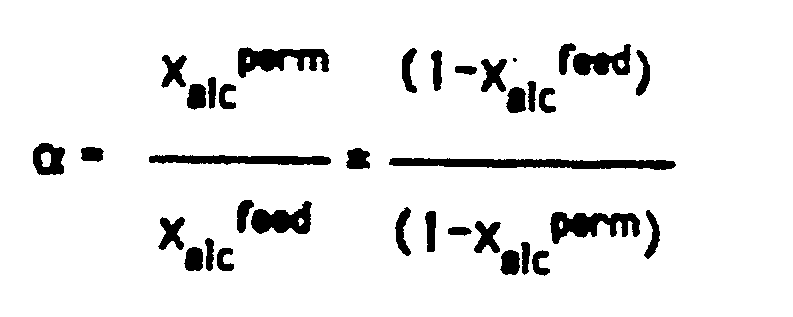
- Tested were the alcohols methanol, ethanol, propanol and isopropanol. The results are listed in Table l.


- This example shows the preparation of a zeolite-filled silicone rubber membrane.
- Zeolite was prepared according to the original patent U.S. Pat. 4,06l,724. The particle size was determined through scanning electron microscopy and was found to be between 0.5 and l0 µm. To avoid the unwanted presence of larger particles the zeolite was sieved on a test sieve with a 40 µm aperture before further use. A silicone rubber mixture was prepared as in example l. An amount of l0 g of the prepared silicalite was mixed in a 25 ml jar with 4.4 g of the silicone rubber mixture. The resulting paste was transferred past a doctor's knife and cast on a perspex plate, casting thickness l50 µm. The zeolite-containing film, zeolite content 69.4 % by weight, was cured as in example l. The membrane thickness was measured as in example l.
- This example illustrates the dependence of membrane performance for a zeolite-filled membrane on the sorption capacity of the silicalite used.
- Several batches of zeolite were prepared according to the original patent U.S. Patent 4,06l,724, in batches of about 30 g. The different batches were characterized through ethanol adsorption at room temperature and surface area measurement (B.E.T. method). The ethanol adsorption was measured from the liquid phase through contacting about l g of zeolite with about l0 g of an ethanol/water mixture of about l0 % by weight ethanol. The composition of the liquid was determined before and after adsorption was completed. The amount of ethanol adsorbed per gram of zeolite was computed from these data as

- Due to scattering in the synthesis results some batches with different Mads were obtained. To obtain pervaporation data for each batch of zeolite, membranes were made from the different batches according to the method in example 2 but with a 60 % by weight filling. The membranes were tested as in example l, the alcohol being ethanol. In table 2 the sorption and pervaporation data are listed for three different zeolite batches.

- This example illustrates the influence of the zeolite content on membrane performance for various alcohols.
- Zeolite was prepared according to the original patent U.S. Pat. 4,06l,724. The zeolite was characterized by ethanol adsorption as in example 3. Batches with an adsorption capacity of 0.l0 + 0.0l g/g were selected. As in example 2 membranes were made but with different zeolite content. Said membranes were tested as in example l to obtain pervaporation data. The data is collected in Table 3.

- This example gives the flux and selectivity of a zeolite-filled silicone rubber membrane for butanol.
- Zeolite was made according to the original patent U.S. Pat. 4,06l,724. The zeolite was characterized through ethanol adsorption as in example 3, the sorption capacity being 0.l0 + 0.0l g/g. As in example 2 a membrane was made but with a filling of 70 % by weight. The membrane performance was tested as in example l but the alcohol used was butanol. The feed solution contained 2.87 % by weight butanol and the temperature of the feed was 2l °C.
- The pervaporation result for butanol was:

- This example illustrates the influence of temperature on pervaporation performance for various alcohols.
- Zeolite was prepared according to the original patent U.S. Pat. 4,06l,724. The adsorption capacity for ethanol was measured as in example 3. Batches with a sorption capacity of 0.l0 + 0.0l g/g were selected and membranes were made as in example 2 but with 60 % by weight zeolite content. The membranes were tested as in example l but the temperature of the feed was raised to 35 °C for methanol. For ethanol and propanol the temperature was raised to 35 °C and to 50 °C.
- The results are listed in Table 4 together with reference data for T=22.5 °C from Table 3.

- In the above examples l to 6 the zeolite has been diffracted. It has been determined that the structure corresponds to that of silicalite.
Claims (15)
- A membrane for the separation of small organic molecules from aqueous solutions a fluid containing same comprising zeolite embedded into a matrix made from an elastomeric polymer, characterized in that
the Si:Al atomic ratio of said zeolite is at least l2 or the SiO₂:Al₂O₃ ratio is at least 35. - The membrane of claim l characterized in that said zeolite has an ethanol absorption capacity in the range of 0.04 to 0.20 g/g.
- The membrane of claim 1 or 2, characterized in that the content of said zeolite is in the range from l0 to 90 percent by weight.
- The membrane of claim 3, characterized in that said content is in the range from 50 to 70 percent by weight.
- The membrane of any of the preceding claims characterized in that said zeolite has a particle size of less than 40 micrometers.
- The membrane of claim 5 characterized in that said particle size is in the range from 0.5 to l0 micrometers.
- The membrane of any of the preceding claims characterized in that the membrane thickness is in the range from 10 to 200 micrometers.
- The membrane of claim 7, characterized in that said thickness is in the range from 5 to 20 micrometers.
- The membrane of any of the preceding claims characterized in that said polymer matrix is made of, silicone rubber, preferably a polysiloxane.
- The membrane of claim 9 characterized in that said polysiloxane is polydimethylsiloxane.
- Use of the membrane according to any of claims 1 to 10 in a membrane pervaporation process for the separation of small organic molecules from aqueous solutions containing same.
- The use of claim 11, characterized in that said organic molecules are alcohols being dissolved in said water.
- The use of claim 12 characterized in that said alcohols are methanol, ethanol, propanol, isopropanol or butanol.
- The use of claim 13, characterized in that the concentration of said alcohols is in the range from 0.5 to 20 percent by weight.
- The use of claim 14 characterized in that said concentration is in the range from 2 to 6 percent by weight.
Priority Applications (5)
| Application Number | Priority Date | Filing Date | Title |
|---|---|---|---|
| AT86110455T ATE64690T1 (en) | 1986-07-29 | 1986-07-29 | PERVAPORATION PROCESS AND MEMBRANE. |
| DE8686110455T DE3679990D1 (en) | 1986-07-29 | 1986-07-29 | PERVAPORATION METHOD AND MEMBRANE. |
| EP19860110455 EP0254758B1 (en) | 1986-07-29 | 1986-07-29 | Pervaporation process and membrane |
| US07/076,733 US4925562A (en) | 1986-07-29 | 1987-07-23 | Pervaporation process and membrane |
| JP62187868A JPH0755287B2 (en) | 1986-07-29 | 1987-07-29 | Pervaporation method and film used therefor |
Applications Claiming Priority (1)
| Application Number | Priority Date | Filing Date | Title |
|---|---|---|---|
| EP19860110455 EP0254758B1 (en) | 1986-07-29 | 1986-07-29 | Pervaporation process and membrane |
Publications (2)
| Publication Number | Publication Date |
|---|---|
| EP0254758A1 EP0254758A1 (en) | 1988-02-03 |
| EP0254758B1 true EP0254758B1 (en) | 1991-06-26 |
Family
ID=8195305
Family Applications (1)
| Application Number | Title | Priority Date | Filing Date |
|---|---|---|---|
| EP19860110455 Expired EP0254758B1 (en) | 1986-07-29 | 1986-07-29 | Pervaporation process and membrane |
Country Status (5)
| Country | Link |
|---|---|
| US (1) | US4925562A (en) |
| EP (1) | EP0254758B1 (en) |
| JP (1) | JPH0755287B2 (en) |
| AT (1) | ATE64690T1 (en) |
| DE (1) | DE3679990D1 (en) |
Cited By (1)
| Publication number | Priority date | Publication date | Assignee | Title |
|---|---|---|---|---|
| EP2719445A1 (en) | 2012-10-09 | 2014-04-16 | Clariant International Ltd. | Process for concentrating small organic molecules from liquid or gaseous mixtures using a composite membrane comprising a fluoropolymer and hydrophobic siliceous particles |
Families Citing this family (81)
| Publication number | Priority date | Publication date | Assignee | Title |
|---|---|---|---|---|
| FR2625690B1 (en) * | 1988-01-11 | 1993-04-23 | Inst Francais Du Petrole | PROCESS FOR SEPARATING THE CONSTITUENTS OF A GAS PHASE MIXTURE USING A COMPOSITE MEMBRANE |
| DE3804236A1 (en) * | 1988-02-11 | 1989-08-24 | Gft Ges Fuer Trenntechnik | METHOD FOR REDUCING THE ALCOHOL CONTENT OF ALCOHOLIC BEVERAGES |
| EP0458790B1 (en) * | 1989-12-20 | 1995-11-15 | Atlas Copco Airpower N.V. | A method for drying of gases, especially compressed air, a membrane for carrying out said method and a process for the manufacturing of said membrane |
| US5019263A (en) * | 1990-06-05 | 1991-05-28 | Mobil Oil Corp. | Membrane composed of a pure molecular sieve |
| GB9022836D0 (en) * | 1990-10-19 | 1990-12-05 | British Petroleum Co Plc | Membranes |
| US5230801A (en) * | 1992-11-02 | 1993-07-27 | Exxon Research And Engineering Company | Recovery of alcohols from n-paraffins by pervaporation |
| EP0808655B1 (en) * | 1993-04-23 | 2006-09-13 | Exxonmobil Research And Engineering Company | Molecular sieve layers and processes for their manufacture |
| US5416259A (en) * | 1993-09-21 | 1995-05-16 | Exxon Research & Engineering Co. | Feed pretreatment for pervaporation process |
| US5464798A (en) * | 1994-02-24 | 1995-11-07 | Jia; Meng-Dong | Ceramic-zeolite composite membranes and use for separation of vapor/gas mixtures |
| FR2717798B1 (en) * | 1994-03-28 | 1996-05-10 | Inst Francais Du Petrole | Process for the purification of ethyl tertiary butyl ether combining a membrane process and a distillation. |
| DE69533510T2 (en) * | 1994-07-08 | 2005-09-15 | Exxon Research And Engineering Co. | ZEOLITE COMPOSITION COMPRISING A SELECTIVITY INCREASING COATING |
| US5639375A (en) * | 1995-03-01 | 1997-06-17 | Neomecs Incorporated | Concentration of pesticides by membrane perstraction |
| DE69627337D1 (en) * | 1995-07-14 | 2003-05-15 | Us Environmental Prot Agency W | MEMBRANES FILLED WITH ADSORBENT MATERIAL FOR THE REMOVAL OF VOLATILE CONNECTIONS FROM WASTEWATER |
| EP0807459A1 (en) * | 1996-05-15 | 1997-11-19 | K.U. Leuven Research & Development | Method for preparing membranes, said membranes, separation methods using said membranes and the use of said membranes as catalytic membranes |
| US5755967A (en) * | 1996-05-22 | 1998-05-26 | Meagher; Michael M. | Silicalite membrane and method for the selective recovery and concentration of acetone and butanol from model ABE solutions and fermentation broth |
| GB9707501D0 (en) * | 1997-04-14 | 1997-06-04 | Univ East London | Liquids separation |
| DE19853971B4 (en) | 1998-11-23 | 2011-06-16 | Fraunhofer-Gesellschaft zur Förderung der angewandten Forschung e.V. | Inorganic / organic polysiloxane hybrid polymers and their use |
| US6316684B1 (en) | 1999-09-01 | 2001-11-13 | Membrane Technology And Research, Inc. | Filled superglassy membrane |
| US6500233B1 (en) | 2000-10-26 | 2002-12-31 | Chevron U.S.A. Inc. | Purification of p-xylene using composite mixed matrix membranes |
| US6447856B1 (en) * | 2000-11-22 | 2002-09-10 | The Board Of Regents Of The University Of Nebraska | Hydrothermal gel process for preparation of silicalite particles and process for preparation of composite membrane |
| PT102608B (en) * | 2001-05-11 | 2003-04-30 | Faculdade De Ciencias Da Unive | METHOD OF DETERMINING VOLTAGE, VOLTAGE CELL AND DEVICE FOR DETERMINATION IN FLOW |
| US6620958B2 (en) * | 2001-06-26 | 2003-09-16 | Exxonmobil Chemical Patents Inc. | Use of membranes to separate organic liquids having different polarities |
| US6626980B2 (en) | 2001-09-21 | 2003-09-30 | L'air Liquide Societe Anonyme Pour L'etude Et L'exploitation Des Procedes Georges Claude | Mixed matrix membranes incorporating chabazite type molecular sieves |
| US6508860B1 (en) | 2001-09-21 | 2003-01-21 | L'air Liquide - Societe Anonyme A'directoire Et Conseil De Surveillance Pour L'etude Et L'exploitation Des Procedes Georges Claude | Gas separation membrane with organosilicon-treated molecular sieve |
| US6899743B2 (en) * | 2002-06-12 | 2005-05-31 | Membrane Technology And Research, Inc. | Separation of organic mixtures using gas separation or pervaporation and dephlegmation |
| US6755975B2 (en) * | 2002-06-12 | 2004-06-29 | Membrane Technology And Research, Inc. | Separation process using pervaporation and dephlegmation |
| GB2413508B (en) * | 2003-02-10 | 2007-02-21 | Waters Investments Ltd | Siloxane-Immobilized particulate stationary phases for chromatographic separations and extractions |
| US7105089B2 (en) * | 2003-03-13 | 2006-09-12 | 3M Innovative Properties Company | Liquid—liquid extraction system and method |
| US7122709B2 (en) * | 2003-03-13 | 2006-10-17 | 3M Innovative Properties Company | Method for obtaining ethanol |
| US6986802B2 (en) * | 2003-08-28 | 2006-01-17 | Bp Corporation North America Inc. | Selective separation of fluid compounds utilizing a membrane separation process |
| GB0329106D0 (en) * | 2003-12-16 | 2004-01-21 | Leuven K U Res & Dev | Pressure driven separations of liquid feeds |
| US7138006B2 (en) * | 2003-12-24 | 2006-11-21 | Chevron U.S.A. Inc. | Mixed matrix membranes with low silica-to-alumina ratio molecular sieves and methods for making and using the membranes |
| US7527673B2 (en) * | 2004-03-26 | 2009-05-05 | L'air Liquide, Societe Anonyme A Directoire Et Conseil De Surveillance Pour L'etude Et L'exploitation Des Procedes Georges Claude | Polyimide based mixed matrix composite membranes |
| US20050230305A1 (en) * | 2004-03-26 | 2005-10-20 | Kulkarni Sudhir S | Novel method for forming a mixed matrix composite membrane using washed molecular sieve particles |
| US20050268782A1 (en) * | 2004-03-26 | 2005-12-08 | Kulkarni Sudhir S | Novel polyimide based mixed matrix membranes |
| WO2006007096A2 (en) * | 2004-06-24 | 2006-01-19 | North Carolina A & T University | An ultrahigh-selectivity oxygen enrichment filled elastomeric silicone polymer membrane incorporating nanofillers |
| US7846322B2 (en) * | 2005-03-11 | 2010-12-07 | Uop Llc | Integrated refinery with enhanced olefin and reformate production |
| US20060201884A1 (en) * | 2005-03-11 | 2006-09-14 | Santi Kulprathipanja | High flux, microporous, sieving membranes and separators containing such membranes and processes using such membranes |
| US20110309016A1 (en) * | 2005-08-24 | 2011-12-22 | Mikel Duke | Desalination method and apparatus |
| DE102006000984A1 (en) * | 2006-01-05 | 2007-07-12 | Heggemann Aerospace Ag | headstock |
| US7846496B2 (en) * | 2006-03-10 | 2010-12-07 | Uop Llc | Mixed matrix membranes incorporating surface-functionalized molecular sieve nanoparticles and methods for making the same |
| JP4899122B2 (en) * | 2006-08-31 | 2012-03-21 | 独立行政法人産業技術総合研究所 | Organic compound separation membrane and organic compound separation method |
| US20080142440A1 (en) * | 2006-12-18 | 2008-06-19 | Chunqing Liu | Liquid Separations Using High Performance Mixed Matrix Membranes |
| US7815712B2 (en) * | 2006-12-18 | 2010-10-19 | Uop Llc | Method of making high performance mixed matrix membranes using suspensions containing polymers and polymer stabilized molecular sieves |
| US7998246B2 (en) * | 2006-12-18 | 2011-08-16 | Uop Llc | Gas separations using high performance mixed matrix membranes |
| WO2008076602A1 (en) * | 2006-12-18 | 2008-06-26 | Uop Llc | Method of making mixed matrix membranes |
| US20080295691A1 (en) * | 2007-06-01 | 2008-12-04 | Chunqing Liu | Uv cross-linked polymer functionalized molecular sieve/polymer mixed matrix membranes |
| US20080300336A1 (en) * | 2007-06-01 | 2008-12-04 | Chunqing Liu | Uv cross-linked polymer functionalized molecular sieve/polymer mixed matrix membranes |
| US20080295692A1 (en) * | 2007-06-01 | 2008-12-04 | Chunqing Liu | Uv cross-linked polymer functionalized molecular sieve/polymer mixed matrix membranes for sulfur reduction |
| US20080296527A1 (en) * | 2007-06-01 | 2008-12-04 | Chunqing Liu | Uv cross-linked polymer functionalized molecular sieve/polymer mixed matrix membranes |
| US7638674B2 (en) * | 2007-09-07 | 2009-12-29 | Uop Llc | Processes for the isomerization of paraffins of 5 and 6 carbon atoms with methylcyclopentane recovery |
| US7638676B2 (en) * | 2007-09-07 | 2009-12-29 | Uop Llc | Processes for the isomerization of feedstocks comprising paraffins of 5 to 7 carbon atoms |
| US7638675B2 (en) * | 2007-09-07 | 2009-12-29 | Uop Llc | Processes for the isomerization of normal butane to isobutane |
| US7812207B2 (en) * | 2007-09-07 | 2010-10-12 | Uop Llc | Membrane separation processes and systems for enhanced permeant recovery |
| US20090126567A1 (en) * | 2007-11-16 | 2009-05-21 | Chunqing Liu | Mixed Matrix Membranes Containing Molecular Sieves With Thin Plate Morphology |
| US20090149313A1 (en) * | 2007-12-11 | 2009-06-11 | Chunqing Liu | Mixed Matrix Membranes Containing Low Acidity Nano-Sized SAPO-34 Molecular Sieves |
| US8226862B2 (en) * | 2007-12-12 | 2012-07-24 | Uop Llc | Molecular sieve/polymer asymmetric flat sheet mixed matrix membranes |
| US20090152755A1 (en) * | 2007-12-12 | 2009-06-18 | Chunqing Liu | Molecular Sieve/Polymer Hollow Fiber Mixed Matrix Membranes |
| US20090155464A1 (en) * | 2007-12-12 | 2009-06-18 | Chunqing Liu | Molecular Sieve/Polymer Mixed Matrix Membranes |
| CN101518719B (en) * | 2008-02-29 | 2012-02-01 | 中国科学院过程工程研究所 | Preparation method of organic-inorganic hybrid pervaporation preferential alcohol permeation membrane |
| US20090236285A1 (en) * | 2008-03-19 | 2009-09-24 | Gas Technology Institute | Ethanol separation by a mixed matrix membrane |
| US20090239288A1 (en) * | 2008-03-19 | 2009-09-24 | Gas Technology Institute | Integrated membrane separation - bioreactor for selective removal of organic products and by-products |
| JP5518186B2 (en) * | 2009-05-18 | 2014-06-11 | ヴィト ナームロゼ ベンノートチャップ | Thin film-containing pervaporation film |
| US8597518B2 (en) * | 2009-08-19 | 2013-12-03 | The University Of Connecticut | Pervaporation composite membrane for aqueous solution separation and methods for using the same |
| JP5578565B2 (en) * | 2009-12-02 | 2014-08-27 | 独立行政法人産業技術総合研究所 | Separation and concentration method of butanol from low-concentration butanol aqueous solution and butanol separation and concentration membrane used in the method |
| US20130217926A1 (en) * | 2010-06-25 | 2013-08-22 | Dalian Institute of Chemical | Composite membrane |
| US8617395B2 (en) | 2010-09-30 | 2013-12-31 | The United States Of America, As Represented By The Secretary Of Agriculture | Thin film composite membranes and their method of preparation and use |
| BR112013030076A2 (en) * | 2011-05-25 | 2016-09-20 | Bp Plc | membranes |
| JP5762860B2 (en) * | 2011-07-15 | 2015-08-12 | オルガノ株式会社 | Method and apparatus for purifying alcohol |
| JP5762861B2 (en) * | 2011-07-15 | 2015-08-12 | オルガノ株式会社 | Method and apparatus for purifying alcohol |
| JP5801763B2 (en) * | 2012-06-19 | 2015-10-28 | 株式会社フジクラ | Direct methanol fuel cell |
| JP5880399B2 (en) | 2012-11-13 | 2016-03-09 | 信越化学工業株式会社 | Method for producing silicone rubber molding |
| KR101695215B1 (en) * | 2013-10-07 | 2017-01-11 | (주)에어레인 | Combined membrane separation process for concentration of IPA and treatment of wastewater from IPA-containing wastewater |
| JP7070408B2 (en) * | 2016-05-27 | 2022-05-18 | 三菱ケミカル株式会社 | Dehydration system for hydrous organic compounds, its operation method, and dehydration method |
| US11097226B2 (en) * | 2016-08-29 | 2021-08-24 | Phillips 66 Company | Systems, devices and methods for molecular separation |
| WO2021054368A1 (en) * | 2019-09-18 | 2021-03-25 | 日東電工株式会社 | Purification system, purification method, membrane separation device, and method for producing solvent |
| JP7838352B2 (en) * | 2021-03-25 | 2026-04-01 | 三菱ケミカル株式会社 | Gas separation membrane, method for manufacturing the same, module using a gas separation membrane, and gas separation method |
| JP2023137101A (en) * | 2022-03-17 | 2023-09-29 | 日東電工株式会社 | Storage method for membrane separation unit, and membrane separation system |
| JPWO2024070575A1 (en) * | 2022-09-26 | 2024-04-04 | ||
| WO2024070355A1 (en) * | 2022-09-26 | 2024-04-04 | 日東電工株式会社 | Pervaporation membrane |
| EP4596093A1 (en) * | 2022-09-26 | 2025-08-06 | Nitto Denko Corporation | Pervaporation membrane |
Family Cites Families (9)
| Publication number | Priority date | Publication date | Assignee | Title |
|---|---|---|---|---|
| US2924630A (en) * | 1957-06-28 | 1960-02-09 | Union Oil Co | Fluid diffusion fractionation |
| FR2079460A5 (en) * | 1970-02-02 | 1971-11-12 | Rhone Poulenc Sa | Polyorganosiloxane elastomer membranes - contng zeolite for gaseous separation procedures in conventional appts |
| NL7509076A (en) * | 1974-08-05 | 1976-02-09 | Monsanto Co | PROCEDURE FOR SEPARATING PHENOLS FROM Aqueous MIXTURES. |
| US4061724A (en) | 1975-09-22 | 1977-12-06 | Union Carbide Corporation | Crystalline silica |
| US4311594A (en) * | 1975-12-01 | 1982-01-19 | Monsanto Company | Membrane separation of organics from aqueous solutions |
| JPS6028826A (en) * | 1983-07-26 | 1985-02-14 | Hiroshi Suzuki | Compound film having surface layer of thin film of cage zeolite and preparation thereof |
| US4737165A (en) * | 1983-11-10 | 1988-04-12 | Uop Inc. | Multicomponent membranes |
| JPS60129139A (en) * | 1983-12-16 | 1985-07-10 | Matsushita Electric Ind Co Ltd | Zeolite film |
| DE3407149A1 (en) * | 1984-02-28 | 1985-08-29 | Basf Ag, 6700 Ludwigshafen | ORGANIC POLYMER MEMBRANES CONTAINING CRYSTALLINE CARRIER COMPOUNDS, THEIR PRODUCTION AND USE |
-
1986
- 1986-07-29 DE DE8686110455T patent/DE3679990D1/en not_active Expired - Fee Related
- 1986-07-29 AT AT86110455T patent/ATE64690T1/en active
- 1986-07-29 EP EP19860110455 patent/EP0254758B1/en not_active Expired
-
1987
- 1987-07-23 US US07/076,733 patent/US4925562A/en not_active Expired - Fee Related
- 1987-07-29 JP JP62187868A patent/JPH0755287B2/en not_active Expired - Lifetime
Cited By (2)
| Publication number | Priority date | Publication date | Assignee | Title |
|---|---|---|---|---|
| EP2719445A1 (en) | 2012-10-09 | 2014-04-16 | Clariant International Ltd. | Process for concentrating small organic molecules from liquid or gaseous mixtures using a composite membrane comprising a fluoropolymer and hydrophobic siliceous particles |
| WO2014056965A1 (en) | 2012-10-09 | 2014-04-17 | Clariant International Ltd. | Process for concentrating at least one chemical from liquid or gaseous mixtures using a membrane comprising fluoropolymer and hydrophobic silica particles |
Also Published As
| Publication number | Publication date |
|---|---|
| EP0254758A1 (en) | 1988-02-03 |
| ATE64690T1 (en) | 1991-07-15 |
| US4925562A (en) | 1990-05-15 |
| DE3679990D1 (en) | 1991-08-01 |
| JPS63116705A (en) | 1988-05-21 |
| JPH0755287B2 (en) | 1995-06-14 |
Similar Documents
| Publication | Publication Date | Title |
|---|---|---|
| US4925562A (en) | Pervaporation process and membrane | |
| Te Hennepe et al. | Zeolite-filled silicone rubber membranes: Part 1. Membrane preparation and pervaporation results | |
| Lee et al. | Sorption, diffusion, and pervaporation of organics in polymer membranes | |
| Wegner et al. | Polycrystalline MFI zeolite membranes: xylene pervaporation and its implication on membrane microstructure | |
| US5127925A (en) | Separation of gases by means of mixed matrix membranes | |
| Leemann et al. | Vapour permeation for the recovery of organic solvents from waste air streams: separation capacities and process optimization | |
| US4218312A (en) | Membrane separation of organics from aqueous solutions | |
| Muller et al. | Infrared microscopic study of sorption and diffusion of toluene in ZSM-5 | |
| US6316684B1 (en) | Filled superglassy membrane | |
| Kim et al. | A short review on hydrophobic pervaporative inorganic membranes for ethanol/water separation applications | |
| US5707423A (en) | Substituted polyacetylene separation membrane | |
| Nakajima et al. | Calixarene-composited host–guest membranes applied for heavy metal ion adsorbents | |
| EP2063982A1 (en) | Gas separation membrane | |
| US5084181A (en) | Enrichment of water in components of heavy water | |
| US3720717A (en) | Concentrating aqueous acetone | |
| JP2910898B2 (en) | Method for separating alkanol having 1 to 3 carbon atoms from another organic solution | |
| US10583390B2 (en) | Continuous process for cleaning process waste air obtained in the production of silicones | |
| Ye | Zeolite Membrane Separation at Low Temperature | |
| US6602418B2 (en) | Solution dewatering with concomitant ion removal | |
| Islam | Poly (Dimethylsiloxane)(PDMS)/Carbon Nanotube (CNT) Nanocomposite Membranes: Preparation and Characterizations | |
| KR102569568B1 (en) | Hydrocarbon capture catalyst containing alpo-based molecular sieve, hydrocarbon separation method using the same, and hydrocarbon separation device including the same | |
| JP2002069012A (en) | METHOD FOR ISOLATING p-XYLENE | |
| Zhmakin et al. | Potential of Polymer Membranes for Xenon Recovery from Medical Waste Gas Mixtures | |
| JPS61212525A (en) | Separation of xylene isomer | |
| JPS58156304A (en) | Separation of organic compound |
Legal Events
| Date | Code | Title | Description |
|---|---|---|---|
| PUAI | Public reference made under article 153(3) epc to a published international application that has entered the european phase |
Free format text: ORIGINAL CODE: 0009012 |
|
| AK | Designated contracting states |
Kind code of ref document: A1 Designated state(s): AT BE CH DE FR GB IT LI LU NL SE |
|
| 17P | Request for examination filed |
Effective date: 19880803 |
|
| RAP1 | Party data changed (applicant data changed or rights of an application transferred) |
Owner name: GFT GESELLSCHAFT FUER TRENNTECHNIK MBH |
|
| 17Q | First examination report despatched |
Effective date: 19890703 |
|
| GRAA | (expected) grant |
Free format text: ORIGINAL CODE: 0009210 |
|
| AK | Designated contracting states |
Kind code of ref document: B1 Designated state(s): AT BE CH DE FR GB IT LI LU NL SE |
|
| REF | Corresponds to: |
Ref document number: 64690 Country of ref document: AT Date of ref document: 19910715 Kind code of ref document: T |
|
| REF | Corresponds to: |
Ref document number: 3679990 Country of ref document: DE Date of ref document: 19910801 |
|
| REG | Reference to a national code |
Ref country code: CH Ref legal event code: PUE Owner name: GFT GESELLSCHAFT FUER TRENNTECHNIK MBH |
|
| RAP2 | Party data changed (patent owner data changed or rights of a patent transferred) |
Owner name: GFT GESELLSCHAFT FUER TRENNTECHNIK MBH |
|
| RAP4 | Party data changed (patent owner data changed or rights of a patent transferred) |
Owner name: GFT GESELLSCHAFT FUER TRENNTECHNIK MBH |
|
| ITF | It: translation for a ep patent filed | ||
| ET | Fr: translation filed | ||
| NLT2 | Nl: modifications (of names), taken from the european patent patent bulletin |
Owner name: GFT GESELLSCHAFT FUER TRENNTECHNIK MBH TE NEUNKIRC |
|
| PLBE | No opposition filed within time limit |
Free format text: ORIGINAL CODE: 0009261 |
|
| STAA | Information on the status of an ep patent application or granted ep patent |
Free format text: STATUS: NO OPPOSITION FILED WITHIN TIME LIMIT |
|
| 26N | No opposition filed | ||
| EPTA | Lu: last paid annual fee | ||
| EAL | Se: european patent in force in sweden |
Ref document number: 86110455.2 |
|
| PGFP | Annual fee paid to national office [announced via postgrant information from national office to epo] |
Ref country code: GB Payment date: 19990708 Year of fee payment: 14 |
|
| PGFP | Annual fee paid to national office [announced via postgrant information from national office to epo] |
Ref country code: FR Payment date: 19990719 Year of fee payment: 14 |
|
| PGFP | Annual fee paid to national office [announced via postgrant information from national office to epo] |
Ref country code: SE Payment date: 19990722 Year of fee payment: 14 Ref country code: NL Payment date: 19990722 Year of fee payment: 14 Ref country code: LU Payment date: 19990722 Year of fee payment: 14 Ref country code: CH Payment date: 19990722 Year of fee payment: 14 Ref country code: AT Payment date: 19990722 Year of fee payment: 14 |
|
| PGFP | Annual fee paid to national office [announced via postgrant information from national office to epo] |
Ref country code: BE Payment date: 19990723 Year of fee payment: 14 |
|
| PGFP | Annual fee paid to national office [announced via postgrant information from national office to epo] |
Ref country code: DE Payment date: 19990827 Year of fee payment: 14 |
|
| PG25 | Lapsed in a contracting state [announced via postgrant information from national office to epo] |
Ref country code: LU Free format text: LAPSE BECAUSE OF NON-PAYMENT OF DUE FEES Effective date: 20000729 Ref country code: GB Free format text: LAPSE BECAUSE OF NON-PAYMENT OF DUE FEES Effective date: 20000729 Ref country code: AT Free format text: LAPSE BECAUSE OF NON-PAYMENT OF DUE FEES Effective date: 20000729 |
|
| PG25 | Lapsed in a contracting state [announced via postgrant information from national office to epo] |
Ref country code: SE Free format text: LAPSE BECAUSE OF NON-PAYMENT OF DUE FEES Effective date: 20000730 |
|
| PG25 | Lapsed in a contracting state [announced via postgrant information from national office to epo] |
Ref country code: LI Free format text: LAPSE BECAUSE OF NON-PAYMENT OF DUE FEES Effective date: 20000731 Ref country code: CH Free format text: LAPSE BECAUSE OF NON-PAYMENT OF DUE FEES Effective date: 20000731 Ref country code: BE Free format text: LAPSE BECAUSE OF NON-PAYMENT OF DUE FEES Effective date: 20000731 |
|
| BERE | Be: lapsed |
Owner name: GFT G.- FUR TRENNTECHNIK M.B.H. Effective date: 20000731 |
|
| PG25 | Lapsed in a contracting state [announced via postgrant information from national office to epo] |
Ref country code: NL Free format text: LAPSE BECAUSE OF NON-PAYMENT OF DUE FEES Effective date: 20010201 |
|
| REG | Reference to a national code |
Ref country code: CH Ref legal event code: PL |
|
| EUG | Se: european patent has lapsed |
Ref document number: 86110455.2 |
|
| GBPC | Gb: european patent ceased through non-payment of renewal fee |
Effective date: 20000729 |
|
| PG25 | Lapsed in a contracting state [announced via postgrant information from national office to epo] |
Ref country code: FR Free format text: LAPSE BECAUSE OF NON-PAYMENT OF DUE FEES Effective date: 20010330 |
|
| NLV4 | Nl: lapsed or anulled due to non-payment of the annual fee |
Effective date: 20010201 |
|
| REG | Reference to a national code |
Ref country code: FR Ref legal event code: ST |
|
| PG25 | Lapsed in a contracting state [announced via postgrant information from national office to epo] |
Ref country code: DE Free format text: LAPSE BECAUSE OF NON-PAYMENT OF DUE FEES Effective date: 20010501 |
|
| PG25 | Lapsed in a contracting state [announced via postgrant information from national office to epo] |
Ref country code: IT Free format text: LAPSE BECAUSE OF NON-PAYMENT OF DUE FEES Effective date: 20050729 |