EP0254272B1 - The use of probucol for preventing and treating heart diseases - Google Patents
The use of probucol for preventing and treating heart diseases Download PDFInfo
- Publication number
- EP0254272B1 EP0254272B1 EP87110551A EP87110551A EP0254272B1 EP 0254272 B1 EP0254272 B1 EP 0254272B1 EP 87110551 A EP87110551 A EP 87110551A EP 87110551 A EP87110551 A EP 87110551A EP 0254272 B1 EP0254272 B1 EP 0254272B1
- Authority
- EP
- European Patent Office
- Prior art keywords
- heart
- probucol
- coronary
- diseases
- preventing
- Prior art date
- Legal status (The legal status is an assumption and is not a legal conclusion. Google has not performed a legal analysis and makes no representation as to the accuracy of the status listed.)
- Expired - Lifetime
Links
Classifications
-
- A—HUMAN NECESSITIES
- A61—MEDICAL OR VETERINARY SCIENCE; HYGIENE
- A61K—PREPARATIONS FOR MEDICAL, DENTAL OR TOILETRY PURPOSES
- A61K31/00—Medicinal preparations containing organic active ingredients
- A61K31/095—Sulfur, selenium, or tellurium compounds, e.g. thiols
- A61K31/10—Sulfides; Sulfoxides; Sulfones
-
- A—HUMAN NECESSITIES
- A61—MEDICAL OR VETERINARY SCIENCE; HYGIENE
- A61P—SPECIFIC THERAPEUTIC ACTIVITY OF CHEMICAL COMPOUNDS OR MEDICINAL PREPARATIONS
- A61P9/00—Drugs for disorders of the cardiovascular system
-
- A—HUMAN NECESSITIES
- A61—MEDICAL OR VETERINARY SCIENCE; HYGIENE
- A61P—SPECIFIC THERAPEUTIC ACTIVITY OF CHEMICAL COMPOUNDS OR MEDICINAL PREPARATIONS
- A61P9/00—Drugs for disorders of the cardiovascular system
- A61P9/06—Antiarrhythmics
Definitions
- the invention relates to the use of probucol for preventing and treating heart diseases, wherein a reduced myocardial oxygen consumption is desirable or required wherein the heart disease to be treated is independent of hyperlipidemia.
- heart diseases include cardiomyopathy of various origins, the hyperkinetic heart syndrome and coronary heart disease, including coronary insufficiency and its concomitant symptoms or secondary diseases.
- Concomitant symptoms of coronary insufficiency may be angina pectoris attacks, a temporary insufficiency of the myocardial contractility associated with a lessening in the force of the heart action, arrhythmias etc.
- Secondary diseases of coronary insufficiency may be tissue necroses with subsequent irreversible heart insufficiency, myocardial infarct, irreversible arrhythmias, etc.
- Probucol is administered in doses of 1000 mg/day to treat certain metabolic disorders which are accompanied by increased serum cholesterol levels; see US Patent 3,862,332.
- the US Defensive Publication No. 960003 contains test results relating to signs of histopathological injuries, signs of cardiomyopathy, signs of tissue necrosis and signs of tissue adhesion in the case of experimentally induced trauma i.e. mechanical trauma (operation), chemical trauma (isoproterenol, cobalt, chloride) and/or pathological trauma (cardiac infarction, aortic stenosis, congenital cardiomyopathy, nephritis, damage of the liver parenchyma) and their response to probucol in mammals.
- mechanical trauma operation
- chemical trauma isoproterenol, cobalt, chloride
- pathological trauma cardiofarction, aortic stenosis, congenital cardiomyopathy, nephritis, damage of the liver parenchyma
- probucol is described as a hypolipidemic agent. Its usefulness in reducing high plasma cholesterol levels, one of the risk factors of coronary heart disease in a multifactorial treatment is discussed.
- probucol has been found to have an advantageous effect on the function and performance capacity of the heart.
- clear signs can be found for the favourable influence of probucol on the regulation of the heart and the circulation in addition to its lowering of the increased serum cholesterol values. This mode of action is reflected in the changes during exercise of the heart rate, the power and oxygen utilization and the cardiac work.
- the stress-induced increase in the rate compared to the results in the control test can be reduced by 10 beats (-13%) in the submaximum range and by 15 beats (-20%) at maximum strain; this effect can already be significantly demonstrated by about 10% at intensities of around 60% of the maximum performance capacity.
- the cardiac work which can be measured in the product of heart rate and systolic blood pressure, is lowered by about 10%.
- the performance capacity of the heart judged by the quotient formed from the power or oxygen utilization, is likewise significantly increased by about 7%.
- the administration of probucol makes it possible to widen the regulatory range of the heart and the blood circulatory system in submaximum and maximum performance without simultaneously reducing the maximum performance capacity.
- the lowering of the blood pressure heart rate product by probucol means an improvement of the coronary reserve, and, in the case of patients suffering from coronary diseases, it also means the improvement of the performance capacity limited by symptoms.
- compositions containing probucol as the active ingredient can be prepared in the manner described in US Patent 3,862,332.
- the pharmaceutical compositions can be administered orally, or parenterally.
- the oral route is preferred.
- Typical examples of dosage unit forms are tablets and injection preparations.
- the dose depends on the severity of the patient's illness, on his age and weight.
- the daily dose may be about 2 to 20 mg, preferably 4 to 15 mg of the active ingredient per kg of bodyweight.
Landscapes
- Health & Medical Sciences (AREA)
- Public Health (AREA)
- Life Sciences & Earth Sciences (AREA)
- Veterinary Medicine (AREA)
- General Health & Medical Sciences (AREA)
- Chemical & Material Sciences (AREA)
- Pharmacology & Pharmacy (AREA)
- Animal Behavior & Ethology (AREA)
- Medicinal Chemistry (AREA)
- General Chemical & Material Sciences (AREA)
- Organic Chemistry (AREA)
- Bioinformatics & Cheminformatics (AREA)
- Nuclear Medicine, Radiotherapy & Molecular Imaging (AREA)
- Chemical Kinetics & Catalysis (AREA)
- Heart & Thoracic Surgery (AREA)
- Engineering & Computer Science (AREA)
- Cardiology (AREA)
- Epidemiology (AREA)
- Medicines That Contain Protein Lipid Enzymes And Other Medicines (AREA)
- Acyclic And Carbocyclic Compounds In Medicinal Compositions (AREA)
- Medicines Containing Material From Animals Or Micro-Organisms (AREA)
- Pharmaceuticals Containing Other Organic And Inorganic Compounds (AREA)
Abstract
Description
- The invention relates to the use of probucol for preventing and treating heart diseases, wherein a reduced myocardial oxygen consumption is desirable or required wherein the heart disease to be treated is independent of hyperlipidemia. Examples of such diseases are cardiomyopathy of various origins, the hyperkinetic heart syndrome and coronary heart disease, including coronary insufficiency and its concomitant symptoms or secondary diseases.
- Concomitant symptoms of coronary insufficiency may be angina pectoris attacks, a temporary insufficiency of the myocardial contractility associated with a lessening in the force of the heart action, arrhythmias etc. Secondary diseases of coronary insufficiency may be tissue necroses with subsequent irreversible heart insufficiency, myocardial infarct, irreversible arrhythmias, etc.
- Probucol is administered in doses of 1000 mg/day to treat certain metabolic disorders which are accompanied by increased serum cholesterol levels; see US Patent 3,862,332.
- The US Defensive Publication No. 960003 contains test results relating to signs of histopathological injuries, signs of cardiomyopathy, signs of tissue necrosis and signs of tissue adhesion in the case of experimentally induced trauma i.e. mechanical trauma (operation), chemical trauma (isoproterenol, cobalt, chloride) and/or pathological trauma (cardiac infarction, aortic stenosis, congenital cardiomyopathy, nephritis, damage of the liver parenchyma) and their response to probucol in mammals.
- Changes in the heart rate, in particular under physical stress, and a positive influence on the regulation of the heart and the blood circulation and the function of the heart are not mentioned. The term "cardioprotective" is used only in connection with histopathological findings but not, as is usual in cardiology, with the function of the heart, the corresponding oxygen consumption and the coronary reserve depending on it.
- The publication "ARTERY", 10(1), pages 22-34 (1982) reviews a clinical study about the hypocholesterolemic effect of probucol. On the basis of this study it is suggested that probucol may protect from having a myocardial infarction.
- In "J. Occup. Med." 23(3), pages 202-209 (1981) the medical management of ischemic heart disease is reviewed.
- On page 205 under the heading "Therapy to Maintain Myocardial Oxygen Supply (Prevention of Coronary artherosclerosis)" the evolution of coronary artherosclerosis is described and its relationship to cholesterol. The use of probucol for lowering cholesterol levels is discussed, to attempt to prevent the inexorable progression of artherosclerosis and thereby the maintenance of the myocardial oxygen supply.
- In the publication "The American Journal of Cardiology", vol. 49, page 914 (1982) an arrhythmic action of probucol is described. Moreover, the authors of this document conclude that probucol has unfavorable effects on the coronary vasculature.
- In "JAMA", vol. 254 (15), pages 2097-2102 (1985) probucol is described as a hypolipidemic agent. Its usefulness in reducing high plasma cholesterol levels, one of the risk factors of coronary heart disease in a multifactorial treatment is discussed.
- In "Chem. Erg. News", vol. 60 (28) (1982) the pathophysiology of artherosclerosis is described, in particular the narrowing of the blood vessels and thereby the decrease in blood flow and decrease in oxygen supply. Moreover, probucol is described here as an anticholesterol agent.
- Surprisingly, probucol has been found to have an advantageous effect on the function and performance capacity of the heart. When considering the result of ergometric testing in judging the size of the heart, clear signs can be found for the favourable influence of probucol on the regulation of the heart and the circulation in addition to its lowering of the increased serum cholesterol values. This mode of action is reflected in the changes during exercise of the heart rate, the power and oxygen utilization and the cardiac work.
- To examine the mode of action of probucol on the regulation of the heart and the blood circulation, 16 normal, clinically healthy males aged 20 to 40 years were administered probucol after stress and examined for stress-induced changes in the heart and the blood circulation. For this purpose, the results of six defined ergometries (gradual bicycle ergometry to the subjective maximum strain whilst lying down, loads each increased by 50 watt and applied for 3 minutes, starting load 100 watt, EC gramm at the end of each stress minute) were collected in each case. The data from 2 tests with medication (2x500 mg probucol, duration of medication 4 and 8 weeks) were contrasted in an examination of the statistical significance (student's t test in paired data) with the findings of 4 control tests (4 weeks and immediately before starting the medication, 4 and 12 weeks after discontinuing the medication).
- While the findings for the individual body weight and the maximum performance capacity, the action of the heart and the heart volume at rest, the regulation and utilization of the carbohydrates before, during and after exercise remain unchanged, the administration of probucol was found to specifically influence
- the heart rate under exercise (see Table I)
- the power (see Table II)
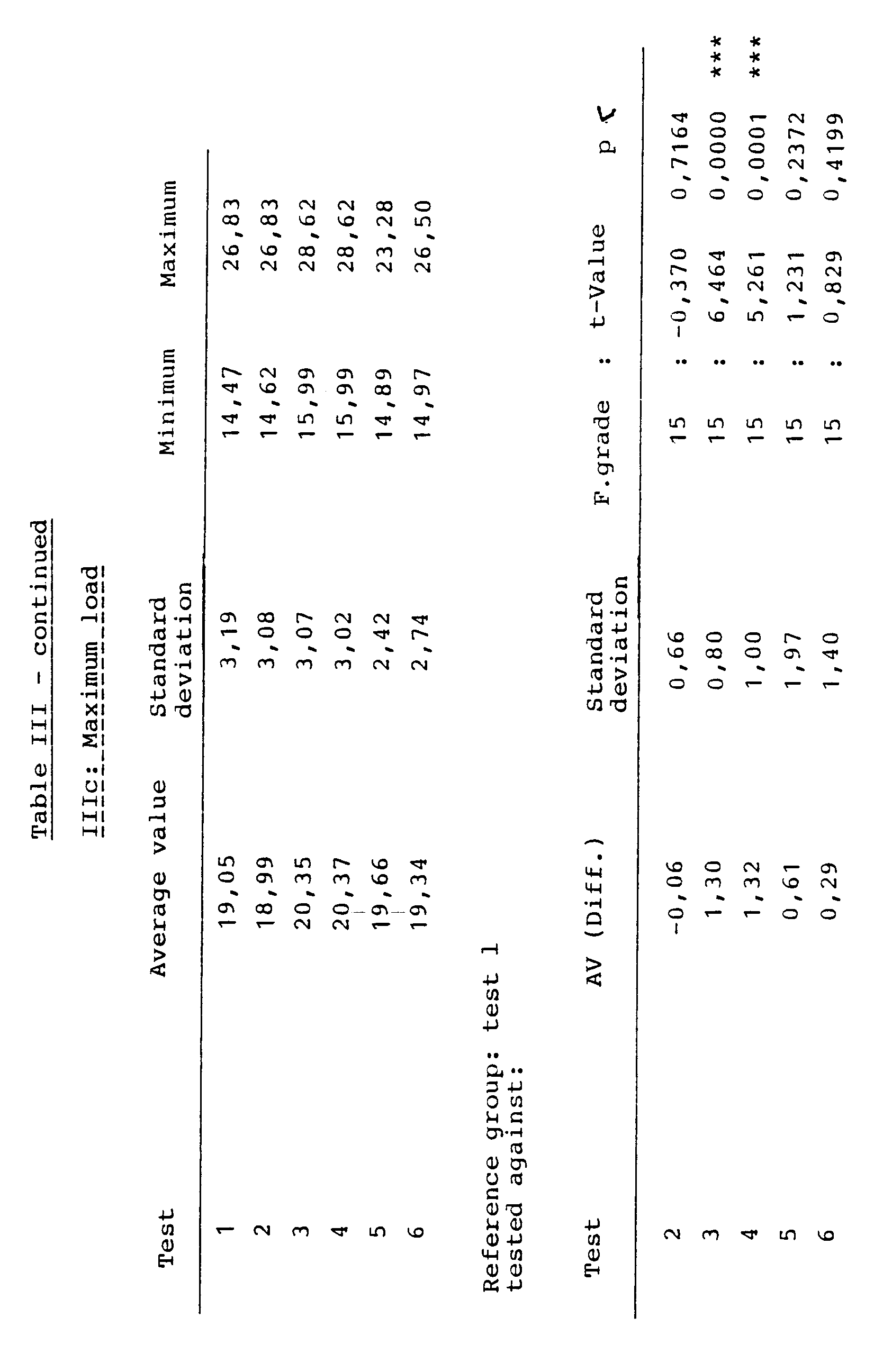
- the oxygen utilization (see Table III) and
- the cardiac work under exercise (see Table IV).
- Starting from almost identical heart rates in repose and comparable heart rates at moderate strain (100 watt corresponding to 40% of the maximum performance capacity, the stress-induced increase in the rate compared to the results in the control test can be reduced by 10 beats (-13%) in the submaximum range and by 15 beats (-20%) at maximum strain; this effect can already be significantly demonstrated by about 10% at intensities of around 60% of the maximum performance capacity. Moreover, without restricting the maximum performance capacity under medication, the cardiac work, which can be measured in the product of heart rate and systolic blood pressure, is lowered by about 10%. The performance capacity of the heart, judged by the quotient formed from the power or oxygen utilization, is likewise significantly increased by about 7%.
- These effects of the test substance must be acknowledged to be of so far unknown, therapeutic importance for a risk population suffering from coronary diseases. The results show that the administration of probucol makes it possible to widen the regulatory range of the heart and the blood circulatory system in submaximum and maximum performance without simultaneously reducing the maximum performance capacity. In view of the established relationship between the blood pressure heart rate product and the oxygen consumption of the heart on the one hand and the oxygen consumption of the heart and the threshold of pain of angina pectoris on the other hand, the lowering of the blood pressure heart rate product by probucol means an improvement of the coronary reserve, and, in the case of patients suffering from coronary diseases, it also means the improvement of the performance capacity limited by symptoms. It is for these very risk patients with coronary heart diseases suffering from dyslipoproteinemia and coronary angiopathy, that it is desirable to lower the cardiac work and the myocardial oxygen consumption, as an improvement of the coronary reserve under strain can be expected to result in a lessening of the ischemic reaction and reduced arrhythmias. Compared to other preparations which reduce the heart rate and the heart action (for instance betablockers), probucol should be especially highlighted in that it exerts this cardioprotective effect, without simultaneously affecting the maximum performance capacity and the contractility reserve of the heart, the latter being perceivable from the former. This is all the more important for persons who can be assumed to already have a lower contractility reserve, for in this case the substance would have to be held to show an undesirable side effect, if its negatively inotropic property, which acts independently, appeared at the same time as the lowering of the heart rate.
- On the basis of the results that are available on the influence of probucol on the regulation of the heart and the blood circulation, the following effects not known so far and differing from other substances are to be highlighted.
- 1. With defined intensities, the individual heart rate is markedly lower as from about 60% of the maximum performance capacity, while the maximum performance remains unchanged. A favourable influence is exerted on the parameters of the working heart (power, oxygen utilization, blood pressure heart rate product), while there is no sign of a lower contractility reserve.
- 2. The regulation of parameters of the heart and the blood circulation at rest remains unchanged; there are no signs of undesired blocking of the sympathoadrenergic tonus
- 3. Nor are there any indications that the reduced action of the heart is coupled with a simultaneous increase in the peripheric muscular strain or fatigue (glucose and lactate behaviour) or an undesired inhibitory effect on the peripheric energy supply (glucose utilization, glycogenolysis).
- Pharmaceutical compositions containing probucol as the active ingredient can be prepared in the manner described in US Patent 3,862,332. The pharmaceutical compositions can be administered orally, or parenterally. The oral route is preferred. Typical examples of dosage unit forms are tablets and injection preparations. The dose depends on the severity of the patient's illness, on his age and weight. The daily dose may be about 2 to 20 mg, preferably 4 to 15 mg of the active ingredient per kg of bodyweight.




Claims (3)
- The use of probucol for the preparation of a medicament for preventing and treating heart diseases by a reduction of myocardial oxygen consumption, wherein the heart disease to be treated is independent of hyperlipidemia.
- An embodiment according to claim 1, characterized in that the disease to be treated is the coronary heart disease, including coronary insufficiency and its consecutive symptoms or secondary diseases.
- An embodiment according to claim 1, characterized in that the disease to be treated is cardiomyopathy of various origins and the hyperkinetic heart syndrom.
Priority Applications (1)
| Application Number | Priority Date | Filing Date | Title |
|---|---|---|---|
| AT87110551T ATE104142T1 (en) | 1986-07-25 | 1987-07-21 | USE OF PROBUCOL FOR PREVENTION AND TREATMENT OF HEART DISEASE. |
Applications Claiming Priority (2)
| Application Number | Priority Date | Filing Date | Title |
|---|---|---|---|
| DE19863625279 DE3625279A1 (en) | 1986-07-25 | 1986-07-25 | USE OF PROBUCOL FOR THE PREVENTION AND TREATMENT OF HEART DISEASES |
| DE3625279 | 1986-07-25 |
Publications (3)
| Publication Number | Publication Date |
|---|---|
| EP0254272A2 EP0254272A2 (en) | 1988-01-27 |
| EP0254272A3 EP0254272A3 (en) | 1989-11-23 |
| EP0254272B1 true EP0254272B1 (en) | 1994-04-13 |
Family
ID=6306020
Family Applications (1)
| Application Number | Title | Priority Date | Filing Date |
|---|---|---|---|
| EP87110551A Expired - Lifetime EP0254272B1 (en) | 1986-07-25 | 1987-07-21 | The use of probucol for preventing and treating heart diseases |
Country Status (5)
| Country | Link |
|---|---|
| EP (1) | EP0254272B1 (en) |
| JP (1) | JPS63107915A (en) |
| AT (1) | ATE104142T1 (en) |
| DE (2) | DE3625279A1 (en) |
| ES (1) | ES2054633T3 (en) |
Families Citing this family (6)
| Publication number | Priority date | Publication date | Assignee | Title |
|---|---|---|---|---|
| EP0971706A2 (en) | 1997-03-24 | 2000-01-19 | Gilles Côte | Vascular remodeling agent |
| US6670398B2 (en) | 1997-05-14 | 2003-12-30 | Atherogenics, Inc. | Compounds and methods for treating transplant rejection |
| ATE356113T1 (en) | 1997-05-14 | 2007-03-15 | Atherogenics Inc | PROBUCOLSUMRIC ACID ESTERS TO INHIBIT THE EXPRESSION OF VCAM-1 |
| US6852878B2 (en) | 1998-05-14 | 2005-02-08 | Atherogenics, Inc. | Thioketals and thioethers for inhibiting the expression of VCAM-1 |
| AU5340101A (en) | 2000-04-11 | 2001-10-23 | Atherogenics Inc | Compounds and methods to increase plasma hdl cholesterol levels and improve hdl functionality |
| EP2139320A4 (en) | 2007-03-26 | 2010-09-08 | Salutria Pharmaceuticals Llc | Methods and compositions of derivatives of probucol for the treatment of diabetes |
Family Cites Families (2)
| Publication number | Priority date | Publication date | Assignee | Title |
|---|---|---|---|---|
| US960003A (en) * | 1909-09-11 | 1910-05-31 | Alexander F Divok | Folding steps. |
| DE3530256A1 (en) * | 1985-08-23 | 1987-02-26 | Merrell Dow Pharma | USE OF PROBUCOL IN THE TREATMENT OF HEART ARRYTHMY |
-
1986
- 1986-07-25 DE DE19863625279 patent/DE3625279A1/en not_active Ceased
-
1987
- 1987-07-21 DE DE3789579T patent/DE3789579T2/en not_active Expired - Fee Related
- 1987-07-21 AT AT87110551T patent/ATE104142T1/en not_active IP Right Cessation
- 1987-07-21 EP EP87110551A patent/EP0254272B1/en not_active Expired - Lifetime
- 1987-07-21 ES ES87110551T patent/ES2054633T3/en not_active Expired - Lifetime
- 1987-07-24 JP JP62186502A patent/JPS63107915A/en active Pending
Also Published As
| Publication number | Publication date |
|---|---|
| DE3789579T2 (en) | 1994-10-13 |
| DE3789579D1 (en) | 1994-05-19 |
| EP0254272A3 (en) | 1989-11-23 |
| ATE104142T1 (en) | 1994-04-15 |
| JPS63107915A (en) | 1988-05-12 |
| EP0254272A2 (en) | 1988-01-27 |
| ES2054633T3 (en) | 1994-08-16 |
| DE3625279A1 (en) | 1988-02-04 |
Similar Documents
| Publication | Publication Date | Title |
|---|---|---|
| Wang et al. | Treatment of attacks in hyperkalaemic familial periodic paralysis by inhalation of salbutamol | |
| DUKE et al. | Intravenous heparin for the prevention of stroke progression in acute partial stable stroke: a randomized controlled trial | |
| Björntorp | Hypertension and exercise. | |
| Ahlmark et al. | Long-term treatment with β-blockers after myocardial infarction | |
| Henry et al. | Hyponatraemia during carbamazepine treatment | |
| EP3195862A1 (en) | Use of dronedarone for the preparation of a medicament for use in the prevention of cardiovascular hospitalization or in the prevention of atrial fibrillation | |
| JP3825469B2 (en) | Use of ketoconazole and related substances as a therapeutic agent for type II diabetes | |
| Durelli et al. | Cardiac side effects of phenytoin and carbamazepine: a dose-related phenomenon? | |
| EP0254272A2 (en) | The use of probucol for preventing and treating heart diseases | |
| del Castillo et al. | Dose‐response effect of sublingual captopril in hypertensive crises | |
| Kostis et al. | The effect of chlorthalidone on ventricular ectopic activity in patients with isolated systolic hypertension | |
| Airaksinen et al. | Pregnancy is not a risk factor for a deterioration of autonomic nervous function in diabetic women | |
| Fernández-Ruiz | Semaglutide is beneficial in patients with HFpEF and obesity | |
| Stojanovic et al. | QT Prolongation Preceding Ventricular Fibrillation After Amiodarone Administration: A Case Report | |
| Grimm Jr | The drug treatment of mild hypertension in the Multiple Risk Factor Intervention Trial: a review | |
| Cohen | One year of sodium dextrothyroxine therapy for hypercholesterolemia | |
| Jalawadi et al. | Managing Amitraz Poisoning: Epidemiological Data and Clinical Insights From a Tertiary Care Hospital in Southern India | |
| Taylor et al. | Safety and effectiveness of ibutilide in a community hospital | |
| Constantino et al. | Tricyclic-induced orthostatic hypotension | |
| SU812288A1 (en) | Method of treating patients with insulin-resistant form of diabetes mellitus | |
| Anugrah et al. | Complications of Recurrent Corticosteroid Use in Patients with Erythema Nodosum Leprosum: A Case Report | |
| Shintani et al. | Prevalence of genuine epilepsy among adult emergency patients with an episode of unconsciousness | |
| RU2168333C2 (en) | Method for treating cardiac insufficiency | |
| Panesar et al. | Factors Associated With Postoperative Arrhythmias in Patients Undergoing Isolated Off-Pump Coronary Artery Bypass Grafting: A Single-Center Prospective Observational Study | |
| RU2320328C2 (en) | Method for treating persisting form of atrial fibrillation |
Legal Events
| Date | Code | Title | Description |
|---|---|---|---|
| PUAI | Public reference made under article 153(3) epc to a published international application that has entered the european phase |
Free format text: ORIGINAL CODE: 0009012 |
|
| AK | Designated contracting states |
Kind code of ref document: A2 Designated state(s): AT BE CH DE ES FR GB GR IT LI LU NL SE |
|
| PUAL | Search report despatched |
Free format text: ORIGINAL CODE: 0009013 |
|
| AK | Designated contracting states |
Kind code of ref document: A3 Designated state(s): AT BE CH DE ES FR GB GR IT LI LU NL SE |
|
| 17P | Request for examination filed |
Effective date: 19900425 |
|
| 17Q | First examination report despatched |
Effective date: 19910404 |
|
| GRAA | (expected) grant |
Free format text: ORIGINAL CODE: 0009210 |
|
| AK | Designated contracting states |
Kind code of ref document: B1 Designated state(s): AT BE CH DE ES FR GB GR IT LI LU NL SE |
|
| REF | Corresponds to: |
Ref document number: 104142 Country of ref document: AT Date of ref document: 19940415 Kind code of ref document: T |
|
| REF | Corresponds to: |
Ref document number: 3789579 Country of ref document: DE Date of ref document: 19940519 |
|
| ET | Fr: translation filed | ||
| ITF | It: translation for a ep patent filed | ||
| REG | Reference to a national code |
Ref country code: ES Ref legal event code: FG2A Ref document number: 2054633 Country of ref document: ES Kind code of ref document: T3 |
|
| REG | Reference to a national code |
Ref country code: GR Ref legal event code: FG4A Free format text: 3012497 |
|
| EPTA | Lu: last paid annual fee | ||
| EAL | Se: european patent in force in sweden |
Ref document number: 87110551.6 |
|
| PLBE | No opposition filed within time limit |
Free format text: ORIGINAL CODE: 0009261 |
|
| STAA | Information on the status of an ep patent application or granted ep patent |
Free format text: STATUS: NO OPPOSITION FILED WITHIN TIME LIMIT |
|
| 26N | No opposition filed | ||
| REG | Reference to a national code |
Ref country code: GB Ref legal event code: IF02 |
|
| PGFP | Annual fee paid to national office [announced via postgrant information from national office to epo] |
Ref country code: FR Payment date: 20020702 Year of fee payment: 16 |
|
| PGFP | Annual fee paid to national office [announced via postgrant information from national office to epo] |
Ref country code: SE Payment date: 20020703 Year of fee payment: 16 Ref country code: NL Payment date: 20020703 Year of fee payment: 16 Ref country code: AT Payment date: 20020703 Year of fee payment: 16 |
|
| PGFP | Annual fee paid to national office [announced via postgrant information from national office to epo] |
Ref country code: CH Payment date: 20020704 Year of fee payment: 16 |
|
| PGFP | Annual fee paid to national office [announced via postgrant information from national office to epo] |
Ref country code: LU Payment date: 20020709 Year of fee payment: 16 |
|
| PGFP | Annual fee paid to national office [announced via postgrant information from national office to epo] |
Ref country code: GB Payment date: 20020717 Year of fee payment: 16 |
|
| PGFP | Annual fee paid to national office [announced via postgrant information from national office to epo] |
Ref country code: GR Payment date: 20020723 Year of fee payment: 16 |
|
| PGFP | Annual fee paid to national office [announced via postgrant information from national office to epo] |
Ref country code: DE Payment date: 20020730 Year of fee payment: 16 |
|
| PGFP | Annual fee paid to national office [announced via postgrant information from national office to epo] |
Ref country code: BE Payment date: 20020802 Year of fee payment: 16 |
|
| PGFP | Annual fee paid to national office [announced via postgrant information from national office to epo] |
Ref country code: ES Payment date: 20020807 Year of fee payment: 16 |
|
| PG25 | Lapsed in a contracting state [announced via postgrant information from national office to epo] |
Ref country code: LU Free format text: LAPSE BECAUSE OF NON-PAYMENT OF DUE FEES Effective date: 20030721 Ref country code: GB Free format text: LAPSE BECAUSE OF NON-PAYMENT OF DUE FEES Effective date: 20030721 Ref country code: AT Free format text: LAPSE BECAUSE OF NON-PAYMENT OF DUE FEES Effective date: 20030721 |
|
| PG25 | Lapsed in a contracting state [announced via postgrant information from national office to epo] |
Ref country code: SE Free format text: LAPSE BECAUSE OF NON-PAYMENT OF DUE FEES Effective date: 20030722 Ref country code: ES Free format text: LAPSE BECAUSE OF NON-PAYMENT OF DUE FEES Effective date: 20030722 |
|
| PG25 | Lapsed in a contracting state [announced via postgrant information from national office to epo] |
Ref country code: LI Free format text: LAPSE BECAUSE OF NON-PAYMENT OF DUE FEES Effective date: 20030731 Ref country code: CH Free format text: LAPSE BECAUSE OF NON-PAYMENT OF DUE FEES Effective date: 20030731 Ref country code: BE Free format text: LAPSE BECAUSE OF NON-PAYMENT OF DUE FEES Effective date: 20030731 |
|
| BERE | Be: lapsed |
Owner name: *MERRELL DOW PHARMACEUTICALS INC. Effective date: 20030731 |
|
| PG25 | Lapsed in a contracting state [announced via postgrant information from national office to epo] |
Ref country code: NL Free format text: LAPSE BECAUSE OF NON-PAYMENT OF DUE FEES Effective date: 20040201 |
|
| PG25 | Lapsed in a contracting state [announced via postgrant information from national office to epo] |
Ref country code: DE Free format text: LAPSE BECAUSE OF NON-PAYMENT OF DUE FEES Effective date: 20040203 |
|
| PG25 | Lapsed in a contracting state [announced via postgrant information from national office to epo] |
Ref country code: GR Free format text: LAPSE BECAUSE OF NON-PAYMENT OF DUE FEES Effective date: 20040205 |
|
| EUG | Se: european patent has lapsed | ||
| GBPC | Gb: european patent ceased through non-payment of renewal fee |
Effective date: 20030721 |
|
| REG | Reference to a national code |
Ref country code: CH Ref legal event code: PL |
|
| PG25 | Lapsed in a contracting state [announced via postgrant information from national office to epo] |
Ref country code: FR Free format text: LAPSE BECAUSE OF NON-PAYMENT OF DUE FEES Effective date: 20040331 |
|
| NLV4 | Nl: lapsed or anulled due to non-payment of the annual fee |
Effective date: 20040201 |
|
| REG | Reference to a national code |
Ref country code: FR Ref legal event code: ST |
|
| REG | Reference to a national code |
Ref country code: ES Ref legal event code: FD2A Effective date: 20030722 |
|
| PG25 | Lapsed in a contracting state [announced via postgrant information from national office to epo] |
Ref country code: IT Free format text: LAPSE BECAUSE OF NON-PAYMENT OF DUE FEES;WARNING: LAPSES OF ITALIAN PATENTS WITH EFFECTIVE DATE BEFORE 2007 MAY HAVE OCCURRED AT ANY TIME BEFORE 2007. THE CORRECT EFFECTIVE DATE MAY BE DIFFERENT FROM THE ONE RECORDED. Effective date: 20050721 |