EP0252717B1 - Curable pressure-sensitive adhesives, constructions embodying such adhesives and process for production of pressure-sensitive adhesive stock - Google Patents
Curable pressure-sensitive adhesives, constructions embodying such adhesives and process for production of pressure-sensitive adhesive stock Download PDFInfo
- Publication number
- EP0252717B1 EP0252717B1 EP87305997A EP87305997A EP0252717B1 EP 0252717 B1 EP0252717 B1 EP 0252717B1 EP 87305997 A EP87305997 A EP 87305997A EP 87305997 A EP87305997 A EP 87305997A EP 0252717 B1 EP0252717 B1 EP 0252717B1
- Authority
- EP
- European Patent Office
- Prior art keywords
- weight
- monomers
- carbon atoms
- monomer
- adhesive
- Prior art date
- Legal status (The legal status is an assumption and is not a legal conclusion. Google has not performed a legal analysis and makes no representation as to the accuracy of the status listed.)
- Expired - Lifetime
Links
- 230000001070 adhesive effect Effects 0.000 title claims description 41
- 239000000853 adhesive Substances 0.000 title claims description 33
- 239000004820 Pressure-sensitive adhesive Substances 0.000 title claims description 25
- 238000000034 method Methods 0.000 title claims description 8
- 238000004519 manufacturing process Methods 0.000 title claims description 3
- 238000010276 construction Methods 0.000 title description 2
- 239000000178 monomer Substances 0.000 claims description 99
- 125000004432 carbon atom Chemical group C* 0.000 claims description 34
- -1 alkyl methacrylate Chemical compound 0.000 claims description 27
- 229920000642 polymer Polymers 0.000 claims description 26
- 125000000217 alkyl group Chemical group 0.000 claims description 23
- NIXOWILDQLNWCW-UHFFFAOYSA-N 2-Propenoic acid Natural products OC(=O)C=C NIXOWILDQLNWCW-UHFFFAOYSA-N 0.000 claims description 22
- JBSLOWBPDRZSMB-BQYQJAHWSA-N dibutyl (e)-but-2-enedioate Chemical compound CCCCOC(=O)\C=C\C(=O)OCCCC JBSLOWBPDRZSMB-BQYQJAHWSA-N 0.000 claims description 21
- 238000010894 electron beam technology Methods 0.000 claims description 21
- SMZOUWXMTYCWNB-UHFFFAOYSA-N 2-(2-methoxy-5-methylphenyl)ethanamine Chemical compound COC1=CC=C(C)C=C1CCN SMZOUWXMTYCWNB-UHFFFAOYSA-N 0.000 claims description 18
- VVQNEPGJFQJSBK-UHFFFAOYSA-N Methyl methacrylate Chemical compound COC(=O)C(C)=C VVQNEPGJFQJSBK-UHFFFAOYSA-N 0.000 claims description 18
- 150000005690 diesters Chemical class 0.000 claims description 17
- CQEYYJKEWSMYFG-UHFFFAOYSA-N butyl acrylate Chemical compound CCCCOC(=O)C=C CQEYYJKEWSMYFG-UHFFFAOYSA-N 0.000 claims description 14
- 150000001990 dicarboxylic acid derivatives Chemical class 0.000 claims description 13
- 125000005250 alkyl acrylate group Chemical group 0.000 claims description 11
- GOXQRTZXKQZDDN-UHFFFAOYSA-N 2-Ethylhexyl acrylate Chemical group CCCCC(CC)COC(=O)C=C GOXQRTZXKQZDDN-UHFFFAOYSA-N 0.000 claims description 9
- 150000001732 carboxylic acid derivatives Chemical class 0.000 claims description 9
- 230000009477 glass transition Effects 0.000 claims description 9
- 239000012943 hotmelt Substances 0.000 claims description 9
- BAPJBEWLBFYGME-UHFFFAOYSA-N Methyl acrylate Chemical compound COC(=O)C=C BAPJBEWLBFYGME-UHFFFAOYSA-N 0.000 claims description 8
- HVVWZTWDBSEWIH-UHFFFAOYSA-N [2-(hydroxymethyl)-3-prop-2-enoyloxy-2-(prop-2-enoyloxymethyl)propyl] prop-2-enoate Chemical group C=CC(=O)OCC(CO)(COC(=O)C=C)COC(=O)C=C HVVWZTWDBSEWIH-UHFFFAOYSA-N 0.000 claims description 8
- 238000012662 bulk polymerization Methods 0.000 claims description 7
- 238000001723 curing Methods 0.000 claims description 7
- 239000000203 mixture Substances 0.000 claims description 7
- 230000005855 radiation Effects 0.000 claims description 7
- 239000011248 coating agent Substances 0.000 claims description 6
- 238000000576 coating method Methods 0.000 claims description 6
- 238000004132 cross linking Methods 0.000 claims description 6
- 239000000758 substrate Substances 0.000 claims description 5
- 238000001227 electron beam curing Methods 0.000 claims description 4
- LTHJXDSHSVNJKG-UHFFFAOYSA-N 2-[2-[2-[2-(2-methylprop-2-enoyloxy)ethoxy]ethoxy]ethoxy]ethyl 2-methylprop-2-enoate Chemical compound CC(=C)C(=O)OCCOCCOCCOCCOC(=O)C(C)=C LTHJXDSHSVNJKG-UHFFFAOYSA-N 0.000 claims description 3
- 239000002253 acid Substances 0.000 claims description 2
- 239000000463 material Substances 0.000 claims 3
- 229920002799 BoPET Polymers 0.000 description 6
- 239000002904 solvent Substances 0.000 description 6
- 150000002148 esters Chemical class 0.000 description 5
- 238000006116 polymerization reaction Methods 0.000 description 5
- 239000003431 cross linking reagent Substances 0.000 description 4
- 238000010586 diagram Methods 0.000 description 4
- 230000000694 effects Effects 0.000 description 4
- VZCYOOQTPOCHFL-UHFFFAOYSA-N trans-butenedioic acid Natural products OC(=O)C=CC(O)=O VZCYOOQTPOCHFL-UHFFFAOYSA-N 0.000 description 4
- VZCYOOQTPOCHFL-OWOJBTEDSA-N Fumaric acid Natural products OC(=O)\C=C\C(O)=O VZCYOOQTPOCHFL-OWOJBTEDSA-N 0.000 description 3
- 239000000654 additive Substances 0.000 description 3
- 230000000996 additive effect Effects 0.000 description 3
- 239000002318 adhesion promoter Substances 0.000 description 3
- 229920001577 copolymer Polymers 0.000 description 3
- 150000001991 dicarboxylic acids Chemical class 0.000 description 3
- KWVGIHKZDCUPEU-UHFFFAOYSA-N 2,2-dimethoxy-2-phenylacetophenone Chemical compound C=1C=CC=CC=1C(OC)(OC)C(=O)C1=CC=CC=C1 KWVGIHKZDCUPEU-UHFFFAOYSA-N 0.000 description 2
- INQDDHNZXOAFFD-UHFFFAOYSA-N 2-[2-(2-prop-2-enoyloxyethoxy)ethoxy]ethyl prop-2-enoate Chemical compound C=CC(=O)OCCOCCOCCOC(=O)C=C INQDDHNZXOAFFD-UHFFFAOYSA-N 0.000 description 2
- OMIGHNLMNHATMP-UHFFFAOYSA-N 2-hydroxyethyl prop-2-enoate Chemical compound OCCOC(=O)C=C OMIGHNLMNHATMP-UHFFFAOYSA-N 0.000 description 2
- NIXOWILDQLNWCW-UHFFFAOYSA-M Acrylate Chemical compound [O-]C(=O)C=C NIXOWILDQLNWCW-UHFFFAOYSA-M 0.000 description 2
- SOGAXMICEFXMKE-UHFFFAOYSA-N Butylmethacrylate Chemical compound CCCCOC(=O)C(C)=C SOGAXMICEFXMKE-UHFFFAOYSA-N 0.000 description 2
- LFQSCWFLJHTTHZ-UHFFFAOYSA-N Ethanol Chemical compound CCO LFQSCWFLJHTTHZ-UHFFFAOYSA-N 0.000 description 2
- 239000004831 Hot glue Substances 0.000 description 2
- CERQOIWHTDAKMF-UHFFFAOYSA-N Methacrylic acid Chemical compound CC(=C)C(O)=O CERQOIWHTDAKMF-UHFFFAOYSA-N 0.000 description 2
- PPBRXRYQALVLMV-UHFFFAOYSA-N Styrene Chemical compound C=CC1=CC=CC=C1 PPBRXRYQALVLMV-UHFFFAOYSA-N 0.000 description 2
- 238000003848 UV Light-Curing Methods 0.000 description 2
- 230000032683 aging Effects 0.000 description 2
- 125000001931 aliphatic group Chemical group 0.000 description 2
- 238000009826 distribution Methods 0.000 description 2
- 238000007720 emulsion polymerization reaction Methods 0.000 description 2
- 239000001530 fumaric acid Substances 0.000 description 2
- 235000011087 fumaric acid Nutrition 0.000 description 2
- 150000002238 fumaric acids Chemical class 0.000 description 2
- 125000000524 functional group Chemical group 0.000 description 2
- 229920001519 homopolymer Polymers 0.000 description 2
- 239000004615 ingredient Substances 0.000 description 2
- 150000002689 maleic acids Chemical class 0.000 description 2
- FPYJFEHAWHCUMM-UHFFFAOYSA-N maleic anhydride Chemical compound O=C1OC(=O)C=C1 FPYJFEHAWHCUMM-UHFFFAOYSA-N 0.000 description 2
- CERQOIWHTDAKMF-UHFFFAOYSA-M methacrylate group Chemical group C(C(=C)C)(=O)[O-] CERQOIWHTDAKMF-UHFFFAOYSA-M 0.000 description 2
- 238000002360 preparation method Methods 0.000 description 2
- 238000003847 radiation curing Methods 0.000 description 2
- 239000000126 substance Substances 0.000 description 2
- 125000004178 (C1-C4) alkyl group Chemical group 0.000 description 1
- VDYWHVQKENANGY-UHFFFAOYSA-N 1,3-Butyleneglycol dimethacrylate Chemical compound CC(=C)C(=O)OC(C)CCOC(=O)C(C)=C VDYWHVQKENANGY-UHFFFAOYSA-N 0.000 description 1
- ZDQNWDNMNKSMHI-UHFFFAOYSA-N 1-[2-(2-prop-2-enoyloxypropoxy)propoxy]propan-2-yl prop-2-enoate Chemical compound C=CC(=O)OC(C)COC(C)COCC(C)OC(=O)C=C ZDQNWDNMNKSMHI-UHFFFAOYSA-N 0.000 description 1
- JAHNSTQSQJOJLO-UHFFFAOYSA-N 2-(3-fluorophenyl)-1h-imidazole Chemical compound FC1=CC=CC(C=2NC=CN=2)=C1 JAHNSTQSQJOJLO-UHFFFAOYSA-N 0.000 description 1
- HWSSEYVMGDIFMH-UHFFFAOYSA-N 2-[2-[2-(2-methylprop-2-enoyloxy)ethoxy]ethoxy]ethyl 2-methylprop-2-enoate Chemical compound CC(=C)C(=O)OCCOCCOCCOC(=O)C(C)=C HWSSEYVMGDIFMH-UHFFFAOYSA-N 0.000 description 1
- OWDBMKZHFCSOOL-UHFFFAOYSA-N 2-[2-[2-(2-methylprop-2-enoyloxy)propoxy]propoxy]propyl 2-methylprop-2-enoate Chemical compound CC(=C)C(=O)OC(C)COC(C)COC(C)COC(=O)C(C)=C OWDBMKZHFCSOOL-UHFFFAOYSA-N 0.000 description 1
- 229940095095 2-hydroxyethyl acrylate Drugs 0.000 description 1
- JLBJTVDPSNHSKJ-UHFFFAOYSA-N 4-Methylstyrene Chemical compound CC1=CC=C(C=C)C=C1 JLBJTVDPSNHSKJ-UHFFFAOYSA-N 0.000 description 1
- QISOBCMNUJQOJU-UHFFFAOYSA-N 4-bromo-1h-pyrazole-5-carboxylic acid Chemical compound OC(=O)C=1NN=CC=1Br QISOBCMNUJQOJU-UHFFFAOYSA-N 0.000 description 1
- DXPPIEDUBFUSEZ-UHFFFAOYSA-N 6-methylheptyl prop-2-enoate Chemical compound CC(C)CCCCCOC(=O)C=C DXPPIEDUBFUSEZ-UHFFFAOYSA-N 0.000 description 1
- LVGFPWDANALGOY-UHFFFAOYSA-N 8-methylnonyl prop-2-enoate Chemical compound CC(C)CCCCCCCOC(=O)C=C LVGFPWDANALGOY-UHFFFAOYSA-N 0.000 description 1
- 239000004215 Carbon black (E152) Substances 0.000 description 1
- OWYWGLHRNBIFJP-UHFFFAOYSA-N Ipazine Chemical compound CCN(CC)C1=NC(Cl)=NC(NC(C)C)=N1 OWYWGLHRNBIFJP-UHFFFAOYSA-N 0.000 description 1
- 239000005041 Mylar™ Substances 0.000 description 1
- OFOBLEOULBTSOW-UHFFFAOYSA-N Propanedioic acid Natural products OC(=O)CC(O)=O OFOBLEOULBTSOW-UHFFFAOYSA-N 0.000 description 1
- DAKWPKUUDNSNPN-UHFFFAOYSA-N Trimethylolpropane triacrylate Chemical compound C=CC(=O)OCC(CC)(COC(=O)C=C)COC(=O)C=C DAKWPKUUDNSNPN-UHFFFAOYSA-N 0.000 description 1
- OKKRPWIIYQTPQF-UHFFFAOYSA-N Trimethylolpropane trimethacrylate Chemical compound CC(=C)C(=O)OCC(CC)(COC(=O)C(C)=C)COC(=O)C(C)=C OKKRPWIIYQTPQF-UHFFFAOYSA-N 0.000 description 1
- XTXRWKRVRITETP-UHFFFAOYSA-N Vinyl acetate Chemical compound CC(=O)OC=C XTXRWKRVRITETP-UHFFFAOYSA-N 0.000 description 1
- 150000001252 acrylic acid derivatives Chemical class 0.000 description 1
- 239000002998 adhesive polymer Substances 0.000 description 1
- 125000005907 alkyl ester group Chemical group 0.000 description 1
- 125000002843 carboxylic acid group Chemical group 0.000 description 1
- 150000001735 carboxylic acids Chemical class 0.000 description 1
- 238000006243 chemical reaction Methods 0.000 description 1
- 239000000470 constituent Substances 0.000 description 1
- 238000007334 copolymerization reaction Methods 0.000 description 1
- GMSCBRSQMRDRCD-UHFFFAOYSA-N dodecyl 2-methylprop-2-enoate Chemical compound CCCCCCCCCCCCOC(=O)C(C)=C GMSCBRSQMRDRCD-UHFFFAOYSA-N 0.000 description 1
- 239000000839 emulsion Substances 0.000 description 1
- UIWXSTHGICQLQT-UHFFFAOYSA-N ethenyl propanoate Chemical compound CCC(=O)OC=C UIWXSTHGICQLQT-UHFFFAOYSA-N 0.000 description 1
- SUPCQIBBMFXVTL-UHFFFAOYSA-N ethyl 2-methylprop-2-enoate Chemical compound CCOC(=O)C(C)=C SUPCQIBBMFXVTL-UHFFFAOYSA-N 0.000 description 1
- 239000000945 filler Substances 0.000 description 1
- 238000010438 heat treatment Methods 0.000 description 1
- 238000007757 hot melt coating Methods 0.000 description 1
- 229930195733 hydrocarbon Natural products 0.000 description 1
- 150000002430 hydrocarbons Chemical class 0.000 description 1
- 229910052739 hydrogen Inorganic materials 0.000 description 1
- 239000001257 hydrogen Substances 0.000 description 1
- 239000003999 initiator Substances 0.000 description 1
- 230000001678 irradiating effect Effects 0.000 description 1
- 239000007788 liquid Substances 0.000 description 1
- VZCYOOQTPOCHFL-UPHRSURJSA-N maleic acid Chemical compound OC(=O)\C=C/C(O)=O VZCYOOQTPOCHFL-UPHRSURJSA-N 0.000 description 1
- 239000011976 maleic acid Substances 0.000 description 1
- 150000002734 metacrylic acid derivatives Chemical class 0.000 description 1
- 125000005395 methacrylic acid group Chemical class 0.000 description 1
- LVHBHZANLOWSRM-UHFFFAOYSA-N methylenebutanedioic acid Natural products OC(=O)CC(=C)C(O)=O LVHBHZANLOWSRM-UHFFFAOYSA-N 0.000 description 1
- 239000003921 oil Substances 0.000 description 1
- 150000007524 organic acids Chemical class 0.000 description 1
- 235000005985 organic acids Nutrition 0.000 description 1
- 230000000704 physical effect Effects 0.000 description 1
- 239000004014 plasticizer Substances 0.000 description 1
- 230000001737 promoting effect Effects 0.000 description 1
- PNXMTCDJUBJHQJ-UHFFFAOYSA-N propyl prop-2-enoate Chemical compound CCCOC(=O)C=C PNXMTCDJUBJHQJ-UHFFFAOYSA-N 0.000 description 1
- 238000010998 test method Methods 0.000 description 1
- 238000001029 thermal curing Methods 0.000 description 1
Images

Classifications
-
- C—CHEMISTRY; METALLURGY
- C09—DYES; PAINTS; POLISHES; NATURAL RESINS; ADHESIVES; COMPOSITIONS NOT OTHERWISE PROVIDED FOR; APPLICATIONS OF MATERIALS NOT OTHERWISE PROVIDED FOR
- C09J—ADHESIVES; NON-MECHANICAL ASPECTS OF ADHESIVE PROCESSES IN GENERAL; ADHESIVE PROCESSES NOT PROVIDED FOR ELSEWHERE; USE OF MATERIALS AS ADHESIVES
- C09J7/00—Adhesives in the form of films or foils
- C09J7/20—Adhesives in the form of films or foils characterised by their carriers
-
- C—CHEMISTRY; METALLURGY
- C09—DYES; PAINTS; POLISHES; NATURAL RESINS; ADHESIVES; COMPOSITIONS NOT OTHERWISE PROVIDED FOR; APPLICATIONS OF MATERIALS NOT OTHERWISE PROVIDED FOR
- C09J—ADHESIVES; NON-MECHANICAL ASPECTS OF ADHESIVE PROCESSES IN GENERAL; ADHESIVE PROCESSES NOT PROVIDED FOR ELSEWHERE; USE OF MATERIALS AS ADHESIVES
- C09J133/00—Adhesives based on homopolymers or copolymers of compounds having one or more unsaturated aliphatic radicals, each having only one carbon-to-carbon double bond, and at least one being terminated by only one carboxyl radical, or of salts, anhydrides, esters, amides, imides, or nitriles thereof; Adhesives based on derivatives of such polymers
- C09J133/04—Homopolymers or copolymers of esters
- C09J133/06—Homopolymers or copolymers of esters of esters containing only carbon, hydrogen and oxygen, the oxygen atom being present only as part of the carboxyl radical
- C09J133/08—Homopolymers or copolymers of acrylic acid esters
-
- C—CHEMISTRY; METALLURGY
- C09—DYES; PAINTS; POLISHES; NATURAL RESINS; ADHESIVES; COMPOSITIONS NOT OTHERWISE PROVIDED FOR; APPLICATIONS OF MATERIALS NOT OTHERWISE PROVIDED FOR
- C09J—ADHESIVES; NON-MECHANICAL ASPECTS OF ADHESIVE PROCESSES IN GENERAL; ADHESIVE PROCESSES NOT PROVIDED FOR ELSEWHERE; USE OF MATERIALS AS ADHESIVES
- C09J7/00—Adhesives in the form of films or foils
- C09J7/30—Adhesives in the form of films or foils characterised by the adhesive composition
- C09J7/38—Pressure-sensitive adhesives [PSA]
- C09J7/381—Pressure-sensitive adhesives [PSA] based on macromolecular compounds obtained by reactions involving only carbon-to-carbon unsaturated bonds
- C09J7/385—Acrylic polymers
-
- C—CHEMISTRY; METALLURGY
- C09—DYES; PAINTS; POLISHES; NATURAL RESINS; ADHESIVES; COMPOSITIONS NOT OTHERWISE PROVIDED FOR; APPLICATIONS OF MATERIALS NOT OTHERWISE PROVIDED FOR
- C09J—ADHESIVES; NON-MECHANICAL ASPECTS OF ADHESIVE PROCESSES IN GENERAL; ADHESIVE PROCESSES NOT PROVIDED FOR ELSEWHERE; USE OF MATERIALS AS ADHESIVES
- C09J2301/00—Additional features of adhesives in the form of films or foils
- C09J2301/30—Additional features of adhesives in the form of films or foils characterized by the chemical, physicochemical or physical properties of the adhesive or the carrier
- C09J2301/302—Additional features of adhesives in the form of films or foils characterized by the chemical, physicochemical or physical properties of the adhesive or the carrier the adhesive being pressure-sensitive, i.e. tacky at temperatures inferior to 30°C
-
- Y—GENERAL TAGGING OF NEW TECHNOLOGICAL DEVELOPMENTS; GENERAL TAGGING OF CROSS-SECTIONAL TECHNOLOGIES SPANNING OVER SEVERAL SECTIONS OF THE IPC; TECHNICAL SUBJECTS COVERED BY FORMER USPC CROSS-REFERENCE ART COLLECTIONS [XRACs] AND DIGESTS
- Y10—TECHNICAL SUBJECTS COVERED BY FORMER USPC
- Y10T—TECHNICAL SUBJECTS COVERED BY FORMER US CLASSIFICATION
- Y10T428/00—Stock material or miscellaneous articles
- Y10T428/28—Web or sheet containing structurally defined element or component and having an adhesive outermost layer
-
- Y—GENERAL TAGGING OF NEW TECHNOLOGICAL DEVELOPMENTS; GENERAL TAGGING OF CROSS-SECTIONAL TECHNOLOGIES SPANNING OVER SEVERAL SECTIONS OF THE IPC; TECHNICAL SUBJECTS COVERED BY FORMER USPC CROSS-REFERENCE ART COLLECTIONS [XRACs] AND DIGESTS
- Y10—TECHNICAL SUBJECTS COVERED BY FORMER USPC
- Y10T—TECHNICAL SUBJECTS COVERED BY FORMER US CLASSIFICATION
- Y10T428/00—Stock material or miscellaneous articles
- Y10T428/28—Web or sheet containing structurally defined element or component and having an adhesive outermost layer
- Y10T428/2839—Web or sheet containing structurally defined element or component and having an adhesive outermost layer with release or antistick coating
-
- Y—GENERAL TAGGING OF NEW TECHNOLOGICAL DEVELOPMENTS; GENERAL TAGGING OF CROSS-SECTIONAL TECHNOLOGIES SPANNING OVER SEVERAL SECTIONS OF THE IPC; TECHNICAL SUBJECTS COVERED BY FORMER USPC CROSS-REFERENCE ART COLLECTIONS [XRACs] AND DIGESTS
- Y10—TECHNICAL SUBJECTS COVERED BY FORMER USPC
- Y10T—TECHNICAL SUBJECTS COVERED BY FORMER US CLASSIFICATION
- Y10T428/00—Stock material or miscellaneous articles
- Y10T428/28—Web or sheet containing structurally defined element or component and having an adhesive outermost layer
- Y10T428/2848—Three or more layers
-
- Y—GENERAL TAGGING OF NEW TECHNOLOGICAL DEVELOPMENTS; GENERAL TAGGING OF CROSS-SECTIONAL TECHNOLOGIES SPANNING OVER SEVERAL SECTIONS OF THE IPC; TECHNICAL SUBJECTS COVERED BY FORMER USPC CROSS-REFERENCE ART COLLECTIONS [XRACs] AND DIGESTS
- Y10—TECHNICAL SUBJECTS COVERED BY FORMER USPC
- Y10T—TECHNICAL SUBJECTS COVERED BY FORMER US CLASSIFICATION
- Y10T428/00—Stock material or miscellaneous articles
- Y10T428/28—Web or sheet containing structurally defined element or component and having an adhesive outermost layer
- Y10T428/2852—Adhesive compositions
- Y10T428/2878—Adhesive compositions including addition polymer from unsaturated monomer
- Y10T428/2891—Adhesive compositions including addition polymer from unsaturated monomer including addition polymer from alpha-beta unsaturated carboxylic acid [e.g., acrylic acid, methacrylic acid, etc.] Or derivative thereof
Definitions
- the present invention relates to curable pressure-sensitive adhesives, constructions embodying such adhesives and process for production of pressure-sensitive adhesive stock.
- the invention is directed to curable, preferably electron-beam (EB) curable, pressure-sensitive, arcylic-based fumaric interpolymers containing an interpolymerized amount of diesters of unsaturated dicarboxylic acids containing from 2 to 4 carbon atoms, namely, fumaric and maleic acids.
- EB electron-beam
- U. S. Patent 2,544,692 to Kuegler et al discloses copolymerization of an acrylic acid with minor amounts of a fumarate diester. Emulsion and bulk polymerization are stated as being feasible.
- U. S. Patent 4,220,744 to Tulacs et al discloses the use of two-stage bulk polymerization to form a viscous liquid containing interpolymerized amounts of dialkyl esters of fumaric or maleic acid.
- U. S. Patent 2,642,414 to Bauer et al discloses copolymers of esters of methacrylic acid and a saturated aliphatic monohydric alcohol and a maleinoid ester of a saturated aliphatic monohydric alcohol of from 4 to 14 carbon atoms, and certain organic acids.
- the maleinoid esters include dibutyl fumarate.
- the products of the reaction are disclosed to have utility in modifying the pour point of hydrocarbon oils.
- U.S. Patent 4,069,123 to Skoultchi et al discloses the UV curing of homopolymers of alkyl esters of acrylic and methacrylic acids, and of copolymers of such esters with other comonomers, including C1-C4 alkyl half-esters of maleic and fumaric acids.
- the polymers are disclosed as being formed by bulk, solvent or emulsion polymerization.
- the present invention commences from WO-A-8 500 821 which discloses a pressure-sensitive adhesive which is an interpolymer formed of an interpolymerized amount of a hard-monomer system comprising at least one monomer selected from the group consisting of methylacrylate, an alkyl methacrylate, e.g.
- methyl methacrylate an unsaturated carboxylic acid having 2 to 8 carbon atoms and mixtures thereof, said hard-monomer system being present in an amount up to 25% by weight, based on the total weight of the monomers; and a soft monomer system which is present in an amount of from 50% to 95% by weight, based on the total weight of the monomers, and comprising at least one alkyl ester compound of an unsaturated dicarboxylic acid containing 4 carbon atoms wherein each alkyl group independently contains up to 8 carbon atoms, and in which the ester compound is present in a total amount of up to 30% by weight, based on the total weight of the monomers, said soft-monomer system further comprising an alkyl acrylate, having 2 to 10 carbon atoms in the alkyl group.
- the present invention is directed to novel, pressure-sensitive adhesive systems formed of cured acrylic-based pressure-sensitive adhesives that contain an interpolymerized amount of at least one alkyl monoester or diester of an unsaturated dicarboxylic acid containing 4 carbon atoms with from 4 to 8 carbon atoms in each alkyl group.
- the monoester or diester promotes adhesion in the cured product.
- the diesters are presently preferred, with dibutyl fumarate being particularly preferred.
- the polymer contains at least one hard monomer and at least one additional soft monomer.
- Inclusion of a multifunctional-monomer crosslinking agent material ly reduces the energy required to improve adhesive properties and is of significant value in low-energy improvement of elevated temperature shear. Cure may be chemical or by any convenient radiant-energy means, with ultraviolet (UV) or electron-beam (EB), particularly electron-beam, being preferred.
- UV ultraviolet
- EB electron-beam
- the copolymers provided as pressure-sensitive adhesives of the instant invention comprise from 50% to 95% by weight soft monomers, based on the total weight of the monomers, of which up to 30% by weight, preferably from 5% to 30% by weight, based on the total weight of the monomers, is one or more alkyl monester(s) or diester(s) of unsaturated dicarboxylic acids containing 4 carbon atoms in the unsaturated carboxylic-acid group and in which each alkyl group independently contains from 4 to 8 carbon atoms.
- the balance of the soft monomer(s) is comprised of at least one alkyl acrylate containing from 2 to 10 carbon atoms in the alkyl group.
- the balance of the monomer system is comprised of hard monomers, at least one of which is an alkyl methacrylate containing from about 1 to 6 carbon atoms in the alkyl group present in an amount up to about 25% by weight, based on the total weight of the monomers.
- hard monomers at least one of which is an alkyl methacrylate containing from about 1 to 6 carbon atoms in the alkyl group present in an amount up to about 25% by weight, based on the total weight of the monomers.
- at least one unsaturated carboxylic acid containing from 2 to 8 carbon atoms present in an amount of from 0% to 10% by weight, preferably from 2% to 10% by weight, based on the total weight of the monomers.
- the pressure-sensitive adhesives of this invention contain, on an interpolymerized basis and based on the total weight of the monomers, from 5% to 30% by weight diester of the unsaturated dicarboxylic acid; from 55% to 95% by weight of an alkyl acrylate such as butyl acrylate and/or 2-ethylhexyl acrylate; up to 25% by weight, more preferably from 5% to 20% by weight, of an alkyl methacrylate such as methyl methacrylate; and from 2% to about 10% by weight of an unsaturated carboxylic acid, preferably acrylic acid.
- the polymer systems may be formed in accordance with the instant invention, by bulk or solvent polymerization, and have a glass-transition temperature in the range of from 30° to 70°C below the use-temperature, preferably from 50° to 70°C below the use-temperature.
- Bulk polymerization to form polymers that are applied to a substrate, preferably by hot-melt techniques followed by cure, is the preferred mode of producing the pressure-sensitive adhesive products of the instant invention.
- the interpolymerized diester of unsaturated dicarboxylic acid is an ingredient effective in promoting adhesion.
- Curing preferably EB or UV curing, is used to enhance adhesive properties, particularly shear.
- Thermal crosslinking may also be used.
- Dosage levels for EB cure may be up to 200 or more kiloGray (kGy), preferably up to 100 kGy.
- kGy kiloGray
- Peel is measured in newtons-per-meter. Elevated temperature shear is measured in kiloseconds. All are for a dosage level of 30 kGy at a coating weight of 50 g/m2.
- pressure-sensitive adhesives based on alkyl monoesters and/or diesters of an unsaturated dicarboxylic acid polymerized in combination with at least one hard monomer, such as an alkyl methacrylate, and at least one soft monomer, such as an alkyl acrylate, provide pressure-sensitive adhesives in which the alkyl monoester or diester of the unsaturated dicarboxylic acid serves as an adhesion promoter.
- Curing chemical but preferably radiation curing, more preferably electron-beam (EB) curing, improves shear, and the use of a multifunctional monomer materially reduces the radiant energy required to improve shear.
- EB electron-beam
- pressure-sensitive adhesives of the instant invention may be prepared by bulk or solvent polymerization, and comprise polymers containing up to 30% by weight, based on the total weight of the monomer charge of at least one alkyl monester or diester of an unsaturated dicarboxylic acid containing 4 carbon atoms in the unsaturated dicarboxylic acid and from 4 to 8 carbon atoms in each alkyl group, with diesters being preferred, dibutyl fumarate being particularly preferred, and up to 25% by weight, preferably from 5 to 20% by weight, of at least one hard monomer.
- the hard monomer content include a positive amount of an unsaturated carboxylic acid, preferably acrylic acid, present in an amount up to 10% by weight, more preferably from 2% to about 10% by weight based on the total weight of the monomers.
- the bulk of the monomer system consists of soft monomers, preferably alkyl acrylates, most preferably butyl acrylate or 2-ethylhexyl acrylate, provided in a concentration of from 55% to 95% by weight.
- cohesive strength is directionally proportional to the concentration of hard monomers and increases with an increase in the concentration of hard monomers.
- Presently preferred pressure-sensitive adhesives contain from 15% to 30% by weight of dibutyl fumarate, from 55% to 75% by weight of butyl acrylate, from 15% to 25% by weight of methyl methacrylate, and from 2% to 10% by weight acrylic acid, based on the total weight of interpolymerized monomers.
- the formed adhesive polymers should have a weight-average molecular-weight ( M w) in excess of 100,000 for polymers having a narrow molecular weight distribution, and 140,000 for polymers having a broad molecular weight distribution, to enable the desired response to EB curing, particularly in the presence of a multifunctional-monomer crosslinking aid.
- M w weight-average molecular-weight
- constituents having a molecular weight of less than about 30,000 are non-responsive to electron-beam radiation.
- hard monomer there is meant a monomer which, when homopolymerized, will yield a homopolymer having a glass-transition temperature greater than -25°C, preferably greater than about 0°C.
- monomers there may be mentioned methyl acrylate, alkyl methacrylates, such as methyl methacrylate, ethyl methacrylate, butyl methacrylate and the like; copolymerizable vinyl-unsaturated monomers, such as vinyl acetate, vinyl propionate and the like; and styrenic monomers, such as styrene, methylstyrene and the like; unsaturated carboxylic acids, such as acrylic acid, methacrylic acid, itaconic acid, fumaric acid and the like.
- soft monomer there is meant a monomer which, when homopolymerized, will yield a polymer of a low glass-transition temperature, i.e., less than -25°C.
- alkyl acrylates such as butyl acrylate, propylacrylate, 2-ethylhexyl acrylate, isooctylacrylate, isodecylacrylate, and the like.
- 2-ethylhexyl acrylate and/or butyl acrylate is included in the soft monomers.
- the polymers prepared in accordance with the present invention must have a net effective glass-transition temperature of from 30° to 70°C below the use temperature, preferably from 50° to 70°C below the use temperature. Accordingly, the monomer used in the preparation of polymers of the instant invention are proportioned to provide polymerization products falling within the designated glass-transition temperature. It is for this reason that a soft monomer other than a diester, preferably 2-ethylhexyl acrylate, is provided as the bulk of the monomers employed. It is also desired that they have pendant acrylate or methacrylate groups to enhance UV and EB cure.
- the pressure-sensitive adhesives prepared in accordance with the instant invention may be applied onto a substrate by solvent or hot-melt techniques. Hot-melt coating is preferred. Coating may be onto a facestock itself, or onto a substrate used to transfer the adhesive to the facestock or one to be combined with the facestock. When the pressure-sensitive adhesive is prepared by solvent polymerization, the solvent is evaporated to yield the adhesive.
- the adhesive When used as a hot-melt, the adhesive must be of sufficiently low viscosity to enable flow at melt temperatures. Traditionally, the adhesive property most greatly sacrificed in this instance, is shear. Curing of the case hot-melt adhesives greatly improves shear properties. While thermal cure or crosslinking is feasible, radiation curing by EB or UV is preferred. Most preferred is EB cure. For EB cure, the level of energy introduced may be varied widely, but will generally range to 200 kGy, preferably up to 100 kGy, depending upon the nature of the adhesive and whether or not a multifunctional monomer is included.
- UV and gamma may be used, but they have a narrower scope of utility than does EB curing.
- Thermal curing is also feasible. Such forms of radiation and thermal cure may require use of an initiator.
- the multifunctional monomer in the system as part of the monomer charge which undergoes polymerization, so that the multifunctional monomer can become chemically bound into the system, as opposed to hydrogen bonding in simple systems where admixture is employed, although a admixture is functional.
- multifunctional monomer as used herein, there is meant a monomer having 2 or more pendant functional groups, preferably acrylate or methacrylate groups.
- multifunctional monomers there may be mentioned pentaerythritol triacrylate (PETA), triethyleneglycol diacrylate, triethyleneglycol dimethacrylate, trimethylolpropane trimethacrylate, trimethylolpropane triacrylate, tripropyleneglycol diacrylate, tripropyleneglycol dimethacrylate, 1,3-butyleneglycol dimethacrylate, tetraethyleneglycol dimethacrylate, and the like.
- Multifunctional monomers having ethoxylated and propoxylated backbones may also be effectively used.
- the concentration is in a positive amount up to 8%, more preferably from 1% to 5% by weight, based on the total weight of the monomers. Its inclusion enables, at least in the instance of EB curing, a reduction in the dosage of EB energy required to improve shear, particularly elevated temperature shear.
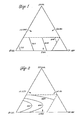
- Figs. 1 to 3 The influence of an alkyl diester of an unsaturated dicarboxylic acid on adhesion is illustrated in Figs. 1 to 3.
- the dosage level applied to an adhesive applied as a hot-melt at a coating weight of 50 g/m2 was 30 kGy.
- the adhesive system was butyl acrylate, dibutyl fumarate, methyl methacrylate, and acrylic acid, and contained 2% PETA as a crosslinking agent.
- Fig. 1 shows the peel strength of the resultant adhesive as for constant methyl methacrylate concentration of 5% by weight, as the other ingredients are varied. As the dibutyl fumarate concentration increased, so did the 180° peel strength, for the regions defined by the dashed lines.
- Fig. 1 shows the peel strength of the resultant adhesive as for constant methyl methacrylate concentration of 5% by weight, as the other ingredients are varied.
- the dibutyl fumarate concentration increased, so did the 180° peel strength, for the regions
- Fig. 3 shows elevated temperature shear in kiloseconds, for the system where arylic acid was a constant at 5% by weight, and shows the significant influence of the dibutyl fumarate as an adhesion promoter for the EB-cured hot-melt adhesive.
- multifunctional monomer is given in percent by weight.
- Test methods utilized were as follows: molecular weight determinations were made using ASTM D-3536-76, ASTM D-3590-68 and ASTM E-682-79; shear by ASTM D-3654-78 and D-1000-68 and PSTC (Pressure-Sensitive Tape Council) Test #7, 6th Edition; 90° peel by PSTC Test #2, 5th Edition; and loop tack by PSTC Test #7, 6th Edition.
- Table III a polymer system having the composition of Examples 1 to 11, a weight-average molecular weight of 154,000, a number-average molecular weight of 12,800, and a viscosity at 15°C of 24,000 cP (24 Pa s).
- ETS elevated temperature shear
- Table IV sets forth the molecular-weight properties and adhesive properties for a number of polymers in which dibutyl fumarate is designated as DBF, butyl acrylate as BA, acrylic acid as AA, methyl methacrylate as MMA, and lauryl methacrylate as LMA.
- the adhesives were compounded with 2.5% by weight PETA and were EB-cured at a dosage level of 50 kGy.
- the polymer employed in Examples 21-23 was combined with 1.5% by weight PETA, and coated onto Mylar® to a coat-weight of 49 g/m2.
- the coated film was EB-cured through Mylar at the dosage levels shown in Table VI, which also shows initial adhesive properties and properties after 3 weeks at 70°C.
- Example 12 The polymer of Example 12 was combined with 1% by weight of an ionic crosslinking agent, and the mixture was applied to a substrate by solvent-coating. Cure occurred with heating to dry off the solevent, and an initial 180° peel of 840 Newtons per meter was obtained.
Landscapes
- Chemical & Material Sciences (AREA)
- Organic Chemistry (AREA)
- Chemical Kinetics & Catalysis (AREA)
- Adhesives Or Adhesive Processes (AREA)
- Addition Polymer Or Copolymer, Post-Treatments, Or Chemical Modifications (AREA)
- Adhesive Tapes (AREA)
Description
- The present invention relates to curable pressure-sensitive adhesives, constructions embodying such adhesives and process for production of pressure-sensitive adhesive stock.
- More particularly, but not exclusively, the invention is directed to curable, preferably electron-beam (EB) curable, pressure-sensitive, arcylic-based fumaric interpolymers containing an interpolymerized amount of diesters of unsaturated dicarboxylic acids containing from 2 to 4 carbon atoms, namely, fumaric and maleic acids.
- U. S. Patent 2,544,692 to Kuegler et al discloses copolymerization of an acrylic acid with minor amounts of a fumarate diester. Emulsion and bulk polymerization are stated as being feasible.
- U. S. Patent 4,220,744 to Tulacs et al discloses the use of two-stage bulk polymerization to form a viscous liquid containing interpolymerized amounts of dialkyl esters of fumaric or maleic acid.
- U. S. Patent 2,642,414 to Bauer et al discloses copolymers of esters of methacrylic acid and a saturated aliphatic monohydric alcohol and a maleinoid ester of a saturated aliphatic monohydric alcohol of from 4 to 14 carbon atoms, and certain organic acids. The maleinoid esters include dibutyl fumarate. The products of the reaction are disclosed to have utility in modifying the pour point of hydrocarbon oils.
- The curing of monomers as well as polymers to induce or improve pressure-sensitive properties, is old in the art. Of relevance to the overall concept is U.S. Patent 3,725,115 to Christenson et al, who disclose the preparation of pressure-sensitive adhesives by irradiating a hot-melt composition. The compositions disclosed are coated on release liners and are subjected to electron-beam irradiation of a dosage of from 6 to 8 megarad (60-80 kGy), leading to high peel strengths. The improved adhesive is then transferred to the face stock.
- U.S. Patent 4,069,123 to Skoultchi et al discloses the UV curing of homopolymers of alkyl esters of acrylic and methacrylic acids, and of copolymers of such esters with other comonomers, including C₁-C₄ alkyl half-esters of maleic and fumaric acids. The polymers are disclosed as being formed by bulk, solvent or emulsion polymerization.
- It has not been heretofore known to use diesters of unsaturated dicarboxylic acids such a dibutyl fumarate, in combination with energy curing, to enhance adhesive properties. This is the subject matter of the present invention.
- The present invention commences from WO-A-8 500 821 which discloses a pressure-sensitive adhesive which is an interpolymer formed of an interpolymerized amount of a hard-monomer system comprising at least one monomer selected from the group consisting of methylacrylate, an alkyl methacrylate, e.g. methyl methacrylate, an unsaturated carboxylic acid having 2 to 8 carbon atoms and mixtures thereof, said hard-monomer system being present in an amount up to 25% by weight, based on the total weight of the monomers; and a soft monomer system which is present in an amount of from 50% to 95% by weight, based on the total weight of the monomers, and comprising at least one alkyl ester compound of an unsaturated dicarboxylic acid containing 4 carbon atoms wherein each alkyl group independently contains up to 8 carbon atoms, and in which the ester compound is present in a total amount of up to 30% by weight, based on the total weight of the monomers, said soft-monomer system further comprising an alkyl acrylate, having 2 to 10 carbon atoms in the alkyl group.
- The invention is characterized in that
- the adhesive interpolymer is cured and has a weight average molecular weight of at least 100,000 at the time of cure, in consequence of which the cured adhesive exhibits enhanced high temperature shear;
- the interpolymer is formed by solution or preferably bulk polymerization;
- the alkyl methacrylate of the hard monomer system has 1 to 6 carbon atoms in the alkyl group, and
- the alkyl ester compound is a monoester or a diester and has 4 to 8 carbon atoms in the alkyl group.
- The invention will now be discussed in the following non-limitative description.
- The present invention is directed to novel, pressure-sensitive adhesive systems formed of cured acrylic-based pressure-sensitive adhesives that contain an interpolymerized amount of at least one alkyl monoester or diester of an unsaturated dicarboxylic acid containing 4 carbon atoms with from 4 to 8 carbon atoms in each alkyl group. The monoester or diester promotes adhesion in the cured product. The diesters are presently preferred, with dibutyl fumarate being particularly preferred. The polymer contains at least one hard monomer and at least one additional soft monomer. Inclusion of a multifunctional-monomer crosslinking agent materially reduces the energy required to improve adhesive properties and is of significant value in low-energy improvement of elevated temperature shear. Cure may be chemical or by any convenient radiant-energy means, with ultraviolet (UV) or electron-beam (EB), particularly electron-beam, being preferred.
- The copolymers provided as pressure-sensitive adhesives of the instant invention comprise from 50% to 95% by weight soft monomers, based on the total weight of the monomers, of which up to 30% by weight, preferably from 5% to 30% by weight, based on the total weight of the monomers, is one or more alkyl monester(s) or diester(s) of unsaturated dicarboxylic acids containing 4 carbon atoms in the unsaturated carboxylic-acid group and in which each alkyl group independently contains from 4 to 8 carbon atoms. The balance of the soft monomer(s) is comprised of at least one alkyl acrylate containing from 2 to 10 carbon atoms in the alkyl group. The balance of the monomer system is comprised of hard monomers, at least one of which is an alkyl methacrylate containing from about 1 to 6 carbon atoms in the alkyl group present in an amount up to about 25% by weight, based on the total weight of the monomers. There may be included as a hard monomer, optionally but desirably, at least one unsaturated carboxylic acid containing from 2 to 8 carbon atoms, present in an amount of from 0% to 10% by weight, preferably from 2% to 10% by weight, based on the total weight of the monomers.
- It is presently preferred that the pressure-sensitive adhesives of this invention contain, on an interpolymerized basis and based on the total weight of the monomers, from 5% to 30% by weight diester of the unsaturated dicarboxylic acid; from 55% to 95% by weight of an alkyl acrylate such as butyl acrylate and/or 2-ethylhexyl acrylate; up to 25% by weight, more preferably from 5% to 20% by weight, of an alkyl methacrylate such as methyl methacrylate; and from 2% to about 10% by weight of an unsaturated carboxylic acid, preferably acrylic acid.
- The polymer systems may be formed in accordance with the instant invention, by bulk or solvent polymerization, and have a glass-transition temperature in the range of from 30° to 70°C below the use-temperature, preferably from 50° to 70°C below the use-temperature. Bulk polymerization, to form polymers that are applied to a substrate, preferably by hot-melt techniques followed by cure, is the preferred mode of producing the pressure-sensitive adhesive products of the instant invention.
- In the polymer, the interpolymerized diester of unsaturated dicarboxylic acid is an ingredient effective in promoting adhesion.
- Curing, preferably EB or UV curing, is used to enhance adhesive properties, particularly shear. Thermal crosslinking may also be used. Dosage levels for EB cure, may be up to 200 or more kiloGray (kGy), preferably up to 100 kGy. Inclusion of a multifunctional monomer containing at least 2 pendant functional groups, such as acrylates and methacrylates, materially improves shear, particularly high-temperature shear, with reduced radiation dosage levels being required to achieve enhanced pressure-sensitive adhesive properties.
- The invention will now be described in more detail by way of example only, with reference to the ternary diagrams constituting the accompanying drawings, in which:
- FIG. 1 is a ternary diagram showing the effect of dibutyl fumarate as an adhesion promoter.
- FIGS. 1 and 2 illustrate that, by increasing dibutyl-fumarate concentration, 180° peel strength is increased, while the purpose of FIG. 3 is to demonstrate that, by increasing the dibutyl-fumarate concentration, elevated temperature shear is increased. The diagrams are for the monomer systems dibutyl fumarate (DBF), butyl acrylate (BA), methyl methacrylate (MMA), and acrylic acid (AA) as indicated by the alphabetic characters at the vertices of the respective diagrams, and
- FIG. 1 in particular, is for a constant methyl methacrylate concentration of 5% by weight, and is variable with respect to the other components,
- FIG. 2 is for a constant acrylic acid concentration of 5% by weight, and is variable with respect to the other components, and
- FIG. 3, which is directed to high-temperature shear (70°C), is for a constant acrylic acid concentration of 5% by weight, and is variable with respect to the other components.
- Peel is measured in newtons-per-meter. Elevated temperature shear is measured in kiloseconds. All are for a dosage level of 30 kGy at a coating weight of 50 g/m².
- It has now been found that pressure-sensitive adhesives based on alkyl monoesters and/or diesters of an unsaturated dicarboxylic acid, polymerized in combination with at least one hard monomer, such as an alkyl methacrylate, and at least one soft monomer, such as an alkyl acrylate, provide pressure-sensitive adhesives in which the alkyl monoester or diester of the unsaturated dicarboxylic acid serves as an adhesion promoter. Curing, chemical but preferably radiation curing, more preferably electron-beam (EB) curing, improves shear, and the use of a multifunctional monomer materially reduces the radiant energy required to improve shear.
- In particular, pressure-sensitive adhesives of the instant invention may be prepared by bulk or solvent polymerization, and comprise polymers containing up to 30% by weight, based on the total weight of the monomer charge of at least one alkyl monester or diester of an unsaturated dicarboxylic acid containing 4 carbon atoms in the unsaturated dicarboxylic acid and from 4 to 8 carbon atoms in each alkyl group, with diesters being preferred, dibutyl fumarate being particularly preferred, and up to 25% by weight, preferably from 5 to 20% by weight, of at least one hard monomer. It is presently preferred that the hard monomer content include a positive amount of an unsaturated carboxylic acid, preferably acrylic acid, present in an amount up to 10% by weight, more preferably from 2% to about 10% by weight based on the total weight of the monomers. The bulk of the monomer system consists of soft monomers, preferably alkyl acrylates, most preferably butyl acrylate or 2-ethylhexyl acrylate, provided in a concentration of from 55% to 95% by weight.
- In the system, cohesive strength is directionally proportional to the concentration of hard monomers and increases with an increase in the concentration of hard monomers.
- Presently preferred pressure-sensitive adhesives, prepared in accordance with the instant invention, contain from 15% to 30% by weight of dibutyl fumarate, from 55% to 75% by weight of butyl acrylate, from 15% to 25% by weight of methyl methacrylate, and from 2% to 10% by weight acrylic acid, based on the total weight of interpolymerized monomers.
- The formed adhesive polymers should have a weight-average molecular-weight (
M w) in excess of 100,000 for polymers having a narrow molecular weight distribution, and 140,000 for polymers having a broad molecular weight distribution, to enable the desired response to EB curing, particularly in the presence of a multifunctional-monomer crosslinking aid. In general, constituents having a molecular weight of less than about 30,000 are non-responsive to electron-beam radiation. - As used herein by the term "hard monomer" there is meant a monomer which, when homopolymerized, will yield a homopolymer having a glass-transition temperature greater than -25°C, preferably greater than about 0°C. Among such monomers there may be mentioned methyl acrylate, alkyl methacrylates, such as methyl methacrylate, ethyl methacrylate, butyl methacrylate and the like; copolymerizable vinyl-unsaturated monomers, such as vinyl acetate, vinyl propionate and the like; and styrenic monomers, such as styrene, methylstyrene and the like; unsaturated carboxylic acids, such as acrylic acid, methacrylic acid, itaconic acid, fumaric acid and the like. By the term "soft monomer" there is meant a monomer which, when homopolymerized, will yield a polymer of a low glass-transition temperature, i.e., less than -25°C. Exemplary are the alkyl acrylates, such as butyl acrylate, propylacrylate, 2-ethylhexyl acrylate, isooctylacrylate, isodecylacrylate, and the like. Presently preferred is 2-ethylhexyl acrylate and/or butyl acrylate. The diester of an unsaturated dicarboxylic acid is included in the soft monomers.
- The polymers prepared in accordance with the present invention, to be functional pressure-sensitive adhesives, must have a net effective glass-transition temperature of from 30° to 70°C below the use temperature, preferably from 50° to 70°C below the use temperature. Accordingly, the monomer used in the preparation of polymers of the instant invention are proportioned to provide polymerization products falling within the designated glass-transition temperature. It is for this reason that a soft monomer other than a diester, preferably 2-ethylhexyl acrylate, is provided as the bulk of the monomers employed. It is also desired that they have pendant acrylate or methacrylate groups to enhance UV and EB cure.
- To produce a useful product, the pressure-sensitive adhesives prepared in accordance with the instant invention may be applied onto a substrate by solvent or hot-melt techniques. Hot-melt coating is preferred. Coating may be onto a facestock itself, or onto a substrate used to transfer the adhesive to the facestock or one to be combined with the facestock. When the pressure-sensitive adhesive is prepared by solvent polymerization, the solvent is evaporated to yield the adhesive.
- When used as a hot-melt, the adhesive must be of sufficiently low viscosity to enable flow at melt temperatures. Traditionally, the adhesive property most greatly sacrificed in this instance, is shear. Curing of the case hot-melt adhesives greatly improves shear properties. While thermal cure or crosslinking is feasible, radiation curing by EB or UV is preferred. Most preferred is EB cure. For EB cure, the level of energy introduced may be varied widely, but will generally range to 200 kGy, preferably up to 100 kGy, depending upon the nature of the adhesive and whether or not a multifunctional monomer is included.
- Other forms of radiation, such as ultraviolet and gamma, may be used, but they have a narrower scope of utility than does EB curing. Thermal curing is also feasible. Such forms of radiation and thermal cure may require use of an initiator.
- It is preferable to include the multifunctional monomer in the system as part of the monomer charge which undergoes polymerization, so that the multifunctional monomer can become chemically bound into the system, as opposed to hydrogen bonding in simple systems where admixture is employed, although a admixture is functional.
- By "multifunctional monomer" as used herein, there is meant a monomer having 2 or more pendant functional groups, preferably acrylate or methacrylate groups. As representative multifunctional monomers there may be mentioned pentaerythritol triacrylate (PETA), triethyleneglycol diacrylate, triethyleneglycol dimethacrylate, trimethylolpropane trimethacrylate, trimethylolpropane triacrylate, tripropyleneglycol diacrylate, tripropyleneglycol dimethacrylate, 1,3-butyleneglycol dimethacrylate, tetraethyleneglycol dimethacrylate, and the like. Multifunctional monomers having ethoxylated and propoxylated backbones, may also be effectively used. When the multifunctional monomer is used, its concentration is in a positive amount up to 8%, more preferably from 1% to 5% by weight, based on the total weight of the monomers. Its inclusion enables, at least in the instance of EB curing, a reduction in the dosage of EB energy required to improve shear, particularly elevated temperature shear.
- The influence of an alkyl diester of an unsaturated dicarboxylic acid on adhesion is illustrated in Figs. 1 to 3. In each, the dosage level applied to an adhesive applied as a hot-melt at a coating weight of 50 g/m², was 30 kGy. The adhesive system was butyl acrylate, dibutyl fumarate, methyl methacrylate, and acrylic acid, and contained 2% PETA as a crosslinking agent. Fig. 1 shows the peel strength of the resultant adhesive as for constant methyl methacrylate concentration of 5% by weight, as the other ingredients are varied. As the dibutyl fumarate concentration increased, so did the 180° peel strength, for the regions defined by the dashed lines. Fig. 2 is for the same system, except that the constant is acrylic acid at a concentration of 5% by weight in the variable, with concentration of methyl methacrylate being a variable. Fig. 3 shows elevated temperature shear in kiloseconds, for the system where arylic acid was a constant at 5% by weight, and shows the significant influence of the dibutyl fumarate as an adhesion promoter for the EB-cured hot-melt adhesive.
- It will be appreciated that there may be included in the pressure-sensitive adhesives, tackifiers, fillers plasticizers and the like.
- The following Examples illustrate the invention. With reference thereto, multifunctional monomer is given in percent by weight. Test methods utilized were as follows: molecular weight determinations were made using ASTM D-3536-76, ASTM D-3590-68 and ASTM E-682-79; shear by ASTM D-3654-78 and D-1000-68 and PSTC (Pressure-Sensitive Tape Council) Test #7, 6th Edition; 90° peel by PSTC Test #2, 5th Edition; and loop tack by PSTC Test #7, 6th Edition.
- There were prepared by bulk polymerization, interpolymers containing 20% by weight dibutyl fumarate, 60% by weight butyl acrylate, 15% by weight methyl methacrylate, and 5% by weight acrylic acid. There is shown in Table I, as a function of molecular weight properties, the effect of a multifunctional crosslinking additive on elevated temperature shear. As can be seen, the multifunctional crosslinking additive produced a dramatic improvement in elevated temperature shear, in responsive polymers having a weight-average molecular-weight in consequence of the presence of the additive.

- For the same polymer system having a weight-average molecular-weight of 158,000, a ratio of weight-average molecular-weight to number-average molecular-weight of 6.5, and a viscosity at 150°C of 23,000 cP (23 Pa s), a sample was prepared by solvent-coating onto a release liner and laminated with 2 mil (0.025 mm) Mylar®. There is shown in Table II, the effect of multi-functional monomers on physical properties of the EB-cured polymer at the dosage rates given.

- There is shown in Table III a polymer system having the composition of Examples 1 to 11, a weight-average molecular weight of 154,000, a number-average molecular weight of 12,800, and a viscosity at 15°C of 24,000 cP (24 Pa s). There is also shown the effect of dosage levels on elevated temperature shear (ETS) of 1,000g shear and 180° peel, initial and after aging for 1 week at 70°C. For this polymer system, an increase in properties was achieved at a dosage level of 15 kGy or above.

- Table IV sets forth the molecular-weight properties and adhesive properties for a number of polymers in which dibutyl fumarate is designated as DBF, butyl acrylate as BA, acrylic acid as AA, methyl methacrylate as MMA, and lauryl methacrylate as LMA. The adhesives were compounded with 2.5% by weight PETA and were EB-cured at a dosage level of 50 kGy.

- A polymer containing 15% by weight dibutyl fumarate, 70.3% by weight 2-ethylhexyl acrylate, 9.7% by weight methyl methacrylate, and 5% by weight acrylic acid, was combined with 2.5% by weight PETA and 1% by weight Irgacure; coated to a coat-weight of 29 g/m² on a release liner; and UV-cured at a density of 200 watts/in.,(78.8 watts/cm) at the speeds shown in Table V, then laminated to Mylar®. Adhesive properties after processing, and after aging at 70°C for 3 weeks, are shown.

- The polymer employed in Examples 21-23 was combined with 1.5% by weight PETA, and coated onto Mylar® to a coat-weight of 49 g/m². The coated film was EB-cured through Mylar at the dosage levels shown in Table VI, which also shows initial adhesive properties and properties after 3 weeks at 70°C.

- A polymer containing, on a polymerized basis, 19% by weight dibutyl fumarate, 60% butyl acrylate, 13% by weight methyl methacrylate, 4% by weight acrylic acid, 4% by weight maleic anhydride, and 1% by weight hydroxy ethylacrylate, a crosslinking agent, and 1.5% Irgacure-651 photointiator, was coated onto a release paper to a coat-weight of 34g/m²; UV-cured at the film speeds shown in Table VII, at a radiation level of 200 watts/in. (78.8 w/cm), then laminated with Mylar®.

- The polymer of Example 12 was combined with 1% by weight of an ionic crosslinking agent, and the mixture was applied to a substrate by solvent-coating. Cure occurred with heating to dry off the solevent, and an initial 180° peel of 840 Newtons per meter was obtained.
- The following compares product properties as function of UV cure and EB cure for the polymer containing 25 parts by weight dibutyl fumarate, 65 parts by weight 2-ethylexylacrylate, 15 parts by weight methylmethacrylate, 2 parts by weight acrylic acid, 3 parts by weight maleic anhydride and 1.5 parts by weight 2-hydroxy ethylacrylate. Viscosity at 150°C was 27 Pa·S. The adhesive was hot-melt coated onto a release liner for application to 1.5 mil (0.038 mm) primed Mylar® facestock. Table VIII shows adhesive performance for UV and EB cure. For UV cure, there was added 1% by weight of the polymer of Irgacure 651 manufactured and sold by Ciby Geigy.

Claims (15)
- A pressure-sensitive adhesive which is an interpolymer formed of an interpolymerized amount of a hard-monomer system comprising at least one monomer selected from the group consisting of methylacrylate, an alkyl methacrylate, e.g. methyl methacrylate, an unsaturated carboxylic acid having 2 to 8 carbon atoms and mixtures thereof, said hard-monomer system being present in an amount up to 25% by weight, based on the total weight of the monomers; and a soft monomer system which is present in an amount of from 50% to 95% by weight, based on the total weight of the monomers, and comprising at least one alkyl ester compound of an unsaturated dicarboxylic acid containing 4 carbon atoms wherein each alkyl group independently contains up to 8 carbon atoms, and in which the ester compound is present in a total amount of up to 30% by weight, based on the total weight of the monomers, said soft-monomer system further comprising an alkyl acrylate, having 2 to 10 carbon atoms in the alkyl group, characterized in that- the adhesive interpolymer is cured and has a weight average molecular weight of at least 100,000 at the time of cure, in consequence of which the cured adhesive exhibits enhanced high temperature shear;- the interpolymer is formed by solution or preferably bulk polymerization;- the alkyl methacrylate of the hard monomer system has 1 to 6 carbon atoms in the alkyl group, and- the alkyl ester compound is a monoester or a diester and has 4 to 8 carbon atoms in the alkyl group.
- An adhesive according to claim 1, wherein the hard-monomer system comprises at least one monomer which will homopolymerize to form a polymer having a glass transition temperature greater than -25°C, and said soft-monomer system further comprises at least one soft-monomer which will homopolymerize to form a polymer having a glass transition temperature less than -25°C.
- An adhesive according to claim 1 or claim 2 in the form of a layer applied to a substrate e.g. a face material as a hot melt prior to cure by electron beam or ultraviolet radiation.
- An adhesive according to claim 1, 2 or 3, which includes a multifunctional monomer in an amount of 1 to 8% by weight of the total monomers.
- An adhesive according to claim 1 applied, e.g. as a hot melt, to a face material and cured thereon by electron beam or ultraviolet irradiation, wherein the soft monomers have a homopolymerization glass-transition temperature of less than about -25°C, of which from 5% to 30% by weight, based on the total weight of the monomers, is at least one alkyl diester of unsaturated dicarboxylic acid containing 4 carbon atoms, wherein each alkyl group independently contains from 4 to 8 carbon atoms, and in which the balance of soft monomers is an alkyl acrylate containing from 2 to 10 carbon atoms, the balance of the monomer system required to form 100 parts by weight being comprised of hard monomers having a homopolymerization glass-transition temperature greater than -25°C, and including at least one unsaturated carboxylic acid containing from 2 to 8 carbon atoms and present in a positive amount of up to 10% by weight, based on the total weight of the monomers, a multifunctional monomer being present in the adhesive in a positive amount up to 8% by weight, based on the weight of the monomers.
- An adhesive according to claim 4 or claim 5, wherein the multifunctional monomer is selected from pentaerythritol triacrylate and tetraethyleneglycol dimethacrylate.
- An adhesive according to any of claims 1 to 4 wherein the unsaturated carboxylic acid containing 2 to 8 carbon atoms is present in the adhesive in a positive amount up to 10% by weight based on the total weight of monomers.
- An adhesive according to claim 7, wherein the unsaturated acid is acrylic acid.
- An adhesive according to claim 5, wherein the unsaturated carboxylic acid is present in an amount of 2 to 10% by weight and the interpolymer has a weight average molecular weight of at least 140,000.
- An adhesive according to any of claims 1 to 9, in which the ester compound is dibutyl fumarate.
- An adhesive according to any one of claims 1 to 10, in which the alkyl acrylate is selected from 2-ethylhexyl acrylate and butyl acrylate.
- An adhesive according to any of claims 1 to 10, comprising, on an interpolymerized basis and based on the total weight of the monomers, from 5% to 30% by weight of dibutyl fumarate, from 55% to 95% by weight of an alkyl acrylate selected from butyl acrylate and 2-ethylhexyl acrylate, methyl methacrylate in a positive amount of up to 25% by weight, and acrylic acid in an amount of from 2 to 10% by weight.
- A process for the production of a pressure-sensitive adhesive stock, which process comprises:
providing onto a face material a coating of a pressure-sensitive adhesive e.g. as a hot melt, said pressure-sensitive adhesive being an interpolymerized amount of a hard-monomer system comprising at least one monomer selected from the group consisting of methylacrylate, an alkyl methacrylate, e.g. methyl methacrylate, an unsaturated carboxylic acid having 2 to 8 carbon atoms and mixtures thereof, said hard-monomer system being present in an amount up to 25% by weight, based on the total weight of the monomers; and a soft monomer system which is present in an amount of from 50% to 95% by weight, based on the total weight of the monomers, and comprising at least one alkyl ester compound of an unsaturated dicarboxylic acid containing 4 carbon atoms wherein each alkyl group independently contains up to 8 carbon atoms, and in which the ester compound is present in a total amount of up to 30% by weight, based on the total weight of the monomers, said soft-monomer system further comprising an alkyl acrylate, having 2 to 10 carbon atoms in the alkyl group, and the adhesive is cross-linked, characterized in that- the interpolymer is formed by solution or preferably bulk polymerization;- the adhesive interpolymer is cured by ultraviolet or electron beam radiation and has a weight average molecular weight of at least 100,000, and preferably at least 140,000, at the time of cure, in consequence of which the cured adhesive exhibits enhanced high temperature shear;- the alkyl methacrylate of the hard monomer system has 1 to 6 carbon atoms in the alkyl group, and- the alkyl ester compound is a monoester or a diester and has 4 to 8 carbon atoms in the alkyl group. - A process according to claim 13, in which the curing is by electron-beam curing, which is applied at a level of up to 200 kiloGray.
- A process according to claim 13 or 14, wherein the pressure-sensitive adhesive is formulated to include a multifunctional monomer capable of cross-linking, the multifunctional monomer being present in an amount from 1% to 8% by weight based on the total weight of the monomers and for example being selected form pentaerythritol triacrylate and tetraethyleneglycol dimethacrylate.
Applications Claiming Priority (2)
| Application Number | Priority Date | Filing Date | Title |
|---|---|---|---|
| US06/883,491 US4786552A (en) | 1986-07-07 | 1986-07-07 | Curable arcylic/fumaric pressure-sensitive adhesives |
| US883491 | 1986-07-07 |
Publications (3)
| Publication Number | Publication Date |
|---|---|
| EP0252717A2 EP0252717A2 (en) | 1988-01-13 |
| EP0252717A3 EP0252717A3 (en) | 1989-06-07 |
| EP0252717B1 true EP0252717B1 (en) | 1993-02-10 |
Family
ID=25382673
Family Applications (1)
| Application Number | Title | Priority Date | Filing Date |
|---|---|---|---|
| EP87305997A Expired - Lifetime EP0252717B1 (en) | 1986-07-07 | 1987-07-07 | Curable pressure-sensitive adhesives, constructions embodying such adhesives and process for production of pressure-sensitive adhesive stock |
Country Status (5)
| Country | Link |
|---|---|
| US (1) | US4786552A (en) |
| EP (1) | EP0252717B1 (en) |
| JP (1) | JP2665744B2 (en) |
| CA (1) | CA1276377C (en) |
| DE (1) | DE3784110T2 (en) |
Families Citing this family (23)
| Publication number | Priority date | Publication date | Assignee | Title |
|---|---|---|---|---|
| DE3788491T2 (en) * | 1986-10-08 | 1994-07-07 | Avery Dennison Corp | Energy-curable pressure-sensitive adhesives and process for the production of pressure-sensitive adhesives. |
| US5011867A (en) * | 1987-09-28 | 1991-04-30 | Avery International Corporation | Electron-beam cured emulsion pressure-sensitive adhesives |
| US5232958A (en) * | 1988-12-28 | 1993-08-03 | Avery Dennison Corporation | Electron-beam cured emulsion pressure-sensitive adhesives |
| CA2085989A1 (en) * | 1991-04-26 | 1992-10-27 | Prakash Mallya | Electron-beam cured emulsion pressure-sensitive adhesives |
| JPH06501273A (en) * | 1991-04-26 | 1994-02-10 | エイベリ デニソン コーポレイション | Electron beam cured emulsion pressure sensitive adhesive |
| US5288827A (en) * | 1993-02-17 | 1994-02-22 | Ciba-Geigy Corporation | Copolymer of (meth)acryloxy-alkyl-siloxysilane and alkyl(meth)acrylates and the use thereof as pressure sensitive adhesives |
| US5602221A (en) * | 1993-11-10 | 1997-02-11 | Minnesota Mining And Manufacturing Company | Pressure sensitive adhesives with good low energy surface adhesion |
| US5683798A (en) * | 1993-11-10 | 1997-11-04 | Minnesota Mining And Manufacturing Company | Tackified pressure sensitive adhesives |
| US5616670A (en) * | 1993-11-10 | 1997-04-01 | Minnesota Mining And Manufacturing Company | Pressure sensitive adhesives with good oily surface adhesion |
| US5654387A (en) * | 1993-11-10 | 1997-08-05 | Minnesota Mining And Manufacturing Company | Pressure sensitive adhesives |
| US5620795A (en) * | 1993-11-10 | 1997-04-15 | Minnesota Mining And Manufacturing Company | Adhesives containing electrically conductive agents |
| US5425991A (en) * | 1994-03-25 | 1995-06-20 | Mobil Oil Corporation | Release sheet |
| JP3876299B2 (en) * | 1994-11-22 | 2007-01-31 | スリーエム カンパニー | Braking structure comprising at least one layer of viscoelastic material attached to a vibrating solid article |
| US20030001108A1 (en) | 1999-11-05 | 2003-01-02 | Energy Sciences, Inc. | Particle beam processing apparatus and materials treatable using the apparatus |
| US7026635B2 (en) | 1999-11-05 | 2006-04-11 | Energy Sciences | Particle beam processing apparatus and materials treatable using the apparatus |
| US7279205B2 (en) | 2001-02-07 | 2007-10-09 | Sonoco Development, Inc. | Packaging material |
| US6703463B2 (en) | 2001-08-01 | 2004-03-09 | Avery Dennison Corporation | Optical adhesive coating having low refractive index |
| US20060062947A1 (en) * | 2004-09-21 | 2006-03-23 | Scott Huffer | Packaging material with energy cured, hotmelt-receptive coating and package made therefrom |
| WO2015131938A1 (en) * | 2014-03-05 | 2015-09-11 | Novamelt GmbH Klebstofftechnologie | Adhesive-coated thermally sensitive polymer substrate, process for its manufacture and use thereof |
| US12006692B2 (en) * | 2016-03-25 | 2024-06-11 | Holcim Technology Ltd | Fully-adhered roof system adhered and seamed with a common adhesive |
| US20200299965A1 (en) * | 2016-03-25 | 2020-09-24 | Firestone Building Products Company, Llc | Fully-adhered roof system adhered and seamed with a common adhesive |
| CN116102983B (en) * | 2022-12-15 | 2024-07-02 | 苏州赛伍应用技术股份有限公司 | Epoxy-containing unsaturated acrylate adhesive and preparation method thereof |
| CN119242230A (en) * | 2024-09-29 | 2025-01-03 | 中国科学技术大学 | A bio-based water-based pressure-sensitive adhesive with high biocarbon content and preparation method thereof |
Family Cites Families (14)
| Publication number | Priority date | Publication date | Assignee | Title |
|---|---|---|---|---|
| US2544692A (en) * | 1946-09-07 | 1951-03-13 | Minnesota Mining & Mfg | Pressure-sensitive adhesive tape |
| US2642414A (en) * | 1950-02-03 | 1953-06-16 | Rohm & Haas | Copolymers of maleic esters and long chain alkyl methacrylates |
| BE639570A (en) * | 1962-11-05 | 1900-01-01 | ||
| US3692679A (en) * | 1970-06-18 | 1972-09-19 | Ethyl Corp | Stabilized organic material |
| US4069123A (en) * | 1972-10-24 | 1978-01-17 | National Starch & Chemical Corporation | Crosslinked pressure sensitive adhesive compositions |
| JPS5146329A (en) * | 1974-10-17 | 1976-04-20 | Nitto Electric Ind Co | TAINETSUSEIHOTSUTOMERUTOSETSUCHAKUZAI |
| JPS5948047B2 (en) * | 1977-10-25 | 1984-11-24 | 住友化学工業株式会社 | Copolymer emulsion and pressure-sensitive adhesive containing it as an active ingredient |
| AT356380B (en) * | 1977-11-17 | 1980-04-25 | Vianova Kunstharz Ag | METHOD FOR PRODUCING POLYMERISATES BY RADICALLY INITIATED SUBSTANCE POLYMERIZATION |
| JPS5822059B2 (en) * | 1979-06-05 | 1983-05-06 | サイデン化学株式会社 | Water-based pressure-sensitive adhesive composition for surface protection |
| JPS5848595B2 (en) * | 1980-12-17 | 1983-10-29 | 日東電工株式会社 | Water-dispersed pressure-sensitive adhesive composition |
| JPS58113278A (en) * | 1981-12-26 | 1983-07-06 | Hoechst Gosei Kk | Emulsion-type pressure-sensitive adhesive having excellent light resistance |
| JPS58113277A (en) * | 1981-12-26 | 1983-07-06 | Hoechst Gosei Kk | Phosphoric acid group-containing emulsion-type pressure- sensitive adhesive |
| US4564664A (en) * | 1983-08-12 | 1986-01-14 | Avery International Corporation | Emulsion-acrylic pressure-sensitive adhesives formed in two step polymerization |
| JPS61141775A (en) * | 1984-12-12 | 1986-06-28 | Sumitomo Naugatuck Co Ltd | Pressure-sensitive adhesive composition |
-
1986
- 1986-07-07 US US06/883,491 patent/US4786552A/en not_active Expired - Fee Related
-
1987
- 1987-07-06 CA CA000541396A patent/CA1276377C/en not_active Expired - Lifetime
- 1987-07-07 JP JP62167968A patent/JP2665744B2/en not_active Expired - Lifetime
- 1987-07-07 EP EP87305997A patent/EP0252717B1/en not_active Expired - Lifetime
- 1987-07-07 DE DE8787305997T patent/DE3784110T2/en not_active Expired - Fee Related
Also Published As
| Publication number | Publication date |
|---|---|
| DE3784110D1 (en) | 1993-03-25 |
| CA1276377C (en) | 1990-11-13 |
| JPS6386779A (en) | 1988-04-18 |
| EP0252717A3 (en) | 1989-06-07 |
| EP0252717A2 (en) | 1988-01-13 |
| US4786552A (en) | 1988-11-22 |
| JP2665744B2 (en) | 1997-10-22 |
| DE3784110T2 (en) | 1993-08-19 |
Similar Documents
| Publication | Publication Date | Title |
|---|---|---|
| US4786552A (en) | Curable arcylic/fumaric pressure-sensitive adhesives | |
| JP2925314B2 (en) | Pressure sensitive adhesives based on silicone emulsion | |
| US4185050A (en) | Pressure sensitive adhesive compositions comprising a mixture of terpolymers | |
| US5234736A (en) | Stock for labels and tapes utilizing siliconized emulsion based pressure-sensitive adhesives | |
| AU3791893A (en) | Emulsion pressure-sensitive adhesive polymers exhibiting excellent guillotine performance | |
| US5011867A (en) | Electron-beam cured emulsion pressure-sensitive adhesives | |
| JPH0742446B2 (en) | Emulsion-acrylic pressure sensitive adhesive | |
| US5187235A (en) | Energy-curable acrylic pressure-sensitive adhesives | |
| US3563953A (en) | Curable copolymer of an alkyl acrylate,a glycidyl acrylate or methacrylate and diketene | |
| JPH01261479A (en) | Pressure-sensitive adhesive | |
| JP3539765B2 (en) | Tackifying resin composition | |
| JP2665747B2 (en) | Energy-curable acrylic pressure-sensitive adhesive | |
| JPH03292379A (en) | Pressure-sensitive adhesive tape or sheet | |
| JP2000303046A (en) | Acrylic pressure-sensitive adhesive composition for bonding polyester film and its adhesive sheets | |
| JPS6030354B2 (en) | Manufacturing method of surface protection sheet | |
| JPH059450A (en) | Acrylic pressure-sensitive adhesive composition for masking tape | |
| AU662481B2 (en) | Electron-beam cured emulsion pressure-sensitive adhesives | |
| JPH04239575A (en) | Pressure-sensitive adhesive sheet for transfer use | |
| JPS60179484A (en) | Energetic ray-curable pressure-sensitive adhesive composition | |
| JPH11256124A (en) | Water-dispersible pressure-sensitive adhesive for re-peeling and production method thereof | |
| JPH0231753B2 (en) | NENCHAKUZAISOSEIBUTSU | |
| WO1992019691A1 (en) | Electron-beam cured emulsion pressure-sensitive adhesives | |
| JPH04270774A (en) | Radiation-curable pressure-sensitive adhesive and adhesive sheet | |
| JPH03200886A (en) | Self-adhesive | |
| JPS62100571A (en) | Water-dispersed pressure-sensitive adhesive composition |
Legal Events
| Date | Code | Title | Description |
|---|---|---|---|
| PUAI | Public reference made under article 153(3) epc to a published international application that has entered the european phase |
Free format text: ORIGINAL CODE: 0009012 |
|
| AK | Designated contracting states |
Kind code of ref document: A2 Designated state(s): BE CH DE FR GB LI NL |
|
| PUAL | Search report despatched |
Free format text: ORIGINAL CODE: 0009013 |
|
| AK | Designated contracting states |
Kind code of ref document: A3 Designated state(s): BE CH DE FR GB LI NL |
|
| 17P | Request for examination filed |
Effective date: 19891205 |
|
| 17Q | First examination report despatched |
Effective date: 19910305 |
|
| GRAA | (expected) grant |
Free format text: ORIGINAL CODE: 0009210 |
|
| AK | Designated contracting states |
Kind code of ref document: B1 Designated state(s): BE CH DE FR GB LI NL |
|
| PG25 | Lapsed in a contracting state [announced via postgrant information from national office to epo] |
Ref country code: LI Effective date: 19930210 Ref country code: CH Effective date: 19930210 |
|
| ET | Fr: translation filed | ||
| REF | Corresponds to: |
Ref document number: 3784110 Country of ref document: DE Date of ref document: 19930325 |
|
| REG | Reference to a national code |
Ref country code: CH Ref legal event code: PL |
|
| PLBE | No opposition filed within time limit |
Free format text: ORIGINAL CODE: 0009261 |
|
| STAA | Information on the status of an ep patent application or granted ep patent |
Free format text: STATUS: NO OPPOSITION FILED WITHIN TIME LIMIT |
|
| 26N | No opposition filed | ||
| PGFP | Annual fee paid to national office [announced via postgrant information from national office to epo] |
Ref country code: NL Payment date: 19960624 Year of fee payment: 10 |
|
| PGFP | Annual fee paid to national office [announced via postgrant information from national office to epo] |
Ref country code: BE Payment date: 19960625 Year of fee payment: 10 |
|
| PG25 | Lapsed in a contracting state [announced via postgrant information from national office to epo] |
Ref country code: BE Free format text: LAPSE BECAUSE OF NON-PAYMENT OF DUE FEES Effective date: 19970731 |
|
| BERE | Be: lapsed |
Owner name: AVERY INTERNATIONAL CORP. Effective date: 19970731 |
|
| PG25 | Lapsed in a contracting state [announced via postgrant information from national office to epo] |
Ref country code: NL Free format text: LAPSE BECAUSE OF NON-PAYMENT OF DUE FEES Effective date: 19980201 |
|
| NLV4 | Nl: lapsed or anulled due to non-payment of the annual fee |
Effective date: 19980201 |
|
| PGFP | Annual fee paid to national office [announced via postgrant information from national office to epo] |
Ref country code: FR Payment date: 19990621 Year of fee payment: 13 |
|
| PGFP | Annual fee paid to national office [announced via postgrant information from national office to epo] |
Ref country code: GB Payment date: 19990622 Year of fee payment: 13 |
|
| PGFP | Annual fee paid to national office [announced via postgrant information from national office to epo] |
Ref country code: DE Payment date: 19990623 Year of fee payment: 13 |
|
| PG25 | Lapsed in a contracting state [announced via postgrant information from national office to epo] |
Ref country code: GB Free format text: LAPSE BECAUSE OF NON-PAYMENT OF DUE FEES Effective date: 20000707 |
|
| GBPC | Gb: european patent ceased through non-payment of renewal fee |
Effective date: 20000707 |
|
| PG25 | Lapsed in a contracting state [announced via postgrant information from national office to epo] |
Ref country code: FR Free format text: LAPSE BECAUSE OF NON-PAYMENT OF DUE FEES Effective date: 20010330 |
|
| REG | Reference to a national code |
Ref country code: FR Ref legal event code: ST |
|
| PG25 | Lapsed in a contracting state [announced via postgrant information from national office to epo] |
Ref country code: DE Free format text: LAPSE BECAUSE OF NON-PAYMENT OF DUE FEES Effective date: 20010501 |