EP0249977B1 - Hydroxypyrazole derivatives, process for their preparation and their use against microbes - Google Patents
Hydroxypyrazole derivatives, process for their preparation and their use against microbes Download PDFInfo
- Publication number
- EP0249977B1 EP0249977B1 EP87108760A EP87108760A EP0249977B1 EP 0249977 B1 EP0249977 B1 EP 0249977B1 EP 87108760 A EP87108760 A EP 87108760A EP 87108760 A EP87108760 A EP 87108760A EP 0249977 B1 EP0249977 B1 EP 0249977B1
- Authority
- EP
- European Patent Office
- Prior art keywords
- dimethyl
- chloro
- halogen
- formula
- hydroxypyrazole
- Prior art date
- Legal status (The legal status is an assumption and is not a legal conclusion. Google has not performed a legal analysis and makes no representation as to the accuracy of the status listed.)
- Expired - Lifetime
Links
- 0 C*(C)*SS*N(C)C Chemical compound C*(C)*SS*N(C)C 0.000 description 2
Classifications
-
- C—CHEMISTRY; METALLURGY
- C07—ORGANIC CHEMISTRY
- C07D—HETEROCYCLIC COMPOUNDS
- C07D231/00—Heterocyclic compounds containing 1,2-diazole or hydrogenated 1,2-diazole rings
- C07D231/02—Heterocyclic compounds containing 1,2-diazole or hydrogenated 1,2-diazole rings not condensed with other rings
- C07D231/10—Heterocyclic compounds containing 1,2-diazole or hydrogenated 1,2-diazole rings not condensed with other rings having two or three double bonds between ring members or between ring members and non-ring members
- C07D231/12—Heterocyclic compounds containing 1,2-diazole or hydrogenated 1,2-diazole rings not condensed with other rings having two or three double bonds between ring members or between ring members and non-ring members with only hydrogen atoms, hydrocarbon or substituted hydrocarbon radicals, directly attached to ring carbon atoms
-
- A—HUMAN NECESSITIES
- A01—AGRICULTURE; FORESTRY; ANIMAL HUSBANDRY; HUNTING; TRAPPING; FISHING
- A01N—PRESERVATION OF BODIES OF HUMANS OR ANIMALS OR PLANTS OR PARTS THEREOF; BIOCIDES, e.g. AS DISINFECTANTS, AS PESTICIDES OR AS HERBICIDES; PEST REPELLANTS OR ATTRACTANTS; PLANT GROWTH REGULATORS
- A01N43/00—Biocides, pest repellants or attractants, or plant growth regulators containing heterocyclic compounds
- A01N43/48—Biocides, pest repellants or attractants, or plant growth regulators containing heterocyclic compounds having rings with two nitrogen atoms as the only ring hetero atoms
- A01N43/56—1,2-Diazoles; Hydrogenated 1,2-diazoles
-
- A—HUMAN NECESSITIES
- A61—MEDICAL OR VETERINARY SCIENCE; HYGIENE
- A61P—SPECIFIC THERAPEUTIC ACTIVITY OF CHEMICAL COMPOUNDS OR MEDICINAL PREPARATIONS
- A61P31/00—Antiinfectives, i.e. antibiotics, antiseptics, chemotherapeutics
- A61P31/04—Antibacterial agents
-
- C—CHEMISTRY; METALLURGY
- C07—ORGANIC CHEMISTRY
- C07D—HETEROCYCLIC COMPOUNDS
- C07D231/00—Heterocyclic compounds containing 1,2-diazole or hydrogenated 1,2-diazole rings
- C07D231/02—Heterocyclic compounds containing 1,2-diazole or hydrogenated 1,2-diazole rings not condensed with other rings
- C07D231/10—Heterocyclic compounds containing 1,2-diazole or hydrogenated 1,2-diazole rings not condensed with other rings having two or three double bonds between ring members or between ring members and non-ring members
- C07D231/14—Heterocyclic compounds containing 1,2-diazole or hydrogenated 1,2-diazole rings not condensed with other rings having two or three double bonds between ring members or between ring members and non-ring members with hetero atoms or with carbon atoms having three bonds to hetero atoms with at the most one bond to halogen, e.g. ester or nitrile radicals, directly attached to ring carbon atoms
- C07D231/16—Halogen atoms or nitro radicals
-
- C—CHEMISTRY; METALLURGY
- C07—ORGANIC CHEMISTRY
- C07D—HETEROCYCLIC COMPOUNDS
- C07D233/00—Heterocyclic compounds containing 1,3-diazole or hydrogenated 1,3-diazole rings, not condensed with other rings
- C07D233/54—Heterocyclic compounds containing 1,3-diazole or hydrogenated 1,3-diazole rings, not condensed with other rings having two double bonds between ring members or between ring members and non-ring members
- C07D233/56—Heterocyclic compounds containing 1,3-diazole or hydrogenated 1,3-diazole rings, not condensed with other rings having two double bonds between ring members or between ring members and non-ring members with only hydrogen atoms or radicals containing only hydrogen and carbon atoms, attached to ring carbon atoms
-
- C—CHEMISTRY; METALLURGY
- C07—ORGANIC CHEMISTRY
- C07D—HETEROCYCLIC COMPOUNDS
- C07D249/00—Heterocyclic compounds containing five-membered rings having three nitrogen atoms as the only ring hetero atoms
- C07D249/02—Heterocyclic compounds containing five-membered rings having three nitrogen atoms as the only ring hetero atoms not condensed with other rings
- C07D249/08—1,2,4-Triazoles; Hydrogenated 1,2,4-triazoles
Definitions
- the present invention relates to new, valuable hydroxipyrazole derivatives with fungicidal, bactericidal and algicidal activity, processes for their preparation, microcides which contain these compounds as active ingredients and processes for combating fungi, bacteria and algae (microorganisms).
- 4-Halogen-1 - [(thiocyanato) methoxy] pyrazole, in particular 4-chloro-1 - [(thiocyanato) methoxy] pyrazole is to be mentioned as a particularly preferred compound.
- the compounds according to the invention are obtained by reacting 1-hydroxipyrazoles of the formula II in which R 1 , R 2 and R 3 have the meaning given above, with the thiocyanates of the formula III R4-CH z -SCN (III) in which R 4 is halogen (chlorine, bromine or iodine).
- DE-OS 3 205 456 Compounds of formula II are described in DE-OS 3 205 456.
- DE-OS 3 409 317 describes alkyl-O- and CN-alkyl-O-substituted derivatives of 1-hydroxipyrazole with a nitrification-inhibiting effect.
- the compounds of formula III are also known (DE-OS 2 648 965, EP 65 190).
- the reactants are preferably left in inert solvents, such as aliphatic and aromatic, optionally chlorinated hydrocarbons, for example toluene or methylene chloride, ethers, for example diethyl ether or tetrahydrofuran, alcohols, for example tert-butanol, ketones, for example acetone, nitriles, for example acetonitrile or amides, for example N, N-dimethylformamide, in the presence of a base, for example a tertiary amine, pyridine, alkali carbonate or alkali metal alcoholate or hydride, between -60 and 180 ° C., preferably between 20 and 80 ° C., with one another react.
- solvents such as aliphatic and aromatic, optionally chlorinated hydrocarbons, for example toluene or methylene chloride, ethers, for example diethyl ether or tetrahydrofuran, alcohols, for example ter
- the reaction mentioned can also be carried out in a two-phase system using phase transfer catalysis.
- chlorinated hydrocarbons for example methylene chloride
- aqueous alkalis for example sodium hydroxide solution
- a phase transfer catalyst for example tetra-n-butylammonium hydroxide
- the new active ingredients are particularly suitable for protecting various materials against degradation or destruction by bacteria or fungi or against infestation and growth by microorganisms.
- Materials that can be preserved or equipped with the new active ingredients are, for example, glues and adhesives, starch solutions, wax emulsions, clay emulsions, sizes, finishes, spinning baths, gelatin preparations, window putty, joint sealants, cooling lubricants, drilling oils, fuels, plastic dispersions, emulsion paints, textiles , Leather, rawhides, cosmetics.
- the compounds are also suitable as slime control agents in the paper industry, in recooling plants and in air humidification systems.
- the following microorganisms can be combated, for example, with the compounds according to the invention: Staphylococcus aureus, Escherichia coli, Klebsiella pneumoniae, Citrobacter freundii, Proteus vulgaris, Pseudomonas aeruginosa, Desulfovibrio desulfuricans, Streptoverticillium rubrireticuli, Aspergillus niger, Penillosumumusicor, Penillususumusicorus, Penicillusumumusicor, Penicillusumusicorum, Peacilomyces varioti, Trichoderma viride, Chaetomium globosum, Aspergillus amstelodami, Phoma pigmentovora, Phoma violacea, Aureobasidium pullulans, Saccharomyces cerevisiae, Alternaria tenuis, Stemphylium macrosporoideum, Cladosporium herbarum,
- the active ingredients are added to a nutrient solution which is optimally suitable for the growth of the Aspergillus niger fungus in amounts of 100, 75, 50, 25, 10, 5 and 2.5 parts by weight per million parts of nutrient solution.
- 20 ml of the nutrient solution treated in this way are inoculated in 100 ml glass flasks with 0.3 mg Aspergillus fungal spores. The flasks are heated at 36 ° C for 120 hours and then the extent of fungal development, which is preferred on the nutrient solution surface, is assessed.
- the active ingredients are added to a nutrient solution which is optimally suitable for the growth of the fungi Paecilomyces variotii, Aureobasidium pullulans and Geotrichum candidans in amounts of 100, 50, 25, 12, 6, 3 and 1.5 parts by weight per million parts of nutrient solution .
- 10 ml of nutrient solution and active ingredient mixture are placed in sterile test tubes and inoculated with a drop of a spore suspension which contains 10 6 conidia or cells. After incubation for 120 hours, samples are taken from those tubes which show no visible fungal growth and transferred to fungal nutrient media.
- the table shows the dilution level at which the fungi no longer grow after a sample has been transferred to the nutrient medium.
- the result of the test shows that, for example, the compounds 1, 2, 3, 4 and 6 have a good fungicidal activity when using 6 ppm, while the same effect with the active compounds A, B, C, D and E only at 50 ppm is achieved.
- the bacterial kill values were determined as follows: 5 ml of a double-diluted nutrient broth were added to 5 ml of a dilution of the agents in water and mixed in sterile test tubes. The test batches contain 200, 100, 50, 25, 12, 6 and 3 parts by weight of active ingredient per million parts of nutrient broth. The tubes were then inoculated by adding a drop of 1:10 diluted 16-hour-old broth cultures of the bacterial species Staphylococcus aureus, Escherichia coli, Proteus vulgaris or Pseudomonas aeruginosa and incubated at 37 ° C. for 24 hours. After this time, samples were transferred from the tubes to bacterial culture media and these were also incubated at 37 ° C. for 24 hours. The dilution level at which no bacterial development occurred after a sample was transferred to the culture medium is given as the kill value.
- the result of the test shows that, for example, compounds 1, 2, 3, 4 and 6 have a good bactericidal activity when using 25 ppm, while the active compounds C, D and E have this activity only at 100 ppm.
- the active ingredients are added to a phosphate-rich nutrient solution which promotes the growth of the unicellular green algae Chlorella vulgaris in amounts of 10, 7.5, 5, 2.5 and 1 part by weight per million parts of nutrient solution.
- 100 ml of nutrient solution mixture and only nutrient solution (control) are placed in 300 ml Erlenmeyer flasks.
- the nutrient solution is inoculated with a suspension of the algae Chlorella vulgaris; the cell density is adjusted to 10 6 cells / ml nutrient solution. After setting up the test batches at room temperature and access to light for 14 days, the effectiveness is assessed.
- the result of the test shows that, for example, compound 1 has a good activity against algae when 2.5 ppm is used.
- the test batches, each 100 ml, are then inoculated with a microorganism suspension which contains Staphylococcus aureus, Escherichia coli, Pseudomonas aeruginosa, Proteus vulgaris, Aspergillus niger, Penicillium funiculosum, Geotrichum candidans and Rhodotorula rubra as germs.
- the germ density in the inoculated dispersion is between 10 6 and 10 7 germs / ml. After a incubation period of 21 days at 25 ° C, samples from the test batches are transferred to agar culture media suitable for the growth of bacteria, mold and yeast and incubated for 3 or 7 days in order to detect viable germs:
Landscapes
- Organic Chemistry (AREA)
- Chemical & Material Sciences (AREA)
- Life Sciences & Earth Sciences (AREA)
- Health & Medical Sciences (AREA)
- General Health & Medical Sciences (AREA)
- Plant Pathology (AREA)
- Pest Control & Pesticides (AREA)
- Engineering & Computer Science (AREA)
- Dentistry (AREA)
- Agronomy & Crop Science (AREA)
- Wood Science & Technology (AREA)
- Zoology (AREA)
- Environmental Sciences (AREA)
- Oncology (AREA)
- Animal Behavior & Ethology (AREA)
- Chemical Kinetics & Catalysis (AREA)
- General Chemical & Material Sciences (AREA)
- Medicinal Chemistry (AREA)
- Nuclear Medicine, Radiotherapy & Molecular Imaging (AREA)
- Pharmacology & Pharmacy (AREA)
- Communicable Diseases (AREA)
- Public Health (AREA)
- Veterinary Medicine (AREA)
- Agricultural Chemicals And Associated Chemicals (AREA)
- Pharmaceuticals Containing Other Organic And Inorganic Compounds (AREA)
- Preparation Of Compounds By Using Micro-Organisms (AREA)
- Heterocyclic Carbon Compounds Containing A Hetero Ring Having Oxygen Or Sulfur (AREA)
- Plural Heterocyclic Compounds (AREA)
Abstract
Description
Die vorliegende Erfindung betrifft neue, wertvolle Hydroxipyrazol-Derivate mit fungizider, bakterizider und algizider Wirksamkeit, Verfahren zu ihrer Herstellung, Mikrozide, die diese Verbindungen als Wirkstoffe enthalten und Verfahren zur Bekämpfung von Pilzen, Bakterien und Algen (Mikroorganismen).The present invention relates to new, valuable hydroxipyrazole derivatives with fungicidal, bactericidal and algicidal activity, processes for their preparation, microcides which contain these compounds as active ingredients and processes for combating fungi, bacteria and algae (microorganisms).
Es ist bekannt, N-Trichlormethylthio-phthalimid (Chemical Week 1972, June 21, Seite 63), Tetramethylthiuramdisulfid (Chemical Week 1972, July 26, Seite 39) oder 2-Thiocyanomethylthio-benzothiazol (Farm Chemicals Handbook 1976, Seite D 43) als Fungizide bzw. Bakterizide zu verwenden. Ihre Wirkung ist jedoch unbefriedigend. Es sind ferner die Alkyl-O- und CN-Alkyl-O-substituierten Derivate das halogensubstituierten 1-Hydroxipyrazols bekannt (DE-A-34 09 317), z.B. das 4-Chlor-1-methoxypyrazol und das 4-Chlor-1-cyanomethoxy-pyrazol.It is known to use N-trichloromethylthio-phthalimide (Chemical Week 1972, June 21, page 63), tetramethylthiuram disulfide (Chemical Week 1972, July 26, page 39) or 2-thiocyanomethylthio-benzothiazole (Farm Chemicals Handbook 1976, page D 43) To use fungicides or bactericides. However, their effect is unsatisfactory. The alkyl-O- and CN-alkyl-O-substituted derivatives of the halogen-substituted 1-hydroxipyrazole are also known (DE-A-34 09 317), e.g. the 4-chloro-1-methoxypyrazole and the 4-chloro-1-cyanomethoxy-pyrazole.
Es wurde gefunden, daß 1-Hydroxipyrazol-Derivate der Formel I

Die erfindungsgemäßen Verbindungen werden durch Umsetzung von 1-Hydroxipyrazolen der Formel II

Verbindungen der Formel II werden in der DE-OS 3 205 456 beschrieben. Alkyl-O- und CN-Alkyl-O-substituierte Derivate von 1-Hydroxipyrazol mit nitrifikationsinhibierender Wirkung in der DE-OS 3 409 317 beschrieben. Die Verbindungen der Formel III sind ebenfalls bekannt (DE-OS 2 648 965, EP 65 190).Compounds of formula II are described in DE-OS 3 205 456. DE-OS 3 409 317 describes alkyl-O- and CN-alkyl-O-substituted derivatives of 1-hydroxipyrazole with a nitrification-inhibiting effect. The compounds of formula III are also known (DE-OS 2 648 965, EP 65 190).
Zur Herstellung der erfindungsgemäßen Verbindungen läßt man die Reaktionspartner vorzugsweise in inerten Lösungsmitteln, wie aliphatischen und aromatischen, gegebenenfalls chlorierten Kohlenwasserstoffen, z.B. Toluol oder Methylenchlorid, Ethern, z.B. Diethylether oder Tetrahydrofuran, Alkoholen, z.B. tert.-Butanol, Ketonen, z.B. Aceton, Nitrilen, z.B. Acetonitril, oder Amiden, z.B. N,N-Dimethylformamid, in Anwesenheit einer Base, z.B. eines tertiären Amins, Pyridins, Alkalicarbonats oder Alkalialkoholats bzw. -hydrids, zwischen -60 und 180°C, vorzugsweise zwischen 20 und 80°C, miteinander reagieren. Die Durchführung der genannten Reaktion ist auch im Zwei-Phasen-System unter Phasentransfer-Katalyse möglich. Dazu werden bevorzugt chlorierte Kohlenwasserstoffe, z.B. Methylenchlorid, wäßrige Laugen, z.B. Natronlauge und ein Phasentransfer-Katalysator, z.B. Tetra-n-butylammoniumhydroxid, bei Temperaturen von 10°C bis zur Rückflußtemperatur der Mischung der Reaktionspartner eingesetzt.To prepare the compounds according to the invention, the reactants are preferably left in inert solvents, such as aliphatic and aromatic, optionally chlorinated hydrocarbons, for example toluene or methylene chloride, ethers, for example diethyl ether or tetrahydrofuran, alcohols, for example tert-butanol, ketones, for example acetone, nitriles, for example acetonitrile or amides, for example N, N-dimethylformamide, in the presence of a base, for example a tertiary amine, pyridine, alkali carbonate or alkali metal alcoholate or hydride, between -60 and 180 ° C., preferably between 20 and 80 ° C., with one another react. The reaction mentioned can also be carried out in a two-phase system using phase transfer catalysis. For this purpose, chlorinated hydrocarbons, for example methylene chloride, aqueous alkalis, for example sodium hydroxide solution and a phase transfer catalyst, for example tetra-n-butylammonium hydroxide, are preferably used at from 10 ° C. to the reflux temperature of the mixture of the reactants.

5 g (42 mMol) 4-Chlor-1-hydroxipyrazol, 13,5 g (126 mMol) Chlormethylthiocyanat und 50 ml Methylenchlorid versetzte man mit 50 ml einer 5 %igen wäßrigen Natronlaugelösung. Nach der Zugabe von 1 g (4 mMol) Tetra-n-butylammoniumhydroxid rührte man 24 h bei Raumtemperatur. Anschließend wurde die organische Phase abgetrennt, getrocknet und eingedampft. Durch Destillation des Rückstandes im Vakuum (Luftbad bis 140°C/3 mbar) erhielt man 5,7 g (71 % d.Th.) 4-Chlor-1-[(thiocyanato)-methoxy]-pyrazol (Verbindung Nr. 1), das aus Ether/Petrolether umkristallisiert wurde (Fp. 60°C).5 g (42 mmol) of 4-chloro-1-hydroxipyrazole, 13.5 g (126 mmol) of chloromethylthiocyanate and 50 ml of methylene chloride were mixed with 50 ml of a 5% aqueous sodium hydroxide solution. After the addition of 1 g (4 mmol) of tetra-n-butylammonium hydroxide, the mixture was stirred at room temperature for 24 h. The organic phase was then separated off, dried and evaporated. Distillation of the residue in vacuo (air bath at 140 ° C / 3 mbar) gave 5.7 g (71% of theory) of 4-chloro-1 - [(thiocyanato) methoxy] pyrazole (compound no. 1 ), which was recrystallized from ether / petroleum ether (mp. 60 ° C).
42 g (1,4 Mol) 80 %iges (Gew.%) Natriumhydrid wurden in 1000 ml trockenem Tetrahydrofuran (THF) vorgelegt. Unter gelinder Kühlung tropfte man dazu 100 g (0,84 Mol) 4-Chlor-1-hydroxipyrazol gelöst in 200 ml trockenem THF. Nachdem man 0,5 h nachgerührt hatte, tropfte man bei 15°C 180,6 g (1,68 Mol) Chlormethylthiocyanat in 200 ml trockenem THF zu und ließ 120 h bei Raumtemperatur (20°C) rühren. Anschließend wurde analog zu Beispiel 1 aufgearbeitet. Das Rohprodukt, das nach dem Entfernen des Lösungsmittels erhalten wurde, unterwarf man einer fraktionierten Destillation. Über eine kurze Destillationskolonne (15 cm) erhielt man bei 90°C/36 mbar 47,5 g Chlormethylthiocyanat zurück. Bei 90 bis 122°C/2 mbar destillierte man schließlich 125,9 g (78 % d.Th.) der Verbindung 1 ab.42 g (1.4 mol) of 80% (wt.%) Sodium hydride were placed in 1000 ml of dry tetrahydrofuran (THF). 100 g (0.84 mol) of 4-chloro-1-hydroxipyrazole dissolved in 200 ml of dry THF were added dropwise with gentle cooling. After stirring for 0.5 h, 180.6 g (1.68 mol) of chloromethylthiocyanate in 200 ml of dry THF were added dropwise at 15 ° C. and the mixture was stirred at room temperature (20 ° C.) for 120 h. It was then worked up analogously to Example 1. The crude product obtained after removing the solvent was subjected to fractional distillation. A short distillation column (15 cm) gave 47.5 g of chloromethylthiocyanate at 90 ° C./36 mbar. Finally, at 90 to 122 ° C./2 mbar, 125.9 g (78% of theory) of compound 1 were distilled off.

Durch entsprechende Abwandlungen des Herstellverfahrens lassen sich beispielsweise 3,4-Dichlor-3,4,5-Trichlor-, 3-Brom-4-chlor, 4-Chlor-3-iod-, 4-Chlor-3,5-dibrom-, 4-Chlor-3,5-diiod-, 4-Brom-3-chlor-, 4-Brom-3-iod-, 4-Brom-3,5-dichlor-, 4-Brom-3,5-diiod-, 3,4-Diiod-, 3,4,5-Triiod-, 3-Brom-4-iod-, 3-Chlor-4-iod-, 4-lod-3,5-dibrom- und 4-lod-3,5-dichlor-1-[thiocyanato-methoxi]pyrazol gewinnen.

Die neuen Wirkstoffe eignen sich insbesondere zum Schutz von verschiedenen Materialien gegen den Abbau bzw. die Zerstörung durch Bakterien oder Pilze oder gegen den Befall und Bewuchs durch Mikroorganismen. Materialien, die mit den neuen Wirkstoffen konserviert bzw. mikrozid ausgerüstet werden können, sind beispielsweise Leime und Klebstoffe, Stärkelösungen, Wachsemulsionen, Tonemulsionen, Schlichten, Appreturen, Spinnbäder, Gelatinezubereitungen, Fensterkitt, Fugendichtungsmassen, Kühlschmierstoffe, Bohröle, Treibstoffe, Kunststoffdispersionen, Dispersionsfarben, Textilien, Leder, Rohhäute, Kosmetika. Weiterhin sind die Verbindungen als Schleimbekämpfungsmittel in der Papierindustrie, in Rückkühlwerken und in Luftbefeuchtungsanlagen geeignet.The new active ingredients are particularly suitable for protecting various materials against degradation or destruction by bacteria or fungi or against infestation and growth by microorganisms. Materials that can be preserved or equipped with the new active ingredients are, for example, glues and adhesives, starch solutions, wax emulsions, clay emulsions, sizes, finishes, spinning baths, gelatin preparations, window putty, joint sealants, cooling lubricants, drilling oils, fuels, plastic dispersions, emulsion paints, textiles , Leather, rawhides, cosmetics. The compounds are also suitable as slime control agents in the paper industry, in recooling plants and in air humidification systems.
Folgende Mikroorganismen lassen sich beispielsweise mit den erfindungsgemäßen Verbindungen bekämpfen: Staphylococcus aureus, Escherichia coli, Klebsiella pneumoniae, Citrobacter freundii, Proteus vulgaris, Pseudomonas aeruginosa, Desulfovibrio desulfuricans, Streptoverticillium rubrireticuli, Aspergillus niger, Aspergillus versicolor, Penicillium funiculosum, Penicillium expansum, Penicillium glaucum, Peacilomyces varioti, Trichoderma viride, Chaetomium globosum, Aspergillus amstelodami, Phoma pigmentovora, Phoma violacea, Aureobasidium pullulans, Saccharomyces cerevisiae, Alternaria tenuis, Stemphylium macrosporoideum, Cladosporium herbarum, Cladosporium resinae, Candida albicans, Trichophyton mentagrophytes, Geotrichum candidans, Monilia sitophila, Scenedesmus quadricauda, Chlorella vulgaris, Nostoc muscorium, Oscillatoria limosa und Anabaena constricta.The following microorganisms can be combated, for example, with the compounds according to the invention: Staphylococcus aureus, Escherichia coli, Klebsiella pneumoniae, Citrobacter freundii, Proteus vulgaris, Pseudomonas aeruginosa, Desulfovibrio desulfuricans, Streptoverticillium rubrireticuli, Aspergillus niger, Penillosumumusicor, Penillususumusicorus, Penicillusumumusicor, Penicillusumusicorum, Peacilomyces varioti, Trichoderma viride, Chaetomium globosum, Aspergillus amstelodami, Phoma pigmentovora, Phoma violacea, Aureobasidium pullulans, Saccharomyces cerevisiae, Alternaria tenuis, Stemphylium macrosporoideum, Cladosporium herbarum, Tradosporidaesicotomicesumumesumumicumicicumitomicusumicesumodum, Tritomidium sicophilia, Cladosporium resinaotyumica sicotomicum, sicotomyidia, sicotomyidia, sicotomicum, sicilyphidicum, sicophytes, sicophytes, sicophytes, sicophytes, sicophytes, sicophytes, sicophytes , Chlorella vulgaris, Nostoc muscorium, Oscillatoria limosa and Anabaena constricta.
Die neuen Wirkstoffe werden in Form von Zubereitungen angewendet. Gegenstand der vorliegenden Erfindung sind demnach auch Mittel oder Zubereitungen, die neben üblichen Verdünnungsmitteln und Trägern eine Verbindung der Formel enthalten. Die Zubereitungen, wie Lösungen, Emulsionen, Suspensionen, Pulver und Pasten, werden in bekannter Weise angewendet. Die mikroziden Mittel enthalten beispielsweise 0,5 bis 95 % (Gew.%) an Wirkstoff. Als übliche Anwendungskonzentration wählt man - bezogen auf das Gewicht des zu schützenden Materials - 0,001 bis 5 % an Wirkstoff; beim Einsatz zur Wasserbehandlung, bei der Erdölförderung, in Bohr- und Schneidölen, Treibstoffen, Rückkühlwerken, Luftbefeuchtungsanlagen oder in der Papierindustrie sind Wirkstoffmengen von 5 bis 500 ppm ausreichend. Die Wirkstoffe können auch mit anderen bekannten Mikroziden gemischt erden. In vielen Fällen erhält man dabei einen synergistischen Effekt. Die folgende Liste von Bakteriziden und Fungiziden, mit denen die erfindungsgemäßen Verbindungen kombiniert werden können, soll die Mischungsmöglichkeiten aufzeigen, nicht aber einschränken. Durch die Kombination mit anderen Wirkstoffen erhält man in vielen Fällen eine Vergrößerung des mikroziden Wirkungsspektrums; bei einer Anzahl dieser Mikrozidmischungen treten auch synergistische Effekte auf, d.h. die mikrozide Wirksamkeit des Kombinationsproduktes ist größer als die der addierten Wirksamkeiten der Einzelkomponenten. Die Zumischung dieser Wirkstoffe zu den erfindungsgemäßen Verbindungen kann im Gewichtsverhältnis 1:1 bis 100:1 erfolgen. Solche Wirkstoffe sind beispielsweise: 2-(Thiocyanomethylthio)-benzthiazol
- 1-2-(2,4-Dichlorphenyl)-2-(2-propenyl-oxy)ethyl-1 H-imidazol
- 2,4,5,6-Tetrachlor-isophthalodinitril
- Methylenbisthiocyanat
- Tributylzinnoxid, -chlorid, -naphthenat, -benzoat, -salicylat
- Mercaptobenzthiazol
- 1,2-Benzisothiazolon und seine Alkalisalze
- Alkaliverbindungen des N'-Hydroxy-N-cyclohexyl-idazeniumoxids
- 2-(Methoxy-carbonylamino)-benzimidazol
- 3-Methyl-3-oxo-5-chlor-thiazolin-3-on
- Trihydroxymethyl-nitro-methan
- Glutardialdehyd
- Chloracetamid
- Polyhexamethylenbisguanide
- 5-Chlor-2-methyl-4-isothiazolin-3-on + Magnesiumsalze
- 3,5-Dimethyltetrahydro-1,3,5-2H-thiadiazin-2-thion
- Hexahydrotriazin
- N,N-Methylolchloracetamid
- 2-n-Octyl-4-isothiazol-in-3-on
- Oxazolidine
- Bisoxaolidine
- 2,5-Dihydro-2,5-dialkoxy-2,5-dialkylfurane
- Diethyl-dodecyl-benzyl-ammoniumchlorid
- Dimethyl-octadecyl-dimethylbenzyl-ammoniumchlorid
- Dimethyl-didecyl-ammoniumchlorid
- Dimethyl-didodecyl-ammoniumchlorid
- Trimethyl-tetradecylammoniumchlorid
- Benzyl-dimethyl-alkyl-(C12-C18)-ammoniumchlorid
- Dichlorbenzyl-dimethyl-dodecyl-ammoniumchlorid
- Cetylpyridiniumchlorid
- Cetylpyridiniumbromid
- Cetyl-trimethyl-ammoniumchlorid
- Laurylpyridniumchlorid
- Laurylpyridniumbisulfat
- Benzyl-dodecyl-di(ß-oxethyl)-ammoniumchlorid
- Dodecylbenzyl-trimethyl-ammoniumchlorid
- n-Alky-dimethyl-benzyl-ammoniumchlorid
- (Alkylrest: 40 % C12, 50 % Ci4,10 % C16)
- Lauryl-dimethyl-ethyl-ammoniumethylsulfat
- n-Alkyl-dimethyl-(1-naphthylmethyl)-ammoniumchlorid
- (Alkylrest: 98 % C12, 2 % Ci4)
- Cetyldimethylbenzylammoniumchlorid
- Lauryldimethylbenzylammoniumchlorid
- 1-2- (2,4-dichlorophenyl) -2- (2-propenyloxy) ethyl-1 H-imidazole
- 2,4,5,6-tetrachloroisophthalonitrile
- Methylene bisthiocyanate
- Tributyltin oxide, chloride, naphthenate, benzoate, salicylate
- Mercaptobenzthiazole
- 1,2-benzisothiazolone and its alkali salts
- Alkaline compounds of N'-hydroxy-N-cyclohexyl-idazenium oxide
- 2- (methoxycarbonylamino) benzimidazole
- 3-methyl-3-oxo-5-chlorothiazolin-3-one
- Trihydroxymethyl nitro methane
- Glutardialdehyde
- Chloroacetamide
- Polyhexamethylene bisguanides
- 5-chloro-2-methyl-4-isothiazolin-3-one + magnesium salts
- 3,5-dimethyltetrahydro-1,3,5-2H-thiadiazine-2-thione
- Hexahydrotriazine
- N, N-methylolchloroacetamide
- 2-n-octyl-4-isothiazol-in-3-one
- Oxazolidines
- Bisoxaolidines
- 2,5-dihydro-2,5-dialkoxy-2,5-dialkylfurans
- Diethyl dodecyl benzyl ammonium chloride
- Dimethyl octadecyl dimethyl benzyl ammonium chloride
- Dimethyl didecyl ammonium chloride
- Dimethyl didodecyl ammonium chloride
- Trimethyl tetradecylammonium chloride
- Benzyl dimethyl alkyl (C 12 -C 18 ) ammonium chloride
- Dichlorobenzyl-dimethyl-dodecyl-ammonium chloride
- Cetylpyridinium chloride
- Cetylpyridinium bromide
- Cetyl trimethyl ammonium chloride
- Lauryl pyridnium chloride
- Lauryl pyridnium bisulfate
- Benzyl-dodecyl-di (β-oxethyl) ammonium chloride
- Dodecylbenzyl trimethyl ammonium chloride
- n-Alky-dimethyl-benzyl-ammonium chloride
- (Alkyl radical: 40% C 12 , 50% Ci4.10% C 16 )
- Lauryl dimethyl ethyl ammonium ethyl sulfate
- n-alkyl-dimethyl- (1-naphthylmethyl) ammonium chloride
- (Alkyl radical: 98% C 12 , 2% Ci 4 )
- Cetyldimethylbenzylammonium chloride
- Lauryldimethylbenzylammonium chloride
Mischungspartner 1,3-Dimethylol-5,5-dimethylhydantoin Dimethylolharnstoff
- Tetramethylolacetylendiharnstoff
- Dimethylolglyoxalmonourein
- Hexamethylentetramin
- Glyoxal
- Glutardialdehyd
- N-Methylol-chloracetamid
- 1-(Hydroxymethyl)-5,5-dimethyl-hydantoin
- 1,3-Bis-(hydroxymethyl)-5,5-dimethylhydantoin
- Imidazolidinylharnstoff
- 1-(3-Chlorallyl)-3,5,7-triaza-1-azonia-adamantan-chlorid
- 1,3-Bis-(ß-ethylhexyl)-5-methyl-5-amino-hexahydropyrimidin
- 1,3,5-Tris-(hydroxyethyl)-1,3,5-hexahydrotriazin
- 1,2-Dibrom-2,4-dicyanobutan
- 5-Brom-5-nitro-1,3-dioxan
- 2-Brom-2-nitropropandiol
- 1,1'-Hexamethylen-bis-[5-(4-chlorphenyl)-biguanid]
- 4,4-Diaminodiphenoxypropan
- 2-Brom-2-nitro-propan-1,3-diol
- Sorbinsäure und ihre Salze
- p-Hydroxybenzoesäure und ihre Ester und Salze
- Zink-2-pyridinethiol-N-oxid
- 2-[(Hydroxylmethyl)amino]-ethanol
- Dithio-2,2'-bis(benzmethyl-amid)
- 5-Chlor-2-(2,4-dichlorphenoxy)-phenol
- Thio-bis-(4-chlorphenol)
- o-Phenyl-phenol
- Chlormethyl-dijodmethylsulfon
- p-Chlorphenyl-3-jodpropargyl-formal
- Tetramethylolacetylene diurea
- Dimethylolglyoxalmonourein
- Hexamethylenetetramine
- Glyoxal
- Glutardialdehyde
- N-methylol chloroacetamide
- 1- (hydroxymethyl) -5,5-dimethyl-hydantoin
- 1,3-bis (hydroxymethyl) -5,5-dimethylhydantoin
- Imidazolidinyl urea
- 1- (3-chloroallyl) -3,5,7-triaza-1-azonia-adamantan chloride
- 1,3-bis ( β- ethylhexyl) -5-methyl-5-amino-hexahydropyrimidine
- 1,3,5-tris (hydroxyethyl) -1,3,5-hexahydrotriazine
- 1,2-dibromo-2,4-dicyanobutane
- 5-bromo-5-nitro-1,3-dioxane
- 2-bromo-2-nitropropanediol
- 1,1'-hexamethylene-bis- [5- (4-chlorophenyl) biguanide]
- 4,4-diaminodiphenoxypropane
- 2-bromo-2-nitro-propane-1,3-diol
- Sorbic acid and its salts
- p-hydroxybenzoic acid and its esters and salts
- Zinc-2-pyridinethiol-N-oxide
- 2 - [(hydroxylmethyl) amino] ethanol
- Dithio-2,2'-bis (benzmethyl amide)
- 5-chloro-2- (2,4-dichlorophenoxy) phenol
- Thio-bis- (4-chlorophenol)
- o-phenylphenol
- Chloromethyl diiodomethyl sulfone
- p-Chlorophenyl-3-iodopropargyl formal
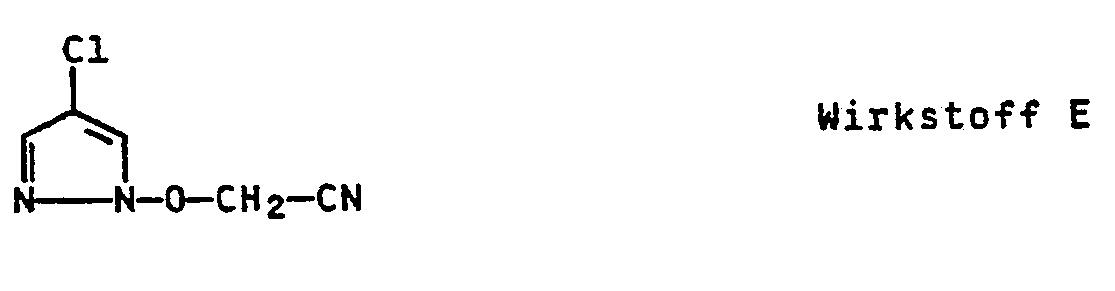
In den Anwendungsbeispielen werden die Wirksamkeiten von erfindungsgemäßen Verbindungen dargelegt. Folgende bekannte Wirkstoffe wurden zu Vergleichszwecken verwendet:


Die Wirkstoffe werden einer für das Wachstum des Pilzes Aspergillus niger optimal geeigneten Nährlösung in Mengen von 100, 75, 50, 25, 10, 5 und 2,5 Gewichtsteilen pro Million Teile Nährlösung zugesetzt. Es werden jeweils 20 ml der so behandelten Nährlösung in 100 ml Glaskolben mit 0,3 mg Aspergillus-Pilzsporen beimpft. Die Kolben werden 120 Stunden lang bei 36°C erwärmt und anschließend das Ausmaß der Pilzentwicklung, das bevorzugt auf der Nährlösungsoberfläche erfolgt, beurteilt.The active ingredients are added to a nutrient solution which is optimally suitable for the growth of the Aspergillus niger fungus in amounts of 100, 75, 50, 25, 10, 5 and 2.5 parts by weight per million parts of nutrient solution. 20 ml of the nutrient solution treated in this way are inoculated in 100 ml glass flasks with 0.3 mg Aspergillus fungal spores. The flasks are heated at 36 ° C for 120 hours and then the extent of fungal development, which is preferred on the nutrient solution surface, is assessed.
Das Ergebnis des Versuches zeigt, daß beispielsweise die Verbindung 1 bei der Anwendung in der Verdünnung 5 zu 1 Million Gewichtsteile eine sehr gute fungizide Wirkung zeigt (100 %) während die bekannten Wirkstoffe A, B, C bei dieser Verdünnung keine Wirkung zeigen (0 %).The result of the test shows that, for example, compound 1 shows very good fungicidal activity when used in the dilution 5 to 1 million parts by weight (100%), while the known active compounds A, B, C have no effect with this dilution (0% ).
Zur Prüfung der Wirksamkeit gegenüber Pilzen werden die Wirkstoffe einer für das Wachstum der Pilze Paecilomyces variotii, Aureobasidium pullulans und Geotrichum candidans optimal geeigneten Nährlösung in Mengen von 100, 50, 25, 12, 6, 3 und 1,5 Gewichtsteilen pro Million Teile Nährlösung zugesetzt. Jeweils 10 ml Nährlösungs-Wirkstoffgemisch werden in sterile Reagenzgläser gegeben und mit einem Tropfen einer Sporensuspension beimpft, die 106 Konidien bzw. Zellen enthält. Nach 120-stündiger Bebrütung werden aus denjenigen Röhrchen, die kein sichtbares Pilzwachstum zeigen, Proben entnommen und auf Pilznährböden übertragen. In der Tabelle wird die Verdünnungsstufe angegeben, bei welcher nach dem Übertragen einer Probe auf den Nährboden kein Wachstum der Pilze mehr erfolgt.To test the effectiveness against fungi, the active ingredients are added to a nutrient solution which is optimally suitable for the growth of the fungi Paecilomyces variotii, Aureobasidium pullulans and Geotrichum candidans in amounts of 100, 50, 25, 12, 6, 3 and 1.5 parts by weight per million parts of nutrient solution . In each case 10 ml of nutrient solution and active ingredient mixture are placed in sterile test tubes and inoculated with a drop of a spore suspension which contains 10 6 conidia or cells. After incubation for 120 hours, samples are taken from those tubes which show no visible fungal growth and transferred to fungal nutrient media. The table shows the dilution level at which the fungi no longer grow after a sample has been transferred to the nutrient medium.
Das Ergebnis des Versuches zeigt, daß beispielsweise die Verbindungen 1, 2, 3, 4 und 6 bei der Anwendung von 6 ppm eine gute fungizide Wirkung haben, während die gleiche Wirkung mit den Wirkstoffen A, B, C, D und E erst bei 50 ppm erzielt wird.The result of the test shows that, for example, the compounds 1, 2, 3, 4 and 6 have a good fungicidal activity when using 6 ppm, while the same effect with the active compounds A, B, C, D and E only at 50 ppm is achieved.
Die Abtötungswerte gegenüber Bakterien wurden wie folgt ermittelt: Zu je 5 ml einer Verdünnung der Mittel in Wasser wurden 5 ml doppeltkonzentrierter Nährbouillon in sterile Reagenzgläser gegeben und vermischt. Die Versuchansätze enthalten 200, 100, 50, 25, 12, 6 und 3 Gewichtsteile Wirkstoff pro Million Teile Nährbouillon. Durch Zugabe von einem Tropfen 1:10 verdünnter 16 Stunden alter Bouillon-Kulturen der Bakterienarten Staphylococcus aureus, Escherichia coli, Proteus vulgaris bzw. Pseudomonas aeruginosa wurden dann die Röhrchen beimpft und 24 Stunden lang bei 37°C bebrütet. Nach dieser Zeit wurden Proben aus den Röhrchen auf Bakteriennährböden übertragen und diese ebenfalls 24 Stunden lang bei 37°C bebrütet. Diejenige Verdünnungsstufe, bei welcher nach dem Übertragen einer Probe auf den Nährboden keine Bakterienentwicklung mehr erfolgte, ist als Abtötungswert angegeben.The bacterial kill values were determined as follows: 5 ml of a double-diluted nutrient broth were added to 5 ml of a dilution of the agents in water and mixed in sterile test tubes. The test batches contain 200, 100, 50, 25, 12, 6 and 3 parts by weight of active ingredient per million parts of nutrient broth. The tubes were then inoculated by adding a drop of 1:10 diluted 16-hour-old broth cultures of the bacterial species Staphylococcus aureus, Escherichia coli, Proteus vulgaris or Pseudomonas aeruginosa and incubated at 37 ° C. for 24 hours. After this time, samples were transferred from the tubes to bacterial culture media and these were also incubated at 37 ° C. for 24 hours. The dilution level at which no bacterial development occurred after a sample was transferred to the culture medium is given as the kill value.
Das Ergebnis des Versuches zeigt, daß beispielsweise die Verbindungen 1, 2, 3, 4 und 6 bei der Anwendung von 25 ppm eine gute bakterizide Wirkung haben, während die Wirkstoffe C, D und E diese Wirkung erst bei 100 ppm haben.The result of the test shows that, for example, compounds 1, 2, 3, 4 and 6 have a good bactericidal activity when using 25 ppm, while the active compounds C, D and E have this activity only at 100 ppm.
Zur Prüfung der Wirksamkeit gegenüber Grünalgen werden die Wirkstoffe einer für die Vermehrung der einzelligen Grünalge Chlorella vulgaris begünstigenden, phosphatreichen Nährlösung in Mengen von 10, 7,5, 5, 2,5 und 1 Gewichtsteilen pro Million Teile Nährlösung zugesetzt. Jeweils 100 ml Nährlösungswirkstoffgemisch sowie nur Nährlösung (Kontrolle) werden in 300 ml Erlenmeyerkolben gegeben. Die Nährlösung wird vor dem Wirkstoffzusatz mit einer Suspension der Alge Chlorella vulgaris beimpft; die Zelldichte wird auf 106 Zellen/ml Nährlösung eingestellt. Nach 14-tägiger Aufstellung der Versuchsansätze bei Raumtemperatur und Lichtzutritt wird die Wirksamkeit beurteilt.To test the effectiveness against green algae, the active ingredients are added to a phosphate-rich nutrient solution which promotes the growth of the unicellular green algae Chlorella vulgaris in amounts of 10, 7.5, 5, 2.5 and 1 part by weight per million parts of nutrient solution. 100 ml of nutrient solution mixture and only nutrient solution (control) are placed in 300 ml Erlenmeyer flasks. Before the active ingredient is added, the nutrient solution is inoculated with a suspension of the algae Chlorella vulgaris; the cell density is adjusted to 10 6 cells / ml nutrient solution. After setting up the test batches at room temperature and access to light for 14 days, the effectiveness is assessed.
Das Ergebnis des Versuches zeigt, daß beispielsweise die Verbindung 1 bei der Anwendung von 2,5 ppm eine gute Wirkung gegen Algen hat.The result of the test shows that, for example, compound 1 has a good activity against algae when 2.5 ppm is used.
Einer gegenüber Mikroorganismen stark anfälligen wäßrigen Dispersion auf Basis eines Polyacrylesters wird der Wirkstoff 1, gelöst in Propylenglykol, in Mengen von 0,1, 0,05, 0,025, 0,01, 0,005, 0,0025 und 0,001 %, bezogen auf das Gewicht der Dispersion, zugesetzt. Danach werden die Versuchsansätze, jeweils 100 ml, mit einer Mikroorganismensuspension beimpft, die als Keime Staphylococcus aureus, Escherichia coli, Pseudomonas aeruginosa, Proteus vulgaris, Aspergillus niger, Penicillium funiculosum, Geotrichum candidans und Rhodotorula rubra enthält. Die Keimdichte in der beimpften Dispersion liegt zwischen 106 und 107 Keime/ml. Nach einer Bebrütungsdauer von 21 Tagen bei 25°C werden aus den Versuchsansätzen Proben für das Wachstum von Bakterien, Schimmel- und Hefepilzen geeignete Agar-Nährmedien übertragen und diese 3 bzw. 7 Tage bebrütet, um noch lebensfähige Keime nachzuweisen:An active ingredient 1, dissolved in propylene glycol, in an amount of 0.1, 0.05, 0.025, 0.01, 0.005, 0.0025 and 0.001%, based on the weight, of an aqueous dispersion based on a polyacrylic ester, which is highly susceptible to microorganisms added to the dispersion. The test batches, each 100 ml, are then inoculated with a microorganism suspension which contains Staphylococcus aureus, Escherichia coli, Pseudomonas aeruginosa, Proteus vulgaris, Aspergillus niger, Penicillium funiculosum, Geotrichum candidans and Rhodotorula rubra as germs. The germ density in the inoculated dispersion is between 10 6 and 10 7 germs / ml. After a incubation period of 21 days at 25 ° C, samples from the test batches are transferred to agar culture media suitable for the growth of bacteria, mold and yeast and incubated for 3 or 7 days in order to detect viable germs:
Dieser Versuch zeigt, daß bereits 0,005 % Wirkstoff 1 ausreichen, um eine wäßrige Polyacrylester-Dispersion gegenüber Mikroorganismenbefall zu konservieren.This experiment shows that 0.005% of active ingredient 1 is already sufficient to preserve an aqueous polyacrylic ester dispersion against attack by microorganisms.
Claims (6)


Priority Applications (1)
| Application Number | Priority Date | Filing Date | Title |
|---|---|---|---|
| AT87108760T ATE57917T1 (en) | 1986-06-19 | 1987-06-19 | HYDROXIPYRAZOLE DERIVATIVES - PROCESSES FOR THEIR PRODUCTION AND USE AGAINST MICROORGANISMS. |
Applications Claiming Priority (2)
| Application Number | Priority Date | Filing Date | Title |
|---|---|---|---|
| DE19863620579 DE3620579A1 (en) | 1986-06-19 | 1986-06-19 | HYDROXYPYRAZOLE DERIVATIVES - METHOD FOR THE PRODUCTION THEREOF AND THEIR USE AGAINST MICROORGANISMS |
| DE3620579 | 1986-06-19 |
Publications (2)
| Publication Number | Publication Date |
|---|---|
| EP0249977A1 EP0249977A1 (en) | 1987-12-23 |
| EP0249977B1 true EP0249977B1 (en) | 1990-10-31 |
Family
ID=6303279
Family Applications (1)
| Application Number | Title | Priority Date | Filing Date |
|---|---|---|---|
| EP87108760A Expired - Lifetime EP0249977B1 (en) | 1986-06-19 | 1987-06-19 | Hydroxypyrazole derivatives, process for their preparation and their use against microbes |
Country Status (11)
| Country | Link |
|---|---|
| US (1) | US4764527A (en) |
| EP (1) | EP0249977B1 (en) |
| JP (1) | JPS6333367A (en) |
| AT (1) | ATE57917T1 (en) |
| AU (1) | AU592195B2 (en) |
| CA (1) | CA1283118C (en) |
| DE (2) | DE3620579A1 (en) |
| ES (1) | ES2018208B3 (en) |
| GR (1) | GR3001310T3 (en) |
| NZ (1) | NZ220772A (en) |
| ZA (1) | ZA874385B (en) |
Families Citing this family (13)
| Publication number | Priority date | Publication date | Assignee | Title |
|---|---|---|---|---|
| DE3820738A1 (en) * | 1988-06-18 | 1989-12-21 | Basf Ag | METHOD FOR PRODUCING N-HYDROXYPYRAZOLES |
| US5292762A (en) * | 1988-06-22 | 1994-03-08 | Rohm And Haas Company | Halopropargyl compounds, compositions, uses and processes of preparation |
| DE3905948A1 (en) * | 1989-02-25 | 1990-08-30 | Basf Ag | SUBSTITUTED N-HYDROXYPYRAZOLES AND FUNGICIDES THAT CONTAIN THESE COMPOUNDS |
| CA2010715C (en) * | 1989-03-03 | 1999-07-06 | Hans-Juergen Neubauer | Substituted n-hydroxypyrazoles and n-hydroxytriazoles for controlling pests |
| CA2019162A1 (en) * | 1989-06-22 | 1990-12-22 | Adam Chi-Tung Hsu | Halopropargyl compounds, compositions, uses and processes of preparation |
| US5252606A (en) * | 1990-01-22 | 1993-10-12 | Howard Martin | Fortified glutaraldehyde disinfectant |
| US5322856A (en) * | 1990-01-22 | 1994-06-21 | Howard Martin | Fortified glutaraldehyde chemical sterilant/disinfectant |
| DE4013874A1 (en) * | 1990-04-30 | 1991-10-31 | Basf Ag | BIOCIDE N-THIOCYANATOMETHOXI AZAHETEROCYCLEN |
| US5668097A (en) * | 1994-08-12 | 1997-09-16 | The Procter & Gamble Company | Uncomplexed cyclodextrin solutions for odor control on inanimate surfaces |
| DE102005013956A1 (en) * | 2005-03-26 | 2006-09-28 | Lanxess Deutschland Gmbh | Water based BIT / TMAD formulations |
| WO2026013034A1 (en) * | 2024-07-08 | 2026-01-15 | The Provost, Fellows, Foundation Scholars, And The Other Members Of Board Of The College Of The Holy And Undivided Trinity Of Queen Elizabeth, Near Dublin | Alkaline hydrolysis of polyethylene terephthalate using phase transfer catalysis |
| EP4678690A1 (en) * | 2024-07-08 | 2026-01-14 | The Provost, Fellows, Foundation Scholars, & the other members of Board, of the College of the Holy & Undiv. Trinity of Queen Elizabeth near Dublin | Alkaline hydrolysis of polyethylene terephthalate using phase transfer catalysis |
| WO2026013039A1 (en) * | 2024-07-08 | 2026-01-15 | The Provost, Fellows, Foundation Scholars, And The Other Members Of Board, Of The College Of The Holy And Undivided Trinity Of Queen Elizabeth, Near Dublin | Neutral hydrolysis of polyethylene terephthalate using phase transfer catalysis |
Family Cites Families (2)
| Publication number | Priority date | Publication date | Assignee | Title |
|---|---|---|---|---|
| DE3409317A1 (en) * | 1984-03-14 | 1985-09-19 | Basf Ag, 6700 Ludwigshafen | NITRIFICATION-INHIBITING 1-HYDROXIPYRAZOLE DERIVATIVES |
| DE3532880A1 (en) * | 1985-09-14 | 1987-03-26 | Basf Ag | 1,4-DISUBSTITUTED PYRAZOLE DERIVATIVES |
-
1986
- 1986-06-19 DE DE19863620579 patent/DE3620579A1/en not_active Withdrawn
-
1987
- 1987-05-28 CA CA000538216A patent/CA1283118C/en not_active Expired - Lifetime
- 1987-05-29 US US07/055,353 patent/US4764527A/en not_active Expired - Fee Related
- 1987-06-17 JP JP62149316A patent/JPS6333367A/en active Pending
- 1987-06-18 ZA ZA874385A patent/ZA874385B/en unknown
- 1987-06-18 AU AU74462/87A patent/AU592195B2/en not_active Ceased
- 1987-06-19 DE DE8787108760T patent/DE3765853D1/en not_active Expired - Lifetime
- 1987-06-19 ES ES87108760T patent/ES2018208B3/en not_active Expired - Lifetime
- 1987-06-19 NZ NZ220772A patent/NZ220772A/en unknown
- 1987-06-19 AT AT87108760T patent/ATE57917T1/en not_active IP Right Cessation
- 1987-06-19 EP EP87108760A patent/EP0249977B1/en not_active Expired - Lifetime
-
1991
- 1991-01-10 GR GR91400017T patent/GR3001310T3/en unknown
Also Published As
| Publication number | Publication date |
|---|---|
| AU592195B2 (en) | 1990-01-04 |
| ES2018208B3 (en) | 1991-04-01 |
| ZA874385B (en) | 1989-02-22 |
| JPS6333367A (en) | 1988-02-13 |
| CA1283118C (en) | 1991-04-16 |
| ATE57917T1 (en) | 1990-11-15 |
| DE3620579A1 (en) | 1987-12-23 |
| EP0249977A1 (en) | 1987-12-23 |
| AU7446287A (en) | 1987-12-24 |
| GR3001310T3 (en) | 1992-08-31 |
| US4764527A (en) | 1988-08-16 |
| NZ220772A (en) | 1989-06-28 |
| DE3765853D1 (en) | 1990-12-06 |
Similar Documents
| Publication | Publication Date | Title |
|---|---|---|
| DE69518323T2 (en) | OXABOROLE AND THEIR SALTS, AND THEIR USE AS BIOCIDES | |
| EP0512349B1 (en) | Benzothiophene-2-carboxamide-S,S-dioxides | |
| EP0199047B1 (en) | Iodopropargyl ethers, process for their preparation and their use | |
| EP0249977B1 (en) | Hydroxypyrazole derivatives, process for their preparation and their use against microbes | |
| DE2723942A1 (en) | AZOLYL ACETOPHENONE OXIME ETHER | |
| DE3238006A1 (en) | AZOLYL METHYLAMINE, THEIR PRODUCTION AND USE IN MICROBICIDES | |
| EP0130366B1 (en) | Arylalkylimidazolium and triazolium salts, process for their preparation and their use as microbicides | |
| DE2736122A1 (en) | FUNGICIDES | |
| EP0068144B1 (en) | 1,1-diphenyl-2-triazolyl-ethanes, their preparation and their application as fungicides | |
| DD209715A5 (en) | SCHAEDLINGSBEKAEMPFUNGSMITTEL | |
| DE3811302A1 (en) | DERIVATIVES OF TRIAZOLYLMETHYL-CYCLOPROPYL CARBINOL AS A MATERIAL PROTECTIVE | |
| EP0057362B1 (en) | Dibenzofurane derivatives, process for their preparation and their use as fungicides | |
| EP0040740A2 (en) | Aminopropanol derivatives, process for their preparation and their use as fungicides | |
| DE3021551A1 (en) | 4-SUBSTITUTED 1-AZOLYL-1-PHENOXY-3,3-DIMETHYL-BUTAN-2-ONE AND -OLE, METHOD FOR THE PRODUCTION THEREOF AND THEIR USE AS FUNGICIDES | |
| DE3500503C2 (en) | ||
| EP0244509B1 (en) | Agent for combating microbes | |
| DE3145890A1 (en) | AZOLYLVINYLDITHIOACETALE, METHOD FOR THE PRODUCTION THEREOF AND THEIR USE AS FUNGICIDES | |
| EP0081679B1 (en) | Substituted benzylimidazolium salts and microbicides containing them | |
| DE3305203A1 (en) | N-SULFENYLATED HYDANTOINE, A METHOD FOR THE PRODUCTION THEREOF AND THEIR USE AS A MICROBICIDE | |
| DD209717A5 (en) | SCHAEDLINGSBEKAEMPFUNGSMITTEL | |
| EP0094566B1 (en) | Dibenzofuranyloxyalkane-imidazolium salts, process for their preparation and their microbicidal application | |
| EP0209819B1 (en) | 3-(3-iodopropargyloxy)propionitrile, process for its preparation and its use | |
| EP0047850B1 (en) | Use of 4-nitroso-pyrazoles in microbiocidal compositions | |
| EP0001571B1 (en) | Phenylazophenyloxy-triazolyl derivatives and fungicides containing them | |
| DE2628420A1 (en) | (1)-Acyloxy-(1)-phenyl-(2)-triazolyl or imidazolyl-ethane derivs. - fungicides, nematocides and bacteriostats used as plant protection agents |
Legal Events
| Date | Code | Title | Description |
|---|---|---|---|
| PUAI | Public reference made under article 153(3) epc to a published international application that has entered the european phase |
Free format text: ORIGINAL CODE: 0009012 |
|
| AK | Designated contracting states |
Kind code of ref document: A1 Designated state(s): AT BE CH DE ES FR GB GR IT LI NL SE |
|
| 17P | Request for examination filed |
Effective date: 19871112 |
|
| 17Q | First examination report despatched |
Effective date: 19890915 |
|
| GRAA | (expected) grant |
Free format text: ORIGINAL CODE: 0009210 |
|
| AK | Designated contracting states |
Kind code of ref document: B1 Designated state(s): AT BE CH DE ES FR GB GR IT LI NL SE |
|
| REF | Corresponds to: |
Ref document number: 57917 Country of ref document: AT Date of ref document: 19901115 Kind code of ref document: T |
|
| ITF | It: translation for a ep patent filed | ||
| REF | Corresponds to: |
Ref document number: 3765853 Country of ref document: DE Date of ref document: 19901206 |
|
| GBT | Gb: translation of ep patent filed (gb section 77(6)(a)/1977) | ||
| ET | Fr: translation filed | ||
| ITTA | It: last paid annual fee | ||
| PLBE | No opposition filed within time limit |
Free format text: ORIGINAL CODE: 0009261 |
|
| STAA | Information on the status of an ep patent application or granted ep patent |
Free format text: STATUS: NO OPPOSITION FILED WITHIN TIME LIMIT |
|
| 26N | No opposition filed | ||
| REG | Reference to a national code |
Ref country code: GR Ref legal event code: FG4A Free format text: 3001310 |
|
| EAL | Se: european patent in force in sweden |
Ref document number: 87108760.7 |
|
| PGFP | Annual fee paid to national office [announced via postgrant information from national office to epo] |
Ref country code: FR Payment date: 19960528 Year of fee payment: 10 |
|
| PGFP | Annual fee paid to national office [announced via postgrant information from national office to epo] |
Ref country code: SE Payment date: 19960529 Year of fee payment: 10 |
|
| PGFP | Annual fee paid to national office [announced via postgrant information from national office to epo] |
Ref country code: NL Payment date: 19960531 Year of fee payment: 10 |
|
| PGFP | Annual fee paid to national office [announced via postgrant information from national office to epo] |
Ref country code: CH Payment date: 19960607 Year of fee payment: 10 Ref country code: AT Payment date: 19960607 Year of fee payment: 10 |
|
| PGFP | Annual fee paid to national office [announced via postgrant information from national office to epo] |
Ref country code: BE Payment date: 19960613 Year of fee payment: 10 |
|
| PGFP | Annual fee paid to national office [announced via postgrant information from national office to epo] |
Ref country code: GB Payment date: 19960617 Year of fee payment: 10 Ref country code: DE Payment date: 19960617 Year of fee payment: 10 |
|
| PGFP | Annual fee paid to national office [announced via postgrant information from national office to epo] |
Ref country code: ES Payment date: 19960619 Year of fee payment: 10 |
|
| PGFP | Annual fee paid to national office [announced via postgrant information from national office to epo] |
Ref country code: GR Payment date: 19960620 Year of fee payment: 10 |
|
| PG25 | Lapsed in a contracting state [announced via postgrant information from national office to epo] |
Ref country code: GB Free format text: LAPSE BECAUSE OF NON-PAYMENT OF DUE FEES Effective date: 19970619 Ref country code: AT Effective date: 19970619 |
|
| PG25 | Lapsed in a contracting state [announced via postgrant information from national office to epo] |
Ref country code: SE Effective date: 19970620 Ref country code: ES Free format text: LAPSE BECAUSE OF EXPIRATION OF PROTECTION Effective date: 19970620 |
|
| PG25 | Lapsed in a contracting state [announced via postgrant information from national office to epo] |
Ref country code: DE Effective date: 19970623 |
|
| PG25 | Lapsed in a contracting state [announced via postgrant information from national office to epo] |
Ref country code: LI Free format text: LAPSE BECAUSE OF NON-PAYMENT OF DUE FEES Effective date: 19970630 Ref country code: GR Free format text: LAPSE BECAUSE OF NON-PAYMENT OF DUE FEES Effective date: 19970630 Ref country code: CH Free format text: LAPSE BECAUSE OF NON-PAYMENT OF DUE FEES Effective date: 19970630 Ref country code: BE Effective date: 19970630 |
|
| BERE | Be: lapsed |
Owner name: BASF A.G. Effective date: 19970630 |
|
| PG25 | Lapsed in a contracting state [announced via postgrant information from national office to epo] |
Ref country code: NL Effective date: 19980101 |
|
| GBPC | Gb: european patent ceased through non-payment of renewal fee |
Effective date: 19970619 |
|
| REG | Reference to a national code |
Ref country code: CH Ref legal event code: PL |
|
| PG25 | Lapsed in a contracting state [announced via postgrant information from national office to epo] |
Ref country code: FR Free format text: LAPSE BECAUSE OF NON-PAYMENT OF DUE FEES Effective date: 19980227 |
|
| EUG | Se: european patent has lapsed |
Ref document number: 87108760.7 |
|
| NLV4 | Nl: lapsed or anulled due to non-payment of the annual fee |
Effective date: 19980101 |
|
| REG | Reference to a national code |
Ref country code: FR Ref legal event code: ST |
|
| REG | Reference to a national code |
Ref country code: FR Ref legal event code: ST |
|
| REG | Reference to a national code |
Ref country code: ES Ref legal event code: FD2A Effective date: 20000301 |
|
| PG25 | Lapsed in a contracting state [announced via postgrant information from national office to epo] |
Ref country code: IT Free format text: LAPSE BECAUSE OF NON-PAYMENT OF DUE FEES;WARNING: LAPSES OF ITALIAN PATENTS WITH EFFECTIVE DATE BEFORE 2007 MAY HAVE OCCURRED AT ANY TIME BEFORE 2007. THE CORRECT EFFECTIVE DATE MAY BE DIFFERENT FROM THE ONE RECORDED. Effective date: 20050619 |