EP0249858A2 - Fluoralkylsubstituted quinoline derivatives, their synthesis and use against unwanted plant growth - Google Patents
Fluoralkylsubstituted quinoline derivatives, their synthesis and use against unwanted plant growth Download PDFInfo
- Publication number
- EP0249858A2 EP0249858A2 EP87108325A EP87108325A EP0249858A2 EP 0249858 A2 EP0249858 A2 EP 0249858A2 EP 87108325 A EP87108325 A EP 87108325A EP 87108325 A EP87108325 A EP 87108325A EP 0249858 A2 EP0249858 A2 EP 0249858A2
- Authority
- EP
- European Patent Office
- Prior art keywords
- fluoroalkyl
- formula
- alkyl
- weight
- quinoline derivatives
- Prior art date
- Legal status (The legal status is an assumption and is not a legal conclusion. Google has not performed a legal analysis and makes no representation as to the accuracy of the status listed.)
- Granted
Links
Classifications
-
- C—CHEMISTRY; METALLURGY
- C07—ORGANIC CHEMISTRY
- C07D—HETEROCYCLIC COMPOUNDS
- C07D215/00—Heterocyclic compounds containing quinoline or hydrogenated quinoline ring systems
- C07D215/02—Heterocyclic compounds containing quinoline or hydrogenated quinoline ring systems having no bond between the ring nitrogen atom and a non-ring member or having only hydrogen atoms or carbon atoms directly attached to the ring nitrogen atom
- C07D215/16—Heterocyclic compounds containing quinoline or hydrogenated quinoline ring systems having no bond between the ring nitrogen atom and a non-ring member or having only hydrogen atoms or carbon atoms directly attached to the ring nitrogen atom with hetero atoms or with carbon atoms having three bonds to hetero atoms with at the most one bond to halogen, e.g. ester or nitrile radicals, directly attached to ring carbon atoms
- C07D215/48—Carbon atoms having three bonds to hetero atoms with at the most one bond to halogen
-
- A—HUMAN NECESSITIES
- A01—AGRICULTURE; FORESTRY; ANIMAL HUSBANDRY; HUNTING; TRAPPING; FISHING
- A01N—PRESERVATION OF BODIES OF HUMANS OR ANIMALS OR PLANTS OR PARTS THEREOF; BIOCIDES, e.g. AS DISINFECTANTS, AS PESTICIDES OR AS HERBICIDES; PEST REPELLANTS OR ATTRACTANTS; PLANT GROWTH REGULATORS
- A01N43/00—Biocides, pest repellants or attractants, or plant growth regulators containing heterocyclic compounds
- A01N43/34—Biocides, pest repellants or attractants, or plant growth regulators containing heterocyclic compounds having rings with one nitrogen atom as the only ring hetero atom
- A01N43/40—Biocides, pest repellants or attractants, or plant growth regulators containing heterocyclic compounds having rings with one nitrogen atom as the only ring hetero atom six-membered rings
- A01N43/42—Biocides, pest repellants or attractants, or plant growth regulators containing heterocyclic compounds having rings with one nitrogen atom as the only ring hetero atom six-membered rings condensed with carbocyclic rings
Definitions
- the invention relates to new fluoroalkyl-substituted quinoline derivatives, processes for their preparation, herbicides which contain these compounds as active ingredients, and a process for controlling unwanted vegetation.
- quinoline-8-carboxylic acids for example 3-haloalkyl-7-halogen (5,7-dihalogen) quinoline-8-carboxylic acids, are known from EP-A-0 104 389. However, only 3-bromomethyl-7-chloro (5,7-dichloro) quinoline-8-carboxylic acid and its alkyl esters are described as representatives of this class of compounds.
- R 1 means, besides chlorine, fluorine, hydroxy, for example O ⁇ Na ⁇ , O ⁇ K ⁇ , methoxy, ethoxy, n-propoxy, iso-propoxy, n-butoxy or a radical of the formula wherein R 5 and R 6 are independently methyl, ethyl or n-propyl.
- Preferred radicals R 1 are hydroxyl or the radical of the formula R 2 and R 3 in formula I mean, for example, hydrogen, methyl, ethyl n-propyl, isopropyl or C 1 -C 3 fluoroalkyl, such as fluoromethyl, difluoromethyl, trifluoromethyl, 1-fluoroethyl, 1,1-difluoroethyl, 2,2 Difluoroethyl, 2,2,2-trifluoroethyl, 3,3,3-trifluoro-n-propyl or pentafluoroethyl, where at least one of the radicals R 2 and R 3 is fluoroalkyl.
- the preferred fluoroalkyl radical is trifluoromethyl.
- R 4 in formula I means fluorine, chlorine or bromine, preferably chlorine.
- an inert diluent for example a halogenated hydrocarbon, such as methylene chloride, chloroform, carbon tetrachloride, dichloroethane, trichloroethane, hexachloroethane,
- Chlorinated hydrocarbons and 10-50 equivalents of hydrofluoric acid are preferred as the reaction medium, 80-160 ° C. as the reaction temperature.
- the oxidation of methyl to carboxyl can be carried out in one or more stages. The bromination of the methyl group and subsequent oxidation is preferred.
- the compound with the methyl group in the 8-position is added with a halogenating agent, such as bromine, chlorine, N-bromosuccinimide, N-chlorosuccinimide, N-chloroacetamide, N-bromoacetamide, N-chlorophthalimide or N-bromophthalimide, in the presence of an inert diluent implemented at an elevated temperature, the typical conditions of a radical reaction (presence of radical initiator, exposure) being advantageous but not absolutely necessary.
- a halogenating agent such as bromine, chlorine, N-bromosuccinimide, N-chlorosuccinimide, N-chloroacetamide, N-bromoacetamide, N-chlorophthalimide or N-bromophthalimide
- Inert diluents can be perhalogenated hydrocarbons, such as carbon tetrachloride, hexachloroethane, trifluorotrichloroethane, or chlorinated aromatics, such as chlorobenzene or dichlorobenzene.
- the reaction temperature can be selected between 60 and 180 ° C depending on the diluent; azo compounds such as azobis (isobutyronitrile) or peroxides such as dibenzoyl peroxide are suitable as radical initiators. Diffuse sunlight is sufficient for exposure, but it can be intensified by incandescent lamps.
- Preferred reaction conditions are: chlorobenzene as the reaction medium, temperatures between 80 and 120 ° C, particularly preferably between 90 and 110 ° C, azobis (isobutyronitrile) as a radical initiator.
- the oxidation of 8-bromomethylquinolines to quinoline-8-carboxylic acids is carried out in a conventional manner by reaction with nitric acid in sulfuric acid or in a carboxylic acid such as propionic acid, advantageously at 100 to 140 ° C.
- 2-trifluoromethylquinoline-8-carboxylic acids can be obtained by reacting 2-trifluoromethyl-3,1-benzoxazin-4-ones with enamines according to the method described in Angew. Chem. 85, 505 (1973).
- substituted 2-trifluoromethyl-3,1-benzoxazinones of the formula III obtained from the corresponding anthranilic acids by cyclization with trifluoroacetic anhydride, where R 4 has the meanings given above, with enamines of the formula (IV) in which R 3 denotes G1-C3-alkyl and NR 10 D i- ( Ci -C 3 alkyl) amino, in polar, aprotic solvents such as acetonitrile, dimethylformamide, N-methylpyrrolidone or tetrahydrofuran, at temperatures between -10 ° C and + 50 ° C implemented. Acetonitrile is preferred as solvent and temperatures between 0 ° C and 30 ° C.
- Acetone oxime ester of 3-trifluoromethyl-7-chloroquinoline-8-carboxylic acid (No. 2 in Tab. 1) 3.65 g (50 mmol) of acetone oxime and 7.9 g (0.1 mol) of pyridine are added to a solution of 16.7 g (50 mmol) of the acid fluoride obtained in la) in 100 ml of 1,1,1-trichloroethane, followed by 3 Stirred at 70 ° C for hours. After cooling, it is extracted with 5% hydrochloric acid, deacidified with sodium bicarbonate solution, dried over magnesium sulfate and concentrated. The remaining oily residue becomes crystalline after stirring with diethyl ether; Mp: 105-107 ° C; Yield: 8.5 g (51%).
- 6-chloroanthranilic acid is acylated with trifluoroacetic anhydride and cyclized with boiling acetic anhydride.
- Example 5 2,3-bis (trifluoromethyl) -7-chloro-quinoline-8-carboxylic acid No. 5 in Table 1)
- Hasteloy-C stirred autoclave with a capacity of 0.5 l, 50 g of 7-chloro-8-methylquinoline-2,3-dicarboxylic acid, 120 ml of methylene chloride, 45 g of hydrofluoric acid and 190 g of sulfuric tetrafluoride are heated to 120 ° C. for 10 hours. After cooling, the mixture is poured into ice water, shaken out with methylene chloride and the solvent is removed on a rotary evaporator after drying.
- the crude product is filtered adsorptively with pentane over silica gel; 34.8 g (58%) of 2,3-bis (trifluoromethyl) -7-chloro-8-methylquinoline with a melting point of 70-73 ° C. are isolated.
- the fluoroalkyl-substituted quinoline derivatives of the formula I can be, for example, in the form of directly sprayable solutions, powders, suspensions, also high-strength aqueous, oily or other suspensions or dispersions, emulsions, oil dispersions, pastes, dusts, sprays or granules by spraying, atomizing, dusting, scattering or Pouring can be applied.
- the application forms depend entirely on the purposes; in any case, they should ensure the finest possible distribution of the active compounds according to the invention.
- strongly polar solvents such as N, N-dimethylformamide, dimethyl sulfoxide, N-methylpyrrolidone or water .
- Aqueous use forms can be prepared from emulsion concentrates, dispersions, pastes, wettable powders or water-dispersible granules by adding water.
- the substrates as such or dissolved in an oil or solvent can be homogenized in water by means of wetting agents, adhesives, dispersants or emulsifiers.
- wetting agents, adhesives, dispersants or emulsifiers, and possibly solvents or oil can also be prepared from active substance and are suitable for dilution with water.
- Powders, materials for broadcasting and dusts can be prepared by mixing or grinding the active substances together with a solid carrier.
- Granules e.g. Coated, impregnated and homogeneous granules can be produced by binding the active ingredients to solid carriers.
- Solid carriers are mineral soils such as silica gel, silicas, silica gels, silicates, talc, kaolin, limestone, lime, chalk, bolus, loess, clay, dolomite, diatomaceous earth, calcium and magnesium sulfate, magnesium oxide, ground plastics, fertilizers such as ammonium sulfate, ammonium phosphate, Ammonium nitrate, ureas and vegetable products, such as cereal flour, tree bark, wood and nutshell flour, cellulose powder or other solid carriers.
- the formulations contain between 0.1 and 95% by weight, preferably between 0.5 and 90% by weight, of active ingredient.
- the active ingredients or agents can be applied pre-emergence or post-emergence. If the active ingredients are less compatible with the crop, application techniques can also be used in which the herbicidal compositions are sprayed with the aid of sprayers in such a way that the leaves of the sensitive crops are not hit as far as possible, while the active ingredients are more undesirable on the leaves below Plants or the uncovered floor area (post-directed, lay-by).
- the active compound application rates are preferably 0.05 to 5 kg / ha, preferably 0.05 to 3 kg / ha.
- test plants are first grown to a height of 3 to 15 cm, depending on the growth form, and then treated.
- post-emergence treatment either plants that have been sown directly and grown in the same containers are selected, or they are first grown separately as seedlings in seed trays and transplanted into the test containers a few days before the treatment. There is no cover during post-emergence treatment.
- the application rates for post-emergence treatment are, for example, 3.0 and 0.5 kg of active ingredient / ha.
- test vessels are set up in the greenhouse, warmer areas (20 to 35 ° C.) for heat-loving species and 10 to 20 ° C. for those more moderate climates are preferred.
- the trial period extends up to 4 weeks.
- the plants are cared for and their response to the individual treatments is evaluated. It is rated on a scale from 0 to 100. 0 means no damage or normal emergence and 100 means no emergence of the plants or complete destruction of at least the aerial parts.
- the plants used in the greenhouse experiments consist of the following types:
- the compound 3-bromomethyl-7-chloro-quinoline-8-carboxylic acid (A) known from EP-A-0 104 389 serves as a comparative agent.
- compound no. 1 When used pre-emergence, compound no. 1 is significantly more active than carrot as indicator plants as comparative agent A (Tab. 1). Carrots are very sensitive bioindicators for herbicidal quinoline carboxylic acids and are suitable for their biological detection (Characteristics of the new Herbicides BAS 518 H, 1985 British Crop Protection Conference - Weeds 63-70. In addition, compound No. 1 combats undesired broad-leafed weeds, such as Ipomoea, when used pre-emergence Species, selective in soy (Tab. 2).
- compound no. 2 combats broad-leaved undesirable plants without damaging the cereal type of oats (table 3).
- compound no. 1 is also more effective against undesired broad-leaved plants than comparative agent A (table 4); Wheat and corn as example crops are not harmed.
- test results can be found in the following tables:
- the quinoline derivatives according to the invention or agents containing them can also be used in a further large number of crop plants for eliminating undesired plant growth.
- the following crops can be considered:
- the quinoline derivatives of the formula I can be mixed with numerous representatives of other herbicidal or growth-regulating active compound groups and applied together.
- quinoline derivatives of the formula I alone or in combination with other herbicides, mixed with other crop protection agents, for example with agents for controlling pests or phytopathogenic fungi or bacteria.
- miscibility with mineral salt solutions which are used to correct nutritional and trace element deficiencies such as Ammonium sulfate can be used.
- Wetting agents (surfactants) and non-phytotoxic oils and oil concentrates can also improve herbicidal activity.
Landscapes
- Chemical & Material Sciences (AREA)
- Organic Chemistry (AREA)
- Life Sciences & Earth Sciences (AREA)
- Agronomy & Crop Science (AREA)
- Pest Control & Pesticides (AREA)
- Plant Pathology (AREA)
- Health & Medical Sciences (AREA)
- Engineering & Computer Science (AREA)
- Dentistry (AREA)
- General Health & Medical Sciences (AREA)
- Wood Science & Technology (AREA)
- Zoology (AREA)
- Environmental Sciences (AREA)
- Agricultural Chemicals And Associated Chemicals (AREA)
Abstract
Fluoralkylsubstituierte Chinolinderivate der Formel
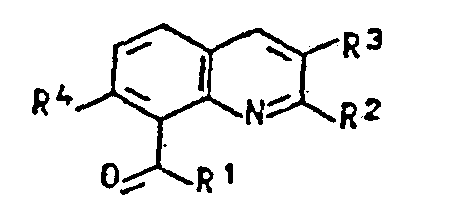
- R1 für Chlor, Fluor, Hydroxy, O⊖Met⊕, C1-C4-Alkoxy oder einen Rest der Formel

- R2, R3 unabhängig voneinander für Wasserstoff, Alkyl, Fluoralkyl und
- R4 für Fluor, Chlor oder Brom stehen, mit der Massgabe, dass mindestens einer der Reste R2 und R3 Fluoralkyl bedeutet, Verfahren zu ihrer Herstellung, Herbizide, die diese Verbindungen als Wirkstoffe enthalten, sowie ihre Verwendung zur Bekämpfung unerwünschten Pflanzenwuchses.
- R 1 for chlorine, fluorine, hydroxy, O⊖Met⊕, C 1 -C 4 alkoxy or a radical of the formula
- R 2 , R 3 independently of one another for hydrogen, alkyl, fluoroalkyl and
- R 4 represents fluorine, chlorine or bromine, with the proviso that at least one of the radicals R 2 and R 3 is fluoroalkyl, processes for their preparation, herbicides which contain these compounds as active compounds, and their use for controlling unwanted vegetation.
Description
Die Erfindung betrifft neue fluoralkylsubstituierte Chinolinderivate, Verfahren zu ihrer Herstellung, Herbizide, die diese Verbindungen als Wirkstoffe enthalten, sowie ein Verfahren zur Bekämpfung unerwünschten Pflanzenwuchses.The invention relates to new fluoroalkyl-substituted quinoline derivatives, processes for their preparation, herbicides which contain these compounds as active ingredients, and a process for controlling unwanted vegetation.
Herbizid wirksame Chinolin-8-carbonsäuren, beispielsweise 3-Halogenalkyl-7-halogen(5,7-dihalogen)chinolin-8-carbonsäuren, sind aus EP-A-0 104 389 bekannt. Als Vertreter dieser Verbindungsklasse sind aber nur 3-Brommethyl-7-chlor(5,7-dichlor)chinolin-8-carbonsäure und deren Alkylester beschrieben.Herbicidally active quinoline-8-carboxylic acids, for example 3-haloalkyl-7-halogen (5,7-dihalogen) quinoline-8-carboxylic acids, are known from EP-A-0 104 389. However, only 3-bromomethyl-7-chloro (5,7-dichloro) quinoline-8-carboxylic acid and its alkyl esters are described as representatives of this class of compounds.
Es wurde nun gefunden, daß fluoralkylsubstituierte Chinolinderivate der Formel I

- R1 für Chlor, Fluor, Hydroxy, O⊖Met⊕, C1-C4-Alkoxy oder einen Rest der Formel

- R 2, R 3 unabhängig voneinander für Wasserstoff, CI-C3-Alkyl, C1-C3-Fluoralkyl und
- R 4 für Fluor, Chlor oder Brom stehen, wobei
- Met⊕ ein Alkalimetallion und
- R 5, R 6 unabhängig voneinander C1-C3-Alkyl bedeuten,
mit der Maßgabe, daß mindestens einer der Reste R2 und R3 C1-C3-Fluoralkyl bedeutet,
herbizid wirksamer und gegenüber wichtigen Kulturpflanzen selektiver sind als die aus EP-A-0 104 389 bekannten 3-Brommethyl-chinolinderivate.It has now been found that fluoroalkyl-substituted quinoline derivatives of the formula I
- R 1 for chlorine, fluorine, hydroxy, O⊖Met⊕, C 1 -C 4 alkoxy or a radical of the formula
- R 2 , R 3 independently of one another for hydrogen, C I -C 3 alkyl, C 1 -C 3 fluoroalkyl and
- R 4 represents fluorine, chlorine or bromine, where
- Met⊕ an alkali metal ion and
- R 5 , R 6 independently of one another are C 1 -C 3 -alkyl,
with the proviso that at least one of the radicals R 2 and R 3 is C 1 -C 3 fluoroalkyl,
are more herbicidally active and more important than important crop plants than the 3-bromomethyl-quinoline derivatives known from EP-A-0 104 389.
In Formel I bedeutet R1 außer Chlor, Fluor, Hydroxy beispielsweise O⊖Na⊕, O⊖K⊕, Methoxy, Ethoxy, n-Propoxy, iso-Propoxy, n-Butoxy oder einen Rest der Formel


R 4 in Formel I bedeutet Fluor, Chlor oder Brom, vorzugsweise Chlor. R 4 in formula I means fluorine, chlorine or bromine, preferably chlorine.
Man erhält die Chinolinderivate der Formel I durch Umsetzung von Verbindungen der Formel II

- R4 die oben angegebenen Bedeutungen hat,
- R9 für Methyl oder Carboxyl und mindestens einer der Substituenten
- R 7 oder R8 für Formyl, Acetyl, Carboxyl, Carboxymethyl, Carboxyethyl oder Formylmethyl steht und gegebenenfalls der andere Substituent Wasserstoff oder Ci-C3-Alkyl bedeutet,
mit Schwefeltetrafluorid, wobei im Falle von R9 = Methyl eine anschließende Oxidation zu Carboxyl erfolgt.The quinoline derivatives of the formula I are obtained by reacting compounds of the formula II
- R 4 has the meanings given above,
- R 9 is methyl or carboxyl and at least one of the substituents
- R 7 or R 8 represents formyl, acetyl, carboxyl, carboxymethyl, carboxyethyl or formylmethyl and optionally the other substituent is hydrogen or C i -C 3 alkyl,
with sulfur tetrafluoride, where in the case of R 9 = methyl there is a subsequent oxidation to carboxyl.
Die Reaktion mit Schwefeltetrafluorid, durch welche die Struktur C-OH in C-F und C=0 in CF2 überführt wird, wird in Gegenwart eines inerten Verdünnungsmittels, beispielsweise eines halogenierten Kohlenwasserstoffs, wie Methylenchlorid, Chloroform, Tetrachlorkohlenstoff, Dichlorethan, Trichlorethan, Hexachlorethan, Trifluortrichlorethan, oder eines Aromaten, wie Benzol, Chlorbenzol, Toluol, in Gegenwart von 0 bis 100 Äquivalenten Fluorwasserstoffsäure, mit 1 bis 20 Äquivalenten Schwefeltetrafluorid unter erhöhtem Druck und erhöhter Temperatur durchgeführt. Bevorzugt sind chlorierte Kohlenwasserstoffe und 10 - 50 Äquivalente Fluorwasserstoffsäure als Reaktionsmedium, 80-160°C als Reaktionstemperatur. Die Oxidation von Methyl zu Carboxyl kann ein- oder mehrstufig erfolgen. Bevorzugt ist die Bromierung der Methylgruppe und anschließende Oxidation.The reaction with sulfur tetrafluoride, through which the structure C-OH is converted into CF and C = 0 into CF 2 , is carried out in the presence of an inert diluent, for example a halogenated hydrocarbon, such as methylene chloride, chloroform, carbon tetrachloride, dichloroethane, trichloroethane, hexachloroethane, trifluorotrichloroethane , or an aromatic, such as benzene, chlorobenzene, toluene, in the presence of 0 to 100 equivalents of hydrofluoric acid, with 1 to 20 equivalents of sulfur tetra fluoride carried out under increased pressure and temperature. Chlorinated hydrocarbons and 10-50 equivalents of hydrofluoric acid are preferred as the reaction medium, 80-160 ° C. as the reaction temperature. The oxidation of methyl to carboxyl can be carried out in one or more stages. The bromination of the methyl group and subsequent oxidation is preferred.
Dazu wird die Verbindung mit der Methylgruppe in 8-Stellung mit einem Halogenierungsmittel, wie Brom, Chlor, N-Bromsuccinimid, N-Chlorsuccinimid, N-Chloracetamid, N-Bromacetamid, N-Chlorphthalimid oder N-Bromphthalimid, in Gegenwart eines inerten Verdünnungsmittels bei erhöhter Temperatur umgesetzt, wobei die typischen Bedingungen einer Radikalreaktion (Anwesenheit von Radikalstarter, Belichtung) vorteilhaft, aber nicht zwingend notwendig sind.The compound with the methyl group in the 8-position is added with a halogenating agent, such as bromine, chlorine, N-bromosuccinimide, N-chlorosuccinimide, N-chloroacetamide, N-bromoacetamide, N-chlorophthalimide or N-bromophthalimide, in the presence of an inert diluent implemented at an elevated temperature, the typical conditions of a radical reaction (presence of radical initiator, exposure) being advantageous but not absolutely necessary.
Inerte Verdünnungsmittel können perhalogenierte Kohlenwasserstoffe, wie Tetrachlormethan, Hexachlorethan, Trifluortrichlorethan, oder chlorierte Aromaten, wie Chlorbenzol oder Dichlorbenzol, sein. Die Reaktionstemperatur kann je nach Verdünnungsmittel zwischen 60 und 180°C gewählt werden; als Radikalstarter sind Azoverbindungen, wie Azobis(isobutter- säurenitril), oder Peroxide, wie Dibenzoylperoxid, geeignet. Zur Belichtung genügt diffuses Sonnenlicht, es kann jedoch durch Glühlampen verstärkt werden.Inert diluents can be perhalogenated hydrocarbons, such as carbon tetrachloride, hexachloroethane, trifluorotrichloroethane, or chlorinated aromatics, such as chlorobenzene or dichlorobenzene. The reaction temperature can be selected between 60 and 180 ° C depending on the diluent; azo compounds such as azobis (isobutyronitrile) or peroxides such as dibenzoyl peroxide are suitable as radical initiators. Diffuse sunlight is sufficient for exposure, but it can be intensified by incandescent lamps.
Bevorzugte Reaktionsbedingungen sind: Chlorbenzol als Reaktionsmedium, Temperaturen zwischen 80 und 120°C, besonders bevorzugt zwischen 90 und 110°C, Azobis(isobuttersäurenitril) als Radikalstarter.Preferred reaction conditions are: chlorobenzene as the reaction medium, temperatures between 80 and 120 ° C, particularly preferably between 90 and 110 ° C, azobis (isobutyronitrile) as a radical initiator.
Die Oxidation von 8-Brommethylchinolinen zu Chinolin-8-carbonsäuren erfolgt in an sich üblicher Weise durch Umsetzung mit Salpetersäure in Schwefelsäure oder in einer Carbonsäure wie Propionsäure, zweckmäßigerweise bei 100 bis 140°C.The oxidation of 8-bromomethylquinolines to quinoline-8-carboxylic acids is carried out in a conventional manner by reaction with nitric acid in sulfuric acid or in a carboxylic acid such as propionic acid, advantageously at 100 to 140 ° C.
2-Trifluormethylchinolin-8-carbonsäuren lassen sich durch Umsetzung von 2-Trifluormethyl-3,1-benzoxazin-4-onen mit Enaminen gemäß dem in Angew. Chem. 85, 505 (1973) beschriebenen Verfahren erhalten. Dazu werden substituierte 2-Trifluormethyl-3,1-benzoxazinone der Formel III, erhalten aus den entsprechenden Anthranilsäuren durch Cyclisierung mit Trifluoressigsäureanhydrid,


Die folgenden Beispiele sollen die Erfindung erläutern, ohne sie einzuschränken.The following examples are intended to illustrate the invention without restricting it.
la) Zu einer Lösung von 58 g (0.23 mol) 7-Chlorchinolin-3,8-dicarbonsäure in 200 ml Methylenchlorid gibt man in einem Hasteloy-C-Rührautoklaven (1.2 1 Fassungsvermögen) 120 g Fluorwasserstoffsäure und 140 g Schwefeltetrafluorid und läßt 10 Stunden bei 120°C rühren. Nach dem Abkühlen werden die flüchtigen Bestandteile am Rotationsdampfer abgezogen. Der Rückstand wird auf Eis gegossen und mit Methylenchlorid extrahiert. Ein unlöslicher Feststoff wird durch Filtration abgetrennt und verworfen. Nach Trocknung der Methylenchloridphase über Magnesiumsulfat wird das Lösungsmittel abgedampft und der erhaltene Rückstand wird aus n-Hexan umkristallisiert. Man erhält 27 g (42%) 3-Trifluormethyl-7-chlorchinolin-8-carbonsäurefluorid vom Schmp. 98 - 99°C.la) 120 g of hydrofluoric acid and 140 g of sulfuric tetrafluoride are added to a solution of 58 g (0.23 mol) of 7-chloroquinoline-3,8-dicarboxylic acid in 200 ml of methylene chloride in a Hasteloy-C stirred autoclave (1.2 1 capacity) and the mixture is left for 10 hours Stir at 120 ° C. After cooling, the volatile components are removed on a rotary steamer. The residue is poured onto ice and extracted with methylene chloride. An insoluble solid is separated off by filtration and discarded. After drying the methylene chloride phase over magnesium sulfate, the solvent is evaporated off and the residue obtained is recrystallized from n-hexane. 27 g (42%) of 3-trifluoromethyl-7-chloroquinoline-8-carboxylic acid fluoride with a melting point of 98-99 ° C. are obtained.
lb) 10 g (36 mmol) des unter a) erhaltenen Säurefluorids werden mit 70 ml 5 %iger Natronlauge zusammengegeben und 5 Min. bei 100°C gerührt. Nach Filtration von ungelösten Bestandteilen wird das Filtrat mit konz. Salzsäure angesäuert (pH 3). Der ausfallende Feststoff wird durch Absaugen isoliert und mit Wasser gewaschen. Nach dem Trocknen bei 50°C unter vermindertem Druck erhält man 7,4 g (75%) 3-Trifluormethyl-7-chlorchinolin-8-carbonsäure vom Schmp. 250°C.Ib) 10 g (36 mmol) of the acid fluoride obtained under a) are combined with 70 ml of 5% sodium hydroxide solution and stirred at 100 ° C. for 5 minutes. After filtration of undissolved components, the filtrate is concentrated with. Acidified hydrochloric acid (pH 3). The solid which precipitates is isolated by suction and washed with water. After drying at 50 ° C. under reduced pressure, 7.4 g (75%) of 3-trifluoromethyl-7-chloroquinoline-8-carboxylic acid with a melting point of 250 ° C. are obtained.
Acetonoximester von 3-Trifluormethyl-7-chlor-chinolin-8-carbonsäure (Nr. 2 in Tab. 1) Zu einer Lösung von 16.7 g (50 mmol) des unter la) erhaltenen Säurefluorids in 100 ml 1,1,1-Trichlorethan werden 3,65 g (50 mmol) Acetonoxim und 7.9 g (0,1 mol) Pyridin gegeben und anschließend 3 Std. bei 70°C gerührt. Nach dem Abkühlen wird mit 5%iger Salzsäure extrahiert, mit Natriumhydrogencarbonat-Lösung entsäuert, über Magnesiumsulfat getrocknet und eingengt. Der verbleibende ölige Rückstand wird nach Anrühren mit Diethylether kristallin; Schmp.: 105-107°C; Ausbeute: 8.5 g (51%).Acetone oxime ester of 3-trifluoromethyl-7-chloroquinoline-8-carboxylic acid (No. 2 in Tab. 1) 3.65 g (50 mmol) of acetone oxime and 7.9 g (0.1 mol) of pyridine are added to a solution of 16.7 g (50 mmol) of the acid fluoride obtained in la) in 100 ml of 1,1,1-trichloroethane, followed by 3 Stirred at 70 ° C for hours. After cooling, it is extracted with 5% hydrochloric acid, deacidified with sodium bicarbonate solution, dried over magnesium sulfate and concentrated. The remaining oily residue becomes crystalline after stirring with diethyl ether; Mp: 105-107 ° C; Yield: 8.5 g (51%).
a) 5-Chlor-2-trifluormethyl-3,1-benzoxazin-4-on 6-Chloranthranilsäure wird mit Trifluoressigsäureanhydrid acyliert und mit siedendem Acetanhydrid cyclisiert.a) 5-chloro-2-trifluoromethyl-3,1-benzoxazin-4-one 6-chloroanthranilic acid is acylated with trifluoroacetic anhydride and cyclized with boiling acetic anhydride.
Schmp.: 91-93°C; Ausbeute 86%.Mp: 91-93 ° C; Yield 86%.
b) Zu einer Lösung von 10.0 g(40 mmol) von 5-Chlor-2-trifluormethyl--3,1-benzoxazin-4-on in 50 ml trockenem Acetonitril wird eine Lösung von 5,1 g (40 mmol) 1-Diethylaminobut-l-en in 10 ml Acetonitril bei 0°C getropft. Nach 16 Std. Rühren bei Raumtemperatur wird der ausgefallene Feststoff durch Absaugen isoliert, mit Diethylether gewaschen und in 30 ml Wasser suspendiert. Nach Zugabe von 12 ml 2 N NaOH wird filtriert, das Filtrat wird mit 2 N Salzsäure auf pH 3 angesäuert. Der ausgefallene Feststoff wird isoliert, mit Wasser gewaschen und bei 60°C unter vermindertem Druck getrocknet.b) To a solution of 10.0 g (40 mmol) of 5-chloro-2-trifluoromethyl-3,1-benzoxazin-4-one in 50 ml of dry acetonitrile, a solution of 5.1 g (40 mmol) of 1- Drops of diethylaminobut-l-ene in 10 ml of acetonitrile at 0 ° C. After stirring for 16 hours at room temperature, the precipitated solid is isolated by suction, washed with diethyl ether and suspended in 30 ml of water. After adding 12 ml of 2N NaOH, the mixture is filtered and the filtrate is acidified to pH 3 with 2N hydrochloric acid. The precipitated solid is isolated, washed with water and dried at 60 ° C. under reduced pressure.
Ausbeute: 4.6 g (38%); 178-180'C.Yield: 4.6 g (38%); 178-180'C.
Analog Beispiel 3 wird aus 5-Chlor-2-trifluormethyl-3,1-benzoxazin-4-on und 1-Diethylamino-prop-1-en 2-Trifluormethyl-3-methyl-7-chlor-chinolin-8--carbonsäure hergestellt; Schmp.: 186-188°C; Ausbeute: 41%. Beispiel 5 2,3-Bis(trifluormethyl)-7-chlor-chinolin-8-carbonsäure Nr. 5 in Tab. 1)Analogously to Example 3, 5-chloro-2-trifluoromethyl-3,1-benzoxazin-4-one and 1-diethylamino-prop-1-ene 2-trifluoromethyl-3-methyl-7-chloroquinoline-8 - carboxylic acid produced; M.p .: 186-188 ° C; Yield: 41%. Example 5 2,3-bis (trifluoromethyl) -7-chloro-quinoline-8-carboxylic acid No. 5 in Table 1)
In einem Hasteloy-C Rührautoklaven mit 0.5 1 Fassungsvermögen werden 50 g 7-Chlor-8-methylchinolin-2,3-dicarbonsäure, 120 ml Methylenchlorid, 45 g Fluorwasserstoffsäure und 190 g Schwefeltetrafluorid für 10 Std. auf 120°C erhitzt. Nach Abkühlen wird in Eiswasser gegeben, mit Methylenchlorid ausgeschüttelt und das Lösungsmittel nach Trocknen am Rotationsverdampfer entfernt. Zur Reinigung wird das Rohprodukt mit Pentan über Kieselgel adsorptiv filtriert; man isoliert 34.8 g (58%) 2,3-Bis(trifluormethyl)-7-chlor-8-methylchinolin vom Schmp. 70 - 73°C.In a Hasteloy-C stirred autoclave with a capacity of 0.5 l, 50 g of 7-chloro-8-methylquinoline-2,3-dicarboxylic acid, 120 ml of methylene chloride, 45 g of hydrofluoric acid and 190 g of sulfuric tetrafluoride are heated to 120 ° C. for 10 hours. After cooling, the mixture is poured into ice water, shaken out with methylene chloride and the solvent is removed on a rotary evaporator after drying. For purification, the crude product is filtered adsorptively with pentane over silica gel; 34.8 g (58%) of 2,3-bis (trifluoromethyl) -7-chloro-8-methylquinoline with a melting point of 70-73 ° C. are isolated.
b) 2,3-Bis(trifluormethyl)-8-brommethyl-7-chlorchinolin 3.1 g der Verbindung aus a) werden in 30 ml Chlorbenzol mit 4.45 g N-Bromsuccinimid und 0.2 g Azobis(isobuttersäurenitril) 3 Std. unter Rückfluß erhitzt. Man entfernt das Lösungsmittel am Rotationsverdampfer, versetzt mit Dimethylformamid und gießt auf Wasser. Es kristallisieren 2.85 g (73%) des 8-Brommethylchinolinderivats aus: Schmp.: 62 - 65°C.b) 2,3-bis (trifluoromethyl) -8-bromomethyl-7-chloroquinoline 3.1 g of the compound from a) are refluxed in 30 ml of chlorobenzene with 4.45 g of N-bromosuccinimide and 0.2 g of azobis (isobutyronitrile) for 3 hours. The solvent is removed on a rotary evaporator, mixed with dimethylformamide and poured onto water. 2.85 g (73%) of the 8-bromomethylquinoline derivative crystallize out: mp: 62 ° -65 ° C.
c) 2.4 g 2,3-Bis(trifluormethyl)-8-brommethyl-7-chlorchinolin suspendiert man in 6.8 g Propionsäure und 6.8 g 70 %iger Schwefelsäure und tropft bei 120°C 5.5 g 65 %ige Salpetersäure zu. Nach 2 Std. bei 120°C wird mit Wasser verdünnt, der Niederschlag wird abgesaugt, gewaschen und getrocknet; man isoliert 1,7 g (84%) 2,3-Bis(trifluormethyl)-7-chlorchinolin-8-carbonsäure; Schmp. 108-111°C.c) 2.4 g of 2,3-bis (trifluoromethyl) -8-bromomethyl-7-chloroquinoline are suspended in 6.8 g of propionic acid and 6.8 g of 70% sulfuric acid, and 5.5 g of 65% nitric acid are added dropwise at 120 ° C. After 2 hours at 120 ° C., the mixture is diluted with water, the precipitate is filtered off, washed and dried; 1.7 g (84%) of 2,3-bis (trifluoromethyl) -7-chloroquinoline-8-carboxylic acid are isolated; M.p. 108-111 ° C.
Beispiele für erfindungsgemäße Verbindungen der Formel I sind in der folgenden Tabelle zusammengestellt:

Zur Herstellung von direkt versprühbaren Lösungen, Emulsionen, Pasten oder öldispersionen kommen Mineralölfraktionen von mittlerem bis hohem Siedepunkt, wie Kerosin oder Dieselöl, ferner Kohlenteeröle sowie öle pflanzlichen oder tierischen Ursprungs, aliphatische, cyclische und aromatische Kohlenwasserstoffe, z.B. Toluol, Xylol, Paraffin, Tetrahydronaphthalin, alkylierte Naphthaline oder deren Derivate, Methanol, Ethanol, Propanol, Butanol, Cyclohexanol, Cyclohexanon, Chlorbenzol, Isophoron oder stark polare Lösungsmittel, wie N,N-Dimethylformamid, Dimethylsulfoxid, N-Methylpyrrolidon oder Wasser in Betracht.For the production of directly sprayable solutions, emulsions, pastes or oil dispersions, mineral oil fractions from medium to high boiling points, such as kerosene or diesel oil, furthermore coal tar oils as well as oils of vegetable or animal origin, aliphatic, cyclic and aromatic hydrocarbons, e.g. Toluene, xylene, paraffin, tetrahydronaphthalene, alkylated naphthalenes or their derivatives, methanol, ethanol, propanol, butanol, cyclohexanol, cyclohexanone, chlorobenzene, isophorone or strongly polar solvents, such as N, N-dimethylformamide, dimethyl sulfoxide, N-methylpyrrolidone or water .
Wäßrige Anwendungsformen können aus Emulsionskonzentraten, Dispersionen, Pasten, netzbaren Pulvern oder wasserdispergierbaren Granulaten durch Zusatz von Wasser bereitet werden. Zur Herstellung von Emulsionen, Pasten oder öldispersionen können die Substrate als solche oder in einem öl oder Lösungsmittel gelöst, mittels Netz-, Haft-, Dispergier- oder Emulgiermittel in Wasser homogenisiert werden. Es können aber auch aus wirksamer Substanz Netz-, Haft-, Dispergier- oder Emulgiermittel und eventuell Lösungsmittel oder öl bestehende Konzentrate hergestellt werden, die zur Verdünnung mit Wasser geeignet sind.Aqueous use forms can be prepared from emulsion concentrates, dispersions, pastes, wettable powders or water-dispersible granules by adding water. To prepare emulsions, pastes or oil dispersions, the substrates as such or dissolved in an oil or solvent can be homogenized in water by means of wetting agents, adhesives, dispersants or emulsifiers. However, wetting agents, adhesives, dispersants or emulsifiers, and possibly solvents or oil, can also be prepared from active substance and are suitable for dilution with water.
Als oberflächenaktive Stoffe kommen Alkali-, Erdalkali-, Ammoniumsalze von Ligninsulfonsäure, Naphthalinsulfonsäure, Phenolsulfonsäure, Alkylarylsulfonate, Alkylsulfate, Alkylsulfonate, Alkali- und Erdalkalisalze der Dibutylnaphthalinsulfonsäure, Laurylethersulfat, Fettalkoholsulfate, fettsaure Alkali- und Erdalkalisalze, Salze sulfatierter Hexadecanole, Heptadecanole, Octadecanole, Salze von sulfatiertem Fettalkoholglykolether, Kondensationsprodukte von sulfoniertem Naphthalin und Naphthalinderivaten mit Formaldehyd, Kondensationsprodukte des Naphthalins bzw. der Naphthalinsulfonsäuren mit Phenol und Formaldehyd, Polyoxyethylenoctylphenolether, ethoxyliertes Isooctylphenol, Octylphenol oder Nonylphenol, Alkylphenolpolyglykolether, Tributylphenylpolyglykolether, Alkylarylpolyetheralkohole, Isotridecylalkohol, Fettalkoholethylenoxid-Kondensate, ethoxyliertes Rizinusöl, Polyoxyethylenalkylether, ethoxyliertes Polyoxypropylen, Laurylalkoholpolyglykoletheracetat, Sorbitester, Lignin, Sulfitablaugen oder Methylcellulose in Betracht.Alkali metal, alkaline earth metal, ammonium salts of lignosulfonic acid, naphthalene sulfonic acid, phenol sulfonic acid, alkylarylsulfonates, alkyl sulfates, alkyl sulfonates, alkali metal and alkaline earth metal salts of dibutylnaphthalenesulfonic acid, lauryl ether sulfate, hexadecalecane alkanolates, hexadecalecalane alkanolates, alkali metal sulfate alkaliates, alkali metal sulfate alkali metal salts, fatty acid alkali alkane alkane salts, fatty alkali metal sulfate alkali metal salts, fatty acid alkali alkane alkane salts, fatty acid alkali alkane alkane salts, fatty acid alkali alkane alkane salts, fatty acid alkali alkane alkane alkane salts alkane, alkali metal alkane alkane alkane salts alkane, alkane and alkali metal alkali metal salts, fatty acid alkali metal alkane alkali metal salts, fatty acid alkali alkane alkane salts, fatty acid alkali alkane alkane salts, fatty alkali metal sulfate, lauryl ether alkane salts, fatty acid alkali alkane alkanes, fatty acid alkali alkane alkanes, fatty acid alkali alkane alkanes, fatty acid alkali alkane alkane salts, of sulfated fatty alcohol glycol ethers, condensates of sulfonated naphthalene and naphthalene derivatives with formaldehyde, condensation products of naphthalene or naphthalenesulfonic acids with phenol and formaldehyde, polyoxyethylene octylphenol ethers, ethoxylated isooctylphenol, octylphenol or nonylphenol, alkylphenol polyglycol ethers, tributylphenyl, alkylaryl polyether alcohols, isotridecyl alcohol, fatty alcohol condensates, ethoxylated castor oil, polyoxyethylene alkyl ethers , ethoxylated polyoxy propylene, lauryl alcohol polyglycol ether acetate, sorbitol ester, lignin, sulfite waste liquor or methyl cellulose.
Pulver-, Streu- und Stäubemittel können durch Mischen oder gemeinsames Vermahlen der wirksamen Substanzen mit einem festen Trägerstoff hergestellt werden.Powders, materials for broadcasting and dusts can be prepared by mixing or grinding the active substances together with a solid carrier.
Granulate, z.B. Umhüllungs-, Imprägnierungs- und Homogengranulate können durch Bindung der Wirkstoffe an feste Trägerstoffe hergestellt werden. Feste Trägerstoffe sind Mineralerden wie Silicagel, Kieselsäuren, Kieselgele, Silikate, Talkum, Kaolin, Kalkstein, Kalk, Kreide, Bolus, Löß, Ton, Dolomit, Diatomeenerde, Calcium- und Magnesiumsulfat, Magnesiumoxid, gemahlene Kunststoffe, Düngemittel, wie Ammoniumsulfat, Ammoniumphosphat, Ammoniumnitrat, Harnstoffe und pflanzliche Produkte, wie Getreidemehl, Baumrinden-, Holz- und Nußschalenmehl, Cellulosepulver oder andere feste Trägerstoffe.Granules, e.g. Coated, impregnated and homogeneous granules can be produced by binding the active ingredients to solid carriers. Solid carriers are mineral soils such as silica gel, silicas, silica gels, silicates, talc, kaolin, limestone, lime, chalk, bolus, loess, clay, dolomite, diatomaceous earth, calcium and magnesium sulfate, magnesium oxide, ground plastics, fertilizers such as ammonium sulfate, ammonium phosphate, Ammonium nitrate, ureas and vegetable products, such as cereal flour, tree bark, wood and nutshell flour, cellulose powder or other solid carriers.
Die Formulierungen enthalten zwischen 0,1 und 95 Gew.%, vorzugsweise zwischen 0,5 und 90 Gew.% Wirkstoff.The formulations contain between 0.1 and 95% by weight, preferably between 0.5 and 90% by weight, of active ingredient.
Beispiele für Formulierungen sind:
- I. Man vermischt 90 Gewichtsteile der Verbindung Nr. 2 mit 10 Gewichtsteilen N-Methyl-<?C-pyrrolidon und erhält eine Lösung, die zur Anwendung in Form kleinster Tropfen geeignet ist.
- II. 20 Gewichtsteile der Verbindung Nr. 1 werden in einer Mischung gelöst, die aus 80 Gewichtsteilen Xylol, 10 Gewichtsteilen des Anlagerungsproduktes von 8 bis 10 Mol Ethylenoxid an 1 Mol ölsäure-N-monoethanolamid, 5 Gewichtsteilen Calciumsalz der Dodecylbenzolsulfonsäure und 5 Gewichtsteilen des Anlagerungsproduktes von 40 Mol Ethylenoxid an 1 Mol Ricinusöl besteht. Durch Ausgießen und feines Verteilen der Lösung in 100 000 Gewichtsteilen Wasser erhält man eine wäßrige Dispersion, die 0,02 Gew.% des Wirkstoffs enthält.
- III. 20 Gewichtsteile der Verbindung Nr. 2 werden in einer Mischung gelöst, die aus 40 Gewichtsteilen Cyclohexanon, 30 Gewichtsteilen Isobutanol, 20 Gewichtsteilen des Anlagerungsproduktes von 7 Mol Ethylenoxid an 1 Mol Isooctylphenol und 10 Gewichtsteilen des Anlagerungsproduktes von 40 Mol Ethylenoxid an 1 Mol Ricinusöl besteht. Durch Eingießen und feines Verteilen der Lösung in 100 000 Gewichtsteilen Wasser erhält man eine wäßrige Dispersion, die 0,02 Gew.% des Wirkstoffs enthält.
- IV. 20 Gewichtsteile des Wirkstoffs Nr. 1 werden in einer Mischung gelöst, die aus 25 Gewichtsteilen Cyclohexanon, 65 Gewichtsteilen einer Mineralölfraktion vom Siedepunkt 210 bis 280°C und 10 Gewichtsteilen des Anlagerungsproduktes von 40 Mol Ethylenoxid an 1 Mol Ricinusöl besteht. Durch Eingießen und feines Verteilen der Lösung in 100 000 Gewichtsteilen Wasser erhält man eine wäßrige Dispersion, die 0,02 Gew.% des Wirkstoffs enthält.
- V. 20 Gewichtsteile des Wirkstoffs Nr. 3 werden mit 3 Gewichtsteilen des Natriumsalzes der DiisobutyInaphthalin-°1-sulfonsäure, 17 Gewichtsteilen des Natriumsalzes einer Ligninsulfonsäure aus einer Sulfit-Ablauge und 60 Gewichtsteilen pulverförmigem Kieselsäuregel gut vermischt und in einer Hammermühle vermahlen. Durch feines Verteilen der Mischung in 20 000 Gewichtsteilen Wasser erhält man eine Spritzbrühe, die 0,1 Gew.% des Wirkstoffs enthält.
- VI. 3 Gewichtsteile des Wirkstoffs Nr. 4 werden mit 97 Gewichtsteilen feinteiligem Kaolin vermischt. Man erhält auf diese Weise ein Stäubemittel, das 3 Gew.% des Wirkstoffs enthält.
- VII. 30 Gewichtsteile des Wirkstoffs Nr. 4 werden mit einer Mischung aus 92 Gewichtsteilen pulverförmigem Kieselsäuregel und 8 Gewichtsteilen Paraffinöl, das auf die Oberfläche dieses Kieselsäuregels gesprüht wurde, innig vermischt. Man erhält auf diese Weise eine Aufbereitung des Wirkstoffs mit guter Haftfähigkeit.
- VIII. 20 Gewichtsteile des Wirkstoffs Nr. 1 werden mit 2 Gewichtsteilen Calciumsalz der Dodecylbenzolsulfonsäure, 8 Gewichtsteilen Fettalkohol-polyglykolether, 2 Gewichtsteilen Natriumsalz eines Phenol-Harnstoff-Formaldehyd-Kondensates und 68 Gewichtsteilen eines paraffinischen Mineralöls innig vermischt. Man erhält eine stabile ölige Dispersion.
- IX. 40 Gewichtsteile des Wirkstoffs Nr. 2 werden in 60 Gewichtsteilen einer Mischung, die aus 93 Gew.% Xylol und 7 Gew.% des Anlagerungsproduktes von 8 Mol Ethylenoxid an 1 Mol Nonylphenol besteht, gelöst. Man erhält eine Lösung, die 40 Gew.% des Wirkstoffs enthält.
- I. 90 parts by weight of compound no. 2 are mixed with 10 parts by weight of N-methyl - <? C-pyrrolidone and a solution is obtained which is suitable for use in the form of tiny drops.
- II. 20 parts by weight of compound no. 1 are dissolved in a mixture consisting of 80 parts by weight of xylene, 10 parts by weight of the adduct of 8 to 10 mol of ethylene oxide and 1 mol of oleic acid-N-monoethanolamide, 5 parts by weight of calcium salt of dodecylbenzenesulfonic acid and 5 parts by weight of the adduct of 40 moles of ethylene oxide to 1 mole of castor oil. By pouring the solution into 100,000 parts by weight of water and finely distributing it therein, an aqueous dispersion is obtained which contains 0.02% by weight of the active ingredient.
- III. 20 parts by weight of compound no. 2 are dissolved in a mixture consisting of 40 parts by weight of cyclohexanone, 30 parts by weight of isobutanol, 20 parts by weight of the adduct of 7 mol of ethylene oxide and 1 mol of isooctylphenol and 10 parts by weight of the adduct of 40 mol of ethylene oxide and 1 mol of castor oil. By pouring and finely distributing the solution in 100,000 parts by weight of water give an aqueous dispersion which contains 0.02% by weight of the active ingredient.
- IV. 20 parts by weight of active ingredient No. 1 are dissolved in a mixture consisting of 25 parts by weight of cyclohexanone, 65 parts by weight of a mineral oil fraction with a boiling point of 210 to 280 ° C. and 10 parts by weight of the adduct of 40 moles of ethylene oxide and 1 mole of castor oil. Pouring the solution into 100,000 parts by weight of water and finely distributing it therein gives an aqueous dispersion which contains 0.02% by weight of the active ingredient.
- V. 20 parts by weight of active ingredient No. 3 are mixed well with 3 parts by weight of the sodium salt of diisobutylinaphthalene-1-sulfonic acid, 17 parts by weight of the sodium salt of lignosulfonic acid from a sulfite waste liquor and 60 parts by weight of powdered silica gel and ground in a hammer mill. By finely distributing the mixture in 20,000 parts by weight of water, a spray liquor is obtained which contains 0.1% by weight of the active ingredient.
- VI. 3 parts by weight of active ingredient No. 4 are mixed with 97 parts by weight of finely divided kaolin. In this way a dust is obtained which contains 3% by weight of the active ingredient.
- VII. 30 parts by weight of active ingredient No. 4 are intimately mixed with a mixture of 92 parts by weight of powdered silica gel and 8 parts by weight of paraffin oil which has been sprayed onto the surface of this silica gel. In this way, a preparation of the active ingredient with good adhesiveness is obtained.
- VIII. 20 parts by weight of active ingredient No. 1 are intimately mixed with 2 parts by weight of calcium salt of dodecylbenzenesulfonic acid, 8 parts by weight of fatty alcohol polyglycol ether, 2 parts by weight of sodium salt of a phenol-urea-formaldehyde condensate and 68 parts by weight of a paraffinic mineral oil. A stable oily dispersion is obtained.
- IX. 40 parts by weight of active ingredient No. 2 are dissolved in 60 parts by weight of a mixture consisting of 93% by weight of xylene and 7% by weight of the adduct of 8 moles of ethylene oxide and 1 mole of nonylphenol. A solution is obtained which contains 40% by weight of the active ingredient.
Die Applikation der Wirkstoffe bzw. der Mittel kann im Vorauflaufverfahren oder bei Nachauflaufanwendung erfolgen. Sind die Wirkstoffe für die Kulturpflanze weniger verträglich, so können auch Ausbringungstechniken angewandt werden, bei welchen die herbiziden Mittel mit Hilfe der Spritzgeräte so gespritzt werden, daß die Blätter der empfindlichen Kulturpflanzen nach Möglichkeit nicht getroffen werden, während die Wirkstoffe auf die Blätter darunter wachsender unerwünschter Pflanzen oder die unbedeckte Bodenfläche gelangen (post-directed, lay-by).The active ingredients or agents can be applied pre-emergence or post-emergence. If the active ingredients are less compatible with the crop, application techniques can also be used in which the herbicidal compositions are sprayed with the aid of sprayers in such a way that the leaves of the sensitive crops are not hit as far as possible, while the active ingredients are more undesirable on the leaves below Plants or the uncovered floor area (post-directed, lay-by).
Die Aufwandmengen an Wirkstoff betragen je nach Bekämpfungsziel, Jahreszeit, Zielpflanzen und Wachstumsstadium vorzugsweise 0,05 bis 5 kg/ha, vorzugsweise 0,05 bis 3 kg/ha.Depending on the control target, the season, the target plants and the stage of growth, the active compound application rates are preferably 0.05 to 5 kg / ha, preferably 0.05 to 3 kg / ha.
Die herbizide Wirkung von Verbindungen der Formel I wird durch Gewächshausversuche gezeigt:
- Als Kulturgefäße dienen Plastikblumentöpfe mit 300 cm3 Inhalt und lehmigem Sand mit etwa 3 % Humus als Substrat. Bei Soja werden größere Anteile Torf zugesetzt, um ein besseres Wachstum zu gewährleisten. Die Samen der Testpflanzen werden nach Arten getrennt flach eingesät. Unmittelbar danach werden bei Vorauflaufanwendung die Wirkstoffe auf die Erdoberfläche aufgebracht. Sie werden hierzu in Wasser als Verteilungsmittel suspendiert oder emulgiert und mittels fein verteilender Düsen gespritzt. Die Beispielsaufwandmengen betragen dabei 0,06, 0,125, 0,25 sowie 0,5 kg Wirkstoff/ha. Nach dem Aufbringen der Wirkstoffe werden die Gefäße leicht beregnet, um Keimung und Wachstum in Gang zu bringen. Danach werden die Gefäße mit durchsichtigen Plastikhauben abgedeckt, bis die Pflanzen angewachsen sind. Diese Abdeckung bewirkt ein gleichmäßiges Keimen der Testpflanzen, sofern diese nicht durch die Wirkstoffe beeinträchtigt werden.
- Plastic flower pots with a content of 300 cm 3 and loamy sand with about 3% humus serve as culture vessels. Larger amounts of peat are added to soybeans to ensure better growth. The seeds of the test plants are sown flat according to species. Immediately afterwards, the active ingredients are applied to the surface of the earth in pre-emergence applications. For this purpose, they are suspended or emulsified in water as a distribution medium and sprayed by means of finely distributing nozzles. The example application rates are 0.06, 0.125, 0.25 and 0.5 kg of active ingredient / ha. After the active ingredients have been applied, the vessels are lightly irrigated to start germination and growth. Then the containers are covered with transparent plastic covers until the plants have grown. This cover causes the test plants to germinate evenly, provided they are not adversely affected by the active ingredients.
Für die Nachauflaufbehandlung werden die Testpflanzen je nach Wuchsform erst bis zu einer Wuchshohe von 3 bis 15 cm angezogen und danach behandelt. Zur Nachauflaufbehandlung werden entweder direkt gesäte und in den gleichen Gefäßen aufgewachsene Pflanzen ausgewählt, oder aber sie werden erst als Keimpflanzen in Saatschalen getrennt angezogen und einige Tage vor der Behandlung in die Versuchsgefäße verpflanzt. Eine Abdeckung unterbleibt bei der Nachauflaufbehandlung. Die Aufwandmengen für die Nachauflaufbehandlung betragen beispielsweise 3,0 und 0,5 kg Wirkstoff/ha.For post-emergence treatment, the test plants are first grown to a height of 3 to 15 cm, depending on the growth form, and then treated. For post-emergence treatment, either plants that have been sown directly and grown in the same containers are selected, or they are first grown separately as seedlings in seed trays and transplanted into the test containers a few days before the treatment. There is no cover during post-emergence treatment. The application rates for post-emergence treatment are, for example, 3.0 and 0.5 kg of active ingredient / ha.
Die Versuchsgefäße werden im Gewächshaus aufgestellt, wobei für wärmeliebende Arten wärmere Bereiche (20 bis 35°C) und für solche gmäßigter Klimate 10 bis 20°C bevorzugt werden. Die Versuchsperiode erstreckt sich bis 4 Wochen. Während dieser Zeit werden die Pflanzen gepflegt, und ihre Reaktion auf die einzelnen Behandlungen wird ausgewertet. Bewertet wird nach einer Skala von 0 bis 100. Dabei bedeutet 0 keine Schädigung oder normaler Auflauf und 100 kein Aufgang der Pflanzen bzw. völlige Zerstörung zumindest der oberirdischen Teile.The test vessels are set up in the greenhouse, warmer areas (20 to 35 ° C.) for heat-loving species and 10 to 20 ° C. for those more moderate climates are preferred. The trial period extends up to 4 weeks. During this time, the plants are cared for and their response to the individual treatments is evaluated. It is rated on a scale from 0 to 100. 0 means no damage or normal emergence and 100 means no emergence of the plants or complete destruction of at least the aerial parts.
Die in den Gewächshausversuchen verwendeten Pflanzen setzen sich aus folgenden Arten zusammen:

Bei Vorauflaufanwendung ist die Verbindung Nr. 1 bei Karotten als Indikatorpflanzen wesentlich aktiver als das Vergleichsmittel A (Tab. 1). Karotten sind sehr sensible Bioindikatoren für herbizide Chinolincarbonsäuren und eignen sich zu deren biologischem Nachweis (Characteristics of the new Herbicides BAS 518 H, 1985 British Crop Protection Conference - Weeds 63-70. Außerdem bekämpft Verbindung Nr. 1 bei Vorauflaufanwendung unerwünschte breitblättrige Unkräuter, wie Ipomoea-Arten, selektiv in Soja (Tab. 2).When used pre-emergence, compound no. 1 is significantly more active than carrot as indicator plants as comparative agent A (Tab. 1). Carrots are very sensitive bioindicators for herbicidal quinoline carboxylic acids and are suitable for their biological detection (Characteristics of the new Herbicides BAS 518 H, 1985 British Crop Protection Conference - Weeds 63-70. In addition, compound No. 1 combats undesired broad-leafed weeds, such as Ipomoea, when used pre-emergence Species, selective in soy (Tab. 2).
Bei Nachauflaufanwendung bekämpft die Verbindung Nr. 2 breitblättrige unerwünschte Pflanzen, ohne die Getreideart Hafer zu schädigen (Tab. 3) Verbindung Nr. 1 ist bei Nachauflaufanwendung auch gegen unerwünschte breitblättrige Pflanzen wirksamer als das Vergleichsmittel A (Tab. 4); Weizen und Mais als Beispielskulturen werden dabei nicht geschädigt.When used post-emergence, compound no. 2 combats broad-leaved undesirable plants without damaging the cereal type of oats (table 3). When used post-emergence, compound no. 1 is also more effective against undesired broad-leaved plants than comparative agent A (table 4); Wheat and corn as example crops are not harmed.
Die Testergebnisse sind den folgenden Tabellen zu entnehmen:


In Betracht kommen beispielsweise folgende Kulturen:


Außerdem ist es von Nutzen, die Chinolinderivate der Formel I allein oder in Kombination mit anderen Herbiziden auch noch mit weiteren Pflanzenschutzmitteln gemischt gemeinsam auszubringen, beispielsweise mit Mitteln zur Bekämpfung von Schädlingen oder phytopathogenen Pilzen bzw. Bakterien. Von Interesse ist ferner die Mischbarkeit mit Mineralsalzlösungen, welche zur Behebung von Ernährungs- und Spurenelementmängeln wie z.B. Ammoniumsulfat eingesetzt werden. Netzmittel (Surfactants) und nichtphytotoxische öle und ölkonzentrate können die herbizide Aktivität ebenfalls verbessern.It is also useful to apply the quinoline derivatives of the formula I, alone or in combination with other herbicides, mixed with other crop protection agents, for example with agents for controlling pests or phytopathogenic fungi or bacteria. Also of interest is the miscibility with mineral salt solutions, which are used to correct nutritional and trace element deficiencies such as Ammonium sulfate can be used. Wetting agents (surfactants) and non-phytotoxic oils and oil concentrates can also improve herbicidal activity.
Claims (7)


mit der Maßgabe, daß mindestens einer der Reste R2 und R3 C1-C3-Fluoralkyl bedeutet,1. Fluoroalkyl-substituted quinoline derivatives of the formula
with the proviso that at least one of the radicals R 2 and R 3 is C 1 -C 3 fluoroalkyl,


Applications Claiming Priority (2)
| Application Number | Priority Date | Filing Date | Title |
|---|---|---|---|
| DE3620064 | 1986-06-14 | ||
| DE19863620064 DE3620064A1 (en) | 1986-06-14 | 1986-06-14 | FLUORALKYL-SUBSTITUTED CHINOLINE DERIVATIVES, THEIR PRODUCTION AND USE FOR CONTROLLING UNWANTED PLANT GROWTH |
Publications (3)
| Publication Number | Publication Date |
|---|---|
| EP0249858A2 true EP0249858A2 (en) | 1987-12-23 |
| EP0249858A3 EP0249858A3 (en) | 1988-02-10 |
| EP0249858B1 EP0249858B1 (en) | 1990-12-05 |
Family
ID=6303011
Family Applications (1)
| Application Number | Title | Priority Date | Filing Date |
|---|---|---|---|
| EP87108325A Expired - Lifetime EP0249858B1 (en) | 1986-06-14 | 1987-06-11 | Fluoralkylsubstituted quinoline derivatives, their synthesis and use against unwanted plant growth |
Country Status (4)
| Country | Link |
|---|---|
| US (1) | US4804404A (en) |
| EP (1) | EP0249858B1 (en) |
| CA (1) | CA1297879C (en) |
| DE (2) | DE3620064A1 (en) |
Families Citing this family (3)
| Publication number | Priority date | Publication date | Assignee | Title |
|---|---|---|---|---|
| DE3706792A1 (en) * | 1987-03-03 | 1988-09-15 | Basf Ag | METHOD FOR PRODUCING 7-CHLORINE-CHINOLINE-8-CARBONIC ACID |
| US4933447A (en) * | 1987-09-24 | 1990-06-12 | Ss Pharmaceutical Co., Ltd. | Quinoline derivatives |
| US8106206B2 (en) * | 2009-11-19 | 2012-01-31 | Kyushu University, National University Corporation | Solid luminescent quinoline compounds |
Family Cites Families (3)
| Publication number | Priority date | Publication date | Assignee | Title |
|---|---|---|---|---|
| IT998326B (en) * | 1973-08-06 | 1976-01-20 | Montedison Spa | DERIVATIVES OF QUINOLIN 8 CARBOXYL ACIDS WITH ANTI-PARAS SITARY ACTIVITY |
| US4497651A (en) * | 1982-02-17 | 1985-02-05 | Basf Aktiengesellschaft | Dichloroquinoline derivatives for use as herbicides |
| DE3233089A1 (en) * | 1982-09-07 | 1984-03-08 | Basf Ag, 6700 Ludwigshafen | CHINOLINE DERIVATIVES, METHOD FOR THE PRODUCTION THEREOF AND THEIR USE FOR CONTROLLING UNWANTED PLANT GROWTH |
-
1986
- 1986-06-14 DE DE19863620064 patent/DE3620064A1/en not_active Withdrawn
-
1987
- 1987-06-10 CA CA000539314A patent/CA1297879C/en not_active Expired - Lifetime
- 1987-06-11 DE DE8787108325T patent/DE3766546D1/en not_active Expired - Lifetime
- 1987-06-11 EP EP87108325A patent/EP0249858B1/en not_active Expired - Lifetime
- 1987-06-15 US US07/062,070 patent/US4804404A/en not_active Expired - Fee Related
Also Published As
| Publication number | Publication date |
|---|---|
| CA1297879C (en) | 1992-03-24 |
| US4804404A (en) | 1989-02-14 |
| EP0249858B1 (en) | 1990-12-05 |
| DE3620064A1 (en) | 1987-12-17 |
| DE3766546D1 (en) | 1991-01-17 |
| EP0249858A3 (en) | 1988-02-10 |
Similar Documents
| Publication | Publication Date | Title |
|---|---|---|
| EP0007990B1 (en) | Pyrazole ether derivatives, process for their preparation and herbicides containing them | |
| EP0017931B1 (en) | 4h-3,1-benzoxazine derivatives, methods of their preparation and their use in combating undesirable vegetation | |
| EP0360163B1 (en) | Aromatic carboxylic-acid derivatives and their use in combating the growth of undesirable plants | |
| EP0002180A1 (en) | Substituted 3-aminopyrazoles, herbicides containing them and method for controlling undesirable growth of plants | |
| DE2546251A1 (en) | ALPHA SQUARE BRACKETS ON 4- (5-MONO-SUBSTITUTED- OR 3,5-DISUBSTITUTED-PYRIDYL-2-OXY) PHENOXY SQUARE BRACKETS FOR ALKANECARBONIC ACIDS AND THEIR DERIVATIVES | |
| EP0071794A1 (en) | 5-Amino-1-phenyl-pyrazole-4-carboxylic-acid derivatives, process for their preparation and their use as herbicides | |
| EP0037925B1 (en) | Substituted pyridazinones, process for their preparation, herbicides containing them and their use as herbicides | |
| EP0332009A1 (en) | N-aryl-tetrahydrophthalimide compounds | |
| EP0300387B1 (en) | Phenyl alkenylcarboxylic acids and their esters | |
| EP0135838B1 (en) | 3-phenyl-4-methoxycarbonyl pyrazoles, process for their preparation and their use against plant growth | |
| EP0218233A2 (en) | Cyclohexenon derivatives, process for their preparation and their use in combating the growth of undesirable plants | |
| DE3533440A1 (en) | N-SUBSTITUTED 3,4,5,6-TETRAHYDROPHTHALIMIDES, METHODS FOR THEIR PRODUCTION AND THEIR USE IN PLANT PROTECTION | |
| EP0007089B1 (en) | Acylanilides with herbicidal and fungicidal activity, process for their preparation and their use | |
| EP0249858B1 (en) | Fluoralkylsubstituted quinoline derivatives, their synthesis and use against unwanted plant growth | |
| EP0053699A1 (en) | 2'-Phenyl-hydrazino-2-cyanacrylic-acid esters and herbicides containing them | |
| EP0001751A1 (en) | Derivatives of N-(imidazolylmethyl)-acetanilide, their use as herbicides and method for controlling undesirable growth of plants | |
| EP0090258B1 (en) | 3-chloro-8-cyanoquinolines, process for their preparation and their use to control undesired plant growth | |
| EP0084673B1 (en) | Aminothiadiazoles, process for their preparation and their use in combating unwanted plant growth | |
| EP0401582B1 (en) | Quinoline derivatives condensed with five-membered heterocyclic rings | |
| EP0098440B1 (en) | 3,7-dichloroquinoline derivatives, process for their preparation and their use to prevent undesired plant growth | |
| EP0358108B1 (en) | 5-(n-3,4,5,6-tetrahydrophthalimido)-cinnamic-acid derivatives | |
| EP0144052A2 (en) | Quinolinoxyphenyl ureas, process for their preparation and their use to combat unwanted plant growth | |
| EP0192998B1 (en) | Thiazolyl amides, process for their preparation and their use in combating non-desired plant growth | |
| EP0107123B1 (en) | Aniline derivatives, process for their preparation and their use in combating undesired plant growth | |
| EP0067381B1 (en) | Anilides, process for their preparation and herbicides containing them |
Legal Events
| Date | Code | Title | Description |
|---|---|---|---|
| PUAI | Public reference made under article 153(3) epc to a published international application that has entered the european phase |
Free format text: ORIGINAL CODE: 0009012 |
|
| PUAL | Search report despatched |
Free format text: ORIGINAL CODE: 0009013 |
|
| AK | Designated contracting states |
Kind code of ref document: A2 Designated state(s): DE FR GB IT |
|
| AK | Designated contracting states |
Kind code of ref document: A3 Designated state(s): DE FR GB IT |
|
| 17P | Request for examination filed |
Effective date: 19871223 |
|
| 17Q | First examination report despatched |
Effective date: 19890803 |
|
| GRAA | (expected) grant |
Free format text: ORIGINAL CODE: 0009210 |
|
| AK | Designated contracting states |
Kind code of ref document: B1 Designated state(s): DE FR GB IT |
|
| ITF | It: translation for a ep patent filed | ||
| REF | Corresponds to: |
Ref document number: 3766546 Country of ref document: DE Date of ref document: 19910117 |
|
| GBT | Gb: translation of ep patent filed (gb section 77(6)(a)/1977) | ||
| ET | Fr: translation filed | ||
| ITTA | It: last paid annual fee | ||
| PLBE | No opposition filed within time limit |
Free format text: ORIGINAL CODE: 0009261 |
|
| STAA | Information on the status of an ep patent application or granted ep patent |
Free format text: STATUS: NO OPPOSITION FILED WITHIN TIME LIMIT |
|
| 26N | No opposition filed | ||
| PGFP | Annual fee paid to national office [announced via postgrant information from national office to epo] |
Ref country code: FR Payment date: 19930512 Year of fee payment: 7 |
|
| PGFP | Annual fee paid to national office [announced via postgrant information from national office to epo] |
Ref country code: GB Payment date: 19930601 Year of fee payment: 7 |
|
| PGFP | Annual fee paid to national office [announced via postgrant information from national office to epo] |
Ref country code: DE Payment date: 19930621 Year of fee payment: 7 |
|
| PG25 | Lapsed in a contracting state [announced via postgrant information from national office to epo] |
Ref country code: GB Effective date: 19940611 |
|
| PG25 | Lapsed in a contracting state [announced via postgrant information from national office to epo] |
Ref country code: DE Effective date: 19940624 |
|
| GBPC | Gb: european patent ceased through non-payment of renewal fee |
Effective date: 19940611 |
|
| PG25 | Lapsed in a contracting state [announced via postgrant information from national office to epo] |
Ref country code: FR Effective date: 19950228 |
|
| REG | Reference to a national code |
Ref country code: FR Ref legal event code: ST |
|
| PG25 | Lapsed in a contracting state [announced via postgrant information from national office to epo] |
Ref country code: IT Free format text: LAPSE BECAUSE OF NON-PAYMENT OF DUE FEES;WARNING: LAPSES OF ITALIAN PATENTS WITH EFFECTIVE DATE BEFORE 2007 MAY HAVE OCCURRED AT ANY TIME BEFORE 2007. THE CORRECT EFFECTIVE DATE MAY BE DIFFERENT FROM THE ONE RECORDED. Effective date: 20050611 |