EP0249434B1 - Peptide derivatives and processes for their preparation - Google Patents
Peptide derivatives and processes for their preparation Download PDFInfo
- Publication number
- EP0249434B1 EP0249434B1 EP87305065A EP87305065A EP0249434B1 EP 0249434 B1 EP0249434 B1 EP 0249434B1 EP 87305065 A EP87305065 A EP 87305065A EP 87305065 A EP87305065 A EP 87305065A EP 0249434 B1 EP0249434 B1 EP 0249434B1
- Authority
- EP
- European Patent Office
- Prior art keywords
- alanine
- residue
- phenylalanine
- leucine
- formula
- Prior art date
- Legal status (The legal status is an assumption and is not a legal conclusion. Google has not performed a legal analysis and makes no representation as to the accuracy of the status listed.)
- Expired - Lifetime
Links
- 0 CC(C*)(CC(C)(N)N)O* Chemical compound CC(C*)(CC(C)(N)N)O* 0.000 description 1
Classifications
-
- C—CHEMISTRY; METALLURGY
- C07—ORGANIC CHEMISTRY
- C07K—PEPTIDES
- C07K5/00—Peptides containing up to four amino acids in a fully defined sequence; Derivatives thereof
- C07K5/04—Peptides containing up to four amino acids in a fully defined sequence; Derivatives thereof containing only normal peptide links
- C07K5/06—Dipeptides
- C07K5/06086—Dipeptides with the first amino acid being basic
-
- C—CHEMISTRY; METALLURGY
- C07—ORGANIC CHEMISTRY
- C07K—PEPTIDES
- C07K5/00—Peptides containing up to four amino acids in a fully defined sequence; Derivatives thereof
- C07K5/04—Peptides containing up to four amino acids in a fully defined sequence; Derivatives thereof containing only normal peptide links
- C07K5/08—Tripeptides
- C07K5/0802—Tripeptides with the first amino acid being neutral
- C07K5/0804—Tripeptides with the first amino acid being neutral and aliphatic
- C07K5/0806—Tripeptides with the first amino acid being neutral and aliphatic the side chain containing 0 or 1 carbon atoms, i.e. Gly, Ala
-
- C—CHEMISTRY; METALLURGY
- C07—ORGANIC CHEMISTRY
- C07K—PEPTIDES
- C07K5/00—Peptides containing up to four amino acids in a fully defined sequence; Derivatives thereof
- C07K5/04—Peptides containing up to four amino acids in a fully defined sequence; Derivatives thereof containing only normal peptide links
- C07K5/08—Tripeptides
- C07K5/0802—Tripeptides with the first amino acid being neutral
- C07K5/0804—Tripeptides with the first amino acid being neutral and aliphatic
- C07K5/0808—Tripeptides with the first amino acid being neutral and aliphatic the side chain containing 2 to 4 carbon atoms, e.g. Val, Ile, Leu
-
- C—CHEMISTRY; METALLURGY
- C07—ORGANIC CHEMISTRY
- C07K—PEPTIDES
- C07K5/00—Peptides containing up to four amino acids in a fully defined sequence; Derivatives thereof
- C07K5/04—Peptides containing up to four amino acids in a fully defined sequence; Derivatives thereof containing only normal peptide links
- C07K5/08—Tripeptides
- C07K5/0802—Tripeptides with the first amino acid being neutral
- C07K5/0812—Tripeptides with the first amino acid being neutral and aromatic or cycloaliphatic
-
- A—HUMAN NECESSITIES
- A61—MEDICAL OR VETERINARY SCIENCE; HYGIENE
- A61K—PREPARATIONS FOR MEDICAL, DENTAL OR TOILETRY PURPOSES
- A61K38/00—Medicinal preparations containing peptides
Definitions
- the invention relates to peptide derivatives of the general formula I in which X is H, a C2 to C5 alkanecarbonyl, a C3 to C6 carboxyalkanecarbonyl or a p-toluenesulfonyl, A is a glycine, alanine, leucine, phenylalanine, tyrosine, lysine or arginine residue, B is a glutamine, proline, arginine or lysine residue or a direct chemical bond, n is an integer of from 1 to 3, R1 is H or a C1 to C3 alkyl and R2 is a C1 to C3 alkoxyl or an amino group when C is a peptidically bound glycine, alanine, leucine, phenylalanine, glutamine or serine residue or R2 is a peptidically bound glycine, alanine, leucine, phenylalanine or serine methyl este
- the subject peptides are of possible interest since under the action of proteolytic enzymes present in pathological tissues they decompose to give C-terminal peptide esters or amides of the general formula II in which n and R1 are the same as in formula I and R2 is as defined above when respectively C is an aforementioned amino acid residue or alternatively a hydrogen atom.
- peptide derivatives cyclize spontaneously and so afford spirocyclic peptides of the general formula III in which n and R1 are the same as in formula I, R3 is H, a methyl, an isobutyl, a 2-aminoethyl, a 2-hydroxyethyl or a benzyl and R4 is a hydrogen atom, or R3 jointly with R4 form a di-, tri- or tetramethylene chain.
- Spirocyclic peptides of formula III are partly known, partly new. They are pharmacodynamically active substances that influence different biological systems. Thus, cyclo (L-alanyl-1-amino-1-cyclopentanecarbonyl) shows remarkable effects on the environmental behaviour of experimental animals (I Krejci et al, Activitas neurosa superior, in print) and in certain other pharmacological tests (Czechoslovak author certificate No. 231 227).
- Said spirocyclic peptides are comparatively less soluble, which is disadvantageous in preparing medicinal dosage forms.
- a possible route to overcoming the above obstacle is based on preparing a sufficiently soluble, more hydrophilic precursor compound comprising an additional optionally modified amino acid or lower peptide moiety and affording under pathophysiological conditions, by enzymic cleavage in the affected (eg, infected or inflamed tissue, the respective pharmacodynamically active substance, which is thus immediately liberated in or safely conveyed to the target organ in an amount substantially corresponding to the actual requirement of the organism without untoward effects of possible overdosage and, due to its gradual liberation, elicits the desired effect over a prolonged time period.
- the affected eg, infected or inflamed tissue, the respective pharmacodynamically active substance
- the object of safe, efficient and economical medication with said spirocyclic compounds of formula III is attained with the use of the subject peptide derivatives of formula I as drug precursors (pro-drugs or intermediates).
- the intact, non-cleaved peptide derivative of formula I is physiologically inert and under non-pathological conditions is metabolized and eliminated from the organism without liberating biologically active substances or leaving undesirable residua in healthy tissues.
- Said pathophysiological cleavage of the subject peptide derivatives of formula I is effected at bodily temperature and pH either under the action of certain pure proteolytic enzymes (proteases), eg, trypsin, kallikrein, chymotrypsin, cathepsin G, thrombin, plasmin or "factor X", as well as aminopeptidases, eg, leucinaminopeptidase, or aminodipeptidyl-peptidases, eg, the DAP IV peptidase, or also under the action of native, endogenous enzymic systems of brain, liver, kidney, pancreas, lungs, heart or intestine tissues or of blood serum.
- proteolytic enzymes eg, trypsin, kallikrein, chymotrypsin, cathepsin G, thrombin, plasmin or "factor X”
- aminopeptidases eg, leucinaminopeptidase,
- the structural design of the subject peptide derivatives of formula I was primarily focused on desired negligible toxic properties and physiological aspects of administration. Therefore, the corresponding esters with Et (an ethyl) as the C-terminal protective group were preferred, and conversion of the products into appropriate acid addition salts, predominantly citrates, was found advantageous.
- the preparative strategy was chosen so as to facilitate the cyclization of the intermediary compounds into the biologically active spirocyclic peptide derivatives.
- the subject compounds of the general formula I are available by conventional methods of the preparative chemistry of peptides.
- a suitable route for preparing the subject compounds consists principally in reacting a peptide derivative of the general formula IV Y-A-B-W IV in which A and B are the same as in formula I, Y is a C2 to C5 alkanecarbonyl or a protective group such as a benzyloxycarbonyl or a tert-butyloxycarbonyl and W is a carboxyl activating moiety such as a reactive halogen atom or an anhydride or reactive ester function, with a peptide derivative of the general formula II, in which n, R1, R2 and C are as defined hereinbefore, subsequent deprotecting of the so obtained peptide derivative and isolation of the liberated product, whereupon if required the product is converted into an acid addition salt or acylated.
- a convenient alternative route to the subject compounds of formula I consists in reacting a peptide derivative of the general formula V in which A, B, n and R1 are the same as in formula I and Y and W are the same as in formula IV, with glycine, alanine, leucine, phenylalanine or serine methyl ester, ethyl ester or amide and subsequent deprotection, isolation and optional salt formation or acylation.
- Said acylation step is effected with the use of a reactive derivative of a carboxylic acid of the general formula X - COOH in which X is the same as in formula I, preferably with an acid anhydride or halide thereof.
- Methyl benzyloxycarbonylalanyl-alanyl-1-amino-1-cyclobutanecarboxylate m.p. 101 to 103°C, [ ⁇ ] 20 D -43.0°.
- Ethyl benzyloxycarbonylalanyl-alanyl-1-amino-1-cyclohexanecarboxylate m.p. 110 to 112°C.
- N g represents the guanidine N atom in the arginine residue
- N g represents the guanidine N atom in the arginine residue
- Methyl acetylleucyl-N epsilon -benzyloxycarbonyllysyl-alanyl-1-amino-1-cyclopentanecarboxylate similarly from N-acetylleucine and methyl N epsilon -benzyloxycarbonyllysyl-alanyl-1-amino-1-cyclopentanecarboxylate hydrochloride (yield 72%), m.p. 202 to 204°C, R f 0.52/S1, 0.63/S2, [ ⁇ ] 20 D -41.6° (c 0.2, MeOH).
- Methyl acetylleucyl-lysyl-alanyl-1-amino-1-cyclopentanecarboxylate acetate similarly by hydrogenolysis (2 MPa) of the corresponding benzyloxycarbonyl derivative (yield 85%), m.p. 210 to 212°C (methanol - ethyl acetate), [ ⁇ ] 20 D -47.1° (c 0.2, MeOH).
- Ethyl benzyloxycarbonylglycyl-prolyl-alanyl-1-amino-1-cyclopentanecarboxylate by the procedure of Example 1 from the preceding compound and ethyl 1-amino-1-cyclopentanecarboxylate, yield 78%, [ ⁇ ] 20 D -61.5°.
- Ethyl N alpha -tert-butyloxycarbonyl-N omega -benzyloxycarbonyllysyl-glutaminyl-1-amino-1-cyclopentanecarboxylate by the anhydride technique from the respective protected lysine compound and the preceding dipeptide ethyl ester, yield 93%, m.p. 127 to 130°C.
- Ethyl acetylleucyl-N omega -benzyloxycarbonyllysyl-glutaminyl-1-amino-1-cyclopentanecarboxylate by the carbodiimide technique in the presence of N-hydroxysuccinimide from N-acetylleucine and the corresponding tripeptide ethyl ester in dimethylformamide, m.p. 231 to 232°C (aqueous dimethylformamide).
- Ethyl N alpha -tert-butyloxycarbonyl-N omega -benzyloxycarbonyllysyl-glycyl-1-amino-1-cyclopentanecarboxylate by the anhydride technique from the respective protected lysine and ethyl glycyl-1-amino-1-cyclopentanecarboxylate hydrobromide, R f 0.41/S1, 0.72/S2.
- Ethyl acetylleucyl-N omega -benzyloxycarbonyllysyl-glycyl-1-amino-1-cyclopentanecarboxylate from N-acetylleucine and the preceding tripeptide ethyl ester in dimethylformamide, m.p. 179 to 182°C (aqueous dimethylformamide).
- Methyl N,O-diacetyltyrosyl-1-amino-1-cyclopentanecarboxylate by the anhydride technique from N,O-diacetyltyrosine and methyl 1-amino-1-cyclopentanecarboxylate, yield 43%, m.p. 210 to 212°C (ethanol).
- N-Acetyltyrosyl-1-amino-1-cyclopentanecarboxylic acid by alkaline hydrolysis of the preceding ester; m.p. 252 to 254°C (aqueous ethanol).
- N-Acetyltyrosyl-1-amino-21-cyclopentanecarbonylserine methyl ester similarly from the preceding acid and serine methyl ester, m.p. 128 to 132°C (2-propanol - petroleum ether), [ ⁇ ] 20 D +8.6°.
- CTA conditioned taste aversion
- mice Male Wistar rats of 280 to 320 g were placed on a water deprivation schedule. Throughout the experiment they received water of 10% sucrose solution for 15 min in individual drinking boxes (from a calibrated 25 pipette) and for 60 min in their home cages. After 4 days of training their daily water intake stabilized. On the subsequent conditioning day 5 the animals were allowed to drink sucrose solution in the boxes for 15 min as before, and after 60 min they were injected i.p. (intraperitoneally) with saline or C.075 M LiCl, 2 ml/100 g. Twenty-four hours thereafter, on day 6, they received s.c. (subcutaneously) 55 mm/kg of sodium nitrite dissolved in 1 ml/kg of water.
Landscapes
- Chemical & Material Sciences (AREA)
- Organic Chemistry (AREA)
- Molecular Biology (AREA)
- Proteomics, Peptides & Aminoacids (AREA)
- Biophysics (AREA)
- General Health & Medical Sciences (AREA)
- Genetics & Genomics (AREA)
- Medicinal Chemistry (AREA)
- Health & Medical Sciences (AREA)
- Biochemistry (AREA)
- Life Sciences & Earth Sciences (AREA)
- Peptides Or Proteins (AREA)
- Medicines That Contain Protein Lipid Enzymes And Other Medicines (AREA)
- Preparation Of Compounds By Using Micro-Organisms (AREA)
- Organic Low-Molecular-Weight Compounds And Preparation Thereof (AREA)
- Pyrrole Compounds (AREA)
Abstract
Description
- The invention relates to peptide derivatives of the general formula I

in which X is H, a C₂ to C₅ alkanecarbonyl, a C₃ to C₆ carboxyalkanecarbonyl or a p-toluenesulfonyl,
A is a glycine, alanine, leucine, phenylalanine, tyrosine, lysine or arginine residue,
B is a glutamine, proline, arginine or lysine residue or a direct chemical bond,
n is an integer of from 1 to 3, R¹ is H or a C₁ to C₃ alkyl
and R² is a C₁ to C₃ alkoxyl or an amino group when C is a peptidically bound glycine, alanine, leucine, phenylalanine, glutamine or serine residue or R² is a peptidically bound glycine, alanine, leucine, phenylalanine or serine methyl ester, ethyl ester or amide residue when C is a direct chemical bond. - The subject peptides are of possible interest since under the action of proteolytic enzymes present in pathological tissues they decompose to give C-terminal peptide esters or amides of the general formula II

in which n and R¹ are the same as in formula I and R² is as defined above when respectively C is an aforementioned amino acid residue or alternatively a hydrogen atom. These peptide derivatives cyclize spontaneously and so afford spirocyclic peptides of the general formula III
in which n and R¹ are the same as in formula I, R³ is H, a methyl, an isobutyl, a 2-aminoethyl, a 2-hydroxyethyl or a benzyl and R⁴ is a hydrogen atom, or R³ jointly with R⁴ form a di-, tri- or tetramethylene chain. - Spirocyclic peptides of formula III are partly known, partly new. They are pharmacodynamically active substances that influence different biological systems. Thus, cyclo (L-alanyl-1-amino-1-cyclopentanecarbonyl) shows remarkable effects on the environmental behaviour of experimental animals (I Krejci et al, Activitas neurosa superior, in print) and in certain other pharmacological tests (Czechoslovak author certificate No. 231 227).
- Said spirocyclic peptides are comparatively less soluble, which is disadvantageous in preparing medicinal dosage forms.
- A possible route to overcoming the above obstacle is based on preparing a sufficiently soluble, more hydrophilic precursor compound comprising an additional optionally modified amino acid or lower peptide moiety and affording under pathophysiological conditions, by enzymic cleavage in the affected (eg, infected or inflamed tissue, the respective pharmacodynamically active substance, which is thus immediately liberated in or safely conveyed to the target organ in an amount substantially corresponding to the actual requirement of the organism without untoward effects of possible overdosage and, due to its gradual liberation, elicits the desired effect over a prolonged time period.
- According to the present invention, the object of safe, efficient and economical medication with said spirocyclic compounds of formula III is attained with the use of the subject peptide derivatives of formula I as drug precursors (pro-drugs or intermediates). The intact, non-cleaved peptide derivative of formula I is physiologically inert and under non-pathological conditions is metabolized and eliminated from the organism without liberating biologically active substances or leaving undesirable residua in healthy tissues.
- Said pathophysiological cleavage of the subject peptide derivatives of formula I is effected at bodily temperature and pH either under the action of certain pure proteolytic enzymes (proteases), eg, trypsin, kallikrein, chymotrypsin, cathepsin G, thrombin, plasmin or "factor X", as well as aminopeptidases, eg, leucinaminopeptidase, or aminodipeptidyl-peptidases, eg, the DAP IV peptidase, or also under the action of native, endogenous enzymic systems of brain, liver, kidney, pancreas, lungs, heart or intestine tissues or of blood serum.
- The spontaneous cyclization of the so liberated intermediary compounds of formula II to give said pharmacodynamically active spirocyclic peptide 2,5-piperazinedione derivatives of formula III proceeds at similar mild conditions in the pathologically affected tissue during a period of about from 4 to 12 hours.
- The above cleavage mechanism was demonstrated in vitro by thin-layer chromatography in n-butanol - acetic acid - water 4 : 1 : 1 for cleaving ethyl leucyl-alanyl-1-amino-1-cyclopentanecarboxylate (Rf 0.44) with leucinaminopeptidase (LAP) in "tris" (abbreviated name for tris(hydroxymethyl)aminomethane) buffer of pH 7.4 at 37°C. The formed ethyl alanyl-1-amino-1-cyclopentanecarboxylate (Rf 0.16) cyclizes spontaneously to afford cyclo(alanyl-1-amino-1-cyclopentanecarbonyl) (Rf 0.64). This two-stage conversion of the starting peptide derivative into the spirocyclic product proceeds markedly even after two hours of incubation. A similar evidence was also obtained for other peptides and other enzymic systems. Thus, ethyl N-acetyltyrosyl-alanyl-1-amino-1-cyclopentanecarboxylate, ethyl 3-carboxypropionylphenylalanyl-phenylalanyl-1-amino-1-cyclopentanecarboxylate and N-acetyltyrosyl-1-amino-1-cyclopentanecarbonylserine methyl ester were cleaved with chymotrypsin, and ethyl glycyl-prolyl-alanyl-1-amino-1-cyclopentanecarboxylate was similarly cleaved with DAP IV. Comparable results were obtained with the use of native tissue extracts with enzymic activity in place of the above mentioned pure enzymes.
- The structural design of the subject peptide derivatives of formula I was primarily focused on desired negligible toxic properties and physiological aspects of administration. Therefore, the corresponding esters with Et (an ethyl) as the C-terminal protective group were preferred, and conversion of the products into appropriate acid addition salts, predominantly citrates, was found advantageous. The preparative strategy was chosen so as to facilitate the cyclization of the intermediary compounds into the biologically active spirocyclic peptide derivatives.
- The subject compounds of the general formula I are available by conventional methods of the preparative chemistry of peptides. A suitable route for preparing the subject compounds consists principally in reacting a peptide derivative of the general formula IV
Y-A-B-W IV
in which A and B are the same as in formula I,
Y is a C₂ to C₅ alkanecarbonyl or a protective group such as a benzyloxycarbonyl or a tert-butyloxycarbonyl
and W is a carboxyl activating moiety such as a reactive halogen atom or an anhydride or reactive ester function, with a peptide derivative of the general formula II, in which n, R¹, R² and C are as defined hereinbefore, subsequent deprotecting of the so obtained peptide derivative and isolation of the liberated product, whereupon if required the product is converted into an acid addition salt or acylated. - A convenient alternative route to the subject compounds of formula I consists in reacting a peptide derivative of the general formula V
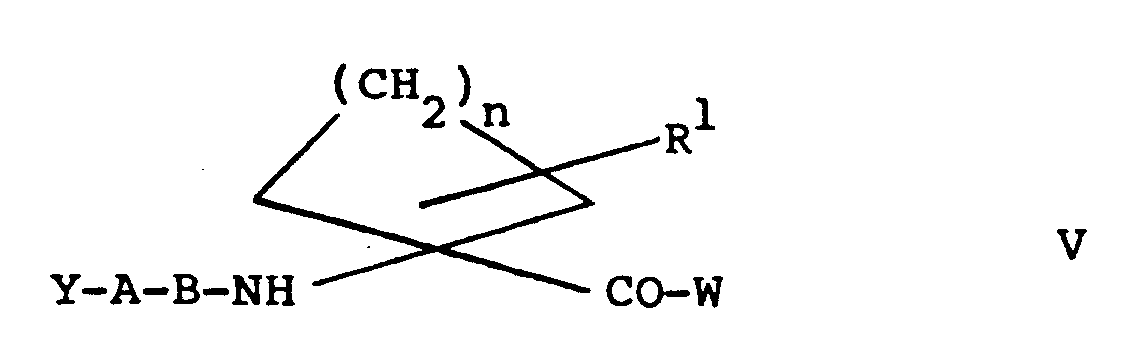
in which A, B, n and R¹ are the same as in formula I and Y and W are the same as in formula IV,
with glycine, alanine, leucine, phenylalanine or serine methyl ester, ethyl ester or amide and subsequent deprotection, isolation and optional salt formation or acylation. - Said acylation step is effected with the use of a reactive derivative of a carboxylic acid of the general formula
X - COOH
in which X is the same as in formula I, preferably with an acid anhydride or halide thereof. - Starting materials required for the preparation are known substances available by methods described in the pertinent literature.
- Further particulars of the procedure are illustrated by the following non-limitative examples. Melting points were determined on Kofler apparatus and are not corrected. Analytical samples were dried at 70 Pa. Optical rotations: Perkin-Elmer 141 polarimeter. Chromatography on silica gel ("Kieselgel" Merck) thin layer in 1-BuOH -AcOH - water 4:1:1 (S₁) and 1-BuOH - AcOH - pyridine - water 15:3:10:6 (S₂) systems. Evaporation of solutions was done on a rotary vacuum evaporator.
- To a solution of benzyloxycarbonylleucyl-alanine (6.72 g, 20 mmoles) in dimethylformamide (70 ml) was added N-hydroxysuccinimide (2.3 g, 20 mmoles) and on cooling to - 5°C N,N'-dicyclohexylcarbodiimide (4.4 g) was admixed. After 1 hour of stirring and cooling (-5°C) there was added a dimethylformamide (40 ml) solution of ethyl 1-amino-1-cyclopentanecarboxylate liberated from its hydrochloride (3.86 g, 20 mmoles) with N-ethylpiperidine (2.8 ml) and the reaction mixture was stirred for a further 2 hours at room temperature. After a subsequent 12 hours of standing the N,N'-dicyclohexylurea precipitate was filtered off, washed with dimethylformamide and the filtrate was evaporated. The residue was dissolved in an ethyl acetate - water mixture and the organic phase was shaken successively with 1M hydrochloric acid, water, 5% sodium hydrogen-carbonate and water, dried over anhydrous sodium sulfate and evaporated. The residue was crystallized from ethyl acetate (25 ml) and petroleum ether (200 ml) to give 7.6 g (80%) of the title compound, m.p. 102 to 104°C, after similar recrystallization 104 to 106°C. [α]

- To a solution of the preceding ester (7.5 g, 15.8 mmoles) in methanol (100 ml) was added a suspension of 5% Pd/C catalyst (0.8 g) in toluene (30 ml). Hydrogenolysis was conducted at room temperature in an autoclave at an initial hydrogen pressure of 2 MPa and stirrer speed of 2000 rpm. After 10 minutes the autoclave was degassed, the catalyst was filtered off and the filtrate was evaporated. The residue was dissolved in methanol (30 ml) and a solution of citric acid (3.3 g) in methanol (20 ml) was added. The resulting solution was mixed gradually with 300 ml of ether and after 2 hours of standing the citrate precipitate was separated, washed with ether and dried in a desiccator over phosphorus pentoxide to give 4.7 g of the title product, Rf 0.44/S₁, 0.58/S₂. [α]

- Similar procedures afforded the following compounds: Ethyl benzyloxycarbonylalanyl-alanyl-1-amino-1-cyclopentanecarboxylate, yield 76%, m.p. 134 to 136°C (ethyl acetate - petroleum ether). [α]

Ethyl alanyl-alanyl-1-amino-1-cyclopentanecarboxylate citrate, m.p. 99 to 102°C, Rf 0.40/S₁, 0.56/S₂.[α]
(c 0.2, MeOH).
Methyl benzyloxycarbonylalanyl-alanyl-1-amino-1-cyclobutanecarboxylate, m.p. 101 to 103°C, [α]
Methyl alanyl-alanyl-1-amino-1-cyclobutanecarboxylate citrate, Rf 0.27/S₁, 0.52/S₂. [α]
Ethyl benzyloxycarbonylalanyl-alanyl-1-amino-1-cyclohexanecarboxylate, m.p. 110 to 112°C. [α]
Ethyl alanyl-alanyl-1-amino-1-cyclohexanecarboxylate citrate, Rf 0.37/S₁, 0.68/S₂. [α]
Ethyl benzyloxycarbonylphenylalanyl-phenylalanyl-1-amino-1-cyclopentanecarboxylate, m.p. 93 to 96°C (toluene - petroleum ether). [α]
Ethyl phenylalanyl-phenylalanyl-1-amino-1-cyclopentanecarboxylate citrate, Rf 0.64/S₁, 0.78/S₂.
[α]
Ethyl tert-butyloxycarbonyl-Ng-nitroarginyl-alanyl-1-amino-1-cyclopentanecarboxylate (Ng represents the guanidine N atom in the arginine residue), by the carbodiimide technique using N-hydroxysuccinimide from Nalpha-tert-butyloxycarbonyl-Ng-nitro-arginine and ethyl alanyl-1-amino-1-cyclopentanecarboxylate hydrobromide, m.p. 112 to 115°C (ethyl acetate), [α]
Ethyl acetylleucyl-Ng-nitroarginyl-alanyl-1-amino-1-cyclopentanecarboxylate, similarly from N-acetylleucine and ethyl Ng-nitroarginyl-alanyl-1-amino-1-cyclopentanecarboxylate hydrochloride (yield 69%), m.p. 223 to 225°C (aqueous ethanol), Rf 0.33/S₁, 0.69/S₂, [α]
Methyl acetylleucyl-Nepsilon-benzyloxycarbonyllysyl-alanyl-1-amino-1-cyclopentanecarboxylate, similarly from N-acetylleucine and methyl Nepsilon-benzyloxycarbonyllysyl-alanyl-1-amino-1-cyclopentanecarboxylate hydrochloride (yield 72%), m.p. 202 to 204°C, Rf 0.52/S₁, 0.63/S₂, [α]
Ethyl acetylleucyl-arginyl-alanyl-1-amino-1-cyclopentanecarboxylate acetate, by pressure hydrogenolysis (6 MPa) deprotection from the corresponding Ng-nitroarginyl analog (yield 78%), m.p. 203 to 205°C (methanol - ethyl acetate) [α]
Methyl acetylleucyl-lysyl-alanyl-1-amino-1-cyclopentanecarboxylate acetate, similarly by hydrogenolysis (2 MPa) of the corresponding benzyloxycarbonyl derivative (yield 85%), m.p. 210 to 212°C (methanol - ethyl acetate), [α]
- To a solution of benzyloxycarbonylglycyl-proline pentachlorophenyl ester (5.55 g, 10 mmoles) in dimethylformamide (30 ml) was added alanine methyl ester liberated from its hydrochloride (1.4 g, 10 mmoles) with N-ethylpiperidine (1.4 ml). After 5 hours of stirring and 12 hours of standing at room temperature the solution was evaporated, the residue was taken into ethyl acetate and the organic phase was washed successively with 1M hydrochloric acid, water, 5% sodium hydrogencarbonate and water, dried over anhydrous sodium sulfate and evaporated. The residue was crystallized from ethyl acetate - petroleum ether to give 1.95 g (50%) of the title product, m.p. 103 to 106°C. An analytical sample was recrystallized similarly, m.p. 105 to 108°C [α]

Benzyloxycarbonylglycyl-prolyl-alanine, by alkaline hydrolysis of the preceding ester, yield 79%, m.p. 144 to 145°C (methylene chloride - petroleum ether).
[α]
Ethyl benzyloxycarbonylglycyl-prolyl-alanyl-1-amino-1-cyclopentanecarboxylate, by the procedure of Example 1 from the preceding compound and ethyl 1-amino-1-cyclopentanecarboxylate, yield 78%, [α]
Ethyl glycyl-prolyl-alanyl-1-amino-1-cyclopentanecarboxylate citrate, by hydrogenolytic deprotection of the preceding, m.p. 115 to 118°C. Rf 0.22/S₁, 0.58/S₂. [α]
- A solution of ethyl benzyloxycarbonylphenylalanyl-phenylalanyl-1-amino-1-cyclopentanecarboxylate (590 mg, 1 mmole) in methanol was hydrogenated by the procedure of Example 1. The methanolic solution was evaporated, dissolved in tetrahydrofuran, evaporated and acylated with glutaric anhydride (175 mg) in dimethylformamide for 2 hours at 80°C. The reaction mixture was evaporated and the product was precipitated with water to give the title compound, m.p. 193 to 196°C (dimethylformamide - water).
- To a solution of N,O-diacetyltyrosine (13.3 g, 50 mmoles) and N-ethylpiperidine (7 ml) in tetrahydrofuran (100 ml) precooled to -15°C was added ethyl chloroformate (5 ml). After 15 minutes of stirring and cooling (-15°C) alanine methyl ester liberated from its hydrochloride (7.0 g, 50 mmoles) with N-ethylpiperidine (7 ml) was admixed. After 2 hours of stirring at 0°C and 12 hours of standing at room temperature the solution was evaporated, the residue was taken into ethyl acetate and the organic phase was successively washed with 1M hydrochloric acid, water, 5% sodium hydrogencarbonate and water, dried over anhydrous sodium sulfate and evaporated. Crystallization from 2-propanol - petroleum ether yielded 10.6 g (60%) of the title product. An analytical sample was recrystallized similarly, m.p. 173 to 176°C. [α]

- The preceding protected ester (7 g, 20 mmoles) dissolved in methanol (100 ml) was hydrolyzed for 1 hour with 2M sodium hydroxide (25 ml). The reaction mixture was processed in the known manner to give an amorphous product. Rf 0.59/S₁, 0.67/S₂.
Ethyl N-acetyltyrosyl-alanyl-1-amino-1-cyclopentanecarboxylate, by the procedure of Example 1 from the preceding compound and ethyl-1-amino-1-cyclopentanecarboxylate, yield 88%, m.p. 168 to 171°C,
[α]
- Similar procedures afforded the following compounds: Ethyl tert-butyloxycarbonylglutaminyl-1-amino-1-cyclopentanecarboxylate, from tert-butyloxycarbonylglutamine and ethyl 1-amino-1-cyclopentanecarboxylate, yield 62%, m.p. 131 to 132°C.
Ethyl glutaminyl-1-amino-1-cyclopentanecarboxylate hydrochloride, by deprotection of the preceding compound with hydrogen chloride in glacial acetic acid. Rf 0.38/S₁, 0.44/S₂.
Ethyl Nalpha-tert-butyloxycarbonyl-Nomega-benzyloxycarbonyllysyl-glutaminyl-1-amino-1-cyclopentanecarboxylate, by the anhydride technique from the respective protected lysine compound and the preceding dipeptide ethyl ester, yield 93%, m.p. 127 to 130°C.
Ethyl Nomega-benzyloxycarbonyllysyl-glutaminyl-1-amino-1-cyclopentanecarboxylate hydrochloride, by analogous deprotection of the preceding compound. Rf 0.28/S₁, 0.63/S₂.
Ethyl acetylleucyl-Nomega-benzyloxycarbonyllysyl-glutaminyl-1-amino-1-cyclopentanecarboxylate, by the carbodiimide technique in the presence of N-hydroxysuccinimide from N-acetylleucine and the corresponding tripeptide ethyl ester in dimethylformamide, m.p. 231 to 232°C (aqueous dimethylformamide).
Ethyl acetylleucyl-lysyl-glutaminyl-1-amino-1-cyclopentanecarboxylate acetate, by hydrogenolytic deprotection of the preceding derivative, after crystallization from ethanol - ether Rf 0.24/S₁, 0.51/S₂.
Ethyl Nalpha-tert-butyloxycarbonyl-Nomega-benzyloxycarbonyllysyl-glycyl-1-amino-1-cyclopentanecarboxylate, by the anhydride technique from the respective protected lysine and ethyl glycyl-1-amino-1-cyclopentanecarboxylate hydrobromide, Rf 0.41/S₁, 0.72/S₂.
Ethyl Nomega-benzyloxycarbonyllysyl-glycyl-1-amino-1-cyclopentanecarboxylate hydrochloride, by analogous deprotection of the preceding compound as above. Rf 0.28/S₁, 0.63/S₂.
Ethyl acetylleucyl-Nomega-benzyloxycarbonyllysyl-glycyl-1-amino-1-cyclopentanecarboxylate, from N-acetylleucine and the preceding tripeptide ethyl ester in dimethylformamide, m.p. 179 to 182°C (aqueous dimethylformamide).
Ethyl acetylleucyl-1-lysyl-glycyl-1-amino-1-cyclopentanecarboxylate acetate, by hydrogenolytic deprotection of the preceding compound, after crystallization from methanol - ether Rf 0.25/S₁, 0.54/S₂.
Methyl N,O-diacetyltyrosyl-1-amino-1-cyclopentanecarboxylate, by the anhydride technique from N,O-diacetyltyrosine and methyl 1-amino-1-cyclopentanecarboxylate, yield 43%, m.p. 210 to 212°C (ethanol).
N-Acetyltyrosyl-1-amino-1-cyclopentanecarboxylic acid, by alkaline hydrolysis of the preceding ester; m.p. 252 to 254°C (aqueous ethanol).
N-Acetyltyrosyl-1-amino-21-cyclopentanecarbonylserine methyl ester, similarly from the preceding acid and serine methyl ester, m.p. 128 to 132°C (2-propanol - petroleum ether), [α]
- To a dimethylformamide (25 ml) solution of ethyl 1-amino-1-cyclopentanecarboxylate liberated from its hydrochloride (1.0 g, 5 mmoles) with N-ethylpiperidine (0.7 ml) there was portionwise added benzyloxycarbonylalanylglycine p-nitrophenyl ester (2.1 g, 5 mmoles). After 3 hours of stirring and 12 hours of standing at room temperature the solution was evaporated, the residue was taken into ethyl acetate and extracted successively with 1% ammonia and water, dried over anhydrous sodium sulfate and evaporated. The residue was crystallized from ethyl acetate - petroleum ether to give 1.4 g (67%) of the title product, m.p. 119 to 121 °C. An analytical sample was crystallized similarly, m.p. 137 to 139 °C. [α]

Hydrogenolytic deprotection of this compound similarly as described in Example 1 yielded ethyl alanyl-glycyl-1-amino-1-cyclopentane-carboxylate, citrate Rf 0.28/S₁, 0.71/S₂. [α]
- Recent pharmacological report on the effect of a typical compound of the invention, Leu-Ala-Acp-OEt.Cit (hereinafter Compound X in which Acp represents 1-amino-1-cyclopentanecarboxylic acid residues Cit - citrate salt) in an in vivo behavioural test in rats.
- The effect of compound X on learning and memory processes was verified using the standard "conditioned taste aversion" (CTA) test generally accepted as conclusive in this respect. Compound X was found to inhibit the partial amnesia of experimental CTA induced by hypoxia in male rats. This is considered to evidence a significant beneficial effect of the substance under test on memory and learning in mammals.
- Male Wistar rats of 280 to 320 g were placed on a water deprivation schedule. Throughout the experiment they received water of 10% sucrose solution for 15 min in individual drinking boxes (from a calibrated 25 pipette) and for 60 min in their home cages. After 4 days of training their daily water intake stabilized. On the subsequent conditioning day 5 the animals were allowed to drink sucrose solution in the boxes for 15 min as before, and after 60 min they were injected i.p. (intraperitoneally) with saline or C.075 M LiCl, 2 ml/100 g. Twenty-four hours thereafter, on day 6, they received s.c. (subcutaneously) 55 mm/kg of sodium nitrite dissolved in 1 ml/kg of water. On day 7 the animals were allowed to drink water according to the previous schedule and the water intake values were recorded; these posterior values did not differ substantially from the intakes measured prior to conditioning. On the subsequent 8th (test) day the degree of taste aversion was determined by offering the animals sucrose solution for 15 min the same way as before. Compound X was administered subcutaneously at two dosage levels, in a single dose of 1.0 or 10.0 mg/kg, over 5 days starting with the last training day. The administration time preceded by 45 min the sucrose drinking on the conditioning day, nitrite administration and sucrose drinking on the test day. Piracetam (PIR, 50 mg/kg sc) was administered analogously using the same time schedule.
- The intake volumes of sucrose solution on the test day are summarized in the following Table 1. The hypoxia induced by sodium nitrite resulted in a partial amnesia of the acquired CTA. This experimental amnesia was significantly inhibited by either dose of compound X of the present application. Antiamnestic effect of PIR used as reference compound for comparison, at the above dosage level, was not significant.
Table 1 Group (N=10) Treatment on the Sucrose intake on the test day mean in ml ± S E Drug mg/kg condit day 6th day 1 saline NaNO₂ 13.5 ± 1.7 saline 2 LiCl saline 6.0 1.8 saline 3 LiCl NaNO₂ 8.1 2.2 saline 4 LiCl NaNO₂ 5.4 1.7 x 1 5 LiCl NaNO₂ 6.3 1.9 x 10 6 LiCl NaNO₂ 7.0 3.5 PIR 50 Significant difference (p 0.05) between the group 1 and all other groups
2 and 3
3 and 4
4 and 5
Claims (16)
- A process for the preparation of peptide derivatives of the general formula I

A is a glycine, alanine, leucine, phenylalanine, tyrosine, lysine or arginine residue,
B is a glutamine, proline, arginine or lysine residue or a direct chemical bond,
n is an integer of from 1 to 3, R¹ is H or a C₁ to C₃ alkyl
and R² is a C₁ to C₃ alkoxyl or an amino group when C is a peptidically bound glycine, alanine, leucine, phenylalanine, glutamine or serine residue
or R² is a peptidically bound glycine, alanine, leucine, phenylalanine or serine methyl ester, ethyl ester or amide residue when C is a direct chemical bond,
and pharmaceutically acceptable acid addition salts thereof, comprising reacting a peptide derivative of the general formula IV
Y-A-B-W IV
in which A and B are the same as in formula I, Y is a C₂ to C₅ alkanecarbonyl or a protective group and W is a carboxyl activating moiety with a peptide derivative of the general formula II, in which n and R¹ are the same as in formula I and R² is a C₁ to C₃ alkoxyl or an amino group when C is a peptidically bound glycine, alanine, leucine, phenylalanine, glutamine or serine residue
or R² is a peptidically bound glycine, alanine, leucine, phenylalanine or serine methyl ester, ethyl ester or amide residue when C is a hydrogen atom,
subsequent deprotecting of the so obtained peptide derivative and isolation of the liberated product, whereupon if required the product is converted into an acid addition salt or acylated. - A process for the preparation of peptide derivatives of formula I of claim 1 comprising reacting a peptide derivative of the general formula

with glycine, alanine, leucine, phenylalanine or serine methyl ester, ethyl ester or amide,
subsequent deprotecting of the so obtained peptide derivative and isolation of the liberated product, whereupon if required the product is converted into an acid addition salt or acylated. - A process of claim 1 or 2 comprising acylating the product with a reactive derivative of a carboxylic acid of the general formula
X - COOH
in which X is the same as in formula I. - A process according to claim 3 wherein the reactive derivative of a carboxylic acid is an acid anhydride or halide thereof.
- A process according to claim 1 wherein Y is a benzyloxycarbonyl or tert-butyloxycarbonyl protective group.
- A process according to claim 1 wherein W is a reactive halogen atom or an anhydride or reactive ester group.
- A peptide derivative of the general formula I, in which X, A, B, C, n, R¹ and R² are the same as in claim 1, whenever prepared by a procedure substantially in accordance with any of the preceding claims or by an obvious equivalent thereof.
Priority Applications (1)
| Application Number | Priority Date | Filing Date | Title |
|---|---|---|---|
| AT8787305065T ATE105300T1 (en) | 1986-06-12 | 1987-06-09 | PEPTIDE DERIVATIVES AND PROCESS FOR THEIR PREPARATION. |
Applications Claiming Priority (2)
| Application Number | Priority Date | Filing Date | Title |
|---|---|---|---|
| CS864332A CS277405B6 (en) | 1986-06-12 | 1986-06-12 | Peptides with 1-amino-1-cycloalkane carboxylic acid |
| CS4332/86 | 1986-06-12 |
Publications (3)
| Publication Number | Publication Date |
|---|---|
| EP0249434A2 EP0249434A2 (en) | 1987-12-16 |
| EP0249434A3 EP0249434A3 (en) | 1990-01-24 |
| EP0249434B1 true EP0249434B1 (en) | 1994-05-04 |
Family
ID=5385817
Family Applications (1)
| Application Number | Title | Priority Date | Filing Date |
|---|---|---|---|
| EP87305065A Expired - Lifetime EP0249434B1 (en) | 1986-06-12 | 1987-06-09 | Peptide derivatives and processes for their preparation |
Country Status (7)
| Country | Link |
|---|---|
| US (1) | US4898930A (en) |
| EP (1) | EP0249434B1 (en) |
| JP (1) | JPH082916B2 (en) |
| AT (1) | ATE105300T1 (en) |
| CA (1) | CA1308515C (en) |
| CS (1) | CS277405B6 (en) |
| DE (1) | DE3789729T2 (en) |
Families Citing this family (3)
| Publication number | Priority date | Publication date | Assignee | Title |
|---|---|---|---|---|
| DE69941708D1 (en) * | 1998-07-20 | 2010-01-07 | Ipsen Pharma | PACAP PEPTIDE ANALOGS |
| RU2142813C1 (en) * | 1999-03-25 | 1999-12-20 | НИИ наркологии МЗРФ | Tetrapeptide trp-nle-asp-phenh-ch(ch3)2 with anxiolytic activity |
| CN1164611C (en) * | 2002-06-17 | 2004-09-01 | 厦门大学 | Propane-glutide dipeptide synthetic method |
Family Cites Families (8)
| Publication number | Priority date | Publication date | Assignee | Title |
|---|---|---|---|---|
| US3704288A (en) * | 1970-04-16 | 1972-11-28 | Joseph A Skorcz | L-tyrosyl-1-aminocyclopentane-1-carbonyl-l-phenylalanine |
| NO774303L (en) * | 1976-12-28 | 1978-06-29 | Troponwerke Gmbh & Co Kg | NEW DEHYDROOLIGOPEPTIDES, PROCEDURES FOR THEIR PREPARATION AND THEIR USE AS MEDICINES |
| US4278595A (en) * | 1979-12-10 | 1981-07-14 | Vega Laboratories, Inc. | Orally active MIF analogs with an effect on the central nervous system |
| US4690936A (en) * | 1980-03-05 | 1987-09-01 | University Of Miami | Anti-hypertensive agents |
| CS231227B1 (en) * | 1982-10-01 | 1984-10-15 | Evzen Kasafirek | 2,5-pierazindion derivatives |
| DE3300774A1 (en) * | 1983-01-12 | 1984-07-12 | Hoechst Ag, 6230 Frankfurt | NEW SPIROCYCLIC AMINO ACIDS, METHOD FOR THE PRODUCTION THEREOF AND THE USE THEREOF AND NEW SPIROCYCLIC AMINO ACIDS AS INTERMEDIATE PRODUCTS AND METHOD FOR THE PRODUCTION THEREOF |
| DE3485587D1 (en) * | 1983-08-16 | 1992-04-23 | Univ Georgia Res Found | PRODUCTION OF AMINOCYCLOPROPANCARBONIC ACIDS AND PEPTIDES. |
| EP0212550A3 (en) * | 1985-08-14 | 1989-05-10 | G.D. Searle & Co. | Substituted dipeptide amides |
-
1986
- 1986-06-12 CS CS864332A patent/CS277405B6/en not_active IP Right Cessation
-
1987
- 1987-05-26 CA CA000537992A patent/CA1308515C/en not_active Expired - Fee Related
- 1987-06-09 DE DE3789729T patent/DE3789729T2/en not_active Expired - Fee Related
- 1987-06-09 AT AT8787305065T patent/ATE105300T1/en not_active IP Right Cessation
- 1987-06-09 EP EP87305065A patent/EP0249434B1/en not_active Expired - Lifetime
- 1987-06-11 JP JP62144207A patent/JPH082916B2/en not_active Expired - Lifetime
- 1987-06-12 US US07/062,300 patent/US4898930A/en not_active Expired - Lifetime
Also Published As
| Publication number | Publication date |
|---|---|
| CS277405B6 (en) | 1993-03-17 |
| DE3789729D1 (en) | 1994-06-09 |
| JPH082916B2 (en) | 1996-01-17 |
| US4898930A (en) | 1990-02-06 |
| JPS633000A (en) | 1988-01-07 |
| DE3789729T2 (en) | 1994-08-18 |
| CS433286A3 (en) | 1992-08-12 |
| EP0249434A3 (en) | 1990-01-24 |
| EP0249434A2 (en) | 1987-12-16 |
| CA1308515C (en) | 1992-10-06 |
| ATE105300T1 (en) | 1994-05-15 |
Similar Documents
| Publication | Publication Date | Title |
|---|---|---|
| IL84766A (en) | Phosphinic acid derivatives, their manufacture and pharmaceutical compositions containing them | |
| HU203369B (en) | Process for producing enzyme inhibiting dipeptidecarbamoyl derivatives and pharmaceutical compositions comprising same | |
| US4816560A (en) | Partially retro-inverted tuftsin analogues, method for the preparation thereof and pharmaceutical compositions containing them | |
| BG60739B2 (en) | TRIEPEPTIDES AFFECTING THE CENTRAL NERVOUS SYSTEM AND METHOD OF THEIR PREPARATION | |
| AU579835B2 (en) | The synthesis of cyclopropane amino acids and peptides | |
| US4216209A (en) | Tripeptide angiotensin converting enzyme inhibitors | |
| EP0009898B1 (en) | Novel anti-hypertensive mercaptoacylamino acid derivatives, their preparation and use | |
| US4346104A (en) | Novel substituted phenylacetic acid amide compounds | |
| US4250192A (en) | Novel substituted phenylacetic acid amide compounds | |
| US4260601A (en) | Chemical compounds | |
| US4420490A (en) | Substituted phenylacetic acid amide compounds | |
| EP0228625B1 (en) | Peptide derivatives inhibitors of hydroxyling enzymes, their process of preparation, the agents thereof and their use | |
| US4898930A (en) | Peptide derivatives and processes for their preparation | |
| US3931139A (en) | Tripeptides having an antidepressive and prolactin-releasing action | |
| CZ280726B6 (en) | Pentapeptidic precursors of biologically active cyclic dipeptides | |
| KR890004365B1 (en) | Method for preparing a difluorocyclostatin-containing polypeptide derivative | |
| AU721261B2 (en) | Peptide inhibitors of hematopoietic cell proliferation | |
| EP0001174B1 (en) | A peptide and the salts thereof, processes for their preparation and compositions containing them | |
| EP1864994B1 (en) | Par-2 agonist | |
| Kasafírek et al. | Linear tri-and tetrapeptides acting as prodrugs | |
| Marquisee et al. | Collagenase-sensitive peptidyl-nitrogen mustards as potential antitumor agents | |
| HU220875B1 (en) | Pentapeptide derivative, production thereof and their intermediates | |
| HU204070B (en) | Process for producing dipeptide derivatvies having renin inhibiting effect and pharmaceutical compositions comprising same | |
| EP0001335B1 (en) | A peptide, processes for its preparation and compositions containing the same | |
| KR870000371B1 (en) | Process for the preparation of polypeptides |
Legal Events
| Date | Code | Title | Description |
|---|---|---|---|
| PUAI | Public reference made under article 153(3) epc to a published international application that has entered the european phase |
Free format text: ORIGINAL CODE: 0009012 |
|
| AK | Designated contracting states |
Kind code of ref document: A2 Designated state(s): AT BE CH DE FR GB IT LI LU NL SE |
|
| PUAL | Search report despatched |
Free format text: ORIGINAL CODE: 0009013 |
|
| AK | Designated contracting states |
Kind code of ref document: A3 Designated state(s): AT BE CH DE FR GB IT LI LU NL SE |
|
| 17P | Request for examination filed |
Effective date: 19900418 |
|
| 17Q | First examination report despatched |
Effective date: 19920121 |
|
| GRAA | (expected) grant |
Free format text: ORIGINAL CODE: 0009210 |
|
| RAP1 | Party data changed (applicant data changed or rights of an application transferred) |
Owner name: VYZKUMNY STAV PRO FARMACII A BIOCHEMII |
|
| AK | Designated contracting states |
Kind code of ref document: B1 Designated state(s): AT BE CH DE FR GB IT LI LU NL SE |
|
| PG25 | Lapsed in a contracting state [announced via postgrant information from national office to epo] |
Ref country code: SE Free format text: THE PATENT HAS BEEN ANNULLED BY A DECISION OF A NATIONAL AUTHORITY Effective date: 19940504 Ref country code: NL Effective date: 19940504 |
|
| REF | Corresponds to: |
Ref document number: 105300 Country of ref document: AT Date of ref document: 19940515 Kind code of ref document: T |
|
| ITF | It: translation for a ep patent filed | ||
| PG25 | Lapsed in a contracting state [announced via postgrant information from national office to epo] |
Ref country code: AT Effective date: 19940609 |
|
| REF | Corresponds to: |
Ref document number: 3789729 Country of ref document: DE Date of ref document: 19940609 |
|
| ET | Fr: translation filed | ||
| PG25 | Lapsed in a contracting state [announced via postgrant information from national office to epo] |
Ref country code: LU Free format text: LAPSE BECAUSE OF NON-PAYMENT OF DUE FEES Effective date: 19940630 |
|
| NLV1 | Nl: lapsed or annulled due to failure to fulfill the requirements of art. 29p and 29m of the patents act | ||
| PLBE | No opposition filed within time limit |
Free format text: ORIGINAL CODE: 0009261 |
|
| STAA | Information on the status of an ep patent application or granted ep patent |
Free format text: STATUS: NO OPPOSITION FILED WITHIN TIME LIMIT |
|
| 26N | No opposition filed | ||
| PGFP | Annual fee paid to national office [announced via postgrant information from national office to epo] |
Ref country code: DE Payment date: 20010605 Year of fee payment: 15 |
|
| PGFP | Annual fee paid to national office [announced via postgrant information from national office to epo] |
Ref country code: GB Payment date: 20010606 Year of fee payment: 15 |
|
| PGFP | Annual fee paid to national office [announced via postgrant information from national office to epo] |
Ref country code: FR Payment date: 20010611 Year of fee payment: 15 |
|
| PGFP | Annual fee paid to national office [announced via postgrant information from national office to epo] |
Ref country code: CH Payment date: 20010615 Year of fee payment: 15 |
|
| PGFP | Annual fee paid to national office [announced via postgrant information from national office to epo] |
Ref country code: BE Payment date: 20010816 Year of fee payment: 15 |
|
| REG | Reference to a national code |
Ref country code: GB Ref legal event code: IF02 |
|
| PG25 | Lapsed in a contracting state [announced via postgrant information from national office to epo] |
Ref country code: GB Free format text: LAPSE BECAUSE OF NON-PAYMENT OF DUE FEES Effective date: 20020609 |
|
| PG25 | Lapsed in a contracting state [announced via postgrant information from national office to epo] |
Ref country code: LI Free format text: LAPSE BECAUSE OF NON-PAYMENT OF DUE FEES Effective date: 20020630 Ref country code: CH Free format text: LAPSE BECAUSE OF NON-PAYMENT OF DUE FEES Effective date: 20020630 Ref country code: BE Free format text: LAPSE BECAUSE OF NON-PAYMENT OF DUE FEES Effective date: 20020630 |
|
| BERE | Be: lapsed |
Owner name: *VYZKUMNY USTAV PRO FARMACII A BIOCHEMII Effective date: 20020630 |
|
| PG25 | Lapsed in a contracting state [announced via postgrant information from national office to epo] |
Ref country code: DE Free format text: LAPSE BECAUSE OF NON-PAYMENT OF DUE FEES Effective date: 20030101 |
|
| GBPC | Gb: european patent ceased through non-payment of renewal fee |
Effective date: 20020609 |
|
| REG | Reference to a national code |
Ref country code: CH Ref legal event code: PL |
|
| PG25 | Lapsed in a contracting state [announced via postgrant information from national office to epo] |
Ref country code: FR Free format text: LAPSE BECAUSE OF NON-PAYMENT OF DUE FEES Effective date: 20030228 |
|
| REG | Reference to a national code |
Ref country code: FR Ref legal event code: ST |
|
| PG25 | Lapsed in a contracting state [announced via postgrant information from national office to epo] |
Ref country code: IT Free format text: LAPSE BECAUSE OF NON-PAYMENT OF DUE FEES Effective date: 20050609 |