EP0248545B1 - Radiation resistant polypropylene articles and method for preparing same - Google Patents
Radiation resistant polypropylene articles and method for preparing same Download PDFInfo
- Publication number
- EP0248545B1 EP0248545B1 EP87304084A EP87304084A EP0248545B1 EP 0248545 B1 EP0248545 B1 EP 0248545B1 EP 87304084 A EP87304084 A EP 87304084A EP 87304084 A EP87304084 A EP 87304084A EP 0248545 B1 EP0248545 B1 EP 0248545B1
- Authority
- EP
- European Patent Office
- Prior art keywords
- polypropylene
- crystalline
- irradiated
- extruded
- film
- Prior art date
- Legal status (The legal status is an assumption and is not a legal conclusion. Google has not performed a legal analysis and makes no representation as to the accuracy of the status listed.)
- Expired - Lifetime
Links
Images


Classifications
-
- C—CHEMISTRY; METALLURGY
- C08—ORGANIC MACROMOLECULAR COMPOUNDS; THEIR PREPARATION OR CHEMICAL WORKING-UP; COMPOSITIONS BASED THEREON
- C08L—COMPOSITIONS OF MACROMOLECULAR COMPOUNDS
- C08L23/00—Compositions of homopolymers or copolymers of unsaturated aliphatic hydrocarbons having only one carbon-to-carbon double bond; Compositions of derivatives of such polymers
- C08L23/02—Compositions of homopolymers or copolymers of unsaturated aliphatic hydrocarbons having only one carbon-to-carbon double bond; Compositions of derivatives of such polymers not modified by chemical after-treatment
- C08L23/10—Homopolymers or copolymers of propene
- C08L23/12—Polypropene
-
- A—HUMAN NECESSITIES
- A61—MEDICAL OR VETERINARY SCIENCE; HYGIENE
- A61L—METHODS OR APPARATUS FOR STERILISING MATERIALS OR OBJECTS IN GENERAL; DISINFECTION, STERILISATION OR DEODORISATION OF AIR; CHEMICAL ASPECTS OF BANDAGES, DRESSINGS, ABSORBENT PADS OR SURGICAL ARTICLES; MATERIALS FOR BANDAGES, DRESSINGS, ABSORBENT PADS OR SURGICAL ARTICLES
- A61L2/00—Disinfection or sterilisation of materials or objects, in general; Accessories therefor
- A61L2/02—Disinfection or sterilisation of materials or objects, in general; Accessories therefor using physical processes
- A61L2/08—Radiation
-
- B—PERFORMING OPERATIONS; TRANSPORTING
- B29—WORKING OF PLASTICS; WORKING OF SUBSTANCES IN A PLASTIC STATE IN GENERAL
- B29C—SHAPING OR JOINING OF PLASTICS; SHAPING OF MATERIAL IN A PLASTIC STATE, NOT OTHERWISE PROVIDED FOR; AFTER-TREATMENT OF THE SHAPED PRODUCTS, e.g. REPAIRING
- B29C48/00—Extrusion moulding, i.e. expressing the moulding material through a die or nozzle which imparts the desired form; Apparatus therefor
- B29C48/022—Extrusion moulding, i.e. expressing the moulding material through a die or nozzle which imparts the desired form; Apparatus therefor characterised by the choice of material
-
- B—PERFORMING OPERATIONS; TRANSPORTING
- B29—WORKING OF PLASTICS; WORKING OF SUBSTANCES IN A PLASTIC STATE IN GENERAL
- B29C—SHAPING OR JOINING OF PLASTICS; SHAPING OF MATERIAL IN A PLASTIC STATE, NOT OTHERWISE PROVIDED FOR; AFTER-TREATMENT OF THE SHAPED PRODUCTS, e.g. REPAIRING
- B29C48/00—Extrusion moulding, i.e. expressing the moulding material through a die or nozzle which imparts the desired form; Apparatus therefor
- B29C48/03—Extrusion moulding, i.e. expressing the moulding material through a die or nozzle which imparts the desired form; Apparatus therefor characterised by the shape of the extruded material at extrusion
- B29C48/07—Flat, e.g. panels
- B29C48/08—Flat, e.g. panels flexible, e.g. films
-
- B—PERFORMING OPERATIONS; TRANSPORTING
- B29—WORKING OF PLASTICS; WORKING OF SUBSTANCES IN A PLASTIC STATE IN GENERAL
- B29C—SHAPING OR JOINING OF PLASTICS; SHAPING OF MATERIAL IN A PLASTIC STATE, NOT OTHERWISE PROVIDED FOR; AFTER-TREATMENT OF THE SHAPED PRODUCTS, e.g. REPAIRING
- B29C48/00—Extrusion moulding, i.e. expressing the moulding material through a die or nozzle which imparts the desired form; Apparatus therefor
- B29C48/25—Component parts, details or accessories; Auxiliary operations
- B29C48/88—Thermal treatment of the stream of extruded material, e.g. cooling
- B29C48/911—Cooling
- B29C48/9135—Cooling of flat articles, e.g. using specially adapted supporting means
-
- B—PERFORMING OPERATIONS; TRANSPORTING
- B29—WORKING OF PLASTICS; WORKING OF SUBSTANCES IN A PLASTIC STATE IN GENERAL
- B29C—SHAPING OR JOINING OF PLASTICS; SHAPING OF MATERIAL IN A PLASTIC STATE, NOT OTHERWISE PROVIDED FOR; AFTER-TREATMENT OF THE SHAPED PRODUCTS, e.g. REPAIRING
- B29C48/00—Extrusion moulding, i.e. expressing the moulding material through a die or nozzle which imparts the desired form; Apparatus therefor
- B29C48/25—Component parts, details or accessories; Auxiliary operations
- B29C48/88—Thermal treatment of the stream of extruded material, e.g. cooling
- B29C48/911—Cooling
- B29C48/9135—Cooling of flat articles, e.g. using specially adapted supporting means
- B29C48/914—Cooling drums
-
- B—PERFORMING OPERATIONS; TRANSPORTING
- B29—WORKING OF PLASTICS; WORKING OF SUBSTANCES IN A PLASTIC STATE IN GENERAL
- B29C—SHAPING OR JOINING OF PLASTICS; SHAPING OF MATERIAL IN A PLASTIC STATE, NOT OTHERWISE PROVIDED FOR; AFTER-TREATMENT OF THE SHAPED PRODUCTS, e.g. REPAIRING
- B29C71/00—After-treatment of articles without altering their shape; Apparatus therefor
- B29C71/04—After-treatment of articles without altering their shape; Apparatus therefor by wave energy or particle radiation, e.g. for curing or vulcanising preformed articles
-
- B—PERFORMING OPERATIONS; TRANSPORTING
- B29—WORKING OF PLASTICS; WORKING OF SUBSTANCES IN A PLASTIC STATE IN GENERAL
- B29C—SHAPING OR JOINING OF PLASTICS; SHAPING OF MATERIAL IN A PLASTIC STATE, NOT OTHERWISE PROVIDED FOR; AFTER-TREATMENT OF THE SHAPED PRODUCTS, e.g. REPAIRING
- B29C48/00—Extrusion moulding, i.e. expressing the moulding material through a die or nozzle which imparts the desired form; Apparatus therefor
-
- B—PERFORMING OPERATIONS; TRANSPORTING
- B29—WORKING OF PLASTICS; WORKING OF SUBSTANCES IN A PLASTIC STATE IN GENERAL
- B29C—SHAPING OR JOINING OF PLASTICS; SHAPING OF MATERIAL IN A PLASTIC STATE, NOT OTHERWISE PROVIDED FOR; AFTER-TREATMENT OF THE SHAPED PRODUCTS, e.g. REPAIRING
- B29C48/00—Extrusion moulding, i.e. expressing the moulding material through a die or nozzle which imparts the desired form; Apparatus therefor
- B29C48/03—Extrusion moulding, i.e. expressing the moulding material through a die or nozzle which imparts the desired form; Apparatus therefor characterised by the shape of the extruded material at extrusion
- B29C48/05—Filamentary, e.g. strands
-
- B—PERFORMING OPERATIONS; TRANSPORTING
- B29—WORKING OF PLASTICS; WORKING OF SUBSTANCES IN A PLASTIC STATE IN GENERAL
- B29K—INDEXING SCHEME ASSOCIATED WITH SUBCLASSES B29B, B29C OR B29D, RELATING TO MOULDING MATERIALS OR TO MATERIALS FOR MOULDS, REINFORCEMENTS, FILLERS OR PREFORMED PARTS, e.g. INSERTS
- B29K2023/00—Use of polyalkenes or derivatives thereof as moulding material
- B29K2023/10—Polymers of propylene
- B29K2023/12—PP, i.e. polypropylene
-
- B—PERFORMING OPERATIONS; TRANSPORTING
- B29—WORKING OF PLASTICS; WORKING OF SUBSTANCES IN A PLASTIC STATE IN GENERAL
- B29K—INDEXING SCHEME ASSOCIATED WITH SUBCLASSES B29B, B29C OR B29D, RELATING TO MOULDING MATERIALS OR TO MATERIALS FOR MOULDS, REINFORCEMENTS, FILLERS OR PREFORMED PARTS, e.g. INSERTS
- B29K2995/00—Properties of moulding materials, reinforcements, fillers, preformed parts or moulds
- B29K2995/0037—Other properties
- B29K2995/0039—Amorphous
Definitions
- This invention relates to irradiated polypropylene articles, such as fibers, films, and nonwoven fabrics and to a method for preparing such articles.
- U.S. Patent No. 4,431,497 discloses radiation-stable polyolefin compositions containing a benzhydrol or benzhydrol derivative stabilizer.
- U.S. Patent No. 4,460,445 discloses radiation-stable polyolefin compositions containing a hindered phenolic stabilizer and a benzaldehyde acetal stabilizer.
- the non-crystalline mesomorphous polypropylene has been described as a non-spherulitic structure by P.H. Geil ( Polymer Single Crystals , Interscience, N.Y., 1963, p. 270). Crystalline polypropylene may have "chain-folds", i.e., crystalline/amorphous folds, in the structure which provide areas for radical attack because of their higher energy. In contrast, the non-crystalline mesomorphous structure is believed to have ordering as in a Fringed Micelle model with no chain-fold defects. It is suspected that this lack of chain fold defects minimizes the number of sites for radical attack and thereby provides the resistance to radiation degradation.
- FIG. 9 is the X-ray diffraction pattern of the non-crystalline mesomorphous polypropylene film of Example 7.
- FIG. 11 is the X-ray diffraction pattern of the non-crystalline mesomorphous polypropylene film of Example 9.
- the non-crystalline mesomorphous phase polypropylene can be irradiated by sterilizing ionizing radiation such as gamma radiation.
- ionizing radiation such as gamma radiation.
- the dosage of gamma radiation is generally in the range of 2.5 to 4.0 Mrad for sterilization of medical articles.
- a melt blown polypropylene microfiber web having a weight of 20 g/m2 was extruded, as described in Wente, Van A., "Superfine Thermoplastic Fibers", supra , using Escorene PP 3085 polypropylene polymer (available from Exxon Chemical Americas.)
- the extruder conditions were: Polymer rate (kg/hr) 6.5 Polymer melt temperature ( o C) 329 Air temperature ( o C) 343 Air pressure (kPa) 138
- the fibers were quenched with water at a temperature of 40 o F (4 o C) and at a rate of 5 gal/hr (19 l/hr) with the spray located 6 inches (15 cm) below the die and directed at the fibers as they exited the die.
- the web was collected on a drum maintained at a temperature of 40 o F (4 o C), by dipping the roll in ice water, to further quench the web.
- Example 11 the fibers were quenched as in Example 10 to produce non-crystalline mesomorphous polypropylene web.
- Example 5 the extruded fibers were not quenched, producing crystalline polypropylene web.
Landscapes
- Engineering & Computer Science (AREA)
- Mechanical Engineering (AREA)
- Health & Medical Sciences (AREA)
- Physics & Mathematics (AREA)
- Thermal Sciences (AREA)
- Chemical & Material Sciences (AREA)
- Animal Behavior & Ethology (AREA)
- Veterinary Medicine (AREA)
- Polymers & Plastics (AREA)
- Organic Chemistry (AREA)
- Epidemiology (AREA)
- Life Sciences & Earth Sciences (AREA)
- Chemical Kinetics & Catalysis (AREA)
- General Health & Medical Sciences (AREA)
- Public Health (AREA)
- Medicinal Chemistry (AREA)
- Treatments Of Macromolecular Shaped Articles (AREA)
- Manufacture Of Macromolecular Shaped Articles (AREA)
- Compositions Of Macromolecular Compounds (AREA)
- Extrusion Moulding Of Plastics Or The Like (AREA)
- Processes Of Treating Macromolecular Substances (AREA)
- Organic Low-Molecular-Weight Compounds And Preparation Thereof (AREA)
- Processing And Handling Of Plastics And Other Materials For Molding In General (AREA)
- Apparatus For Disinfection Or Sterilisation (AREA)
- Artificial Filaments (AREA)
Description
- This invention relates to irradiated polypropylene articles, such as fibers, films, and nonwoven fabrics and to a method for preparing such articles.
- Polypropylene is often a material of choice for articles of medical use due to its various properties such as non-toxicity and inertness to drugs and liquid media used with drugs, as well as its low cost and the ease with which it can be extruded, molded, and formed into articles. Such articles generally require sterilization before use. A preferred method of sterilization is by gamma radiation using radioactive cobalt since it can be performed on impermeably wrapped packages ensuring total and reliable sterility. However, gamma-irradiated polypropylene is subject to degradation, e.g., embrittlement, discoloration, and thermal sensitivity, during or subsequent to irradiation.
- The addition of various stabilizers, e.g., antioxidants, to the polypropylene material has been suggested to prevent discoloration and degradation.
- U.S. Patent No. 4,110,185 (Williams et al.) discloses irradiation sterilized articles of polypropylene which have incorporated therein a mobilizer which increases the free volume of the polymer and, therefore, lowers the density of the polymer. Suitable mobilizers mentioned include hydrocarbon oils, halogenated hydrocarbon oils, phthalic ester oils, vegetable oils, silicone oils, and polymer greases.
- U.S. Patent No. 4,113,595 (Hagiwara et al.) discloses irradiated crosslinked polyolefin molded products of a blend of polyolefin, a compound having acetylenic linkage, and an aromatic hydrocarbon-substituted organic amine or an aromatic secondary amino compound.
- U.S. Patents Nos. 4,274,932 and No. 4,467,065 (Williams et al.) disclose polypropylene stabilized for irradiation sterilization. The polypropylene has a narrow molecular weight distribution and has incorporated therein a mobilizer, as used in U.S. Patent No. 4,110,185, described hereinabove.
- U.S. Patent No. 4,431,497 (Rekers) discloses radiation-stable polyolefin compositions containing a benzhydrol or benzhydrol derivative stabilizer.
- U.S. Patent No. 4,460,445 (Rekers) discloses radiation-stable polyolefin compositions containing a hindered phenolic stabilizer and a benzaldehyde acetal stabilizer.
- European Patent Application No. 0,068,555 (Lenzi) discloses irradiation-sterilizable polypropylene articles, the polypropylene having one to eight weight percent low density polyethylene added thereto.
- U.S. Patent No. 3,987,001 (Wedel et al.) discloses an ultraviolet protectorant composition for surface application by aerosol to polyolefins, which composition contains a 2-hydroxy benzophenone and benzoate ester ultraviolet protectorant, a polymethacrylate binder, a solvent and propellant.
- Although the addition of the various stabilizers to polypropylene serves to diminish degradation by radiation, the use of additives increases costs, some additives may pose toxicological problem when contacted with pharmaceuticals, and some additives may adversely affect the physical properties of the polypropylene.
- The present invention overcomes these problems without addition of radiation stabilizing additives as required in the afore-mentioned Williams et al. '185, '932 and '065, Hagiwara et al. '595, Rekers '497 and '445, Lenzi '555 and Wedel '001 patents, and provides low cost irradiated polypropylene articles and a method for preparing irradiated polypropylene articles, with the articles exhibiting little or no degradation after irradiation even after prolonged storage periods.
- The present invention provides irradiated polypropylene articles of non-crystalline mesomorphous polypropylene which polypropylene need not contain radiation stabilizing additives, the articles having been irradiated with a sterilizing dosage of ionizing radiation. The irradiated articles such as films and blown microfiber webs are substantially undegraded after storage periods of as long as six months. For example, films of the invention generally retain an elongation at break of at least 200 percent, preferably at least 300 percent, after irradiation, and blown microfiber webs and other articles retain at least 50 percent, preferably at least 80 percent, of the elongation at break that they exhibited prior to irradiation.
- The invention further provides a method for preparing irradiated polypropylene articles, the steps of which include: extruding polypropylene which polypropylene need not contain radiation stabilizing additives; quenching the extruded polypropylene immediately after extrusion to provide non-crystalline mesomorphous polypropylene; and irradiating the non-crystalline mesomorphous polypropylene with a dosage of ionizing radiation that would degrade crystalline polypropylene. The irradiated articles, after six months storage, are substantially undegraded.
- Although non-crystalline, mesomorphous polypropylene is known (Natta, G. et al. Structure and Properties of Isotactic Polypropylene, Del Nuovo Cimento, Supplemento Al. Volume XV, Serie X, N.1, 1960, pp. 40-51) the present invention for the first time, insofar as known, applies a sterilizing dose of gamma radiation to non-crystalline, mesomorphous polypropylene to achieve non-degraded gamma radiation-sterilized polypropylene products. In fact, it has been thought that crystalline regions in polypropylene provide oxygen-impermeable regions which limit the extent of oxidation and reduce the maximum oxidation rate, and that readily-accessible amorphous regions were preferentially attacked (Pimer, S.H., ed., Weathering and Degradation of Plastics, Gordon and Breach, Science Publishers Inc., New York, 1966, pp. 104-107).
- It is suspected that the radiation stability of the non-crystalline mesomorphous polypropylene is related to control of the morphology. The non-crystalline mesomorphous polypropylene has been described as a non-spherulitic structure by P.H. Geil (Polymer Single Crystals, Interscience, N.Y., 1963, p. 270). Crystalline polypropylene may have "chain-folds", i.e., crystalline/amorphous folds, in the structure which provide areas for radical attack because of their higher energy. In contrast, the non-crystalline mesomorphous structure is believed to have ordering as in a Fringed Micelle model with no chain-fold defects. It is suspected that this lack of chain fold defects minimizes the number of sites for radical attack and thereby provides the resistance to radiation degradation.
- FIG. 1 is the X-ray diffraction pattern of the non-crystalline mesomorphous polypropylene film of Example 1.
- FIG. 2 is the X-ray diffraction pattern of the non-crystalline mesomorphous polypropylene film of Example 2.
- FIG. 3 is the X-ray diffraction pattern of the non-crystalline mesomorphous polypropylene film of Example 3.
- FIG. 4 is the X-ray diffraction pattern of the crystalline polypropylene film of Comparative Example 1.
- FIG. 5 is the X-ray diffraction pattern of the non-crystalline polypropylene film of Example 4.
- FIG. 6 is the X-ray diffraction pattern of the non-crystalline polypropylene film of Example 5.
- FIG. 7 is the X-ray diffraction pattern of the non-crystalline mesomorphous polypropylene film of Example 6.
- FIG. 8 is the X-ray diffraction pattern of the crystalline polypropylene film of comparative Example 2.
- FIG. 9 is the X-ray diffraction pattern of the non-crystalline mesomorphous polypropylene film of Example 7.
- FIG. 10 is the X-ray diffraction pattern of the non-crystalline mesomorphous polypropylene film of Example 8.
- FIG. 11 is the X-ray diffraction pattern of the non-crystalline mesomorphous polypropylene film of Example 9.
- FIG. 12 is the X-ray diffraction pattern of the crystalline polypropylene film of Comparative Example 3.
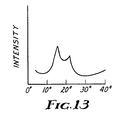
- FIG. 13 is the X-ray diffraction pattern of the non-crystalline mesomorphous polypropylene blown microfiber web of Example 10.
- Polypropylene to be used in products of the invention can be extruded from polymer melt in any shape which can be rapidly cooled throughout after extrusion to obtain non-crystalline mesomorphous phase polypropylene. The shape and/or thickness of the extruded material will be dependent on the efficiency of the quenching systems utilized. Generally, films, and blown microfiber webs are the preferred extruded materials. The extruded polypropylene should not be subjected to any treatment at temperatures above about 140oF (60oC), such as orientation or stretching, as such treatment would change the polypropylene structure to the crystalline phase. After irradiation, the polypropylene can be stretched or oriented if properties provided by such treatment are desired.
- The polypropylene may contain conventional additives such as antistatic materials, dyes, plasticizers, ultraviolet absorbers, nucleating agents and the like. The amount of additives is typically less than ten weight percent of the polymer component, preferably less than two percent by weight.
- To obtain the non-crystalline mesomorphous phase polypropylene, the extruded material must be quenched immediately after extrusion before the material reaches the crystalline state. The presence of the non-crystalline mesomorphous phase polypropylene can be confirmed by X-ray diffraction. FIGS. 1-3, 5-7, 9-11, and 13 are X-ray diffraction patterns for non-crystalline mesomorphous polypropylene. FIGS. 4, 8 and 12 are X-ray diffraction patterns for crystalline polypropylene. Although the term "non-crystalline mesomorphous" is used to describe the polypropylene useful in the present invention, the material contains some crystalline phase polypropylene as determined by density measurements using a gradient column. Generally, the percent crystallinity of the non-crystalline mesomorphous polypropylene is below about 45 percent.
- Various known methods of quenching can be used to obtain the non-crystalline mesomorphous structure including plunging the extruded material into a cold liquid, e.g., ice water bath, spraying the extruded material with a liquid such as water, and/or running the extruded material over a cooled roll or drum.
- Extruded polypropylene film is preferably quenched by contact with a quench roll or by plunging the film into a quench bath, such as an ice-water bath as disclosed by R.L. Miller ("On the Existence of Near-range Order in Isotactic Polypropylenes", Polymer, 1, 135 (1960). Where a quench roll is used, the roll temperature is preferably maintained at a temperature below about 75oF (24oC) and the film is generally in contact with the roll until solidified. The quench roll should be positioned relatively close to the extruder die, the distance being dependent on the roll temperature, the extrusion rate, the film thickness, and the roll speed. Generally, the distance from the die to the roll is 0.1 in (0.25 cm) to 2 in (5 cm). Where a quench bath is used, the bath temperature is preferably maintained at a temperature below about 40oF (4oC). The bath should be positioned relatively close to the die, generally 0.1 in (0.25 cm) to 5 in (13 cm) from the die to the bath.
- Polypropylene melt blown microfibers are produced by extruding molten polymer through a die into a high velocity hot air stream to produce fibers having an average fiber diameter of less than about 10 microns. The fibers are generally collected on a drum in the form of a web. The preparation of microfiber webs is described in Report No. 4364 of the Naval Research Laboratories, published May 25, 1954, entitled "Manufacture of Superfine Organic Fibers," by Wente, Van A. et al. and in Wente, Van A., "Superfine Thermoplastic Fibers" in Industrial Engineering Chemistry, Vol. 48, No. 8, August, 1956, pp. 1342-1346. To achieve non-crystalline, mesomorphous polypropylene webs, the blown microfiber web is preferably quenched by spraying with a liquid such as water or by cooling the collector drum onto which the microfiber web is collected. Optimum quenching can be achieved by spraying the fiber web near the die, then collecting the web on a cooled drum. The water spray is preferably at a temperature of less than about 50oF (10oC) and less than about 1 inch (2.5 cm) from the die and the collector drum is preferably 2 in (5 cm) to 4 in (10 cm) from the die, but can be as much as 8 in (20 cm) to 10 in (25 cm) depending on extrusion rates.
- The non-crystalline mesomorphous phase polypropylene can be irradiated by sterilizing ionizing radiation such as gamma radiation. The dosage of gamma radiation is generally in the range of 2.5 to 4.0 Mrad for sterilization of medical articles.
- The following non-limiting examples are provided to further illustrate the invention.
- Polypropylene films were extruded from Gulf PX2252 polypropylene polymer (melt flow index: 300; average molecular weight, by GPC: 51,900) using a 1½ in (3.2 cm) Brabender extruder with a 12 in (30.5 cm) wide film die at a thickness of about 1.5 mil (0.04 mm) under the following conditions:
Melt temperature (oC): 200 Screw speed (rpm): 30 Polymer flow rate (kg/hr): 5 Die temperature (oC): 204 - The films were extruded onto a chrome-plated 3 in (7.6 cm) diameter casting roll spaced one inch (2.5 cm) from the die. The film was in contact with the roll for about 2.5 seconds. The roll was maintained at the temperatures indicated in Table 1. The percent crystallinity was determined for each film by measuring the density using a gradient column. The percent crystallinities are also shown in Table 1.
Table 1 Roll Temperature (oC) Percent Crystallinity Example 1 6.7 31.9 Example 2 15.5 32.4 Example 3 23.9 33.2 Comparative Example 1 65.5 50.0
Each film was analyzed using wide angle X-ray diffraction to determine the morphology of the film. FIGS. 1-3 show the X-ray diffraction curves for the films of Examples 1-3 respectively and are indicative of non-crystalline mesomorphous polypropylene. FIG. 4 shows the X-ray diffraction curve for the film of Comparative Example 1 and is indicative of crystalline polypropylene. - Samples of each film were irradiated with 1 Mrad gamma radiation and tested together with non-irradiated samples quenched at the same temperature for yield stress and elongation at break using ASTM Test Method D882-31 after periods of storage at 70oF (22oC). The results are shown in Table 2.
Table 2 Example (Quench temp.) Time (mo.) Yield stress (kg/cm²) Elongation at break (%) Example 1 (6.7oC) 0 203 >400 0.5 196 >400 1 196 >400 2 188 >400 3 206 >400 6 209 >400 Non-irradiated (6.7oC) 0 203 >400 3 196 >400 Example 2 (5.5oC) 0 188 >400 0.5 181 >400 1 186 >400 2 191 >400 3 201 >400 6 195 >400 Non-irradiated (5.5oC) 0 188 >400 3 185 >400 Example 3 (23.9oC) 0 192 >400 0.5 188 >400 1 203 >400 2 193 >400 3 209 >400 6 195 >400 Non-irradiated (23.9oC) 0 192 >400 3 199 >400 Comparative Example 1 (65.5oC) 0 326 16 0.5 324 11 1 331 13 2 333 13 3 333 11 6 321 7 Non-irradiated (65.5oC) 0 326 16 3 342 19 - Samples of each film were irradiated with 3 Mrad gamma radiation and tested as described hereinabove. The results are shown in Table 3.
Table 3 Example (Quench temp.) Time (mo) Yield stress (kg/cm²) Elongation at break (%) Example 1 (6.7oC) 0 204 >400 0.5 202 >400 1 199 >400 2 203 >400 3 211 >400 6 209 >360 Non-irradiated (6.7oC) 0 204 >400 3 197 >400 Example 2 (15.5oC) 0 188 >400 0.5 194 >400 1 186 >400 2 192 >400 3 206 >400 6 195 335 Non-irradiated (15.5oC) 0 188 >400 3 185 >400 Example 3 (23.9oC) 0 192 >400 0.5 195 >400 1 201 >400 2 199 >400 3 201 >400 6 188 >400 Non-irradiated (23.9oC) 0 192 >400 3 200 >400 Comparative Example 1 (65.5oC) 0 326 16 0.5 314 9 1 314 6 2 312 7 3 6 too brittle to test Non-irradiated (65.5oC) 0 326 16 3 342 19 - As can be seen from the data in Tables 2 and 3, the non-crystalline mesomorphous films of Examples 1-3 exhibited minimal degradation of tensile properties after irradiation with as much as a 3 Mrad sterilizing dose of gamma radiation even after storage periods of six months.
- Polypropylene films were extruded from Exxon PP-3014 polypropylene polymer (melt flow index - 12; average molecular weight, by GPC: 161,000) using a 1¼ in (3.2 cm) Brabender extruder with a 12 in (30.5 cm) wide film die at a thickness of about 1.5 mil (0.04 mm) under the following conditions:
Melt temperature (oC) 203 Screw speed (rpm) 40 Polymer flow rate (kg/hr) 5 Die temperature (oC) 204 - The films were extruded onto a chrome-plated 3 in (7.6 cm) diameter casting roll spaced one inch (2.5 cm) from the die. The film was in contact with the roll for about 2.5 seconds. The roll was maintained at the temperature indicated in Table 4. The percent crystallinity was determined for each film by measuring the density using a gradient column. The percent crystallinities are also shown in Table 4.
Table 4 Roll temp. (oC) Percent crystallinity Example 4 6.7 32.7 Example 5 15.5 31.9 Example 6 23.9 32.9 Comparative Example 2 65.5 48.8
Each film was analyzed using wide angle X-ray diffraction to determine the morphology of the film. FIGS. 5-7 show the X-ray diffraction curves for the films of Examples 4-6 respectively and are indicative of non-crystalline mesomorphous polypropylene. FIG. 8 shows the X-ray diffraction curve for the film of Comparative Example 2 and is indicative of crystalline polypropylene. - Samples of each film were irradiated with 3 Mrad gamma radiation and tested together with non-irradiated samples quenched at the same temperature for yield stress and elongation at break using ASTM Test Method D882-31 after periods of storage at 70oF (22oC). The results are shown in Table 5.
Table 5 Example (Quench temp.) Time (mo.) Yield stress (kg/cm)2 Elongation at break (%) Example 4 (6.7oC) 0 203 >400 0.5 205 >400 1 220 >400 2 214 >400 3 218 >400 6 233 >400 Non-irradiated (6.7oC) 0 203 >400 3 213 >400 Example 5 (15.5oC) 0 205 >400 0.5 204 >400 1 221 >400 2 217 >400 3 223 >400 6 219 >400 Non-irradiated (15.5oC) 0 205 >400 3 211 >400 Example 6 (23.9oC) 0 209 >400 0.5 215 >400 1 231 >400 2 228 >400 3 224 >400 6 237 >400 Non-irradiated (23.9oC) 0 209 >400 3 220 >400 Comparative Example 2 (65.5oC) 0 322 >400 0.5 321 337 1 335 320 2 347 320 3 340 250 6 335 56 Non-irradiated (65.5oC) 0 322 >400 3 343 >400 - As can be seen from the data in Table 5, the non-crystalline mesomorphous films of Examples 4-6 showed no degradation of tensile properties after irradiation with a 3 Mrad sterilizing dose of gamma radiation even after storage periods of six months. The film of Comparative Example 2, when irradiated with a 3 Mrad dose of gamma radiation, exhibited some degradation within 0.5 month and severe degradation after six months storage.
- Polypropylene films were extruded from Arco 8670 polypropylene polymer (melt flow index - 4; average molecular weight, by GPC - 204,000) using a 1-1/4 in (3.2 cm) Brabender extruder with a 12 in (30.5 cm) wide film die at a thickness of about 1.5 mil (0.04 mm) under the following conditions:
Melt temperature (oC) 206 Screw speed (rpm) 47 Polymer flow rate (kg/hr) 4.7 Die temperature (oC) 204 - The films were extruded onto a chrome-plated 3 in (7.6 cm) diameter casting roll spaced one inch (2.5 cm) from the die. The film was in contact with the roll for about 2.5 seconds. The roll was maintained at the temperature indicated in Table 6. The percent crystallinity was determined for each film by measuring the density using a gradient column. The percent crystallinities are also shown in Table 6.
Table 6 Roll temp. (°C) Percent crystallinity Example 7 6.7 34.6 Example 8 15.5 37.3 Example 9 23.9 35.9 Comparative Example 3 65.5 64.6 - Each was analyzed using wide angle X-ray diffraction to determine the morphology of the film. FIGS. 9-11 show the X-ray diffraction curves for the films of Examples 7-9 respectively and are indicative of non-crystalline mesomorphous polypropylene. FIG. 12 shows the X-ray diffraction curve for the film of Comparative Example 3 and is indicative of crystalline polypropylene.
- Samples of each film were irradiated with 3 Mrad gamma radiation and tested together with non-irradiated samples quenched at the same temperature for yield stress and elongation at break using ASTM Test Method D882-31 after periods of storage at 70°F (22°C). The test results are shown in Table 7.
Table 7 Example (Quench temp.) Time (mo) Yield Stress (kg/cm²) Elongation at break (%) Example 7 (6.7oC) 0 210 >400 0.5 214 >400 1 208 >400 2 203 >400 3 222 >400 6 279 >400 Non-irradiated (6.7oC) 0 210 >400 3 213 >400 Example 8 (15.5oC) 0 209 >400 0.5 223 >400 1 226 >400 2 217 >400 3 225 >400 6 286 >400 Non-irradiated (15.5oC) 0 209 >400 3 221 >400 Example 9 (23.9oC) 0 222 >400 0.5 237 >400 1 226 >400 2 228 >400 3 237 >400 6 279 >400 Non-irradiated (23.9oC) 0 222 >400 3 231 >400 Comparative Example 3 (65.5oC) 0 306 >400 0.5 320 >400 1 315 >400 2 316 >400 3 319 350 6 307 260 Non-irradiated (65.5oC) 0 306 >400 3 329 >400 - A melt blown polypropylene microfiber web having a weight of 20 g/m² was extruded, as described in Wente, Van A., "Superfine Thermoplastic Fibers", supra, using Escorene PP 3085 polypropylene polymer (available from Exxon Chemical Americas.) The extruder conditions were:
Polymer rate (kg/hr) 6.5 Polymer melt temperature (oC) 329 Air temperature (oC) 343 Air pressure (kPa) 138 - The fibers were quenched with water at a temperature of 40oF (4oC) and at a rate of 5 gal/hr (19 l/hr) with the spray located 6 inches (15 cm) below the die and directed at the fibers as they exited the die. The web was collected on a drum maintained at a temperature of 40oF (4oC), by dipping the roll in ice water, to further quench the web.
- The quenched web was analyzed by wide angle X-ray diffraction as shown in FIG. 13 and found to be non-crystalline mesomorphous in structure. The percent crystallinity of the web, as determined by density was found to be 33 percent.
- Samples of the non-crystalline mesomorphous web were sterilized using gamma radiation at a dosage of between 2.86 to 3.39 Mrad. The sterilized non-crystalline mesomorphous web was tested for yield strength and elongation at break after various periods of storage using an Instron Tensile Tester with a 1 in (2.5 cm) wide by 5 in (12.7 cm) long sample at a rate of 5 in (12.7 cm) per minute. The results are shown in Table 10.
Table 10 Time (days) Yield stress (kg/cm²) Elongation at break (%) 0 (not sterilized) 1.2 52 3 0.9 51 10 0.9 44 17 1.0 58 22 1.1 58 - Melt blown polypropylene microfiber webs were prepared in a manner similar to that used in Example 10, except that the fibers were not water quenched. A first sample having a weight of 26.6 g/m² had a tensile strength of 0.63 kg when tested as in Example 12. A second sample having a weight of 26.4 g/m² was sterilized using gamma radiation at a dosage of 2.5 Mrad. Two weeks after sterilization, this second sample had a tensile strength of 0.34 kg, a tensile strength reduction of 46%. After storage for an additional four weeks, the second sample had degraded to an extent that disintegration and powdering occurred on handling.
- Melt blown microfiber web was extruded using Escorene PP 3145 polypropylene polymer (available from Exxon Chemical Americas) as in Example 10 with extruder conditions of:
Polymer rate (kg/hr) 4.5 Polymer melt temperature (oC) 290 Air temperature (oC) 292 Air pressure (kPa) 124 - For Example 11, the fibers were quenched as in Example 10 to produce non-crystalline mesomorphous polypropylene web. For Comparative Example 5, the extruded fibers were not quenched, producing crystalline polypropylene web.
- Samples of the non-crystalline mesomorphous polypropylene web and the crystalline polypropylene web were sterilized using gamma radiation at a dosage of about 3 Mrads.
- Sterilized and unsterilized samples of the non-crystalline mesomorphous polypropylene and the crystalline polypropylene were tested for initial elongation at break and elongation at break after the intervals set forth in Table 11.
Table 11 Elongation at Break (%) Time (days) Example 11 Comparative Example 5 Not Sterilized Sterilized Not Sterilized Sterilized 0 50 45 20 21 13 38 24 15 7 21 35 37 15 7 28 34 35 14 9 35 36 26 13 7 42 36 40 11 9 52 31 28 10 7 67 36 26 12 6 83 34 31 13 8 - As can be seen from the data in Table 11, the loss of elongation of the sterilized non-crystalline polypropylene (31%) was comparable to that of the non-sterilized non-crystalline polypropylene (32%) at an 83 day interval. In contrast, the sterilized crystalline polypropylene exhibited about double the loss in elongation as the non-sterilized crystalline polypropylene, the losses being 62% and 35% respectively.
Claims (12)
- A method for preparing irradiated polypropylene articles comprising:a) extruding polypropyleneb) quenching said extruded polypropylene immediately after extrusion to provide non-crystalline mesomorphous polypropylene; andc) irradiating said non-crystalline mesomorphous polypropylene with a dosage of ionizing radiation that would degrade crystalline polypropylene.
- The method of claim 1 wherein said extruded polypropylene is in the form of a blown microfiber web and quenching is achieved by application of liquid cooling spray to said extruded polypropylene.
- The method of claim 2 wherein said spray is spaced less than about 2.5 cm from the point of extrusion.
- The method of claim 2 wherein said spray is at a temperature of less than about 10oC.
- The method of claim 1 wherein said extruded polypropylene is in the form of a blown microfiber web and quenching is achieved by collecting said web on a cooled collector drum.
- The method of claim 5 wherein said drum is 5 to 10 cm from the die.
- The method of claim 1 wherein said extruded polypropylene is film and quenching is achieved by casting said extruded polypropylene onto a cooled casting roll.
- The method of claim 7 wherein said casting roll is spaced 0.25 to 5 cm from the point of extrusion.
- The method of claim 1 wherein a sterilizing dosage of ionizing radiation between 2.5 and 4.0 Mrad is used.
- An irradiated polypropylene article formed from non-crystalline mesomorphic polypropylene according to the method of claim 1 which is substantially undegraded after at least six months storage.
- A sterile pack comprising a gamma radiation sterilized polypropylene article formed according to the method of claim 1 wherein said article is a non-crystalline mesomorphous polypropylene article contained within a sealed container, said article having been sterilized while in said sealed container, said article being substantially undegraded after six months storage.
- An irradiated polypropylene blown microfiber web formed according to the method of claim 1 which is substantially undegraded after at least six months storage.
Applications Claiming Priority (2)
| Application Number | Priority Date | Filing Date | Title |
|---|---|---|---|
| US86106886A | 1986-05-08 | 1986-05-08 | |
| US861068 | 1986-05-08 |
Publications (3)
| Publication Number | Publication Date |
|---|---|
| EP0248545A2 EP0248545A2 (en) | 1987-12-09 |
| EP0248545A3 EP0248545A3 (en) | 1988-08-10 |
| EP0248545B1 true EP0248545B1 (en) | 1993-01-13 |
Family
ID=25334790
Family Applications (1)
| Application Number | Title | Priority Date | Filing Date |
|---|---|---|---|
| EP87304084A Expired - Lifetime EP0248545B1 (en) | 1986-05-08 | 1987-05-07 | Radiation resistant polypropylene articles and method for preparing same |
Country Status (10)
| Country | Link |
|---|---|
| EP (1) | EP0248545B1 (en) |
| JP (1) | JPH07121991B2 (en) |
| KR (1) | KR940008073B1 (en) |
| AR (1) | AR243795A1 (en) |
| AU (1) | AU597975B2 (en) |
| BR (1) | BR8702336A (en) |
| CA (1) | CA1311719C (en) |
| DE (1) | DE3783514T2 (en) |
| ES (1) | ES2036573T3 (en) |
| MX (1) | MX168272B (en) |
Families Citing this family (8)
| Publication number | Priority date | Publication date | Assignee | Title |
|---|---|---|---|---|
| US5209984A (en) * | 1989-06-26 | 1993-05-11 | Minnesota Mining And Manufacturing Company | Films of radiation resistant heat sealable polymer blends having a surface adhesion layer grafted thereto |
| US5140073A (en) * | 1989-06-26 | 1992-08-18 | Minnesota Mining And Manufacturing Company | Radiation resistant heat sealable polymer blends of compatible polymers and methods of preparing same |
| US5258419A (en) * | 1989-06-26 | 1993-11-02 | Minnesota Mining And Manufacturing Company | Methods of preparing radiation resistant heat sealable polymer blends |
| JP2894823B2 (en) * | 1989-12-06 | 1999-05-24 | 三井化学株式会社 | Method for producing radiation-resistant polypropylene resin composition and radiation-resistant molded article |
| US5496295A (en) * | 1991-12-18 | 1996-03-05 | Minnesota Mining And Manufacturing Company | Multilayered barrier structures |
| JPH07502219A (en) * | 1991-12-18 | 1995-03-09 | ミネソタ マイニング アンド マニュファクチャリング カンパニー | Multilayer barrier structure |
| FI95153C (en) * | 1994-02-11 | 1995-12-27 | Suominen Oy J W | Process for producing a polypropylene fiber that can withstand gamma irradiation for nonwovens to be radiation sterilized and in connection therewith for the process of producing said mechanically or hydraulically bondable nonwovens. |
| DE19621465A1 (en) * | 1996-05-29 | 1997-12-04 | Danubia Petrochem Deutschland | Use of amorphous polypropylene@ to improve radiation stability |
Family Cites Families (2)
| Publication number | Priority date | Publication date | Assignee | Title |
|---|---|---|---|---|
| JPS54160475A (en) * | 1978-06-09 | 1979-12-19 | Sumitomo Bakelite Co Ltd | Production of polypropylene sheet |
| NZ208423A (en) * | 1983-10-26 | 1987-05-29 | Becton Dickinson Co | Sterilised, radiation-stabilised semi-crystalline polymer articles |
-
1987
- 1987-05-07 EP EP87304084A patent/EP0248545B1/en not_active Expired - Lifetime
- 1987-05-07 BR BR8702336A patent/BR8702336A/en not_active IP Right Cessation
- 1987-05-07 KR KR1019870004447A patent/KR940008073B1/en not_active Expired - Fee Related
- 1987-05-07 CA CA000536576A patent/CA1311719C/en not_active Expired - Lifetime
- 1987-05-07 ES ES198787304084T patent/ES2036573T3/en not_active Expired - Lifetime
- 1987-05-07 DE DE8787304084T patent/DE3783514T2/en not_active Expired - Fee Related
- 1987-05-07 JP JP62111661A patent/JPH07121991B2/en not_active Expired - Lifetime
- 1987-05-08 AR AR87307514A patent/AR243795A1/en active
- 1987-05-08 MX MX006417A patent/MX168272B/en unknown
- 1987-05-08 AU AU72627/87A patent/AU597975B2/en not_active Ceased
Also Published As
| Publication number | Publication date |
|---|---|
| ES2036573T3 (en) | 1993-06-01 |
| JPH07121991B2 (en) | 1995-12-25 |
| EP0248545A2 (en) | 1987-12-09 |
| AU597975B2 (en) | 1990-06-14 |
| KR940008073B1 (en) | 1994-09-01 |
| JPS62273232A (en) | 1987-11-27 |
| BR8702336A (en) | 1988-02-17 |
| DE3783514T2 (en) | 1993-08-05 |
| DE3783514D1 (en) | 1993-02-25 |
| MX168272B (en) | 1993-05-14 |
| CA1311719C (en) | 1992-12-22 |
| EP0248545A3 (en) | 1988-08-10 |
| AU7262787A (en) | 1987-11-12 |
| AR243795A1 (en) | 1993-09-30 |
| KR870011283A (en) | 1987-12-22 |
Similar Documents
| Publication | Publication Date | Title |
|---|---|---|
| US4931230A (en) | Method for preparing radiation resistant polypropylene articles | |
| US5254378A (en) | Radiation resistant polypropylene articles and method for preparing same | |
| EP0405793B1 (en) | Radiation resistant heat sealable polymer blends of compatible polymers and methods of preparing same | |
| US5258419A (en) | Methods of preparing radiation resistant heat sealable polymer blends | |
| EP1023388B2 (en) | Polypropylene composition useful for making solid state oriented film | |
| US4950549A (en) | Polypropylene articles and method for preparing same | |
| US5078925A (en) | Preparing polypropylene articles | |
| EP2831169B1 (en) | Soft polypropylene with improved optical properties | |
| EP2831168B1 (en) | Unoriented film based on soft polypropylene | |
| EP2931809B1 (en) | Extrusion blow molded bottles | |
| EP0248545B1 (en) | Radiation resistant polypropylene articles and method for preparing same | |
| EP0451743B1 (en) | Method for molding syndiotactic polypropylene and molded article | |
| EP2557118B1 (en) | Preparation of a soft heterophasic propylene copolymer | |
| EA015604B1 (en) | Transparent easy tearable film, a process for producing thereof (variants), use a composition for producing the film and use thereof | |
| JPWO1998031741A1 (en) | Method for recrystallizing diacetal in polyolefin resin | |
| US20020107351A1 (en) | Propylene-based polymer and film made of the same | |
| JPS6311968B2 (en) | ||
| EP0297741A2 (en) | Polypropylene articles and method for preparing same | |
| JPS6316256B2 (en) | ||
| US5209984A (en) | Films of radiation resistant heat sealable polymer blends having a surface adhesion layer grafted thereto | |
| EP0547834B1 (en) | Polymer blends, articles and methods for preparing same | |
| WO2008024154A1 (en) | High clarity polymer compositions, methods and articles made therefrom | |
| EP2557096A1 (en) | Soft propylene copolymer | |
| EP0547824A1 (en) | Mesocopolymers, articles, and methods for preparing same | |
| US5260395A (en) | Method for molding syndiotactic polypropylene and molded article |
Legal Events
| Date | Code | Title | Description |
|---|---|---|---|
| PUAI | Public reference made under article 153(3) epc to a published international application that has entered the european phase |
Free format text: ORIGINAL CODE: 0009012 |
|
| AK | Designated contracting states |
Kind code of ref document: A2 Designated state(s): CH DE ES FR GB IT LI SE |
|
| PUAL | Search report despatched |
Free format text: ORIGINAL CODE: 0009013 |
|
| AK | Designated contracting states |
Kind code of ref document: A3 Designated state(s): CH DE ES FR GB IT LI SE |
|
| 17P | Request for examination filed |
Effective date: 19890123 |
|
| 17Q | First examination report despatched |
Effective date: 19900507 |
|
| ITTA | It: last paid annual fee | ||
| GRAA | (expected) grant |
Free format text: ORIGINAL CODE: 0009210 |
|
| AK | Designated contracting states |
Kind code of ref document: B1 Designated state(s): CH DE ES FR GB IT LI SE |
|
| ITF | It: translation for a ep patent filed | ||
| REF | Corresponds to: |
Ref document number: 3783514 Country of ref document: DE Date of ref document: 19930225 |
|
| ET | Fr: translation filed | ||
| REG | Reference to a national code |
Ref country code: ES Ref legal event code: FG2A Ref document number: 2036573 Country of ref document: ES Kind code of ref document: T3 |
|
| PLBE | No opposition filed within time limit |
Free format text: ORIGINAL CODE: 0009261 |
|
| STAA | Information on the status of an ep patent application or granted ep patent |
Free format text: STATUS: NO OPPOSITION FILED WITHIN TIME LIMIT |
|
| 26N | No opposition filed | ||
| EAL | Se: european patent in force in sweden |
Ref document number: 87304084.4 |
|
| PGFP | Annual fee paid to national office [announced via postgrant information from national office to epo] |
Ref country code: CH Payment date: 19950412 Year of fee payment: 9 |
|
| PG25 | Lapsed in a contracting state [announced via postgrant information from national office to epo] |
Ref country code: LI Effective date: 19960531 Ref country code: CH Effective date: 19960531 |
|
| REG | Reference to a national code |
Ref country code: CH Ref legal event code: PL |
|
| PGFP | Annual fee paid to national office [announced via postgrant information from national office to epo] |
Ref country code: SE Payment date: 19980420 Year of fee payment: 12 |
|
| PGFP | Annual fee paid to national office [announced via postgrant information from national office to epo] |
Ref country code: ES Payment date: 19980519 Year of fee payment: 12 |
|
| PG25 | Lapsed in a contracting state [announced via postgrant information from national office to epo] |
Ref country code: SE Free format text: LAPSE BECAUSE OF NON-PAYMENT OF DUE FEES Effective date: 19990508 Ref country code: ES Free format text: LAPSE BECAUSE OF EXPIRATION OF PROTECTION Effective date: 19990508 |
|
| EUG | Se: european patent has lapsed |
Ref document number: 87304084.4 |
|
| PGFP | Annual fee paid to national office [announced via postgrant information from national office to epo] |
Ref country code: DE Payment date: 20010419 Year of fee payment: 15 |
|
| REG | Reference to a national code |
Ref country code: ES Ref legal event code: FD2A Effective date: 20010601 |
|
| REG | Reference to a national code |
Ref country code: GB Ref legal event code: IF02 |
|
| PGFP | Annual fee paid to national office [announced via postgrant information from national office to epo] |
Ref country code: FR Payment date: 20020417 Year of fee payment: 16 |
|
| PGFP | Annual fee paid to national office [announced via postgrant information from national office to epo] |
Ref country code: GB Payment date: 20020501 Year of fee payment: 16 |
|
| PG25 | Lapsed in a contracting state [announced via postgrant information from national office to epo] |
Ref country code: DE Free format text: LAPSE BECAUSE OF NON-PAYMENT OF DUE FEES Effective date: 20021203 |
|
| PG25 | Lapsed in a contracting state [announced via postgrant information from national office to epo] |
Ref country code: GB Free format text: LAPSE BECAUSE OF NON-PAYMENT OF DUE FEES Effective date: 20030507 |
|
| GBPC | Gb: european patent ceased through non-payment of renewal fee |
Effective date: 20030507 |
|
| PG25 | Lapsed in a contracting state [announced via postgrant information from national office to epo] |
Ref country code: FR Free format text: LAPSE BECAUSE OF NON-PAYMENT OF DUE FEES Effective date: 20040130 |
|
| REG | Reference to a national code |
Ref country code: FR Ref legal event code: ST |
|
| PG25 | Lapsed in a contracting state [announced via postgrant information from national office to epo] |
Ref country code: IT Free format text: LAPSE BECAUSE OF NON-PAYMENT OF DUE FEES;WARNING: LAPSES OF ITALIAN PATENTS WITH EFFECTIVE DATE BEFORE 2007 MAY HAVE OCCURRED AT ANY TIME BEFORE 2007. THE CORRECT EFFECTIVE DATE MAY BE DIFFERENT FROM THE ONE RECORDED. Effective date: 20050507 |