EP0248523A1 - Pyrazoles - Google Patents
Pyrazoles Download PDFInfo
- Publication number
- EP0248523A1 EP0248523A1 EP87303666A EP87303666A EP0248523A1 EP 0248523 A1 EP0248523 A1 EP 0248523A1 EP 87303666 A EP87303666 A EP 87303666A EP 87303666 A EP87303666 A EP 87303666A EP 0248523 A1 EP0248523 A1 EP 0248523A1
- Authority
- EP
- European Patent Office
- Prior art keywords
- formula
- pyrazol
- alkyl
- phenyl
- compound
- Prior art date
- Legal status (The legal status is an assumption and is not a legal conclusion. Google has not performed a legal analysis and makes no representation as to the accuracy of the status listed.)
- Granted
Links
Classifications
-
- C—CHEMISTRY; METALLURGY
- C07—ORGANIC CHEMISTRY
- C07D—HETEROCYCLIC COMPOUNDS
- C07D231/00—Heterocyclic compounds containing 1,2-diazole or hydrogenated 1,2-diazole rings
- C07D231/02—Heterocyclic compounds containing 1,2-diazole or hydrogenated 1,2-diazole rings not condensed with other rings
- C07D231/10—Heterocyclic compounds containing 1,2-diazole or hydrogenated 1,2-diazole rings not condensed with other rings having two or three double bonds between ring members or between ring members and non-ring members
- C07D231/14—Heterocyclic compounds containing 1,2-diazole or hydrogenated 1,2-diazole rings not condensed with other rings having two or three double bonds between ring members or between ring members and non-ring members with hetero atoms or with carbon atoms having three bonds to hetero atoms with at the most one bond to halogen, e.g. ester or nitrile radicals, directly attached to ring carbon atoms
- C07D231/38—Nitrogen atoms
Definitions
- This invention relates to new heterocyclic compounds, processes for their preparation and compositions containing them.
- the cyclisation reaction (a) is preferably carried out in a polar solvent, eg ethanol, at a temperature of from about 25 to 75°C.
- a polar solvent eg ethanol
- the process of reaction (b) is preferably carried out in a solvent.
- the solvent is preferably inert to the reaction conditions, eg a polar, aprotic solvent such as 1,4-dioxan, dimethylformamide or N-methylpyrrolidone.
- the reaction may, if desired, be carried out in the presence of a non-nucleophilic base, eg sodium carbonate, sodium hydride or potassium t-butoxide.
- Good leaving groups that X may represent include tosylate and halide, eg chloride, bromide and iodide.
- the reaction may be carried out at a temperature of from about 0 to 150°C.
- the aromatisation of process (c) may be carried out in the presence of an agent which is capable of accepting hydrogen, for example palladium or charcoal.
- the aromatisation may be carried out by bubbling air or oxygen through a solution of the compound of formula V in an inert solvent, eg an halogenated hydrocarbon.
- an oxidising agent eg a metal oxide such as manganese dioxide.
- the oxidation is preferably carried out in a solvent which is inert to the reaction conditions, eg in an halogenated hydrocarbon, at a temperature of from about -70 to I50°C.
- Leaving groups that L may represent in the aromatisation of process (d) include halogen, Oacetyl and especially arylsulphonyl, for example, tosyl.
- the aromatisation may be effected by heating. However we prefer to carry out the reaction in the presence of a base, eg a metal alkoxide in an alcohol. Sodium ethoxide in ethanol is particularly suitable. The reaction may be carried out at a temperature of from 40 to 150 o C .
- Protected hydroxy groups that ArIa, Ar 2 a and Ar 3 a may bear include alkyloxy, eg methoxy, acetoxy, trifluoroacetoxy and arylmethoxy, eg phenylmethoxy.
- Other protecting groups are well known and include those described in Protective Groups in Organic Chemistry, ed JWF McOmie, Plenum Press (1973) and Protective Groups in Organic Synthesis, TW Greene, Wiley-Interscience (1981). Removal of the protecting group depends on the nature of the protecting group; conventional techniques may generally be employed, including acidic or basic cleavage or hydrogenolysis.
- protecting alkyl or phenylalkyl groups may be removed using a protic acid, eg hydrochloric acid or hydrobromic acid at a temperature of from 0 to 150°C, or a Lewis acid, eg by reacting with boron trihalide in a halocarbon solvent.
- a protic acid eg hydrochloric acid or hydrobromic acid at a temperature of from 0 to 150°C
- a Lewis acid eg by reacting with boron trihalide in a halocarbon solvent.
- cleavage may be effected using a base, eg sodium hydroxide, in a suitable solvent, eg aqueous ethanol.
- Lewis bases eg pyridine hydrochloride, may be used to cleave alkyl or phenylalkyl groups.
- Arylmethyl groups eg benzyl
- Compounds of formula V may be prepared by reacting a compound of formula VIII, in which L 2 represents a leaving group and R 1 , R 4 and R 5 are as defined above, with a compound of formula IX, in which R 3 and Ar 2 are as defined above.
- the reaction may be carried out by heating the two reactants with or without a solvent, eg at a temperature of 50 to 250°C.
- Suitable leaving groups that L 2 may represent include halogen, eg chlorine, NH 2 and hydroxy.
- Compounds of formula VI may be prepared from compounds of formula V in which R 1 represents hydrogen by conventional techniques, for example when L represents p-toluenesulphonyl, compounds of formula VI may be prepared by reacting a compound of formula V in which R 1 is hydrogen with p-toluenesulphonyl chloride in the presence of a base.
- the acid addition salts of the compounds of formula I may be prepared by reaction of the free base with an appropriate acid.
- the acid addition salts may be converted to the corresponding free base by the action of a stronger base.
- the process as described above may produce the compound of formula I or an acid addition, salt thereof. It is also within the scope of this invention to treat any derivatives so produced to liberate the free compound of formula I, or to convert one derivative into another.
- Pharmaceutically acceptable acid addition salts include, eg salts of mineral acids, such as hydrohalic acids, eg hydrochloric acid or hydrobromic acid, or organic acids such as formic, acetic or lactic acids.
- the acid may be polybasic, for example sulphuric, fumaric or citric acid.
- the compounds of formula I, and pharmaceutically acceptable acid addition salts thereof, are useful because they possess pharmacological activity in animals.
- the compounds are useful as broad spectrum anti-inflammatory agents as indicated in one or more of the following assay systems:
- the compounds are indicated for use in the treatment or prophylaxis of inflammatory conditions in mammals, including man. Conditions that may be specifically mentioned are: rheumatoid arthritis, rheumatoid spondylitis, osteoarthritis, gouty arthritis, and other arthritic conditions, inflamed joints;
- the dosage administered will, of course, vary with the compound employed, the mode of administration and the treatment desired. However, in general satisfactory results are obtained when the compounds are administered at a daily dosage of from about O.lmg to about 20mg per kg of animal body weight, preferably given in divided doses 1 to 4 times ,a day or in sustained release form.
- the total daily dose is in the range of from 7.0mg to 1,400mg and unit dosage forms suitable for oral administration comprise from 2.0mg to 1,400mg of the compound admixed with a solid or liquid pharmaceutical carrier or diluent.
- the compounds of formula I, and pharmaceutically acceptable acid addition salts thereof, may be used on their own or in the form of appropriate medicinal preparations for enteral, parenteral or topical administration.
- a pharmaceutical composition comprising preferably less than 80% and more preferably less than 50% by weight of a compound of formula I, or a pharmaceutically acceptable acid addition salt thereof, in admixture with a pharmaceutically acceptable adjuvant, diluent or carrier.
- adjuvants, diluents and carriers are:- for tablets and dragees: lactose, starch, talc, stearic acid; for capsules: tartaric acid or lactose; for injectable solutions: water, alcohols, glycerin, vegetable oils; for suppositories: natural or hardened oils or waxes.
- compositions in a form suitable for oral, ie oesophageal administration include tablets, capsules and dragees;
- the compounds of formula I and pharmaceutically acceptable acid addition salts thereof have the advantage that they are less toxic, more efficacious, are longer acting, have a broader range of activity, are more potent, produce fewer side effects, are more easily absorbed, eg orally or have other useful pharmacological properties, than compounds of similar structure.
- R 1 , R 3' R 4 , R 5 , R 6 or R 7 represent alkyl or alkanoyl
- the group preferably contains up to 10, more preferably up to six carbon atoms.
- Particular alkyl groups that R 1 , R 3 , R 4 , R 5 , R 6 and R 7 may represent include saturated and unsaturated alkyl groups, for example, methyl, ethyl, 2-propenyl and butyl.
- Particular NR 6 R 7 groups that may substitute the N-phenyl include -NH 2 , -NHCH 3 and -N(CH 3 ) 2 .
- R 1 may represent include hydrogen, acetyl, benzyl, 4-alkoxybenzyl, methyl and isopropyl.
- R 1 may represent CH2Arl, alkyl or hydrogen.
- R 1 may represent hydrogen when R 5 represents Ar 3 .
- Ar 1 may represent include phenyl and substituted by hydroxy or alkoxy.
- phenyl group of Ar 2 to bear a substituent in the 2- or 4- position.
- phenyl group to bear an OH, alkoxy, eg methoxy or dialkylamino group in the 2- or 4- position.
- An especially favoured group that Ar 2 may represent is hydroxyphenyl, in particular 2- or 4-hydroxyphenyl.
- Ar 2 may be further substituted by groups selected from halogen, alkoxy and especially alkyl, eg methyl.
- R 3 to represent alkyl and particularly hydrogen.
- R 4 to represent phenyl and particularly hydrogen.
- R 5 may represent include hydrogen, methyl and Ar 3 .
- Ar 3 may represent include phenyl and hydroxyphenyl, eg 4-hydroxyphenyl.
- Certain of the compounds of formula I possess one or more chiral centres and the invention also provides the compounds in the form of their individual optical isomers or as racemic or other mixtures thereof. Certain of the compounds of formula I may also exist as stereoisomers and in these cases the invention provides all stereoisomeric forms. The various isomers may be prepared and/or separated using conventional processes known per se.
- Example 2 The compound of Example 1 (1.0g), acetyl chloride (0.43g) and pyridine (0.43g) were stirred together at room temperature for 0.5 hr. The mixture was partitioned between ethyl acetate and aqueous brine. The organic layer was extracted, dried and chromatographed on silica eluting with 5% ethyl acetate/95% dichloromethane, to give the title produced as colourless crystals, 280 mg, mp 123-124°.
- step a) To a stirred solution of the product of step a) (13.3g) in dichloromethane (250ml) was added active manganese dioxide in portions until all traces of starting material had disappeared. The reaction mix was filtered, evaporated to a gum and purified by chromatography on silica, eluting with ether, to give the product, mp 68-71°.
- Example 3 The title pyrazole of Example 3 (6.3g) was heated on a steam bath in a mixture of aqueous HBr (48%, 200ml) and glacial acetic acid (25ml) for 6 hours. The reaction mixture was cooled, poured into water, neutralised with sodium bicarbonate, extracted with ethyl acetate, washed with brine, dried and evaporated to give after chromatography the title compound, l.Og, mp 114-116°
- step a) The product of step a) (7.5g) was added to a solution of sodium ethoxide (60ml, prepared from 0.6g sodium), at a temperature of 60°. The mixture was refluxed for 10 minutes, cooled, added to water, extracted with ethyl acetate, dried and evaporated to give the sub-title compound as a purple oil, ms 189 (M + ).
- step b) The product of step b) (4.6g) was dissolved in 48% aqueous HBr (100ml) and refluxed for 8 hours. The mixture was poured onto water (750ml), neutralised with solid sodium bicarbonate, extracted with ethyl acetate, washed with brine and evaporated to give the title compound as a white crystalline solid, 0.49g, mp 163-4° (from ethyl acetate/cyclohexane).
- the pyrazole from Example 5 b) (4.0g) was added to a mixture of crushed potassium hydroxide pellets (4.7g) in dry dimethylsulphoxide, which had previously been stirred for 5 minutes under nitrogen at room temperature. After stirring for 0.75 hours, methyl iodide (3.1g) was added to the red solution and stirring was maintained for a further 0.75 hours. The reaction mix was poured into water, extracted with ethyl acetate, the organic layer washed, dried, evaporated and chromatographed to give a light brown oil.
- Example 2 The title pyrazole from Example 1 (3g) was heated in a mixture of aqueous HBr (30%, 10ml) and glacial acetic acid (2ml) on a steam bath for 72 hours. The mixture was cooled, filtered and neutralised with dilute sodium bicarbonate to give the title compound as a colourless solid, 2.2g, mp 215-17° (from ethanol).
Landscapes
- Chemical & Material Sciences (AREA)
- Organic Chemistry (AREA)
- Pharmaceuticals Containing Other Organic And Inorganic Compounds (AREA)
- Nitrogen And Oxygen Or Sulfur-Condensed Heterocyclic Ring Systems (AREA)
Abstract

- R1 represents hydrogen, alkyl, alkanoyl or alkyl substituted by Ar1,
- R3, R4 and R5, which may be the same or different, each independently represent hydrogen, alkyl or Ar3,
- Ar,, Ar2 and Ar3, which may be the same or different, independently represent phenyl or phenyl substituted by one or more of alkyl, hydroxy, alkoxy, NR6R7 or halogen,
- R6 and R7, which may be the same or different, independently represent hydrogen or alkyl,
- and pharmaceutically acceptable acid addition salts thereof.
Description
- This invention relates to new heterocyclic compounds, processes for their preparation and compositions containing them.
- Chemical Abstracts, Vol 71, 1969, 22058Z describes several 3-aryl-5-methylpyrazol-3-amines but does not disclose any pharmaceutical uses of these compounds.
- The Indian Journal of Chemistry, Section B, 1985 24(B), 472-6 describes several 3,5-diarylpyrazol-3-amines but does not disclose any pharmaceutical uses of these compounds.
- Pyrazole-3-amines are also described in Chemische Berichte, 1962 95 937-43, Chemische Berichte 1969, 100, 2577-2584, and in East German Patent 211343.
- We have now found that certain pyrazol-3-amines have useful pharmacological properties.
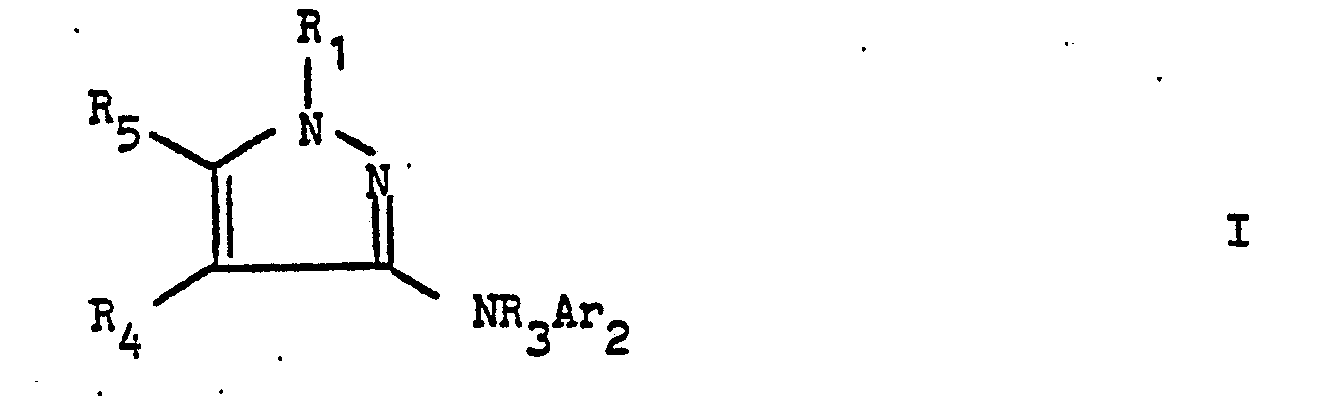
- According to the invention there are provided the compounds of formula I,

- R l-represents hydrogen, alkyl, alkanoyl or alkyl substituted by Arl,
- R 3, R4 and R5, which may be the same or different, each independently represent hydrogen, alkyl or Ar3,
- Ar1, Ar2 and,Ar3, which may be the same or different, independently represent phenyl or phenyl substituted by one or more of alkyl, hydroxy, alkoxy, NR6R7 or halogen,
- R6 and R7, which may be the same or different, independently represent hydrogen or alkyl,
- and pharmaceutically acceptable acid addition salts thereof,
- for use as a pharmaceutical.
- According to the invention there are also provided the novel compounds of formula I, as hereinbefore defined, provided that
- i) when R1, R3 and R4 each represent hydrogen, and RS represents methyl, then Ar2 does not represent phenyl or phenyl substituted by alkyl, alkoxy or halogen and
- ii) when R1, R3 and R4 each represent hydrogen and Ar2 represents phenyl or phenyl substituted by alkyl, then R5 does not represent phenyl or phenyl substituted by alkyl, alkoxy or halogen and
- iii) when R1 and R3 represent hydrogen, and Ar2 represents phenyl, then
- (a) R4 and R5 do not both represent phenyl and
- (b) R5 does not represent hydrogen when R4 represents alkyl,
- and pharmaceutically acceptable acid addition salts thereof.
- According to the invention there is further provided a process for the preparation of compounds of formula I or pharmaceutically acceptable acid addition salts thereof, which comprises
- (a) reacting a compound of formula II,
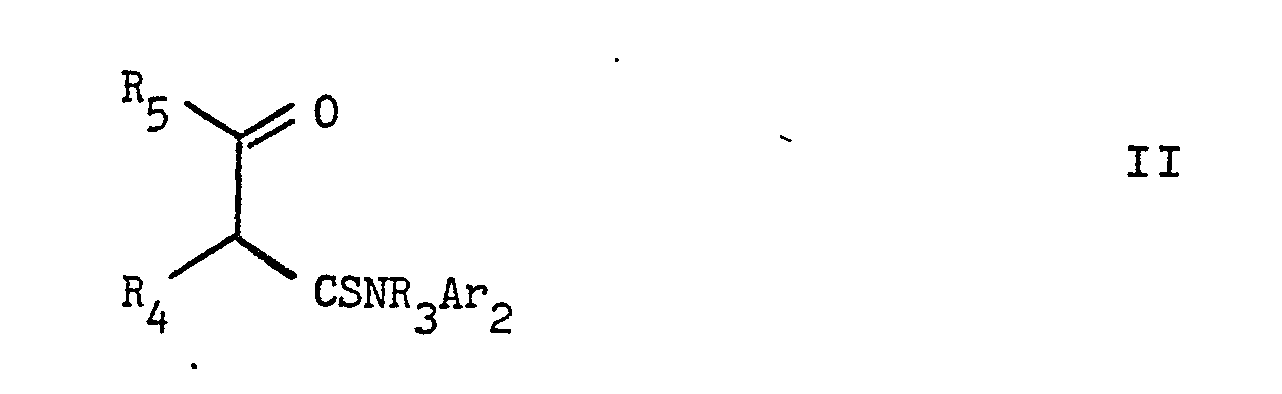

- (b) producing a compound of formula I in which R1 represents alkyl, alkanoyl or alkyl substituted by Ar1, by reacting a corresponding compound of formula I in which R1 represents hydrogen, with a compound of formula IV,

- (c) aromatising a compound of formula V,

- (d) producing a compound of formula I in which R1 represents hydrogen, by aromatising a compound of formula VI,

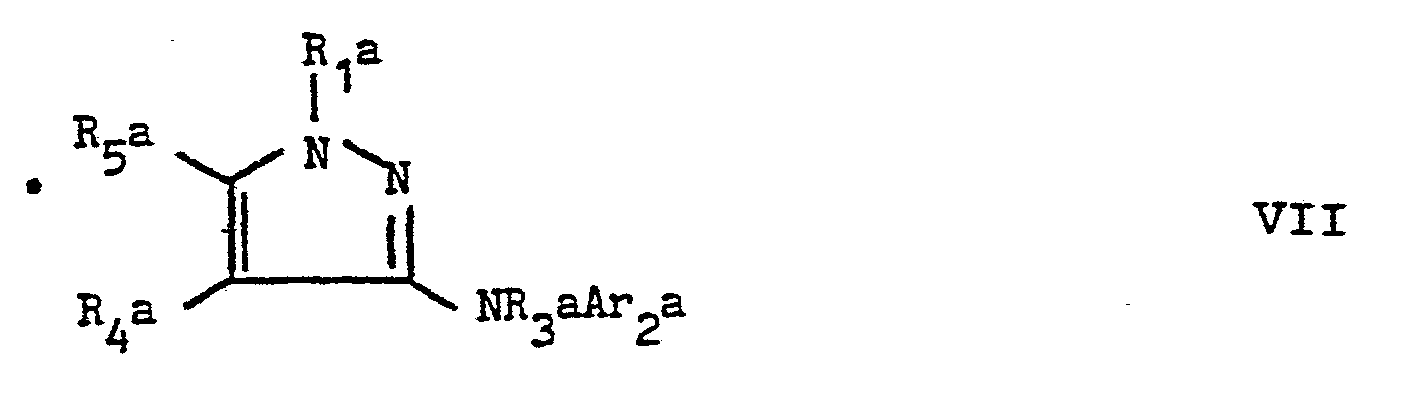
- (e) producing a compound of formula I in which one or more of Ar1, Ar2 and Ar3 is substituted by at least one -OH, by removing one or more protecting groups from a corresponding compound of formula VII,

- and where desired or necessary converting the resulting compound of formula I into a pharmaceutically acceptable acid addition salt thereof or vice versa.
- The cyclisation reaction (a) is preferably carried out in a polar solvent, eg ethanol, at a temperature of from about 25 to 75°C.
- The process of reaction (b) is preferably carried out in a solvent. The solvent is preferably inert to the reaction conditions, eg a polar, aprotic solvent such as 1,4-dioxan, dimethylformamide or N-methylpyrrolidone. The reaction may, if desired, be carried out in the presence of a non-nucleophilic base, eg sodium carbonate, sodium hydride or potassium t-butoxide. Good leaving groups that X may represent include tosylate and halide, eg chloride, bromide and iodide. The reaction may be carried out at a temperature of from about 0 to 150°C.
- The aromatisation of process (c) may be carried out in the presence of an agent which is capable of accepting hydrogen, for example palladium or charcoal. The aromatisation may be carried out by bubbling air or oxygen through a solution of the compound of formula V in an inert solvent, eg an halogenated hydrocarbon. However we prefer to carry out the aromatisation using an oxidising agent, eg a metal oxide such as manganese dioxide. The oxidation is preferably carried out in a solvent which is inert to the reaction conditions, eg in an halogenated hydrocarbon, at a temperature of from about -70 to I50°C.
- Leaving groups that L may represent in the aromatisation of process (d) include halogen, Oacetyl and especially arylsulphonyl, for example, tosyl. The aromatisation may be effected by heating. However we prefer to carry out the reaction in the presence of a base, eg a metal alkoxide in an alcohol. Sodium ethoxide in ethanol is particularly suitable. The reaction may be carried out at a temperature of from 40 to 150o C.
- Protected hydroxy groups that ArIa, Ar2a and Ar3a may bear include alkyloxy, eg methoxy, acetoxy, trifluoroacetoxy and arylmethoxy, eg phenylmethoxy. Other protecting groups are well known and include those described in Protective Groups in Organic Chemistry, ed JWF McOmie, Plenum Press (1973) and Protective Groups in Organic Synthesis, TW Greene, Wiley-Interscience (1981). Removal of the protecting group depends on the nature of the protecting group; conventional techniques may generally be employed, including acidic or basic cleavage or hydrogenolysis. For example protecting alkyl or phenylalkyl groups may be removed using a protic acid, eg hydrochloric acid or hydrobromic acid at a temperature of from 0 to 150°C, or a Lewis acid, eg by reacting with boron trihalide in a halocarbon solvent. When the protecting group is alkanoyl or haloalkanoyl, cleavage may be effected using a base, eg sodium hydroxide, in a suitable solvent, eg aqueous ethanol. Lewis bases, eg pyridine hydrochloride, may be used to cleave alkyl or phenylalkyl groups. Arylmethyl groups, eg benzyl, may be removed by catalytic hydrogenation using a suitable catalyst, eg palladium, in a suitable solvent, eg ethanol or acetic acid. Further methods for the removal of protecting groups are described in both McOmie and Greene, loc. cit. Both McOmie and Greene also describe numerous methods for the application of protecting groups.
- Compounds of formula V may be prepared by reacting a compound of formula VIII,


- The reaction may be carried out by heating the two reactants with or without a solvent, eg at a temperature of 50 to 250°C. Suitable leaving groups that L2 may represent include halogen, eg chlorine, NH2 and hydroxy.
- Compounds of formula VI may be prepared from compounds of formula V in which R1 represents hydrogen by conventional techniques, for example when L represents p-toluenesulphonyl, compounds of formula VI may be prepared by reacting a compound of formula V in which R1 is hydrogen with p-toluenesulphonyl chloride in the presence of a base.
- Compounds of formula VII may be prepared by processes analogous to those described in process a), b), c) or d).
- Compounds of formulae II, III, IV, VIII and IX are either known, or may be made from known compounds using conventional techniques known per se.
- The acid addition salts of the compounds of formula I may be prepared by reaction of the free base with an appropriate acid. The acid addition salts may be converted to the corresponding free base by the action of a stronger base.
- The process as described above may produce the compound of formula I or an acid addition, salt thereof. It is also within the scope of this invention to treat any derivatives so produced to liberate the free compound of formula I, or to convert one derivative into another.
- The compounds of formula I and the intermediates thereto may be isolated from their reaction mixtures using conventional techniques.
- Pharmaceutically acceptable acid addition salts include, eg salts of mineral acids, such as hydrohalic acids, eg hydrochloric acid or hydrobromic acid, or organic acids such as formic, acetic or lactic acids. The acid may be polybasic, for example sulphuric, fumaric or citric acid.
- When R represents hydrogen, compounds of formula I may exist in a tautomeric form, formula A,

- These compounds are included in the scope of the definition of the compounds of formula I.
- The compounds of formula I, and pharmaceutically acceptable acid addition salts thereof, are useful because they possess pharmacological activity in animals. In particular, the compounds are useful as broad spectrum anti-inflammatory agents as indicated in one or more of the following assay systems:
- (a) Inhibition of lipoxygenases, e.g. 5, 12 and 15 lipoxygenase, in the presence of exogenous arachidonic acid and measurement of the enzyme activity by either a modification of B A Jakschik et al, Biochemical and Biophysical Research Communications, 95(1), 103, (1980) using reverse phase HPLC to quantify the products or by a modification of the method of F F Sun et al, Prostaglandins 21 (2) 333 (1981) using uv absorption to quantify product formation.
- (b) Inhibition of prostaglandin synthetase, utilising bovine seminal vesicle microsomes as the enzyme source after the method of Egan et al Biochemistry 17, 2230 (1978) using either radiolabelled arachidonic acid as substrate and product separation by thin layer chromatography and quantification by scintillation counting or unlabelled arachidonic acid as substrate and a specific radioimmunoassay kit (New England Nuclear) to measure prostaglandin E2 produced.
- (c) Inhibition of 5 lipoxygenase activity in intact human neutrophils stimulated by ionophore A23187 and supplemented with exogenous arachidonic acid after the method of P Borgeat and B Samuelsson, Proceedings New York Academy of Science 70 2148 (1979) using reverse phase HPLC to measure the products.
- (d) Inhibition of formation of arachidonic acid metabolites by mouse peritoneal macrophages challenged in vitro with immune complexes by the method of Blackham et al, J. Pharm. Pharmac. (1985).
- (e) Inhibition of PGE2 formation and cell infiltration in the carrageenin sponge model by the method of Higgs et al, Eur. J. Pharmac. 66 81 (1980).
- (f) Inhibition of immune complex mediated inflammation in the mouse peritoneal cavity by the method of Blackham et al, J. Pharmac. Methods (1985).
- (g) Inhibition of carrageenin oedema in the rat by the method of Winter et al, Proc. Soc. Exp. Biol. 111 544 (1962).
- (h) Inhibition of bronchial anaphylaxis in guinea pigs by the method of Anderson, Br. J. Pharmac. 77 301 (1982).
- The compounds are indicated for use in the treatment or prophylaxis of inflammatory conditions in mammals, including man. Conditions that may be specifically mentioned are: rheumatoid arthritis, rheumatoid spondylitis, osteoarthritis, gouty arthritis, and other arthritic conditions, inflamed joints;
- eczema, psoriasis or other inflammatory skin conditions such as sunburn;
- inflammatory eye conditions including conjunctivitis;
- lung disorders in which inflammation is involved, eg asthma, bronchitis, pigeon fancier's disease and farmer's lung;
- conditions of the gastrointestinal tract including aphthous ulcers, gingivitis, Crohn's disease (a condition of the small, and sometimes also of the large intestine), atrophic gastritis and gastritis varialoforme (conditions of the stomach), ulcerative colitis (a condition of the large intestine and sometimes the small intestine) coeliac disease (a condition of the small intestine), regional ileitis (a regional inflammatory condition of the terminal ileum), peptic ulceration (a condition of the stomach and duodenum) and irritable bowel syndrome; pyresis, pain;
- and other conditions associated with inflammation, particularly those in which lipoxygenase and cyclooxygenase products are a factor.
- For the above mentioned uses the dosage administered will, of course, vary with the compound employed, the mode of administration and the treatment desired. However, in general satisfactory results are obtained when the compounds are administered at a daily dosage of from about O.lmg to about 20mg per kg of animal body weight, preferably given in divided doses 1 to 4 times ,a day or in sustained release form. For man the total daily dose is in the range of from 7.0mg to 1,400mg and unit dosage forms suitable for oral administration comprise from 2.0mg to 1,400mg of the compound admixed with a solid or liquid pharmaceutical carrier or diluent.
- The compounds of formula I, and pharmaceutically acceptable acid addition salts thereof, may be used on their own or in the form of appropriate medicinal preparations for enteral, parenteral or topical administration.
- According to our invention we also provide a pharmaceutical composition comprising preferably less than 80% and more preferably less than 50% by weight of a compound of formula I, or a pharmaceutically acceptable acid addition salt thereof, in admixture with a pharmaceutically acceptable adjuvant, diluent or carrier. Examples of such adjuvants, diluents and carriers are:- for tablets and dragees: lactose, starch, talc, stearic acid; for capsules: tartaric acid or lactose; for injectable solutions: water, alcohols, glycerin, vegetable oils; for suppositories: natural or hardened oils or waxes.
- Compositions in a form suitable for oral, ie oesophageal administration include tablets, capsules and dragees;
- compositions in a form suitable for administration to the lung include aerosols, particularly pressurised aerosols;
- compositions in a form suitable for administration to the skin include creams, eg oil-in-water emulsions or water-in-oil emulsion;
- compositions in a form suitable for administration to the eye include drops and ointments.
- We prefer the composition to contain up to 50% and more preferably up to 25% by weight of the compound of formula I, or of the pharmaceutically acceptable acid addition salt thereof.
- The compounds of formula I and pharmaceutically acceptable acid addition salts thereof have the advantage that they are less toxic, more efficacious, are longer acting, have a broader range of activity, are more potent, produce fewer side effects, are more easily absorbed, eg orally or have other useful pharmacological properties, than compounds of similar structure.
- When R1, R 3' R 4, R5, R6 or R7 represent alkyl or alkanoyl, the group preferably contains up to 10, more preferably up to six carbon atoms. Particular alkyl groups that R1, R3, R4, R 5, R6 and R7 may represent include saturated and unsaturated alkyl groups, for example, methyl, ethyl, 2-propenyl and butyl.
- Particular NR6R7 groups that may substitute the N-phenyl include -NH2, -NHCH3 and -N(CH3)2.
- Particular groups that R1 may represent include hydrogen, acetyl, benzyl, 4-alkoxybenzyl, methyl and isopropyl. We prefer R1 to represent CH2Arl, alkyl or hydrogen. We particularly prefer R1 to represent hydrogen when R5 represents Ar3. Specific groups that Ar1 may represent include phenyl and substituted by hydroxy or alkoxy.
- We prefer the phenyl group of Ar2 to bear a substituent in the 2- or 4- position. We particularly prefer the phenyl group to bear an OH, alkoxy, eg methoxy or dialkylamino group in the 2- or 4- position. An especially favoured group that Ar2 may represent is hydroxyphenyl, in particular 2- or 4-hydroxyphenyl. Ar2 may be further substituted by groups selected from halogen, alkoxy and especially alkyl, eg methyl.
- We prefer R3 to represent alkyl and particularly hydrogen.
- We prefer R4 to represent phenyl and particularly hydrogen.
- Particular groups that R5 may represent include hydrogen, methyl and Ar3. Particular groups that Ar3 may represent include phenyl and hydroxyphenyl, eg 4-hydroxyphenyl.
- Certain of the compounds of formula I possess one or more chiral centres and the invention also provides the compounds in the form of their individual optical isomers or as racemic or other mixtures thereof. Certain of the compounds of formula I may also exist as stereoisomers and in these cases the invention provides all stereoisomeric forms. The various isomers may be prepared and/or separated using conventional processes known per se.
- The invention will now be illustrated by the following Examples, in which temperatures are in degrees centigrade.
- Hydrazine hydrate (0.55ml) was added to a suspension of N-(4-methoxyphenyl)-3-phenyl-thiopropiolamide (2.7g) in ethanol (20ml) stirred at room temperature. After 2 hours, the mixture was heated to 60° for 2 hours then cooled to room temperature. The mixture was partitioned between ethyl acetate and dilute aqueous brine. The organic layer was collected and dried. The solvent was evaporated and the residue was recrystallised from ethanol to give the title compound, l.lg m.p. 155-157°. C16H15N3O:
- Requires: C = 72.45%, H = 5.66%, N = 15.85%
- Found: C = 72.36%, H = 5.82%, N = 15.80%
- The compound of Example 1 (1.0g), acetyl chloride (0.43g) and pyridine (0.43g) were stirred together at room temperature for 0.5 hr. The mixture was partitioned between ethyl acetate and aqueous brine. The organic layer was extracted, dried and chromatographed on silica eluting with 5% ethyl acetate/95% dichloromethane, to give the title produced as colourless crystals, 280 mg, mp 123-124°.
- 4,5-dihydro-1-phenylmethyl-1H-pyrazol-3-amine (24g) (prepared by the method of H. Dorm, A. Otto, Chem Ber. 103 2505 (1970), p-anisidine (17.5g) and p-toluenesulphonic acid (100mg) was heated at 1700 under dry nitrogen until evolution of ammonia ceased. The reaction mix was cooled, purified by chromatography on SiO2 eluting with ether:pentane 1:1 to give the sub-title compound as colourless cubes (13.3.g).
- To a stirred solution of the product of step a) (13.3g) in dichloromethane (250ml) was added active manganese dioxide in portions until all traces of starting material had disappeared. The reaction mix was filtered, evaporated to a gum and purified by chromatography on silica, eluting with ether, to give the product, mp 68-71°.
- The title pyrazole of Example 3 (6.3g) was heated on a steam bath in a mixture of aqueous HBr (48%, 200ml) and glacial acetic acid (25ml) for 6 hours. The reaction mixture was cooled, poured into water, neutralised with sodium bicarbonate, extracted with ethyl acetate, washed with brine, dried and evaporated to give after chromatography the title compound, l.Og, mp 114-116°
- A mixture of 4,5-dihydro-l-(4-toluenesulphonyl)-lH- pyrazol-3-amine (8.08g) (Organic Synthesis 48,8, (1968)), o-anisidine (8.0g) and glacial acetic acid (80ml) was heated on a steam bath for 4 hours. The reaction mixture was cooled, filtered and washed with ether to give the sub-title product, 7.6g, mp 176-9°.
- The product of step a) (7.5g) was added to a solution of sodium ethoxide (60ml, prepared from 0.6g sodium), at a temperature of 60°. The mixture was refluxed for 10 minutes, cooled, added to water, extracted with ethyl acetate, dried and evaporated to give the sub-title compound as a purple oil, ms 189 (M+).
- The product of step b) (4.6g) was dissolved in 48% aqueous HBr (100ml) and refluxed for 8 hours. The mixture was poured onto water (750ml), neutralised with solid sodium bicarbonate, extracted with ethyl acetate, washed with brine and evaporated to give the title compound as a white crystalline solid, 0.49g, mp 163-4° (from ethyl acetate/cyclohexane).
- The pyrazole from Example 5 b) (4.0g) was added to a mixture of crushed potassium hydroxide pellets (4.7g) in dry dimethylsulphoxide, which had previously been stirred for 5 minutes under nitrogen at room temperature. After stirring for 0.75 hours, methyl iodide (3.1g) was added to the red solution and stirring was maintained for a further 0.75 hours. The reaction mix was poured into water, extracted with ethyl acetate, the organic layer washed, dried, evaporated and chromatographed to give a light brown oil.
- The pyrazole from step a) (1.7g) was dissolved in dichloromethane (30ml) under an atmosphere of nitrogen. Brown tribromide (8ml) in dichloromethane was added dropwise and the mixture stirred at room temperature for 24 hours. After addition of dilute sodium bicarbonate, the organic phase was removed, dried and evaporated to give a pale oil, which was converted to the hydrochloride salt of the title compound, by trituration with ethereal HC1, to give an off-white solid, 0.75g, mp 162-1640.
- The title pyrazole from Example 1 (3g) was heated in a mixture of aqueous HBr (30%, 10ml) and glacial acetic acid (2ml) on a steam bath for 72 hours. The mixture was cooled, filtered and neutralised with dilute sodium bicarbonate to give the title compound as a colourless solid, 2.2g, mp 215-17° (from ethanol).
- The following compounds were prepared by methods analogous to those described in Examples 1 to 7 above:
- (a) N-[4-Methoxyphenyl]-1-[1-methyl]ethyl-1H-pyrazol-3- amine, oil;
- (b) N-[4-Methoxyphenyl]-1-methyl-lH-pyrazol-3-amine, mp 64-66°;
- (c) 5-Methyl-N-phenyl-l-phenylmethyl-lH-pyrazol-3-amine, mp 97-98°;
- (d) N-[4-Methoxyphenyl]-lH-pyrazol-3-amine, mp 95-96°;
- (e) 5-Methyl-N-phenyl-lH-pyrazole-3-amine, mp 130-131°;
- (f) N-[4-Methoxyphenyl]-5-methyl-lH-pyrazol-3-amine, mp 132-133°;
- (g) N-[4-Methoxyphenyl]-1-methyl-5-phenyl-1H-pyrazol-3- amine, mp 107-108°;
- (h) N-[4-Methoxyphenyl]-4,5-diphenyl-1H-pyrazol-3-amine, mp 190-191 0.
- (i) 4-[3-(4-Methoxyphenylamino)-1H-pyrazol-5-yl)phenol, mp 170-172°.
- (j) N-(4-Hydroxyphenyl)-lH-pyrazol-3-amine, mp 190-192°. (k) 4-(1-methylpyrazol-3-yl)aminophenol, mp 183-185°.
- (1) 1-Methyl-N-(4-dimethylaminophenyl)-1H-pyrazol-3-amino, mp 84-85°.
- (m) 4-(1-(4-Methoxyphenyl)methylpyrazol-3-yl)aminophenol, mp 123-124 0.
Claims (13)


Priority Applications (1)
| Application Number | Priority Date | Filing Date | Title |
|---|---|---|---|
| AT87303666T ATE68485T1 (en) | 1986-05-07 | 1987-04-27 | PYRAZOLE. |
Applications Claiming Priority (4)
| Application Number | Priority Date | Filing Date | Title |
|---|---|---|---|
| GB868611102A GB8611102D0 (en) | 1986-05-07 | 1986-05-07 | Heterocyclic compounds |
| GB8611102 | 1986-05-07 | ||
| GB868630906A GB8630906D0 (en) | 1986-12-24 | 1986-12-24 | Heterocyclic compounds |
| GB8630906 | 1986-12-24 |
Publications (2)
| Publication Number | Publication Date |
|---|---|
| EP0248523A1 true EP0248523A1 (en) | 1987-12-09 |
| EP0248523B1 EP0248523B1 (en) | 1991-10-16 |
Family
ID=26290729
Family Applications (1)
| Application Number | Title | Priority Date | Filing Date |
|---|---|---|---|
| EP87303666A Expired - Lifetime EP0248523B1 (en) | 1986-05-07 | 1987-04-27 | Pyrazoles |
Country Status (13)
| Country | Link |
|---|---|
| US (1) | US4803216A (en) |
| EP (1) | EP0248523B1 (en) |
| KR (1) | KR870011101A (en) |
| AT (1) | AT390732B (en) |
| AU (1) | AU595602B2 (en) |
| CA (1) | CA1305157C (en) |
| DE (1) | DE3773746D1 (en) |
| DK (1) | DK231687A (en) |
| FI (1) | FI871974L (en) |
| IL (1) | IL82421A0 (en) |
| NO (1) | NO871879L (en) |
| NZ (1) | NZ220214A (en) |
| PT (1) | PT84831B (en) |
Cited By (6)
| Publication number | Priority date | Publication date | Assignee | Title |
|---|---|---|---|---|
| WO1990014338A1 (en) * | 1989-05-20 | 1990-11-29 | Fisons Plc | Anti-inflammatory 4-aminophenol derivatives |
| WO2005047273A1 (en) * | 2003-11-14 | 2005-05-26 | Novartis Ag | Thiazole and pyrazole derivatives as flt-3 kinase inhibitors |
| WO2009135944A1 (en) | 2008-05-09 | 2009-11-12 | Janssen Pharmaceutica Nv | Trisubstituted pyrazoles as acetylcholine receptor modulators |
| WO2011033018A1 (en) | 2009-09-17 | 2011-03-24 | Janssen Pharmaceutica Nv | Substituted n-phenyl-1-(4-pyridinyl)-1h-pyrazol-3-amines |
| EP3160949A4 (en) * | 2014-06-26 | 2018-01-17 | Monash University | Enzyme interacting agents |
| CN111836801A (en) * | 2018-02-07 | 2020-10-27 | 韩国化学硏究院 | Compounds for inhibiting TNIK and their medical uses |
Families Citing this family (24)
| Publication number | Priority date | Publication date | Assignee | Title |
|---|---|---|---|---|
| DE4234886A1 (en) * | 1992-10-16 | 1994-04-21 | Wella Ag | New N-phenylaminopyrazole derivatives and agents and processes for coloring hair |
| GB9312853D0 (en) * | 1993-06-22 | 1993-08-04 | Euro Celtique Sa | Chemical compounds |
| US5500439A (en) * | 1993-12-09 | 1996-03-19 | Alteon Inc. | Aminopyrazoles |
| EP0766676B1 (en) * | 1994-06-24 | 2002-05-22 | Euroceltique S.A. | Compounds for inhibiting phosphodiesterase iv |
| US5591776A (en) * | 1994-06-24 | 1997-01-07 | Euro-Celtique, S.A. | Pheynl or benzyl-substituted rolipram-based compounds for and method of inhibiting phosphodiesterase IV |
| US5922751A (en) * | 1994-06-24 | 1999-07-13 | Euro-Celtique, S.A. | Aryl pyrazole compound for inhibiting phosphodiesterase IV and methods of using same |
| US6066641A (en) * | 1994-12-13 | 2000-05-23 | Euro-Celtique S.A. | Aryl thioxanthines |
| EP0799040B1 (en) * | 1994-12-13 | 2003-08-20 | Euroceltique S.A. | Trisubstituted thioxanthines |
| US6025361A (en) * | 1994-12-13 | 2000-02-15 | Euro-Celtique, S.A. | Trisubstituted thioxanthines |
| US6166041A (en) * | 1995-10-11 | 2000-12-26 | Euro-Celtique, S.A. | 2-heteroaryl and 2-heterocyclic benzoxazoles as PDE IV inhibitors for the treatment of asthma |
| US6075016A (en) * | 1996-04-10 | 2000-06-13 | Euro-Celtique S.A. | 6,5-fused aromatic ring systems having enhanced phosphodiesterase IV inhibitory activity |
| US5864037A (en) | 1996-06-06 | 1999-01-26 | Euro-Celtique, S.A. | Methods for the synthesis of chemical compounds having PDE-IV inhibitory activity |
| US5744473A (en) * | 1996-09-16 | 1998-04-28 | Euro-Celtique, S.A. | PDE IV inhibitors: "bis-compounds" |
| JP4202250B2 (en) | 2001-07-25 | 2008-12-24 | バイオマリン ファーマシューティカル インコーポレイテッド | Compositions and methods for modulating blood brain barrier transport |
| WO2004076414A2 (en) * | 2003-02-27 | 2004-09-10 | Smithkline Beecham Corporation | Novel compounds |
| EP2671507A3 (en) | 2005-04-28 | 2014-02-19 | Proteus Digital Health, Inc. | Pharma-informatics system |
| JO3019B1 (en) | 2006-04-19 | 2016-09-05 | Janssen Pharmaceutica Nv | Trisubstituted 1,2,4-Triazoles |
| MX2009002893A (en) | 2006-09-18 | 2009-07-10 | Raptor Pharmaceutical Inc | Treatment of liver disorders by administration of receptor-associated protein (rap)-conjugates. |
| JP2011500625A (en) | 2007-10-18 | 2011-01-06 | ジヤンセン・フアーマシユーチカ・ナームローゼ・フエンノートシヤツプ | Tri-substituted 1,2,4-triazole |
| JO2784B1 (en) | 2007-10-18 | 2014-03-15 | شركة جانسين فارماسوتيكا ان. في | 1,3,5-trisubstitued triazole derivative |
| AR070936A1 (en) | 2008-03-19 | 2010-05-12 | Janssen Pharmaceutica Nv | 1,2,4-TRISUSTITUTED TRIAZOLS |
| CA2752373C (en) | 2009-02-20 | 2017-10-10 | To-Bbb Holding B.V. | Glutathione-based drug delivery system |
| IL255113B (en) | 2009-05-06 | 2022-09-01 | Laboratory Skin Care Inc | Preparations for administration through the skin that include complexes of an active substance with calcium phosphate and methods of using them |
| US20120077778A1 (en) | 2010-09-29 | 2012-03-29 | Andrea Bourdelais | Ladder-Frame Polyether Conjugates |
Citations (1)
| Publication number | Priority date | Publication date | Assignee | Title |
|---|---|---|---|---|
| EP0178035A1 (en) * | 1984-05-12 | 1986-04-16 | FISONS plc | Anti-inflammatory 1,N-diarylpyrazol-3-amines, compositions containing them and processes for their preparation |
Family Cites Families (1)
| Publication number | Priority date | Publication date | Assignee | Title |
|---|---|---|---|---|
| DD211343A1 (en) * | 1982-11-08 | 1984-07-11 | Univ Ernst Moritz Arndt | PROCESS FOR SYNTHESIS OF PYRAZOLES |
-
1987
- 1987-04-27 EP EP87303666A patent/EP0248523B1/en not_active Expired - Lifetime
- 1987-04-27 DE DE8787303666T patent/DE3773746D1/en not_active Expired - Fee Related
- 1987-05-05 IL IL82421A patent/IL82421A0/en unknown
- 1987-05-05 US US07/046,656 patent/US4803216A/en not_active Expired - Fee Related
- 1987-05-05 FI FI871974A patent/FI871974L/en not_active IP Right Cessation
- 1987-05-06 NZ NZ220214A patent/NZ220214A/en unknown
- 1987-05-06 CA CA000536506A patent/CA1305157C/en not_active Expired - Fee Related
- 1987-05-06 DK DK231687A patent/DK231687A/en not_active Application Discontinuation
- 1987-05-06 NO NO871879A patent/NO871879L/en unknown
- 1987-05-07 AU AU72584/87A patent/AU595602B2/en not_active Ceased
- 1987-05-07 KR KR870004448A patent/KR870011101A/en not_active Withdrawn
- 1987-05-07 PT PT84831A patent/PT84831B/en not_active IP Right Cessation
- 1987-11-03 AT AT0290487A patent/AT390732B/en not_active IP Right Cessation
Patent Citations (1)
| Publication number | Priority date | Publication date | Assignee | Title |
|---|---|---|---|---|
| EP0178035A1 (en) * | 1984-05-12 | 1986-04-16 | FISONS plc | Anti-inflammatory 1,N-diarylpyrazol-3-amines, compositions containing them and processes for their preparation |
Non-Patent Citations (5)
| Title |
|---|
| CHEMICAL ABSTRACT, vol. 88, no. 7, 13th February 1978, page 164, abstract no. 46216v, Columbus, Ohio, US; A.N. BORISEVICH et al.: "Synthesis and growth regulating effect of substituted 1-acylpyrazole", & FIZIOL. AKT. VESHCHESTVA 1977, 9, 47-52 * |
| CHEMICAL ABSTRACTS, vol. 104, no. 19, 12th May 1986, page 667, abstract no. 168404z, Columbus, Ohio, US; J.N. VISHWAKARMA et al.: "Reactions of polarized ketene S,N-acetals with hydrazine: a facile general route to 3(5)-sbstituted amino-4,5(3)-substituted pyrazoles. Part XLV.", & INDIAN J. CHEM. SECT. B 1985, 24B(5), 472-6 * |
| CHEMICAL ABSTRACTS, vol. 71, no. 5, 4th August 1969, page 323, abstract no. 22058t, Columbus, Ohio, US; A.N. BORISEVICH et al.: "Arylamides of substituted thionoacetic acid. IV. Interaction of arylamides of monoacetylthionoacetic acid with nucleophilic reagents", & KHIM. GETEROTSIKL. SOEDIN. 1969, (2), 312-15 * |
| CHEMISCHE BERICHTE, vol. 100, no. 8, 1967, pages 2577-2584, Weinheim, DE; A. DORNOW et al.: "Synthesen von Pyrazolo-pyrimidinen aus neuen Pyrazol- und Pyrimidin-Derivaten" * |
| CHEMISCHE BERICHTE, vol. 95, no. 4, 1962, pages 937-943, Weinheim, DE; S. HÜNIG et al.: "Synthesen mit Enaminen, VIII. Heterocyclen aus Enamin-Isothiocyanat-Addukten" * |
Cited By (16)
| Publication number | Priority date | Publication date | Assignee | Title |
|---|---|---|---|---|
| WO1990014338A1 (en) * | 1989-05-20 | 1990-11-29 | Fisons Plc | Anti-inflammatory 4-aminophenol derivatives |
| US5428044A (en) * | 1989-05-20 | 1995-06-27 | Fisons Plc | Anti-inflammatory 4-aminophenyl derivatives |
| WO2005047273A1 (en) * | 2003-11-14 | 2005-05-26 | Novartis Ag | Thiazole and pyrazole derivatives as flt-3 kinase inhibitors |
| WO2009135944A1 (en) | 2008-05-09 | 2009-11-12 | Janssen Pharmaceutica Nv | Trisubstituted pyrazoles as acetylcholine receptor modulators |
| US20110065683A1 (en) * | 2008-05-09 | 2011-03-17 | Thuring Johannes Wilhelmus John F | Trisubstituted pyrazoles as acetylcholine receptor modulators |
| EA018187B1 (en) * | 2008-05-09 | 2013-06-28 | Янссен Фармацевтика Нв | Trisubstituted pyrazoles as acetylcholine receptor modulators |
| US8779158B2 (en) * | 2008-05-09 | 2014-07-15 | Janssen Pharmaceutica Nv | Trisubstituted pyrazoles as acetylcholine receptor modulators |
| WO2011033018A1 (en) | 2009-09-17 | 2011-03-24 | Janssen Pharmaceutica Nv | Substituted n-phenyl-1-(4-pyridinyl)-1h-pyrazol-3-amines |
| EP3160949A4 (en) * | 2014-06-26 | 2018-01-17 | Monash University | Enzyme interacting agents |
| CN111836801A (en) * | 2018-02-07 | 2020-10-27 | 韩国化学硏究院 | Compounds for inhibiting TNIK and their medical uses |
| EP3749648A4 (en) * | 2018-02-07 | 2021-11-24 | Korea Research Institute of Chemical Technology | COMPOUNDS INTENDED FOR INHIBITION OF TNIK AND ASSOCIATED MEDICAL USES |
| US11485711B2 (en) | 2018-02-07 | 2022-11-01 | Korea Research Institute Of Chemical Technology | Compounds for inhibiting TNIK and medical uses thereof |
| AU2019217094B2 (en) * | 2018-02-07 | 2023-04-06 | Industry-Academic Cooperation Foundation, Yonsei University | Compounds for inhibiting TNIK and medical uses thereof |
| US11767297B2 (en) | 2018-02-07 | 2023-09-26 | Korea Research Institute Of Chemical Technology | Compounds for inhibiting TNIK and medical uses thereof |
| CN111836801B (en) * | 2018-02-07 | 2024-02-02 | 韩国化学硏究院 | Compounds for inhibiting TNIK and their medical uses |
| EP4477271A3 (en) * | 2018-02-07 | 2025-04-30 | Korea Research Institute of Chemical Technology | Compounds for inhibiting tnik and medical uses thereof |
Also Published As
| Publication number | Publication date |
|---|---|
| FI871974A7 (en) | 1987-11-08 |
| NO871879D0 (en) | 1987-05-06 |
| NO871879L (en) | 1987-11-09 |
| AT390732B (en) | 1990-06-25 |
| FI871974L (en) | 1987-11-08 |
| US4803216A (en) | 1989-02-07 |
| DK231687D0 (en) | 1987-05-06 |
| PT84831A (en) | 1987-06-01 |
| IL82421A0 (en) | 1987-11-30 |
| DK231687A (en) | 1987-11-08 |
| PT84831B (en) | 1990-02-08 |
| AU595602B2 (en) | 1990-04-05 |
| KR870011101A (en) | 1987-12-21 |
| NZ220214A (en) | 1990-06-26 |
| DE3773746D1 (en) | 1991-11-21 |
| FI871974A0 (en) | 1987-05-05 |
| EP0248523B1 (en) | 1991-10-16 |
| ATA290487A (en) | 1989-12-15 |
| CA1305157C (en) | 1992-07-14 |
| AU7258487A (en) | 1987-11-12 |
Similar Documents
| Publication | Publication Date | Title |
|---|---|---|
| EP0248523B1 (en) | Pyrazoles | |
| US4810719A (en) | Anti-inflammator 1,n-diarylpyrazol-3-amines | |
| US5428044A (en) | Anti-inflammatory 4-aminophenyl derivatives | |
| US5459151A (en) | N-acyl substituted phenyl piperidines as bronchodilators and antiinflammatory agents | |
| US4216220A (en) | Platelet aggregation inhibiting 2-oxyindoles, their compositions and method of use | |
| US4925853A (en) | Benzimidazoles as 5-lipoxygenase inhibitors | |
| US5670533A (en) | Pyrazole derivatives, processes for preparation thereof and pharmaceutical composition comprising the same | |
| US4294841A (en) | Derivatives of 1-phenyl 3-(4-piperidyl) 1-propanone usable as drugs | |
| US4612318A (en) | CNS-depressant and analgesic tricyclo-[pyrazolo-[3,4-6]-pyridine] derivatives and pharmaceutical compositions thereof | |
| Child et al. | Fenbufen, a new anti-inflammatory analgesic: synthesis and structure-activity relationships of analogs | |
| EP0485984A2 (en) | Diarylmethoxypiperidine derivatives | |
| US4088764A (en) | Pharmaceutically active derivatives of 1-phenoxy-3-amino-propan-2-ol | |
| EP0127371B1 (en) | 1,n-diaryl-4,5-dihydro-1h-pyrazol-3-amines, compositions containing them and methods for their preparation | |
| US4009166A (en) | Pyrido(2,3-d) pyrimidinones | |
| US5051430A (en) | 3-(1H-indazol-3-yl)-4-pyridinamines | |
| US4757078A (en) | Cyclic aryl hydroxamic acids, derivatives thereof and method of use as anti-allergy agents | |
| US4243665A (en) | 2-Heterocyclylalkyl-6-methoxy-naphthalenes | |
| EP0287971B1 (en) | Benzimidazole derivatives and process for their preparations | |
| US4454136A (en) | Substituted benzopyranotriazoles and antiallergic use | |
| EP0121806A1 (en) | Pyrazolo(1,5-a)pyridine derivatives and compositions containing them | |
| JPS62267269A (en) | Pyrazole-3-amines | |
| US3972883A (en) | 1,6-Dimethyl-8β-[2' or 3'-pyrroyloxyethyl or substituted pyrroyloxyethyl]-10α-methoxyergolene compounds | |
| KR920006784B1 (en) | Anti-inflammatory 1-heteroaryl-oxindole-3-carboxamide | |
| KOMESHIMA et al. | Synthesis and anti-inflammatory activity of antioxidants, 4-alkylthio-o-anisidine derivatives | |
| US4473570A (en) | Imidazo[1,5-c]pyrimidin-5-ones |
Legal Events
| Date | Code | Title | Description |
|---|---|---|---|
| PUAI | Public reference made under article 153(3) epc to a published international application that has entered the european phase |
Free format text: ORIGINAL CODE: 0009012 |
|
| 17P | Request for examination filed |
Effective date: 19870506 |
|
| AK | Designated contracting states |
Kind code of ref document: A1 Designated state(s): AT BE CH DE ES FR GB GR IT LI LU NL SE |
|
| 17Q | First examination report despatched |
Effective date: 19890614 |
|
| GRAA | (expected) grant |
Free format text: ORIGINAL CODE: 0009210 |
|
| AK | Designated contracting states |
Kind code of ref document: B1 Designated state(s): AT BE CH DE ES FR GB GR IT LI LU NL SE |
|
| PG25 | Lapsed in a contracting state [announced via postgrant information from national office to epo] |
Ref country code: IT Free format text: LAPSE BECAUSE OF FAILURE TO SUBMIT A TRANSLATION OF THE DESCRIPTION OR TO PAY THE FEE WITHIN THE PRESCRIBED TIME-LIMIT;WARNING: LAPSES OF ITALIAN PATENTS WITH EFFECTIVE DATE BEFORE 2007 MAY HAVE OCCURRED AT ANY TIME BEFORE 2007. THE CORRECT EFFECTIVE DATE MAY BE DIFFERENT FROM THE ONE RECORDED. Effective date: 19911016 Ref country code: LI Effective date: 19911016 Ref country code: GR Free format text: LAPSE BECAUSE OF FAILURE TO SUBMIT A TRANSLATION OF THE DESCRIPTION OR TO PAY THE FEE WITHIN THE PRESCRIBED TIME-LIMIT Effective date: 19911016 Ref country code: AT Effective date: 19911016 Ref country code: CH Effective date: 19911016 Ref country code: NL Effective date: 19911016 Ref country code: BE Effective date: 19911016 Ref country code: SE Effective date: 19911016 |
|
| REF | Corresponds to: |
Ref document number: 68485 Country of ref document: AT Date of ref document: 19911115 Kind code of ref document: T |
|
| REF | Corresponds to: |
Ref document number: 3773746 Country of ref document: DE Date of ref document: 19911121 |
|
| PG25 | Lapsed in a contracting state [announced via postgrant information from national office to epo] |
Ref country code: ES Free format text: LAPSE BECAUSE OF FAILURE TO SUBMIT A TRANSLATION OF THE DESCRIPTION OR TO PAY THE FEE WITHIN THE PRESCRIBED TIME-LIMIT Effective date: 19920127 |
|
| REG | Reference to a national code |
Ref country code: CH Ref legal event code: PL |
|
| EN | Fr: translation not filed | ||
| PG25 | Lapsed in a contracting state [announced via postgrant information from national office to epo] |
Ref country code: FR Effective date: 19920306 |
|
| NLV1 | Nl: lapsed or annulled due to failure to fulfill the requirements of art. 29p and 29m of the patents act | ||
| PG25 | Lapsed in a contracting state [announced via postgrant information from national office to epo] |
Ref country code: LU Free format text: LAPSE BECAUSE OF NON-PAYMENT OF DUE FEES Effective date: 19920430 |
|
| PLBE | No opposition filed within time limit |
Free format text: ORIGINAL CODE: 0009261 |
|
| STAA | Information on the status of an ep patent application or granted ep patent |
Free format text: STATUS: NO OPPOSITION FILED WITHIN TIME LIMIT |
|
| 26N | No opposition filed | ||
| REG | Reference to a national code |
Ref country code: FR Ref legal event code: ST |
|
| PGFP | Annual fee paid to national office [announced via postgrant information from national office to epo] |
Ref country code: GB Payment date: 19940419 Year of fee payment: 8 |
|
| PGFP | Annual fee paid to national office [announced via postgrant information from national office to epo] |
Ref country code: DE Payment date: 19940426 Year of fee payment: 8 |
|
| PG25 | Lapsed in a contracting state [announced via postgrant information from national office to epo] |
Ref country code: GB Effective date: 19950427 |
|
| GBPC | Gb: european patent ceased through non-payment of renewal fee |
Effective date: 19950427 |
|
| PG25 | Lapsed in a contracting state [announced via postgrant information from national office to epo] |
Ref country code: DE Effective date: 19960103 |