EP0247979A2 - Armchair structure having independently adjustable back, seat and foot-rest - Google Patents
Armchair structure having independently adjustable back, seat and foot-rest Download PDFInfo
- Publication number
- EP0247979A2 EP0247979A2 EP87830188A EP87830188A EP0247979A2 EP 0247979 A2 EP0247979 A2 EP 0247979A2 EP 87830188 A EP87830188 A EP 87830188A EP 87830188 A EP87830188 A EP 87830188A EP 0247979 A2 EP0247979 A2 EP 0247979A2
- Authority
- EP
- European Patent Office
- Prior art keywords
- seat
- foot
- rest
- hinged
- independently adjustable
- Prior art date
- Legal status (The legal status is an assumption and is not a legal conclusion. Google has not performed a legal analysis and makes no representation as to the accuracy of the status listed.)
- Granted
Links
Images

Classifications
-
- A—HUMAN NECESSITIES
- A47—FURNITURE; DOMESTIC ARTICLES OR APPLIANCES; COFFEE MILLS; SPICE MILLS; SUCTION CLEANERS IN GENERAL
- A47C—CHAIRS; SOFAS; BEDS
- A47C1/00—Chairs adapted for special purposes
- A47C1/02—Reclining or easy chairs
- A47C1/022—Reclining or easy chairs having independently-adjustable supporting parts
- A47C1/024—Reclining or easy chairs having independently-adjustable supporting parts the parts, being the back-rest, or the back-rest and seat unit, having adjustable inclination
- A47C1/026—Reclining or easy chairs having independently-adjustable supporting parts the parts, being the back-rest, or the back-rest and seat unit, having adjustable inclination by means of a peg-and-notch or pawl-and-ratchet mechanism
- A47C1/0265—Reclining or easy chairs having independently-adjustable supporting parts the parts, being the back-rest, or the back-rest and seat unit, having adjustable inclination by means of a peg-and-notch or pawl-and-ratchet mechanism positioned under the arm-rests
-
- A—HUMAN NECESSITIES
- A47—FURNITURE; DOMESTIC ARTICLES OR APPLIANCES; COFFEE MILLS; SPICE MILLS; SUCTION CLEANERS IN GENERAL
- A47C—CHAIRS; SOFAS; BEDS
- A47C1/00—Chairs adapted for special purposes
- A47C1/02—Reclining or easy chairs
- A47C1/022—Reclining or easy chairs having independently-adjustable supporting parts
- A47C1/024—Reclining or easy chairs having independently-adjustable supporting parts the parts, being the back-rest, or the back-rest and seat unit, having adjustable inclination
- A47C1/026—Reclining or easy chairs having independently-adjustable supporting parts the parts, being the back-rest, or the back-rest and seat unit, having adjustable inclination by means of a peg-and-notch or pawl-and-ratchet mechanism
-
- A—HUMAN NECESSITIES
- A47—FURNITURE; DOMESTIC ARTICLES OR APPLIANCES; COFFEE MILLS; SPICE MILLS; SUCTION CLEANERS IN GENERAL
- A47C—CHAIRS; SOFAS; BEDS
- A47C7/00—Parts, details, or accessories of chairs or stools
- A47C7/50—Supports for the feet or the legs
- A47C7/506—Supports for the feet or the legs of adjustable type
-
- A—HUMAN NECESSITIES
- A47—FURNITURE; DOMESTIC ARTICLES OR APPLIANCES; COFFEE MILLS; SPICE MILLS; SUCTION CLEANERS IN GENERAL
- A47C—CHAIRS; SOFAS; BEDS
- A47C7/00—Parts, details, or accessories of chairs or stools
- A47C7/50—Supports for the feet or the legs
- A47C7/506—Supports for the feet or the legs of adjustable type
- A47C7/5066—Supports for the feet or the legs of adjustable type by rotation
Definitions
- Everybody knows the common deck-chairs, wherein the maximum adjustment consists only in the more or less outstretched position of the body.
- Another object of the invention is an armchair that can be also used as a deck-chair, wherein the seat can be set in different positions according to the sitter's will, there being not necessary for the latter to get up.
- the armchair structure consists of three distinct parts, joined to one another, namely, one part, generally referenced as A, used as back; one part, generally referenced as B, used as seat, and one part C used as foot-rest.
- Back A is hinged in 1 at seat B
- foot-rest C is hinged in 2 at the end of seat B, opposite to the previous end.
- Front elements 3 and rear elements 4 hold the three above mentioned parts together.
- the front and rear supporting elements are hinged at each other in 5 so as to form a sort of stand, but they could as well be independent from each other, other elements being used, in that case, to give the whole the necessary rigidity.
- back A is formed by a frame hinged in 1 at the frame of seat B, and at the uprights thereof are hinged in 6 the armrests 7.
- armrests 7 have, on their free end, a rack 8 engaging an extension 9 fixedly mounted on the supporting frame 3,4. By disengaging extension 9 from rack 8, and by displacing armrests 7 axially, it is possible to adjust the inclination of back A.
- seat B is provided, at the rear ends of its longitudinal members, with hinges 1 of the back, and is hinged in turn in 10 at the front supports 3 of the armchair.
- hinges are set beyond the centre line of the seat, in the proximity of the end to which the foot-rest C is secured.
- Each longitudinal member 11 of the seat, in correspondence with hinge 1, is provided with a rack 12 engaging the end of a double armed lever 13 suitable hinged, at the opposite end, at post 3 in the proximity of extension 9.
- the free end of lever 13 is substantially parallel to armrest 7.
- levers 13 are resiliently engaging racks 12, so as to secure the position taken on by seat B.
- levers 13 engaging racks 12 are preferably interconnected so as to perform identical movements and, by being in the same position on the respective rack, to avoid any twisting of the seat.
- Seat B can therefore be adjusted with respect to its position and inclination indepently from back A and also from foot-rest C.
- the foot-rest C has its fulcrum in 2 at the end of seat B, as already explained, and has a toothing 20 rotatable therewith.
- a suitable spring urges toothing 20 to rotate so as to bring the foot-rest either in alignment with the seat or to a raised position with respect thereto (see Fig.2).
- Upon said toothing 20 acts a ratchet 21 resiliently urged, as schematically indicated in 2, against the said toothing 20.
- ratchet 21 By effect of ratchet 21 engaging with toothing 20, foot-rest C can be set in any desired position. In fact, it is sufficient to act upon the push-button 23 and then on spring 22 to disengage ratchet 21 and, by acting with one's legs, either to lower foot-rest C or to let it raise until the desired position.
- the foot-rest can obviously be formed by a plurality of interlinked consecutive sections that can be set at will either to the working or to the resting position by means of suitable resilient constraints and return springs such as the above mentioned ratchet and toothing.
- the armchair structure with independently adjustable back, seat and foot-rest of the present invention may vary in its shape, finish, sizes and in every detail, provided its substantial building characteristics are not changed or modified.
Landscapes
- Health & Medical Sciences (AREA)
- Dentistry (AREA)
- General Health & Medical Sciences (AREA)
- Passenger Equipment (AREA)
- Chairs For Special Purposes, Such As Reclining Chairs (AREA)
- Seats For Vehicles (AREA)
Abstract
Description
- It is known that, in order to reach a complete relaxation to the stresses to which people of any class and activity are subjected in modern life, it is necessary for the body to find the resting position best suiting every single individual.
- Everybody knows the common deck-chairs, wherein the maximum adjustment consists only in the more or less outstretched position of the body.
- There are also known small armchairs in which the back can be set, from an almost upright position, to a more or less inclined position in respect of the seat that remains in its original horizontal position.
- In other known armchairs the orientation of the back is depending on the position of the foot-rest, the consequence being that the sitter is sometimes obliged to take on undesidered or uncomfortable positions.
- It is an object of the prevent invention an armchair structure having independently adjustable back, seat and foot-rest.
- Another object of the invention is an armchair that can be also used as a deck-chair, wherein the seat can be set in different positions according to the sitter's will, there being not necessary for the latter to get up.
- These and other purposes and advantages of the invention will result in more clearly from the detailed description of a preferred embodiment thereof, with reference to the attached drawings wherein:
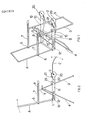
- - Figgs. 1 and 2 show an overall and a side view of the schematical structure, with the foot-rest in folded and outstretched position.
- - Fig. 3 shows a detail of the device for limiting the inclination of the back, when the same is in the utilization position.
- With reference to the drawings, the armchair structure according to the present invention consists of three distinct parts, joined to one another, namely, one part, generally referenced as A, used as back; one part, generally referenced as B, used as seat, and one part C used as foot-rest.
- Back A is hinged in 1 at seat B, and foot-rest C is hinged in 2 at the end of seat B, opposite to the previous end.
Front elements 3 andrear elements 4 hold the three above mentioned parts together. In the illustrated embodiment, the front and rear supporting elements are hinged at each other in 5 so as to form a sort of stand, but they could as well be independent from each other, other elements being used, in that case, to give the whole the necessary rigidity. - As a general rule back A is formed by a frame hinged in 1 at the frame of seat B, and at the uprights thereof are hinged in 6 the
armrests 7. In a manner known per se,armrests 7 have, on their free end, arack 8 engaging anextension 9 fixedly mounted on the supportingframe extension 9 fromrack 8, and by displacingarmrests 7 axially, it is possible to adjust the inclination of back A. - As above said, seat B is provided, at the rear ends of its longitudinal members, with hinges 1 of the back, and is hinged in turn in 10 at the front supports 3 of the armchair. Such hinges are set beyond the centre line of the seat, in the proximity of the end to which the foot-rest C is secured. Each
longitudinal member 11 of the seat, in correspondence with hinge 1, is provided with arack 12 engaging the end of a doublearmed lever 13 suitable hinged, at the opposite end, atpost 3 in the proximity ofextension 9. The free end oflever 13 is substantially parallel toarmrest 7. By slightly moving one's own body towards the axis ofhinges 10, and acting at the same time on the free end of eachlever 13, it is possible to disengagelevers 13 fromracks 12 and therefore either to raise or to lower the end of seat B at the side opposite its oscillation axis coinciding withhinges 10. - Preferably,
levers 13 are resiliently engagingracks 12, so as to secure the position taken on by seat B. - The ends of
levers 13engaging racks 12 are preferably interconnected so as to perform identical movements and, by being in the same position on the respective rack, to avoid any twisting of the seat. Seat B can therefore be adjusted with respect to its position and inclination indepently from back A and also from foot-rest C. - In the case of collapsible seats, where back A and seat B would tend to fold up because of the full weight of the load resting between the hinge axis 10-10 and the front edge of the seat itself, in order to facilitate transport and storage there is provided a constraint on the
longitudinal members 11 or legs 3-4 and/or on back A in the proximity to the axis of rotation 1-1, constraint that prevents seat B - when it is in the utilization position - from shifting forward beyond a certain limit angle; such constraint may be for instance aratchet 16, as indicated in the drawing of Fig. 3. - The foot-rest C has its fulcrum in 2 at the end of seat B, as already explained, and has a toothing 20 rotatable therewith. A suitable spring (not shown) urges toothing 20 to rotate so as to bring the foot-rest either in alignment with the seat or to a raised position with respect thereto (see Fig.2). Upon said toothing 20 acts a ratchet 21 resiliently urged, as schematically indicated in 2, against the said toothing 20. By effect of ratchet 21 engaging with toothing 20, foot-rest C can be set in any desired position. In fact, it is sufficient to act upon the push-button 23 and then on
spring 22 to disengage ratchet 21 and, by acting with one's legs, either to lower foot-rest C or to let it raise until the desired position. - The foot-rest can obviously be formed by a plurality of interlinked consecutive sections that can be set at will either to the working or to the resting position by means of suitable resilient constraints and return springs such as the above mentioned ratchet and toothing.
- It can be noted from what above stated that the present invention fully answers its purpose, that is the obtainment of an armachair with independently adjustable back, seat and foot-rest, there being not necessary for the sitter to get up.
- The armchair structure with independently adjustable back, seat and foot-rest of the present invention may vary in its shape, finish, sizes and in every detail, provided its substantial building characteristics are not changed or modified.
Claims (6)
Priority Applications (1)
| Application Number | Priority Date | Filing Date | Title |
|---|---|---|---|
| AT87830188T ATE74258T1 (en) | 1986-05-29 | 1987-05-25 | ARMCHAIR WITH INDEPENDENTLY ADJUSTABLE BACK, SEAT AND FOOTREST. |
Applications Claiming Priority (2)
| Application Number | Priority Date | Filing Date | Title |
|---|---|---|---|
| IT8648080A IT8648080A0 (en) | 1986-05-29 | 1986-05-29 | SEPARATELY ADJUSTABLE ARMCHAIR STRUCTURE WITH BACKREST, SEAT AND FOOTREST POSITIONS |
| IT4808086 | 1986-05-29 |
Publications (3)
| Publication Number | Publication Date |
|---|---|
| EP0247979A2 true EP0247979A2 (en) | 1987-12-02 |
| EP0247979A3 EP0247979A3 (en) | 1988-06-29 |
| EP0247979B1 EP0247979B1 (en) | 1992-04-01 |
Family
ID=11264413
Family Applications (1)
| Application Number | Title | Priority Date | Filing Date |
|---|---|---|---|
| EP87830188A Expired - Lifetime EP0247979B1 (en) | 1986-05-29 | 1987-05-25 | Armchair structure having independently adjustable back, seat and foot-rest |
Country Status (7)
| Country | Link |
|---|---|
| US (1) | US4776634A (en) |
| EP (1) | EP0247979B1 (en) |
| AT (1) | ATE74258T1 (en) |
| DE (2) | DE3777884D1 (en) |
| ES (1) | ES2006152A6 (en) |
| GR (1) | GR880300074T1 (en) |
| IT (1) | IT8648080A0 (en) |
Families Citing this family (5)
| Publication number | Priority date | Publication date | Assignee | Title |
|---|---|---|---|---|
| US10881209B2 (en) | 2018-01-12 | 2021-01-05 | L&P Property Management Company | Recliner seating mechanism with seat extension |
| US12446692B2 (en) * | 2023-04-04 | 2025-10-21 | E.C. Woods, Inc. | Height adjustment mechanism for furniture |
| US12349809B2 (en) * | 2023-05-09 | 2025-07-08 | Te-Lung Chen | Foldable chair |
| US11944198B1 (en) * | 2023-07-10 | 2024-04-02 | Alexander Chan | Rocking and reclining seating apparatus |
| US12207736B1 (en) * | 2023-10-04 | 2025-01-28 | Alexander Chan | Seating apparatus |
Family Cites Families (18)
| Publication number | Priority date | Publication date | Assignee | Title |
|---|---|---|---|---|
| US433836A (en) * | 1890-08-05 | van slyke | ||
| DE23624C (en) * | F. W. A. erdmann in Wismar i. M., Altwismarstr. 6, und H. ruperti in Cassel | Adjustable chair | ||
| DE496755C (en) * | 1928-07-29 | 1930-04-26 | Paul Schneider | Collapsible seat and deck chair |
| US2170509A (en) * | 1938-08-23 | 1939-08-22 | J B Orders | Reclining chair |
| US2410088A (en) * | 1941-11-14 | 1946-10-29 | Lundquist Carl Ernst Edvard | Adjustable chair, bedstead, stretcher, or the like |
| US2659416A (en) * | 1950-10-14 | 1953-11-17 | Heyman Sam | Collapsible reclining chair |
| US2608237A (en) * | 1951-01-03 | 1952-08-26 | Thomas T Lecroy | Chair having adjustable seat and leg rest |
| US2972373A (en) * | 1959-07-27 | 1961-02-21 | Morton I Thomas | Concealed adjustment mechanism for folding chairs |
| FR1281637A (en) * | 1961-02-15 | 1962-01-12 | Articulation system for lever arms | |
| DE1803051A1 (en) * | 1968-10-15 | 1970-04-16 | Dietmar Wagner | Rest furniture |
| CA869340A (en) * | 1968-11-20 | 1971-04-27 | Feher Tibor | Adjustable chair |
| BE758227A (en) * | 1969-11-05 | 1971-04-01 | Bleicher Rene | RACK ADJUSTMENT SYSTEM |
| US3779655A (en) * | 1971-12-23 | 1973-12-18 | Sanshin Kinzoku Ind Co Ltd | Angle variable joint for foldable chair |
| DE2332596C3 (en) * | 1973-06-27 | 1985-10-03 | Christof Stoll Gmbh & Co Kg, 7890 Waldshut | Seating |
| DE2501754A1 (en) * | 1974-01-18 | 1975-07-24 | Fritz Kerstholt | Seat or couch with movable back - has second support in two parts jointed together |
| FR2392629A1 (en) * | 1977-06-01 | 1978-12-29 | Condor | Reclining armchair with footrest - uses electrically operated double-action movement controlling mechanism operated whilst user is seated |
| DE3206214A1 (en) * | 1982-02-20 | 1983-09-01 | Fritz 5461 Hausen Kerstholt | Seating aids for patients for seating/reclining furniture elements |
| FR2567733B1 (en) * | 1984-07-18 | 1987-01-02 | Allibert Sa | REST SEAT |
-
1986
- 1986-05-29 IT IT8648080A patent/IT8648080A0/en unknown
-
1987
- 1987-05-21 US US07/052,785 patent/US4776634A/en not_active Expired - Fee Related
- 1987-05-25 EP EP87830188A patent/EP0247979B1/en not_active Expired - Lifetime
- 1987-05-25 AT AT87830188T patent/ATE74258T1/en not_active IP Right Cessation
- 1987-05-25 DE DE8787830188T patent/DE3777884D1/en not_active Expired - Lifetime
- 1987-05-25 DE DE198787830188T patent/DE247979T1/en active Pending
- 1987-05-29 ES ES8701602A patent/ES2006152A6/en not_active Expired
-
1988
- 1988-10-21 GR GR88300074T patent/GR880300074T1/en unknown
Also Published As
| Publication number | Publication date |
|---|---|
| DE3777884D1 (en) | 1992-05-07 |
| US4776634A (en) | 1988-10-11 |
| GR880300074T1 (en) | 1988-10-21 |
| ES2006152A6 (en) | 1989-04-16 |
| EP0247979A3 (en) | 1988-06-29 |
| EP0247979B1 (en) | 1992-04-01 |
| ATE74258T1 (en) | 1992-04-15 |
| IT8648080A0 (en) | 1986-05-29 |
| DE247979T1 (en) | 1988-07-21 |
Similar Documents
| Publication | Publication Date | Title |
|---|---|---|
| US3120407A (en) | Net seating | |
| US5464270A (en) | Stageless folding deck chair | |
| US6547322B2 (en) | Collapsible reclining chair | |
| CA2394954A1 (en) | Ergonomic chair | |
| EP0232032A2 (en) | A back rest device | |
| EP1909616A2 (en) | Reversible lounge chair | |
| US5681085A (en) | Rocking armchair with reclining seat and back | |
| JPS6395008A (en) | Chair equipped with movable seat and backrest | |
| US4863215A (en) | Action furniture mechanism | |
| US2926724A (en) | Folding chair | |
| US4367894A (en) | Foldable dental chair | |
| US4570994A (en) | Foldable chair | |
| US4614377A (en) | Foldable lounge chair | |
| US3116091A (en) | Stadium seat | |
| GB2384978A (en) | Foldable chair with adjustable back with adjustment mechanism inside the pivots | |
| EP0247979B1 (en) | Armchair structure having independently adjustable back, seat and foot-rest | |
| US5094509A (en) | Deck chair to transform into a sun bed | |
| GB2098471A (en) | Improvements in or relating to a chair | |
| US3029105A (en) | Foldable chair and rack | |
| US3414321A (en) | Reclining lawn chair | |
| EP3718438B1 (en) | Sofa support structure and sofa thereof | |
| GB2124556A (en) | Foldable pushchair | |
| IL47839A (en) | Collapsible easy-chair | |
| US5295275A (en) | Convertible sofa bed system | |
| US3018132A (en) | Folding lounge seat |
Legal Events
| Date | Code | Title | Description |
|---|---|---|---|
| PUAI | Public reference made under article 153(3) epc to a published international application that has entered the european phase |
Free format text: ORIGINAL CODE: 0009012 |
|
| AK | Designated contracting states |
Kind code of ref document: A2 Designated state(s): AT BE CH DE ES FR GB GR LI LU NL SE |
|
| PUAL | Search report despatched |
Free format text: ORIGINAL CODE: 0009013 |
|
| TCAT | At: translation of patent claims filed | ||
| TCNL | Nl: translation of patent claims filed | ||
| EL | Fr: translation of claims filed | ||
| AK | Designated contracting states |
Kind code of ref document: A3 Designated state(s): AT BE CH DE ES FR GB GR LI LU NL SE |
|
| DET | De: translation of patent claims | ||
| 17P | Request for examination filed |
Effective date: 19881013 |
|
| 17Q | First examination report despatched |
Effective date: 19891110 |
|
| GRAA | (expected) grant |
Free format text: ORIGINAL CODE: 0009210 |
|
| AK | Designated contracting states |
Kind code of ref document: B1 Designated state(s): AT BE CH DE ES FR GB GR LI LU NL SE |
|
| PG25 | Lapsed in a contracting state [announced via postgrant information from national office to epo] |
Ref country code: SE Effective date: 19920401 Ref country code: NL Effective date: 19920401 Ref country code: LI Effective date: 19920401 Ref country code: GR Free format text: LAPSE BECAUSE OF FAILURE TO SUBMIT A TRANSLATION OF THE DESCRIPTION OR TO PAY THE FEE WITHIN THE PRESCRIBED TIME-LIMIT Effective date: 19920401 Ref country code: CH Effective date: 19920401 Ref country code: BE Effective date: 19920401 Ref country code: AT Effective date: 19920401 |
|
| REF | Corresponds to: |
Ref document number: 74258 Country of ref document: AT Date of ref document: 19920415 Kind code of ref document: T |
|
| REF | Corresponds to: |
Ref document number: 3777884 Country of ref document: DE Date of ref document: 19920507 |
|
| PG25 | Lapsed in a contracting state [announced via postgrant information from national office to epo] |
Ref country code: LU Free format text: LAPSE BECAUSE OF NON-PAYMENT OF DUE FEES Effective date: 19920531 |
|
| ET | Fr: translation filed | ||
| PG25 | Lapsed in a contracting state [announced via postgrant information from national office to epo] |
Ref country code: GB Effective date: 19920701 |
|
| PG25 | Lapsed in a contracting state [announced via postgrant information from national office to epo] |
Ref country code: ES Free format text: LAPSE BECAUSE OF FAILURE TO SUBMIT A TRANSLATION OF THE DESCRIPTION OR TO PAY THE FEE WITHIN THE PRESCRIBED TIME-LIMIT Effective date: 19920712 |
|
| REG | Reference to a national code |
Ref country code: CH Ref legal event code: PL |
|
| NLV1 | Nl: lapsed or annulled due to failure to fulfill the requirements of art. 29p and 29m of the patents act | ||
| PG25 | Lapsed in a contracting state [announced via postgrant information from national office to epo] |
Ref country code: DE Effective date: 19930202 |
|
| PLBE | No opposition filed within time limit |
Free format text: ORIGINAL CODE: 0009261 |
|
| STAA | Information on the status of an ep patent application or granted ep patent |
Free format text: STATUS: NO OPPOSITION FILED WITHIN TIME LIMIT |
|
| GBPC | Gb: european patent ceased through non-payment of renewal fee |
Effective date: 19920701 |
|
| 26N | No opposition filed | ||
| PGFP | Annual fee paid to national office [announced via postgrant information from national office to epo] |
Ref country code: FR Payment date: 19950524 Year of fee payment: 9 |
|
| PG25 | Lapsed in a contracting state [announced via postgrant information from national office to epo] |
Ref country code: FR Effective date: 19970131 |
|
| REG | Reference to a national code |
Ref country code: FR Ref legal event code: ST |