EP0247828B1 - Copolyester and compositions comprising it - Google Patents
Copolyester and compositions comprising it Download PDFInfo
- Publication number
- EP0247828B1 EP0247828B1 EP87304648A EP87304648A EP0247828B1 EP 0247828 B1 EP0247828 B1 EP 0247828B1 EP 87304648 A EP87304648 A EP 87304648A EP 87304648 A EP87304648 A EP 87304648A EP 0247828 B1 EP0247828 B1 EP 0247828B1
- Authority
- EP
- European Patent Office
- Prior art keywords
- copolyester
- composition according
- parts
- weight
- group
- Prior art date
- Legal status (The legal status is an assumption and is not a legal conclusion. Google has not performed a legal analysis and makes no representation as to the accuracy of the status listed.)
- Expired
Links
Classifications
-
- C—CHEMISTRY; METALLURGY
- C08—ORGANIC MACROMOLECULAR COMPOUNDS; THEIR PREPARATION OR CHEMICAL WORKING-UP; COMPOSITIONS BASED THEREON
- C08L—COMPOSITIONS OF MACROMOLECULAR COMPOUNDS
- C08L67/00—Compositions of polyesters obtained by reactions forming a carboxylic ester link in the main chain; Compositions of derivatives of such polymers
- C08L67/02—Polyesters derived from dicarboxylic acids and dihydroxy compounds
- C08L67/025—Polyesters derived from dicarboxylic acids and dihydroxy compounds containing polyether sequences
-
- C—CHEMISTRY; METALLURGY
- C08—ORGANIC MACROMOLECULAR COMPOUNDS; THEIR PREPARATION OR CHEMICAL WORKING-UP; COMPOSITIONS BASED THEREON
- C08G—MACROMOLECULAR COMPOUNDS OBTAINED OTHERWISE THAN BY REACTIONS ONLY INVOLVING UNSATURATED CARBON-TO-CARBON BONDS
- C08G63/00—Macromolecular compounds obtained by reactions forming a carboxylic ester link in the main chain of the macromolecule
- C08G63/66—Polyesters containing oxygen in the form of ether groups
- C08G63/668—Polyesters containing oxygen in the form of ether groups derived from polycarboxylic acids and polyhydroxy compounds
- C08G63/672—Dicarboxylic acids and dihydroxy compounds
Definitions
- the present invention relates to copolyesters and resin compositions comprising them.
- PET Polyethylene terephthalate
- PET Polyethylene terephthalate
- glass-fibre-reinforced PBT polybutylene terephthalate
- PET whether or not reinforced with glass fibre or other filler material, does not possess a sufficiently high impact resistance and the problem of breakage of shaped articles in secondary processing and during transport is frequently encountered.
- the general method for improving the impact resistance of PET, whether unreinforced or reinforced, comprises adding a certain elastomeric polymer to the PET.
- Japanese Patent Publication No. 45-26223 discloses a copolymer of an ⁇ -olefin with a saturated aliphatic monocarboxylic acid vinyl ester as an impact-strength-improving agent for polyester resin.
- Japanese Patent Publication No. 45-26224 discloses a copolymer of an acrylic ester with a conjugated diene as an impact-strength-improving agent for polyester resin.
- Japanese Patent Publication No. 45-26225 discloses an ionomer as an impact-strength-improving agent.
- shaped articles manufactured by the above-mentioned methods are still not fully satisfactory in impact strength.
- Japanese Patents Laid-open Nos. 51-144452, 52-32045 and 53-117049 teach the technique of blending a polyester resin with a copolymer of an ⁇ -olefin with an ⁇ , ⁇ -unsaturated carboxylic acid glycidyl ester.
- the technique of using an ethylene copolymer as a third component in addition to the above-mentioned copolymer is disclosed in Japanese Patents Laid-open Nos. 58-17148 and 58-17151, and the technique of using polyphenylene sulphide as an additive component is described in Japanese Patent Laid-open No. 57-92044.
- this composition is prepared by blending the PET polyester with the PBT polyester at a high temperature, transesterification is liable to take place. Moreover, when moulding scraps are pulverized and the resulting pellets added to the moulding material for reuse of the raw material, the high impact strength attainable with the virgin moulding material cannot be obtained. Moreover, the composition has a further disadvantage in that the shaped article is either poor in surface gloss or not satisfactory in mould releasability.
- the conventional composition prepared by adding an elastomeric polymer to a polyester resin shows a decrease in impact strength when the shaped article is exposed to a high temperature for a long time.
- the impact strength of a filler-reinforced polyester resin can be improved by blending a very large amount of an elastomer (e.g. Japanese Patent Publication No. 59-30742).
- an elastomer e.g. Japanese Patent Publication No. 59-30742
- the incorporation of such a large amount of the elastomer results in the deterioration of the inherent heat resistance and mechanical strength of the polyester.
- Japanese Patent Laid-open No. 53-102360 teaches that the addition of PBT to a filler-reinforced PET composition results in an improved resistance to warping. However, this blending does not provide for an increased impact strength.
- the conventional glass-fibre-reinforced polyethylene terephthalate referred to above has the disadvantages that its impact resistance decreases on prolonged exposure to high temperature and that satisfactory surface gloss and mould releasability cannot be achieved unless the mould temperature is set at a comparatively high level.
- Laminates which have such compositions as adhesives are said to have remarkable resistance to delamination at low temperatures.
- the present invention provides a mouldable copolyester consisting essentially of structural units of the following formulas (I) to (IV): in which R is a bivalent group obtained by removing the carboxyl groups from an aliphatic dicarboxylic acid containing not fewer than 9 carbon atoms and n is an integer of from 8 to 84, in which (I) is bound to (III) and/or (IV), (II) is bound to (III) and/or (IV), the sum of the number of moles of (I) and (II) is substantially equal to the sum of the number of moles of (III) and (IV), and the amount of (II) is 0.2 to 5 moles and that of the repeating unit ( ⁇ CH2CH2CH2O) ⁇ of (IV) is 1 to 20 moles to each 100 moles of (I).
- the present invention also provides a polyester resin composition
- a polyester resin composition comprising, by weight (A) 100 parts of a copolyester as defined above, together with either (B) 0.05 to 20 parts of a nucleating agent, (C) 0.1 to 10 parts of a polyalkylene glycol of the general formula R1O( ⁇ R2O)) ⁇ n R'1, where each of R1 and R'1, independently of the other, is a hydrogen atom or a C1 ⁇ 10 alkyl, acyl or aroyl group; R2 is a C2 ⁇ 4 alkylene group and n is an integer not less than 5, and (D) optionally, 0 to 140 parts of a reinforcing filler: or (B) 3 to 100 parts of a metal salt of a copolymer consisting of an ⁇ -olefin, an ⁇ , ⁇ -unsaturated carboxylic aid and optionally a third vinyl monomer, and (C) optionally, 0 to 60 percent of a reinfor
- polyesters of the invention are tough and mitigate or overcome the brittleness of polyethylene terephthalate, while retaining its other excellent characteristics, namely, its high melting point, high rigidity, chemical resistance, mechanical properties and electrical characteristics.
- resin compositions of the invention are able to give mouldings with excellent surface glass and good mould releasability even at low mould temperature, without losing the above-mentioned beneficial properties of the polyester.
- Such compositions may be markedly improved in impact resistance and in the decrease of impact resistance on prolonged exposure to high temperature, while retaining the other excellent characteristics of the conventional polyethylene terephthalate.
- Glass-fibre-reinforced compositions of the invention can be improved in brittleness without losing the excellent high heat distortion temperature and high rigidity of the conventional glass-fibre-reinforced polyethylene terephthalate composition.
- the unit (I) of the copolyester according to the invention is derived from terephthalic acid or its esters such as dimethyl terephthalate and diethyl terephthalate.
- Unit (II) is derived from an aliphatic dicarboxylic acid containing not fewer than 9 carbon atoms or its ester.
- the number of carbon atoms in the backbone chain between the carboxylic groups is not less than 7, and the backbone chain may be branched or may partially form a ring.
- the number of carbon atoms between carboxy groups means the smallest one.
- aliphatic dicarboxylic acids examples include linear dicarboxylic acids such as azelaic acid, sebacic acid, decanedicarboxylic acid, dodecanedicarboxylic acid, tetradecanedicarboxylic acid, hexadecanedicarboxylic acid and eicosanedicarboxylic acid, dimer acids and hydrogenated dimer acids, and their esters. These aliphatic dicarboxylic acids and esters can be used singly or in combination.
- the dicarboxylic acids particularly preferred are dimer acids and hydrogenated dimer acids.
- the dimer acids used in the invention are prepared from C18 unsaturated fatty acids, such as linoleic acid and linolenic acid, or their monohydric alcohol esters, and consist mainly of C36 dimer acids, although they contain minor (and preferably very small) amounts of monomeric and trimer acids.
- the amount of unit (II) is 0.2 to 5 moles, and for better results, not more than 3 moles, per 100 moles of unit (I).
- the crystallized copolyester shows excellent ductility without a loss of high rigidity, with consequent high toughness.
- the proportion is less than 0.2 moles, toughness is not improved as in the case with poly(tetramethylene oxide)glycol alone.
- the proportion exceeds 10 moles, the melting point of the crystallized product is depressed too much and the rigidity is also sacrificed.
- Unit (III) of the copolyester is derived from ethylene glycol.
- Unit (IV) of the copolyester is derived from poly(tetramethylene oxide)glycol.
- the use of poly(tetramethylene oxide)glycol as a comonomer is essential to improvement in brittleness of substantially unoriented crystalline polyethylene terephthalate, and the resulting copolymer contains 1 to 20 moles preferably 3 to 15 moles and, for still better results, 3 to 10 moles, of the repeating unit ( ⁇ CH2CH2CH2CH2-O) ⁇ of poly(tetramethylene oxide)glycol per 100 moles of the terephthalic acid unit.
- the proportion is less than 1 mole, it is not sufficient to attain an improvement in brittleness of polyethylene terephthalate; when it exceeds 20 moles, the rigidity and, melting point of the crystalline product are depressed.
- the molecular weight of the poly(tetramethylene oxide)glycol must be in the range 600 to 6000, which corresponds to a degree of polymerization (n) of 8-84.
- the use of poly(tetramethylene oxide)glycol having a molecular weight not within the above range is undesirable, for it will reduce the ductility of the composition.
- the preferred range of molecular weight is 600 to 2000 (n is 8 to 28).
- poly(ethylene oxide) glycol is used in lieu of poly(tetramethylene oxide)glycol and this is copolymerized with terephthalic acid, ethylene glycol and dimer acids.
- copolyester containing poly(ethylene oxide)glycol are poor in elongation at break and do not have the degree of toughness provided by the present invention.
- polyethylene terephthalate copolymer in the production of the polyethylene terephthalate copolymer according to the invention, there may be incorporated, within the range not detrimental to the effects of the invention, a small amount of additional monomers, for example polyfunctional monomers such as triols and tetraols, e.g.
- glycerol trimethylolpropane, pentaerythritol, 1,2,6-hexane triol and trimethylolethane
- benzenetricarboxylic acids such as trimellitic acid, trimesic acid and pyromellitic acid, benzenetetracarboxylic acids, polyhydroxycarboxylic acids containing 3 or 4 hydroxyl groups and carboxylic groups and monofunctional monomers such as aliphatic monocarboxylic acids, e.g. stearic acid and oleic acid, and aromatic monocarboxylic acids, e.g. benzoic acid, phenylacetic acid, diphenylacetic acid and ⁇ -naphthoic acid.
- the copolyester according to the invention can be produced conventionally, usually by heating a mixture of reactants in the presence or absence of a catalyst at atmospheric or superatmospheric pressure in an inert gaseous atmosphere.
- the reaction temperature is in the range of 200°C to 270°C and preferably in the range of 230°C to 260°C. After completion of the reaction, the resulting oligomer is subjected to polycondensation.
- This polycondensation reaction is carried out in the presence of a known catalyst such as antimony, titanium, iron, zinc, cobalt, lead, manganese or germanium catalysts at a pressure of 15 mmHg (2 kPa) or less, preferably not more than 1 mmHg (133 Pa) at a temperature of 270°C to 300°C.
- a known catalyst such as antimony, titanium, iron, zinc, cobalt, lead, manganese or germanium catalysts
- poly(tetramethylene oxide)glycol and aliphatic dicarboxylic acid or ester can be added before or during the transesterification or esterification reaction but they are preferably added after, that is, in the condensation stage.
- the intrinsic viscosity of the copolyester according to the first invention as determined in a 50:50 (w/w) mixture of phenol and tetrachloroethane at 30°C is in the range 0.5 to 1.5, preferably 0.5 to 1.0.
- the 1H-NMR spectrum (500 MHz) of the copolyester according to the invention shows a peak due to ethylene glycol attached to the aliphatic dicarboxylic acid aside from the peak of ethylene glycol attached to terephthalic acid and a peak not observed with poly(tetramethylene oxide)glycol, because of the formation of ester bonds at the terminal hydroxyl groups of poly(tetramethylene oxide)glycol. This indicates that both the aliphatic dicarboxylic acid and poly(tetramethylene oxide)glycol are linked to the polymer chain by ester linkages to form an ethylene terephthalate copolymer.
- This copolyester has an excellent toughness, in addition to the high melting point and high rigidity of polyethylene terephthalate as such, and is suitable for use as a raw material for film, sheet and other shaped articles.
- This copolyester can, in accordance with the invention, be further formulated with other components to give resin compositions possessing very desirable performance characteristics as described hereinafter.
- the addition of a nucleating agent and a polyalkylene glycol compound to the copolyester of the invention gives a polyester resin composition that undergoes sufficient crystallization even at a low mould temperature of not more than 100°C.
- the resulting polyester resin composition can be blended with a reinforcing filler such as glass fibre to give a reinforced polyester resin composition having superior heat resistance and rigidity.
- a reinforcing filler such as glass fibre
- the incorporation of a reinforcing filler results in a marked decrease in toughness, e.g. in terms of tensile elongation, as compared with the unreinforced composition.
- this polyester resin composition shows excellent toughness as compared with the conventional filler-reinforced polyester resin composition.
- the copolyester (A) can be used as it is.
- the nucleating agent (B) may be a material generally used as a nucleating agent for polyethylene terephthalate copolyesters, for example, inorganic nucleating agents such as neutral clay, e.g. talc, oxides, sulphates or silicates of Group II metals, such as zinc oxide, magnesium oxide, calcium silicate, magnesium silicate, calcium sulphate and barium sulphate, and organic nucleating agents such as univalent or bivalent metal salts of organic C7 ⁇ 54 carboxylic acids or of carboxyl-group-containing polymers.
- inorganic nucleating agents such as neutral clay, e.g. talc, oxides, sulphates or silicates of Group II metals, such as zinc oxide, magnesium oxide, calcium silicate, magnesium silicate, calcium sulphate and barium sulphate
- organic nucleating agents such as univalent or bivalent metal salts of organic C7 ⁇ 54 carboxylic acids or of carboxyl-group-containing polymers.
- organic nucleating agent gives a composition having high toughness and assuring a markedly improved moulded surface.
- organic nucleating agents are Group Ia and Group IIa metal salts (a) of C7 ⁇ 54 (preferably C7 ⁇ 25) organic carboxylic acids, such as sodium stearate, calcium stearate, sodium pelargonate, sodium behenate, sodium benzoate, calcium benzoate, sodium terephthalate and lithium terephthalate, (b) of copolymers of C2 ⁇ 5 ⁇ -olefins, such as ethylene and propylene, with ⁇ , ⁇ -unsaturated carboxylic acids such as acrylic and methacrylic acids, or (c) of copolymers of aromatic olefins with ⁇ , ⁇ -unsaturated carboxylic acids, such as styrenemaleic anhydride copo
- Examples of the Group Ia or Group IIa metals are sodium, potassium, lithium and calcium.
- the sodium or potassium salts of carboxyl-group-containing polymers are preferred because the viscosity drop of the polyester is small at moulding.
- ⁇ -olefins or aromatic olefins preferably account for 50 to 98 weight percent.
- Particularly preferred is the sodium salt of ethylene-methacrylic acid copolymer. This copolymer characteristically gives a composition assuring a very high degree of toughness.
- carboxyl-group-containing polymers it is not necessary that all the available carboxyl groups have been neutralized.
- the preferred degree of neutralization is 40% or more, especially 60% or more.
- the proportion of the nucleating agent (B) is 0.05 to 20, preferably 0.1 to 10, parts by weight per 100 parts by weight of polyester resin (A). When the proportion exceeds 20 parts by weight, the mechanical properties of the mouldings are sacrificed; when it is less than 0.05 part by weight, the mouldability is not improved as much as desired.
- polyalkylene glycol (C) of the general formula: examples include polyethylene glycol, polypropylene glycol and polytetramethylene glycol, their mono- or dialkyl ethers, for example, monomethyl or dimethyl ethers, monoethyl or diethyl ethers, monopropyl or dipropyl ethers and monobutyl or dibutyl ethers, mono- or dialkylates and mono- or diarylates, for example, monoacetate, diacetate, mono-2-ethylhexanoate, di-2-ethylhexanoate, monobenzoate and dibenzoate.
- monomethyl or dimethyl ethers for example, monomethyl or dimethyl ethers, monoethyl or diethyl ethers, monopropyl or dipropyl ethers and monobutyl or dibutyl ethers
- mono- or dialkylates and mono- or diarylates for example, monoacetate, diacetate, mono-2-e
- a polyalkylene glycol forming alkyl ethers at both ends in that the intrinsic viscosity of the polyester resin is then not decreased much as moulding.
- the use of monoalkyl ethers or polyalkylene glycols having free hydroxyl groups at both ends results in a substantial reduction in intrinsic viscosity of the polyester resins at moulding and, to avoid this result, it becomes necessary to use a polyester resin having a higher degree of polymerization.
- the degree of polymerization (n) of the polyalkylene glycol (C) must not be less than 5. When n is less than 5, the polyalkylene glycol (C) tends to bleed on the surface of the moulding.
- the proportion of polyalkylene glycol (C) is 0.1 to 10 parts by weight and preferably 1 to 5 parts by weight per 100 parts by weight of copolyester (A). When the proportion exceeds 10 parts by weight, the rigidity of the moulding is sacrified; when it is less than 0.1 part by weight, the mouldability is not improved as much as desired.
- the resin composition can be formulated with a reinforcing filler (D) and the resulting reinforced composition offers various excellent properties.
- the reinforcing fillers may be fibrous, sheet-like or granular or of mixed type.
- fibrous fillers include inorganic fibres such as glass fibre, carbon fibre, graphite fibre, metal fibre, silicon carbide fibre, asbestos fibre, wallastonite fibre, potassium titanate fibre, whiskers, and various organic fibres.
- inorganic fibres such as glass fibre, carbon fibre, graphite fibre, metal fibre, silicon carbide fibre, asbestos fibre, wallastonite fibre, potassium titanate fibre, whiskers, and various organic fibres.
- type of fibre that can be used. It is selected in accordance with the desired properties of the finished product, such as improvement in mechanical properties, heat resistance, electrical conductivity, fictional characteristics, or flame retardation.
- sheet-like or granular fillers examples include mica e.g. muscovite and phlogopite, sericite, clays, sheet glass (glass flake), glass bead, talc, and metal foil.
- sheet-like materials alone is effective against deformation but in order to assure high mechanical strength and good dimensional stability with little curling, they are more advantageously used in combination with fibrous fillers.
- fibrous, sheet-like and granular reinforcing fillers can be used singly or in combination, it is preferable to use at least a fibrous filler as an essential component.
- Glass fibre is used with advantage. It may be an ordinary glass fibre that is commonly used for reinforcement of plastics: while its diameter is not critical, it is preferably in the range of 3 to 30 ⁇ m. Depending on the production process, various forms such as rovings and chopped strands can be used. Moreover, the glass fibre is preferably subjected to silanation or chrome-treatment for improved adhesion to the plastics material.
- the proportion of reinforcing filler such as glass fibre is usually not more than 140 parts by weight per 100 parts by weight of the copolyester. Particularly when 5 parts by weight or more of glass fibre is incorporated in the resin composition of the second invention, the heat distortion temperature of the composition is increased to a level as high as that of the ordinary glass-fibre-reinforced polyester resin composition.
- the composition of the second invention characteristically assures a very high degree of toughness as compared with the conventional glass-fibre-reinforced polyester composition.
- glass fibre is used in a proportion of 10 to 100 parts by weight per 100 parts by weight of the polyester resin.
- the composition shows a high rate of crystallization even at a comparatively low temperature
- moulding at a mould temperature of about 80 to 100°C which is commonly used for the moulding of general-purpose thermoplastic resins
- the resulting shaped article is not only excellent in dimensional stability with a minimum of curling but also shows high heat resistance, superior mechanical properties and a particularly high flexural modulus of elasticity.
- an injection-moulded product having a very satisfactory surface gloss can be obtained with good mould releasability even at a comparatively low mould temperature for PET resin compositions.
- the resulting product fully retains the inherent properties (such as heat resistance and mechanical strength) of the filler-reinforced polyethylene terephthalate resin composition.
- the copolyester of the invention can be used as it is: the high impact strength is derived from its presence in the composition.
- the metal salt of a copolymer of an ⁇ -olefin with an ⁇ , ⁇ -unsaturated carboxylic acid and, if necessary, a third vinyl monomer (this copolymer is sometimes referred to as the ionomer) (B) is incorporated in the resin composition.
- the ⁇ -olefin unit of the ionomer include ethylene and propylene.
- the ⁇ , ⁇ -unsaturated carboxylic acid include acrylic acid, methacrylic acid, maleic acid, fumaric acid and itaconic acid.
- the third vinyl monomer include ethyl acrylate and vinyl acetate.
- the metal may be univalent, bivalent or tervalent and is preferably sodium, potassium, calcium, zinc or aluminium.
- copolyester (A) it has ben found that when the metal is an alkali metal such as sodium, not only is a remarkably high impact strength obtained but also this high impact strength is retained even after prolonged exposure to high temperature. This characteristic phenomenon is observed only when a very special type of copolyester such as the one described herein is used as copolyester (A).
- the above ionomer can be produced by copolymerizing an ⁇ -olefin with an ⁇ , ⁇ -unsaturated carboxylic acid and, if necessary, further with a third vinyl monomer as aforesaid, and then replacing some or all of the carboxylic acid by a metal salt.
- an ⁇ , ⁇ -unsaturated carboxylic acid may be graft-polymerized to a polymer or copolymer consisting of ⁇ -olefin units and optionally a third vinyl monomer and the substitution with a metal salt carried out thereafter.
- an ⁇ -olefin can be copolymerized with an ⁇ , ⁇ -unsaturated carboxylic ester and, if necessary, further with a third vinyl monomer, the carboxylic ester bonds hydrolysed, and the substitution with a metal salt carried out thereafter.
- Any of the ionomers prepared by these methods can be used in the invention.
- a particularly preferred ionomer is a metal salt of an ethylene-acrylic acid or ethylene-methacrylic acid copolymer.
- Such ionomers can be readily obtained from many sources, e.g. Mitsui Chemical Co., which supplies HI-MILAN.
- the carboxylic acid unit, inclusive of its salt should account for 1 to 30 mole percent of the total copolymer. If the proportion is less than 1 mole percent, the impact strength of the polyester resin is not improved as much as desired. When the proportion exceeds 30 mole percent, the ionomer cannot be easily blended with the polyester in molten state in a short time.
- the preferred proportion of the carboxylic acid unit in the ionomer is 2 to 10 mole percent. It is not necessary that all the carboxyl groups in the ionomer have been neutralized by metal ions but is is essential that at least 20 percent of all the carboxyl groups have been neutralized. When the degree of neutralization is less than 20 mole percent, the impact resistance of the polyester resin is not sufficiently improved.
- the preferred degree of neutralization is 40% or more and, for still better results, 60% or more.
- the proportion of (B) is 3 to 100 parts, preferably 5 to 50, and particularly 20 to 50, parts by weight per 100 parts by weight of the copolyester.
- the proportion is less than 3 parts by weight, the impact strength of the shaped article is not improved as much as desired, while the use of more than 100 parts by weight results in poor mechanical properties of the shaped article.
- a reinforcing filler (C) can be incorporated as desired, e.g. one of those used in conjunction with a nucleating agent, with the glass fibres being preferred.
- the proportion of the reinforcing filler is 0 to 60 weight, preferably 5 to 60, and particularly 10 to 50, weight percent based on the total weight of the composition. When the proportion is low, the resulting composition does not have a sufficient mechanical strength. When it exceeds 60 weight percent, the fluidity of the composition decreased to interfere with the moulding procedure. When the proportion of reinforcing glass fibre is within the range 20 to 45 parts by weight, the composition has particularly high impact strength, heat distortion temperature and rigidity and is very excellent in fluidity, so that it is well balanced in properties.
- copolyester and ionomer are generally available in powdery or particulate forms, e.g. pellets or chips.
- the desired polyester moulding can be manufactured by mere mix-melting and moulding of these materials together with the reinforcing filler.
- the mixture can first be moulded into pellets or chips, which can then be melt-moulded. Therefore, the mixture of copolyester, ionomer and reinforcing filler means not only a mere mixture of the respective components but also a mixture of such components prepared by mix-melting.
- composition thus obtained provides shaped articles having a very high impact strength, which cannot be expected from the conventional PET polyester resins and, moreover, shows only a minimum of decrease in impact strength even on prolonged exposure to high temperature. Therefore, the invention contributes a great deal to the industry.
- copolyester of the invention and the compositions comprising it may be formulated with various additives that are commonly used in polyester compositions.
- additives as colours, mould releases, oxidation inhibitors, ultraviolet absorbers and flame retardants can be incorporated as required.
- other resins such as other polyesters, polyolefins, acrylic resins, polycarbonates, polyamides and rubber-like elastomers, can also be blended.
- copolyester and compositions of the invention can not only be injection-moulded but also moulded by other techniques such as extrusion into a variety of shaped articles.
- Shaped articles that can be obtained by extrusion moulding including fibres, rods, films, sheets, plates, tubes and pipes. Moreover, by cutting such shaped articles, particulate or fragmentary moulding materials such as chips and pellets can be produced as desired.
- injection moulding articles of desired shapes can be manufactured according to the mould geometry. Whichever moulding method is used, the resulting shaped articles can be easily processed into final products by secondary processes such as blow moulding, drawing and vacuum moulding.
- copolyesters and compositions according to the present invention may be used in household utensils such as irons, hair-dryers and kitchen ware, electrical and electronic parts such as coil bobbins, switches and connectors, machine parts such as gears and covers, and automotive parts such as under-bonnet parts and shells.
- An esterification reactor heated with a heat medium at 260°C was fed with a slurry composed of 1.5 kg (9.03 moles) of terephthalic acid, 0.67 kg (10.8 moles) of ethylene glycol, 0.69 g of antimony trioxide, and 0.13 g of phosphorous acid under pressure to carry out the esterification reaction. After the reaction mixture had become clear, the esterification was further continued until the carboxyl group content of the reaction system was decreased to 600 ⁇ eq/g.
- This reaction mixture was fed under pressure to a polymerization reactor, where 43 g of poly(tetramethylene oxide)glycol with a molecular weight of about 860, 43 g of dimeric acid (Versadyme 288, Henkel Japan) and 3.5 g of Irganox 1010 (Ciba-Geigy) were added.
- the jacket temperature of the polymerization reactor was increased to 280°C and the internal pressure of the reactor was gradually decreased to 0.3 mmHg.
- the polymerization was conducted under these conditions for 60 minutes to give a copolyester.
- the polymer was taken out in strand form from the nozzle, cooled with water and cut into pellets.
- the intrinsic viscosity of this polymer was 0.74 dl/g.
- the above polymer was dissolved in hexafluoropropanol and analyzed by 1H-NMR at 500 MHz. The analysis showed that it contained 1.13 moles of dimer acid unit and 7.61 moles of poly(tetramethylene oxide)glycol unit per 100 moles of terephthalic acid unit.
- the above copolyester was molded into a film with a thickness of about 50 ⁇ m and this film was quenched with water to give a substantially amorphous quenched film.
- Its melting temperature (Tm) was determined from the peak crystal melting temperature in DSC with a temperature incremental rate of 20°C/minutes. The Tm value was 249°C.
- the copolyester pellets obtained as above were dried in vacuo at 120°C for 12 hours. Then, the dried pellets were sandwiched between Teflon-coated iron plates with a 1 mm-thick spacer and were press-molded at 280°C. The molding was immediately transferred to a separate hot press pre-heated to 150°C, in which it was held for 5 minutes. The molding was finally cooled to give a 1 mm-thick sheet which had been substantially non-oriented and fully crystallized.
- a tensile testpiece was prepared using a preheated No. 2 dumbell punch for rubber use.
- the esterification reaction between terephthalic acid and ethylene glycol was conducted in the same manner as Run 1 and the reaction mixture was transferred to a polymerization reactor, where 43 g of sebacic acid, 43 g of poly(tetramethylene oxide)glycol with a molecular weight of about 2000 and 3.5 g of Irganox 1010 (Ciba-Geigy) were added. Thereafter, the polycondensation reaction was conducted in the same manner as Run 1 to give pellets of a copolyester. The intrinsic viscosity of the copolyester was 0.72 dl/g.
- composition analysis by 1H-NMR spectrometry showed that this copolyester contained 2.81 moles of sebacic acid unit and 7.48 moles of poly(tetramethylene oxide)glycol unit per 100 moles of terephthalic acid.
- Tm was determined by DSC and the tensile test was performed in the same manner as Run 1. The results are shown in Table 2.
- the pellets thus obtained were dried in a hot air current at 120°C for 15 hours and, then, molded into testpieces with an injection molding machine (Nikko-Ankerberg, Model V-15-75) at the cylinder temperature of 240-260-275°C, the nozzle temperature of 280°C and the mold temperature of 90°C.
- an injection molding machine Nikko-Ankerberg, Model V-15-75
- the properties of the moldings are shown in Table 3.
- the compositions according to the present invention invariably showed satisfactory moldability and gave moldings with an excellent surface gloss.
- the moldings obtained from the compositions of the invention showed very high elongation values and, in the flexural test, showed large strains without being broken.
- the composition was melted and extruded at the cylinder temperature of 250-275-275-275°C, the adapter temperature of 265°C and the die temperature of 265°C and the resulting strand was cooled with water and cut into pellets. The kneading and extrusion could be effected smoothly and pellets in which the glass fiber had been uniformly dispersed were obtained.
- the pellets thus obtained were dried in a hot air current of 120°C for 15 hours and testpieces were prepared from the dried pellets using an injection molding machine (Nikko-Ankerberg, Model V-15-75) at the cylinder temperature of 240-260-280°C, the nozzle temperature of 280°C, and the mold temperature of 90°C.
- an injection molding machine Nikko-Ankerberg, Model V-15-75
- the properties of the moldings are shown in Table 4.
- the elongation at break was measured by the between-gages method under ASTM D 638.
- the compositions according to the present invention invariably showed excellent moldability and gave moldings with a superior surface gloss.
- the compositions of the invention also showed high toughness, high heat distortion temperatures and high rigidity.
- the moldings in Runs 32 to 37 were either low in both elongation at break and bending strain with consequent poor toughness or low in tensile strength, flexural strength and heat distortion temperature although they showed fairly high toughness.
- the properties of the resulting moldings are shown in Table 4.
- the moldings were inferior in surface smoothness and poor in dimensional stability at annealing. It appeared that under the molding conditions used, the polyethylene terephthalate was not sufficiently crystallized. Further, despite the small proportion of sodium salt of ethylene-methacrylic acid copolymer which is low in elasticity, the product was lower than the product of Run 26 in both tensile strength and flexural strength.
- Run 26 The procedure of Run 26 was repeated except that, in the manufacture of pellets by extrusion, the glass fiber was used in a proportion of 44.4 parts by weight and the sodium salt of ethylene-methacrylic acid copolymer was replaced with 0.3 part by weight of sodium stearate, and testpieces were prepared from the resulting pellets.
- testpieces The properties of the testpieces are shown in Table 4. Each testpiece had a satisfactory surface gloss and a high degree of toughness.
- the product had high toughness but showed a low heat distortion temperature and is not in accordance with the present invention.
- a commercial polybutylene terephthalate resin (containing 30 weight % of glass fibre) was dried by heating at 120°C for 15 hours and testpieces were prepared by means of an injection-moulding machine at the cylinder temperature of 235-255-255°C, the nozzle temperature of 255°C, and the mould temperature of 60°C.
- composition according to the present invention assures the toughness comparable to that of polybutylene terephthalate resin.
- thermal deformation temperature of polybutylene terephthalate resin containing 30 weight % of glass fibre was about 210°C
- the composition according to the present invention (containing 30 weight % of glass fibre) showed a higher value of at least 225°C.
- the resulting composition was charged into the hopper of a 30 mm (dia.) two-axis extruding machine (Plastic Kogaku Kenkyusho) and melted and extruded at the cylinder temperature of 190-270-280-285°C (from the hopper side), the adapter temperature of 285°C and the die temperature of 275°C to give a strand which was then cut into pellets.
- a 30 mm (dia.) two-axis extruding machine (Plastic Kogaku Kenkyusho)
- the pellets thus obtained were dried at 120°C for 12 hours and, then, preheated in a hot press with a 3 mm spacer at 280°C for 5 minutes and, then, pressed at the pressure of 50 kg/cm2 for 5 minutes.
- the pressed product was further pressed with a press at 150°C for 4 minutes and, then, cooled in a cooling press for thorough crystallization to give a sheet with a thickness of about 3 mm.
- Testpieces were cut out from the sheet and the Izod impact strength (notched; ASTM D 256) was measured. The result is shown in Table 5.
- compositions according to the invention as prepared by varying the sort, molecular weight and proportion of the aliphatic dicarboxylic acid and poly(tetramethylene oxide)glycol in the copolyester invariably showed high impact strength values.
- the moldings obtained were allowed to stand in an air bath at 150°C for 7 days and their Izod impact strengths were determined. The results are shown in Table 5.
- the moldings Despite the prolonged exposure to a high temperature, the moldings retained high impact strengths. Moreover, the moldings had satisfactory surfaces.
- Copolyesters were produced under various conditions, namely without addition of an aliphatic dicarboxylic acid (copolyester F, Run 55), without addition of poly(tetramethylene oxide)glycol (copolyester G, Run 56), addition of an excess thereof (copolyester H, run 57), addition of an aliphatic dicarboxylic acid with a small carbon number (copolyester I, Run 58) and addition of an excess of aliphatic dicarboxylic acid (copolyester O, Run 59), and each copolyester was molded in the same manner as Run 48. Izod impact strength data on the products are shown in Table 5.
- a shaped article was manufactured in the same manner as Run 47 except that an ethylene-ethyl acrylate copolymer (Yukalon X-190-1, Mitsubishi Petrochemical) was used in lieu of the ionomer.
- the impact strength data on the article are given in Table 5.
- Run 48 The procedure of Run 48 was repeated except that poly(ethylene oxide)glycol-modified polyester P was used as the copolyester.
- the impact strength of the shaped article showed a marked decrease when it was exposed to high temperature for a long time.
- Shaped articles were manufactured in the same manner as Run 63 except that the kind of copolyester was changed.
- the impact strength values of the shaped articles are given in Table 6.
- the impact strength was high at the stage immediately after molding but experienced a marked decrease on prolonged exposure to high temperature.
- the impact strength was very low even at the stage immediately after molding.
- compositions according to the present invention invariably gave testpieces showing high impact strength values. These testpieces were allowed to rest in an air bath at 150°C for 7 days and the Izod impact strength of each testpiece was determined. The results are shown in cable 7. Despite the prolonged exposure to high temperature, these testpieces retained high impact strength values. The flexual strength of each testpiece was also determined in accordance with ASTM D 790. It was found that the products according to the present invention invariably showed high flexual strength values.
- Shaped articles were manufactured in the same manner as Run 73 except under the varied conditions, namely without addition of an aliphatic dicarboxylic acid (copolyester F), without addition of poly(tetramethylene oxide)glycol (copolyester G), with addition of an excess of poly(tetramethylene oxide)glycol (copolyester H), with addition of an aliphatic dicarboxylic acid with a small carbon number (copolyester I) and with addition of an excess of aliphatic dicarboxylic acid (copolyester O).
- the Izod impact strength and flexual strength were determined. The results are shown in Table 7.
- Run 73 Comparison of Run 73 with Runs 83 to 87 shows that the latter products are inferior to the products of Run 73 in both the impact strength immediately after molding and that after 7 days at 150°C. Particularly the products of Run 85 to 87 are fairly low in flexual strength, too.
- a shaped article was manufactured in the same manner as Run 73 except that a polyethylene terephthalate with an intrinsic viscosity of 0.74 dl/g was used in lieu of the copolyester, and its impact strength was determined. The result is shown in Table 7.
- a shaped article was manufactured in the same manner as Run 73 except that an ethylene-ethyl acrylate copolymer (Yukalon X-190-1, Mitsubishi Petrochemical) was used in lieu of the ionomer, and its impact strength was determined. The results are shown in Table 7.
Landscapes
- Chemical & Material Sciences (AREA)
- Health & Medical Sciences (AREA)
- Chemical Kinetics & Catalysis (AREA)
- Medicinal Chemistry (AREA)
- Polymers & Plastics (AREA)
- Organic Chemistry (AREA)
- Compositions Of Macromolecular Compounds (AREA)
Description
- The present invention relates to copolyesters and resin compositions comprising them.
- Polyethylene terephthalate (hereinafter sometimes referred to briefly as PET) has been used in various applications. While this resin has the advantage of high secondary transition point and high melting point as compared with polybutylene terephthalate, which is also a thermoplastic polyester, it is disadvantageous in that when fully crystallized with its molecular chains in non-orientated state, it is brittle and, unless it is reinforced with a reinforcing material such as glass fibre, shaped articles manufactured by injection moulding or extrusion moulding are not of practical value. It is known that ductility can be imparted to polyethylene terephthalate, by the addition of a metallic ion neutralisate of a copolymer of an α-olefin with an α,β-ethylenically unsaturated carboxylic acid (Japanese Patent Laid-open No. 52-84244), but the melt viscosity of the composition is markedly increased in this method so that troubles are encountered, particularly in injection moulding. Furthermore, the composition containing such copolymers discolours on heating.
- On the other hand, it is known that glass-fibre-reinforced PBT (polybutylene terephthalate) compositions have sufficient toughness, but these compositions have the disadvantage of a low heat-distortion temperature.
- PET, whether or not reinforced with glass fibre or other filler material, does not possess a sufficiently high impact resistance and the problem of breakage of shaped articles in secondary processing and during transport is frequently encountered. The general method for improving the impact resistance of PET, whether unreinforced or reinforced, comprises adding a certain elastomeric polymer to the PET.
- For example, Japanese Patent Publication No. 45-26223 discloses a copolymer of an α-olefin with a saturated aliphatic monocarboxylic acid vinyl ester as an impact-strength-improving agent for polyester resin. Japanese Patent Publication No. 45-26224 discloses a copolymer of an acrylic ester with a conjugated diene as an impact-strength-improving agent for polyester resin. Japanese Patent Publication No. 45-26225 discloses an ionomer as an impact-strength-improving agent. However, shaped articles manufactured by the above-mentioned methods are still not fully satisfactory in impact strength.
- Several other methods are known for improving the impact strength of unreinforced PET or reinforced PET. By way of example, Japanese Patents Laid-open Nos. 51-144452, 52-32045 and 53-117049 teach the technique of blending a polyester resin with a copolymer of an α-olefin with an α,β-unsaturated carboxylic acid glycidyl ester. The technique of using an ethylene copolymer as a third component in addition to the above-mentioned copolymer is disclosed in Japanese Patents Laid-open Nos. 58-17148 and 58-17151, and the technique of using polyphenylene sulphide as an additive component is described in Japanese Patent Laid-open No. 57-92044.
- However, even these techniques are not fully capable of assuring sufficient impact strength.
- Of all the plastics, aromatic polycarbonates are known to have the greatest impact resistance, and there was an early attempt to blend PET with this resin to improve the impact resistance of PET (Japanese Patent Publication No. 36-14035). More recently, United States Patent No. 4257937, for instance, teaches the combination of a polyacrylate resin and an aromatic polycarbonate resin as an impact-strength-improving agent for polyester resin. By this method, a fairly high impact resistance has been obtained. Japanese Patent Laid-open No. 59-161460 showed that in improving the impact strength of PET with a polyacrylate resin and an aromatic polycarbonate resin, the concomitant use of poly(1,4-butylene terephthalate) results in a further remarkable improvement in impact strength. However, even by this method, the impact strength (Izod impact strength) of the product simply approaches that of a PBT/polyacrylate/aromatic polycarbonate resin composition and does not exceed it.
- The use of a PBT polyester has already been proposed: by modifying the blend further with a metal salt of a certain carboxyl-group-containing polymer, a shaped article with a very high impact strength can be obtained.
- However, since this composition is prepared by blending the PET polyester with the PBT polyester at a high temperature, transesterification is liable to take place. Moreover, when moulding scraps are pulverized and the resulting pellets added to the moulding material for reuse of the raw material, the high impact strength attainable with the virgin moulding material cannot be obtained. Moreover, the composition has a further disadvantage in that the shaped article is either poor in surface gloss or not satisfactory in mould releasability.
- Furthermore, the conventional composition prepared by adding an elastomeric polymer to a polyester resin shows a decrease in impact strength when the shaped article is exposed to a high temperature for a long time.
- On the other hand, it is known that the impact strength of a filler-reinforced polyester resin can be improved by blending a very large amount of an elastomer (e.g. Japanese Patent Publication No. 59-30742). However, the incorporation of such a large amount of the elastomer results in the deterioration of the inherent heat resistance and mechanical strength of the polyester.
- Japanese Patent Laid-open No. 53-102360 teaches that the addition of PBT to a filler-reinforced PET composition results in an improved resistance to warping. However, this blending does not provide for an increased impact strength.
- It has been shown that use of PBT polyester in a specified proportion in combination with a PET polyester and the modification of the blend with a specified amount of a metal salt of a carboxyl-group-containing polymer results in a very high product impact strength, with a notched Izod impact strength value exceeding 20 kg. cm/cm being sometimes obtained. However, since this composition is prepared by blending a PET polyester with a PBT polyester at a high temperature, transesterification takes place so that the heat resistance of the shaped article is poor. Moreover, as mentioned above, when moulding scraps are pulverized and added to the virgin moulding material for reclamation and reuse of the scraps, the high impact resistance achieved with the virgin material cannot be obtained.
- The conventional glass-fibre-reinforced polyethylene terephthalate referred to above has the disadvantages that its impact resistance decreases on prolonged exposure to high temperature and that satisfactory surface gloss and mould releasability cannot be achieved unless the mould temperature is set at a comparatively high level.
- United States Patent No. 3,013,914 discloses a polyester composition consisting of:
- (I) 55-95 mole% of terephthalic acid or mixtures of isophthalic and terephthalic acids
- (II) 45-5 mole% of at least one C₆-C₁₂ α,Ω-saturated aliphatic dicarboxylic acid, and
- (III) 97-80 mole% of ethylene glycol
- (IV) 3-20 mole% of poly(tetramethylene ether) glycol (m.w. 500-3000).
- Laminates which have such compositions as adhesives are said to have remarkable resistance to delamination at low temperatures. In any case there is no disclosure in the US Patent of certain ratios which are part of the present invention as set out below.
- The present invention provides a mouldable copolyester consisting essentially of structural units of the following formulas (I) to (IV):

in which R is a bivalent group obtained by removing the carboxyl groups from an aliphatic dicarboxylic acid containing not fewer than 9 carbon atoms and n is an integer of from 8 to 84, in which (I) is bound to (III) and/or (IV), (II) is bound to (III) and/or (IV), the sum of the number of moles of (I) and (II) is substantially equal to the sum of the number of moles of (III) and (IV), and the amount of (II) is 0.2 to 5 moles and that of the repeating unit (̵CH₂CH₂CH₂CH₂O)̵ of (IV) is 1 to 20 moles to each 100 moles of (I). - The present invention also provides a polyester resin composition comprising, by weight (A) 100 parts of a copolyester as defined above, together with either (B) 0.05 to 20 parts of a nucleating agent, (C) 0.1 to 10 parts of a polyalkylene glycol of the general formula R₁O(̵R₂O))̵nR'₁, where each of R₁ and R'₁, independently of the other, is a hydrogen atom or a C₁₋₁₀ alkyl, acyl or aroyl group; R₂ is a C₂₋₄ alkylene group and n is an integer not less than 5, and (D) optionally, 0 to 140 parts of a reinforcing filler: or (B) 3 to 100 parts of a metal salt of a copolymer consisting of an α-olefin, an α,β-unsaturated carboxylic aid and optionally a third vinyl monomer, and (C) optionally, 0 to 60 percent of a reinforcing filler, based on the total composition.
- As will be seen by considering specific preferred embodiments of the invention set forth below, polyesters of the invention are tough and mitigate or overcome the brittleness of polyethylene terephthalate, while retaining its other excellent characteristics, namely, its high melting point, high rigidity, chemical resistance, mechanical properties and electrical characteristics.
- Moreover, resin compositions of the invention, whether filler-reinforced or not, are able to give mouldings with excellent surface glass and good mould releasability even at low mould temperature, without losing the above-mentioned beneficial properties of the polyester. Such compositions may be markedly improved in impact resistance and in the decrease of impact resistance on prolonged exposure to high temperature, while retaining the other excellent characteristics of the conventional polyethylene terephthalate.
- Glass-fibre-reinforced compositions of the invention can be improved in brittleness without losing the excellent high heat distortion temperature and high rigidity of the conventional glass-fibre-reinforced polyethylene terephthalate composition.
- The research for toughening polyethylene terephthalate by overcoming its brittleness was restricted by the condition that toughening should be accomplished without affecting the high melting and high rigidity features of polyethylene terephthalate in comparison with polybutylene terephthalate. The most outstanding feature of the copolyester according to the invention resides in the very fact that toughness could be built into polyethylene terephthalate without substantially sacrificing its high melting point and high rigidity.
- Attempts to impart ductility to polyethylene terephthalate by copolymerizing it with various polyalkylene glycols were unsatisfactory, although some effects were observed with poly(tetramethylene oxide)glycol. Surprisingly, however, it was found that when polyethylene terephthalate was copolymerized with poly(tetramethylene oxide)glycol and an aliphatic dicarboxylic acid containing not fewer than 9 carbon atoms or an ester thereof, the inclusion of even a small proportion of such comonomers results in a marked improvement in elongation at break of substantially unoriented crystalline polyethylene terephthalate. This finding provided the basis for the present invention.
- The factors responsible for the effect of addition of the said aliphatic dicarboxylic acid containing not fewer than 9 carbon atoms remain to be elucidated, but the following assumption may be advanced. Thus, whereas the copolymerization of polyethylene terephthalate with poly(tetramethylene oxide)glycol alone gives a polymerization reaction product with a coarse phase separation texture, the use of an aliphatic dicarboxylic acid containing not fewer than 9 carbon atoms gives a copolymer with a delicate particulate dispersed phase texture, as observed by transmission electron microscopy of osmic-acid-stained specimens. It is considered that this alternation in phase separation pattern is associated with the observed improvement in ductility, i.e. the toughening effect.
- The unit (I) of the copolyester according to the invention is derived from terephthalic acid or its esters such as dimethyl terephthalate and diethyl terephthalate.
- Unit (II) is derived from an aliphatic dicarboxylic acid containing not fewer than 9 carbon atoms or its ester. In the aliphatic dicarboxylic acid, the number of carbon atoms in the backbone chain between the carboxylic groups (not including the carbon atoms of the carboxyl groups) is not less than 7, and the backbone chain may be branched or may partially form a ring. In a ring-forming aliphatic dicarboxylic acid, the number of carbon atoms between carboxy groups means the smallest one. Examples of such aliphatic dicarboxylic acids include linear dicarboxylic acids such as azelaic acid, sebacic acid, decanedicarboxylic acid, dodecanedicarboxylic acid, tetradecanedicarboxylic acid, hexadecanedicarboxylic acid and eicosanedicarboxylic acid, dimer acids and hydrogenated dimer acids, and their esters. These aliphatic dicarboxylic acids and esters can be used singly or in combination. The dicarboxylic acids particularly preferred are dimer acids and hydrogenated dimer acids.
- The dimer acids used in the invention are prepared from C₁₈ unsaturated fatty acids, such as linoleic acid and linolenic acid, or their monohydric alcohol esters, and consist mainly of C₃₆ dimer acids, although they contain minor (and preferably very small) amounts of monomeric and trimer acids.
- In the copolyester according to the invention, the amount of unit (II) is 0.2 to 5 moles, and for better results, not more than 3 moles, per 100 moles of unit (I). In the above range, the crystallized copolyester shows excellent ductility without a loss of high rigidity, with consequent high toughness. When the proportion is less than 0.2 moles, toughness is not improved as in the case with poly(tetramethylene oxide)glycol alone. When the proportion exceeds 10 moles, the melting point of the crystallized product is depressed too much and the rigidity is also sacrificed.
- The modification by the above-mentioned proportion of unit (II) results in a remarkable improvement in the brittleness of the crystallized polyethylene terephthalate which is somewhat improved over modification with poly(tetramethylene oxide)glycol alone. This effect cannot be achieved with an aliphatic dicarboxylic acid containing fewer than 9 carbon atoms. There is virtually no upper limit to the number of carbon atoms of the aliphatic dicarboxylic acid.
- Unit (III) of the copolyester is derived from ethylene glycol.
- Unit (IV) of the copolyester is derived from poly(tetramethylene oxide)glycol. The use of poly(tetramethylene oxide)glycol as a comonomer is essential to improvement in brittleness of substantially unoriented crystalline polyethylene terephthalate, and the resulting copolymer contains 1 to 20 moles preferably 3 to 15 moles and, for still better results, 3 to 10 moles, of the repeating unit (̵CH₂CH₂CH₂CH₂-O)̵ of poly(tetramethylene oxide)glycol per 100 moles of the terephthalic acid unit. When the proportion is less than 1 mole, it is not sufficient to attain an improvement in brittleness of polyethylene terephthalate; when it exceeds 20 moles, the rigidity and, melting point of the crystalline product are depressed.
- The molecular weight of the poly(tetramethylene oxide)glycol must be in the range 600 to 6000, which corresponds to a degree of polymerization (n) of 8-84. The use of poly(tetramethylene oxide)glycol having a molecular weight not within the above range is undesirable, for it will reduce the ductility of the composition. The preferred range of molecular weight is 600 to 2000 (n is 8 to 28).
- In United States Patent No. 4,211,678, poly(ethylene oxide) glycol is used in lieu of poly(tetramethylene oxide)glycol and this is copolymerized with terephthalic acid, ethylene glycol and dimer acids. However, copolyester containing poly(ethylene oxide)glycol are poor in elongation at break and do not have the degree of toughness provided by the present invention.
- In the production of the polyethylene terephthalate copolymer according to the invention, there may be incorporated, within the range not detrimental to the effects of the invention, a small amount of additional monomers, for example polyfunctional monomers such as triols and tetraols, e.g. glycerol, trimethylolpropane, pentaerythritol, 1,2,6-hexane triol and trimethylolethane, benzenetricarboxylic acids such as trimellitic acid, trimesic acid and pyromellitic acid, benzenetetracarboxylic acids, polyhydroxycarboxylic acids containing 3 or 4 hydroxyl groups and carboxylic groups and monofunctional monomers such as aliphatic monocarboxylic acids, e.g. stearic acid and oleic acid, and aromatic monocarboxylic acids, e.g. benzoic acid, phenylacetic acid, diphenylacetic acid and β-naphthoic acid.
- The copolyester according to the invention can be produced conventionally, usually by heating a mixture of reactants in the presence or absence of a catalyst at atmospheric or superatmospheric pressure in an inert gaseous atmosphere. The reaction temperature is in the range of 200°C to 270°C and preferably in the range of 230°C to 260°C. After completion of the reaction, the resulting oligomer is subjected to polycondensation. This polycondensation reaction is carried out in the presence of a known catalyst such as antimony, titanium, iron, zinc, cobalt, lead, manganese or germanium catalysts at a pressure of 15 mmHg (2 kPa) or less, preferably not more than 1 mmHg (133 Pa) at a temperature of 270°C to 300°C.
- The poly(tetramethylene oxide)glycol and aliphatic dicarboxylic acid or ester can be added before or during the transesterification or esterification reaction but they are preferably added after, that is, in the condensation stage.
- The intrinsic viscosity of the copolyester according to the first invention as determined in a 50:50 (w/w) mixture of phenol and tetrachloroethane at 30°C is in the range 0.5 to 1.5, preferably 0.5 to 1.0.
- The ¹H-NMR spectrum (500 MHz) of the copolyester according to the invention shows a peak due to ethylene glycol attached to the aliphatic dicarboxylic acid aside from the peak of ethylene glycol attached to terephthalic acid and a peak not observed with poly(tetramethylene oxide)glycol, because of the formation of ester bonds at the terminal hydroxyl groups of poly(tetramethylene oxide)glycol. This indicates that both the aliphatic dicarboxylic acid and poly(tetramethylene oxide)glycol are linked to the polymer chain by ester linkages to form an ethylene terephthalate copolymer. This copolyester has an excellent toughness, in addition to the high melting point and high rigidity of polyethylene terephthalate as such, and is suitable for use as a raw material for film, sheet and other shaped articles. This copolyester can, in accordance with the invention, be further formulated with other components to give resin compositions possessing very desirable performance characteristics as described hereinafter.
- The addition of a nucleating agent and a polyalkylene glycol compound to the copolyester of the invention gives a polyester resin composition that undergoes sufficient crystallization even at a low mould temperature of not more than 100°C. Furthermore, the resulting polyester resin composition can be blended with a reinforcing filler such as glass fibre to give a reinforced polyester resin composition having superior heat resistance and rigidity. Generally, the incorporation of a reinforcing filler results in a marked decrease in toughness, e.g. in terms of tensile elongation, as compared with the unreinforced composition. However, even at the usual incorporation level of 30 to 40% by weight of the reinforcing filler, this polyester resin composition shows excellent toughness as compared with the conventional filler-reinforced polyester resin composition.
- The copolyester (A) can be used as it is.
- The nucleating agent (B) may be a material generally used as a nucleating agent for polyethylene terephthalate copolyesters, for example, inorganic nucleating agents such as neutral clay, e.g. talc, oxides, sulphates or silicates of Group II metals, such as zinc oxide, magnesium oxide, calcium silicate, magnesium silicate, calcium sulphate and barium sulphate, and organic nucleating agents such as univalent or bivalent metal salts of organic C₇₋₅₄ carboxylic acids or of carboxyl-group-containing polymers.
- The research on which the present invention is based has revealed that by a synergisitic effect of polyalkylene glycol, the use of an organic nucleating agent gives a composition having high toughness and assuring a markedly improved moulded surface. Examples of such organic nucleating agents, are Group Ia and Group IIa metal salts (a) of C₇₋₅₄ (preferably C₇₋₂₅) organic carboxylic acids, such as sodium stearate, calcium stearate, sodium pelargonate, sodium behenate, sodium benzoate, calcium benzoate, sodium terephthalate and lithium terephthalate, (b) of copolymers of C₂₋₅ α-olefins, such as ethylene and propylene, with α,β-unsaturated carboxylic acids such as acrylic and methacrylic acids, or (c) of copolymers of aromatic olefins with α,β-unsaturated carboxylic acids, such as styrenemaleic anhydride copolymer. Examples of the Group Ia or Group IIa metals are sodium, potassium, lithium and calcium. Of the above-mentioned nucleating agents, the sodium or potassium salts of carboxyl-group-containing polymers are preferred because the viscosity drop of the polyester is small at moulding. In the above-mentioned copolymers, α-olefins or aromatic olefins preferably account for 50 to 98 weight percent. Particularly preferred is the sodium salt of ethylene-methacrylic acid copolymer. This copolymer characteristically gives a composition assuring a very high degree of toughness.
- Referring to the above-mentioned carboxyl-group-containing polymers, it is not necessary that all the available carboxyl groups have been neutralized. The preferred degree of neutralization is 40% or more, especially 60% or more.
- The proportion of the nucleating agent (B) is 0.05 to 20, preferably 0.1 to 10, parts by weight per 100 parts by weight of polyester resin (A). When the proportion exceeds 20 parts by weight, the mechanical properties of the mouldings are sacrificed; when it is less than 0.05 part by weight, the mouldability is not improved as much as desired.
- Examples of the polyalkylene glycol (C) of the general formula:

include polyethylene glycol, polypropylene glycol and polytetramethylene glycol, their mono- or dialkyl ethers, for example, monomethyl or dimethyl ethers, monoethyl or diethyl ethers, monopropyl or dipropyl ethers and monobutyl or dibutyl ethers, mono- or dialkylates and mono- or diarylates, for example, monoacetate, diacetate, mono-2-ethylhexanoate, di-2-ethylhexanoate, monobenzoate and dibenzoate. It is preferable to use a polyalkylene glycol forming alkyl ethers at both ends in that the intrinsic viscosity of the polyester resin is then not decreased much as moulding. The use of monoalkyl ethers or polyalkylene glycols having free hydroxyl groups at both ends results in a substantial reduction in intrinsic viscosity of the polyester resins at moulding and, to avoid this result, it becomes necessary to use a polyester resin having a higher degree of polymerization. The degree of polymerization (n) of the polyalkylene glycol (C) must not be less than 5. When n is less than 5, the polyalkylene glycol (C) tends to bleed on the surface of the moulding. The proportion of polyalkylene glycol (C) is 0.1 to 10 parts by weight and preferably 1 to 5 parts by weight per 100 parts by weight of copolyester (A). When the proportion exceeds 10 parts by weight, the rigidity of the moulding is sacrified; when it is less than 0.1 part by weight, the mouldability is not improved as much as desired. - The resin composition can be formulated with a reinforcing filler (D) and the resulting reinforced composition offers various excellent properties.
- The reinforcing fillers may be fibrous, sheet-like or granular or of mixed type. Examples of fibrous fillers, include inorganic fibres such as glass fibre, carbon fibre, graphite fibre, metal fibre, silicon carbide fibre, asbestos fibre, wallastonite fibre, potassium titanate fibre, whiskers, and various organic fibres. There is virtually no limitation on the type of fibre that can be used. It is selected in accordance with the desired properties of the finished product, such as improvement in mechanical properties, heat resistance, electrical conductivity, fictional characteristics, or flame retardation.
- Examples of the sheet-like or granular fillers include mica e.g. muscovite and phlogopite, sericite, clays, sheet glass (glass flake), glass bead, talc, and metal foil.
- The addition of sheet-like materials alone is effective against deformation but in order to assure high mechanical strength and good dimensional stability with little curling, they are more advantageously used in combination with fibrous fillers.
- While these fibrous, sheet-like and granular reinforcing fillers can be used singly or in combination, it is preferable to use at least a fibrous filler as an essential component.
- Glass fibre is used with advantage. It may be an ordinary glass fibre that is commonly used for reinforcement of plastics: while its diameter is not critical, it is preferably in the range of 3 to 30 µm. Depending on the production process, various forms such as rovings and chopped strands can be used. Moreover, the glass fibre is preferably subjected to silanation or chrome-treatment for improved adhesion to the plastics material.
- The proportion of reinforcing filler such as glass fibre is usually not more than 140 parts by weight per 100 parts by weight of the copolyester. Particularly when 5 parts by weight or more of glass fibre is incorporated in the resin composition of the second invention, the heat distortion temperature of the composition is increased to a level as high as that of the ordinary glass-fibre-reinforced polyester resin composition.
- Moreover, even when a large amount of glass fibre is incorporated, the composition of the second invention characteristically assures a very high degree of toughness as compared with the conventional glass-fibre-reinforced polyester composition. In order to obtain a composition which assures both a high degree of toughness and a high heat distortion temperature, glass fibre is used in a proportion of 10 to 100 parts by weight per 100 parts by weight of the polyester resin.
- Since the composition shows a high rate of crystallization even at a comparatively low temperature, moulding at a mould temperature of about 80 to 100°C, which is commonly used for the moulding of general-purpose thermoplastic resins, results in a shaped article well and uniformly crystallized up to the surface layer and having an excellent surface gloss with good mould releasability even in a short in-mould residence time. Moreover, the resulting shaped article is not only excellent in dimensional stability with a minimum of curling but also shows high heat resistance, superior mechanical properties and a particularly high flexural modulus of elasticity.
- When a metal salt of an α-olefin-α,β-unsaturated carboxylic acid copolymer is added to the copolyester of the invention, the impact resistance of the shaped article is remarkably increased. Moreover, even when this shaped article is pulverized, the resulting powder blended with the unmoulded raw material, and the mixture moulded, there is unexpectedly obtained a shaped article having a high impact strength comparable to that of a shaped article moulded from the virign material. It is also surprising that such shaped articles retain high impact strength even after prolonged exposure to a high temperature, e.g. 150°C. Moreover, an injection-moulded product having a very satisfactory surface gloss can be obtained with good mould releasability even at a comparatively low mould temperature for PET resin compositions. In addition, even when a reinforcing filler is incorporated, the resulting product fully retains the inherent properties (such as heat resistance and mechanical strength) of the filler-reinforced polyethylene terephthalate resin composition.
- The copolyester of the invention can be used as it is: the high impact strength is derived from its presence in the composition.
- The metal salt of a copolymer of an α-olefin with an α,β-unsaturated carboxylic acid and, if necessary, a third vinyl monomer (this copolymer is sometimes referred to as the ionomer) (B) is incorporated in the resin composition. Examples of the α-olefin unit of the ionomer include ethylene and propylene. Examples of the α,β-unsaturated carboxylic acid include acrylic acid, methacrylic acid, maleic acid, fumaric acid and itaconic acid. Examples of the third vinyl monomer include ethyl acrylate and vinyl acetate. The metal may be univalent, bivalent or tervalent and is preferably sodium, potassium, calcium, zinc or aluminium.
- It has ben found that when the metal is an alkali metal such as sodium, not only is a remarkably high impact strength obtained but also this high impact strength is retained even after prolonged exposure to high temperature. This characteristic phenomenon is observed only when a very special type of copolyester such as the one described herein is used as copolyester (A).
- When zinc is selected as the metal, a resin composition with a minimum of coloration is obtained and it has been confirmed that such composition is not readily discoloured even on prolonged exposure to high temperature.
- The above ionomer can be produced by copolymerizing an α-olefin with an α,β-unsaturated carboxylic acid and, if necessary, further with a third vinyl monomer as aforesaid, and then replacing some or all of the carboxylic acid by a metal salt. As an alternative production process for the ionomer, an α,β-unsaturated carboxylic acid may be graft-polymerized to a polymer or copolymer consisting of α-olefin units and optionally a third vinyl monomer and the substitution with a metal salt carried out thereafter. As a further alternative, an α-olefin can be copolymerized with an α,β-unsaturated carboxylic ester and, if necessary, further with a third vinyl monomer, the carboxylic ester bonds hydrolysed, and the substitution with a metal salt carried out thereafter. Any of the ionomers prepared by these methods can be used in the invention. A particularly preferred ionomer is a metal salt of an ethylene-acrylic acid or ethylene-methacrylic acid copolymer. Such ionomers can be readily obtained from many sources, e.g. Mitsui Chemical Co., which supplies HI-MILAN.
- In the above ionomer, the carboxylic acid unit, inclusive of its salt, should account for 1 to 30 mole percent of the total copolymer. If the proportion is less than 1 mole percent, the impact strength of the polyester resin is not improved as much as desired. When the proportion exceeds 30 mole percent, the ionomer cannot be easily blended with the polyester in molten state in a short time. The preferred proportion of the carboxylic acid unit in the ionomer is 2 to 10 mole percent. It is not necessary that all the carboxyl groups in the ionomer have been neutralized by metal ions but is is essential that at least 20 percent of all the carboxyl groups have been neutralized. When the degree of neutralization is less than 20 mole percent, the impact resistance of the polyester resin is not sufficiently improved. The preferred degree of neutralization is 40% or more and, for still better results, 60% or more.
- The degree of neutralization can be found by infra-red absorption spectrometry of the copolymer. Thus, it can be estimated from the ratio of the νC=0 absorption intensity of the carboxyl groups forming salts to the νC=0 absorption intensity of unneutralized carboxyl groups.
- The proportion of (B) is 3 to 100 parts, preferably 5 to 50, and particularly 20 to 50, parts by weight per 100 parts by weight of the copolyester. When the proportion is less than 3 parts by weight, the impact strength of the shaped article is not improved as much as desired, while the use of more than 100 parts by weight results in poor mechanical properties of the shaped article.
- A reinforcing filler (C) can be incorporated as desired, e.g. one of those used in conjunction with a nucleating agent, with the glass fibres being preferred.
- The proportion of the reinforcing filler is 0 to 60 weight, preferably 5 to 60, and particularly 10 to 50, weight percent based on the total weight of the composition. When the proportion is low, the resulting composition does not have a sufficient mechanical strength. When it exceeds 60 weight percent, the fluidity of the composition decreased to interfere with the moulding procedure. When the proportion of reinforcing glass fibre is within the range 20 to 45 parts by weight, the composition has particularly high impact strength, heat distortion temperature and rigidity and is very excellent in fluidity, so that it is well balanced in properties.
- The above-mentioned copolyester and ionomer are generally available in powdery or particulate forms, e.g. pellets or chips. The desired polyester moulding can be manufactured by mere mix-melting and moulding of these materials together with the reinforcing filler. However, the mixture can first be moulded into pellets or chips, which can then be melt-moulded. Therefore, the mixture of copolyester, ionomer and reinforcing filler means not only a mere mixture of the respective components but also a mixture of such components prepared by mix-melting.
- The composition thus obtained provides shaped articles having a very high impact strength, which cannot be expected from the conventional PET polyester resins and, moreover, shows only a minimum of decrease in impact strength even on prolonged exposure to high temperature. Therefore, the invention contributes a great deal to the industry.
- The copolyester of the invention and the compositions comprising it may be formulated with various additives that are commonly used in polyester compositions. For example, such additives as colours, mould releases, oxidation inhibitors, ultraviolet absorbers and flame retardants can be incorporated as required. Moreover, within the range not interfering with the effects of the invention, other resins, such as other polyesters, polyolefins, acrylic resins, polycarbonates, polyamides and rubber-like elastomers, can also be blended.
- Further, the copolyester and compositions of the invention can not only be injection-moulded but also moulded by other techniques such as extrusion into a variety of shaped articles. Shaped articles that can be obtained by extrusion moulding including fibres, rods, films, sheets, plates, tubes and pipes. Moreover, by cutting such shaped articles, particulate or fragmentary moulding materials such as chips and pellets can be produced as desired. By injection moulding, articles of desired shapes can be manufactured according to the mould geometry. Whichever moulding method is used, the resulting shaped articles can be easily processed into final products by secondary processes such as blow moulding, drawing and vacuum moulding.
- The copolyesters and compositions according to the present invention may be used in household utensils such as irons, hair-dryers and kitchen ware, electrical and electronic parts such as coil bobbins, switches and connectors, machine parts such as gears and covers, and automotive parts such as under-bonnet parts and shells.
- The following examples are further illustrative of the present invention, although some comparative data are included. Unless otherwise indicated, all parts are by weight.
- An esterification reactor heated with a heat medium at 260°C was fed with a slurry composed of 1.5 kg (9.03 moles) of terephthalic acid, 0.67 kg (10.8 moles) of ethylene glycol, 0.69 g of antimony trioxide, and 0.13 g of phosphorous acid under pressure to carry out the esterification reaction. After the reaction mixture had become clear, the esterification was further continued until the carboxyl group content of the reaction system was decreased to 600 µeq/g. This reaction mixture was fed under pressure to a polymerization reactor, where 43 g of poly(tetramethylene oxide)glycol with a molecular weight of about 860, 43 g of dimeric acid (Versadyme 288, Henkel Japan) and 3.5 g of Irganox 1010 (Ciba-Geigy) were added. The jacket temperature of the polymerization reactor was increased to 280°C and the internal pressure of the reactor was gradually decreased to 0.3 mmHg. The polymerization was conducted under these conditions for 60 minutes to give a copolyester. By means of a gear pump, the polymer was taken out in strand form from the nozzle, cooled with water and cut into pellets. The intrinsic viscosity of this polymer was 0.74 dl/g.
- The above polymer was dissolved in hexafluoropropanol and analyzed by ¹H-NMR at 500 MHz. The analysis showed that it contained 1.13 moles of dimer acid unit and 7.61 moles of poly(tetramethylene oxide)glycol unit per 100 moles of terephthalic acid unit.
- By means of a hot press preheated to 280°C the above copolyester was molded into a film with a thickness of about 50 µm and this film was quenched with water to give a substantially amorphous quenched film. Its melting temperature (Tm) was determined from the peak crystal melting temperature in DSC with a temperature incremental rate of 20°C/minutes. The Tm value was 249°C.
- The copolyester pellets obtained as above were dried in vacuo at 120°C for 12 hours. Then, the dried pellets were sandwiched between Teflon-coated iron plates with a 1 mm-thick spacer and were press-molded at 280°C. The molding was immediately transferred to a separate hot press pre-heated to 150°C, in which it was held for 5 minutes. The molding was finally cooled to give a 1 mm-thick sheet which had been substantially non-oriented and fully crystallized.
- From the above sheet, a tensile testpiece was prepared using a preheated No. 2 dumbell punch for rubber use.
- This testpiece was subjected to a tensile test using an Instron universal tester at the pulling speed of 0.5 cm/min. at 23°C. The mean for 5 specimens (n=5) was calculated. The tensile characteristics of the product sheet are shown in Table 1.
- The esterification reaction between terephthalic acid and ethylene glycol was conducted in the same manner as Run 1 and the reaction mixture was transferred to a polymerization reactor, where 43 g of sebacic acid, 43 g of poly(tetramethylene oxide)glycol with a molecular weight of about 2000 and 3.5 g of Irganox 1010 (Ciba-Geigy) were added. Thereafter, the polycondensation reaction was conducted in the same manner as Run 1 to give pellets of a copolyester. The intrinsic viscosity of the copolyester was 0.72 dl/g.
- The composition analysis by ¹H-NMR spectrometry showed that this copolyester contained 2.81 moles of sebacic acid unit and 7.48 moles of poly(tetramethylene oxide)glycol unit per 100 moles of terephthalic acid.
- The esterification reaction between terephthalic acid and ethylene glycol (butylene glycol in the case of copolyester N) was carried out at 260°C. Then, predetermined amounts of an aliphatic dicarboxylic acid and a poly(alkylene oxide)glycol were added and, by the same procedure as Run 1, the various copolyesters shown in Table 1 were produced.

- By the polymerization procedure described in Run 1, pure polyethylene terephthalate with an intrinsic viscosity of 0.72 dl/g was prepared.
- For each of the samples prepared in Runs 1 to 9, 11, 16 and 17, Tm was determined by DSC and the tensile test was performed in the same manner as Run 1. The results are shown in Table 2.
Table 2 Run No. Tm (°C) Young's modulus (kg/cm²) Tensile strength at break (kg/cm²) Elongation at break (%) 1 249 17,000 650 110 2 247 13,000 480 78 3 251 16,000 680 95 4 247 10,000 580 130 5 247 13,000 480 53 6 251 18,000 510 22 7 253 17,000 450 16 8 237 7,500 380 200 9 244 13,000 500 25 11 249 15,000 520 95 16 248 14,000 510 32 17 254 17,000 700 10 - One-hundred parts by weight of a polyester mentioned in Table 3, 6 parts by weight of sodium salt of ethylene- methacrylic acid copolymer (HI-MILAN 1707, Mitsui Polychemical), 3 parts by weight of polyethylene glycol dimethyl ether (average molecular weight of polyethylene glycol moiety 1,500) and 0.7 part by weight of Irganox 1010 (Ciba-Geigy) were dried and mixed and the mixture was charged into the hopper of a 40 mm (dia.) extruding machine (Osaka Seiki Kosakusha, Model 8 VSE- 40-28). The mixture was melted and extruded at the cylinder temperature of 250-270-275-275-275°C, the adapter temperature of 265°C and the die temperature of 265°C and the resulting strand was cooled with water and cut into pellets.
- The pellets thus obtained were dried in a hot air current at 120°C for 15 hours and, then, molded into testpieces with an injection molding machine (Nikko-Ankerberg, Model V-15-75) at the cylinder temperature of 240-260-275°C, the nozzle temperature of 280°C and the mold temperature of 90°C.

- The properties of the moldings are shown in Table 3. The compositions according to the present invention invariably showed satisfactory moldability and gave moldings with an excellent surface gloss. Moreover, the moldings obtained from the compositions of the invention showed very high elongation values and, in the flexural test, showed large strains without being broken.
- One-hundred parts by weight of a copolyester mentioned in Table 4, 8 parts by weight of sodium salt of ethylene- methacrylic acid copolymer (HI-MILAN, Mitsui Polychemical), 3 parts by weight of polyethylene glycol dimethyl ether (average molecular weight of polyethylene glycol moiety 1,000), 0.7 part by weight of Irganox 1010 and 48 parts by weight of glass fiber (bundled chopped strand, 3 mm lengths, Nitto Boseki) were premixed and the composition was charged into the hopper of a 40 mm (dia.) extruding machine (Osaka Seiki Kosakusha, Model 8 VSE-40-28). The composition was melted and extruded at the cylinder temperature of 250-275-275-275°C, the adapter temperature of 265°C and the die temperature of 265°C and the resulting strand was cooled with water and cut into pellets. The kneading and extrusion could be effected smoothly and pellets in which the glass fiber had been uniformly dispersed were obtained.
- The pellets thus obtained were dried in a hot air current of 120°C for 15 hours and testpieces were prepared from the dried pellets using an injection molding machine (Nikko-Ankerberg, Model V-15-75) at the cylinder temperature of 240-260-280°C, the nozzle temperature of 280°C, and the mold temperature of 90°C.
- The properties of the moldings are shown in Table 4. The elongation at break was measured by the between-gages method under ASTM D 638. The compositions according to the present invention invariably showed excellent moldability and gave moldings with a superior surface gloss. The compositions of the invention also showed high toughness, high heat distortion temperatures and high rigidity. In contrast, the moldings in Runs 32 to 37 were either low in both elongation at break and bending strain with consequent poor toughness or low in tensile strength, flexural strength and heat distortion temperature although they showed fairly high toughness.
- The molding procedure of Run 26 was repeated except that the sodium salt of ethylene-methacrylic acid copolymer was used in a proportion of 0.04 part by weight and the glass fiber in a proportion of 44.3 parts by weight.
- The properties of the resulting moldings are shown in Table 4. The moldings were inferior in surface smoothness and poor in dimensional stability at annealing. It appeared that under the molding conditions used, the polyethylene terephthalate was not sufficiently crystallized. Further, despite the small proportion of sodium salt of ethylene-methacrylic acid copolymer which is low in elasticity, the product was lower than the product of Run 26 in both tensile strength and flexural strength.
- The molding procedure of Run 26 was repeated except that the polyethylene glycol dimethyl ether was used in a proportion of 11 parts by weight and the glass fiber in a proportion of 50.7 parts by weight. The properties of the resulting molded product are shown in Table 4. The fluidity of the resin at molding was satisfactory and the surface smoothness of the product was also satisfactory. However, because of the high proportion of the plasticizer, the product was poor in toughness. Furthermore, bleeding of the plasticizer at annealing caused a loss of surface gloss.
- The molding procedure of Run 26 was repeated except that the glass fiber was used in a proportion of 46.0 parts by weight and the polyethylene glycol dimethyl ether was omitted. The molded product had a corrugated surface and since it was of no practical value, determination of properties was not performed.
- The procedure of Run 26 was repeated except that, in the manufacture of pellets by extrusion, the glass fiber was used in a proportion of 44.4 parts by weight and the sodium salt of ethylene-methacrylic acid copolymer was replaced with 0.3 part by weight of sodium stearate, and testpieces were prepared from the resulting pellets.
- The properties of the testpieces are shown in Table 4. Each testpiece had a satisfactory surface gloss and a high degree of toughness.
- The molding procedure of Run 26 was repeated except that the sodium salt of ethylene-methacrylic acid copolymer was used in a proportion of 3 parts by weight and the glass fiber in a proportion of 45.6 parts by weight. The properties of the resulting molded product are shown in Table 4. Like the product of Run 26, the above product was excellent in surface smoothness and toughness
- The procedure of Run 26 was repeated except that copolyester N was used in lieu of copolyester A and the proportion of glass fibre was changed to 43.0 parts by weight.
- The product had high toughness but showed a low heat distortion temperature and is not in accordance with the present invention.
- A commercial polybutylene terephthalate resin (containing 30 weight % of glass fibre) was dried by heating at 120°C for 15 hours and testpieces were prepared by means of an injection-moulding machine at the cylinder temperature of 235-255-255°C, the nozzle temperature of 255°C, and the mould temperature of 60°C.
- The properties of the resulting product are shown in Table 4. It is clear that the composition according to the present invention assures the toughness comparable to that of polybutylene terephthalate resin. On the other hand, whereas the thermal deformation temperature of polybutylene terephthalate resin containing 30 weight % of glass fibre was about 210°C, the composition according to the present invention (containing 30 weight % of glass fibre) showed a higher value of at least 225°C.

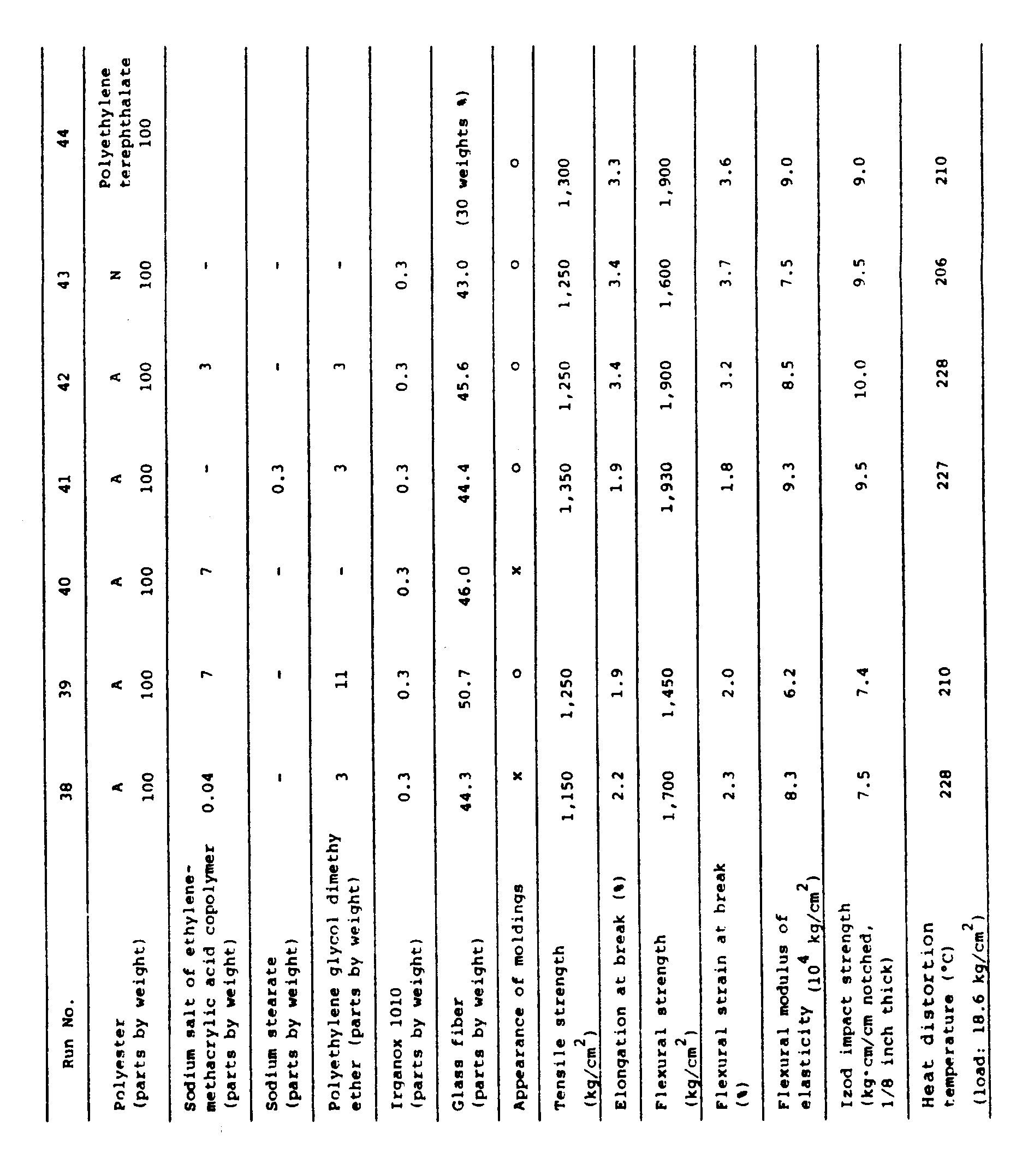
- One-hundred parts of each copolyester indicated in Table 5 and a predetermined amount of sodium salt of ethylene-methacrylic acid copolymer (an ionomer, HIMILAN 1856, Mitsui Polychemical) were thoroughly dried in a hot air current and mixed with 1/10 of the amount of ionomer of Phosphite® 168 (Ciba-Geigy) as an antioxidant. The resulting composition was charged into the hopper of a 30 mm (dia.) two-axis extruding machine (Plastic Kogaku Kenkyusho) and melted and extruded at the cylinder temperature of 190-270-280-285°C (from the hopper side), the adapter temperature of 285°C and the die temperature of 275°C to give a strand which was then cut into pellets.
- The pellets thus obtained were dried at 120°C for 12 hours and, then, preheated in a hot press with a 3 mm spacer at 280°C for 5 minutes and, then, pressed at the pressure of 50 kg/cm² for 5 minutes. The pressed product was further pressed with a press at 150°C for 4 minutes and, then, cooled in a cooling press for thorough crystallization to give a sheet with a thickness of about 3 mm. Testpieces were cut out from the sheet and the Izod impact strength (notched; ASTM D 256) was measured. The result is shown in Table 5.
- The presence of at least 5 parts by weight of the ionomer assured a high impact strength.
- The compositions according to the invention as prepared by varying the sort, molecular weight and proportion of the aliphatic dicarboxylic acid and poly(tetramethylene oxide)glycol in the copolyester invariably showed high impact strength values. The moldings obtained were allowed to stand in an air bath at 150°C for 7 days and their Izod impact strengths were determined. The results are shown in Table 5.
- Despite the prolonged exposure to a high temperature, the moldings retained high impact strengths. Moreover, the moldings had satisfactory surfaces.
- Copolyesters were produced under various conditions, namely without addition of an aliphatic dicarboxylic acid (copolyester F, Run 55), without addition of poly(tetramethylene oxide)glycol (copolyester G, Run 56), addition of an excess thereof (copolyester H, run 57), addition of an aliphatic dicarboxylic acid with a small carbon number (copolyester I, Run 58) and addition of an excess of aliphatic dicarboxylic acid (copolyester O, Run 59), and each copolyester was molded in the same manner as Run 48. Izod impact strength data on the products are shown in Table 5.
- The incorporation of an ionomer invariably resulted in an improved impact strength after molding but when the molded products were exposed to high temperature for a long time, they showed a large variation in impact strength probably due to local degradation, thus lacking in the stability of quality. It is thus clear that a stable and high impact strength can be obtained only with compositions containing a copolyester in which the sort and amount of aliphatic dicarboxylic acid and the amount of poly(tetramethylene oxide)glycol are each within the range of the present invention.
- The procedure of Run 48 was repeated except that a polyethylene terephthalate with an intrinsic viscosity of 0.74 dl/g was used in lieu of the copolyester and the impact strength of the resulting product was determined. The result is shown in Table 5.
- In the case of unmodified polyethylene terephthalate, the incorporation of an ionomer results in some improvement in impact strength but a marked reduction in impact strength occurred when the product was exposed to high temperature for a long time.
- A shaped article was manufactured in the same manner as Run 47 except that an ethylene-ethyl acrylate copolymer (Yukalon X-190-1, Mitsubishi Petrochemical) was used in lieu of the ionomer. The impact strength data on the article are given in Table 5.
- The mere use of a polymer not having formed a metal salt failed to give a high impact strength.
- The procedure of Run 48 was repeated except that poly(ethylene oxide)glycol-modified polyester P was used as the copolyester. The impact strength of the shaped article showed a marked decrease when it was exposed to high temperature for a long time.
- Using an ethylene-methacrylic acid copolymer zinc salt (trade name, HI-MILAN 1855, Mitsui Polychemical) as the ionomer, shaped articles were manufactured in the same manner as Runs 48, 50 and 51, respectively. These articles were white without a yellow cast. Impact strength data on these shaped articles are shown in Table 6.
- When allowed to remain in an air bath at 150°C for 7 days, the articles remained substantially uncolored.

- Shaped articles were manufactured in the same manner as Run 63 except that the kind of copolyester was changed. The impact strength values of the shaped articles are given in Table 6. When such other kinds of copolyesters were used, the impact strength was high at the stage immediately after molding but experienced a marked decrease on prolonged exposure to high temperature. In Run 69 in which polyethylene terephthalate was used in lieu of the copolyester, the impact strength was very low even at the stage immediately after molding.

- In the same manner as Run 45, the copolyester, ionomer and glass fiber were blended as shown in Table 7 to prepare resin compositions. Using these compositions, testpieces were prepared and the impact strength of each testpiece was determined. The results are shown in Table 7.
- When the proportion of the ionomer was not less than 5 parts by weight, high impact strength values were obtained.
- The compositions according to the present invention invariably gave testpieces showing high impact strength values. These testpieces were allowed to rest in an air bath at 150°C for 7 days and the Izod impact strength of each testpiece was determined. The results are shown in cable 7. Despite the prolonged exposure to high temperature, these testpieces retained high impact strength values. The flexual strength of each testpiece was also determined in accordance with ASTM D 790. It was found that the products according to the present invention invariably showed high flexual strength values.
- When the proportion of the ionomer was one part by weight which is outside of the scope of the invention, the impact strength of the resulting shaped article was inadequate (Run 70).
- Shaped articles were manufactured in the same manner as Run 73 except under the varied conditions, namely without addition of an aliphatic dicarboxylic acid (copolyester F), without addition of poly(tetramethylene oxide)glycol (copolyester G), with addition of an excess of poly(tetramethylene oxide)glycol (copolyester H), with addition of an aliphatic dicarboxylic acid with a small carbon number (copolyester I) and with addition of an excess of aliphatic dicarboxylic acid (copolyester O). The Izod impact strength and flexual strength were determined. The results are shown in Table 7.
- Comparison of Run 73 with Runs 83 to 87 shows that the latter products are inferior to the products of Run 73 in both the impact strength immediately after molding and that after 7 days at 150°C. Particularly the products of Run 85 to 87 are fairly low in flexual strength, too.
- A shaped article was manufactured in the same manner as Run 73 except that a polyethylene terephthalate with an intrinsic viscosity of 0.74 dl/g was used in lieu of the copolyester, and its impact strength was determined. The result is shown in Table 7.
- In the case of the unmodified polyethylene terephthalate, the incorporation of an ionomer failed to achieve an improvement in impact strength.
- A shaped article was manufactured in the same manner as Run 73 except that an ethylene-ethyl acrylate copolymer (Yukalon X-190-1, Mitsubishi Petrochemical) was used in lieu of the ionomer, and its impact strength was determined. The results are shown in Table 7.
- The mere use of a polymer not having formed a salt failed to achieve a high impact strength.

Claims (26)
- A mouldable copolyester consisting essentially of structural units of the following formulas (I) to (IV):
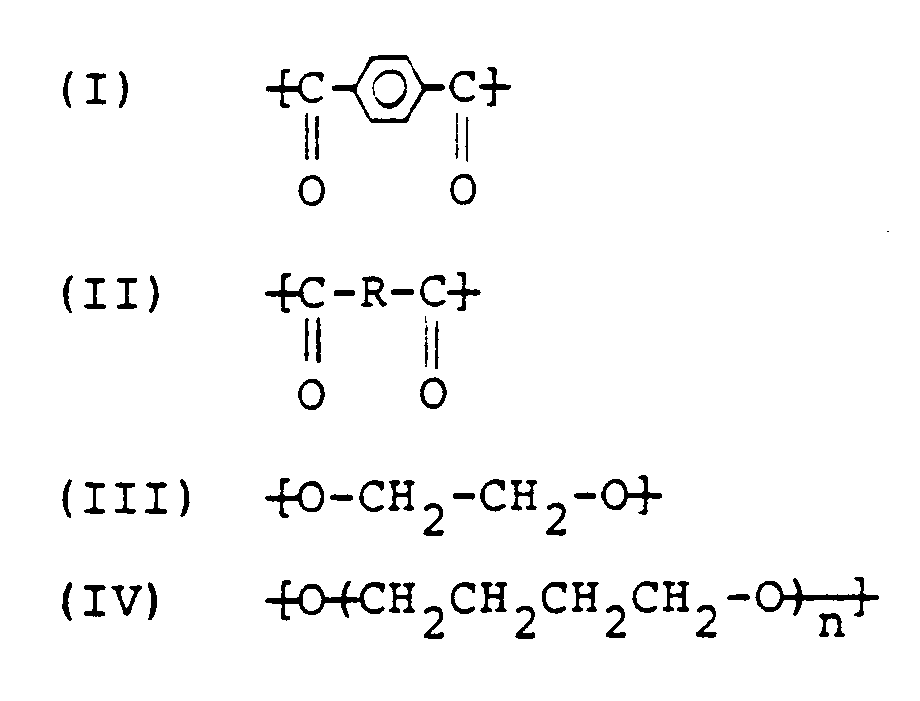
- A copolyester according to Claim 1 in which the amount of repeating unit (̵CH₂CH₂CH₂CH₂O)̵ of (IV) is 3 to 15 moles to 100 moles of (I).
- A copolyester according to Claim 1 or 2 in which R in the structural unit of (II) is a bivalent group obtained by elimination of the carboxyl groups from at least one C₁₆₋₅₄ aliphatic dicarboxylic acid.
- A copolyester according to Claim 3 in which the dicarboxylic acid(s) is/are one or more of tetradecanedicarboxylic acid, octadecanedicarboxylic acid, dimer acids and hydrogenated dimer acids.
- A copolyester according to Claim 3 in which the dicarboxylic acid(s) is/are one or more dimer acids and/or hydrogenated dimer acids.
- A copolyester according to any one of the preceding claims having an intrinsic viscosity of 0.5 to 1.5.
- A shaped article fabricated from a copolyester according to any one of the preceding claims.
- A polyester resin composition comprising, by weight (A) 100 parts of a copolyester according to any one of Claims 1 to 6; (B) 0.05 to 20 parts of a nucleating agent, (C) 0.1 to 10 parts of a polyalkylene glycol of the general formula R₁O(̵R₂O))̵nR'₁, where each of R₁ and R'₁, independently of the other, is a hydrogen atom or a C₁₋₁₀ alkyl, acyl or aroyl group; R₂ is a C₂₋₄ alkylene group and n is an integer not less than 5, and (D) optionally, 0 to 140 parts of a reinforcing filler.
- A composition according to Claim 8 in which n of the structural unit of (IV) is in the range 8 to 28.
- A composition according to Claim 8 or 9 in which the nucleating agent (B) is a Group Ia or Group IIa metal salt of C₇₋₅₄ carboxylic acid and/or a Group Ia or Group IIa metal salt of a carboxyl-group-containing polymer.
- A composition according to Claim 10 in which the nucleating agent (B) is a Group Ia or Group IIa metal salt of a carboxyl-group-containing polymer.
- A composition according to Claim 10 or 11 in which the metal of the salt is sodium or potassium.
- A polyester resin composition according to any one of Claims 8 to 12 in which each of R₁ and R'₁ of the polyalkylene glycol (C) is a C₁₋₁₀ alkyl group.
- A composition according to any one of Claims 8 to 13 in which reinforcing filler is glass fibre.
- A composition according to Claim 14 in which the amount of glass fibre is 5 to 140 parts by weight, per 100 parts by weight of the copolyester.
- A composition according to Claim 15 in which the amount of glass fibre is 10 to 100 parts by weight per 100 parts by weight of the copolyester.
- A shaped article fabricated from a polyester resin composition according to any one of Claims 8 to 16.
- A polyester resin composition comprising by weight (A) 100 parts of a copolyester according to any one of Claims 1 to 6, (B) 3 to 100 parts of a metal salt of a copolymer consisting of an α-olefin, an α,β-unsaturated carboxylic acid and optionally a third vinyl monomer, and (C) optionally, 0 to 60 percent of a reinforcing filler, based on the total composition.
- A composition according to Claim 18 in which n of the structural unit of (IV) is in the range 8 to 28.
- A polyester resin composition according to Claim 18 or 19 in which the unit (B) is an alkali metal salt of a copolymer consisting of ethylene, (meth)acrylic acid and optionally a third vinyl monomer.
- A composition according to Claim 18, 19 or 20 in which the metal of the salt (B) is sodium.
- A composition according to Claim 18 or 19 in which the metal of the salt (B) is zinc.
- A composition according to any one of Claims 18 to 22 in which the reinforcing filler is glass fibre.
- A composition according to Claim 23 in which the amount of glass fibre is 5 to 60% by weight, based on the total composition.
- A composition according to Claim 24 in which the amount of glass fibre is 10 to 50% by weight, based on the total composition.
- A shaped article fabricated from polyester resin composition according to any one of Claims 18 to 25.
Applications Claiming Priority (8)
| Application Number | Priority Date | Filing Date | Title |
|---|---|---|---|
| JP61122850A JPH0762068B2 (en) | 1986-05-27 | 1986-05-27 | Copolyester |
| JP122850/86 | 1986-05-27 | ||
| JP277935/86 | 1986-11-20 | ||
| JP277936/86 | 1986-11-20 | ||
| JP27793686A JPH0684467B2 (en) | 1986-11-20 | 1986-11-20 | Polyester resin composition with excellent impact strength |
| JP27793586A JPH0684466B2 (en) | 1986-11-20 | 1986-11-20 | Polyester resin composition with excellent impact resistance |
| JP61277934A JPH0684468B2 (en) | 1986-11-20 | 1986-11-20 | Polyester resin composition |
| JP277934/86 | 1986-11-20 |
Publications (3)
| Publication Number | Publication Date |
|---|---|
| EP0247828A2 EP0247828A2 (en) | 1987-12-02 |
| EP0247828A3 EP0247828A3 (en) | 1988-10-19 |
| EP0247828B1 true EP0247828B1 (en) | 1992-07-29 |
Family
ID=27470884
Family Applications (1)
| Application Number | Title | Priority Date | Filing Date |
|---|---|---|---|
| EP87304648A Expired EP0247828B1 (en) | 1986-05-27 | 1987-05-26 | Copolyester and compositions comprising it |
Country Status (3)
| Country | Link |
|---|---|
| US (2) | US4772652A (en) |
| EP (1) | EP0247828B1 (en) |
| DE (1) | DE3780708T2 (en) |
Families Citing this family (20)
| Publication number | Priority date | Publication date | Assignee | Title |
|---|---|---|---|---|
| US4772652A (en) * | 1986-05-27 | 1988-09-20 | Kuraray Co., Ltd. | Copolyester and polyester resin composition comprising said copolyester |
| GB8811995D0 (en) * | 1988-05-20 | 1988-06-22 | Ciba Geigy Ag | Flame retardant polymer composition |
| US5089553A (en) * | 1988-08-30 | 1992-02-18 | Idemitsu Petrochemical Co., Ltd. | Copolymerized polyester compositions |
| US5300747A (en) * | 1989-07-17 | 1994-04-05 | Campbell Soup Company | Composite material for a microwave heating container and container formed therefrom |
| WO1992003505A1 (en) * | 1990-08-27 | 1992-03-05 | E.I. Du Pont De Nemours And Company | Toughened thermoplastic polyester compositions |
| DE4027853A1 (en) * | 1990-09-03 | 1992-03-05 | Hoechst Ag | MICROWAVE COMPATIBLE FOOD COVER FILM |
| DE4041520A1 (en) * | 1990-12-22 | 1992-06-25 | Bayer Ag | MODIFIED POLYESTER RESINS, A METHOD OF PREPARING THEM AND TONERS CONTAINING SUCH POLYESTER RESINS |
| ATE226233T1 (en) * | 1993-04-21 | 2002-11-15 | Atofina | THERMOPLASTIC ELASTOMERS WITH POLYETHER SEGMENTS |
| JPH07179736A (en) * | 1993-12-24 | 1995-07-18 | Kanegafuchi Chem Ind Co Ltd | High melt viscoelasticity-expressing resin composition and method for producing aromatic polyester resin foam using the same |
| US6001935A (en) * | 1997-11-10 | 1999-12-14 | Stephan Company | Durable hydrophilic polymer coatings |
| WO1998027263A1 (en) * | 1996-12-18 | 1998-06-25 | E.I. Du Pont De Nemours And Company | Durable hydrophilic polymer coatings |
| JP4335444B2 (en) | 1998-03-11 | 2009-09-30 | ディーエスエム アイピー アセッツ ビー.ブイ. | Continuous process for the production of segmented elastomeric polyester copolymers. |
| US20030114831A1 (en) * | 2001-12-14 | 2003-06-19 | Scimed Life Systems, Inc. | Catheter having improved curve retention and method of manufacture |
| US20050143501A1 (en) * | 2003-12-25 | 2005-06-30 | Fuji Photo Film Co., Ltd. | Polycarbonate resin molding |
| US20060155064A1 (en) * | 2005-01-10 | 2006-07-13 | Hansen Steven M | Polyesters and slurries containing microfiber and micropowder, and methods for using and making same |
| KR20130062334A (en) | 2010-09-01 | 2013-06-12 | 교도 인사쯔 가부시키가이샤 | Laminate, packaging container, and packaging body |
| US20120246873A1 (en) * | 2011-04-01 | 2012-10-04 | Rama Konduri | Hollow articles comprising fiber-filled polyester compositions, methods of manufacture, and uses thereof |
| US11578185B2 (en) | 2020-03-31 | 2023-02-14 | Toray Industries, Inc. | Polyester resin composition, molded article, and composite molded article |
| JP2023538841A (en) * | 2020-08-07 | 2023-09-12 | ビーエーエスエフ ソシエタス・ヨーロピア | thermoplastic mixture |
| CN114230984B (en) * | 2021-11-19 | 2023-05-05 | 金发科技股份有限公司 | PCTG material with high transparency, heat resistance and easy demolding, and preparation method and application thereof |
Family Cites Families (17)
| Publication number | Priority date | Publication date | Assignee | Title |
|---|---|---|---|---|
| US3013914A (en) * | 1958-03-11 | 1961-12-19 | Du Pont | Terephthalic acid copolyester compositions |
| DE1694168A1 (en) * | 1967-07-18 | 1971-06-09 | Hoechst Ag | Thermoplastic polyester molding compounds |
| DE1694186A1 (en) * | 1967-08-30 | 1971-08-26 | Hoechst Ag | Thermoplastic molding compounds |
| FR2129162A5 (en) * | 1971-03-17 | 1972-10-27 | Allied Chem | Nucleating agents for polyethylene terepha - late moulding compsn |
| US4172859A (en) * | 1975-05-23 | 1979-10-30 | E. I. Du Pont De Nemours And Company | Tough thermoplastic polyester compositions |
| US4010222A (en) * | 1975-05-23 | 1977-03-01 | E. I. Du Pont De Nemours And Company | Blends of copolyesters and ethylene/carboxylic acid copolymers which are at least ten percent neutralized |
| JPS5247069A (en) * | 1975-10-11 | 1977-04-14 | Toyo Boseki | Polyester system films with superior processibilty |
| US4211678A (en) * | 1978-09-12 | 1980-07-08 | Akzona Incorporated | Copolyester yarns and fibers dyeable without carrier at atmospheric pressure |
| US4257937A (en) * | 1978-11-06 | 1981-03-24 | General Electric Company | Modified polyester compositions |
| EP0019575B1 (en) * | 1979-05-17 | 1984-04-04 | The Goodyear Tire & Rubber Company | Random elastomeric copolyesters |
| DE3067764D1 (en) * | 1979-09-21 | 1984-06-14 | Ici Plc | Fast crystallising block copolyester composition |
| DE3265115D1 (en) * | 1981-01-06 | 1985-09-12 | Du Pont | Reinforced poly(ethylene terephthalate) compositions |
| JPS5817148A (en) * | 1981-07-24 | 1983-02-01 | Toray Ind Inc | Polyester composition |
| US4558085A (en) * | 1983-10-11 | 1985-12-10 | Plastics Engineering Company | Process for the preparation of fast crystallizing polyalkyleneterephthalate resin compositions |
| US4582895A (en) * | 1984-12-04 | 1986-04-15 | Henkel Corporation | Fatty segmented polyester elastomers |
| US4636442A (en) * | 1985-10-11 | 1987-01-13 | Eastman Kodak Company | Laminated structures of polyethylene terephthalate and elastomeric copolyesterethers |
| US4772652A (en) * | 1986-05-27 | 1988-09-20 | Kuraray Co., Ltd. | Copolyester and polyester resin composition comprising said copolyester |
-
1987
- 1987-05-21 US US07/053,156 patent/US4772652A/en not_active Expired - Fee Related
- 1987-05-26 DE DE8787304648T patent/DE3780708T2/en not_active Expired - Fee Related
- 1987-05-26 EP EP87304648A patent/EP0247828B1/en not_active Expired
-
1988
- 1988-07-06 US US07/215,737 patent/US4931538A/en not_active Expired - Lifetime
Also Published As
| Publication number | Publication date |
|---|---|
| EP0247828A3 (en) | 1988-10-19 |
| US4772652A (en) | 1988-09-20 |
| EP0247828A2 (en) | 1987-12-02 |
| US4931538A (en) | 1990-06-05 |
| DE3780708D1 (en) | 1992-09-03 |
| DE3780708T2 (en) | 1993-03-25 |
Similar Documents
| Publication | Publication Date | Title |
|---|---|---|
| US4772652A (en) | Copolyester and polyester resin composition comprising said copolyester | |
| EP0057415B1 (en) | Polyester resin composition | |
| US4659757A (en) | Polyester resin composition for forming an impact resistant article | |
| CN1454930A (en) | Polyester composition | |
| US4778842A (en) | Polyester resin compositions | |
| JPS5910698B2 (en) | polyester composition | |
| EP0020693B1 (en) | Copolyesters of polybutylene terephthalate | |
| JPH0449579B2 (en) | ||
| US4965111A (en) | Olefinic impact modifiers for, and blends with, thermoplastic polyester resins | |
| GB2123008A (en) | Thermoplastic composite material | |
| US20070299212A1 (en) | Polymer impact modifier blend concentrate | |
| EP0299064B1 (en) | Olefinic impact modifiers for, and blends with, thermoplastic polyester resins | |
| US4271063A (en) | Thermoplastic molding compositions | |
| JPH0739535B2 (en) | High-density thermoplastic molding composition with improved impact strength | |
| US5314948A (en) | Olefinic impact modifiers for, and blends with, thermoplastic polyester resins | |
| AU605596B2 (en) | Glycidyl methacrylate grafted epdm modifiers in fiber reinforced polyester compositions | |
| JPH09124909A (en) | Polyester resin composition with excellent impact resistance | |
| KR890002713B1 (en) | Polyester resin composition | |
| GB2105351A (en) | Polyester resin composition | |
| JP2642131B2 (en) | Glass fiber reinforced polyester resin composition with excellent toughness and crystallinity | |
| JPH0684468B2 (en) | Polyester resin composition | |
| JP2642129B2 (en) | Glass fiber reinforced polyester resin composition with excellent crystallinity | |
| JPH0684467B2 (en) | Polyester resin composition with excellent impact strength | |
| US5179169A (en) | Olefinic impact modifiers for, and blends with, thermoplastic polyester resins | |
| JPS61246250A (en) | Reinforced polyester resin composition having excellent impact strength |
Legal Events
| Date | Code | Title | Description |
|---|---|---|---|
| PUAI | Public reference made under article 153(3) epc to a published international application that has entered the european phase |
Free format text: ORIGINAL CODE: 0009012 |
|
| AK | Designated contracting states |
Kind code of ref document: A2 Designated state(s): DE FR GB IT NL |
|
| PUAL | Search report despatched |
Free format text: ORIGINAL CODE: 0009013 |
|
| AK | Designated contracting states |
Kind code of ref document: A3 Designated state(s): DE FR GB IT NL |
|
| 17P | Request for examination filed |
Effective date: 19890303 |
|
| 17Q | First examination report despatched |
Effective date: 19901001 |
|
| GRAA | (expected) grant |
Free format text: ORIGINAL CODE: 0009210 |
|
| AK | Designated contracting states |
Kind code of ref document: B1 Designated state(s): DE FR GB IT NL |
|
| PG25 | Lapsed in a contracting state [announced via postgrant information from national office to epo] |
Ref country code: NL Effective date: 19920729 Ref country code: IT Free format text: LAPSE BECAUSE OF FAILURE TO SUBMIT A TRANSLATION OF THE DESCRIPTION OR TO PAY THE FEE WITHIN THE PRE;WARNING: LAPSES OF ITALIAN PATENTS WITH EFFECTIVE DATE BEFORE 2007 MAY HAVE OCCURRED AT ANY TIME BEFORE 2007. THE CORRECT EFFECTIVE DATE MAY BE DIFFERENT FROM THE ONE RECORDED.SCRIBED TIME-LIMIT Effective date: 19920729 |
|
| REF | Corresponds to: |
Ref document number: 3780708 Country of ref document: DE Date of ref document: 19920903 |
|
| EN | Fr: translation not filed | ||
| PG25 | Lapsed in a contracting state [announced via postgrant information from national office to epo] |
Ref country code: FR Effective date: 19921218 |
|
| NLV1 | Nl: lapsed or annulled due to failure to fulfill the requirements of art. 29p and 29m of the patents act | ||
| PLBE | No opposition filed within time limit |
Free format text: ORIGINAL CODE: 0009261 |
|
| STAA | Information on the status of an ep patent application or granted ep patent |
Free format text: STATUS: NO OPPOSITION FILED WITHIN TIME LIMIT |
|
| 26N | No opposition filed | ||
| REG | Reference to a national code |
Ref country code: FR Ref legal event code: ST |
|
| PGFP | Annual fee paid to national office [announced via postgrant information from national office to epo] |
Ref country code: GB Payment date: 19970519 Year of fee payment: 11 |
|
| PGFP | Annual fee paid to national office [announced via postgrant information from national office to epo] |
Ref country code: DE Payment date: 19970530 Year of fee payment: 11 |
|
| PG25 | Lapsed in a contracting state [announced via postgrant information from national office to epo] |
Ref country code: GB Free format text: LAPSE BECAUSE OF NON-PAYMENT OF DUE FEES Effective date: 19980526 |
|
| GBPC | Gb: european patent ceased through non-payment of renewal fee |
Effective date: 19980526 |
|
| PG25 | Lapsed in a contracting state [announced via postgrant information from national office to epo] |
Ref country code: DE Free format text: LAPSE BECAUSE OF NON-PAYMENT OF DUE FEES Effective date: 19990302 |