EP0247779A2 - Process for the production of substituted 2-oxocyclo-hexaneacetic acid esters - Google Patents
Process for the production of substituted 2-oxocyclo-hexaneacetic acid esters Download PDFInfo
- Publication number
- EP0247779A2 EP0247779A2 EP87304443A EP87304443A EP0247779A2 EP 0247779 A2 EP0247779 A2 EP 0247779A2 EP 87304443 A EP87304443 A EP 87304443A EP 87304443 A EP87304443 A EP 87304443A EP 0247779 A2 EP0247779 A2 EP 0247779A2
- Authority
- EP
- European Patent Office
- Prior art keywords
- compound
- formula
- lower alkyl
- produce
- cis
- Prior art date
- Legal status (The legal status is an assumption and is not a legal conclusion. Google has not performed a legal analysis and makes no representation as to the accuracy of the status listed.)
- Withdrawn
Links
- 0 *C(C(CCC1(*)CC(O*)=O)C(*)(*)CC(*)=C(*)*)C1=O Chemical compound *C(C(CCC1(*)CC(O*)=O)C(*)(*)CC(*)=C(*)*)C1=O 0.000 description 6
- RKTUNCDBZKPWBR-UHFFFAOYSA-O CCNC(CCCC1([N]2(CCC2)[NH3+])I)C1=O Chemical compound CCNC(CCCC1([N]2(CCC2)[NH3+])I)C1=O RKTUNCDBZKPWBR-UHFFFAOYSA-O 0.000 description 1
Classifications
-
- C—CHEMISTRY; METALLURGY
- C07—ORGANIC CHEMISTRY
- C07C—ACYCLIC OR CARBOCYCLIC COMPOUNDS
- C07C67/00—Preparation of carboxylic acid esters
- C07C67/30—Preparation of carboxylic acid esters by modifying the acid moiety of the ester, such modification not being an introduction of an ester group
- C07C67/333—Preparation of carboxylic acid esters by modifying the acid moiety of the ester, such modification not being an introduction of an ester group by isomerisation; by change of size of the carbon skeleton
- C07C67/343—Preparation of carboxylic acid esters by modifying the acid moiety of the ester, such modification not being an introduction of an ester group by isomerisation; by change of size of the carbon skeleton by increase in the number of carbon atoms
- C07C67/347—Preparation of carboxylic acid esters by modifying the acid moiety of the ester, such modification not being an introduction of an ester group by isomerisation; by change of size of the carbon skeleton by increase in the number of carbon atoms by addition to unsaturated carbon-to-carbon bonds
-
- C—CHEMISTRY; METALLURGY
- C07—ORGANIC CHEMISTRY
- C07C—ACYCLIC OR CARBOCYCLIC COMPOUNDS
- C07C67/00—Preparation of carboxylic acid esters
- C07C67/30—Preparation of carboxylic acid esters by modifying the acid moiety of the ester, such modification not being an introduction of an ester group
- C07C67/307—Preparation of carboxylic acid esters by modifying the acid moiety of the ester, such modification not being an introduction of an ester group by introduction of halogen; by substitution of halogen atoms by other halogen atoms
-
- C—CHEMISTRY; METALLURGY
- C07—ORGANIC CHEMISTRY
- C07C—ACYCLIC OR CARBOCYCLIC COMPOUNDS
- C07C67/00—Preparation of carboxylic acid esters
- C07C67/30—Preparation of carboxylic acid esters by modifying the acid moiety of the ester, such modification not being an introduction of an ester group
- C07C67/317—Preparation of carboxylic acid esters by modifying the acid moiety of the ester, such modification not being an introduction of an ester group by splitting-off hydrogen or functional groups; by hydrogenolysis of functional groups
-
- C—CHEMISTRY; METALLURGY
- C07—ORGANIC CHEMISTRY
- C07C—ACYCLIC OR CARBOCYCLIC COMPOUNDS
- C07C69/00—Esters of carboxylic acids; Esters of carbonic or haloformic acids
- C07C69/66—Esters of carboxylic acids having esterified carboxylic groups bound to acyclic carbon atoms and having any of the groups OH, O—metal, —CHO, keto, ether, acyloxy, groups, groups, or in the acid moiety
- C07C69/73—Esters of carboxylic acids having esterified carboxylic groups bound to acyclic carbon atoms and having any of the groups OH, O—metal, —CHO, keto, ether, acyloxy, groups, groups, or in the acid moiety of unsaturated acids
- C07C69/738—Esters of keto-carboxylic acids or aldehydo-carboxylic acids
Definitions
- This invention relates to a process for the production of substituted 2-oxocyclohexaneacetic acid esters and to the intermediates used for their production,and their preparation.
- the substituted 2-oxocyclohexaneacetic acid esters produced by the present process are themselves intermediates for the manufacture of useful analgesic and anti-inflammatory compounds described in Mobilio et al, United States Patent No. 4,616,028, October 7, 1986, which is herein incorporated by reference.
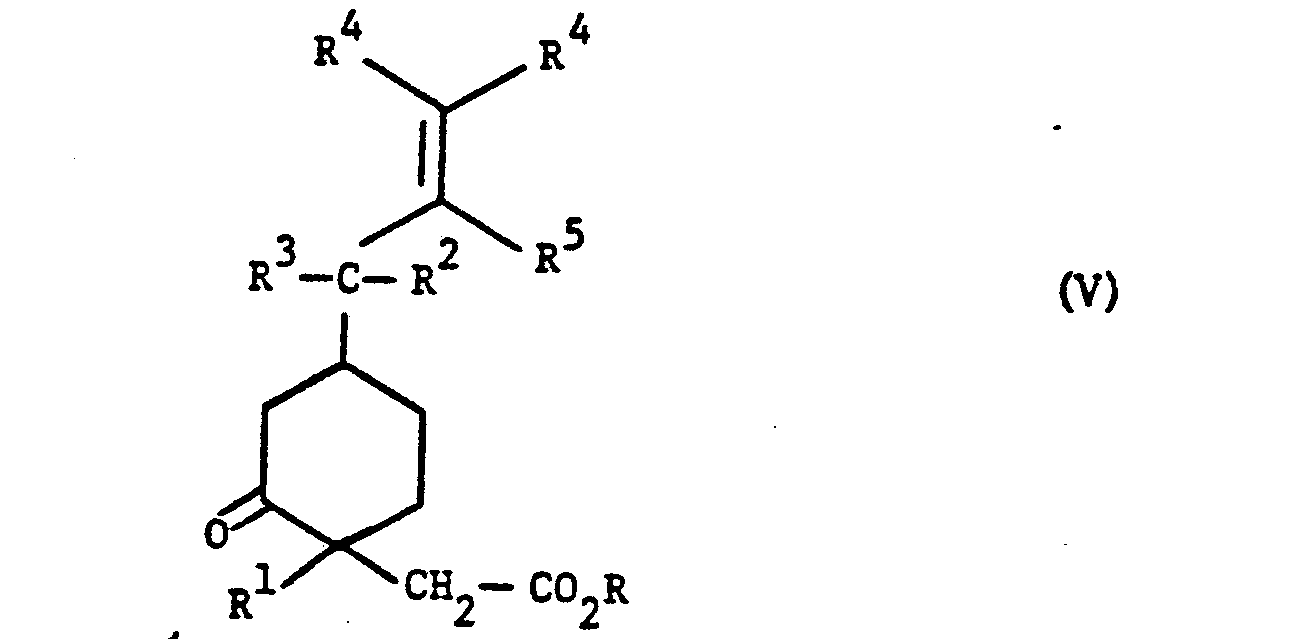
- V 1,4-disubstituted 2-oxocyclohexaneacetic acid ester of formula (V) wherein R and R are lower alkyl;R 2 ,R 3 and R 5 are each independently hydrogen or lower alkyl wherein lower alkyl contains 1 to 6 carbon
- Mobilio et al United States Patent No. 4,616,028 disclose the 1,4-disubstituted 2-oxocyclohexaneacetic acid esters of formula (V) and the process for producing analgesic and anti-inflammatory compounds from said 2 - oxocyclohexaneacetic acid esters of formula (V).
- Mobilio et al employ the expensive phenylselenenyl chloride in the production process of the 2-oxocyclohexaneacetic acid esters of formula (V).
- the present invention provides a novel process for producing said 2-oxocyclohexaneacetic acid esters in high yield, from inexpensive reagents which can be conveniently carr.ied out on a large scale without the necessity for purifying intermediate compounds by chromatography.
- the present process also provides a high yield of the preferred isomer of 2-oxoc y clohexaneacetic acid esters of formula (V).
- optical isomers of the compounds of formula (IV) which result from asymmetric centers, contained therein.
- Such isomers are obtained in substantially pure form by classical separation techniques and by sterically controlled synthesis.
- the preferred intermediate compounds of the present invention are the isomers of the 2-oxocyclohexaneacetic acid esters represented by formulae (IVa-( ⁇ )cis) and (rVb-( ⁇ )cis): wherein the 1-acetic acid methyl ester group is cis to the 4-(2-propenyl) group, or the 4-(phenylmethyl) group.
- This invention also provides the individual process steps of multi step processes described above which prepare novel compounds,e.g.V from IV, IV from III, III from II and II from I or combinations of such steps e.g.V from I V from III, IV from III from II.
- Example 3 The isomer ratio (cis:trans), after bromine removal in Example 3, was 7:5:1. Subsequent experiments indicated that better selectivity (isomer ratio 15:1) was obtained in Example 3 by adding the allyltrimethylsilane dropwise as a 20% methylene ehloride solution over an hour in Example 2.
- ketones of Examples 3, 4 or 5 can be subjected to Fischer indole synthesis conditions, as described in Mobilio et al, United States Patent No. 4,616,028, by refluxing with 2-ethylphenylhydrazine or phenylhydrazine- in methanol the appropriate time to form the corresponding hydrazone.
- the hydrazone solution can then be cooled to 0°C, treated with acetyl chloride to generate HC1 and refluxed an additional 45 minutes to affect Fischer indole cyclization.
- the resulting esters can then be hydrolyzed with potassium carbonate in aqueous methanol to afford known substituted tetrahydro-lH- carbazole-I-acetic acids having analgesic and anti-inflammatory activity.
Landscapes
- Chemical & Material Sciences (AREA)
- Organic Chemistry (AREA)
- Organic Low-Molecular-Weight Compounds And Preparation Thereof (AREA)
- Indole Compounds (AREA)
Abstract
Description
- This invention relates to a process for the production of substituted 2-oxocyclohexaneacetic acid esters and to the intermediates used for their production,and their preparation. The substituted 2-oxocyclohexaneacetic acid esters produced by the present process are themselves intermediates for the manufacture of useful analgesic and anti-inflammatory compounds described in Mobilio et al, United States Patent No. 4,616,028, October 7, 1986, which is herein incorporated by reference.
- More specifically, this invention relates to the production of 1,4-disubstituted 2-oxocyclohexaneacetic acid ester of formula (V)

- Mobilio et al, United States Patent No. 4,616,028 disclose the 1,4-disubstituted 2-oxocyclohexaneacetic acid esters of formula (V) and the process for producing analgesic and anti-inflammatory compounds from said 2-oxocyclohexaneacetic acid esters of formula (V). Mobilio et al employ the expensive phenylselenenyl chloride in the production process of the 2-oxocyclohexaneacetic acid esters of formula (V). The present invention provides a novel process for producing said 2-oxocyclohexaneacetic acid esters in high yield, from inexpensive reagents which can be conveniently carr.ied out on a large scale without the necessity for purifying intermediate compounds by chromatography. The present process also provides a high yield of the preferred isomer of 2-oxocyclohexaneacetic acid esters of formula (V).
- A. Asselin et al, J Med Chem, 19, 787 (1976) disclose an alternate production method for . substituted 2-oxocyclohexaneacetic acid esters.
- A. Asselin et al, United States Patent No. 4,057,559, November 8, 1977, disclose still another process for the production of substituted 2-oxocyclohexaneacetic acid esters,
- The novel intermediate compounds of this invention are represented by formulae (IV), (III) and (II):


- Included in the present invention are the diastereoisomers of formula (IV) wherein the 4-substituent is either cis or trans to the acetic acid chain at position one. Racemic mixtures of such compounds are herein designated (IV-(i)cis) and (IV-(±)trans).
- Also included in this invention are the optical isomers of the compounds of formula (IV) which result from asymmetric centers, contained therein. Such isomers are obtained in substantially pure form by classical separation techniques and by sterically controlled synthesis.
- The preferred intermediate compounds of the present invention are the isomers of the 2-oxocyclohexaneacetic acid esters represented by formulae (IVa-(±)cis) and (rVb-(±)cis):

- The novel process for the production of the known intermediate compounds of formula (V)

- a) dihalogenating the compound of formula (I)


- b) dehydrohalogenating compound (II) in the presence of a base such as lithium carbonate, calcium carbonate, diazabicycloundecane, or collidine with or without added salts such as lithium bromide, or sodium chloride in a suitable solvent such as N,N-dimethylformamide or dimethylsulfoxide to produce the novel intermediate compound (III)

- c) reacting the compound (III) with
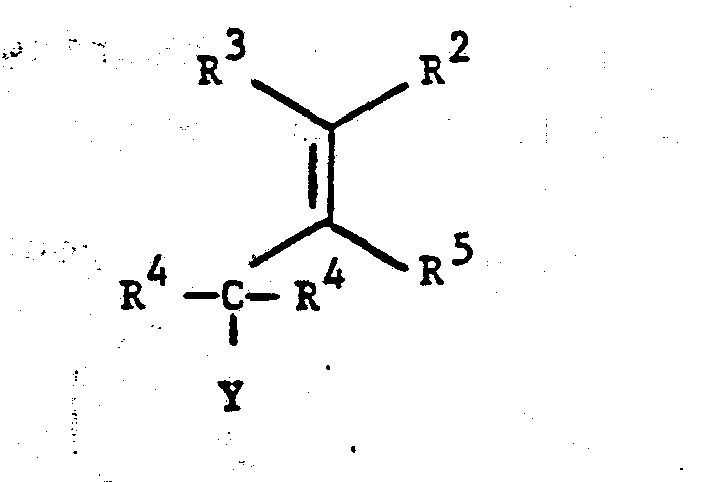

- d) dehalogenating the compound (IV) with a reducing agent such as zinc in a weak acid, or with sodium dithionite to produce the desired known compound(V).
- The novel process for the production of the known intermediate compounds of formula (V)

- a) reacting the compound (III) with


- b) dehalogenating the compound (IV) with a reducing agent such as zinc in a weak acid, or with sodium dithionite to produce the desired known compound-(V).
- This invention also provides the individual process steps of multi step processes described above which prepare novel compounds,e.g.V from IV, IV from III, III from II and II from I or combinations of such steps e.g.V from IVfrom III, IV from III from II.
- The following examples further illustrate this invention:
- Preparation of 3-Bromo-l-ethyl-2-oxocyclohex-3-eneacetic Acid Methyl Ester (III: R= -CH3; R1= -C2H5; X= -Br)
- a) A 5% (v/v) solution of bromine in methylene chloride (136 mL, 127 mmol, 2.5 eq) was added dropwise to a stirred solution of l-ethyl-2- oxocyclohexaneacetic acid methyl ester (10.0 g, 50.5 mmol) prepared by the process of A. Asselin et al, J. Med. Chem., 19, 787 (1976). The mixture was stirred an additional thirty minutes and treated with isobutylene to consume the excess bromine. The reaction mixture was concentrated to give 20.2 g (> 100%) of 3,3-dibromo-1-ethyl-2roxocyelohexaneacetic acid methyl ester as an orange oil (a portion of the oil was recrystallized from hexanes to give a solid m.p. 61-62° C).
- b) The oil from step (a) was dissolved in N,N-dimethylformamide (62 mL) and treated with lithium bromide (6.4g,74mmol) and lithium carbonate (3.9g,54mmol). The reaction mixture was heated with stirring to 100°C for one hour. The reaction mixture was poured into water (100mL) and extracted with toluene (4 x 100 mL). The toluene extracts were washed with water (4 x.50mL), dried (MgS04), and concentrated to give 13.8 g (99%) of 3-bromo-1-ethyl-2-oxocyclohex-3-eneacetic acid methyl ester as a light orange oil. This product was used in Example 2 without further purification.
- P reparation of 3-Bromo-1-ethyl-2-oxo-4-(2-propenyl)cyclohexaneacetic Acid Methyl Ester (IV: R= -CH3; R1= -C2H5; R2, R3, R4, R5= -H; X= -Br)
- 3-Bromo-1-ethyl-2-oxocyclohex-3-eneacetic acid methyl ester (13.8 g, 50.2 mmol) was dissolved in CH2C12 (distilled from CaH, 50 mL) and cooled to -20° C. The mixture was treated dropwise with TiCl4 (14.28 g, 75.3 mmol) followed after one hour by allyltrimethylsilane (6.9 g, 9.6 mL, 60.2 mmol). The mixture was stirred for one hour at -20°C then quenched with methanol (42 mL) followed by water (56 mL). The mixture was then extracted with toluene (4 x 150 mL). The combined toluene extracts were washed with saturated sodium chloride solution (100 mL), dried (MgS04), and concentrated to give 15.9 g (99%) of an isomeric mixture of 3-bromo-1-ethyl-2-oxo-4-(2-propenyl)cyclohexaneacetic acid methyl ester. This product was used in Example 3 without further purification.
- NMR (CDC13, 200 MHz) δ 0.8 (3H, t), 1.5-2.8 (11H, m), 3.6 (3H, s), 5.0-5.2 (3H, m), 5.5-5.8 (1H, m).
- This compound crystallized on prolonged standing.
- Preparation of cis-l-Ethyl-2-oxo-4-(2-propenyl)cyclohexaneacetic Acid Methyl Ester (Va-(±)cis)
- a) 3-Bromo-l-ethyl-2-oxo-4-(2-propenyl)cyclohexaneacetie acid methyl ester (15.9 g, 50.3 mmol) was dissolved in acetic acid (107 mL) and treated with zinc dust (19.4 g, 302 mmol). The stirred mixture was heated to 100°C for five hours then cooled to room temperature. The excess zinc was filtered off and washed with water (50 mL) and toluene (50 mL). The filtrate was then added to more water (100 mL) and extracted with toluene (3 x 150 mL). The combined toluene extracts were then washed with a saturated sodium bicarbonate solution, dried (MgS04) and concentrated to give 11.14 g (93%) of cis-l-ethyl-2-oxo-4-(2-propenyl)cyclohexaneacetic acid methyl ester as a yellowish oil. The oil was distilled (108-113°C at 0.3 mmHg) to give 10.06 g (84%) of the product as a clear oil.
- Gas chromatography analysis showed a 7.5:1 cis:trans isomer ratio.
- NMR (CDC13, 200 MHz) δ 0.8 (3H, t), 1.5-2.6 (13H, m), 3.6 (3H, s), 5.0-5.1 (2H, m), 5.6-5.8 (lH, m).
- b) The isomer ratio (cis:trans), after bromine removal in Example 3, was 7:5:1. Subsequent experiments indicated that better selectivity (isomer ratio 15:1) was obtained in Example 3 by adding the allyltrimethylsilane dropwise as a 20% methylene ehloride solution over an hour in Example 2.
- Preparation of cis-1-Ethyl-2-oxo-4-(2-propenyl)cyclohexaneacetic Acid Methyl Ester (Va-(±)cis)
- 3-Bromo-1-ethyl-2-oxo-4-(2-propenyl)cyclohexaneacetic acid methyl ester (200 mg, 0.631 mmol) and sodium dithionite (1.1 g, 6.31 mmol) were dissolved in N,N-dimethylformamide:water (5 mL each) and stirred under N2 for two days. The solvents were then removed under vacuum (0.1 mmHg) at room temperature. The residue was partitioned between ether (100 mL) and water (50 mL). The ether layer was dried (MgS04) and concentrated to give a slightly yellow oil. The product was then purified by bulb-to-bulb distillation (85°C at 0.1 mm Hg) to give 128 mg (85%) of cis-1-ethyl-2-oxo-4-(2-propenyl)cyclohexaneacetic acid methyl ester, identical by NMR to the product of Example 3.
- Preparation of cis-1-Ethyl-2-oxo-4-(phenylmethyl)cyclohexaneaeetic Acid Methyl Ester (Vb-(t)cis)
- A solution of 3-bromo-1-ethyl-2roxoeyclohex-3-eneacetic acid methyl ester (10 g, 36.3 mmol, as prepared in Example 1) and copper (I) bromide-dimethyl sulfide complex (3.63 mmol, 746 mg) in 107 mL of dry tetrahydrofuran was stirred at 0°C under nitrogen and treated with anhydrous zinc bromide (36.3 mmol, 8.17 g). After 5 minutes, the mixture was treated dropwise with 36.3 mmol of benzylmagnesium chloride (18.2 mL of 2M in THF). After 45 mintues, another 8 mmol of benzylmagnesium chloride were added followed by 350 mg of copper (I) bromide-dimethyl sulfide complex and then another 16 mmol of benzylmagnesium chloride. The reaction was quenched with 150 mL of 1M HC1 and extracted with 4 X 50 mL of ether. The extracts were combined, dried over magnesium sulfate, and concentrated affording 3-bromo-l-ethyl-2-oxo-4-(phenylmethyl)cyclohexaneacetic acid methyl ester. This was then stirred in a solution of 74 mL of N,N-dimethylformamide and 35 mL of water and treated with 109 mmol (18.96 g) of sodium dithionite. The mixture was heated at 55°C under nitrogen for 20 minutes, poured into 200 mL of water and extracted with 4 X 100 mL of 1:1 ether-petroleum ether. The extracts were combined, washed with 100 mL of water and 100 mL of saturated sodium bicarbonate (aq), dried over magnesium sulfate, and concentrated affording 10.48 g (36.3 mmol, 100% crude yield) of product as a pale yellow oil. Analysis by capillary GC demonstrated a 4.41:1 ratio of diastereomers, with the cis isomer predominating. The reduction of the intermediate 3-bromo-1-ethyl-2-oxo-4-(phenylmethyl)cyclohexaneacetic acid methyl ester to the title compound can also be carried out as described in Example 3.
- NMR (CDCl3/TMS, 200 MHz) δ 0.8 (t, 3H, J=7.5Hz), 1.4-2.9 (m, 13H), 3.6 and 3.7 (2s, 3H, OCH3 from major and minor isomers), 7.1-7.5 (m, 5H).
- The ketones of Examples 3, 4 or 5 can be subjected to Fischer indole synthesis conditions, as described in Mobilio et al, United States Patent No. 4,616,028, by refluxing with 2-ethylphenylhydrazine or phenylhydrazine- in methanol the appropriate time to form the corresponding hydrazone. The hydrazone solution can then be cooled to 0°C, treated with acetyl chloride to generate HC1 and refluxed an additional 45 minutes to affect Fischer indole cyclization. The resulting esters can then be hydrolyzed with potassium carbonate in aqueous methanol to afford known substituted tetrahydro-lH- carbazole-I-acetic acids having analgesic and anti-inflammatory activity.
- The demonstration of analgesic and anti-inflammatory activity and the method of treatment of inflammatory or painful conditions is also described in Mobilio et al, United States Patent No. 4,616,028.
Claims (31)




Applications Claiming Priority (4)
| Application Number | Priority Date | Filing Date | Title |
|---|---|---|---|
| US86823086A | 1986-05-28 | 1986-05-28 | |
| US868230 | 1986-05-28 | ||
| US07/020,426 US4748266A (en) | 1986-05-28 | 1987-03-02 | Substituted 2-oxocyclohexaneacetic acid esters |
| US20426 | 2001-12-07 |
Publications (2)
| Publication Number | Publication Date |
|---|---|
| EP0247779A2 true EP0247779A2 (en) | 1987-12-02 |
| EP0247779A3 EP0247779A3 (en) | 1988-01-07 |
Family
ID=26693424
Family Applications (1)
| Application Number | Title | Priority Date | Filing Date |
|---|---|---|---|
| EP87304443A Withdrawn EP0247779A3 (en) | 1986-05-28 | 1987-05-19 | Process for the production of substituted 2-oxocyclo-hexaneacetic acid esters |
Country Status (2)
| Country | Link |
|---|---|
| US (1) | US4748266A (en) |
| EP (1) | EP0247779A3 (en) |
Family Cites Families (4)
| Publication number | Priority date | Publication date | Assignee | Title |
|---|---|---|---|---|
| US3435063A (en) * | 1965-02-25 | 1969-03-25 | Squibb & Sons Inc | Fluorinated cyclic keto esters |
| JPS6029694B2 (en) * | 1979-02-14 | 1985-07-12 | 工業技術院長 | Method for producing alkyl↓-1↓-chloro↓-2↓-oxocycloalkane carboxylate |
| US4616028A (en) * | 1985-04-22 | 1986-10-07 | American Home Products Corporation | Substituted 2,3,4,9-tetrahydro-1H-carbazole-1-acetic acid derivatives, compositions and use |
| US4578398A (en) * | 1985-05-31 | 1986-03-25 | American Home Products Corporation | Substituted 2,3,4,9-tetrahydro-1H-carbazole-1-acetic acid, compositions and use |
-
1987
- 1987-03-02 US US07/020,426 patent/US4748266A/en not_active Expired - Lifetime
- 1987-05-19 EP EP87304443A patent/EP0247779A3/en not_active Withdrawn
Also Published As
| Publication number | Publication date |
|---|---|
| EP0247779A3 (en) | 1988-01-07 |
| US4748266A (en) | 1988-05-31 |
Similar Documents
| Publication | Publication Date | Title |
|---|---|---|
| CZ287168B6 (en) | Process for preparing 13,14-dihydro-15(R)-17-phenyl-18,19,20-trinor-PGF2 esters and intermediates for this preparation process | |
| US5003087A (en) | Process for preparing a naphthalene derivative and a synthetic intermediate thereof | |
| US4235780A (en) | Derivatives of 2H-pyran-2-one | |
| EP0151702A2 (en) | Alpha-hydroxyketone acetals | |
| US4625039A (en) | 4-trisubstituted silyl protected hydroxy-6-oxo-tetrahydropyran-2-yl-aldehyde intermediates | |
| US4982006A (en) | Process for the preparation of certain substituted aromatic compounds | |
| US4861910A (en) | Process for the production of substituted 2-oxocyclohexaneacetic acid esters | |
| US4748266A (en) | Substituted 2-oxocyclohexaneacetic acid esters | |
| EP0095835B1 (en) | Preparing 4,7-dialkoxybenzofurans, and intermediates used therein | |
| US5026877A (en) | Optically pure 1,3-dioxenones, methods for preparing same and use thereof | |
| US4007217A (en) | Process for producing 2-hydroxy-3-butenoic acid derivatives | |
| JP4881298B2 (en) | Method for producing indenol ester or ether | |
| US4898967A (en) | Process for the production of substituted 2-oxocyclohexaneacetic acid esters | |
| CS202044B2 (en) | Method of preparation of 2-arylpropione acids | |
| US4568762A (en) | 4-Methyl-2-oxo-cyclopentylidene acetic acid and esters thereof | |
| US4237058A (en) | Bicyclic lactone derivatives | |
| US4107181A (en) | Useful prostaglandin intermediates | |
| KR100253715B1 (en) | 4- (1,1-dialkoxycarbonylalkyl) azetidin-2-one derivative and method for preparing 4- (1-carboxyalkyl) azetidin-2-one derivative using the same | |
| JP3212104B2 (en) | Novel thioacetal compound and method for producing the same | |
| AU717844B2 (en) | Process for the preparation of 2,6-disubstituted benzothiophene compounds | |
| JPS62294642A (en) | Manufacture of substituted 2-oxocyclohexaneacetic ester | |
| US6103914A (en) | Method of producing optically active material of tricyclic compound | |
| US4342694A (en) | Processes for producing pyrethroid insecticide intermediates | |
| US4344884A (en) | Process for producing cis-3-(2,2-disubstituted-ethenyl)-2,2-dimethylcyclopropanecarboxylic acid and intermediates | |
| KR100320772B1 (en) | Process for Preparation of (S)-Benzoxazine Derivatives and Process for Racemization of (R)-Benzoxazine Derivatives |
Legal Events
| Date | Code | Title | Description |
|---|---|---|---|
| PUAI | Public reference made under article 153(3) epc to a published international application that has entered the european phase |
Free format text: ORIGINAL CODE: 0009012 |
|
| PUAL | Search report despatched |
Free format text: ORIGINAL CODE: 0009013 |
|
| AK | Designated contracting states |
Kind code of ref document: A2 Designated state(s): AT BE CH DE ES FR GB GR IT LI LU NL SE |
|
| AK | Designated contracting states |
Kind code of ref document: A3 Designated state(s): AT BE CH DE ES FR GB GR IT LI LU NL SE |
|
| STAA | Information on the status of an ep patent application or granted ep patent |
Free format text: STATUS: THE APPLICATION IS DEEMED TO BE WITHDRAWN |
|
| 18D | Application deemed to be withdrawn |
Effective date: 19880908 |
|
| RIN1 | Information on inventor provided before grant (corrected) |
Inventor name: HUGHES, PHILIP FLOYD Inventor name: MOBILIO, DOMINICK Inventor name: HUMBER, LESLIE GEORGE |