EP0247434A1 - Lithium/fluorinated carbon battery with no voltage delay at the beginning of the discharge - Google Patents
Lithium/fluorinated carbon battery with no voltage delay at the beginning of the discharge Download PDFInfo
- Publication number
- EP0247434A1 EP0247434A1 EP87106909A EP87106909A EP0247434A1 EP 0247434 A1 EP0247434 A1 EP 0247434A1 EP 87106909 A EP87106909 A EP 87106909A EP 87106909 A EP87106909 A EP 87106909A EP 0247434 A1 EP0247434 A1 EP 0247434A1
- Authority
- EP
- European Patent Office
- Prior art keywords
- carbon
- fluorinated
- discharge
- fluorinated carbon
- battery
- Prior art date
- Legal status (The legal status is an assumption and is not a legal conclusion. Google has not performed a legal analysis and makes no representation as to the accuracy of the status listed.)
- Withdrawn
Links
- QLOAVXSYZAJECW-UHFFFAOYSA-N methane;molecular fluorine Chemical compound C.FF QLOAVXSYZAJECW-UHFFFAOYSA-N 0.000 title claims abstract description 34
- WHXSMMKQMYFTQS-UHFFFAOYSA-N Lithium Chemical compound [Li] WHXSMMKQMYFTQS-UHFFFAOYSA-N 0.000 title claims abstract description 8
- 229910052744 lithium Inorganic materials 0.000 title claims abstract description 8
- OKTJSMMVPCPJKN-UHFFFAOYSA-N Carbon Chemical compound [C] OKTJSMMVPCPJKN-UHFFFAOYSA-N 0.000 claims abstract description 39
- 229910052799 carbon Inorganic materials 0.000 claims abstract description 30
- 238000000034 method Methods 0.000 claims abstract description 25
- 238000003682 fluorination reaction Methods 0.000 claims description 17
- 229910052731 fluorine Inorganic materials 0.000 claims description 14
- 239000011737 fluorine Substances 0.000 claims description 12
- 230000004584 weight gain Effects 0.000 claims description 10
- 235000019786 weight gain Nutrition 0.000 claims description 10
- 239000002006 petroleum coke Substances 0.000 claims description 9
- LFQSCWFLJHTTHZ-UHFFFAOYSA-N Ethanol Chemical compound CCO LFQSCWFLJHTTHZ-UHFFFAOYSA-N 0.000 claims description 6
- 230000035484 reaction time Effects 0.000 claims description 6
- 230000003068 static effect Effects 0.000 claims description 6
- 239000002245 particle Substances 0.000 claims description 4
- 239000006182 cathode active material Substances 0.000 claims description 3
- 238000004519 manufacturing process Methods 0.000 claims description 3
- 239000007795 chemical reaction product Substances 0.000 claims 2
- 239000000047 product Substances 0.000 claims 2
- PXGOKWXKJXAPGV-UHFFFAOYSA-N Fluorine Chemical compound FF PXGOKWXKJXAPGV-UHFFFAOYSA-N 0.000 claims 1
- 230000001629 suppression Effects 0.000 abstract description 15
- 239000000463 material Substances 0.000 abstract description 10
- 208000028659 discharge Diseases 0.000 description 38
- 239000000203 mixture Substances 0.000 description 16
- PXHVJJICTQNCMI-UHFFFAOYSA-N Nickel Chemical compound [Ni] PXHVJJICTQNCMI-UHFFFAOYSA-N 0.000 description 12
- YCKRFDGAMUMZLT-UHFFFAOYSA-N Fluorine atom Chemical compound [F] YCKRFDGAMUMZLT-UHFFFAOYSA-N 0.000 description 11
- IJGRMHOSHXDMSA-UHFFFAOYSA-N Atomic nitrogen Chemical compound N#N IJGRMHOSHXDMSA-UHFFFAOYSA-N 0.000 description 7
- 238000006243 chemical reaction Methods 0.000 description 7
- 230000001590 oxidative effect Effects 0.000 description 7
- OKKJLVBELUTLKV-UHFFFAOYSA-N Methanol Chemical compound OC OKKJLVBELUTLKV-UHFFFAOYSA-N 0.000 description 6
- 229910052759 nickel Inorganic materials 0.000 description 6
- 238000007792 addition Methods 0.000 description 5
- 239000007789 gas Substances 0.000 description 5
- -1 Li/CFx Chemical compound 0.000 description 3
- 229910000792 Monel Inorganic materials 0.000 description 3
- HEMHJVSKTPXQMS-UHFFFAOYSA-M Sodium hydroxide Chemical compound [OH-].[Na+] HEMHJVSKTPXQMS-UHFFFAOYSA-M 0.000 description 3
- 229910003481 amorphous carbon Inorganic materials 0.000 description 3
- 239000003575 carbonaceous material Substances 0.000 description 3
- 229910001873 dinitrogen Inorganic materials 0.000 description 3
- 230000000694 effects Effects 0.000 description 3
- 229920001343 polytetrafluoroethylene Polymers 0.000 description 3
- 239000004810 polytetrafluoroethylene Substances 0.000 description 3
- 239000007858 starting material Substances 0.000 description 3
- KLZUFWVZNOTSEM-UHFFFAOYSA-K Aluminium flouride Chemical compound F[Al](F)F KLZUFWVZNOTSEM-UHFFFAOYSA-K 0.000 description 2
- 230000002411 adverse Effects 0.000 description 2
- XAGFODPZIPBFFR-UHFFFAOYSA-N aluminium Chemical compound [Al] XAGFODPZIPBFFR-UHFFFAOYSA-N 0.000 description 2
- 239000006229 carbon black Substances 0.000 description 2
- 150000001875 compounds Chemical class 0.000 description 2
- 229910002804 graphite Inorganic materials 0.000 description 2
- 239000010439 graphite Substances 0.000 description 2
- 238000002156 mixing Methods 0.000 description 2
- 229910052757 nitrogen Inorganic materials 0.000 description 2
- 239000000126 substance Substances 0.000 description 2
- XTHFKEDIFFGKHM-UHFFFAOYSA-N Dimethoxyethane Chemical compound COCCOC XTHFKEDIFFGKHM-UHFFFAOYSA-N 0.000 description 1
- 239000004743 Polypropylene Substances 0.000 description 1
- 239000000654 additive Substances 0.000 description 1
- 229910052782 aluminium Inorganic materials 0.000 description 1
- 238000013459 approach Methods 0.000 description 1
- 238000010420 art technique Methods 0.000 description 1
- 239000011230 binding agent Substances 0.000 description 1
- 239000013590 bulk material Substances 0.000 description 1
- 239000000571 coke Substances 0.000 description 1
- 230000007423 decrease Effects 0.000 description 1
- 238000006115 defluorination reaction Methods 0.000 description 1
- 230000002939 deleterious effect Effects 0.000 description 1
- 238000010586 diagram Methods 0.000 description 1
- 238000007599 discharging Methods 0.000 description 1
- 238000006073 displacement reaction Methods 0.000 description 1
- 239000003792 electrolyte Substances 0.000 description 1
- 239000000835 fiber Substances 0.000 description 1
- 239000011888 foil Substances 0.000 description 1
- 238000010348 incorporation Methods 0.000 description 1
- 230000000977 initiatory effect Effects 0.000 description 1
- 229910001496 lithium tetrafluoroborate Inorganic materials 0.000 description 1
- 229910001635 magnesium fluoride Inorganic materials 0.000 description 1
- 239000011159 matrix material Substances 0.000 description 1
- 239000008188 pellet Substances 0.000 description 1
- 229920001155 polypropylene Polymers 0.000 description 1
- 239000000843 powder Substances 0.000 description 1
- 238000002203 pretreatment Methods 0.000 description 1
- 238000012545 processing Methods 0.000 description 1
- 230000002035 prolonged effect Effects 0.000 description 1
- RUOJZAUFBMNUDX-UHFFFAOYSA-N propylene carbonate Chemical compound CC1COC(=O)O1 RUOJZAUFBMNUDX-UHFFFAOYSA-N 0.000 description 1
- 238000010298 pulverizing process Methods 0.000 description 1
- 230000000087 stabilizing effect Effects 0.000 description 1
- 238000012360 testing method Methods 0.000 description 1
- 238000009281 ultraviolet germicidal irradiation Methods 0.000 description 1
- 238000005406 washing Methods 0.000 description 1
Images


Classifications
-
- H—ELECTRICITY
- H01—ELECTRIC ELEMENTS
- H01M—PROCESSES OR MEANS, e.g. BATTERIES, FOR THE DIRECT CONVERSION OF CHEMICAL ENERGY INTO ELECTRICAL ENERGY
- H01M4/00—Electrodes
- H01M4/02—Electrodes composed of, or comprising, active material
- H01M4/36—Selection of substances as active materials, active masses, active liquids
- H01M4/58—Selection of substances as active materials, active masses, active liquids of inorganic compounds other than oxides or hydroxides, e.g. sulfides, selenides, tellurides, halogenides or LiCoFy; of polyanionic structures, e.g. phosphates, silicates or borates
- H01M4/583—Carbonaceous material, e.g. graphite-intercalation compounds or CFx
- H01M4/5835—Comprising fluorine or fluoride salts
-
- C—CHEMISTRY; METALLURGY
- C01—INORGANIC CHEMISTRY
- C01B—NON-METALLIC ELEMENTS; COMPOUNDS THEREOF; METALLOIDS OR COMPOUNDS THEREOF NOT COVERED BY SUBCLASS C01C
- C01B32/00—Carbon; Compounds thereof
- C01B32/10—Carbon fluorides, e.g. [CF]nor [C2F]n
-
- Y—GENERAL TAGGING OF NEW TECHNOLOGICAL DEVELOPMENTS; GENERAL TAGGING OF CROSS-SECTIONAL TECHNOLOGIES SPANNING OVER SEVERAL SECTIONS OF THE IPC; TECHNICAL SUBJECTS COVERED BY FORMER USPC CROSS-REFERENCE ART COLLECTIONS [XRACs] AND DIGESTS
- Y02—TECHNOLOGIES OR APPLICATIONS FOR MITIGATION OR ADAPTATION AGAINST CLIMATE CHANGE
- Y02E—REDUCTION OF GREENHOUSE GAS [GHG] EMISSIONS, RELATED TO ENERGY GENERATION, TRANSMISSION OR DISTRIBUTION
- Y02E60/00—Enabling technologies; Technologies with a potential or indirect contribution to GHG emissions mitigation
- Y02E60/10—Energy storage using batteries
Definitions
- the present invention relates to an improved fluorinated carbon (CF x ) useful in the manufacture of batteries. More particularly, the invention relates to a novel essentially single step process for producing CF x which can be used in a lithium battery to eliminate low voltage at the beginning of discharge.
- the process in which a thick carbon bed is used to assure proper degree and type of inhomogeneity yields a product which is a fully-, or overfluorinated CF x admixed with a small amount of underfluorinated material to eliminate voltage suppression in the battery performance.
- Fluorinated carbon is known by the formula (CF x ) n , where x is a number between 0 and 1.5 and n is an indefinite number greater than 2.
- (CF x ) n is abbreviated as CF x .
- Fluorinated carbon is ordinarily obtained by fluorinating a crystalline or amorphous carbon with elemental fluorine gas at elevated temperature.
- One of the major applications of the fluorinated carbon is a cathode active material in a lithium, i.e., Li/CF x , battery.
- This Li/CF x battery shows many advantages over other types of lithium batteries. The advantages include high energy density, flat discharge curve and long shelf life, etc.
- Japanese Kokai No. 83 05,967 discloses the addition of a fluorinated carbon black made from a starting carbon black having a specific surface area of 800 m2/g;
- Japanese Kokai No. 82 84,570 discloses the use of a mixture of 10 to 50 wt.% of polydicarbon monofluoride, (C2F) n , and the CF x to eliminate the initial voltage delay;
- Japanese Kokai No. 84 31,564 discloses the use of carbon containing adsorbed fluorine in the CF x electrode to replace the carbons which are typically used to provide the electrical conductivity of the electrode matrix;
- Japanese Kokai No. 82 206,057 discloses the incorporation of a AlF3 or MgF2 and F2 intercalated graphite fluoride ternary compound into a CF x cathode to improve the initial discharge voltage.
- Japanese Kokai No. 83 123,663 discloses the addition of aluminum powder
- Japanese Kokai No. 83 206,058 discloses the addition of aluminum fiber to CF x cathode compositions for the purporse of stabilizing the initial discharge voltage
- Japanese Kokai No. 83 161,260 disclosed the addition of compounds of the form Cr x O y where 15 ⁇ y/x ⁇ Examples given are Cr3O6 and Cr2O5. These additives are claimed to improve the initial drop in cell voltage.
- Japanese Kokai 84 87,762 discloses defluorination of over-fluorinated CF x by using aqueous HI solution in the presence of methanol can improve the initial discharge characteristics;
- Japanese Kokai 84 86,155 discloses the UV irradiation of CF x in the NaOH/MeOH solution to reduce the initial voltage delay
- Japanese Kokai 77 10,519 discloses the use of a CF x with high free oxidizing power, which has a deleterious effect on the shelf life of the Li/CF x battery;
- Japanese Kokai 83 140,972 discloses the use of a fluorinated carbon obtained from fluorinating a mixture of graphite or petroleum coke with a cabon black having a surface area ⁇ 800 m2/g;
- Japanese Kokai No. 80 31,991 discloses the use of a CF x obtained by subsequent refluorination of a pulverized CF x of large particle size (200 mesh) for the purposes of improving the initial discharge characteristics;
- Japanese Kokai No. 82 124,865 discloses that Li/CF x batteries can be partially discharged to less than 10% of the battery capacity to improve the initial discharge voltage. This practice minimizes the voltage delay but suffers from several disadvantages; an additional step is required in the production process, processing time is increased, and additional equipment is required.
- the amorphous carbon particularly petroleum coke, is the preferred starting material because it gives a fluorinated carbon with much lower free oxidizing power than that from a crystalline carbon.
- the free oxidizing power adversely affects the shelf life of Li/CF x battery.
- the fluorinated carbon produced from the single step process in accordance with the invention when incorporated in a battery will not require pre-discharging of the battery to eliminate the initial voltage suppression.
- the process obviates the multistep operations such as blending of different material(s) with CF x or carbon before fluorination, chemical pretreatment of CF x , prefluorination followed by pulverization, etc. which various prior art techniques entail.
- fluorinated carbon having the property of obviating initial voltage delay can be prepared by a single step process by the use of a thick bed depth and control of the fluorination time; a static bed reactor is employed. Fluorination time is controlled so that a proper degree and type of inhomogeneity is obtained. Such inhomogeneity is observed as color distribution through the profile of CF x layer in the vertical direction after fluorination.
- the color of CF x reflects the degree of fluorination, with a white color indicating a fully fluorinated carbon (CF x ) wherein the value of x in the formula CF x , is greater than 1.0.
- a gray color indicates a CF x with x approximately equal to 0.9.
- the color changes gradually from gray to black as the x value decreases.
- the CF x appears with a brownish tone when a crystalline carbon is used as starting material.
- the powder should have a micron size of less than 150 microns and preferably less than 30 microns.
- the weight gain of the carbon resulting from the fluorination of the carbon is at least 10 percent and more appropriately at least about 50 percent.
- the weight gain should be of the order of from about 100 to 140 percent.
- Fig. 1 shows the discharge curve of a commercially available fluorinated carbon illustrating the typical initial discharge characteristics. It has a 130mV voltage suppression at an approximate discharge rate of 2.4mA/cm2.
- Fig. 2 shows the discharge curve of fluorinated carbon with 54%F made from petroleum coke powder in a bed 0.5cm thick. An initial voltage suppression of about 120mV is observed. When the bed depth is increased to 0.65cm, the voltage delay is reduced substantially although not completely eliminated. The discharge curve shown in Fig. 3 becomes more sloping. When the bed depth is increased to 1 cm, the initial voltage suppression is completely eliminated. This is shown by the discharge curve of the fluorinated carbon shown in Fig. 4.
- CF x In the case of crystalline carbon, the CF x with no initial voltage delay is easier to obtain than from petroleum coke. A relatively thin bed depth can provide the required inhomogeneity.
- Fig. 7(a) shows a discharge curve of a fluorinated carbon prepared by fluorinating a 0.5 cm thick bed of crystalline carbon at 460°C. Again, the reaction time is controlled to give a non-homogeneous CF x .
- the color distribution in the static bed reactor after fluorination is similar to that made from petroleum coke. Brownish white CF x appears across the bed uniformly. This brownish white color persists through half of the bed depth and then changes from brownish gray to black in the bottom half of the CF x layer.
- Fig. 8 shows the discharge curve of the material giving the discharge curve "a" of Fig. 7 washed with 95% ethanol in a Soxhlet extractor for 5 days.
- the high front end voltage disappears without introducing a voltage suppression.
- the high front end voltage is mainly due to the adsorbed fluorine which caused the high free oxidizing power.
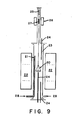
- Fig. 9 illustrates a thermobalance device.
- the thermobalance is a type of static bed reactor where starting carbon is contained in a 2" or 3" diameter nickel pan 20.
- the fluorine gas diluted with nitrogen is fed to the unit at 28 and is brought to the top of the reactor by a monel tube inside the reactor.
- the fluorine and nitrogen gas mixture flows in a direction perpendicular to the sample pan 20.
- the reactor temperature is maintained by a three-zone tube furnace 22 surrounding the 4" diameter monel reactor 23 with three internal sensing thermocouples 24.
- a gas outlet is shown at 29.
- thermobalance As the fluorination proceeds, the weight of sample as it accepts fluorine increases.
- a spring 25 and a displacement transducer 26 with core 27 is used to monitor the weight gain during fluorination. Reaction conditions determined in the thermobalance essentially can be translated directly to a large scale static bed reactor.
- the underfluorinated fluorinated carbon materials indicated in Table 1 are prepared in a horizontal tube reactor a known device which generally comprises a 1" monel pipe, and 1 1/2" tube furnace and a nickel boat (2 1/2" x 1/2").
- the sample is contained in the nickel boat which is placed in the center of the tube reactor.
- Temperature used to control the reactor is sensed by a thermocouple inserted underneath the nickel boat.
- the fluorine and nitrogen gas mixture flows in a direction parallel to the sample surface.
- Petroleum coke powder with a median particle size of 7 microns was used to prepare fluorinated carbons, the product derived, gave discharge curve shown by Fig. 2.
- Example 3 The procedure and conditions as in Example 1 were employed, except a 2" diameter sample pan was used to provide a bed depth of 0.65 cm.
- the discharge curve of the fluorinated carbon derived is shown in Fig. 3.
- Example 2 The procedure and conditions as in Example 2 were employed except a greater quantity, i.e., nine grams of carbon powder was used which gave a carbon bed depth of 1 cm. The discharge curve of this CF x is shown in Fig. 4.
- Pulverized crystalline carbon (available as Desulco from Superior Graphite Corporation) with a median particle size of 5 microns was used to produce CF x 's giving discharge curves (a) and (b) in Fig. 7.
- Five grams of starting carbon ws used in both cases in the thermobalance to give a bed depth of 0.5 cm.
- the reaction was run at 460°C with 15 vol. % F2 and a total flow rate of 150 cc/min. of the N2/F2 mixture.
- the CF x in Fig. 7(a) was obtained by terminating the reaction at approximately 100-110% weight gain.
- the reaction producing the material in Fig. 7(b) was completed when weight gain leveled off. The total weight gain was approximately 120-130%.
- the five underfluorinated fluorinated carbon materials listed in Table 1 were prepared in a horizontal tube reactor. In a typical run, one gram of the petroleum coke powder was used. A total flow rate of 50 cc/min. of fluorine and nitrogen (15 vol. % F2) was used at 350°C. Fluorinated carbon products with x-value from .14 to .46 were obtained by using different reaction time, ranging from 1 to 5 hours respectively.
Landscapes
- Chemical & Material Sciences (AREA)
- Inorganic Chemistry (AREA)
- Organic Chemistry (AREA)
- Chemical Kinetics & Catalysis (AREA)
- Electrochemistry (AREA)
- General Chemical & Material Sciences (AREA)
- Life Sciences & Earth Sciences (AREA)
- Environmental & Geological Engineering (AREA)
- General Life Sciences & Earth Sciences (AREA)
- Geology (AREA)
- Battery Electrode And Active Subsutance (AREA)
- Carbon And Carbon Compounds (AREA)
Abstract
Description
- The present invention relates to an improved fluorinated carbon (CFx) useful in the manufacture of batteries. More particularly, the invention relates to a novel essentially single step process for producing CFx which can be used in a lithium battery to eliminate low voltage at the beginning of discharge. The process in which a thick carbon bed is used to assure proper degree and type of inhomogeneity yields a product which is a fully-, or overfluorinated CFx admixed with a small amount of underfluorinated material to eliminate voltage suppression in the battery performance.
- Fluorinated carbon is known by the formula (CFx)n, where x is a number between 0 and 1.5 and n is an indefinite number greater than 2. Hereafter, (CFx)n is abbreviated as CFx. Fluorinated carbon is ordinarily obtained by fluorinating a crystalline or amorphous carbon with elemental fluorine gas at elevated temperature. One of the major applications of the fluorinated carbon is a cathode active material in a lithium, i.e., Li/CFx, battery. This Li/CFx battery shows many advantages over other types of lithium batteries.The advantages include high energy density, flat discharge curve and long shelf life, etc. However, there is a characteristic voltage delay at the initial discharge stage. This voltage delay adversely impacts its applications.
- Numerous disclosures have been made in the prior art with the aim of improving the initial discharge voltage of the lithium/fluorinated carbon batteries. Some of these prior art efforts to eliminate or reduce initial voltage suppression are summarized as follows:
- The following Japanese unexamined patent applications disclose the addition of a fluorinated carboneous materials to the CFx to reduce or eliminate the initial voltage delay.
- Japanese Kokai No. 83 05,967 discloses the addition of a fluorinated carbon black made from a starting carbon black having a specific surface area of 800 m²/g;
- Japanese Kokai No. 82 84,570 discloses the use of a mixture of 10 to 50 wt.% of polydicarbon monofluoride, (C₂F)n, and the CFx to eliminate the initial voltage delay;
- Japanese Kokai No. 84 31,564 discloses the use of carbon containing adsorbed fluorine in the CFx electrode to replace the carbons which are typically used to provide the electrical conductivity of the electrode matrix; and
- Japanese Kokai No. 82 206,057 discloses the incorporation of a AlF₃ or MgF₂ and F₂ intercalated graphite fluoride ternary compound into a CFx cathode to improve the initial discharge voltage.
- The following Japanese patent publications disclose the use of a variety of materials which do not contain fluorine and are indicated as having the capability to eliminate or reduce the severity of voltage suppression in Li/CFx cells;
- Japanese Kokai No. 83 123,663 discloses the addition of aluminum powder;
- Japanese Kokai No. 83 206,058 discloses the addition of aluminum fiber to CFx cathode compositions for the purporse of stabilizing the initial discharge voltage; and
- Japanese Kokai No. 83 161,260 disclosed the addition of compounds of the form CrxOy where 15< y/x < Examples given are Cr₃O₆ and Cr₂O₅. These additives are claimed to improve the initial drop in cell voltage.
- The following references disclose miscellaneous efforts to alter the discharge voltage such as by chemical pretreatment, electrochemical predischarge, etc.
- Japanese Kokai 84 87,762 discloses defluorination of over-fluorinated CFx by using aqueous HI solution in the presence of methanol can improve the initial discharge characteristics;
- Japanese Kokai 84 86,155 discloses the UV irradiation of CFx in the NaOH/MeOH solution to reduce the initial voltage delay;
- Japanese Kokai 77 10,519 discloses the use of a CFx with high free oxidizing power, which has a deleterious effect on the shelf life of the Li/CFx battery;
- Japanese Kokai 83 140,972 discloses the use of a fluorinated carbon obtained from fluorinating a mixture of graphite or petroleum coke with a cabon black having a surface area ≧ 800 m²/g;
- Japanese Kokai No. 80 31,991 discloses the use of a CFx obtained by subsequent refluorination of a pulverized CFx of large particle size (200 mesh) for the purposes of improving the initial discharge characteristics; and
- Japanese Kokai No. 82 124,865 discloses that Li/CFx batteries can be partially discharged to less than 10% of the battery capacity to improve the initial discharge voltage. This practice minimizes the voltage delay but suffers from several disadvantages; an additional step is required in the production process, processing time is increased, and additional equipment is required.
- Each of the foregoing approaches suffers from one or more disadvantages from the standpoint of, for example, economy, practicality and complexity. Therefore, a need exists for a process to prepare a fluorinated carbon with no initial voltage delay upon discharge in a Li/CFx battery and free of the aforementioned draw-backs of free oxidizing power.
- In accordance with the present invention, we have discovered a single step process to make a CFx without initial voltage delay which occurs in the discharge of Li/CFx battery. In the practice of the process of the invention, a thick carbon bed in a static bed reactor is used to assure that the proper degree and type of underfluorinated CFx is admixed with fully- or overfluorinated material. The fluorination time is controlled to give the right amount of inhomogeneity of the CFx product. These process conditions can apply to fluorination of either crystalline or amorphous carbon. The amorphous carbon, particularly petroleum coke, is the preferred starting material because it gives a fluorinated carbon with much lower free oxidizing power than that from a crystalline carbon. The free oxidizing power adversely affects the shelf life of Li/CFx battery.
- The fluorinated carbon produced from the single step process in accordance with the invention when incorporated in a battery will not require pre-discharging of the battery to eliminate the initial voltage suppression. In addition, the process obviates the multistep operations such as blending of different material(s) with CFx or carbon before fluorination, chemical pretreatment of CFx, prefluorination followed by pulverization, etc. which various prior art techniques entail.
-
- Fig. 1 shows a discharge curve of the commercially available CFx illustrating a relatively substantial suppression at the initial part of the discharge of Li/CFx battery.
- Figs. 2, 3 and 4 illustrate the effect of bed depth on the initial discharge characteristics of a coke-based CFx.
- Fig. 5 shows a discharge curve of mixture A of Table 1.
- Fig. 6 shows a discharge curve of mixture B of Table 1.
- Figs. 7(a) and (b). Fig. 7(a) is the discharge curve of a CFx made from a crystalline carbon in accordance with the process conditions of this invention. Fig. 7(b) is the discharge curve of a CFx made from the same starting carbon of 7(a) without controlling the reaction time.
- Fig. 8 shows the discharge curve of the same material of that in Fig. 7(a) after ethanol-wash.
- Fig. 9 is a schematic diagram of a fluorination reactor which may be used in preparing the fluorinated carbon in accordance with the invention.
- In accordance with the invention, fluorinated carbon having the property of obviating initial voltage delay can be prepared by a single step process by the use of a thick bed depth and control of the fluorination time; a static bed reactor is employed. Fluorination time is controlled so that a proper degree and type of inhomogeneity is obtained. Such inhomogeneity is observed as color distribution through the profile of CFx layer in the vertical direction after fluorination. The color of CFx reflects the degree of fluorination, with a white color indicating a fully fluorinated carbon (CFx) wherein the value of x in the formula CFx, is greater than 1.0. A gray color indicates a CFx with x approximately equal to 0.9. The color changes gradually from gray to black as the x value decreases. The CFx appears with a brownish tone when a crystalline carbon is used as starting material. In selecting the carbon powder for use in the process of the invention, the powder should have a micron size of less than 150 microns and preferably less than 30 microns.
- When petroleum coke powder is used as starting material, a minimum bed depth of 1 cm is required. For fluorination at 380°C, the reaction time is controlled to give a weight increase of 117% corresponding to approximately 54%F. The color of CFx on the surface of the CFx layer is uniformly white. This color persists through two thirds of the bed depth. The color in the bottom third of the bed changes gradually from white to gray and is almost black at the bottom. This product gives no initial voltage delay when used as a cathode active material in a Li/CFx battery.
- In general, the weight gain of the carbon resulting from the fluorination of the carbon, in accordance with the invention, is at least 10 percent and more appropriately at least about 50 percent. Preferably, the weight gain should be of the order of from about 100 to 140 percent.
- As illustrated by the drawing, Fig. 1 shows the discharge curve of a commercially available fluorinated carbon illustrating the typical initial discharge characteristics. It has a 130mV voltage suppression at an approximate discharge rate of 2.4mA/cm².
- The effect of the depth of the carbon layer is illustrated in Figs. 2, 3 and 4. Fig. 2 shows the discharge curve of fluorinated carbon with 54%F made from petroleum coke powder in a bed 0.5cm thick. An initial voltage suppression of about 120mV is observed. When the bed depth is increased to 0.65cm, the voltage delay is reduced substantially although not completely eliminated. The discharge curve shown in Fig. 3 becomes more sloping. When the bed depth is increased to 1 cm, the initial voltage suppression is completely eliminated. This is shown by the discharge curve of the fluorinated carbon shown in Fig. 4.
- The proper degree of inhomogeneity resulting from the increase of carbon bed depth is essential for producing a CFx with no initial voltage suppression upon discharge of a Li/CFx battery. In order to demonstrate the nature and effect of inhomogeneity, study of blending several CFx's with different x value was conducted. Underfluorinated CFx's with x-value ranging from 0.14 to 0.46 were used. Table 1 shows the different weight percent of the underfluorinated CFx's used in mixtures of A and B. The bulk material, CF1.0 (80% by weight) has initial discharge characteristics as shown in Fig. 1. However,in the discharge curve of mixture A shown in Fig. 5, the initial voltage suppression is almost completely eliminated. In mixture B, with CF.23 and CF.35 omitted, the initial voltage suppression as shown in Fig. 6 is substantially minimized but not eliminated. The results indicate that a mixture of different components of CFx's with different x-values is required to eliminate initial voltage suppression. This type of mixture or inhomogeneity is adequately supplied by the fluorinated carbon obtained by the process of the invention.
- In the case of crystalline carbon, the CFx with no initial voltage delay is easier to obtain than from petroleum coke. A relatively thin bed depth can provide the required inhomogeneity. Fig. 7(a) shows a discharge curve of a fluorinated carbon prepared by fluorinating a 0.5 cm thick bed of crystalline carbon at 460°C. Again, the reaction time is controlled to give a non-homogeneous CFx. The color distribution in the static bed reactor after fluorination is similar to that made from petroleum coke. Brownish white CFx appears across the bed uniformly. This brownish white color persists through half of the bed depth and then changes from brownish gray to black in the bottom half of the CFx layer. Fluorination of the same material under the same conditions with prolonged reaction time gives a CFx with a normal voltage delay at the initial stage. The discharge curve of this CFx is shown in Curve "b" of Fig. 7. A characteristic initial voltage suppression is observed.
- Because of the nature of crystalline carbon, the fluorinated carbon produced from this material at 460°C has high free oxidizing power. However, the free oxidizing power can be minimized by washing with 95% ethanol. Fig. 8 shows the discharge curve of the material giving the discharge curve "a" of Fig. 7 washed with 95% ethanol in a Soxhlet extractor for 5 days. The high front end voltage disappears without introducing a voltage suppression. The high front end voltage is mainly due to the adsorbed fluorine which caused the high free oxidizing power.
- The nature of the reaction apparatus of a kind which may be used to produce the fluorinated carbon in accordance with the process of the present invention will be described with reference to Fig. 9 of the drawing. Fig. 9 illustrates a thermobalance device. The thermobalance is a type of static bed reactor where starting carbon is contained in a 2" or 3"
diameter nickel pan 20. The fluorine gas diluted with nitrogen is fed to the unit at 28 and is brought to the top of the reactor by a monel tube inside the reactor. The fluorine and nitrogen gas mixture flows in a direction perpendicular to thesample pan 20. The reactor temperature is maintained by a three-zone tube furnace 22 surrounding the 4"diameter monel reactor 23 with threeinternal sensing thermocouples 24. A gas outlet is shown at 29. - As the fluorination proceeds, the weight of sample as it accepts fluorine increases. A
spring 25 and adisplacement transducer 26 withcore 27 is used to monitor the weight gain during fluorination. Reaction conditions determined in the thermobalance essentially can be translated directly to a large scale static bed reactor. - The underfluorinated fluorinated carbon materials indicated in Table 1 are prepared in a horizontal tube reactor a known device which generally comprises a 1" monel pipe, and 1 1/2" tube furnace and a nickel boat (2 1/2" x 1/2"). The sample is contained in the nickel boat which is placed in the center of the tube reactor. Temperature used to control the reactor is sensed by a thermocouple inserted underneath the nickel boat. The fluorine and nitrogen gas mixture flows in a direction parallel to the sample surface.
- The invention will be further described by the following specific examples. It should be understood, however, that although these examples may describe in detail certain preferred operating conditions of the invention they are given primarily for purposes of illustration and the invention in its broader aspects is not limited thereto.
- Petroleum coke powder with a median particle size of 7 microns was used to prepare fluorinated carbons, the product derived, gave discharge curve shown by Fig. 2.
- Five grams of carbon powder were evenly distributed on the nickel pan to give 0.5 cm bed depth in a 3" diameter nickel pan in the thermobalance. After the sample was loaded, the reactor temperature was increased to 200°C under a steady stream of nitrogen gas. Then, fluorine gas was introduced as the reactor temperature was gradually increased to 370-380°C. A total flow rate of 150 cc/min. of gas mixture was used with a 15 vol. % F₂. The weight gain of the sample was monitored throughout the reaction. The reaction was terminated at approximately 115 to 120% weight gain, corresponding to 53 to 55% of total combined fluorine in CFx.
- The procedure and conditions as in Example 1 were employed, except a 2" diameter sample pan was used to provide a bed depth of 0.65 cm. The discharge curve of the fluorinated carbon derived is shown in Fig. 3.
- The procedure and conditions as in Example 2 were employed except a greater quantity, i.e., nine grams of carbon powder was used which gave a carbon bed depth of 1 cm. The discharge curve of this CFx is shown in Fig. 4.
- Pulverized crystalline carbon (available as Desulco from Superior Graphite Corporation) with a median particle size of 5 microns was used to produce CFx's giving discharge curves (a) and (b) in Fig. 7. Five grams of starting carbon ws used in both cases in the thermobalance to give a bed depth of 0.5 cm. The reaction was run at 460°C with 15 vol. % F₂ and a total flow rate of 150 cc/min. of the N₂/F₂ mixture. The CFx in Fig. 7(a) was obtained by terminating the reaction at approximately 100-110% weight gain. The reaction producing the material in Fig. 7(b) was completed when weight gain leveled off. The total weight gain was approximately 120-130%.
- The five underfluorinated fluorinated carbon materials listed in Table 1 were prepared in a horizontal tube reactor. In a typical run, one gram of the petroleum coke powder was used. A total flow rate of 50 cc/min. of fluorine and nitrogen (15 vol. % F₂) was used at 350°C. Fluorinated carbon products with x-value from .14 to .46 were obtained by using different reaction time, ranging from 1 to 5 hours respectively.

- In a typical battery test, one gram of fluorinated carbon was used to mix with 12 wt. % of Shawinigan black obtainable commercially from Gulf Oil Chemical Co. and 3 wt.% of PTFE (polytetrafluoroethylene). Shawinigan Black is used as a conduting carbon, whereas PTFE is a binder. The homogenized mixture was pressed into a cathode pellet sealed into cell with excess amount of lithium foil as an anode and a polypropylene separator. An organic mixture of propylene carbonate and dimethoxy ethane (50/50) with 1M LiBF₄ was used as an electrolyte. The battery was discharged across a constant 1 Kohm load. The current density at 50% depth of discharge was approximately 2.4 mA/cm².
- It will be understood that variations may be made in the details disclosed for illustrative purposes herein and therefore the invention, except as expressed in the claims, is not to be limited to such details.
Claims (9)
Applications Claiming Priority (2)
| Application Number | Priority Date | Filing Date | Title |
|---|---|---|---|
| US864242 | 1986-05-19 | ||
| US06/864,242 US4681823A (en) | 1986-05-19 | 1986-05-19 | Lithium/fluorinated carbon battery with no voltage delay |
Publications (1)
| Publication Number | Publication Date |
|---|---|
| EP0247434A1 true EP0247434A1 (en) | 1987-12-02 |
Family
ID=25342819
Family Applications (1)
| Application Number | Title | Priority Date | Filing Date |
|---|---|---|---|
| EP87106909A Withdrawn EP0247434A1 (en) | 1986-05-19 | 1987-05-13 | Lithium/fluorinated carbon battery with no voltage delay at the beginning of the discharge |
Country Status (3)
| Country | Link |
|---|---|
| US (1) | US4681823A (en) |
| EP (1) | EP0247434A1 (en) |
| JP (1) | JPS62290060A (en) |
Cited By (1)
| Publication number | Priority date | Publication date | Assignee | Title |
|---|---|---|---|---|
| CN111204735A (en) * | 2020-01-16 | 2020-05-29 | 厦门稀土材料研究所 | A kind of preparation method of fluorocarbon material and application thereof |
Families Citing this family (20)
| Publication number | Priority date | Publication date | Assignee | Title |
|---|---|---|---|---|
| US6783888B2 (en) | 2000-05-18 | 2004-08-31 | Wilson Greatbatch Ltd. | Control of cell swelling by the proper choice of carbon monofluoride (CFx) cathode materials in high rate defibrillator cells |
| US6804557B1 (en) | 2001-10-11 | 2004-10-12 | Pacesetter, Inc. | Battery monitoring system for an implantable medical device |
| KR100462661B1 (en) * | 2002-07-02 | 2004-12-20 | 금호석유화학 주식회사 | Method for evaluating their capacities by calculating mathematically specific elements among resistance elements of equivalent circuit model fitted from impedance spectrum of secondary batteries |
| US20050227146A1 (en) * | 2003-12-12 | 2005-10-13 | Dania Ghantous | Medium rate and high rate batteries |
| US20060115738A1 (en) * | 2004-12-01 | 2006-06-01 | Sergiy Sazhin | Lithium-fluorinated carbon cells |
| US8377586B2 (en) * | 2005-10-05 | 2013-02-19 | California Institute Of Technology | Fluoride ion electrochemical cell |
| US8232007B2 (en) * | 2005-10-05 | 2012-07-31 | California Institute Of Technology | Electrochemistry of carbon subfluorides |
| US20100221603A1 (en) * | 2006-03-03 | 2010-09-02 | Rachid Yazami | Lithium ion fluoride battery |
| US20070218364A1 (en) * | 2005-10-05 | 2007-09-20 | Whitacre Jay F | Low temperature electrochemical cell |
| EP1999812A2 (en) * | 2006-02-21 | 2008-12-10 | California Institute of Technology | Electrochemistry of carbon subfluorides |
| US20070281213A1 (en) * | 2006-06-02 | 2007-12-06 | Gentcorp Ltd. | Carbon Monofluoride Cathode Materials Providing Simplified Elective Replacement Indication |
| WO2008113023A1 (en) * | 2007-03-14 | 2008-09-18 | California Institute Of Technology | High discharge rate batteries |
| EP2167228B1 (en) * | 2007-05-09 | 2015-07-08 | California Institute of Technology | Lithium fluoropolymer and fluoro-organic batteries |
| US8961833B2 (en) | 2010-11-24 | 2015-02-24 | The United States Of America As Represented By The Secretary Of The Army | Fluorinated carbon composite cathode for a high-energy lithium battery |
| US9755235B2 (en) | 2014-07-17 | 2017-09-05 | Ada Technologies, Inc. | Extreme long life, high energy density batteries and method of making and using the same |
| GB2532035B (en) | 2014-11-06 | 2018-01-10 | Schlumberger Holdings | Lithium carbon fluoride primary battery |
| WO2016209460A2 (en) | 2015-05-21 | 2016-12-29 | Ada Technologies, Inc. | High energy density hybrid pseudocapacitors and method of making and using the same |
| WO2017023797A1 (en) | 2015-07-31 | 2017-02-09 | Ada Technologies, Inc. | High energy and power electrochemical device and method of making and using same |
| US11024846B2 (en) | 2017-03-23 | 2021-06-01 | Ada Technologies, Inc. | High energy/power density, long cycle life, safe lithium-ion battery capable of long-term deep discharge/storage near zero volt and method of making and using the same |
| US10615408B1 (en) | 2018-02-23 | 2020-04-07 | Government Of The United States, As Represented By The Secretary Of The Air Force | Hybrid primary lithium battery |
Citations (4)
| Publication number | Priority date | Publication date | Assignee | Title |
|---|---|---|---|---|
| US3536532A (en) * | 1968-04-12 | 1970-10-27 | Matsushita Electric Industrial Co Ltd | Primary cell for electric batteries |
| GB2028570A (en) * | 1978-08-21 | 1980-03-05 | Applied Science Res Inst | Electrolytic cell |
| FR2510092A1 (en) * | 1981-07-22 | 1983-01-28 | Central Glass Co Ltd | PROCESS FOR PRODUCING GRAPHITE FLUORIDE |
| EP0128560A2 (en) * | 1983-06-09 | 1984-12-19 | Daikin Kogyo Co., Ltd. | Active materials for batteries |
Family Cites Families (7)
| Publication number | Priority date | Publication date | Assignee | Title |
|---|---|---|---|---|
| JPS4825566B1 (en) * | 1968-04-17 | 1973-07-30 | ||
| FR2127398A5 (en) * | 1971-03-05 | 1972-10-13 | Accumulateurs Fixes | |
| SU584369A1 (en) * | 1975-08-01 | 1977-12-15 | Предприятие П/Я В-2763 | Chemical source of current |
| US4105836A (en) * | 1977-06-08 | 1978-08-08 | The United States Of America As Represented By The Secretary Of The Army | High energy density lithium cell |
| JPS549730A (en) * | 1977-06-24 | 1979-01-24 | Matsushita Electric Industrial Co Ltd | Active material on positive electrode of battery |
| US4166888A (en) * | 1978-10-30 | 1979-09-04 | Exxon Research & Engineering Co. | Cell having an alkali metal anode, a fluorinated carbon cathode and an electrolyte which includes an alkali metal halide salt and a solvent system containing a substituted amide solvent and a cyclic carbonate cosolvent |
| US4548881A (en) * | 1985-02-08 | 1985-10-22 | Allied Corporation | High energy density battery with cathode composition |
-
1986
- 1986-05-19 US US06/864,242 patent/US4681823A/en not_active Expired - Fee Related
-
1987
- 1987-05-13 EP EP87106909A patent/EP0247434A1/en not_active Withdrawn
- 1987-05-19 JP JP62122386A patent/JPS62290060A/en active Pending
Patent Citations (4)
| Publication number | Priority date | Publication date | Assignee | Title |
|---|---|---|---|---|
| US3536532A (en) * | 1968-04-12 | 1970-10-27 | Matsushita Electric Industrial Co Ltd | Primary cell for electric batteries |
| GB2028570A (en) * | 1978-08-21 | 1980-03-05 | Applied Science Res Inst | Electrolytic cell |
| FR2510092A1 (en) * | 1981-07-22 | 1983-01-28 | Central Glass Co Ltd | PROCESS FOR PRODUCING GRAPHITE FLUORIDE |
| EP0128560A2 (en) * | 1983-06-09 | 1984-12-19 | Daikin Kogyo Co., Ltd. | Active materials for batteries |
Non-Patent Citations (3)
| Title |
|---|
| JOURNAL OF POWER SOURCES, vol. 5, 1980, pages 111-125, Elsevier Sequoia S.A., Lausanne, CH; MORITA AKIYOSHI et al.: "Evaluation of cathode materials for the lithium/carbonmonofluoride battery" * |
| PATENT ABSTRACTS OF JAPAN, vol. 7, no. 103 (E-173)[1248], 6th May 1983; & JP-A-58 26 457 (MATSUSHITA DENKI SANGYO K.K.) 16-02-1983 * |
| PATENT ABSTRACTS OF JAPAN, vol. 8, no. 200 (E-266)[1637], 13th September 1984; & JP-A-59 87 763 (DAIKIN KOGYO K.K.) 21-05-1984 * |
Cited By (2)
| Publication number | Priority date | Publication date | Assignee | Title |
|---|---|---|---|---|
| CN111204735A (en) * | 2020-01-16 | 2020-05-29 | 厦门稀土材料研究所 | A kind of preparation method of fluorocarbon material and application thereof |
| CN111204735B (en) * | 2020-01-16 | 2021-07-27 | 厦门稀土材料研究所 | A kind of preparation method of fluorocarbon material and application thereof |
Also Published As
| Publication number | Publication date |
|---|---|
| US4681823A (en) | 1987-07-21 |
| JPS62290060A (en) | 1987-12-16 |
Similar Documents
| Publication | Publication Date | Title |
|---|---|---|
| US4681823A (en) | Lithium/fluorinated carbon battery with no voltage delay | |
| US4753786A (en) | Method for producing graphite fluoride | |
| US4247608A (en) | Electrolytic cell of high voltage | |
| Nakajima | Fluorine compounds as energy conversion materials | |
| Peled et al. | Improved graphite anode for lithium‐ion batteries chemically: bonded solid electrolyte interface and nanochannel formation | |
| KR100228145B1 (en) | A spinel-type lithium manganese complex oxide for a cathode active material of a lithium secondary battery | |
| US4197366A (en) | Non-aqueous electrolyte cells | |
| US20050107553A1 (en) | Binder for electrodes | |
| US4770959A (en) | Lithium-fluorinated graphite cell | |
| HUP9903748A2 (en) | Improved electrochemical cells containing vinylidene fluoride polymers | |
| JPH0251220B2 (en) | ||
| US5827331A (en) | Electrode compositions | |
| US4737423A (en) | Cathode active material for metal of CFX battery | |
| Hamwi et al. | Graphite fluorides prepared at room temperature 2. A very good electrochemical behaviour as cathode material in lithium non-aqueous electrolyte cell | |
| US3892590A (en) | Cathode material for use in non-aqueous electrolytes | |
| US4684591A (en) | Active materials for batteries | |
| EP1667259A1 (en) | Nonaqueous electrolyte secondary cell, carbon material for use therein and precursor of said carbon material | |
| US4548881A (en) | High energy density battery with cathode composition | |
| US4765968A (en) | Fluorinated carbon composition for use in fabricating a Li/CFx battery cathode | |
| US5871864A (en) | Lithium secondary cells and methods for preparing active materials for negative electrodes | |
| JP2002270170A (en) | Carbonaceous negative electrode material for lithium secondary battery and producing method thereof | |
| JPS6313268A (en) | battery active material | |
| JP3259930B2 (en) | Lithium secondary battery | |
| SU564668A1 (en) | Positive electrode of chemical current source | |
| Bonino et al. | The cycling life of complete Li/Tio, and Li/TiS, cells |
Legal Events
| Date | Code | Title | Description |
|---|---|---|---|
| PUAI | Public reference made under article 153(3) epc to a published international application that has entered the european phase |
Free format text: ORIGINAL CODE: 0009012 |
|
| AK | Designated contracting states |
Kind code of ref document: A1 Designated state(s): DE FR GB |
|
| 17P | Request for examination filed |
Effective date: 19880227 |
|
| STAA | Information on the status of an ep patent application or granted ep patent |
Free format text: STATUS: THE APPLICATION HAS BEEN WITHDRAWN |
|
| 18W | Application withdrawn |
Withdrawal date: 19881029 |
|
| RIN1 | Information on inventor provided before grant (corrected) |
Inventor name: MCCURRY, LYNN EDWARDALLIED CORPORATION Inventor name: TUNG, HSEUH SUNGALLIED CORPORATION Inventor name: SUKORNICK, BERNARDALLIED CORPORATION Inventor name: FRIEDLAND, DAVID JOELALLIED CORPORATION Inventor name: EIBECK, RICHARD ELMERALLIED CORPORATION Inventor name: LOCKYER, GEORGE DONALDALLIED CORPORATION |