EP0246215A2 - Verfahren zur Bestimmung des Einsetzens der Geburt - Google Patents
Verfahren zur Bestimmung des Einsetzens der Geburt Download PDFInfo
- Publication number
- EP0246215A2 EP0246215A2 EP87850155A EP87850155A EP0246215A2 EP 0246215 A2 EP0246215 A2 EP 0246215A2 EP 87850155 A EP87850155 A EP 87850155A EP 87850155 A EP87850155 A EP 87850155A EP 0246215 A2 EP0246215 A2 EP 0246215A2
- Authority
- EP
- European Patent Office
- Prior art keywords
- mbp
- level
- labor
- weeks
- gestational
- Prior art date
- Legal status (The legal status is an assumption and is not a legal conclusion. Google has not performed a legal analysis and makes no representation as to the accuracy of the status listed.)
- Withdrawn
Links
Images

Classifications
-
- G—PHYSICS
- G01—MEASURING; TESTING
- G01N—INVESTIGATING OR ANALYSING MATERIALS BY DETERMINING THEIR CHEMICAL OR PHYSICAL PROPERTIES
- G01N33/00—Investigating or analysing materials by specific methods not covered by groups G01N1/00 - G01N31/00
- G01N33/48—Biological material, e.g. blood, urine; Haemocytometers
- G01N33/50—Chemical analysis of biological material, e.g. blood, urine; Testing involving biospecific ligand binding methods; Immunological testing
- G01N33/68—Chemical analysis of biological material, e.g. blood, urine; Testing involving biospecific ligand binding methods; Immunological testing involving proteins, peptides or amino acids
- G01N33/689—Chemical analysis of biological material, e.g. blood, urine; Testing involving biospecific ligand binding methods; Immunological testing involving proteins, peptides or amino acids related to pregnancy or the gonads
-
- G—PHYSICS
- G01—MEASURING; TESTING
- G01N—INVESTIGATING OR ANALYSING MATERIALS BY DETERMINING THEIR CHEMICAL OR PHYSICAL PROPERTIES
- G01N2800/00—Detection or diagnosis of diseases
- G01N2800/36—Gynecology or obstetrics
- G01N2800/368—Pregnancy complicated by disease or abnormalities of pregnancy, e.g. preeclampsia, preterm labour
-
- Y—GENERAL TAGGING OF NEW TECHNOLOGICAL DEVELOPMENTS; GENERAL TAGGING OF CROSS-SECTIONAL TECHNOLOGIES SPANNING OVER SEVERAL SECTIONS OF THE IPC; TECHNICAL SUBJECTS COVERED BY FORMER USPC CROSS-REFERENCE ART COLLECTIONS [XRACs] AND DIGESTS
- Y10—TECHNICAL SUBJECTS COVERED BY FORMER USPC
- Y10S—TECHNICAL SUBJECTS COVERED BY FORMER USPC CROSS-REFERENCE ART COLLECTIONS [XRACs] AND DIGESTS
- Y10S436/00—Chemistry: analytical and immunological testing
- Y10S436/906—Fertility tests
Definitions
- Preterm labor occurs in little more than 5% of pregnancies but causes 85% of early neonatal deaths .not associated with lethal fetal abnormality.
- One approach to the prediction of preterm labors has been to measure the contractions of the uterus in combination with the regular assessment of cervical dilatation and effacement. However, the validity of these procedures is in dispute. Vaginal examination in pregnancy has been shown to raise prostaglandin levels in the maternal circulation within minutes of this procedure. Since prostaglandins are known to be implicated in uterine contractility, repeated'vaginal examinations might provoke preterm labor rather than helping to prevent it.
- Methods for the prediction of the imminence of term labor would also serve to relieve anxietv and would lead to improved medical care planning, particularly in the case of women who elect to travel in the third trimester.
- the present invention is directed to a method for determining whether or not labor is imminent which is based upon the measurement of the relative levels of eosinophil major basic protein (MBP) in the physiological fluids of'a pregnant woman. More specifically, the present invention provides a method for determining the imminence of labor in a pregnant woman comprising:
- the present method is based upon our discovery that the MBP levels present in the physiological fluids such as serum, plasma, saliva, urine and the like of a pregnant woman, become stabilized at an elevated level after about week 20 of gestation. This stabilized level which is attained after about 20 weeks of gestation will be hereinafter referred to as the " plateau gestational level" of MBP in the pertinent physiological fluid.
- the MBP level undergoes an additional rapid rise over the plateau MBP level at the onset of the biological events which lead to labor.
- the MBP levels peak near the time cf parturition, and then fall to normal. Therefore, the present invention is particularly useful to detect a point of time within the gestational period which is within 1-2 weeks of the onset of term labor.
- the present invention is also useful to detect the imminence of preterm labor, e.g., labor occurring before 37 weeks. See WHO, Acta Obstet. Gynecol. Scand., 59, 247 (1977).
- the plateau gestational level of MBP in a population of pregnant women can vary widely, e.g., between about 1500-8000 ng/ml of serum or plasma.
- the absolute level of MBP can vary from the average gestational value determined for a given woman. For example, a rise in the MBP level to about 10% above the average gestational level generally is not indicative of the onset of labor. Therefore, the percent rise in the MBP level which is diagnostic for the immminence of labor is dependent on both the accuracy of the determination of the average plateau gestation MBP lsysl and its stsbility.
- the plateau gestational MBP level is derived from a determination of the MBP levels in a series of fluid samples.
- the samples are preferably obtained and assayed during about 20-33 weeks of gestation, e.g., at weekly or bimonthly intervals.
- a rise of at least 'about 25-30% in the average MBP level can be considered diagnostic for the onset of labor.
- Figure 1 summarizes the plasma MBP concentration changes determined during pregnancy for one woman.
- MBP levels were clearly above baseline by 4 weeks postconception and showed a steady increase through approximately 20 weeks gestation. From 20 to 33 weeks, the MBP level remained substantially constant. This was followed by a "late rise" in MBP with the largest increase occurring during the last week before parturition. The late-term increase in MBP accounted for 54% of the total increase. The MBP levels then fell rapidly after parturition, which occurred in week 38.
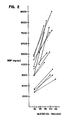
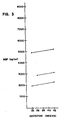
- FIGS. 2 and 3 summarize the plasma MBP level data for the seventeen women studied.
- the spontaneous labor group (Figure 2), the late rise in the plateau MBP levels constituted 42 ⁇ 6.6% of the peak MBP levels seen at term which averaged 5720 ⁇ 2257 ng MBP/ml.
- the oxytocin-induced women ( Figure 3), MBP concentrations changed less than 10% (which is within the variability of the assay) and peak MBP levels at term averaged 3529 ⁇ 1533 ng/ml. Both groups displayed a wide variation in maximal MBP levels. Therefore, it is clear that a relative change in MBP level rather than a given absolute level is associated with the onset of labor.
- the present invention has been exemplified with respect to the measurement of the relative MBP levels in plasma.
- immunoreactive MBP in the urine of pregnant women which can be readily detected by RIA without reduction and alkylation, it is believed that other physiological fluids can be employed in the present method.
Landscapes
- Life Sciences & Earth Sciences (AREA)
- Health & Medical Sciences (AREA)
- Engineering & Computer Science (AREA)
- Hematology (AREA)
- Chemical & Material Sciences (AREA)
- Urology & Nephrology (AREA)
- Molecular Biology (AREA)
- Biomedical Technology (AREA)
- Immunology (AREA)
- Microbiology (AREA)
- Food Science & Technology (AREA)
- Biotechnology (AREA)
- Proteomics, Peptides & Aminoacids (AREA)
- Reproductive Health (AREA)
- Pregnancy & Childbirth (AREA)
- Gynecology & Obstetrics (AREA)
- Cell Biology (AREA)
- Medicinal Chemistry (AREA)
- Physics & Mathematics (AREA)
- Analytical Chemistry (AREA)
- Biochemistry (AREA)
- General Health & Medical Sciences (AREA)
- General Physics & Mathematics (AREA)
- Pathology (AREA)
- Investigating Or Analysing Biological Materials (AREA)
Applications Claiming Priority (2)
| Application Number | Priority Date | Filing Date | Title |
|---|---|---|---|
| US06/862,451 US4710475A (en) | 1986-05-12 | 1986-05-12 | Method for the determination of the imminence of labor |
| US862451 | 1986-05-12 |
Publications (2)
| Publication Number | Publication Date |
|---|---|
| EP0246215A2 true EP0246215A2 (de) | 1987-11-19 |
| EP0246215A3 EP0246215A3 (de) | 1989-04-19 |
Family
ID=25338514
Family Applications (1)
| Application Number | Title | Priority Date | Filing Date |
|---|---|---|---|
| EP87850155A Withdrawn EP0246215A3 (de) | 1986-05-12 | 1987-05-12 | Verfahren zur Bestimmung des Einsetzens der Geburt |
Country Status (4)
| Country | Link |
|---|---|
| US (1) | US4710475A (de) |
| EP (1) | EP0246215A3 (de) |
| JP (1) | JPS63106557A (de) |
| AU (1) | AU7272387A (de) |
Families Citing this family (3)
| Publication number | Priority date | Publication date | Assignee | Title |
|---|---|---|---|---|
| JPH077186B2 (ja) * | 1987-10-15 | 1995-01-30 | 富士写真フイルム株式会社 | ハロゲン化銀写真感光材料 |
| GB0405133D0 (en) * | 2004-03-08 | 2004-04-07 | Univ Leicester | Detection of preterm labour |
| EP3800470A1 (de) * | 2013-03-15 | 2021-04-07 | Sera Prognostics, Inc. | Biomarker und verfahren zur vorhersage einer frühgeburt |
Family Cites Families (1)
| Publication number | Priority date | Publication date | Assignee | Title |
|---|---|---|---|---|
| US4755460A (en) * | 1984-07-06 | 1988-07-05 | The Regents Of The Univ. Of Minnesota | Bovine antigen glycoprotein, related antibody, and use in detection of pregnancy in cattle |
-
1986
- 1986-05-12 US US06/862,451 patent/US4710475A/en not_active Expired - Fee Related
-
1987
- 1987-05-12 EP EP87850155A patent/EP0246215A3/de not_active Withdrawn
- 1987-05-12 JP JP62115683A patent/JPS63106557A/ja active Pending
- 1987-05-12 AU AU72723/87A patent/AU7272387A/en not_active Abandoned
Also Published As
| Publication number | Publication date |
|---|---|
| JPS63106557A (ja) | 1988-05-11 |
| EP0246215A3 (de) | 1989-04-19 |
| AU7272387A (en) | 1987-11-19 |
| US4710475A (en) | 1987-12-01 |
Similar Documents
| Publication | Publication Date | Title |
|---|---|---|
| CAMERON et al. | Occult ovarian failure: a syndrome of infertility, regular menses, and elevated follicle-stimulating hormone concentrations | |
| Kligman et al. | Differentiating clinical profiles: predicting good responders, poor responders, and hyperresponders | |
| Peleg et al. | The relationship between maternal serum thyroid-stimulating immunoglobulin and fetal and neonatal thyrotoxicosis | |
| Berkowitz et al. | Corticotropin-releasing factor and its binding protein: maternal serum levels in term and preterm deliveries | |
| Gordon et al. | Concentrations of pregnancy-specific β1-glycoprotein in maternal blood in normal pregnancy and in intrauterine growth retardation | |
| Geva et al. | Autoimmune disorders: another possible cause for in-vitro fertilization and embryo transfer failure | |
| Tulchinsky et al. | The plasma estradiol as an index of fetoplacental function | |
| Daya | Human chorionic gonadotropin increase in normal early pregnancy | |
| Ahmed Ebbiary et al. | The significance of elevated basal follicle stimulating hormone in regularly menstruating infertile women | |
| La Marca et al. | Human chorionic gonadotropin, thyroid function, and immunological indices in threatened abortion | |
| Csemiczky et al. | Predictive power of clomiphene citrate challenge test for failure of in vitro fertilization treatment | |
| Yu et al. | Prognostic value of repeated serum kisspeptin measurements in early first trimester pregnancy: a preliminary study | |
| Walker et al. | Occult biochemical pregnancy: fact or fiction? | |
| Coleman et al. | Corticotropin-releasing hormone, corticotropin-releasing hormone–binding protein, and activin A in maternal serum: Prediction of preterm delivery and response to glucocorticoids in women with symptoms of preterm labor | |
| Ahmed et al. | Diagnosis of early pregnancy by assay of placental proteins | |
| Lindblom et al. | Serial human chorionic gonadotropin determinations by fluoroimmunoassay for differentiation between intrauterine and ectopic gestation | |
| Warren et al. | Corticotropin-releasing hormone and pituitary-adrenal hormones in pregnancies complicated by chronic hypertension | |
| Ruge et al. | Can pregnancy-associated plasma protein A (PAPP-A) predict the outcome of pregnancy in women with threatened abortion and confirmed fetal viability? | |
| US4710475A (en) | Method for the determination of the imminence of labor | |
| Taylor et al. | The lupus anticoagulant, anticardiolipin antibodies, and recurrent miscarriage | |
| Hedriana et al. | Changes in rates of salivary estriol increases before parturition at term | |
| de Lima Ferreira Fernandes Costa et al. | Prevalence of anti-cardiolipin antibody in habitual aborters | |
| Hay et al. | Monitoring early production of chorionic gonadotrophin (HCG) following in vitro fertilization and embryo transfer | |
| Seppälä et al. | The use of hCG and other pregnancy proteins in the diagnosis of ectopic pregnancy | |
| Bersinger et al. | Implantation: Endometrial and placental protein markers and ovarian steroids in serum during in-vitro fertilization cycles |
Legal Events
| Date | Code | Title | Description |
|---|---|---|---|
| PUAI | Public reference made under article 153(3) epc to a published international application that has entered the european phase |
Free format text: ORIGINAL CODE: 0009012 |
|
| AK | Designated contracting states |
Kind code of ref document: A2 Designated state(s): AT BE CH DE ES FR GB GR IT LI LU NL SE |
|
| PUAL | Search report despatched |
Free format text: ORIGINAL CODE: 0009013 |
|
| AK | Designated contracting states |
Kind code of ref document: A3 Designated state(s): AT BE CH DE ES FR GB GR IT LI LU NL SE |
|
| STAA | Information on the status of an ep patent application or granted ep patent |
Free format text: STATUS: THE APPLICATION IS DEEMED TO BE WITHDRAWN |
|
| 18D | Application deemed to be withdrawn |
Effective date: 19891201 |
|
| RIN1 | Information on inventor provided before grant (corrected) |
Inventor name: GLEICH, GERALD J. Inventor name: WASMOEN, TERRI LEE Inventor name: COULAM, CAROLYN B. |