EP0243940A2 - Phenyl- and cyclohexyl-isobutylpyrrolidine - Google Patents
Phenyl- and cyclohexyl-isobutylpyrrolidine Download PDFInfo
- Publication number
- EP0243940A2 EP0243940A2 EP87106164A EP87106164A EP0243940A2 EP 0243940 A2 EP0243940 A2 EP 0243940A2 EP 87106164 A EP87106164 A EP 87106164A EP 87106164 A EP87106164 A EP 87106164A EP 0243940 A2 EP0243940 A2 EP 0243940A2
- Authority
- EP
- European Patent Office
- Prior art keywords
- tert
- phenyl
- formula
- compound
- alkyl
- Prior art date
- Legal status (The legal status is an assumption and is not a legal conclusion. Google has not performed a legal analysis and makes no representation as to the accuracy of the status listed.)
- Granted
Links
- 0 CCC(C)CN1CC(*)C(*)C1 Chemical compound CCC(C)CN1CC(*)C(*)C1 0.000 description 2
Classifications
-
- C—CHEMISTRY; METALLURGY
- C07—ORGANIC CHEMISTRY
- C07D—HETEROCYCLIC COMPOUNDS
- C07D207/00—Heterocyclic compounds containing five-membered rings not condensed with other rings, with one nitrogen atom as the only ring hetero atom
- C07D207/02—Heterocyclic compounds containing five-membered rings not condensed with other rings, with one nitrogen atom as the only ring hetero atom with only hydrogen or carbon atoms directly attached to the ring nitrogen atom
- C07D207/04—Heterocyclic compounds containing five-membered rings not condensed with other rings, with one nitrogen atom as the only ring hetero atom with only hydrogen or carbon atoms directly attached to the ring nitrogen atom having no double bonds between ring members or between ring members and non-ring members
- C07D207/08—Heterocyclic compounds containing five-membered rings not condensed with other rings, with one nitrogen atom as the only ring hetero atom with only hydrogen or carbon atoms directly attached to the ring nitrogen atom having no double bonds between ring members or between ring members and non-ring members with hydrocarbon radicals, substituted by hetero atoms, attached to ring carbon atoms
-
- A—HUMAN NECESSITIES
- A01—AGRICULTURE; FORESTRY; ANIMAL HUSBANDRY; HUNTING; TRAPPING; FISHING
- A01N—PRESERVATION OF BODIES OF HUMANS OR ANIMALS OR PLANTS OR PARTS THEREOF; BIOCIDES, e.g. AS DISINFECTANTS, AS PESTICIDES OR AS HERBICIDES; PEST REPELLANTS OR ATTRACTANTS; PLANT GROWTH REGULATORS
- A01N43/00—Biocides, pest repellants or attractants, or plant growth regulators containing heterocyclic compounds
- A01N43/34—Biocides, pest repellants or attractants, or plant growth regulators containing heterocyclic compounds having rings with one nitrogen atom as the only ring hetero atom
- A01N43/36—Biocides, pest repellants or attractants, or plant growth regulators containing heterocyclic compounds having rings with one nitrogen atom as the only ring hetero atom five-membered rings
-
- A—HUMAN NECESSITIES
- A01—AGRICULTURE; FORESTRY; ANIMAL HUSBANDRY; HUNTING; TRAPPING; FISHING
- A01N—PRESERVATION OF BODIES OF HUMANS OR ANIMALS OR PLANTS OR PARTS THEREOF; BIOCIDES, e.g. AS DISINFECTANTS, AS PESTICIDES OR AS HERBICIDES; PEST REPELLANTS OR ATTRACTANTS; PLANT GROWTH REGULATORS
- A01N43/00—Biocides, pest repellants or attractants, or plant growth regulators containing heterocyclic compounds
- A01N43/34—Biocides, pest repellants or attractants, or plant growth regulators containing heterocyclic compounds having rings with one nitrogen atom as the only ring hetero atom
- A01N43/36—Biocides, pest repellants or attractants, or plant growth regulators containing heterocyclic compounds having rings with one nitrogen atom as the only ring hetero atom five-membered rings
- A01N43/38—Biocides, pest repellants or attractants, or plant growth regulators containing heterocyclic compounds having rings with one nitrogen atom as the only ring hetero atom five-membered rings condensed with carbocyclic rings
-
- C—CHEMISTRY; METALLURGY
- C07—ORGANIC CHEMISTRY
- C07D—HETEROCYCLIC COMPOUNDS
- C07D207/00—Heterocyclic compounds containing five-membered rings not condensed with other rings, with one nitrogen atom as the only ring hetero atom
- C07D207/02—Heterocyclic compounds containing five-membered rings not condensed with other rings, with one nitrogen atom as the only ring hetero atom with only hydrogen or carbon atoms directly attached to the ring nitrogen atom
- C07D207/04—Heterocyclic compounds containing five-membered rings not condensed with other rings, with one nitrogen atom as the only ring hetero atom with only hydrogen or carbon atoms directly attached to the ring nitrogen atom having no double bonds between ring members or between ring members and non-ring members
- C07D207/06—Heterocyclic compounds containing five-membered rings not condensed with other rings, with one nitrogen atom as the only ring hetero atom with only hydrogen or carbon atoms directly attached to the ring nitrogen atom having no double bonds between ring members or between ring members and non-ring members with radicals, containing only hydrogen and carbon atoms, attached to ring carbon atoms
-
- C—CHEMISTRY; METALLURGY
- C07—ORGANIC CHEMISTRY
- C07D—HETEROCYCLIC COMPOUNDS
- C07D209/00—Heterocyclic compounds containing five-membered rings, condensed with other rings, with one nitrogen atom as the only ring hetero atom
- C07D209/02—Heterocyclic compounds containing five-membered rings, condensed with other rings, with one nitrogen atom as the only ring hetero atom condensed with one carbocyclic ring
- C07D209/44—Iso-indoles; Hydrogenated iso-indoles
- C07D209/48—Iso-indoles; Hydrogenated iso-indoles with oxygen atoms in positions 1 and 3, e.g. phthalimide
-
- C—CHEMISTRY; METALLURGY
- C07—ORGANIC CHEMISTRY
- C07D—HETEROCYCLIC COMPOUNDS
- C07D209/00—Heterocyclic compounds containing five-membered rings, condensed with other rings, with one nitrogen atom as the only ring hetero atom
- C07D209/02—Heterocyclic compounds containing five-membered rings, condensed with other rings, with one nitrogen atom as the only ring hetero atom condensed with one carbocyclic ring
- C07D209/52—Heterocyclic compounds containing five-membered rings, condensed with other rings, with one nitrogen atom as the only ring hetero atom condensed with one carbocyclic ring condensed with a ring other than six-membered
-
- C—CHEMISTRY; METALLURGY
- C07—ORGANIC CHEMISTRY
- C07D—HETEROCYCLIC COMPOUNDS
- C07D295/00—Heterocyclic compounds containing polymethylene-imine rings with at least five ring members, 3-azabicyclo [3.2.2] nonane, piperazine, morpholine or thiomorpholine rings, having only hydrogen atoms directly attached to the ring carbon atoms
- C07D295/02—Heterocyclic compounds containing polymethylene-imine rings with at least five ring members, 3-azabicyclo [3.2.2] nonane, piperazine, morpholine or thiomorpholine rings, having only hydrogen atoms directly attached to the ring carbon atoms containing only hydrogen and carbon atoms in addition to the ring hetero elements
- C07D295/027—Heterocyclic compounds containing polymethylene-imine rings with at least five ring members, 3-azabicyclo [3.2.2] nonane, piperazine, morpholine or thiomorpholine rings, having only hydrogen atoms directly attached to the ring carbon atoms containing only hydrogen and carbon atoms in addition to the ring hetero elements containing only one hetero ring
- C07D295/03—Heterocyclic compounds containing polymethylene-imine rings with at least five ring members, 3-azabicyclo [3.2.2] nonane, piperazine, morpholine or thiomorpholine rings, having only hydrogen atoms directly attached to the ring carbon atoms containing only hydrogen and carbon atoms in addition to the ring hetero elements containing only one hetero ring with the ring nitrogen atoms directly attached to acyclic carbon atoms
Definitions
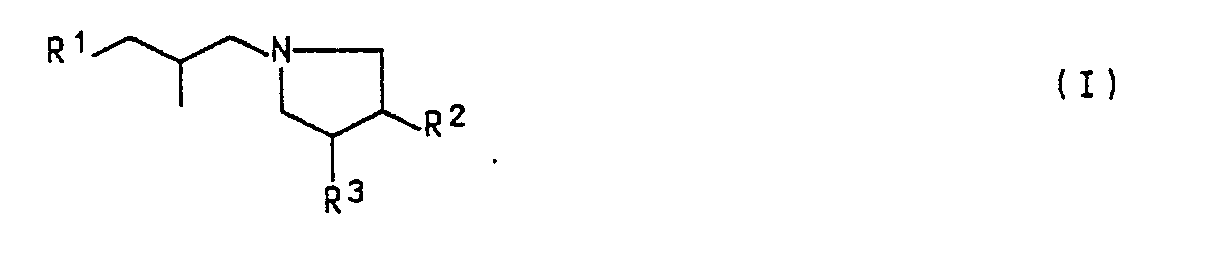
- the present invention relates to novel phenyl- and cyclohexyl-isobutylpyrrolidines of the general formula I. in which the substituents have the following meaning: R1 4-tert-butylphenyl or 4-tert-butylcyclohexyl, R2 C5-C20-alkyl, C2-C20-alkenyl, C1 - C20-alkoxy, C2-C20-alkenyloxy, C1-C20-hydroxyalkyl, C2-C20-alkoxyalkyl, C3-C20-alkenyloxyalkyl, C2-C20-acyloxyalkyl, C3-C20-alkylcarbonylalkyl, benzyl, benzyloxy, C8-C20-benzyloxyalkyl or substituted phenyl, benzyl, benzyloxy, C8-C20-benzyloxyalkyl with up to three times substituted by halogen, C1
- the invention also relates to the preparation of the compounds I, their use as fungicides and fungicides which comprise the compounds I.
- the invention had for its object to provide new compounds of this type with improved properties as fungicides.
- the resulting pyrrolaldehyde derivative XI can be reduced in an inert solvent with hydrogen in the presence of a noble metal catalyst.
- Tetrahydrofuran and dioxane are suitable as inert solvents.
- PtO2, Ru2O3 and palladium on carbon are preferred as noble metal catalysts.
- the alcohols formed can be etherified or esterified with a compound R4-X in which X is a leaving group such as chlorine, bromine, iodine, the methane, benzene or toluenesulfone group by customary methods, so that an explicit description of these methods is unnecessary.
- X is a leaving group such as chlorine, bromine, iodine, the methane, benzene or toluenesulfone group by customary methods, so that an explicit description of these methods is unnecessary.
- tert-butylphenyl compounds For the synthesis of the compounds I one can start from tert-butylphenyl compounds.
- the hydrogenation of the aromatic to produce the tert-butylcyclohexyl compounds can be at the beginning of the reaction sequence or at any stage, but especially as a last reaction.
- the hydrogenation can be carried out using hydrogen and catalytic amounts of a suitable noble metal catalyst, if appropriate under pressure and at higher temperatures. PtO2 and Ru2O3 are preferred as catalysts.
- Tetrahydrofuran and dioxane are suitable as solvents.
- the pressure range is preferably 100 to 400 bar, the range between 250 and 350 bar is particularly suitable.
- the preferred temperature range is 100 to 150 ° C.
- the radical R2 stands for the following substituents: - C5-C20-alkyl, preferably for C5-C12-alkyl and particularly preferably for C5-C8-alkyl, such as n-pentyl, iso-pentyl, neo-pentyl, n-hexyl, iso-hexyl and n-octyl.
- R1 is 4-tert-butylphenyl, particularly preferably methyl, - in the event that R1 is 4-tert-butylcyclohexyl, C1-C4-alkyl, such as methyl, ethyl, n-propyl, iso-propyl, n-butyl, iso-butyl and tert-butyl, - in the event that R1 is 4-tert-butylcyclohexyl, hydroxy, - in the event that R1 is 4-tert-butylcyclohexyl, hydroxy, in the event that R1 is tert-butylcyclohexyl, phenyl, - C2-C20-alkenyl, preferably for C2-C8-alkenyl, such as 3-methyl-but-1-en-1-yl and hex-1-en-1-yl and particularly preferably for C2-C4-akenyl, such as Vinyl, allyl and
- R3 can also mean one of the substituents R2.
- R2 and R3 can be linked to form a carbocyclic ring, for example in the following bicyclic pyrrolidines:
- Plant-compatible salts of the amines of the formula I can be formed, for example, with: HCl, HBr, HJ, H2SO4, H3PO4, HCO2H, CH3CO2H, CH3CH2CO2H, C12H25-C6H5-SO3H.
- HCl is particularly preferred.
- the new pyrrolidine derivatives of formula I contain at least one, but mostly several chiral centers. They are generally obtained as mixtures of stereoisomers. Both the diastereomerically pure or enantiomerically pure compounds I and the stereoisomer mixtures obtained in the synthesis are suitable for the use of the compounds I as fungicides.
- the phenyl- and cyclohexyl-isobutylpyrrolidine derivatives I and their physiologically compatible salts can be converted into the customary formulations, such as solutions, emulsions, suspensions, dusts, powders, pastes and granules.
- the application forms depend entirely on the purposes; in any case, they should ensure a fine and uniform distribution of the active substance.
- the formulations are prepared in a known manner, for example by stretching the active ingredient with solvents and / or carriers, optionally using emulsifiers and dispersants, in which If water is used as a diluent, other organic solvents can also be used as auxiliary solvents.
- auxiliaries solvents such as aromatics (e.g.
- Carriers such as natural stone powder (e.g. kaolins, clays, talc, chalk) and synthetic stone powder (e.g. highly disperse silica, silicates), emulsifiers such as nonionic and anionic emulsifiers (e.g. polyoxyethylene fatty alcohol ethers, alkyl sulfonates and aryl sulfonates) and dispersants, such as L Sulphite blues and methyl cellulose.
- natural stone powder e.g. kaolins, clays, talc, chalk
- synthetic stone powder e.g. highly
- the compounds I and their salts are used by spraying or dusting the plants with the active compounds or by treating the seeds of the plants with the active compounds. It is used before or after the plants or seeds are infected by the fungi.
- the phenyl and cyclohexyl isobutylpyrrolidine derivatives of the formula I and their salts can be combined with the following fungicides: Sulfur, Dithiocarbamates and their derivatives, such as Ferridimethyl, zinc dimethyl, zinc ethylene bis, manganese ethylene bis, manganese zinc ethylene diamine bis or zinc (N, N ⁇ -propylene bis-dithiocarbamate), Ammonia complexes of zinc (N, N ⁇ -ethylene-bis-dithiocarbamate) and of zinc (N, N ⁇ -propylene-bis-dithiocarbamate), Tetramethylthiuram disulfide or N, N ⁇ -polypropylene-bis- (thiocarbamoyl) disulfide, Nitro compounds such as Dinitro- (1-methylheptyl) phenylcrotonate, 2-sec-butyl-4,6-dinitrophenyl-3,3-dimethylacrylate, 2-sec-but-but
- the phenyl- and cyclohexyl-isobutylpyrrolidine derivatives of the formula I and their plant-compatible salts are notable for excellent activity against a broad spectrum of phytopathogenic fungi, in particular from the class of the Ascomycetes and Basidiomycetes. Some of them are systemically effective and can be used as foliar and soil fungicides.
- the fungicidal compounds are particularly interesting for controlling a large number of fungi on various crop plants or their seeds, in particular wheat, rye, barley, oats, rice, corn, k lawn, cotton, soybeans, coffee, sugar cane, fruit and ornamental plants in horticulture, Viticulture and vegetables - such as cucumbers, beans and pumpkin plants.
- the compounds I are particularly suitable for controlling the plant diseases listed in / on the corresponding useful plants.
- some of the compounds are also suitable for controlling skin-pathogenic fungi, e.g. Trichophyton mentagrophytes and Candida albicans.
- the fungicidal compositions generally contain between 0.1 and 95% by weight, preferably between 0.5 and 90% by weight, of active ingredient.
- the application rates are between 0.02 and 3 kg of active ingredient or more per hectare.
- the new connections can also be used in material protection. When using the active ingredients in material protection, i.a. to combat wood-destroying fungi such as Coniophora souna and Polystictus versicolor.
- the new active ingredients can also be used as fungicidally active components of oily wood preservatives to protect wood against wood-staining fungi. They are used in such a way that the wood is treated with these agents, for example soaked or painted.
- compositions according to the invention can also be present together with other active compounds, such as, for example, herbicides, insecticides, growth regulators and fungicides, or else mixed and applied with fertilizers.
- active compounds such as, for example, herbicides, insecticides, growth regulators and fungicides, or else mixed and applied with fertilizers.
- fungicidal activity spectrum is enlarged in many cases.
- a compound I was dissolved in ether. When gaseous hydrochloric acid was introduced, the corresponding hydrochloride precipitated, which was filtered off with suction and dried in vacuo.
- Pepper seedlings of the "Neusiedler Ideal Elite" variety were sprayed to runoff point after 4-5 leaves had developed well, with aqueous suspensions containing 80% active ingredient and 20% emulsifier in the dry matter. After the spray coating had dried on, the plants were sprayed with a conidia suspension of the botrytis cinerea fungus and placed at 22-24 ° C. in a chamber with high atmospheric humidity. After 5 days, the disease had developed so strongly on the untreated control plants that the leaf necrosis formed covered the majority of the leaves.
- Leaves of potted vines of the "Müller-Thurgau" variety were sprayed with an aqueous spray mixture which contained 80% active ingredient and 20% emulsifier in the dry matter.
- the plants were placed in the greenhouse for 8 days after the spray coating had dried on. Only then were the leaves infected with a zoospore suspension of Plasmopara viticola (vine peronospora).
- the vines were then placed for 48 hours in a steam-saturated chamber at 24 ° C and then for 5 days in a greenhouse at temperatures between 20 and 30 ° C. After this time, the plants were again placed in the moist chamber for 16 hours to accelerate the sporangium carrier outbreak. Then the extent of the fungal outbreak on the undersides of the leaves was assessed.
Landscapes
- Chemical & Material Sciences (AREA)
- Organic Chemistry (AREA)
- Life Sciences & Earth Sciences (AREA)
- Dentistry (AREA)
- Pest Control & Pesticides (AREA)
- Plant Pathology (AREA)
- Health & Medical Sciences (AREA)
- Engineering & Computer Science (AREA)
- Agronomy & Crop Science (AREA)
- General Health & Medical Sciences (AREA)
- Wood Science & Technology (AREA)
- Zoology (AREA)
- Environmental Sciences (AREA)
- Pyrrole Compounds (AREA)
- Agricultural Chemicals And Associated Chemicals (AREA)
- Pharmaceuticals Containing Other Organic And Inorganic Compounds (AREA)
Abstract
Phenyl- und Cyclohexyl-isobutylpyrrolidinderivate der allgemeinen Formel I

R¹ 4-tert.-Butylphenyl oder 4-tert.-Butylcyclohexyl,
R² C₅-C₂₀-Alkyl, C₂-C₂₀-Alkenyl, C₁-C₂₀-Alkoxy, C₂-C₂₀-Alkenyloxy, C₁-C₂₀-Hydroxyalkyl, C₂-C₂₀-Alkoxyalkyl, C₃-C₂₀-Alkenyloxyalkyl, C₂-C₂₀-Acyloxyalkyl, C₃-C₂₀-Alkylcarbonylalkyl, Benzyl, Benzyloxy, C₈-C₂₀-Benzyloxyalkyl oder substituiertes Phenyl, Benzyl, Benzyloxy, C₈-C₂₀-Benzyloxyalkyl mit bis zu dreifach durch Halogen, C₁-C₈-Alkyl oder C₁-C₈-Alkoxy substituierten Aromaten,
und für den Fall, daß R¹ 4-tert.-Butylphenyl bedeutet, zusätzlich die Methylgruppe,
und für den Fall, daß R¹ 4-tert.-Butylcyclohexyl bedeutet, zusätzlich C₁-C₄-Alkyl, die Phenyl- oder Hydroxylgruppe,
R³ Wasserstoff oder einen der Reste R², wobei
R² und R³ auch gemeinsam einen carbocyclischen Rest bedeuten können,
sowie deren pflanzenphysiologisch verträgliche Salze und die Herstellung dieser Verbindungen sowie deren Verwendung als Fungizide. Phenyl and cyclohexyl isobutyl pyrrolidine derivatives of the general formula I
R¹ 4-tert-butylphenyl or 4-tert-butylcyclohexyl,
R² C₅-C₂₀-alkyl, C₂-C₂₀-alkenyl, C₁-C₂₀-alkoxy, C₂-C₂₀-alkenyloxy, C₁-C₂₀-hydroxyalkyl, C₂-C₂₀-alkoxyalkyl, C₃-C₂₀-alkenyloxyalkyl, C₂-C₂₀-acyloxyalkyl, C₃ -C₂₀-alkylcarbonylalkyl, benzyl, benzyloxy, C₈-C₂₀-benzyloxyalkyl or substituted phenyl, benzyl, benzyloxy, C₈-C₂₀-benzyloxyalkyl with up to triple aromatic compounds substituted by halogen, C₁-C₈-alkyl or C₁-C₈-alkoxy,
and in the event that R¹ is 4-tert-butylphenyl, the methyl group,
and in the event that R¹ is 4-tert-butylcyclohexyl, additionally C₁-C₄-alkyl, the phenyl or hydroxyl group,
R³ is hydrogen or one of the radicals R², where
R² and R³ can also together represent a carbocyclic radical,
as well as their physiologically acceptable salts and the preparation of these compounds and their use as fungicides.
Description
Die vorliegende Erfindung betrifft neue Phenyl- und Cyclohexyl-isobutylpyrrolidine der allgemeinen Formel I

R¹ 4-tert.-Butylphenyl oder 4-tert.-Butylcyclohexyl,
R² C₅-C₂₀-Alkyl, C₂-C₂₀-Alkenyl, C₁--C₂₀-Alkoxy, C₂-C₂₀-Alkenyloxy, C₁-C₂₀-Hydroxyalkyl, C₂-C₂₀-Alkoxyalkyl, C₃-C₂₀-Alkenyloxyalkyl, C₂-C₂₀-Acyloxyalkyl, C₃-C₂₀-Alkylcarbonylalkyl, Benzyl, Benzyloxy, C₈-C₂₀-Benzyloxyalkyl oder substituiertes Phenyl, Benzyl, Benzyloxy, C₈-C₂₀-Benzyloxyalkyl mit bis zu dreifach durch Halogen, C₁-C₈-Alkyl oder C₁-C₈-Alkoxy substituierten Aromaten, und für den Fall, daß R¹ 4-tert.-Butylphenyl bedeutet, zusätzlich die Methylgruppe, und für den Fall, daß R¹ 4-tert.-Butylcyclohexyl bedeutet, zusätzlich C₁-C₄-Alkyl, die Phenyl- oder Hydroxylgruppe,
R³ Wasserstoff oder einen der Reste R², wobei
R² und R³ auch gemeinsam einen carbocyclischen Rest bedeuten können,
sowie deren pflanzenphysiologisch verträgliche Salze.The present invention relates to novel phenyl- and cyclohexyl-isobutylpyrrolidines of the general formula I.
R¹ 4-tert-butylphenyl or 4-tert-butylcyclohexyl,
R² C₅-C₂₀-alkyl, C₂-C₂₀-alkenyl, C₁ - C₂₀-alkoxy, C₂-C₂₀-alkenyloxy, C₁-C₂₀-hydroxyalkyl, C₂-C₂₀-alkoxyalkyl, C₃-C₂₀-alkenyloxyalkyl, C₂-C₂₀-acyloxyalkyl, C₃-C₂₀-alkylcarbonylalkyl, benzyl, benzyloxy, C₈-C₂₀-benzyloxyalkyl or substituted phenyl, benzyl, benzyloxy, C₈-C₂₀-benzyloxyalkyl with up to three times substituted by halogen, C₁-C₈-alkyl or C₁-C₈-alkoxy aromatics, and for the case that R¹ is 4-tert-butylphenyl, additionally the methyl group, and for the case that R¹ is 4-tert-butylcyclohexyl, additionally C₁-C₄-alkyl, the phenyl or hydroxyl group,
R³ is hydrogen or one of the radicals R², where
R² and R³ can also together represent a carbocyclic radical,
and their physiologically acceptable salts.
Außerdem betrifft die Erfindung die Herstellung der Verbindungen I, ihre Verwendung als Fungizide, sowie Fungizide, die die Verbindungen I enthalten.The invention also relates to the preparation of the compounds I, their use as fungicides and fungicides which comprise the compounds I.
Aus der DE-OS-27 27 482 ist das Phenylpyrrolidinderivat Iʹ und dessen Hydrochlorid bekannt.

Der Erfindung lag die Aufgabe zugrunde, neue Verbindungen dieses Typs mit verbesserten Eigenschaften als Fungizide bereitzustellen.The invention had for its object to provide new compounds of this type with improved properties as fungicides.
Demgemäß wurden die eingangs definierten neuen Phenyl- und Cyclohexyl-isobutylpyrrolidine I gefunden. Weiterhin wurde gefunden, daß sich die Verbindungen I hervorragend als Fungizide eignen.We have found that this object is achieved by the novel phenyl- and cyclohexyl-isobutylpyrrolidines I defined at the outset. Furthermore, it was found that the compounds I are outstandingly suitable as fungicides.
Außerdem wurden Verfahren zur Herstellung der Verbindungen I gefunden.Processes for the preparation of the compounds I were also found.
Die Verbindungen I sind im einzelnen nach folgenden Methoden erhältlich.
- a) Umsetzung einer Verbindung II mit einem Pyrrolidinderivat III

Die Reaktion wird bei 100 bis 200°C gegebenenfalls in Gegenwart eines inerten Lösungsmittels durchgeführt. Als Basen werden anorganische Basen bevorzugt, beispielsweise Kalium-, Natrium- und Lithiumhydroxid, Natriumhydrid und Natrium- und Kaliumcarbonat. Geeignet sind auch organische Basen wie z.B. Triethylamin, Dicyclohexylamin und Diisopropylamin. Die Reaktion läßt sich auch mit einem Überschuß des Pyrrolidinderivates III, das auch als Reaktionspartner fungiert, durchführen. Um die entsprechenden Reaktionstemperaturen zu erreichen, empfiehlt sich u.U. das Arbeiten unter Druck (etwa bis zu 10 bar). - b) Umsetzung eines Aldehydes IV mit einem Pyrrolidinderivat III unter gleichzeitiger oder anschließender Hydrierung.

- b₁) Bei der direkten Methode zur Herstellung der Verbindungen I wird ein Gemisch aus III und IV in Gegenwart eines Lösungsmittels, beispielsweise Methanol, Ethanol, Tetrahydrofuran oder Toluol, und eines Hydrierkatalysators wie z.B. Raney-Nickel, Platin-IV-oxid, Ru₂O₃ oder Palladium auf Kohle im Autoklaven auf 100 bis 150°C erwärmt. Nach einer Vorlaufzeit von 30 Minuten wird Wasserstoff bis zu Druckkonstanz aufgepreßt.
- b₂) Bei der Zweistufen-Reaktion wird das Enamin VIII in an sich bekannter Weise unter wasserentziehenden Bedingungen hergestellt und anschließend mit einem Edelmetallkatalysator wie Raney-Nickel, Raney-Cobalt, PtO₂ oder Ru₂O₃, vorzugsweise Palladium auf Kohle mit Wasserstoff reduziert.
- c) Umsetzung eines Aminderivats V mit einer Verbindung VIa, VIb oder VIc

Als wasserbindende Verbindungen eignen sich Acetanhydrid, Hexachlorethyltriphenylphosphin oder Molekularsiebe.
Als Lösungsmittel bei dieser Reaktionsführung eignen sich Kohlenwasserstoffe wie Toluol oder Xylol, Halogenkohlenwasserstoffe wie Chlorbenzol, Ether wie Tetrahydrofuran oder Dioxan, in einzelnen Fällen auch Alkohole wie Methanol, Ethanol oder Isopropanol.
Es kann hierbei jedoch auch ohne Lösungsmittel gearbeitet werden. Die Reaktionen lassen sich bei Temperaturen ab 100°C durchführen. Falls die Reaktionstemperatur unter Normaldruck nicht erreichbar ist, wird im Autoklaven unter dem Eigendruck der Reaktionsmischung bei der benötigten Umsetzungstemperatur gearbeitet.
Die Dicarbonsäuredihalogenide lassen sich bei -20 bis +100°C, vorzugsweise bei 0 bis +10°C in Gegenwart einer Base, die zusätzlich als Lösungsmittel dienen kann, wie beispielsweise Diisopropylamin, Tributylamin, Pyridin, Picolin, Triethylamin, Dicyclohexylethylamin oder einer Base wie beispielweise Natriumcarbonat, Kaliumcarbonat oder Natriumhydrogencarbonat in Gegenwart eines inerten Lösungsmittels wie Chloroform, Dichlormethan oder Tetrahydrofuran umsetzen.
Die Umsetzung der Aminderivate V mit einem 5-Ringlactamderivat VIII findet bei hohen Temperaturen, die zwischen 150 und 200°C liegen, leichter statt, wobei die benötigte Reaktionstemperatur gegebenenfalls nur in einem Autoklaven erreicht werden kann. Die Reaktion kann in einem inerten Lösungsmittel wie beispielsweise Toluol, Xylol, Ethanol, Isopropanol oder Cyclohexanol erfolgen oder auch in Abwesenheit eines Lösungsmittels.
Zur Reduktion der Carbonylverbindungen zu Alkylverbindungen kann man mit einem Reduktionsmittel bei -20 bis +100°C, vorzugsweise 0 bis +10°C umsetzen. Als Reduktionsmittel sind Hydride wie Lithiumaluminiumhydrid und Diboran bevorzugt.
Die Reaktion kann auch unter Wolff-Kishner-Reaktionsbedingungen oder elektrochemisch erfolgen.
Geeignete Lösungsmittel für die Hydridreduktion sind Ether wie Diethylether, Diisopropylether, Tetrahydrofuran und Dioxan, Kohlenwasserstoffe wie, Xylol und Toluol. - d) Verbindungen Ia


- a) reaction of a compound II with a pyrrolidine derivative III
The reaction is carried out at 100 to 200 ° C, optionally in the presence of an inert solvent. Inorganic bases are preferred as bases, for example potassium, sodium and lithium hydroxide, sodium hydride and sodium and potassium carbonate. Organic bases such as triethylamine, dicyclohexylamine and diisopropylamine are also suitable. The reaction can also be carried out with an excess of pyrrolidine derivative III, which also acts as a reactant. To achieve the appropriate reaction temperatures, working under pressure (up to about 10 bar) may be recommended. - b) reaction of an aldehyde IV with a pyrrolidine derivative III with simultaneous or subsequent hydrogenation.
- b₁) In the direct method for the preparation of the compounds I is a mixture of III and IV in the presence of a solvent, for example methanol, ethanol, tetrahydrofuran or toluene, and a hydrogenation catalyst such as Raney nickel, platinum IV oxide, Ru₂O₃ or palladium heated to coal in an autoclave at 100 to 150 ° C. After a lead time of 30 minutes, hydrogen is injected to constant pressure.
- b₂) In the two-stage reaction, the enamine VIII is prepared in a manner known per se under dehydrating conditions and then reduced with a noble metal catalyst such as Raney nickel, Raney cobalt, PtO₂ or Ru₂O₃, preferably palladium on carbon with hydrogen.
- c) reaction of an amine derivative V with a compound VIa, VIb or VIc
Acetic anhydride, hexachloroethyltriphenylphosphine or molecular sieves are suitable as water-binding compounds.
Suitable solvents in this reaction are hydrocarbons such as toluene or xylene, halogenated hydrocarbons such as chlorobenzene, ethers such as tetrahydrofuran or dioxane, and in individual cases also alcohols such as methanol, ethanol or isopropanol.
However, it is also possible to work without a solvent. The reactions can be carried out at temperatures above 100 ° C. If the reaction temperature cannot be reached under normal pressure, the autoclave is operated under the autogenous pressure of the reaction mixture at the required reaction temperature.
The dicarboxylic acid dihalides can be at -20 to + 100 ° C, preferably at 0 to + 10 ° C in the presence of a base which can also serve as a solvent, such as diisopropylamine, tributylamine, pyridine, picoline, triethylamine, dicyclohexylethylamine or a base such as for example react sodium carbonate, potassium carbonate or sodium hydrogen carbonate in the presence of an inert solvent such as chloroform, dichloromethane or tetrahydrofuran.
The reaction of the amine derivatives V with a 5-ring lactam derivative VIII takes place more easily at high temperatures which are between 150 and 200 ° C., the required reaction temperature possibly only being able to be achieved in an autoclave. The reaction can be carried out in an inert solvent such as toluene, xylene, ethanol, isopropanol or cyclohexanol, or in the absence of a solvent.
To reduce the carbonyl compounds to alkyl compounds, a reducing agent can be used at -20 to + 100 ° C, preferably 0 to + 10 ° C. Hydrides such as lithium aluminum hydride and diborane are preferred as reducing agents.
The reaction can also be carried out under Wolff-Kishner reaction conditions or electrochemically.
Suitable solvents for the hydride reduction are ethers such as diethyl ether, diisopropyl ether, tetrahydrofuran and dioxane, hydrocarbons such as xylene and toluene. - d) compounds Ia
Das entstandene Pyrrolaldehydderivat XI läßt sich in einem inerten Lösungsmittel mit Wasserstoff in Gegenwart eines Edelmetallkatalysators reduzieren.

Als inerte Lösungsmittel eignen sich Tetrahydrofuran und Dioxan.Tetrahydrofuran and dioxane are suitable as inert solvents.
Als Edelmetallkatalysatoren werden PtO₂, Ru₂O₃ und Palladium auf Kohle bevorzugt.PtO₂, Ru₂O₃ and palladium on carbon are preferred as noble metal catalysts.
Gegebenenfalls lassen sich die gebildeten Alkohole mit einer Verbindung R⁴-X, in der X eine Abgangsgruppe wie Chlor, Brom, Jod, die Methan-, Benzol- oder Toluolsulfongruppe nach üblichen Methoden verethern oder verestern, wodurch eine explizite Beschreibung dieser Methoden entbehrlich ist.If necessary, the alcohols formed can be etherified or esterified with a compound R⁴-X in which X is a leaving group such as chlorine, bromine, iodine, the methane, benzene or toluenesulfone group by customary methods, so that an explicit description of these methods is unnecessary.
Zur Synthese der Verbindungen I kann man von tert.-Butylphenylverbindungen ausgehen. Die Hydrierung des Aromaten zur Herstellung der tert.-Butylcyclohexylverbindungen kann zu Anfang der Reaktionssequenz oder auf einer beliebigen Stufe, besonders aber auch als letzte Reaktion ausgeführt werden. Die Hydrierung läßt sich mit Wasserstoff und katalytischen Mengen eines geeigneten Edelmetallkatalysators gegebenenfalls unter Druck und höheren Temperaturen durchführen. Als Katalysatoren werden PtO₂ und Ru₂O₃ bevorzugt.For the synthesis of the compounds I one can start from tert-butylphenyl compounds. The hydrogenation of the aromatic to produce the tert-butylcyclohexyl compounds can be at the beginning of the reaction sequence or at any stage, but especially as a last reaction. The hydrogenation can be carried out using hydrogen and catalytic amounts of a suitable noble metal catalyst, if appropriate under pressure and at higher temperatures. PtO₂ and Ru₂O₃ are preferred as catalysts.
Als Lösungsmittel eignen sich Tetrahydrofuran und Dioxan.Tetrahydrofuran and dioxane are suitable as solvents.
As Druckbereich werden 100 bis 400 bar bevorzugt, besonders geeignet ist der Bereich zwischen 250 und 350 bar. Als Temperaturbereich wird 100 bis 150°C bevorzugt.The pressure range is preferably 100 to 400 bar, the range between 250 and 350 bar is particularly suitable. The preferred temperature range is 100 to 150 ° C.
Unter den Resten R¹ wird 4-tert.-Butylcyclohexyl bevorzugt und 4-tert.-Butylphenyl besonders bevorzugt.Among the radicals R 1, 4-tert-butylcyclohexyl is preferred and 4-tert-butylphenyl is particularly preferred.
Der Rest R² steht für folgende Substituenten:
- C₅-C₂₀-Alkyl, bevorzugt für C₅-C₁₂-Alkyl und besonders bevorzugt für C₅-C₈-Alkyl, wie n-Pentyl, iso-Pentyl, neo-Pentyl, n-Hexyl, iso-Hexyl und n-Octyl.
- für den Fall, daß R¹ 4-tert.-Butylphenyl bedeutet, besonders bevorzugt Methyl,
- für den Fall, daß R¹ 4-tert.-Butylcyclohexyl bedeutet, C₁-C₄-Alkyl, wie Methyl, Ethyl, n-Propyl, iso-Propyl, n-Butyl, iso-Butyl und tert.-Butyl,
- für den Fall, daß R¹ 4-tert.-Butylcyclohexyl bedeutet, Hydroxy,
- für den Fall, daß R¹ 4-tert.-Butylcyclohexyl bedeutet, Hydroxy,
- für den Fall, daß R¹-tert.-Butylcyclohexyl bedeutet, Phenyl,
- C₂-C₂₀-Alkenyl, bevorzugt für C₂-C₈-Alkenyl, wie 3-Methyl-but-1-en-1-yl und Hex-1-en-1-yl und besonders bevorzugt für C₂-C₄-Akenyl, wie Vinyl, Allyl und Crotyl,
- C₁-C₂₀-Alkoxy, bevorzugt C₁-C₈-Alkoxy, besonders bevorzugt C₁-C₄-Alkoxy, wie Methoxy, Ethoxy, n-Propoxy, iso-Propoxy, n-Butoxy, iso-Butoxy und tert.-Butoxy,
- C₂-C₂₀-Alkenyloxy, bevorzugt für C₂-C₈-Alkenyloxy und besonders bevorzugt für C₂-C₄-Alkenyloxy, wie Vinyloxy, Allyloxy und Crotyloxy,
- C₁-C₂₀-Hydroxyalkyl, bevorzugt für C₁-C₈-Hydroxyalkyl und besonders bevorzugt für C₁-C₄-Hydroxyalkyl, wie Hydroxymethyl und Hydroxyethyl,
- C₂-C₂₀-Alkoxyalkyl, bevorzugt für C₂-C₈-Alkoxyalkyl und besonders bevorzugt für C₂-C₄-Alkoxyalkyl, wie Methoxymethyl, Methoxyethyl, Ethoxymethyl, Ethoxyethyl und Methoxy-n-propyl,
- C₃-C₂₀-Alkenyloxyalkyl, bevorzugt für C₃-C₁₂-Alkenyloxyalkyl, besonders bevorzugt für C₃-C₈-Alkenyloxyalkyl, wie Vinyloxymethyl, Vinyloxyethyl, Allyloxymethyl, Allyloxyethyl, Crotyloxymethyl und Crotyloxyethyl,
- C₂-C₂₀-Acyloxyalkyl, bevorzugt für C₂-C₈-Acyloxyalkyl und besonders bevorzugt C₂-C₄-Acyloxyalkyl, wie Formyloxymethyl, Formyloxyethyl, Acetoxymethyl, Acetoxyethyl, Acetoxy-n-propyl und Propionyloxymethyl,
- C₃-C₂₀-Alkylcarbonylalkyl, bevorzugt C₃-C₁₂-Alkylcarbonylalkyl und besonders bevorzugt C₃-C₈-Alkylcarbonylalkyl, wie Methylcarbonylmethyl, Methylcarbonylethyl, Ethylcarbonylmethyl und Ethylcarbonylmethyl,
- Benzyl
- Benzyloxy
- C₈-C₂₀-Benzyloxyalkyl, bevorzugt für C₈-C₁₂-Benzyloxyalkyl und besonders bevorzugt für C₈-C₁₂-Benzyloxyalkyl, wie Benzyloxymethyl
- ein bis dreifach durch Halogen substituiertes Phenyl,
- ein bis dreifach durch C₁-C₈-Alkoxy substituiertes Phenyl,
- ein bis dreifach durch Halogen substituiertes Benzyl,
- ein bis dreifach durch C₁-C₈-Alkyl substituiertes Benzyl,
- ein bis dreifach durch C₁-C₈-Alkoxy substituiertes Benzyl,
- ein bis dreifach durch Halogen substituiertes Benzyloxy,
- ein bis dreifach durch C₁-C₈-Alkyl substituiertes Benzyloxy,
- ein bis dreifach durch C₁-C₈-Alkoxy substituiertes Benzyloxy,
- ein bis dreifach durch Halogen im Aromaten substituiertes C₈-C₂₀-Benzylioxyalkyl,
- ein bis dreifach durch C₁-C₈-Alkyl im Aromaten substituiertes C₈-C₂₀-Benzylioxyalkyl,
- ein bis dreifach durch C₁-C₈-Alkoxy im Aromaten substituiertes C₈-C₂₀-Benzylioxyalkyl,
The radical R² stands for the following substituents:
- C₅-C₂₀-alkyl, preferably for C₅-C₁₂-alkyl and particularly preferably for C₅-C₈-alkyl, such as n-pentyl, iso-pentyl, neo-pentyl, n-hexyl, iso-hexyl and n-octyl.
in the event that R¹ is 4-tert-butylphenyl, particularly preferably methyl,
- in the event that R¹ is 4-tert-butylcyclohexyl, C₁-C₄-alkyl, such as methyl, ethyl, n-propyl, iso-propyl, n-butyl, iso-butyl and tert-butyl,
- in the event that R¹ is 4-tert-butylcyclohexyl, hydroxy,
- in the event that R¹ is 4-tert-butylcyclohexyl, hydroxy,
in the event that R¹ is tert-butylcyclohexyl, phenyl,
- C₂-C₂₀-alkenyl, preferably for C₂-C₈-alkenyl, such as 3-methyl-but-1-en-1-yl and hex-1-en-1-yl and particularly preferably for C₂-C₄-akenyl, such as Vinyl, allyl and crotyl,
- C₁-C₂₀-alkoxy, preferably C₁-C₈-alkoxy, particularly preferably C₁-C₄-alkoxy, such as methoxy, ethoxy, n-propoxy, iso-propoxy, n-butoxy, iso-butoxy and tert-butoxy,
- C₂-C₂₀-alkenyloxy, preferably for C₂-C₈-alkenyloxy and particularly preferably for C₂-C₄-alkenyloxy, such as vinyloxy, allyloxy and crotyloxy,
- C₁-C₂₀-hydroxyalkyl, preferably for C₁-C₈-hydroxyalkyl and particularly preferably for C₁-C₄-hydroxyalkyl, such as hydroxymethyl and hydroxyethyl,
- C₂-C₂₀-alkoxyalkyl, preferably for C₂-C₈-alkoxyalkyl and particularly preferably for C₂-C₄-alkoxyalkyl, such as methoxymethyl, methoxyethyl, ethoxymethyl, ethoxyethyl and methoxy-n-propyl,
- C₃-C₂₀-alkenyloxyalkyl, preferably for C₃-C₁₂-alkenyloxyalkyl, particularly preferably for C₃-C₈-alkenyloxyalkyl, such as vinyloxymethyl, vinyloxyethyl, allyloxymethyl, allyloxyethyl, crotyloxymethyl and crotyloxyethyl,
- C₂-C₂₀-acyloxyalkyl, preferably for C₂-C₈-acyloxyalkyl and particularly preferably C₂-C₄-acyloxyalkyl, such as formyloxymethyl, formyloxyethyl, acetoxymethyl, acetoxyethyl, acetoxy-n-propyl and propionyloxymethyl,
- C₃-C₂₀-alkylcarbonylalkyl, preferably C₃-C₁₂-alkylcarbonylalkyl and particularly preferably C₃-C₈-alkylcarbonylalkyl, such as methylcarbonylmethyl, methylcarbonylethyl, ethylcarbonylmethyl and ethylcarbonylmethyl,
- benzyl
- benzyloxy
- C₈-C₂₀-benzyloxyalkyl, preferably for C₈-C₁₂-benzyloxyalkyl and particularly preferably for C₈-C₁₂-benzyloxyalkyl, such as benzyloxymethyl
phenyl which is substituted one to three times by halogen,
phenyl substituted one to three times by C₁-C₈alkoxy,
- benzyl substituted one to three times by halogen,
- One to three times substituted by C₁-C₈-alkyl benzyl,
- benzyl substituted one to three times by C₁-C₈ alkoxy,
one to three times halogen-substituted benzyloxy,
- benzyloxy substituted one to three times by C₁-C₈-alkyl,
- benzyloxy substituted one to three times by C₁-C₈ alkoxy,
- C bis-C₂₀-benzylioxyalkyl substituted one to three times by halogen in the aromatic,
- One to three times substituted by C₁-C₈-alkyl in the aromatic C₈-C₂₀-benzylioxyalkyl,
- One to three times substituted by C₁-C₈-alkoxy in the aromatic C₈-C₂₀-benzylioxyalkyl,
Unter den Resten R³ wird Wasserstoff besonders bevorzugt. Daneben kann R³ aber auch einen der Substituenten R² bedeuten.Hydrogen is particularly preferred among the R³ radicals. In addition, R³ can also mean one of the substituents R².
R² und R³ können zu einem carbocyclischen Ring verknüpft sein, beispielsweise in den folgenden bicyclischen Pyrrolidinen:

Beispiele für geeignete Verbindungen I sind:

Die neuen Pyrrolidinderivate der Formel I enthalten mindestens ein, zumeist aber mehrere chirale Zentren. Sie werden im allgemeinen als Stereoisomerengemische erhalten. Für die Anwendung der Verbindungen I als Fungizide sind sowohl die diastereomerenreinen bzw. enantiomerenreinen Verbindungen I als auch die bei der Synthese anfallenden Stereoisomerengemische geeignet.The new pyrrolidine derivatives of formula I contain at least one, but mostly several chiral centers. They are generally obtained as mixtures of stereoisomers. Both the diastereomerically pure or enantiomerically pure compounds I and the stereoisomer mixtures obtained in the synthesis are suitable for the use of the compounds I as fungicides.
Die Phenyl- und Cyclohexyl-isobutylpyrrolidinderivate I und deren pflanzenphysiologisch verträglichen Salze können in die üblichen Formulierungen übergeführt werden, wie Lösungen, Emulsionen, Suspensionen, Stäube, Pulver, Pasten und Granulate. Die Anwendungsformen richten sich ganz nach den Verwendungszwecken; sie sollen in jedem Fall eine feine und gleichmäßige Verteilung der wirksamen Substanz gewährleisten. Die Formulierungen werden in bekannter Weise hergestellt, z.B. durch Verstrecken des Wirkstoffs mit Lösungsmitteln und/oder Trägerstoffen, gegebenenfalls unter Verwendung von Emulgiermitteln und Dispergiermitteln, wobei im Falle der Benutzung von Wasser als Verdünnungsmittel auch andere organische Lösungsmittel als Hilfslösungsmittel verwendet werden können. Als Hilfsstoffe kommen dafür im wesentlichen in Frage: LÖsungsmittel wie Aromaten (z.B. Xylol, Toluol, Benzol), chlorierte Aromaten (z.B. Chlorbenzole), Paraffine (z.B. Erdölfraktionen), Alkohole (z.B. Methanol, Butanol), Ketone (z.B. Aceton, Cyclohexanon), Amine (z.B. Ethanolamin, Dimethylformamid) und Wasser; Trägerstoffe wie natürliche Gesteinsmehle (z.B. Kaoline, Tonerden, Talkum, Kreide) und synthetische Gesteinsmehle (z.B. hochdisperse Kieselsäure, Silikate), Emulgiermittel, wie nichtionogene und anionische Emulgatoren (z.B. Polyoxyethylen-Fettalkohol-Ether, Alkylsulfonate und Arylsulfonate) und Dispergiermittel, wie Lignin, Sulfitblaugen und Methylcellulose.The phenyl- and cyclohexyl-isobutylpyrrolidine derivatives I and their physiologically compatible salts can be converted into the customary formulations, such as solutions, emulsions, suspensions, dusts, powders, pastes and granules. The application forms depend entirely on the purposes; in any case, they should ensure a fine and uniform distribution of the active substance. The formulations are prepared in a known manner, for example by stretching the active ingredient with solvents and / or carriers, optionally using emulsifiers and dispersants, in which If water is used as a diluent, other organic solvents can also be used as auxiliary solvents. The following are essentially suitable as auxiliaries: solvents such as aromatics (e.g. xylene, toluene, benzene), chlorinated aromatics (e.g. chlorobenzenes), paraffins (e.g. petroleum fractions), alcohols (e.g. methanol, butanol), ketones (e.g. acetone, cyclohexanone), Amines (eg ethanolamine, dimethylformamide) and water; Carriers such as natural stone powder (e.g. kaolins, clays, talc, chalk) and synthetic stone powder (e.g. highly disperse silica, silicates), emulsifiers such as nonionic and anionic emulsifiers (e.g. polyoxyethylene fatty alcohol ethers, alkyl sulfonates and aryl sulfonates) and dispersants, such as L Sulphite blues and methyl cellulose.
Die Verbindungen I und deren Salze werden angewendet, indem man die Pflanzen mit den Wirkstoffen besprüht oder bestäubt oder die Samen der Pflanzen mit den Wirkstoffen behandelt. Die Anwendung erfolgt vor oder nach der Infektion der Pflanzen oder Samen durch die Pilze.The compounds I and their salts are used by spraying or dusting the plants with the active compounds or by treating the seeds of the plants with the active compounds. It is used before or after the plants or seeds are infected by the fungi.
Beispielsweise können die Phenyl- und Cyclohexyl-isobutylpyrrolidinderivate der Formel I und deren Salze mit den folgenden Fungiziden kombiniert werden:
Schwefel,
Dithiocarbamate und deren Derivate, wie
Ferridimethyl-, Zinkdimethyl-, Zinkethylenbis-, Manganethylenbis-, Mangan-Zink-ethylendiamin-bis- oder Zink-(N,Nʹ-propylen-bis-dithiocarbamat),
Ammoniakkomplexe von Zink-(N,Nʹ-ethylen-bis-dithiocarbamat) und von Zink-(N,Nʹ-propylen-bis-dithiocarbamat),
Tetramethylthiuramdisulfide oder
N,Nʹ-Polypropylen-bis-(thiocarbamoyl)-disulfid,
Nitroverbindungen, wie
Dinitro-(1-methylheptyl)-phenylcrotonat,
2-sec.-Butyl-4,6-dinitrophenyl-3,3-dimethylacrylat,
2-sec.-Butyl-4,6-dinitrophenyl-isopropylcarbonat oder
5-Nitro-isophthalsäure-diisopropylester,
Heterocyclen, wie
N-Cyclohexyl-N-methoxy-2,5-dimethyl-furan-3-carbonsäureamid,
2,5-Dimethyl-furan-3-carbonsäurecyclohexylamid,
2-Methyl-furan-3-carbonsäureanilid,
2,5-Dimethyl-furan-3-carbonsäureanilid,
2,4,5-Trimethyl-furan-3-carbonsäureanilid,
DL-Methyl-N-(2,6-dimethyl-phenyl)-N-furoyl(2)-alaninat,
0,0-Diethylphthalimidophosphonothioat,
N-Trichlormethylthio-phthalimid,
N-(1,1,2,2-Tetrachlorethylthio)-tetrahydrophthalimid,
N-Trichlormethylthio-tetrahydrophthalimid,
2-Heptadecyl-2-imidazolin-acetat,
2-(Furyl)-(2)-benzimidazol,
2-Methoxycarbonylamino-benzimidazol,
1-(Butylcarbamoyl)-2-benzimidazol-carbaminsäuremethylester,
2-(Thiazolyl)-(4))-benzimidazol,
N-(n-Propyl)-N-(2,4,6-trichlorphenoxyethyl)-Nʹ-imidazol-yl-harnstoff,
5-Methyl-5-vinyl-3-(3,5-dichlorphenyl)-2,4-dioxo-1,3-oxazolidin,
3-(3,5-Dichlorphenyl)-5-methyl-5-methoxymethyl-1,3-oxazolidin-2,4-dion,
4-(2-Chlorphenylhydrazono)-3-methyl-5-isoxazolan,
2-Thio-1,3-dithio-(4,5-b)-chinoxalin,
2,3-Dihydro-5-carboxanilido-6-methyl-1,4-oxathiin,
2,3-Dihydro-5-carboxanilido-6-methyl-1,4-oxathiin-4,4-dioxid,
2-Rhodamethylthiobenzthiazol,
1-[2-(2,4-Dichlorphenyl)-4-ethyl-1,3-dioxolan-2-yl-ethyl]-1H-1,2,4,-triazol,
1-[2-(2,4-Dichlorphenyl)-4-n-propyl-1,3-dioxolan-2-yl-ethyl]-1H-1,2,4-triazol,
1-(2-(2,4-Dichlorphenyl)-pentyl)-1H-1,2,4-triazol,
5-Amino-1-[bis-(dimethylamino)-phosphinyl]-3-phenyl-1,2,4-triazol,
1-[bis-(4-Fluorphenyl)-methylsilyl]-methyl-1H-1,2,4-triazol,
1-(4-Chlorphenoxy)-3,3-dimethyl-1-(1H-1,2,4-triazol-1-yl)-2-butanon,
1-(4-Phenylphenoxy)-3,3-dimethyl-1-(1H-1,2,4-triazol-1-yl)-2-butanol,
2,4ʹ-Difluor-α-(1H-1,2,4-triazolyl-1-methyl)-benzhydrylalkohol,
1-(4-Phenylphenoxy)-3,3-dimethyl-1-(1H-1,2,4-triazol-1-yl)-2-butanol,
5-Ethoxy-3-trichlormethyl-1,2,3-thiadiazol,
2-Methyl-5,6-dihydro-4-H-pyran-3-carbonsäure-anilid,
N-[3-p-tert.-Butylphenyl)-2-methylpropyl]-piperidin,
3-[3-(3,5-Dimethyl-2-oxycyclohexyl)-2-hydroxyethyl]-glutarimid,
2,6-Dimethyl-N-cyclododecyl-morpholin bzw. 2,6-Dimethyl-N-tridecylmorpholin und deren Salze,
N-Formyl-N-morpholin-2,2,2-trichlorethylacetal,
N-[3-(p-tert.-Butylphenyl)-2-methylpropyl]-cis-2,6-dimethylmorpholin,
Piperazin-1,4-diyl-bis-[1-(2,2,2-trichlor-ethyl)-formamid,
Pyridin-2-thio-1-oxid, Bis-(p-chlorphenyl)-3-pyridinmethanol,
N-(3-Chlor-2,6-dinitro-4-trifluormethylphenyl)-5-trifluormethyl-3-chlor-2-aminopyridin,
8-Hydroxychinolin bzw. dessen Kupfersalz,
5-Butyl-2-dimethylamino-4-hydroxy-6-methyl-pyrimidin,
α-(2-Chlorphenyl)-α-(4-chlorphenyl)-5-pyrimidinmethanol,
2,4-Dichlor-6-(o-chloranilino)-s-triazin oder
N-(2,6-Dimethylphenyl)-N-chloracetyl-D,L-2-aminobutyrolacton,
sowie andere Fungizide, wie
1-(3,4-Dichloranilino)-1-formylamino-2,2,2-trichlorethan,
Dodecylguanidinacetat,
3-(3,5-Dichlorphenyl)-1-isopropylcarbamoylhydantoin,
Hexachlorbenzol,
1,4-Dichlor-2,5-dimethoxybenzol,
1,2-Bis-(3-methoxycarbonyl-2-thioureido)-benzol,
1,2-Bis-(3-ethoxycarbonyl-2-thioureido)-benzol,
2-Methyl-benzoesäure-anilid,
2-Iod-benzoesäure-anilid,
2,3-Dicyano-1,4-dithioanthrachinon,
DL-N-(2,6-Dimethylphenyl)-N-(phenylacetyl)-alaninmethylester,
2-Cyano-N-[(ethylaminocarbonyl)-2-methoximino]-acetamid,
N-(3,5-Dichlorphenyl)-1,2-dimethylcyclopropan-1,2-dicarbonsäureimid,
N-Dichlorfluormethylthio-Nʹ,Nʹ-dimethyl-N-phenyl-schwefelsäurediamid oder
DL-N-(2,6-Dimethyl-phenyl)-N-(2ʹ-methoxyacetyl)-alaninmethylester.For example, the phenyl and cyclohexyl isobutylpyrrolidine derivatives of the formula I and their salts can be combined with the following fungicides:
Sulfur,
Dithiocarbamates and their derivatives, such as
Ferridimethyl, zinc dimethyl, zinc ethylene bis, manganese ethylene bis, manganese zinc ethylene diamine bis or zinc (N, Nʹ-propylene bis-dithiocarbamate),
Ammonia complexes of zinc (N, Nʹ-ethylene-bis-dithiocarbamate) and of zinc (N, Nʹ-propylene-bis-dithiocarbamate),
Tetramethylthiuram disulfide or
N, Nʹ-polypropylene-bis- (thiocarbamoyl) disulfide,
Nitro compounds such as
Dinitro- (1-methylheptyl) phenylcrotonate,
2-sec-butyl-4,6-dinitrophenyl-3,3-dimethylacrylate,
2-sec-butyl-4,6-dinitrophenyl-isopropyl carbonate or
5-nitro-isophthalic acid diisopropyl ester,
Heterocycles, such as
N-cyclohexyl-N-methoxy-2,5-dimethyl-furan-3-carboxamide,
2,5-dimethyl-furan-3-carboxylic acid cyclohexylamide,
2-methyl-furan-3-carboxylic acid anilide,
2,5-dimethyl-furan-3-carboxylic acid anilide,
2,4,5-trimethyl-furan-3-carboxylic acid anilide,
DL-methyl-N- (2,6-dimethyl-phenyl) -N-furoyl (2) -alaninate,
0,0-diethylphthalimidophosphonothioate,
N-trichloromethylthio-phthalimide,
N- (1,1,2,2-tetrachloroethylthio) tetrahydrophthalimide,
N-trichloromethylthio-tetrahydrophthalimide,
2-heptadecyl-2-imidazoline acetate,
2- (furyl) - (2) -benzimidazole,
2-methoxycarbonylamino-benzimidazole,
1- (butylcarbamoyl) -2-benzimidazole-carbamic acid methyl ester,
2- (thiazolyl) - (4)) - benzimidazole,
N- (n-propyl) -N- (2,4,6-trichlorophenoxyethyl) -Nʹ-imidazol-yl urea,
5-methyl-5-vinyl-3- (3,5-dichlorophenyl) -2,4-dioxo-1,3-oxazolidine,
3- (3,5-dichlorophenyl) -5-methyl-5-methoxymethyl-1,3-oxazolidine-2,4-dione,
4- (2-chlorophenylhydrazono) -3-methyl-5-isoxazolane,
2-thio-1,3-dithio- (4,5-b) -quinoxaline,
2,3-dihydro-5-carboxanilido-6-methyl-1,4-oxathiine,
2,3-dihydro-5-carboxanilido-6-methyl-1,4-oxathiin-4,4-dioxide,
2-rhodamethylthiobenzthiazole,
1- [2- (2,4-dichlorophenyl) -4-ethyl-1,3-dioxolan-2-yl-ethyl] -1H-1,2,4, -triazole,
1- [2- (2,4-dichlorophenyl) -4-n-propyl-1,3-dioxolan-2-yl-ethyl] -1H-1,2,4-triazole,
1- (2- (2,4-dichlorophenyl) pentyl) -1H-1,2,4-triazole,
5-amino-1- [bis- (dimethylamino) phosphinyl] -3-phenyl-1,2,4-triazole,
1- [bis- (4-fluorophenyl) methylsilyl] methyl-1H-1,2,4-triazole,
1- (4-chlorophenoxy) -3,3-dimethyl-1- (1H-1,2,4-triazol-1-yl) -2-butanone,
1- (4-phenylphenoxy) -3,3-dimethyl-1- (1H-1,2,4-triazol-1-yl) -2-butanol,
2,4ʹ-difluoro-α- (1H-1,2,4-triazolyl-1-methyl) -benzhydryl alcohol,
1- (4-phenylphenoxy) -3,3-dimethyl-1- (1H-1,2,4-triazol-1-yl) -2-butanol,
5-ethoxy-3-trichloromethyl-1,2,3-thiadiazole,
2-methyl-5,6-dihydro-4-H-pyran-3-carboxylic acid anilide,
N- [3-p-tert-butylphenyl) -2-methylpropyl] piperidine,
3- [3- (3,5-dimethyl-2-oxycyclohexyl) -2-hydroxyethyl] glutarimide,
2,6-dimethyl-N-cyclododecyl-morpholine or 2,6-dimethyl-N-tridecylmorpholine and their salts,
N-formyl-N-morpholine-2,2,2-trichloroethyl acetal,
N- [3- (p-tert-butylphenyl) -2-methylpropyl] cis-2,6-dimethylmorpholine,
Piperazin-1,4-diyl-bis- [1- (2,2,2-trichloro-ethyl) -formamide,
Pyridine-2-thio-1-oxide, bis- (p-chlorophenyl) -3-pyridine-methanol,
N- (3-chloro-2,6-dinitro-4-trifluoromethylphenyl) -5-trifluoromethyl-3-chloro-2-aminopyridine,
8-hydroxyquinoline or its copper salt,
5-butyl-2-dimethylamino-4-hydroxy-6-methyl-pyrimidine,
α- (2-chlorophenyl) -α- (4-chlorophenyl) -5-pyrimidinemethanol,
2,4-dichloro-6- (o-chloroanilino) -s-triazine or
N- (2,6-dimethylphenyl) -N-chloroacetyl-D, L-2-aminobutyrolactone,
as well as other fungicides, such as
1- (3,4-dichloroanilino) -1-formylamino-2,2,2-trichloroethane,
Dodecylguanidine acetate,
3- (3,5-dichlorophenyl) -1-isopropylcarbamoylhydantoin,
Hexachlorobenzene,
1,4-dichloro-2,5-dimethoxybenzene,
1,2-bis (3-methoxycarbonyl-2-thioureido) benzene,
1,2-bis (3-ethoxycarbonyl-2-thioureido) benzene,
2-methylbenzoic acid anilide,
2-iodo-benzoic acid anilide,
2,3-dicyano-1,4-dithioanthraquinone,
DL-N- (2,6-dimethylphenyl) -N- (phenylacetyl) alanine methyl ester,
2-cyano-N - [(ethylaminocarbonyl) -2-methoximino] acetamide,
N- (3,5-dichlorophenyl) -1,2-dimethylcyclopropane-1,2-dicarboximide,
N-dichlorofluoromethylthio-Nʹ, Nʹ-dimethyl-N-phenyl-sulfuric acid diamide or
DL-N- (2,6-dimethyl-phenyl) -N- (2ʹ-methoxyacetyl) alanine methyl ester.
Die Phenyl- und Cyclohexyl-isobutylpyrrolidinderivate der Formel I und deren pflanzenverträgliche Salze zeichnen sich durch eine hervorragende Wirksamkeit gegen ein breites Spektrum von pflanzenpathogenen Pilzen, insbesondere aus der Klasse der Ascomyceten und Basidiomyceten, aus. Sie sind zum Teil systemisch wirksam und können als Blatt- und Bodenfungizide eingesetzt werden.The phenyl- and cyclohexyl-isobutylpyrrolidine derivatives of the formula I and their plant-compatible salts are notable for excellent activity against a broad spectrum of phytopathogenic fungi, in particular from the class of the Ascomycetes and Basidiomycetes. Some of them are systemically effective and can be used as foliar and soil fungicides.
Besonders interessant sind die fungiziden Verbindungen für die Bekämpfung einer Vielzahl von Pilzen an verschiedenen Kulturpflanzen oder ihren Samen, insbesondere Weizen, Roggen, Gerste, Hafer, Reis, Mais,k Rasen, Baumwolle, Soja, Kaffee, Zuckerrohr, Obst und Zierpflanzen im Gartenbau, Weinbau sowie Gemüse - wie Gurken, Bohnen und Kürbisgewächse.The fungicidal compounds are particularly interesting for controlling a large number of fungi on various crop plants or their seeds, in particular wheat, rye, barley, oats, rice, corn, k lawn, cotton, soybeans, coffee, sugar cane, fruit and ornamental plants in horticulture, Viticulture and vegetables - such as cucumbers, beans and pumpkin plants.
Die Verbindungen I eignen sich besonders zur Bekämpfung der aufgeführten Pflanzenkrankheiten in/an den entsprechenden Nutzpflanzen.

Außerdem eignen sich einige der Verbindungen auch zur Bekämpfung hautpathogener Pilze wie z.B. Trichophyton mentagrophytes und Candida albicans.In addition, some of the compounds are also suitable for controlling skin-pathogenic fungi, e.g. Trichophyton mentagrophytes and Candida albicans.
Die fungiziden Mittel enthalten im allgemeinen zwischen 0,1 und 95 Gew.%, vorzugsweise zwischen 0,5 und 90 Gew.% Wirkstoff.The fungicidal compositions generally contain between 0.1 and 95% by weight, preferably between 0.5 and 90% by weight, of active ingredient.
Die Aufwandmengen liegen je nach Art des gewünschten Effektes zwischen 0,02 und 3 kg Wirkstoff oder mehr je Hektar. Die neuen Verbindungen können auch im Materialschutz eingesetzt werden. Bei Anwendung der Wirkstoffe im Materialschutz u.a. zur Bekämpfung holzzerstörender Pilze wie Coniophora puteana und Polystictus versicolor eingesetzt werden. Die neuen Wirkstoffe können auch als fungizid wirksame Bestandteile öliger Holzschutzmittel zum Schutz von Holz gegen holzverfärbende Pilze eingesetzt werden. Die Anwendung erfolgt in der Weise, daß man das Holz mit diesen Mitteln behandelt, beispielsweise tränkt oder anstreicht.Depending on the type of effect desired, the application rates are between 0.02 and 3 kg of active ingredient or more per hectare. The new connections can also be used in material protection. When using the active ingredients in material protection, i.a. to combat wood-destroying fungi such as Coniophora puteana and Polystictus versicolor. The new active ingredients can also be used as fungicidally active components of oily wood preservatives to protect wood against wood-staining fungi. They are used in such a way that the wood is treated with these agents, for example soaked or painted.
Die erfindungsgemäßen Mittel können in diesen Anwendungsformen auch zusammen mit anderen Wirkstoffen vorliegen, wie z.B. Herbiziden, Insektiziden, Wachstumsregulatoren und Fungiziden, oder auch mit Düngemitteln vermischt und ausgebracht werden. Beim Vermischen mit Fungiziden erhält man dabei in vielen Fällen eine Vergrößerung des fungiziden Wirkungsspektrums.In these forms of use, the compositions according to the invention can also be present together with other active compounds, such as, for example, herbicides, insecticides, growth regulators and fungicides, or else mixed and applied with fertilizers. When mixed with fungicides, the fungicidal activity spectrum is enlarged in many cases.
350 mmol eines 5-Ring-Lactonderivates VIII und 360 mmol eines Aminderivates V wurden 10 Stunden bei 250°C im Autoklaven unter Eigendruck gerührt und wie üblich aufgearbeitet.350 mmol of a 5-ring lactone derivative VIII and 360 mmol of an amine derivative V were stirred for 10 hours at 250 ° C. in an autoclave under autogenous pressure and worked up as usual.
Die Ergebnisse sind in Tabelle 1 zusammengefaßt.

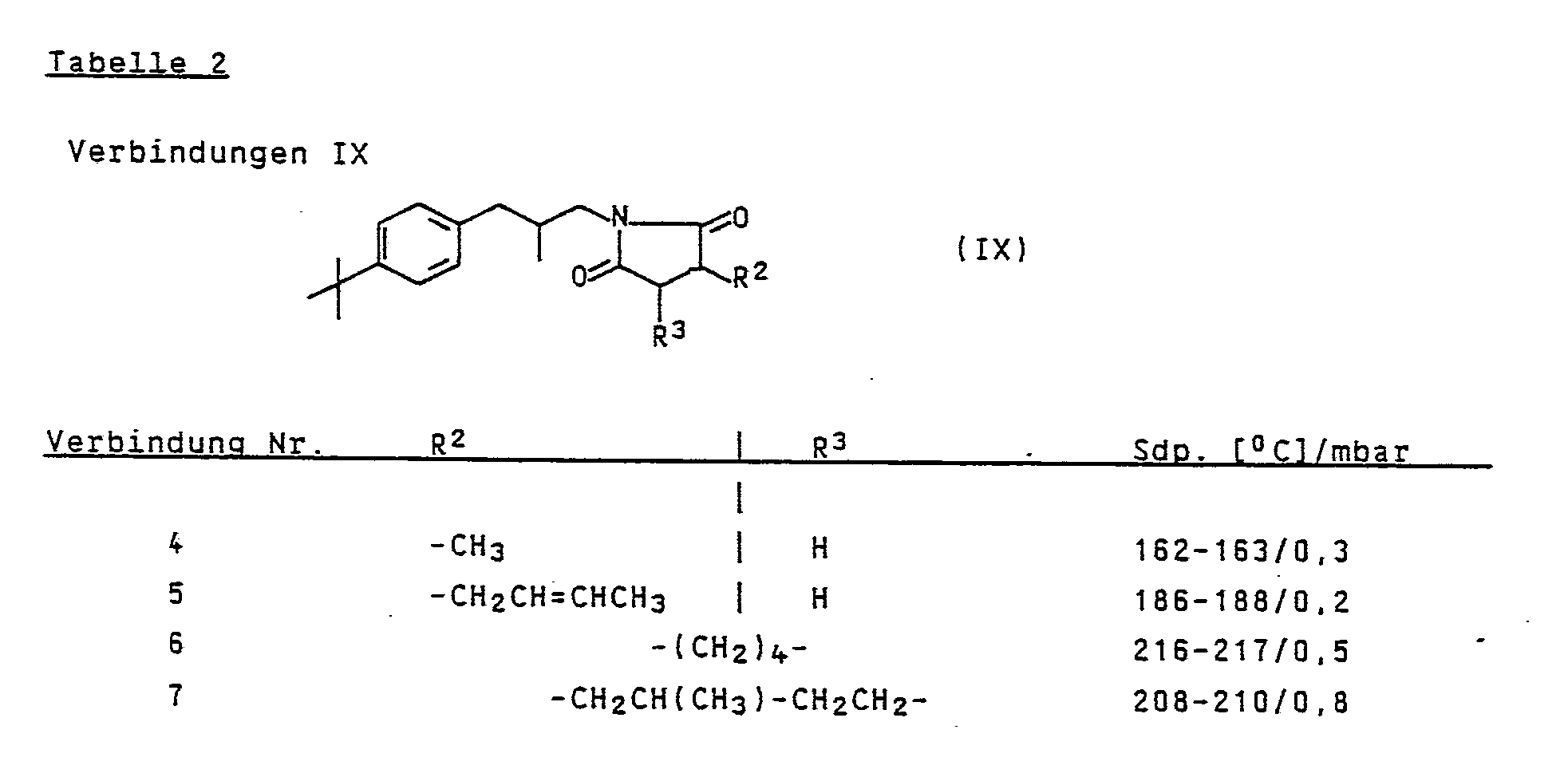
Zu 400 mmol eines Derivates des Bernsteinsäureanhydrids VIb in 500 ml Tetrahydrofuran wurden 395 mmol eines Aminderivates V zugetropft. Nach 3 Stunden unter Rückfluß wurde eingeengt und der Rückstand in 1 Liter Essigsäureanhydrid gelöst, nochmals 2 Stunden zum Rückfluß erhitzt und anschließend wie üblich aufgearbeitet.395 mmol of an amine derivative V were added dropwise to 400 mmol of a derivative of succinic anhydride VIb in 500 ml of tetrahydrofuran. After 3 hours under reflux, the mixture was concentrated and the residue was dissolved in 1 liter of acetic anhydride, heated to reflux for a further 2 hours and then worked up as usual.
Die Ergebnisse sind in Tabelle 2 zusammengefaßt.
Zu einer Suspension von 263 mmol Lithiumaluminiumhydrid in 500 ml Diethylether wurde eine Lösung von 133 mmol eines Succinimidderivates IX in 200 ml Diethylether zugetropft. Nach 4stündigem Rühren bei Raumtemperatur wurde 1 Stunde unter Rückfluß erhitzt und wie üblich aufgearbeitet.A solution of 133 mmol of a succinimide derivative IX in 200 ml of diethyl ether was added dropwise to a suspension of 263 mmol of lithium aluminum hydride in 500 ml of diethyl ether. After stirring for 4 hours at room temperature, the mixture was heated under reflux for 1 hour and worked up as usual.
Zu 750 ml 99 %iger Essigsäure wurden 1,77 mol eines Aminderivates V, bei 80°C anschließend 1,8 mol 2,5-Dimethoxy-tetrahydrofuranderivates VII zugetropft. Nach einstündigem Rühren bei 80°C wurde wie üblich aufgearbeitet.1.77 mol of an amine derivative V and then 1.8 mol of 2,5-dimethoxy-tetrahydrofuran derivative VII were added dropwise to 750 ml of 99% acetic acid. After stirring for one hour at 80 ° C., the mixture was worked up as usual.
353 mmol des Zwischenproduktes wurden in 500 ml Dioxan gelöst und mit Ru(OH)₃ bei 130°C und 300 bar hydriert. Nach dem Erreichen der Druckkonstanz ließ man das Reaktionsgemisch erkalten und arbeitete wie üblich auf.353 mmol of the intermediate were dissolved in 500 ml of dioxane and hydrogenated with Ru (OH) ₃ at 130 ° C and 300 bar. After reaching constant pressure, the reaction mixture was allowed to cool and worked up as usual.
Zu 59,4 mmol eines Alkohols, hergestellt in Beispiel 4, in 200 ml Tetrahydrofuran wurden 5,7 g Pyridin und eine Spatelspitze 4-Dimethylaminopyridin (DMAP) zugegeben. Nach Zutropfen von 7,3 g Acetanhydrid und 15-stündigem Rühren bei Raumtemperatur wurde wie üblich aufgearbeitet.5.7 g of pyridine and a spatula tip of 4-dimethylaminopyridine (DMAP) were added to 59.4 mmol of an alcohol, prepared in Example 4, in 200 ml of tetrahydrofuran. After dropwise addition of 7.3 g of acetic anhydride and stirring for 15 hours at room temperature, the mixture was worked up as usual.
Zu 62,7 mmol eines Alkohols, hergestellt in Beispiel 4, in 390 ml Diethylether und 110 ml Dimethylsulfoxid wurde portionsweise 4,2 g Natriumhydrid als 8 %ige Paraffinsuspension zugegeben. Nach 1stündigem Rühren bei Raumtemperatur wurden 126 mmol Methyliodid zugetropft, 1 Stunde zum Rückfluß erhitzt und anschließend wie üblich aufgearbeitet.To 62.7 mmol of an alcohol, prepared in Example 4, in 390 ml of diethyl ether and 110 ml of dimethyl sulfoxide, 4.2 g of sodium hydride was added in portions as an 8% paraffin suspension. After stirring for 1 hour at room temperature, 126 mmol of methyl iodide were added dropwise, the mixture was heated to reflux for 1 hour and then worked up as usual.
Die Ergebnisse der Beispiele 3 bis 6 sind in Tabelle 3 zusammengestellt.

Eine Verbindung I wurde in Ether gelöst. Beim Einleiten von gasförmiger Chlorwasserstoffsäure fiel das entsprechende Hydrochlorid aus, das abgesaugt und im Vakuum getrocknet wurde.A compound I was dissolved in ether. When gaseous hydrochloric acid was introduced, the corresponding hydrochloride precipitated, which was filtered off with suction and dried in vacuo.
Die Ergebnisse sind in Tabelle 4 zusammengestellt.

Blätter von in Töpfen gewachsenen Weizenkeimlingen der Sorte Frühgold wurden mit wäßriger Spritzbrühe, die 80 % Wirkstoff und 20 % Emulgiermittel in der Trockensubstanz enthielt, besprüht und 24 Stunden nach dem Antrocknen des Spritzbelages mit Oidien (Sporen des Weizenmehltaus (Erysiphe graminis var. tritici) bestäubt. Die Versuchspflanzen wurden anschließend im Gewächshaus bei Temperaturen zwischen 20 und 22°C und 75 bis 80 % relativer Luftfeuchtigkeit aufgestellt. Nach 7 Tagen wurde das Ausmaß der Mehltauentwicklung ermittelt.Leaves of early gold wheat seedlings grown in pots were sprayed with an aqueous spray liquor containing 80% active ingredient and 20% dry matter emulsifier and dusted with oidia (spores of powdery mildew (Erysiphe graminis var. Tritici)) 24 hours after the spray coating had dried on The test plants were then placed in a greenhouse at temperatures between 20 and 22 ° C. and 75 to 80% relative atmospheric humidity After 7 days the extent of mildew development was determined.
Das Ergebnis des Versuches zeigte, daß die Verbindungen 8 und 11 bis 15 bei der Anwendung als 0,0015 %ige Spritzbrühe eine bessere fungizide Wirkung (mit 90 %) zeigten als die Verleichsverbindung 3-(4-tert.-Butylphenyl)-2-methylpropylpyrrolidin aus der DE-OS 27 27 482 (mit 60 %). Bei höheren Konzentrationen z.B. als 0,006 %ige Spritzbrühe fand man für die fungizide Wirkung einen Wert von ebenfalls 90 % für die Verbindungen 8 und 11 bis 15 und für die Vergleichsverbindung 70 % Wirksamkeit. Bei der Anwendung einer 0,025 %igen Spritzbrühe erhielt man für die Verbindungen 8 und 11 bis 15 eine fungizide Wirkung von 97 %, für die Vergleichsverbindung 90 %.The result of the test showed that the compounds 8 and 11 to 15 when used as 0.0015% spray liquor had a better fungicidal activity (with 90%) than the comparative compound 3- (4-tert-butylphenyl) -2- methylpropylpyrrolidin from DE-OS 27 27 482 (with 60%). At higher concentrations e.g. as a 0.006% spray liquor, a value of 90% was also found for the fungicidal activity for the compounds 8 and 11 to 15 and 70% activity for the comparison compound. When using a 0.025% spray liquor, a fungicidal activity of 97% was obtained for the compounds 8 and 11 to 15, and 90% for the comparative compound.
Blätter von in Töpfen gewachsenen Gurkenkeimlingen der Sorte "Chinesische Schlange" wurden im Zweiblattstadium mit einer Sporensuspension des Gurkenmehltaus besprüht. Nach etwa 20 Stunden wurden die Versuchspflanzen mit einer wäßrigen Spritzbrühe, die 80 % Wirkstoff und 20 % Emulgiermittel in der Trockensubstanz enthielt, bis zur Tropfnässe besprüht. Nach dem Antrocknen des Spritzbelages wurden sie anschließend im Gewächshaus bei Temperaturen zwischen 20 und 22°C und 70 bis 80 % relativer Luftfeuchtigkeit aufgestellt. Zur Beurteilung der Wirksamkeit der neuen Stoffe wurde das Ausmaß der Pilzentwicklung nach 21 Tagen ermittelt.Leaves of potted cucumber seedlings of the "Chinese snake" variety were sprayed with a spore suspension of cucumber powdery mildew at the two-leaf stage. After about 20 hours, the test plants were sprayed to runoff point with an aqueous spray mixture which contained 80% active ingredient and 20% emulsifier in the dry matter. After the spray coating had dried on, they were then placed in a greenhouse at temperatures between 20 and 22 ° C. and 70 to 80% relative atmospheric humidity. To assess the effectiveness of the new substances, the extent of fungal development was determined after 21 days.
Das Ergebnis des Versuches zeigte, daß die Verbindungen 8, 9, 10, 12 bis 18 und 21 bei der Anwendung als 0,025 %ige Spritzbrühe eine bessere fungizide Wirkung (mit größer als 97 %) zeigen als die Vergleichsverbindung aus Beispiel A (mit 10 %).The result of the test showed that compounds 8, 9, 10, 12 to 18 and 21 were better when used as a 0.025% spray liquor show fungicidal activity (with greater than 97%) than the comparison compound from Example A (with 10%).
Paprikasämlinge der Sorte "Neusiedler Ideal Elite" wurden nachdem sich 4-5 Blätter gut entwickelt hatten, mit wäßrigen Suspensionen, die 80 % Wirkstoff und 20 % Emulgiermittel in der Trockensubstanz enthielten, tropfnaß gespritzt. Nach dem Antrocknen des Spritzbelages wurden die Pflanzen mit einer Konidienaufschwemmung des Pilzes Botrytis cinerea besprüht und bei 22-24°C in eine Kammer mit hoher Luftfeuchtigkeit gestellt. Nach 5 Tagen hatte sich die Krankheit auf den unbehandelten Kontrollpflanzen so stark entwickelt, daß die entstandenen Blattnekrosen den überwiegenden Teil der Blätter bedecken.Pepper seedlings of the "Neusiedler Ideal Elite" variety were sprayed to runoff point after 4-5 leaves had developed well, with aqueous suspensions containing 80% active ingredient and 20% emulsifier in the dry matter. After the spray coating had dried on, the plants were sprayed with a conidia suspension of the botrytis cinerea fungus and placed at 22-24 ° C. in a chamber with high atmospheric humidity. After 5 days, the disease had developed so strongly on the untreated control plants that the leaf necrosis formed covered the majority of the leaves.
Das Ergebnis des Versuches zeigte, daß die Verbindungen 12, 13, 15, 16 und 20 bei der Anwendung als 0,05 %ige Spritzbrühe eine bessere fungizide Wirkung (mit 90 %) zeigten als die Vergleichsverbindung aus Beispiel A (mit 60 %).The result of the test showed that the compounds 12, 13, 15, 16 and 20 when used as a 0.05% spray liquor had a better fungicidal activity (with 90%) than the comparison compound from Example A (with 60%).
Blätter von Topfreben der Sorte "Müller-Thurgau" wurden mit einer wäßrigen Spritzbrühe, die 80 % Wirkstoff und 20 % Emulgiermittel in der Trockensubstanz enthielt, besprüht. Um die Wirkungsdauer der Wirkstoffe beurteilen zu können, wurden die Pflanzen nach dem Antrocknen des Spritzbelages 8 Tage im Gewächsaus aufgestellt. Erst dann wurden die Blätter mit einer Zoosporenaufschwemmung von Plasmopara viticola (Rebenperonospora) infiziert. Danach wurden die Reben zunächst für 48 Stunden in einer wasserdampfgesättigten Kammer bei 24°C und anschließend für 5 Tage in einem Gewächshaus mit Temperaturen zwischen 20 und 30°C aufgestellt. Nach dieser Zeit wurden die Pflanzen zur Beschleunigung des Sporangienträgerausbruches abermals für 16 Stunden in der feuchten Kammer aufgestellt. Dann erfolgte die Beurteilung des Ausmaßes des Pilzausbruches auf den Blattunterseiten.Leaves of potted vines of the "Müller-Thurgau" variety were sprayed with an aqueous spray mixture which contained 80% active ingredient and 20% emulsifier in the dry matter. In order to be able to assess the duration of action of the active ingredients, the plants were placed in the greenhouse for 8 days after the spray coating had dried on. Only then were the leaves infected with a zoospore suspension of Plasmopara viticola (vine peronospora). The vines were then placed for 48 hours in a steam-saturated chamber at 24 ° C and then for 5 days in a greenhouse at temperatures between 20 and 30 ° C. After this time, the plants were again placed in the moist chamber for 16 hours to accelerate the sporangium carrier outbreak. Then the extent of the fungal outbreak on the undersides of the leaves was assessed.
Das Ergebnis des Versuches zeigte, daß die Verbindungen 8, 11, 13, 16 und 18 bei der Anwendung als 0,05 %ige Spritzbrühe eine bessere fungizide Wirkung (mit 94 %) zeigen als die Vergleichsverbindung aus Beispiel A (mit 60 %).The result of the test showed that the compounds 8, 11, 13, 16 and 18 when used as a 0.05% spray liquor had a better fungicidal activity (with 94%) than the comparison compound from Example A (with 60%).
Claims (8)

R¹ 4-tert.-Butylphenyl oder 4-tert.-Butylcyclohexyl,
R² C₅-C₂₀-Alkyl, C₂-C₂₀-Alkenyl, C₁-C₂₀-Alkoxy, C₂-C₂₀-Alkenyloxy, C₁-C₂₀-Hydroxyalkyl, C₂-C₂₀-Alkoxyalkyl, C₃-C₂₀-Alkenyloxyalkyl, C₂-C₂₀-Acyloxyalkyl, C₃-C₂₀-Alkylcarbonylalkyl, Benzyl, Benzyloxy, C₈-C₂₀-Benzyloxyalkyl oder substituiertes Phenyl, Benzyl, Benyloxy, C₈-C₂₀-Benzyloxyalkyl mit bis zu dreifach durch Halogen, C₁-C₈-Alkyl oder C₁-C₈-Alkoxy substituierten Aromaten, und für den Fall, daß R¹ 4-tert.-Butylphenyl bedeutet, zusätzlich die Methylgruppe,
und für den Fall, daß R¹ 4-tert.-Butylcyclohexyl bedeutet, zusätzlich C₁-C₄-Alkyl, die Phenyl- oder Hydroxylgruppe,
R³ Wasserstoff oder einen der Reste R², wobei
R² und R³ auch gemeinsam einen carbocyclischen Rest bedeuten können,
sowie deren pflanzenphysiologisch verträgliche Salze,
dadurch gekennzeichnet, daß man


R¹ 4-tert-butylphenyl or 4-tert-butylcyclohexyl,
R² C₅-C₂₀-alkyl, C₂-C₂₀-alkenyl, C₁-C₂₀-alkoxy, C₂-C₂₀-alkenyloxy, C₁-C₂₀-hydroxyalkyl, C₂-C₂₀-alkoxyalkyl, C₃-C₂₀-alkenyloxyalkyl, C₂-C₂₀-acyloxyalkyl, C₃ -C₂₀-alkylcarbonylalkyl, benzyl, benzyloxy, C₈-C₂₀-benzyloxyalkyl or substituted phenyl, benzyl, benyloxy, C₈-C₂₀-benzyloxyalkyl with up to three times substituted by halogen, C₁-C₈-alkyl or C₁-C₈-alkoxy, and for the case that R¹ is 4-tert-butylphenyl, additionally the methyl group,
and in the event that R¹ is 4-tert-butylcyclohexyl, additionally C₁-C₄-alkyl, the phenyl or hydroxyl group,
R³ is hydrogen or one of the radicals R², where
R² and R³ can also together represent a carbocyclic radical,
and their physiologically acceptable salts,
characterized in that one


Priority Applications (1)
| Application Number | Priority Date | Filing Date | Title |
|---|---|---|---|
| AT87106164T ATE52079T1 (en) | 1986-05-02 | 1987-04-28 | PHENYL AND CYCLOHEXYL ISOBUTYL PYRROLIDINE DERIVATIVES. |
Applications Claiming Priority (2)
| Application Number | Priority Date | Filing Date | Title |
|---|---|---|---|
| DE3614906 | 1986-05-02 | ||
| DE19863614906 DE3614906A1 (en) | 1986-05-02 | 1986-05-02 | PHENYL AND CYCLOHEXYL ISOBUTYLPYRROLIDINE DERIVATIVES |
Publications (3)
| Publication Number | Publication Date |
|---|---|
| EP0243940A2 true EP0243940A2 (en) | 1987-11-04 |
| EP0243940A3 EP0243940A3 (en) | 1988-08-10 |
| EP0243940B1 EP0243940B1 (en) | 1990-04-18 |
Family
ID=6300034
Family Applications (1)
| Application Number | Title | Priority Date | Filing Date |
|---|---|---|---|
| EP87106164A Expired - Lifetime EP0243940B1 (en) | 1986-05-02 | 1987-04-28 | Phenyl- and cyclohexyl-isobutylpyrrolidine |
Country Status (5)
| Country | Link |
|---|---|
| EP (1) | EP0243940B1 (en) |
| AT (1) | ATE52079T1 (en) |
| DE (2) | DE3614906A1 (en) |
| ES (1) | ES2014008B3 (en) |
| GR (1) | GR3000518T3 (en) |
Cited By (4)
| Publication number | Priority date | Publication date | Assignee | Title |
|---|---|---|---|---|
| US5068245A (en) * | 1987-09-30 | 1991-11-26 | Basf Aktiengesellschaft | Fungicidal n-substituted 3-arylpyrrolidine derivatives |
| US5068246A (en) * | 1987-09-30 | 1991-11-26 | Basf Aktiengesellschaft | Fungicidal n-substituted 3-alkyl-4-arylpyrrolidine derivatives |
| US5192767A (en) * | 1987-10-14 | 1993-03-09 | Basf Aktiengesellschaft | 3-substituted pyridines and fungicides containing them |
| CN107074741A (en) * | 2014-11-10 | 2017-08-18 | 奇华顿股份有限公司 | In organic compound or associated improvement |
Families Citing this family (1)
| Publication number | Priority date | Publication date | Assignee | Title |
|---|---|---|---|---|
| US5216018A (en) * | 1992-02-14 | 1993-06-01 | Du Pont Merck Pharmaceutical Company | Hydroisoindolines and hydroisoquinolines as psychotropic |
Family Cites Families (2)
| Publication number | Priority date | Publication date | Assignee | Title |
|---|---|---|---|---|
| DE2727482A1 (en) * | 1977-06-18 | 1979-01-11 | Basf Ag | DERIVATIVES OF CYCLIC AMINES |
| DE2830127A1 (en) * | 1978-07-08 | 1980-01-17 | Basf Ag | N-ARYL PROPYL SUBSTITUTED CYCLIC AMINES |
-
1986
- 1986-05-02 DE DE19863614906 patent/DE3614906A1/en not_active Withdrawn
-
1987
- 1987-04-28 EP EP87106164A patent/EP0243940B1/en not_active Expired - Lifetime
- 1987-04-28 ES ES87106164T patent/ES2014008B3/en not_active Expired - Lifetime
- 1987-04-28 AT AT87106164T patent/ATE52079T1/en active
- 1987-04-28 DE DE8787106164T patent/DE3762340D1/en not_active Expired - Lifetime
-
1990
- 1990-05-29 GR GR90400333T patent/GR3000518T3/en unknown
Cited By (5)
| Publication number | Priority date | Publication date | Assignee | Title |
|---|---|---|---|---|
| US5068245A (en) * | 1987-09-30 | 1991-11-26 | Basf Aktiengesellschaft | Fungicidal n-substituted 3-arylpyrrolidine derivatives |
| US5068246A (en) * | 1987-09-30 | 1991-11-26 | Basf Aktiengesellschaft | Fungicidal n-substituted 3-alkyl-4-arylpyrrolidine derivatives |
| US5192767A (en) * | 1987-10-14 | 1993-03-09 | Basf Aktiengesellschaft | 3-substituted pyridines and fungicides containing them |
| CN107074741A (en) * | 2014-11-10 | 2017-08-18 | 奇华顿股份有限公司 | In organic compound or associated improvement |
| CN107074741B (en) * | 2014-11-10 | 2019-08-13 | 奇华顿股份有限公司 | Improvements in or related to organic compounds |
Also Published As
| Publication number | Publication date |
|---|---|
| DE3762340D1 (en) | 1990-05-23 |
| GR3000518T3 (en) | 1991-07-31 |
| DE3614906A1 (en) | 1987-11-05 |
| ES2014008B3 (en) | 1990-06-16 |
| EP0243940B1 (en) | 1990-04-18 |
| ATE52079T1 (en) | 1990-05-15 |
| EP0243940A3 (en) | 1988-08-10 |
Similar Documents
| Publication | Publication Date | Title |
|---|---|---|
| EP0159584B1 (en) | N-(azolylcarbamoyl)-hydroxyl amines and fungicides containing them | |
| DE3614907A1 (en) | N-SUBSTITUTED PYRROLIDONE AND PIPERIDINE DERIVATIVES AND THEIR SALTS | |
| EP0327912B1 (en) | N,n-disubstituted piperazines | |
| EP0243940B1 (en) | Phenyl- and cyclohexyl-isobutylpyrrolidine | |
| EP0129152B1 (en) | Process for the preparation of triazolyl alcohols | |
| EP0309913B1 (en) | Fungicidal N-substituted 3-aryl-pyrrolidine derivatives | |
| EP0162246B1 (en) | N-(arylpropyl) azolylureas and fungicides containing them | |
| EP0129186A2 (en) | Azole derivatives | |
| EP0174565B1 (en) | Piperidine derivatives and fungicidal compositions containing them, and process for combating fungi | |
| EP0182224B1 (en) | Nitrogen-substituted 4-(p-tert. butyl-phenyl)-3-methyl-piperidines, quaternary salts thereof and their use as fungicides | |
| EP0102559B1 (en) | Neopentyl-phenetyl triazoles, process for their preparation and fungicides containing them | |
| EP0193065B1 (en) | Morpholine derivatives, processes for their production and their use as fungicides | |
| EP0057362A1 (en) | Dibenzofurane derivatives, process for their preparation and their use as fungicides | |
| EP0269041A2 (en) | Fungicidal cyclohexylamines | |
| EP0102540B1 (en) | Beta-triazolyl ketals, process for their preparation and fungicides containing them | |
| EP0309914A2 (en) | Fungicidal N-substituted 3-alkyl-4-aryl-pyrrolidine derivatives | |
| EP0214566B1 (en) | 3-propenyl pyridines and their use as fungicides | |
| EP0156255A2 (en) | N-((2,3-dihydrobenzofuran)-2-yl)-azolyl ureas and fungicides containing them | |
| EP0134499A1 (en) | Biscyclohexylamine alcanes and process for combating fungi | |
| EP0244641B1 (en) | 1,4-cyclohexane diamines, process for their preparation and their use as fungicides | |
| EP0243842B1 (en) | Aryloxycarbamoyl azoles and fungicides containing them | |
| EP0102543B1 (en) | Dioxanylazol derivatives, fungicides containing them and their use as fungicides | |
| EP0171502A2 (en) | Vinylazolyl ureas and fungicides containing them | |
| DE3601430A1 (en) | HALOGENED AZOL COMPOUNDS AND FUNGICIDES CONTAINING THEM | |
| EP0174567B1 (en) | Tetrahydropyran-2-yl-alkenyltriazoles, fungicides containing them, process for the preparation of the triazole compounds and intermediates for the preparation |
Legal Events
| Date | Code | Title | Description |
|---|---|---|---|
| PUAI | Public reference made under article 153(3) epc to a published international application that has entered the european phase |
Free format text: ORIGINAL CODE: 0009012 |
|
| AK | Designated contracting states |
Kind code of ref document: A2 Designated state(s): AT BE CH DE ES FR GB GR IT LI NL SE |
|
| PUAL | Search report despatched |
Free format text: ORIGINAL CODE: 0009013 |
|
| AK | Designated contracting states |
Kind code of ref document: A3 Designated state(s): AT BE CH DE ES FR GB GR IT LI NL SE |
|
| 17P | Request for examination filed |
Effective date: 19880630 |
|
| 17Q | First examination report despatched |
Effective date: 19890119 |
|
| GRAA | (expected) grant |
Free format text: ORIGINAL CODE: 0009210 |
|
| AK | Designated contracting states |
Kind code of ref document: B1 Designated state(s): AT BE CH DE ES FR GB GR IT LI NL SE |
|
| REF | Corresponds to: |
Ref document number: 52079 Country of ref document: AT Date of ref document: 19900515 Kind code of ref document: T |
|
| ITF | It: translation for a ep patent filed | ||
| REF | Corresponds to: |
Ref document number: 3762340 Country of ref document: DE Date of ref document: 19900523 |
|
| GBT | Gb: translation of ep patent filed (gb section 77(6)(a)/1977) | ||
| ET | Fr: translation filed | ||
| REG | Reference to a national code |
Ref country code: GR Ref legal event code: FG4A Free format text: 3000518 |
|
| PLBE | No opposition filed within time limit |
Free format text: ORIGINAL CODE: 0009261 |
|
| STAA | Information on the status of an ep patent application or granted ep patent |
Free format text: STATUS: NO OPPOSITION FILED WITHIN TIME LIMIT |
|
| 26N | No opposition filed | ||
| ITTA | It: last paid annual fee | ||
| EAL | Se: european patent in force in sweden |
Ref document number: 87106164.4 |
|
| PGFP | Annual fee paid to national office [announced via postgrant information from national office to epo] |
Ref country code: FR Payment date: 19950327 Year of fee payment: 9 |
|
| PGFP | Annual fee paid to national office [announced via postgrant information from national office to epo] |
Ref country code: SE Payment date: 19950328 Year of fee payment: 9 Ref country code: CH Payment date: 19950328 Year of fee payment: 9 |
|
| PGFP | Annual fee paid to national office [announced via postgrant information from national office to epo] |
Ref country code: GR Payment date: 19950330 Year of fee payment: 9 |
|
| PGFP | Annual fee paid to national office [announced via postgrant information from national office to epo] |
Ref country code: AT Payment date: 19950405 Year of fee payment: 9 |
|
| PGFP | Annual fee paid to national office [announced via postgrant information from national office to epo] |
Ref country code: GB Payment date: 19950418 Year of fee payment: 9 Ref country code: ES Payment date: 19950418 Year of fee payment: 9 |
|
| PGFP | Annual fee paid to national office [announced via postgrant information from national office to epo] |
Ref country code: DE Payment date: 19950427 Year of fee payment: 9 |
|
| PGFP | Annual fee paid to national office [announced via postgrant information from national office to epo] |
Ref country code: NL Payment date: 19950430 Year of fee payment: 9 |
|
| PGFP | Annual fee paid to national office [announced via postgrant information from national office to epo] |
Ref country code: BE Payment date: 19950508 Year of fee payment: 9 |
|
| PG25 | Lapsed in a contracting state [announced via postgrant information from national office to epo] |
Ref country code: DE Effective date: 19960424 |
|
| PG25 | Lapsed in a contracting state [announced via postgrant information from national office to epo] |
Ref country code: GB Effective date: 19960428 Ref country code: AT Effective date: 19960428 |
|
| PG25 | Lapsed in a contracting state [announced via postgrant information from national office to epo] |
Ref country code: SE Effective date: 19960429 Ref country code: ES Free format text: LAPSE BECAUSE OF NON-PAYMENT OF DUE FEES Effective date: 19960429 |
|
| PG25 | Lapsed in a contracting state [announced via postgrant information from national office to epo] |
Ref country code: LI Effective date: 19960430 Ref country code: CH Effective date: 19960430 Ref country code: BE Effective date: 19960430 |
|
| BERE | Be: lapsed |
Owner name: BASF A.G. Effective date: 19960430 |
|
| PG25 | Lapsed in a contracting state [announced via postgrant information from national office to epo] |
Ref country code: GR Free format text: THE PATENT HAS BEEN ANNULLED BY A DECISION OF A NATIONAL AUTHORITY Effective date: 19961031 |
|
| PG25 | Lapsed in a contracting state [announced via postgrant information from national office to epo] |
Ref country code: NL Effective date: 19961101 |
|
| REG | Reference to a national code |
Ref country code: GR Ref legal event code: MM2A Free format text: 3000518 |
|
| REG | Reference to a national code |
Ref country code: CH Ref legal event code: PL |
|
| GBPC | Gb: european patent ceased through non-payment of renewal fee |
Effective date: 19960428 |
|
| PG25 | Lapsed in a contracting state [announced via postgrant information from national office to epo] |
Ref country code: FR Effective date: 19961227 |
|
| NLV4 | Nl: lapsed or anulled due to non-payment of the annual fee |
Effective date: 19961101 |
|
| EUG | Se: european patent has lapsed |
Ref document number: 87106164.4 |
|
| REG | Reference to a national code |
Ref country code: FR Ref legal event code: ST |
|
| REG | Reference to a national code |
Ref country code: ES Ref legal event code: FD2A Effective date: 19990301 |
|
| PG25 | Lapsed in a contracting state [announced via postgrant information from national office to epo] |
Ref country code: IT Free format text: LAPSE BECAUSE OF NON-PAYMENT OF DUE FEES;WARNING: LAPSES OF ITALIAN PATENTS WITH EFFECTIVE DATE BEFORE 2007 MAY HAVE OCCURRED AT ANY TIME BEFORE 2007. THE CORRECT EFFECTIVE DATE MAY BE DIFFERENT FROM THE ONE RECORDED. Effective date: 20050428 |