EP0243881B1 - Behandlung von Abgasen aus einem Siliziumofen - Google Patents
Behandlung von Abgasen aus einem Siliziumofen Download PDFInfo
- Publication number
- EP0243881B1 EP0243881B1 EP87105963A EP87105963A EP0243881B1 EP 0243881 B1 EP0243881 B1 EP 0243881B1 EP 87105963 A EP87105963 A EP 87105963A EP 87105963 A EP87105963 A EP 87105963A EP 0243881 B1 EP0243881 B1 EP 0243881B1
- Authority
- EP
- European Patent Office
- Prior art keywords
- silicon
- gases
- gas
- furnace
- solid
- Prior art date
- Legal status (The legal status is an assumption and is not a legal conclusion. Google has not performed a legal analysis and makes no representation as to the accuracy of the status listed.)
- Expired
Links
- 239000007789 gas Substances 0.000 title claims description 148
- XUIMIQQOPSSXEZ-UHFFFAOYSA-N Silicon Chemical compound [Si] XUIMIQQOPSSXEZ-UHFFFAOYSA-N 0.000 title claims description 93
- 239000010703 silicon Substances 0.000 title claims description 93
- 229910052710 silicon Inorganic materials 0.000 title claims description 90
- 239000006227 byproduct Substances 0.000 title description 6
- 239000007787 solid Substances 0.000 claims description 42
- 239000000463 material Substances 0.000 claims description 40
- 229930195733 hydrocarbon Natural products 0.000 claims description 35
- 150000002430 hydrocarbons Chemical class 0.000 claims description 35
- VYPSYNLAJGMNEJ-UHFFFAOYSA-N Silicium dioxide Chemical compound O=[Si]=O VYPSYNLAJGMNEJ-UHFFFAOYSA-N 0.000 claims description 33
- 239000004215 Carbon black (E152) Substances 0.000 claims description 31
- VNWKTOKETHGBQD-UHFFFAOYSA-N methane Chemical compound C VNWKTOKETHGBQD-UHFFFAOYSA-N 0.000 claims description 22
- 238000000034 method Methods 0.000 claims description 16
- 238000006243 chemical reaction Methods 0.000 claims description 14
- 239000000203 mixture Substances 0.000 claims description 11
- 235000012239 silicon dioxide Nutrition 0.000 claims description 11
- 239000000377 silicon dioxide Substances 0.000 claims description 11
- ATUOYWHBWRKTHZ-UHFFFAOYSA-N Propane Chemical compound CCC ATUOYWHBWRKTHZ-UHFFFAOYSA-N 0.000 claims description 10
- 239000003638 chemical reducing agent Substances 0.000 claims description 5
- 239000003345 natural gas Substances 0.000 claims description 5
- 239000001294 propane Substances 0.000 claims description 5
- OTMSDBZUPAUEDD-UHFFFAOYSA-N Ethane Chemical compound CC OTMSDBZUPAUEDD-UHFFFAOYSA-N 0.000 claims description 2
- 239000001273 butane Substances 0.000 claims description 2
- IJDNQMDRQITEOD-UHFFFAOYSA-N n-butane Chemical compound CCCC IJDNQMDRQITEOD-UHFFFAOYSA-N 0.000 claims description 2
- OFBQJSOFQDEBGM-UHFFFAOYSA-N n-pentane Natural products CCCCC OFBQJSOFQDEBGM-UHFFFAOYSA-N 0.000 claims description 2
- LIVNPJMFVYWSIS-UHFFFAOYSA-N silicon monoxide Chemical compound [Si-]#[O+] LIVNPJMFVYWSIS-UHFFFAOYSA-N 0.000 description 32
- 229910052681 coesite Inorganic materials 0.000 description 11
- 229910052906 cristobalite Inorganic materials 0.000 description 11
- 229910052682 stishovite Inorganic materials 0.000 description 11
- 229910052905 tridymite Inorganic materials 0.000 description 11
- 238000011084 recovery Methods 0.000 description 8
- UGFAIRIUMAVXCW-UHFFFAOYSA-N Carbon monoxide Chemical group [O+]#[C-] UGFAIRIUMAVXCW-UHFFFAOYSA-N 0.000 description 6
- 229910002091 carbon monoxide Inorganic materials 0.000 description 6
- 238000006722 reduction reaction Methods 0.000 description 6
- 238000002485 combustion reaction Methods 0.000 description 5
- 238000001816 cooling Methods 0.000 description 5
- 239000004744 fabric Substances 0.000 description 5
- 239000000446 fuel Substances 0.000 description 4
- 238000000926 separation method Methods 0.000 description 4
- 239000000428 dust Substances 0.000 description 3
- 239000001257 hydrogen Substances 0.000 description 3
- 229910052739 hydrogen Inorganic materials 0.000 description 3
- 238000004519 manufacturing process Methods 0.000 description 3
- 229910052814 silicon oxide Inorganic materials 0.000 description 3
- 230000008016 vaporization Effects 0.000 description 3
- 238000010276 construction Methods 0.000 description 2
- 238000007323 disproportionation reaction Methods 0.000 description 2
- 230000000694 effects Effects 0.000 description 2
- 238000010891 electric arc Methods 0.000 description 2
- 230000005611 electricity Effects 0.000 description 2
- 238000001914 filtration Methods 0.000 description 2
- 150000002431 hydrogen Chemical class 0.000 description 2
- 238000009434 installation Methods 0.000 description 2
- 239000007788 liquid Substances 0.000 description 2
- 229910052751 metal Inorganic materials 0.000 description 2
- 239000002184 metal Substances 0.000 description 2
- 238000011946 reduction process Methods 0.000 description 2
- 238000007789 sealing Methods 0.000 description 2
- 238000003860 storage Methods 0.000 description 2
- XLYOFNOQVPJJNP-UHFFFAOYSA-N water Substances O XLYOFNOQVPJJNP-UHFFFAOYSA-N 0.000 description 2
- OKTJSMMVPCPJKN-UHFFFAOYSA-N Carbon Chemical compound [C] OKTJSMMVPCPJKN-UHFFFAOYSA-N 0.000 description 1
- UFHFLCQGNIYNRP-UHFFFAOYSA-N Hydrogen Chemical compound [H][H] UFHFLCQGNIYNRP-UHFFFAOYSA-N 0.000 description 1
- QVGXLLKOCUKJST-UHFFFAOYSA-N atomic oxygen Chemical compound [O] QVGXLLKOCUKJST-UHFFFAOYSA-N 0.000 description 1
- 230000005540 biological transmission Effects 0.000 description 1
- 230000015572 biosynthetic process Effects 0.000 description 1
- 229910052799 carbon Inorganic materials 0.000 description 1
- 239000000919 ceramic Substances 0.000 description 1
- 239000000470 constituent Substances 0.000 description 1
- 239000010779 crude oil Substances 0.000 description 1
- 238000011161 development Methods 0.000 description 1
- 230000018109 developmental process Effects 0.000 description 1
- 238000010586 diagram Methods 0.000 description 1
- 239000003085 diluting agent Substances 0.000 description 1
- 238000009826 distribution Methods 0.000 description 1
- 238000005516 engineering process Methods 0.000 description 1
- 230000003628 erosive effect Effects 0.000 description 1
- 239000002737 fuel gas Substances 0.000 description 1
- 238000010438 heat treatment Methods 0.000 description 1
- 239000000543 intermediate Substances 0.000 description 1
- 150000002739 metals Chemical class 0.000 description 1
- 229910052755 nonmetal Inorganic materials 0.000 description 1
- 239000001301 oxygen Substances 0.000 description 1
- 229910052760 oxygen Inorganic materials 0.000 description 1
- 239000002245 particle Substances 0.000 description 1
- 239000008188 pellet Substances 0.000 description 1
- 239000003208 petroleum Substances 0.000 description 1
- 238000005381 potential energy Methods 0.000 description 1
- 239000000843 powder Substances 0.000 description 1
- 238000002360 preparation method Methods 0.000 description 1
- 238000005086 pumping Methods 0.000 description 1
- 239000008247 solid mixture Substances 0.000 description 1
- 239000013589 supplement Substances 0.000 description 1
- 238000009834 vaporization Methods 0.000 description 1
- 239000002023 wood Substances 0.000 description 1
Images
Classifications
-
- C—CHEMISTRY; METALLURGY
- C01—INORGANIC CHEMISTRY
- C01B—NON-METALLIC ELEMENTS; COMPOUNDS THEREOF; METALLOIDS OR COMPOUNDS THEREOF NOT COVERED BY SUBCLASS C01C
- C01B33/00—Silicon; Compounds thereof
- C01B33/02—Silicon
- C01B33/021—Preparation
- C01B33/023—Preparation by reduction of silica or free silica-containing material
- C01B33/025—Preparation by reduction of silica or free silica-containing material with carbon or a solid carbonaceous material, i.e. carbo-thermal process
-
- Y—GENERAL TAGGING OF NEW TECHNOLOGICAL DEVELOPMENTS; GENERAL TAGGING OF CROSS-SECTIONAL TECHNOLOGIES SPANNING OVER SEVERAL SECTIONS OF THE IPC; TECHNICAL SUBJECTS COVERED BY FORMER USPC CROSS-REFERENCE ART COLLECTIONS [XRACs] AND DIGESTS
- Y02—TECHNOLOGIES OR APPLICATIONS FOR MITIGATION OR ADAPTATION AGAINST CLIMATE CHANGE
- Y02P—CLIMATE CHANGE MITIGATION TECHNOLOGIES IN THE PRODUCTION OR PROCESSING OF GOODS
- Y02P20/00—Technologies relating to chemical industry
- Y02P20/10—Process efficiency
Definitions
- This invention relates to an improvement in the process for the carbothermic reduction of silicon dioxide to prepare silicon in which the by-produced gases of the process are freed of silicon monoxide and other silicon-containing materials to facilitate recovery of the energy value of the combustible by-produced gases.
- Silicon is prepared by the carbothermic reduction of silicon dioxide (Si0 2 ) and carbonaceous reducing agents.
- the overall reduction reaction can be represented by the equation It is generally recognized that the above reaction in reality involves multiple reactions, the most significant being outlined below: and
- the primary gaseous by-product is carbon monoxide (CO).
- CO carbon monoxide
- the carbonaceous reducing agent can come from a wide range of materials including wood and other hydrocarbon containing materials, the by-produced gases may also contain other combustible constituents such as hydrogen, methane and other hydrocarbons.
- the gases finally discharged from the furnace system may be as little as 3 volume percent of the by-produced gases, the remainder being air.
- Recent developments in silicon furnace technology facilitate the effective sealing of the furnace to operate in a "closed” mode. Effectively sealing the furnace will allow collection of by-produced gases in an undiluted form.
- SiO silicon monoxide
- SiO silicon monoxide
- SiO is a gas.
- the SiO is thought to disproportionate to a mixture of silicon and Si0 2
- the disproportionation of SiO can be represented by the reaction
- the silicon and Si0 2 so formed is a finely dispersed solid in the by-produced gas stream. It is estimated that as much as 10 to 20 percent of the silicon in the Si0 2 fed in present silicon furnaces is lost as gaseous SiO or as silicon and Si0 2 from the disproportionation of SiO. SiO will also react with oxygen to form solid Si0 2 .
- SiO, silicon, or Si0 2 causes mechanical difficulties in schemes to recover energy.
- the possible use of the by-produced gases to operate a steam boiler could be a problem.
- Combustion of the by-produced gases in a steam boiler converts any silicon-containing material to Si0 2 .
- Si0 2 can fuse into a glassy material and cause fouling of the boiler tubes.
- Another example of potential mechanical problems is in combustion of the by-produced gases in a gas turbine, where solid Si0 2 formed causes severe erosion of the high-speed, rotating turbine.
- Pre-cooling of the by-produced gases by conventional heat exchanger means to agglomerate the finely dispersed silicon and Si0 2 and subsequent solid remowal from this gas stream appears to be one solution to this problem.
- the process of cooling the gases is severely hindered by the formation of agglomerated solids on heat transfer surfaces.
- Herold et al. go on to disclose that these gases can be used by any known process, such as providing a boiler gas to generate steam and supplying a gas turbine which is coupled to an electric generator.
- Herold et al. disclose, via discussion or example, the presence of silicon monoxide or other silicon-containing materials in the combustible gases from a silicon furnace.
- the primary objective of the instant invention is to effectively remove silicon-containing materials from the by-produced gases from a silicon furnace to facilitate practical recovery of the energy value of these gases while avoiding the above-mentioned problems.
- a further objective is to lower the manufacturing cost of silicon by recovery of the potential energy in the by-produced gases.
- the instant invention utilizes the cooling effect of a vaporizing liquid without introducing a diluent, non-combustible material to the by-produced gases.
- the instant invention also utilizes the nature of finely dispersed silicon-containing materials to completely condense and to agglomerate to far- ger solid particles upon cooling. The combination of the these two features generates a solid-containing gas stream that can be handled by solid-gas separation techniques to yield a gas with a high potential for practical energy recovery.
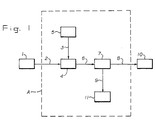
- Figure 1 is a schematic representation of one embodiment of the instant invention.
- Figure 1 is a schematic diagram outlining
- FIG 1 is a representation of a silicon furnace.
- the silicon furnace is a closed furnace capable of being operated under pressure.
- the silicon furnace can be of designs and installations known in the art such as a submerged electric arc furnace or a furnace in which the electrical energy is provided by either a transferred arc plasma or a non-transferred arc plasma.
- the hot by-produced gas stream 2 containing gaseous silicon monoxide or finely dispersed silicon and silicon dioxide, leaves the silicon furnace at a temperature of 600°C or higher.
- the silicon furnace is typically operated at or above atmospheric pressure. Typically there is a sufficient driving force due to pressure within the furnace to facilitate transmission of the gas stream 2 for subsequent handling.
- a liquified hydrocarbon-containing gas stream 3 is fed, along with the by-produced gas stream 2 to a means 4 of contacting the by-produced gas stream 2 and the liquified hydrocarbon-containing gas stream 3.
- the liquified hydrocarbon-containing gas stream 3 vaporizes, cooling the hot by-produced gas stream 2 and causing silicon-containing materials to completely condense to a solid and to agglomerate.
- the means 4 of contacting streams 2 and 3 can be any known means in the art for facilitating the vaporization of a liquified gas, such as an expansion chamber.
- the liqu i fied hydrocarbon-containing stream 3 is fed to means 4 of contacting streams 2 and 3 by a means 5 of feeding a liquified gas.
- the means 5 of feeding a liqu i fied gas may be any conventional means such as use of the pressure in the vapor space of a liquified gas storage tank as the motive force or use of a pump suitable for handling liquified gases.
- the cooled stream 6, comprising the by-produced gases and solid, agglomerated silicon-containing materials, is passed through a means 7 to separate the by-produced gases from the solid, agglomerated silicon-containing materials.
- the means 7 to separate solid, agglomerated silicon-containing materials from the cooled stream 6 can be any conventional means of solid-gas separation such as a fabric filter bag in a baghouse.
- the means 7 to separate solids and gases separates cooled stream 6 into a solids-free by-produced gas stream 8 and a stream 9 of solid, agglomerated silicon-containing materials.
- the solids-free by-produced gas stream 8 is passed on to a means 10 of recovering the energy value of the by-product gas stream 8.
- This means 10 of energy recovery can be any conventional means such as combustion in a steam boiler or combustion in a gas turbine.
- the solid, agglomerated silicon-containing materials stream 9 is handled by a means 11 to dispose of the finely divided powder.
- the means 11 of disposal of the solids stream 9 can be such conventional means as dust collection and disposal or recycle of the silicon-containing material to the silicon furnace as a feed.
- the silicon furnace may be of any design known in the art. Examples of such furnace design are submerged electric arc furnaces and furnaces in which electrical energy is supplied by a transferred arc plasma or a non-transferred arc plasma.
- the silicon furnace irrespective of the mode of energy input, must be operated in a sealed or "closed" mode. The use of a closed mode is necessary to eliminate the introduction of extraneous gases from the atmosphere that would dilute the energy value of the by-produced gases.
- the silicon furnace should be designed to operate at or above atmospheric pressure.
- “By-produced gases” means the gaseous by-products of the carbothermic reduction of silicon dioxide and other gases which leave the silicon furnace. These gases can include carbon monoxide, hydrogen, hydrocarbons, water, silicon monoxide, finely dispersed silicon and silicon dioxide, and others.
- gaseous silicon monoxide and finely dispersed silicon and silicon dioxide are grouped together and defined as "silicon-containing materials.”
- liquid hydrocarbon-containing gas means natural gas, a pure hydrocarbon, or mixture of hydrocarbons that has a vapor pressure such that while it will be a liquid under pressure it will be a gas well below ambient temperatures at atmospheric pressure.
- Natural gas means the mixture of naturally-occurring hydrocarbon-containing gases that result from petroleum crude oil well or gas well operations.
- the liquefied hydrocarbon-containing gas used in contacting the by-produced gases from the carbothermic reduction of silicon dioxide is selected from a group which consists of liquified natural gas, methane, ethane, propane, butane, and mixtures thereof.
- Feeding the by-produced gases to a means of contacting with a liquified hydrocarbon-containing gas can be effected by means of the pressure within the silicon furnace. Feeding of the by-produced gases may also be effected by conventional means such as a gas blower; such a blower needs to be of special design and materials of construction to withstand the high temperatures of the exiting by-produced gases. Feeding the liquified hydrocarbon-containing gas is effected by conventional means such as use of the pressure of the vapor space above the liquified gas in a storage tank as the motive force or the use of a pump which is suitable for pumping liquified gases.
- Controlling the proportions of the by-produced gas stream and the liquified hydrocarbon-containing gas can be effected by such conventional means as manual control or automatic control.
- the proportions of by-produced gases relative to the liquified hydrocarbon-containing gas are controlled so that the final temperature of the resultant gas and solid, agglomerated silicon-containing material stream is compatible with the materials of construction of downstream handling equipment - for ceramics and high-temperature metals a temperature less than 400°C; for fabric- type filters a temperature less than 200°C.
- the final temperature of the cooled by-produced gases and solid, agglomerated silicon-containing materials should be at 400°C or lower.
- Contacting the by-produced gases from a silicon furnace with a liquified hydrocarbon-containing gas to vaporize the liquified natural gas, to cool the by-produced gases, and to cause the finely dispersed silicon-containing materials to form an agglomerated solid can be effected by conventional means.
- An example of such conventional means is an expansion chamber in which the by-produced gases and the pressurized, liquified hydrocarbon-containing gas are brought into contact, the liquified hydrocarbon-containing gas vaporizing upon release of pressure, the resultant gas mixture being cooled, and the finely dispersed silicon-containing materials being converted to an agglomerated solid.
- a means to remove the agglomerated, solid silicon-containing material means any suitable conventional gas-solid separation device.
- An example of a suitable class of gas-solid separation devices is filtration.
- conventional filters that can be used for the instant invention are fabric medium filters, porous solid medium filters, or the like.
- Fabric medium filters are known in the art of filtration.
- An example of fabric medium filters are bag filters used in conjunction with a conventional baghouse for separating solids from large-volume process gas streams.
- Porous solid medium filters are also well-known in the art. Examples of porous solid medium filters are sintered metal and sintered non-metal filter elements.
- the by-produced gases freed of solids, which are composed primarily of carbon monoxide, with the remainder being composed mainly of hydrogen and hydrocarbons, have energy value as a fuel gas.
- a representation of a typical composition of silicon furnace gas is as follows: This particular gas has an energy or value of approximately 2225 to 2670 kcal/m (250 to 300 British Thermal Units (BTU)/standard cubic feet) of gas.
- BTU British Thermal Units
- the energy value or heating value for the above gas mixture compares to values of from 8900 to 22250 kcal/m 3 (1000 to 2500 BTU/stan- dard cubic feet) of gas for natural gas and propane. respectively.
- the gas could contain as much as 20 percent by weight silicon monoxide.
- the by-produced gases have sufficient energy value alone as a fuel.
- the combination with a liquified natural gas would greatly enrich the energy value of this combined gas mixture.
- the energy value of the by-produced gases from a silicon furnace combined with a vaporized, liquified hydrocarbon-containing gas could be utilized in such known applications as fuel for a boiler to produce process steam.
- the gas mixture could be utilized as a fuel for a gas turbine which is coupled to an electric generator.
- the electricity so generated could supplement much of the electricity needed for operation of the silicon furnace.
- Steam boilers and gas turbines to run an electric generator can be any of those means known in the art of design and installation of such means.
- the preferred mode of carrying out the instant invention is to operate a closed silicon furnace.
- the closed furnace can be a submerged arc furnace or a furnace in which the electrical energy is provided by a transferred arc plasma or a non-transferred arc plasma.
- the liquified hydrocarbon-containing gas which is vaporized and used to cool the by-produced gases from a silicon furnace is either natural gas or propane.
- the proportions of the by-produced gases and the liquified hydrocarbon-containing gas should be controlled so that the temperature of the resultant gas-solid mixture is less than 400°C.
- the means for removing the solid silicon-containing materials from the mixed gas stream of the by-produced gases from the silicon furnace and the vaporized liquified natural gas is a baghouse which contains bags constructed of a fabric filter medium.
- the means for recovering the fuel value of the mixture of the by-product gases of a silicon furnace and the vaporized liquified natural gas is either a steam boiler or a gas turbine coupled to an electric generator.
Landscapes
- Chemical & Material Sciences (AREA)
- Organic Chemistry (AREA)
- Inorganic Chemistry (AREA)
- Silicon Compounds (AREA)
Claims (5)
Applications Claiming Priority (2)
| Application Number | Priority Date | Filing Date | Title |
|---|---|---|---|
| US85699686A | 1986-04-29 | 1986-04-29 | |
| US856996 | 1986-04-29 |
Publications (2)
| Publication Number | Publication Date |
|---|---|
| EP0243881A1 EP0243881A1 (de) | 1987-11-04 |
| EP0243881B1 true EP0243881B1 (de) | 1989-12-06 |
Family
ID=25324924
Family Applications (1)
| Application Number | Title | Priority Date | Filing Date |
|---|---|---|---|
| EP87105963A Expired EP0243881B1 (de) | 1986-04-29 | 1987-04-23 | Behandlung von Abgasen aus einem Siliziumofen |
Country Status (4)
| Country | Link |
|---|---|
| EP (1) | EP0243881B1 (de) |
| JP (1) | JP2548720B2 (de) |
| CA (1) | CA1257767A (de) |
| DE (1) | DE3761087D1 (de) |
Family Cites Families (1)
| Publication number | Priority date | Publication date | Assignee | Title |
|---|---|---|---|---|
| FR2517422B1 (fr) * | 1981-12-01 | 1986-04-04 | Sofrem | Procede et dispositif de recuperation de gaz combustibles dans un four d'electrometallurgie |
-
1987
- 1987-03-10 CA CA000531570A patent/CA1257767A/en not_active Expired
- 1987-04-21 JP JP62096393A patent/JP2548720B2/ja not_active Expired - Lifetime
- 1987-04-23 DE DE8787105963T patent/DE3761087D1/de not_active Expired - Fee Related
- 1987-04-23 EP EP87105963A patent/EP0243881B1/de not_active Expired
Also Published As
| Publication number | Publication date |
|---|---|
| JPS63201012A (ja) | 1988-08-19 |
| DE3761087D1 (de) | 1990-01-11 |
| EP0243881A1 (de) | 1987-11-04 |
| CA1257767A (en) | 1989-07-25 |
| JP2548720B2 (ja) | 1996-10-30 |
Similar Documents
| Publication | Publication Date | Title |
|---|---|---|
| US4132065A (en) | Production of H2 and co-containing gas stream and power | |
| CN105283562B (zh) | 用于金属生产的鼓风炉以及用于处理金属矿石的方法 | |
| CN102639213B (zh) | 在其中氧气由可再生的金属氧化物吸附剂提供的增氧燃烧过程中捕集二氧化碳的方法和系统 | |
| US4193259A (en) | Process for the generation of power from carbonaceous fuels with minimal atmospheric pollution | |
| US4099382A (en) | By-product superheated steam from the partial oxidation process | |
| US20100156104A1 (en) | Thermal Reduction Gasification Process for Generating Hydrogen and Electricity | |
| US5319924A (en) | Partial oxidation power system | |
| EP0405632B1 (de) | Kohlenvergasungsverfahren und Reaktor | |
| US3466021A (en) | Thermal treatments in fluidized beds | |
| US4104191A (en) | Hydrogen generation from flue gases | |
| US4200815A (en) | MHD Generating system | |
| EP0243880A1 (de) | Siliciumkarbid als Ausgangsmaterial für die Erzeugung von Silicium | |
| CN102056840A (zh) | 制备合成气的方法和设备 | |
| EP0243881B1 (de) | Behandlung von Abgasen aus einem Siliziumofen | |
| US4702902A (en) | Handling of by-product gases from a silicon furnace | |
| JP5119219B2 (ja) | 炭素微粒子の製造方法 | |
| US4097217A (en) | Method for converting combustor from hydrocarbonaceous fuel to carbonaceous fuel | |
| US3017244A (en) | Oxy-thermal process | |
| US4604268A (en) | Methods of desulfurizing gases | |
| EP0009524B1 (de) | Verfahren zur Herstellung von Gasgemischen, die CO und H2 enthalten, durch Teiloxydation von Kohlenwasserstoffen mit Gewinnung von Arbeit durch Expansion in einer Turbine | |
| CA1090574A (en) | Hydrogen generation from flue gases | |
| US4714598A (en) | Methods of desulfurizing gases | |
| GB2034349A (en) | Production of H2 and Co-containing gas stream | |
| JP2626787B2 (ja) | 硫化水素含有ガスから硫黄を回収する方法 | |
| JP2024140141A (ja) | 二酸化炭素の回収設備及び回収方法、二酸化炭素の貯留方法、セメントクリンカの製造システム及び製造方法、並びにドライアイスの製造方法 |
Legal Events
| Date | Code | Title | Description |
|---|---|---|---|
| PUAI | Public reference made under article 153(3) epc to a published international application that has entered the european phase |
Free format text: ORIGINAL CODE: 0009012 |
|
| AK | Designated contracting states |
Kind code of ref document: A1 Designated state(s): DE FR GB |
|
| 17P | Request for examination filed |
Effective date: 19880113 |
|
| 17Q | First examination report despatched |
Effective date: 19881220 |
|
| GRAA | (expected) grant |
Free format text: ORIGINAL CODE: 0009210 |
|
| AK | Designated contracting states |
Kind code of ref document: B1 Designated state(s): DE FR GB |
|
| REF | Corresponds to: |
Ref document number: 3761087 Country of ref document: DE Date of ref document: 19900111 |
|
| ET | Fr: translation filed | ||
| PLBE | No opposition filed within time limit |
Free format text: ORIGINAL CODE: 0009261 |
|
| STAA | Information on the status of an ep patent application or granted ep patent |
Free format text: STATUS: NO OPPOSITION FILED WITHIN TIME LIMIT |
|
| 26N | No opposition filed | ||
| PGFP | Annual fee paid to national office [announced via postgrant information from national office to epo] |
Ref country code: DE Payment date: 19920306 Year of fee payment: 6 |
|
| PGFP | Annual fee paid to national office [announced via postgrant information from national office to epo] |
Ref country code: GB Payment date: 19920316 Year of fee payment: 6 |
|
| PGFP | Annual fee paid to national office [announced via postgrant information from national office to epo] |
Ref country code: FR Payment date: 19930301 Year of fee payment: 7 |
|
| PG25 | Lapsed in a contracting state [announced via postgrant information from national office to epo] |
Ref country code: GB Effective date: 19930423 |
|
| GBPC | Gb: european patent ceased through non-payment of renewal fee |
Effective date: 19930423 |
|
| PG25 | Lapsed in a contracting state [announced via postgrant information from national office to epo] |
Ref country code: DE Effective date: 19940101 |
|
| PG25 | Lapsed in a contracting state [announced via postgrant information from national office to epo] |
Ref country code: FR Effective date: 19941229 |
|
| REG | Reference to a national code |
Ref country code: FR Ref legal event code: ST |