EP0243492B1 - Assoziative, holographische speichervorrichtung unter verwendung von phasen-konjugierten spiegeln - Google Patents
Assoziative, holographische speichervorrichtung unter verwendung von phasen-konjugierten spiegeln Download PDFInfo
- Publication number
- EP0243492B1 EP0243492B1 EP87900360A EP87900360A EP0243492B1 EP 0243492 B1 EP0243492 B1 EP 0243492B1 EP 87900360 A EP87900360 A EP 87900360A EP 87900360 A EP87900360 A EP 87900360A EP 0243492 B1 EP0243492 B1 EP 0243492B1
- Authority
- EP
- European Patent Office
- Prior art keywords
- hologram
- image
- probe
- phase conjugate
- reference beam
- Prior art date
- Legal status (The legal status is an assumption and is not a legal conclusion. Google has not performed a legal analysis and makes no representation as to the accuracy of the status listed.)
- Expired - Lifetime
Links
Images

Classifications
-
- G—PHYSICS
- G06—COMPUTING OR CALCULATING; COUNTING
- G06N—COMPUTING ARRANGEMENTS BASED ON SPECIFIC COMPUTATIONAL MODELS
- G06N3/00—Computing arrangements based on biological models
- G06N3/02—Neural networks
- G06N3/06—Physical realisation, i.e. hardware implementation of neural networks, neurons or parts of neurons
- G06N3/067—Physical realisation, i.e. hardware implementation of neural networks, neurons or parts of neurons using optical means
-
- G—PHYSICS
- G11—INFORMATION STORAGE
- G11C—STATIC STORES
- G11C15/00—Digital stores in which information comprising one or more characteristic parts is written into the store and in which information is read-out by searching for one or more of these characteristic parts, i.e. associative or content-addressed stores
Definitions
- This invention relates to information storage and retrieval apparatus and, more particularly, to associative memory apparatus.
- An associative memory in which pairs of information patterns are stored in such a way that introduction of one pattern results in the recall of another, has potential applications in logical operations, pattern recognition, and image understanding.
- associative memories have been implemented and reported in the literature.
- One approach to implementing such memories employs various algorithms for associative recall using matrix algebraic manipulations on a digital computer.
- Another approach employs holograms, which are inherently optical associative memories in that input reference beams are used to recall associated images.
- the foregoing and other objects of the invention are accomplished by associative holographic memory apparatus for recalling a stored image using an input image which includes a portion of the stored image.
- the apparatus includes a hologram having the stored image written thereon simultaneously with a stored-image-associated reference beam.
- the hologram has the properties of providing a probe reference beam in response to a probe image being incident therein and, in a reciprocal manner, of providing the probe image in response to the probe reference beam being incident therein.
- a first phase conjugate mirror is also provided.
- a first light path is established for conveying the probe reference beam provided by the hologram to the first phase conjugate mirror and for conveying back to the hologram a phase conjugated probe reference beam as generated by the first phase conjugate mirror.
- a second phase conjugate mirror is provided, and a second light path is established for conveying the probe image provided by the hologram to the second phase conjugate mirror and for conveying back to the hologram a phase conjugated probe image as generated by the second phase conjugate mirror.
- a third light path is provided for conveying the input image to the hologram as a probe image.
- a fourth light path conveys the phase conjugated probe image as generated by the second phase conjugate mirror to an output image viewing plane.
- the first phase conjugate mirror includes a thresholding function whereby a phase conjugate of only those components of the probe reference beam which exceed a predetermined threshold level of beam intensity is conveyed back to the hologram.
- the first phase conjugate mirror may also include amplification so that the amplitude of the phase conjugated probe reference beam is greater than that of the probe reference beam. The level of amplification can be made sufficient to overcome any undesirable losses in the hologram and the second phase conjugate mirror, whereby a phase conjugate resonator cavity is formed by the combination of the first and second mirrors. The resonator cavity acts to cause the output image to converge to the stored image.
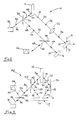
- FIG. 1 there is shown a schematic/block diagram of a first embodiment 10 of the invention which employs a permanent hologram 12 and first and second phase conjugate mirrors (PCMs) 14 and 16, respectively, to form an associative holographic memory.
- PCMs phase conjugate mirrors
- the hologram 12 which may be in the form of a photographic plate, has stored thereon a plurality of images. Each stored image is written onto the hologram 12 using a unique reference beam associated with that image (hereinafter referred to as a stored-image-associated reference beam). - Generally, images are stored on the hologram using plane wave reference beams.
- a hologram When it is illuminated with a reference beam (hereinafter referred to as a probe reference beam) which corresponds to a stored image associated reference beam, it will produce an image (hereinafter referred to as a probe image) corresponding to the particular stored image to which that probe reference is associated.
- a probe reference beam which corresponds to a stored image associated reference beam
- the hologram will produce a probe reference beam which is the unique reference beam associated with that particular stored image.
- the resultant probe reference beam generated consists of a composite of reference beams, primarily containing the correct stored-image-associated reference beam.
- the resultant probe image generated consists of a composite of stored images, primarily containing the correct stored image associated with that reference beam.
- Nonlinear Optical Phase Conjugation In the early 1970's a new field emerged in the area of coherent optics, known as Nonlinear Optical Phase Conjugation (NOPC). As a result of studies and experiments in that field, remarkable devices known as phase conjugate mirrors (PCMs) have been developed. A rather complete discourse on PCMs, including a thorough list of references in the field of NOPC may be found in a paper by one of the coinventors of the present invention, David M. Pepper, entitled “Nonlinear Optical phase Conjugation,” Optical Engineering, Vol. 21, No. 2, March/April, 1982.
- NOPC Nonlinear Optical Phase Conjugation
- a PCM is a device capable of producing a wavefront-reversed replica of a light beam incident on the mirror.
- This backward-going beam called a phase-conjugate wave, exactly retraces the path of the incident beam, ultimately returning to the point of origin of that beam.
- PCM may be used to restore the optical fidelity of an incident wave which has been distorted as it propogates from its source to the PCM.
- PCM devices There are two major classes of PCM devices.
- One class employs the phenomenon of elastic photon scattering in an optically nonlinear medium.
- This medium may consist of a wide variety of gases (e.g. sodium vapor, carbon dioxide, rubidium vapor), solids (e.g. gallium arsenide, silicon, germanium) or liquids (e.g. chlorophyl, organics) as well as plasmas, liquid crystals and aerosols.
- gases e.g. sodium vapor, carbon dioxide, rubidium vapor
- solids e.g. gallium arsenide, silicon, germanium
- liquids e.g. chlorophyl, organics
- a particular type of PCM employing elastic photon scattering involves the interaction of four optical beams in the nonlinear medium.
- This type of PCM is known as a four wave mixing (FWM) PCM.
- the four beams involved include the incident input beam, the outgoing conjugate beam, and two input pump waves which act to sensit
- PCM devices employs the phenomenon of inelastic photon scattering in a nonlinear medium. Interactions such as Raman, Brillouin, and Rayleigh scattering fall under this classification.
- a feature of this class of PCM is its passive nature. The only optical beam required is the input wave to be conjugated. No additional sources (e.g. pump waves) are required However, the amplitude of the conjugate wave is less than that of the input wave.
- Both classes of PCMs can also be configured to provide a threshold effect whereby the output beam is a phase conjugate of only those portions of the input beam which exceed a predetermined threshold level of beam intensity.
- the first PCM 14 which is preferably of the FWM type having input waves 15 and 17, is positioned to receive an input beam hologram generated probe reference wave (depicted in Figure 1 by arrows 18) from the hologram 12 via light path 20.
- a focusing lens 22 is positioned so that the probe reference wave 18 is focused on the PCM 14.
- the PCM 16 which may be of the inelastic photon scattering type, is positioned to receive as an input beam a hologram generated probe image wave (depicted in Figure 1 by arrows 24) from the hologram 12.
- the path from the hologram 12 to the PCM 16 for the probe image wave 24 includes light path 26, beam splitter 28, and light path 30.
- An input object 32 is provided to the hologram 12 as an input probe image.
- the input probe image (depicted in Figure 1 by arrows 34) is conveyed via light path 36 through beam splitter 28 and along path 26 to the hologram 12.
- a beam splitter 38 is provided in the path 30 so that a portion of the waves emanating from the PCM 16 are directed along light path 40 (as shown by arrow 48) to a viewing plane where an output image 44 may be observed.
- the hologram 12 has stored thereon an image (hereinafter referred to as the desired stored image) in the form of a square with a triangle contained therein, and that this image was stored using a stored-image-associated reference beam in the form of a plane wave.
- the hologram 12 may also contain other stored images, each stored using a unique reference beam.
- the input object 32 includes a portion of the desired stored image, for example, just the square portion without the triangle. It is a feature of the associative memory 10 that when presented with an input object resembling a stored object, it will retrieve that stored object. This operation is accomplished as follows.
- the input object 32 in the form of a square, is presented as a probe image 34 to the hologram 12 via light paths 36 and 26.
- the hologram 12 produces a probe reference beam 18 which is focused on PCM 14 by lens 22. Since the probe image 34 contains a portion of the desired stored image, the probe reference beam 18 will be similar to but not identical to the stored-image-associated reference beam. It may be shown by correlation theory that the stored-image-associated component of the probe reference beam will be of higher intensity than the remaining components of the probe reference beam.
- the properties of the PCM 14 can be constructed to include thresholding, amplification, and phase conjugation of the input beam. Accordingly, the probe reference beam 18 is amplified, and only those components which exceed a predetermined threshold of intensity are conjugated.
- the thresholding process acts to enhance those components of the probe reference which correlate most closely to the stored-image-associated reference.
- the amplification acts to overcome the losses in the hologram 12.
- the phase conjugation acts to correct for abberations and distortions of the stored-image-associated reference (e.g. beam divergence).
- the resultant phase conjugated beam (depicted by arrows 46 in Figure I) is returned exactly to its point of origin, the hologram 12, by the PCM 14.
- the beam 46 is hereinafter referred to as the restored probe reference beam since the thresholding and phase conjugation performed by PCM acts in a manner to restore the reference beam 18 to the desired stored-image-associated reference.
- the restored beam 46 impinges on the hologram 12, causing it to produce a probe image 24 which is conveyed to the PCM 16 via light path 26, beam splitter 28 and light path 30.
- the PCM 16 phase conjugates the probe image 24, thus correcting for abberations and distortions, and returns a restored probe image, depicted by arrows 48, to the hologram 12.
- the processes described above for the system 10 repeat, whereby the restored probe image causes the hologram 12 to produce a probe reference beam 18 which is even more closely correlated to the desired stored-image-associated reference.
- the reference beam 18 is further enhanced by the PCM 14 and returned to the hologram 12.
- the system 10 acts as a phase conjugate resonator. Resonance is sustained by assuring that the amplification level of the PCM 14 is sufficient to overcome the losses in the hologram 12 and the PCM 16.
- the resonant nature of the system 10 causes, for each pass of the beams through the system, the probe reference and image beams to eventually converge to the stored-image-associated reference and the stored image, respectively.
- the desired stored image thus appears as the output image 44.
- a permanent hologram 12 was employed, in which images were permanently stored.
- the present invention may also be used in conjunction with a multiple storage and erasure hologram.
- a schematic/block diagram of such an implemenation 50 is shown in Figure 2. The construction and operation of the implemenation 50 is substantially identical to that of the system 10, with the following differences.
- a multiple storage and erasure hologram 52 replaces the permanent hologram 12 of Figure 1.
- the hologram 52 may be formed, for example, of one of a number of photorefractive crystals. A description of such holograms may be found in the paper by D. L. Staebler, W. J. Burke, W. Phillips, and J.J. Amodei entitled “Multiple Storage and Erasure of Fixed Holograms in FE- doped LiNb0 3 ,” Applied Physics Letters, Vol. 26, No. 4, February 15, 1975.
- images are stored in the hologram 52 by illuminating it with the image to be stored and a reference wave. Removal of these beams causes the stored image to be erased, whereupon new images may be stored In certain photorefractive crystals, elevation of the crystal temperature may be used to cause the hologram to retain the stored image, as decribed in the above referenced paper.
- an image (depicted by arrow 54) of the object to be stored 56 is provided to the hologram 52 via light paths 58 and 26.
- a stored-image-associated-reference beam, depicted by arrow 60, is provided to the hologram 52 via light path 62.
- the beams 54 and 60 may be thought of as write beams since they act to write the stored image 54 onto the hologram.
- the write beams are polarized in a first direction, indicated by arrows 64, while the remaining beams in the system 50 are polarized in a second direction, indicated by circles 66, which is orthogonal to the first direction.
- the reference write beam 60 is thus prevented from interacting with the probe and restored reference beams 18 and 46, respectively, by polarizer 68.
- an input object 32 which includes a portion of the desired stored object 56 is provided as input probe image 34 to the hologram 52 via path 36, beam splitter 70, path 30, beam splitter 28, and path 26.
- the remainder of the system 50 behaves in the same manner as that described for the system 10.
- the restored probe image beams 48 from the PCM 16 converge to the desired stored object 56, which is viewable as output image 44.
- the ability of the system 50 to provide multiple storage and erasure of images enables the system 50 to be used as a real time associative memory having a myriad of applications in pattern recognition systems.
- FIG. 1 Another embodiment 80 of the invention, employing only a single phase conjugate mirror 14 is shown in the schematic/block diagram of Figure 3.
- the input image 34 of the input object 32 is provided to the hologram 12 via light path 36, beam splitter 82, light path 83 and light path 26.
- Probe reference beam 18 generated by hologram 12 is provided to PCM 14 via light path 20, focusing lens 22, plane mirror 86, and light path 88. Restored probe reference beam 46 is returned to hologram 12 by PCM 14 via these same paths.
- Probe image beam 24 generated by hologram 12 is provided to PCM 14 via light path 26, beam splitter 84 and light path 30. Restored probe beam 48 is returned to hologram 12 by PCM 24 via these same paths.
- the output image 44 is obtained by viewing the probe image beam 24 from the hologram 12 via light path 26, beamsplitter 84, light path 83, beam splitter 82, and light path 40. It will be appreciated that the single PCM 14 is used in the embodiment 80 to restore both the probe reference and image beams. This is feasible because of the property of the PCM that it will return a phase conjugate of an input beam to its source, regardless of the angle of incidence of that input beam.
- the applications for the embodiment 80 are more limited than those of the previously described embodiments because the same PCM is used to restore both reference and image beams as well as thresholding the reference beams.
- the PCMs 14 and 16 can each be separately optimized in their characteristics to obtain a wider range of system performance. While the system 80 is shown using a permanent hologram 12, the multiple storage and erasure hologram 52 may also be employed.
- the examples used assumed that the input image included a portion of the stored image. In fact, the input image need only resemble one of the stored images in some characteristic. The various systems will then provide as an output image that stored image which is most closely associated with the input image.
- the stored-image-associated reference wave was a simple plane wave.
- this reference wave can be an image of another object or can be an image of the same stored object with which it is associated.
- heteroassociative memories may be formed.
- the components of the systems described above are, for the most part, self-aligning. Alignment is required, however, between the input object 32 and the stored image in the hologram 12. It may be shown that the performance of the embodiments of the present invention will be insensitive to shifts in the input object which are within a distance which is the reciprocal of the spatial frequency bandwidth of the input object.
- Fresnel holograms In order to further increase the invariance to shifts in the position of the input object, Fourier holograms, well known to those skilled in the art, rather than Fresnel holograms, may be employed.
Landscapes
- Engineering & Computer Science (AREA)
- Physics & Mathematics (AREA)
- Health & Medical Sciences (AREA)
- Life Sciences & Earth Sciences (AREA)
- Biomedical Technology (AREA)
- Biophysics (AREA)
- Theoretical Computer Science (AREA)
- Evolutionary Computation (AREA)
- General Engineering & Computer Science (AREA)
- Data Mining & Analysis (AREA)
- Artificial Intelligence (AREA)
- General Health & Medical Sciences (AREA)
- Molecular Biology (AREA)
- Computing Systems (AREA)
- Computational Linguistics (AREA)
- General Physics & Mathematics (AREA)
- Mathematical Physics (AREA)
- Software Systems (AREA)
- Neurology (AREA)
- Holo Graphy (AREA)
- Infusion, Injection, And Reservoir Apparatuses (AREA)
Claims (14)
Applications Claiming Priority (2)
| Application Number | Priority Date | Filing Date | Title |
|---|---|---|---|
| US06/786,884 US4739496A (en) | 1985-10-11 | 1985-10-11 | Associative holographic memory apparatus employing phase conjugate mirrors |
| US786884 | 1985-10-11 |
Publications (2)
| Publication Number | Publication Date |
|---|---|
| EP0243492A1 EP0243492A1 (de) | 1987-11-04 |
| EP0243492B1 true EP0243492B1 (de) | 1990-08-08 |
Family
ID=25139848
Family Applications (1)
| Application Number | Title | Priority Date | Filing Date |
|---|---|---|---|
| EP87900360A Expired - Lifetime EP0243492B1 (de) | 1985-10-11 | 1986-09-26 | Assoziative, holographische speichervorrichtung unter verwendung von phasen-konjugierten spiegeln |
Country Status (6)
| Country | Link |
|---|---|
| US (1) | US4739496A (de) |
| EP (1) | EP0243492B1 (de) |
| JP (1) | JPS63501751A (de) |
| DE (1) | DE3673404D1 (de) |
| IL (1) | IL79991A0 (de) |
| WO (1) | WO1987002505A2 (de) |
Families Citing this family (24)
| Publication number | Priority date | Publication date | Assignee | Title |
|---|---|---|---|---|
| JPS63292495A (ja) * | 1987-05-25 | 1988-11-29 | Agency Of Ind Science & Technol | 光−電気ハイブリット型連想記憶装置 |
| JPH067240B2 (ja) * | 1987-06-10 | 1994-01-26 | 浜松ホトニクス株式会社 | 光学的連想記憶装置 |
| US5526298A (en) * | 1987-06-10 | 1996-06-11 | Hamamatsu Photonics K.K. | Optical associative memory |
| US4860253A (en) * | 1987-06-19 | 1989-08-22 | Hughes Aircraft Company | Associative memory system with spatial light modulator and feedback for adjustable thresholding and enhancement |
| US4837843A (en) * | 1987-06-19 | 1989-06-06 | Hughes Aircraft Company | Hybrid optical and electronic associative memory |
| US4961615A (en) * | 1987-06-19 | 1990-10-09 | Hughes Aircraft Company | Associative memory system with spatial light modulator |
| US4934782A (en) * | 1988-01-19 | 1990-06-19 | Hughes Aircraft Company | Optical thresholding apparatus and method |
| US5132835A (en) * | 1988-07-18 | 1992-07-21 | Northrop Corporation | Continuous-time optical neural network process |
| US5099434A (en) * | 1988-07-18 | 1992-03-24 | Northrop Corporation | Continuous-time optical neural network |
| US5132813A (en) * | 1988-08-18 | 1992-07-21 | Teledyne Industries, Inc. | Neural processor with holographic optical paths and nonlinear operating means |
| US5004309A (en) * | 1988-08-18 | 1991-04-02 | Teledyne Brown Engineering | Neural processor with holographic optical paths and nonlinear operating means |
| US5214745A (en) * | 1988-08-25 | 1993-05-25 | Sutherland John G | Artificial neural device utilizing phase orientation in the complex number domain to encode and decode stimulus response patterns |
| US4953954A (en) * | 1989-02-10 | 1990-09-04 | Rockwell International Corporation | Phase-conjugate communication using mutually incoherent laser beams |
| US4934779A (en) * | 1989-04-24 | 1990-06-19 | Hughes Aircraft Company | System and method for low noise optical retroreflection with gain |
| US5361328A (en) * | 1989-09-28 | 1994-11-01 | Ezel, Inc. | Data processing system using a neural network |
| JP2724374B2 (ja) * | 1989-10-11 | 1998-03-09 | 株式会社鷹山 | データ処理装置 |
| US5039182A (en) * | 1989-10-23 | 1991-08-13 | International Business Machines Corporation | Storing information in dual holographic images |
| JP2784389B2 (ja) * | 1990-03-15 | 1998-08-06 | 日本電信電話株式会社 | 誘導光エコーを用いた光画像処理およびパターン認識装置 |
| US5120133A (en) * | 1990-12-21 | 1992-06-09 | United States Of America Is Represented By The Secretary Of The Navy | Interferometer with two phase-conjugate mirrors |
| US5729660A (en) * | 1994-05-03 | 1998-03-17 | Chiabrera; Alessandro | 3-D inverse scattering by artificial intelligence : apparatus and method |
| CA2551483A1 (en) * | 2003-12-30 | 2005-07-21 | Aprilis, Inc. | Replication of data to holographic medium |
| US7161723B1 (en) * | 2004-09-03 | 2007-01-09 | Storage Technology Corporation | Scheme capable of providing gain and thresholding to the parallel recording and replication of holographic media |
| US20120036098A1 (en) * | 2007-06-14 | 2012-02-09 | The Boeing Company | Analyzing activities of a hostile force |
| US10168599B2 (en) | 2016-01-26 | 2019-01-01 | The Boeing Company | System and method for time reversal situational awareness |
Family Cites Families (6)
| Publication number | Priority date | Publication date | Assignee | Title |
|---|---|---|---|---|
| GB1143086A (en) * | 1965-08-13 | 1969-02-19 | Ibm | Information correlating |
| US3614191A (en) * | 1968-03-29 | 1971-10-19 | Nippon Electric Co | Associative memory employing holography |
| US4005935A (en) * | 1975-07-31 | 1977-02-01 | Hughes Aircraft Company | Method and apparatus for providing a phase compensated optical beam |
| US4275454A (en) * | 1978-12-01 | 1981-06-23 | Environmental Research Institute Of Michigan | Optical system phase error compensator |
| US4529273A (en) * | 1982-12-21 | 1985-07-16 | California Institute Of Technology | Passive phase conjugate mirror |
| US4598973A (en) * | 1984-03-07 | 1986-07-08 | Greenleaf James F | Apparatus and method for recording and displaying a three-dimensional image |
-
1985
- 1985-10-11 US US06/786,884 patent/US4739496A/en not_active Expired - Lifetime
-
1986
- 1986-09-09 IL IL79991A patent/IL79991A0/xx not_active IP Right Cessation
- 1986-09-26 DE DE8787900360T patent/DE3673404D1/de not_active Expired - Fee Related
- 1986-09-26 JP JP62500130A patent/JPS63501751A/ja not_active Withdrawn
- 1986-09-26 EP EP87900360A patent/EP0243492B1/de not_active Expired - Lifetime
- 1986-09-26 WO PCT/US1986/002033 patent/WO1987002505A2/en not_active Ceased
Also Published As
| Publication number | Publication date |
|---|---|
| DE3673404D1 (de) | 1990-09-13 |
| WO1987002505A2 (en) | 1987-04-23 |
| EP0243492A1 (de) | 1987-11-04 |
| WO1987002505A3 (en) | 1987-07-16 |
| IL79991A0 (en) | 1986-12-31 |
| US4739496A (en) | 1988-04-19 |
| JPS63501751A (ja) | 1988-07-14 |
Similar Documents
| Publication | Publication Date | Title |
|---|---|---|
| EP0243492B1 (de) | Assoziative, holographische speichervorrichtung unter verwendung von phasen-konjugierten spiegeln | |
| US4750153A (en) | Associative holographic memory apparatus employing phase conjugate mirrors and a two-wave mixing contra-directional coherent image amplifier | |
| US4837843A (en) | Hybrid optical and electronic associative memory | |
| Soffer et al. | Associative holographic memory with feedback using phase-conjugate mirrors | |
| Owechko et al. | Holographic associative memory with nonlinearities in the correlation domain | |
| US4762397A (en) | Optical phase conjugator with spatially resolvable thresholding utilizing liquid crystal light valve | |
| US4961615A (en) | Associative memory system with spatial light modulator | |
| US4860253A (en) | Associative memory system with spatial light modulator and feedback for adjustable thresholding and enhancement | |
| Berra et al. | The impact of optics on data and knowledge base systems | |
| Wagner et al. | Optical competitive learning with VLSI/liquid-crystal winner-take-all modulators | |
| Psaltis et al. | Optical implementation of neural computers | |
| Owechko et al. | Associative memory in a phase conjugate resonator cavity utilizing a hologram | |
| Fielding et al. | Position, scale, and rotation invariant holographic associative memory | |
| Petts et al. | A Real-Time Optical Image Processing System | |
| Soffer et al. | Holographic associative memory employing phase conjugation | |
| Wunsch et al. | An optical adaptive resonance neural network utilizing phase conjugation | |
| Paek et al. | VanderLugt correlator and neural networks | |
| Frye | Neural network associative memory using non-linear holographic storage media | |
| Gustafson et al. | Neural Network Models Based on Optical Resonator Designs | |
| Kohonen | Optical associative memories | |
| Farhat et al. | Architectures for optical implementation of 2-D content addressable memories | |
| Anderson | Coherent optical Eigenstate memory | |
| Chao et al. | High-speed optical object recognition processor with massive holographic memory | |
| Psaltis et al. | Acoustooptic implementation of neural network models | |
| Dunning et al. | All-optical associative holographic memory with feedback using phase conjugate mirrors |
Legal Events
| Date | Code | Title | Description |
|---|---|---|---|
| PUAI | Public reference made under article 153(3) epc to a published international application that has entered the european phase |
Free format text: ORIGINAL CODE: 0009012 |
|
| 17P | Request for examination filed |
Effective date: 19870605 |
|
| AK | Designated contracting states |
Kind code of ref document: A1 Designated state(s): CH DE FR GB IT LI NL SE |
|
| 17Q | First examination report despatched |
Effective date: 19891026 |
|
| GRAA | (expected) grant |
Free format text: ORIGINAL CODE: 0009210 |
|
| AK | Designated contracting states |
Kind code of ref document: B1 Designated state(s): CH DE FR GB IT LI NL SE |
|
| REF | Corresponds to: |
Ref document number: 3673404 Country of ref document: DE Date of ref document: 19900913 |
|
| ET | Fr: translation filed | ||
| ITF | It: translation for a ep patent filed | ||
| PLBE | No opposition filed within time limit |
Free format text: ORIGINAL CODE: 0009261 |
|
| STAA | Information on the status of an ep patent application or granted ep patent |
Free format text: STATUS: NO OPPOSITION FILED WITHIN TIME LIMIT |
|
| 26N | No opposition filed | ||
| ITTA | It: last paid annual fee | ||
| PGFP | Annual fee paid to national office [announced via postgrant information from national office to epo] |
Ref country code: FR Payment date: 19940808 Year of fee payment: 9 |
|
| PGFP | Annual fee paid to national office [announced via postgrant information from national office to epo] |
Ref country code: CH Payment date: 19940812 Year of fee payment: 9 |
|
| PGFP | Annual fee paid to national office [announced via postgrant information from national office to epo] |
Ref country code: SE Payment date: 19940815 Year of fee payment: 9 Ref country code: GB Payment date: 19940815 Year of fee payment: 9 |
|
| PGFP | Annual fee paid to national office [announced via postgrant information from national office to epo] |
Ref country code: DE Payment date: 19940824 Year of fee payment: 9 |
|
| PGFP | Annual fee paid to national office [announced via postgrant information from national office to epo] |
Ref country code: NL Payment date: 19940930 Year of fee payment: 9 |
|
| EAL | Se: european patent in force in sweden |
Ref document number: 87900360.6 |
|
| PG25 | Lapsed in a contracting state [announced via postgrant information from national office to epo] |
Ref country code: GB Effective date: 19950926 |
|
| PG25 | Lapsed in a contracting state [announced via postgrant information from national office to epo] |
Ref country code: SE Effective date: 19950927 |
|
| PG25 | Lapsed in a contracting state [announced via postgrant information from national office to epo] |
Ref country code: LI Effective date: 19950930 Ref country code: CH Effective date: 19950930 |
|
| PG25 | Lapsed in a contracting state [announced via postgrant information from national office to epo] |
Ref country code: NL Effective date: 19960401 |
|
| REG | Reference to a national code |
Ref country code: CH Ref legal event code: PL |
|
| GBPC | Gb: european patent ceased through non-payment of renewal fee |
Effective date: 19950926 |
|
| PG25 | Lapsed in a contracting state [announced via postgrant information from national office to epo] |
Ref country code: FR Effective date: 19960531 |
|
| PG25 | Lapsed in a contracting state [announced via postgrant information from national office to epo] |
Ref country code: DE Effective date: 19960601 |
|
| NLV4 | Nl: lapsed or anulled due to non-payment of the annual fee |
Effective date: 19960401 |
|
| EUG | Se: european patent has lapsed |
Ref document number: 87900360.6 |
|
| REG | Reference to a national code |
Ref country code: FR Ref legal event code: ST |
|
| PG25 | Lapsed in a contracting state [announced via postgrant information from national office to epo] |
Ref country code: IT Free format text: LAPSE BECAUSE OF NON-PAYMENT OF DUE FEES Effective date: 20050926 |