EP0243161B1 - Microwave-absorptive composite - Google Patents
Microwave-absorptive composite Download PDFInfo
- Publication number
- EP0243161B1 EP0243161B1 EP87303520A EP87303520A EP0243161B1 EP 0243161 B1 EP0243161 B1 EP 0243161B1 EP 87303520 A EP87303520 A EP 87303520A EP 87303520 A EP87303520 A EP 87303520A EP 0243161 B1 EP0243161 B1 EP 0243161B1
- Authority
- EP
- European Patent Office
- Prior art keywords
- sheet
- absorptive composite
- layer
- microwave absorptive
- microwave
- Prior art date
- Legal status (The legal status is an assumption and is not a legal conclusion. Google has not performed a legal analysis and makes no representation as to the accuracy of the status listed.)
- Expired - Lifetime
Links
- 239000002131 composite material Substances 0.000 title claims description 23
- 229920005989 resin Polymers 0.000 claims description 24
- 239000011347 resin Substances 0.000 claims description 24
- 239000006229 carbon black Substances 0.000 claims description 17
- 229910052751 metal Inorganic materials 0.000 claims description 13
- 239000002184 metal Substances 0.000 claims description 13
- 229920002379 silicone rubber Polymers 0.000 claims description 12
- 229920001187 thermosetting polymer Polymers 0.000 claims description 11
- 229920001971 elastomer Polymers 0.000 claims description 10
- 239000005060 rubber Substances 0.000 claims description 10
- XEEYBQQBJWHFJM-UHFFFAOYSA-N Iron Chemical compound [Fe] XEEYBQQBJWHFJM-UHFFFAOYSA-N 0.000 claims description 8
- 239000004944 Liquid Silicone Rubber Substances 0.000 claims description 8
- 239000000835 fiber Substances 0.000 claims description 8
- 229920000049 Carbon (fiber) Polymers 0.000 claims description 7
- 239000004917 carbon fiber Substances 0.000 claims description 7
- 229910052782 aluminium Inorganic materials 0.000 claims description 6
- XAGFODPZIPBFFR-UHFFFAOYSA-N aluminium Chemical compound [Al] XAGFODPZIPBFFR-UHFFFAOYSA-N 0.000 claims description 6
- 239000004593 Epoxy Substances 0.000 claims description 5
- VNWKTOKETHGBQD-UHFFFAOYSA-N methane Chemical compound C VNWKTOKETHGBQD-UHFFFAOYSA-N 0.000 claims description 5
- 229920003986 novolac Polymers 0.000 claims description 5
- RYGMFSIKBFXOCR-UHFFFAOYSA-N Copper Chemical compound [Cu] RYGMFSIKBFXOCR-UHFFFAOYSA-N 0.000 claims description 4
- VYPSYNLAJGMNEJ-UHFFFAOYSA-N Silicium dioxide Chemical compound O=[Si]=O VYPSYNLAJGMNEJ-UHFFFAOYSA-N 0.000 claims description 4
- 229910052802 copper Inorganic materials 0.000 claims description 4
- 239000010949 copper Substances 0.000 claims description 4
- 229910052742 iron Inorganic materials 0.000 claims description 4
- 239000004945 silicone rubber Substances 0.000 claims description 4
- 239000005011 phenolic resin Substances 0.000 claims description 3
- 229920001721 polyimide Polymers 0.000 claims description 3
- 239000009719 polyimide resin Substances 0.000 claims description 3
- 229920006305 unsaturated polyester Polymers 0.000 claims description 3
- 229910000838 Al alloy Inorganic materials 0.000 claims description 2
- 229910052582 BN Inorganic materials 0.000 claims description 2
- PZNSFCLAULLKQX-UHFFFAOYSA-N Boron nitride Chemical compound N#B PZNSFCLAULLKQX-UHFFFAOYSA-N 0.000 claims description 2
- 229910001369 Brass Inorganic materials 0.000 claims description 2
- 239000004952 Polyamide Substances 0.000 claims description 2
- 239000004372 Polyvinyl alcohol Substances 0.000 claims description 2
- PNEYBMLMFCGWSK-UHFFFAOYSA-N aluminium oxide Inorganic materials [O-2].[O-2].[O-2].[Al+3].[Al+3] PNEYBMLMFCGWSK-UHFFFAOYSA-N 0.000 claims description 2
- 239000010951 brass Substances 0.000 claims description 2
- 239000003822 epoxy resin Substances 0.000 claims description 2
- 229920002647 polyamide Polymers 0.000 claims description 2
- 229920000647 polyepoxide Polymers 0.000 claims description 2
- 229920000728 polyester Polymers 0.000 claims description 2
- 229920002451 polyvinyl alcohol Polymers 0.000 claims description 2
- HBMJWWWQQXIZIP-UHFFFAOYSA-N silicon carbide Chemical compound [Si+]#[C-] HBMJWWWQQXIZIP-UHFFFAOYSA-N 0.000 claims description 2
- 229910010271 silicon carbide Inorganic materials 0.000 claims description 2
- 239000000377 silicon dioxide Substances 0.000 claims description 2
- NIXOWILDQLNWCW-UHFFFAOYSA-N acrylic acid group Chemical group C(C=C)(=O)O NIXOWILDQLNWCW-UHFFFAOYSA-N 0.000 claims 1
- 229940105289 carbon black Drugs 0.000 description 15
- 235000019241 carbon black Nutrition 0.000 description 15
- 239000000203 mixture Substances 0.000 description 12
- 238000010521 absorption reaction Methods 0.000 description 9
- 239000006096 absorbing agent Substances 0.000 description 8
- 239000004744 fabric Substances 0.000 description 7
- 239000000463 material Substances 0.000 description 5
- 239000004760 aramid Substances 0.000 description 3
- 229920003235 aromatic polyamide Polymers 0.000 description 3
- 230000009477 glass transition Effects 0.000 description 3
- 239000012784 inorganic fiber Substances 0.000 description 3
- 238000012856 packing Methods 0.000 description 3
- 239000003973 paint Substances 0.000 description 3
- 239000002245 particle Substances 0.000 description 3
- 239000000126 substance Substances 0.000 description 3
- 229910000859 α-Fe Inorganic materials 0.000 description 3
- QTWJRLJHJPIABL-UHFFFAOYSA-N 2-methylphenol;3-methylphenol;4-methylphenol Chemical compound CC1=CC=C(O)C=C1.CC1=CC=CC(O)=C1.CC1=CC=CC=C1O QTWJRLJHJPIABL-UHFFFAOYSA-N 0.000 description 2
- MQJKPEGWNLWLTK-UHFFFAOYSA-N Dapsone Chemical compound C1=CC(N)=CC=C1S(=O)(=O)C1=CC=C(N)C=C1 MQJKPEGWNLWLTK-UHFFFAOYSA-N 0.000 description 2
- 229920000271 Kevlar® Polymers 0.000 description 2
- KWYHDKDOAIKMQN-UHFFFAOYSA-N N,N,N',N'-tetramethylethylenediamine Chemical compound CN(C)CCN(C)C KWYHDKDOAIKMQN-UHFFFAOYSA-N 0.000 description 2
- 239000000853 adhesive Substances 0.000 description 2
- 230000001070 adhesive effect Effects 0.000 description 2
- 230000000052 comparative effect Effects 0.000 description 2
- 229930003836 cresol Natural products 0.000 description 2
- 239000004761 kevlar Substances 0.000 description 2
- 239000007787 solid Substances 0.000 description 2
- DNIAPMSPPWPWGF-VKHMYHEASA-N (+)-propylene glycol Chemical compound C[C@H](O)CO DNIAPMSPPWPWGF-VKHMYHEASA-N 0.000 description 1
- YPFDHNVEDLHUCE-UHFFFAOYSA-N 1,3-propanediol Substances OCCCO YPFDHNVEDLHUCE-UHFFFAOYSA-N 0.000 description 1
- XMNIXWIUMCBBBL-UHFFFAOYSA-N 2-(2-phenylpropan-2-ylperoxy)propan-2-ylbenzene Chemical compound C=1C=CC=CC=1C(C)(C)OOC(C)(C)C1=CC=CC=C1 XMNIXWIUMCBBBL-UHFFFAOYSA-N 0.000 description 1
- KUBDPQJOLOUJRM-UHFFFAOYSA-N 2-(chloromethyl)oxirane;4-[2-(4-hydroxyphenyl)propan-2-yl]phenol Chemical compound ClCC1CO1.C=1C=C(O)C=CC=1C(C)(C)C1=CC=C(O)C=C1 KUBDPQJOLOUJRM-UHFFFAOYSA-N 0.000 description 1
- YPACMOORZSDQDQ-UHFFFAOYSA-N 3-(4-aminobenzoyl)oxypropyl 4-aminobenzoate Chemical compound C1=CC(N)=CC=C1C(=O)OCCCOC(=O)C1=CC=C(N)C=C1 YPACMOORZSDQDQ-UHFFFAOYSA-N 0.000 description 1
- HCHKCACWOHOZIP-UHFFFAOYSA-N Zinc Chemical compound [Zn] HCHKCACWOHOZIP-UHFFFAOYSA-N 0.000 description 1
- QTBSBXVTEAMEQO-UHFFFAOYSA-N acetic acid Substances CC(O)=O QTBSBXVTEAMEQO-UHFFFAOYSA-N 0.000 description 1
- CSCPPACGZOOCGX-UHFFFAOYSA-N acetone Substances CC(C)=O CSCPPACGZOOCGX-UHFFFAOYSA-N 0.000 description 1
- -1 acryl Chemical group 0.000 description 1
- 230000005540 biological transmission Effects 0.000 description 1
- 230000015572 biosynthetic process Effects 0.000 description 1
- 239000003054 catalyst Substances 0.000 description 1
- 230000007547 defect Effects 0.000 description 1
- 230000001419 dependent effect Effects 0.000 description 1
- 230000000694 effects Effects 0.000 description 1
- 239000011888 foil Substances 0.000 description 1
- 239000003365 glass fiber Substances 0.000 description 1
- JEIPFZHSYJVQDO-UHFFFAOYSA-N iron(III) oxide Inorganic materials O=[Fe]O[Fe]=O JEIPFZHSYJVQDO-UHFFFAOYSA-N 0.000 description 1
- 239000004922 lacquer Substances 0.000 description 1
- 239000007788 liquid Substances 0.000 description 1
- 238000004519 manufacturing process Methods 0.000 description 1
- 239000011159 matrix material Substances 0.000 description 1
- 239000005022 packaging material Substances 0.000 description 1
- 229920001296 polysiloxane Polymers 0.000 description 1
- 229920000166 polytrimethylene carbonate Polymers 0.000 description 1
- 239000000843 powder Substances 0.000 description 1
- 230000005855 radiation Effects 0.000 description 1
- 238000009877 rendering Methods 0.000 description 1
- 239000013464 silicone adhesive Substances 0.000 description 1
- 229920003051 synthetic elastomer Polymers 0.000 description 1
- 229920002994 synthetic fiber Polymers 0.000 description 1
- 239000012209 synthetic fiber Substances 0.000 description 1
- 229920003002 synthetic resin Polymers 0.000 description 1
- 239000000057 synthetic resin Substances 0.000 description 1
- 239000005061 synthetic rubber Substances 0.000 description 1
- 238000009827 uniform distribution Methods 0.000 description 1
- 239000011701 zinc Substances 0.000 description 1
- 229910052725 zinc Inorganic materials 0.000 description 1
Images
Classifications
-
- B—PERFORMING OPERATIONS; TRANSPORTING
- B32—LAYERED PRODUCTS
- B32B—LAYERED PRODUCTS, i.e. PRODUCTS BUILT-UP OF STRATA OF FLAT OR NON-FLAT, e.g. CELLULAR OR HONEYCOMB, FORM
- B32B25/00—Layered products comprising a layer of natural or synthetic rubber
- B32B25/10—Layered products comprising a layer of natural or synthetic rubber next to a fibrous or filamentary layer
-
- B—PERFORMING OPERATIONS; TRANSPORTING
- B32—LAYERED PRODUCTS
- B32B—LAYERED PRODUCTS, i.e. PRODUCTS BUILT-UP OF STRATA OF FLAT OR NON-FLAT, e.g. CELLULAR OR HONEYCOMB, FORM
- B32B25/00—Layered products comprising a layer of natural or synthetic rubber
- B32B25/20—Layered products comprising a layer of natural or synthetic rubber comprising silicone rubber
-
- B—PERFORMING OPERATIONS; TRANSPORTING
- B32—LAYERED PRODUCTS
- B32B—LAYERED PRODUCTS, i.e. PRODUCTS BUILT-UP OF STRATA OF FLAT OR NON-FLAT, e.g. CELLULAR OR HONEYCOMB, FORM
- B32B7/00—Layered products characterised by the relation between layers; Layered products characterised by the relative orientation of features between layers, or by the relative values of a measurable parameter between layers, i.e. products comprising layers having different physical, chemical or physicochemical properties; Layered products characterised by the interconnection of layers
- B32B7/04—Interconnection of layers
- B32B7/12—Interconnection of layers using interposed adhesives or interposed materials with bonding properties
-
- H—ELECTRICITY
- H01—ELECTRIC ELEMENTS
- H01Q—ANTENNAS, i.e. RADIO AERIALS
- H01Q17/00—Devices for absorbing waves radiated from an antenna; Combinations of such devices with active antenna elements or systems
- H01Q17/005—Devices for absorbing waves radiated from an antenna; Combinations of such devices with active antenna elements or systems using woven or wound filaments; impregnated nets or clothes
-
- B—PERFORMING OPERATIONS; TRANSPORTING
- B32—LAYERED PRODUCTS
- B32B—LAYERED PRODUCTS, i.e. PRODUCTS BUILT-UP OF STRATA OF FLAT OR NON-FLAT, e.g. CELLULAR OR HONEYCOMB, FORM
- B32B2260/00—Layered product comprising an impregnated, embedded, or bonded layer wherein the layer comprises an impregnation, embedding, or binder material
- B32B2260/02—Composition of the impregnated, bonded or embedded layer
- B32B2260/021—Fibrous or filamentary layer
-
- B—PERFORMING OPERATIONS; TRANSPORTING
- B32—LAYERED PRODUCTS
- B32B—LAYERED PRODUCTS, i.e. PRODUCTS BUILT-UP OF STRATA OF FLAT OR NON-FLAT, e.g. CELLULAR OR HONEYCOMB, FORM
- B32B2260/00—Layered product comprising an impregnated, embedded, or bonded layer wherein the layer comprises an impregnation, embedding, or binder material
- B32B2260/04—Impregnation, embedding, or binder material
- B32B2260/046—Synthetic resin
-
- B—PERFORMING OPERATIONS; TRANSPORTING
- B32—LAYERED PRODUCTS
- B32B—LAYERED PRODUCTS, i.e. PRODUCTS BUILT-UP OF STRATA OF FLAT OR NON-FLAT, e.g. CELLULAR OR HONEYCOMB, FORM
- B32B2307/00—Properties of the layers or laminate
- B32B2307/50—Properties of the layers or laminate having particular mechanical properties
- B32B2307/56—Damping, energy absorption
-
- B—PERFORMING OPERATIONS; TRANSPORTING
- B32—LAYERED PRODUCTS
- B32B—LAYERED PRODUCTS, i.e. PRODUCTS BUILT-UP OF STRATA OF FLAT OR NON-FLAT, e.g. CELLULAR OR HONEYCOMB, FORM
- B32B2309/00—Parameters for the laminating or treatment process; Apparatus details
- B32B2309/60—In a particular environment
- B32B2309/68—Vacuum
Definitions
- This invention relates to microwave-absorptive composite materials for use in ships, aircrafts and other mobile objects.
- Microwave-absorptive materials are broadly classified into an attenuation type in which the energy of incident wave attenuates as it passes through the absorber, and a matching type in which the amount of reflection of incident wave on the front surface of the absorber and that of reflection of wave from a reflector on the rear surface of the absorber are controlled so as to in effect eliminate the generation of reflected wave.
- a typical matching-type wave absorber well known in the art comprises an absorbing layer made up of a synthetic resin or rubber sheet carrying magnetic ferrite (Fe2O3).
- This type of material excels of course in wave absorption, but is rather heavy, hence unsuitable for light-weight applications and furthermore structurally weak as it is a resinous or rubber sheet simply admixed with ferrite.
- Such absorber was however effective only in handling a narrow band of microwaves. It has been known that wave absorption over wide bands can be achieved by the use of multi-layered absorbers. This would however involve considerable difficulty in fabrication chiefly because of the different characteristic properties of the different layers.
- the outermost layer consists usually of fiber-reinforced thermosetting resin.
- the intermediate layer contains carbonblack particles to permit partial absorption and partial transmission of incident wave and hence cannot for this reason be the same composition as the outermost layer.
- the innermost layer must be of a different composition having metal or carbon fibers to afford wave reflection.
- GB-A-1, 074, 971 discloses a laminated microwave absorptive packaging material comprising; a fibrous packing material; a microwave absorptive layer applied to one surface of the said packing material, said surface facing away from the incident microwave radiation; and a reflecting layer consisting either of a metallic foil or a metallic powder sprayed with a lacquer, said absorptive layer being intermediate the packing material and the reflecting layer.
- GB-A-1,074 971 does not disclose an intermediate layer comprising a normally liquid silicone rubber filled with carbonblack.
- GB-A-1, 074, 971 does not address the problem of providing a microwave absorptive composite which has excellent heat resistance and structural strength and which is free from distortion or warping.
- the present invention is aimed at the provision of an improved microwave absorptive composite which is capable of wave absorption over a wide band; free from deformation or distortion; and excellent in heat resistance and structural strength.
- the invention provides a microwave absorptive composite as claimed in claims 1 to 10.
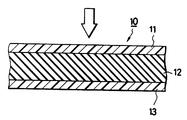
- the microwave absorptive composite 10 comprises at least three different layers; i.e. an outermost layer 11, an intermediate layer 12 and an innermost layer 13 which are laminated or otherwise united in this order.
- the arrow indicates the direction of incidence of a microwave.
- the outermost layer 11 comprises a thermosetting resin impregnated with an organic or inorganic fiber.
- the thermosetting resin is selected from the group consisting of epoxy, unsaturated polyester, novolak, polyimide and phenol resins.
- the organic fiber includes synthetic fibers of polyester, polyamide, acryl and polyvinyl alcohol, of which an aromatic polyamide fiber is preferred for its heat resistance and mechanical strength.
- the inorganic fiber includes silica, silicon carbide, alumina, and boron nitride.
- the organic and inorganic fibers may be disposed in the form of a woven or knitted fabric, or a blind. Alternatively, the fibers may be simply combed unidirectionally where they are relatively long, or may be dispersed randomly where they are relatively short.
- the outermost layer 11 may further consist of an additional layer or layers including small quantities of particulate carbonblack admixed in the thermosetting resin.
- the thickness of the outermost layer 11 is preferably in the range of 2.0 - 6.4 mm, more preferably in the range of 2.8 - 4.5 mm.
- the intermediate layer 12 comprises a silicone rubber admixed with carbonblack particles.
- a normally liquid silicone rubber having dispersed therein a particulate carbonblack.
- the tan ⁇ value approximates 1 with liquid silicone rubber, which literally indicates increased absorption and reduced reflection of microwaves.
- the choice of silicone as the liquid rubber is attributed to its resistance to heat and low temperature alike, rendering the wave absorber suitable for application with ocean- and air-crafts.
- Liquid silicone rubber eligible for the purpose of the invention is of a one-pack type such as de-acetic acid type, de-oxime type and de-acetone type, or of a two-pack type catalytically curable, both of which are curable preferably at room temperature but may be cured with heat at about 50° - 200°C.
- Carbonblack contents in the intermediate layer 12, though dependent upon the composition of the outermost layer 11, are preferably 50% by weight or less, more preferably 20 - 40% by weight, as it is difficult to make uniform distribution of more than 50 wt.% carbonblack over the rubber layer.
- the thickness of the layer 12 is preferably 0.25 - 4 mm, more preferably 0.8 - 2.0 mm.
- the innermost layer 13 consists of a sheet of thermosetting resin reinforced with carbon fiber or wire mesh, a sheet of metal, a resinous sheet incorporating a particulate metal, or a resinous sheet surface-welded with a metal.
- the carbon fiber if cut short, may be randomly dispersed, and if long, may be drawn unidirectionally together. It may be knitted into a grid form.
- thermosetting resin for the innermost layer 13 may be epoxy, unsaturated polyester, novolak, polyimide and phenol resins.
- the wire mesh referred to above may be made of aluminum, iron, copper and brass.
- the resinous sheet containing a particulate metal may be an epoxy resin and the particulate metal therefor may be aluminum, iron and copper.
- the metal sheet used for the innermost layer may be a sheet of lightweight aluminum or aluminum alloys.
- the intermediate layer 12 may be pre-cured and sandwiched between the outer and inner layers 11 and 13 that are unhardened and then cured to set, or the outer and inner layers 11 and 13 may be hardened separately and the intermediate layer 12 is interposed therebetween and then cured together, or all of the three layers may be separately cured and adhesively bonded together.
- ELM 434 cresol novolak epoxy
- CUA-4 1,3-propanediol
- the resulting prepreg upon hardening showed a glass-transition temperature of 230°C.
- C-Pre a prepreg (C-Pre) of carbon fiber cloth.
- 100 parts by weight of liquid silicone rubber (tradename KE-108, manufactured by Shinetsu Chemical Industry Co.) and 40 parts by weight of carbonblack (ISAF) were admixed and pulverized by a paint mill.
- the rubber was press-formed at 80°C and 0.9806 MPa (10 kg/cm2) for 30 minutes into a sheet 1.8 mm thick.
- This sheet was laminated on one side with 15 sheets of K-Pre and on the other side with 7 sheets of C-Pre, and then cured in an autoclave at 180°C and 0.6374 MPa (6.5 kg/cm2) for 2 hours.
- the resulting composite was found perfectly flat with no warp or sag, and tested for microwave absorption capabilities to show above 14 dB over a given band.
- K-Pre and C-Pre both prepared as per Inventive Example 1 were cured in an autoclave.
- the rubber sheet was also made as in Inventive Example 1.
- the three layers were bonded together with a silicone adhesive.
- the resulting composite was flat and free of surface defects. Wave absorption test showed above 20 dB over a given microwave band.
- the intermediate layer was interposed between separately cured outer and inner layers and bonded in place with an adhesive of the same blend as the matrix resin for each layer and pressed into a sheet at l80°C for 2 hours.
- the resulting composite sheet when removed from the press was found considerably warped. This was attributable to large thermal expansion differences between the respective layers and was not improved even through many different curing conditions for the adhesive.
- ELM 434 cresol novolak epoxy
- Sumicure S
- the resulting prepreg upon hardening showed a glass-transition temperature of 235°C.
- C-Pre a prepreg (C-Pre) of carbon fiber cloth.
- 100 parts by weight of liquid silicone rubber (tradename KE-108, manufactured by Shinetsu Chemical Industry Co.) and 40 parts by weight of carbonblack (ISAF) were admixed and pulverized by a paint mill.
- the rubber was press-formed at 80°C and 0.9806 MPa (10 kg/cm2) for 30 minutes into a sheet 1.8 mm thick.
- This sheet was laminated on one side with 15 sheets of K-Pre and on the other side with 7 sheets of C-Pre, and then cured in an autoclave at 180°C and 0.6374 MPa (6.5 kg/cm2) for 2 hours.
- the resulting composite was found perfectly flat with no warp or sag, and tested for microwave absorption capabilities to show above 15 dB over a given band.
- a prepreg (G-Pre) was prepared from a cloth of glass fibers and a blend of resins including 72 grams of a resin chiefly including bismaleimide-triazine resin (tradename BT 2160, manufactured by Mitsubishi Gas Chemical Co.), 28 grams of an expoxy resin (tradename Epikote 1001, manufactured by Yuka Shell Co.), and 0.22 gram of catalyst (0.02 gram of zinc octanonate and 0.2 gram of dicumyl peroxide), as in Inventive Example 1. Also a prepreg (C-Pre) was prepared from the same blend of resins and a cloth of carbon fibers, as in Inventive Example 1. The resulting prepreg upon hardening showed a glass-transition temperature of 220°C.
- liquid silicone rubber (tradename KE-108, manufactured by Shinetsu Chemical Industry Co.) and 40 parts by weight of carbonblack (ISAF) were admixed and pulverized by a paint mill.
- the rubber was press-formed at 80°C and 0.9806 MPa (10 kg/cm2) for 30 minutes into a sheet 1.8 mm thick.
- This sheet was laminated on one side with 15 wheets of G-Pre and on the other side with 7 sheets of C-Pre, and then cured in an autoclave at 180°C and 0.6374 MPa (6.5 kg/cm2) for 2 hours.
- the resulting composite was found perfectly flat with no warp or sag, and tested for microwave absorption capabilities to show above 14 dB over a given band.
Landscapes
- Laminated Bodies (AREA)
- Reinforced Plastic Materials (AREA)
- Shielding Devices Or Components To Electric Or Magnetic Fields (AREA)
Description
- This invention relates to microwave-absorptive composite materials for use in ships, aircrafts and other mobile objects.
- Microwave-absorptive materials are broadly classified into an attenuation type in which the energy of incident wave attenuates as it passes through the absorber, and a matching type in which the amount of reflection of incident wave on the front surface of the absorber and that of reflection of wave from a reflector on the rear surface of the absorber are controlled so as to in effect eliminate the generation of reflected wave.
- A typical matching-type wave absorber well known in the art comprises an absorbing layer made up of a synthetic resin or rubber sheet carrying magnetic ferrite (Fe₂O₃). This type of material excels of course in wave absorption, but is rather heavy, hence unsuitable for light-weight applications and furthermore structurally weak as it is a resinous or rubber sheet simply admixed with ferrite. Attempts were made to produce a light-weight microwave absorber from a rubber composition having dispersed therein carbonblack particles in place of ferrite. Such absorber was however effective only in handling a narrow band of microwaves. It has been known that wave absorption over wide bands can be achieved by the use of multi-layered absorbers. This would however involve considerable difficulty in fabrication chiefly because of the different characteristic properties of the different layers. The outermost layer consists usually of fiber-reinforced thermosetting resin. Whereas, the intermediate layer contains carbonblack particles to permit partial absorption and partial transmission of incident wave and hence cannot for this reason be the same composition as the outermost layer. Likewise, the innermost layer must be of a different composition having metal or carbon fibers to afford wave reflection. Thus, all these layers are different in linear expansion coefficient with the result that the finished product upon formation with heat becomes strained, warped or otherwise deformed.
- GB-A-1, 074, 971 discloses a laminated microwave absorptive packaging material comprising;
a fibrous packing material;
a microwave absorptive layer applied to one surface of the said packing material, said surface facing away from the incident microwave radiation;
and a reflecting layer consisting either of a metallic foil or a metallic powder sprayed with a lacquer, said absorptive layer being intermediate the packing material and the reflecting layer. - However, GB-A-1,074 971 does not disclose an intermediate layer comprising a normally liquid silicone rubber filled with carbonblack.
- Moreover, GB-A-1, 074, 971 does not address the problem of providing a microwave absorptive composite which has excellent heat resistance and structural strength and which is free from distortion or warping.
- With the foregoing difficulties of the prior art in view, the present invention is aimed at the provision of an improved microwave absorptive composite which is capable of wave absorption over a wide band; free from deformation or distortion; and excellent in heat resistance and structural strength.
- This and other objects and features of the invention will be better understood from the following detailed description.
- The invention provides a microwave absorptive composite as claimed in claims 1 to 10.
- The accompanying drawing is a cross-sectional view of part of the microwave absorptive composite embodying the invention.
- As shown in the drawing, the microwave
absorptive composite 10 comprises at least three different layers; i.e. anoutermost layer 11, anintermediate layer 12 and aninnermost layer 13 which are laminated or otherwise united in this order. The arrow indicates the direction of incidence of a microwave. - The
outermost layer 11 comprises a thermosetting resin impregnated with an organic or inorganic fiber. The thermosetting resin is selected from the group consisting of epoxy, unsaturated polyester, novolak, polyimide and phenol resins. The organic fiber includes synthetic fibers of polyester, polyamide, acryl and polyvinyl alcohol, of which an aromatic polyamide fiber is preferred for its heat resistance and mechanical strength. The inorganic fiber includes silica, silicon carbide, alumina, and boron nitride. When impregnated in the thermosetting resin, the organic and inorganic fibers may be disposed in the form of a woven or knitted fabric, or a blind. Alternatively, the fibers may be simply combed unidirectionally where they are relatively long, or may be dispersed randomly where they are relatively short. - The
outermost layer 11 may further consist of an additional layer or layers including small quantities of particulate carbonblack admixed in the thermosetting resin. - The thickness of the
outermost layer 11 is preferably in the range of 2.0 - 6.4 mm, more preferably in the range of 2.8 - 4.5 mm. - Turning to the
intermediate layer 12, this comprises a silicone rubber admixed with carbonblack particles. According to an important aspect of the invention, there is used a normally liquid silicone rubber having dispersed therein a particulate carbonblack. Conventional normally solid rubber when added with carbonblack exhibits a dielectric loss factor (tan δ = ε"/ε') of much smaller than 1. In fact, this value would be as small as 0.41 in the case where 30 parts by weight of carbonblack is used per 100 parts by weight of solid silicone rubber. In contrast to this, the tan δ value approximates 1 with liquid silicone rubber, which literally indicates increased absorption and reduced reflection of microwaves. The choice of silicone as the liquid rubber is attributed to its resistance to heat and low temperature alike, rendering the wave absorber suitable for application with ocean- and air-crafts. - Liquid silicone rubber eligible for the purpose of the invention is of a one-pack type such as de-acetic acid type, de-oxime type and de-acetone type, or of a two-pack type catalytically curable, both of which are curable preferably at room temperature but may be cured with heat at about 50° - 200°C.
- Carbonblack contents in the
intermediate layer 12, though dependent upon the composition of theoutermost layer 11, are preferably 50% by weight or less, more preferably 20 - 40% by weight, as it is difficult to make uniform distribution of more than 50 wt.% carbonblack over the rubber layer. There may be provided a plurality of layers each having different carbonblack contents. The thickness of thelayer 12 is preferably 0.25 - 4 mm, more preferably 0.8 - 2.0 mm. - Now, the
innermost layer 13 consists of a sheet of thermosetting resin reinforced with carbon fiber or wire mesh, a sheet of metal, a resinous sheet incorporating a particulate metal, or a resinous sheet surface-welded with a metal. The carbon fiber, if cut short, may be randomly dispersed, and if long, may be drawn unidirectionally together. It may be knitted into a grid form. - The thermosetting resin for the
innermost layer 13 may be epoxy, unsaturated polyester, novolak, polyimide and phenol resins. - The wire mesh referred to above may be made of aluminum, iron, copper and brass.
- The resinous sheet containing a particulate metal may be an epoxy resin and the particulate metal therefor may be aluminum, iron and copper.
- The metal sheet used for the innermost layer may be a sheet of lightweight aluminum or aluminum alloys.
- The above three
layers intermediate layer 12 may be pre-cured and sandwiched between the outer andinner layers inner layers intermediate layer 12 is interposed therebetween and then cured together, or all of the three layers may be separately cured and adhesively bonded together. - A blend of resins including 80 grams of N,N,N',N'-tetraglycidyl di-(para aminodiphenyl)-methane (tradename ELM 434, manufactured by Sumitomo Chemical Co.), 20 grams of cresol novolak epoxy (tradename ESCN 220 HH, manufactured by Sumitomo Chemical Co.), 44 grams of 1,3-propanediol di-para-aminobenzoate (tradename CUA-4, manufactured by Iraha Chemical Co.), and 0.5 gram of BF₃-monoethylamine complex (tradename Sumicure BF-M, manufactured by Sumitomo Chemical Co.) was formed into a sheet 0.25 mm thick which was laminated with a cloth of aromatic polyamide fiber (tradename Kevlar, manufactured by Dupont) and then impregnated with resin to provide a prepreg (K-Pre). The resulting prepreg upon hardening showed a glass-transition temperature of 230°C. In a similar manner, there was prepared a prepreg (C-Pre) of carbon fiber cloth. 100 parts by weight of liquid silicone rubber (tradename KE-108, manufactured by Shinetsu Chemical Industry Co.) and 40 parts by weight of carbonblack (ISAF) were admixed and pulverized by a paint mill. The rubber was press-formed at 80°C and 0.9806 MPa (10 kg/cm²) for 30 minutes into a sheet 1.8 mm thick. This sheet was laminated on one side with 15 sheets of K-Pre and on the other side with 7 sheets of C-Pre, and then cured in an autoclave at 180°C and 0.6374 MPa (6.5 kg/cm²) for 2 hours. The resulting composite was found perfectly flat with no warp or sag, and tested for microwave absorption capabilities to show above 14 dB over a given band.
- K-Pre and C-Pre both prepared as per Inventive Example 1 were cured in an autoclave. The rubber sheet was also made as in Inventive Example 1. The three layers were bonded together with a silicone adhesive. The resulting composite was flat and free of surface defects. Wave absorption test showed above 20 dB over a given microwave band.
- There was prepared an intermediate layer from a blend of thermosetting resins of the same composition as that of the outer and inner layers, the blend being similar to Inventive Example 1 and admixed with carbonblack. The resinous layer was laminated on one side with C-Pre and on the other side with K-Pre and cured in an autoclave. The resulting composite was found warped. The intermediate layer cracked when cooled to room temperature.
- The intermediate layer was interposed between separately cured outer and inner layers and bonded in place with an adhesive of the same blend as the matrix resin for each layer and pressed into a sheet at l80°C for 2 hours. The resulting composite sheet when removed from the press was found considerably warped. This was attributable to large thermal expansion differences between the respective layers and was not improved even through many different curing conditions for the adhesive.
- A blend of resins including 80 grams of N,N,N',N'-tetraglycidyl di-(para-aminodiphenyl)-methane (tradename ELM 434, manufactured by Sumitomo Chemical Co.), 20 grams of cresol novolak epoxy (tradename ESCN 220 HH, manufactured by Sumitomo Chemical Co.), 35 grams of 4,4'-diaminodiphenylsulfone (tradename Sumicure S, manufactured by Sumitomo Chemical Co.), and 0.5 gram of BF₃-monoethylamine complex (tradename Sumicure BF-M, manufactured by Sumitomo Chemical Co.) was formed into a sheet 0.25 mm thick which was laminated with a cloth of aromatic polyamide fiber (tradename Kevlar, manufactured by DuPont) and then impregnated with resin to provide a prepreg (K-Pre) as in Inventive Example 1. The resulting prepreg upon hardening showed a glass-transition temperature of 235°C. In a similar manner, there was prepared a prepreg (C-Pre) of carbon fiber cloth. 100 parts by weight of liquid silicone rubber (tradename KE-108, manufactured by Shinetsu Chemical Industry Co.) and 40 parts by weight of carbonblack (ISAF) were admixed and pulverized by a paint mill. The rubber was press-formed at 80°C and 0.9806 MPa (10 kg/cm²) for 30 minutes into a sheet 1.8 mm thick. This sheet was laminated on one side with 15 sheets of K-Pre and on the other side with 7 sheets of C-Pre, and then cured in an autoclave at 180°C and 0.6374 MPa (6.5 kg/cm²) for 2 hours. The resulting composite was found perfectly flat with no warp or sag, and tested for microwave absorption capabilities to show above 15 dB over a given band.
- A prepreg (G-Pre) was prepared from a cloth of glass fibers and a blend of resins including 72 grams of a resin chiefly including bismaleimide-triazine resin (tradename BT 2160, manufactured by Mitsubishi Gas Chemical Co.), 28 grams of an expoxy resin (tradename Epikote 1001, manufactured by Yuka Shell Co.), and 0.22 gram of catalyst (0.02 gram of zinc octanonate and 0.2 gram of dicumyl peroxide), as in Inventive Example 1. Also a prepreg (C-Pre) was prepared from the same blend of resins and a cloth of carbon fibers, as in Inventive Example 1. The resulting prepreg upon hardening showed a glass-transition temperature of 220°C. 100 parts by weight of liquid silicone rubber (tradename KE-108, manufactured by Shinetsu Chemical Industry Co.) and 40 parts by weight of carbonblack (ISAF) were admixed and pulverized by a paint mill. The rubber was press-formed at 80°C and 0.9806 MPa (10 kg/cm²) for 30 minutes into a sheet 1.8 mm thick. This sheet was laminated on one side with 15 wheets of G-Pre and on the other side with 7 sheets of C-Pre, and then cured in an autoclave at 180°C and 0.6374 MPa (6.5 kg/cm²) for 2 hours. The resulting composite was found perfectly flat with no warp or sag, and tested for microwave absorption capabilities to show above 14 dB over a given band.
Claims (10)
- A microwave absorptive composite (10) comprising a fibrous outermost layer (11), a rubbery intermediate layer (12) and a resinous innermost layer (13) laminated in the order mentioned into an integral sheet structure, characterized in that said outermost layer (11) comprises an organic or inorganic fibrous sheet impregnated with a thermosetting resin; in that said intermediate layer (12) comprises a rubber sheet of a normally liquid silicone rubber admixed with a carbon black; in that said innermost layer (13) comprises a thermosetting resin sheet reinforced with a carbon fiber, a metal fiber or wire mesh, a metal sheet, a resin sheet containing a particulate metal, or a resin sheet surface-welded with a metal; and in that said thermosetting resin of each of said outermost and innermost layers is selected from the group consisting of epoxy, unsaturated polyester, novolak, polyimide and phenol resins.
- A microwave absorptive composite (10) according to claim 1 wherein said carbon black is present in an amount of less than 50 parts by weight per 100 parts by weight of said silicone rubber.
- A microwave absorptive composite (10) according to claim 1 or 2 wherein said fibrous sheet of said outermost layer (11) comprises polyester, polyamide, acrylic or polyvinyl alcohol fibers.
- A microwave absorptive composite (10) according to claim 1 or 2 wherein said fibrous sheet of said outermost layer (11) comprises silica, silicon carbide, alumina or boron nitride fibers.
- A microwave absorptive composite (10) according to any one preceding claim wherein said silicone rubber is of a one-pack type curable at room temperature or a two-pack type catalytically curable at about 50 - 200°C.
- A microwave absorptive composite (10) according to any one preceding claim wherein said outermost layer (11) has a thickness within the range of 2.0 - 6.4 mm.
- A microwave absorptive composite (10) according to any one preceding claim wherein said intermediate layer (12) has a thickness within the range of 0.25 - 4 mm.
- A microwave absorptive composite (10) according to any one preceding claim wherein said wire mesh in said innermost layer (13) comprises aluminum, iron, copper or brass.
- A microwave absorptive composite (10) according to any one preceding claim wherein said metal sheet in said innermost layer (13) comprises aluminum or an aluminum alloy.
- A microwave absorptive composite (10) according to any one preceding claim wherein said particulate metal-containing resin sheet in said innermost layer (13) comprises epoxy resin and aluminum, iron or copper.
Applications Claiming Priority (4)
| Application Number | Priority Date | Filing Date | Title |
|---|---|---|---|
| JP91280/86 | 1986-04-22 | ||
| JP61091280A JPS62248299A (en) | 1986-04-22 | 1986-04-22 | Electric wave absorbing composite unit |
| JP108634/86 | 1986-05-14 | ||
| JP61108634A JPS62265799A (en) | 1986-05-14 | 1986-05-14 | Manufacture of multilayer wave absorber |
Publications (3)
| Publication Number | Publication Date |
|---|---|
| EP0243161A2 EP0243161A2 (en) | 1987-10-28 |
| EP0243161A3 EP0243161A3 (en) | 1989-01-25 |
| EP0243161B1 true EP0243161B1 (en) | 1992-06-24 |
Family
ID=26432733
Family Applications (2)
| Application Number | Title | Priority Date | Filing Date |
|---|---|---|---|
| EP87303520A Expired - Lifetime EP0243161B1 (en) | 1986-04-22 | 1987-04-22 | Microwave-absorptive composite |
| EP87303521A Expired - Lifetime EP0243162B1 (en) | 1986-04-22 | 1987-04-22 | Multi-layered microwave absorber and method of manufacturing the same |
Family Applications After (1)
| Application Number | Title | Priority Date | Filing Date |
|---|---|---|---|
| EP87303521A Expired - Lifetime EP0243162B1 (en) | 1986-04-22 | 1987-04-22 | Multi-layered microwave absorber and method of manufacturing the same |
Country Status (2)
| Country | Link |
|---|---|
| EP (2) | EP0243161B1 (en) |
| DE (2) | DE3784185D1 (en) |
Families Citing this family (11)
| Publication number | Priority date | Publication date | Assignee | Title |
|---|---|---|---|---|
| WO1992008924A1 (en) * | 1990-11-13 | 1992-05-29 | T&N Technology Limited | Flexible sheet material |
| IT1274492B (en) * | 1995-05-12 | 1997-07-17 | Oto Melara Spa | STRUCTURE OF COMPOSITE MATERIAL SUITABLE TO ABSORB AND DISSIPATE THE POWER OF THE INCIDENT ELECTROMAGNETIC RADIATION, IN PARTICULAR FOR MEANS OF AIR, SHIP, AND LAND TRANSPORT AND FOR STATIONARY LAND EQUIPMENT |
| BR9707761A (en) * | 1996-02-29 | 1999-07-27 | Minnesota Mining & Mfg | Dielectric material laminated structure and processes for adjusting the dielectric properties of a dielectric material and for preparing a dielectric laminate |
| EP0828313A3 (en) * | 1996-10-05 | 1998-10-07 | Ten Kabushiki Kaisha | Electromagnetic-wave absorber |
| DE102011076246B4 (en) | 2011-05-20 | 2016-05-19 | Antonics-Icp Gmbh | Multi-band arrangement for radio signals and method for producing an associated exciter structure |
| US9541678B2 (en) * | 2013-11-13 | 2017-01-10 | Arc Technologies, Inc. | Multi-layer absorber |
| US9832918B2 (en) | 2015-08-13 | 2017-11-28 | Arc Technologies, Inc. | EMR absorbing server vent |
| RU191612U1 (en) * | 2019-01-29 | 2019-08-14 | Федеральное государственное унитарное предприятие "Крыловский государственный научный центр" | FLEXIBLE COVER FOR REDUCING REFLECTION OF RADIO WAVES BASED ON CARBON-CONTAINING FABRIC |
| CN114193850B (en) * | 2021-11-22 | 2024-04-30 | 航天科工武汉磁电有限责任公司 | Light flexible bending-resistant target characteristic control composite material and preparation method thereof |
| CN114274623B (en) * | 2021-12-23 | 2023-06-09 | 航天科工武汉磁电有限责任公司 | High-temperature-resistant wave absorbing plate and preparation method thereof |
| CN115195230B (en) * | 2022-07-12 | 2023-05-05 | 航天特种材料及工艺技术研究所 | Broadband wave-absorbing and high-heat-conductivity flexible electromagnetic loss material and preparation method thereof |
Family Cites Families (5)
| Publication number | Priority date | Publication date | Assignee | Title |
|---|---|---|---|---|
| US2923689A (en) * | 1953-08-31 | 1960-02-02 | Alvin R Saltzman | Electromagnetic wave energy absorbing material |
| DE977522C (en) * | 1957-01-15 | 1966-11-03 | Eltro G M B H & Co Ges Fuer St | Packaging material in the form of containers with interference absorption for electromagnetic waves |
| US4173018A (en) * | 1967-07-27 | 1979-10-30 | Whittaker Corporation | Anti-radar means and techniques |
| DE1955834C3 (en) * | 1969-11-06 | 1974-01-24 | Vorwerk & Sohn, 5600 Wuppertalbarmen | Increase in the absorption of electromagnetic waves during the heat treatment of filled or unfilled masses |
| JPS51163498U (en) * | 1976-06-09 | 1976-12-27 |
-
1987
- 1987-04-22 DE DE8787303521T patent/DE3784185D1/en not_active Expired - Lifetime
- 1987-04-22 EP EP87303520A patent/EP0243161B1/en not_active Expired - Lifetime
- 1987-04-22 EP EP87303521A patent/EP0243162B1/en not_active Expired - Lifetime
- 1987-04-22 DE DE8787303520T patent/DE3779952T2/en not_active Expired - Fee Related
Also Published As
| Publication number | Publication date |
|---|---|
| DE3784185D1 (en) | 1993-03-25 |
| EP0243161A2 (en) | 1987-10-28 |
| DE3779952D1 (en) | 1992-07-30 |
| EP0243162B1 (en) | 1993-02-17 |
| DE3779952T2 (en) | 1993-01-28 |
| EP0243162A3 (en) | 1989-01-25 |
| EP0243161A3 (en) | 1989-01-25 |
| EP0243162A2 (en) | 1987-10-28 |
Similar Documents
| Publication | Publication Date | Title |
|---|---|---|
| US4960633A (en) | Microwave-absorptive composite | |
| US4581284A (en) | Fiber compound material | |
| EP0238291B1 (en) | Electromagnetic wave absorbers | |
| US4507354A (en) | Electromagnetic wave absorbers of silicon carbide fibers | |
| EP1872439B1 (en) | Method and apparatus for reducing the infrared and radar signature of a vehicle | |
| US5003311A (en) | Fiber composite with layers matched to peak radar wave attenuation | |
| CN213242802U (en) | High-frequency band wave-transparent glass fiber radome | |
| EP0243161A2 (en) | Microwave-absorptive composite | |
| US3453620A (en) | Radome structural composite | |
| KR20200051828A (en) | Radome structures, protected radioactive systems and methods for using them | |
| CN114055874A (en) | Double-stealth shelter coating with radar stealth and infrared stealth | |
| JP2648702B2 (en) | Manufacturing method of millimeter wave radio wave absorber | |
| US6111534A (en) | Structural composite material absorbing radar waves and use of such a material | |
| EP0742095B1 (en) | Composite material structure able to absorb and dissipate incident electromagnetic radiation power, in particular for air, water and land craft and for fixed ground installations | |
| CA1273087A (en) | Multi-layered microwave absorber and method of manufacturing the same | |
| CN210441746U (en) | Wallboard of radar invisible shelter | |
| JP2961171B1 (en) | Broadband syntactic foam radio wave absorbing material | |
| CA2532274A1 (en) | Rigid radome with polyester-polyarylate fibers and a method of making same | |
| JPH01155691A (en) | Radio wave absorbing composite material | |
| JPS586200A (en) | Radio wave absorber | |
| JPH06232581A (en) | Absorber for millimeter radiowave | |
| CN117565491A (en) | Nanocomposite absorbing board and preparation method thereof | |
| JPS5970005A (en) | Antenna | |
| JP2001077584A (en) | Millimeter radio wave absorber | |
| GB2205275A (en) | Composite materials |
Legal Events
| Date | Code | Title | Description |
|---|---|---|---|
| PUAI | Public reference made under article 153(3) epc to a published international application that has entered the european phase |
Free format text: ORIGINAL CODE: 0009012 |
|
| AK | Designated contracting states |
Kind code of ref document: A2 Designated state(s): DE FR GB IT |
|
| PUAL | Search report despatched |
Free format text: ORIGINAL CODE: 0009013 |
|
| AK | Designated contracting states |
Kind code of ref document: A3 Designated state(s): DE FR GB IT |
|
| 17P | Request for examination filed |
Effective date: 19890522 |
|
| 17Q | First examination report despatched |
Effective date: 19901109 |
|
| GRAA | (expected) grant |
Free format text: ORIGINAL CODE: 0009210 |
|
| AK | Designated contracting states |
Kind code of ref document: B1 Designated state(s): DE FR GB IT |
|
| ITF | It: translation for a ep patent filed | ||
| REF | Corresponds to: |
Ref document number: 3779952 Country of ref document: DE Date of ref document: 19920730 |
|
| ET | Fr: translation filed | ||
| PGFP | Annual fee paid to national office [announced via postgrant information from national office to epo] |
Ref country code: FR Payment date: 19930408 Year of fee payment: 7 |
|
| PG25 | Lapsed in a contracting state [announced via postgrant information from national office to epo] |
Ref country code: GB Effective date: 19930422 |
|
| PLBE | No opposition filed within time limit |
Free format text: ORIGINAL CODE: 0009261 |
|
| STAA | Information on the status of an ep patent application or granted ep patent |
Free format text: STATUS: NO OPPOSITION FILED WITHIN TIME LIMIT |
|
| 26N | No opposition filed | ||
| GBPC | Gb: european patent ceased through non-payment of renewal fee |
Effective date: 19930422 |
|
| PG25 | Lapsed in a contracting state [announced via postgrant information from national office to epo] |
Ref country code: DE Effective date: 19940101 |
|
| PG25 | Lapsed in a contracting state [announced via postgrant information from national office to epo] |
Ref country code: FR Effective date: 19941229 |
|
| REG | Reference to a national code |
Ref country code: FR Ref legal event code: ST |
|
| PG25 | Lapsed in a contracting state [announced via postgrant information from national office to epo] |
Ref country code: IT Free format text: LAPSE BECAUSE OF NON-PAYMENT OF DUE FEES;WARNING: LAPSES OF ITALIAN PATENTS WITH EFFECTIVE DATE BEFORE 2007 MAY HAVE OCCURRED AT ANY TIME BEFORE 2007. THE CORRECT EFFECTIVE DATE MAY BE DIFFERENT FROM THE ONE RECORDED. Effective date: 20050422 |