EP0243136A2 - Anilinopyrimidine fungicides - Google Patents
Anilinopyrimidine fungicides Download PDFInfo
- Publication number
- EP0243136A2 EP0243136A2 EP87303450A EP87303450A EP0243136A2 EP 0243136 A2 EP0243136 A2 EP 0243136A2 EP 87303450 A EP87303450 A EP 87303450A EP 87303450 A EP87303450 A EP 87303450A EP 0243136 A2 EP0243136 A2 EP 0243136A2
- Authority
- EP
- European Patent Office
- Prior art keywords
- alkyl
- optionally substituted
- group
- sulphur
- hydrogen
- Prior art date
- Legal status (The legal status is an assumption and is not a legal conclusion. Google has not performed a legal analysis and makes no representation as to the accuracy of the status listed.)
- Withdrawn
Links
Classifications
-
- C—CHEMISTRY; METALLURGY
- C07—ORGANIC CHEMISTRY
- C07D—HETEROCYCLIC COMPOUNDS
- C07D239/00—Heterocyclic compounds containing 1,3-diazine or hydrogenated 1,3-diazine rings
- C07D239/02—Heterocyclic compounds containing 1,3-diazine or hydrogenated 1,3-diazine rings not condensed with other rings
- C07D239/24—Heterocyclic compounds containing 1,3-diazine or hydrogenated 1,3-diazine rings not condensed with other rings having three or more double bonds between ring members or between ring members and non-ring members
- C07D239/28—Heterocyclic compounds containing 1,3-diazine or hydrogenated 1,3-diazine rings not condensed with other rings having three or more double bonds between ring members or between ring members and non-ring members with hetero atoms or with carbon atoms having three bonds to hetero atoms with at the most one bond to halogen, directly attached to ring carbon atoms
- C07D239/32—One oxygen, sulfur or nitrogen atom
- C07D239/42—One nitrogen atom
-
- A—HUMAN NECESSITIES
- A01—AGRICULTURE; FORESTRY; ANIMAL HUSBANDRY; HUNTING; TRAPPING; FISHING
- A01N—PRESERVATION OF BODIES OF HUMANS OR ANIMALS OR PLANTS OR PARTS THEREOF; BIOCIDES, e.g. AS DISINFECTANTS, AS PESTICIDES OR AS HERBICIDES; PEST REPELLANTS OR ATTRACTANTS; PLANT GROWTH REGULATORS
- A01N43/00—Biocides, pest repellants or attractants, or plant growth regulators containing heterocyclic compounds
- A01N43/48—Biocides, pest repellants or attractants, or plant growth regulators containing heterocyclic compounds having rings with two nitrogen atoms as the only ring hetero atoms
- A01N43/54—1,3-Diazines; Hydrogenated 1,3-diazines
-
- A—HUMAN NECESSITIES
- A01—AGRICULTURE; FORESTRY; ANIMAL HUSBANDRY; HUNTING; TRAPPING; FISHING
- A01N—PRESERVATION OF BODIES OF HUMANS OR ANIMALS OR PLANTS OR PARTS THEREOF; BIOCIDES, e.g. AS DISINFECTANTS, AS PESTICIDES OR AS HERBICIDES; PEST REPELLANTS OR ATTRACTANTS; PLANT GROWTH REGULATORS
- A01N47/00—Biocides, pest repellants or attractants, or plant growth regulators containing organic compounds containing a carbon atom not being member of a ring and having no bond to a carbon or hydrogen atom, e.g. derivatives of carbonic acid
- A01N47/08—Biocides, pest repellants or attractants, or plant growth regulators containing organic compounds containing a carbon atom not being member of a ring and having no bond to a carbon or hydrogen atom, e.g. derivatives of carbonic acid the carbon atom having one or more single bonds to nitrogen atoms
- A01N47/10—Carbamic acid derivatives, i.e. containing the group —O—CO—N<; Thio analogues thereof
- A01N47/20—N-Aryl derivatives thereof
-
- A—HUMAN NECESSITIES
- A01—AGRICULTURE; FORESTRY; ANIMAL HUSBANDRY; HUNTING; TRAPPING; FISHING
- A01N—PRESERVATION OF BODIES OF HUMANS OR ANIMALS OR PLANTS OR PARTS THEREOF; BIOCIDES, e.g. AS DISINFECTANTS, AS PESTICIDES OR AS HERBICIDES; PEST REPELLANTS OR ATTRACTANTS; PLANT GROWTH REGULATORS
- A01N47/00—Biocides, pest repellants or attractants, or plant growth regulators containing organic compounds containing a carbon atom not being member of a ring and having no bond to a carbon or hydrogen atom, e.g. derivatives of carbonic acid
- A01N47/08—Biocides, pest repellants or attractants, or plant growth regulators containing organic compounds containing a carbon atom not being member of a ring and having no bond to a carbon or hydrogen atom, e.g. derivatives of carbonic acid the carbon atom having one or more single bonds to nitrogen atoms
- A01N47/10—Carbamic acid derivatives, i.e. containing the group —O—CO—N<; Thio analogues thereof
- A01N47/22—O-Aryl or S-Aryl esters thereof
-
- A—HUMAN NECESSITIES
- A01—AGRICULTURE; FORESTRY; ANIMAL HUSBANDRY; HUNTING; TRAPPING; FISHING
- A01N—PRESERVATION OF BODIES OF HUMANS OR ANIMALS OR PLANTS OR PARTS THEREOF; BIOCIDES, e.g. AS DISINFECTANTS, AS PESTICIDES OR AS HERBICIDES; PEST REPELLANTS OR ATTRACTANTS; PLANT GROWTH REGULATORS
- A01N47/00—Biocides, pest repellants or attractants, or plant growth regulators containing organic compounds containing a carbon atom not being member of a ring and having no bond to a carbon or hydrogen atom, e.g. derivatives of carbonic acid
- A01N47/08—Biocides, pest repellants or attractants, or plant growth regulators containing organic compounds containing a carbon atom not being member of a ring and having no bond to a carbon or hydrogen atom, e.g. derivatives of carbonic acid the carbon atom having one or more single bonds to nitrogen atoms
- A01N47/28—Ureas or thioureas containing the groups >N—CO—N< or >N—CS—N<
- A01N47/36—Ureas or thioureas containing the groups >N—CO—N< or >N—CS—N< containing the group >N—CO—N< directly attached to at least one heterocyclic ring; Thio analogues thereof
-
- A—HUMAN NECESSITIES
- A01—AGRICULTURE; FORESTRY; ANIMAL HUSBANDRY; HUNTING; TRAPPING; FISHING
- A01N—PRESERVATION OF BODIES OF HUMANS OR ANIMALS OR PLANTS OR PARTS THEREOF; BIOCIDES, e.g. AS DISINFECTANTS, AS PESTICIDES OR AS HERBICIDES; PEST REPELLANTS OR ATTRACTANTS; PLANT GROWTH REGULATORS
- A01N47/00—Biocides, pest repellants or attractants, or plant growth regulators containing organic compounds containing a carbon atom not being member of a ring and having no bond to a carbon or hydrogen atom, e.g. derivatives of carbonic acid
- A01N47/08—Biocides, pest repellants or attractants, or plant growth regulators containing organic compounds containing a carbon atom not being member of a ring and having no bond to a carbon or hydrogen atom, e.g. derivatives of carbonic acid the carbon atom having one or more single bonds to nitrogen atoms
- A01N47/28—Ureas or thioureas containing the groups >N—CO—N< or >N—CS—N<
- A01N47/38—Ureas or thioureas containing the groups >N—CO—N< or >N—CS—N< containing the group >N—CO—N< where at least one nitrogen atom is part of a heterocyclic ring; Thio analogues thereof
-
- A—HUMAN NECESSITIES
- A01—AGRICULTURE; FORESTRY; ANIMAL HUSBANDRY; HUNTING; TRAPPING; FISHING
- A01N—PRESERVATION OF BODIES OF HUMANS OR ANIMALS OR PLANTS OR PARTS THEREOF; BIOCIDES, e.g. AS DISINFECTANTS, AS PESTICIDES OR AS HERBICIDES; PEST REPELLANTS OR ATTRACTANTS; PLANT GROWTH REGULATORS
- A01N53/00—Biocides, pest repellants or attractants, or plant growth regulators containing cyclopropane carboxylic acids or derivatives thereof
-
- C—CHEMISTRY; METALLURGY
- C07—ORGANIC CHEMISTRY
- C07D—HETEROCYCLIC COMPOUNDS
- C07D401/00—Heterocyclic compounds containing two or more hetero rings, having nitrogen atoms as the only ring hetero atoms, at least one ring being a six-membered ring with only one nitrogen atom
- C07D401/02—Heterocyclic compounds containing two or more hetero rings, having nitrogen atoms as the only ring hetero atoms, at least one ring being a six-membered ring with only one nitrogen atom containing two hetero rings
- C07D401/12—Heterocyclic compounds containing two or more hetero rings, having nitrogen atoms as the only ring hetero atoms, at least one ring being a six-membered ring with only one nitrogen atom containing two hetero rings linked by a chain containing hetero atoms as chain links
-
- C—CHEMISTRY; METALLURGY
- C07—ORGANIC CHEMISTRY
- C07D—HETEROCYCLIC COMPOUNDS
- C07D403/00—Heterocyclic compounds containing two or more hetero rings, having nitrogen atoms as the only ring hetero atoms, not provided for by group C07D401/00
- C07D403/02—Heterocyclic compounds containing two or more hetero rings, having nitrogen atoms as the only ring hetero atoms, not provided for by group C07D401/00 containing two hetero rings
- C07D403/12—Heterocyclic compounds containing two or more hetero rings, having nitrogen atoms as the only ring hetero atoms, not provided for by group C07D401/00 containing two hetero rings linked by a chain containing hetero atoms as chain links
-
- C—CHEMISTRY; METALLURGY
- C07—ORGANIC CHEMISTRY
- C07D—HETEROCYCLIC COMPOUNDS
- C07D409/00—Heterocyclic compounds containing two or more hetero rings, at least one ring having sulfur atoms as the only ring hetero atoms
- C07D409/02—Heterocyclic compounds containing two or more hetero rings, at least one ring having sulfur atoms as the only ring hetero atoms containing two hetero rings
- C07D409/12—Heterocyclic compounds containing two or more hetero rings, at least one ring having sulfur atoms as the only ring hetero atoms containing two hetero rings linked by a chain containing hetero atoms as chain links
Definitions
- This invention relates to new pyrimidine derivatives, having fungicidal activity.
- Pyrimidine compounds with fungicidal activity are already known (e.g. DD PS 151,404 and 236,667).
- Imino groups are preferably sustituted e.g. by alkyl or aryl.
- Alkyl and alkoxy groups are preferably of 1 to 7, e.g. 1 to 4 carbon atoms, especially methyl.
- Substituents, when present on any alkyl, alkylene or alkoxy group include halogen, alkoxy (e.g. of 1 to 4 carbon atoms), hydroxy, alkylthio, nitro, optionally substituted amino, cyano, trialkylsilyl, carboxy, alkoxycarbonyl, acyloxy, aryl and heteroaryl.
- Alkenyl groups are generally of 2 to 4 carbon atoms and may be substituted e.g. by halogen or aryl.
- aryl means phenyl, optionally substituted, e.g. by halogen, alkyl, haloalkyl, alkoxy or nitro.
- heteroaryl includes groups such as furyl, pyridyl, imidazolyl, pyrazolyl, thienyl, pyridyl, triazolyl, tetrazolyl; benzimidazolyl and thiazolyl.
- nitrogen or sulphur containing heterocyclic group is meant a nitrogen or sulphur containing groups such as those given under the term "heteroaryl", and non-aromatic groups such as morpholino, and piperidino.
- acyl' includes the residue of sulphonic and phosphorus containing acids as well as carboxylic acids.
- Acyl groups are preferably alkanoyl e.g. of 1 to 4 carbon atoms.
- Amino groups may be substituted, e.g. by one or two alkyl groups or two substituents can form a ring, e.g. to form a morpholino or piperidino ring.
- R 2 and R 3 are both methyl. It is also preferred that n is 0.
- a particularly preferred group of compounds are those in which R 1 is -COR 5 , where R5 is 1-(1,2,4-triazolyl) or 1-imidazolyl or is -COOR 7 , in which R 7 is C 1-7 -alkyl, optionally substituted by C 1-7 -alkylamino.
- Another valuable group of compounds are those where R 1 is -CSR 5 , in which R 5 is hydrogen or alkyl.
- the compounds of the invention have activity as fungicides, especially against fungal diseases of plants, e.g. Botr y tis spp., especially B. cinerea; mildews and particularly barley powdery mildew (Er y si p he raminis), cucurbit powdery mildew (E. cichoracearum, and vine downy mildew (Plasmopora viticola), rice blast (Pyricularia orvzae) and wheat brown rust (Puccinia recondita).
- Botr y tis spp. especially B. cinerea
- rice blast Pyricularia orvzae
- wheat brown rust Puccinia recondita
- the invention thus also provides a method of combating a fungus at a locus infested or liable to be infested therewith, which comprises applying to the locus a fungicidally effective amount of a compound of the invention.
- the invention also provides an agricultural composition
- an agricultural composition comprising a compound of formula I in admixture with an agriculturally acceptable diluent or carrier.
- composition of the invention may of course include more than one compound of the invention.
- composition can comprise one or more additional active ingredients, for example compounds known to possess plant-growth regulant, herbicidal, fungicidal, insecticidal or acaricidal properties. If desired the compounds of the invention can be used in sequence with the other active ingredient.
- the compounds of the invention show their activity both in pre- and post-emergent treatment.
- the rates of use depending on the target, amount in general to 0.005 to 5 kg of active agent/ha but can also be optionally higher.
- the time of application is determined by the target and the climatic conditions.
- compositions of the invention can take any form known in the art for the formulation of agrochemicals, for example, a solution, a dispersion, an aqueous emulsion, a dusting powder, a seed dressing, a fumigant, a smoke, a dispersible powder, an emulsifiable concentrate or granules. Moreover it can be in a suitable form for direct application or as a concentrate or primary composition which requires dilution with a suitable quantity of water or other diluent before application.
- An emulsifiable concentrate comprises a compound of the invention dissolved in a water-immiscible solvent which is formed into an emulsion with water in the presence of an emulsifying agent.
- a dusting powder comprises a compound of the invention intimately mixed and ground with a solid pulverulent diluent, for example, kaolin.
- a granular solid comprises a compound of the invention associated with similar diluents to those which may be employed in dusting powders, but the mixture is granulated by known methods. Alternatively it comprises the active ingredient absorbed or adsorbed on a pre-granular diluent, for example. Fuller's earth, attapulgite or limestone grit.
- Wettable powders, granules or grains usually comprise the active ingredient in admixture with a suitable surfactant and an inert powder diluent such as china clay.
- Another suitable concentrate is a flowable suspension concentrate which is formed by grinding the compound with water or other liquid, a wetting agent and a suspending agent.
- compositions can contain about 10 to 90 percent by weight active ingredients, and about 90 to 10 percent by weight liquid or solid carriers, as well as, optionally up to 20 percent by weight of surfactant.
- the preparation of the formulations according to the invention can be carried out in a known manner, for example by milling or mixing processes.
- individual components can be mixed just before use for example by the so-called tank-mixing method.
- Formulations can be prepared, for example, from the following ingredients:
- the compounds of the invention can be prepared in a variety of known ways.
- R 1 is the group -CXR 5 , where R 5 is i) a heterocyclic group or an optionally substituted amino group or ii) NHR 6 , where R 6 is substituted amino or when R 1 is -CXYR 7 .
- X and Y are oxygen or sulphur
- a compound of formula II in which R 2 , R 3 and R 4 have the meanings given above is reacted with a compound of formula, R 5 H or R 7 YH, in which R 5 , R 7 and Y have the meanings given above.
- a compound of the invention can be prepared by reacting a compound of formula I, where R is hydrogen, with i) a compound of formula R 5 CXCl or R 7 YCXCl, ii) with cyanogen bromide, when R1 in formula I is cyano or iii) with an isocyanate when R 5 is substituted amino or with a sulphonyl isocyanate when R 6 is alkyl- or arylsulphonyl.
- This reaction is generally carried out in the presence of an inert solvent such as diethyl ether, tetrahydrofuran, dimethylformamide or dimethyl sulphoxide.
- reaction can advantageously be carried out under basic conditions.
- the compound of formula R 5 H or R 7 YH can form a salt, (e.g. in the case when R 5 H is triazole or imidazole or R 7 YH is a phenol) then it may be desirable that it is reacted as a salt, e.g. the sodium salt, which is generally formed in situ.
- the reaction temperature is generally from -15 to 100°C, preferably between 20 and 50°C.
- the compound of formula II can be prepared by reacting a compound of formula I, where R 5 is hydrogen, preferably in the form of a salt such as the sulphate or hydrochloride. with a compound such as phosgene or trichloromethyl chloroformate.
- the reaction is generally carried out in an inert solvent, e.g. in an aromatic hydrocarbon, such as toluene, at a temperature of around 100°C.
- R 1 is formyl
- the compounds of the invention can be prepared by reacting a compound of formula I, where R 1 is hydrogen, with formic-acetic anhydride.
- Compounds where X is sulphur can be obtained by sulphurising the corresponding compound where X is oxygen, e.g. with phosphorus pentasulphide.
- R 5 is the group -NHR 6
- the compounds of the invention can be obtained by reacting a compound of formula I, where R 1 is hydrogen, with the corresponding isocyanate or isothiocyanate of formula, R 6 NCX.
- R 1 is -CXYR 7 , where one of X and Y is an imino group
- the compounds of the invention can be obtained by reacting the compound of formula I, where R is hydrogen, with an isocyanate or isothiocyanate under basic conditions followed by reaction with a compound, R 7 Halogen.
- the compounds of formula IV and V are either known or can be prepared according to known methods.
- 2-Anilino-4,6-dimethylpyrimidine hydrochloride 100 g was suspended in toluene (1200 ml). A slow stream of phosgene was passed through this over 5.5 hours at 108 ° (bath temperature of 120°) and then stirred for a further hour at the same temperature. After standing overnight, c. 300 ml of toluene was distilled at a bath temperature of 15 0°. It was then evaporated under reduced pressure. The oily residue was extracted twice with hexane (1000 ml) and the solution concentrated under reduced pressure.
- Methylsulphonyl isocyanate (3.15 g) was added dropwise to a solution of 2-anilino-4,6-dimethylpyrimidine (3.98 g) in toluene (40 ml). The mixture was then stirred for 2 hours at room temperature. The solid was separated and dried in vacuo, to give 1-(4.6-dimethylpyrimidine-2-yl)-3-methylsulphonyl-l-phenylurea. m.p. 186-192°. (Compound 5).
- Aqueous sodium hydroxide 130 ml of 40% solution was added to a stirred solution of 4-nitrophenol (50 g) in dioxan (450 ml). The mixture was heated to 80° and, with stirring, chlorodifluoromethane was bubbled through over 20 hours at a rate such that no gas was exhausted. The mixture was then filtered, the filtrate evaporated and the residue extracted with ether. The extract was washed with aqueous sodium hydroxide, dried and evaporated to give 1-difluoromethoxy-4-nitrobenzene. This was then converted by treatment in a conventional manner with zinc and ammonium chloride to give 4-difluoromethoxyaniline as a yellow oil.
- the compounds of the invention were subjected to various tests.
- Aqueous solutions or dispersions of the compounds at the desired concentration, including a wetting agent, were sprayed onto the appropriate plant and then inoculated by spraying with spore suspensions of the fungi or by dusting or shaking diseased material over the treated plants for the Ervsiphe spp.. Plants were then kept under controlled environment conditions suitable for maintaining plant growth and development of the disease. After an appropriate time, the degree of infection of the leaf surface is visually estimated.
- Flasks containing maize meal/sand were inoculated with the test fungus and then incubated.
- the maize meal/sand cultures were used to infest potting compost which was then put into plastic pots.
- Aqueous solutions or dispersions of the compounds, including a wetting agent, were added to the pots to give a desired concentration of compound in each pot.
- Control pots were set up by adding similar solutions or dispersions without the test compound Immediately after application of the test compound each pot was sown with a number of cabbage seeds. The seeds were covered with treated infested soil and the pots incubated under controlled environment conditions suitable for plant growth and development of the disease. The number of emerged cabbage seedlings is counted and percentage disease control calculated by comparison with the untreated infested pots.
Landscapes
- Life Sciences & Earth Sciences (AREA)
- Chemical & Material Sciences (AREA)
- Organic Chemistry (AREA)
- Health & Medical Sciences (AREA)
- Pest Control & Pesticides (AREA)
- Plant Pathology (AREA)
- Agronomy & Crop Science (AREA)
- Engineering & Computer Science (AREA)
- Dentistry (AREA)
- General Health & Medical Sciences (AREA)
- Wood Science & Technology (AREA)
- Zoology (AREA)
- Environmental Sciences (AREA)
- Agricultural Chemicals And Associated Chemicals (AREA)
- Plural Heterocyclic Compounds (AREA)
Abstract
- R, is a) the group -CXRs, where X is oxygen or sulphur and R5 is hydrogen, a nitrogen or sulphur containing heterocyclic group, which can contain other hetero atoms, optionally substituted alkenyl, acyl, alkoxycarbonyl, alkyl substituted by aryloxy, or optionally substituted mono- or dialkylamino; or R5 is the group -NHR6, where R6 is substituted amino, substituted carbamoyl, optionally substituted alkylsul- phonyul, acyl or arylsulphonyl, and when n is 0 or when X is sulphur, R5 can also be alkyl, haloalkyl, aryl, aralkyl, alkoxycarbonylalkyl or arylamino;
- b) cyano or the group -CXYR7, where X and Y are the same or different and are oxygen, sulphur or optionally substituted imino and R7 is optionally substituted alkyl, aryl, acyl or a nitrogen or sulphur containing heterocyclic group, which can contain other hetero atoms; or
- c) when n is 1 or 2 and at least one R4 group is haloalkoxy, R, can be hydrogen;
- R2 and R3 are the same or different and are alkyl, and
- R4 is alkyl, alkoxy, halogen, haloalkyl, haloalkoxy, nitro or
- cyano. The compounds have fungicidal activity.
Description
- This invention relates to new pyrimidine derivatives, having fungicidal activity.
- Pyrimidine compounds with fungicidal activity are already known (e.g. DD PS 151,404 and 236,667).
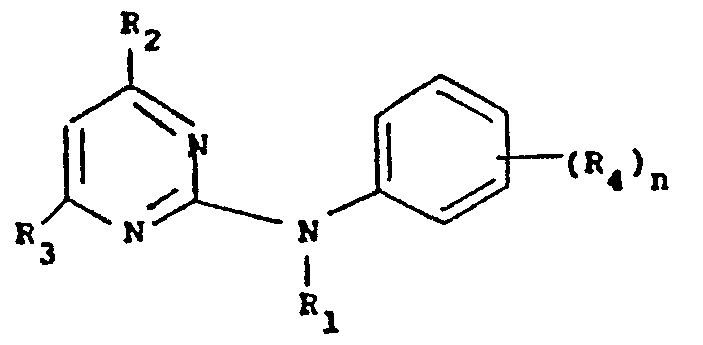
- According to the invention there are provided compounds of general formula I

- n is 0, 1 or 2;
- R 1 is
- a) the group -CXR5, where X is oxygen or sulphur and R5 is hydrogen, a nitrogen or sulphur containing heterocyclic group, which can contain other hetero atoms, optionally substituted alkenyl, acyl, alkoxycarbonyl, alkyl substituted by aryloxy, or optionally substituted mono- or dialkylamino; or R5 is the group -NHR6, where R6 is substituted amino, substituted carbamoyl, optionally substituted alkylsulphonyl. acyl or arylsulphonyl, and when n is 0 or when X is sulphur, R5 can also be alkyl, haloalkyl, aryl, aralkyl, alkoxycarbonylalkyl or arylamino:
- b) cyano or the group -CXYR7, where X and Y are the same or different and are oxygen, sulphur or optionally substituted imino and R7 is optionally substituted alkyl, aryl, acyl or a nitrogen or sulphur containing heterocyclic group, which can contain other hetero atoms: or
- c) when n is 1 or 2 and at least one R group is haloalkoxy, R1 can be hydrogen:
- R2 and R3 are the same or different and are alkyl, and
- R4 is alkyl, alkoxy, halogen, haloalkyl, haloalkoxy, nitro or cyano.
- Imino groups are preferably sustituted e.g. by alkyl or aryl. Alkyl and alkoxy groups are preferably of 1 to 7, e.g. 1 to 4 carbon atoms, especially methyl. Substituents, when present on any alkyl, alkylene or alkoxy group, include halogen, alkoxy (e.g. of 1 to 4 carbon atoms), hydroxy, alkylthio, nitro, optionally substituted amino, cyano, trialkylsilyl, carboxy, alkoxycarbonyl, acyloxy, aryl and heteroaryl. Alkenyl groups are generally of 2 to 4 carbon atoms and may be substituted e.g. by halogen or aryl. The term aryl means phenyl, optionally substituted, e.g. by halogen, alkyl, haloalkyl, alkoxy or nitro. The term heteroaryl includes groups such as furyl, pyridyl, imidazolyl, pyrazolyl, thienyl, pyridyl, triazolyl, tetrazolyl; benzimidazolyl and thiazolyl. By the term nitrogen or sulphur containing heterocyclic group is meant a nitrogen or sulphur containing groups such as those given under the term "heteroaryl", and non-aromatic groups such as morpholino, and piperidino. The term 'acyl' includes the residue of sulphonic and phosphorus containing acids as well as carboxylic acids. Acyl groups are preferably alkanoyl e.g. of 1 to 4 carbon atoms. Amino groups may be substituted, e.g. by one or two alkyl groups or two substituents can form a ring, e.g. to form a morpholino or piperidino ring.
- It is generally preferred that R2 and R3 are both methyl. It is also preferred that n is 0. A particularly preferred group of compounds are those in which R1 is -COR5, where R5 is 1-(1,2,4-triazolyl) or 1-imidazolyl or is -COOR7, in which R7 is C1-7-alkyl, optionally substituted by C1-7-alkylamino. Another valuable group of compounds are those where R1 is -CSR5, in which R5 is hydrogen or alkyl.
- The compounds of the invention have activity as fungicides, especially against fungal diseases of plants, e.g. Botrytis spp., especially B. cinerea; mildews and particularly barley powdery mildew (Erysiphe raminis), cucurbit powdery mildew (E. cichoracearum, and vine downy mildew (Plasmopora viticola), rice blast (Pyricularia orvzae) and wheat brown rust (Puccinia recondita). Other diseases against which the compounds may be active include apple scab (Venturia inaegualis), potato blight (Phvtophthora infestans), bean rust (Uromyces appendiculatus), Fusarium nivale on rye, leaf spot, e.g. Septoria nodorum on wheat, and also bunt on wheat (Tilletia caries)
- The invention thus also provides a method of combating a fungus at a locus infested or liable to be infested therewith, which comprises applying to the locus a fungicidally effective amount of a compound of the invention.
- The invention also provides an agricultural composition comprising a compound of formula I in admixture with an agriculturally acceptable diluent or carrier.
- The composition of the invention may of course include more than one compound of the invention. In addition the composition can comprise one or more additional active ingredients, for example compounds known to possess plant-growth regulant, herbicidal, fungicidal, insecticidal or acaricidal properties. If desired the compounds of the invention can be used in sequence with the other active ingredient.
- The compounds of the invention show their activity both in pre- and post-emergent treatment.
- The rates of use, depending on the target, amount in general to 0.005 to 5 kg of active agent/ha but can also be optionally higher. The time of application is determined by the target and the climatic conditions.
- The compositions of the invention can take any form known in the art for the formulation of agrochemicals, for example, a solution, a dispersion, an aqueous emulsion, a dusting powder, a seed dressing, a fumigant, a smoke, a dispersible powder, an emulsifiable concentrate or granules. Moreover it can be in a suitable form for direct application or as a concentrate or primary composition which requires dilution with a suitable quantity of water or other diluent before application.
- An emulsifiable concentrate comprises a compound of the invention dissolved in a water-immiscible solvent which is formed into an emulsion with water in the presence of an emulsifying agent.
- A dusting powder comprises a compound of the invention intimately mixed and ground with a solid pulverulent diluent, for example, kaolin.
- A granular solid comprises a compound of the invention associated with similar diluents to those which may be employed in dusting powders, but the mixture is granulated by known methods. Alternatively it comprises the active ingredient absorbed or adsorbed on a pre-granular diluent, for example. Fuller's earth, attapulgite or limestone grit.
- Wettable powders, granules or grains usually comprise the active ingredient in admixture with a suitable surfactant and an inert powder diluent such as china clay.
- Another suitable concentrate is a flowable suspension concentrate which is formed by grinding the compound with water or other liquid, a wetting agent and a suspending agent.
- The percentage of the active ingredient(s) in the various preparations can vary within wide limits. For example, the compositions can contain about 10 to 90 percent by weight active ingredients, and about 90 to 10 percent by weight liquid or solid carriers, as well as, optionally up to 20 percent by weight of surfactant.
- The preparation of the formulations according to the invention can be carried out in a known manner, for example by milling or mixing processes. Optionally. individual components can be mixed just before use for example by the so-called tank-mixing method.
- Formulations can be prepared, for example, from the following ingredients:
-
- a) 40 percent by weight active ingredient 25 percent by weight bentonite 20 percent by weight silicic acid 10 percent by weight calcium lignosulphonate 5 percent by weight surface-active agent based on a mixture of calcium lignosulphonate and alkylphenol polyglycol ether
- b) 25 percent by weight active ingredient 60 percent by weight kaolin 10 percent by weight silicic acid 5 percent by weight surface-active agent based on the sodium salt of N-methyl-N-oleyltaurine and calcium lignosulphonate
- c) 10 percent by weight active ingredient 60 percent by weight bentonite 15 percent by weight silicic acid 10 percent by weight calcium lignosulphonate 5 percent by weight surface-active agent based on the sodium salt of N-methyl-N-oleyltaurine and calcium lignosulphonate
- 45 percent by weight active ingredient 5 percent by weight sodium aluminium silicate 15 percent by weight cetylpolyglycol ether with 8 moles ethylene oxide 2 percent by weight spindle oil 10 percent by weight polyethylene glycol 23 parts water
- 25 percent by weight active ingredient 15 percent by weight cyclohexanone 55 percent by weight xylene 5 percent by weight of mixture of nonylphenylpolyoxyethylene or calcium dodecylbenzenesulphonate
- The compounds of the invention can be prepared in a variety of known ways. Thus in the case when R1 is the group -CXR5, where R5 is i) a heterocyclic group or an optionally substituted amino group or ii) NHR6, where R6 is substituted amino or when R1 is -CXYR7. where X and Y are oxygen or sulphur, then a compound of formula II

- Alternatively, a compound of the invention can be prepared by reacting a compound of formula I, where R is hydrogen, with i) a compound of formula R5CXCl or R7YCXCl, ii) with cyanogen bromide, when R1 in formula I is cyano or iii) with an isocyanate when R5 is substituted amino or with a sulphonyl isocyanate when R6 is alkyl- or arylsulphonyl. This reaction is generally carried out in the presence of an inert solvent such as diethyl ether, tetrahydrofuran, dimethylformamide or dimethyl sulphoxide. Where the molecule which is eliminated is acidic, the reaction can advantageously be carried out under basic conditions. Where the compound of formula R5H or R7YH can form a salt, (e.g. in the case when R5H is triazole or imidazole or R7YH is a phenol) then it may be desirable that it is reacted as a salt, e.g. the sodium salt, which is generally formed in situ. The reaction temperature is generally from -15 to 100°C, preferably between 20 and 50°C.
- The compound of formula II can be prepared by reacting a compound of formula I, where R5 is hydrogen, preferably in the form of a salt such as the sulphate or hydrochloride. with a compound such as phosgene or trichloromethyl chloroformate. The reaction is generally carried out in an inert solvent, e.g. in an aromatic hydrocarbon, such as toluene, at a temperature of around 100°C.
- When R1 is formyl the compounds of the invention can be prepared by reacting a compound of formula I, where R1 is hydrogen, with formic-acetic anhydride. Compounds where X is sulphur can be obtained by sulphurising the corresponding compound where X is oxygen, e.g. with phosphorus pentasulphide.
- When R5 is the group -NHR6 the compounds of the invention can be obtained by reacting a compound of formula I, where R1 is hydrogen, with the corresponding isocyanate or isothiocyanate of formula, R6NCX.
- Where R1 is -CXYR7, where one of X and Y is an imino group, the compounds of the invention can be obtained by reacting the compound of formula I, where R is hydrogen, with an isocyanate or isothiocyanate under basic conditions followed by reaction with a compound, R7Halogen.
- Compounds of formula I, where R1 is hydrogen, can be prepared by reacting a compound of formula IV


- The compounds of formula IV and V are either known or can be prepared according to known methods.
- The compounds of formula I, where R5 is hydrogen, and R3 and R4 are different, are novel and form part of the invention. The compounds of formula I, where R5 is hydrogen, and R3 and R4 are both ethyl are also novel and form part of the invention.
- The invention is illustrated in the following Examples. Structures of isolated novel compounds were confirmed by elemental and/or other appropriate analyses. Temperatures are in °C.
- 2-Anilino-4,6-dimethylpyrimidine hydrochloride (100 g) was suspended in toluene (1200 ml). A slow stream of phosgene was passed through this over 5.5 hours at 108° (bath temperature of 120°) and then stirred for a further hour at the same temperature. After standing overnight, c. 300 ml of toluene was distilled at a bath temperature of 150°. It was then evaporated under reduced pressure. The oily residue was extracted twice with hexane (1000 ml) and the solution concentrated under reduced pressure. After a period of time crystals formed and these were separated to give N-(4.6-dimethylpyrimidin-2-yl)-N-phenylcarbamoyl chloride. This was shown by thin layer chromatography to be a uniform product, which was used without further purification.
- Sodium triazole (54.6 g) was added portionwise to a solution of this product (78.53 g) in tetrahydrofuran (THF) (700 ml). The internal temperature rose to 32° over 12 minutes. It was then stirred overnight, filtered and the remaining solution concentrated in vacuo. After stirring with dry diisopropyl ether, there was obtained N-(4.6-dimethylpyrimidin-2-yl)-N-phenyl-1,2,4-triazole-1-carboxamide, as colourless crystals, m.p. 157°. (Compound 1).
- Dry calcium carbonate (3.06 g) was added potionwise with vigorous stirring to a solution of N-(4,6-dimethyl- pyrimidin-2-yl)-N-phenylcarbamoyl chloride (4.0 g) in methanol (100 ml). The mixture was then heated to 50° anc after 15 minutes worked up. The inorganic salt was filtered off and the mother liquor concentrated. After treatment with ether the insoluble calcium chloride was filtered and the filtrate concentrated whereby methyl N-(4,6-dimethylpyrimidin-2-yl)-N-phenylcarbamate, m.p. 97-100°, crystallised out. (Compound 2).
- 2-Anilino-4,6-dimethylpyrimidine (10 g) was added to formic-acetic anhydride (prepared from formic acid (5 ml) and acetic anydride (12ml)) and the mixture heated gently to 40° to give a clear solution. After standing for 4 days, a crystalline solid separated and toluene was added to give a clear solution again. The mixture was evaporate to dryness, more toluene added and reevaporated. The product was recrystallised from ethyl acetate/light petroleum to give N-(4,6-dimethylpyrimidin-2-yl)-formanilide, m.p. 134-5°. (Compound 3).
- A mixture of the product from Example 3 (4.5 g) and phosphorus pentasulphide (5 g) in dry benzene (150 ml) was heated at reflux for 2% hours. The mixture was filtered and the filtrate was treated whilst hot with charcoal and re-filtered. The filtrate was evaporated and the residue extracted with toluene. The extract was filtered and allowed to crystallise. The solid was re-crystallised from toluene-light petroleum to give N-(4,6-dimethyl- pyrimidin-2-yl)thioformanilide, m.p. 161-5-163°. (Compound 4).
- Methylsulphonyl isocyanate (3.15 g) was added dropwise to a solution of 2-anilino-4,6-dimethylpyrimidine (3.98 g) in toluene (40 ml). The mixture was then stirred for 2 hours at room temperature. The solid was separated and dried in vacuo, to give 1-(4.6-dimethylpyrimidine-2-yl)-3-methylsulphonyl-l-phenylurea. m.p. 186-192°. (Compound 5).
- Aqueous sodium hydroxide (130 ml of 40% solution) was added to a stirred solution of 4-nitrophenol (50 g) in dioxan (450 ml). The mixture was heated to 80° and, with stirring, chlorodifluoromethane was bubbled through over 20 hours at a rate such that no gas was exhausted. The mixture was then filtered, the filtrate evaporated and the residue extracted with ether. The extract was washed with aqueous sodium hydroxide, dried and evaporated to give 1-difluoromethoxy-4-nitrobenzene. This was then converted by treatment in a conventional manner with zinc and ammonium chloride to give 4-difluoromethoxyaniline as a yellow oil. 2-Chloro-4,6-dimethylpyrimidine (4.7 g) was added with stirring to this product (6 g) followed by concentrated hydrochloric acid (0.25 ml) and the mixture heated to 140°. It was then cooled, added to aqueous sodium hydroxide and extracted with ethyl acetate. The extract was washed with aqueous sodium chloride, dried and evaporated. The residue was recrystallised from diisopropyl ether in light petroleum to give 2-(4-difluoro- methoxyanilino)-4,6-dimethylpyrimidine, m.p. 81-2°. (Compound 6).
- 2-Anilino-4,6-dimethylpyrimidine (10 g) was added to a suspension of sodium hydride in oil (1.65 g of an 80% suspension) in dry THF (100 ml) and the mixture was heated under reflux until evolution of hydrogen ceased. Phenyl isothiocyanate (6.6 ml) was added slowly to the clear solution. The mixture was then stirred at room temperature for 2 hours. The solid was collected, washed with ether and dried in vacuo to give crude N-(4.6-dimethylpyrimidin- 2-yl)-N,N'-diphenylisothiourea sodium salt. To a stirred solution of this product (7.2 g) in dimethyl sulphoxide (10 ml) was added a solution of methyl iodide (1.3 ml) in dimethyl sulphoxide (10 ml). The mixture was stirred at room temperature for 3 hours and then concentrated. The residue was treated with water and then extracted with dichloromethane. The extract was worked up in conventional manner to give N-(4,6-dimethylpyrimidin-2-yl)-S-methyl-N,N'-diphenylisothiourea, m.p. 101-3°. (Compound 7).
- A solution of 2-anilino-4,6-dimethylpyrimidine (5 g) in toluene was added to a suspension of sodium hydride in oil (0.75 g of an 80% suspension) in toluene (100 ml) and the mixture was heated under reflux until evolution of hydrogen ceased. A solution of trichloroacetyl chloride (2.8 ml) in toluene (20 ml) was added dropwise at room temperature and the mixture heated at 80° for one hour. It was then worked up by filtration through silica using dichloromethane as eluent. The solvent was evaporated and the residue, after solidification, was recrystallised from ethyl acetate/diisopropyl ether to give N-(4,6-dimethyl- pyrimidin-2-yl)-N-phenyltrichloroacetamide, m.p. 125.5-7°. (Compound 8).
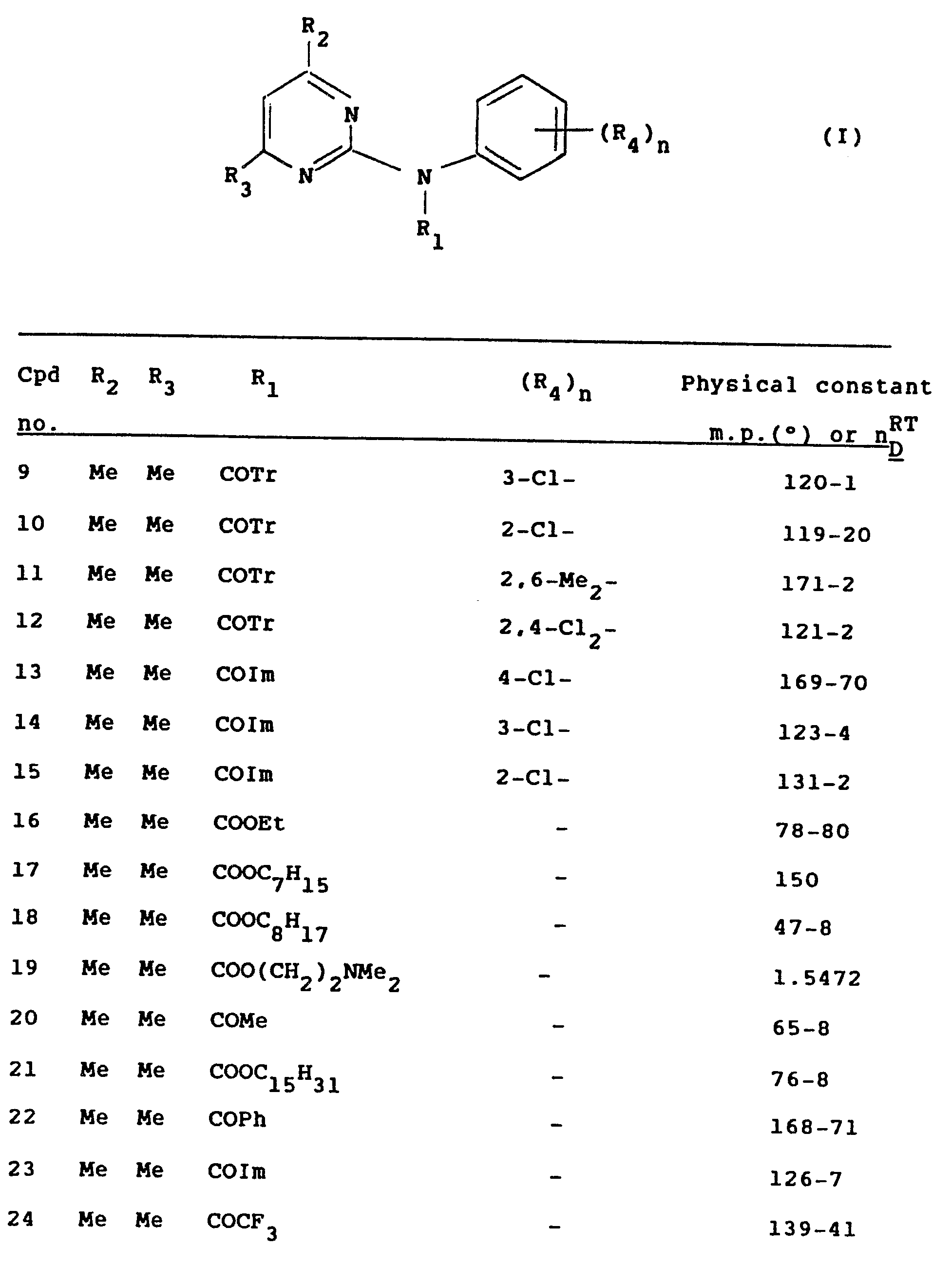
- In a similar manner to that described in one of the previous Examples, the following compounds were obtained:
- In the table the following abbreviation are used:
- Tr = 1,2,4-triazol-1-yl;
- Im = 1-imidazolyl;
- Py = 1-pyrazolyl:
- Te = 1-tetrazolyl;
- Be = 1-benzimidazolyl;
- Th = 2-thienyl;
- Suc = succinimido:
- Mo = morpholino;
- Pip = piperidino:
- Pyr(4) = 4-pyridyl;
- Pyr(2) = 2-pyridyl:
- Me = methyl:
- Et = ethyl;
- Pr = propyl;
- Ph = phenyl;
- Fu = 2-furyl.


- 2-Anilino-4,6-dimethylpyrimidine (3.98 g) was treated with sodium hydride in a similar manner to that described in Example 8. The resulting sodium salt was then treated with cyanogen bromide (2.12 g) and the mixture heated under reflux for 4 hours. The mixture was then filtered through silica gel and eluted with dichloromethane and the solution evaporated. The residue was recrystallised from ethyl acetate to give N-(4,6-dimethylpyrimidin-2-yl)-N-phenylcyanamide, m.p. 153-4°. (Compound 94).
- The compounds of the invention were subjected to various tests.
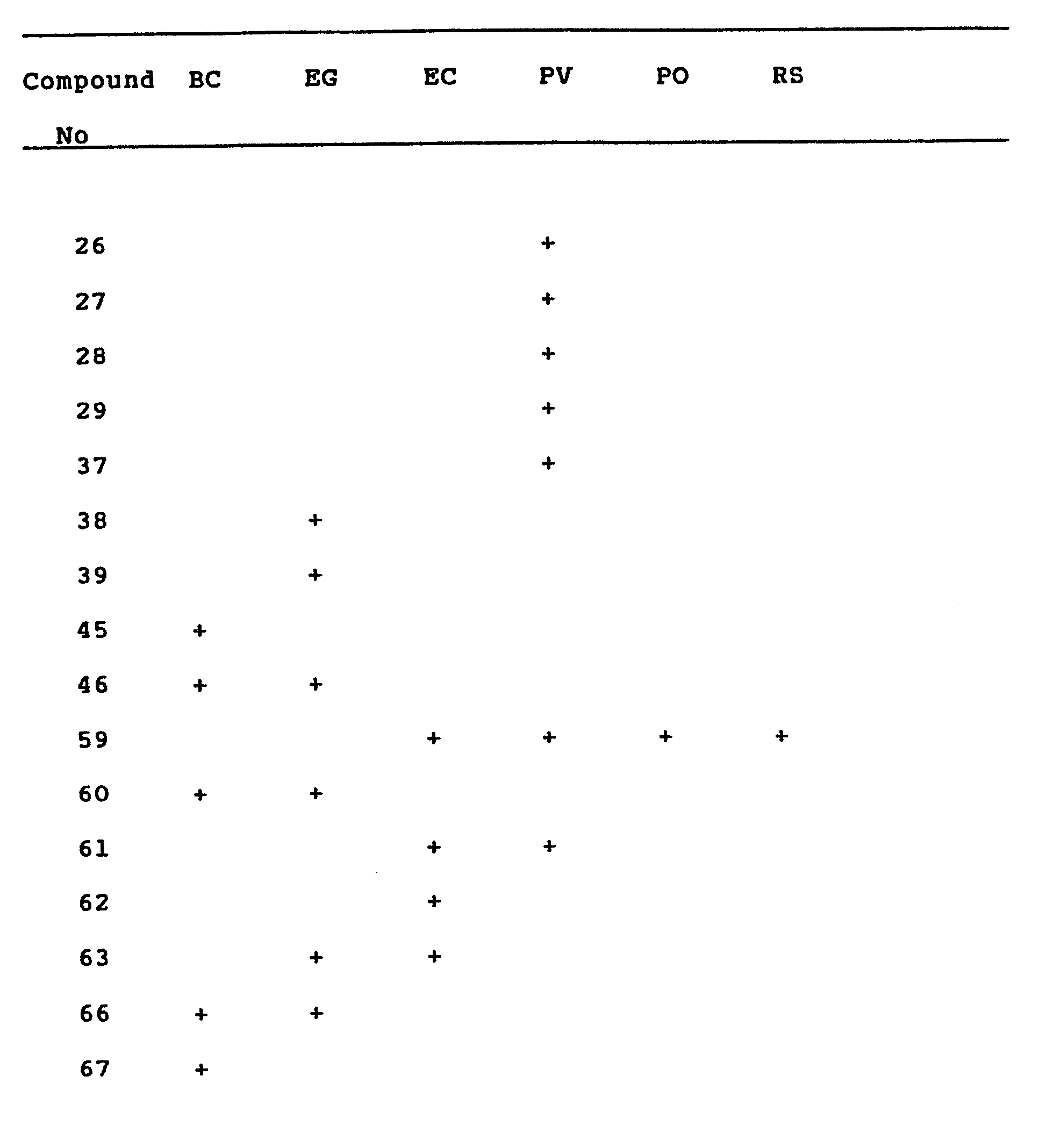
- Compounds were assessed for activity against one or more of the following:
- Erysiphe graminis: barley powdery mildew (EG)
- Ervsiphe cichoracearum: cucurbit powdery mildew (EC)
- Plasmopara viticola: vine downy mildew (PV)
- Pyricularia oryzae: rice blast (PO)
- Botrytis cinerea: grey mould of tomato (BC)
- Aqueous solutions or dispersions of the compounds at the desired concentration, including a wetting agent, were sprayed onto the appropriate plant and then inoculated by spraying with spore suspensions of the fungi or by dusting or shaking diseased material over the treated plants for the Ervsiphe spp.. Plants were then kept under controlled environment conditions suitable for maintaining plant growth and development of the disease. After an appropriate time, the degree of infection of the leaf surface is visually estimated.
- Compounds were considered active if they gave greater than 50% control of the disease at a concentration of 500 ppm (w/v) or less.
- Flasks containing maize meal/sand were inoculated with the test fungus and then incubated. The maize meal/sand cultures were used to infest potting compost which was then put into plastic pots. Aqueous solutions or dispersions of the compounds, including a wetting agent, were added to the pots to give a desired concentration of compound in each pot. Control pots were set up by adding similar solutions or dispersions without the test compound Immediately after application of the test compound each pot was sown with a number of cabbage seeds. The seeds were covered with treated infested soil and the pots incubated under controlled environment conditions suitable for plant growth and development of the disease. The number of emerged cabbage seedlings is counted and percentage disease control calculated by comparison with the untreated infested pots.
- Compounds were considered active if they gave greater than 50% control of the disease at a concentration of 300 parts by weight of compound or less per million parts by volume of soil.
- Activities were demonstrated as follows (+ = active).

Claims (8)

Applications Claiming Priority (2)
| Application Number | Priority Date | Filing Date | Title |
|---|---|---|---|
| DE3614060 | 1986-04-23 | ||
| DE19863614060 DE3614060A1 (en) | 1986-04-23 | 1986-04-23 | PYRIMIDINE DERIVATIVES, METHOD FOR THE PRODUCTION THEREOF AND THEIR USE AS FUNGICIDES |
Publications (2)
| Publication Number | Publication Date |
|---|---|
| EP0243136A2 true EP0243136A2 (en) | 1987-10-28 |
| EP0243136A3 EP0243136A3 (en) | 1988-09-28 |
Family
ID=6299546
Family Applications (1)
| Application Number | Title | Priority Date | Filing Date |
|---|---|---|---|
| EP87303450A Withdrawn EP0243136A3 (en) | 1986-04-23 | 1987-04-21 | Anilinopyrimidine fungicides |
Country Status (6)
| Country | Link |
|---|---|
| US (1) | US4783459A (en) |
| EP (1) | EP0243136A3 (en) |
| JP (1) | JPS62294665A (en) |
| AU (1) | AU582049B2 (en) |
| DE (1) | DE3614060A1 (en) |
| ZA (1) | ZA872825B (en) |
Cited By (7)
| Publication number | Priority date | Publication date | Assignee | Title |
|---|---|---|---|---|
| EP0337943A3 (en) * | 1988-04-12 | 1991-09-04 | Ciba-Geigy Ag | N-phenyl-n-pyrimidin-2-yl-ureas with herbicidal and plant-growth regulating activity |
| FR2666722A1 (en) * | 1990-09-15 | 1992-03-20 | Schering Ag | METHOD FOR CONTROLLING VENTURIA. |
| US5120741A (en) * | 1990-02-07 | 1992-06-09 | Ciba-Geigy Corporation | Microbicides |
| EP0337946B1 (en) * | 1988-04-12 | 1993-07-28 | Ciba-Geigy Ag | Ureas |
| EP0337944B1 (en) * | 1988-04-12 | 1993-07-28 | Ciba-Geigy Ag | Ureas |
| AU659016B2 (en) * | 1992-06-10 | 1995-05-04 | Schering Aktiengesellschaft | Fungicidal mixtures |
| US7759357B2 (en) | 2002-02-01 | 2010-07-20 | Novartis Ag | Phenylpyrimidine amines as IgE inhibitors |
Families Citing this family (6)
| Publication number | Priority date | Publication date | Assignee | Title |
|---|---|---|---|---|
| JPH0784445B2 (en) * | 1986-12-03 | 1995-09-13 | クミアイ化学工業株式会社 | Pyrimidine derivatives and agricultural and horticultural fungicides |
| GB9117486D0 (en) * | 1991-08-13 | 1991-09-25 | Schering Ag | Fungicides |
| CA2174080A1 (en) * | 1993-10-12 | 1995-04-20 | Paul Edward Aldrich | 1n-alkyl-n-arylpyrimidinamines and derivatives thereof |
| AU2145500A (en) * | 1998-11-30 | 2000-06-19 | Ishihara Sangyo Kaisha Ltd. | A meta-nitro phenol derivative and a process for producing it |
| TW550258B (en) * | 1999-05-31 | 2003-09-01 | Hoffmann La Roche | 4-phenyl-pyrimidine derivatives |
| EP2253206B1 (en) | 2008-03-21 | 2014-01-01 | Sumitomo Chemical Company, Limited | Plant disease control composition |
Family Cites Families (8)
| Publication number | Priority date | Publication date | Assignee | Title |
|---|---|---|---|---|
| US2748122A (en) * | 1954-05-06 | 1956-05-29 | Searle & Co | 2-anilino-4, 6-dimethylpyrimidines |
| US2748124A (en) * | 1954-05-06 | 1956-05-29 | Searle & Co | 1-(4-anilino-2-pyrimidino)-3-alkylureas |
| AU5319479A (en) * | 1978-12-22 | 1980-06-26 | Ici Australia Limited | Pyrimidinyl amino phenoxy carboxylate derivatives |
| DD151404A1 (en) * | 1980-06-13 | 1981-10-21 | Friedrich Franke | FUNGICIDAL AGENTS |
| GB8311003D0 (en) * | 1983-04-22 | 1983-05-25 | Shell Int Research | Aniline compounds |
| US4659363A (en) * | 1983-07-25 | 1987-04-21 | Ciba-Geigy Corporation | N-(2-nitrophenyl)-2-aminopyrimidine derivatives, the preparation and use thereof |
| DD236667A1 (en) * | 1984-05-21 | 1986-06-18 | Fahlberg List Veb | FUNGICIDES CONTAINING 2-AMINO-PYRIMIDINES |
| DE3581570D1 (en) * | 1984-06-25 | 1991-03-07 | Ciba Geigy Ag | PYRIMID DERIVATIVES EFFECTIVE AS A PEST CONTROL. |
-
1986
- 1986-04-23 DE DE19863614060 patent/DE3614060A1/en not_active Withdrawn
-
1987
- 1987-04-21 EP EP87303450A patent/EP0243136A3/en not_active Withdrawn
- 1987-04-22 ZA ZA872825A patent/ZA872825B/en unknown
- 1987-04-23 AU AU71903/87A patent/AU582049B2/en not_active Ceased
- 1987-04-23 JP JP62098758A patent/JPS62294665A/en active Pending
- 1987-04-23 US US07/041,706 patent/US4783459A/en not_active Expired - Fee Related
Cited By (9)
| Publication number | Priority date | Publication date | Assignee | Title |
|---|---|---|---|---|
| EP0337943A3 (en) * | 1988-04-12 | 1991-09-04 | Ciba-Geigy Ag | N-phenyl-n-pyrimidin-2-yl-ureas with herbicidal and plant-growth regulating activity |
| EP0337946B1 (en) * | 1988-04-12 | 1993-07-28 | Ciba-Geigy Ag | Ureas |
| EP0337944B1 (en) * | 1988-04-12 | 1993-07-28 | Ciba-Geigy Ag | Ureas |
| US5120741A (en) * | 1990-02-07 | 1992-06-09 | Ciba-Geigy Corporation | Microbicides |
| FR2666722A1 (en) * | 1990-09-15 | 1992-03-20 | Schering Ag | METHOD FOR CONTROLLING VENTURIA. |
| GR910100378A (en) * | 1990-09-15 | 1992-09-11 | Schering Ag | Method for venturia fighting |
| BE1004053A3 (en) * | 1990-09-15 | 1992-09-15 | Schering Ag | Method for fight against venturia. |
| AU659016B2 (en) * | 1992-06-10 | 1995-05-04 | Schering Aktiengesellschaft | Fungicidal mixtures |
| US7759357B2 (en) | 2002-02-01 | 2010-07-20 | Novartis Ag | Phenylpyrimidine amines as IgE inhibitors |
Also Published As
| Publication number | Publication date |
|---|---|
| EP0243136A3 (en) | 1988-09-28 |
| US4783459A (en) | 1988-11-08 |
| JPS62294665A (en) | 1987-12-22 |
| AU7190387A (en) | 1987-11-26 |
| ZA872825B (en) | 1988-01-27 |
| AU582049B2 (en) | 1989-03-09 |
| DE3614060A1 (en) | 1987-10-29 |
Similar Documents
| Publication | Publication Date | Title |
|---|---|---|
| US5093364A (en) | 5-fluoroanthranilic fungicides | |
| KR100255682B1 (en) | New Phenylpyrazole Fungicides | |
| KR100744987B1 (en) | Fungicides | |
| KR20000057254A (en) | Methyl substituted fungicides and arthropodicides | |
| EP0284277A1 (en) | Cyanoimidazole fungicides | |
| US4783459A (en) | Anilinopyrimidine fungicides | |
| WO1992007835A1 (en) | Imidazole fungicides | |
| JPH01305082A (en) | Tri-substituted 1, 3, 5-triazine-2, 4, 6- triones | |
| IL44710A (en) | 1-phenyl-2-azolyl-formamidines their preparation and their use as herbicides | |
| JPS6097962A (en) | 1-substituted imidazole-5-carboxylic acid derivatives, manufacture and fungicide, herbicide and plant growth regulant | |
| EP0031173B1 (en) | New nitrothiophenes, method of preparing the new compounds, as well as fungicidal and/or bactericidal compositions on the basis of the new compounds | |
| EP0432892B1 (en) | Imidazole fungicides | |
| EP0455300B1 (en) | Barbituric acid derivatives having insecticidal activity | |
| US4623377A (en) | 1,2,3,4-tetrahydroquinolin-1-ylcarbonylimidazoles and herbicidal use thereof | |
| US5096915A (en) | Azole fungicides | |
| PL154972B1 (en) | Fungicide | |
| US4780473A (en) | Bicyclic fungicides | |
| US5045557A (en) | Imidazable fungicides and use thereof | |
| US4657579A (en) | Novel N-(5-pyrimidinyl)-chloroacetamides | |
| EP0301613B1 (en) | Thiazole compounds having fungicidal activity | |
| US5120346A (en) | Substituted tetrazolinones for plant growth inhibition | |
| WO1998004525A1 (en) | Fungicidal n-aryl five-membered cyclic imides | |
| EP0412681B1 (en) | Azolidine derivatives, process for preparing the same and agricultural and horticultural fungicide | |
| GB1571481A (en) | 1,2,4-triazolium compounds having pesticidal and plant growth regulating properties | |
| US4920142A (en) | Fungicidal imidazole derivatives |
Legal Events
| Date | Code | Title | Description |
|---|---|---|---|
| PUAI | Public reference made under article 153(3) epc to a published international application that has entered the european phase |
Free format text: ORIGINAL CODE: 0009012 |
|
| AK | Designated contracting states |
Kind code of ref document: A2 Designated state(s): AT BE CH DE ES FR GB GR IT LI LU NL SE |
|
| PUAL | Search report despatched |
Free format text: ORIGINAL CODE: 0009013 |
|
| AK | Designated contracting states |
Kind code of ref document: A3 Designated state(s): AT BE CH DE ES FR GB GR IT LI LU NL SE |
|
| 17P | Request for examination filed |
Effective date: 19890313 |
|
| STAA | Information on the status of an ep patent application or granted ep patent |
Free format text: STATUS: THE APPLICATION IS DEEMED TO BE WITHDRAWN |
|
| 18D | Application deemed to be withdrawn |
Effective date: 19901103 |
|
| RIN1 | Information on inventor provided before grant (corrected) |
Inventor name: PIEROH, ERNST Inventor name: BUEHMANN, ULRICH Inventor name: BAUMERT, DIETRICH Inventor name: WESTERMANN, JUERGEN Inventor name: RICHARDS, IAN CHRISTOPHER Inventor name: CLIFF, GEOFFREY ROSS |