EP0242686A2 - Process for the preparation of D-(+)-biotine - Google Patents
Process for the preparation of D-(+)-biotine Download PDFInfo
- Publication number
- EP0242686A2 EP0242686A2 EP87105054A EP87105054A EP0242686A2 EP 0242686 A2 EP0242686 A2 EP 0242686A2 EP 87105054 A EP87105054 A EP 87105054A EP 87105054 A EP87105054 A EP 87105054A EP 0242686 A2 EP0242686 A2 EP 0242686A2
- Authority
- EP
- European Patent Office
- Prior art keywords
- formula
- meaning given
- acid
- give
- imidazo
- Prior art date
- Legal status (The legal status is an assumption and is not a legal conclusion. Google has not performed a legal analysis and makes no representation as to the accuracy of the status listed.)
- Granted
Links
Classifications
-
- C—CHEMISTRY; METALLURGY
- C07—ORGANIC CHEMISTRY
- C07D—HETEROCYCLIC COMPOUNDS
- C07D495/00—Heterocyclic compounds containing in the condensed system at least one hetero ring having sulfur atoms as the only ring hetero atoms
- C07D495/02—Heterocyclic compounds containing in the condensed system at least one hetero ring having sulfur atoms as the only ring hetero atoms in which the condensed system contains two hetero rings
- C07D495/04—Ortho-condensed systems
-
- C—CHEMISTRY; METALLURGY
- C07—ORGANIC CHEMISTRY
- C07D—HETEROCYCLIC COMPOUNDS
- C07D513/00—Heterocyclic compounds containing in the condensed system at least one hetero ring having nitrogen and sulfur atoms as the only ring hetero atoms, not provided for in groups C07D463/00, C07D477/00 or C07D499/00 - C07D507/00
- C07D513/02—Heterocyclic compounds containing in the condensed system at least one hetero ring having nitrogen and sulfur atoms as the only ring hetero atoms, not provided for in groups C07D463/00, C07D477/00 or C07D499/00 - C07D507/00 in which the condensed system contains two hetero rings
- C07D513/04—Ortho-condensed systems
Definitions
- the invention relates to a process for the preparation of D - (+) - biotin from L-cysteine or L-cystine or L-serine via an optically active (7R) -1H, 3H-imidazo [1,5-c] azole as an intermediate .
- the object of the invention was to provide a new process for the production of optically active D - (+) - biotin, which avoids carrying out a resolution and thus discarding or recycling the undesired enantiomer.
- D - (+) - biotin from the naturally occurring amino acids L-cysteine or L-cystine or L-serine via an optically active (7R) -IH, 3H-imidazo [1,5-c] Azole of the formula I can be prepared as an intermediate in a stereospecific manner without additional racemate separation.
- the radical R 3 is preferably unsubstituted or by one or more, particularly preferably one or two, C 1 -C 4 alkyl and / or C 1 -C 4 alkoxy groups substituted benzyl, in particular unsubstituted benzyl, in addition also C 3 -C 5 alk-2-enyl or C 3 -C 6 trialkylsilyl.
- the substituents are preferably the same, but they can also be different. They are preferably in the 4- and / or 2-position, but they can also be in the 3-, 5- and / or 6-position.
- the invention is in particular a process for the preparation of D - (+) - B iotin of L-cysteine or L-cystine or L-serine via an intermediate product of the formula I, preferred is any of the above in which at least one of said radicals Has meanings.
- the invention furthermore relates to compounds of the formula XI, since they represent valuable intermediates and starting products for a large number of synthesis options for optically active D - (+) - biotin.
- R 1 , R 2 , X and Y have the meaning given and R 3 represents a protective group suitable for a nitrogen atom.
- Preferred compounds of the formula XI are those in which X is sulfur and Y is oxygen.
- the compounds of the formula I are prepared by methods known per se, as described in the literature (for example in standard works such as Houben-Weyl, Methods of Organic Chemistry, Georg-Thieme-Verlag, Stuttgart), namely Reaction conditions as are known and suitable for the reactions mentioned. Use can also be made of variants which are known per se and are not mentioned here in detail.
- the starting materials of the formula II are known or can be prepared from L-cysteine or L-serine by known methods, such as, for example, in Schöberl, Hamm, Chem. Ber. 81 [1948], 210 and Karabinos, Szabo, J. Amer. Chem. Soc. 66 [1944], 649 by reacting the free amino acids or their acid addition salts with an alkali metal or alkaline earth metal cyanate or thiocyanate in a suitable solvent such as water, alcohols or mixtures thereof, preferably at elevated temperature, and the intermediate product obtained in situ cyclized under the action of an acid, for example a mineral acid.
- a suitable solvent such as water, alcohols or mixtures thereof, preferably at elevated temperature
- the reaction of the hydantoins of the formula II with carbonyl compounds of the formula III to the bicycles of the formula IV can be carried out by the processes known and customary for acetalizations, such as, for example, in Houben-Weyl, Methods of Organic Chemistry, Vol. VI / 3, p. 199 , are described.
- the reaction partners are preferably reacted with the addition of a dehydrating agent such as. B.
- an acid such as sulfuric acid, phosphoric acid, hydrogen chloride, p-toluenesulfonic acid, an acid derivative such as phosphorus pentoxide, phosphorus trichloride, phosphorus pentachloride, phosphorus oxychloride, a metal salt such as anhydrous Calcium chloride, copper sulfate, iron (III) chloride, an acidic ion exchanger or molecular sieves.
- the water of reaction formed can also be removed by azeotropic distillation with a suitable solvent such as benzene, toluene, chloroform, dichloromethane.
- Suitable inert solvents are preferably hydrocarbons such as pentane, hexane, cyclohexane, benzene, toluene or xylene, and chlorinated hydrocarbons such as dichloromethane, chloroform or carbon tetrachloride.
- R 3 is, for example, benzyl, 4- Methoxybenzyl, 3,4-dimethoxybenzyl, 4-methylbenzyl, allyl, methallyl, crotyl, methoxymethyl, trimethylsilyl, tert-butyldimethylsilyl or tert-butyldiphenylsilyl.
- This protection Groups are prepared by known methods, such as those found in Mac Omie, Protective Groups in Organic Chemistry, Plenum Press, New York, 1973, by reacting the corresponding reactive halides with the bicycles of the formula IV to give (7R) - 1H, 3H-Imidazo [1,5c] azoles of the formula I, introduced.
- the reaction partners are preferably reacted in a suitable solvent with the addition of a basic reagent.
- suitable solvents are in particular ethers such as diethyl ether, di-n-butyl ether, THF, dioxane or anisole, ketones such as acetone, butanone or cyclohexanone, amides such as DMF or phosphoric acid hexamethyltriamide, hydrocarbons such as benzene, toluene or xylene, halogenated hydrocarbons such as carbon tetrachloride or tetrachlorethylene and sulfoxides such as dimethyl sulfoxide or sulfolane.
- a preferred reaction procedure is the reaction of a bicyclic compound of formula IV with a reactive, the - R 3 bearing compound, preferably in a basic medium, important bases being, in particular alkali metal hydroxides such as sodium or potassium hydroxide, alkali metal carbonates or hydrogen carbonates such as sodium carbonate, sodium hydrogen carbonate , Potassium carbonate or potassium hydrogen carbonate, alkali metal acetates such as sodium or potassium acetate, alkaline earth metal hydroxides such as calcium hydroxide, alkali metal hydrides such as sodium hydride, amides such as sodium amide, lithium diisopropylamide, alcoholates such as sodium methylate, sodium ethylate, lithium ethylate or organic bases such as triethylamine, 4-pyridine, imidazole, lutidine, lutidine, lutidine N, N-dimethylamino) pyridine or quinoline are important.
- alkali metal hydroxides such as sodium or potassium hydroxide
- the reaction temperature is usually between -50 ° C and +250 ° C, preferably between -20 ° C and +80 ° C. At these temperatures, the reactions are usually complete after 15 minutes to 48 hours.
- Azolidines of the formula V can be converted into compounds of the formula IV and, as indicated, into the imidazo [1,5-c] azoles of the formula I using alkali metal or alkaline earth metal cyanates or thiocyanates under the reaction conditions already given for the preparation of compounds of the formula II will.
- Organoisocyanates and isothiocyanates of the formula VI are known or can be prepared by known methods, for example in Houben-Weyl, Methods of Organic Chemistry, Vol. VIII, p. 75 and. IX, p. 773, can be obtained.
- ethers such as diethyl ether, di-n-butyl ether, THF, dioxane or anisole, ketones such as acetone, butanone or cyclohexanone, amides such as DMF or phosphoric acid hexamethyltriamide, hydrocarbons such as benzene, toluene or xylene, halogenated hydrocarbons such as carbon tetrachloride or tetrachlorethylene and sulfoxides such as dimethylsulfoxide Sulfolan.
- Basic solvents such as pyridine, lutidine, collidine, diethylamine or triethylamine and mixtures of these bases with the solvents indicated above are also suitable.
- Suitable water-releasing agents are, for example, acids such as sulfuric acid, hydrogen chloride, toluenesulfonic acid or bases such as sodium or potassium hydroxide. You can work in the presence or absence of an inert solvent at temperatures between about 0 ° C and 150 ° C, preferably between about 20 C ° and 100 ° C; come as a solvent, for. B. water and alcohols such as methanol, ethanol, isopropanol or butanol.
- L-cystine is reacted with an alkali metal or alkaline earth metal cyanate or thiocyanate to give a bishydantoin of the formula VII.
- an alkali metal or alkaline earth metal cyanate or thiocyanate for this purpose, use can be made of the same methods which have already been given for the preparation of the hydantoins of the formula I I , the same or similar reaction conditions being used.
- Suitable reducing agents can be found, for example, in Houben-Weyl, Methods of Organic Chemistry, Vol. 15/1, p. 798.
- Sodium / liquid ammonia, zinc / acid or phosphonium iodide are preferably suitable for the reductive cleavage of the disulfide bond.
- the reduction of the bishydantoins of the formula VII is carried out with an equivalent, in particular with an excess of reducing agent, in a suitable solvent which is matched to the chemical nature of the reagent, such as, for. B. water, liquid ammonia, alcohols such as methanol, ethanol, isopropanol, acids such as hydrochloric acid, sulfuric acid, formic acid, acetic acid, ethers such as diethyl ether, THF or dioxane or mixtures thereof, advantageously at temperatures between about -50 ° C and +150 ° C.
- a suitable solvent which is matched to the chemical nature of the reagent, such as, for. B. water, liquid ammonia, alcohols such as methanol, ethanol, isopropanol, acids such as hydrochloric acid, sulfuric acid, formic acid, acetic acid, ethers such as diethyl ether, THF or dioxane or mixtures thereof, advantageously at temperatures between about
- a particularly advantageous method for cleaving the disulfide bond in the compounds of formula VII is their thiolysis with a suitable mercaptan such as. B. thiophenol, butane-1,4-dithiol or 1,4-dithio-threitol analogous to that in Hase, Walter, Inst. J. Pept. Prot. Res. 5 (1973), 283 Way of working.
- the reaction partners are advantageously reacted in a suitable solvent such as, for. B. aqueous alkali metal hydroxide solutions, chlorinated hydrocarbons or liquid ammonia at temperatures between about -40 ° C and +120 ° C.
- the bishydantoins of the formula VII can furthermore be provided with a protective group of the formula R 3 .
- To prepare these protected bishydantoins of the formula VIII use can be made of the methods already given for the preparation of the compounds of the formula I from the bicycles of the formula IV, the same or similar reaction conditions being used.
- Another process for the preparation of the protected bishydantoins of the formula VIII consists in the reaction of L-cystine with an organoisocyanate or isothiocyanate of the formula VI given in analogy to the preparation of compounds of the formula I from azolidines of the formula V, the same or similar Process operated, as already indicated for the preparation of the compounds of formula I.
- One method for producing D - (+) - biotin from I is to reduce an oxo compound of the formula I to an alcohol of the formula IX. Suitable processes can be found, for example, in Houben-Weyl, Methods of Organic Chemistry, Vol. 4 / lc + 4 / ld.
- the reduction can be carried out, for example, by catalytic hydrogenation at temperatures between about 0 ° C. and about 200 ° C. and pressures between about 1 and 200 bar in an inert solvent, for example an alcohol such as methanol, ethanol or isopropanol, an ether such as tetrahydrofuran (THF) or dioxane, an ester such as ethyl acetate, a carboxylic acid such as acetic acid or a hydrocarbon such as cyclohexane.
- an inert solvent for example an alcohol such as methanol, ethanol or isopropanol, an ether such as tetrahydrofuran (THF) or dioxane, an ester such as ethyl acetate, a carboxylic acid such as acetic acid or a hydrocarbon such as cyclohexane.
- an inert solvent for example an alcohol such as methanol, ethanol or isopropanol, an
- Suitable catalysts are suitably noble metals such as Pt or Pd, which can be used in the form of oxides (for example Pt0 2 , PdO), on a support (for example Pd on carbon, calcium carbonate or strontium carbonate) or in finely divided form.
- Pt or Pd which can be used in the form of oxides (for example Pt0 2 , PdO), on a support (for example Pd on carbon, calcium carbonate or strontium carbonate) or in finely divided form.
- Reductions with complex hydrides such as boranes such as diborane, sodium boranate, lithium cyano-trihydroborate, metal hydrides such as sodium hydride, aluminum hydride, silicon hydrides such as triethylsilane, tributyltin hydride and mixed hydrides such as lithium alanate, sodium alanate, sodium bis (2-methoxy- ethoxy) dihydridoaluminate, potassium boranate or lithium boranate.
- complex hydrides such as boranes such as diborane, sodium boranate, lithium cyano-trihydroborate, metal hydrides such as sodium hydride, aluminum hydride, silicon hydrides such as triethylsilane, tributyltin hydride and mixed hydrides such as lithium alanate, sodium alanate, sodium bis (2-methoxy- ethoxy) dihydridoaluminate, potassium boranate or lithium
- the reaction of the oxo compounds of the formula I with the reducing agents is advantageously carried out in a suitable solvent at temperatures between about -100 ° C. and + 150 °, in particular between about 0 ° and 100 °;
- solvents such as water, alcohols such as methanol, Ethanol, isopropanol, butanol, ethers such as tetrahydrofuran, dioxane, diethyl ether, ethylene glycol dimethyl ether and hydrocarbons such as pentane, cyclohexane, benzene, toluene can be considered.
- R 4- Q which carries the radical R 4 , where R 4 is, for example, alkanoyl such as acetyl, aroyl such as benzoyl, 4-nitrobenzoyl, alkylsulfonyl such as methanesulfonyl, ethanesulfonyl, Trifluoromethanesulfonyl, arylsulfonyl such as phenylsulfonyl, aralkylsulfonyl such as benzylsulfonyl means.
- alkanoyl such as acetyl, aroyl such as benzoyl, 4-nitrobenzoyl, alkylsulfonyl such as methanesulfonyl, ethanesulfonyl, Trifluoromethanesulfonyl, arylsulfonyl such as phenylsulfonyl, aralkylsulfonyl
- R 4 is a radical Azol-M, in which Azol stands for a nitrogen-containing, unsubstituted or substituted and / or condensed five-membered ring, such as, for example, imidazole, 1,2,4-triazole, 1,2,3-triazole, benzotriazole, benzimidazole, pyrazole , 3,5-dimethylpyrazole, indazole, and M means CO, CS, SO, S0 2 , S.
- R 4 is preferably acetyl, imidazol-1-ylcarbonyl, imidazol-1-ylsulfinyl, imidazol-1-ylsulfonyl.
- Q represents halogen, alkoxy, alkanoyloxy or a further azole radical.
- a preferred reaction mode is the reaction of an alcohol of formula IX with a reactive compound bearing the radical R 4 , preferably in a basic medium, organic bases such as triethylamine, pyridine, lutidine, collidine or quinoline being particularly suitable as bases.
- the reaction temperature is ge usually between -50 ° C and +150 ° C, preferably between -20 ° C and +80 ° C. At these temperatures, the reactions are usually complete after 15 minutes to 48 hours.
- the activated esters of the formula X can be reacted with a cyanide, advantageously with a metal cyanide such as sodium cyanide, potassium cyanide or copper cyanide or a cyanosilane such as e.g. Trimethylsilyl cyanide, B-trimethylsilylpropionitrile or diethylaluminium cyanide, e.g. in an inert solvent such as dichloromethane, toluene, pyridine, dimethylformamide, dimethyl sulfoxide, N-methylpyrrolidone or hexamethylphosphoric triamide at temperatures between -50 ° C and 200 ° C.
- a metal cyanide such as sodium cyanide, potassium cyanide or copper cyanide
- a cyanosilane such as e.g. Trimethylsilyl cyanide, B-trimethylsilylpropionitrile or diethylaluminium cyanide
- a preferred process for the preparation of nitriles of the formula XI from activated esters of the formula X, in which R 4 is a radical azole-M with the meaning given above, consists in an additional activation of the esters of the formula X by their N-alkylation.
- Suitable alkylating agents for this are, for example, alkyl, alkenyl and aryl iodides, bromides, chlorides, sulfates and sulfonates.
- a suitable solvent such as, for example, ethers such as diethyl ether, tetrahydrofuran, dioxane or ketones such as acetone, diethyl ketone, methyl isobutyl ketone; however, it can also be carried out without the addition of solvents.
- nitriles of the formula XI from esters of the formula X consists in the reaction of the latter with a cyanosilane Methods such as, for example, MT Reetz et al., Tetrahedron 39 (1983) 961; T. Hiyama et al., Synthesis 1986 689 or Houben-Weyl, Vol. E5, pp. 1389 ff (1985).
- the compounds of the formula X in which R 4 is alkanoyl or aroyl, in particular alkanoyl such as acetyl, are particularly suitable for this reaction.
- Trimethylsilyl cyanide proves to be a particularly suitable cyanation reagent.
- the reactants are expediently placed in an inert solvent such as e.g. Dichloromethane or toluene at temperatures from -50 ° C to 150 ° CV, optionally with the addition of a catalyst such as e.g. Tin (IV) chloride, titanium (IV) chloride, tin (IV) triflate or zinc bromide.
- esters of formula X can be isolated and reacted with a cyanide in the manner described above to give the nitriles of formula XI, but they can also be formed in situ without being isolated, formed and reacted with a cyanide.
- Nitriles of the formula XI can be reacted with bases or acids to give the acids of the formula XII in which R 5 is H, the bases being in particular alkali metal hydroxides such as sodium or potassium hydroxide, alkali metal carbonates or hydrogen carbonates such as sodium carbonate, sodium hydrogen carbonate, potassium carbonate or potassium hydrogen carbonate or Alkaline earth metal hydroxides such as calcium hydroxide are suitable.
- suitable acids are hydrochloric acid, sulfuric acid or hydrobromic acid.
- the reaction temperature is usually between -20 ° C and +200 ° C, preferably between 0 ° C and +100 ° C. At these temperatures, the reactions are usually complete between 30 minutes and 48 hours.
- nitriles of the formula XI can be reacted with acid catalysis to give acid derivatives of the formula XII, in which R 5 is lower alkyl, cycloalkyl or aryl.
- Suitable acids are in particular hydrogen chloride, sulfuric acid and boron trifluoride, for example in the form of its diethyl ether adduct.
- the reaction is advantageously carried out in an excess of the alcohol R 5- O H as solvent at temperatures between 0 ° C. and +150 ° C.
- Heavy metal salts such as silver nitrate, mercury (II) chloride or mercury (II) acetate and the subsequent decomposition of the intermediate metal mercaptides with hydrogen sulfide can also be used as cleavage reagent.
- Solvents suitable for this cleavage reaction can be found, for example, among alcohols such as methanol, ethanol, amides such as dimethylformamide or ethers such as tetrahydrofuran.
- Acid derivatives of the formula XII, in which XS is XS, can be reacted with reducing agents to give intermediates of the formula XIIa, in which R 6 is CHR R and XS .
- Suitable reducing agents are, for example, metals such as zinc.
- the acid derivatives are cleaved by reduction with metals, preferably in an acidic environment.
- Suitable acids are, for example, mineral acids such as hydrochloric acid or sulfuric acid or organic acids such as formic acid or acetic acid. These acids are expediently used as solvents or in a mixture with other solvents such as alcohols.
- the reaction temperature is usually between 0 ° C and 200 ° C, preferably between 20 ° C and 150 ° C. At these temperatures, the reactions are usually completed between 15 minutes and 24 hours.
- the intermediates of formula XIIa obtained can be isolated; however, they are expediently reacted in situ to give the known lactones of the formula XIII.
- the latter lactones are often already formed to a high or complete extent when the bicycles of the formula XII are cleaved.
- Suitable agents for this purpose are, for example, in alkali metal salts such as potassium or sodium acetate, potassium thioacetate, in acids such as methanesulphonic acid, p-toluenesulphonic acid, phosphoric acid, sulfuric acid or hydrochloric acid, in anhydrides such as acetic anhydride or trifluoroacetic anhydride or in other dehydrating reagents or dicidicyclic acid, such as aluminum oxide, potassium hydroxide, for example alumina cyanide carboxylate, such as aluminum oxide, potassium oxide, for example, alumina cyanide carboxylate Available.
- lactonizing agents often proves to be advantageous.
- Suitable reaction conditions for lactonization can be found, for example, in Houben-Weyl, Methods of Organic Chemistry, volume E5.
- nitriles of the formula XI are converted to oxo compounds of the formula XIV with an organometallic compound implemented.
- organometallic compounds are, for example, those of magnesium (Blaise process), zinc (Reformatzky process), lithium or aluminum.
- the reaction conditions for converting the organometallic compounds are based on the nature and chemical reactivity of the functional groups present and can be selected analogously to known processes, as described, for example, in Houben-Weyl, Methods of Organic Chemistry, Vol. VII / 2a, p. 603, are described.
- Suitable bases for this are, for example, alkali metal hydroxides such as sodium or potassium hydroxide, Alkali metal carbonates such as sodium hydrogen carbonate, potassium carbonate, potassium hydrogen carbonate, alkali metal acetates such as sodium or potassium acetate, alkaline earth metal hydroxides and oxides such as calcium hydroxide, calcium oxide or aluminum oxide or organic bases such as triethylamine, pyridine, lutidine, piperidine, morpholine, piperazine, collidine or quinoline.
- Basic ion exchangers are also suitable for the cyclization of compounds of the formula XV.
- the reaction is expediently carried out in an inert solvent.
- Suitable inert solvents are preferably hydrocarbons such as cyclohexane, benzene, toluene, ethers such as tetrahydrofuran, dioxane, amides such as dimethylformamide, hexamethylphosphoric acid triamide, sulfoxides such as dimethyl sulfoxide, alcohols such as methanol, ethanol, esters such as ethyl acetate or lower carboxylic acids such as formic acid or acetic acid.
- An excess of organic base is also suitable as a solvent, which in combination with a lower carboxylic acid is a particularly preferred cyclization medium.
- the reaction temperatures are advantageously between about 0 ° and 200 ° C, preferably between 20 and 150 ° C, the reaction times between about 1 and 48 hours.
- Hemiacetals of the formula XVI are known and can be converted to D - (+) - biotin by known methods, such as, for example, from DE-20 58 234.
- Good results can also be achieved by reacting the nitriles of the formula XI with 2-mercaptoethanol to give the corresponding 2-substituted 1,3-benzooxathiazoles and reducing them using sodium borohydride.
- the reduction of the nitriles of the formula X I takes place particularly advantageously with complex hydrides such as sodium hydro-triethoxyaluminate, lithium hydro-triethoxyalanate or, particularly preferably, with diisobutylaluminium hydride.
- the complex hydrides are advantageously reacted with the nitriles of the formula XI in an inert solvent.
- Suitable inert solvents are preferably hydrocarbons such as pentane, hexane, cyclohexane, benzene or toluene or ethers such as diethyl ether, tetrahydrofuran, dioxane or ethylene glycol dimethyl ether and mixtures of these solvents with one another.
- the reaction temperatures are advantageously between about -120 ° C and +150 ° C, preferably between -80 ° C and +100 ° C, the reaction times between about 30 minutes and 24 hours.
- the unsaturated compounds of the formula XVIII can be prepared from the aldehydes of the formula XVII using suitable phosphororganylenes in the presence of a base.
- phosphoranes can be converted according to the methods described in Houben-Weyl, Methods of Organic Chemistry, Vol. 5/16, p. 383, and phosphonates after formation of the anion in analogy to, for example, in Organic Reactions, Vol. 25, John Wiley, New York, 1978, chap. 2, described method or Phosphine oxides in the manner described, for example, in Houben-Weyl, Methods of Organic Chemistry, Vol. XII / 1, p.
- Suitable bases for preparing a reactive phosphorylide, phosphonate or phosphine oxide anion are, depending on the deprotonation ability of the phosphororganyl used, for example alkali metal hydroxides such as sodium or potassium hydroxide, alkali metal carbonates such as sodium or potassium carbonate, alcoholates such as sodium methylate, sodium ethylate, lithium ethylate or potassium tert.
- alkali metal amides such as potassium or sodium amide
- alkali metal organyls such as methyl lithium, butyllithium or phenyllithium or other organic bases such as lithium diisopropylamide or sodium methylsulfinylmethylide.
- the reaction is expediently carried out in an inert solvent.
- Suitable inert solvents are preferably ethers such as diethyl ether, ethylene glycol dimethyl ether, tetrahydrofuran or dioxane and amides such as dimethylformamide, hexamethylphosphoric acid triamide, dimethyl acetamide or N-methylpyrrolidone, furthermore sulfoxides such as dimethyl sulfoxide or sulfolane and hydrocarbons such as pentane, hexane, cyclohexane or benzene.
- the reaction temperatures are expediently between about -10.degree. C. and about +150.degree. C., preferably between +20.degree. C. and +100.degree. C., depending on the reactivity of the phosphororganyl used, and the reaction times are between 1 and 48 hours.
- oxo compounds of the formula XIV can be converted into biotin derivatives of the formula XX by methods analogous to the cleavage of acid derivatives of the formula XII, where R 3 , X, Y and Z have the meaning given.
- Biotin derivatives of the formula XIX are known and can be prepared by known methods such as e.g. in DE-20 58 234, EP-O 036 030 and EP-O 084 377, to be converted to D - (+) - biotin.
- the process according to the invention thus allows the production of optically active D - (+) - biotin in a simple and stereospecific manner in high yields from easily accessible, inexpensive starting materials in a few synthetic steps, some of which can be carried out in one-pot processes, and thus represents a significant advance in the field of Biotin synthesis.
- the solution is then stirred into 5000 ml of ice water and extracted five times with 500 ml of toluene each.
- the combined organic phases are washed with water and saturated sodium chloride solution, dried over sodium sulfate and concentrated under reduced pressure.
- reaction mixture is then stirred into 1000 ml of ice water and extracted three times with 200 ml of toluene.
- the combined organic phases are washed with water and saturated sodium chloride solution, dried over sodium sulfate and concentrated under reduced pressure.
- the red reaction mixture is carefully mixed with 0 ml of 1 N hydrochloric acid at 0 ° C and stirred at room temperature until complete decolorization.
- the organic phase is then separated off, washed twice with 1000 ml of water each time, dried over sodium sulfate and concentrated.
- the solution is cooled to room temperature, washed three times with 200 ml of 1N hydrochloric acid and 200 ml of toluene are distilled off.
- reaction mixture is then carefully mixed at 0 ° C. with 350 ml of 1 N hydrochloric acid and stirred at room temperature until it has completely decolorized.
- the organic phase is separated off, washed twice with 300 ml of water each time, dried over sodium sulfate and concentrated.
- the solvent is then largely distilled off, 200 ml of water are added and the mixture is extracted three times with 100 ml of dichloromethane each time.
- the clear solution is stirred for 30 minutes at room temperature, washed twice with 150 ml of water each time, dried over sodium sulfate and filtered.
- the reaction mixture is then stirred into 500 ml of ice water and extracted three times with 150 ml of ethyl acetate each time.
- the combined organic phases are washed with water and saturated sodium chloride solution and concentrated under reduced pressure.
- the hydrolysis of the nitrile obtained is carried out analogously to the manner described in Example 6 using 200 ml of n-butanol, 19.8 g (0.3 mol) of 85% potassium hydroxide and 40 ml of water.
- the mixture is then cooled to 60 ° C., filtered and concentrated under reduced pressure.
- the mixture is then cooled to room temperature, stirred into 900 ml of water and extracted four times with 100 ml of toluene.
- the combined organic phases are washed three times with 50 ml of water and once with 50 ml of saturated saline and concentrated under reduced pressure. The residue is recrystallized from ethyl acetate.
- the mixture is then cooled to room temperature, stirred into 800 ml of water and extracted four times with 100 ml of toluene.
- the combined organic phases are washed three times with 50 ml of water and once with saturated sodium chloride solution and concentrated under reduced pressure.
- the mixture is then cooled to room temperature, stirred into 800 ml of water and extracted four times with 100 ml of toluene.
- the combined organic phases are washed three times with 50 ml of water and once with saturated sodium chloride solution and concentrated under reduced pressure.
- the oily residue is dissolved in 100 ml of dimethylformamide and heated at 130 ° C for 3 hours.
- the mixture is then cooled to room temperature, stirred into 800 ml of water and extracted four times with 100 ml of toluene.
- the combined organic phases are washed three times with 50 ml of water and once with saturated sodium chloride solution and concentrated under reduced pressure.
- the mixture is then cooled to room temperature, washed twice with 25 ml of 1N hydrochloric acid, dried over sodium sulfate and concentrated under reduced pressure.
- the mixture is then cooled to room temperature, stirred in 1500 ml of water, extracted four times with 200 ml of toluene, the combined extracts are washed three times with 150 ml of water and once with saturated sodium chloride solution and concentrated under reduced pressure.
- the mixture is then cooled to room temperature, stirred into 200 ml of water, extracted four times with 100 ml of toluene, the combined extracts are washed three times with 50 ml of water and once with 50 ml of saturated sodium chloride solution and concentrated under reduced pressure.
- a Grignard reagent solution prepared from 3.68 g (30 mmol) of 1-chloro-4-methoxybutane and 0.97 g (40 mmol) of magnesium in 15 ml of tetrahydrofuran is added dropwise at 40 ° C. under nitrogen to a solution of 6.71 g ( 20 mmol) (7R, 7aR) -3-phenyl-6-benzyl-7-cyano-7,7a-dihydro-1H, 3H-imidazo [1,5-c] thiazol-5 (6H) -one in 10 ml Tetrahydrofuran.
- the mixture is stirred at 40 ° C.
- the pale yellow oil is dissolved in 3.66 g (61 mmol) of anhydrous acetic acid at room temperature, 5.19 g (61 mmol) of piperidine is added dropwise with ice cooling and the melt is heated to 100 ° C. for 90 minutes with stirring.
- the mixture is then cooled to 20 ° C., 150 ml of water are added and the mixture is extracted three times with 100 ml each of tert-butyl methyl ether.
- the combined organic phases are washed with 1N hydrochloric acid and water, dried over sodium sulfate and concentrated under reduced pressure.
- the mixture is then stirred at room temperature for one hour, then at 50 ° C. for 2 hours, cooled to 0 ° C. and decomposed with a mixture of 30 ml of ice water and 25 ml of conc. Hydrochloric acid.
- a solution of 12.40 g (66 mmol) 1 is added dropwise at 23 to 27 ° C to a suspension of 5.49 g (226 mmol) of magnesium shavings in a mixture of 35 ml of diethyl ether and 35 ml of toluene, which is stirred under nitrogen , 2-dibromoethane in 18 ml of diethyl ether, stirred for 45 minutes at room temperature and then a solution of 8.38 g (66 mmol) of 1,4-dichlorobutane in a mixture of 18 ml of diethyl ether and 38 ml of toluene is added dropwise within 25 minutes without cooling .
- Carbon dioxide is then passed in for 60 minutes, the temperature being allowed to rise to 0.degree. It is then concentrated under reduced pressure and the residue is partitioned between 150 ml of 1N hydrochloric acid and 200 ml of ethyl acetate. The organic phase is separated off, dried over sodium sulfate and concentrated under reduced pressure.
- the mixture is then cooled to 25 ° C., mixed with 100 ml of water, adjusted to pH 3 with 2 N hydrochloric acid and extracted three times with 50 ml of ethyl acetate each time.
- reaction mixture is then cooled to -30 ° C. and carbon dioxide is passed in for 60 minutes, the temperature being allowed to rise to 0 ° C.
- the crude product is dissolved in 40 ml of methanol, mixed with 30 ml of saturated methanolic hydrochloric acid and the solution is stirred for 2 hours at room temperature. It is then concentrated under reduced pressure and the oily residue is taken up in 100 ml of toluene.
- the phases are separated, washed twice with 100 ml of water each time, dried over sodium sulfate and concentrated under reduced pressure.
- reaction mixture is stirred for 60 minutes at 20 ° C., cooled to 0 ° C. and a solution of 13.54 g (40 mmol) of a mixture of (7R, 7aR) and (7S, 7aR) -2 is dripped within 15 minutes -Oxo-3-phenyl-6-benzyl-7,7a-dihydro-1H, 3H, 6H-imidazo [1,5-c] thiazole-7-carbaldehyde in 50 ml of tetrahydrofuran. After a further 60 minutes, the reaction mixture is stirred into 200 ml of ice water and concentrated with. Hydrochloric acid brought to pH 2.
- the phases are separated and the aqueous phase is extracted twice with 50 ml of ethyl acetate each.
- the combined organic phases are washed with water and saturated sodium chloride solution, dried over sodium sulfate and concentrated under reduced pressure.
- the crude product is then chromatographed on silica gel using ethyl acetate.
Landscapes
- Chemical & Material Sciences (AREA)
- Organic Chemistry (AREA)
- Heterocyclic Carbon Compounds Containing A Hetero Ring Having Oxygen Or Sulfur (AREA)
- Nitrogen And Oxygen Or Sulfur-Condensed Heterocyclic Ring Systems (AREA)
- Nitrogen Condensed Heterocyclic Rings (AREA)
Abstract
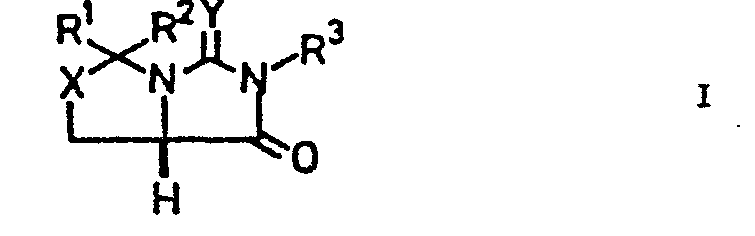
D-(+)-Biotin kann aus optisch aktiven Hydantoinen der Formel I,
Dabei stellt das bicyclische Nitril der Formel XI,
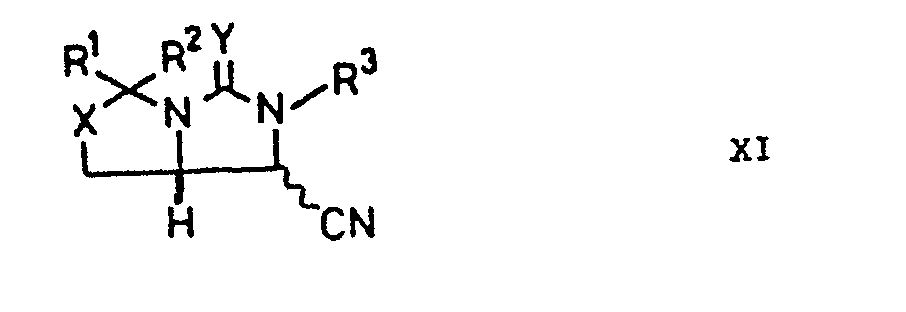
Vielzahl von Synthesemöglichkeiten für optisch aktives D-(+)-Biotin dar.Numerous synthesis options for optically active D - (+) - biotin.
Description
Die Erfindung betrifft ein Verfahren zur Herstellung von D-(+)-Biotin aus L-Cystein oder L-Cystin oder L-Serin über ein optisch aktives (7R)-1H,3H-Imidazo[1,5-c]azol als Zwischenprodukt.The invention relates to a process for the preparation of D - (+) - biotin from L-cysteine or L-cystine or L-serine via an optically active (7R) -1H, 3H-imidazo [1,5-c] azole as an intermediate .
Der Erfindung lag die Aufgabe zugrunde, ein neues Verfahren für die Herstellung optisch aktiven D-(+)-Biotins bereitzustellen, welches die Durchführung einer Racematspaltung und damit das Verwerfen oder Rückführen des unerwünschten Enantiomeren vermeidet.The object of the invention was to provide a new process for the production of optically active D - (+) - biotin, which avoids carrying out a resolution and thus discarding or recycling the undesired enantiomer.
Verfahren zur stereospezifischen Synthese von D-(+)-Biotin aus Zuckern geeigneter Konfiguration sind bekannt. So wird in Tetrahedron Letters Nr. 32, S. 2765-2766 (1975), als Ausgangsmaterial D-Mannose, in Agric. Biol. Chem. Nr. 42, S. 465 (1978), D-Glucose und in den DE-OS 31 22 562 und DE-OS 33 20 140 D-Arabinose als chirales Ausgangsmaterial verwendet.Methods for the stereospecific synthesis of D - (+) - biotin from sugars of a suitable configuration are known. For example, Tetrahedron Letters No. 32, pp. 2765-2766 (1975), D-mannose as the starting material, in Agric. Biol. Chem. No. 42, p. 465 (1978), D-glucose and in DE-OS 31 22 562 and DE-OS 33 20 140 D-arabinose used as a chiral starting material.
Alle diese Verfahren sind jedoch durch eine hohe Zahl von Syntheseschritten mit folglich geringer Gesamtausbeute gekennzeichnet. Die aufgrund ihrer Zuckernatur meist nicht kristallisierbaren Zwischenstufen werden oft nur in unbefriedigender Reinheit erhalten und er- . fordern, bedingt durch ihre Polyfunktionalität und der damit verbundenen chemischen Labilität die Einhaltung vergleichsweise enger Reaktionsparameter. Eine Reihe von Zuckern ist auch aus natürlichen Quellen nicht zugänglich, was einen hohen Preis zur Folge hat.However, all of these processes are characterized by a large number of synthesis steps with consequently low overall yield. The intermediate stages, which are usually not crystallizable due to their sugar nature, are often only obtained and obtained in unsatisfactory purity. demand, due to their polyfunctionality and the associated chemical lability compliance with comparatively narrow reaction parameters. A number of sugars are also inaccessible from natural sources, which results in a high price.
Die Verwendung von L-Cystein, wie aus US-4009172, US-4130713, US-4337345 und Journal of the American Chemical Society Nr. 99, S. 7020 (1977) bekannt, vermeidet zwar die Handhabung labiler Zwischenstufen, führt hingegen über insgesamt 18 Reaktionsstufen unter Abtrennung unerwünschter Isomere nur in unbefriedigender Ausbeute zu optisch aktivem D-(+)-Biotin.The use of L-cysteine, as known from US-4009172, US-4130713, US-4337345 and Journal of the American Chemical Society No. 99, p. 7020 (1977), avoids the handling of unstable intermediates, but leads over all 18 reaction steps with separation of undesired isomers only in unsatisfactory yield to optically active D - (+) - biotin.
In einem weiteren Verfahren werden in Journal of the American Chemical Society Nr. 105, S. 5946 (1983) und in der EP-OS 0 094776 substituierte 3H,5H-Imidazo[l,5-c]-tetrahydrothiazole beschrieben, aus denen nach Racematspaltung optisch aktives Biotin erhalten wird.In a further process, substituted 3H, 5H-imidazo [1,5-c] -tetrahydrothiazoles are described in Journal of the American Chemical Society No. 105, p. 5946 (1983) and in EP-OS 0 094776, from which according to Racemate resolution is obtained optically active biotin.
Da die vergleichsweise hohe Stufenzahl, verbunden mit teilweise mäßigen Ausbeuten und der Notwendigkeit einer optischen Trennungtauch diese Ausgangsstoffe als zur Herstellung von D-(+)-Biotin wenig geeignet erscheinen lassen, bestand weiterhin Bedarf an einem geeigneten Verfahren zur einfachen, ökonomischen und stereospezifischen Herstellung von D-(+)-Biotin.Since the comparatively high number of steps, connected to partially moderate yields and the need for optical resolution t these starting materials as for the preparation of D - (+) - blank biotin appear less suitable, still a need for a suitable method for the simple, economical and stereospecific Production of D - (+) - biotin.
Es wurde nun überraschend gefunden, daß D-(+)-Biotin aus den natürlich vorkommenden Aminosäuren L-Cystein oder L-Cystin oder L-Serin über ein optisch aktives (7R)-lH,3H-Imidazo[1,5-c]azol der Formel I als Zwischenprodukt auf stereospezifische Weise ohne zusätzliche Racemattrennung hergestellt werden kann.It has now surprisingly been found that D - (+) - biotin from the naturally occurring amino acids L-cysteine or L-cystine or L-serine via an optically active (7R) -IH, 3H-imidazo [1,5-c] Azole of the formula I can be prepared as an intermediate in a stereospecific manner without additional racemate separation.
Gegenstand der Erfindung ist daher ein Verfahren zur Herstellung von D-(+)-Biotin aus L-Cystein oder L-Cystin oder L-Serin, dadurch gekennzeichnet, daß die Synthese über ein Zwischenprodukt der Formel I geführt wird,

- R1 und R2 jeweils unabhängig voneinander H, unsubstituiertes oder substituiertes niederes Alkyl, Cycloalkyl, Aryl, Aralkyl oder Heteroaryl oder zusammengenommen unsubstituiertes oder substituiertes Alkylen oder Heteroalkylen,
- R3 H oder eine für ein Stickstoffatom geeignete Schutzgruppe und
- X und Y jeweils unabhängig voneinander O oder S bedeuten.
- R1 and R 2 each independently of one another are H, unsubstituted or substituted lower alkyl, cycloalkyl, aryl, aralkyl or heteroaryl or, taken together, unsubstituted or substituted alkylene or heteroalkylene,
- R 3 H or a protective group suitable for a nitrogen atom and
- X and Y each independently represent O or S.
In dieser Formel bedeutet X vorzugsweise S und Y vorzugsweise O, insbesonder sind gleichzeitig X = S und Y = O. Die Reste R1 und R2 bedeuten vorzugsweise H, C1-C4-Alkyl, unsubstituiertes oder durch C1-C3 Alkyl und/oder Alkoxy ein- oder mehrfach substituiertes Phenyl oder Benzyl, insbesonder sind gleichzeitig R1 = H, R2 = Phenyl. Vorzugsweise bedeutet der Rest R3 unsubstituiertes oder durch eine oder mehrere, insbesonders bevorzugt eine oder zwei, Cl-C4 Alkyl- und/oder C1-C4-Alkoxygruppen substituiertes Benzyl, insbesondere unsubstituiertes Benzyl, daneben auch C3-C5 Alk-2-enyl oder C3-C6 Trialkylsilyl. Bei mehrfacher, vorzugsweise zweifacher Substitution eines Phenylrings sind die Substituenten vorzugsweise gleich, sie können aber auch verschieden sein. Sie befinden sich vorzugsweise in 4- und/oder 2-Stellung, sie können aber auch in 3-, 5- und/oder 6-Stellung stehen.In this formula, X preferably denotes S and Y preferably O, in particular X = S and Y = O at the same time. The radicals R 1 and R 2 preferably denote H, C 1 -C 4 alkyl, unsubstituted or by C 1 -C 3 Alkyl and / or alkoxy mono- or polysubstituted phenyl or benzyl, in particular R 1 = H, R2 = phenyl. The radical R 3 is preferably unsubstituted or by one or more, particularly preferably one or two, C 1 -C 4 alkyl and / or C 1 -C 4 alkoxy groups substituted benzyl, in particular unsubstituted benzyl, in addition also C 3 -C 5 alk-2-enyl or C 3 -C 6 trialkylsilyl. In the case of multiple, preferably double substitution of a phenyl ring, the substituents are preferably the same, but they can also be different. They are preferably in the 4- and / or 2-position, but they can also be in the 3-, 5- and / or 6-position.
Dementsprechend ist Gegenstand der Erfindung insbesondere ein Verfahren zur Herstellung von D-(+)-Biotin aus L-Cystein oder L-Cystin oder L-Serin über ein Zwischenprodukt der Formel I, in dem mindestens einer der genannten Reste eine der vorstehend angegebenen bevorzugten Bedeutungen hat.Accordingly, the invention is in particular a process for the preparation of D - (+) - B iotin of L-cysteine or L-cystine or L-serine via an intermediate product of the formula I, preferred is any of the above in which at least one of said radicals Has meanings.
Gegenstand der Erfindung ist ferner ein Verfahren zur Herstellung der optisch aktiven Hydantoine der Formel I, dadurch gekennzeichnet, daß man L-Cystein oder L-Serin mit einem Alkali- oder Erdalkalimetallcyanat oder -thiocyanat in ein Hydantoin der Formel II umsetzt,
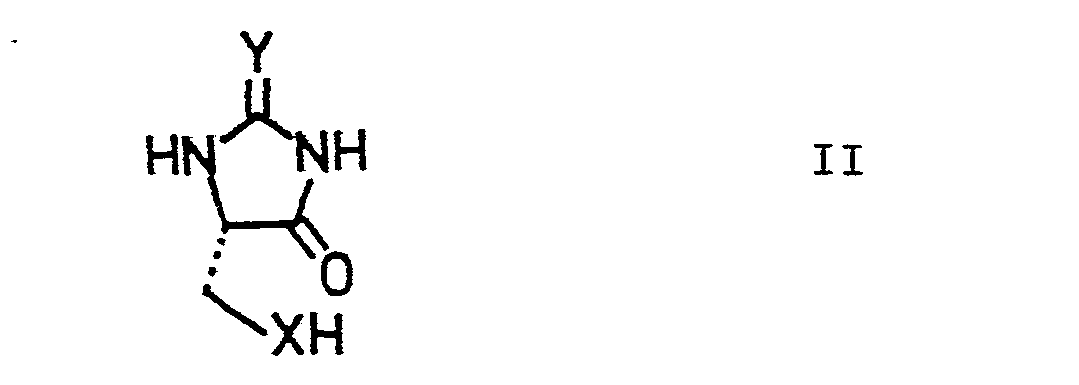
- worin X und Y die angegebene Bedeutung besitzen, dieses mit einer Carbonylverbindung der Formel III,

- worin R 1 und R2 die angegebene Bedeutung besitzen, unter Wasserabspaltung zu einem Bicyclus der Formel IV umsetzt,

- worin R 1, R 2, X und Y die angegebene Bedeutung besitzen, und dessen sekundäres Stickstoffatom mit einer Schutzgruppe R3 der angegebenen Bedeutung versieht,
- oder daß man L-Cystein oder L-Serin mit einer Carbonylverbindung der Formel III mit der angegebenen Bedeutung unter Wasserabspaltung zu einem Azolidin V umsetzt,

- worin R1, R 2 und X die angegebene Bedeutung besitzen, dieses mit einem Metallcyanat oder -thiocyanat zu einer Verbindung der Formel IV umsetzt und weiter wie voranstehend angegeben verfährt, oder mit einem Organoisocyanat oder -isothiocyanat der Formel VI umsetzt,

- worin R3 und Y die angegebene Bedeutung besitzen,
- oder daß man L-Cystin mit einem Alkali- oder Erdalkalicyanat oder -thiocyanat zu einem Bishydantoin der Formel VII umsetzt,

- worin Y O oder S bedeutet,
- dieses durch ein Reduktionsmittel in ein Hydantoin der Formel II überführt und wie voranstehend angegeben weiter umsetzt, oder dessen in 3-Stellung befindliches Stickstoffatom mit einer Schutzgruppe R3 der angegebenen Bedeutung versieht und das erhaltene Bishydantoin der Formel VIII,

- worin R3 und Y die angegebene Bedeutung besitzen, nach Spaltung durch ein Reduktionsmittel mit einer Carbonylverbindung der Formel III umsetzt,
- oder daß man L-Cystin mit einem Organoisocyanat oder -isothiocyanat der angegebenen Formel VI zu einem Bishydantoin der Formel VIII umsetzt und wie voranstehend angegeben weiter verfährt.
- wherein X and Y have the meaning given, this with a carbonyl compound of the formula III,
- wherein R 1 and R 2 have the meaning given, with elimination of water to form a bicyclic compound of the formula IV,
- in which R 1 , R 2 , X and Y have the meaning given, and the secondary nitrogen atom of which provides a protective group R 3 with the meaning given,
- or that L-cysteine or L-serine is reacted with a carbonyl compound of the formula III with the meaning given, with elimination of water, to give an azolidine V,
- wherein R 1 , R 2 and X have the meaning given, reacting this with a metal cyanate or thiocyanate to give a compound of the formula IV and proceeding as indicated above, or reacting with an organoisocyanate or isothiocyanate of the formula VI,
- where R 3 and Y have the meaning given,
- or that L-cystine is reacted with an alkali metal or alkaline earth metal cyanate or thiocyanate to give a bishydantoin of the formula VII,
- where YO or S means
- this is converted into a hydantoin of the formula II by a reducing agent and reacted further as indicated above, or its nitrogen atom in the 3-position is provided with a protective group R 3 of the meaning given and the bishydantoin of the formula VIII obtained,
- in which R 3 and Y have the meaning given, after cleavage by a reducing agent with a carbonyl compound of the formula III,
- or that L-cystine is reacted with an organoisocyanate or isothiocyanate of the formula VI given to give a bishydantoin of the formula VIII and the procedure is as described above.
Weiterhin ist Gegenstand der vorliegenden Erfindung ein Verfahren zur Herstellung von D-(+)-Biotin aus Verbindungen der Formel I, indem
- a) I zu einem Alkohol der Formel IX reduziert wird,

- worin R1, R2, R3, X und Y die angegebene Bedeutung besitzen, der in einen aktivierten Ester der Formel X überführt wird,
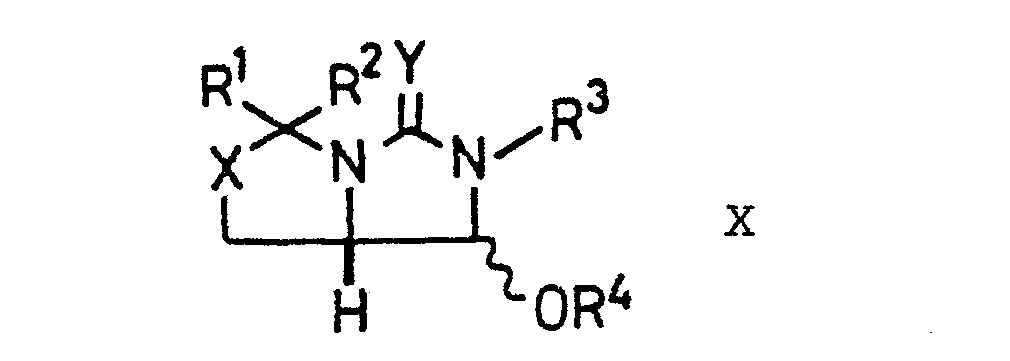
- worin R 1, R2, R 3, X und Y die angegebene Bedeutung besitzen und der Rest R4 für eine aktivierende Estergruppe steht, der mit einem Alkali-oder Erdalkalicyanid oder einem Cyanosilan zu einem Nitril der Formel XI umgesetzt wird,

- worin R1, R 2, R3, X und Y die angegebene Bedeutung besitzen, das mit einer Base oder einer Säure zu einem Säurederivat der Formel XII umgesetzt wird,

- worin R1, R2, R3, X und Y die angegebene Bedeutung besitzen und R5 H oder niederes Alkyl bedeutet, das unter Wasserabspaltung zu einem Lacton der Formel XIII cyclisiert wird,

- worin R3, X und Y die angegebene Bedeutung besitzen und R6 H oder R1R2CH bedeutet, das nach bekannten Verfahren in D-(+)-Biotin überführt wird,
- worin R1, R2, R3, X und Y die angegebene Bedeutung besitzen, der in einen aktivierten Ester der Formel X überführt wird,
- b) XI mit einer metallorganischen Verbindung zu einer Oxoverbindung der Formel XIV umgesetzt wird,

- worin R 1, R2, R3, X und Y die angegebene Bedeutung besitzen und Z OR5 oder COOR5 bedeutet, wobei R 5 H, niederes Alkyl, Cycloalkyl oder Aryl bedeutet, die durch Behandeln mit einer Säure und/oder einem Reduktionsmittel zu einem Imidazolidin der Formel XV gespalten wird,

- worin R3, R6, X, Y und Z die angegebene Bedeutung besitzen, das unter Einwirkung einer Base zu einem Biotinderivat der Formel XVI cyclisiert wird,

- worin R 3, R 6, X, Y und Z die angegebene Bedeutung besitzen, das nach bekannten Verfahren in D-(+)-Biotin überführt wird,
- worin R 1, R2, R3, X und Y die angegebene Bedeutung besitzen und Z OR5 oder COOR5 bedeutet, wobei R 5 H, niederes Alkyl, Cycloalkyl oder Aryl bedeutet, die durch Behandeln mit einer Säure und/oder einem Reduktionsmittel zu einem Imidazolidin der Formel XV gespalten wird,
- c) XI mit einem Reduktionsmittel zu einem Aldehyd der Formel XVII umgesetzt wird,

- worin R1, R 2, R3, X und Y die angegebene Bedeutung besitzen, der mit einer Organophosphorverbindung zu einer ungesättigten Carbonsäure der Formel XVIII kondensiert wird,
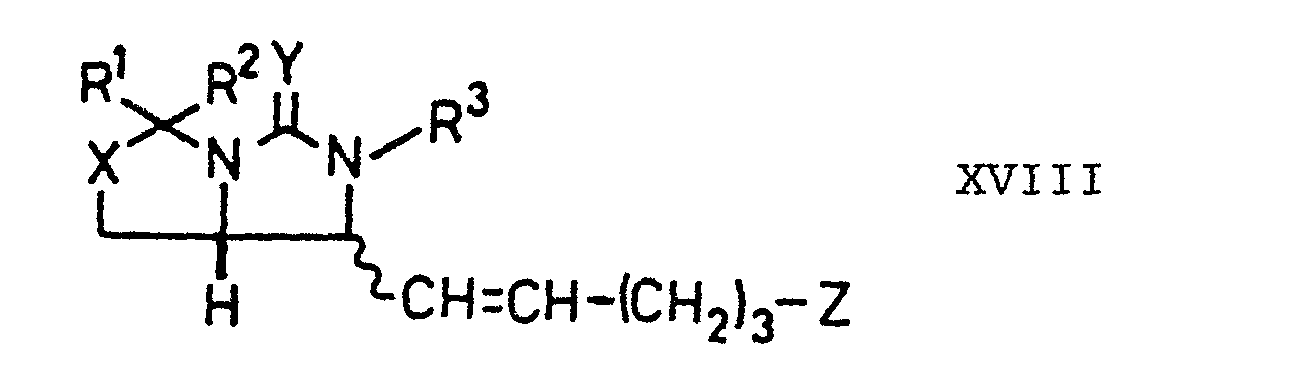
- worin R1, R , R , X, Y und Z die angegebene Bedeutung besitzen, die durch eine Säure und/ oder ein Reduktionsmittel zu einem Biotinderivat der Formel XIX umgesetzt wird,
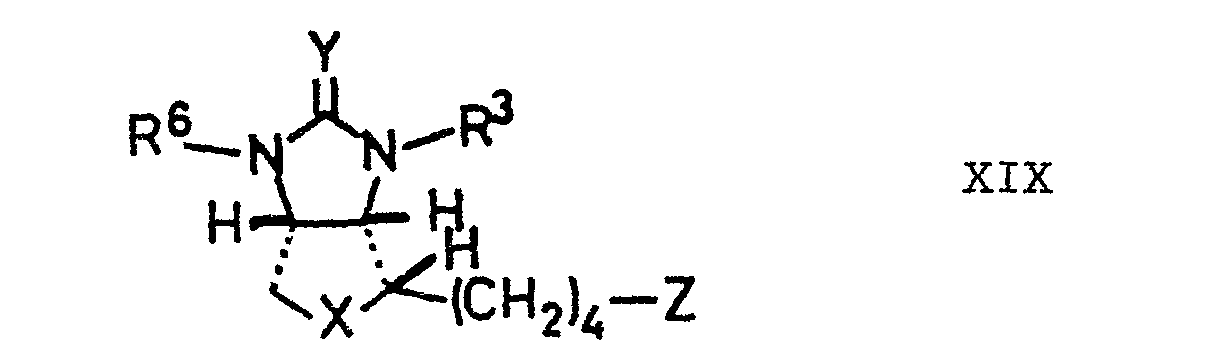
- worin R 3, R 6, X, Y und Z die angegebene Bedeutung besitzen, das nach bekannten Verfahren in D-(+)-Biotin überführt wird,
- worin R1, R 2, R3, X und Y die angegebene Bedeutung besitzen, der mit einer Organophosphorverbindung zu einer ungesättigten Carbonsäure der Formel XVIII kondensiert wird,
- d) eine Oxoverbindung der voranstehend angegebenen Formel XIV unter Säureeinwirkung zu einem Biotinderivat der Formel XX umgesetzt wird,

- worin R 3, X, Y und Z die angegebene Bedeutung besitzen, das nach bekannten Verfahren in D-(+)-Biotin überführt wird.
- a) I is reduced to an alcohol of the formula IX,
- wherein R 1 , R 2 , R 3 , X and Y have the meaning given, which is converted into an activated ester of the formula X,
- in which R 1 , R 2 , R 3 , X and Y have the meaning given and the radical R 4 represents an activating ester group which is reacted with an alkali metal or alkaline earth metal cyanide or a cyanosilane to give a nitrile of the formula XI,
- in which R 1 , R 2 , R 3 , X and Y have the meaning given, which is reacted with a base or an acid to give an acid derivative of the formula XII,
- in which R 1 , R 2 , R 3 , X and Y have the meaning given and R 5 is H or lower alkyl which is cyclized to a lactone of the formula XIII with elimination of water,
- wherein R 3 , X and Y have the meaning given and R 6 is H or R 1 R 2 CH, which is converted into D - (+) - biotin by known processes,
- wherein R 1 , R 2 , R 3 , X and Y have the meaning given, which is converted into an activated ester of the formula X,
- b) XI is reacted with an organometallic compound to give an oxo compound of the formula XIV,
- wherein R 1 , R 2 , R 3 , X and Y have the meaning given and Z is OR 5 or COOR 5 , where R 5 is H, lower alkyl, cycloalkyl or aryl, by treatment with an acid and / or a reducing agent is split into an imidazolidine of the formula XV,
- wherein R 3 , R 6 , X, Y and Z have the meaning given, which is cyclized to a biotin derivative of the formula XVI under the action of a base,
- in which R 3 , R 6 , X, Y and Z have the meaning given, which is converted into D - (+) - biotin by known processes,
- wherein R 1 , R 2 , R 3 , X and Y have the meaning given and Z is OR 5 or COOR 5 , where R 5 is H, lower alkyl, cycloalkyl or aryl, by treatment with an acid and / or a reducing agent is split into an imidazolidine of the formula XV,
- c) XI is reacted with a reducing agent to give an aldehyde of the formula XVII,
- wherein R 1 , R 2 , R 3 , X and Y have the meaning given, which is condensed with an organophosphorus compound to give an unsaturated carboxylic acid of the formula XVIII,
- in which R 1 , R, R, X, Y and Z have the meaning given, which is converted by an acid and / or a reducing agent to give a biotin derivative of the formula XIX,
- in which R 3 , R 6 , X , Y and Z have the meaning given, which is converted into D - (+) - biotin by known processes,
- wherein R 1 , R 2 , R 3 , X and Y have the meaning given, which is condensed with an organophosphorus compound to give an unsaturated carboxylic acid of the formula XVIII,
- d) an oxo compound of the above formula XIV is converted to a biotin derivative of the formula XX under the action of acid,
- wherein R 3 , X, Y and Z have the meaning given, which is converted into D - (+) - biotin by known processes.
Weiterhin sind Verbindungen der Formel XI Gegenstand der Erfindung, da sie wertvolle Zwischen- und Ausgangsprodukte einer Vielzahl von Synthesemöglichkeiten von optisch aktivem D-(+)-Biotin darstellen.

Hierbei besitzen R1, R2, X und Y die angegebene Bedeutung und R3 stellt eine für ein Stickstoffatom geeignete Schutzgruppe dar.Here R 1 , R 2 , X and Y have the meaning given and R 3 represents a protective group suitable for a nitrogen atom.
Bevorzugt sind Verbindungen der Formel XI, worin X Schwefel und Y Sauerstoff bedeuten. Insbesondere bevorzugt ist die Verbindung XIa, worin R1 Wasserstoff, R2 Phenyl und R3 Benzyl bedeuten.

Die Herstellung der Verbindungen der Formel I erfolgt nach an sich bekannten Methoden, wie sie in der Literatur (z. B. in Standardwerken wie Houben-Weyl, Methoden der Organischen Chemie, Georg-Thieme-Verlag, Stuttgart) beschrieben sind, und zwar unter Reaktionsbedingungen, wie sie für die genannten Umsetzungen bekannt und geeignet sind. Dabei kann man auch von an sich bekannten, hier nicht näher erwähnten Varianten Gebrauch machen.The compounds of the formula I are prepared by methods known per se, as described in the literature (for example in standard works such as Houben-Weyl, Methods of Organic Chemistry, Georg-Thieme-Verlag, Stuttgart), namely Reaction conditions as are known and suitable for the reactions mentioned. Use can also be made of variants which are known per se and are not mentioned here in detail.
Die Ausgangsstoffe der Formel II sind bekannt oder können nach bekannten Methoden aus L-Cystein oder L-Serin hergestellt werden, wie beispielsweise in Schöberl, Hamm, Chem. Ber. 81 [1948], 210 und Karabinos, Szabo, J. Amer. Chem. Soc. 66 [1944], 649 angegeben, indem man die freien Aminosäuren oder deren Säureadditionssalze mit einem Alkali- oder Erdalkalimetallcyanat oder -thiocyanat in einem geeigneten Lösungsmittel wie Wasser, Alkoholen oder deren Gemischen, vorzugsweise bei erhöhter Temperatur, miteinander umsetzt und das erhaltene Zwischenprodukt in situ unter Einwirkung einer Säure, beispielsweise einer Mineralsäure, cyclisiert.The starting materials of the formula II are known or can be prepared from L-cysteine or L-serine by known methods, such as, for example, in Schöberl, Hamm, Chem. Ber. 81 [1948], 210 and Karabinos, Szabo, J. Amer. Chem. Soc. 66 [1944], 649 by reacting the free amino acids or their acid addition salts with an alkali metal or alkaline earth metal cyanate or thiocyanate in a suitable solvent such as water, alcohols or mixtures thereof, preferably at elevated temperature, and the intermediate product obtained in situ cyclized under the action of an acid, for example a mineral acid.
Die Umsetzung der Hydantoine der Formel II mit Carbonylverbindungen der Formel III zu den Bicyclen der Formel IV kann nach den für Acetalisierungen bekannten und gebräuchlichen Verfahren erfolgen wie sie beispielsweise in Houben-Weyl, Methoden der Organischen Chemie, Bd. VI/3, S. 199, beschrieben sind. Vorzugsweise erfolgt die Umsetzung der Reaktionspartner unter Zusatz eines wasserentziehenden Mittels wie z. B. einer Säure wie Schwefelsäure, Phosphorsäure, Chlorwasserstoff, p-Toluolsulfonsäure, einem Säurederivat wie Phosphorpentoxid, Phosphortrichlorid, Phosphorpentachlorid, Phosphoroxychlorid, einem Metallsalz wie wasserfreiem Calciumchlorid, Kupfersulfat, Eisen(III)-chlorid, einem sauren Ionenaustauscher oder Molekularsieben. Die Entfernung des gebildeten Reaktionswassers kann auch durch azeotrope Destillation mit einem geeigneten Lösungsmittel wie Benzol, Toluol, Chloroform, Dichlormethan erfolgen. Schließlich ist es auch möglich, anstelle einer freien Carbonylverbindung der Formel III, deren Acetal mit einem geeigneten Alkohol, vorzugsweise einem niederen Alkohol, zur Herstellung der Verbindungen der Formel IV zu verwenden. Zweckmäßigerweise wird der bei der Reaktion freiwerdende Alkohol laufend aus dem Reaktionsgemisch entfernt, beispielsweise durch Destillation oder Adsorption. Auch kann durch einen Überschuß an Acetal von Oxoverbindung III gebildetes Reaktionswasser entfernt werden.The reaction of the hydantoins of the formula II with carbonyl compounds of the formula III to the bicycles of the formula IV can be carried out by the processes known and customary for acetalizations, such as, for example, in Houben-Weyl, Methods of Organic Chemistry, Vol. VI / 3, p. 199 , are described. The reaction partners are preferably reacted with the addition of a dehydrating agent such as. B. an acid such as sulfuric acid, phosphoric acid, hydrogen chloride, p-toluenesulfonic acid, an acid derivative such as phosphorus pentoxide, phosphorus trichloride, phosphorus pentachloride, phosphorus oxychloride, a metal salt such as anhydrous Calcium chloride, copper sulfate, iron (III) chloride, an acidic ion exchanger or molecular sieves. The water of reaction formed can also be removed by azeotropic distillation with a suitable solvent such as benzene, toluene, chloroform, dichloromethane. Finally, it is also possible to use, instead of a free carbonyl compound of the formula III, its acetal with a suitable alcohol, preferably a lower alcohol, for the preparation of the compounds of the formula IV. The alcohol liberated in the reaction is expediently removed from the reaction mixture, for example by distillation or adsorption. Water of reaction formed by an excess of acetal of oxo compound III can also be removed.
Für die Umsetzung mit den Hydantoinen der Formel II verwendet man vorteilhaft ein Äquivalent an Carbonylverbindung III bzw. deren Acetal, welche gleichzeitig als Lösungsmittel dienen können. Zweckmäßiger ist es jedoch, ein zusätzliches inertes Lösungsmittel zuzusetzen. Als inerte Lösungsmittel eignen sich vorzugsweise Kohlenwasserstoffe wie Pentan, Hexan, Cyclohexan, Benzol, Toluol oder Xylol sowie chlorierte Kohlenwasserstoffe wie Dichlormethan, Chloroform oder Tetrachlorkohlenstoff.For the reaction with the hydantoins of the formula II, it is advantageous to use an equivalent of carbonyl compound III or its acetal, which can simultaneously serve as a solvent. However, it is more expedient to add an additional inert solvent. Suitable inert solvents are preferably hydrocarbons such as pentane, hexane, cyclohexane, benzene, toluene or xylene, and chlorinated hydrocarbons such as dichloromethane, chloroform or carbon tetrachloride.
Das Stickstoffatom in den bicyclischen Verbindungen der Formeln I, VIII, IX, X, XI, XII, XIII, XIV, XV, XVI, XVII, XVIII, XIX und XX wird durch Schutzgruppe R 3 geschützt, worin R3 z.B. Benzyl, 4-Methoxybenzyl, 3,4-Dimethoxybenzyl, 4-Methylbenzyl, Allyl, Methallyl, Crotyl, Methoxymethyl, Trimethylsilyl, tert-Butyldimethylsilyl oder tert-Butyldiphenylsilyl bedeutet. Diese Schutzgruppen werden nach bekannten Verfahren, wie sie beispielsweise aus Mac Omie, Protective Groups in Organic Chemistry, Plenum Press, New York, 1973 entnommen werden können, durch Umsetzen der entsprechenden reaktiven Halogenide mit den Bicyclen der Formel IV, unter Erhalt von (7R)-1H,3H-Imidazo[1,5c]azolen der Formel I, eingeführt.The nitrogen atom in the bicyclic compounds of the formulas I, VIII, IX, X, XI, XII, XIII, XIV, XV, XVI, XVII, XVIII, XIX and XX is protected by protective group R 3 , where R 3 is, for example, benzyl, 4- Methoxybenzyl, 3,4-dimethoxybenzyl, 4-methylbenzyl, allyl, methallyl, crotyl, methoxymethyl, trimethylsilyl, tert-butyldimethylsilyl or tert-butyldiphenylsilyl. This protection Groups are prepared by known methods, such as those found in Mac Omie, Protective Groups in Organic Chemistry, Plenum Press, New York, 1973, by reacting the corresponding reactive halides with the bicycles of the formula IV to give (7R) - 1H, 3H-Imidazo [1,5c] azoles of the formula I, introduced.
Vorzugsweise erfolgt die Umsetzung der Reaktionspartner in einem geeigneten Lösungsmittel unter Zusatz eines basischen Reagenzes. Gut geeignete Lösungsmittel sind insbesondere Ether wie Diethylether, Di-n-butylether, THF, Dioxan oder Anisol, Ketone wie Aceton, Butanon oder Cyclohexanon, Amide wie DMF oder Phosphorsäurehexamethyltriamid, Kohlenwasserstoffe wie Benzol, Toluol oder Xylol, Halogenkohlenwasserstoffe wie Tetrachlorkohlenstoff oder Tetrachlorethylen und Sulfoxide wie Dimethylsulfoxid oder Sulfolan.The reaction partners are preferably reacted in a suitable solvent with the addition of a basic reagent. Suitable solvents are in particular ethers such as diethyl ether, di-n-butyl ether, THF, dioxane or anisole, ketones such as acetone, butanone or cyclohexanone, amides such as DMF or phosphoric acid hexamethyltriamide, hydrocarbons such as benzene, toluene or xylene, halogenated hydrocarbons such as carbon tetrachloride or tetrachlorethylene and sulfoxides such as dimethyl sulfoxide or sulfolane.
Eine bevorzugte Reaktionsweise ist die Umsetzung einer bicyclischen Verbindung der Formel IV mit einer reaktiven, den-Rest R3 tragenden Verbindung, vorzugsweise in einem basischen Milieu, wobei als Basen insbesondere Alkalimetallhydroxide wie Natrium- oder Kaliumhydroxid, Alkalimetallcarbonate bzw. -hydrogencarbonate wie Natriumcarbonat, Natriumhydrogencarbonat, Kaliumcarbonat oder Kaliumhydrogencarbonat, Alkalimetallacetate wie Natrium- oder Kaliumacetat, Erdalkalimetallhydroxide wie Calciumhydroxid, Alkalimetallhydride wie Natriumhydrid, Amide wie Natriumamid, Lithiumdiisopropylamid, Alkoholate wie Natriummethylat, Natriumethylat, Lithiumethylat oder organische Basen wie Triethylamin, Pyridin, Lutidin, Collidin, Imidazol, 4-(N,N-Dimethylamino)-pyridin oder Chinolin von Bedeutung sind.A preferred reaction procedure is the reaction of a bicyclic compound of formula IV with a reactive, the - R 3 bearing compound, preferably in a basic medium, important bases being, in particular alkali metal hydroxides such as sodium or potassium hydroxide, alkali metal carbonates or hydrogen carbonates such as sodium carbonate, sodium hydrogen carbonate , Potassium carbonate or potassium hydrogen carbonate, alkali metal acetates such as sodium or potassium acetate, alkaline earth metal hydroxides such as calcium hydroxide, alkali metal hydrides such as sodium hydride, amides such as sodium amide, lithium diisopropylamide, alcoholates such as sodium methylate, sodium ethylate, lithium ethylate or organic bases such as triethylamine, 4-pyridine, imidazole, lutidine, lutidine, lutidine N, N-dimethylamino) pyridine or quinoline are important.
Die Reaktionstemperatur liegt gewöhnlich zwischen -50 °C und +250 °C, vorzugsweise zwischen -20 °C und +80 °C. Bei diesen Temperaturen sind die Reaktionen in der Regel nach 15 Minuten bis 48 Stunden beendet.The reaction temperature is usually between -50 ° C and +250 ° C, preferably between -20 ° C and +80 ° C. At these temperatures, the reactions are usually complete after 15 minutes to 48 hours.
In einem weiteren Verfahren zur Herstellung der Verbindungen der Formel II setzt man L-Cystein oder L-Serin mit einer Carbonylverbindung der Formel III zu einem Azolidin V um. Verbindungen der Formel V und Verfahren zu deren Herstellung sind beispielsweise bekannt aus Schubert, J. Biol. Chem. 114 (1936), 341, Uskovic et al., J. Amer. Chem. Soc. 97 (1975), 5936, Lieberman et al., ibid. 70 (1948), 3094 und US-3957794 sowie US-4009172. Ebenfalls geeignet sind die zur Herstellung der Verbindungen der Formel IV angegebenen Reaktionsbedingungen.In a further process for the preparation of the compounds of the formula II, L-cysteine or L-serine is reacted with a carbonyl compound of the formula III to give an azolidine V. Compounds of formula V and processes for their preparation are known, for example, from Schubert, J. Biol. Chem. 114 (1936), 341, Uskovic et al., J. Amer. Chem. Soc. 97 (1975), 5936, Lieberman et al., Ibid. 70 (1948), 3094 and US-3957794 and US-4009172. The reaction conditions specified for the preparation of the compounds of the formula IV are also suitable.
Azolidine der Formel V können mittels Alkalimetall-oder Erdalkalimetallcyanaten oder -thiocyanaten unter den bereits für die Herstellung von Verbindungen der Formel II angegebenen Reaktionsbedingungen in Verbindungen der Formel IV und weiter wie angegeben in die Imidazo[1,5-c]azole der Formel I überführt werden.Azolidines of the formula V can be converted into compounds of the formula IV and, as indicated, into the imidazo [1,5-c] azoles of the formula I using alkali metal or alkaline earth metal cyanates or thiocyanates under the reaction conditions already given for the preparation of compounds of the formula II will.
Zweckmäßiger ist es jedoch, die Azole der Formel V mit einem Organoisocyanat oder -isothiocyanat der Formel VI direkt zu den Imidazo[l,5-c]azolen der Formel I umzusetzen. Organoisocyanate und -isothiocyanate der Formel VI sind bekannt oder können nach bekannten Methoden wie beispielsweise in Houben-Weyl, Methoden der Organischen Chemie, Bde. VIII, S. 75 u. IX, S. 773, beschrieben, erhalten werden.However, it is more expedient to react the azoles of the formula V directly with an organoisocyanate or isothiocyanate of the formula VI to give the imidazo [1,5-c] azoles of the formula I. Organoisocyanates and isothiocyanates of the formula VI are known or can be prepared by known methods, for example in Houben-Weyl, Methods of Organic Chemistry, Vol. VIII, p. 75 and. IX, p. 773, can be obtained.
Aus Lieberman, J. Amer. Chem. Soc. 70 (1948), 3094 und Crabb et al., Tetrahedron 29 (1973), 3389, ist die Umsetzung von Hydantoinen mit Phenyl- und Methylisocyanat bekannt. Nach diesen Methoden kann auch die Reaktion der Azole der Formel V mit den Organoisocyanaten oder -isothiocyanaten der Formel VI erfolgen. Vorzugsweise wird die Umsetzung der Reaktionspartner in einem geeigneten Lösungsmittel durchgeführt wie z. B. Ether wie Diethylether, Di-n-butylether, THF, Dioxan oder Anisol, Ketone wie Aceton, Butanon oder Cyclohexanon, Amide wie DMF oder Phosphorsäurehexamethyltriamid, Kohlenwasserstoffe wie Benzol, Toluol oder Xylol, Halogenkohlenwasserstoffe wie Tetrachlorkohlenstoff oder Tetrachlorethylen und Sulfoxide wie Dimethylsulfoxid oder Sulfolan. Geeignet sind auch basische Lösungsmittel wie Pyridin, Lutidin, Collidin, Diethylamin oder Triethylamin sowie Gemische dieser Basen mit den voranstehend angegebenen Lösungsmitteln.From Lieberman, J. Amer. Chem. Soc. 70 (1948), 3094 and Crabb et al., Tetrahedron 29 (1973), 3389, the reaction of hydantoins with phenyl and methyl isocyanate is known. These methods can also be used to react the azoles of the formula V with the organoisocyanates or isothiocyanates of the formula VI. The reaction of the reactants is preferably carried out in a suitable solvent, such as, for. B. ethers such as diethyl ether, di-n-butyl ether, THF, dioxane or anisole, ketones such as acetone, butanone or cyclohexanone, amides such as DMF or phosphoric acid hexamethyltriamide, hydrocarbons such as benzene, toluene or xylene, halogenated hydrocarbons such as carbon tetrachloride or tetrachlorethylene and sulfoxides such as dimethylsulfoxide Sulfolan. Basic solvents such as pyridine, lutidine, collidine, diethylamine or triethylamine and mixtures of these bases with the solvents indicated above are also suitable.
Gegebenenfalls kann es zweckmäßig sein, die primär gebildete Carbamoyl- oder Thiocarbamoylverbindung zu isolieren und in einem separaten Reaktionsschritt unter Wasserabspaltung zu cyclisieren. Als wasserabspaltende Mittel eignen sich beispielsweise Säuren wie Schwefelsäure, Chlorwasserstoff, Toluolsulfonsäure oder Basen wie Natrium- oder Kaliumhydroxid. Man kann dabei in Gegenwart oder Abwesenheit eines inerten Lösungsmittels bei Temperaturen zwischen etwa 0 °C und 150°C, vorzugsweise zwischen etwa 20 C° und 100 °C, arbeiten; als Lösungsmittel kommen z. B. Wasser und Alkohole wie Methanol, Ethanol, Isopropanol oder Butanol in Betracht.If appropriate, it may be expedient to isolate the carbamoyl or thiocarbamoyl compound that is formed and to cyclize it in a separate reaction step with elimination of water. Suitable water-releasing agents are, for example, acids such as sulfuric acid, hydrogen chloride, toluenesulfonic acid or bases such as sodium or potassium hydroxide. You can work in the presence or absence of an inert solvent at temperatures between about 0 ° C and 150 ° C, preferably between about 20 C ° and 100 ° C; come as a solvent, for. B. water and alcohols such as methanol, ethanol, isopropanol or butanol.
In einem weiteren Verfahren zur Herstellung der Verbindungen der Formel II setzt man L-Cystin mit einem Alkalimetall- oder Erdalkalimetallcyanat oder -thiocyanat zu einem Bishydantoin der Formel VII um. Dazu kann von den gleichen Methoden Gebrauch gemacht werden, die bereits zur Herstellung der Hydantoine der Formel II angegeben wurden, wobei gleiche oder ähnliche Reaktionsbedingungen zur Anwendung gelangen.In a further process for the preparation of the compounds of the formula II, L-cystine is reacted with an alkali metal or alkaline earth metal cyanate or thiocyanate to give a bishydantoin of the formula VII. For this purpose, use can be made of the same methods which have already been given for the preparation of the hydantoins of the formula I I , the same or similar reaction conditions being used.
Aus den Bishydantoinen der Formel VII lassen sich durch Behandeln mit einem Reduktionsmittel Hydantoine der Formel II (X = S) erhalten, aus denen nach den voranstehend angegebenen Methoden die Imidazo[1,5-c]thiazole der Formel I (X = S) hergestellt werden. Geeignete Reduktionsmittel sind beispielsweise Houben-Weyl, Methoden der Organischen Chemie, Bd. 15/1, S. 798, zu entnehmen. Vorzugsweise eignen sich Natrium/flüssiger Ammoniak, Zink/Säure oder Phosphoniumiodid zur reduktiven Spaltung der Disulfid-Bindung. Zweckmäßigerweise führt man die Reduktion der Bishydantoine der Formel VII mit einem Äquivalent, insbesondere mit einem Überschuß Reduktionsmittel durch in einem geeigneten, der chemischen Natur des Reagenzes angepaßten Lösungsmittel wie z. B. Wasser, flüssigem Ammoniak, Alkoholen wie Methanol, Ethanol, Isopropanol, Säuren wie Salzsäure, Schwefelsäure, Ameisensäure, Essigsäure, Ethern wie Diethylether, THF oder Dioxan oder auch deren Gemischen, zweckmäßig bei Temperaturen zwischen etwa -50 °C und +150 °C.From the bishydantoins of the formula VII, hydantoins of the formula II (X = S) can be obtained by treatment with a reducing agent, from which the imidazo [1,5-c] thiazoles of the formula I (X = S) are prepared by the methods given above will. Suitable reducing agents can be found, for example, in Houben-Weyl, Methods of Organic Chemistry, Vol. 15/1, p. 798. Sodium / liquid ammonia, zinc / acid or phosphonium iodide are preferably suitable for the reductive cleavage of the disulfide bond. Advantageously, the reduction of the bishydantoins of the formula VII is carried out with an equivalent, in particular with an excess of reducing agent, in a suitable solvent which is matched to the chemical nature of the reagent, such as, for. B. water, liquid ammonia, alcohols such as methanol, ethanol, isopropanol, acids such as hydrochloric acid, sulfuric acid, formic acid, acetic acid, ethers such as diethyl ether, THF or dioxane or mixtures thereof, advantageously at temperatures between about -50 ° C and +150 ° C.
Ein besonders vorteilhaftes Verfahren zur Spaltung der Disulfidbindung in den Verbindungen der Formel VII besteht in deren Thiolyse mit einem geeigneten Mercaptan wie z. B. Thiophenol, Butan-1,4-dithiol oder 1,4-Dithio-threitol analog zu der bei Hase, Walter, Inst. J. Pept. Prot. Res. 5 (1973), 283, angegebenen Arbeitsweise. Die Umsetzung der Reaktionspartner erfolgt zweckmäßigerweise in einem geeigneten Lösungsmittel wie z. B. wäßrigen Alkalimetallhydroxidlösungen, Chlorkohlenwasserstoffen oder flüssigem Ammoniak bei Temperaturen zwischen etwa -40 °C und +120 °C.A particularly advantageous method for cleaving the disulfide bond in the compounds of formula VII is their thiolysis with a suitable mercaptan such as. B. thiophenol, butane-1,4-dithiol or 1,4-dithio-threitol analogous to that in Hase, Walter, Inst. J. Pept. Prot. Res. 5 (1973), 283 Way of working. The reaction partners are advantageously reacted in a suitable solvent such as, for. B. aqueous alkali metal hydroxide solutions, chlorinated hydrocarbons or liquid ammonia at temperatures between about -40 ° C and +120 ° C.
Weiterhin können die Bishydantoine der Formel VII mit einer Schutzgruppe der Formel R3 versehen werden. Zur Herstellung dieser geschützten Bishydantoine der Formel VIII kann von den bereits für die Herstellung der Verbindungen der Formel I aus den Bicyclen der Formel IV angegebenen Methoden Gebrauch gemacht werden, wobei gleiche oder ähnliche Reaktionsbedingungen zur Anwendung gelangen.The bishydantoins of the formula VII can furthermore be provided with a protective group of the formula R 3 . To prepare these protected bishydantoins of the formula VIII, use can be made of the methods already given for the preparation of the compounds of the formula I from the bicycles of the formula IV, the same or similar reaction conditions being used.
Ein weiteres Verfahren zur Herstellung der geschützten Bishydantoine der Formel VIII besteht in der Umsetzung von L-Cystin mit einem Organoisocyanat oder -isothiocyanat der angegebenen Formel VI in Analogie zur Herstellung von Verbindungen der Formel I aus Azolidinen der Formel V, wobei man sich gleicher oder ähnlicher Verfahren bedient, wie bereits für die Herstellung der Verbindungen der Formel I angegeben.Another process for the preparation of the protected bishydantoins of the formula VIII consists in the reaction of L-cystine with an organoisocyanate or isothiocyanate of the formula VI given in analogy to the preparation of compounds of the formula I from azolidines of the formula V, the same or similar Process operated, as already indicated for the preparation of the compounds of formula I.
Zur Überführung der Verbindungen der Formel VIII in die (7aR)-lH,3H-Imidazo[l,5-c]thiazole der Formel I (X = S) werden diese in einer der Herstellung der Hydantoine der Formel II aus den Disulfiden der Formel VII entsprechenden Weise unter Anwendung gleicher oder ähnlicher Verfahren und Reaktionsbedingungen mit einem Reduktionsmittel oder einem die Thiolyse bewirkenden Reagenz behandelt und darauf, entsprechend der Herstellung von Verbindungen der Formel V, mit einer Carbonylverbindung der Formel III umgesetzt.To convert the compounds of the formula VIII into the (7aR) -1H, 3H-imidazo [1,5-c] thiazoles of the formula I (X = S), they are used in one of the preparation of the hydantoins of the formula II from the disulfides of the formula VII treated in a corresponding manner using the same or similar processes and reaction conditions with a reducing agent or a reagent which brings about thiolysis and then, in accordance with the preparation of compounds of the formula V, reacted with a carbonyl compound of the formula III.
Ein Verfahren zur Herstellung von D-(+)-Biotin aus I besteht darin, daß eine Oxoverbindung der Formel I zu einem Alkohol der Formel IX reduziert wird. Geeignete Verfahren sind beispielsweise Houben-Weyl, Methoden der Organischen Chemie, Bd. 4/lc + 4/ld, zu entnehmen.One method for producing D - (+) - biotin from I is to reduce an oxo compound of the formula I to an alcohol of the formula IX. Suitable processes can be found, for example, in Houben-Weyl, Methods of Organic Chemistry, Vol. 4 / lc + 4 / ld.
Die Reduktion kann z.B. erfolgen durch katalytische Hydrierung bei Temperaturen zwischen etwa 0 °C und etwa 200 °C sowie Drucken zwischen etwa 1 und 200 bar in einem inerten Lösungsmittel, z.B. einem Alkohol wie Methanol, Ethanol oder Isopropanol, einem Ether wie Tetrahydrofuran (THF) oder Dioxan, einem Ester wie Ethylacetat, einer Carbonsäure wie Essigsäure oder einem Kohlenwasserstoff wie Cyclohexan. Als Katalysatoren eignen sich zweckmäßig Edelmetalle wie Pt oder Pd, die in Form von Oxiden (z.B. Pt02, PdO), auf einem Träger (z.B. Pd auf Kohle, Calciumcarbonat oder Strontiumcarbonat) oder in feinverteilter Form eingesetzt werden können.The reduction can be carried out, for example, by catalytic hydrogenation at temperatures between about 0 ° C. and about 200 ° C. and pressures between about 1 and 200 bar in an inert solvent, for example an alcohol such as methanol, ethanol or isopropanol, an ether such as tetrahydrofuran (THF) or dioxane, an ester such as ethyl acetate, a carboxylic acid such as acetic acid or a hydrocarbon such as cyclohexane. Suitable catalysts are suitably noble metals such as Pt or Pd, which can be used in the form of oxides (for example Pt0 2 , PdO), on a support (for example Pd on carbon, calcium carbonate or strontium carbonate) or in finely divided form.
Weiterhin sind Reduktionen mit komplexen Hydriden möglich wie beispielsweise Boranen wie Diboran, Natriumboranat, Lithium-cyano-trihydro-borat, Metallhydriden wie Natriumhydrid, Aluminiumhydrid, Siliciumhydriden wie Triethylsilan, Tributylzinnhydrid und gemischten Hydriden wie Lithiumalanat, Natriumalanat, Natrium- bis(2-methoxy-ethoxy)-dihydridoaluminat, Kaliumboranat oder Lithiumboranat.Reductions with complex hydrides such as boranes such as diborane, sodium boranate, lithium cyano-trihydroborate, metal hydrides such as sodium hydride, aluminum hydride, silicon hydrides such as triethylsilane, tributyltin hydride and mixed hydrides such as lithium alanate, sodium alanate, sodium bis (2-methoxy- ethoxy) dihydridoaluminate, potassium boranate or lithium boranate.
Die Umsetzung der Oxoverbindungen der Formel I mit den Reduktionsmitteln erfolgt zweckmäßig in einem geeigneten Lösungsmittel bei Temperaturen zwischen etwa -100 °C und +150°, insbesondere zwischen etwa 0° und 100°; als Lösungsmittel kommen je nach der chemischen Natur des Reduktionsmittel z.B. Wasser, Alkohole wie Methanol, Ethanol, Isopropanol, Butanol, Ether wie Tetrahydrofuran, Dioxan, Diethylether, Ethylenglykoldimethylether und Kohlenwasserstoffe wie Pentan, Cyclohexan, Benzol, Toluol in Betracht.The reaction of the oxo compounds of the formula I with the reducing agents is advantageously carried out in a suitable solvent at temperatures between about -100 ° C. and + 150 °, in particular between about 0 ° and 100 °; Depending on the chemical nature of the reducing agent, solvents such as water, alcohols such as methanol, Ethanol, isopropanol, butanol, ethers such as tetrahydrofuran, dioxane, diethyl ether, ethylene glycol dimethyl ether and hydrocarbons such as pentane, cyclohexane, benzene, toluene can be considered.
Zur Aktivierung der Hydroxylgruppe in den Alkoholen der Formel IX werden diese mit einer reaktiven, den Rest R4 tragenden Verbindung R4-Q umgesetzt, worin R4 beispielsweise Alkanoyl wie Acetyl, Aroyl wie Benzoyl, 4-Nitrobenzoyl, Alkylsulfonyl wie Methansulfonyl, Ethansulfonyl, Trifluormethansulfonyl, Arylsulfonyl wie Phenylsulfonyl, Aralkylsulfonyl wie Benzylsulfonyl bedeutet. Weiterhin ist R4 ein Rest Azol-M, worin Azol für einen stickstoffhaltigen, unsubstituierten oder substituierten und/oder kondensierten Fünfring steht wie beispielsweise Imidazol, 1,2,4-Triazol, 1,2,3-Triazol, Benzotriazol, Benzimidazol, Pyrazol, 3,5-Dimethylpyrazol, Indazol, und M CO, CS, SO, S02, S bedeutet. Vorzugsweise bedeutet R4 Acetyl, Imidazol-1-yl- carbonyl, Imidazol-1-ylsulfinyl, Imidazol-1-ylsulfonyl. Q bedeutet Halogen, Alkoxy, Alkanoyloxy oder ein weiterer Rest Azol.To activate the hydroxyl group in the alcohols of the formula IX, they are reacted with a reactive compound R 4- Q which carries the radical R 4 , where R 4 is, for example, alkanoyl such as acetyl, aroyl such as benzoyl, 4-nitrobenzoyl, alkylsulfonyl such as methanesulfonyl, ethanesulfonyl, Trifluoromethanesulfonyl, arylsulfonyl such as phenylsulfonyl, aralkylsulfonyl such as benzylsulfonyl means. Furthermore, R 4 is a radical Azol-M, in which Azol stands for a nitrogen-containing, unsubstituted or substituted and / or condensed five-membered ring, such as, for example, imidazole, 1,2,4-triazole, 1,2,3-triazole, benzotriazole, benzimidazole, pyrazole , 3,5-dimethylpyrazole, indazole, and M means CO, CS, SO, S0 2 , S. R 4 is preferably acetyl, imidazol-1-ylcarbonyl, imidazol-1-ylsulfinyl, imidazol-1-ylsulfonyl. Q represents halogen, alkoxy, alkanoyloxy or a further azole radical.
Somit sind zur Herstellung von aktiven Estern der Formel X insbesondere die Umsetzung von Acetylchlorid, Acetanhydrid, 1,1'-Carbonyldiimidazol, l,l'-Sulfinyl- diimidazol und 1,1'-sulfonyldiimidazol mit Alkoholen der Formel IX geeignet.Thus, the reaction of acetyl chloride, acetic anhydride, 1,1'-carbonyldiimidazole, l, l'-sulfinyl-diimidazole and 1,1'-sulfonyldiimidazole with alcohols of the formula IX are particularly suitable for the preparation of active esters of the formula X.
Eine bevorzugte Reaktionsweise ist die Umsetzung eines Alkohols der Formel IX mit einer reaktiven, den Rest R4 tragenden Verbindung, vorzugsweise in einem basischen Milieu, wobei als Basen insbesondere organische Basen wie Triethylamin, Pyridin, Lutidin, Collidin oder Chinolin geeignet sind. Die Reaktionstemperatur liegt gewöhnlich zwischen -50 °C und +150 °C, vorzugsweise zwischen -20 °C und +80 °C. Bei diesen Temperaturen sind die Umsetzungen in der Regel nach 15 Minuten bis 48 Stunden beendet.A preferred reaction mode is the reaction of an alcohol of formula IX with a reactive compound bearing the radical R 4 , preferably in a basic medium, organic bases such as triethylamine, pyridine, lutidine, collidine or quinoline being particularly suitable as bases. The reaction temperature is ge usually between -50 ° C and +150 ° C, preferably between -20 ° C and +80 ° C. At these temperatures, the reactions are usually complete after 15 minutes to 48 hours.
Zur Überführung in Nitrile der Formel XI können die aktivierten Ester der Formel X mit einem Cyanid umgesetzt werden, zweckmäßig mit einem Metallcyanid wie Natriumcyanid, Kaliumcyanid oder Kupfercyanid oder einem Cyanosilan wie z.B. Trimethylsilylcyanid, B-Trimethylsilylpropionitril oder Diethylaluminiumcyanid, z.B. in einem inerten Lösungsmittel wie Dichlormethan, Toluol, Pyridin, Dimethylformamid, Dimethylsulfoxid, N-Methylpyrrolidon oder Hexamethylphosphorsäuretriamid bei Temperaturen zwischen -50 °C und 200 °C.For conversion into nitriles of the formula XI, the activated esters of the formula X can be reacted with a cyanide, advantageously with a metal cyanide such as sodium cyanide, potassium cyanide or copper cyanide or a cyanosilane such as e.g. Trimethylsilyl cyanide, B-trimethylsilylpropionitrile or diethylaluminium cyanide, e.g. in an inert solvent such as dichloromethane, toluene, pyridine, dimethylformamide, dimethyl sulfoxide, N-methylpyrrolidone or hexamethylphosphoric triamide at temperatures between -50 ° C and 200 ° C.
Ein bevorzugtes Verfahren zur Herstellung von Nitrilen der Formel XI aus aktivierten Estern der Formel X, worin R 4 ein Rest Azol-M mit der voranstehend angegebenen Bedeutung ist, besteht in einer zusätzlichen Aktivierung der Ester der Formel X durch deren N-Älkylierung. Hierfür geeignete Alkylierungsmittel sind beispielsweise Alkyl-, Alkenyl- und Aryliodide-, -bromide, -chloride, -sulfate und -sulfonate. Deren Umsetzung mit den aktivierten Estern der Formel X erfolgt zweckmäßigerweise in einem geeigneten Lösungsmittel wie beispielsweise Ethern wie Diethylether, Tetrahydrofuran, Dioxan oder Ketonen wie Aceton, Diethylketon, Methylisobutylketon; sie kann jedoch auch ohne Lösungsmittelzusatz erfolgen.A preferred process for the preparation of nitriles of the formula XI from activated esters of the formula X, in which R 4 is a radical azole-M with the meaning given above, consists in an additional activation of the esters of the formula X by their N-alkylation. Suitable alkylating agents for this are, for example, alkyl, alkenyl and aryl iodides, bromides, chlorides, sulfates and sulfonates. Their reaction with the activated esters of the formula X is advantageously carried out in a suitable solvent such as, for example, ethers such as diethyl ether, tetrahydrofuran, dioxane or ketones such as acetone, diethyl ketone, methyl isobutyl ketone; however, it can also be carried out without the addition of solvents.
Ein weiteres bevorzugtes Verfahren zur Herstellung von Nitrilen der Formel XI aus Estern der Formel X, besteht in der Umsetzung letzterer mit einem Cyanosilan nach Methoden wie sie beispielsweise M.T. Reetz et al., Tetrahedron 39 (1983) 961; T. Hiyama et al., Synthesis 1986 689 oder Houben-Weyl, Bd. E5, S. 1389 ff (1985) zu entnehmen sind.Another preferred process for the preparation of nitriles of the formula XI from esters of the formula X consists in the reaction of the latter with a cyanosilane Methods such as, for example, MT Reetz et al., Tetrahedron 39 (1983) 961; T. Hiyama et al., Synthesis 1986 689 or Houben-Weyl, Vol. E5, pp. 1389 ff (1985).
Zu dieser Reaktion besonders geeignet sind die Verbindungen der Formel X, worin R 4 Alkanoyl oder Aroyl, insbesondere Alkanoyl wie Acetyl, bedeutet. Trimethylsilylcyanid erweist sich dabei als ein besonders geeignetes Cyanierungsreagenz. Zweckmäßigerweise setzt man die Reaktionspartner in einem inerten Lösungsmittel wie z.B. Dichlormethan oder Toluol bei Temperaturen von -50 °C bis 150 °CV, gegebenenfalls unter Zusatz eines Katalysators wie z.B. Zinn(IV)-chlorid, Titan(IV)-chlorid, Zinn(IV)-triflat oder Zinkbromid, miteinander um.The compounds of the formula X in which R 4 is alkanoyl or aroyl, in particular alkanoyl such as acetyl, are particularly suitable for this reaction. Trimethylsilyl cyanide proves to be a particularly suitable cyanation reagent. The reactants are expediently placed in an inert solvent such as e.g. Dichloromethane or toluene at temperatures from -50 ° C to 150 ° CV, optionally with the addition of a catalyst such as e.g. Tin (IV) chloride, titanium (IV) chloride, tin (IV) triflate or zinc bromide.
Die Ester der Formel X können isoliert und in der voranstehend angegebenen Weise mit einem Cyanid zu den Nitrilen der Formel XI umgesetzt werden, sie können jedoch auch in situ, ohne daß man sie isoliert, gebildet und mit einem Cyanid zur Umsetzung gebracht werden.The esters of formula X can be isolated and reacted with a cyanide in the manner described above to give the nitriles of formula XI, but they can also be formed in situ without being isolated, formed and reacted with a cyanide.
Nitrile der Formel XI können mit Basen oder Säuren zu Säuren der Formel XII, in der R5 H bedeutet, umgesetzt werden, wobei als Basen insbesondere Alkalimetallhydroxide wie Natrium- oder Kaliumhydroxid, Alkalimetallcarbonate bzw. -hydrogencarbonate wie Natriumcarbonat, Natriumhydrogencarbonat, Kaliumcarbonat oder Kaliumhydrogencarbonat oder Erdalkalimetallhydroxide wie Calciumhydroxid geeignet sind. Als Säuren sind beispielsweise Salzsäure, Schwefelsäure oder Bromwasserstoffsäure geeignet. Die Reaktionstemperatur liegt gewöhnlich zwischen -20 °C und +200 °C, vorzugsweise zwischen 0 °C und +100 °C. Bei diesen Temperaturen sind die Reaktionen in der Regel zwischen 30 Minuten und 48 Stunden beendet.Nitriles of the formula XI can be reacted with bases or acids to give the acids of the formula XII in which R 5 is H, the bases being in particular alkali metal hydroxides such as sodium or potassium hydroxide, alkali metal carbonates or hydrogen carbonates such as sodium carbonate, sodium hydrogen carbonate, potassium carbonate or potassium hydrogen carbonate or Alkaline earth metal hydroxides such as calcium hydroxide are suitable. Examples of suitable acids are hydrochloric acid, sulfuric acid or hydrobromic acid. The reaction temperature is usually between -20 ° C and +200 ° C, preferably between 0 ° C and +100 ° C. At these temperatures, the reactions are usually complete between 30 minutes and 48 hours.
Mit Alkoholen R5-OH können Nitrile der Formel XI unter Säurekatalyse zu Säurederivaten der Formel XII, in der R 5 niederes Alkyl, Cycloalkyl oder Aryl bedeutet, umgesetzt werden.With alcohols R 5- OH, nitriles of the formula XI can be reacted with acid catalysis to give acid derivatives of the formula XII, in which R 5 is lower alkyl, cycloalkyl or aryl.
Geeignete Säuren sind insbesondere Chlorwasserstoff, Schwefelsäure und Bortrifluorid, beispielsweise in Form seines Diethyletheradduktes. Vorteilhafterweise führt man die Umsetzung in einem Überschuß des Alkohols R 5- OH als Lösungsmittel bei Temperaturen zwischen 0 °C und +150 °C durch.Suitable acids are in particular hydrogen chloride, sulfuric acid and boron trifluoride, for example in the form of its diethyl ether adduct. The reaction is advantageously carried out in an excess of the alcohol R 5- O H as solvent at temperatures between 0 ° C. and +150 ° C.
Aus den Säurederivaten der Formel XII können die bekannten Lactone der Formel XIII erhalten werden, indem aus ersteren die Hydroxymethyl- (X = O) bzw. Mercaptomethyl (X = S) -gruppe wieder in Freiheit gesetzt wird und die so gewonnenen Zwischenprodukte der Formel XIIa,
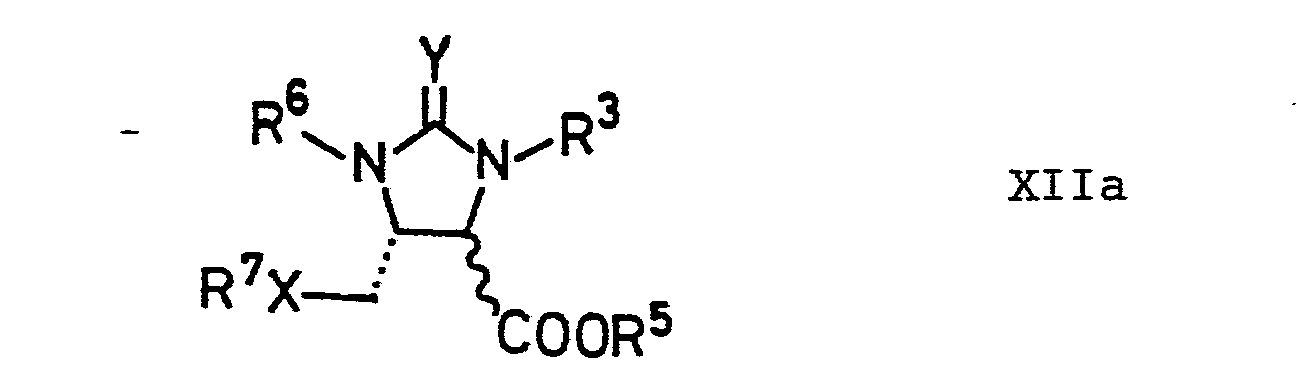
Zur Spaltung der Bicyclen der Formel XII eignen sich beispielsweise Säuren wie Salzsäure oder Schwefelsäure, die, zweckmäßigerweise in einem Lösungsmittel, z.B. Wasser oder Alkoholen, zu den Hydantoinen der Formel XIIa, worin R = R7 = H, führen.For the cleavage of the bicycles of the formula XII, for example, acids such as hydrochloric acid or sulfuric acid are suitable which, expediently in a solvent, for example water or alcohols, lead to the hydantoins of the formula XIIa, in which R = R 7 = H.
Als Spaltungsreagenz weiterhin anwendbar sind Schwermetallsalze wie Silbernitrat, Quecksilber(II)-chlorid oder Quecksilber(II)-acetat und die anschließende Zersetzung der intermediär gebildeten Metallmercaptide mit Schwefelwasserstoff. Für diese Spaltungsreaktion geeignete Lösungsmittel finden sich beispielsweise unter den Alkoholen wie Methanol, Ethanol, Amiden wie Dimethylformamid oder Ethern wie Tetrahydrofuran.Heavy metal salts such as silver nitrate, mercury (II) chloride or mercury (II) acetate and the subsequent decomposition of the intermediate metal mercaptides with hydrogen sulfide can also be used as cleavage reagent. Solvents suitable for this cleavage reaction can be found, for example, among alcohols such as methanol, ethanol, amides such as dimethylformamide or ethers such as tetrahydrofuran.
Mit Reduktionsmitteln können Säurederivate der Formel XII, in-denen X S bedeutet, zu Zwischenprodukten der Formel XIIa, worin R6 CHR R und X S bedeutet, umgesetzt werden. Geeignete Reduktionsmittel sind beispielsweise Metalle wie Zink. Die Spaltung der Säurederivate durch Reduktion mit Metallen erfolgt vorzugsweise in saurem Milieu. Hierfür geeignete Säuren sind beispielsweise Mineralsäuren wie Salzsäure oder Schwefelsäure oder organische Säuren wie Ameisensäure oder Essigsäure. Zweckmäßig werden diese Säuren als Lösungsmittel oder im Gemisch mit anderen Lösungsmitteln wie z.B. Alkoholen verwendet. Die Reaktionstemperatur liegt üblicherweise zwischen 0 °C und 200 °C, vorzugsweise zwischen 20 °C und 150 °C. Bei diesen Temperaturen sind die Reaktionen in der Regel zwischen 15 Minuten und 24 Stunden beendet.Acid derivatives of the formula XII, in which XS is XS, can be reacted with reducing agents to give intermediates of the formula XIIa, in which R 6 is CHR R and XS . Suitable reducing agents are, for example, metals such as zinc. The acid derivatives are cleaved by reduction with metals, preferably in an acidic environment. Suitable acids are, for example, mineral acids such as hydrochloric acid or sulfuric acid or organic acids such as formic acid or acetic acid. These acids are expediently used as solvents or in a mixture with other solvents such as alcohols. The reaction temperature is usually between 0 ° C and 200 ° C, preferably between 20 ° C and 150 ° C. At these temperatures, the reactions are usually completed between 15 minutes and 24 hours.
Unter den voranstehend angegebenen Bedingungen werden üblicherweise Verbindungen der Formel XIIa erhalten, worin R7 H bedeutet. Wird die Reduktion jedoch in wasserfreiem Milieu unter Zusatz eines Acylierungsmittels, wie z.B. einem Säurehalogenid oder -anhydrid, durchgeführt, so gelangt man zu Verbindungen der Formel XIIa, in denen R7 Alkanoyl oder Aroyl bedeutet. Derartige Verbindungen eignen sich bevorzugt zur Überführung in Lactone der Formel XIII.Compounds of the formula XIIa in which R 7 is H are usually obtained under the conditions given above. However, if the reduction is carried out in an anhydrous medium with the addition of an acylating agent, such as, for example, an acid halide or anhydride, compounds of the formula XIIa in which R 7 denotes alkanoyl or aroyl are obtained. Such compounds are preferably suitable for conversion into lactones of the formula XIII.
Die erhaltenen Zwischenprodukte der Formel XIIa können isoliert werden; sie werden jedoch zweckmäßigerweise in situ weiter zu den bekannten Lactonen der Formel XIII umgesetzt. Häufig entstehen letztere Lactone bereits in hohem Maße oder vollständig bereits bei der Spaltung der Bicyclen der Formel XII. Zur Bildung der Lactone der Formel XIII aus den Zwischenprodukten der Formel XIIa werden diese mit einem die Wasser- oder Alkoholabspaltung bewirkenden Mittel behandelt. Hierfür geeignete Mittel stehen beispielsweise in Alkalimetallsalzen wie Kalium- oder Natriumacetat, Kaliumthioacetat, in Säuren wie Methansulfonsäure, p-Toluolsulfonsäure, Phosphorsäure, Schwefelsäure oder Salzsäure, in Anhydriden wie Acetanhydrid oder Trifluoracetanhydrid oder in anderen Dehydratisierungsreagenzien wie beispielsweise Aluminiumoxid, Kaliumhydroxid, Cyansäure oder Dicyclohexylcarbodiimid zur Verfügung. Die Anwendung eines Überschusses der vorbenannten Lactonisierungsmittel erweist sich oft als vorteilhaft. Geeignete Reaktionsbedingungen für die Lactonisierung lassen sich beispielsweise Houben-Weyl, Methoden der Organischen Chemie, Bd. E5, entnehmen.The intermediates of formula XIIa obtained can be isolated; however, they are expediently reacted in situ to give the known lactones of the formula XIII. The latter lactones are often already formed to a high or complete extent when the bicycles of the formula XII are cleaved. To form the lactones of the formula XIII from the intermediates of the formula XIIa, these are treated with an agent which eliminates water or alcohol. Suitable agents for this purpose are, for example, in alkali metal salts such as potassium or sodium acetate, potassium thioacetate, in acids such as methanesulphonic acid, p-toluenesulphonic acid, phosphoric acid, sulfuric acid or hydrochloric acid, in anhydrides such as acetic anhydride or trifluoroacetic anhydride or in other dehydrating reagents or dicidicyclic acid, such as aluminum oxide, potassium hydroxide, for example alumina cyanide carboxylate, such as aluminum oxide, potassium oxide, for example, alumina cyanide carboxylate Available. The use of an excess of the aforementioned lactonizing agents often proves to be advantageous. Suitable reaction conditions for lactonization can be found, for example, in Houben-Weyl, Methods of Organic Chemistry, volume E5.
Verbindungen der Formel XIIa, worin R7 Alkanoyl oder Aroyl bedeutet, lassen sich vorteilhafterweise in Lactone der Formel XIII überführen, indem man deren entsprechende Alkalimetallsalze, insbesondere deren Natrium- oder Kaliumsalze (XIIa, R = Na, K) einer thermischen Epimerisierung/Cyclisierung unterwirft. Man führt die Umsetzung der gegebenenfalls in situ hergestellten Alkalimetallsalze von Carbonsäuren der Formel XII vorteilhaft in einem inerten Lösungsmittel wie Dimethylformamid, Dimethylacetamid, Dimethylsulfoxid oder N-Methylpyrrolidon bei Temperaturen von 30-200 °C, insbesondere bei 50-150 °C, durch. Die Reaktionzeiten liegen bei 30 Minuten bis 12 Stunden.Compounds of the formula XIIa, in which R 7 is alkanoyl or aroyl, can advantageously be converted into lactones of the formula XIII by subjecting their corresponding alkali metal salts, in particular their sodium or potassium salts (XIIa, R = N a, K), to thermal epimerization / cyclization submits. The reaction of the alkali metal salts of carboxylic acids of the formula XII, which are optionally prepared in situ, is advantageously carried out in an inert solvent such as dimethylformamide, dimethylacetamide, dimethyl sulfoxide or N-methylpyrrolidone at temperatures of 30-200 ° C. , in particular at 50-150 ° C. The reaction times range from 30 minutes to 12 hours.
Die Überführung der Lactone der Formel XIII in D-(+)-Biotin ist z.B. aus DE-20 58 234 und DE-23 31 244 bekannt.The conversion of the lactones of formula XIII into D - (+) - biotin is e.g. known from DE-20 58 234 and DE-23 31 244.
In einem weiteren Verfahren zur.Herstellung von D-(+)-Biotin aus (7aR)-lH,3H-Imidazo[l,5-c]azolen der Formel I werden Nitrile der Formel XI mit einer metallorganischen Verbindung zu Oxoverbindungen der Formel XIV umgesetzt. Hierfür geeignete metallorganische Verbindungen sind beispielsweise solche des Magnesiums (Verfahren nach Blaise), des Zinks (Verfahren nach Reformatzky), des Lithiums oder des Aluminiums. Die Reaktionsbedingungen zur Umsetzung der metallorganischen Verbindungen orientieren sich an der Natur und chemischen Reaktivität der vorhandenen funktionellen Gruppen und können analog bekannten Verfahren gewählt werden, wie sie beispielsweise in Houben-Weyl, Methoden der Organischen Chemie, Bd. VII/2a, S. 603, beschrieben sind.In a further process for the preparation of D - (+) - biotin from (7aR) -lH, 3H-imidazo [l, 5-c] azoles of the formula I, nitriles of the formula XI are converted to oxo compounds of the formula XIV with an organometallic compound implemented. Suitable organometallic compounds are, for example, those of magnesium (Blaise process), zinc (Reformatzky process), lithium or aluminum. The reaction conditions for converting the organometallic compounds are based on the nature and chemical reactivity of the functional groups present and can be selected analogously to known processes, as described, for example, in Houben-Weyl, Methods of Organic Chemistry, Vol. VII / 2a, p. 603, are described.
Zur Überführung der bicyclischen Oxoverbindungen der Formel XIV in die Hydantoine der Formel XV mittels einer Säure oder eines Reduktionsmittels eignen sich die gleichen, voranstehend angegebenen Methoden zur Darstellung der Hydantoine der Formel XIIa aus den Säurederivaten XII. Bei einer Spaltung mittels Säuren werden Imidazolidine der Formel XV erhalten, in denen R6 H bedeutet, bei einer Spaltung durch ein Reduktionsmittel bedeutet R 6 in Formel XV R1R2CH. Die Reaktionsbedingungen orientieren sich an den zuvor angegebenen Methoden.To convert the bicyclic oxo compounds of the formula XIV into the hydantoins of the formula XV using an acid or a reducing agent, the same methods given above for preparing the hydantoins of the formula XIIa from the acid derivatives XII are suitable. In the case of cleavage by means of acids, imidazolidines of the formula XV in which R 6 is H are obtained; in the case of cleavage by a reducing agent, R 6 in the formula XV is R 1 R 2 CH. The reaction conditions are based on the methods given above.
Verbindungen der Formel XV können unter basischen Bedingungen zu den Hemiacetalen der Formel XVI cyclisiert werden. Hierfür geeignete Basen sind beispielsweise Alkalimetallhydroxide wie Natrium- oder Kaliumhydroxid, Alkalimetallcarbonate wie Natriumhydrogencarbonat, Kaliumcarbonat, Kaliumhydrogencarbonat, Alkalimetallacetate wie Natrium- oder Kaliumacetat, Erdalkalimetallhydroxide und - oxide wie Calciumhydroxid, Calciumoxid oder Aluminiumoxid oder organische Basen wie Triethylamin, Pyridin, Lutidin, Piperidin, Morpholin, Piperazin, Collidin oder Chinolin. Weiterhin eignen sich auch basische Ionenaustauscher zur Cyclisierung von Verbindungen der Formel XV. Zweckmäßig führt man die Reaktion in einem inerten Lösungsmittel durch. Als inerte Lösungsmittel eignen sich vorzugsweise Kohlenwasserstoffe wie Cyclohexan, Benzol, Toluol, Ether wie Tetrahydrofuran, Dioxan, Amide wie Dimethylformamid, Hexamethylphosphorsäuretriamid, Sulfoxide wie Dimethylsulfoxid, Alkohole wie Methanol, Ethanol, Ester wie Ethylacetat oder niedere Carbonsäuren wie Ameisensäure oder Essigsäure. Auch ein Überschuß an organischer Base eignet sich als Lösungsmittel, welcher in Kombination mit einer niederen Carbonsäure ein besonders bevorzugtes Cyclisierungsmedium darstellt. Die Reaktionstemperaturen liegen zweckmäßig zwischen etwa 0° und 200 °C, vorzugsweise zwischen 20 und 150 °C, die Reaktionszeiten zwischen etwa 1 und 48 Stunden.Compounds of the formula XV can be cyclized under basic conditions to the hemiacetals of the formula XVI. Suitable bases for this are, for example, alkali metal hydroxides such as sodium or potassium hydroxide, Alkali metal carbonates such as sodium hydrogen carbonate, potassium carbonate, potassium hydrogen carbonate, alkali metal acetates such as sodium or potassium acetate, alkaline earth metal hydroxides and oxides such as calcium hydroxide, calcium oxide or aluminum oxide or organic bases such as triethylamine, pyridine, lutidine, piperidine, morpholine, piperazine, collidine or quinoline. Basic ion exchangers are also suitable for the cyclization of compounds of the formula XV. The reaction is expediently carried out in an inert solvent. Suitable inert solvents are preferably hydrocarbons such as cyclohexane, benzene, toluene, ethers such as tetrahydrofuran, dioxane, amides such as dimethylformamide, hexamethylphosphoric acid triamide, sulfoxides such as dimethyl sulfoxide, alcohols such as methanol, ethanol, esters such as ethyl acetate or lower carboxylic acids such as formic acid or acetic acid. An excess of organic base is also suitable as a solvent, which in combination with a lower carboxylic acid is a particularly preferred cyclization medium. The reaction temperatures are advantageously between about 0 ° and 200 ° C, preferably between 20 and 150 ° C, the reaction times between about 1 and 48 hours.
Hemiacetale der Formel XVI sind bekannt und können nach bekannten Methoden, wie beispielsweise der DE-20 58 234 zu entnehmen, zu D-(+)-Biotin umgesetzt werden.Hemiacetals of the formula XVI are known and can be converted to D - (+) - biotin by known methods, such as, for example, from DE-20 58 234.
In einem weiteren Verfahren zur Herstellung von D-(+)-Biotin aus (7aR)-lH,3H-Imidazo[l,5-c]azolen der Formel I werden Nitrile der Formel XI mit einem Reduktionsmittel zu einem Aldehyd der Formel XVII umgesetzt. Hierfür geeignete Verfahren sind beispielsweise Houben-Weyl, - Methoden der Organischen Chemie, Bde. 7/1, S. 299 und E3, S. 476, zu entnehmen. Als Reduktionsmittel können z.B. Zinn(II)-chlorid mit Chlorwasserstoff in etherischer Lösung oder Wasserstoff unter Raney-Nickel Katalyse in saurem Milieu Anwendung finden. Gute Ergebnisse sind auch durch Umsetzung der Nitrile der Formel XI mit 2-Mercaptoethanol zu den entsprechenden 2-substituierten 1,3-Benzooxathiazolen und deren Reduktion mittels Natriumborhydrid zu erzielen. Besonders vorteilhaft erfolgt die Reduktion der Nitrile der Formel XI mit komplexen Hydriden wie Natrium-hydro-triethoxyaluminat, Lithium-hydro-triethoxyalanat oder, insbesondere bevorzugt, mit Diisobutylaluminiumhydrid.In a further process for the preparation of D - (+) - biotin from (7aR) -lH, 3H-imidazo [l, 5-c] azoles of the formula I, nitriles of the formula XI are reacted with a reducing agent to give an aldehyde of the formula XVII . Suitable methods for this are, for example, Houben-Weyl, - Methods of Organic Chemistry, Vol. 7/1, p. 299 and E3, p. 476. Tin (II) chloride with hydrogen chloride in ethereal solution or hydrogen with Raney nickel catalysis in an acidic environment can be used as reducing agents. Good results can also be achieved by reacting the nitriles of the formula XI with 2-mercaptoethanol to give the corresponding 2-substituted 1,3-benzooxathiazoles and reducing them using sodium borohydride. The reduction of the nitriles of the formula X I takes place particularly advantageously with complex hydrides such as sodium hydro-triethoxyaluminate, lithium hydro-triethoxyalanate or, particularly preferably, with diisobutylaluminium hydride.
Man führt die Umsetzung der komplexen Hydride mit den Nitrilen der Formel XI vorteilhaft in einem inerten Lösungsmittel durch. Als inerte Lösungsmittel eignen sich vorzugsweise Kohlenwasserstoffe wie Pentan, Hexan, Cyclohexan, Benzol oder Toluol oder Ether wie Diethylether, Tetrahydrofuran, Dioxan oder Ethylenglykoldimethylether sowie Gemische dieser Lösungsmittel untereinander. Die Reaktionstemperaturen liegen zweckmäßig zwischen etwa -120 °C und +150 °C, vorzugsweise zwischen -80 °C und +100 °C, die Reaktionszeiten zwischen etwa 30 Minuten und 24 Stunden.The complex hydrides are advantageously reacted with the nitriles of the formula XI in an inert solvent. Suitable inert solvents are preferably hydrocarbons such as pentane, hexane, cyclohexane, benzene or toluene or ethers such as diethyl ether, tetrahydrofuran, dioxane or ethylene glycol dimethyl ether and mixtures of these solvents with one another. The reaction temperatures are advantageously between about -120 ° C and +150 ° C, preferably between -80 ° C and +100 ° C, the reaction times between about 30 minutes and 24 hours.
Aus den Aldehyden der Formel XVII lassen sich mit geeigneten Phosphororganylen in Anwesenheit einer Base die ungesättigten Verbindungen der Formel XVIII herstellen. So können beispielsweise Phosphorane nach Überführung in die entsprechenden Ylide nach den in Houben-Weyl, Methoden der Organischen Chemie, Bd. 5/16, S. 383, Phosphonate nach Bildung des Anions in analog den z.B. in Organic Reactions, Bd. 25, John Wiley, New York, 1978, Kap. 2, beschriebenen Verfahren oder Phosphinoxide auf beispielsweise in Houben-Weyl, Methoden der organischen Chemie, Bd. XII/1, S. 167, beschriebene Weise für die Olefinierung von Aldehyden der Formel XVII Verwendung finden. Als Basen zur Bereitung eines reaktiven Phosphorylids, Phosphonat-oder Phosphinoxidanions eignen sich in Abhängigkeit von der Deprotonierungsfähigkeit des eingesetzten Phosphororganyls z.B. Alkalimetallhydroxide wie Natrium- oder Kaliumhydroxid, Alkalimetallcarbonate wie Natrium- oder Kaliumcarbonat, Alkoholate wie Natriummethylat, Natriumethylat, Lithiumethylat oder Kalium-tert.-butanolat, Alkalimetallamide wie Kalium-oder Natriumamid, Alkalimetallorganyle wie Methyllithium, Butyllithium oder Phenyllithium oder andere organische Basen wie Lithiumdiisopropylamid oder Natriummethylsulfinylmethylid. Zweckmäßig führt man die Reaktion in einem inerten Lösungsmittel durch. Als inerte Lösungsmittel eignen sich vorzugsweise Ether wie Diethylether, Ethylenglykoldimethylether, Tetrahydrofuran oder Dioxan sowie Amide wie Dimethylformamid, Hexamethylphosphorsäuretriamid, Dimethyl-acetamid oder N-Methylpyrrolidon, ferner Sulfoxide wie Dimethylsulfoxid oder Sulfolan sowie Kohlenwasserstoffe wie Pentan, Hexan, Cyclohexan, Benzol oder Toluol. Die Reaktionstemperaturen liegen zweckmäßig entsprechend der Reaktivität des eingesetzten Phosphororganyls zwischen etwa -10 °C und etwa +150 °C, vorzugsweise zwischen +20 °C und +100 °C, die Reaktionszeiten zwischen 1 und 48 Stunden.The unsaturated compounds of the formula XVIII can be prepared from the aldehydes of the formula XVII using suitable phosphororganylenes in the presence of a base. For example, after conversion into the corresponding ylides, phosphoranes can be converted according to the methods described in Houben-Weyl, Methods of Organic Chemistry, Vol. 5/16, p. 383, and phosphonates after formation of the anion in analogy to, for example, in Organic Reactions, Vol. 25, John Wiley, New York, 1978, chap. 2, described method or Phosphine oxides in the manner described, for example, in Houben-Weyl, Methods of Organic Chemistry, Vol. XII / 1, p. 167, are used for the olefination of aldehydes of the formula XVII. Suitable bases for preparing a reactive phosphorylide, phosphonate or phosphine oxide anion are, depending on the deprotonation ability of the phosphororganyl used, for example alkali metal hydroxides such as sodium or potassium hydroxide, alkali metal carbonates such as sodium or potassium carbonate, alcoholates such as sodium methylate, sodium ethylate, lithium ethylate or potassium tert. butanolate, alkali metal amides such as potassium or sodium amide, alkali metal organyls such as methyl lithium, butyllithium or phenyllithium or other organic bases such as lithium diisopropylamide or sodium methylsulfinylmethylide. The reaction is expediently carried out in an inert solvent. Suitable inert solvents are preferably ethers such as diethyl ether, ethylene glycol dimethyl ether, tetrahydrofuran or dioxane and amides such as dimethylformamide, hexamethylphosphoric acid triamide, dimethyl acetamide or N-methylpyrrolidone, furthermore sulfoxides such as dimethyl sulfoxide or sulfolane and hydrocarbons such as pentane, hexane, cyclohexane or benzene. The reaction temperatures are expediently between about -10.degree. C. and about +150.degree. C., preferably between +20.degree. C. and +100.degree. C., depending on the reactivity of the phosphororganyl used, and the reaction times are between 1 and 48 hours.
Nach zur Spaltung von Säurederivaten der Formel XII analogen, voranstehend beschriebenen Verfahren werden die ungesättigten bicyclischen Verbindungen der Formel XVIII mit Säuren und/oder Reduktionsmitteln umgesetzt. Als Zwischenprodukte entstehende Hydroxy-(X = O) oder Mercapto- (X = S)-methylhydantoine erfahren unter den Spaltungsbedingungen Ringschluß zu den Biotinderivaten der Formel XIX, worin im Falle einer Säurespaltung R6 H bedeutet; bei einer Spaltung durch ein Reduktionsmittel bedeutet R6 R1R2CH. Die Reaktions- bedingungen orientieren sich an den zuvor angegebenen Methoden.After the above-described processes analogous to the cleavage of acid derivatives of the formula XII, the unsaturated bicyclic compounds of the formula XVIII are reacted with acids and / or reducing agents. Hydroxy- (X = O) or mercapto- (X = S) -methylhydantoins undergo ring closure under the cleavage conditions to give the biotin derivatives of the formula XIX, where R 6 is H in the case of an acid cleavage; when cleaved by a reducing agent, R 6 denotes R 1 R 2 CH. The R eaktions- conditions are based on the methods described above.
Schließlich können Oxoverbindungen der Formel XIV nach zur Spaltung von Säurederivaten der Formel XII analogen, voranstehend beschriebenen Verfahren in Biotinderivate der Formel XX überführt werden, wobei R3, X, Y und Z die angegebene Bedeutung zukommt.Finally, oxo compounds of the formula XIV can be converted into biotin derivatives of the formula XX by methods analogous to the cleavage of acid derivatives of the formula XII, where R 3 , X, Y and Z have the meaning given.
Biotinderivate der Formel XIX sind bekannt und können nach bekannten Methoden wie z.B. in DE-20 58 234, EP-O 036 030 und EP-O 084 377 offenbart, zu D-(+)-Biotin umgesetzt werden.Biotin derivatives of the formula XIX are known and can be prepared by known methods such as e.g. in DE-20 58 234, EP-O 036 030 and EP-O 084 377, to be converted to D - (+) - biotin.
Das erfindungsgemäße Verfahren erlaubt somit die Herstellung von optisch aktivem D-(+)-Biotin auf einfache und stereospezifische Weise in hohen Ausbeuten aus leicht zugänglichen, wohlfeilen Ausgangsstoffen in wenigen, zum Teil in Eintopfverfahren durchführbaren Syntheseschritten und stellt damit einen wesentlichen Fortschritt auf dem Gebiet der Biotinsynthese dar.The process according to the invention thus allows the production of optically active D - (+) - biotin in a simple and stereospecific manner in high yields from easily accessible, inexpensive starting materials in a few synthetic steps, some of which can be carried out in one-pot processes, and thus represents a significant advance in the field of Biotin synthesis.
Eine unter Stickstoff gehaltene Lösung von 97,32 g (0,3 Mol) (7aR)-3-Phenyl-6-benzyl-lH,3H-imidazo[1,5-c]-thiazol-5,7(6H,7aH)-dion in 800 ml Tetrahydrofuran wird bei +5 °C portionsweise mit 6,53 g (0,3 Mol) Lithiumborhydrid versetzt und anschließend 3 Stunden bei Raumtemperatur gerührt.A solution of 97.32 g (0.3 mol) of (7aR) -3-phenyl-6-benzyl-1H, 3H-imidazo [1,5-c] -thiazole-5,7 (6H, 7aH) kept under nitrogen ) -dione in 800 ml of tetrahydrofuran is mixed in portions at +5 ° C with 6.53 g (0.3 mol) of lithium borohydride and then stirred for 3 hours at room temperature.
Danach zersetzt man vorsichtig mit 400 ml Eiswasser, destilliert das Tetrahydrofuran weitgehend ab und extrahiert das Produkt mit insgesamt 800 ml Ethylacetat.Then it is carefully decomposed with 400 ml of ice water, the tetrahydrofuran is largely distilled off and the product is extracted with a total of 800 ml of ethyl acetate.
Die organischen Phasen werden vereinigt, zweimal mit je 150 ml Wasser gewaschen, über Natriumsulfat getrocknet und unter vermindertem Druck eingeengt.The organic phases are combined, washed twice with 150 ml of water each time, dried over sodium sulfate and concentrated under reduced pressure.
Man erhält 90,8 g (7RS,7aR)-3-Phenyl-6-benzyl-7,7a-dihydro-7-hydroxy-1H,3H-imidazo[1,5-c]thiazol-5(6H)-on mit einem Schmelzpunkt von 151-153 °C.
-
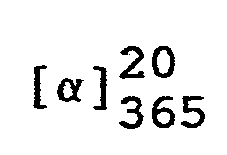
-
In eine Lösung von 324,4 g (1 Mol) (7aR)-3-Phenyl-6-benzyl-lH,3H-imidazo[1,5-c]thiazol-5,7(6H,7aH)-dion in 1200 ml Tetrahydrofuran läßt man bei Raumtemperatur eine Lösung von 43,35 g (1,1 Mol) 96 %igem Natriumborhydrid in 300 ml Wasser einfließen und rührt das Reaktionsgemisch 12 Stunden bei 50 °C. Anschließend kühlt man auf 20 °C ab, trennt die wässrige Phase ab und engt die organische Lösung unter vermindertem Druck ein.In a solution of 324.4 g (1 mol) of (7aR) -3-phenyl-6-benzyl-1H, 3H-imidazo [1,5-c] thiazole-5,7 (6H, 7aH) -dione in 1200 ml of tetrahydrofuran is allowed to flow in at room temperature with a solution of 43.35 g (1.1 mol) of 96% sodium borohydride in 300 ml of water and the reaction mixture is stirred at 50 ° C. for 12 hours. The mixture is then cooled to 20 ° C., the aqueous phase is separated off and the organic solution is concentrated under reduced pressure.
Den Rückstand suspendiert man in 1000 ml 2-Propanol, destilliert 100 ml Lösungsmittel ab und läßt bei 0 °C kristallisieren.The residue is suspended in 1000 ml of 2-propanol, 100 ml of solvent are distilled off and the mixture is left to crystallize at 0.degree.
Man erhält 303,5 g (7R,7aR)-3-Phenyl-6-benzyl-7,7a-dihydro-7-hydroxy-lH,3H-imidazo[1,5-c]thiazol-5(6H)-on mit einem Schmelzpunkt von 174-175 °C.
-
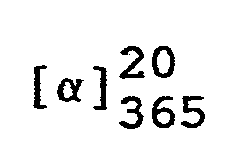
-
In eine Lösung von 324,4 g (1 Mol) (7aR)-3-Phenyl-6-benzyl-lH,3H-imidazo[1,5-c]thiazol-5,7(6H,7aH)-dion in 1200 ml Tetrahydrofuran läßt man bei Raumtemperatur eine Lösung von 43,35 g (1,1 Mol) 96 %igem Natriumborhydrid in 300 ml Wasser einfließen und rührt das Reaktionsgemisch 7 Stunden bei 50 °C. Anschließend kühlt man auf 20 °C ab, trennt die wäßrige Phase ab und engt die organische Lösung unter vermindertem Druck ein.In a solution of 324.4 g (1 mol) of (7aR) -3-phenyl-6-benzyl-1H, 3H-imidazo [1,5-c] thiazole-5,7 (6H, 7aH) -dione in 1200 ml of tetrahydrofuran is allowed to flow in at room temperature with a solution of 43.35 g (1.1 mol) of 96% sodium borohydride in 300 ml of water and the reaction mixture is stirred at 50 ° C. for 7 hours. The mixture is then cooled to 20 ° C., the aqueous phase is separated off and the organic solution is concentrated under reduced pressure.
Den Rückstand suspendiert man in 1000 ml 2-Propanol, destilliert 100 ml Lösungsmittel ab und läßt bei 0 °C kristallisieren.The residue is suspended in 1000 ml of 2-propanol, 100 ml of solvent are distilled off and the mixture is left to crystallize at 0.degree.
Man erhält 298,7 g (7RS,7aR)-3-Phenyl-6-benzyl-7,7a-dihydro-7-hydroxy-1H,3H-imidazo[1,5-c]thiazol-5(6H)-on mit einem Schmelzpunkt von 164-166 °C.
-

-
In eine unter Stickstoff gehaltene Suspension von 97,92 g (0,3 Mol) (7RS,7aR)-3-Phenyl-6-benzyl-7,7a-dihydro-7-hydroxy-1H,3H-imidazo[1,5-c]thiazol-5(6H)-on in 300 ml Acetonitril werden innert 30 Minuten 50,27 g (0,31 Mol) 1,1-Carbonyldiimidazol bei +10 °C eingetragen. Man rührt die entstehende klare Lösung 30 Minuten bei Raumtemperatur, engt ein und verteilt den Rückstand zwischen 300 ml Wasser und 500 ml Ethylacetat. Die organische Phase wird dreimal mit je 100 ml Wasser gewaschen, über Natriumsulfat getrocknet und unter vermindertem Druck eingeengt.In a nitrogen-containing suspension of 97.92 g (0.3 mol) (7RS, 7aR) -3-phenyl-6-benzyl-7,7a-dihydro-7-hydroxy-1H, 3H-imidazo [1.5 -c] thiazol-5 (6H) -one in 300 ml of acetonitrile, 50.27 g (0.31 mol) of 1,1-carbonyldiimidazole are introduced at +10 ° C. within 30 minutes. The resulting clear solution is stirred at room temperature for 30 minutes, concentrated and the residue is partitioned between 300 ml of water and 500 ml of ethyl acetate. The organic phase is washed three times with 100 ml of water, dried over sodium sulfate and concentrated under reduced pressure.
Man erhält 104,6 g (7RS,7aR)-3-Phenyl-6-benzyl-7,7a-dihydro-7-(imidazol-1-ylcarbonyloxy)-lH,3H-imidazo-[1,5-c]thiazol-5(6H)-on als Öl.
-

-
In eine Suspension von 0,96 g (32 mMol) 80 %igem Natriumhydrid in 20 ml Tetrahydrofuran tropft man unter Stickstoff bei Raumtemperatur eine Lösung von 9,79 g (30 mMol) (7RS,7aR)-3-Phenyl-6-benzyl-7,7a-dihydro-7-hydroxy-lH,3H-imidazo[1,5-c]thiazo1-5(6H)-on in 100 ml Tetrahydrofuran und rührt die entstehende Lösung 45 Minuten bei Raumtemperatur. Anschließend wird eine Lösung von 6,34 g (32 mMol) 1,1-Sulfonyldiimidazol in 80 ml Tetrahydrofuran bei Raumtemperatur innert 10 Minuten zugetropft und das Gemisch weitere 20 Minuten gerührt.A solution of 9.79 g (30 mmol) (7RS, 7aR) -3-phenyl-6-benzyl is dropped into a suspension of 0.96 g (32 mmol) of 80% sodium hydride in 20 ml of tetrahydrofuran at room temperature under nitrogen -7.7a-dihydro-7-hydroxy-1H, 3H-imidazo [1,5-c] thiazo1-5 (6H) -one in 100 ml of tetrahydrofuran and the resulting solution is stirred for 45 minutes at room temperature. A solution of 6.34 g (32 mmol) of 1,1-sulfonyldiimidazole in 80 ml of tetrahydrofuran is then added dropwise at room temperature within 10 minutes and the mixture is stirred for a further 20 minutes.
Man engt ein, versetzt den Rückstand mit 200 ml Eiswasser und extrahiert dreimal mit je 100 ml Diethylether. Die vereinigten organischen Phasen werden über Natriumsulfat getrocknet und unter vermindertem Druck eingeengt.It is concentrated, the residue is mixed with 200 ml of ice water and extracted three times with 100 ml of diethyl ether. The combined organic phases are dried over sodium sulfate and concentrated under reduced pressure.
Nach Chromatographie des Rückstandes an Kieselgel (Ethylacetat) erhält man 8,1 g (7RS,7aR)-3-Phenyl-6-benzyl-7,7a-dihydro-7-(imidazol-1-ylsulfonyloxy)-1H,3H-imidazo[1,5-c]thiazol-5(6H)-on als Öl.
-
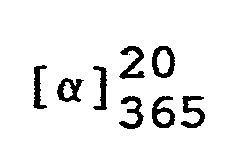
-
In eine Lösung von 97,92 g (0,3 Mol) (7RS,7aR)-3-Phenyl-6-benzyl-7,7a-dihydro-7-hydroxy-lH,3H-imidazo-[1,5-c]thiazol-5(6H)-on in 900 ml Pyridin tropft man innert 10 Minuten 33,69 g (0,33 Mol) Essigsäureanhydrid und rührt die Lösung 12 Stunden bei Raumtemperatur.In a solution of 97.92 g (0.3 mol) (7RS, 7aR) -3-phenyl-6-benzyl-7,7a-dihydro-7-hydroxy-1H, 3H-imidazo- [1,5-c ] thiazol-5 (6H) -one in 900 ml of pyridine is added dropwise within 10 minutes 33.69 g (0.33 mol) of acetic anhydride and the solution is stirred for 12 hours at room temperature.
Anschließend engt man unter vermindertem Druck ein, löst den Rückstand in 600 ml Toluol, wäscht dreimal mit je 100 ml 1 N Salzsäure und destilliert das Lösungsmittel ab.The mixture is then concentrated under reduced pressure, the residue is dissolved in 600 ml of toluene, washed three times with 100 ml of 1N hydrochloric acid and the solvent is distilled off.
Man erhält 110,1 g (7RS,7aR)-3-Phenyl-6-benzyl-7,7a-dihydro-7-acetoxy-1H,3H-imidazo[1,5-c]thiazol-5(6H)-on als Öl.
-
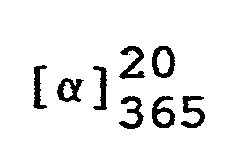
-
In eine Lösung von 210,24 g (0,5 Mol) (7RS,7aR)-3-Phenyl-6-benzyl-7,7a-dihydro-7-(imidazol-1-ylcarbonyl- oxy)-lH,3H-imidazo[1,5-c]thiazol-5(6H)-on in 1500 ml Aceton tropft man innert 10 Minuten 354,85 g (2,5 Mol) Iodmethan und rührt die Lösung 3 Stunden bei Raumtemperatur.In a solution of 210.24 g (0.5 mol) (7RS, 7aR) -3-phenyl-6-benzyl-7,7a-dihydro-7- (imidazol-1-ylcarbonyloxy) -lH, 3H- imidazo [1,5-c] thiazol-5 (6H) -one in 1500 ml acetone is added dropwise within 10 minutes to 354.85 g (2.5 mol) iodomethane and the solution is stirred for 3 hours at room temperature.
Anschließend wird eingeengt, der Rückstand in 750 ml Dimethylformamid gelöst, mit 98,02 g (2 Mol) Natriumcyanid versetzt und das Gemisch eine Stunde bei 75 °C gerührt.The mixture is then concentrated, the residue is dissolved in 750 ml of dimethylformamide, 98.02 g (2 mol) of sodium cyanide are added and the mixture is stirred at 75 ° C. for one hour.
Danach wird die Lösung in 5000 ml Eiswasser eingerührt und fünfmal mit je 500 ml Toluol extrahiert. Die vereinigten organischen Phasen werden mit Wasser sowie gesättigter Kochsalz-Lösung gewaschen, über Natriumsulfat getrocknet und unter vermindertem Druck eingeengt.The solution is then stirred into 5000 ml of ice water and extracted five times with 500 ml of toluene each. The combined organic phases are washed with water and saturated sodium chloride solution, dried over sodium sulfate and concentrated under reduced pressure.
Man erhält 150,7 g eines Gemisches aus (7R,7aR)- und (7S,7aR)-3-Phenyl-6-benzyl-7-cyano-7,7a-dihydro-1H,3H-imidazo[1,5-c]thiazol-5(6H)-on als Öl, das an Kieselgel mit Petrolether/tert.-Butylmethylether (1:1, v/v) chromatographiert wird.
- 7S-Nitril: Ausbeute 35 g; Fp.: 102-103 °C

- 7R-Nitril: Ausbeute 107 g; Fp.: 109-110 °C

- 7S-nitrile: yield 35 g; Mp .: 102-103 ° C
- 7R-nitrile: yield 107 g; Mp .: 109-110 ° C
45,65 g (0,1 Mol) (7RS,7aR)-3-Phenyl-6-benzyl-7,7a-di- hydro-7-(imidazol-1-sulfonyloxy)-1H,3H-imidazo[1,5-c]-thiazol-5(6H)-on werden in 350 ml Aceton vorgelegt. In diese Lösung tropft man innert 5 Minuten 60,49 g (0,5 Mol) Allylbromid und rührt das Reaktionsgemisch 30 Minuten bei Raumtemperatur.45.65 g (0.1 mol) (7RS, 7aR) -3-phenyl-6-benzyl-7,7a-di-hydro-7- (imidazole-1-sulfonyloxy) -1H, 3H-imidazo [1, 5-c] -thiazol-5 (6H) -one are placed in 350 ml of acetone. 60.49 g (0.5 mol) of allyl bromide are added dropwise to this solution within 5 minutes and the reaction mixture is stirred at room temperature for 30 minutes.
Anschließend wird eingeengt, der Rückstand in 100 ml 1-Methyl-2-pyrrolidon gelöst, die Lösung mit 19,6 g (0,4 Mol) Natriumcycanid versetzt und 45 Minuten bei 80 °C gerührt.The mixture is then concentrated, the residue is dissolved in 100 ml of 1-methyl-2-pyrrolidone, 19.6 g (0.4 mol) of sodium cyanide are added to the solution and the mixture is stirred at 80 ° C. for 45 minutes.
Danach wird das Reaktionsgemisch in 1000 ml Eiswasser eingerührt und dreimal mit je 200 ml Toluol extrahiert. Die vereingten organischen Phasen wäscht man mit Wasser und gesättigter Kochsalzlösung, trocknet über Natriumsulfat und engt unter vermindertem Druck ein.The reaction mixture is then stirred into 1000 ml of ice water and extracted three times with 200 ml of toluene. The combined organic phases are washed with water and saturated sodium chloride solution, dried over sodium sulfate and concentrated under reduced pressure.
Man erhält 16,8 g eines Gemisches aus (7R,7aR)- und (7S,7aR)-3-Phenyl-6-benzyl-7-cyano-7,7a-dihydro-lH,3H-imidazo[l,5-c]thiazol-5(6H)-on als Öl, das an Kieselgel mit Petrolether/tert.-Butylmethylether (1:1, v/v chromatographiert wird.
- 7S-Nitril: Ausbeute 3,8 g; Fp.: 103 °C

- 7R-Nitril: Ausbeute 11,8 g; Fp.: 109-110 °C

- 7S nitrile: yield 3.8 g; Mp .: 103 ° C
- 7R-nitrile: yield 11.8 g; Mp .: 109-110 ° C
In eine unter Stickstoff gehaltene Lösung von 368,45 g (1 Mol) (7RS,7aR)-3-Phenyl-6-benzyl-7,7a-dihydro-7-acetoxy-1H,3H-imidazo[1,5-c]thiazol-5(6H)-on in 3500 ml Dichlormethan läßt man bei -20 °C 104,17 g (1,05 Mol) Trimethylsilylcyanid einfließen, tropft anschließend unter kräftigem Rühren 189,71 g (1 Mol) Titan(IV)-chlorid innert 15 Minuten zu und rührt 45 Minuten bei -20 °C.In a nitrogen-containing solution of 368.45 g (1 mol) (7RS, 7aR) -3-phenyl-6-benzyl-7,7a-dihydro-7-acetoxy-1H, 3H-imidazo [1,5-c ] thiazol-5 (6H) -one in 3500 ml dichloromethane is allowed to allow 104.17 g (1.05 mol) of trimethylsilyl cyanide to flow in at -20 ° C., then 189.71 g (1 mol) of titanium (IV) are added dropwise with vigorous stirring -chloride within 15 minutes and stirred for 45 minutes at -20 ° C.
Das rote Reaktionsgemisch wird bei 0 °C vorsichtig mit 1000 ml 1 N Salzsäure versetzt und bis zur vollständigen Entfärbung bei Raumtemperatur gerührt.The red reaction mixture is carefully mixed with 0 ml of 1 N hydrochloric acid at 0 ° C and stirred at room temperature until complete decolorization.
Anschließend wird die organische Phase abgetrennt, zweimal mit je 1000 ml Wasser gewaschen, über Natriumsulfat getrocknet und eingeengt.The organic phase is then separated off, washed twice with 1000 ml of water each time, dried over sodium sulfate and concentrated.
Man erhält 321,3 g (7RS,7aR)-3-Phenyl-6-benzyl-7-cyano-7,7a-dihydro-lH,3H-imidazo[l,5-c]thiazol-5(6H)-on als Öl.
-
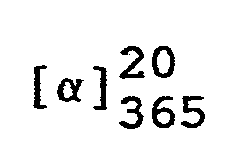
-
Eine Suspension von 97,92 g (0,3 Mol) (7RS,7aR)-3-Phenyl-6-benzyl-7,7a-dihydro-7-hydroxy-lH,3H-imidazo[1,5-c]-thiazol-5(6H)-on in 1200 ml Toluol wird mit 31,64 g (0,4 Mol) Pyridin und 33,69 g (0,33 Mol) Essigsäureanhydrid versetzt und 10 Stunden bei 50 °C gerührt.A suspension of 97.92 g (0.3 mol) (7RS, 7aR) -3-phenyl-6-benzyl-7,7a-dihydro-7-hydroxy-1H, 3H-imidazo [1,5-c] - 31.64 g (0.4 mol) of pyridine and 33.69 g (0.33 mol) of acetic anhydride are added to thiazol-5 (6H) -one in 1200 ml of toluene and the mixture is stirred at 50 ° C. for 10 hours.
Man kühlt die Lösung auf Raumtemperatur ab, wäscht dreimal mit je 200 ml 1 N Salzsäure und destilliert 200 ml Toluol ab.The solution is cooled to room temperature, washed three times with 200 ml of 1N hydrochloric acid and 200 ml of toluene are distilled off.
Nach Abkühlung auf -20 °C versetzt man unter Stickstoff mit 30,76 g (0,31 Mol) Trimethylsilylcyanid und tropft innert 5 Minuten 56,91 g (0,3 Mol) Titan(IV)-chlorid zu.After cooling to -20 ° C., 30.76 g (0.31 mol) of trimethylsilyl cyanide are added under nitrogen and 56.91 g (0.3 mol) of titanium (IV) chloride are added dropwise within 5 minutes.
In das braune Reaktionsgemisch tropft man bei 0 °C vorsichtig 350 ml 1 N Salzsäure und rührt bis zur vollständigen Entfärbung bei Raumtemperatur.350 ml of 1N hydrochloric acid are carefully added dropwise to the brown reaction mixture at 0 ° C. and the mixture is stirred at room temperature until it has completely decolorized.
Die organische Phase wird abgetrennt, zweimal mit je 300 ml Wasser gewaschen und eingeengt,The organic phase is separated off, washed twice with 300 ml of water each time and concentrated,
Man erhält 89,6 g (7RS,7aR)-3-Phenyl-6-benzyl-7-cyano-7,7a-dihydro-lH,3H-imidazo[l,5-c]thiazol-5(6H)-on als Öl.
-
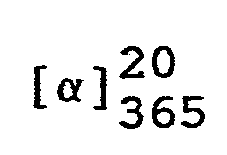
-
Eine Lösung von 97,92 g (0,3 Mol) (7RS,7aR)-3-Phenyl-6-benzyl-7,7a-dihydro-7-hydroxy-lH,3H-imidazo[l,5-c]-thiazol-5(6H)-on in 960 ml Dichlormethan wird mit 47,46 g (0,6 Mol) Pyridin und 33,69 g (0,33 Mol) Essigsäureanhydrid versetzt und 8 Stunden unter Rückfluß gekocht.A solution of 97.92 g (0.3 mol) (7RS, 7aR) -3-phenyl-6-benzyl-7,7a-dihydro-7-hydroxy-lH, 3H-imidazo [l, 5-c] - 47.46 g (0.6 mol) of pyridine and 33.69 g (0.33 mol) of acetic anhydride are added to thiazol-5 (6H) -one in 960 ml of dichloromethane and the mixture is boiled under reflux for 8 hours.
Man kühlt auf Raumtemperatur ab, wäscht dreimal mit je 300 ml 1 N Salzsäure und trocknet über Natriumsulfat.It is cooled to room temperature, washed three times with 300 ml of 1N hydrochloric acid and dried over sodium sulfate.
Anschließend kühlt man die Lösung auf -20 °C ab, läßt unter Stickstoff 30,76 g (0,31 Mol) Trimethylsilylcyanid zufließen und tropft innert 5 Minuten 78,15 g (0,3 Mol) Zinn(IV)-chlorid zu.The solution is then cooled to -20 ° C., 30.76 g (0.31 mol) of trimethylsilyl cyanide flow in under nitrogen and 78.15 g (0.3 mol) of tin (IV) chloride are added dropwise within 5 minutes.
Danach versetzt man das Reaktionsgemisch bei 0 °C vorsichtig mit 350 ml 1 N Salzsäure und rührt bei Raumtemperatur bis zur vollständigen Entfärbung.The reaction mixture is then carefully mixed at 0 ° C. with 350 ml of 1 N hydrochloric acid and stirred at room temperature until it has completely decolorized.
Die organische Phase wird abgetrennt, zweimal mit je 300 ml Wasser gewaschen, über Natriumsulfat getrocknet und eingeengt.The organic phase is separated off, washed twice with 300 ml of water each time, dried over sodium sulfate and concentrated.
Man erhält 86,3 g (7RS,7aR)-3-Phenyl-6-benzyl-7-cyano-7,7a-dihydro-lH,3H-imidazo[1,5-c]thiazol-5(6H)-on als Öl.
-

-
Analog werden hergestellt
- (7RS,7aR)-3-Phenyl-6-(4-methoxybenzyl)-7-cyano-7,7a-dihydro-1H,3H-imidazo[1,5c]thiazo-5(6H)-on
- (7RS, 7aR)-3-Phenyl-6-(4-chlorbenzyl)-7-cyano-7,7a-dihydro-1H,3H-imidazo[1,5c]thiazo-5(6H)-on
- (7RS,7aR)-3-Phenyl-6-(4-nitrobenzyl)-7-cyano-7,7a-dihydro-1H,3H-imidazo[1,5c]thiazo-5(6H)-on
- (7RS,7aR)-3-Phenyl-6-(trimethylsilyl)-7-cyano-7,7a-dihydro-1H,3H-imidazo[1,5c]thiazo-5(6H)-on
- (7RS,7aR)-3-Phenyl-6-(2-propenyl)-7-cyano-7,7a-dihydro-1H,3H-imidazo[1,5c]thiazo-5(6H)-on
- (7RS,7aR)-3-Propyl-6-benzyl-7-cyano-7,7a-dihydro-1H,3H-imidazo[1,5c]thiazo-5(6H)-on
- (7RS,7aR)-3,3-Dimethyl-6-benzyl-7-cyano-7,7a-dihydro-1H,3H-imidazo[1,5c]thiazo-5(6H)-on
- (7RS,7aR)-3-Ethyl-3-methyl-6-benzyl-7-cyano-7,7a-dihydro-1H,3H-imidazo[1,5c]thiazo-5(6H)-on
- (7RS,7aR)-3-Cyclohexyl-6-benzyl-7-cyano-7,7a-dihydro-1H,3H-imidazo[1,5c]thiazo-5(6H)-on
- (7RS,7aR)-3,3-Tetramethylenyl-6-benzyl-7-cyano-7,7a-dihydro-1H,3H-imidazo[1,5c]thiazo-5(6H)-on
- (7RS,7aR)-3,3-Pentamethylenyl-6-benzyl-7-cyano-7,7a-dihydro-1H,3H-imidazo[1,5c]thiazo-5(6H)-on
- (7RS, 7aR) -3-phenyl-6- (4-methoxybenzyl) -7-cyano-7,7a-dihydro-1H, 3H-imidazo [1,5c] thiazo-5 (6H) -one
- (7RS, 7aR) -3-phenyl-6- (4-chlorobenzyl) -7-cyano-7,7a-dihydro-1H, 3H-imidazo [1,5c] thiazo-5 (6H) -one
- (7RS, 7aR) -3-phenyl-6- (4-nitrobenzyl) -7-cyano-7,7a-dihydro-1H, 3H-imidazo [1,5c] thiazo-5 (6H) -one
- (7RS, 7aR) -3-phenyl-6- (trimethylsilyl) -7-cyano-7,7a-dihydro-1H, 3H-imidazo [1,5c] thiazo-5 (6H) -one
- (7RS, 7aR) -3-phenyl-6- (2-propenyl) -7-cyano-7,7a-dihydro-1H, 3H-imidazo [1,5c] thiazo-5 (6H) -one
- (7RS, 7aR) -3-propyl-6-benzyl-7-cyano-7,7a-dihydro-1H, 3H-imidazo [1,5c] thiazo-5 (6H) -one
- (7RS, 7aR) -3,3-dimethyl-6-benzyl-7-cyano-7,7a-dihydro-1H, 3H-imidazo [1,5c] thiazo-5 (6H) -one
- (7RS, 7aR) -3-ethyl-3-methyl-6-benzyl-7-cyano-7,7a-dihydro-1H, 3H-imidazo [1,5c] thiazo-5 (6H) -one
- (7RS, 7aR) -3-cyclohexyl-6-benzyl-7-cyano-7,7a-dihydro-1H, 3H-imidazo [1,5c] thiazo-5 (6H) -one
- (7RS, 7aR) -3,3-tetramethylenyl-6-benzyl-7-cyano-7,7a-dihydro-1H, 3H-imidazo [1,5c] thiazo-5 (6H) -one
- (7RS, 7aR) -3,3-pentamethylenyl-6-benzyl-7-cyano-7,7a-dihydro-1H, 3H-imidazo [1,5c] thiazo-5 (6H) -one
Eine Lösung von 13,42 g (40 mMol) eines Gemisches aus (7R,7aR)- und (7S,7aR)-3-Phenyl-6-benzyl-7-cyano-7,7a-dihydro-1H,3H-imidazo[1,5-c]thiazol-5(6H)-on in 75 ml n-Butanol wird mit einer Lösung von 7,92 g (0,12 Mol) 85 %igem Kaliumhydroxid in 20 ml Wasser versetzt und 90 Minuten bei 100 °C gerührt.A solution of 13.42 g (40 mmol) of a mixture of (7R, 7aR) - and (7S, 7aR) -3-phenyl-6-benzyl-7-cyano-7,7a-dihydro-1H, 3H-imidazo A solution of 7.92 g (0.12 mol) of 85% potassium hydroxide in 20 ml of water is added to [1,5-c] thiazol-5 (6H) -one in 75 ml of n-butanol and 90 minutes at 100 ° C stirred.
Anschließend destilliert man das Lösungsmittel weitgehend ab, versetzt mit 200 ml Wasser und extrahiert dreimal mit je 100 ml Dichlormethan.The solvent is then largely distilled off, 200 ml of water are added and the mixture is extracted three times with 100 ml of dichloromethane each time.
In die wässrige Phase tropft man bei 0 °C konz. Salzsäure, bis pH 1 erreicht ist, saugt das Produkt ab und wäscht portionsweise mit insgesamt 100 ml Wasser nach.In the aqueous phase, dropwise at 0 ° C conc. Hydrochloric acid until pH 1 is reached, the product is suctioned off and washed in portions with a total of 100 ml of water.
Man erhält 13,5 g (7R,7aR)-3-Phenyl-5(6H)-oxo-6-benzyl-7,7a-dihydro-1H,3H-imidazo[1,5]thiazol-7-carbonsäure mit einem Schmelzpunkt von 184-185 °C.
-

-
Man suspendiert 134,17 g (0,4 Mol) (7R,7aR)-3-Phenyl-6-benzyl-7-cyano-7,7a-dihydro-1H,3H-imidazo[1,5-c]thiazol-5(6H)-on in 1000 ml konz. Salzsäure und rührt das Gemisch 3 Stunden bei 80 °C. Anschließend wird auf 0 °C abgekühlt, 3 Stunden nachgerührt, abgesaugt und portionsweise mit 500 ml Wasser gewaschen.134.17 g (0.4 mol) (7R, 7aR) -3-phenyl-6-benzyl-7-cyano-7,7a-dihydro-1H, 3H-imidazo [1,5-c] thiazole are suspended. 5 (6H) -on in 1000 ml conc. Hydrochloric acid and the mixture is stirred at 80 ° C. for 3 hours. The mixture is then cooled to 0 ° C., stirred for 3 hours, suction filtered and washed in portions with 500 ml of water.
Man erhält 129,8 g (7R,7aR)-3-Phenyl-5(6H)-oxo-6-benzyl-7,7a-dihydro-1H,3H-imidazo[1,5-c]thiazol-7-carbonsäure mit einem Schmelzpunkt von 183-184 °C.
-

-
Nach der in Beispiel 13 angegebenen Arbeitsweise werden 13,42 g (40 mMol) (7S,7aR)-3-Phenyl-6-benzyl-7-cyano-7,7a-dihydro-lH,3H-imidazo[1,5-c]thiazol-5(6H)-on und 100 ml konz. Salzsäure 3 Stunden bei 80 ° zur Reaktion gebracht. Nach der angegebenen Aufarbeitung erhält man (7S,7aR)-3-Phenyl-5(6H)-oxo-6-benzyl-7,7a-dihydro-1H, 3H-imidazo[1,5-c]thiazol-7-carbonsäure; Fp.: 220-225 °C.According to the procedure given in Example 13, 13.42 g (40 mmol) (7S, 7aR) -3-phenyl-6-benzyl-7-cyano-7,7a-dihydro-1H, 3H-imidazo [1,5- c] thiazol-5 (6H) -one and 100 ml conc. Hydrochloric acid reacted for 3 hours at 80 °. After the indicated work-up, (7S, 7aR) -3-phenyl-5 (6H) -oxo-6-benzyl-7,7a-dihydro-1H, 3H-imidazo [1,5-c] thiazole-7-carboxylic acid is obtained ; Mp .: 220-225 ° C.
Nach der in Beispiel 13 angegebenen Arbeitsweise werden 134,17 g (0,4 Mol) eines Gemisches aus (7R,7aR)- und (7S,7aR)-3-Phenyl-6-benzyl-7-cyano-7,7a-dihydro-1H,3H-imidazo[1,5-c]thiazol-5(6H)-on mit Salzsäure hydrolysiert. Man erhält 127,2 g eines Gemisches aus (7R,7aR)-und (7S,7aR)-3-Phenyl-5(6H)-oxo-6-benzyl-7,7a-dihydro-1H,3H-imidazo[1,5-c]thiazol-7-carbonsäure, welches keinen definierten Schmelzpunkt aufweist.Using the procedure given in Example 13, 134.17 g (0.4 mol) of a mixture of (7R, 7aR) - and (7S, 7aR) -3-phenyl-6-benzyl-7-cyano-7,7a- dihydro-1H, 3H-imidazo [1,5-c] thiazol-5 (6H) -one hydrolyzed with hydrochloric acid. 127.2 g of a mixture of (7R, 7aR) and (7S, 7aR) -3-phenyl-5 (6H) -oxo-6-benzyl-7,7a-dihydro-1H, 3H-imidazo [1 , 5-c] thiazole-7-carboxylic acid, which has no defined melting point.
Zu einer Lösung von 20,04 g (0,11 Mol) 1,1-Sulfinyldiimidazol (W. Walter, M. Radke; Liebigs Ann. Chem. 1979, 1756-67) in 350 ml Dichlormethan werden unter Stickstoff bei Raumtemperatur 32,64 g (0,1 Mol) (7RS,7aR)-3-Phenyl-6-benzyl-7-cyano-7,7a-dihydro-7-hydroxy-1H,3H-imidazo[1,5-c]thiazol-5(6H)-on gegeben.To a solution of 20.04 g (0.11 mol) of 1,1-sulfinyldiimidazole (W. Walter, M. Radke; Liebigs Ann. Chem. 1979, 1756-67) in 350 ml of dichloromethane, 32 under nitrogen at room temperature. 64 g (0.1 mol) (7RS, 7aR) -3-phenyl-6-benzyl-7-cyano-7,7a-dihydro-7-hydroxy-1H, 3H-imidazo [1,5-c] thiazole- 5 (6H) -one given.
Man rührt die klare Lösung 30 Minuten bei Raumtemperatur, wäscht zweimal mit je 150 ml Wasser, trocknet über Natriumsulfat und filtriert.The clear solution is stirred for 30 minutes at room temperature, washed twice with 150 ml of water each time, dried over sodium sulfate and filtered.
Zum Filtrat tropft man bei 10 °C 37,84 g (0,3 Mol) Dimethylsulfat (10 Minuten) und rührt die Lösung 4 Stunden bei 20 °C.37.84 g (0.3 mol) of dimethyl sulfate (10 minutes) are added dropwise to the filtrate at 10 ° C. and the solution is stirred at 20 ° C. for 4 hours.
Anschließend zerstört man überschüssiges Dimethylsulfat durch Zugabe von Triethylamin bei 20 °C und engt unter vermindertem Druck ein.Excess dimethyl sulfate is then destroyed by adding triethylamine at 20 ° C. and concentrated under reduced pressure.
Den öligen Rückstand löst man in 100 ml Dimethylformamid, trägt 14,7 g (0,3 Mol) Natriumcyanid ein und rührt das Reaktionsgemisch 60 Minuten bei 85 °C.The oily residue is dissolved in 100 ml of dimethylformamide, 14.7 g (0.3 mol) of sodium cyanide are added and the reaction mixture is stirred at 85 ° C. for 60 minutes.
Danach wird das Reaktionsgemisch in 500 ml Eiswasser eingerührt und dreimal mit je 150 ml Ethylacetat extrahiert. Die vereinigten organischen Phasen wäscht man mit Wasser und gesättigter Kochsalzlösung und engt unter vermindertem Druck ein. Die Hydrolyse des erhaltenen Nitrils erfolgt analog der in Beispiel 6 beschriebenen Weise unter Verwendung von 200 ml n-Butanol, 19,8 g (0,3 Mol) 85 %igem Kaliumhydroxid und 40 ml Wasser.The reaction mixture is then stirred into 500 ml of ice water and extracted three times with 150 ml of ethyl acetate each time. The combined organic phases are washed with water and saturated sodium chloride solution and concentrated under reduced pressure. The hydrolysis of the nitrile obtained is carried out analogously to the manner described in Example 6 using 200 ml of n-butanol, 19.8 g (0.3 mol) of 85% potassium hydroxide and 40 ml of water.
Man erhält 22,68 g (7R,7aR)-3-Phenyl-5(6H)-oxo-6-benzyl-7,7a-dihydr_o-1H,3H-imidazo[1,5-c]thiazol-7-carbonsäure, Fp.: 180-181 °C, 
Eine Lösung von 9,92 g (28 mMol) (7R,7aR)-3-Phenyl-5(6H)-oxo-6-benzyl-7,7a-dihydro-lH,3H-imidazo[1,5-c]-thiazol-7-carbonsäure in 150 ml wasserfreier Essigsäure wird bei 80 °C portionsweise mit 7,32 g (112 mMol) Zinkpulver versetzt, weitere 4 Stunden bei 80 °C gerührt, filtriert und unter vermindertem Druck eingeengt.A solution of 9.92 g (28 mmol) (7R, 7aR) -3-phenyl-5 (6H) -oxo-6-benzyl-7,7a-dihydro-1H, 3H-imidazo [1,5-c] -thiazole-7-carboxylic acid in 150 ml of anhydrous acetic acid is mixed in portions at 80 ° C with 7.32 g (112 mmol) of zinc powder, stirred for a further 4 hours at 80 ° C, filtered and concentrated under reduced pressure.
Den Rückstand löst man in 500 ml Ethylacetat, wäscht mit 200 ml Wasser und 100 ml gesättigter Kochsalzlösung, trocknet über Natriumsulfat und engt unter vermindertem Druck ein. Beim Verreiben mit Diethylether kristallisiert das Produkt.The residue is dissolved in 500 ml of ethyl acetate, washed with 200 ml of water and 100 ml of saturated sodium chloride solution, dried over sodium sulfate and concentrated under reduced pressure. The product crystallizes when triturated with diethyl ether.
Man erhält 9,39 g (4R,5R)-1,3-Dibenzyl-2-oxo-5-mercaptomethyl-imidazolidin-4-carbonsäure mit einem Schmelzpunkt von 167-169 °C.
-

-
Eine Lösung von 9,92 g (28 mMol) (7R,7aR)-3-Phenyl-5-(6H) -oxo-6-benzyl-7,7a-dihydro-lH,3H-imidazo[l,5-c]-thiazol-7-carbonsäure in einem Gemisch aus 100 ml wasserfreier Essigsäure und 4,29 g (42 mMol) Essigsäureanhydrid wird bei 90 °C portionsweise mit 7,32 g (112 mMol) Zinkpulver versetzt und danach 2 Stunden bei 110 °C gerührt.A solution of 9.92 g (28 mmol) of (7R, 7aR) -3-phenyl-5- (6H) -oxo-6-benzyl-7,7a-dihydro-1H, 3H-imidazo [1,5-c ] -thiazole-7-carboxylic acid in a mixture of 100 ml of anhydrous acetic acid and 4.29 g (42 mmol) of acetic anhydride is added in portions at 90 ° C with 7.32 g (112 mmol) of zinc powder and then 2 hours at 110 ° C. touched.
Anschließend wird auf 60 °C abgekühlt, filtriert und unter vermindertem Druck eingeengt.The mixture is then cooled to 60 ° C., filtered and concentrated under reduced pressure.
Den Rückstand suspendiert man in 120 ml Wasser, rührt 60 Minuten bei Raumtemperatur, filtriert und trocknet im Vakuum.The residue is suspended in 120 ml of water, stirred for 60 minutes at room temperature, filtered and dried in vacuo.
Man erhält 9,5 g (4R,5R)-l,3-Dibenzyl-2-oxo-5-acetylmer- captomethyl-imidazolin-4-carbonsäure mit einem Schmelzpunkt von 135-140 °C.
-
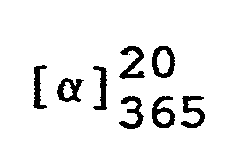
-
Man löst 35,64 g (0,1 Mol) (4R,5R)-1,3-Dibenzyl-2-oxo-5-mercaptomethyl-imidazolin-4-carbonsäure in 300 ml Dimethylacetamid, trägt 13,61 g (0,1 Mol) Natriumacetat-Trihydrat ein und erhitzt das Gemisch 40 Minuten auf 150 °C.35.64 g (0.1 mol) of (4R, 5R) -1,3-dibenzyl-2-oxo-5-mercaptomethyl-imidazoline-4-carboxylic acid are dissolved in 300 ml of dimethylacetamide, 13.61 g (0, 1 mol) of sodium acetate trihydrate and the mixture is heated at 150 ° C. for 40 minutes.
Anschließend wird auf Raumtemperatur abgekühlt, in 900 ml Wasser eingerührt und viermal mit je 100 ml Toluol extrahiert. Die vereinigten organischen Phasen werden dreimal mit je 50 ml Wasser und einmal mit 50 ml gesättigter Kochsalzlösung gewaschen und unter vermindertem Druck eingeengt. Der Rückstand wird aus Ethylacetat umkristallisiert.The mixture is then cooled to room temperature, stirred into 900 ml of water and extracted four times with 100 ml of toluene. The combined organic phases are washed three times with 50 ml of water and once with 50 ml of saturated saline and concentrated under reduced pressure. The residue is recrystallized from ethyl acetate.
Man erhält 28,76 g (3aS,6aR)-1,3-Dibenzyl-tetrahydro- thieno[3,4-d]imidazol-2(3H),4-dion mit einem Schmelzpunkt von 118-119 °C.
-
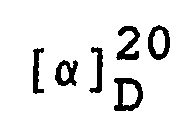
-
Man löst 39,85 g (0,1 Mol) (4R,5R)-1,3-Dibenzyl-2-oxo-5-acetylmercaptomethyl-imidazolin-4-carbonsäure in 100 ml Dimethylformamid, trägt 11,42 g (0,1 Mol) Kaliumthioacetat ein und erhitzt das Reaktionsgemisch 2 Stunden auf 130 °C.39.85 g (0.1 mol) of (4R, 5R) -1,3-dibenzyl-2-oxo-5-acetylmercaptomethyl-imidazoline-4-carboxylic acid are dissolved in 100 ml of dimethylformamide, 11.42 g (0, 1 mol) of potassium thioacetate and the reaction mixture is heated at 130 ° C. for 2 hours.
Anschließend wird auf Raumtemperatur abgekühlt, in 800 ml Wasser eingerührt und viermal mit je 100 ml Toluol extrahiert. Die vereinigten organischen Phasen werden dreimal mit je 50 ml Wasser und einmal mit gesättigter Kochsalzlösung gewaschen und unter vermindertem Druck eingeengt.The mixture is then cooled to room temperature, stirred into 800 ml of water and extracted four times with 100 ml of toluene. The combined organic phases are washed three times with 50 ml of water and once with saturated sodium chloride solution and concentrated under reduced pressure.
Den Rückstand kristallisiert man aus 2-Propanol um und erhält 25,4 g (3aS,6aR)-l,3-Dibenzyl-tetrahydrothieno[3,4-d]-imidazol-2(3H),4-dion mit einem Schmelzpunkt von 118 °C.
- [α]20 D = +90,7 °, C = 1 (CHCl3)
- [α] 20 D = +90.7 °, C = 1 (CHCl 3 )
Eine Lösung von 39,85 g (0,1 Mol) (4R,5R)-l,3-Dibenzyl-2-oxo-5-acetylmercaptomethyl-imidazolin-4-carbonsäure in 300 ml 1N Natronlauge wird 60 Minuten bei Raumtemperatur gerührt, anschließend mit konz. Salzsäure auf pH 4 angesäuert und dreimal mit je 100 ml Dichlormethan extrahiert. Die vereinigten organischen Phasen werden über Natriumsulfat getrocknet und unter vermindertem Druck eingeengt.A solution of 39.85 g (0.1 mol) (4R, 5R) -l, 3-dibenzyl-2-oxo-5-acetylmercaptomethyl-imidazoline-4-carboxylic acid in 300 ml of 1N sodium hydroxide solution is stirred for 60 minutes at room temperature, then with conc. Acidified hydrochloric acid to pH 4 and extracted three times with 100 ml dichloromethane. The combined organic phases are dried over sodium sulfate and concentrated under reduced pressure.
Den Rückstand löst man in 100 ml N-Methylpyrrolidon, trägt 11,42 g (0,1 mol) Kaliumthioacetat ein und erhitzt das Reaktionsgemisch 90 Minuten auf 130 °C.The residue is dissolved in 100 ml of N-methylpyrrolidone, 11.42 g (0.1 mol) of potassium thioacetate are added and the reaction mixture is heated to 130 ° C. for 90 minutes.
Anschließend wird auf Raumtemperatur abgekühlt, in 800 ml Wasser eingerührt und viermal mit je 100 ml Toluol extrahiert. Die vereinigten organischen Phasen werden dreimal mit je 50 ml Wasser und einmal mit gesättigter Kochsalz- lösung gewaschen und unter vermindertem Druck eingeengt.The mixture is then cooled to room temperature, stirred into 800 ml of water and extracted four times with 100 ml of toluene. The combined organic phases are washed three times with 50 ml of water and once with saturated sodium chloride solution and concentrated under reduced pressure.
Den Rückstand kristallisiert man aus 2-Propanol um und erhält 22,6 g (3aS,6aR)-l,3-Dibenzyl-tetrahydrothieno-[3,4-d]imidazol-2(3H),4-dion mit einem Schmelzpunkt von 119-120 °C.
-

-
Eine Lösung von 39,85 g (0,1 Mol) (4S,5R)-l,3-Dibenzyl-2-oxo-5-acetylmercaptomethyl-imidazolin-4-carbonsäure in 200 ml Methanol wird mit 100 ml einmolarer methanolischer Kalilauge versetzt und unter vermindertem Druck eingeengt.A solution of 39.85 g (0.1 mol) (4S, 5R) -l, 3-dibenzyl-2-oxo-5-acetylmercaptomethyl-imidazoline-4-carboxylic acid in 200 ml of methanol is mixed with 100 ml of one molar methanolic potassium hydroxide solution and concentrated under reduced pressure.
Den öligen Rückstand löst man in 100 ml Dimethylformamid und erhitzt 3 Stunden auf 130 °C.The oily residue is dissolved in 100 ml of dimethylformamide and heated at 130 ° C for 3 hours.
Anschließend wird auf Raumtemperatur abgekühlt, in 800 ml Wasser eingerührt und viermal mit je 100 ml Toluol extrahiert. Die vereinigten organischen Phasen werden dreimal mit je 50 ml Wasser und einmal mit gesättigter Kochsalz- lösung gewaschen und unter vermindertem Druck eingeengt.The mixture is then cooled to room temperature, stirred into 800 ml of water and extracted four times with 100 ml of toluene. The combined organic phases are washed three times with 50 ml of water and once with saturated sodium chloride solution and concentrated under reduced pressure.
Den Rückstand kristalliert man aus 2-Propanol um und erhält 27,7 g (3aS,6aR)-l,3-Dibenzyltetrahydrothieno[3,4-d] imidazol-2(3H)-4-dion mit einem Schmelzpunkt von 119 °C.
- [α]20 D = +91,1°, c = 1 (CHCl3)
- [α] 20 D = + 91.1 °, c = 1 (CHCl 3 )
Man löst 39,85 g (0,1 Mol) (4R,5R)-1,3-Dibenzyl-2-oxo-5-acetylmercaptomethyl-imidazolin-4-carbonsäure in 100 ml N-Methylpyrrolidon, trägt 11,22 g (0,2 Mol) Kalium-tert.-butylat ein und erhitzt das Reaktionsgemisch 2 Stunden auf 130 °C.39.85 g (0.1 mol) (4R, 5R) -1,3-dibenzyl-2-oxo-5-acetylmercaptomethyl-imidazoline-4-carboxylic acid are dissolved in 100 ml N-methylpyrrolidone, 11.22 g ( 0.2 mol) of potassium tert-butoxide and the reaction mixture is heated at 130 ° C. for 2 hours.
Anschließend wird auf Raumtemperatur abgekühlt, in 800 ml Wasser eingerührt und viermal mit je 100 ml To-luol extrahiert. Die vereinigten organischen Phasen werden dreimal mit je 50 ml Wasser gewaschen und unter vermindertem Druck eingeengt.It is then cooled to room temperature, stirred into 800 ml of water and four times with 100 ml of o-T luol extracted. The combined organic phases are washed three times with 50 ml of water each time and concentrated under reduced pressure.
Den Rückstand kristallisiert man aus 2-Propanol um und erhält 28,3 g (3aS,6aR)-l,3-Dibenzyltetrahydrothieno-[3,4-d]imidazol-2(3H),4-dion mit einem Schmelzpunkt von 118-119 °C.
- [α]20 D = +90,8°, c = 1 (CHCl3)
- [α] 20 D = + 90.8 °, c = 1 (CHCl 3 )
Nach der in Beispiel 23 angegebenen Arbeitsweise werden 39,85 g (0,1 Mol) (4R,5R)-1,3-Dibenzyl-2-oxo-5-acetyl- mercaptomethyl-imidazolin-4-carbonsäure mit 5,40 g (0,1 Mol) Natriummethylat in 100 ml N-Methylpyrrolidon umgesetzt.According to the procedure given in Example 23, 39.85 g (0.1 mol) of (4R, 5R) -1,3-dibenzyl-2-oxo-5-acetyl-mercaptomethyl-imidazoline-4-carboxylic acid with 5.40 g (0.1 mol) sodium methylate in 100 ml of N-methylpyrrolidone reacted.
Man erhält 28,0 g (3aS,6aR)-1,3-Dibenzyltetrahydro- thieno[3,4-d]imidazol-2(3H),4-dion mit einem Schmelzpunkt von 119-120 °C.
- [α]20 D = +91,3°, c = 1 (CHCl3)
- [α] 20 D = + 91.3 °, c = 1 (CHCl 3 )
Nach der in Beispiel 23 angegebenen Arbeitsweise werden 39,85 g (0,1 Mol) (4R,5R)-1,3-Dibenzyl-2-oxo-5-acetyl- mercaptomethyl-imidazolin-4-carbonsäure mit 4,0 g (0,1 Mol) Natriumhydroxid in 100 ml N-Methylpyrrolidon umgesetzt.According to the procedure given in Example 23, 39.85 g (0.1 mol) of (4R, 5R) -1,3-dibenzyl-2-oxo-5-acetyl-mercaptomethyl-imidazoline-4-carboxylic acid with 4.0 g (0.1 mol) sodium hydroxide reacted in 100 ml of N-methylpyrrolidone.
Man erhält 22,9 g (3aS,6aR)-1,3-Dibenzyl-tetrahydro- thieno[3,4-d]imidazol-2(3H),4-dion mit einem Schmelzpunkt von 119 °C.
- [a]20 D = +90,8°, c = 1 (CHCl3)
- [a] 20 D = + 90, 8 °, c = 1 (CHCl 3)
Eine Lösung von 53,47 g (0,15 Mol) (4R,5S)-l,3-Dibenzyl-2-oxo-5-mercaptomethyl-imidazolidin-4-carbonsäure in 300 ml Pyridin wird bei Raumtemperatur mit 1,43 g (7,5 mMol) Toluol-4-sulfonsäure-Monohydrat und 37,14 g (0,18 Mol) N,N'-Dicyclohexylcarbodiimid versetzt und 6 Stunden bei 20 °C gerührt.A solution of 53.47 g (0.15 mol) of (4R, 5S) -l, 3-dibenzyl-2-oxo-5-mercaptomethyl-imidazolidine-4-carboxylic acid in 300 ml of pyridine is mixed with 1.43 g at room temperature (7.5 mmol) of toluene-4-sulfonic acid monohydrate and 37.14 g (0.18 mol) of N, N'-dicyclohexylcarbodiimide were added and the mixture was stirred at 20 ° C. for 6 hours.
Anschließend saugt man ab und engt das Filtrat unter vermindertem Druck ein.It is then suctioned off and the filtrate is concentrated under reduced pressure.
Den Rückstand löst man in 400 ml Toluol, wäscht zweimal mit je 50 ml 1 N Salzsäure, engt ein und kristallisiert aus 2-Propanol um.The residue is dissolved in 400 ml of toluene, washed twice with 50 ml of 1N hydrochloric acid, concentrated and recrystallized from 2-propanol.
Es werden 40,6 g (3aS,6aR)-l,3-Dibenzyltetrahydrothieno-[3,4-d]imidazol-2(3H),4-dion mit einem Schmelzpunkt von 119-120 °C erhalten.
-
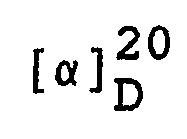
-
Eine Lösung von 5,35 g (15 mMol) (4R,5R)-1,3-Dibenzyl-2-oxo-5-mercaptomethyl-imidazolidin-4-carbonsäure in einem Gemisch aus 50 ml Dichlormethan und 1,42 g (18 mMol) Pyridin wird bei 5 °C mit 1,70 g (18 mMol) Methylchlorformiat versetzt und 36 Stunden unter Rückfluß gekocht.A solution of 5.35 g (15 mmol) (4R, 5R) -1,3-dibenzyl-2-oxo-5-mercaptomethyl-imidazolidine-4-carboxylic acid in a mixture of 50 ml dichloromethane and 1.42 g (18 1.70 g (18 mmol) of methyl chloroformate are added to pyridine at 5 ° C. and the mixture is boiled under reflux for 36 hours.
Anschließend wird auf Raumtemperatur abgekühlt, zweimal mit je 25 ml 1 N Salzsäure gewaschen, über Natriumsulfat getrocknet und unter vermindertem Druck eingeengt.The mixture is then cooled to room temperature, washed twice with 25 ml of 1N hydrochloric acid, dried over sodium sulfate and concentrated under reduced pressure.
Der Rückstand wird an Kieselgel mit Toluol/Ethylacetat (9:1, v/v) chromatographiert.The residue is chromatographed on silica gel with toluene / ethyl acetate (9: 1, v / v).
Man erhält 3,1 g (3aS,6aR)-l,3-Dibenzyltetrahydrothieno-[3,4-d]imidazol-2(3H),4-dion mit einem Schmelzpunkt von 119 °C.
- [α]20 D = +90,9°, c = 1 (CHCl3)
- [α] 20 D = + 90.9 °, c = 1 (CHCl 3 )
Eine Lösung von 9,92 g (28 mMol) (7S,7aR)-3-Phenyl-5(6H)-oxo-6-benzyl-7,7a-dihydro-1H,3H-imidazo[1,5-c]-thiazol-7-carbonsäure in 150 ml wasserfreier Essigsäure wird bei 80 °C portionsweise mit 7,32 g (112 mMol) Zinkpulver versetzt, weitere 4 Stunden bei 80 °C gerührt, filtriert und unter vermindertem Druck eingeengt.A solution of 9.92 g (28 mmol) (7S, 7aR) -3-phenyl-5 (6H) -oxo-6-benzyl-7,7a-dihydro-1H, 3H-imidazo [1,5-c] -thiazole-7-carboxylic acid in 150 ml of anhydrous acetic acid is mixed in portions at 80 ° C with 7.32 g (112 mmol) of zinc powder, stirred for a further 4 hours at 80 ° C, filtered and concentrated under reduced pressure.
Den Rückstand löst man in 300 ml Toluol, wäscht mit 150 ml Wasser und 75 ml gesättigter Kochsalzlösung und engt unter vermindertem Druck ein. Das rohe Thiolacton wird aus Ethylacetat umkristallisiert.The residue is dissolved in 300 ml of toluene, washed with 150 ml of water and 75 ml of saturated sodium chloride solution and concentrated under reduced pressure. The crude thiolactone is recrystallized from ethyl acetate.
Man erhält 8,0 g (3aS,6aR)-1,3-Dibenzyl-tetrahydro- thieno[3,4-d]imidazol-2(3H),4-dion mit einem Schmelzpunkt von 119-120 °C.
- [α]20 D = +91,2°, c = 1 (CHCl3)
- [α] 20 D = + 91.2 °, c = 1 (CHCl 3 )
Eine Lösung von 99,24 g (0,28 Mol) (7R,7aR)- und (7S,7aR)-3-Phenyl-5(6H)-oxo-6-benzyl-7,7a-dihydro-1H, 3H-imidazo[1,5-c]thiazol-7-carbonsäure in 1500 ml wasserfreier Essigsäure wird bei 80 °C portionsweise mit 73,22 g (1,12 Mol) Zinkpulver versetzt, weitere 4 Stunden bei 80 °C gerührt, filtriert und unter vermindertem Druck eingeengt.A solution of 99.24 g (0.28 mol) of (7R, 7aR) - and (7S, 7aR) -3-phenyl-5 (6H) -oxo-6-benzyl-7,7a-dihydro-1H, 3H -imidazo [1,5-c] thiazole-7-carboxylic acid in 1500 ml of anhydrous acetic acid is added in portions at 80 ° C with 73.22 g (1.12 mol) of zinc powder, stirred for a further 4 hours at 80 ° C, filtered and concentrated under reduced pressure.
Der Rückstand wird in 1000 ml Dimethylformamid gelöst, die Lösung mit 38,1 g (0,28 Mol) Natriumacetat-Trihydrat versetzt und 60 Minuten bei 125 °C gerührt.The residue is dissolved in 1000 ml of dimethylformamide, the solution is mixed with 38.1 g (0.28 mol) of sodium acetate trihydrate and stirred at 125 ° C. for 60 minutes.
Anschließend kühlt man auf Raumtemperatur ab, rührt in 1500 ml Wasser ein, extrahiert viermal mit je 200 ml Toluol, wäscht die vereinigten Extrakte dreimal mit je 150 ml Wasser und einmal mit gesättigter Kochsalzlösung und engt unter vermindertem Druck ein.The mixture is then cooled to room temperature, stirred in 1500 ml of water, extracted four times with 200 ml of toluene, the combined extracts are washed three times with 150 ml of water and once with saturated sodium chloride solution and concentrated under reduced pressure.
Den Rückstand kristallisiert man aus Ethylacetat um und erhält 75,8 g (3aS,6aR)-1,3-Dibenzyl-tetrahydro-thieno-[3,4-d]imidazol-2(3H),4-dion mit einem Schmelzpunkt von 118-119 °C.
- [α]20 D = +90,6°, c = 1 (CHC13)
- [α] 20 D = + 90.6 °, c = 1 (CHC1 3 )
Man suspendiert 10,06 g (30 mMol) (7S,7aR)-3-Phenyl-6-benzyl-7-cyano-7,7a-dihydro-1H,3H-imidazo[1,5-c]thiazol-5(6H)-on in 150 ml gesättigter methanolischer Salzsäure und rührt das Gemisch 5 Stunden bei 60 °C.10.06 g (30 mmol) of (7S, 7aR) -3-phenyl-6-benzyl-7-cyano-7,7a-dihydro-1H, 3H-imidazo [1,5-c] thiazole-5 ( 6H) -on in 150 ml of saturated methanolic hydrochloric acid and the mixture is stirred at 60 ° C. for 5 hours.
Anschließend wird abgekühlt, mit 500 ml Eiswasser zersetzt und viermal mit je 150 ml Ethylacetat extrahiert.It is then cooled, decomposed with 500 ml of ice water and extracted four times with 150 ml of ethyl acetate.
Die vereinigten organischen Phasen werden mit insgesamt 300 ml Wasser gewaschen, über Natriumsulfat getrocknet und unter vermindertem Druck eingeengt. Beim Verreiben mit Diethylether kristallisiert das Produkt.The combined organic phases are washed with a total of 300 ml of water, dried over sodium sulfate and concentrated under reduced pressure. The product crystallizes when triturated with diethyl ether.
Man erhält 10,2 g (7S,7aR)-3-Phenyl-5(6H)-oxo-6-benzyl-7,7a-dihydro-1H,3H-imidazojl,5-c]-thiazol-7-carbonsäuremethylester mit einem Schmelzpunkt von 155-156 °C.
- [α]20 365 = -752°, c = 1 (Methanol)
- [α] 20 365 = -752 °, c = 1 (methanol)
Aus 10,06 g (30 mMol) (7R,7aR)-3-Phenyl-6-benzyl-7-cyano-7,7a-dihydro-1H,3H-imidazo[1,5-c]thiazol-5(6H)-on werden nach der in Beispiel 15 angegebenen Arbeitsweise 10,1 g (7R,7aR)-3-Phenyl-5(6H)-oxo-6-benzyl-7,7a-dihydro-lH,3H-imidazo[1,5-c]-thiazol-7-carbonsäuremethylester als farbloses Öl erhalten;
-

-
Eine Lösung von 11,05 g (30 mMol) (7S,7aR)-3-Phenyl-5(6H)-oxo-6-benzyl-7,7a-dihydro-1H,3H-imidazo[1,5-c]-thiazol-7-carbonsäuremethylester in 150 ml wasserfreier Essigsäure wird bei 80 °C portionsweise mit 7,85 g (120 mMol) Zinkpulver versetzt, weitere 4 Stunden bei 80 °C gerührt, filtriert und unter vermindertem Druck eingeengt.A solution of 11.05 g (30 mmol) (7S, 7aR) -3-phenyl-5 (6H) -oxo-6-benzyl-7,7a-dihydro-1H, 3H-imidazo [1,5-c] -thiazole-7-carboxylic acid methyl ester in 150 ml of anhydrous acetic acid is added in portions at 80 ° C with 7.85 g (120 mmol) of zinc powder, stirred for a further 4 hours at 80 ° C, filtered and concentrated under reduced pressure.
Den Rückstand löst man in 300 ml Toluol, wäscht mit 150 ml Wasser und 75 ml gesättigter Kochsalzlösung und engt unter vermindertem Druck ein.The residue is dissolved in 300 ml of toluene, washed with 150 ml of water and 75 ml of saturated sodium chloride solution and concentrated under reduced pressure.
Das rohe Thiolacton wird aus Ethylacetat umkristallisiert. Man erhält 8,4 g (3aS,6aR)-1,3-Dibenzyl-tetra- hydro-thieno[3,4-d]imidazol-2(3H),4-dion mit einem Schmelzpunkt von 120 °C.
- [α]20 D = +91,1°, c = 1 (CHCl3)
- [α] 20 D = +91 , 1 ° , c = 1 (CHCl 3 )
Eine Lösung von 11,05 g (30 mMol) (7R,7aR)-3-Phenyl-5(6H)-oxo-6-benzyl-7,7a-dihydro-lH,3H-imidazo[1,5-c]-thiazol-7-carbonsäuremethylester in 150 ml wasserfreier Essigsäure wird bei 80 °C portionsweise mit 7,85 g (120 mMol) Zinkpulver versetzt, weitere 4 Stunden bei 80 °C gerührt, filtriert und unter vermindertem Druck eingeengt.A solution of 11.05 g (30 mmol) (7R, 7aR) -3-phenyl-5 (6H) -oxo-6-benzyl-7,7a-dihydro-1H, 3H-imidazo [1,5-c] -thiazole-7-carboxylic acid methyl ester in 150 ml of anhydrous acetic acid is added in portions at 80 ° C with 7.85 g (120 mmol) of zinc powder, stirred for a further 4 hours at 80 ° C, filtered and concentrated under reduced pressure.
Der Rückstand wird in 110 ml Dimethylformamid gelöst, die Lösung mit 4,08 g (30 mMol) Natriumacetet-Trihydrat versetzt und 60 Minuten bei 110 °C gerührt.The residue is dissolved in 110 ml of dimethylformamide, 4.08 g (30 mmol) of sodium acetate trihydrate are added to the solution and the mixture is stirred at 110 ° C. for 60 minutes.
Anschließend kühlt man auf Raumtemperatur ab, rührt in 200 ml Wasser ein, extrahiert viermal mit je 100 ml Toluol, wäscht die vereinigten Extrakte dreimal mit je 50 ml Wasser und einmal mit 50 ml gesättigter Kochsalz- lösung und engt unter vermindertem Druck ein.The mixture is then cooled to room temperature, stirred into 200 ml of water, extracted four times with 100 ml of toluene, the combined extracts are washed three times with 50 ml of water and once with 50 ml of saturated sodium chloride solution and concentrated under reduced pressure.
Den Rückstand kristallisiert man aus Ethylacetat um-und erhält 7,5 g (3aS,6aR)-l,3-Dibenzyl-tetrahydro- thieno[3,4-d]imidazol-2(3H),4-dion mit einem Schmelzpunkt von 119 °C.
- [α]20 D = + 90,6°, c = 1 (CHCl3)
- [α] 20 D = + 90.6 °, c = 1 (CHCl 3 )
Eine aus 3,68 g (30 mMol) 1-Chlor-4-methoxybutan und 0,97 g (40 mMol) Magnesium in 15 ml Tetrahydrofuran bereitete Grignardreagenzlösung tropft man bei 40 °C unter Stickstoff zu einer Lösung von 6,71 g (20 mMol) (7R,7aR)-3-Phenyl-6-benzyl-7-cyano-7,7a-dihydro-1H,3H-imidazo[l,5-c]thiazol-5(6H)-on in 10 ml Tetrahydrofuran. Man rührt 30 Minuten bei 40 °C, zersetzt mit 50 ml Eiswasser und stellt mit IN Salzsäure pH 4 ein. Anschließend wird dreimal mit je 50 ml Ether extrahiert, über Natriumsulfat getrocknet und unter vermindertem Druck eingeengt. Das Rohprodukt wird an Kieselgel mit Diethylether chromatographiert.A Grignard reagent solution prepared from 3.68 g (30 mmol) of 1-chloro-4-methoxybutane and 0.97 g (40 mmol) of magnesium in 15 ml of tetrahydrofuran is added dropwise at 40 ° C. under nitrogen to a solution of 6.71 g ( 20 mmol) (7R, 7aR) -3-phenyl-6-benzyl-7-cyano-7,7a-dihydro-1H, 3H-imidazo [1,5-c] thiazol-5 (6H) -one in 10 ml Tetrahydrofuran. The mixture is stirred at 40 ° C. for 30 minutes, decomposed with 50 ml of ice water and adjusted to pH 4 with 1N hydrochloric acid. The mixture is then extracted three times with 50 ml of ether each time, dried over sodium sulfate and concentrated under reduced pressure. The crude product is chromatographed on silica gel with diethyl ether.
Man erhält 6,6 g (7R,7aR)-3-Phenyl-6-benzyl-7-(5-me- thoxypentanoyl)-7,7a-dihydro-lH,3H-imidazo[1,5-c]thiazol-5(6H)-on als gelbes Öl.
-

-
Nach der in Beispiel 19 angegebenen Arbeitsweise werden 3,86 g (30 mMol) 1-Chlor-4-methoxybutan, 0,97 g (40 mMol) Magnesium und 6,71 g (20 mMol) (7S,7aR)-3-Phenyl-6-benzyl-7-cyano-7,7a-dihydro-lH,3H-imidazo-[l,5-c]thiazol-5(6H)-on in 25 ml Tetrahydrofuran miteinander umgesetzt.According to the procedure given in Example 19, 3.86 g (30 mmol) of 1-chloro-4-methoxybutane, 0.97 g (40 mmol) of magnesium and 6.71 g (20 mmol) of (7S, 7aR) -3- Phenyl-6-benzyl-7-cyano-7,7a-dihydro-1H, 3H-imidazo [1,5-c] thiazol-5 (6H) -one in 25 ml of tetrahydrofuran reacted with one another.
Man erhält 6,3 g (7R,7aR)-3-Phenyl-6-benzyl-7-(5-me- thoxypentanoyl)-7,7a-dihydro-lH,3H-imidazo[1,5-c]thiazol-5(6H)-on als gelbes Öl.
-

-
Eine Lösung von 11,46 g (27 mMol) (7R,7aR)-3-Phenyl-6-benzyl-7-(5-methoxypentanoyl)-7,7a-dihydro-lH,3H-imid- azo[1,5-c]thiazol-5(6H)-on in 200 ml wasserfreier Essigsäure wird bei 80 °C portionsweise mit 7,06 g (108 mMol) Zinkpulver versetzt, weitere 5 Stunden bei 80 °C gerührt, filtriert und unter vermindertem Druck eingeengt.A solution of 11.46 g (27 mmol) (7R, 7aR) -3-phenyl-6-benzyl-7- (5-methoxypentanoyl) -7.7a-dihydro-1H, 3H-imide-azo [1.5 -c] thiazol-5 (6H) -one in 200 ml of anhydrous acetic acid is added in portions at 80 ° C with 7.06 g (108 mmol) of zinc powder, for a further 5 hours Stirred at 80 ° C., filtered and concentrated under reduced pressure.
Den Rückstand nimmt man in 150 ml Toluol auf, wäscht dreimal mit je 100 ml Wasser und engt erneut unter vermindertem Druck ein. Als Rückstand wird (4R,5R)-1,3-Dibenzyl-2-oxo-4-(5-methoxypentanoyl)-5-mercaptomethyl-imidazolidin erhalten;
- [α]20 365 = -52,6 °, c = 1 (Methanol).
- [α] 20 365 = - 52.6 °, c = 1 (methanol).
Man löst das schwach gelbe Öl bei Raumtemperatur in 3,66 g (61 mMol) wasserfreier Essigsäure, tropft unter Eiskühlung 5,19 g (61 mMol) Piperidin zu und erhitzt die Schmelze unter Rühren 90 Minuten auf 100 °C.The pale yellow oil is dissolved in 3.66 g (61 mmol) of anhydrous acetic acid at room temperature, 5.19 g (61 mmol) of piperidine is added dropwise with ice cooling and the melt is heated to 100 ° C. for 90 minutes with stirring.
Anschließend kühlt man auf 20 °C ab, versetzt mit 150 ml Wasser und extrahiert dreimal mit je 100 ml tert.-Butylmethylether. Die vereinigten organischen Phasen werden mit 1 N Salzsäure und Wasser gewaschen, über Natriumsulfat getrocknet und unter vermindertem Druck eingeengt.The mixture is then cooled to 20 ° C., 150 ml of water are added and the mixture is extracted three times with 100 ml each of tert-butyl methyl ether. The combined organic phases are washed with 1N hydrochloric acid and water, dried over sodium sulfate and concentrated under reduced pressure.
Danach wird die Lösung des öligen Rückstandes in 50 ml Essigsäure 2 Stunden auf 100 °C erhitzt, abgekühlt und unter vermindertem Druck eingeengt.The solution of the oily residue in 50 ml of acetic acid is then heated to 100 ° C. for 2 hours, cooled and concentrated under reduced pressure.
Den Rückstand nimmt man in 100 ml tert.-Butylmethylether auf, wäscht einmal mit 50 ml 2 N Natronlauge, danach zweimal mit je 50 ml Wasser, trocknet über Natriumsulfat, engt ein und chromatographiert das Rohprodukt an Kieselgel (Diethylether).The residue is taken up in 100 ml of tert-butyl methyl ether, washed once with 50 ml of 2N sodium hydroxide solution, then twice with 50 ml of water each time, dried over sodium sulfate, concentrated and the crude product is chromatographed on silica gel (diethyl ether).
Man erhält 8,1 g (3aS,6aR)-1,3-Dibenzyl-4-(4-methoxy- butyliden)-tetrahydro-thieno[3,4-d]imidazol-2(3H)-on als Öl.
- [α]25 D = +236°, c = 1 (Benzol)
- [α] 25 D = + 236 °, c = 1 (benzene)
Zu einer unter Stickstoff gerührten Suspension von 19,95 g (45 mMol) (4-Carboxybutyl)-triphenylphospho- niumbromid in 120 ml Tetrahydrofuran tropft man bei 20 °C 57,5 ml (92 mMol) einer 1,6 molaren Lösung von n-Butyl-lithium in n-Hexan.57.5 ml (92 mmol) of a 1.6 molar solution of n are added dropwise at 20 ° C. to a suspension of 19.95 g (45 mmol) of (4-carboxybutyl) triphenylphosphonium bromide in 120 ml of tetrahydrofuran which is stirred under nitrogen -Butyl lithium in n-hexane.
Man rührt das Gemisch 40 Minuten bei Raumtemperatur, kühlt auf 0 °C ab, trägt 7,36 g (55 mMol) Lithiumiodid ein und tropft innert 20 Minuten eine Lösung von 13,42 g (40 mMol) eines Gemisches aus (7R,7aR)- und (7S,7aR)-3-Phenyl-6-benzyl-7-cyano-7,7a-dihydro-lH, 3H-imidazo[1,5-c]thiazol-5(6H)-on in 75 ml THF zu.The mixture is stirred for 40 minutes at room temperature, cooled to 0 ° C, 7.36 g (55 mmol) of lithium iodide is added and a solution of 13.42 g (40 mmol) of a mixture is dripped out within 20 minutes (7R, 7aR ) - and (7S, 7aR) -3-phenyl-6-benzyl-7-cyano-7,7a-dihydro-1H, 3H-imidazo [1,5-c] thiazol-5 (6H) -one in 75 ml THF too.
Anschließend rührt man das Gemisch eine Stunde bei Raumtemperatur, danach 2 Stunden bei 50 °C, kühlt auf 0 °C ab und zersetzt mit einem Gemisch aus 30 ml Eiswasser und 25 ml konz. Salzsäure.The mixture is then stirred at room temperature for one hour, then at 50 ° C. for 2 hours, cooled to 0 ° C. and decomposed with a mixture of 30 ml of ice water and 25 ml of conc. Hydrochloric acid.
Man rührt 30 Minuten bei Raumtemperatur und destilliert den größten Teil des Lösungsmittels unter vermindertem Druck ab. Der Rückstand wird in 150 ml Ethylacetat aufgenommen.The mixture is stirred at room temperature for 30 minutes and most of the solvent is distilled off under reduced pressure. The residue is taken up in 150 ml of ethyl acetate.
Nach Phasentrennung wird die organische Lösung zweimal mit je 50 ml Wasser gewaschen, über Natriumsulfat getrocknet und unter vermindertem Druck eingeengt.After phase separation, the organic solution is washed twice with 50 ml of water each time, dried over sodium sulfate and concentrated under reduced pressure.
Der Rückstand wird in 150 ml wasserfreier Essigsäure gelöst und bei 80 °C portionsweise mit 7,85 g (120 mMol) Zinkpulver versetzt. Man rührt das Gemisch 4 Stunden bei 90 °C, filtriert und engt unter vermindertem Druck ein.The residue is dissolved in 150 ml of anhydrous acetic acid, and 7.85 g (120 mmol) of zinc powder are added in portions at 80 ° C. The mixture is stirred for 4 hours at 90 ° C., filtered and concentrated under reduced pressure.
Den öligen Rückstand nimmt man in 100 ml Toluol auf, wäscht dreimal mit je 50 ml Wasser und engt erneut unter vermindertem Druck ein. Als Rückstand wird (4R,5R)-1,3-Dibenzyl-2-oxo-4-(5-carboxypentanoyl)-5-mercaptomethyl-imidazolidin erhalten.The oily residue is taken up in 100 ml of toluene, washed three times with 50 ml of water each time and concentrated again under reduced pressure. The residue obtained is (4R, 5R) -1,3-dibenzyl-2-oxo-4- (5-carboxypentanoyl) -5-mercaptomethyl-imidazolidine.
Zur Lösung des Rückstandes in 7,21 g (120 mMol) Essigsäure tropft man bei 0 °C 11,92 g (140 mMol) Piperidin und erhitzt das Gemisch 2 Stunden auf 100 °C.To dissolve the residue in 7.21 g (120 mmol) of acetic acid, 11.92 g (140 mmol) of piperidine are added dropwise at 0 ° C. and the mixture is heated at 100 ° C. for 2 hours.
Anschließend kühlt man auf 25 °C ab, versetzt mit 150 ml Wasser, stellt mit 2 N Salzsäure pH 3 ein und extrahiert dreimal mit je 100 ml Ethylacetat. Die vereinigten organischen Lösungen werden mit 1 N Salzsäure und Wasser gewaschen, über Natriumsulfat getrocknet und unter vermindertem Druck eingeengt. Als Rückstand wird (3aS,4RS,6aR)-1,3-Dibenzyl-4-hydroxy-4-(4-carboxybutyl)-tetrahydro-thieno[3,4-d]imidazol-2(3H)-on erhalten.The mixture is then cooled to 25 ° C., 150 ml of water are added, the pH is adjusted to 3 with 2N hydrochloric acid and the mixture is extracted three times with 100 ml of ethyl acetate. The combined organic solutions are washed with 1N hydrochloric acid and water, dried over sodium sulfate and concentrated under reduced pressure. The residue obtained is (3aS, 4RS, 6aR) -1,3-dibenzyl-4-hydroxy-4- (4-carboxybutyl) tetrahydro-thieno [3,4-d] imidazol-2 (3H) -one.
Danach wird die Lösung des öligen Rückstandes in 75 ml Essigsäure 1 Stunde auf 100 °C erhitzt, auf Raumtemperatur abgekühlt und unter vermindertem Druck eingeengt.The solution of the oily residue in 75 ml of acetic acid is then heated at 100 ° C. for 1 hour, cooled to room temperature and concentrated under reduced pressure.
Den Rückstand nimmt man in 150 ml Ethylacetat auf, wäscht zweimal mit je 50 ml Wasser, trocknet über Natriumsulfat, engt ein und chromatographiert das Rohprodukt an Kieselgel (Toluol/Ethylacetat 3 : 1, v/v). Man erhält 10,1 g (3aS,6aR)-l,3-Dibenzyl-4-(4-carb- oxybutyliden)-tetrahydrothieno[3,4-d]imidazol-2(3H)-on mit einem Schmelzpunkt von 79-82 °C.
- [α]22 D = +215°, c = 1 (Methanol)
- [α] 22 D = + 215 °, c = 1 (methanol)
Zu einer unter Stickstoff gerührten Suspension von 5,49 g (226 mMol) Magnesiumspänen in einem Gemisch aus 35 ml Diethylether und 35 ml Toluol tropft man bei 23 bis 27 °C innert 15 Minuten eine Lösung von 12,40 g (66 mMol) 1,2-Dibromethan in 18 ml Diethylether, rührt 45 Minuten bei Raumtemperatur und tropft anschließend eine Lösung von 8,38 g (66 mMol) 1,4-Dichlorbutan in einem Gemisch aus 18 ml Diethylether und 38 ml Toluol innert 25 Minuten ohne Kühlung zu.A solution of 12.40 g (66 mmol) 1 is added dropwise at 23 to 27 ° C to a suspension of 5.49 g (226 mmol) of magnesium shavings in a mixture of 35 ml of diethyl ether and 35 ml of toluene, which is stirred under nitrogen , 2-dibromoethane in 18 ml of diethyl ether, stirred for 45 minutes at room temperature and then a solution of 8.38 g (66 mmol) of 1,4-dichlorobutane in a mixture of 18 ml of diethyl ether and 38 ml of toluene is added dropwise within 25 minutes without cooling .
Man rührt weitere 90 Minuten, kühlt auf -30 °C ab und tropft bei dieser Temperatur eine Lösung von 7,38 g (22 mMol) (7RS,7aR)-3-Phenyl-6-benzyl-7-cyano-7,7a-dihydro-1H,3H-imidazo[1,5-c]-thiazol-5(6H)-on in 150 ml Toluol innert 30 Minuten zu.The mixture is stirred for a further 90 minutes, cooled to -30 ° C. and a solution of 7.38 g (22 mmol) (7RS, 7aR) -3-phenyl-6-benzyl-7-cyano-7,7a is added dropwise at this temperature -dihydro-1H, 3H-imidazo [1,5-c] -thiazol-5 (6H) -one in 150 ml of toluene within 30 minutes.
Anschließend wird während 60 Minuten Kohlendioxid eingeleitet, wobei man die Temperatur auf 0 °C ansteigen läßt. Danach wird unter vermindertem Druck eingeengt und der Rückstand zwischen 150 ml 1 N Salzsäure und 200 ml Ethylacetat verteilt. Die organische Phase wird abgetrennt, über Natriumsulfat getrocknet und unter vermindertem Druck eingeengt.Carbon dioxide is then passed in for 60 minutes, the temperature being allowed to rise to 0.degree. It is then concentrated under reduced pressure and the residue is partitioned between 150 ml of 1N hydrochloric acid and 200 ml of ethyl acetate. The organic phase is separated off, dried over sodium sulfate and concentrated under reduced pressure.
Man erhält 6,05 g (7RS,7aR)-3-Phenyl-6-benzyl-7-{5-car- boxypentanoyl)-7,7a-dihydro-lH,3H-imidazo[1,5-c]-5-(6H)-on als in Methanol linksdrehendes Öl.6.05 g (7RS, 7aR) -3-phenyl-6-benzyl-7- {5-car-boxypentanoyl) -7.7a-dihydro-1H, 3H-imidazo [1,5-c] -5 are obtained - (6H) -one as left-turning oil in methanol.
Der Rückstand wird in 100 ml wasserfreier Essigsäure gelöst und bei 80 °C portionsweise mit 5,88 g (90 mMol) Zinkpulver versetzt. Man rührt das Gemisch 4 Stunden bei 90 °C, filtriert und engt unter vermindertem Druck ein.The residue is dissolved in 100 ml of anhydrous acetic acid, and 5.88 g (90 mmol) of zinc powder are added in portions at 80 ° C. The mixture is stirred for 4 hours at 90 ° C., filtered and concentrated under reduced pressure.
Zur Lösung des Rückstandes in 5,40 g (90 mMol) Essigsäure tropft man bei 0 °C 8,52 g (100 mMol) Piperidin und erhitzt das Gemisch 2 Stunden auf 100 °C.To dissolve the residue in 5.40 g (90 mmol) of acetic acid, 8.52 g (100 mmol) of piperidine are added dropwise at 0 ° C. and the mixture is heated at 100 ° C. for 2 hours.
Anschließend kühlt man auf 25 °C ab, versetzt mit 100 ml Wasser, stellt mit 2 N Salzsäure pH 3 ein und extrahiert dreimal mit je 50 ml Ethylacetat.The mixture is then cooled to 25 ° C., mixed with 100 ml of water, adjusted to pH 3 with 2 N hydrochloric acid and extracted three times with 50 ml of ethyl acetate each time.
Die vereinigten organischen Lösungen werden mit 1 N Salzsäure und Wasser gewaschen, über Natriumsulfat getrocknet und unter vermindertem Druck eingeengt.The combined organic solutions are washed with 1N hydrochloric acid and water, dried over sodium sulfate and concentrated under reduced pressure.
Als Rückstand wird (3aS,4RS,6aR)-1,3-Dibenzyl-4-hydroxy-4-(4-carboxybutyl)-tetrahydrothieno[3,4-d]imidazol-2(3H)-on als in Methanol rechtsdrehendes Öl erhalten.The residue is (3aS, 4RS, 6aR) -1,3-dibenzyl-4-hydroxy-4- (4-carboxybutyl) tetrahydrothieno [3,4-d] imidazol-2 (3H) -one as a right-turning oil in methanol receive.
Danach wird die Lösung des Rückstandes in 50 ml Essigsäure 1 Stunde auf 100 °C erhitzt und unter vermindertem Druck eingeengt. Den Rückstand nimmt man in 100 ml Ethylacetat auf, wäscht zweimal mit je 50 ml Wasser, trocknet über Natriumsulfat, engt ein und chromatographiert das Rohprodukt an Kieselgel (Toluol/Ethylacetat 3:1, v/v).The solution of the residue in 50 ml of acetic acid is then heated to 100 ° C. for 1 hour and concentrated under reduced pressure. The residue is taken up in 100 ml of ethyl acetate, washed twice with 50 ml of water each time, dried over sodium sulfate, concentrated and the crude product is chromatographed on silica gel (toluene / ethyl acetate 3: 1, v / v).
Man erhält 4,2 g (3aS,6aR)-l,3-Dibenzyl-4-(4-carboxy- butyliden)-tetrahydrothieno[3,4-d]imidazol-2(3H)-on mit einem Schmelzpunkt von 80-82 °C.
-

-
Zu einer unter Stickstoff gerührten Suspension von 7,53 g (310 mMol) Magnesiumspänen in 50 ml Diethylether tropft man innert 30 Minuten eine Lösung von 19,43 g (90 mMol) 1,4-Dibrombutan in 240 ml Diethylether, kocht 60 Minuten unter Rückfluß und tropft anschließend bei 30 °C eine Lösung von 10,06 g (30 mMol) (7RS,7aR)-3-Phenyl-6-benzyl-7-cyano-7,7a-dihydro-lH,3H-imidazo[l,5-c]thiazol-5(6H)-on in 300 ml Diethylether innert 10 Minuten zu.A solution of 19.43 g (90 mmol) of 1,4-dibromobutane in 240 ml of diethyl ether is added dropwise to a suspension of 7.53 g (310 mmol) of magnesium shavings in 50 ml of diethyl ether which is stirred under nitrogen within 30 minutes and the mixture is boiled for 60 minutes Reflux and then dropwise at 30 ° C a solution of 10.06 g (30 mmol) (7RS, 7aR) -3-phenyl-6-benzyl-7-cyano-7,7a-dihydro-1H, 3H-imidazo [1 , 5-c] thiazol-5 (6H) -one in 300 ml of diethyl ether within 10 minutes.
Danach kühlt man das Reaktionsgemisch auf -30 °C ab und leitet während 60 Minuten Kohlendioxid ein, wobei man die Temperatur auf 0 °C ansteigen läßt.The reaction mixture is then cooled to -30 ° C. and carbon dioxide is passed in for 60 minutes, the temperature being allowed to rise to 0 ° C.
Nach Abdestillieren des Lösungsmittels wird der Rückstand zwischen 200 ml 1 N Salzsäure und 200 ml Ethylacetat verteilt. Die organische Phase wird abgetrennt, über Natriumsulfat getrocknet und unter vermindertem Druck eingeengt. Man erhält 7,2 g (7RS,7aR)-3-Phenyl-6-benzyl-7-(5-carboxy- pentanoyl)-7,7a-dihydro-1H,3H-imidazo[1,5-c]thiazol-5(6H)-on als in Methanol linksdrehendes Öl.After the solvent has been distilled off, the residue is partitioned between 200 ml of 1N hydrochloric acid and 200 ml of ethyl acetate. The organic phase is separated off, dried over sodium sulfate and concentrated under reduced pressure. 7.2 g of (7RS, 7aR) -3-phenyl-6-benzyl-7- (5-carboxypentanoyl) -7.7a-dihydro-1H, 3H-imidazo [1,5-c] thiazole- 5 (6H) -one as left-turning oil in methanol.
Der Rückstand wird in 150 ml wasserfreier Essigsäure gelöst und bei 80 °C portionsweise mit 6,54 g (100 mMol) Zinkpulver versetzt. Man rührt das Gemisch 4 Stunden bei 90 °C, filtriert und destilliert 140 ml Essigsäure ab.The residue is dissolved in 150 ml of anhydrous acetic acid and 6.54 g (100 mmol) of zinc powder are added in portions at 80 ° C. The mixture is stirred for 4 hours at 90 ° C., filtered and distilled off 140 ml of acetic acid.
Nach Zugabe von 17,03 g (200 mMol) Piperidin bei 0 °C wird das Reaktionsgemisch 2 Stunden auf 100 °C erhitzt, danach mit 150 ml Essigsäure versetzt, weitere 60 Minuten bei 100 °C gerührt und unter vermindertem Druck eingeengt.After addition of 17.03 g (200 mmol) of piperidine at 0 ° C., the reaction mixture is heated at 100 ° C. for 2 hours, then 150 ml of acetic acid are added, the mixture is stirred at 100 ° C. for a further 60 minutes and concentrated under reduced pressure.
Den Rückstand nimmt man in 150 ml Ethylacetat auf, wäscht mit 1 N Salzsäure und Wasser, trocknet über Natriumsulfat und engt unter vermindertem Druck ein.The residue is taken up in 150 ml of ethyl acetate, washed with 1N hydrochloric acid and water, dried over sodium sulfate and concentrated under reduced pressure.
Als Rückstand wird (3aS,6aR)-l,3-Dibenzyl-4-(4-carboxy- butyliden)-tetrahydrothieno[3,4-d]imidazol-2(3H)-on erhalten.The residue obtained is (3aS, 6aR) -l, 3-dibenzyl-4- (4-carboxybutylidene) tetrahydrothieno [3,4-d] imidazol-2 (3H) -one.
Das Rohprodukt löst man in 40 ml Methanol, versetzt mit 30 ml gesättigter methanolischer Salzsäure und rührt die Lösung 2 Stunden bei Raumtemperatur. Danach wird unter vermindertem Druck eingeengt und der ölige Rückstand in 100 ml Toluol aufgenommen.The crude product is dissolved in 40 ml of methanol, mixed with 30 ml of saturated methanolic hydrochloric acid and the solution is stirred for 2 hours at room temperature. It is then concentrated under reduced pressure and the oily residue is taken up in 100 ml of toluene.
Man wäscht die Lösung zweimal mit je 50 ml Wasser, destilliert das Lösungsmittel ab und chromatographiert das Rohprodukt an Kieselgel (Toluol/Ethylacetat 9:1, v/v).The solution is washed twice with 50 ml of water each time, the solvent is distilled off and the crude product is chromatographed on silica gel (toluene / ethyl acetate 9: 1, v / v).
Man erhält 6,4 g (3aS,6aR)-l,3-Dibenzyl-4-(4-methoxy- carbonylbutyliden)-tetrahydrothieno13,4-d]imidazol-2(3H)-on als Öl.
- [α]25 D = + 227°, c = 1 (Benzol)
- [α] 25 D = + 2 27 °, c = 1 (benzene)
Nach der in Beispiel 39 angegebenen Arbeitsweise werden 19,43 g (90 mMol) 1,4-Dibrombutan, 7,53 g (310 mMol) Magnesium und 10,06 g (30 mMol) (7R,7aR)-3-Phenyl-6-benzyl-7-cyano-7,7a-dihydro-1H,3H-imidazo[1,5-c]thiazol-5(6H)-on in 290 ml Diethylether umgesetzt.Following the procedure given in Example 39, 19.43 g (90 mmol) of 1,4-dibromobutane, 7.53 g (310 mmol) of magnesium and 10.06 g (30 mmol) of (7R, 7aR) -3-phenyl- 6-benzyl-7-cyano-7,7a-dihydro-1H, 3H-imidazo [1,5-c] thiazol-5 (6H) -one in 290 ml of diethyl ether.
Man erhält 6,8 g (3aS,6aR)-l,3-Dibenzyl-4-(4-methoxy- carbonylbutyliden)-tetrahydrothieno[3,4-d]imidazol-2(3H)-on als Öl.
- [α]25 D = + 225°, c = 1 (Benzol)
- [α] 25 D = + 2 25 °, c = 1 (benzene)
Nach der in Beispiel 39 angegebenen Arbeitsweise werden 19,43 g (90 mMol) 1,4-Dibrombutan, 7,53 g (310 mMol) Magnesium und 10,06 g (30 mMol) (7S,7aR)-3-Phenyl-6-benzyl-7-cyano-7,7a-dihydro-1H,3H-imidazo[1,5-c]thiazol-5(6H)-on in 290 ml Diethylether umgesetzt.Following the procedure given in Example 39, 19.43 g (90 mmol) of 1,4-dibromobutane, 7.53 g (310 mmol) of magnesium and 10.06 g (30 mmol) of (7S, 7aR) -3-phenyl- 6-benzyl-7-cyano-7,7a-dihydro-1H, 3H-imidazo [1,5-c] thiazol-5 (6H) -one in 290 ml of diethyl ether.
Man erhält 5,2 g (3aS,6aR)-l,3-Dibenzyl-4-(4-methoxy- carbonylbutyliden)-tetrahydrothieno[3,4-d]imidazol-2(3H)-on als Öl.
-

-
Zu einer Lösung von 33,54 g (0,1 Mol) eines Gemisches aus (7R,7aR)- und (7S,7aR)-3-Phenyl-6-benzyl-7-cyano-7,7a-dihydro-1H,3H-imidazo[1,5-c]thiazol-5(6H)-on in 250 ml Toluol tropft man unter Stickstoff bei -70 °C 200 ml einer 1 M Lösung von Diisobutylaluminiumhydrid in Toluol, erwärmt innert 3 Stunden auf 0 °C und hält weitere 2 Stunden bei dieser Temperatur. Anschließend wird mit 5 ml Methanol zersetzt und in 250 ml gesättigte Ammoniumchloridlösung eingerührt. Man trennt die Phasen und schüttelt die organische Phase anschließend 20 Minuten mit 100 ml 10 %iger Schwefelsäure.To a solution of 33.54 g (0.1 mol) of a mixture of (7R, 7aR) - and (7S, 7aR) -3-phenyl-6-benzyl-7-cyano-7,7a-dihydro-1H, 3H-imidazo [1,5-c] thiazol-5 (6H) -one in 250 ml of toluene is added dropwise under nitrogen at -70 ° C. 200 ml of a 1 M solution of diisobutylaluminum hydride in toluene, warmed to 0 ° C. in the course of 3 hours and holds at this temperature for another 2 hours. It is then decomposed with 5 ml of methanol and stirred into 250 ml of saturated ammonium chloride solution. The phases are separated and the organic phase is then shaken for 20 minutes with 100 ml of 10% sulfuric acid.
Man trennt die Phasen, wäscht zweimal mit je 100 ml Wasser, trocknet über Natriumsulfat und engt unter vermindertem Druck ein.The phases are separated, washed twice with 100 ml of water each time, dried over sodium sulfate and concentrated under reduced pressure.
Man erhält 29,4 g eines Gemisches aus (7R,7aR)- und (7S,7aR)-3-Phenyl-5(6H)-oxo-6-benzyl-7,7a-dihydro-1H, 3H-imidazo[1,5-c]thiazol-7-carbaldehyd.29.4 g of a mixture of (7R, 7aR) - and (7S, 7aR) -3-phenyl-5 (6H) -oxo-6-benzyl-7,7a-dihydro-1H, 3H-imidazo [1 , 5-c] thiazole-7-carbaldehyde.
In eine unter Stickstoff gerührte Suspension von 19,95 g (45 mMol) (4-Carboxybutyl)-triphenylphosphonium- bromid in 150 ml Tetrahydrofuran tropft man bei 20 °C 57,5 ml (92 mMol) einer 1,6 M Lösung von n-Butyllithium in n-Hexan.In a suspension of 19.95 g (45 mmol) of (4-carboxybutyl) triphenylphosphonium bromide in 150 ml of tetrahydrofuran, stirred under nitrogen, 57.5 ml (92 mmol) of a 1.6 M solution of n -Butyllithium in n-hexane.
Man rührt das Reaktionsgemisch 60 Minuten bei 20 °C, kühlt auf 0 °C ab und tropft innert 15 Minuten eine Lösung von 13,54 g (40 mMol) eines Gemisches aus (7R,7aR)-und (7S,7aR)-2-Oxo-3-phenyl-6-benzyl-7,7a-dihydro-lH, 3H,6H-imidazo[l,5-c]thiazol-7-carbaldehyd in 50 ml Tetrahydrofuran zu. Nach weiteren 60 Minuten wird das Reaktionsgemisch in 200 ml Eiswasser eingerührt und mit konz. Salzsäure auf pH 2 gebracht. Man trennt die Phasen und extrahiert die wässrige Phase zweimal mit je 50 ml Ethylacetat. Die vereinigten organischen Phasen werden mit Wasser sowie gesättigter Kochsalzlösung gewaschen, über Natriumsulfat getrocknet und unter vermindertem Druck eingeengt. Das Rohprodukt wird anschließend mit Ethylacetat an Kieselgel chromatographiert.The reaction mixture is stirred for 60 minutes at 20 ° C., cooled to 0 ° C. and a solution of 13.54 g (40 mmol) of a mixture of (7R, 7aR) and (7S, 7aR) -2 is dripped within 15 minutes -Oxo-3-phenyl-6-benzyl-7,7a-dihydro-1H, 3H, 6H-imidazo [1,5-c] thiazole-7-carbaldehyde in 50 ml of tetrahydrofuran. After a further 60 minutes, the reaction mixture is stirred into 200 ml of ice water and concentrated with. Hydrochloric acid brought to pH 2. The phases are separated and the aqueous phase is extracted twice with 50 ml of ethyl acetate each. The combined organic phases are washed with water and saturated sodium chloride solution, dried over sodium sulfate and concentrated under reduced pressure. The crude product is then chromatographed on silica gel using ethyl acetate.
Man erhält 13,9 g eines Gemisches aus (7R,7aR)- und (7S,7aR)-3-Phenyl-6-benzyl-(5-carboxy-pent-1-enyl)-7,7a-dihydro-1H,3H-imidazo[1,5-c]thiazol-5(6H)-on als Öl.13.9 g of a mixture of (7R, 7aR) - and (7S, 7aR) -3-phenyl-6-benzyl- (5-carboxy-pent-1-enyl) -7.7a-dihydro-1H are obtained, 3H-imidazo [1,5-c] thiazol-5 (6H) -one as an oil.
Eine Lösung von 12,68 g (30 mMol) eines Gemisches aus (7R,7aR)- und (7S,7aR)-3-Phenyl-6-benzyl-(5-carboxy- pent-l-enyl)-7,7a-dihydro-lH,3H-imidazo[1,5-c]thiazol-5(6H)-on in 150 ml wasserfreier Essigsäure wird bei 85 °C portionsweise mit 7,85 g (120 mMol) Zinkpulver versetzt, weitere 4 Stunden bei 85 °C gerührt, filtriert und unter vermindertem Druck eingeengt. Der Rückstand wird an Kieselgel chromatographiert (Dichlormethan/Methanol 9 : 1, v/v).A solution of 12.68 g (30 mmol) of a mixture of (7R, 7aR) - and (7S, 7aR) -3-phenyl-6-benzyl- (5-carboxypent-l-enyl) -7.7a dihydro-lH, 3H-imidazo [1,5-c] thiazol-5 (6H) -one in 150 ml of anhydrous acetic acid is added in portions at 85 ° C. with 7.85 g (120 mmol) of zinc powder added, stirred for a further 4 hours at 85 ° C., filtered and concentrated under reduced pressure. The residue is chromatographed on silica gel (dichloromethane / methanol 9: 1, v / v).
Man erhält 4,8 g (3aS,4S,6aR)-1,3-Dibenzyl-4-(4-carboxybutyl)-tetrahydro-thieno[3,4-d]imidazol-2(3H)-on mit einem Schmelzpunkt von 88-89 °C.
- [α]22 D = -24,3°, c = 1 (Methanol)
- [α] 22 D = -24.3 °, c = 1 (methanol)
8,77 g (20 mMol) eines nach der in den Beispielen 38-41 beschriebenen Arbeitsweise erhaltenen Gemisches aus (7S, 7aR)- und (7R,7aR)-3-Phenyl-6-benzyl-7-(5-carboxypenta- noyl)-7,7a-dihydro-1H,3H-imidazo[1,5-c]thiazol-5(6H)-on werden in 60 ml Methanol gelöst und mit 40 ml gesättigter methanolischer Salzsäure versetzt.8.77 g (20 mmol) of a mixture of (7S, 7aR) - and (7R, 7aR) -3-phenyl-6-benzyl-7- (5-carboxypenta) obtained by the procedure described in Examples 38-41 noyl) -7.7a-dihydro-1H, 3H-imidazo [1,5-c] thiazol-5 (6H) -one are dissolved in 60 ml of methanol and mixed with 40 ml of saturated methanolic hydrochloric acid.
Man rührt 2 Stunden bei Raumtemperatur und engt unter vermindertem Druck ein. Den Rückstand löst man in 100 ml Toluol, wäscht zweimal mit je 50 ml Wasser, destilliert das Lösungsmittel ab und chromatographiert das Rohprodukt an Kieselgel (Ethylacetat).The mixture is stirred at room temperature for 2 hours and concentrated under reduced pressure. The residue is dissolved in 100 ml of toluene, washed twice with 50 ml of water each time, the solvent is distilled off and the crude product is chromatographed on silica gel (ethyl acetate).
Man erhält 3,3 g (3aS,6aR)-3-Benzyl-4-(4-methoxycarbonyl- butyliden)-tetrahydrothieno[3,4-d]imidazol-2(3H)-on als Öl.
- [α]25 D = + 215°, c = 1 (Methanol)
- [α] 25 D = + 215 °, c = 1 (methanol)
Claims (6)

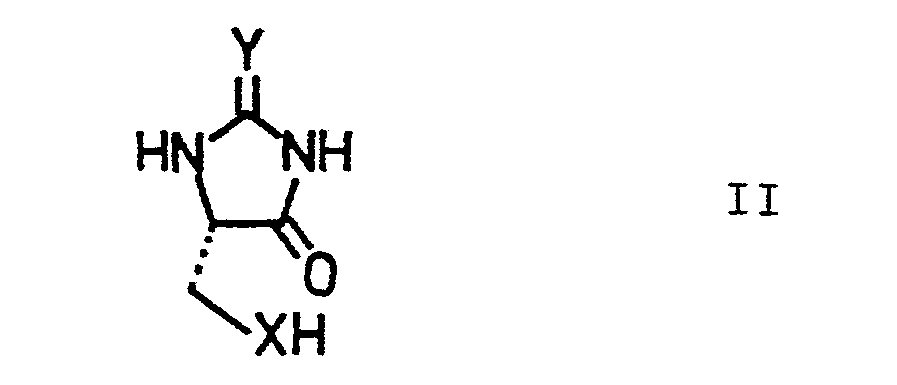

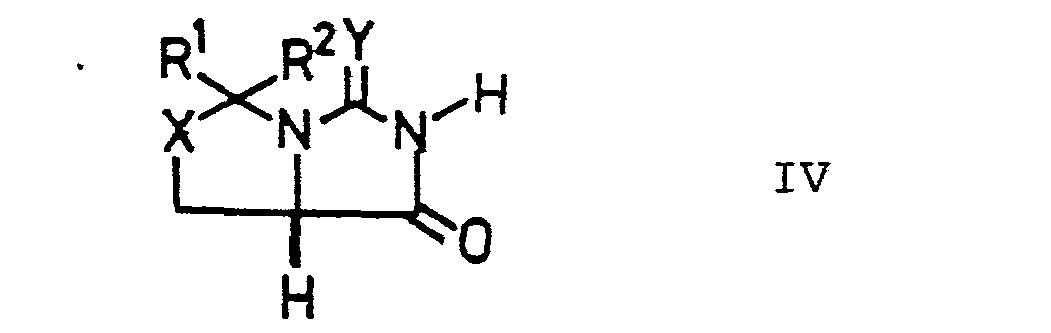




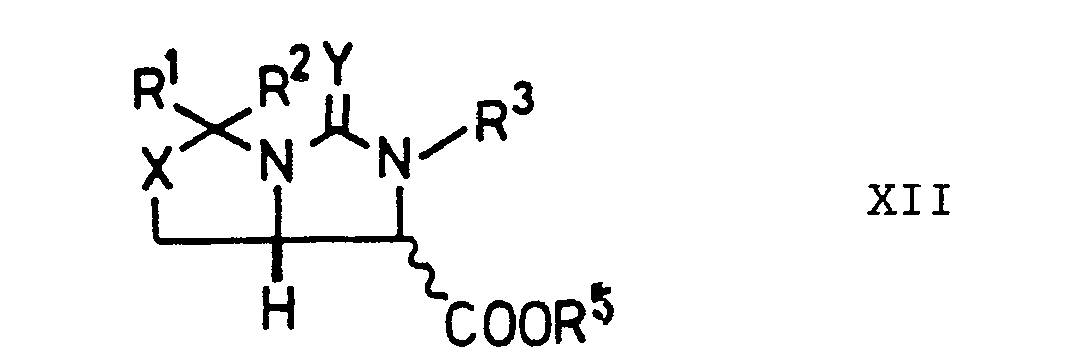

oder indem

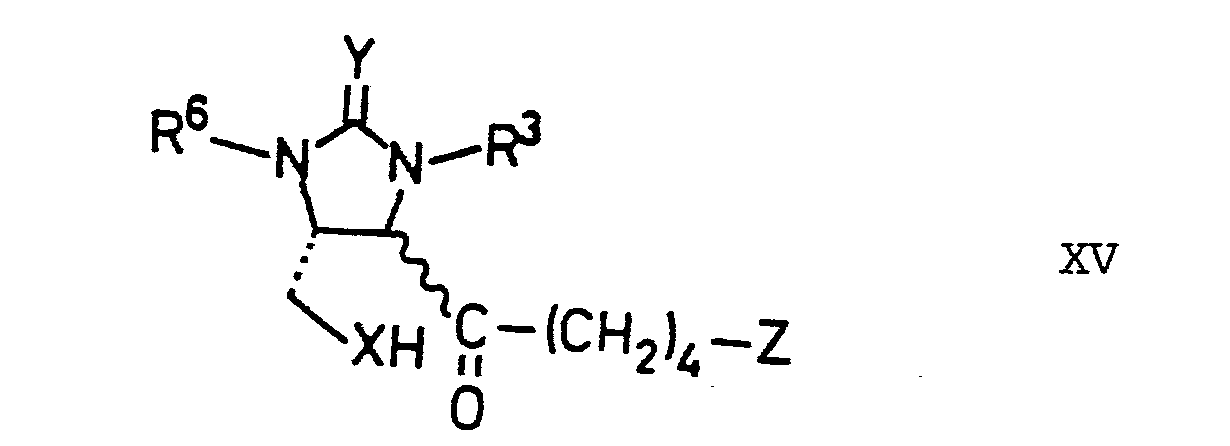

oder indem


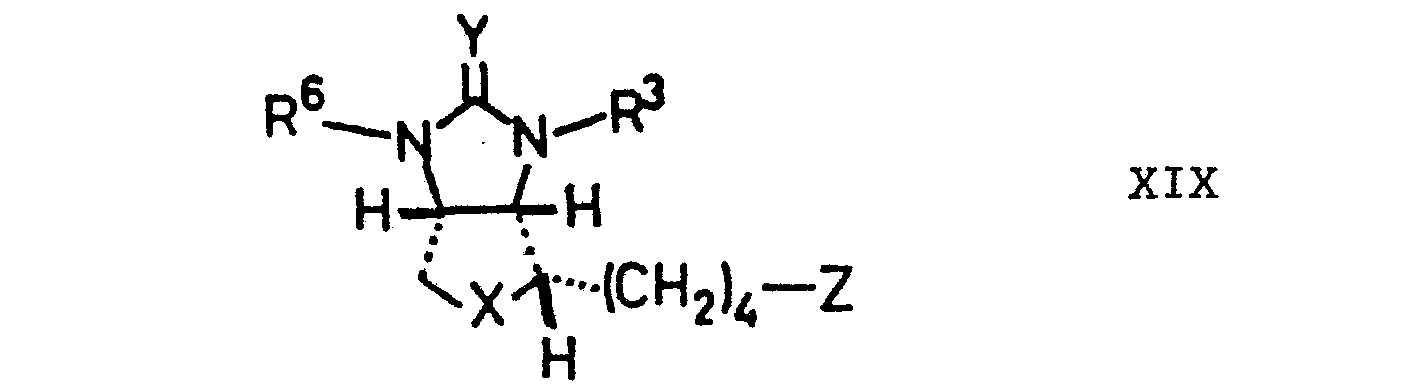
oder indem
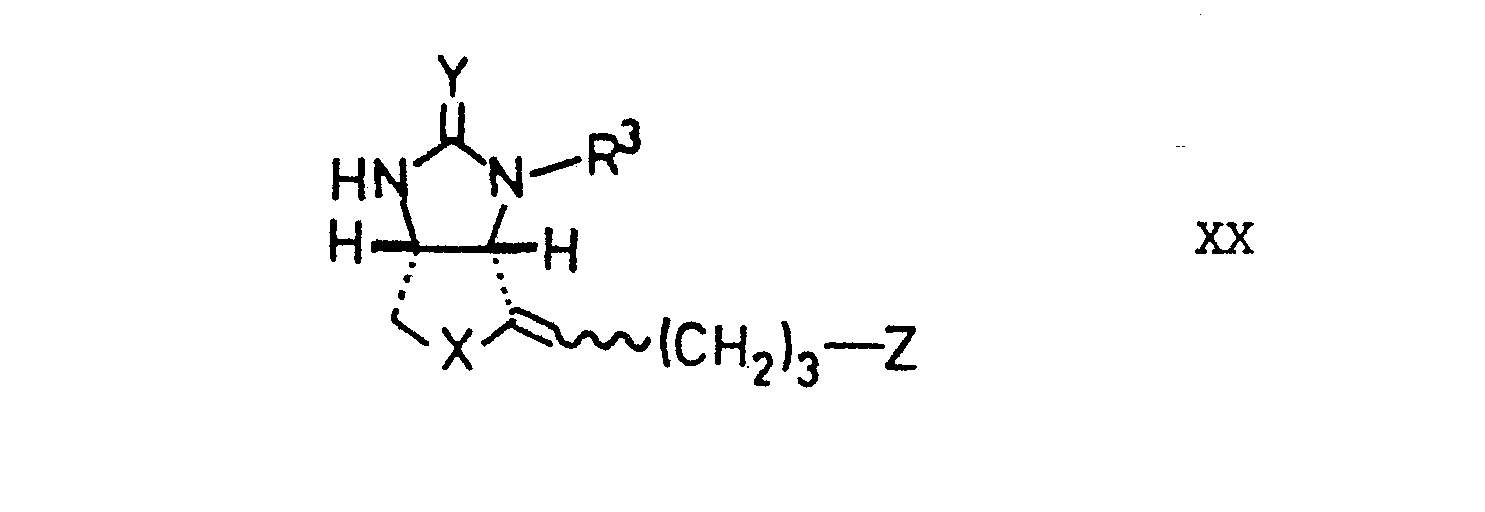
or by
or by
or by


Applications Claiming Priority (4)
| Application Number | Priority Date | Filing Date | Title |
|---|---|---|---|
| DE19863613245 DE3613245A1 (en) | 1986-04-19 | 1986-04-19 | Process for the preparation of D-(+)-biotin |
| DE3613245 | 1986-04-19 | ||
| DE19873703872 DE3703872A1 (en) | 1987-02-07 | 1987-02-07 | Process for the preparation of D-(+)-biotin |
| DE3703872 | 1987-02-07 |
Publications (3)
| Publication Number | Publication Date |
|---|---|
| EP0242686A2 true EP0242686A2 (en) | 1987-10-28 |
| EP0242686A3 EP0242686A3 (en) | 1989-02-08 |
| EP0242686B1 EP0242686B1 (en) | 1992-01-29 |
Family
ID=25843038
Family Applications (1)
| Application Number | Title | Priority Date | Filing Date |
|---|---|---|---|
| EP87105054A Expired - Lifetime EP0242686B1 (en) | 1986-04-19 | 1987-04-06 | Process for the preparation of d-(+)-biotine |
Country Status (4)
| Country | Link |
|---|---|
| US (5) | US4732987A (en) |
| EP (1) | EP0242686B1 (en) |
| JP (2) | JP2537049B2 (en) |
| DE (1) | DE3776385D1 (en) |
Cited By (6)
| Publication number | Priority date | Publication date | Assignee | Title |
|---|---|---|---|---|
| WO1991002734A1 (en) * | 1989-08-12 | 1991-03-07 | MERCK Patent Gesellschaft mit beschränkter Haftung | Process for preparing d-(+)-biotin |
| EP0415166A3 (en) * | 1989-08-26 | 1991-10-16 | Merck Patent Gesellschaft Mit Beschraenkter Haftung | Process for the preparation of cyanohydantoines |
| EP0469432A1 (en) * | 1990-08-03 | 1992-02-05 | MERCK PATENT GmbH | Process for the production of cyanohydantoines |
| EP0502392A1 (en) * | 1991-03-06 | 1992-09-09 | MERCK PATENT GmbH | Process for the preparation of D-(+)-biotin and intermediates in this process |
| EP0513700A1 (en) * | 1991-05-17 | 1992-11-19 | MERCK PATENT GmbH | Process for the preparation of imidazothiazolone derivates |
| WO2003048131A1 (en) | 2001-12-04 | 2003-06-12 | Tanabe Seiyaku Co., Ltd. | Intermediate for biotin and process for producing the same |
Families Citing this family (15)
| Publication number | Priority date | Publication date | Assignee | Title |
|---|---|---|---|---|
| FI935609L (en) * | 1992-12-18 | 1994-06-19 | Lonza Ag | Asymmetric hydrogenation of dihydrofuroimidazole derivatives |
| ZA966885B (en) * | 1995-08-22 | 1998-02-16 | Du Pont Merck Pharma | Substituted cyclic ureas and derivatives thereof useful as retroviral protease inhibitors. |
| ATE326471T1 (en) * | 2000-12-27 | 2006-06-15 | Council Scient Ind Res | NEW SUBSTITUTED 2-(6-BENZYL-5-OXO-3-PHENYL-(S3,7S,7AR)-PERHYDRO MIDAZOLE-(1,5-C)(1,3)-THIAZOLE-7-YL COMPOUNDS |
| US20050159602A1 (en) * | 2004-01-16 | 2005-07-21 | Labeltek Inc. | Method for synthesizing chiral bicyclic thiazolidine hydantoin |
| CN102250113B (en) * | 2010-02-09 | 2014-09-03 | 浙江新和成股份有限公司 | Preparation method of d-biotin |
| CN103788112B (en) * | 2012-11-02 | 2016-03-09 | 菏泽市方明制药有限公司 | A kind of benzyl vitamin H takes off the method that benzyl prepares vitamin H |
| CN103242342B (en) * | 2013-04-27 | 2015-09-16 | 浙江新和成股份有限公司 | The preparation method of 1,3-alkyl tetrahydro thieno-[3,4-d] imidazoles-2 (3H)-4-dione compounds |
| CN104277054B (en) * | 2013-07-03 | 2016-08-10 | 浙江新和成股份有限公司 | The preparation method of 7-alkoxyl-3-phenyl imidazolidine also [1,5-c] thiazole-5 (1H)-one compound |
| CN105418634B (en) * | 2015-12-10 | 2018-07-10 | 蚌埠丰原医药科技发展有限公司 | The preparation method of biotin intermediate impurity |
| CN106555206B (en) * | 2016-11-23 | 2018-07-06 | 浙江新和成药业有限公司 | A kind of preparation method using electrolytic cell synthesis D-biotin intermediate |
| CN110506045B (en) | 2017-04-12 | 2023-01-13 | 帝斯曼知识产权资产管理有限公司 | Process for preparing imidazothiazolone compounds |
| WO2022257152A1 (en) * | 2021-06-11 | 2022-12-15 | Dsm Ip Assets B.V. | Process for producing biotin intermediate |
| WO2022257151A1 (en) * | 2021-06-11 | 2022-12-15 | Dsm Ip Assets B.V. | Process for producing biotin intermediate |
| CN116396306A (en) * | 2023-04-13 | 2023-07-07 | 华东理工大学 | A kind of preparation method of D-biotin key intermediate thiolactone |
| WO2024250224A1 (en) * | 2023-06-08 | 2024-12-12 | Dsm Ip Assets B.V. | A process for producing a biotin intermediate |
Family Cites Families (5)
| Publication number | Priority date | Publication date | Assignee | Title |
|---|---|---|---|---|
| US4009172A (en) * | 1975-05-02 | 1977-02-22 | Hoffmann-La Roche Inc. | 2,3,3A,6,7,7A-Hexahydro-thieno[3,2-b]pyridin-(4H)5-ones |
| US4468516A (en) * | 1982-05-17 | 1984-08-28 | Pfizer Inc. | Process for the preparation of biotin |
| US4772717A (en) * | 1982-05-17 | 1988-09-20 | Pfizer Inc. | Novel process for the preparation of biotin |
| WO2010134215A1 (en) | 2009-05-19 | 2010-11-25 | デロテコム株式会社 | Collapsible container |
| JP5516435B2 (en) | 2011-01-19 | 2014-06-11 | 三菱電機株式会社 | Method for manufacturing thin film solar cell |
-
1987
- 1987-04-06 DE DE8787105054T patent/DE3776385D1/en not_active Expired - Fee Related
- 1987-04-06 EP EP87105054A patent/EP0242686B1/en not_active Expired - Lifetime
- 1987-04-17 US US07/039,342 patent/US4732987A/en not_active Expired - Lifetime
- 1987-04-17 JP JP62093464A patent/JP2537049B2/en not_active Expired - Fee Related
-
1988
- 1988-01-06 US US07/141,161 patent/US4837402A/en not_active Expired - Lifetime
- 1988-10-05 US US07/253,995 patent/US4877882A/en not_active Expired - Lifetime
-
1989
- 1989-10-17 US US07/422,828 patent/US4937351A/en not_active Expired - Lifetime
-
1990
- 1990-04-13 US US07/508,747 patent/US5095118A/en not_active Expired - Lifetime
-
1996
- 1996-01-11 JP JP8042236A patent/JP2762068B2/en not_active Expired - Fee Related
Cited By (11)
| Publication number | Priority date | Publication date | Assignee | Title |
|---|---|---|---|---|
| WO1991002734A1 (en) * | 1989-08-12 | 1991-03-07 | MERCK Patent Gesellschaft mit beschränkter Haftung | Process for preparing d-(+)-biotin |
| US5250699A (en) * | 1989-08-12 | 1993-10-05 | Merck Patent Gesellschaft Mit Beschrankter Haftung | 2-oxo-5-mercaptomethylimidazolidine-4-ols |
| EP0415166A3 (en) * | 1989-08-26 | 1991-10-16 | Merck Patent Gesellschaft Mit Beschraenkter Haftung | Process for the preparation of cyanohydantoines |
| EP0469432A1 (en) * | 1990-08-03 | 1992-02-05 | MERCK PATENT GmbH | Process for the production of cyanohydantoines |
| EP0502392A1 (en) * | 1991-03-06 | 1992-09-09 | MERCK PATENT GmbH | Process for the preparation of D-(+)-biotin and intermediates in this process |
| EP0513700A1 (en) * | 1991-05-17 | 1992-11-19 | MERCK PATENT GmbH | Process for the preparation of imidazothiazolone derivates |
| US5233045A (en) * | 1991-05-17 | 1993-08-03 | Merck Patent Gesellschaft Mit Beschrankter Haftung | Process for the preparation of imidazothiazolone derivatives |
| WO2003048131A1 (en) | 2001-12-04 | 2003-06-12 | Tanabe Seiyaku Co., Ltd. | Intermediate for biotin and process for producing the same |
| EP1462444A4 (en) * | 2001-12-04 | 2006-10-11 | Tanabe Seiyaku Co | INTERMEDIATE FOR BIOTIN AND PROCESS FOR PRODUCING THE SAME |
| US7335778B2 (en) | 2001-12-04 | 2008-02-26 | Tanabe Seiyaku Co., Ltd. | Intermediate for biotin and process for producing the same |
| US7799929B2 (en) | 2001-12-04 | 2010-09-21 | Tanabe Seiyaku Co., Ltd. | Biotin intermediate and process for preparing the same |
Also Published As
| Publication number | Publication date |
|---|---|
| EP0242686A3 (en) | 1989-02-08 |
| DE3776385D1 (en) | 1992-03-12 |
| US4937351A (en) | 1990-06-26 |
| JP2762068B2 (en) | 1998-06-04 |
| US4732987A (en) | 1988-03-22 |
| JP2537049B2 (en) | 1996-09-25 |
| JPS62255496A (en) | 1987-11-07 |
| EP0242686B1 (en) | 1992-01-29 |
| US4837402A (en) | 1989-06-06 |
| JPH08231553A (en) | 1996-09-10 |
| US5095118A (en) | 1992-03-10 |
| US4877882A (en) | 1989-10-31 |
Similar Documents
| Publication | Publication Date | Title |
|---|---|---|
| EP0242686B1 (en) | Process for the preparation of d-(+)-biotine | |
| EP0273270B1 (en) | Process for the preparation of (+)-biotin | |
| DE2658806A1 (en) | CYCLIC DERIVATIVES OF 1,4-BENZOXAZINE AND 1,4-BENZOTHIAZINE, THE PROCESS FOR THEIR MANUFACTURING AND THE PHARMACEUTICAL PRODUCT CONTAINING THEY | |
| DE2833888A1 (en) | THIOPHEN DERIVATES, THEIR PRODUCTION AND USE | |
| EP0270076A1 (en) | Imidazole derivatives and a process for their preparation | |
| EP0161580B1 (en) | Process for the preparation of a lacton | |
| US5274107A (en) | Process for synthesis of D(+) biotin | |
| EP0243734B1 (en) | Optically active hydantoin | |
| DE3703872A1 (en) | Process for the preparation of D-(+)-biotin | |
| DE3613245A1 (en) | Process for the preparation of D-(+)-biotin | |
| DE3926690A1 (en) | PROCESS FOR PREPARING D - (+) - BIOTIN | |
| EP0173185B1 (en) | Process for the preparation of (3a5,6ar)-and/or(3ar,6as)-1,3-dibenzyl-hexahydro-1h-furo(3,4-d)imidazole-2,4-dione | |
| DE69714980T2 (en) | ISOXAZOLIDINE DERIVATIVES | |
| DE2305078A1 (en) | NEW OXABICYCLOOCTANES AND THE PROCESS FOR THEIR PRODUCTION | |
| DE3703871A1 (en) | Optically active hydantoins | |
| DE3613246A1 (en) | Optically active hydantoins | |
| DE69127846T2 (en) | Stereoselective process for the preparation of 2-aminoethanol derivatives with central analgesic activity and intermediates | |
| DE3906174A1 (en) | PROCESS FOR THE PREPARATION OF D-MANNOSAMINE DERIVATIVES | |
| DE4024692A1 (en) | METHOD FOR PRODUCING CYANHYDANTOINES | |
| EP0415166B1 (en) | Process for the preparation of cyanohydantoines | |
| CH658649A5 (en) | (3RS, 4SR) -BENZYL-4- (CYANOMETHYL) -3- (1'-HYDROXYAETHYL) -2-AZETIDINONE. | |
| DE2934342C2 (en) | ||
| EP0486806B1 (en) | Process for the preparation of racemic pilosinine derivatives | |
| DD255159A5 (en) | METHOD FOR THE PRODUCTION OF OPTICALLY ACTIVE ACYLOXYAZETIDIENES | |
| CH661269A5 (en) | HETEROCYCLIC ACETIC ACID ESTERS. |
Legal Events
| Date | Code | Title | Description |
|---|---|---|---|
| PUAI | Public reference made under article 153(3) epc to a published international application that has entered the european phase |
Free format text: ORIGINAL CODE: 0009012 |
|
| AK | Designated contracting states |
Kind code of ref document: A2 Designated state(s): CH DE FR GB IT LI |
|
| PUAL | Search report despatched |
Free format text: ORIGINAL CODE: 0009013 |
|
| AK | Designated contracting states |
Kind code of ref document: A3 Designated state(s): CH DE FR GB IT LI |
|
| 17P | Request for examination filed |
Effective date: 19890603 |
|
| 17Q | First examination report despatched |
Effective date: 19890828 |
|
| ITF | It: translation for a ep patent filed | ||
| GRAA | (expected) grant |
Free format text: ORIGINAL CODE: 0009210 |
|
| AK | Designated contracting states |
Kind code of ref document: B1 Designated state(s): CH DE FR GB IT LI |
|
| GBT | Gb: translation of ep patent filed (gb section 77(6)(a)/1977) | ||
| REF | Corresponds to: |
Ref document number: 3776385 Country of ref document: DE Date of ref document: 19920312 |
|
| ET | Fr: translation filed | ||
| PLBE | No opposition filed within time limit |
Free format text: ORIGINAL CODE: 0009261 |
|
| STAA | Information on the status of an ep patent application or granted ep patent |
Free format text: STATUS: NO OPPOSITION FILED WITHIN TIME LIMIT |
|
| 26N | No opposition filed | ||
| REG | Reference to a national code |
Ref country code: GB Ref legal event code: IF02 |
|
| PGFP | Annual fee paid to national office [announced via postgrant information from national office to epo] |
Ref country code: GB Payment date: 20040331 Year of fee payment: 18 |
|
| PGFP | Annual fee paid to national office [announced via postgrant information from national office to epo] |
Ref country code: FR Payment date: 20040408 Year of fee payment: 18 |
|
| PGFP | Annual fee paid to national office [announced via postgrant information from national office to epo] |
Ref country code: DE Payment date: 20040415 Year of fee payment: 18 |
|
| PGFP | Annual fee paid to national office [announced via postgrant information from national office to epo] |
Ref country code: CH Payment date: 20040416 Year of fee payment: 18 |
|
| PG25 | Lapsed in a contracting state [announced via postgrant information from national office to epo] |
Ref country code: IT Free format text: LAPSE BECAUSE OF NON-PAYMENT OF DUE FEES;WARNING: LAPSES OF ITALIAN PATENTS WITH EFFECTIVE DATE BEFORE 2007 MAY HAVE OCCURRED AT ANY TIME BEFORE 2007. THE CORRECT EFFECTIVE DATE MAY BE DIFFERENT FROM THE ONE RECORDED. Effective date: 20050406 Ref country code: GB Free format text: LAPSE BECAUSE OF NON-PAYMENT OF DUE FEES Effective date: 20050406 |
|
| PG25 | Lapsed in a contracting state [announced via postgrant information from national office to epo] |
Ref country code: LI Free format text: LAPSE BECAUSE OF NON-PAYMENT OF DUE FEES Effective date: 20050430 Ref country code: CH Free format text: LAPSE BECAUSE OF NON-PAYMENT OF DUE FEES Effective date: 20050430 |
|
| PG25 | Lapsed in a contracting state [announced via postgrant information from national office to epo] |
Ref country code: DE Free format text: LAPSE BECAUSE OF NON-PAYMENT OF DUE FEES Effective date: 20051101 |
|
| REG | Reference to a national code |
Ref country code: CH Ref legal event code: PL |
|
| GBPC | Gb: european patent ceased through non-payment of renewal fee |
Effective date: 20050406 |
|
| PG25 | Lapsed in a contracting state [announced via postgrant information from national office to epo] |
Ref country code: FR Free format text: LAPSE BECAUSE OF NON-PAYMENT OF DUE FEES Effective date: 20051230 |
|
| REG | Reference to a national code |
Ref country code: FR Ref legal event code: ST Effective date: 20051230 |